EP0774793A1 - Alkaline storage battery and method for producing positive electrode thereof - Google Patents
Alkaline storage battery and method for producing positive electrode thereof Download PDFInfo
- Publication number
- EP0774793A1 EP0774793A1 EP96308260A EP96308260A EP0774793A1 EP 0774793 A1 EP0774793 A1 EP 0774793A1 EP 96308260 A EP96308260 A EP 96308260A EP 96308260 A EP96308260 A EP 96308260A EP 0774793 A1 EP0774793 A1 EP 0774793A1
- Authority
- EP
- European Patent Office
- Prior art keywords
- compound oxide
- nickel hydroxide
- positive electrode
- metal element
- hydroxide
- Prior art date
- Legal status (The legal status is an assumption and is not a legal conclusion. Google has not performed a legal analysis and makes no representation as to the accuracy of the status listed.)
- Granted
Links
Images



Classifications
-
- H—ELECTRICITY
- H01—ELECTRIC ELEMENTS
- H01M—PROCESSES OR MEANS, e.g. BATTERIES, FOR THE DIRECT CONVERSION OF CHEMICAL ENERGY INTO ELECTRICAL ENERGY
- H01M4/00—Electrodes
- H01M4/02—Electrodes composed of, or comprising, active material
- H01M4/62—Selection of inactive substances as ingredients for active masses, e.g. binders, fillers
- H01M4/624—Electric conductive fillers
-
- H—ELECTRICITY
- H01—ELECTRIC ELEMENTS
- H01M—PROCESSES OR MEANS, e.g. BATTERIES, FOR THE DIRECT CONVERSION OF CHEMICAL ENERGY INTO ELECTRICAL ENERGY
- H01M10/00—Secondary cells; Manufacture thereof
- H01M10/05—Accumulators with non-aqueous electrolyte
- H01M10/056—Accumulators with non-aqueous electrolyte characterised by the materials used as electrolytes, e.g. mixed inorganic/organic electrolytes
- H01M10/0564—Accumulators with non-aqueous electrolyte characterised by the materials used as electrolytes, e.g. mixed inorganic/organic electrolytes the electrolyte being constituted of organic materials only
- H01M10/0566—Liquid materials
- H01M10/0567—Liquid materials characterised by the additives
-
- H—ELECTRICITY
- H01—ELECTRIC ELEMENTS
- H01M—PROCESSES OR MEANS, e.g. BATTERIES, FOR THE DIRECT CONVERSION OF CHEMICAL ENERGY INTO ELECTRICAL ENERGY
- H01M10/00—Secondary cells; Manufacture thereof
- H01M10/42—Methods or arrangements for servicing or maintenance of secondary cells or secondary half-cells
- H01M10/4235—Safety or regulating additives or arrangements in electrodes, separators or electrolyte
-
- H—ELECTRICITY
- H01—ELECTRIC ELEMENTS
- H01M—PROCESSES OR MEANS, e.g. BATTERIES, FOR THE DIRECT CONVERSION OF CHEMICAL ENERGY INTO ELECTRICAL ENERGY
- H01M4/00—Electrodes
- H01M4/02—Electrodes composed of, or comprising, active material
- H01M4/36—Selection of substances as active materials, active masses, active liquids
- H01M4/48—Selection of substances as active materials, active masses, active liquids of inorganic oxides or hydroxides
- H01M4/52—Selection of substances as active materials, active masses, active liquids of inorganic oxides or hydroxides of nickel, cobalt or iron
-
- H—ELECTRICITY
- H01—ELECTRIC ELEMENTS
- H01M—PROCESSES OR MEANS, e.g. BATTERIES, FOR THE DIRECT CONVERSION OF CHEMICAL ENERGY INTO ELECTRICAL ENERGY
- H01M2200/00—Safety devices for primary or secondary batteries
-
- H—ELECTRICITY
- H01—ELECTRIC ELEMENTS
- H01M—PROCESSES OR MEANS, e.g. BATTERIES, FOR THE DIRECT CONVERSION OF CHEMICAL ENERGY INTO ELECTRICAL ENERGY
- H01M6/00—Primary cells; Manufacture thereof
- H01M6/14—Cells with non-aqueous electrolyte
- H01M6/16—Cells with non-aqueous electrolyte with organic electrolyte
- H01M6/162—Cells with non-aqueous electrolyte with organic electrolyte characterised by the electrolyte
- H01M6/164—Cells with non-aqueous electrolyte with organic electrolyte characterised by the electrolyte by the solvent
-
- H—ELECTRICITY
- H01—ELECTRIC ELEMENTS
- H01M—PROCESSES OR MEANS, e.g. BATTERIES, FOR THE DIRECT CONVERSION OF CHEMICAL ENERGY INTO ELECTRICAL ENERGY
- H01M6/00—Primary cells; Manufacture thereof
- H01M6/14—Cells with non-aqueous electrolyte
- H01M6/16—Cells with non-aqueous electrolyte with organic electrolyte
- H01M6/162—Cells with non-aqueous electrolyte with organic electrolyte characterised by the electrolyte
- H01M6/168—Cells with non-aqueous electrolyte with organic electrolyte characterised by the electrolyte by additives
-
- Y—GENERAL TAGGING OF NEW TECHNOLOGICAL DEVELOPMENTS; GENERAL TAGGING OF CROSS-SECTIONAL TECHNOLOGIES SPANNING OVER SEVERAL SECTIONS OF THE IPC; TECHNICAL SUBJECTS COVERED BY FORMER USPC CROSS-REFERENCE ART COLLECTIONS [XRACs] AND DIGESTS
- Y02—TECHNOLOGIES OR APPLICATIONS FOR MITIGATION OR ADAPTATION AGAINST CLIMATE CHANGE
- Y02E—REDUCTION OF GREENHOUSE GAS [GHG] EMISSIONS, RELATED TO ENERGY GENERATION, TRANSMISSION OR DISTRIBUTION
- Y02E60/00—Enabling technologies; Technologies with a potential or indirect contribution to GHG emissions mitigation
- Y02E60/10—Energy storage using batteries
Definitions
- the present invention relates to alkaline storage batteries and nickel positive electrodes in the alkaline storage batteries, and more particularly to a paste-type nickel positive electrode suitable for a nickel-cadmium storage battery, a nickel-metal hydride storage battery, and a nickel-zinc storage battery and a method for producing the positive electrode thereof.
- Alkaline storage batteries such as nickel-cadmium storage batteries and nickel-metal hydride storage batteries are highly reliable and capable of being miniaturized. For these advantages, they are used both as the power sources of portable appliances and industrial power sources, depending on their sizes. In this type of alkaline storage batteries, sintered-type or paste-type nickel electrodes are used.
- a paste-type nickel positive electrode is manufactured as follows. Firstly, a nickel hydroxide powder synthesized by mixing a sodium hydroxide aqueous solution and an aqueous solution containing a nickel salt as its main component. Thus obtained nickel hydroxide powder is mixed with a cobalt powder, a cadmium powder, or another such powder. Then, a binder and water are added to and mixed with the mixture to obtain a paste. Finally, the paste is applied to a porous substrate so as to obtain a nickel positive electrode. The paste-type nickel electrode thus manufactured has a higher energy density than the sintered-type nickel electrode.
- the electric conductivity of nickel hydroxide acting as an active material is as low as about 10 -14 S/cm when the valence of nickel is 2. However, it can be 10 -2 S/cm or higher when the valence of nickel becomes larger through oxidation.
- the electrochemical oxidation of nickel in nickel hydroxide from divalence to trivalence can be achieved with comparative ease.
- the electrochemical reduction from trivalence to divalence is very difficult because the electric conductivity of nickel hydroxide suddenly drops when the valence of nickel becomes 2.2 or lower. Consequently, the upper limit of the utilization rate of nickel hydroxide is about 80%.
- metallic cobalt or a cobalt compound such as cobalt hydroxide and cobalt oxide is added to the positive electrode, and as a result, the utilization rate is raised to nearly 100%.
- the reason for the increase in the utilization rate is that the metallic cobalt or the cobalt compound is converted during charge of a battery, through oxidation, into cobalt oxyhydroxide, which is conductive high-order oxide, forming a conductive network.
- the cobalt oxyhydroxide which is conductive and in a high-order oxidation state, is converted into a cobalt compound having divalent cobalt, which is soluble in the electrolyte.
- the cobalt in the nickel positive electrode is either reduced in amount or localized. This reduction or localization of cobalt decreases the electric conductivity among nickel hydroxide active material particles, thereby deteriorating the utilization rate of the nickel hydroxide.
- a conductive agent such as metallic nickel powder or a carbon powder which is stable in an alkaline electrolyte and has a high conductivity, may be added to the positive electrode.
- a conductive agent such as metallic nickel powder or a carbon powder which is stable in an alkaline electrolyte and has a high conductivity
- the present invention provides an alkaline storage battery comprising a positive electrode, a negative electrode and an electrolyte of an alkaline aqueous solution, wherein the positive electrode contains nickel hydroxide as an active material and a compound oxide having an electric conductivity of not less than 10 -2 S/cm at 25 °C and a stability against the alkaline aqueous solution, the positive electrode containing the compound oxide by 2-30 wt% to the amount of the nickel hydroxide.
- the present invention further provides an alkaline storage battery comprising a positive electrode, a negative electrode and an electrolyte of an alkaline aqueous solution, wherein the positive electrode contains nickel hydroxide as an active material and a compound oxide by 2-30 wt% to the amount of the nickel hydroxide, the compound oxide containing at least one transition metal element, and at least either a rare earth element or an alkaline earth metal element.
- the compound oxide further contains an alkali metal element.
- the present invention further provides an alkaline storage battery comprising a positive electrode, a negative electrode and an electrolyte of an alkaline aqueous solution, wherein the positive electrode contains nickel hydroxide as an active material and a compound oxide containing at least one transition metal element and at least one alkali metal element by 2-30 wt% to the amount of the nickel hydroxide.
- the compound oxide is a powder having an average particle diameter of not larger than 5 ⁇ m. It is further preferable that the compound oxide is an aggregate or a sintered body, and has a columnar shape or fibrous shape.
- a method for producing a positive electrode of an alkaline storage battery of the present invention comprises the steps of:
- Another method for producing a positive electrode of an alkaline storage battery in the present invention comprises the steps of:
- the method further comprises the step of coating the nickel hydroxide with the oxide or the hydroxide of the transition metal element before the dipping step.
- the hydrothermal reaction can be conducted after forming a layer of such element on the nickel hydroxide.
- Another method for producing a positive electrode of an alkaline storage battery of the present invention comprises the steps of:
- Another method for producing a positive electrode of an alkaline storage battery of the present invention comprises the steps of:
- Another method for producing a positive electrode of an alkaline storage battery of the present invention comprises the steps of:
- Another method for producing a positive electrode of an alkaline storage battery of the present invention comprises the steps of:
- Another method for producing a positive electrode of an alkaline storage battery of the present invention comprises the steps of:
- Another method for producing a positive electrode of an alkaline storage battery of the present invention comprises the steps of:
- the positive electrode in the alkaline storage battery of the present invention is composed of a conductive substrate and a mixture of nickel hydroxide acting as an active material and a compound oxide.
- the substrate can be made from foamed metal, punching metal, a metal sheet, or a member having a three-dimensional space such as metal fiber felt.
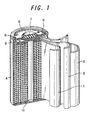
- FIG. 1 is a longitudinal cross-sectional view of the cylindrical alkaline storage battery of the embodiment of the present invention.
- FIG. 2 is a graph showing the relation between the amount of compound oxide added and the utilization rate of the positive electrode active material in the alkaline storage battery during a discharge process of 1 C at 20 °C.
- FIG. 3 is a graph showing the relation between the average particle diameter of compound oxide and the utilization rate of the positive electrode active material in the alkaline storage battery during a discharge process of 1 C at 20 °C.
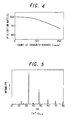
- FIG. 4 is a graph showing the relation between the charge/discharge cycles with 1 C at 45 °C and the capacity preservation rate of the alkaline storage battery.
- FIG. 5 shows an X ray diffraction pattern of a compound oxide CaTiO 3-x which has a perovskite crystal structure.
- FIG. 6 shows an X ray diffraction pattern of a compound oxide La y Sr 1-y CoO 3-x (y ⁇ 0.5) which has the perovskite crystal structure.
- FIG. 7 shows an X ray diffraction pattern of a compound oxide La y Ca 1-y MnO 3-x (y ⁇ 0.8) which has the perovskite crystal stricture.
- FIG. 8 shows an X ray diffraction pattern of a compound oxide YBa 2 CU 3 O 7 which has the perovskite crystal structure.
- FIG. 9a shows a model which has an A-type perovskite crystal structure.
- FIG. 9b shows a model which has a B-type perovskite crystal structure.
- FIG. 9c shows a relation of the A-type and the B-type.
- FIG. 10 shows an X ray diffraction pattern of a compound oxide of Na x CoO 2 (x ⁇ 0.8) which has a layer structure.
- FIG. 11 shows an X ray diffraction pattern of a compound oxide of Li x CoO 2 (x ⁇ 0.8) which has the layer structure.
- the x represents a defect amount of oxygen. Generally, the amount of oxygen in compound oxide is varied depending on its composition or synthesizing conditions, so that it shows a non-integer value. The difference between the value and an integer is indicated as the amount of defective.
- the compound oxide La 0.7 Sr 0.3 CoO 3-x was synthesized as follows.
- a metal salts aqueous solution was prepared by dissolving 131.5 g of lanthanum nitrate hexa hydrate Ln(NO 3 ) 3 .6H 2 O, 27.6 g of anhydrous strontium nitrate Sr(NO 3 ) 2 , and 126.3 g of cobalt nitrate hexa hydrate Co(NO 3 ) 2 .6H 2 O in 2 liter of water. Furthermore, an alkaline aqueous solution was prepared by dissolving 100 g of sodium hydroxide and 100 g of sodium carbonate in 1 liter of water.
- the precipitated mixture was filtered, dried, and pulverized into powder.
- the obtained powder was washed in water and preliminarily sintered in the air for three hours at a temperature of 600 °C. Then, the powder was washed in water again to remove sodium remained in the powder. The washing was continued until the pH of the washing water became 9 or lower, and then the powder was sintered in the air for three hours at 800 °C. Then, in order to subject the sintered powder to a full oxidation reaction, a process of pulverizing, mixing and sintering the sintered powder in the air for three hours at 800 °C was repeated two times. As the result, 100 g of the compound oxide La 0.7 Sr 0.3 CoO 3-x was synthesized. This synthesizing method is hereinafter referred to as the "solution synthesizing method".
- the compound oxide powder thus synthesized was mixed with a methyl cellulose powder by 1 wt% to the amount of the compound oxide powder, and pressed with a pressure of 2 t/cm 2 to form it into a disk shape pellet having a thickness of 5 mm and a diameter of 25 mm, using a metal mold.
- the pellet was cut and formed into a square prism with a length of about 20 mm and a cross section of 5 mm ⁇ 5 mm, and was used as a test piece.
- the electric conductivity of the test piece was measured at 25 °C by AC four-terminal method, and turned out to be about 10 S/cm.
- this compound oxide was hardly dissolved in a 31 wt% KOH aqueous solution.
- the average diameter of the primary particles of the compound oxide had been 1 ⁇ m or smaller (in a specific surface area of 10 to 20 m 2 /g), these primary particles were aggregated each other to form into secondary particles whose average diameter was 10 to 20 ⁇ m. These secondary particles were put in water and dispersed in a dispersion device with a high-rate dispersion blade until the average diameter of the particles became about 2 ⁇ m.
- Another compound oxide which has the same composition as the aforementioned compound oxide was synthesized as follows. Firstly, predetermined amounts of a lanthanum oxide powder, a strontium carbonate powder, and a tricobalt tetroxide powder were stirred and mixed. The mixture was kneaded with some water, dried, pulverized, and sintered in the air for three hours at 1,100 °C. The purpose of adding some water to the mixture is to fully mix the whole contents by dissolving water-soluble materials in the water. The sintering was executed at 1,100 °C because the compound reaction is hard to take place at a lower temperature.
- the compound oxide was mixed with a 1 wt% methyl cellulose powder and pressed with a pressure of 2 t/cm 2 , by using a cylindrical metal mold having a diameter of 2.5 cm, so as to form it into a pellet.
- the pellet was sintered in the air for twenty four hours at 1,200 °C, then pulverized, and classified.
- a positive electrode was manufactured as follows by using the compound oxide powder, La 0.7 Sr 0.3 CoO 3-x and an alkaline storage battery was manufactured by using the positive electrode.
- a predetermined amount of the compound oxide powder, La 0.7 Sr 0.3 CoO 3-x which had been synthesized by the solution synthesizing method was added to nickel hydroxide powder containing cobalt and zinc in a state of solid-solution (hereinafter referred to merely as nickel hydroxide powder), and fully stirred to mix. Then, this mixture was further mixed with a 1 wt% zinc oxide (ZnO) powder and some water to obtain a paste. The paste was applied to a foamed nickel sheet which had an average pore size of 150 ⁇ m, a porosity of 95%, and a thickness of 1.0 mm.
- the foamed nickel sheet with the paste was dried at 90 °C, pressed with a roller press to be 0.7 to 0.8 mm thick, and coated with a fluorocarbon resin powder.
- zinc oxide works to prevent the positive electrode from swelling during a charge/discharge process, thereby improving the cycle life characteristic of the alkaline storage battery.
- the foamed nickel sheet was cut into a size of a width of 3.5 cm and a length of 11 cm, and a lead was attached to a predetermined position. As the result, a positive electrode with a capacity of about 1,500 mAh was obtained.
- a negative electrode was manufactured as follows by using hydrogen storage alloy powder represented by the general formula of MmNi 3.55 CO 0.75 Mn 0.4 Al 0.3 .
- Mm is a misch metal synthesized of La, Ce, and the like.
- the hydrogen storage alloy powder having a particle diameter of 53 ⁇ m or smaller was soaked in a 31 wt% KOH alkaline aqueous solution of 80 °C for one hour so as to remove alkali-soluble elements in the alloy powder, and activate the alloy powder surface.
- the activation-processed alloy powder was mixed with a diluted carboxymethyl cellulose aqueous solution to form a paste.
- the paste was applied to a foamed nickel sheet which had an average pore size of 150 ⁇ m, a porosity of 95%, and a thickness of 1.0 mm. Then, the foamed nickel sheet with the paste was dried at 90 °C, pressed with a roller press to be 0.4 mm thick, and coated with a fluorocarbon resin powder. The foamed nickel sheet was cut into a size of a width of 3.5 cm and a length of 14.5 cm. As a result, a negative electrode was obtained.
- the alkaline storage battery shown in FIG. 1 was assembled as follows.
- the positive electrode 1 and the negative electrode 2 were stacked with a separator 3 disposed therebetween.
- the separator 3 was made from an unwoven fabric of polypropylene fiber whose surface had been subjected to a hydrophilic treatment.
- This stack was coiled up and put into a 4/5 A sized battery case 4 made of nickel plated steel.
- the battery case 4 was filled with 2.35 ml of an alkaline electrolyte which was synthesized of a potassium hydroxide aqueous solution having a specific gravity of 1.3 and 30 g/l lithium hydroxide dissolved therein.
- the battery case 4 was sealed with a sealing plate 5.
- the positive terminal cap 6 was welded to the sealing plate 5, and a gasket 8 was provided around the sealing plate 5.
- a safety valve 7 is disposed between the sealing plate 5 and the positive terminal cap 6 in a state of being compressed.
- the bottom surface of the sealing plate 5 is electrically connected with the positive electrode 1 via a connector 9.
- the negative electrode 2 is electrically connected with the bottom surface of the battery case 4 via another connector 10.
- the alkaline storage battery thus assembled was charged to 150% of the capacity at 0.1 C (10-hour rate, that is, for example, in a battery with 1,500 mAh, the electric current is 150 mA) at 20 °C and then discharged at 0.2 C until the battery voltage dropped to 1.0 V. After the completion of the discharge process, the battery was left for five days at 45 °C, and then subjected to a forming process. The forming process was performed by repeating to charge the battery to 120% of the capacity at 0.2 C at 45 °C and then to discharge it at 0.2 C until the battery voltage dropped to 1.0 V for 10 to 20 cycles. This battery is referred to as a test battery.
- the test battery was used to examine the relation between the amount of the compound oxide powder La 0.7 Sr 0.3 CoO 3-x added to the positive electrode and the utilization rate of the positive electrode active material during a charge/discharge process at 1 C at 20 °C.
- the compound oxide powder used here had been synthesized by the solution synthesizing method and then subjected to the high-rate dispersion process.
- Test batteries which employed positive electrodes containing compound oxide powder La 0.7 Sr 0.3 CoO 3-x in a range of 0 to 30 wt% were manufactured and subjected to the following tests.
- the test batteries were discharged at 0.2 C (0.3 A) to a cut-off voltage of 1.0 V at 20 °C, and charged at 1 C to 120% of the capacity, that is, for 1.2 hours. After having been left for one hour, the batteries were discharged at 1 C until the voltage decreased to 1.0 V, and the discharge capacity was measured. The results are shown in FIG. 2.
- the utilization rate of the positive electrode active material in a test battery that employed a positive electrode containing no compound oxide was about 70%. The utilization rate became higher as more amount of compound oxide was added to the positive electrode and reached it peak when the amount added was 15 wt%. When more amount of compound oxide was added, the utilization rate did not grow higher than 95%.
- the utilization rate continued to grow until the amount of compound oxide added reached 30 wt%.
- the more amount of compound oxide is added the higher the utilization rate of the positive electrode active material becomes.
- the theoretical capacity of a battery is determined by the amount of nickel hydroxide acting as a positive electrode active material.
- the amount of the compound oxide added is increased, the amount of nickel hydroxide is reduced, which leads to a drop in the battery capacity. Therefore, it is necessary to minimize the amount of the compound oxide added in order to secure the amount of the positive electrode active material.
- the preferable amount of the compound oxide to be added is in a range of 2 to 30 wt% of nickel hydroxide, and further preferably in a range of 5 to 15 wt%.
- the results of the evaluation are shown in FIG. 3.
- the utilization rate of the positive electrode active material decreases. This utilization rate is as high as 90 wt% when the average particle diameter is about 5 ⁇ m or smaller. However, it falls to 80 wt% when the average particle diameter is 10 ⁇ m or larger. Consequently, it has been revealed that the compound oxide powder with smaller particles can effectively increase the conductivity among the nickel hydroxide particles.
- the preferable average particle diameter of the compound oxide is 5 ⁇ m or smaller.
- test battery which employed the positive electrode containing the compound oxide powder D of 10 wt% of nickel hydroxide was subjected to a deep discharge test and a charge/discharge cycle life test under the following conditions.
- test battery was discharged at 0.2 C at 20 °C until the battery voltage decreased to 1.0 V, and then preserved for two months at 45 °C with a 1 k ⁇ external load connected to the electrodes.
- the discharge capacity in the charge/discharge test at 1 C at 20 °C was measured before and after the preservation.
- test battery was charged at 1 C to 120% of the capacity at 45 °C and then discharged at 1 C until the battery voltage decreased to 1.0 V. This charge/discharge cycle was repeated, and a decrease in the discharge capacity during the repeated cycles was measured.
- the capacity restoration rate of the test battery was as high as 92%.
- the capacity preservation rate was about 85 wt% as shown in FIG. 4 even after 200 cycles passed.
- Test batteries were manufactured by using different compound oxides which had been synthesized as follows, and these test batteries were evaluated in the same manner as in EXAMPLE 1. The compositions of the compound oxides were adjusted to the amount of the materials.
- An aqueous solution was prepared by dissolving predetermined amounts of lanthanum nitrate, calcium nitrate, and manganese nitrate in 2 liter of water. While stirring this aqueous solution, drops of another aqueous solution which contained 1 liter of water and 100 g of sodium hydroxide and 100 g of sodium carbonate dissolved in the water were added. As a result, a mixture of the constituent metal element hydroxide and carbonate was precipitated. The precipitated mixture was filtered, dried, pulverized, washed in water, and sintered in the air for three hours at 600 °C. Then, the sintered mixture was washed in water again to remove sodium remained in the mixture.
- the washing was continued until the pH of the washing water became 9 or lower, and then the mixture was sintered in the air for three hours at 900 °C. Then, in order to subject the sintered mixture to a full oxidation reaction, a process of pulverizing, mixing and sintering the mixture in the air for three hours at 900 °C was repeated two times. As the result, the compound oxide La 0.8 Ca 0.2 MnO 3-x was synthesized.
- An aqueous solution was prepared by dissolving predetermined amounts of lanthanum nitrate, cerium nitrate, and chrome nitrate in 2 liter of water. While stirring this aqueous solution, drops of another aqueous solution which contained 1 liter of water and 100 g of sodium hydroxide dissolved therein were added. As a result, a mixture of the constituent metal element hydroxides was precipitated. The precipitated mixture was filtered, dried, pulverized, washed in water, and sintered in the air for three hours at 600 °C. Then, the mixture was washed in water again to remove sodium remained in the mixture, and sintered in the air for three hours at 800 °C. Then, a process of pulverizing, mixing, and sintering the mixture in the air for three hours at 800 °C was repeated two times. As the result, the compound oxide La 0.8 Ce 0.2 CrO 3-x was synthesized.
- a metal salts aqueous solution was prepared by dissolving predetermined amounts of lanthanum nitrate, cerium nitrate, and nickel nitrate in 2 liter of water. While stirring this metal salts aqueous solution, drops of another aqueous solution which contained 1 liter of water and 100 g of sodium hydroxide dissolved therein were added. As a result, a mixture of the constituent metal element hydroxides was precipitated. The precipitated mixture was filtered, dried, pulverized, washed in water, and sintered in the air for three hours at 600 °C. Then, the mixture was washed in the water again to remove sodium remained in the mixture, and sintered in the air for three hours at 900 °C. Then, a process of pulverizing, mixing and sintering the mixture in the air for three hours at 900 °C was repeated two times. As the result, the compound oxide La 0.9 Ce 0.1 NiO 3-x was synthesized.
- a metal salts aqueous solution was prepared by dissolving predetermined amounts of neodymium nitrate, strontium nitrate, and iron nitrate in 2 liter of water. While stirring this metal salts aqueous solution, drops of another aqueous solution containing 100 g of sodium hydroxide and 100 g of sodium carbonate dissolved in 1 liter of water were added. As a result, a mixture of the constituent metal element hydroxides and carbonates was precipitated. The precipitated mixture was filtered, dried, pulverized, washed in water, and sintered in the air for three hours at 600 °C.
- the mixture was washed in water again to remove sodium remained in the mixture, and sintered in the air for three hours at 900 °C. Then, a process of pulverizing, mixing and sintering the mixture in the air for three hours at 900 °C was repeated two times. As the result, the compound oxide Nd 0.8 Sr 0.2 FeO 3-x was synthesized.
- Predetermined amounts of a Li 2 CO 3 powder and a CO 3 O 4 powder were mixed with some water.
- the mixture was pulverized, mixed and sintered in the air for three hours at 900 °C.
- a process of pulverizing, mixing and sintering the sintered mixture in the air for three hours at 900 °C was repeated three times.
- the compound oxide Li 0.8 COO 2-x was synthesized.
- Predetermined amounts of an Li 2 CO 3 powder and a TiO 2 powder were mixed with some water.
- the mixture was pulverized, mixed and sintered in the air for three hours at 1,000 °C.
- a process of pulverizing, mixing and sintering the sintered mixture in the air for three hours at 1,000 °C was repeated three times.
- the compound oxide Li 0.75 TiO 2-x was synthesized.
- a metal salts aqueous solution was prepared by dissolving predetermined amounts of yttrium nitrate, barium nitrate, and copper nitrate in 2 liter of water. While stirring this metal salts aqueous solution, drops of another aqueous solution which contained 1 liter of water and 200 g of guanidine carbonate dissolved therein were added. As a result, a mixture of the constituent metal element hydroxides and carbonates was precipitated. The precipitated mixture was filtered, dried, pulverized, and sintered in the air for three hours at 900 °C. Then, the mixture was pulverized, mixed and sintered in the air for three hours at 900 °C. As a result, the compound oxide YBa 2 CU 3 O 7-x was synthesized.
- organic bases such as potassium hydroxide, lithium hydroxide, ethlamine, butylamine, or guanidine can be used to obtain the same effect.
- an alkali carbonate or an alkali bromide can be used as well.
- a compound oxide La 0.7 Sr 0.3 Co 0.6 Fe 0.4 O 3-x was synthesized by the solution synthesizing method used in EXAMPLE 1.
- the compound oxide was subjected to the high-rate dispersion process and dried under a diminished pressure at low temperatures. Then, the dried compound oxide was put into an acrylic resin prepolymer aqueous solution and mixed well, thereby forming it into a paste having a high viscosity.
- the paste was pressed out a die through a number of nozzles having a diameter of 0.2 mm formed thereon, so as to shape the paste into a fiber and then heated to harden the prepolymer.
- the compound oxide-contained fiber was sintered for four hours under an atmosphere diminished pressure at 1,000 °C in order to remove an acrylic resin contained in the fiber, cooled, and again sintered in the air for six hours at 1,100 °C.
- a fibrous compound oxide La 0.7 Sr 0.3 Co 0.6 Fe 0.4 O 3-x having a diameter of 6 to 10 ⁇ m and a length of 0.1 to 0.3 mm was obtained.
- a positive electrode containing the fibrous compound oxide by 10 wt% to the amount of nickel hydroxide was manufactured in the same manner as EXAMPLE 1, and a test battery employing this positive electrode was manufactured and evaluated.
- the positive electrode further contained cobalt oxide (CoO) by 5 wt% and zinc oxide (ZnO) by 1 wt% to the amount of nickel hydroxide.
- cobalt oxide which is used in the present embodiment
- metallic cobalt or cobalt hydroxide can be used to obtain the same effects.
- the purpose of adding the metallic cobalt or the cobalt compounds is storing a discharge reserve (a discharge compensation capacity) in the negative electrode rather than improving the electric conductivity among nickel hydroxide particles. This can improve the low-temperature discharge characteristic of the test battery by a fewer number of a charge/discharge formation process.
- a positive electrode containing the fibrous compound oxide has excellent characteristics in the capacity restoration rate after the deep discharge and the high-temperature charge/discharge cycle life.
- a fibrous compound oxide was prepared by dispersing a compound oxide in a prepolymer, forming the dispersion into fiber, and sintering the fiber.
- the same fibrous compound oxide can be prepared by spreading compound oxide powder over the surface of resin fiber and sintering it to remove the resin fiber. Furthermore, it can also be prepared by separately spreading metal oxide over the fiber and sintering it.
- Another compound oxide was prepared by the hydrothermal synthesis method as follows.
- a powder obtained by oxidizing cobalt hydroxide in the air at 120 °C, predetermined amounts of a strontium hydroxide powder and a lanthanum oxide powder were mixed with a 20 wt% sodium hydroxide aqueous solution. After having stirred well, the mixture was heat-treated for 60 hours at 500 °C in a sealed vessel with heat- and pressure-resistance. As the result, a compound oxide La 0.7 Sr 0.3 Co 0.3 O 3-x having a specific surface area as large as 30 to 50 m 2 /g was synthesized.
- This compound oxide was also insoluble in a 31 wt% KOH aqueous solution of 20 °C.
- the electric conductivity of the compound oxide was measured in the same manner as in EXAMPLE 1 and turned out to be as high as 10 S/cm.
- a positive electrode containing this compound oxide by 10 wt% to the amount of the nickel hydroxide was manufactured.
- a test battery employing this positive electrode was manufactured and evaluated in the same manner as in EXAMPLE 1.
- the utilization rate of the positive electrode active material of this test battery in the 1 C charge/discharge test at 20 °C was about 93%, and the capacity restoration rate in the deep discharge test was 95%.
- the test battery showed a capacity preservation rate of over 90% in the charge/discharge cycle life test at 45 °C even after 200 cycles passed.
- the compound oxide was mixed with nickel hydroxide after having been synthesized.
- nickel hydroxide powder in a reaction vessel together with the materials of the compound oxide and then subjecting to the hydrothermal reaction.
- the reason for this is that since transition metal elements other than nickel are more stable than nickel in a high-order (greater than trivalence) oxidation state, the oxidation of the materials and the synthesization of the compound oxide are taken place preferentially.
- Another method for composing compound oxide is to form a transition metal oxide layer over the surface of a nickel hydroxide powder and then to convert it to compound oxide in the following manner.
- a nickel hydroxide powder was mixed with cobalt oxyhydroxide which had been obtained by oxidizing cobalt hydroxide in the air at 120 °C. As the result, a cobalt oxyhydroxide layer was formed over the surface of the nickel hydroxide powder.
- This powder was put into a 30 wt% NaOH aqueous solution and stirred to be mixed. The mixture was heat-treated for 60 hours at 300 °C in a sealed vessel with heat- and pressure-resistance. As the result, a layer of compound oxide Na x CoO 2 (x ⁇ 1) was formed over the surface of the nickel hydroxide.
- a positive electrode containing the nickel hydroxide thus obtained was manufactured, and a test battery employing this positive electrode was assembled and evaluated in the same manner as in EXAMPLE 1.
- the utilization rate of the positive electrode active material of this test battery in the 1 C charge/discharge test at 20 °C was about 92%, and the capacity restoration rate after the deep discharge was 97%.
- the test battery showed a capacity preservation rate of over 90% in the charge/discharge cycle life test at 45 °C even after 200 cycles passed.
- a nickel hydroxide powder was mixed with chromium oxide Cr 2 O 3 by 10 wt% to the amount of the nickel hydroxide, and as a result, a chromium oxide layer was formed over the surface of the nickel hydroxide powder.
- a positive electrode in which the nickel hydroxide powder had been applied to a foamed nickel sheet in the same manner as in EXAMPLE 1 was manufactured.
- the positive electrode was soaked in a 30 wt% nitrate aqueous solution which contained lanthanum and strontium in a ratio of 9:1.
- This nitrate aqueous solution also contained as much amount of a lanthanum oxide powder and a strontium carbonate powder in a ratio of 9:1 as remained undissolved in the solution.
- the purpose of adding these powders is to prevent the positive electrode from being corroded by nitrate ions which remained in the solution after the precipitation of lanthanum and strontium.
- the positive electrode was subjected to electrolytic oxidation by sending electric current, using a metallic nickel plate as the counter electrode.
- compound oxide La 1-a Sr a CrO 3-x was precipitated on the surface of nickel hydroxide.
- a test battery employing this positive electrode was assembled and evaluated in the same manner as EXAMPLE 1.
- the utilization rate of the positive electrode active material of this test battery in the 1 C charge/discharge test at 20 °C was about 91%, and the capacity restoration rate after the deep discharge was 96%.
- the test battery showed a capacity preservation rate of 87% in the charge/discharge cycle life test at 45 °C even after 200 cycles passed.
- Metallic nickel fiber having an average length of about 5 ⁇ m was soaked in a 1 mol/liter lanthanum nitrate aqueous solution, and heat-treated in the air for 15 minutes at 60 °C. After having repeated this process two more times, it was sintered in the air for 30 minutes at 800 °C. As the result, LaNiO 3-x was formed over the surface of the metallic nickel fiber.
- the same nickel hydroxide powder that was used in EXAMPLE 1 was mixed with the metallic nickel fiber of 10 wt% to the amount of the nickel hydroxide, and a positive electrode containing this mixture was manufactured.
- a test battery employing this positive electrode was assembled and evaluated in the same manner as in EXAMPLE 1.
- Co(OH) 2 of 5 wt% and ZnO by 2 wt% were added to the positive electrode.
- the battery showed a capacity preservation rate of over 90% in the 1 C charge/discharge cycle life test at 45 °C even after 200 cycles passed.
- the fibrous compound oxide can also be obtained by plating or coating a resinous fiber with a transition metal or the like, and executing the same process as for the metal fiber. In this case, the same effects as the metal fiber used in the present example can be obtained.
- the compound oxides used in the above examples are explained in view of crystal structure. All the specific compound oxides explained in the above examples oxides containing a transition metal element and a rare earth elements or additionally contains alkaline earth metal elements have perovskite crystal structure. Compound oxides which contain at least one transition metal element and at least either one element of rare earth elements and alkaline earth metal elements also have the perovskite crystal structure, and the same effect is obtained by using these compound oxides.
- the transition metal elements include Ti, Cr, Mn, Fe, Co, Ni, and Cu
- the rare earth elements include La, Ce, Nd, Pr, and Y
- the alkaline earth metal elements include Mg, Sr, Ca, and Ba.
- FIGs. 5-10 X ray diffraction patterns of compound oxides as concrete examples which can be used in the positive electrode of the alkaline storage battery in accordance with the present invention are shown in FIGs. 5-10. These diffraction patterns are caused by their perovskite-type crystal structures.
- perovskite crystal structure there are A-type unit cell as is shown in FIG. 9a and B-type unit cell as is shown in FIG. 9b.
- A-type unit cell an atom A occupies body center of the unit cell
- an atom B occupies corner of the unit cell
- atom X occupies center of an edge of the unit cell.
- B-type unit cell an atom A occupies corner of the unit cell
- an atom B occupies body center of the unit cell
- an atom X occupies face center of the unit cell.
- a structure of layers in the perovskite type crystal is as shown in FIG. 9c. This shows a relation between the A-type and the B-type.
- crystal structure is defective from the complete perovskite type crystal structure to some extent because of strains.
- the compound oxides which contain transition metal elements or alkaline metal elements have either a layer structure or a rock salt (NaCl) crystal structure.
- X ray diffraction patterns of such compound oxides having the layer structure are shown in FIG. 10 and FIG. 11. These diffraction patterns indicate that the compound oxides has a layer structure in which plural layers composed of constituent atoms are piled, and show peaks based on intervals of the layers.
- the transition metal elements include Ti, Cr, Mn, Fe, Co, Ni and Cu.
- the alkali metal elements include Li, Na, K, and Rb.
- the present embodiment employs nickel-hydrogen storage batteries which use a hydrogen storage alloy for the negative electrode, the same effects can be obtained by using alkaline storage batteries which employ cadmium or zinc for the negative electrode.
- the compound oxide may be in the form of column or fiber, instead of powder.
- an aggregated or a sintered compound oxide powder can be used to obtain the same effects.
- the alkaline storage batteries of the present invention show high capacity restoration rate after a long-term preservation at a temperature of 45 °C or higher or a deep discharge, and excellent high-temperature charge/discharge cycle life.
Landscapes
- Chemical & Material Sciences (AREA)
- Chemical Kinetics & Catalysis (AREA)
- Electrochemistry (AREA)
- General Chemical & Material Sciences (AREA)
- Engineering & Computer Science (AREA)
- Manufacturing & Machinery (AREA)
- Inorganic Chemistry (AREA)
- Physics & Mathematics (AREA)
- Condensed Matter Physics & Semiconductors (AREA)
- General Physics & Mathematics (AREA)
- Battery Electrode And Active Subsutance (AREA)
- Secondary Cells (AREA)
Abstract
Description
- The present invention relates to alkaline storage batteries and nickel positive electrodes in the alkaline storage batteries, and more particularly to a paste-type nickel positive electrode suitable for a nickel-cadmium storage battery, a nickel-metal hydride storage battery, and a nickel-zinc storage battery and a method for producing the positive electrode thereof.
- Alkaline storage batteries such as nickel-cadmium storage batteries and nickel-metal hydride storage batteries are highly reliable and capable of being miniaturized. For these advantages, they are used both as the power sources of portable appliances and industrial power sources, depending on their sizes. In this type of alkaline storage batteries, sintered-type or paste-type nickel electrodes are used.
- Generally, a paste-type nickel positive electrode is manufactured as follows. Firstly, a nickel hydroxide powder synthesized by mixing a sodium hydroxide aqueous solution and an aqueous solution containing a nickel salt as its main component. Thus obtained nickel hydroxide powder is mixed with a cobalt powder, a cadmium powder, or another such powder. Then, a binder and water are added to and mixed with the mixture to obtain a paste. Finally, the paste is applied to a porous substrate so as to obtain a nickel positive electrode. The paste-type nickel electrode thus manufactured has a higher energy density than the sintered-type nickel electrode.
- The electric conductivity of nickel hydroxide acting as an active material is as low as about 10-14 S/cm when the valence of nickel is 2. However, it can be 10-2 S/cm or higher when the valence of nickel becomes larger through oxidation.
- The electrochemical oxidation of nickel in nickel hydroxide from divalence to trivalence can be achieved with comparative ease. On the other hand, the electrochemical reduction from trivalence to divalence is very difficult because the electric conductivity of nickel hydroxide suddenly drops when the valence of nickel becomes 2.2 or lower. Consequently, the upper limit of the utilization rate of nickel hydroxide is about 80%.
- In order to increase the utilization rate of nickel hydroxide, metallic cobalt or a cobalt compound such as cobalt hydroxide and cobalt oxide is added to the positive electrode, and as a result, the utilization rate is raised to nearly 100%. The reason for the increase in the utilization rate is that the metallic cobalt or the cobalt compound is converted during charge of a battery, through oxidation, into cobalt oxyhydroxide, which is conductive high-order oxide, forming a conductive network.
- However, when the electric potential of the nickel positive electrode has fallen to 1.0 V or lower against the potential of the cadmium negative electrode or the hydrogen storage alloy negative electrode, the cobalt oxyhydroxide, which is conductive and in a high-order oxidation state, is converted into a cobalt compound having divalent cobalt, which is soluble in the electrolyte. Thus, when the voltage of an alkaline storage battery has decreased during a discharge process or a long-term preservation at a high temperature, the cobalt in the nickel positive electrode is either reduced in amount or localized. This reduction or localization of cobalt decreases the electric conductivity among nickel hydroxide active material particles, thereby deteriorating the utilization rate of the nickel hydroxide. In order to prevent the deterioration of the utilization rate, a conductive agent such as metallic nickel powder or a carbon powder which is stable in an alkaline electrolyte and has a high conductivity, may be added to the positive electrode. However, the use of these conductive agents has a problem that if the charge/discharge process of the battery is executed at a high temperature of 45 °C, the conductive agents are oxidized and gradually lose their conductivity.
- In view of the foregoing problem, there is a need for an alkaline storage battery which shows an excellent performance at high temperatures.
- The present invention provides an alkaline storage battery comprising a positive electrode, a negative electrode and an electrolyte of an alkaline aqueous solution, wherein the positive electrode contains nickel hydroxide as an active material and a compound oxide having an electric conductivity of not less than 10-2 S/cm at 25 °C and a stability against the alkaline aqueous solution, the positive electrode containing the compound oxide by 2-30 wt% to the amount of the nickel hydroxide.
- The present invention further provides an alkaline storage battery comprising a positive electrode, a negative electrode and an electrolyte of an alkaline aqueous solution, wherein the positive electrode contains nickel hydroxide as an active material and a compound oxide by 2-30 wt% to the amount of the nickel hydroxide, the compound oxide containing at least one transition metal element, and at least either a rare earth element or an alkaline earth metal element.
- It is preferable that the compound oxide further contains an alkali metal element.
- The present invention further provides an alkaline storage battery comprising a positive electrode, a negative electrode and an electrolyte of an alkaline aqueous solution, wherein the positive electrode contains nickel hydroxide as an active material and a compound oxide containing at least one transition metal element and at least one alkali metal element by 2-30 wt% to the amount of the nickel hydroxide.
- It is preferable that the compound oxide is a powder having an average particle diameter of not larger than 5 µm. It is further preferable that the compound oxide is an aggregate or a sintered body, and has a columnar shape or fibrous shape.
- A method for producing a positive electrode of an alkaline storage battery of the present invention comprises the steps of:
- preparing a solution in which at least one salt of transition metal element and at least either salt of a rare earth element or an alkaline earth metal element are dissolved;
- adding, to the solution, at least one alkaline solution selected from the group consisting of an alkali hydroxide solution, an alkali carbonate solution and an alkali bromide solution so as to synthesize a mixture containing a hydroxide, a carbonate or a bromide of the elements;
- sintering the mixture so as to synthesize a compound oxide of the elements;
- preparing a cathode mixture containing nickel hydroxide as an active material and the compound oxide by 2-30 wt% to the amount of the nickel oxyhydroxide; and
- applying the cathode mixture to a substrate for supporting the substrate.
- Another method for producing a positive electrode of an alkaline storage battery of the present invention comprises the steps of:
- dipping an oxide or a hydroxide of at least one transition metal element, and an oxide or a hydroxide of at least either one element of a rare earth element or an alkaline earth metal element into an aqueous solution in which at least one hydroxide of an alkali metal element is dissolved;
- synthesizing a compound oxide by heating the aqueous solution to 100 to 700 °C under a circumstance of being isolated or an oxidizing gas so as to conduct a hydrothermal reaction; and
- applying a mixture containing nickel hydroxide and the compound oxide by 2-30 wt% to the amount of the nickel hydroxide to a substrate for supporting the substrate.
- Another method for producing a positive electrode of an alkaline storage battery in the present invention comprises the steps of:
- forming a layer of an oxide or a hydroxide of a transition metal element on a surface of nickel hydroxide;
- dipping the nickel hydroxide and at least one oxide or one hydroxide of a transition metal element or an alkaline earth metal element into an aqueous solution in which at least one alkali metal element hydroxide is dissolved;
- forming a compound oxide layer on the nickel hydroxide by heating the aqueous solution to 100 to 700 °C under a circumstance of being isolated or an oxidizing gas so as to conduct a hydrothermal reaction; and
- applying a mixture containing the nickel hydroxide having the compound oxide layer to a substrate for supporting the substrate.
- It is preferable that the method further comprises the step of coating the nickel hydroxide with the oxide or the hydroxide of the transition metal element before the dipping step.
- The hydrothermal reaction can be conducted after forming a layer of such element on the nickel hydroxide.
- Another method for producing a positive electrode of an alkaline storage battery of the present invention comprises the steps of:
- applying nickel hydroxide as an active material to a substrate for supporting the substrate;
- dipping the substrate into an aqueous solution in which at least one transition metal element salt and at least either one salt of a rare earth element or an alkaline earth metal element are dissolved; and
- synthesizing a compound oxide on a surface of the nickel hydroxide by conducting an electrolytic oxidation until the amount of the compound oxide be 2-30 wt% to the amount of the nickel hydroxide.
- Another method for producing a positive electrode of an alkaline storage battery of the present invention comprises the steps of:
- mixing nickel hydroxide as an active material and at least one oxide or one hydroxide of a transition metal element;
- applying the mixture to a substrate for supporting the substrate;
- dipping the substrate into an aqueous solution in which at least either one salt of rare earth element or one alkaline earth metal element is dissolved; and
- synthesizing a compound oxide on a surface of the nickel hydroxide by conducting an electrolytic oxidation.
- Another method for producing a positive electrode of an alkaline storage battery of the present invention comprises the steps of:
- mixing nickel hydroxide as an active material and at least either one oxide or one hydroxide of a rare earth element or an alkaline earth metal element;
- applying the mixture to a substrate for supporting the substrate;
- dipping the substrate into an alkaline aqueous solution; and
- synthesizing a compound oxide layer on a surface of the nickel hydroxide by conducting an electrolytic oxidation.
- It is possible to dip the substrate and to conduct the electrolytic oxidation after filling the substrate with the nickel hydroxide.
- Another method for producing a positive electrode of an alkaline storage battery of the present invention comprises the steps of:
- sticking at least either one salt of a rare earth element or an alkaline earth metal element on a surface of a fiber, the fiber is made of a transition metal or a resin having a layer of the transition metal on the surface thereof; and
- synthesizing a compound oxide by heating the fiber.
- Another method for producing a positive electrode of an alkaline storage battery of the present invention comprises the steps of:
- mixing nickel hydroxide as an active material and at least one transition metal powder;
- sticking at least one alkali metal salt with the nickel hydroxide; and
- synthesizing a compound oxide by heating the nickel hydroxide until the amount of the compound oxide be 2-30 wt% to the amount of the nickel hydroxide.
- Another method for producing a positive electrode of an alkaline storage battery of the present invention comprises the steps of:
- sticking at least one salt of an alkaline earth metal element on a surface of a fiber, the fiber is made of a transition metal or a resin having a layer of the transition metal on the surface thereof;
- synthesizing a compound oxide by heating the fiber; and
- applying a mixture containing nickel hydroxide and the compound oxide by 2-30 wt% to the amount of the nickel hydroxide to a substrate for supporting the substrate.
- The positive electrode in the alkaline storage battery of the present invention is composed of a conductive substrate and a mixture of nickel hydroxide acting as an active material and a compound oxide. The substrate can be made from foamed metal, punching metal, a metal sheet, or a member having a three-dimensional space such as metal fiber felt.
- While the invention is set forth particularly in the appended claims, the invention, both as to organization and content, will be better understood and appreciated, along with other objects and features thereof, from the following detailed description taken in conjunction with the drawings.
- FIG. 1 is a longitudinal cross-sectional view of the cylindrical alkaline storage battery of the embodiment of the present invention.
- FIG. 2 is a graph showing the relation between the amount of compound oxide added and the utilization rate of the positive electrode active material in the alkaline storage battery during a discharge process of 1 C at 20 °C.
- FIG. 3 is a graph showing the relation between the average particle diameter of compound oxide and the utilization rate of the positive electrode active material in the alkaline storage battery during a discharge process of 1 C at 20 °C.
- FIG. 4 is a graph showing the relation between the charge/discharge cycles with 1 C at 45 °C and the capacity preservation rate of the alkaline storage battery.
- FIG. 5 shows an X ray diffraction pattern of a compound oxide CaTiO3-x which has a perovskite crystal structure.
- FIG. 6 shows an X ray diffraction pattern of a compound oxide LaySr1-yCoO3-x (y ≈ 0.5) which has the perovskite crystal structure.
- FIG. 7 shows an X ray diffraction pattern of a compound oxide LayCa1-yMnO3-x (y ≈ 0.8) which has the perovskite crystal stricture.
- FIG. 8 shows an X ray diffraction pattern of a compound oxide YBa2CU3O7 which has the perovskite crystal structure.
- FIG. 9a shows a model which has an A-type perovskite crystal structure. FIG. 9b shows a model which has a B-type perovskite crystal structure. FIG. 9c shows a relation of the A-type and the B-type.
- FIG. 10 shows an X ray diffraction pattern of a compound oxide of NaxCoO2 (x ≈ 0.8) which has a layer structure.
- FIG. 11 shows an X ray diffraction pattern of a compound oxide of LixCoO2 (x ≈ 0.8) which has the layer structure.
- The embodiment of the present invention will be detailed below with reference to the drawings.
- The following is a description on a compound oxide La0.7Sr0.3CoO3-x which is one of the compound oxides used in the positive electrode of the alkaline storage battery of the present invention. The x represents a defect amount of oxygen. Generally, the amount of oxygen in compound oxide is varied depending on its composition or synthesizing conditions, so that it shows a non-integer value. The difference between the value and an integer is indicated as the amount of defective. The compound oxide La0.7Sr0.3CoO3-x was synthesized as follows.
- A metal salts aqueous solution was prepared by dissolving 131.5 g of lanthanum nitrate hexa hydrate Ln(NO3)3.6H2O, 27.6 g of anhydrous strontium nitrate Sr(NO3)2, and 126.3 g of cobalt nitrate hexa hydrate Co(NO3)2.6H2O in 2 liter of water. Furthermore, an alkaline aqueous solution was prepared by dissolving 100 g of sodium hydroxide and 100 g of sodium carbonate in 1 liter of water. While stirring the metal salts aqueous solution, drops of the alkaline aqueous solution were added until the pH of the metal salts aqueous solution was set in a range of 10 to 12 and a mixture of hydroxides and carbonates of the constituent metal elements was precipitated. Here, the carbonates were used because strontium carbonate has lower solubility than strontium hydroxide synthesized therewith.
- The precipitated mixture was filtered, dried, and pulverized into powder. The obtained powder was washed in water and preliminarily sintered in the air for three hours at a temperature of 600 °C. Then, the powder was washed in water again to remove sodium remained in the powder. The washing was continued until the pH of the washing water became 9 or lower, and then the powder was sintered in the air for three hours at 800 °C. Then, in order to subject the sintered powder to a full oxidation reaction, a process of pulverizing, mixing and sintering the sintered powder in the air for three hours at 800 °C was repeated two times. As the result, 100 g of the compound oxide La0.7 Sr0.3CoO3-x was synthesized. This synthesizing method is hereinafter referred to as the "solution synthesizing method".
- The compound oxide powder thus synthesized was mixed with a methyl cellulose powder by 1 wt% to the amount of the compound oxide powder, and pressed with a pressure of 2 t/cm2 to form it into a disk shape pellet having a thickness of 5 mm and a diameter of 25 mm, using a metal mold. The pellet was cut and formed into a square prism with a length of about 20 mm and a cross section of 5 mm × 5 mm, and was used as a test piece. The electric conductivity of the test piece was measured at 25 °C by AC four-terminal method, and turned out to be about 10 S/cm. In addition, this compound oxide was hardly dissolved in a 31 wt% KOH aqueous solution.
- Although the average diameter of the primary particles of the compound oxide had been 1 µm or smaller (in a specific surface area of 10 to 20 m2/g), these primary particles were aggregated each other to form into secondary particles whose average diameter was 10 to 20 µm. These secondary particles were put in water and dispersed in a dispersion device with a high-rate dispersion blade until the average diameter of the particles became about 2 µm.
- Another compound oxide which has the same composition as the aforementioned compound oxide was synthesized as follows. Firstly, predetermined amounts of a lanthanum oxide powder, a strontium carbonate powder, and a tricobalt tetroxide powder were stirred and mixed. The mixture was kneaded with some water, dried, pulverized, and sintered in the air for three hours at 1,100 °C. The purpose of adding some water to the mixture is to fully mix the whole contents by dissolving water-soluble materials in the water. The sintering was executed at 1,100 °C because the compound reaction is hard to take place at a lower temperature. Then, in order to subject the sintered powder to a full oxidation reaction, a process of pulverizing, mixing and sintering the sintered powder in the air for three hours at 1,100 °C was repeated two times. As the result, the compound oxide La0.7Sr0.3CoO3-x was synthesized. This synthesizing method is hereinafter referred to as the powder synthesizing method. The average diameter of the primary particles of the compound oxide powder thus synthesized was in a range of 2 to 5 µm. In order to obtain particles having larger diameters, the compound oxide was mixed with a 1 wt% methyl cellulose powder and pressed with a pressure of 2 t/cm2, by using a cylindrical metal mold having a diameter of 2.5 cm, so as to form it into a pellet. The pellet was sintered in the air for twenty four hours at 1,200 °C, then pulverized, and classified.
- A positive electrode was manufactured as follows by using the compound oxide powder, La0.7Sr0.3CoO3-x and an alkaline storage battery was manufactured by using the positive electrode.
- A predetermined amount of the compound oxide powder, La0.7Sr0.3CoO3-x which had been synthesized by the solution synthesizing method was added to nickel hydroxide powder containing cobalt and zinc in a state of solid-solution (hereinafter referred to merely as nickel hydroxide powder), and fully stirred to mix. Then, this mixture was further mixed with a 1 wt% zinc oxide (ZnO) powder and some water to obtain a paste. The paste was applied to a foamed nickel sheet which had an average pore size of 150 µm, a porosity of 95%, and a thickness of 1.0 mm. Then, the foamed nickel sheet with the paste was dried at 90 °C, pressed with a roller press to be 0.7 to 0.8 mm thick, and coated with a fluorocarbon resin powder. Here, zinc oxide works to prevent the positive electrode from swelling during a charge/discharge process, thereby improving the cycle life characteristic of the alkaline storage battery. The foamed nickel sheet was cut into a size of a width of 3.5 cm and a length of 11 cm, and a lead was attached to a predetermined position. As the result, a positive electrode with a capacity of about 1,500 mAh was obtained.
- A negative electrode was manufactured as follows by using hydrogen storage alloy powder represented by the general formula of MmNi3.55CO0.75Mn0.4Al0.3. Mm is a misch metal synthesized of La, Ce, and the like. Firstly, the hydrogen storage alloy powder having a particle diameter of 53 µm or smaller was soaked in a 31 wt% KOH alkaline aqueous solution of 80 °C for one hour so as to remove alkali-soluble elements in the alloy powder, and activate the alloy powder surface. Then, the activation-processed alloy powder was mixed with a diluted carboxymethyl cellulose aqueous solution to form a paste. The paste was applied to a foamed nickel sheet which had an average pore size of 150 µm, a porosity of 95%, and a thickness of 1.0 mm. Then, the foamed nickel sheet with the paste was dried at 90 °C, pressed with a roller press to be 0.4 mm thick, and coated with a fluorocarbon resin powder. The foamed nickel sheet was cut into a size of a width of 3.5 cm and a length of 14.5 cm. As a result, a negative electrode was obtained.
- By using the
positive electrode 1 and thenegative electrode 2, the alkaline storage battery shown in FIG. 1 was assembled as follows. Thepositive electrode 1 and thenegative electrode 2 were stacked with aseparator 3 disposed therebetween. Theseparator 3 was made from an unwoven fabric of polypropylene fiber whose surface had been subjected to a hydrophilic treatment. This stack was coiled up and put into a 4/5 Asized battery case 4 made of nickel plated steel. Then, thebattery case 4 was filled with 2.35 ml of an alkaline electrolyte which was synthesized of a potassium hydroxide aqueous solution having a specific gravity of 1.3 and 30 g/l lithium hydroxide dissolved therein. Finally, thebattery case 4 was sealed with a sealingplate 5. The positiveterminal cap 6 was welded to the sealingplate 5, and agasket 8 was provided around the sealingplate 5. Asafety valve 7 is disposed between the sealingplate 5 and the positiveterminal cap 6 in a state of being compressed. The bottom surface of the sealingplate 5 is electrically connected with thepositive electrode 1 via aconnector 9. Thenegative electrode 2 is electrically connected with the bottom surface of thebattery case 4 via anotherconnector 10. - The alkaline storage battery thus assembled was charged to 150% of the capacity at 0.1 C (10-hour rate, that is, for example, in a battery with 1,500 mAh, the electric current is 150 mA) at 20 °C and then discharged at 0.2 C until the battery voltage dropped to 1.0 V. After the completion of the discharge process, the battery was left for five days at 45 °C, and then subjected to a forming process. The forming process was performed by repeating to charge the battery to 120% of the capacity at 0.2 C at 45 °C and then to discharge it at 0.2 C until the battery voltage dropped to 1.0 V for 10 to 20 cycles. This battery is referred to as a test battery.
- The test battery was used to examine the relation between the amount of the compound oxide powder La0.7Sr0.3CoO3-x added to the positive electrode and the utilization rate of the positive electrode active material during a charge/discharge process at 1 C at 20 °C. The compound oxide powder used here had been synthesized by the solution synthesizing method and then subjected to the high-rate dispersion process. Test batteries which employed positive electrodes containing compound oxide powder La0.7Sr0.3CoO3-x in a range of 0 to 30 wt% were manufactured and subjected to the following tests.
- The test batteries were discharged at 0.2 C (0.3 A) to a cut-off voltage of 1.0 V at 20 °C, and charged at 1 C to 120% of the capacity, that is, for 1.2 hours. After having been left for one hour, the batteries were discharged at 1 C until the voltage decreased to 1.0 V, and the discharge capacity was measured. The results are shown in FIG. 2. The utilization rate of the positive electrode active material in a test battery that employed a positive electrode containing no compound oxide was about 70%. The utilization rate became higher as more amount of compound oxide was added to the positive electrode and reached it peak when the amount added was 15 wt%. When more amount of compound oxide was added, the utilization rate did not grow higher than 95%. In a case of a high-rate discharge process, which is not shown, the utilization rate continued to grow until the amount of compound oxide added reached 30 wt%. Thus, the more amount of compound oxide is added, the higher the utilization rate of the positive electrode active material becomes. However, the theoretical capacity of a battery is determined by the amount of nickel hydroxide acting as a positive electrode active material. When the amount of the compound oxide added is increased, the amount of nickel hydroxide is reduced, which leads to a drop in the battery capacity. Therefore, it is necessary to minimize the amount of the compound oxide added in order to secure the amount of the positive electrode active material. Taking the discharge capacity during a high-rate discharge process into consideration, the preferable amount of the compound oxide to be added is in a range of 2 to 30 wt% of nickel hydroxide, and further preferably in a range of 5 to 15 wt%.
- Another test was conducted to examine the influence of the average particle diameter of the compound oxide powder, La0.7Sr0.3CoO3-x on the utilization rate of the positive electrode active material during the charge/discharge process at 1 C at 20 °C. Five positive electrodes containing the following different powders A-D by 10 wt% tq the amount of the hydroxide powder were manufactured and test batteries employing these positive electrodes were evaluated.
- A) a compound oxide powder La0.7Sr0.3CoO3-x with average particle diameter of about 2 µm which has been synthesized by the solution synthesizing method and subjected to the high-rate dispersion process
- B) the same compound oxide powder which has been synthesized by the powder synthesizing method
- C) a mixture of the same compound oxide powder which has been synthesized by the solution synthesizing method and not subjected to the high-rate dispersion process, and the same compound oxide powder which has been synthesized by the powder synthesizing method
- D) a compound oxide powder which has been synthesized by the powder synthesizing method and classified
- The results of the evaluation are shown in FIG. 3. As the average particle diameter of the compound oxide powder becomes larger, the utilization rate of the positive electrode active material decreases. This utilization rate is as high as 90 wt% when the average particle diameter is about 5 µm or smaller. However, it falls to 80 wt% when the average particle diameter is 10 µm or larger. Consequently, it has been revealed that the compound oxide powder with smaller particles can effectively increase the conductivity among the nickel hydroxide particles. The preferable average particle diameter of the compound oxide is 5 µm or smaller.
- The test battery which employed the positive electrode containing the compound oxide powder D of 10 wt% of nickel hydroxide was subjected to a deep discharge test and a charge/discharge cycle life test under the following conditions.
- The test battery was discharged at 0.2 C at 20 °C until the battery voltage decreased to 1.0 V, and then preserved for two months at 45 °C with a 1 kΩ external load connected to the electrodes. The discharge capacity in the charge/discharge test at 1 C at 20 °C was measured before and after the preservation.
- The test battery was charged at 1 C to 120% of the capacity at 45 °C and then discharged at 1 C until the battery voltage decreased to 1.0 V. This charge/discharge cycle was repeated, and a decrease in the discharge capacity during the repeated cycles was measured.
- In the deep discharge test, the capacity restoration rate of the test battery was as high as 92%. In the charge/discharge cycle life test, the capacity preservation rate was about 85 wt% as shown in FIG. 4 even after 200 cycles passed. These results indicate excellent cycle characteristic of the test battery.
- Test batteries were manufactured by using different compound oxides which had been synthesized as follows, and these test batteries were evaluated in the same manner as in EXAMPLE 1. The compositions of the compound oxides were adjusted to the amount of the materials.
- An aqueous solution was prepared by dissolving predetermined amounts of lanthanum nitrate, calcium nitrate, and manganese nitrate in 2 liter of water. While stirring this aqueous solution, drops of another aqueous solution which contained 1 liter of water and 100 g of sodium hydroxide and 100 g of sodium carbonate dissolved in the water were added. As a result, a mixture of the constituent metal element hydroxide and carbonate was precipitated. The precipitated mixture was filtered, dried, pulverized, washed in water, and sintered in the air for three hours at 600 °C. Then, the sintered mixture was washed in water again to remove sodium remained in the mixture. The washing was continued until the pH of the washing water became 9 or lower, and then the mixture was sintered in the air for three hours at 900 °C. Then, in order to subject the sintered mixture to a full oxidation reaction, a process of pulverizing, mixing and sintering the mixture in the air for three hours at 900 °C was repeated two times. As the result, the compound oxide La0.8Ca0.2MnO3-x was synthesized.
- An aqueous solution was prepared by dissolving predetermined amounts of lanthanum nitrate, cerium nitrate, and chrome nitrate in 2 liter of water. While stirring this aqueous solution, drops of another aqueous solution which contained 1 liter of water and 100 g of sodium hydroxide dissolved therein were added. As a result, a mixture of the constituent metal element hydroxides was precipitated. The precipitated mixture was filtered, dried, pulverized, washed in water, and sintered in the air for three hours at 600 °C. Then, the mixture was washed in water again to remove sodium remained in the mixture, and sintered in the air for three hours at 800 °C. Then, a process of pulverizing, mixing, and sintering the mixture in the air for three hours at 800 °C was repeated two times. As the result, the compound oxide La0.8Ce0.2CrO3-x was synthesized.
- A metal salts aqueous solution was prepared by dissolving predetermined amounts of lanthanum nitrate, cerium nitrate, and nickel nitrate in 2 liter of water. While stirring this metal salts aqueous solution, drops of another aqueous solution which contained 1 liter of water and 100 g of sodium hydroxide dissolved therein were added. As a result, a mixture of the constituent metal element hydroxides was precipitated. The precipitated mixture was filtered, dried, pulverized, washed in water, and sintered in the air for three hours at 600 °C. Then, the mixture was washed in the water again to remove sodium remained in the mixture, and sintered in the air for three hours at 900 °C. Then, a process of pulverizing, mixing and sintering the mixture in the air for three hours at 900 °C was repeated two times. As the result, the compound oxide La0.9Ce0.1NiO3-x was synthesized.
- A metal salts aqueous solution was prepared by dissolving predetermined amounts of neodymium nitrate, strontium nitrate, and iron nitrate in 2 liter of water. While stirring this metal salts aqueous solution, drops of another aqueous solution containing 100 g of sodium hydroxide and 100 g of sodium carbonate dissolved in 1 liter of water were added. As a result, a mixture of the constituent metal element hydroxides and carbonates was precipitated. The precipitated mixture was filtered, dried, pulverized, washed in water, and sintered in the air for three hours at 600 °C. Then, the mixture was washed in water again to remove sodium remained in the mixture, and sintered in the air for three hours at 900 °C. Then, a process of pulverizing, mixing and sintering the mixture in the air for three hours at 900 °C was repeated two times. As the result, the compound oxide Nd0.8Sr0.2FeO3-x was synthesized.
- Predetermined amounts of a Li2CO3 powder and a CO3O4 powder were mixed with some water. The mixture was pulverized, mixed and sintered in the air for three hours at 900 °C. In order to subject the sintered mixture to a full oxidation reaction, a process of pulverizing, mixing and sintering the sintered mixture in the air for three hours at 900 °C was repeated three times. As the result, the compound oxide Li0.8COO2-x was synthesized.
- Predetermined amounts of an Li2CO3 powder and a TiO2 powder were mixed with some water. The mixture was pulverized, mixed and sintered in the air for three hours at 1,000 °C. In order to subject the sintered mixture to a full oxidation reaction, a process of pulverizing, mixing and sintering the sintered mixture in the air for three hours at 1,000 °C was repeated three times. As the result, the compound oxide Li0.75TiO2-x was synthesized.
- A metal salts aqueous solution was prepared by dissolving predetermined amounts of yttrium nitrate, barium nitrate, and copper nitrate in 2 liter of water. While stirring this metal salts aqueous solution, drops of another aqueous solution which contained 1 liter of water and 200 g of guanidine carbonate dissolved therein were added. As a result, a mixture of the constituent metal element hydroxides and carbonates was precipitated. The precipitated mixture was filtered, dried, pulverized, and sintered in the air for three hours at 900 °C. Then, the mixture was pulverized, mixed and sintered in the air for three hours at 900 °C. As a result, the compound oxide YBa2CU3O7-x was synthesized.
- These compound oxides were all insoluble in a 31 wt% KOH aqueous solution at 20 °C. The electric conductivity of these compound oxides were measured in the same manner as in EXAMPLE 1. After subjecting these compound oxides to the high-rate dispersion process, each positive electrode which contained one of these compound oxides by 10 wt% to the amount of the nickel hydroxide was manufactured. Then, test batteries employing these positive electrodes respectively were manufactured and subjected tq the electric conductivity measurement, the 1 C charge/discharge test (1), the deep discharge test (2), and high-temperature charge/discharge cycle life test (3) in the same manner as in EXAMPLE 1. The results of these tests are shown in TABLE 1.

- All the test batteries that employed any of these compound oxides demonstrated excellent characteristics both in the deep discharge test and the high-temperature charge/discharge cycle life test.
- In addition, another compound oxide which had been synthesized by the solution synthesizing method by using two or more transition metal elements showed excellent characteristics as well.
- In place of sodium hydroxide as an alkali hydroxide in the present embodiment, organic bases such as potassium hydroxide, lithium hydroxide, ethlamine, butylamine, or guanidine can be used to obtain the same effect. Furthermore, an alkali carbonate or an alkali bromide can be used as well.
- A compound oxide La0.7Sr0.3Co0.6Fe0.4O3-x was synthesized by the solution synthesizing method used in EXAMPLE 1. The compound oxide was subjected to the high-rate dispersion process and dried under a diminished pressure at low temperatures. Then, the dried compound oxide was put into an acrylic resin prepolymer aqueous solution and mixed well, thereby forming it into a paste having a high viscosity. The paste was pressed out a die through a number of nozzles having a diameter of 0.2 mm formed thereon, so as to shape the paste into a fiber and then heated to harden the prepolymer.
- The compound oxide-contained fiber was sintered for four hours under an atmosphere diminished pressure at 1,000 °C in order to remove an acrylic resin contained in the fiber, cooled, and again sintered in the air for six hours at 1,100 °C. As the result, a fibrous compound oxide La0.7Sr0.3Co0.6Fe0.4O3-x having a diameter of 6 to 10 µm and a length of 0.1 to 0.3 mm was obtained.
- A positive electrode containing the fibrous compound oxide by 10 wt% to the amount of nickel hydroxide was manufactured in the same manner as EXAMPLE 1, and a test battery employing this positive electrode was manufactured and evaluated. The positive electrode further contained cobalt oxide (CoO) by 5 wt% and zinc oxide (ZnO) by 1 wt% to the amount of nickel hydroxide. In place of cobalt oxide, which is used in the present embodiment, metallic cobalt or cobalt hydroxide can be used to obtain the same effects. The purpose of adding the metallic cobalt or the cobalt compounds is storing a discharge reserve (a discharge compensation capacity) in the negative electrode rather than improving the electric conductivity among nickel hydroxide particles. This can improve the low-temperature discharge characteristic of the test battery by a fewer number of a charge/discharge formation process.
- The utilization rate of the positive electrode active material of this test battery in the 1 C charge/discharge test at 20 °C was 95%, and the capacity restoration rate in the deep discharge test was 96%. The test battery showed a capacity preservation rate of over 90 wt% in the 1 C charge/discharge cycle life test at 45°C even after 200 cycles passed. Thus, it has been revealed that a positive electrode containing the fibrous compound oxide has excellent characteristics in the capacity restoration rate after the deep discharge and the high-temperature charge/discharge cycle life.
- In this example, a fibrous compound oxide was prepared by dispersing a compound oxide in a prepolymer, forming the dispersion into fiber, and sintering the fiber. The same fibrous compound oxide can be prepared by spreading compound oxide powder over the surface of resin fiber and sintering it to remove the resin fiber.
Furthermore, it can also be prepared by separately spreading metal oxide over the fiber and sintering it. - Another compound oxide was prepared by the hydrothermal synthesis method as follows.
- A powder obtained by oxidizing cobalt hydroxide in the air at 120 °C, predetermined amounts of a strontium hydroxide powder and a lanthanum oxide powder were mixed with a 20 wt% sodium hydroxide aqueous solution. After having stirred well, the mixture was heat-treated for 60 hours at 500 °C in a sealed vessel with heat- and pressure-resistance. As the result, a compound oxide La0.7Sr0.3Co0.3O3-x having a specific surface area as large as 30 to 50 m2/g was synthesized.
- This compound oxide was also insoluble in a 31 wt% KOH aqueous solution of 20 °C. The electric conductivity of the compound oxide was measured in the same manner as in EXAMPLE 1 and turned out to be as high as 10 S/cm. After subjecting the compound oxide to the high-rate dispersion process, a positive electrode containing this compound oxide by 10 wt% to the amount of the nickel hydroxide was manufactured. Then, a test battery employing this positive electrode was manufactured and evaluated in the same manner as in EXAMPLE 1. The utilization rate of the positive electrode active material of this test battery in the 1 C charge/discharge test at 20 °C was about 93%, and the capacity restoration rate in the deep discharge test was 95%. The test battery showed a capacity preservation rate of over 90% in the charge/discharge cycle life test at 45 °C even after 200 cycles passed.
- In the present example, the compound oxide was mixed with nickel hydroxide after having been synthesized. However, the same effects can be obtained by putting nickel hydroxide powder in a reaction vessel together with the materials of the compound oxide and then subjecting to the hydrothermal reaction. The reason for this is that since transition metal elements other than nickel are more stable than nickel in a high-order (greater than trivalence) oxidation state, the oxidation of the materials and the synthesization of the compound oxide are taken place preferentially.
- Another method for composing compound oxide is to form a transition metal oxide layer over the surface of a nickel hydroxide powder and then to convert it to compound oxide in the following manner.
- A nickel hydroxide powder was mixed with cobalt oxyhydroxide which had been obtained by oxidizing cobalt hydroxide in the air at 120 °C. As the result, a cobalt oxyhydroxide layer was formed over the surface of the nickel hydroxide powder. This powder was put into a 30 wt% NaOH aqueous solution and stirred to be mixed. The mixture was heat-treated for 60 hours at 300 °C in a sealed vessel with heat- and pressure-resistance. As the result, a layer of compound oxide NaxCoO2 (x<1) was formed over the surface of the nickel hydroxide.
- A positive electrode containing the nickel hydroxide thus obtained was manufactured, and a test battery employing this positive electrode was assembled and evaluated in the same manner as in EXAMPLE 1. The utilization rate of the positive electrode active material of this test battery in the 1 C charge/discharge test at 20 °C was about 92%, and the capacity restoration rate after the deep discharge was 97%. The test battery showed a capacity preservation rate of over 90% in the charge/discharge cycle life test at 45 °C even after 200 cycles passed.
- A nickel hydroxide powder was mixed with chromium oxide Cr2O3 by 10 wt% to the amount of the nickel hydroxide, and as a result, a chromium oxide layer was formed over the surface of the nickel hydroxide powder. A positive electrode in which the nickel hydroxide powder had been applied to a foamed nickel sheet in the same manner as in EXAMPLE 1 was manufactured.
- Then, the positive electrode was soaked in a 30 wt% nitrate aqueous solution which contained lanthanum and strontium in a ratio of 9:1. This nitrate aqueous solution also contained as much amount of a lanthanum oxide powder and a strontium carbonate powder in a ratio of 9:1 as remained undissolved in the solution. The purpose of adding these powders is to prevent the positive electrode from being corroded by nitrate ions which remained in the solution after the precipitation of lanthanum and strontium.
- Then, the positive electrode was subjected to electrolytic oxidation by sending electric current, using a metallic nickel plate as the counter electrode. As a result, compound oxide La1-aSraCrO3-x was precipitated on the surface of nickel hydroxide.
- A test battery employing this positive electrode was assembled and evaluated in the same manner as EXAMPLE 1. The utilization rate of the positive electrode active material of this test battery in the 1 C charge/discharge test at 20 °C was about 91%, and the capacity restoration rate after the deep discharge was 96%. The test battery showed a capacity preservation rate of 87% in the charge/discharge cycle life test at 45 °C even after 200 cycles passed.
- Metallic nickel fiber having an average length of about 5 µm was soaked in a 1 mol/liter lanthanum nitrate aqueous solution, and heat-treated in the air for 15 minutes at 60 °C. After having repeated this process two more times, it was sintered in the air for 30 minutes at 800 °C. As the result, LaNiO3-x was formed over the surface of the metallic nickel fiber.
- The same nickel hydroxide powder that was used in EXAMPLE 1 was mixed with the metallic nickel fiber of 10 wt% to the amount of the nickel hydroxide, and a positive electrode containing this mixture was manufactured. A test battery employing this positive electrode was assembled and evaluated in the same manner as in EXAMPLE 1. In addition to the compound oxide, Co(OH)2 of 5 wt% and ZnO by 2 wt% were added to the positive electrode.
- The utilization rate of the positive electrode active material of this test battery in the 1 C charge/discharge test at 20 °C was 93%, and the capacity restoration rate after the deep discharge was 96%. The battery showed a capacity preservation rate of over 90% in the 1 C charge/discharge cycle life test at 45 °C even after 200 cycles passed. Thus, it has been revealed that a positive electrode containing the compound oxide formed over the surface of the metal fiber can also have excellent characteristics. The fibrous compound oxide can also be obtained by plating or coating a resinous fiber with a transition metal or the like, and executing the same process as for the metal fiber. In this case, the same effects as the metal fiber used in the present example can be obtained.
- Hereafter, the compound oxides used in the above examples are explained in view of crystal structure. All the specific compound oxides explained in the above examples oxides containing a transition metal element and a rare earth elements or additionally contains alkaline earth metal elements have perovskite crystal structure. Compound oxides which contain at least one transition metal element and at least either one element of rare earth elements and alkaline earth metal elements also have the perovskite crystal structure, and the same effect is obtained by using these compound oxides. The transition metal elements include Ti, Cr, Mn, Fe, Co, Ni, and Cu, the rare earth elements include La, Ce, Nd, Pr, and Y, and the alkaline earth metal elements include Mg, Sr, Ca, and Ba.
- X ray diffraction patterns of compound oxides as concrete examples which can be used in the positive electrode of the alkaline storage battery in accordance with the present invention are shown in FIGs. 5-10. These diffraction patterns are caused by their perovskite-type crystal structures.
- Here, some explanation about perovskite crystal structure is mentioned. An identically perovskite crystal structure, there are A-type unit cell as is shown in FIG. 9a and B-type unit cell as is shown in FIG. 9b. In the A-type unit cell, an atom A occupies body center of the unit cell, an atom B occupies corner of the unit cell and atom X occupies center of an edge of the unit cell. On the other hand, in the B-type unit cell, an atom A occupies corner of the unit cell, an atom B occupies body center of the unit cell and an atom X occupies face center of the unit cell. A structure of layers in the perovskite type crystal is as shown in FIG. 9c. This shows a relation between the A-type and the B-type. However, in a practical compound oxide, as well known in the art, crystal structure is defective from the complete perovskite type crystal structure to some extent because of strains.
- On the other hand, the compound oxides which contain transition metal elements or alkaline metal elements have either a layer structure or a rock salt (NaCl) crystal structure. X ray diffraction patterns of such compound oxides having the layer structure are shown in FIG. 10 and FIG. 11. These diffraction patterns indicate that the compound oxides has a layer structure in which plural layers composed of constituent atoms are piled, and show peaks based on intervals of the layers. The transition metal elements include Ti, Cr, Mn, Fe, Co, Ni and Cu. The alkali metal elements include Li, Na, K, and Rb.
- Although the present embodiment employs nickel-hydrogen storage batteries which use a hydrogen storage alloy for the negative electrode, the same effects can be obtained by using alkaline storage batteries which employ cadmium or zinc for the negative electrode. In addition, the compound oxide may be in the form of column or fiber, instead of powder. Furthermore, an aggregated or a sintered compound oxide powder can be used to obtain the same effects.
- The alkaline storage batteries of the present invention show high capacity restoration rate after a long-term preservation at a temperature of 45 °C or higher or a deep discharge, and excellent high-temperature charge/discharge cycle life.
- Although the present invention has been fully described by way of examples with reference to the accompanying drawings, it is to be noted that various changes and modifications will be apparent to those skilled in the art. Therefore, unless such changes and modifications depart from the scope of the present invention, they should be construed as being included therein.
Claims (27)
- An alkaline storage battery comprising a positive electrode, a negative electrode and an electrolyte of an alkaline aqueous solution, wherein said positive electrode contains nickel hydroxide as an active material and a compound oxide having an electric conductivity of not less than 10-2 S/cm at 25 °C and a stability against said alkaline aqueous solution, said positive electrode containing said compound oxide by 2-30 wt% to the amount of said nickel hydroxide.
- The alkaline storage battery in accordance with claim 1, wherein said compound oxide is a powder having an average particle diameter of not larger than 5 µm.
- The alkaline storage battery in accordance with claim 1, wherein said compound oxide is an aggregate or a sintered body, and has a columnar shape or a fibrous shape.
- An alkaline storage battery comprising a positive electrode, a negative electrode and an electrolyte of an alkaline aqueous solution, wherein said positive electrode contains nickel hydroxide as an active material and a compound oxide by 2-30 wt% to the amount of said nickel hydroxide, said compound oxide containing at least one transition metal element, and at least either one rare earth element or one alkaline earth metal element.
- The alkaline storage battery in accordance with claim 4, wherein said compound oxide further contains an alkali metal element.
- The alkaline storage battery in accordance with claim 4, wherein said compound oxide is a powder having an average particle diameter of not larger than 5 µm.
- The alkaline storage battery in accordance with claim 4, wherein said compound oxide is an aggregate or a sintered body, and has a columnar shape or a fibrous shape.
- An alkaline storage battery comprising a positive electrode, a negative electrode and an electrolyte of an alkaline aqueous solution, wherein said positive electrode contains nickel hydroxide as an active material and a compound oxide by 2-30 wt% to the amount of said nickel hydroxide, said compound oxide containing at least one transition metal element and at least one alkali metal element.
- The alkaline storage battery in accordance with claim 8, wherein said compound oxide is a powder having an average particle diameter of not larger than 5 µm.
- The alkaline storage battery in accordance with claim 8, wherein said compound oxide is an aggregate or sintered body, and has a columnar shape or fibrous shape.
- A method for producing a positive electrode of an alkaline storage battery comprising the steps of:preparing a solution in which at least one salt of transition metal element and at least either one salt of a rare earth element or an alkaline earth metal element are dissolved;adding, to said solution, at least one alkaline solution selected from the group consisting of an alkali hydroxide solution, an alkali carbonate solution and an alkali bromide solution so as to synthesize a mixture containing a hydroxide, a carbonate or a bromide of said elements;sintering said mixture so as to synthesize a compound oxide of said elements; andpreparing a cathode mixture containing nickel hydroxide as an active material and said compound oxide by 2-30 wt% to the amount of said nickel oxyhydroxide; andapplying said cathode mixture to a substrate for supporting said substrate.
- A method for producing a positive electrode of an alkaline storage battery comprising the steps of:dipping an oxide or a hydroxide of at least one transition metal element, and an oxide or a hydroxide of at least either one element of a rare earth element or an alkaline earth metal element into an aqueous solution wherein at least one hydroxide of an alkali metal element is dissolved;synthesizing a compound oxide of said elements by heating said aqueous solution to 100 to 700 °C under a circumstance of being isolated or an oxidizing gas so as to conduct a hydrothermal reaction; andapplying a mixture containing nickel hydroxide and said compound oxide by 2-30 wt% to the amount of said nickel hydroxide to a substrate for supporting said substrate.
- A method for producing a positive electrode of an alkaline storage battery comprising the steps of:forming a layer of an oxide or a hydroxide of a transition metal element on a surface of nickel hydroxide;dipping said nickel hydroxide and at least one oxide or one hydroxide of a transition metal element or an alkaline earth metal element into an aqueous solution in which at least one alkali metal element hydroxide is dissolved;forming a compound oxide layer containing said elements on said nickel hydroxide by heating said aqueous solution to 100 to 700 °C under a circumstance of being isolated or an oxidizing gas so as to conduct a hydrothermal reaction; andapplying a mixture containing said nickel hydroxide having said compound oxide layer to a substrate for supporting said substrate.
- A method for producing a positive electrode of an alkaline storage battery comprising the steps of:dipping at least one oxide or one hydroxide of a transition metal element into an aqueous solution containing at least one alkali metal element hydroxide;synthesizing a compound oxide of said elements by heating said aqueous solution to 100 to 700 °C under a circumstance of being isolated or an oxidizing gas so as to conduct a hydrothermal reaction; andapplying a mixture containing nickel hydroxide and said compound oxide by 2-30 wt% to the amount of said nickel hydroxide to a substrate for supporting said substrate.
- The method for producing a positive electrode of an alkaline storage battery in accordance with claim 14, further comprising the step of coating said nickel hydroxide with the oxide or the hydroxide of said transition metal element before said dipping step.
- A method for producing a positive electrode of an alkaline storage battery, comprising the steps of:applying nickel hydroxide as an active material to a substrate for supporting said substrate;dipping said substrate into an aqueous solution in which at least one transition metal element salt and at least either one salt of a rare earth element or alkaline earth metal element are dissolved; andsynthesizing a compound oxide containing said elements on a surface of said nickel hydroxide by conducting an electrolytic oxidation until the amount of said compound oxide be 2-30 wt% to the amount of said nickel hydroxide.
- A method for producing a positive electrode of an alkaline storage battery, comprising the steps of:mixing nickel hydroxide as an active material and at least one oxide or one hydroxide of a transition metal element;applying the mixture to a substrate for supporting said substrate;dipping said substrate into an aqueous solution in which at least either one salt of a rare earth element or one alkaline earth metal element is dissolved; andsynthesizing a compound oxide containing said elements on a surface of said nickel hydroxide by conducting an electrolytic oxidation.
- The method for producing a positive electrode of an alkaline storage battery in accordance with claim 17, further comprising the step of coating on a surface of said nickel hydroxide with an oxide or a hydroxide of an transition metal element before the mixing step.
- A method for producing a positive electrode of an alkaline storage battery, comprising the steps of:mixing nickel hydroxide as an active material and at least either one oxide or one hydroxide of a rare earth element or an alkaline earth metal element;applying the mixture to a substrate for supporting said substrate;dipping said substrate into an alkaline aqueous solution ; andsynthesizing a compound oxide layer containing said elements on a surface of said nickel hydroxide by conducting an electrolytic oxidation.
- A method for producing a positive electrode of an alkaline storage battery, comprising the steps of:applying nickel hydroxide to a substrate for supporting said substrate;dipping said substrate into an aqueous solution in which at least one transition metal element salt and at least one alkali metal element hydroxide are dissolved; andforming a compound oxide layer containing said elements on a surface of said nickel hydroxide by conducting an electrolytic oxidation until the amount of said compound oxide be 2-30 wt% to the amount of said nickel hydroxide.
- A method for producing a positive electrode of an alkaline storage battery, comprising the steps of:applying nickel hydroxide having a layer of an oxide or a hydroxide of a transition metal element on a surface thereof to a substrate for supporting said substrate;dipping said substrate into an aqueous solution in which an alkali metal element hydroxide is dissolved; andforming a compound oxide layer containing said elements on a surface of said nickel hydroxide by conducting an electrolytic oxidation.
- A method for producing a positive electrode of an alkaline storage battery, comprising the steps of:mixing nickel hydroxide as an active material and at least one transition metal powder;applying the mixture to a substrate for supporting said substrate; andforming a compound oxide layer containing said transition metal and the nickel on a surface of said nickel hydroxide by conducting an electrolytic oxidation until the amount of said compound oxide be 2-30 wt% to the amount of said nickel hydroxide.
- The method for producing a positive electrode of an alkaline storage battery in accordance with claim 22, wherein a surface of said nickel hydroxide are coated with said transition metal powder in said mixing step.
- A method for producing a positive electrode of an alkaline storage battery, comprising the steps of:sticking at least either one salt of a rare earth element or an alkaline earth metal element on a surface of a fiber, said fiber is made of a transition metal or a resin having a layer of the transition metal on the surface thereof; andsynthesizing a compound oxide containing said elements by heating said fiber.
- A method for producing a positive electrode of an alkaline storage battery, comprising the steps of:mixing nickel hydroxide as an active material and at least one transition metal powder;sticking at least one alkali metal salt with said nickel hydroxide; andsynthesizing a compound oxide containing the transition metal element and the alkali metal element by heating said nickel hydroxide until the amount of said compound oxide be 2-30 wt% to the amount of said nickel hydroxide.
- The method for producing a positive electrode of an alkaline storage battery in accordance with claim 25, wherein a surface of said nickel hydroxide are coated with said transition metal in said mixing step.
- A method for producing a positive electrode of an alkaline storage battery, comprising the steps of:sticking at least one salt of an alkaline earth metal element on a surface of a fiber, said fiber is made of a transition metal or a resin having a layer of the transition metal on the surface thereof;synthesizing a compound oxide containing said alkaline earth metal element and the transition metal element by heating said fiber; andapplying a mixture containing nickel hydroxide and said compound oxide by 2-30 wt% to the amount of said nickel hydroxide, to a substrate for supporting said substrate.
Applications Claiming Priority (6)
| Application Number | Priority Date | Filing Date | Title |
|---|---|---|---|
| JP298051/95 | 1995-11-16 | ||
| JP29805195 | 1995-11-16 | ||
| JP29805195 | 1995-11-16 | ||
| JP23273096 | 1996-09-03 | ||
| JP232730/96 | 1996-09-03 | ||
| JP23273096A JP3527594B2 (en) | 1995-11-16 | 1996-09-03 | Alkaline storage battery and method of manufacturing the same |
Publications (2)
| Publication Number | Publication Date |
|---|---|
| EP0774793A1 true EP0774793A1 (en) | 1997-05-21 |
| EP0774793B1 EP0774793B1 (en) | 2002-09-11 |
Family
ID=26530626
Family Applications (1)
| Application Number | Title | Priority Date | Filing Date |
|---|---|---|---|
| EP96308260A Expired - Lifetime EP0774793B1 (en) | 1995-11-16 | 1996-11-15 | Alkaline storage battery and method for producing positive electrode thereof |
Country Status (5)
| Country | Link |
|---|---|
| US (2) | US5804334A (en) |
| EP (1) | EP0774793B1 (en) |
| JP (1) | JP3527594B2 (en) |
| CN (1) | CN1090389C (en) |
| DE (1) | DE69623570T2 (en) |
Cited By (6)
| Publication number | Priority date | Publication date | Assignee | Title |
|---|---|---|---|---|
| WO2001001504A1 (en) * | 1999-06-30 | 2001-01-04 | Matsushita Electric Industrial Co., Ltd. | Nickel positive electrode plate for alkaline storage batteries and method for producing the same |
| EP1137087A3 (en) * | 2000-03-21 | 2002-07-31 | Matsushita Electric Industrial Co., Ltd. | Alkaline storage battery and positive electrode used for the alkaline storage battery |
| EP1207576A3 (en) * | 2000-11-15 | 2003-11-26 | Matsushita Electric Industrial Co., Ltd. | Cobalt compound for use in alkaline storage battery, method for manufacturing the same, and positive electrode plate of alkaline storage battery employing the same |
| EP0866510A3 (en) * | 1997-03-21 | 2006-04-12 | Matsushita Electric Industrial Co., Ltd. | Alkaline storage battery and method for treating surface of positive electrode active material thereof |
| EP1110259A4 (en) * | 1998-08-18 | 2007-08-01 | Ovonic Battery Co | Nickel positive electrode having high-temperature capacity |
| EP2713428A1 (en) * | 2012-09-28 | 2014-04-02 | GS Yuasa International Ltd. | Alkaline storage battery and positive electrode material for alkaline storage battery |
Families Citing this family (34)
| Publication number | Priority date | Publication date | Assignee | Title |
|---|---|---|---|---|
| CN1205679C (en) * | 1995-09-28 | 2005-06-08 | 株式会社汤浅 | Hydrogen storage electrodes, nickel electrodes and alkaline batteries |
| FR2748607B1 (en) * | 1996-05-07 | 1998-06-05 | Accumulateurs Fixes | PICK-UP NICKEL ELECTRODE FOR AN ALKALINE BATTERY |
| JP3351261B2 (en) * | 1996-09-30 | 2002-11-25 | 松下電器産業株式会社 | Nickel positive electrode and nickel-metal hydride storage battery using it |
| US6287726B1 (en) | 1997-01-10 | 2001-09-11 | Matsushita Electric Industrial Co., L.T.D. | Method for producing nickel positive electrode for alkaline storage batteries |
| FR2760567B1 (en) | 1997-03-06 | 1999-04-16 | Alsthom Cge Alcatel | POSITIVE ACTIVE MATERIAL FOR NICKEL ELECTRODE OF ALKALINE ELECTROLYTE BATTERY |
| US6482374B1 (en) * | 1999-06-16 | 2002-11-19 | Nanogram Corporation | Methods for producing lithium metal oxide particles |
| US7063915B1 (en) * | 1998-02-20 | 2006-06-20 | Sanyo Electric Co., Ltd. | Nickel electrode for alkali storage battery, method of producing nickel electrode for alkali storage battery, and alkali storage battery |
| US6306542B1 (en) * | 1998-05-22 | 2001-10-23 | Kabushiki Kaisha Toyota Chuo Kenkyusho | Lithium manganese composite oxide for lithium secondary battery cathode active material, manufacturing method thereof, and lithium secondary battery using the composite oxide as cathode active material |
| JP4252641B2 (en) * | 1998-06-15 | 2009-04-08 | パナソニック株式会社 | Positive electrode for alkaline storage battery and positive electrode active material |
| JP2988479B1 (en) * | 1998-09-11 | 1999-12-13 | 松下電器産業株式会社 | Alkaline storage battery, hydrogen storage alloy electrode and method for producing the same |
| US6436575B1 (en) * | 1998-11-13 | 2002-08-20 | Moltech Power Systems, Inc. | Pasted positive electrode and process for its production |
| JP3744716B2 (en) * | 1999-03-30 | 2006-02-15 | 三洋電機株式会社 | Sealed alkaline storage battery |
| CN1127163C (en) * | 1999-04-05 | 2003-11-05 | 深圳市比亚迪股份有限公司 | High-temperature Ni/H2 battery and its manufacture |
| JP3773694B2 (en) | 1999-04-07 | 2006-05-10 | 三洋電機株式会社 | Manufacturing method of nickel metal hydride storage battery |
| CA2371150A1 (en) | 1999-04-20 | 2000-10-26 | Zinc Air Power Corporation | Lanthanum nickel compound/metal mixture as a third electrode in a metal-air battery |
| JP4759786B2 (en) * | 2000-06-07 | 2011-08-31 | 株式会社Gsユアサ | Non-aqueous electrolyte battery |
| US7829221B2 (en) * | 2000-11-10 | 2010-11-09 | Powergenix Systems, Inc. | Cobalt containing positive electrode formulation for a nickel-zinc cell |
| JP2003346795A (en) * | 2002-03-19 | 2003-12-05 | Tanaka Chemical Corp | Method for producing nickel oxyhydroxide by electrolytic oxidation |
| US7201857B2 (en) * | 2003-03-03 | 2007-04-10 | Texaco Ovonic Battery Systems, Llc | Performance enhancing additive material for the nickel hydroxide positive electrode in rechargeable alkaline cells |
| EP1661195B1 (en) * | 2003-08-18 | 2016-01-13 | PowerGenix Systems, Inc. | Method of manufacturing nickel zinc batteries |
| US20060207084A1 (en) * | 2004-08-17 | 2006-09-21 | Powergenix, Inc. | Method of manufacturing nickel zinc batteries |
| US20080166632A1 (en) * | 2003-08-18 | 2008-07-10 | Powergenix, Inc. | Method of manufacturing nickel zinc batteries |
| US7678355B2 (en) * | 2004-06-24 | 2010-03-16 | Universal Entertainment Corporation | Method for producing perovskite-type complex oxide |
| JP5034156B2 (en) * | 2004-07-02 | 2012-09-26 | トヨタ自動車株式会社 | Nickel metal hydride storage battery |
| US8703330B2 (en) * | 2005-04-26 | 2014-04-22 | Powergenix Systems, Inc. | Nickel zinc battery design |
| US8043748B2 (en) * | 2008-02-07 | 2011-10-25 | Powergenix Systems, Inc. | Pasted nickel hydroxide electrode for rechargeable nickel-zinc batteries |
| US8048566B2 (en) * | 2008-02-07 | 2011-11-01 | Powergenix Systems, Inc. | Nickel hydroxide electrode for rechargeable batteries |
| EP2272124B1 (en) * | 2008-04-02 | 2016-03-23 | PowerGenix Systems, Inc. | Cylindrical nickel-zinc cell with negative can |
| KR101064299B1 (en) * | 2008-11-17 | 2011-09-14 | 한국과학기술연구원 | Nickel-Manganese Bicomponent Composite Electrode Materials for Electrochemical Supercapacitors and Methods for Manufacturing the Same |
| EP2455342B1 (en) * | 2009-07-17 | 2019-09-11 | GS Yuasa International Ltd. | Cobalt cerium compound, alkaline storage battery, and method for producing cobalt cerium compound |
| JP5700282B2 (en) | 2011-01-11 | 2015-04-15 | 株式会社Gsユアサ | Alkaline storage battery |
| WO2012096294A1 (en) | 2011-01-11 | 2012-07-19 | 株式会社Gsユアサ | Positive electrode active material for alkaline storage battery, manufacturing method for positive electrode active material, and alkaline storage battery |
| EP2943991A4 (en) | 2013-01-14 | 2016-01-06 | Powergenix Systems Inc | Pasted nickel hydroxide electrode and additives for rechargeable alkaline batteries |
| CN106876149B (en) * | 2017-03-07 | 2018-06-22 | 华南理工大学 | A kind of ultracapacitor that silver nano-grain is supported based on porous cobalt strontium lanthanum oxide substrate |
Citations (5)
| Publication number | Priority date | Publication date | Assignee | Title |
|---|---|---|---|---|
| WO1994011910A1 (en) * | 1992-11-12 | 1994-05-26 | Ovonic Battery Company, Inc. | Optimized positive electrode for alkaline cells |
| EP0634804A1 (en) * | 1993-04-28 | 1995-01-18 | Matsushita Electric Industrial Co., Ltd. | Nickel positive electrode for alkaline storage battery and sealed nickel-hydrogen storage battery using nickel positive electrode |
| US5393616A (en) * | 1990-10-29 | 1995-02-28 | Yuasa Corporation | Metal hydride electrode |
| EP0658947A1 (en) * | 1993-12-18 | 1995-06-21 | VARTA Batterie Aktiengesellschaft | Nickel/metallic hydride secondary cell |
| US5508121A (en) * | 1994-02-25 | 1996-04-16 | Furukawa Denchi Kabushiki Kaisha | Nickel hydroxide electrode for use in an alkaline secondary battery |
Family Cites Families (14)
| Publication number | Priority date | Publication date | Assignee | Title |
|---|---|---|---|---|
| US4215190A (en) * | 1979-06-08 | 1980-07-29 | Ferrando William A | Lightweight battery electrode |
| US4485085A (en) * | 1983-04-21 | 1984-11-27 | Celanese Corporation | Process for producing ferrimagnetic spinel fibers |
| US4546058A (en) * | 1984-12-12 | 1985-10-08 | Energy Research Corporation | Nickel electrode for alkaline batteries |
| JPS63216268A (en) * | 1987-03-03 | 1988-09-08 | Sanyo Electric Co Ltd | Manufacture of nickel hydroxide electrode for alkaline storage battery |
| JP2589123B2 (en) * | 1987-10-15 | 1997-03-12 | 三洋電機株式会社 | Method for producing positive electrode plate for alkaline storage battery |
| EP0353837B1 (en) * | 1988-07-19 | 1994-07-27 | Yuasa Corporation | A nickel electrode for an alkaline battery |
| JP2609911B2 (en) * | 1988-10-19 | 1997-05-14 | 三洋電機株式会社 | Alkaline storage battery |
| JP3097347B2 (en) * | 1992-09-18 | 2000-10-10 | 松下電器産業株式会社 | Nickel-metal hydride battery |
| US5569563A (en) * | 1992-11-12 | 1996-10-29 | Ovshinsky; Stanford R. | Nickel metal hybride battery containing a modified disordered multiphase nickel hydroxide positive electrode |
| US5466546A (en) * | 1993-03-01 | 1995-11-14 | Eveready Battery Company, Inc. | Positive nickel electrode for nickel metal hydride cells |
| JP3263511B2 (en) * | 1993-12-15 | 2002-03-04 | 三洋電機株式会社 | Alkaline secondary battery |
| DE69505911T2 (en) * | 1994-08-04 | 1999-04-08 | Sanyo Electric Co., Ltd., Moriguchi, Osaka | Active mass powder for non-sintered nickel electrode, non-sintered nickel electrode for alkaline battery and process for their production |
| JPH08264177A (en) * | 1995-03-22 | 1996-10-11 | Sanyo Electric Co Ltd | Non-sintered type nickel electrode for alkaline storage battery |
| US5766789A (en) * | 1995-09-29 | 1998-06-16 | Energetics Systems Corporation | Electrical energy devices |
-
1996
- 1996-09-03 JP JP23273096A patent/JP3527594B2/en not_active Expired - Lifetime
- 1996-11-14 US US08/748,940 patent/US5804334A/en not_active Expired - Lifetime
- 1996-11-15 EP EP96308260A patent/EP0774793B1/en not_active Expired - Lifetime
- 1996-11-15 DE DE69623570T patent/DE69623570T2/en not_active Expired - Lifetime
- 1996-11-16 CN CN96123312A patent/CN1090389C/en not_active Expired - Fee Related
-
1998
- 1998-06-11 US US09/095,952 patent/US6156455A/en not_active Expired - Lifetime
Patent Citations (6)
| Publication number | Priority date | Publication date | Assignee | Title |
|---|---|---|---|---|
| US5393616A (en) * | 1990-10-29 | 1995-02-28 | Yuasa Corporation | Metal hydride electrode |
| WO1994011910A1 (en) * | 1992-11-12 | 1994-05-26 | Ovonic Battery Company, Inc. | Optimized positive electrode for alkaline cells |
| EP0634804A1 (en) * | 1993-04-28 | 1995-01-18 | Matsushita Electric Industrial Co., Ltd. | Nickel positive electrode for alkaline storage battery and sealed nickel-hydrogen storage battery using nickel positive electrode |
| US5571636A (en) * | 1993-04-28 | 1996-11-05 | Matsushita Electric Industrial Co., Ltd. | Nickel positive electrode for alkaline storage battery and sealed nickel-hydrogen storage battery using nickel positive electrode |
| EP0658947A1 (en) * | 1993-12-18 | 1995-06-21 | VARTA Batterie Aktiengesellschaft | Nickel/metallic hydride secondary cell |
| US5508121A (en) * | 1994-02-25 | 1996-04-16 | Furukawa Denchi Kabushiki Kaisha | Nickel hydroxide electrode for use in an alkaline secondary battery |
Non-Patent Citations (1)
| Title |
|---|
| E. SCHLEITZER-STEINKOPF: "Gmelins Handbuch der anorganischen Chemie, 8th Ed., Part C1", 1973, VERLAG CHEMIE GMBH, WEINHEIM (DE), XP002026170 * |
Cited By (8)
| Publication number | Priority date | Publication date | Assignee | Title |
|---|---|---|---|---|
| EP0866510A3 (en) * | 1997-03-21 | 2006-04-12 | Matsushita Electric Industrial Co., Ltd. | Alkaline storage battery and method for treating surface of positive electrode active material thereof |
| EP1110259A4 (en) * | 1998-08-18 | 2007-08-01 | Ovonic Battery Co | Nickel positive electrode having high-temperature capacity |
| WO2001001504A1 (en) * | 1999-06-30 | 2001-01-04 | Matsushita Electric Industrial Co., Ltd. | Nickel positive electrode plate for alkaline storage batteries and method for producing the same |
| US6596436B1 (en) | 1999-06-30 | 2003-07-22 | Matsushita Electric Industrial Co., Ltd | Nickel positive electrode plate for alkaline storage batteries and method for producing the same |
| EP1137087A3 (en) * | 2000-03-21 | 2002-07-31 | Matsushita Electric Industrial Co., Ltd. | Alkaline storage battery and positive electrode used for the alkaline storage battery |
| EP1207576A3 (en) * | 2000-11-15 | 2003-11-26 | Matsushita Electric Industrial Co., Ltd. | Cobalt compound for use in alkaline storage battery, method for manufacturing the same, and positive electrode plate of alkaline storage battery employing the same |
| US7166391B2 (en) | 2000-11-15 | 2007-01-23 | Matsushita Electric Industrial Co., Ltd. | Cobalt compound for use in alkaline storage battery, method for manufacturing the same, and positive electrode plate of alkaline storage battery employing the same |
| EP2713428A1 (en) * | 2012-09-28 | 2014-04-02 | GS Yuasa International Ltd. | Alkaline storage battery and positive electrode material for alkaline storage battery |
Also Published As
| Publication number | Publication date |
|---|---|
| CN1090389C (en) | 2002-09-04 |
| CN1160294A (en) | 1997-09-24 |
| JPH09199131A (en) | 1997-07-31 |
| US6156455A (en) | 2000-12-05 |
| EP0774793B1 (en) | 2002-09-11 |
| JP3527594B2 (en) | 2004-05-17 |
| DE69623570D1 (en) | 2002-10-17 |
| US5804334A (en) | 1998-09-08 |
| DE69623570T2 (en) | 2003-05-15 |
Similar Documents
| Publication | Publication Date | Title |
|---|---|---|
| EP0774793B1 (en) | Alkaline storage battery and method for producing positive electrode thereof | |
| EP0869565B1 (en) | Alkaline storage battery | |
| US6261720B1 (en) | Positive electrode active material for alkaline storage batteries | |
| JP3191752B2 (en) | Nickel-hydrogen secondary battery and method for manufacturing electrode thereof | |
| US20040209166A1 (en) | Nickel hydrogen secondary battery | |
| US6835497B2 (en) | Nickel electrode for alkaline storage battery and alkaline storage battery | |
| JP3661045B2 (en) | Alkaline storage battery | |
| US6042753A (en) | Active materials for the positive electrode in alkaline storage batteries | |
| US6489059B2 (en) | Alkaline storage battery and positive electrode used for the alkaline storage battery | |
| US6274270B1 (en) | Non-sintered nickel electrode for an alkaline electrolyte secondary electrochemical cell | |
| JP4420767B2 (en) | Nickel / hydrogen storage battery | |
| JP3414200B2 (en) | Alkaline storage battery | |
| JP3925963B2 (en) | Alkaline secondary battery | |
| JP4458713B2 (en) | Alkaline storage battery | |
| JPH0950805A (en) | Nickel electrode for alkaline storage battery and active material for nickel electrode and its manufacturing method and alkaline storage battery | |
| JP3707486B2 (en) | Method for producing alkaline storage battery | |
| JP2989877B2 (en) | Nickel hydride rechargeable battery | |
| JP2001313069A (en) | Nickel hydrogen storage battery | |
| JP2001223000A (en) | Alkaline secondary battery | |
| JP4366729B2 (en) | Cathode active material for alkaline storage battery | |
| KR100276798B1 (en) | Manufacturing method of paste type positive electrode and alkali secondary battery for alkali secondary battery, alkali secondary battery | |
| JP2000188106A (en) | Alkaline secondary battery | |
| JP2000077066A (en) | Nickel electrode for alkaline secondary battery, alkaline secondary battery incorporating it | |
| JP2000200599A (en) | Alkaline secondary battery | |
| JPH04322065A (en) | Manufacture of alkaline secondary battery |
Legal Events
| Date | Code | Title | Description |
|---|---|---|---|
| PUAI | Public reference made under article 153(3) epc to a published international application that has entered the european phase |
Free format text: ORIGINAL CODE: 0009012 |
|
| 17P | Request for examination filed |
Effective date: 19961127 |
|
| AK | Designated contracting states |
Kind code of ref document: A1 Designated state(s): DE FR GB |
|
| 17Q | First examination report despatched |
Effective date: 19981120 |
|
| GRAG | Despatch of communication of intention to grant |
Free format text: ORIGINAL CODE: EPIDOS AGRA |
|
| GRAG | Despatch of communication of intention to grant |
Free format text: ORIGINAL CODE: EPIDOS AGRA |
|
| GRAH | Despatch of communication of intention to grant a patent |
Free format text: ORIGINAL CODE: EPIDOS IGRA |
|
| GRAH | Despatch of communication of intention to grant a patent |
Free format text: ORIGINAL CODE: EPIDOS IGRA |
|
| GRAA | (expected) grant |
Free format text: ORIGINAL CODE: 0009210 |
|
| AK | Designated contracting states |
Kind code of ref document: B1 Designated state(s): DE FR GB |
|
| REG | Reference to a national code |
Ref country code: GB Ref legal event code: FG4D |
|
| REF | Corresponds to: |
Ref document number: 69623570 Country of ref document: DE Date of ref document: 20021017 |
|
| ET | Fr: translation filed | ||
| PLBE | No opposition filed within time limit |
Free format text: ORIGINAL CODE: 0009261 |
|
| STAA | Information on the status of an ep patent application or granted ep patent |
Free format text: STATUS: NO OPPOSITION FILED WITHIN TIME LIMIT |
|
| 26N | No opposition filed |
Effective date: 20030612 |
|
| PGFP | Annual fee paid to national office [announced via postgrant information from national office to epo] |
Ref country code: DE Payment date: 20141111 Year of fee payment: 19 Ref country code: FR Payment date: 20141110 Year of fee payment: 19 Ref country code: GB Payment date: 20141112 Year of fee payment: 19 |
|
| REG | Reference to a national code |
Ref country code: DE Ref legal event code: R119 Ref document number: 69623570 Country of ref document: DE |
|
| GBPC | Gb: european patent ceased through non-payment of renewal fee |
Effective date: 20151115 |
|
| REG | Reference to a national code |
Ref country code: FR Ref legal event code: ST Effective date: 20160729 |
|
| PG25 | Lapsed in a contracting state [announced via postgrant information from national office to epo] |
Ref country code: GB Free format text: LAPSE BECAUSE OF NON-PAYMENT OF DUE FEES Effective date: 20151115 Ref country code: DE Free format text: LAPSE BECAUSE OF NON-PAYMENT OF DUE FEES Effective date: 20160601 |
|
| PG25 | Lapsed in a contracting state [announced via postgrant information from national office to epo] |
Ref country code: FR Free format text: LAPSE BECAUSE OF NON-PAYMENT OF DUE FEES Effective date: 20151130 |