EP0772574B1 - Elektrisch leitende keramik und ihre verwendung in einer vorrichtung zum aufbringen von ladung auf fiber - Google Patents
Elektrisch leitende keramik und ihre verwendung in einer vorrichtung zum aufbringen von ladung auf fiber Download PDFInfo
- Publication number
- EP0772574B1 EP0772574B1 EP95926232A EP95926232A EP0772574B1 EP 0772574 B1 EP0772574 B1 EP 0772574B1 EP 95926232 A EP95926232 A EP 95926232A EP 95926232 A EP95926232 A EP 95926232A EP 0772574 B1 EP0772574 B1 EP 0772574B1
- Authority
- EP
- European Patent Office
- Prior art keywords
- alumina
- ppm
- ceramic
- resistivity
- electrically conductive
- Prior art date
- Legal status (The legal status is an assumption and is not a legal conclusion. Google has not performed a legal analysis and makes no representation as to the accuracy of the status listed.)
- Expired - Lifetime
Links
- 239000000919 ceramic Substances 0.000 title claims description 69
- 238000007600 charging Methods 0.000 title claims description 15
- 239000000835 fiber Substances 0.000 title description 3
- PNEYBMLMFCGWSK-UHFFFAOYSA-N aluminium oxide Inorganic materials [O-2].[O-2].[O-2].[Al+3].[Al+3] PNEYBMLMFCGWSK-UHFFFAOYSA-N 0.000 claims description 89
- JLVVSXFLKOJNIY-UHFFFAOYSA-N Magnesium ion Chemical compound [Mg+2] JLVVSXFLKOJNIY-UHFFFAOYSA-N 0.000 claims description 54
- 239000011651 chromium Substances 0.000 claims description 36
- 229910001425 magnesium ion Inorganic materials 0.000 claims description 35
- 239000000843 powder Substances 0.000 claims description 35
- 229910052804 chromium Inorganic materials 0.000 claims description 34
- 238000000034 method Methods 0.000 claims description 33
- -1 Cr3+ cations Chemical class 0.000 claims description 31
- 239000000203 mixture Substances 0.000 claims description 28
- BFGKITSFLPAWGI-UHFFFAOYSA-N chromium(3+) Chemical compound [Cr+3] BFGKITSFLPAWGI-UHFFFAOYSA-N 0.000 claims description 26
- 239000011777 magnesium Substances 0.000 claims description 23
- GSQKXUNYYCYYKT-UHFFFAOYSA-N cyclo-trialuminium Chemical compound [Al]1[Al]=[Al]1 GSQKXUNYYCYYKT-UHFFFAOYSA-N 0.000 claims description 22
- 238000005245 sintering Methods 0.000 claims description 22
- 239000007788 liquid Substances 0.000 claims description 18
- 229910052749 magnesium Inorganic materials 0.000 claims description 18
- 239000002243 precursor Substances 0.000 claims description 17
- 230000008569 process Effects 0.000 claims description 17
- FYYHWMGAXLPEAU-UHFFFAOYSA-N Magnesium Chemical compound [Mg] FYYHWMGAXLPEAU-UHFFFAOYSA-N 0.000 claims description 16
- 150000002500 ions Chemical class 0.000 claims description 15
- 150000001768 cations Chemical class 0.000 claims description 12
- 239000006104 solid solution Substances 0.000 claims description 11
- 239000002904 solvent Substances 0.000 claims description 11
- 239000012298 atmosphere Substances 0.000 claims description 9
- 238000010438 heat treatment Methods 0.000 claims description 9
- 239000002002 slurry Substances 0.000 claims description 7
- 230000001590 oxidative effect Effects 0.000 claims description 6
- 239000011532 electronic conductor Substances 0.000 claims description 5
- 238000001704 evaporation Methods 0.000 claims description 4
- 239000002657 fibrous material Substances 0.000 claims description 4
- 238000002156 mixing Methods 0.000 claims description 3
- CPLXHLVBOLITMK-UHFFFAOYSA-N Magnesium oxide Chemical compound [Mg]=O CPLXHLVBOLITMK-UHFFFAOYSA-N 0.000 description 55
- VYPSYNLAJGMNEJ-UHFFFAOYSA-N Silicium dioxide Chemical compound O=[Si]=O VYPSYNLAJGMNEJ-UHFFFAOYSA-N 0.000 description 49
- 239000012535 impurity Substances 0.000 description 39
- 238000007792 addition Methods 0.000 description 33
- 239000000395 magnesium oxide Substances 0.000 description 27
- 239000000377 silicon dioxide Substances 0.000 description 24
- 239000013078 crystal Substances 0.000 description 21
- OKKJLVBELUTLKV-UHFFFAOYSA-N Methanol Chemical compound OC OKKJLVBELUTLKV-UHFFFAOYSA-N 0.000 description 18
- 229940096405 magnesium cation Drugs 0.000 description 18
- QDOXWKRWXJOMAK-UHFFFAOYSA-N dichromium trioxide Chemical compound O=[Cr]O[Cr]=O QDOXWKRWXJOMAK-UHFFFAOYSA-N 0.000 description 17
- 239000000523 sample Substances 0.000 description 15
- 230000000694 effects Effects 0.000 description 14
- VYZAMTAEIAYCRO-UHFFFAOYSA-N Chromium Chemical compound [Cr] VYZAMTAEIAYCRO-UHFFFAOYSA-N 0.000 description 13
- 230000015572 biosynthetic process Effects 0.000 description 13
- 239000000463 material Substances 0.000 description 13
- 238000005755 formation reaction Methods 0.000 description 12
- 238000005259 measurement Methods 0.000 description 12
- 239000012071 phase Substances 0.000 description 12
- 239000000243 solution Substances 0.000 description 10
- 230000004913 activation Effects 0.000 description 9
- 230000007547 defect Effects 0.000 description 8
- 229910052751 metal Inorganic materials 0.000 description 8
- 239000002184 metal Substances 0.000 description 8
- 229910052593 corundum Inorganic materials 0.000 description 7
- 229910001845 yogo sapphire Inorganic materials 0.000 description 7
- 239000000654 additive Substances 0.000 description 6
- 230000003247 decreasing effect Effects 0.000 description 6
- 238000002847 impedance measurement Methods 0.000 description 6
- 238000012545 processing Methods 0.000 description 6
- 239000010979 ruby Substances 0.000 description 6
- 229910001750 ruby Inorganic materials 0.000 description 6
- 230000015556 catabolic process Effects 0.000 description 5
- 230000000052 comparative effect Effects 0.000 description 5
- 229920001903 high density polyethylene Polymers 0.000 description 5
- 239000004700 high-density polyethylene Substances 0.000 description 5
- 230000007246 mechanism Effects 0.000 description 5
- 238000002360 preparation method Methods 0.000 description 5
- 229910052596 spinel Inorganic materials 0.000 description 5
- 229910010293 ceramic material Inorganic materials 0.000 description 4
- 238000011109 contamination Methods 0.000 description 4
- 239000004751 flashspun nonwoven Substances 0.000 description 4
- 229920000642 polymer Polymers 0.000 description 4
- 239000011029 spinel Substances 0.000 description 4
- 239000000126 substance Substances 0.000 description 4
- 238000012360 testing method Methods 0.000 description 4
- OKTJSMMVPCPJKN-UHFFFAOYSA-N Carbon Chemical compound [C] OKTJSMMVPCPJKN-UHFFFAOYSA-N 0.000 description 3
- 239000006057 Non-nutritive feed additive Substances 0.000 description 3
- 239000011230 binding agent Substances 0.000 description 3
- 230000007423 decrease Effects 0.000 description 3
- 238000000280 densification Methods 0.000 description 3
- 238000007786 electrostatic charging Methods 0.000 description 3
- 238000000921 elemental analysis Methods 0.000 description 3
- 238000001125 extrusion Methods 0.000 description 3
- 238000010304 firing Methods 0.000 description 3
- 239000007791 liquid phase Substances 0.000 description 3
- 238000004519 manufacturing process Methods 0.000 description 3
- 230000037361 pathway Effects 0.000 description 3
- 239000004065 semiconductor Substances 0.000 description 3
- 238000007569 slipcasting Methods 0.000 description 3
- 238000004677 spark ionization mass spectrometry Methods 0.000 description 3
- LFQSCWFLJHTTHZ-UHFFFAOYSA-N Ethanol Chemical compound CCO LFQSCWFLJHTTHZ-UHFFFAOYSA-N 0.000 description 2
- 239000004698 Polyethylene Substances 0.000 description 2
- GWEVSGVZZGPLCZ-UHFFFAOYSA-N Titan oxide Chemical compound O=[Ti]=O GWEVSGVZZGPLCZ-UHFFFAOYSA-N 0.000 description 2
- 230000000996 additive effect Effects 0.000 description 2
- 230000002411 adverse Effects 0.000 description 2
- 229910052782 aluminium Inorganic materials 0.000 description 2
- XAGFODPZIPBFFR-UHFFFAOYSA-N aluminium Chemical compound [Al] XAGFODPZIPBFFR-UHFFFAOYSA-N 0.000 description 2
- 238000000498 ball milling Methods 0.000 description 2
- 230000008901 benefit Effects 0.000 description 2
- 238000009835 boiling Methods 0.000 description 2
- 239000011575 calcium Substances 0.000 description 2
- 239000003990 capacitor Substances 0.000 description 2
- 229910052799 carbon Inorganic materials 0.000 description 2
- 238000005266 casting Methods 0.000 description 2
- 239000004020 conductor Substances 0.000 description 2
- 230000000593 degrading effect Effects 0.000 description 2
- 238000011161 development Methods 0.000 description 2
- 239000006185 dispersion Substances 0.000 description 2
- 239000003574 free electron Substances 0.000 description 2
- 230000002401 inhibitory effect Effects 0.000 description 2
- 239000012212 insulator Substances 0.000 description 2
- 229910021645 metal ion Inorganic materials 0.000 description 2
- 229910044991 metal oxide Inorganic materials 0.000 description 2
- 150000004706 metal oxides Chemical class 0.000 description 2
- 230000005012 migration Effects 0.000 description 2
- 238000013508 migration Methods 0.000 description 2
- 239000008188 pellet Substances 0.000 description 2
- 230000000704 physical effect Effects 0.000 description 2
- 229920000573 polyethylene Polymers 0.000 description 2
- 230000004044 response Effects 0.000 description 2
- 150000003839 salts Chemical class 0.000 description 2
- 238000005204 segregation Methods 0.000 description 2
- 239000010703 silicon Substances 0.000 description 2
- 229910052710 silicon Inorganic materials 0.000 description 2
- 239000011734 sodium Substances 0.000 description 2
- 238000003892 spreading Methods 0.000 description 2
- 230000007480 spreading Effects 0.000 description 2
- 239000004094 surface-active agent Substances 0.000 description 2
- OYPRJOBELJOOCE-UHFFFAOYSA-N Calcium Chemical compound [Ca] OYPRJOBELJOOCE-UHFFFAOYSA-N 0.000 description 1
- 239000004215 Carbon black (E152) Substances 0.000 description 1
- RYGMFSIKBFXOCR-UHFFFAOYSA-N Copper Chemical compound [Cu] RYGMFSIKBFXOCR-UHFFFAOYSA-N 0.000 description 1
- 229920001474 Flashspun fabric Polymers 0.000 description 1
- DGAQECJNVWCQMB-PUAWFVPOSA-M Ilexoside XXIX Chemical compound C[C@@H]1CC[C@@]2(CC[C@@]3(C(=CC[C@H]4[C@]3(CC[C@@H]5[C@@]4(CC[C@@H](C5(C)C)OS(=O)(=O)[O-])C)C)[C@@H]2[C@]1(C)O)C)C(=O)O[C@H]6[C@@H]([C@H]([C@@H]([C@H](O6)CO)O)O)O.[Na+] DGAQECJNVWCQMB-PUAWFVPOSA-M 0.000 description 1
- 229910026161 MgAl2O4 Inorganic materials 0.000 description 1
- BPQQTUXANYXVAA-UHFFFAOYSA-N Orthosilicate Chemical compound [O-][Si]([O-])([O-])[O-] BPQQTUXANYXVAA-UHFFFAOYSA-N 0.000 description 1
- ZLMJMSJWJFRBEC-UHFFFAOYSA-N Potassium Chemical compound [K] ZLMJMSJWJFRBEC-UHFFFAOYSA-N 0.000 description 1
- XUIMIQQOPSSXEZ-UHFFFAOYSA-N Silicon Chemical compound [Si] XUIMIQQOPSSXEZ-UHFFFAOYSA-N 0.000 description 1
- 229910000831 Steel Inorganic materials 0.000 description 1
- 239000004809 Teflon Substances 0.000 description 1
- 229920006362 Teflon® Polymers 0.000 description 1
- WGLPBDUCMAPZCE-UHFFFAOYSA-N Trioxochromium Chemical compound O=[Cr](=O)=O WGLPBDUCMAPZCE-UHFFFAOYSA-N 0.000 description 1
- 150000001242 acetic acid derivatives Chemical class 0.000 description 1
- 150000004703 alkoxides Chemical class 0.000 description 1
- 238000004458 analytical method Methods 0.000 description 1
- 238000013459 approach Methods 0.000 description 1
- 230000004888 barrier function Effects 0.000 description 1
- 229910052791 calcium Inorganic materials 0.000 description 1
- ODINCKMPIJJUCX-UHFFFAOYSA-N calcium oxide Inorganic materials [Ca]=O ODINCKMPIJJUCX-UHFFFAOYSA-N 0.000 description 1
- 238000012512 characterization method Methods 0.000 description 1
- 239000002800 charge carrier Substances 0.000 description 1
- 150000003841 chloride salts Chemical class 0.000 description 1
- 150000001844 chromium Chemical class 0.000 description 1
- 229910001430 chromium ion Inorganic materials 0.000 description 1
- 229910000423 chromium oxide Inorganic materials 0.000 description 1
- 238000004140 cleaning Methods 0.000 description 1
- 229910052681 coesite Inorganic materials 0.000 description 1
- 238000010276 construction Methods 0.000 description 1
- 238000001816 cooling Methods 0.000 description 1
- 229910052802 copper Inorganic materials 0.000 description 1
- 239000010949 copper Substances 0.000 description 1
- 229910052906 cristobalite Inorganic materials 0.000 description 1
- 238000006731 degradation reaction Methods 0.000 description 1
- 238000000151 deposition Methods 0.000 description 1
- 238000013461 design Methods 0.000 description 1
- 238000007723 die pressing method Methods 0.000 description 1
- 238000001035 drying Methods 0.000 description 1
- 229920001971 elastomer Polymers 0.000 description 1
- 239000000806 elastomer Substances 0.000 description 1
- 230000008030 elimination Effects 0.000 description 1
- 238000003379 elimination reaction Methods 0.000 description 1
- 230000008020 evaporation Effects 0.000 description 1
- 229910052732 germanium Inorganic materials 0.000 description 1
- GNPVGFCGXDBREM-UHFFFAOYSA-N germanium atom Chemical compound [Ge] GNPVGFCGXDBREM-UHFFFAOYSA-N 0.000 description 1
- PCHJSUWPFVWCPO-UHFFFAOYSA-N gold Chemical compound [Au] PCHJSUWPFVWCPO-UHFFFAOYSA-N 0.000 description 1
- 239000010931 gold Substances 0.000 description 1
- 229910052737 gold Inorganic materials 0.000 description 1
- 239000012456 homogeneous solution Substances 0.000 description 1
- 229930195733 hydrocarbon Natural products 0.000 description 1
- 150000002430 hydrocarbons Chemical class 0.000 description 1
- 238000001746 injection moulding Methods 0.000 description 1
- 229910052500 inorganic mineral Inorganic materials 0.000 description 1
- JEIPFZHSYJVQDO-UHFFFAOYSA-N iron(III) oxide Inorganic materials O=[Fe]O[Fe]=O JEIPFZHSYJVQDO-UHFFFAOYSA-N 0.000 description 1
- 238000000462 isostatic pressing Methods 0.000 description 1
- 230000000670 limiting effect Effects 0.000 description 1
- YIXJRHPUWRPCBB-UHFFFAOYSA-N magnesium nitrate Inorganic materials [Mg+2].[O-][N+]([O-])=O.[O-][N+]([O-])=O YIXJRHPUWRPCBB-UHFFFAOYSA-N 0.000 description 1
- AXZKOIWUVFPNLO-UHFFFAOYSA-N magnesium;oxygen(2-) Chemical compound [O-2].[Mg+2] AXZKOIWUVFPNLO-UHFFFAOYSA-N 0.000 description 1
- 239000007769 metal material Substances 0.000 description 1
- 150000002739 metals Chemical class 0.000 description 1
- 238000003801 milling Methods 0.000 description 1
- 239000011707 mineral Substances 0.000 description 1
- 238000012986 modification Methods 0.000 description 1
- 230000004048 modification Effects 0.000 description 1
- 150000002823 nitrates Chemical class 0.000 description 1
- 239000004745 nonwoven fabric Substances 0.000 description 1
- 239000002420 orchard Substances 0.000 description 1
- 230000003647 oxidation Effects 0.000 description 1
- 238000007254 oxidation reaction Methods 0.000 description 1
- 239000011224 oxide ceramic Substances 0.000 description 1
- 239000003973 paint Substances 0.000 description 1
- 230000036961 partial effect Effects 0.000 description 1
- 239000011591 potassium Substances 0.000 description 1
- 229910052700 potassium Inorganic materials 0.000 description 1
- NOTVAPJNGZMVSD-UHFFFAOYSA-N potassium monoxide Inorganic materials [K]O[K] NOTVAPJNGZMVSD-UHFFFAOYSA-N 0.000 description 1
- CHWRSCGUEQEHOH-UHFFFAOYSA-N potassium oxide Chemical compound [O-2].[K+].[K+] CHWRSCGUEQEHOH-UHFFFAOYSA-N 0.000 description 1
- 238000000197 pyrolysis Methods 0.000 description 1
- 239000010453 quartz Substances 0.000 description 1
- 229910052594 sapphire Inorganic materials 0.000 description 1
- 239000010980 sapphire Substances 0.000 description 1
- 229910052708 sodium Inorganic materials 0.000 description 1
- 238000007711 solidification Methods 0.000 description 1
- 230000008023 solidification Effects 0.000 description 1
- 238000009987 spinning Methods 0.000 description 1
- 238000001694 spray drying Methods 0.000 description 1
- 238000012430 stability testing Methods 0.000 description 1
- 239000010959 steel Substances 0.000 description 1
- 229910052682 stishovite Inorganic materials 0.000 description 1
- 239000000758 substrate Substances 0.000 description 1
- 230000003746 surface roughness Effects 0.000 description 1
- 239000000725 suspension Substances 0.000 description 1
- 238000003786 synthesis reaction Methods 0.000 description 1
- 238000010345 tape casting Methods 0.000 description 1
- 229910052905 tridymite Inorganic materials 0.000 description 1
- XLYOFNOQVPJJNP-UHFFFAOYSA-N water Substances O XLYOFNOQVPJJNP-UHFFFAOYSA-N 0.000 description 1
- XOOUIPVCVHRTMJ-UHFFFAOYSA-L zinc stearate Chemical class [Zn+2].CCCCCCCCCCCCCCCCCC([O-])=O.CCCCCCCCCCCCCCCCCC([O-])=O XOOUIPVCVHRTMJ-UHFFFAOYSA-L 0.000 description 1
Images

Classifications
-
- C—CHEMISTRY; METALLURGY
- C04—CEMENTS; CONCRETE; ARTIFICIAL STONE; CERAMICS; REFRACTORIES
- C04B—LIME, MAGNESIA; SLAG; CEMENTS; COMPOSITIONS THEREOF, e.g. MORTARS, CONCRETE OR LIKE BUILDING MATERIALS; ARTIFICIAL STONE; CERAMICS; REFRACTORIES; TREATMENT OF NATURAL STONE
- C04B35/00—Shaped ceramic products characterised by their composition; Ceramics compositions; Processing powders of inorganic compounds preparatory to the manufacturing of ceramic products
- C04B35/01—Shaped ceramic products characterised by their composition; Ceramics compositions; Processing powders of inorganic compounds preparatory to the manufacturing of ceramic products based on oxide ceramics
- C04B35/10—Shaped ceramic products characterised by their composition; Ceramics compositions; Processing powders of inorganic compounds preparatory to the manufacturing of ceramic products based on oxide ceramics based on aluminium oxide
- C04B35/111—Fine ceramics
-
- H—ELECTRICITY
- H01—ELECTRIC ELEMENTS
- H01B—CABLES; CONDUCTORS; INSULATORS; SELECTION OF MATERIALS FOR THEIR CONDUCTIVE, INSULATING OR DIELECTRIC PROPERTIES
- H01B1/00—Conductors or conductive bodies characterised by the conductive materials; Selection of materials as conductors
- H01B1/06—Conductors or conductive bodies characterised by the conductive materials; Selection of materials as conductors mainly consisting of other non-metallic substances
- H01B1/08—Conductors or conductive bodies characterised by the conductive materials; Selection of materials as conductors mainly consisting of other non-metallic substances oxides
Definitions
- This invention relates to electrically conductive compositions and their use, and more particularly to electrically conductive ceramic compositions and their use.
- compositions having selective electrical conductivity have been developed for various purposes.
- U.S. Patent No. 3,578,739 discloses that a composition having a resistance measured at 65°C at between 1 x 10 6 and 1 x 10 10 ohms is useful for a covered surface of a target electrode employed in an apparatus for electrostatically charging a continuous fibrous material (e.g., polyethylene) being forwarded in a linear path.
- a continuous fibrous material e.g., polyethylene
- the electrostatic charging of flash-spun polyethylene may be accomplished by corona charging.
- Target electrodes used in these processes should have the ability to withstand corona potentials used in the charging process, should be suitably resistive to collect the corona current while inhibiting back-corona, should be structurally sound, and should be sufficiently hard to undergo mechanical cleaning. There is interest in developing ceramic materials for this application.
- the electrical conductivity of ceramic materials can encompass a wide range of values ranging from insulators to semiconductors to those of metallic conductors. Electrical conductivity in metals occurs by the movement of free electrons and is the result of bonding in the bulk crystal structure. In non-metallic materials such as ceramics, electrical conductivity can involve both electronic (migration of free electrons and holes) and ionic (migration of charged atoms) charge carriers and is the result of atomic imperfections (point defects) in the crystal structure or electronic imperfections (departure from stoichiometry) . Atomic point defects are variations from the perfect periodicity of the crystal lattice.
- vacancies i.e., atomic sites in the crystal lattice which are not occupied that in the ideal crystal should be occupied
- interstitial atoms i.e., atoms which occupy sites that in the ideal crystal should not be occupied
- misplaced atoms i.e., atoms which occupy sites that in the ideal crystal are assigned to atoms of a different type; for example, in an AB crystal, a few A atoms may occupy B sites and vice versa
- impurity atoms i.e., impurity atoms which occupy normal host atom sites or interstitial host sites.
- silica is a particularly influential impurity since it is generally present as an impurity and has limited bulk solubility in ionic metal oxide ceramics. Silica segregates at grain boundaries forming amorphous films that often adversely affect electrical properties. Intrinsic grain boundary effects can, however, be used advantageously to create engineered electrical properties in polycrystalline systems that cannot be obtained in single crystal systems. Varistors, thermistors, and barrier layer capacitors are good examples of devices that exploit grain boundary effects to obtain their unique electrical properties.
- Alumina has many desirable intrinsic physical properties including mechanical strength, temperature resistance, chemical inertness, and electrical resistance that are primarily determined by its crystal structure.
- the electrical resistivity of alumina-based ceramics is typically greater than about 10 15 ⁇ cm at room temperature, which makes it suitable for use as insulators and electronic substrates.
- chromia-alumina polycrystalline samples without magnesium cation additions are considered electrically insulating (i.e., their volume resistivity, ⁇ , is generally greater than about 10 15 ⁇ cm) and magnesia-alumina polycrystalline samples without chromium cation additions are also considered electrically insulating (i.e., their ⁇ is generally greater than about 10 15 ⁇ cm). This is generally true at temperatures ranging from about 25°C to 600°C.
- alumina Although alumina has desirable physical properties and is easily fabricated into functional shapes by standard ceramic forming and firing methods, its high electrical resistivity makes it unsuitable for applications requiring electrical conduction. Numerous ceramics are electrically conductive. However, most conductive ceramics have undesirable physical characteristics such as poor mechanical or thermal properties and are difficult to fabricate into useful shapes. A ceramic composition taking advantage of alumina's superior physical parameters, while being electrically conductive as well, would represent a particularly desirable ceramic.
- aluminas are sintered via a liquid phase route through the use of additives such as oxides of silicon, calcium, sodium, and potassium, often added in the form of minerals or clays. These additives enhance formation of siliceous liquid phases, and the presence of these viscous liquid phases during sintering aid densification at relatively low firing temperatures. They also form glassy (siliceous) grain boundary films on cooling. Even when liquid-forming additives are not used, sufficient impurities are generally present in the starting alumina powder to result in trace liquid formation upon sintering. Typical impurities include SiO 2 , CaO, Fe 2 O 3 , TiO 2 , K 2 O, and MgO.
- Siliceous grain boundary films can deleteriously affect properties such as thermal and electrical conductivity by scattering conducting photons or electrons. For electronic conducting materials it is desirable to eliminate glassy grain boundary films to minimize scattering effects. Thus, of primary importance in developing an electrically conductive alumina is the elimination of any siliceous grain boundary films and unintended second phases and unintended impurity ions that may segregate to grain boundaries.
- JP-A-59097572 describes methods of manufacturing polycrystalline artificial rubies.
- the method comprises sintering a mixture of alumina, 0.01 to 5.0 mol % of chromium oxide, and 0.01 to 0.5 mol % of magnesium oxide relative to the aluminium oxide in a vacuum of greater than 13 Pa (10 -1 torr) and at a temperature of 1400 to 2000°C.
- the oxide mixture may be formed by wet chemical methods, followed by drying, densification and sintering under vacuum.
- the resulting synthetic polycrystalline rubies have improved transparency.
- the present invention provides a process to prepare an electrically conductive polycrystalline, solid solution alumina-based ceramic said process comprising the steps of:
- the present invention further provides a polycrystalline, solid solution alumina-based ceramic consisting essentially of oxides of Mg 2+ , Cr 3+ and Al 3+ , wherein the atomic ratio of Cr 3+ to Al 3+ is within the range of from 1000 to 100,000 ppm, and the atomic ratio of Mg 2+ to Al 3+ is within the range of from 25 to 10,000 ppm, characterized in that said alumina-based ceramic is electrically conductive at 20°C.
- the ceramic composition is provided in a form of a ceramic body formed by sintering the composition at a temperature of about 1950°C, or less.
- the stated upper limit for the Mg 2+ content is approximately three times the solubility limit of magnesia in alumina at the sintering temperature.
- the alumina-based ceramics according to the present invention preferably have a resistivity of 10 12 ohm-cm or less at 20°C.
- the present invention also provides a sintered, polycrystalline, solid solution alumina-based ceramic body consisting essentially of oxides of Mg 2+ , Cr 3+ and Al 3+ , characterized in that said ceramic body is electrically conductive, said Mg 2+ and Cr 3+ being present in amounts sufficient to provide a resistivity of about 10 12 ⁇ cm or less at 20°C.
- Ceramics according to the present invention are useful as target electrodes for electrostatic charging of continuous fibrous materials, and accordingly the present invention further provides an apparatus for electrostatically charging a continuous fibrous material being forwarded in a path from a source to a collecting means including a charged ion gun and an opposed grounded target electrode positioned on opposite sides of said path between said source and said collection means, characterized by: said target electrode having a ceramic surface facing said ion gun, said ceramic being a stable electronic conductor comprising a polycrystalline, solid solution alumina-based ceramic having a volume resistivity of from 1 x 10 7 to 5 x 10 10 ohm-cm measured at the operating temperature and a Vickers hardness of at least about 5 Gpa, and wherein the ceramic consists essentially of oxides of Mg 2+ , Cr 3+ and Al 3+ , wherein the atomic ratio of Cr 3+ to Al 3+ is within the range of from 1000 to 100,000 ppm, and the atomic ratio of Mg 2+ to Al 3+ is within the range of from
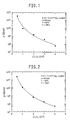
- Figure 1 graphs resistivity versus chromium cation additions, at constant voltage (10kv), temperature (60°C), magnesium cation content (500 ppm) for a time of 60 minutes.
- Figure 2 graphs resistivity versus chromium cation additions at constant voltage (10kv), temperature (60°C), magnesium cation content (700 ppm) for a time of 60 minutes.
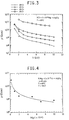
- Figure 3 graphs resistivity versus voltage for various chromium cation additions at constant temperature (60°C) and magnesium cation content (500 ppm).
- Figure 4 graphs resistivity versus magnesium cation additions at constant voltage (10kV), temperature (60°C), chromium cation content (20000 ppm) for a time of 60 minutes.
- Figure 5 graphs resistivity versus time for various chromium cation additions at constant voltage (10kV), temperature (60°C), magnesium cation content (700 ppm).
- Figure 6 graphs volume resistivity versus time for various magnesium cation additions at constant voltage (10kV), temperature (60°C), and chromium cation content (20000 ppm).
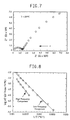
- Figure 7 represents a complex impedance plot at 250°C for a sample having 30000 ppm chromia, 500 ppm magnesia and no silica impurities.
- Figure 8 represents an Arrhenius plot for low and high frequency components to grain boundary electrical conductivity for an alumina-based sample having 30000 ppm chromia, 500 ppm magnesia, and no silica.
- This invention provides a ceramic composition of magnesia, chromia and alumina, that when sintered forms a polycrystalline, solid solution alumina-based body that is electrically conductive at room temperature, has excellent electrical stability, and excellent mechanical properties. More specifically, by controlling the chromium, magnesium and impurity levels and by avoiding undesirable segregation and second phase formations at grain boundaries, superior room temperature semiconducting properties are achieved in an alumina-based polycrystalline ceramic.
- a feature of the electrically conductive compositions of this invention is their excellent stability against voltage breakdown at high d.c. voltages, (e.g., 10 kV). Electrical instability generally is demonstrated by an increase or drift in resistivity with time, which eventually leads to voltage breakdown. Compositions may be prepared in accordance with this invention with essentially no resistivity drift. Electrical stability is especially important in high voltage d.c. applications and is generally not obtainable in electronic ceramics to the degree observed in the materials of this invention.
- Ceramic bodies can be prepared in accordance with this invention with resistivities of about 10 12 ⁇ -cm or less at approximately 20°C under a.c. conditions. Ceramic bodies can also be prepared in accordance with this invention with resistivities of about 10 12 ⁇ -cm or less at approximately 20°C under d.c. conditions.
- resistivity is meant the electrical resistance per cm of an article of 1 cm 2 cross-sectional area, having units of ohm-cm. Resistivity is the inverse of conductivity, and may also be referred to as bulk or volume resistivity.
- essentially no resistivity drift is meant that the resistivity of a material will not vary over time from an initial resistivity by more than about 10%, under constant d.c. voltage of at least 10 kilovolts and constant temperature up to at least 350°C.
- magnesia (MgO) and chromia (Cr 2 O 3 ) are added as substitutional additives in solid solution with alumina, avoiding the formation of silaceous grain boundary phases and second phase spinel (MgAl 2 O 4 ) to produce a ceramic body which is electronically conductive.
- Figure 3 shows that resistivity decreased as the chromia content was increased.
- Figure 4 shows that resistivity decreased as the magnesia content was increased up to the solubility limit of magnesia in alumina; increasing the magnesia content beyond the solubility limit did not appreciably affect resistivity.
- Figure 6 shows that concentrations near the solubility limit exhibit essentially no resistivity drift.
- Magnesia (MgO) has limited solubility in alumina and is preferably added below its solubility limit to avoid the formation of spinel and achieve a single-phase product.
- magnesia in alumina acts as a solid-solution sintering aid which promotes densification, controls (retards) grain growth and has been suggested to redistribute silica impurities (see, S. J. Bennison et al., Ceramic Transactions, 7 (1990) 13-49).
- the solubility limit of magnesia in alumina preferably should not be exceeded.
- the solubility limit of magnesia in alumina increases with increasing sintering temperature (see, R. L. Coble et al., J. Am. Ceram. Soc., 5 [1] (1968) 1-6), increasing impurity level and is also affected by the sintering atmosphere.
- a reducing sintering atmosphere increases the solubility limit and an oxidizing atmosphere, required to enhance conductivity in accordance with this invention, decreases the solubility limit.
- a spinel phase forms during sintering. In the process of the invention herein, it is not essential to be below the solubility limit of MgO in Al 2 O 3 .
- Electrical conductivity in the sintered body can be obtained at Mg additions above the solubility limit.
- magnesia additions above the solubility limit can be tolerated without degrading the electrical conductivity (preferably they do not exceed three times the solubility limit).
- Magnesia contents at levels above the solubility limit will not appreciably increase electrical conductivity or adversely affect electrical stability (i.e., the ceramic will exhibit essentially no resistivity drift at d.c. voltages of about 10 kV).
- magnesium cation (Mg 2+ ) and chromium cation (Cr 3+ ) additions are given as atomic mole fractions, i.e., mole of cation additive per mole of aluminum (Al 3+ ) cation.
- the sintering temperature will range from about 1550°C to about 1950°C.
- the sintering temperature required to create fully dense bodies is preferably above about 1550°C and about 160 ppm Mg 2+ .
- the starting alumina powders are often a source of impurities.
- the starting alumina should be at least 99.900% pure and this purity level must be maintained during processing.
- the powder is derived from an alkoxide route and although the metal ion impurities are of the order of 10 ppm, the powder contains carbon residue of the order of 100 ppm. Ceralox HP Al 2 O 3 was also found to be a suitable starting alumina.
- Magnesia additions are necessary for creating electrical conduction. Magnesia suppresses the formation of liquid grain boundary phases during sintering (see, Bennison et al., supra) which can degrade electrical properties in polycrystals. Polycrystalline and single crystal (ruby) chromium/alumina samples without magnesia additions are electrically insulating. Also, the compositions must be fired in an oxidizing atmosphere to create electrical conductivity. Samples fired in inert or reducing atmospheres will be electrically insulating.
- all processing should be carried out in clean conditions to avoid contamination of the precursor powder and green body with unwanted impurities.
- glassware, metalware, and milling in ceramic mills should be avoided in the preparation to minimize metal and silica impurities. Ball milling in ceramic mills should be avoided since it can introduce unwanted silica impurities.
- the preparation process preferably employs Teflon or high density polyethylene (HDPE) containers, stirrers, and spatulas. If processing aids such as surfactants or binders are employed, they should be of the clean-burning variety leaving essentially no residue on heat treatment. Surfactants and binders that contain metal ions should be avoided since these ions are adsorbed strongly onto the starting powder and remain as unwanted impurities during firing.
- HDPE high density polyethylene
- a suitable magnesia/chromia/alumina precursor powder for fabricating functional articles can be prepared using a solution method where the chromium and magnesium cations are added as soluble metal salts to a liquid containing high purity alumina powder and other green processing aids.
- the cations can also be added as metal oxides into a liquid containing alumina powder.
- One preparation method can be accomplished using the following steps: (a) preparing a liquid containing a mixture (e.g., a solution and/or suspension) of the appropriate amount of magnesium and chromium cations by adding appropriate cation-containing precursors to a solvent; (b) mixing with the liquid of step (a) a high purity alumina powder (the alumina being preferably at least 99.900% pure, and more preferably at least 99.995% pure) to obtain a well-dispersed slurry; (c) evaporating the liquid from the slurry of step (b) to form a dried powder containing the magnesium and chromium cations, alumina, and any other processing aids; (d) preparing a green powder compact from the powder of step (c); and (e) heating the green powder compact of step (d) in an oxidizing atmosphere to densify.
- a mixture e.g., a solution and/or suspension
- a mixture e.g., a solution and/or
- any solvent in which the magnesium and/or chromium precursor cation salts will dissolve or disperse can be used, such as methanol, ethanol, or water.
- the solvent should be high purity to minimize contamination.
- the magnesium and chromium precursor salts can be those of nitrates, acetates, stearates, and chlorides or any other form that will decompose upon sintering; or they can be oxides which effectively disperse upon sintering.
- the liquid can be evaporated by heating to form a dried powder cake or by spray drying.
- the magnesia/chromia/alumina precursor powder can be compacted to form a green body (compact) by any compacting process yielding green densities of a least about 40%, preferably on the order of 55% or greater, of theoretical.
- clean burning binders should be employed in order to minimize sources of contamination.
- Appropriate compacting methods include slip casting, tape casting, double-ended die pressing, isostatic pressing and injection molding. The method will vary depending on the fabricated article. For a forming method such as slip casting, casting can be done directly from the precursor solution since the soluble cations are strongly adsorbed onto the alumina surface and will not be lost with the solvent into the casting mold. Slip casting can also be accomplished by redispersing dried precursor powder in an appropriate liquid.
- the sintering atmosphere When sintering the green compact, it is preferable to surround the compact with powder of the same composition and purity. This prevents contamination from the furnace and minimizes the loss of magnesia and chromia both which vaporize during heating.
- the sintering atmosphere In order to maintain high electrical conductivity, the sintering atmosphere must be oxidizing. Low O 2 partial pressure (e.g., reducing or inert atmospheres) results in poor electrical conductivity.
- the temperature is ramped at 100°C/hr to 1000°C and held for two hours. This effectively calcines the compact, decomposing the starting magnesium and chromium salts and distributing the magnesium and chromium ions to the alumina, and removing carbon impurities though pyrolysis and oxidation.
- the heat treatment is continued by ramping at 500°C/hr to the sintering temperature, for example 1650°C, with a one hour soak.
- the furnace is then cooled to ambient.
- the resulting sintered article of the above preparation method has high density (approximately 99%), is polycrystalline with a grain size of about 5 to 10 mm, and is electrically conductive at room temperature.
- Articles of this invention are useful as structural ceramic materials in various applications. They exhibit superior mechanical properties such as high strength, toughness and wear, and are especially useful in applications requiring mechanical integrity. They have the added advantage of being about five times lighter than steel per unit volume. Oxygen-sintered articles of this invention further are particularly useful in electronic applications requiring selective electrical conductivity at or near room temperature, such as electrostatic charging applications.
- This invention provides a d.c. stable electronic conductor (i.e., an electronic conductor which has essentially no resistivity drift).
- an embodiment of this invention is useful for a discharge electrode in a process to produce flash-spun fibrous non-woven structures as described in U.S. Patent No. 3,227,784 and U.S. Patent No. 3,387,326, which are hereby incorporated by reference herein.
- U.S. Patent No. 3,387,326 discloses an apparatus for spreading and then charging a fibrous web in a corona charging field, and subsequently depositing the web uniformly in overlapping layers on a moving surface to form a nonwoven sheet.
- the corona charging field is generated by and consists of an active charge generating electrode (e.g., an ion gun) and a passive charge collecting electrode (e.g., a target plate).
- the web is prepared by flash extrusion of a solution of crystallizable polymer. In this "flash extrusion" process, the strand is formed by extruding a homogeneous solution of a fiber-forming polymer dissolved in a liquid which is a solvent for the polymer above its normal boiling point.
- the solution at a temperature above the normal boiling point of the solvent is extruded into a medium of lower temperature and substantially lower pressure.
- the liquid within the extrudate then vaporizes and cools the extrudate, causing solidification of the polymer.
- the resulting fibrous web may be spread out by causing it to impinge on a baffle or curved surface as it exits from the extrusion orifice. It may then be deposited upon a moving belt in overlapping, multidirectional layers to form a nonwoven fibrous sheet.
- a corona charging device is located along the path of advance just downstream from the mechanical spreading device. It serves to place a charge on the fibers in the web and to thereby sustain them in a separated or open condition.
- the charging device includes an electrode, such as an ion gun, and a second electrode, a target discharge plate.
- the target plate is a flat plate construction assembled in the equipment with the flat surface facing the ion gun and the path of advance. The trailing edge of the target plate terminates in a slightly rounded edge.
- Target plates comprising the ceramic composition of this invention are useful in such processes to produce fibrous webs because the ceramic exhibits desirable conductivity and mechanical properties. Accordingly, target plates of ceramics which are stable electronic conductors are provided herein.
- the use of a ceramic material having suitable resistivity for the passive charge collecting electrode in accordance with this invention improves the operability, stability and the longevity of the charging plate.
- a typical plate thickness is about 3/8 inch (0.95 cm).
- the ceramic used for such plates has a volume resistivity of from about 1 x 10 9 to about 5 x 10 9 ohm-cm measured at the operating temperature.
- the ceramic used for a 0.95 cm thick plate suitably has a volume resistivity of about 1.6 x 10 9 ohm-cm.
- volume resistivity e.g., 5 x 10 9 to 1 x 10 10 ohm-cm
- 5 x 10 9 to 1 x 10 10 ohm-cm are generally more desirable.
- the ceramic have a Vickers hardness of at least about 5 GPa (preferably at least about 14 GPa) and a modulus of rupture (i.e., breaking strength) of at least about 400 MPa.
- Conductive ceramic compositions of oxides of Mg +2 , Cr +3 and Al +3 of this invention are considered suitable for this application.
- a precursor powder with cation additions of 500 ppm Mg 2+ and 5000 ppm Cr 3+ was prepared in the following manner:
- Example 1-16 Electrical measurements were made on 1.0 inch (2.54 cm) diameter sintered sample disks by a two-probe d.c. method (Examples 1-16). Two probe d.c. measurements were used to calculate volume resistivities and the ac impedance measurements were used to characterize electrical conductivity mechanisms. The d.c. measurement data are expressed as volume (bulk) resistivity ( ⁇ cm).
- sample disks were not electroded since nonohmic contact behavior is not a concern when measuring resistivities of the magnitude of these compositions.
- a constant voltage was impressed across the samples using 0.25 inch (0.64 cm) diameter copper contacts placed on the top and bottom surfaces of the sample disks. The resultant current through the sample was then measured. Voltage and current measurements were made using a Hitotronics H800-PL unit. Voltage was varied from 1 kV to 10 kV to characterize voltage effects. Measurements were made in a constant temperature and humidity chamber at room temperature and 60°C, and 50% humidity.
- Examples 2 through 16 were prepared essentially as described in Example 1, however, the amounts of the components were varied. The actual amounts used and the resistivity measurement (d.c. method) for each sample are shown in Table I. Additionally, Examples 6 through 16 were tested for electrical stability (resistivity drift) for a 24 hour time period.
- Figure 1 plots results from Examples 1-5 and shows the effect of chromium cation (Cr 3+ ) additions on volume resistivity at constant voltage (10 kV), temperature (60°C), and magnesium cation (Mg 2+ ) content (500 ppm). This figure shows that resistivity decreased from insulating to less than 10 8 ⁇ cm as the amount of chromium cations were increased. The data was fitted to the solid line using the method of least squares.
- Figure 3 depicts Examples 2-5 and shows the effect of voltage on volume resistivity for various chromium cation additions at constant temperature (60°C), and magnesium cation content (500 ppm). This figure shows that resistivity increased as the d.c. voltage was decreased. The figure also shows that resistivity decreased as the amount of chromium cations were increased, as discussed above.
- Figure 4 depicts Examples 11-16 and shows the effect of magnesium cation additions on volume resistivity at constant voltage (10 kV), temperature (60°C), and chromium cation content (20000 ppm). This figure shows that resistivity decreased from insulating to less than 10 9 as the amount of magnesium cations were increased.
- the solubility limit of magnesia in alumina is approximately 500 ppm. Magnesia addition above the solubility limit does not appreciably contribute to conductivity, and may degrade conductivity.
- a ceramic was prepared substantially similar to the manner of Example 1, except the ceramic was formed into a functional electrostatic discharge plate.
- the precursor powder was placed in a mold and uniaxially dry pressed at 24 MPa (3500 psi) to form an unfired circular plate which was 13 mm (0.5 inches) thick and 305 mm (12.0 inches) in diameter.
- This plate was then sintered in air at 1650°C.
- the resulting plate had an outer diameter dimension of 250 mm (9.84 inches) due to shrinkage of approximately 18%.
- a target discharge plate prepared substantially in accordance with the procedure of Example 17 was machined, forming an annulus having a 4.1 inch (10.4 cm) inside diameter and a 9.0 inch (22.9 cm) outside diameter to conform to the desired dimensions of a target plate for flash spinning.
- the target plate surface was polished to about a 0.2 ⁇ m (9 microinch) surface roughness with-a resulting thickness of 0.375 inches (0.95 cm).
- a metallic paint on the back of the plate was used for attachment to ground.
- the volume resistivity of this finished target plate was about 5 x 10 9 ohm-cm.
- the Vickers hardness of the discharge plate ceramic is estimated as above 14 GPa.
- the ceramic target plate was compared to a metal target plate in a two-position test spin where a 20 weight percent solution of high density polyethylene in hydrocarbon solvent was flash spun at about 55 pounds per hour (25 Kg/h) substantially in accordance with the general procedures outlined in U.S. Patent No. 3,227,784, U.S. Patent No. 3,387,326, U.S. Patent No. 3,587,739 and U.S. Patent No. 3,860,369.
- the flash-spun webs were (1) passed through the charging zones formed by an ion gun and ceramic plate in one position and an ion gun and metal plate in a second position, (2) then passed through identical diffusers, and (3) laid and pinned to a belt moving at 50 yards a minute (45.7 m/min.).
- the ion gun potential and current were maintained at about 10 kV (direct current) and about 350 microamps.
- the web current was about 40 microamps on the position with the ceramic plate and about 45 microamps on the position with the metal plate, giving charging efficiencies of about 11 and 13 percent, respectively, with a resulting web charge of about 6 microcoulombs/gm in both cases. Both webs were judged to pin both equivalently and satisfactorily to the belt.
- the ceramic target plate resistance at about 5 x 10 9 ohm-cm, was judged to be somewhat higher than optimum as there was some leakage current around the outer surface to ground. Discharge plates of somewhat lower resistance can readily be prepared in accordance with this invention.
- Example 4 - 30,000 ppm Cr 3+ /500 ppm Mg 2+ /alumina with no added silica impurities; Comparative Example A - 30,000 ppm Cr 3+ /500 ppm Mg 2+ /alumina with 1000 ppm silica; Comparative Example B - 20,000 ppm Cr 3+ /500 ppm Mg 2+ /alumina with 1000 ppm silica; Comparative Example C - 500 ppm Mg 2+ /alumina with no chromium or added silica; Comparative Example D - single crystal ruby (500 ppm Cr 3+ ).
- Examples 4 and A-D were prepared by the solution method, as described in Example 1, to minimize impurities.
- Examples A and B were ball milled in alumina mills for eight hours. Ball milling effectively introduced silica and other impurities, as indicated by the elemental analysis (Table III), and should be avoided. Silica impurities were expected to degrade electrical conductivity.
- Example D single crystal ruby, was electronic grade (Union Carbide, Crystal Products Division, Washougol, WA) with minimal impurities.
- AC impedance measurements were used to characterize electrical conductivity mechanisms.
- the overall electrical response of a material can be modeled in terms of equivalence circuits that distinguish individual processes contributing to conductivity within the material.
- Each conductivity component is assigned a parallel resistor-capacitor network that are connected in series as shown in Figure 7, a complex impedance plot for Example 4. If the capacitance of each network is sufficiently different, a series of contacting semicircles can be obtained in a complex impedance plot allowing individual conductivity processes to be distinguished. Impedance plots are useful for characterizing bulk, grain boundary, and bulk/electrode interface responses. It is also effective for characterizing any changes in conductivity processes that can occur from variations in processing.
- sample disks were electroded with evaporated gold metal on the top and bottom surfaces to ensure ohmic contacts.
- Two terminal measurements of the capacitance and loss tangent were made in the frequency range from 13 Hz to 100 Hz using a Genrad GR1689 bridge. Measurements at room temperature were obtained using a Hewlett-Packard 16043E test fixture. Measurements taken at high temperature were done in a quartz tube furnace using a test fixture made of high-purity alumina and sapphire. Prior to all measurements, short and open calibrations were done for the instruments and the holders at each measurement temperature and compensations were included in the resultant calculations.
- AC impedance measurement data are expressed as bulk conductivity (( ⁇ cm) -1 ).
- Figure 7 shows a complex impedance plot at 250°C for Example 4, alumina with 30,000 ppm Cr 3+ and 500 ppm Mg 2+ , with no silica.
- the figure shows two well formed connecting semicircles corresponding to components of high and low frequency conduction. Both semicircles correspond to regions of grain boundary electrical conductivity. Bulk conductivity in alumina based materials is highly unlikely at these temperatures.
- Figure 8 shows an arrhenius plot in the temperature range of ambient to 600°C for the low and high frequency components of conductivity for Example 4.
- the log ⁇ T - 1/T plots are linear.
- ⁇ T ⁇ o e (-E/KT)
- E the activation energy
- K the Boltzman constant
- T absolute temperature
- activation energies of 0.46 eV (44.4 kJ/mol) and 0.60 eV (57.9 kJ/mol) were calculated for the respective low frequency (Q 1 ) and high frequency (Q 2 ) conductivity components.
- Activation energies in this range and temperature region are consistent with electronic conductivity. Ionic or fast ion conductivities are highly unlikely in alumina-based materials at these temperatures.
- Example 4 without silica impurities was more conductive and had lower activation energies than Examples A and B with silica impurities.
- Clearly silica degrades electrical conductivity.
- Example C (no chromium) was substantially more insulating with a higher activation energy than samples containing both chromium and magnesium.
- chromium and magnesium are required to create electrical conductivity.
- Example B (20000 ppm Cr 3+ /500 ppm Mg 2+ /alumina with silica) the high frequency component of conductivity was absent and thus only the low frequency activation energy was calculated. The absence of a high frequency conductivity component, as well as higher low frequency activation energies and higher resistivities, suggests that silica impurities were inhibiting conductivity by deleteriously altering conductive pathways along grain boundaries.
- Example C with no chromium also lacked a high frequency component which suggests a similar degradation in conductivity from lack of chromium additions.
- the complex impedance analysis suggests that chromium and magnesium additions in alumina in optimized amounts enhanced electrical conductivity by creating effective pathways for conduction along grain boundaries. Silica, and other impurities, inhibited conductivity by degrading these conductive pathways.
- FIGURES 1 159.54 100.0 0.7451 0.3219 5000 500 - 3.5x10 11 1 2 159.54 100.0 1.4902 0.3219 10000 500 - 9.7x10 10 1,3 3 159.54 100.0 2.9804 0.3219 20000 500 - 1.6x10 9 1,3 4 159.54 100.0 4.4706 0.3219 30000 500 - 4.1x10 8 1,3,7,8 5 159.54 100.0 5.9608 0.3219 40000 500 - 6.2x10 7 1,3 6 159.54 100.0 0.7451 0.4506 5000 700 None 2.5x10 11 2,5 7 159.54 100.0 1.4902 0.4506 10000 700 None 1.1x10 10 2,5 8 .
Landscapes
- Engineering & Computer Science (AREA)
- Chemical & Material Sciences (AREA)
- Ceramic Engineering (AREA)
- Manufacturing & Machinery (AREA)
- Materials Engineering (AREA)
- Structural Engineering (AREA)
- Organic Chemistry (AREA)
- Compositions Of Oxide Ceramics (AREA)
- Inorganic Fibers (AREA)
- Manufacture Of Alloys Or Alloy Compounds (AREA)
- Conductive Materials (AREA)
Claims (8)
- Verfahren zur Herstellung einer elektrisch leitenden polykristallinen Keramik auf der Basis von festem Lösungs-Aluminiumoxid, umfassend die folgenden Stufen:worin das Cr3+ mit dem Aluminiumoxid in einer ausreichenden Menge gemischt wird, um ein Atomverhältnis von Cr3+ zu Al3+ innerhalb des Bereichs von 1000 ppm bis 100000 ppm bereitzustellen, und das Mg2+ mit dem Aluminiumoxid in einer ausreichenden Menge gemischt wird, um ein Atomverhältnis von Mg2+ zu Al3+ innerhalb des Bereichs von 25 ppm bis 10000 ppm bereitzustellen; dadurch gekennzeichnet, daß die Stufe des Erwärmens in einer oxidierenden Atmosphäre durchgeführt wird.(a) Herstellung einer Flüssigkeit, die eine Mischung von Mg2+- und Cr3+-Kationen enthält, durch Zugabe von Vorstufen dieser Kationen zu einem Lösungsmittel;(b) Mischen eines hochreinen Aluminiumoxid-Pulvers mit der Flüssigkeit von Stufe (a), um eine gut dispergierte Aufschlämmung zu erhalten;(c) Abdampfen der Flüssigkeit von der Aufschlämmung von Stufe (b) unter Bildung eines getrockneten Pulvers, das die Magnesium- und Chrom-Kationen und Aluminiumoxid enthält;(d) Herstellung eines Preßlings aus grünem Pulver aus dem Pulver von Stufe (c); und(e) Erwärmen des Preßlings aus grünem Pulver von Stufe (d) zwecks Verdichtung;
- Polykristalline Keramik auf der Basis von festem Lösungs-Aluminiumoxid, die im wesentlichen aus den Oxiden von Mg2+, Cr3+ und Al3+ besteht, in welcher das Atomverhältnis von Cr3+ zu Al3+ innerhalb des Bereichs von 1000 bis 100000 ppm liegt und das Atomverhältnis von Mg2+ zu Al3+ im Bereich von 25 bis 10000 ppm liegt, dadurch gekennzeichnet, daß die Keramik auf Aluminiumoxid-Basis mit einem spezifischen Widerstand von 1012 Ω · cm oder weniger bei 20° C elektrisch leitend ist.
- Verfahren nach Anspruch 1, weiter umfassend die Stufe des Sintems der Keramik auf Aluminiumoxid-Basis bei einer Sintertemperatur von 1950° C oder weniger in einer oxidierenden Atmosphäre unter Bildung eines elektrisch leitenden keramischen Körpers.
- Keramik nach Anspruch 2 mit einem spezifischen Widerstand von etwa 1012 Ω · cm oder weniger bei etwa 20° C unter Gleichstrom-Bedingungen.
- Keramik nach Anspruch 2 mit einem spezifischen Widerstand von etwa 1012 Ω · cm oder weniger bei etwa 20° C unter Wechselstrom-Bedingungen.
- Polykristalliner Sinterkörper auf der Basis von festem Lösungs-Aluminiumoxid, der im wesentlichen aus den Oxiden von Mg2+, Cr3+ und Al3+ besteht, dadurch gekennzeichnet, daß der keramische Körper elektrisch leitend ist, wobei das Mg2+ und Cr3+ in ausreichenden Mengen vorhanden sind, um einen spezifischen Widerstand von etwa 1012 Ω · cm oder weniger bei 20° C zu liefern.
- Vorrichtung zur elektrostatischen Aufladung eines Endlosfaser-Materials, das in einem Pfad von einer Quelle zu einer Sammeleinrichtung transportiert wird, umfassend eine geladene Ionen-Pistole und eine entgegengesetzt geerdete Zielelektrode, die auf gegenüberliegenden Seiten des Pfads zwischen der Quelle und der Sammeleinrichtung positioniert sind, dadurch gekennzeichnet, daß:
die Zielelektrode eine Oberfläche aus Keramik aufweist, die der Ionen-Pistole gegenüber liegt, wobei die Keramik aus einem stabilen Elektronenleiter besteht, welcher eine polykristalline Keramik auf der Basis von festem Lösungs-Aluminiumoxid mit einem Durchgangswiderstand von etwa 1 x 10⁷ bis 5 x 10¹⁰ Ω-cm, gemessen bei der Betriebstemperatur, und einer Vickers-Härte von mindestens etwa 5 GPa umfaßt, und worin die Keramik im wesentlichen aus Oxiden von Mg2+, Cr3+ und Al3+ besteht, wobei das Atomverhältnis von Cr3+ zu Al3+ innerhalb des Bereichs von 1000 bis 100000 ppm liegt und das Atomverhältnis von Mg2+ zu Al3+ im Bereich von 25 ppm bis 10000 ppm liegt. - Vorrichtung nach Anspruch 7, in welcher die Keramik eine Vickers-Härte von mindestens etwa 14 GPa aufweist.
Applications Claiming Priority (3)
| Application Number | Priority Date | Filing Date | Title |
|---|---|---|---|
| US08/282,939 US5656203A (en) | 1994-07-29 | 1994-07-29 | Electrically conductive ceramics with oxides of Al, Cr, and Mg |
| US282939 | 1994-07-29 | ||
| PCT/US1995/008642 WO1996004218A1 (en) | 1994-07-29 | 1995-07-18 | Electrically conductive ceramics and their use in fiber charging apparatus |
Publications (2)
| Publication Number | Publication Date |
|---|---|
| EP0772574A1 EP0772574A1 (de) | 1997-05-14 |
| EP0772574B1 true EP0772574B1 (de) | 1999-10-20 |
Family
ID=23083781
Family Applications (1)
| Application Number | Title | Priority Date | Filing Date |
|---|---|---|---|
| EP95926232A Expired - Lifetime EP0772574B1 (de) | 1994-07-29 | 1995-07-18 | Elektrisch leitende keramik und ihre verwendung in einer vorrichtung zum aufbringen von ladung auf fiber |
Country Status (8)
| Country | Link |
|---|---|
| US (2) | US5656203A (de) |
| EP (1) | EP0772574B1 (de) |
| JP (1) | JPH10503464A (de) |
| KR (1) | KR100409171B1 (de) |
| CA (1) | CA2196163A1 (de) |
| DE (1) | DE69512919T2 (de) |
| ES (1) | ES2139919T3 (de) |
| WO (1) | WO1996004218A1 (de) |
Families Citing this family (3)
| Publication number | Priority date | Publication date | Assignee | Title |
|---|---|---|---|---|
| US5766789A (en) * | 1995-09-29 | 1998-06-16 | Energetics Systems Corporation | Electrical energy devices |
| NL1002696C2 (nl) * | 1996-03-25 | 1997-09-26 | Simco Nederland | Werkwijze en inrichting voor het vervaardigen van een spuitgietvoorwerp, alsmede een daarmee vervaardigd voorwerp. |
| JP5099656B2 (ja) * | 2003-12-15 | 2012-12-19 | 独立行政法人産業技術総合研究所 | 針状セラミック体、針状セラミック触媒体及びその製造方法 |
Family Cites Families (30)
| Publication number | Priority date | Publication date | Assignee | Title |
|---|---|---|---|---|
| US3227664A (en) * | 1961-12-07 | 1966-01-04 | Du Pont | Ultramicrocellular structures of crystalline organic polymer |
| US3387326A (en) * | 1964-06-04 | 1968-06-11 | Du Pont | Apparatus for charging and spreading a web |
| US3535588A (en) * | 1967-04-06 | 1970-10-20 | Du Pont | Apparatus for charging fibrous material |
| US3456156A (en) * | 1967-04-06 | 1969-07-15 | Du Pont | Apparatus for applying an electrostatic charge to fibrous material |
| US3565979A (en) * | 1968-09-18 | 1971-02-23 | Du Pont | Flash spinning |
| US3578739A (en) * | 1969-05-13 | 1971-05-18 | Du Pont | Apparatus for applying electrostatic charge to fibrous structure |
| JPS53120B2 (de) * | 1972-03-03 | 1978-01-05 | ||
| US4008092A (en) * | 1972-09-20 | 1977-02-15 | Osterreichisch-Amerkianische Magnesit Aktiengesellschaft | Method of producing MgO and Cr2 O3 based refractories and the products thereof |
| US3860369A (en) * | 1972-11-02 | 1975-01-14 | Du Pont | Apparatus for making non-woven fibrous sheet |
| US4077808A (en) * | 1973-08-31 | 1978-03-07 | Kaman Sciences Corporation | Chromia-bonded refractory body devoid of vitreous and sintered bonding |
| JPS5110813A (en) * | 1974-07-16 | 1976-01-28 | Fujitsu Ltd | Seramitsukukibanno seizohoho |
| US4148595A (en) * | 1977-09-28 | 1979-04-10 | E. I. Du Pont De Nemours And Company | Coating for aerodynamic shield in apparatus for making non-woven web |
| JPS5526490A (en) * | 1978-06-06 | 1980-02-25 | Commw Scient Ind Res Org | Oxygen detector |
| GB2029817A (en) * | 1978-09-06 | 1980-03-26 | Thorn Electrical Ind Ltd | Sealing of ceramic and cermet partds |
| DE3063533D1 (en) * | 1979-11-12 | 1983-07-07 | Emi Plc Thorn | An electrically conducting cermet, its production and use |
| JPS5997572A (ja) * | 1982-11-22 | 1984-06-05 | 科学技術庁無機材質研究所長 | 多結晶人造ルビ−の製造法 |
| US4537733A (en) * | 1983-10-31 | 1985-08-27 | E. I. Du Pont De Nemours And Company | Nonwoven fiber-sheet process |
| US4696873A (en) * | 1985-06-21 | 1987-09-29 | Kabushiki Kaisha Toshiba | Rechargeable electrochemical cell with a negative electrode comprising a hydrogen absorbing alloy including rare earth component |
| US4666395A (en) * | 1985-12-30 | 1987-05-19 | E. I. Dupont De Nemours And Company | Apparatus for making nonwoven sheet |
| US5250958A (en) * | 1987-12-10 | 1993-10-05 | Matsushita Electric Industrial Co., Ltd. | Thermal head and manufacturing method thereof |
| US4968238A (en) * | 1989-09-22 | 1990-11-06 | E. I. Du Pont De Nemours And Company | Apparatus for making a non-woven sheet |
| US5221558A (en) * | 1990-01-12 | 1993-06-22 | Lanxide Technology Company, Lp | Method of making ceramic composite bodies |
| US5051586A (en) * | 1990-04-18 | 1991-09-24 | Sabreen Scott R | Corona charging of plastic and apparatus therefor |
| US5108658A (en) * | 1991-01-24 | 1992-04-28 | Amoco Corporation | Light metal oxide-based amorphous conductor |
| DE4102667A1 (de) * | 1991-01-30 | 1992-08-06 | Hoechst Ceram Tec Ag | Brauner aluminiumoxid-formkoerper und verfahren zu seiner herstellung |
| AT394850B (de) * | 1991-03-11 | 1992-06-25 | Treibacher Chemische Werke Ag | Gesintertes, mikrokristallines keramisches material |
| JP2533992B2 (ja) * | 1991-08-28 | 1996-09-11 | 日本碍子株式会社 | アルミニウムチタネ―トセラミックス及びその製造方法 |
| US5296172A (en) * | 1992-07-31 | 1994-03-22 | E. I. Du Pont De Nemours And Company | Electrostatic field enhancing process and apparatus for improved web pinning |
| US5401446A (en) * | 1992-10-09 | 1995-03-28 | The University Of Tennessee Research Corporation | Method and apparatus for the electrostatic charging of a web or film |
| US5830819A (en) * | 1994-04-20 | 1998-11-03 | Kyocera Corporation | Alumina sintered product |
-
1994
- 1994-07-29 US US08/282,939 patent/US5656203A/en not_active Expired - Fee Related
-
1995
- 1995-03-07 US US08/400,224 patent/US5601853A/en not_active Expired - Lifetime
- 1995-07-18 CA CA002196163A patent/CA2196163A1/en not_active Abandoned
- 1995-07-18 DE DE69512919T patent/DE69512919T2/de not_active Expired - Fee Related
- 1995-07-18 WO PCT/US1995/008642 patent/WO1996004218A1/en not_active Ceased
- 1995-07-18 ES ES95926232T patent/ES2139919T3/es not_active Expired - Lifetime
- 1995-07-18 EP EP95926232A patent/EP0772574B1/de not_active Expired - Lifetime
- 1995-07-18 KR KR1019970700581A patent/KR100409171B1/ko not_active Expired - Fee Related
- 1995-07-18 JP JP8506508A patent/JPH10503464A/ja active Pending
Also Published As
| Publication number | Publication date |
|---|---|
| CA2196163A1 (en) | 1996-02-15 |
| US5656203A (en) | 1997-08-12 |
| ES2139919T3 (es) | 2000-02-16 |
| KR100409171B1 (ko) | 2004-02-18 |
| US5601853A (en) | 1997-02-11 |
| JPH10503464A (ja) | 1998-03-31 |
| WO1996004218A1 (en) | 1996-02-15 |
| KR970704643A (ko) | 1997-09-06 |
| DE69512919D1 (de) | 1999-11-25 |
| EP0772574A1 (de) | 1997-05-14 |
| DE69512919T2 (de) | 2000-04-13 |
Similar Documents
| Publication | Publication Date | Title |
|---|---|---|
| Kuwabara | Effect of microstructure on the PTCR effect in semiconducting barium titanate ceramics | |
| Huang et al. | Low temperature sintering and microwave dielectric properties of Ba2Ti9O20 ceramics using glass additions | |
| Guan et al. | LaMn1-xTixO3-NiMn2O4 (0≤ x≤ 0.7): a composite NTC ceramic with controllable electrical property and high stability | |
| Yan et al. | Preparation and properties of PbO–MgO–Nb2O5 ceramics near the Pb (Mg⅓Nb⅔) O3 composition | |
| US6641939B1 (en) | Transition metal oxide doped alumina and methods of making and using | |
| Wang et al. | Nonlinear electrical behavior and dielectric properties of (Ca, Ta)-doped TiO2 ceramics | |
| Koval et al. | Dielectric Properties and Phase Transition Behavior of x PMN-(1− x) PZT Ceramic Systems | |
| Wu et al. | Effect of Lead Oxide on Niobium‐Doped Titania Varistors | |
| Bentzen et al. | The preparation and characterization of dense, highly conductive Na5GdSi4O12 nasicon (NGS) | |
| Huang et al. | The microwave dielectric properties and the microstructures of Bi (Nb, Ta) O4 ceramics | |
| US5601853A (en) | Electrically conductive ceramics and their use in fiber charging apparatus | |
| Fang et al. | Enhanced dielectric breakdown strength in TiO2-SiO2-Al2O3 based ceramics prepared through hot-press assisted liquid phase sintering | |
| Kharchouche et al. | Influence of SrCO3‐doping on the microstructure and electrical properties of ZnO–(Bi2O3/Sb2O3) varistor ceramics | |
| Voss et al. | The effects of various b-site modifications on the dielectric and electrostrictive properties of lead magnesium niobate ceramics | |
| Lei et al. | The influence of CeO2 on the microstructure and electrical behaviour of ZnO–Bi2O3 based varistors | |
| Wang et al. | Effect of phosphor doping on the microstructure and dielectric properties of barium titanate ceramics | |
| Neirman et al. | Dielectric properties of polycrystalline CaTiO3 doped with yttrium oxide | |
| Kim et al. | The effect of Bi2O3 on the microstructure and electrical conductivity of ZrO2-Y2O3 ceramics | |
| Choudhary et al. | Structural, dielectric and electrical properties of lead cadmium tungstate ceramics | |
| Shen et al. | Effect of CuO or/and V2O5 oxide additives on Bi2O3–ZnO–Ta2O5 based ceramics | |
| Yoon et al. | Influence of synthesis methods of the PTCR effect in semiconductive BaTiO3 | |
| Araujo et al. | Dielectric properties of steatite ceramics produced from talc and kaolin wastes | |
| Zhou et al. | A novel method of preparing Ba0. 96Ca0. 04Ti1. 02O3 ceramics with low room temperature resistivity | |
| Wang et al. | Effect of Zn2P2O7 additive on the electrical breakdown strength and energy storage properties of (Ba0. 6Sr0. 4) 0.85 Bi0. 1TiO3 ceramics | |
| Issa | Electrical properties of polycrystalline PTCR barium titanate |
Legal Events
| Date | Code | Title | Description |
|---|---|---|---|
| PUAI | Public reference made under article 153(3) epc to a published international application that has entered the european phase |
Free format text: ORIGINAL CODE: 0009012 |
|
| 17P | Request for examination filed |
Effective date: 19970116 |
|
| AK | Designated contracting states |
Kind code of ref document: A1 Designated state(s): DE ES FR GB IT |
|
| 17Q | First examination report despatched |
Effective date: 19970707 |
|
| GRAG | Despatch of communication of intention to grant |
Free format text: ORIGINAL CODE: EPIDOS AGRA |
|
| GRAG | Despatch of communication of intention to grant |
Free format text: ORIGINAL CODE: EPIDOS AGRA |
|
| GRAH | Despatch of communication of intention to grant a patent |
Free format text: ORIGINAL CODE: EPIDOS IGRA |
|
| GRAH | Despatch of communication of intention to grant a patent |
Free format text: ORIGINAL CODE: EPIDOS IGRA |
|
| GRAA | (expected) grant |
Free format text: ORIGINAL CODE: 0009210 |
|
| AK | Designated contracting states |
Kind code of ref document: B1 Designated state(s): DE ES FR GB IT |
|
| ET | Fr: translation filed | ||
| REF | Corresponds to: |
Ref document number: 69512919 Country of ref document: DE Date of ref document: 19991125 |
|
| ITF | It: translation for a ep patent filed | ||
| REG | Reference to a national code |
Ref country code: ES Ref legal event code: FG2A Ref document number: 2139919 Country of ref document: ES Kind code of ref document: T3 |
|
| PLBE | No opposition filed within time limit |
Free format text: ORIGINAL CODE: 0009261 |
|
| STAA | Information on the status of an ep patent application or granted ep patent |
Free format text: STATUS: NO OPPOSITION FILED WITHIN TIME LIMIT |
|
| 26N | No opposition filed | ||
| PGFP | Annual fee paid to national office [announced via postgrant information from national office to epo] |
Ref country code: ES Payment date: 20010719 Year of fee payment: 7 |
|
| REG | Reference to a national code |
Ref country code: GB Ref legal event code: IF02 |
|
| PG25 | Lapsed in a contracting state [announced via postgrant information from national office to epo] |
Ref country code: ES Free format text: LAPSE BECAUSE OF NON-PAYMENT OF DUE FEES Effective date: 20020719 |
|
| REG | Reference to a national code |
Ref country code: ES Ref legal event code: FD2A Effective date: 20030811 |
|
| PGFP | Annual fee paid to national office [announced via postgrant information from national office to epo] |
Ref country code: GB Payment date: 20040714 Year of fee payment: 10 |
|
| PGFP | Annual fee paid to national office [announced via postgrant information from national office to epo] |
Ref country code: DE Payment date: 20040729 Year of fee payment: 10 |
|
| PGFP | Annual fee paid to national office [announced via postgrant information from national office to epo] |
Ref country code: FR Payment date: 20050708 Year of fee payment: 11 |
|
| PG25 | Lapsed in a contracting state [announced via postgrant information from national office to epo] |
Ref country code: IT Free format text: LAPSE BECAUSE OF NON-PAYMENT OF DUE FEES;WARNING: LAPSES OF ITALIAN PATENTS WITH EFFECTIVE DATE BEFORE 2007 MAY HAVE OCCURRED AT ANY TIME BEFORE 2007. THE CORRECT EFFECTIVE DATE MAY BE DIFFERENT FROM THE ONE RECORDED. Effective date: 20050718 Ref country code: GB Free format text: LAPSE BECAUSE OF NON-PAYMENT OF DUE FEES Effective date: 20050718 |
|
| PG25 | Lapsed in a contracting state [announced via postgrant information from national office to epo] |
Ref country code: DE Free format text: LAPSE BECAUSE OF NON-PAYMENT OF DUE FEES Effective date: 20060201 |
|
| GBPC | Gb: european patent ceased through non-payment of renewal fee |
Effective date: 20050718 |
|
| REG | Reference to a national code |
Ref country code: FR Ref legal event code: ST Effective date: 20070330 |
|
| PG25 | Lapsed in a contracting state [announced via postgrant information from national office to epo] |
Ref country code: FR Free format text: LAPSE BECAUSE OF NON-PAYMENT OF DUE FEES Effective date: 20060731 |