EP0769080B1 - Konversionsbeschichtung und verfahren und lösung zu deren herstellung - Google Patents
Konversionsbeschichtung und verfahren und lösung zu deren herstellung Download PDFInfo
- Publication number
- EP0769080B1 EP0769080B1 EP95921651A EP95921651A EP0769080B1 EP 0769080 B1 EP0769080 B1 EP 0769080B1 EP 95921651 A EP95921651 A EP 95921651A EP 95921651 A EP95921651 A EP 95921651A EP 0769080 B1 EP0769080 B1 EP 0769080B1
- Authority
- EP
- European Patent Office
- Prior art keywords
- solution
- metal
- rare earth
- molar
- concentration
- Prior art date
- Legal status (The legal status is an assumption and is not a legal conclusion. Google has not performed a legal analysis and makes no representation as to the accuracy of the status listed.)
- Expired - Lifetime
Links
Images

Classifications
-
- C—CHEMISTRY; METALLURGY
- C23—COATING METALLIC MATERIAL; COATING MATERIAL WITH METALLIC MATERIAL; CHEMICAL SURFACE TREATMENT; DIFFUSION TREATMENT OF METALLIC MATERIAL; COATING BY VACUUM EVAPORATION, BY SPUTTERING, BY ION IMPLANTATION OR BY CHEMICAL VAPOUR DEPOSITION, IN GENERAL; INHIBITING CORROSION OF METALLIC MATERIAL OR INCRUSTATION IN GENERAL
- C23C—COATING METALLIC MATERIAL; COATING MATERIAL WITH METALLIC MATERIAL; SURFACE TREATMENT OF METALLIC MATERIAL BY DIFFUSION INTO THE SURFACE, BY CHEMICAL CONVERSION OR SUBSTITUTION; COATING BY VACUUM EVAPORATION, BY SPUTTERING, BY ION IMPLANTATION OR BY CHEMICAL VAPOUR DEPOSITION, IN GENERAL
- C23C22/00—Chemical surface treatment of metallic material by reaction of the surface with a reactive liquid, leaving reaction products of surface material in the coating, e.g. conversion coatings, passivation of metals
- C23C22/05—Chemical surface treatment of metallic material by reaction of the surface with a reactive liquid, leaving reaction products of surface material in the coating, e.g. conversion coatings, passivation of metals using aqueous solutions
- C23C22/06—Chemical surface treatment of metallic material by reaction of the surface with a reactive liquid, leaving reaction products of surface material in the coating, e.g. conversion coatings, passivation of metals using aqueous solutions using aqueous acidic solutions with pH less than 6
- C23C22/48—Chemical surface treatment of metallic material by reaction of the surface with a reactive liquid, leaving reaction products of surface material in the coating, e.g. conversion coatings, passivation of metals using aqueous solutions using aqueous acidic solutions with pH less than 6 not containing phosphates, hexavalent chromium compounds, fluorides or complex fluorides, molybdates, tungstates, vanadates or oxalates
- C23C22/56—Treatment of aluminium or alloys based thereon
-
- C—CHEMISTRY; METALLURGY
- C23—COATING METALLIC MATERIAL; COATING MATERIAL WITH METALLIC MATERIAL; CHEMICAL SURFACE TREATMENT; DIFFUSION TREATMENT OF METALLIC MATERIAL; COATING BY VACUUM EVAPORATION, BY SPUTTERING, BY ION IMPLANTATION OR BY CHEMICAL VAPOUR DEPOSITION, IN GENERAL; INHIBITING CORROSION OF METALLIC MATERIAL OR INCRUSTATION IN GENERAL
- C23C—COATING METALLIC MATERIAL; COATING MATERIAL WITH METALLIC MATERIAL; SURFACE TREATMENT OF METALLIC MATERIAL BY DIFFUSION INTO THE SURFACE, BY CHEMICAL CONVERSION OR SUBSTITUTION; COATING BY VACUUM EVAPORATION, BY SPUTTERING, BY ION IMPLANTATION OR BY CHEMICAL VAPOUR DEPOSITION, IN GENERAL
- C23C22/00—Chemical surface treatment of metallic material by reaction of the surface with a reactive liquid, leaving reaction products of surface material in the coating, e.g. conversion coatings, passivation of metals
- C23C22/82—After-treatment
- C23C22/83—Chemical after-treatment
-
- C—CHEMISTRY; METALLURGY
- C23—COATING METALLIC MATERIAL; COATING MATERIAL WITH METALLIC MATERIAL; CHEMICAL SURFACE TREATMENT; DIFFUSION TREATMENT OF METALLIC MATERIAL; COATING BY VACUUM EVAPORATION, BY SPUTTERING, BY ION IMPLANTATION OR BY CHEMICAL VAPOUR DEPOSITION, IN GENERAL; INHIBITING CORROSION OF METALLIC MATERIAL OR INCRUSTATION IN GENERAL
- C23C—COATING METALLIC MATERIAL; COATING MATERIAL WITH METALLIC MATERIAL; SURFACE TREATMENT OF METALLIC MATERIAL BY DIFFUSION INTO THE SURFACE, BY CHEMICAL CONVERSION OR SUBSTITUTION; COATING BY VACUUM EVAPORATION, BY SPUTTERING, BY ION IMPLANTATION OR BY CHEMICAL VAPOUR DEPOSITION, IN GENERAL
- C23C22/00—Chemical surface treatment of metallic material by reaction of the surface with a reactive liquid, leaving reaction products of surface material in the coating, e.g. conversion coatings, passivation of metals
- C23C22/05—Chemical surface treatment of metallic material by reaction of the surface with a reactive liquid, leaving reaction products of surface material in the coating, e.g. conversion coatings, passivation of metals using aqueous solutions
- C23C22/06—Chemical surface treatment of metallic material by reaction of the surface with a reactive liquid, leaving reaction products of surface material in the coating, e.g. conversion coatings, passivation of metals using aqueous solutions using aqueous acidic solutions with pH less than 6
- C23C22/48—Chemical surface treatment of metallic material by reaction of the surface with a reactive liquid, leaving reaction products of surface material in the coating, e.g. conversion coatings, passivation of metals using aqueous solutions using aqueous acidic solutions with pH less than 6 not containing phosphates, hexavalent chromium compounds, fluorides or complex fluorides, molybdates, tungstates, vanadates or oxalates
-
- C—CHEMISTRY; METALLURGY
- C23—COATING METALLIC MATERIAL; COATING MATERIAL WITH METALLIC MATERIAL; CHEMICAL SURFACE TREATMENT; DIFFUSION TREATMENT OF METALLIC MATERIAL; COATING BY VACUUM EVAPORATION, BY SPUTTERING, BY ION IMPLANTATION OR BY CHEMICAL VAPOUR DEPOSITION, IN GENERAL; INHIBITING CORROSION OF METALLIC MATERIAL OR INCRUSTATION IN GENERAL
- C23C—COATING METALLIC MATERIAL; COATING MATERIAL WITH METALLIC MATERIAL; SURFACE TREATMENT OF METALLIC MATERIAL BY DIFFUSION INTO THE SURFACE, BY CHEMICAL CONVERSION OR SUBSTITUTION; COATING BY VACUUM EVAPORATION, BY SPUTTERING, BY ION IMPLANTATION OR BY CHEMICAL VAPOUR DEPOSITION, IN GENERAL
- C23C22/00—Chemical surface treatment of metallic material by reaction of the surface with a reactive liquid, leaving reaction products of surface material in the coating, e.g. conversion coatings, passivation of metals
- C23C22/78—Pretreatment of the material to be coated
Definitions
- This invention relates to a conversion coating for metal surfaces and a process and a solution for forming a conversion coating on metal surfaces.
- the invention is particularly concerned with a conversion coating on aluminium or aluminium alloy and a process and a solution for the formation of a conversion coating on aluminium or aluminium alloy.
- conversion coating is a well known term of the art and refers to the replacement of native oxide on the surface of a metal by the controlled chemical formation of a film. Oxides or phosphates are common conversion coatings. Conversion coatings are used on metals such as aluminium, steel, zinc, cadmium or magnesium and their alloys, and provide a key for paint adhesion and/or corrosion protection of the substrate metal. Accordingly, conversion coatings find application in such areas as the aerospace, automotive, architectural, can stock, instrument and building industries.
- US-A-5192374 discloses an aqueous composition comprising cerium nitrate, chloride or sulfate.
- the Al coupons were cleaned, rinsed, deoxidized at 30-35°C for 20 minutes in a mixture of 10% nitric acid and 3% sodium bromate, rinsed in deionized water, placed in deionized water at 97-100°C for 5 minutes, and placed in a solution of 0.1% cerium chloride, 1% lithium nitrate and 1% aluminium nitrate at a pH of 4 at 97-100°C for 5 minutes; optionally a potassium silicate sealant is applied.
- a process for forming a chromate- and phosphate-free conversion coating on the surface of a metal includes the steps of:
- the degreasing step comprises treatment of the metal surface with any suitable degreasing solution to remove any oils or grease (such as lanoline) or plastic coating present on the metal surface.
- the degreasing step if present, preferably comprises treating the metal surface with a vapour degreasing agent such as trichloroethane or an aqueous degreasing solution available under the trade name of BRULIN.
- a degreasing step may be necessary, for example, where the metal has been previously coated with lanoline or other oils or grease or with a plastic coating.
- the metal surface preferably undergoes a cleaning step in order to dissolve contaminants and impurities, such as oxides, from the surface of the metal.
- the cleaning step comprises treatment with an alkaline based solution.
- the alkaline solution' is preferably a "non-etch" solution, that is, one for which the rate of etching of material from the metal surface is low.
- a suitable alkaline cleaning solution is that commercially available under the trade name RIDOLINE 53.
- the treatment with an alkaline cleaning solution is preferably conducted at an elevated temperature, such as up to 80°C, preferably up to 70°C.
- smut is intended to include impurities, oxides and any loosely-bound intermetallic particles which as a result of the alkaline treatment are no longer incorporated into the matrix of the aluminium alloy. It is therefore preferable to treat the metal surface with a "desmutting” or “deoxidizing” solution in order to remove the smut from the metal surface. (Throughout this specification, the terms “desmutting” and “deoxidizing” are used interchangeably). Removal of smut is normally effected by treatment with a desmutting (deoxidizing) solution comprising an acidic solution having effective amounts of appropriate additives.
- the desmutting solution also dissolves native oxide from the surface of the metal to leave a homogeneously thin oxide on the metal surface.
- the desmutting solution may be chromate-based, which due to the presence of Cr 6+ ions, presents environmental and health risks.
- the desmutting solution may be one which contains rare earth elements such as the desmutting solution disclosed in co-pending PCT Patent Application No. WO 95/08008. Treatment with rare earth containing desmutting solutions lessens the risk to the environment and health and results in improvement in coating time and corrosion performance of subsequently applied conversion coatings.
- the rare earth element of the desmutting solution preferably should possess more than one higher valence state.
- “higher valence state” is meant a valence state above zero valency.
- the multiple valence states of the rare earth element imparts a redox function enabling the rare earth element to oxidise surface impurities and result in their removal as ions into solution.
- rare earth elements include cerium, praseodymium, neodymium, samarium, europium, terbium and ytterbium.
- the preferred rare earth elements are cerium and/or praseodymium and/or a mixture of rare earth elements.
- the rare earth compound is cerium (IV) hydroxide, cerium (IV) sulphate, or ammonium cerium (IV) sulphate.
- the mineral acid is preferably a mixture of sulphuric acid and nitric acid with F - ions.
- the pH of the rare earth containing desmutting solution is preferably less than 1.
- a process for forming a conversion coating on the surface of a metal including the steps of:
- the process of the invention includes a further step comprising treatment with a sealing solution.
- the rare earth impregnated coating may be sealed by treatment with one of a variety of aqueous or non-aqueous inorganic, organic or mixed organic/inorganic sealing solutions.
- the sealing solution initially penetrates the semi-porous structure then subsequently forms a surface layer on the rare earth containing coating and may further enhance the corrosion resistance of the rare earth containing coating.
- the coating is sealed by an alkali metal silicate solution, such as a potassium silicate solution.
- potassium silicate solutions which may be used are those commercially available under the trade names "PQ Kasil #2236" and "PQ Kasil #1".
- the alkali metal sealing solution may be sodium based, such as a sodium silicate or a sodium orthophosphate, or a mixture thereof.
- each step of the process of the present invention is followed by a water rinsing step.
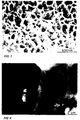
- FIG. 1 is a photomicrograph of the rare earth impregnated aluminium oxide coating at the completion of step 6 of Example 3.
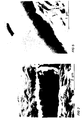
- FIG. 2 is another photomicrograph of the rare earth impregnated aluminium oxide coating at the completion of step 6 of Example 3.
- FIG. 3 is an X-ray photoelectron spectroscopy depth profile of the silicate-sealed coating of Example 3, at the completion of step 7.
- FIGS. 4 & 5 are photomicrographs of the silicate-sealed coating of Example 3 at the completion of step 7.
- the process of the present invention includes the step of initiation of growth on the surface of the aluminium or aluminium alloy of an aluminium oxide, or hydrated aluminium oxide.
- aluminium oxide shall be herein used to refer to the compounds aluminium oxide, hydrated aluminium oxide or aluminium hydroxide either singly or in any combination thereof.
- the surface of the metal is treated with a suitable solution in order to initiate aluminium oxide growth and to form a thin oxide layer on the metal surface.
- the thin oxide layer may be up to 10 nanometres thick.
- Oxide growth is initiated by immersing the metal in an acidic solution containing an effective quantity of an oxidant.
- the acidic solution may be selected from one or more of nitric acid, phosphoric acid and sulphuric acid.
- the acid is nitric acid. If present, the nitric acid preferably has a concentration of up to 1.6M.
- Suitable oxidants include (metal) perchlorates, (metal) bromates, (metal) persulphates, nitrates, hydrogen peroxide and ammonium cerium (IV) nitrate.
- the oxidant is NaBrO 3 .
- the solution may therefore contain nitric acid plus another acid.
- Nitric acid provides both an acidic and an oxidant function.
- the preferred acidic oxidant-containing solution contains nitric acid and NaBrO 3 .
- a halogen is present in the oxidant (such as in NaBrO 3 ) it may assist in removal of the oxide on the metal surface.
- the oxidant may be present in solution up to its solubility limit. However, for most applications the oxidant is present at lower concentrations. A suitable maximum concentration is 10 wt%. The lower limit of oxidant concentration may be 0.01wt%.
- the pH of the acidic, oxidant-containing solution will vary according to the nature of the oxidant and the other species added to the solution.
- the pH of the acidic solution is less than 1.0. In a preferred embodiment, it comprises HNO 3 .
- a pH of less than 0.5 is preferred when the solution contains the oxidant NaBrO 3 and HNO 3 .
- the low pH arises from use of HNO 3 in the NaBrO 3 solution.
- other nitrates may partially or completely replace the HNO 3 , resulting in variation of solution pH.
- the temperature of the acidic, oxidant-containing solution may be any value up to the boiling point of the solution.
- the lower limit on solution temperature may be ambient temperature, such as from 10°C to 30°C.
- the temperature of the acidic solution is 20°C.
- Other embodiments of the process are conducted at a temperature higher than 20°C, such as up to 50°C.
- the solution temperature may be 25°C or higher, and in some embodiments may be as high as 40°C.
- the metal surface is treated with the acidic, oxidant-containing solution for a period of time sufficient to initiate growth of aluminium oxide on the metal surface to the desired degree.
- Treatment time may be up to one hour. However advantageously, it is 30 minutes or less, such as up to 20 minutes. In some embodiments, treatment with the acidic solution is conducted for up to 15 minutes arid may be 10 minutes or less. In preferred embodiments, the treatment time is up to 7 minutes.
- the acidic, oxidant containing solution comprises a 3% (0.2 molar) metal bromate solution containing 7% (1.1 molar) nitric acid having a pH less than 0.5. Treatment with the acidic solution is conducted at 25-40°C for 7 minutes. It is followed by a rinse in water.
- the process of the present invention further includes thickening the aluminium oxide layer by treatment with water.
- a continuous layer comprising a porous cellular structure is formed, typically a columnar structure.
- the treatment water is preferably distilled and/or deionised. However it may advantageously include particular additives.
- the water has a low Si content, such as less than 0.05 ppm, or is Si free, because high Si content has been found to adversely affect oxide thickening.
- the pH of the treatment water is around neutral, such as from 4 to 7, since the dissolution rate of the oxide layer is minimal in this range.
- the water has low halide concentrations or is halide free. Similarly, low or zero sulphate concentration is preferred.
- a surfactant may be included in the water, in an effective amount, in order to lower the surface tension of the solution.
- the surfactant may be cationic, anionic or non-ionic.
- Inclusion of a surfactant is further beneficial in that by reducing surface tension of the coating solution, it thereby minimises "drag-out” from the solution. "Drag-out” is an excess portion of coating solution which adheres to the metal and is removed from solution with the metal and subsequently lost. Accordingly, there is less waste and costs are minimised by adding surfactant to the coating solution.
- the surfactant may be present in solution at a concentration up to 0.02weight%, such as up to 0.015weight%.
- concentration is around 0.01weight% or lower.
- the lower limit on surfactant concentration may be around 0.001weight%.
- the lower concentration limit is 0.005weight% whilst in others it is higher, such as 0.0075weight%.
- FC-135" An example of a suitable surfactant is that available under the trade name FLUORAD "FC-135", which is a cationic fluorochemical surfactant.
- FC-135 A water treatment solution containing FC-135 has a pH of around 5.5.
- nitrate compounds such as potassium nitrate (KNO 3 ), cerium (III) sulphate octahydrate (Ce 2 (SO 4 ) 3 .8H 2 O), solutions of ammonia and its salts, such as NH 4 OAC, NH 4 NO 3 , (NH 4 ) 2 CO 3 , NH 4 OH and sodium carbonate Na 2 CO 3 .
- the temperature of the water used for oxide thickening may be up to the boiling point of the treatment solution (that is, 100°C for pure water), such as up to 95°C.
- the temperature of treatment is up to 90°C.
- the lower limit of water temperature is 70°C.
- the temperature of the water treatment step is between 85 and 90°C. While the temperature of the water treatment solution may be less than 85°C, aluminium oxide growth is slower, and is even slower below 70°C.
- the metal surface may be treated with the water for up to 60 minutes, such as up to 35 minutes.
- the maximum treatment time is 20 minutes.
- the minimum treatment time may be as low as 2 1/2 minutes. However, in some embodiments, the treatment time is greater than three minutes. Alternatively, the treatment time may be 5 minutes or more.
- the present invention also includes the step of contacting the metal with rare earth elements in order to impregnate and substantially seal the oxide containing layer.
- the rare earth element is generally provided in the form of ions in an aqueous solution.
- the rare earth ion may possess more than one higher valence state.
- “higher valence state” is meant a valence state above zero. If the rare earth ion does possess more than one higher valence state, the rare earth ion is added to the solution in a lower valence state.
- Such rare earth elements include cerium, praseodymium, neodymium, samarium, europium, terbium, thulium, lutetium and ytterbium.
- the rare earth element is cerium and/or praseodymium and/or a mixture of rare earth elements.
- the rare earth cation acts as a substitutional cation for Al 3+ in the aluminium oxide layer.
- the rare earth element is cerium, it is preferably added as Ce 3+ which, it is believed, may substitute for Al 3+ in the oxide layer.
- a rare earth solution may be made by dissolving a rare earth salt in water.
- suitable rare earth salts include Ce(NO 3 ) 3 .6H 2 O, Ce 2 (SO 4 ) 3 .8H 2 O and Pr(NO 3 ) 3 .6H 2 O.
- the rare earth salt is cerium (III) nitrate hexahydrate (Ce(NO 3 ) 3 .6H 2 O).
- a rare earth containing solution may contain up to 100 grams per litre (0.23 molar) of dissolved rare earth salt (expressed as equivalent grams of Ce(NO 3 ) 3. -6H 2 O per litre of solution) such as up to 50 grams per litre (0.12 molar).
- the maximum concentration of rare earth salt is 40 grams/litre (0.092 molar). In other embodiments, the maximum concentration is 20 grams/litre (approximately 0.05 molar). Alternatively, the maximum concentration of rare earth salt may be 10 grams/litre (0.023 molar). The minimum amount of rare earth salt per litre of solution may be 0.1 grams (2.3 x 10 -4 molar).
- the concentration is 0.5 g/l and above, such as above 1.0 g/l. In yet further embodiments, the minimum concentration is 5.0 grams/litre.
- a rare earth containing solution may further include other additives.
- One such additive is excess nitrate ions, which may enhance oxidation of aluminium at the interface of the metal and the aluminium oxide phases.
- the excess nitrate ion may be added in various forms, including KNO 3 , LiNO 3 or NH 4 NO 3 or as combinations of these.
- the concentration of excess nitrate ion may be as high as the saturation limit of the corresponding nitrate salt. However lower concentrations of nitrate are also effective, such as up to 2.0M.
- a suitable concentration may be up to 1.0M.
- Fluoride ions may also be added to the rare earth containing solution. They may be added as MgF 2 or NaF. If present, the F- ions may be present at a concentration of up to 0.01M, such as up to 0.005M. Preferably, the fluoride ions are present up to 0.001M. While the exact role of the F - ion is unknown, it is thought that F - attacks aluminium in the aluminium oxide layer to form a soluble Al 3+ complex. The Al in the oxide layer may then be replaced with the rare earth elements from the solution. The rare earth element may then be present in the oxide layer as an oxide or a fluoride or mixture thereof.
- the temperature of treatment with the rare earth containing solution of the process may be as high as the boiling point of the solution, such as up to 95°C.
- the maximum temperature is 90°C.
- the lower temperature limit may be 60°C.
- the temperature of treatment with the solution is 70°C and higher.
- the temperature is 85°C and above.
- the rare earth containing solution preferably is acidic to neutral. It may have a pH up to 7, such as less than 5.5. In some embodiments of the process, the pH of the solution is less than 5. The pH may advantageously be above 4, such as 4.1 and above. Accordingly, for those embodiments of the invention, the preferred pH range is from 4 to 5. In further embodiments of the invention, the pH of the solution is 2 and above, such as higher than 3.
- Ce(NO 3 ) 3 .6H 2 O is the rare earth salt used in the rare earth containing solution, it has been observed that the pH of the solution decreases slightly with increasing concentration of Ce(NO 3 ) 3 .6H 2 O.
- the oxide coated metal surface is treated with the rare earth containing solution for a period of time sufficient to enable effective impregnation of the columnar aluminium oxide layer with the rare earth ions in solution.
- Treatment time may be up to 60 minutes. However normally treatment is for up to 40 minutes. Preferably, the treatment is carried out for a period of time up to 30 minutes. In some embodiments, effective impregnation is possible after treatment for 10 or more minutes, such as for at least 20 minutes.
- the impregnated oxide coating on the metal surface preferably has a porous, crazed oxide structure.
- An embodiment of such a structure is shown in Figure 1, relating to Example 3.
- Figure 2 shows that this coating has a thickness of approximately 1.5 ⁇ m and has a columnar structure.
- the sealing step may comprise treatment of the rare earth impregnated coating with an aqueous or non-aqueous inorganic, organic or mixed inorganic/organic sealing solution.
- a preferred sealing solution is an inorganic sealing solution.
- the sealing solution contains one or more oxidants.
- the sealing solution comprises a silicate solution, such as an alkali metal silicate solution.
- the sealing solution In addition to the sealing solution forming a surface layer on the rare earth impregnated oxide layer, it penetrates and fills the pores of the crazed oxide structure.
- FIG. 3 An X-ray photoelectron spectroscopy depth profile of the sealed, rare earth impregnated oxide coating of Example 3 is given in Figure 3.
- the thickness of the coating was less and the structure of the coating had altered from a crazed oxide structure to a smooth surfaced coating with a thickness of less than 1 ⁇ m.
- Figures 4 and 5 illustrate these features.
- the sealed coating has a layered structure comprising a homogeneous, smooth outer layer disposed on the columnar structure of the impregnated aluminium oxide.
- the depth profile for this embodiment shown in Figure 3 suggests that the outer layer comprises predominantly a silicate phase and the inner, columnar layer, comprises predominantly an aluminosilicate phase.
- the concentration of the alkali metal silicate may be below 20%, such as below 15%.
- a preferred upper limit of alkali metal silicate concentration is 3.6% [10%] (approximately 0.012M K 2 0 and 0.04M SiO 2 .)
- the lower concentration limit of the alkali metal silicate may be 0.001%, such as 0.01%.
- a preferred lower limit of concentration is 0.018% (approx. 2.1 x 10 -5 M K 2 0/7.4 x 10 -5 M SiO 2 .)
- the temperature of the sealing solution may be as high as 100°C, such as up to 95°C.
- the temperature is up to 90°C and is more preferably below 85°C.
- a suitable temperature is up to 70°C.
- the lower limit of the temperature is preferably ambient temperature, such as from 10°C to 30°C.
- the aluminium oxide coating is treated with the sealing solution for a period of time sufficient to produce the desired degree of sealing.
- a suitable time period may be up to 30 minutes, such as up to 15 minutes.
- Preferably the treatment lasts for up to 10 minutes.
- the minimum period of time may be 2 minutes.
- the metal substrate used was a panel of 2024 aluminium alloy having the dimensions 3 inches by 1 inch (7.6 cm by 2.5 cm), with the exception of Examples 1, 2 and 58 to 61 in which the panels were 3 inches by 4 inches (7.6 cm by 10.2 cm).
- the 2024 aluminium alloy is part of the 2000 series alloys, which is one of the most difficult to protect against corrosion, particularly in a chloride ion containing environment. Such environments exist, for example, in sea water, or exposure to sea spray and around airport runways and roads, where salt may be applied.
- corrosion resistance is measured by the amount of time it takes for the metal to develop pitting in neutral salt spray (NSS), according to the American standard salt spray tests described in American Society for Testing of Materials (ASTM) Standard B-117. Time to pitting of 20 hours represents a considerable improvement in the corrosion resistance of 2024 alloy and can be considered as an acceptable indicator for some applications. In other applications, 48 hours in neutral salt spray is normally required, whereas for aerospace applications, 168 hours is normally required.
- Corrosion resistance is also measured by "TAFEL” values.
- the TAFEL experiment is an electrochemical method of measuring the rate of corrosion of a coated or uncoated metal.
- the coated metal is placed in a cell containing 0.5M NaCI together with a saturated KCI calomel reference electrode and a platinum counter electrode.
- the potential of the coated surface is controlled relative to the reference electrode by a potentiostat which also measures the current.
- the corrosion rate is calculated from the intercepts of the linear sections of a plot of potential against log 10 (current) (a "Tafel" plot), at the corrosion potential. By measuring Tafel plots over a prolonged period of exposure, an indication of the variation of corrosion rate with time may be obtained.
- the TAFEL data for each Example includes the time in hours ("h") after preparation of the coating when i corr was measured.
- a disadvantage of some prior conversion coating processes is the long coating times that are required to put down the coating. In some cases, a period of between several hours and several days is required.
- One advantage of the present process is the relatively short coating times, such as under one hour in most embodiments.
- the final coated metal alloy had a two layered coating comprising an outer, relatively smooth homogeneous layer and an inner, columnar structure layer.
- Table I shows the deoxidising solution used in step 3 for Examples 1 to 4 and the resulting performance in neutral salt spray, expressed as "NSS" - which is the time to pitting of the coated alloy in neutral salt spray.
- step 5 of Examples 3, 4 and 5 differs from the other Examples in that the water contains 0.01 wt% of the surfactant FC-135.
- DEOXIDISING SOLUTIONS Ex. Deoxidising Solution Used in Step 3 T(°C) (and time) of Step 3 NSS (hours) TAFEL i corr ( ⁇ A.
- Example 3 far exceeded those of the other Examples. Accordingly, it appears that a cerium based deoxidising solution used in step 3, results in a high corrosion resistance of the subsequently applied conversion coating.
- Figures 1 and 2 illustrate the impregnated oxide coating of Example 3 prior to treatment with the silicate sealing solution.
- Figures 3 to 5 relate to Example 3 after the silicate seal step.
- Example 3 passed adhesion tests described in ASTM D - 3330 and Boeing Specification Support Standard 7225 as well as forward and reverse impact resistance testing in Boeing Material Specification 10-11 R.
- Example 6 passed adhesion tests described in ASTM D-3330 and Boeing Specification Support Standard (BSS) 7225 and impact resistance tests described in Boeing Material Specification (BMS) 10-11R.
- Example 5 The temperature of treatment with the deoxidising solution in step 3 of Example 5 was varied according to Table III.
- Examples 8 and 9 indicate that, for the conditions specified, an increase in temperature of the ammonium cerium (IV) sulphate deoxidising solution results in an increase in corrosion resistance.
- the temperature of the rare earth deoxidising solution was varied.
- Examples 10 and 11 show that, for the conditions specified in these two Examples, variation of the temperature of the deoxidising solution does not affect the corrosion resistance.
- a 2024 aluminum alloy plate was cleaned, then conversion-coated according to the following process:
- Examples 12 to 15 illustrate that there is some improvement in corrosion resistance by increasing the HNO 3 concentration to 21% in the oxide growth initiation step. However, at concentrations of HNO 3 between 21% and 42%, there is a decrease in corrosion resistance. Moreover, Examples 12 and 13 indicate that in the presence of low HNO 3 concentrations, an increase in temperature of the NaBrO 3 containing solution results in a decrease in corrosion resistance.
- Examples 12 to 15 are varied by omitting step 4 and replacing step 5 with the step of immersing the plate in 0.1M ammonium ceric nitrate ((NH 4 ) 2 Ce(NO 3 ) 6 ) solution with an addition of 1.1% (0.17 molar) HNO 3 , for the times listed in Table VI.
- Example Time mins.) NSS (hours)
- Step 6 of Examples 12-15 was varied in Examples 18 and 19 by immersing the plate in H 2 O at 85 to 90°C for the times listed in Table VII. All other steps are the same as for 12-15, with the exception that in step 5, NaBrO 3 was at 50°C and contains 7% (1.1M) HNO 3 .
- Step 6 of Example 13 was varied by immersing the alloy in H 2 O with potassium nitrate added at the concentrations given in Table VIII at 85 to 90°C for 5 minutes. All other steps are the same as for Example 13.
- CONCENTRATION OF KNO 3 Example KNO 3 Concentration (molar) NSS (hours) TAFEL i corr ( ⁇ A.cm -2 ) 20 0.05 20 20h 0.01 230h 1.80 21 0.5 20 20h 0.50 230h 0.30 22 1.0 10 0h 0.40 40h 0.07
- Examples 20 to 22 demonstrate that, for the particular conditions of these Examples, KNO 3 may be added to the water treatment of step 6 without adversely affecting corrosion performance.
- Example 22 indicates that at a concentration of KNO 3 above 0.5 molar, corrosion resistance declines. This value is different however where other parameters of the process have been varied, for instance, when Ce(NO 3 ) 3 .6H 2 O concentration in step 7 is varied - see Examples 42 to 44.
- Examples 23 and 24 contain the same steps as for Examples 20 to 22, with the exception that, instead of KNO 3 , surfactant is added to the water in step 6.
- the surfactant is a fluorochemical surfactant commercially available under the trade name FLUORAD FC135.
- the concentration of FC135 and corrosion performance data are provided in Table IX. CONCENTRATION OF FC-135
- Examples 23 and 24 show that under the specific set of conditions for each Example, increasing the concentration of surfactant in the water of step 6, makes no significant improvement to corrosion performance.
- Example 25 instead of KNO 3 , cerium (III) sulphate octahydrate (Ce 2 (SO 4 ) 3 .8H 2 O) is added to the water of step 6 in a concentration of 20 grams/litre (0.028 molar) with all other steps the same as for Examples 20 to 22.
- Ce 2 (SO 4 ) 3 .8- H 2 O Concentration NSS (hours) TAFEL i corr ( ⁇ A.cm -2 ) 25 20 grams/litre 20 0h 0.30 (0.028 molar) 20h 0.05 70h 0.60
- Example 3 The steps of Example 3 were varied by replacing the water of step 5 with a solution according to the details of Table Xl. All other steps are the same as for Example 3 with the exception that surfactant is not added in step 5, unless specified in Table XI.
- SOLUTION COMPOSITION IN STEP 4 Example Solution NSS (hours) TAFEL i corr ( ⁇ A.cm -2 ) 26 0.1% (0.01 M) NH 4 OAc 10 0h 0.30 80h 0.03 27 0.1% (0.01 M) NH 4 OAc + 0.01% FC-135 20 0h 0.40 70h 0.02 28 0.001M NH 4 OH 168 0h 0.05 30h 0.05 29 0.001M NH 4 NO 3 45 20h 0.02 140h 0.04 30 0.001M (NH 4 ) 2 CO 3 85 20h 0.10 140h 0.02 31 0.001M Na 2 CO 3 40 20h 0.04 100h 0.04
- Example 28 indicates similar corrosion resistance as compared to Example 3, when the water/surfactant solution is replaced with a 0.001M NH 4 OH solution.
- Examples 32 to 38 show that with increasing Ce(NO 3 ) 3 .6H 2 O concentration, there is a general increase in corrosion resistance for the particular conditions of these Examples. It should be noted that the pH varies from 5.05 to 3.75. However, it appears that the maximum cost benefit is achieved when the concentration of Ce(NO 3 ) 3 .6H 2 O is between 10 g/l and 20 g/l. However, there could be cost benefit in higher concentration when other parameters of the process are varied.
- Examples 39 to 41 illustrate, for the particular conditions of those Examples, an overall increase in corrosion resistance in going from NH 4 NO 3 to LiNO 3 to KNO 3 addition to the rare earth sealing solution. It should be noted that there is a corresponding increase in pH of the rare earth sealing solution.
- Excess nitrate can be added to the Ce(NO 3 ) 3 . 6H 2 O bath at a concentration of cerium lower than that in Examples 20 to 22. All steps in Examples 42 to 44 are the same as for Examples 20 to 22, except that in step 6, the solution does not contain KNO 3 and in step 7, the solution contains 1M KNO 3 and the cerium concentrations provided in Table XIV. Ce(NO 3 ) 3 .6H 2 O CONCENTRATION Ex.
- Examples 42 to 44 show that for the particular conditions of Examples 42 to 44, corrosion performance starts to decline at a concentration of Ce(NO 3 ) 3 .6H 2 O between 0.5 and 1.0 g/l.
- Example 45 The steps in Example 45 are the same as those for Example 39, except that in step 4, cationic fluorochemical surfactant FC-135 (Fluorad) 0.005wt% is added to the Ce(NO 3 ) 3 .6H 2 O solution in the presence of 1M KNO 3 and in step 5 the silicate solution was heated to 50°C with immersion for 2 minutes. The approximate pH of the Ce(NO 3 ) 3 .6H 2 O solution was 4.75. Accordingly, the change in conditions between Example 39 and Example 45 do not adversely affect corrosion performance.
- Step 7 of Example 13 was modified by replacing Ce(NO 3 ) 3 .6H 2 O with Ce 2 (SO 4 ) 3 .8H 2 O at a concentration of 20 grams/litre (0.028 molar).
- the pH of the rare earth sealing solution was 3.15. All other steps were the same as for Example 13. Accordingly, the change in conditions between Example 13 and Example 46 do not result in an adverse change in corrosion performance.
- Step 7 of Example 13 was again modified by adding fluoride ions to the Ce(NO 3 ) 3 .6H 2 O bath at the concentrations provided in Table XV, and immersing the plate in the bath for only 15 minutes. All other steps were the same as for Example 13.
- FLUORIDE ADDITION TO Ce(NO 3 ) 3 .6H 2 O SOLUTION Ex. Fluoride Species pH Concentration (Molar) NSS (hrs) TAFEL i corr ( ⁇ A.cm -2 ) 47 MgF 2 4.10 0.001 5 0h 0.10 100h 0.02 120h 0.06 48 NaF 4.25 0.002 15
- step 6 of Example 3 Ce(NO 3 ) 3 .6H 2 O was replaced with Pr(NO 3 ) 3 .6H 2 O at a concentration of 10 grams/litre (0.02 molar). All other steps were the same as for Example 3, except that in Example 50, step 3 comprised pretreatment with a praseodymium containing solution, as for step 3 of Example 4. Pr(NO 3 ) 3 .6H 2 O SUBSTITUTED FOR Ce(NO 3 ) 3 .6H 2 O IN STEP 6 Ex.
- Pretreatment Solution Pr(NO 3 ) 3 .6- H 2 O Concencentration NSS (hrs) TAFEL i corr ( ⁇ A.cm -2 ) (grams/litre) (molar) 49 Cerium 10 0.02 60 0h 0.05 120h 0.06 50 Praseodymium 10 0.02 30 2h 0.07 90h 0.04
- Example 49 shows that better corrosion performance results when the cerium containing solution is used in step 6 than when a praseodymium containing solution is used. However, different results may be achieved when other parameters of the process are varied.
- Examples 51 to 53 illustrate varying concentration of silicate in the potassium silicate sealing solution.
- Steps 1 to 6 are the same as for the corresponding steps of Example 1, with the exception that in step 3, the deoxidising solution is a rare earth pretreatment solution as described in step 3 of Example 3 and in step 5, the water bath includes 0.01% of the surfactant FC-135.
- Step 7 comprises sealing with a potassium silicate solution, PQ Kasil #2236 at room temperature for 4 minutes and at the concentrations given in Table XVII.
- SILICATE CONCENTRATIONS Ex. Silicate Concentration wt% pH NSS (hrs.) TAFEL i corr ( ⁇ A.cm -2 ) 51 1.8 10.9 220 0h 0.04 110h 0.08 52 3.6 11 200 20h 0.02 110h 0.01 53 5.4 11 60 20h 0.006 110h 0.01
- Examples 51 to 53 clearly illustrate improved corrosion resistance at silicate concentrations below around 3.6 wt%.
- corrosion resistance noticeably decreases between 3.6 and 5.4 wt% of silicate in the silicate sealing solution.
- This range of silicate concentration may therefore be the maximum cost beneficial silicate concentration.
- Examples 54 to 56 illustrate varying the temperature of the silicate sealing solution.
- Examples 54 to 56 show that for the particular conditions of those Examples, variation in the temperature of the silicate sealing solution did not affect the corrosion performance.
- the sealing solution may include sodium silicate.
- Steps 1 to 4 are the same as for Example 39.
- Step 5 comprises sealing in sodium silicate solution at 36 grams/ litre (0.3 molar) at 50°C having a pH of approximately 11 for 10 minutes. There was a 5 minute rinse in water between all steps.
- Example 57 shows that, for the particular conditions of these Examples, substitution of potassium silicate solution with sodium silicate solution resulted in a slight decrease in corrosion resistance. However, the result may be different where other variables are varied.
- Examples 62 to 64 indicate that, at least for the specific conditions of these Examples, use of NaBrO 3 to initiate oxide growth results in better corrosion resistance than use of either KBrO 3 or KClO 3 . However, a different result may be achieved when other variables are varied.
Landscapes
- Chemical & Material Sciences (AREA)
- General Chemical & Material Sciences (AREA)
- Chemical Kinetics & Catalysis (AREA)
- Engineering & Computer Science (AREA)
- Materials Engineering (AREA)
- Mechanical Engineering (AREA)
- Metallurgy (AREA)
- Organic Chemistry (AREA)
- Chemical Treatment Of Metals (AREA)
- Application Of Or Painting With Fluid Materials (AREA)
- Materials For Medical Uses (AREA)
- Chemically Coating (AREA)
- Fuel Cell (AREA)
- Other Surface Treatments For Metallic Materials (AREA)
- Battery Electrode And Active Subsutance (AREA)
- Hybrid Cells (AREA)
- Glass Compositions (AREA)
Claims (26)
- Verfahren zur Bildung einer Chromat- und Phosphat-freien Passivierungsschicht auf der Oberfläche eines Metalls, welches die Schritte einschließt:(a) Kontaktieren der Metalloberfläche mit einer desoxidierenden Lösung, um Schmutz von der Metalloberfläche zu entfernen;(b) Kontaktieren des Metalls mit einer sauren Lösung, die ein Oxidationsmittel enthält, das aus der Gruppe ausgewählt ist, bestehend aus: Metallhalogenat, Metallpersulfat, Nitrat, H2O2 oder (NH4)2Ce(NO3)6, und einen pH von weniger als 1 aufweist, um ein Wachstum einer Metalloxid-Zellstruktur auf der Metalloberfläche einzuleiten, wobei die saure, ein Oxidationsmittel enthaltende Lösung eine Zusammensetzung aufweist, die von der desoxidierenden Lösung verschieden ist;(c) Kontaktieren der Metalloberfläche mit Wasser mit einer Temperatur zwischen 70°C und dem Siedepunkt über eine Zeitspanne, die ausreicht, um die Oxidstruktur zu verdicken und eine Metalloxid enthaltende Schicht einer gewünschten Dicke zu bilden; und(d) Kontaktieren der Metalloberfläche mit einer wässrigen, ein Seltenerdelement enthaltenden Lösung, um die Metalloxid-haltige Schicht zu imprägnieren und im Wesentlichen zu versiegeln.
- Verfahren nach Anspruch 1, in dem cas Metall Aluminium oder eine Aluminium-haltige Legierung ist.
- Verfahren nach Anspruch 1 oder 2, in dem das Metallhalogenat aus NaBrO3, KBrO2 und KCIO3 ausgewählt ist.
- Verfahren nach Anspruch 3, in dem das Metallhalogenat NaBrO3 ist.
- Verfahren nach irgendeinem der Ansprüche 1 bis 4, in dem die saure Lösung HNO3 enthält, vorzugsweise bei einer Konzentration bis zu 1,6 molar.
- Verfahren nach irgendeinem der Ansprüche 1 bis 5, in dem die Konzentration des Oxitationsmittels in der sauren Lösung bis zu 10 Gew.-% (0,67 M), vorzugsweise bis zu 0,2 M beträgt.
- Verfahren nach irgendeinem cer Ansprüche 1 bis 6, in dem der pH der sauren Lösung in Schritt (b) weniger als 0,5 beträgt.
- Verfahren nach irgendeinem der Ansprüche 1 bis 7, in dem die Temperatur der sauren Lösung 50°C oder niedriger, vorzugsweise Umgebungstemperatur wie von 10°C bis 30°C, ist.
- Verfahren nach irgendeinem der Ansprüche 1 bis 8, das weiter den Schritt cer Behandlung der Metalloberfläche mit einer desoxidierenden Lösung einschließt, welche vorzugsweise ein oder mehrere Seltenerdmetallionen enthält.
- Verfahren nach Anspruch 9, in dem die desoxidierende Lösung Cer(lV)-hydroxid, Cer(IV)-sulfat oder Ammoniumcer(IV)-sulfat, gelöst in einer Mineralsäure-Lösung, umfasst, und vorzugsweise Cer(lV)-sulfat, gelöst in einer Schwefelsäure und Salpetersäure-Lösung umfasst.
- Verfahren nach Anspruch 9 oder 10, in dem der Schritt der Behandlung mit einer desoxidierenden Lösung dem Schritt des Kontaktierens des Metalles mit der sauren Lösung vorangestellt ist.
- Verfahren nach irgendeinem der Ansprüche 1 bis 11, in dem jedem Schritt ein Spülen mit Wasser folgt.
- Verfahren nach irgendeinem der Ansprüche 1 bis 12, in dem der Schritt des Kontaktierens des Metalls mit Wasser einen Kontakt mit deionisiertem und/oder destilliertem Wasser, vorzugsweise mit einer Temperatur von 85°C bis 90°C, umfasst.
- Verfahren nach irgendeinem der Ansprüche 1 bis 15, in dem das Wasser ein Tensid einschließt und vorzugsweise weiter einen oder mehrere Zusätze einschließt, die aus Nitratverbindungen, wie Kaliumnitrat, Cer(lll)-sulfatoctahydrat, Lösungen von Ammoniak und seinen Salzen, wie NH4OAc, NH4NO3, (NH4)2CO3 und NH4OH, und Natriumcarbonat ausgewählt sind.
- Verfahren nach Anspruch 14, in dem der eine oder die mehreren Zusätze NH4OH einschließen.
- Verfahren nach irgendeinem der Ansprüche 1 bis 15, worin das Seltenerdelement durch eine wässrige Selteneremetallich-haltige Lösung bereitgestellt wird, weiche ein Seltenerametallsalz umfasst, das aus Ce(NO3)3·6H2O, Ce2(SO4)3·8H2O und Pr(NO3)3·6H2O, gelöst in Wasser, ausgewählt ist, und vorzugsweise eine Konzentration des Seitenerdmetalisalzes von bis zu 50 Gramm/Liter (0,12 molar), bevorzugter von 0,1 Gramm/Liter bis 40 Gramm/Liter (2,3 x 10⁻⁴ bis 0,09 molar) aufweist.
- Verfahren nach Anspruch 16, in dem der Oxid-Verdickungsschritt und der Imprägnierungsschritt mit dem Seitenerdelement im Wesentlichen gleichzeitig stattfinden, indem man das Metall mit einer wässrigen Seltenerdmetallich-haltigen Lösung behandelt, in welcher die wässrige Komponente das Wasser bereitstellt, das für die Verdickung der Metalloxidschicht erforderlich ist, und die Seltenerdmetallionen das Metalloxid imprägnieren.
- Verfahren nach Anspruch 16 oder Anspruch 17, in dem das Seltenerdmetallsalz Ce(NO3)3·6H2O umfasst.
- Verfahren nach irgendeinem der Ansprüche 16 bis 18, in dem der pH der wässrigen Seltenerdmetallion-haltigen Lösung sauer bis neutral, vorzugsweise von 3 bis 5,5, bevorzugter von 4 bis 5, ist.
- Verfahren nach irgendeinem der Ansprüche 16 bis 19, in dem die Temperatur der wässrigen Seltenerdmetallion-haltigen Lösung zwischen 70°C und 100°C, vorzugsweise zwischen 85°C und 100°C, bevorzugter zwischen 85°C und 90°C, ist.
- Verfahren nach irgendeinem der Ansprüche 16 bis 20, in dem die wässrige Seltenerdmetallion-haltige Lösung weiter eine oder mehrere Komponenten einschließt, die aus Nitrationen, Fluoridionen und Tensiden ausgewählt sind.
- Verfahren nach irgendeinem der Ansprüche 16 bis 20, in dem die wässrige Seltenerdelement-haltige Lösung zusätzliche Nitrationen einschließt, die als KNO3, LiNO3 oder NH4NO3 oder als eine Kombination derselben zugesetzt sind.
- Verfahren nach Anspruch 21 oder Anspruch 22, in dem die Konzentration an Nitrationen 2,0 molar oder geringer ist.
- Verfahren nach irgendeinem der Ansprüche 1 bis 23, das weiter den Schritt des Kontaktierens des Metalls mit einer Versiegelungslösung einschließt, um eine Oberflächenschicht auf der mit Seltenerdmetall imprägnierten Oxidschicht zu bilden, wobei die versiegelnde Lösung vorzugsweise eine anorganische versiegelnde Lösung umfasst.
- Verfahren nach Anspruch 24, in dem die versiegelnde Lösung ein Oxidationsmittel einschließt.
- Verfahren nach Anspruch 24 oder 25, in dem die versiegelnde Lösung eine Lösung auf Alkalimetallbasis, vorzugsweise eine Kallumsilicat-Lösung, ist.
Applications Claiming Priority (4)
| Application Number | Priority Date | Filing Date | Title |
|---|---|---|---|
| AUPM6211/94 | 1994-06-10 | ||
| AUPM621194 | 1994-06-10 | ||
| AUPM6211A AUPM621194A0 (en) | 1994-06-10 | 1994-06-10 | Conversion coating and process for its formation |
| PCT/AU1995/000340 WO1995034693A1 (en) | 1994-06-10 | 1995-06-09 | Conversion coating and process and solution for its formation |
Publications (3)
| Publication Number | Publication Date |
|---|---|
| EP0769080A1 EP0769080A1 (de) | 1997-04-23 |
| EP0769080A4 EP0769080A4 (de) | 1997-09-03 |
| EP0769080B1 true EP0769080B1 (de) | 2000-09-20 |
Family
ID=3780781
Family Applications (1)
| Application Number | Title | Priority Date | Filing Date |
|---|---|---|---|
| EP95921651A Expired - Lifetime EP0769080B1 (de) | 1994-06-10 | 1995-06-09 | Konversionsbeschichtung und verfahren und lösung zu deren herstellung |
Country Status (13)
| Country | Link |
|---|---|
| US (1) | US6022425A (de) |
| EP (1) | EP0769080B1 (de) |
| JP (1) | JP3963944B2 (de) |
| KR (1) | KR970704070A (de) |
| AT (1) | ATE196514T1 (de) |
| AU (2) | AUPM621194A0 (de) |
| CA (1) | CA2192449C (de) |
| CZ (1) | CZ359896A3 (de) |
| DE (1) | DE69518923T2 (de) |
| ES (1) | ES2151069T3 (de) |
| NO (1) | NO315569B1 (de) |
| PL (1) | PL317482A1 (de) |
| WO (1) | WO1995034693A1 (de) |
Cited By (1)
| Publication number | Priority date | Publication date | Assignee | Title |
|---|---|---|---|---|
| CN102108507A (zh) * | 2010-12-09 | 2011-06-29 | 中国海洋大学 | 铝合金表面铈耐腐蚀膜的制备工艺 |
Families Citing this family (28)
| Publication number | Priority date | Publication date | Assignee | Title |
|---|---|---|---|---|
| ATE211780T1 (de) | 1993-09-13 | 2002-01-15 | Commw Scient Ind Res Org | Metallbehandlung mit saurer, seltene erden ionen enthaltenden reinigungslösungen |
| AUPM621194A0 (en) * | 1994-06-10 | 1994-07-07 | Commonwealth Scientific And Industrial Research Organisation | Conversion coating and process for its formation |
| CA2204897C (en) | 1994-11-11 | 2005-01-25 | Anthony Ewart Hughes | Process and solution for providing a conversion coating on a metal surface |
| GB2328447A (en) * | 1997-08-16 | 1999-02-24 | British Aerospace | A desmutting solution for use prior to anodising |
| US6620519B2 (en) * | 1998-04-08 | 2003-09-16 | Lockheed Martin Corporation | System and method for inhibiting corrosion of metal containers and components |
| WO2000036176A2 (en) * | 1998-12-15 | 2000-06-22 | Lynntech, Inc. | Polymetalate and heteropolymetalate conversion coatings for metal substrates |
| AUPQ633200A0 (en) | 2000-03-20 | 2000-04-15 | Commonwealth Scientific And Industrial Research Organisation | Process and solution for providing a conversion coating on a metallic surface I |
| AUPQ633300A0 (en) | 2000-03-20 | 2000-04-15 | Commonwealth Scientific And Industrial Research Organisation | Process and solution for providing a conversion coating on a metallic surface ii |
| US6461683B1 (en) | 2000-10-04 | 2002-10-08 | Lockheed Martin Corporation | Method for inorganic paint to protect metallic surfaces exposed to moisture, salt and extreme temperatures against corrosion |
| US7005056B2 (en) * | 2000-10-04 | 2006-02-28 | The Johns Hopkins University | Method for inhibiting corrosion of alloys employing electrochemistry |
| US7235142B2 (en) * | 2002-01-04 | 2007-06-26 | University Of Dayton | Non-toxic corrosion-protection rinses and seals based on cobalt |
| US7294211B2 (en) * | 2002-01-04 | 2007-11-13 | University Of Dayton | Non-toxic corrosion-protection conversion coats based on cobalt |
| AU2002953190A0 (en) * | 2002-12-09 | 2002-12-19 | Commonwealth Scientific And Industrial Research Organisation | Aqueous coating solutions and method for the treatment of a metal surface |
| ES2717205T3 (es) * | 2003-01-17 | 2019-06-19 | Univ Missouri | Revestimientos resistentes a la corrosión que contienen carbono |
| US7601425B2 (en) * | 2003-03-07 | 2009-10-13 | The Curators Of The University Of Missouri | Corrosion resistant coatings containing carbon |
| EP1678345B1 (de) * | 2003-11-07 | 2013-11-20 | Henkel AG & Co. KGaA | Farbige chromfreie konversionsschichten auf metalloberflächen |
| US7452427B2 (en) * | 2004-12-01 | 2008-11-18 | Deft, Inc. | Corrosion resistant conversion coatings |
| DE102005023729A1 (de) * | 2005-05-23 | 2006-11-30 | Basf Coatings Ag | Korrosionsschutzmittel und Verfahren zu dessen stromfreier Applikation |
| US20080286588A1 (en) * | 2007-05-18 | 2008-11-20 | Biomedflex, Llc | Metallic component with wear and corrosion resistant coatings and methods therefor |
| JP2010202924A (ja) * | 2009-03-02 | 2010-09-16 | Central Glass Co Ltd | 網目状多孔質構造体およびその製造方法 |
| WO2010101136A1 (ja) * | 2009-03-02 | 2010-09-10 | セントラル硝子株式会社 | 網目状多孔質構造体およびそれを用いた親水性部材およびこれらの製造方法 |
| US9347134B2 (en) | 2010-06-04 | 2016-05-24 | Prc-Desoto International, Inc. | Corrosion resistant metallate compositions |
| CN102656671B (zh) * | 2010-12-24 | 2015-12-02 | 松下电器产业株式会社 | 半导体晶体管的制造方法、使用了由该方法制造的半导体晶体管的驱动电路、包括该驱动电路和显示元件的像素电路、该像素电路配置成行列状的显示面板、以及具有该显示面板的显示装置 |
| US10876211B2 (en) | 2011-09-16 | 2020-12-29 | Prc-Desoto International, Inc. | Compositions for application to a metal substrate |
| CN104099589A (zh) * | 2014-06-19 | 2014-10-15 | 锐展(铜陵)科技有限公司 | 一种无铬酸盐的铝合金表面处理剂 |
| CZ305721B6 (cs) * | 2014-11-11 | 2016-02-17 | Univerzita J. E. Purkyně V Ústí Nad Labem | Způsob povlakování kovových forem ze slitin typu Al - Mg a Al - Si, zejména pro výrobu pneumatik motorových vozidel v automobilovém průmyslu |
| KR102410808B1 (ko) * | 2020-09-08 | 2022-06-20 | 주식회사 포스코 | 아연도금강판의 표면개질 방법 및 그에 따라 표면개질된 아연도금강판 |
| US11926899B2 (en) * | 2020-12-04 | 2024-03-12 | Raytheon Company | Process for application of oxyhydroxides coating for aluminum containing material |
Family Cites Families (36)
| Publication number | Priority date | Publication date | Assignee | Title |
|---|---|---|---|---|
| US3728188A (en) * | 1971-07-29 | 1973-04-17 | Amchem Prod | Chrome-free deoxidizing and desmutting composition and method |
| CA1014831A (en) * | 1973-06-06 | 1977-08-02 | Donald J. Melotik | Rare earth metal rinse for metal coatings |
| US4310390A (en) * | 1977-08-10 | 1982-01-12 | Lockheed Corporation | Protective coating process for aluminum and aluminum alloys |
| US4264278A (en) * | 1977-10-31 | 1981-04-28 | Oscar Weingart | Blade or spar |
| US4298404A (en) * | 1979-09-06 | 1981-11-03 | Richardson Chemical Company | Chromium-free or low-chromium metal surface passivation |
| US4349392A (en) * | 1981-05-20 | 1982-09-14 | Occidental Chemical Corporation | Trivalent chromium passivate solution and process |
| CA1228000A (en) * | 1981-04-16 | 1987-10-13 | David E. Crotty | Chromium appearance passivate solution and process |
| US4359347A (en) * | 1981-04-16 | 1982-11-16 | Occidental Chemical Corporation | Chromium-free passivate solution and process |
| AU572825B2 (en) * | 1983-03-03 | 1988-05-19 | Fmc Corporation (Uk) Limited | Inhibition of corrosion and scale formation of metal surfaces |
| DE3583583D1 (de) * | 1984-11-17 | 1991-08-29 | Daikin Ind Ltd | Aetzzusammensetzung. |
| JPS61231188A (ja) * | 1985-04-04 | 1986-10-15 | Nippon Paint Co Ltd | アルミニウム表面洗浄剤の管理方法 |
| US4878963A (en) * | 1986-09-18 | 1989-11-07 | Sanchem, Inc. | Corrosion resistant aluminum coating composition |
| US4755224A (en) * | 1986-09-18 | 1988-07-05 | Sanchem, Inc. | Corrosion resistant aluminum coating composition |
| CA1292155C (en) * | 1987-03-03 | 1991-11-19 | Lance Wilson | Method of forming a corrosion resistant coating |
| US5030323A (en) * | 1987-06-01 | 1991-07-09 | Henkel Corporation | Surface conditioner for formed metal surfaces |
| DE68903770T2 (de) * | 1988-02-03 | 1993-04-08 | British Petroleum Co | Verfahren zur behandlung einer metalloxidschicht, verfahren zum verbinden eines mit einer metalloxidschicht versehenen metallgegenstandes und daraus hergestellte anordnungen. |
| US4921552A (en) * | 1988-05-03 | 1990-05-01 | Betz Laboratories, Inc. | Composition and method for non-chromate coating of aluminum |
| GB8825482D0 (en) * | 1988-11-01 | 1988-12-07 | British Petroleum Co Plc | Surface treatment of metals |
| US4883541A (en) * | 1989-01-17 | 1989-11-28 | Martin Marietta Corporation | Nonchromate deoxidizer for aluminum alloys |
| US4988396A (en) * | 1989-04-26 | 1991-01-29 | Sanchem, Inc. | Corrosion resistant aluminum coating composition |
| US5194138A (en) * | 1990-07-20 | 1993-03-16 | The University Of Southern California | Method for creating a corrosion-resistant aluminum surface |
| US5118356A (en) * | 1990-11-19 | 1992-06-02 | Eastman Kodak Company | Process for cleaning a photographic processing device |
| US5198141A (en) * | 1990-11-19 | 1993-03-30 | Eastman Kodak Company | Process for cleaning a photographic process device |
| ATE154401T1 (de) * | 1990-11-30 | 1997-06-15 | Boeing Co | Chromatfreier kobalt-konversionsüberzug |
| US5221371A (en) * | 1991-09-03 | 1993-06-22 | Lockheed Corporation | Non-toxic corrosion resistant conversion coating for aluminum and aluminum alloys and the process for making the same |
| AU653251B2 (en) * | 1991-09-10 | 1994-09-22 | Gibson Chemetall Pty Ltd | Improved coating solution |
| US5166223A (en) * | 1991-09-20 | 1992-11-24 | Air Products And Chemicals, Inc. | Hydroxyl group-containing amine-boron adducts are reduced odor catalyst compositions for the production of polyurethanes |
| US5118138A (en) * | 1991-09-25 | 1992-06-02 | Brotz Gregory R | Self-illuminating book |
| US5192374A (en) * | 1991-09-27 | 1993-03-09 | Hughes Aircraft Company | Chromium-free method and composition to protect aluminum |
| DE4243214A1 (de) * | 1992-12-19 | 1994-06-23 | Metallgesellschaft Ag | Verfahren zur Erzeugung von Phosphatüberzügen |
| US5362335A (en) * | 1993-03-25 | 1994-11-08 | General Motors Corporation | Rare earth coating process for aluminum alloys |
| US5356492A (en) * | 1993-04-30 | 1994-10-18 | Locheed Corporation | Non-toxic corrosion resistant conversion process coating for aluminum and aluminum alloys |
| WO1995000340A1 (en) * | 1993-06-18 | 1995-01-05 | Rexham Graphics Inc. | Ink jet receiver sheet |
| ATE211780T1 (de) * | 1993-09-13 | 2002-01-15 | Commw Scient Ind Res Org | Metallbehandlung mit saurer, seltene erden ionen enthaltenden reinigungslösungen |
| AUPM621194A0 (en) * | 1994-06-10 | 1994-07-07 | Commonwealth Scientific And Industrial Research Organisation | Conversion coating and process for its formation |
| GB9420295D0 (en) * | 1994-10-07 | 1994-11-23 | Lu Yucheng | Method of increasing corrosion resistance of steels by treatment with cerium |
-
1994
- 1994-06-10 AU AUPM6211A patent/AUPM621194A0/en not_active Abandoned
-
1995
- 1995-06-09 DE DE69518923T patent/DE69518923T2/de not_active Expired - Lifetime
- 1995-06-09 KR KR1019960707020A patent/KR970704070A/ko not_active Withdrawn
- 1995-06-09 WO PCT/AU1995/000340 patent/WO1995034693A1/en not_active Ceased
- 1995-06-09 CZ CZ963598A patent/CZ359896A3/cs unknown
- 1995-06-09 AT AT95921651T patent/ATE196514T1/de not_active IP Right Cessation
- 1995-06-09 PL PL95317482A patent/PL317482A1/xx unknown
- 1995-06-09 AU AU26649/95A patent/AU683388B2/en not_active Expired
- 1995-06-09 US US08/750,784 patent/US6022425A/en not_active Expired - Lifetime
- 1995-06-09 JP JP50139096A patent/JP3963944B2/ja not_active Expired - Lifetime
- 1995-06-09 ES ES95921651T patent/ES2151069T3/es not_active Expired - Lifetime
- 1995-06-09 CA CA002192449A patent/CA2192449C/en not_active Expired - Lifetime
- 1995-06-09 EP EP95921651A patent/EP0769080B1/de not_active Expired - Lifetime
-
1996
- 1996-12-09 NO NO19965256A patent/NO315569B1/no not_active IP Right Cessation
Non-Patent Citations (1)
| Title |
|---|
| Komplexometrische Bestimmungsverfahren mit Titriplex, E. Merck, 1982, Darmstadt, DE, p. 93 * |
Cited By (1)
| Publication number | Priority date | Publication date | Assignee | Title |
|---|---|---|---|---|
| CN102108507A (zh) * | 2010-12-09 | 2011-06-29 | 中国海洋大学 | 铝合金表面铈耐腐蚀膜的制备工艺 |
Also Published As
| Publication number | Publication date |
|---|---|
| EP0769080A1 (de) | 1997-04-23 |
| WO1995034693A1 (en) | 1995-12-21 |
| AUPM621194A0 (en) | 1994-07-07 |
| EP0769080A4 (de) | 1997-09-03 |
| JPH10501303A (ja) | 1998-02-03 |
| PL317482A1 (en) | 1997-04-14 |
| DE69518923D1 (de) | 2000-10-26 |
| CZ359896A3 (en) | 1997-06-11 |
| KR970704070A (ko) | 1997-08-09 |
| DE69518923T2 (de) | 2001-03-29 |
| AU2664995A (en) | 1996-01-05 |
| AU683388B2 (en) | 1997-11-06 |
| NO965256L (no) | 1997-02-07 |
| NO965256D0 (no) | 1996-12-09 |
| ES2151069T3 (es) | 2000-12-16 |
| CA2192449A1 (en) | 1995-12-21 |
| JP3963944B2 (ja) | 2007-08-22 |
| ATE196514T1 (de) | 2000-10-15 |
| CA2192449C (en) | 2001-01-16 |
| NO315569B1 (no) | 2003-09-22 |
| US6022425A (en) | 2000-02-08 |
Similar Documents
| Publication | Publication Date | Title |
|---|---|---|
| US6022425A (en) | Conversion coating and process and solution for its formation | |
| US3964936A (en) | Coating solution for metal surfaces | |
| US4878963A (en) | Corrosion resistant aluminum coating composition | |
| US5964928A (en) | Protective coatings for metals and other surfaces | |
| EP1433875B1 (de) | Mittel zur chemischen Konversionsbeschichtung und beschichtete Metalloberflächen | |
| US4711667A (en) | Corrosion resistant aluminum coating | |
| US5374347A (en) | Trivalent chromium solutions for sealing anodized aluminum | |
| CA2171606C (en) | Metal treatment with acidic, rare earth ion containing cleaning solution | |
| US4988396A (en) | Corrosion resistant aluminum coating composition | |
| US4755224A (en) | Corrosion resistant aluminum coating composition | |
| CA2784150C (en) | Pretreatment process for aluminum and high etch cleaner used therein | |
| US4614607A (en) | Non-chromated deoxidizer | |
| EP0348630A1 (de) | Verfahren zur Herstellung von korrosionsfesten Überzügen auf Aluminiumlegierungen und erhaltene Erzeugnisse | |
| KR20040058040A (ko) | 화성 처리제 및 표면 처리 금속 | |
| WO1996012052A1 (en) | Corrosion resistant aluminum and aluminum coating | |
| CA2247141A1 (en) | Zinc phosphatising using low concentration of copper and mangnese | |
| KR19990087077A (ko) | 저농도의 니켈 및/또는 코발트를 이용한 아연-포스파타이징 방법 | |
| US6126997A (en) | Method for treating magnesium die castings | |
| US3556868A (en) | Chromate coating composition and method | |
| US4569699A (en) | Method for providing a corrosion resistant coating for magnesium containing materials | |
| US20040115448A1 (en) | Corrosion resistant magnesium and magnesium alloy and method of producing same | |
| KR100213470B1 (ko) | 알루미늄과 그 합금의 표면처리 조성물 및 그 처리방법 | |
| AU687882B2 (en) | Metal treatment with acidic, rare earth ion containing cleaning solution | |
| AU773837B2 (en) | Process and solution for providing a conversion coating on metallic surface | |
| JPH0149789B2 (de) |
Legal Events
| Date | Code | Title | Description |
|---|---|---|---|
| PUAI | Public reference made under article 153(3) epc to a published international application that has entered the european phase |
Free format text: ORIGINAL CODE: 0009012 |
|
| 17P | Request for examination filed |
Effective date: 19970103 |
|
| AK | Designated contracting states |
Kind code of ref document: A1 Designated state(s): AT BE CH DE DK ES FR GB IT LI LU NL SE |
|
| A4 | Supplementary search report drawn up and despatched |
Effective date: 19970721 |
|
| AK | Designated contracting states |
Kind code of ref document: A4 Designated state(s): AT BE CH DE DK ES FR GB IT LI LU NL SE |
|
| 17Q | First examination report despatched |
Effective date: 19980805 |
|
| GRAG | Despatch of communication of intention to grant |
Free format text: ORIGINAL CODE: EPIDOS AGRA |
|
| GRAG | Despatch of communication of intention to grant |
Free format text: ORIGINAL CODE: EPIDOS AGRA |
|
| GRAH | Despatch of communication of intention to grant a patent |
Free format text: ORIGINAL CODE: EPIDOS IGRA |
|
| GRAH | Despatch of communication of intention to grant a patent |
Free format text: ORIGINAL CODE: EPIDOS IGRA |
|
| GRAH | Despatch of communication of intention to grant a patent |
Free format text: ORIGINAL CODE: EPIDOS IGRA |
|
| GRAA | (expected) grant |
Free format text: ORIGINAL CODE: 0009210 |
|
| AK | Designated contracting states |
Kind code of ref document: B1 Designated state(s): AT BE CH DE DK ES FR GB IT LI LU NL SE |
|
| PG25 | Lapsed in a contracting state [announced via postgrant information from national office to epo] |
Ref country code: NL Free format text: LAPSE BECAUSE OF FAILURE TO SUBMIT A TRANSLATION OF THE DESCRIPTION OR TO PAY THE FEE WITHIN THE PRESCRIBED TIME-LIMIT Effective date: 20000920 Ref country code: LI Free format text: LAPSE BECAUSE OF FAILURE TO SUBMIT A TRANSLATION OF THE DESCRIPTION OR TO PAY THE FEE WITHIN THE PRESCRIBED TIME-LIMIT Effective date: 20000920 Ref country code: CH Free format text: LAPSE BECAUSE OF FAILURE TO SUBMIT A TRANSLATION OF THE DESCRIPTION OR TO PAY THE FEE WITHIN THE PRESCRIBED TIME-LIMIT Effective date: 20000920 Ref country code: BE Free format text: LAPSE BECAUSE OF FAILURE TO SUBMIT A TRANSLATION OF THE DESCRIPTION OR TO PAY THE FEE WITHIN THE PRESCRIBED TIME-LIMIT Effective date: 20000920 Ref country code: AT Free format text: LAPSE BECAUSE OF FAILURE TO SUBMIT A TRANSLATION OF THE DESCRIPTION OR TO PAY THE FEE WITHIN THE PRESCRIBED TIME-LIMIT Effective date: 20000920 |
|
| REF | Corresponds to: |
Ref document number: 196514 Country of ref document: AT Date of ref document: 20001015 Kind code of ref document: T |
|
| REG | Reference to a national code |
Ref country code: CH Ref legal event code: EP |
|
| REF | Corresponds to: |
Ref document number: 69518923 Country of ref document: DE Date of ref document: 20001026 |
|
| ITF | It: translation for a ep patent filed | ||
| ET | Fr: translation filed | ||
| REG | Reference to a national code |
Ref country code: ES Ref legal event code: FG2A Ref document number: 2151069 Country of ref document: ES Kind code of ref document: T3 |
|
| PG25 | Lapsed in a contracting state [announced via postgrant information from national office to epo] |
Ref country code: SE Free format text: LAPSE BECAUSE OF FAILURE TO SUBMIT A TRANSLATION OF THE DESCRIPTION OR TO PAY THE FEE WITHIN THE PRESCRIBED TIME-LIMIT Effective date: 20001220 Ref country code: DK Free format text: LAPSE BECAUSE OF FAILURE TO SUBMIT A TRANSLATION OF THE DESCRIPTION OR TO PAY THE FEE WITHIN THE PRESCRIBED TIME-LIMIT Effective date: 20001220 |
|
| NLV1 | Nl: lapsed or annulled due to failure to fulfill the requirements of art. 29p and 29m of the patents act | ||
| REG | Reference to a national code |
Ref country code: CH Ref legal event code: PL |
|
| PG25 | Lapsed in a contracting state [announced via postgrant information from national office to epo] |
Ref country code: LU Free format text: LAPSE BECAUSE OF NON-PAYMENT OF DUE FEES Effective date: 20010609 |
|
| PLBE | No opposition filed within time limit |
Free format text: ORIGINAL CODE: 0009261 |
|
| STAA | Information on the status of an ep patent application or granted ep patent |
Free format text: STATUS: NO OPPOSITION FILED WITHIN TIME LIMIT |
|
| 26N | No opposition filed | ||
| REG | Reference to a national code |
Ref country code: GB Ref legal event code: IF02 |
|
| PGFP | Annual fee paid to national office [announced via postgrant information from national office to epo] |
Ref country code: GB Payment date: 20140604 Year of fee payment: 20 |
|
| PGFP | Annual fee paid to national office [announced via postgrant information from national office to epo] |
Ref country code: ES Payment date: 20140528 Year of fee payment: 20 Ref country code: IT Payment date: 20140617 Year of fee payment: 20 Ref country code: DE Payment date: 20140603 Year of fee payment: 20 |
|
| PGFP | Annual fee paid to national office [announced via postgrant information from national office to epo] |
Ref country code: FR Payment date: 20140609 Year of fee payment: 20 |
|
| REG | Reference to a national code |
Ref country code: DE Ref legal event code: R071 Ref document number: 69518923 Country of ref document: DE |
|
| REG | Reference to a national code |
Ref country code: GB Ref legal event code: PE20 Expiry date: 20150608 |
|
| PG25 | Lapsed in a contracting state [announced via postgrant information from national office to epo] |
Ref country code: GB Free format text: LAPSE BECAUSE OF EXPIRATION OF PROTECTION Effective date: 20150608 |
|
| REG | Reference to a national code |
Ref country code: ES Ref legal event code: FD2A Effective date: 20150925 |
|
| PG25 | Lapsed in a contracting state [announced via postgrant information from national office to epo] |
Ref country code: ES Free format text: LAPSE BECAUSE OF EXPIRATION OF PROTECTION Effective date: 20150610 |