EP0767778B1 - 1-phenoxy-3-n-alkylaminopropan-2-ol halogenierte derivate als marker für beta-adrenerge herzmuskelrezeptoren sowie als betablocker - Google Patents
1-phenoxy-3-n-alkylaminopropan-2-ol halogenierte derivate als marker für beta-adrenerge herzmuskelrezeptoren sowie als betablocker Download PDFInfo
- Publication number
- EP0767778B1 EP0767778B1 EP95924384A EP95924384A EP0767778B1 EP 0767778 B1 EP0767778 B1 EP 0767778B1 EP 95924384 A EP95924384 A EP 95924384A EP 95924384 A EP95924384 A EP 95924384A EP 0767778 B1 EP0767778 B1 EP 0767778B1
- Authority
- EP
- European Patent Office
- Prior art keywords
- formula
- group
- phenoxy
- compound
- derivative
- Prior art date
- Legal status (The legal status is an assumption and is not a legal conclusion. Google has not performed a legal analysis and makes no representation as to the accuracy of the status listed.)
- Expired - Lifetime
Links
Classifications
-
- A—HUMAN NECESSITIES
- A61—MEDICAL OR VETERINARY SCIENCE; HYGIENE
- A61K—PREPARATIONS FOR MEDICAL, DENTAL OR TOILETRY PURPOSES
- A61K49/00—Preparations for testing in vivo
- A61K49/04—X-ray contrast preparations
- A61K49/0433—X-ray contrast preparations containing an organic halogenated X-ray contrast-enhancing agent
-
- A—HUMAN NECESSITIES
- A61—MEDICAL OR VETERINARY SCIENCE; HYGIENE
- A61K—PREPARATIONS FOR MEDICAL, DENTAL OR TOILETRY PURPOSES
- A61K51/00—Preparations containing radioactive substances for use in therapy or testing in vivo
- A61K51/02—Preparations containing radioactive substances for use in therapy or testing in vivo characterised by the carrier, i.e. characterised by the agent or material covalently linked or complexing the radioactive nucleus
- A61K51/04—Organic compounds
-
- C—CHEMISTRY; METALLURGY
- C07—ORGANIC CHEMISTRY
- C07C—ACYCLIC OR CARBOCYCLIC COMPOUNDS
- C07C217/00—Compounds containing amino and etherified hydroxy groups bound to the same carbon skeleton
- C07C217/02—Compounds containing amino and etherified hydroxy groups bound to the same carbon skeleton having etherified hydroxy groups and amino groups bound to acyclic carbon atoms of the same carbon skeleton
- C07C217/04—Compounds containing amino and etherified hydroxy groups bound to the same carbon skeleton having etherified hydroxy groups and amino groups bound to acyclic carbon atoms of the same carbon skeleton the carbon skeleton being acyclic and saturated
- C07C217/28—Compounds containing amino and etherified hydroxy groups bound to the same carbon skeleton having etherified hydroxy groups and amino groups bound to acyclic carbon atoms of the same carbon skeleton the carbon skeleton being acyclic and saturated having one amino group and at least two singly-bound oxygen atoms, with at least one being part of an etherified hydroxy group, bound to the carbon skeleton, e.g. ethers of polyhydroxy amines
- C07C217/30—Compounds containing amino and etherified hydroxy groups bound to the same carbon skeleton having etherified hydroxy groups and amino groups bound to acyclic carbon atoms of the same carbon skeleton the carbon skeleton being acyclic and saturated having one amino group and at least two singly-bound oxygen atoms, with at least one being part of an etherified hydroxy group, bound to the carbon skeleton, e.g. ethers of polyhydroxy amines having the oxygen atom of at least one of the etherified hydroxy groups further bound to a carbon atom of a six-membered aromatic ring
- C07C217/32—Compounds containing amino and etherified hydroxy groups bound to the same carbon skeleton having etherified hydroxy groups and amino groups bound to acyclic carbon atoms of the same carbon skeleton the carbon skeleton being acyclic and saturated having one amino group and at least two singly-bound oxygen atoms, with at least one being part of an etherified hydroxy group, bound to the carbon skeleton, e.g. ethers of polyhydroxy amines having the oxygen atom of at least one of the etherified hydroxy groups further bound to a carbon atom of a six-membered aromatic ring the six-membered aromatic ring or condensed ring system containing that ring being further substituted
- C07C217/34—Compounds containing amino and etherified hydroxy groups bound to the same carbon skeleton having etherified hydroxy groups and amino groups bound to acyclic carbon atoms of the same carbon skeleton the carbon skeleton being acyclic and saturated having one amino group and at least two singly-bound oxygen atoms, with at least one being part of an etherified hydroxy group, bound to the carbon skeleton, e.g. ethers of polyhydroxy amines having the oxygen atom of at least one of the etherified hydroxy groups further bound to a carbon atom of a six-membered aromatic ring the six-membered aromatic ring or condensed ring system containing that ring being further substituted by halogen atoms, by trihalomethyl, nitro or nitroso groups, or by singly-bound oxygen atoms
-
- C—CHEMISTRY; METALLURGY
- C07—ORGANIC CHEMISTRY
- C07C—ACYCLIC OR CARBOCYCLIC COMPOUNDS
- C07C233/00—Carboxylic acid amides
- C07C233/01—Carboxylic acid amides having carbon atoms of carboxamide groups bound to hydrogen atoms or to acyclic carbon atoms
- C07C233/16—Carboxylic acid amides having carbon atoms of carboxamide groups bound to hydrogen atoms or to acyclic carbon atoms having the nitrogen atom of at least one of the carboxamide groups bound to a carbon atom of a hydrocarbon radical substituted by singly-bound oxygen atoms
- C07C233/24—Carboxylic acid amides having carbon atoms of carboxamide groups bound to hydrogen atoms or to acyclic carbon atoms having the nitrogen atom of at least one of the carboxamide groups bound to a carbon atom of a hydrocarbon radical substituted by singly-bound oxygen atoms with the substituted hydrocarbon radical bound to the nitrogen atom of the carboxamide group by a carbon atom of a six-membered aromatic ring
- C07C233/25—Carboxylic acid amides having carbon atoms of carboxamide groups bound to hydrogen atoms or to acyclic carbon atoms having the nitrogen atom of at least one of the carboxamide groups bound to a carbon atom of a hydrocarbon radical substituted by singly-bound oxygen atoms with the substituted hydrocarbon radical bound to the nitrogen atom of the carboxamide group by a carbon atom of a six-membered aromatic ring having the carbon atom of the carboxamide group bound to a hydrogen atom or to a carbon atom of an acyclic saturated carbon skeleton
-
- C—CHEMISTRY; METALLURGY
- C07—ORGANIC CHEMISTRY
- C07C—ACYCLIC OR CARBOCYCLIC COMPOUNDS
- C07C233/00—Carboxylic acid amides
- C07C233/01—Carboxylic acid amides having carbon atoms of carboxamide groups bound to hydrogen atoms or to acyclic carbon atoms
- C07C233/16—Carboxylic acid amides having carbon atoms of carboxamide groups bound to hydrogen atoms or to acyclic carbon atoms having the nitrogen atom of at least one of the carboxamide groups bound to a carbon atom of a hydrocarbon radical substituted by singly-bound oxygen atoms
- C07C233/24—Carboxylic acid amides having carbon atoms of carboxamide groups bound to hydrogen atoms or to acyclic carbon atoms having the nitrogen atom of at least one of the carboxamide groups bound to a carbon atom of a hydrocarbon radical substituted by singly-bound oxygen atoms with the substituted hydrocarbon radical bound to the nitrogen atom of the carboxamide group by a carbon atom of a six-membered aromatic ring
- C07C233/27—Carboxylic acid amides having carbon atoms of carboxamide groups bound to hydrogen atoms or to acyclic carbon atoms having the nitrogen atom of at least one of the carboxamide groups bound to a carbon atom of a hydrocarbon radical substituted by singly-bound oxygen atoms with the substituted hydrocarbon radical bound to the nitrogen atom of the carboxamide group by a carbon atom of a six-membered aromatic ring having the carbon atom of the carboxamide group bound to a carbon atom of an acyclic unsaturated carbon skeleton
Definitions
- the subject of the present invention is halogenated derivatives of 1-phenoxy-3-N-alkylaminopropan-2-ol, usable as markers for ⁇ receptors myocardial adrenergics and as a ⁇ -blocker.
- ⁇ -adrenergic receptors are the receptors most studied in vitro, and for which there is a large amount of experimental data.
- myocardial adrenergic receptors are involved in the regulation and control of mechanical and electrical activities of the heart, as well as in the regulation of cell metabolism.
- these receptors Placed in the cytoplasmic membrane of heart cells these receptors are activated either by norepinephrine released in situ by sympathetic nerve endings of the myocardium, i.e. by the circulating adrenaline released by the glands adrenal glands.
- the tracers that can be used can in particular be iodinated analogs of the ⁇ blockers known for their pharmacological action.
- ⁇ blockers attempts have been made to iodize practolol, alprenolol, cyanopindolol and pindolol with iodine, which correspond to the following formulas:
- Kizuka et al. have described iodine derivatives of practolol of formulas: in which iodine is also attached to a benzene ring, and they indicated that such ligands were unsuitable for in vivo studies.
- halogenated derivatives of practolol i.e. derivatives of 1-phenoxy-3-N-alkyl aminopropan-2-ol, which have better properties than derivatives known for use as markers of myocardial ⁇ -adrenergic receptors
- the carbon that carries the OH group can have either R or S configuration, or R and S in variable proportions.
- R 1 , R 3 , R 4 , R 5 , R 6 , R 8 and R are alkyl groups, they preferably have from 1 to 10 carbon atoms and they can be linear or branched.
- R 1 the isopropyl group is preferably used.
- the aryl groups which can be used for R 1 , R 3 , R 4 , R 5 , R 6 , R 8 and R are aromatic groups such as the phenyl group.
- the substituents can be halogen atoms, OH groups, CONH 2 , CF 3 , etc.
- saturated or unsaturated hydrocarbon groups used for R 3 , R 4 , R 5 and R 6 may be alkyl, alkenyl, alkynyl groups and they may contain hetero atoms such as O or S in their chain.
- the aralkyl groups used for R 1 can be of different types. By way of example, mention may be made of benzyl and phenethyl groups. When they are substituted on their aryl part, the substituents may be alkyl or alkoxy groups, for example methoxy groups.
- the halogen atoms can be for example F, Cl, Br or I.
- the halogen atom of R 2 is I.
- the halogen atom of R 2 can be in particular I or Cl.
- this isotope can be 123 I, 125 I, or 131 I.
- Halogenated derivatives, of formula (I) in which halogen is radioactive iodine can be used as markers or as agents therapeutic.
- Halogenated derivatives of formula (1) in which X is a non-radioactive halogen atom can be used in compositions pharmaceuticals, in particular as ⁇ -blockers.
- halogenated derivatives of the invention are very interesting because they have high affinity practolol for adrenergic ⁇ 1 receptors, all by having a lower lipophilicity than that of iodine derivatives of practolol known and better in vivo stability than these.
- glycidyl tosylate can be either R, or S, or R and S.
- the process includes in addition a complementary step of atom exchange of halogen X by the same radioactive halogen X.
- iodine we can carry out the hot exchange with radioactive iodide, for example KI. You can also get an activity higher specific, for example by tin-iodine exchange on an organostannic.
- radioactive iodide for example KI.
- halogen is iodine
- the acids of formula R 2 - (CH 2 ) n -COOH with R 2 representing -C ⁇ CX can be prepared by reaction of the iodine-morpholine complex on the ester of formula CH ⁇ C- (CH 2 ) n COOCH 3 followed hydrolysis.
- halogenated derivatives of formula (I) with R 2 representing O- (CH 2 ) 2 X can be prepared by a process comprising the following steps:
- the acid ICH CHCOOH can be obtained directly by the action of hydroiodic acid on propiolic acid and leads under the conditions used to the Z isomer only.
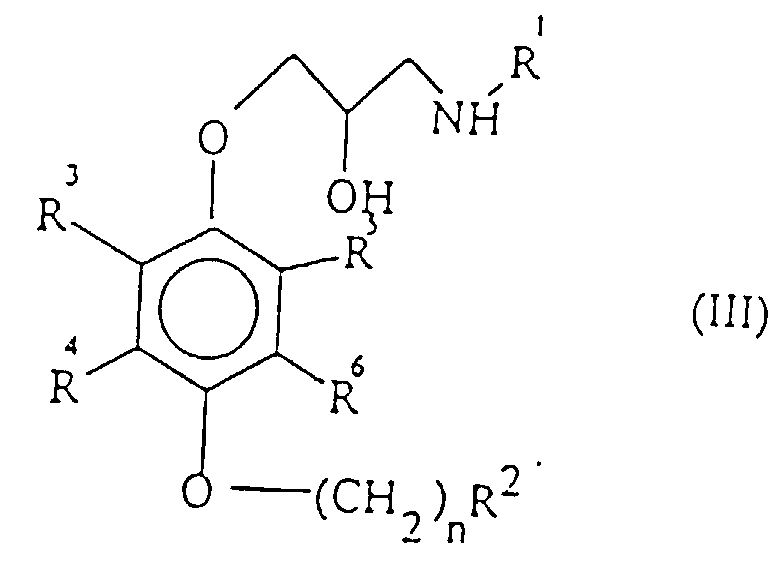
- halogenated derivatives of formula (III) with R 2 representing O (CH 2 ) 2 X can be prepared by reaction of a compound of formula: with a compound of formula: Cl (CH 2 ) n OCH 2 CH 2 OH
- Compound 16 can also be prepared by the following scheme, in which the amine function is first protected in the form of the carbamate.
- One of the best methods of obtaining vinyl iodides is to use a stannic derivative. This easily undergoes destannylation in the presence of iodine, iodine chloride or iodosuccinimide for example.
- the electrophilic substitution which occurs does not modify the stereochemistry around the double bond: the halogen simply replaces the group R 3 Sn.
- This halogenation method is also applicable to the preparation of radioiodinated compounds with high specific activity; this is particularly advantageous by allowing the use of low doses during biological tests.
- halogenated derivatives of the invention are more interesting than the halogenated derivatives described in the prior art because they have good affinity for ⁇ -adrenergic receptors with high specificity, improved hydrophilicity by compared to the iodine derivatives of practolol containing a aromatic cycle on which the iodine atom is fixed, and good in vivo stability due to the fixation of the halogen atom on an unsaturated or ⁇ carbon of a oxygen atom.
- derivatives halogens of the invention can be used as ⁇ blockers when they contain a non-halogen atom radioactive, or as markers, for the study of in vivo ⁇ -adrenergic receptors, for example to count these receptors, when they include a radioactive isotope of a halogen.
- the halogenated derivative of the invention either in the form of mixtures (R, S), or in the form of pure enantiomer.
- Examples 1 to 6 illustrate the synthesis of 1- [4- (4-iodobut-3-enamido) phenoxy] -3-N-isopropylaminopropan-2-ol, in accordance with the following reaction scheme:
- Example 7 illustrates the preparation of the halogenated derivative (compound No. 6) labeled with iodine 123 I.
- Examples 8 to 12 illustrate the properties and the results obtained with compound No. 6 of Example 6, marked with 123 I.
- a solution of 8.31 g (2.06.10 -2 mol) of compound n ° 1 in 150 ml of CH 2 Cl 2 is introduced into a 250 ml flask and the temperature is lowered to 0 ° C.
- a solution of 3.35 g (2.06.10 -2 mol) of iodine monochloride in 50 ml of CH 2 Cl 2 is then added by an isobaric bulb. During the addition (rapid drop by drop) the iodine chloride solution instantly discolours.
- TLC Thin layer chromatography
- the signal intensity ratio between 6.20 and 6.31 ppm to that of the others signals between 6.45-6.59 and at 6.08 and 6.15 ppm is 19/81.
- the ratio of the signals located at 3.69 and 3.68 ppm is at 25/75.
- the yield is 97.5%.
- Example 7 Marking of compound n ° 6 with iodine 123 .
- the exchange is carried out on 4 mg of compound No. 6 using 1 ml of acetone and 4 ⁇ g of K 123 I, at 170 ° C for 2 hours.
- a radioactive compound is thus obtained stable which presents the partition coefficients octanol-water at room temperature given in the Table 1 below.
- Compound 6 is therefore less hydrophobic than propranolol.
- the affinity of the compound 6 labeled with 123 I is tested for ⁇ -adrenergic receptors.
- [ 3 H] CGP 12177 occupies all the ⁇ -adrenergic receptors of cardiomyocytes.
- the concentration of propranolol necessary to inhibit 50% (IC 50) of this fixation is 1.9.10 -7 M.
- the IC50 of atenolol ( ⁇ hydrophilic blocker) is 1.9.10 -5 M.
- Compound 6 has an IC50 of 2.0.10 -6 M.
- the experiment is conducted on a rat heart isolated and perfused according to the Langendorff technique.
- the heart is perfused with isoprenaline at a concentration of 10 -8 M for 10 minutes; then with a 10 -8 M isoprenaline solution associated with the molecule to be tested at a concentration of 10 -6 M.
- the contractility of the heart assessed by measuring the maximum dP / dt, increases with isoprenaline alone by 254% compared to the pre-infusion, then returns to the basal value when propranolol is perfused at 10 -6 M.
- n the number of experiences.
- the fate of radioactivity is monitored by external detection with a gamma camera, for 60 minutes.
- the computer system for processing the image makes it possible to appreciate the radioactivity present in previously selected areas.
- the measure of this activity is expressed in cpm / pixel.mCi.
- Radioactivity in the blood is measured by taking and counting samples. The results are given in table 6 which follows.
- Examples 8 to 12 show that the compound 6 labeled with 123 I is a marker for ⁇ -adrenergic receptors whose affinity is close to that of propranolol, but whose hydrophobicity is lower. This compound antagonizes the effect of isoprenaline on isolated and perfused heart of rat in the same way as propranolol.
- cardiac activity is constant from the 45th minute.
- the injection of a small amount of timolol leads to a decrease of the cardiac activity detected from 60 to 67% from the 45 th minute. This indicates an important specific cardiac fixation.
- the compounds of the invention are therefore very interesting as markers for ⁇ receptors -adrenergic.
- a first elution carried out using ether or ethyl acetate in the presence of ammonia (0.1%) makes it possible to remove the excess of tributyltin hydride.
- the eluent used in TLC then makes it possible to recover 1.99 g of compound 9 (62%) in the form of a thick yellow oil.
- CGP12177 being the reference, a batch of mice was studied after injection of CGP 12177 labeled with tritium. Results Biodistribution of [ 3 H] CGP12177 (reference) Time 1 min. 2 min. 5 min. 10 minutes. Heart 9 ⁇ 1.4 7.2 ⁇ 0.9 7.0 ⁇ 1 6.7 ⁇ 1.3 Lung 66.3 ⁇ 9.2 44.3 ⁇ 8.6 37.9 ⁇ 9.3 42 ⁇ 8.5
Landscapes
- Chemical & Material Sciences (AREA)
- Organic Chemistry (AREA)
- Health & Medical Sciences (AREA)
- Life Sciences & Earth Sciences (AREA)
- Epidemiology (AREA)
- Veterinary Medicine (AREA)
- Public Health (AREA)
- General Health & Medical Sciences (AREA)
- Animal Behavior & Ethology (AREA)
- Physics & Mathematics (AREA)
- Pharmacology & Pharmacy (AREA)
- Optics & Photonics (AREA)
- Medicinal Chemistry (AREA)
- Proteomics, Peptides & Aminoacids (AREA)
- Organic Low-Molecular-Weight Compounds And Preparation Thereof (AREA)
- Acyclic And Carbocyclic Compounds In Medicinal Compositions (AREA)
Claims (21)
- Halogenderivat von 1-Phenoxy-3-N-alkyl-aminopropan-2-ol der Formelworin bedeuten:

- R1
- eine Alkylgruppe, eine Arylgruppe, eine Aralkylgruppe, die an ihrem Aryl-Teil gegebenenfalls durch Alkyl- oder Alkoxygruppen substituiert ist, oder eine Gruppe -CH2-CH2-Y1-R8, worin Y1 für O, S, NHCO, CONH oder NHCONH und R8 für eine gegebenenfalls substituierte Alkyl- oder Arylgruppe stehen,
- R2
- eine Gruppe mit einer der folgenden Formeln
- CH = CHX
- C ≡ CX
- O-(CH2)2X
- OCH2CH = CHX
- R3, R4, R5 und R6,
- die gleich oder verschieden sein können, ein Wasserstoffatom, ein Halogenatom, eine gesättigte oder ungesättigte Kohlenwasserstoffgruppe, eine Arylgruppe, OH, CN, NH2 oder eine Gruppe der Formel NHR, NR2, COR, CONHR oder COOR, worin R für eine gegebenenfalls substituierte Alkyl- oder Arylgruppe steht,
- R7
- O oder NHCO und
- n
- die Zahl 0, 1 oder 2.
- Derivat nach Anspruch 1, in dem das Kohlenstoffatom, das die OH-Gruppe trägt, in der Konfiguration R oder S oder R,S in variablen Mengenan-teilen vorliegt.
- Derivate nach einem der Ansprüche 1 und 2, dadurch gekennzeichnet, daß es der Formel entsprichtin der n, R1, R3, R4, R5 und R6 wie in Anspruch 1 definiert sind und R2 für CH=CHI steht.

- Derivat nach einem der Ansprüche 1 und 2, dadurch gekennzeichnet, daß es der Formel entsprichtin der n, R1, R3, R4, R5 und R6 wie in Anspruch 1 definiert sind und R2 für die Gruppe O-(CH2)2-I, O-(CH2)2Cℓ oder OCH2CH=CHI steht.
- Derivat nach einem der Ansprüche 1 bis 4, dadurch gekennzeichnet, daß R1 für die Isopropyl-Gruppe steht.
- Derivat nach einem der Ansprüche 1 bis 5, dadurch gekennzeichnet, daß X für I oder Cℓ steht.
- Derivat nach einem der Ansprüche 1 bis 5, dadurch gekennzeichnet, daß X für 123I, 125I oder 131I steht.
- 1-[4-(4-lodobut-3-enamido)phenoxy]-3-N-isopropylaminopropan-2-ol.
- 1-[4-(5-lodo-2-oxapent-4-enyloxy)phenoxy]-3-isopropylaminopropan-2-ol.
- 1-[4-(2-lodoethylenamido)phenoxy]-3-isopropylaminopropan-2-ol.
- 1-{4-(2-(2-Iodoethoxy)ethoxy]phenoxy}-3-isopropyl-aminopropan-2-ol.
- Derivat nach einem der Ansprüche 8 bis 11, dadurch gekennzeichnet, daß es sich bei dem lod um 123I, 125I oder 131I handelt.
- Verfahren zur Herstellung eines Halogenderivats der Formelworin R1 die in Anspruch 1 angegebene Bedeutung hat, R2 für -CH=CHX oder -C≡CX steht, wobei X ein nicht radioaktives Halogenatom bedeutet, und n für die Zahl 0, 1 oder 2 steht,

dadurch gekennzeichnet, daß es umfaßt:a) die Umsetzung eines 4-Aminophenols mit einer Säure der Formel R2-(CH2)n-COOH zur Bildung eines Amids der Formel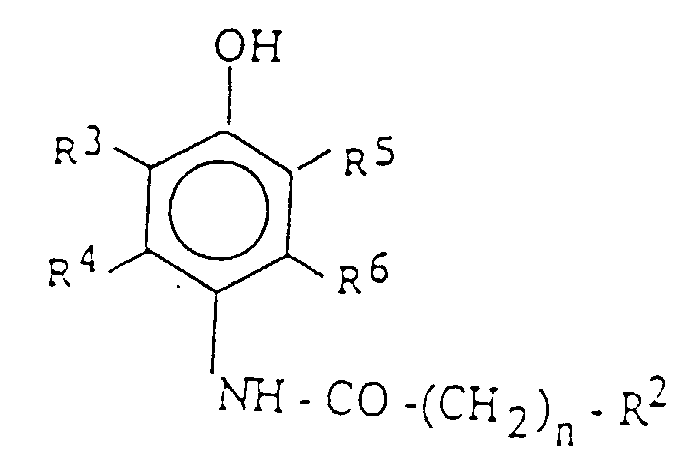 b) die Glycidylierung des auf diese Weise erhaltenen Amids durch Umsetzung mit dem Glycidyltosylat zur Bildung eines Epoxids der Formel
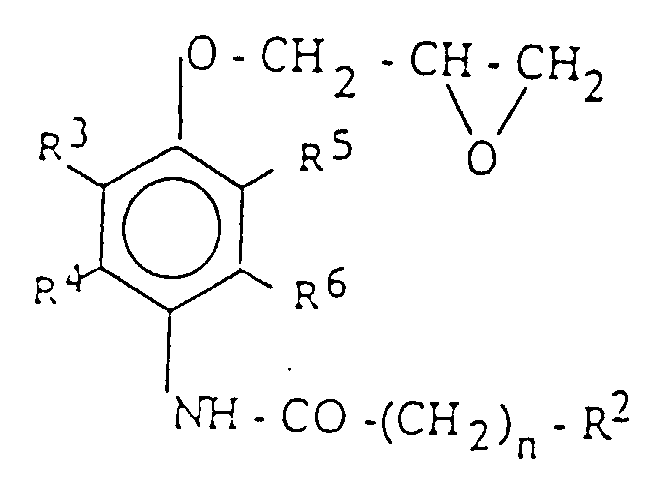 c) die Umsetzung des Epoxids mit einem Amin der Formel R1NH2 zur Bildung des Halogenderivats der Formel (II).
 - Verfahren nach Anspruch 13, dadurch gekennzeichnet, daß das in der Stufe (b) verwendete Glycidyltosylat in der R- oder S- oder R,S-Konfiguration vorliegt.
- Verfahren nach einem der Ansprüche 13 und 14, dadurch gekennzeichnet, daß es eine zusätzliche Stufe zum Austausch des Halogenatoms X gegen das gleiche radioaktive Halogenatom X umfaßt.
- Verfahren nach einem der Ansprüche 13 und 14, dadurch gekennzeichnet, daß man die Säure der Formel R2-(CH2)n-COOH, worin R2 für CH=CHI steht, herstellt durch Umsetzung eines Methylesters der Formel
- Pharmazeutische Zusammensetzung, dadurch gekennzeichnet, daß sie ein Halogenderivat von 1-Phenoxy-3-N-alkyl-aminopropan-2-ol nach einem der Ansprüche 1 bis 6 und 8 bis 11 enthält.
- Pharmazeutische Zusammensetzung nach Anspruch 17, in der das Halogenderivat ein β-Blocker ist.
- Radiopharmazeutische Zusammensetzung, dadurch gekennzeichnet, daß sie ein Halogenderivat von 1-Phenoxy-3-N-alkyl-aminopropan-2-ol nach einem der Ansprüche 1 bis 5, 7 und 12 enthält, in dem das Halogenatom ein radioaktives Halogenatom ist.
- Zusammensetzung nach Anspruch 19 für die bildliche Darstellung in der Medizin.
- Zusammensetzung nach Anspruch 19 für die Sichtbarmachung von β-adrenergischen Rezeptoren.
Applications Claiming Priority (3)
| Application Number | Priority Date | Filing Date | Title |
|---|---|---|---|
| FR9408092A FR2721925B1 (fr) | 1994-06-30 | 1994-06-30 | Derives halogenes de 1-phenoxy-3-n-alky-laminopropan-2 ol utilisables comme marqueurs des recepteurss b adrenergiques myocardiques et comme (b-bloquant) |
| FR9408092 | 1994-06-30 | ||
| PCT/FR1995/000870 WO1996000717A1 (fr) | 1994-06-30 | 1995-06-29 | DERIVES HALOGENES DE 1-PHENOXY-3-N ALKYLAMINOPROPAN-2-OL UTILISABLES COMME MARQUEURS DES RECEPTEURS β ADRENERGIQUES MYOCARDIQUES ET COMME (β-BLOQUANT) |
Publications (2)
| Publication Number | Publication Date |
|---|---|
| EP0767778A1 EP0767778A1 (de) | 1997-04-16 |
| EP0767778B1 true EP0767778B1 (de) | 1998-12-16 |
Family
ID=9464856
Family Applications (1)
| Application Number | Title | Priority Date | Filing Date |
|---|---|---|---|
| EP95924384A Expired - Lifetime EP0767778B1 (de) | 1994-06-30 | 1995-06-29 | 1-phenoxy-3-n-alkylaminopropan-2-ol halogenierte derivate als marker für beta-adrenerge herzmuskelrezeptoren sowie als betablocker |
Country Status (5)
| Country | Link |
|---|---|
| EP (1) | EP0767778B1 (de) |
| AT (1) | ATE174585T1 (de) |
| DE (1) | DE69506709T2 (de) |
| FR (1) | FR2721925B1 (de) |
| WO (1) | WO1996000717A1 (de) |
Families Citing this family (2)
| Publication number | Priority date | Publication date | Assignee | Title |
|---|---|---|---|---|
| DE10127835A1 (de) * | 2001-06-08 | 2003-01-30 | Rossendorf Forschzent | Radioaktiv markierte 3-0-Methyl-6-halogen-L-DOPA-Verbindung und deren Verwendung zur Diagnose und Therapie von Tumoren sowie Verfahren zu ihrer Herstellung |
| EP2268320A4 (de) * | 2008-03-24 | 2014-10-01 | Univ Texas | Bildgeführte therapie von myokard-erkrankung: zusammensetzung, herstellung und anwendungen |
-
1994
- 1994-06-30 FR FR9408092A patent/FR2721925B1/fr not_active Expired - Fee Related
-
1995
- 1995-06-29 AT AT95924384T patent/ATE174585T1/de not_active IP Right Cessation
- 1995-06-29 WO PCT/FR1995/000870 patent/WO1996000717A1/fr not_active Ceased
- 1995-06-29 EP EP95924384A patent/EP0767778B1/de not_active Expired - Lifetime
- 1995-06-29 DE DE69506709T patent/DE69506709T2/de not_active Expired - Fee Related
Also Published As
| Publication number | Publication date |
|---|---|
| FR2721925A1 (fr) | 1996-01-05 |
| FR2721925B1 (fr) | 1996-08-30 |
| EP0767778A1 (de) | 1997-04-16 |
| DE69506709D1 (de) | 1999-01-28 |
| ATE174585T1 (de) | 1999-01-15 |
| DE69506709T2 (de) | 1999-06-24 |
| WO1996000717A1 (fr) | 1996-01-11 |
Similar Documents
| Publication | Publication Date | Title |
|---|---|---|
| US9238631B2 (en) | Radiolabeled amino acids for diagnostic imaging | |
| EP3003399B1 (de) | Neuartige chemische verbindungen aus normemantin und verwendung davon im medizinischen bereich | |
| EP0458886B1 (de) | Mittel für die diagnose und die behandlung der melanomen, halogenierte, aromatische derivate, verwendbar als solche mittel und ihre herstellung | |
| EP0354094A1 (de) | Indolon-Derivate, Verfahren zu ihrer Herstellung und ihre therapeutische Verwendung | |
| JP3839049B2 (ja) | メタ位置換のアリルアルキルアミン類ならびに治療および診断のためのその使用 | |
| WO1996000717A1 (fr) | DERIVES HALOGENES DE 1-PHENOXY-3-N ALKYLAMINOPROPAN-2-OL UTILISABLES COMME MARQUEURS DES RECEPTEURS β ADRENERGIQUES MYOCARDIQUES ET COMME (β-BLOQUANT) | |
| EP0069648B1 (de) | Verfahren zur extemporierten Herstellung einer mit radioaktivem Jod markierten injizierbaren Fettsäure und Herstellung von in der Ausführung dieses Verfahrens brauchbaren jodierten Derivaten | |
| EP0351255A2 (de) | 2-[(4-Piperidinyl)methyl]-1,2,3,4-tetrahydroisochinolin-Derivate, ihre Herstellung und ihre therapeutische Verwendung | |
| WO2020103392A1 (zh) | 一种以7-脱氮腺嘌呤碱基为母核的18f-pet/ct示踪剂及其制备方法 | |
| FR2534576A1 (fr) | Composition contenant des cations lipophiles a marquage radioactif, destinee a la formation de l'image radiographique du myocarde | |
| EP3655397B1 (de) | Lipophile makrocyclische liganden, komplexe davon und verwendungen davon | |
| US9345791B2 (en) | Ligands for targeting of S1P receptors for in vivo imaging and treatment of diseases | |
| CA2155849A1 (fr) | Nouveaux derives heterocycliques de l'aminomethyl-4 piperidine, leur preparation et leur application en therapeutique | |
| FR2645532A1 (fr) | Composes ammonium quaternaire ayant une activite myorelaxante et leur procede de preparation | |
| FR3068695A1 (fr) | Composes utiles comme agent d'imagerie de l'hypoxie | |
| EP0143711A2 (de) | Derivate von N-(Methoxyphenacyl)aminen, ihre therapeutische Verwendung und Verfahren zu ihrer Herstellung | |
| US20040087567A1 (en) | Diaminedithiol derivatives and radiorhenium or radiotechnetium complex thereof; a liver cancer-treating composition comprising the radiorhenium complex and lipiodol; and a kit for preparation of the liver cancer-treating composition | |
| CA3165028A1 (en) | Fatty acid derivative labeled with positron-emitting radionuclide | |
| FR2503150A1 (fr) | Mercaptoacyl-carnitines, procede pour leur preparation et leurs utilisations therapeutiques dans le traitement des intoxications et des brulures et en tant qu'agents mucolytiques | |
| OHMOMO et al. | Synthesis of [125I] iodoclorgyline, a selective monoamine oxidase A inhibitor, and its biodistribution in mice | |
| LU88383A1 (fr) | Dérivés de la N-(phényléthyl- 01) amine, un procédé pour leur preparation et des compositions thérapeutiques les contenant | |
| CN113301926A (zh) | 靶向去甲肾上腺素转运蛋白的化合物 | |
| FR2499559A1 (fr) | Nouveaux derives de l'acide 2-hydroxy-5-(2',4'-difluorophenyl)-benzoique, leurs procedes de preparation, leur utilisation comme agent pharmacologiquement actif et les compositions pharmaceutiques les contenant | |
| EP4247437A1 (de) | Radioaktiv markierte verbindungen zur diagnose von cholinergen neurodegenerativen erkrankungen | |
| JPS5946264A (ja) | 分子中にキレ−ト形成基とアミノ基またはアルキルアミノ基を有する新規化合物 |
Legal Events
| Date | Code | Title | Description |
|---|---|---|---|
| PUAI | Public reference made under article 153(3) epc to a published international application that has entered the european phase |
Free format text: ORIGINAL CODE: 0009012 |
|
| 17P | Request for examination filed |
Effective date: 19961028 |
|
| AK | Designated contracting states |
Kind code of ref document: A1 Designated state(s): AT BE CH DE DK ES FR GB GR IT LI LU NL SE |
|
| GRAG | Despatch of communication of intention to grant |
Free format text: ORIGINAL CODE: EPIDOS AGRA |
|
| 17Q | First examination report despatched |
Effective date: 19980123 |
|
| GRAG | Despatch of communication of intention to grant |
Free format text: ORIGINAL CODE: EPIDOS AGRA |
|
| GRAG | Despatch of communication of intention to grant |
Free format text: ORIGINAL CODE: EPIDOS AGRA |
|
| GRAH | Despatch of communication of intention to grant a patent |
Free format text: ORIGINAL CODE: EPIDOS IGRA |
|
| GRAH | Despatch of communication of intention to grant a patent |
Free format text: ORIGINAL CODE: EPIDOS IGRA |
|
| GRAA | (expected) grant |
Free format text: ORIGINAL CODE: 0009210 |
|
| AK | Designated contracting states |
Kind code of ref document: B1 Designated state(s): AT BE CH DE DK ES FR GB GR IT LI LU NL SE |
|
| PG25 | Lapsed in a contracting state [announced via postgrant information from national office to epo] |
Ref country code: IT Free format text: LAPSE BECAUSE OF FAILURE TO SUBMIT A TRANSLATION OF THE DESCRIPTION OR TO PAY THE FEE WITHIN THE PRE;WARNING: LAPSES OF ITALIAN PATENTS WITH EFFECTIVE DATE BEFORE 2007 MAY HAVE OCCURRED AT ANY TIME BEFORE 2007. THE CORRECT EFFECTIVE DATE MAY BE DIFFERENT FROM THE ONE RECORDED.SCRIBED TIME-LIMIT Effective date: 19981216 Ref country code: GR Free format text: LAPSE BECAUSE OF NON-PAYMENT OF DUE FEES Effective date: 19981216 Ref country code: ES Free format text: THE PATENT HAS BEEN ANNULLED BY A DECISION OF A NATIONAL AUTHORITY Effective date: 19981216 Ref country code: AT Free format text: LAPSE BECAUSE OF FAILURE TO SUBMIT A TRANSLATION OF THE DESCRIPTION OR TO PAY THE FEE WITHIN THE PRESCRIBED TIME-LIMIT Effective date: 19981216 |
|
| REF | Corresponds to: |
Ref document number: 174585 Country of ref document: AT Date of ref document: 19990115 Kind code of ref document: T |
|
| REG | Reference to a national code |
Ref country code: CH Ref legal event code: EP |
|
| REF | Corresponds to: |
Ref document number: 69506709 Country of ref document: DE Date of ref document: 19990128 |
|
| GBT | Gb: translation of ep patent filed (gb section 77(6)(a)/1977) |
Effective date: 19990217 |
|
| PG25 | Lapsed in a contracting state [announced via postgrant information from national office to epo] |
Ref country code: SE Free format text: LAPSE BECAUSE OF FAILURE TO SUBMIT A TRANSLATION OF THE DESCRIPTION OR TO PAY THE FEE WITHIN THE PRESCRIBED TIME-LIMIT Effective date: 19990316 Ref country code: DK Free format text: LAPSE BECAUSE OF FAILURE TO SUBMIT A TRANSLATION OF THE DESCRIPTION OR TO PAY THE FEE WITHIN THE PRESCRIBED TIME-LIMIT Effective date: 19990316 |
|
| PG25 | Lapsed in a contracting state [announced via postgrant information from national office to epo] |
Ref country code: LU Free format text: LAPSE BECAUSE OF NON-PAYMENT OF DUE FEES Effective date: 19990629 Ref country code: GB Free format text: LAPSE BECAUSE OF NON-PAYMENT OF DUE FEES Effective date: 19990629 |
|
| PG25 | Lapsed in a contracting state [announced via postgrant information from national office to epo] |
Ref country code: LI Free format text: LAPSE BECAUSE OF NON-PAYMENT OF DUE FEES Effective date: 19990630 Ref country code: CH Free format text: LAPSE BECAUSE OF NON-PAYMENT OF DUE FEES Effective date: 19990630 |
|
| PLBE | No opposition filed within time limit |
Free format text: ORIGINAL CODE: 0009261 |
|
| STAA | Information on the status of an ep patent application or granted ep patent |
Free format text: STATUS: NO OPPOSITION FILED WITHIN TIME LIMIT |
|
| 26N | No opposition filed | ||
| PG25 | Lapsed in a contracting state [announced via postgrant information from national office to epo] |
Ref country code: NL Free format text: LAPSE BECAUSE OF NON-PAYMENT OF DUE FEES Effective date: 20000101 |
|
| REG | Reference to a national code |
Ref country code: FR Ref legal event code: TP |
|
| REG | Reference to a national code |
Ref country code: CH Ref legal event code: PL |
|
| GBPC | Gb: european patent ceased through non-payment of renewal fee |
Effective date: 19990629 |
|
| NLV4 | Nl: lapsed or anulled due to non-payment of the annual fee |
Effective date: 20000101 |
|
| PGFP | Annual fee paid to national office [announced via postgrant information from national office to epo] |
Ref country code: FR Payment date: 20060627 Year of fee payment: 12 Ref country code: DE Payment date: 20060627 Year of fee payment: 12 |
|
| PGFP | Annual fee paid to national office [announced via postgrant information from national office to epo] |
Ref country code: BE Payment date: 20060817 Year of fee payment: 12 |
|
| BERE | Be: lapsed |
Owner name: L'UNIVERSITE JOSEPH *FOURIER (GRENOBLE 1) Effective date: 20070630 |
|
| PG25 | Lapsed in a contracting state [announced via postgrant information from national office to epo] |
Ref country code: BE Free format text: LAPSE BECAUSE OF NON-PAYMENT OF DUE FEES Effective date: 20070630 |
|
| REG | Reference to a national code |
Ref country code: FR Ref legal event code: ST Effective date: 20080229 |
|
| PG25 | Lapsed in a contracting state [announced via postgrant information from national office to epo] |
Ref country code: DE Free format text: LAPSE BECAUSE OF NON-PAYMENT OF DUE FEES Effective date: 20080101 |
|
| PG25 | Lapsed in a contracting state [announced via postgrant information from national office to epo] |
Ref country code: FR Free format text: LAPSE BECAUSE OF NON-PAYMENT OF DUE FEES Effective date: 20070702 |