EP0764690B1 - Lichtinitiiert kationisch härtende, dauerflexible Epoxidharzmasse und ihre Verwendung - Google Patents
Lichtinitiiert kationisch härtende, dauerflexible Epoxidharzmasse und ihre Verwendung Download PDFInfo
- Publication number
- EP0764690B1 EP0764690B1 EP96110294A EP96110294A EP0764690B1 EP 0764690 B1 EP0764690 B1 EP 0764690B1 EP 96110294 A EP96110294 A EP 96110294A EP 96110294 A EP96110294 A EP 96110294A EP 0764690 B1 EP0764690 B1 EP 0764690B1
- Authority
- EP
- European Patent Office
- Prior art keywords
- mass
- composition
- parts
- component
- masses
- Prior art date
- Legal status (The legal status is an assumption and is not a legal conclusion. Google has not performed a legal analysis and makes no representation as to the accuracy of the status listed.)
- Expired - Lifetime
Links
- 229920000647 polyepoxide Polymers 0.000 title claims abstract description 32
- 239000003822 epoxy resin Substances 0.000 title claims abstract description 29
- 239000000203 mixture Substances 0.000 title claims description 53
- 229920005862 polyol Polymers 0.000 claims abstract description 19
- 150000003077 polyols Chemical class 0.000 claims abstract description 18
- -1 epoxide compounds Chemical class 0.000 claims abstract description 13
- 150000001450 anions Chemical class 0.000 claims abstract description 8
- 239000000945 filler Substances 0.000 claims abstract description 6
- 150000003839 salts Chemical class 0.000 claims abstract description 6
- 229920002554 vinyl polymer Polymers 0.000 claims abstract description 6
- DHKHKXVYLBGOIT-UHFFFAOYSA-N acetaldehyde Diethyl Acetal Natural products CCOC(C)OCC DHKHKXVYLBGOIT-UHFFFAOYSA-N 0.000 claims abstract description 4
- 239000008139 complexing agent Substances 0.000 claims abstract description 4
- 239000003381 stabilizer Substances 0.000 claims abstract description 4
- 239000002562 thickening agent Substances 0.000 claims abstract description 4
- 239000003999 initiator Substances 0.000 claims abstract description 3
- 230000001590 oxidative effect Effects 0.000 claims abstract description 3
- 125000002777 acetyl group Chemical class [H]C([H])([H])C(*)=O 0.000 claims abstract 2
- 150000001875 compounds Chemical class 0.000 claims description 19
- 125000003700 epoxy group Chemical group 0.000 claims description 11
- 150000002009 diols Chemical class 0.000 claims description 10
- 239000005062 Polybutadiene Substances 0.000 claims description 8
- 229920002857 polybutadiene Polymers 0.000 claims description 8
- 229920005906 polyester polyol Polymers 0.000 claims description 8
- 238000005266 casting Methods 0.000 claims description 7
- 239000011248 coating agent Substances 0.000 claims description 6
- 238000000576 coating method Methods 0.000 claims description 6
- 229920000515 polycarbonate Polymers 0.000 claims description 6
- 239000004417 polycarbonate Substances 0.000 claims description 6
- BOXSCYUXSBYGRD-UHFFFAOYSA-N cyclopenta-1,3-diene;iron(3+) Chemical class [Fe+3].C=1C=C[CH-]C=1.C=1C=C[CH-]C=1 BOXSCYUXSBYGRD-UHFFFAOYSA-N 0.000 claims description 5
- 125000002947 alkylene group Chemical group 0.000 claims description 4
- 239000000975 dye Substances 0.000 claims description 4
- 239000003607 modifier Substances 0.000 claims description 4
- 238000007789 sealing Methods 0.000 claims description 4
- 239000000758 substrate Substances 0.000 claims description 4
- FRIBMENBGGCKPD-UHFFFAOYSA-N 3-(2,3-dimethoxyphenyl)prop-2-enal Chemical compound COC1=CC=CC(C=CC=O)=C1OC FRIBMENBGGCKPD-UHFFFAOYSA-N 0.000 claims description 3
- 239000002253 acid Substances 0.000 claims description 3
- 150000002432 hydroperoxides Chemical class 0.000 claims description 3
- 229920002451 polyvinyl alcohol Polymers 0.000 claims description 3
- 239000002841 Lewis acid Substances 0.000 claims description 2
- 239000004372 Polyvinyl alcohol Substances 0.000 claims description 2
- 150000007513 acids Chemical class 0.000 claims description 2
- 125000000732 arylene group Chemical group 0.000 claims description 2
- 150000007517 lewis acids Chemical class 0.000 claims description 2
- PVEOYINWKBTPIZ-UHFFFAOYSA-N but-3-enoic acid Chemical group OC(=O)CC=C PVEOYINWKBTPIZ-UHFFFAOYSA-N 0.000 claims 1
- 239000000463 material Substances 0.000 abstract description 4
- 239000013008 thixotropic agent Substances 0.000 abstract description 4
- 239000000049 pigment Substances 0.000 abstract description 3
- 230000000269 nucleophilic effect Effects 0.000 abstract 1
- 238000002360 preparation method Methods 0.000 description 23
- 238000012360 testing method Methods 0.000 description 10
- 238000003860 storage Methods 0.000 description 8
- 239000004593 Epoxy Substances 0.000 description 7
- LNEPOXFFQSENCJ-UHFFFAOYSA-N haloperidol Chemical compound C1CC(O)(C=2C=CC(Cl)=CC=2)CCN1CCCC(=O)C1=CC=C(F)C=C1 LNEPOXFFQSENCJ-UHFFFAOYSA-N 0.000 description 7
- KAKZBPTYRLMSJV-UHFFFAOYSA-N Butadiene Chemical compound C=CC=C KAKZBPTYRLMSJV-UHFFFAOYSA-N 0.000 description 6
- 238000004026 adhesive bonding Methods 0.000 description 6
- 125000003118 aryl group Chemical group 0.000 description 6
- 238000004519 manufacturing process Methods 0.000 description 6
- 230000009257 reactivity Effects 0.000 description 6
- 125000002887 hydroxy group Chemical group [H]O* 0.000 description 5
- 229920000570 polyether Polymers 0.000 description 5
- 229920005989 resin Polymers 0.000 description 5
- 239000011347 resin Substances 0.000 description 5
- 150000001241 acetals Chemical class 0.000 description 4
- 239000011521 glass Substances 0.000 description 4
- 238000000034 method Methods 0.000 description 4
- WSFSSNUMVMOOMR-UHFFFAOYSA-N Formaldehyde Chemical compound O=C WSFSSNUMVMOOMR-UHFFFAOYSA-N 0.000 description 3
- XEEYBQQBJWHFJM-UHFFFAOYSA-N Iron Chemical compound [Fe] XEEYBQQBJWHFJM-UHFFFAOYSA-N 0.000 description 3
- MUBZPKHOEPUJKR-UHFFFAOYSA-N Oxalic acid Chemical compound OC(=O)C(O)=O MUBZPKHOEPUJKR-UHFFFAOYSA-N 0.000 description 3
- 239000004721 Polyphenylene oxide Substances 0.000 description 3
- 239000000853 adhesive Substances 0.000 description 3
- 230000001070 adhesive effect Effects 0.000 description 3
- 230000000694 effects Effects 0.000 description 3
- 229910052751 metal Inorganic materials 0.000 description 3
- 239000002184 metal Substances 0.000 description 3
- 238000002156 mixing Methods 0.000 description 3
- 229920003023 plastic Polymers 0.000 description 3
- 239000004033 plastic Substances 0.000 description 3
- 229920001610 polycaprolactone Polymers 0.000 description 3
- 229920000642 polymer Polymers 0.000 description 3
- 238000004382 potting Methods 0.000 description 3
- 230000009467 reduction Effects 0.000 description 3
- 238000003756 stirring Methods 0.000 description 3
- NLHHRLWOUZZQLW-UHFFFAOYSA-N Acrylonitrile Chemical compound C=CC#N NLHHRLWOUZZQLW-UHFFFAOYSA-N 0.000 description 2
- ZTQSAGDEMFDKMZ-UHFFFAOYSA-N Butyraldehyde Chemical compound CCCC=O ZTQSAGDEMFDKMZ-UHFFFAOYSA-N 0.000 description 2
- PPBRXRYQALVLMV-UHFFFAOYSA-N Styrene Chemical compound C=CC1=CC=CC=C1 PPBRXRYQALVLMV-UHFFFAOYSA-N 0.000 description 2
- 150000001412 amines Chemical class 0.000 description 2
- 125000003178 carboxy group Chemical group [H]OC(*)=O 0.000 description 2
- 150000001768 cations Chemical class 0.000 description 2
- 238000006243 chemical reaction Methods 0.000 description 2
- 239000003795 chemical substances by application Substances 0.000 description 2
- 229920001577 copolymer Polymers 0.000 description 2
- RWGFKTVRMDUZSP-UHFFFAOYSA-N cumene Chemical compound CC(C)C1=CC=CC=C1 RWGFKTVRMDUZSP-UHFFFAOYSA-N 0.000 description 2
- 235000013312 flour Nutrition 0.000 description 2
- 238000010438 heat treatment Methods 0.000 description 2
- 238000000265 homogenisation Methods 0.000 description 2
- 125000004435 hydrogen atom Chemical group [H]* 0.000 description 2
- 150000002739 metals Chemical class 0.000 description 2
- 150000002894 organic compounds Chemical class 0.000 description 2
- 239000004632 polycaprolactone Substances 0.000 description 2
- 229920000728 polyester Polymers 0.000 description 2
- 238000006116 polymerization reaction Methods 0.000 description 2
- 235000019422 polyvinyl alcohol Nutrition 0.000 description 2
- 238000011417 postcuring Methods 0.000 description 2
- 230000008569 process Effects 0.000 description 2
- 150000004756 silanes Chemical class 0.000 description 2
- 239000007787 solid Substances 0.000 description 2
- 125000001424 substituent group Chemical group 0.000 description 2
- 238000009864 tensile test Methods 0.000 description 2
- 239000005725 8-Hydroxyquinoline Substances 0.000 description 1
- 239000007848 Bronsted acid Substances 0.000 description 1
- KCXVZYZYPLLWCC-UHFFFAOYSA-N EDTA Chemical class OC(=O)CN(CC(O)=O)CCN(CC(O)=O)CC(O)=O KCXVZYZYPLLWCC-UHFFFAOYSA-N 0.000 description 1
- LFQSCWFLJHTTHZ-UHFFFAOYSA-N Ethanol Chemical compound CCO LFQSCWFLJHTTHZ-UHFFFAOYSA-N 0.000 description 1
- OAKJQQAXSVQMHS-UHFFFAOYSA-N Hydrazine Chemical class NN OAKJQQAXSVQMHS-UHFFFAOYSA-N 0.000 description 1
- GWEVSGVZZGPLCZ-UHFFFAOYSA-N Titan oxide Chemical compound O=[Ti]=O GWEVSGVZZGPLCZ-UHFFFAOYSA-N 0.000 description 1
- RTAQQCXQSZGOHL-UHFFFAOYSA-N Titanium Chemical compound [Ti] RTAQQCXQSZGOHL-UHFFFAOYSA-N 0.000 description 1
- 230000002745 absorbent Effects 0.000 description 1
- 239000002250 absorbent Substances 0.000 description 1
- 238000010521 absorption reaction Methods 0.000 description 1
- 238000006359 acetalization reaction Methods 0.000 description 1
- 150000001298 alcohols Chemical class 0.000 description 1
- 239000004844 aliphatic epoxy resin Substances 0.000 description 1
- 125000001931 aliphatic group Chemical group 0.000 description 1
- 125000000217 alkyl group Chemical group 0.000 description 1
- 229910052782 aluminium Inorganic materials 0.000 description 1
- XAGFODPZIPBFFR-UHFFFAOYSA-N aluminium Chemical compound [Al] XAGFODPZIPBFFR-UHFFFAOYSA-N 0.000 description 1
- 150000008064 anhydrides Chemical class 0.000 description 1
- 125000004429 atom Chemical group 0.000 description 1
- 230000008901 benefit Effects 0.000 description 1
- 230000001588 bifunctional effect Effects 0.000 description 1
- 230000015572 biosynthetic process Effects 0.000 description 1
- 150000001244 carboxylic acid anhydrides Chemical class 0.000 description 1
- 125000002091 cationic group Chemical group 0.000 description 1
- 238000010538 cationic polymerization reaction Methods 0.000 description 1
- 230000008859 change Effects 0.000 description 1
- JBTHDAVBDKKSRW-UHFFFAOYSA-N chembl1552233 Chemical compound CC1=CC(C)=CC=C1N=NC1=C(O)C=CC2=CC=CC=C12 JBTHDAVBDKKSRW-UHFFFAOYSA-N 0.000 description 1
- 239000007795 chemical reaction product Substances 0.000 description 1
- 239000008199 coating composition Substances 0.000 description 1
- 230000000052 comparative effect Effects 0.000 description 1
- 238000009833 condensation Methods 0.000 description 1
- 230000005494 condensation Effects 0.000 description 1
- 238000001816 cooling Methods 0.000 description 1
- 239000011353 cycloaliphatic epoxy resin Substances 0.000 description 1
- 125000000113 cyclohexyl group Chemical class [H]C1([H])C([H])([H])C([H])([H])C([H])(*)C([H])([H])C1([H])[H] 0.000 description 1
- 230000001419 dependent effect Effects 0.000 description 1
- 239000012933 diacyl peroxide Substances 0.000 description 1
- 125000005520 diaryliodonium group Chemical group 0.000 description 1
- 150000001991 dicarboxylic acids Chemical class 0.000 description 1
- 239000006185 dispersion Substances 0.000 description 1
- 238000009826 distribution Methods 0.000 description 1
- 238000004870 electrical engineering Methods 0.000 description 1
- 238000005538 encapsulation Methods 0.000 description 1
- 238000006735 epoxidation reaction Methods 0.000 description 1
- 150000002118 epoxides Chemical class 0.000 description 1
- 150000002148 esters Chemical class 0.000 description 1
- 125000005678 ethenylene group Chemical group [H]C([*:1])=C([H])[*:2] 0.000 description 1
- 238000011049 filling Methods 0.000 description 1
- 125000001153 fluoro group Chemical group F* 0.000 description 1
- 238000009472 formulation Methods 0.000 description 1
- 229910052736 halogen Inorganic materials 0.000 description 1
- 150000002367 halogens Chemical class 0.000 description 1
- 229920001519 homopolymer Polymers 0.000 description 1
- 239000003112 inhibitor Substances 0.000 description 1
- 229910052742 iron Inorganic materials 0.000 description 1
- 239000007788 liquid Substances 0.000 description 1
- 230000007774 longterm Effects 0.000 description 1
- 230000004048 modification Effects 0.000 description 1
- 238000012986 modification Methods 0.000 description 1
- 230000003287 optical effect Effects 0.000 description 1
- 239000011368 organic material Substances 0.000 description 1
- 235000006408 oxalic acid Nutrition 0.000 description 1
- 229960003540 oxyquinoline Drugs 0.000 description 1
- 239000000123 paper Substances 0.000 description 1
- 150000002976 peresters Chemical class 0.000 description 1
- 125000000864 peroxy group Chemical group O(O*)* 0.000 description 1
- 125000005634 peroxydicarbonate group Chemical group 0.000 description 1
- 150000002989 phenols Chemical class 0.000 description 1
- AQSJGOWTSHOLKH-UHFFFAOYSA-N phosphite(3-) Chemical class [O-]P([O-])[O-] AQSJGOWTSHOLKH-UHFFFAOYSA-N 0.000 description 1
- 229920000233 poly(alkylene oxides) Polymers 0.000 description 1
- 238000006068 polycondensation reaction Methods 0.000 description 1
- 239000004848 polyfunctional curative Substances 0.000 description 1
- 229920002635 polyurethane Polymers 0.000 description 1
- 239000004814 polyurethane Substances 0.000 description 1
- 238000001556 precipitation Methods 0.000 description 1
- 239000000047 product Substances 0.000 description 1
- 239000010453 quartz Substances 0.000 description 1
- MCJGNVYPOGVAJF-UHFFFAOYSA-N quinolin-8-ol Chemical compound C1=CN=C2C(O)=CC=CC2=C1 MCJGNVYPOGVAJF-UHFFFAOYSA-N 0.000 description 1
- 238000010526 radical polymerization reaction Methods 0.000 description 1
- 230000001105 regulatory effect Effects 0.000 description 1
- 239000011342 resin composition Substances 0.000 description 1
- 150000004760 silicates Chemical class 0.000 description 1
- VYPSYNLAJGMNEJ-UHFFFAOYSA-N silicon dioxide Inorganic materials O=[Si]=O VYPSYNLAJGMNEJ-UHFFFAOYSA-N 0.000 description 1
- 239000002904 solvent Substances 0.000 description 1
- 239000007858 starting material Substances 0.000 description 1
- 239000000126 substance Substances 0.000 description 1
- 229940073450 sudan red Drugs 0.000 description 1
- 150000003568 thioethers Chemical class 0.000 description 1
- 239000010936 titanium Substances 0.000 description 1
- 229910052719 titanium Inorganic materials 0.000 description 1
- 235000010215 titanium dioxide Nutrition 0.000 description 1
- 125000005409 triarylsulfonium group Chemical group 0.000 description 1
- 150000003918 triazines Chemical class 0.000 description 1
- DQZNLOXENNXVAD-UHFFFAOYSA-N trimethoxy-[2-(7-oxabicyclo[4.1.0]heptan-4-yl)ethyl]silane Chemical compound C1C(CC[Si](OC)(OC)OC)CCC2OC21 DQZNLOXENNXVAD-UHFFFAOYSA-N 0.000 description 1
- 150000004072 triols Chemical class 0.000 description 1
- HGBOYTHUEUWSSQ-UHFFFAOYSA-N valeric aldehyde Natural products CCCCC=O HGBOYTHUEUWSSQ-UHFFFAOYSA-N 0.000 description 1
- 238000009423 ventilation Methods 0.000 description 1
- 125000000391 vinyl group Chemical group [H]C([*])=C([H])[H] 0.000 description 1
- 230000000007 visual effect Effects 0.000 description 1
- 210000004127 vitreous body Anatomy 0.000 description 1
- XLYOFNOQVPJJNP-UHFFFAOYSA-N water Substances O XLYOFNOQVPJJNP-UHFFFAOYSA-N 0.000 description 1
- 239000002023 wood Substances 0.000 description 1
- PAPBSGBWRJIAAV-UHFFFAOYSA-N ε-Caprolactone Chemical compound O=C1CCCCCO1 PAPBSGBWRJIAAV-UHFFFAOYSA-N 0.000 description 1
Classifications
-
- C—CHEMISTRY; METALLURGY
- C08—ORGANIC MACROMOLECULAR COMPOUNDS; THEIR PREPARATION OR CHEMICAL WORKING-UP; COMPOSITIONS BASED THEREON
- C08L—COMPOSITIONS OF MACROMOLECULAR COMPOUNDS
- C08L63/00—Compositions of epoxy resins; Compositions of derivatives of epoxy resins
-
- C—CHEMISTRY; METALLURGY
- C08—ORGANIC MACROMOLECULAR COMPOUNDS; THEIR PREPARATION OR CHEMICAL WORKING-UP; COMPOSITIONS BASED THEREON
- C08G—MACROMOLECULAR COMPOUNDS OBTAINED OTHERWISE THAN BY REACTIONS ONLY INVOLVING UNSATURATED CARBON-TO-CARBON BONDS
- C08G59/00—Polycondensates containing more than one epoxy group per molecule; Macromolecules obtained by polymerising compounds containing more than one epoxy group per molecule using curing agents or catalysts which react with the epoxy groups
- C08G59/18—Macromolecules obtained by polymerising compounds containing more than one epoxy group per molecule using curing agents or catalysts which react with the epoxy groups ; e.g. general methods of curing
- C08G59/20—Macromolecules obtained by polymerising compounds containing more than one epoxy group per molecule using curing agents or catalysts which react with the epoxy groups ; e.g. general methods of curing characterised by the epoxy compounds used
- C08G59/22—Di-epoxy compounds
- C08G59/24—Di-epoxy compounds carbocyclic
-
- C—CHEMISTRY; METALLURGY
- C08—ORGANIC MACROMOLECULAR COMPOUNDS; THEIR PREPARATION OR CHEMICAL WORKING-UP; COMPOSITIONS BASED THEREON
- C08G—MACROMOLECULAR COMPOUNDS OBTAINED OTHERWISE THAN BY REACTIONS ONLY INVOLVING UNSATURATED CARBON-TO-CARBON BONDS
- C08G59/00—Polycondensates containing more than one epoxy group per molecule; Macromolecules obtained by polymerising compounds containing more than one epoxy group per molecule using curing agents or catalysts which react with the epoxy groups
- C08G59/18—Macromolecules obtained by polymerising compounds containing more than one epoxy group per molecule using curing agents or catalysts which react with the epoxy groups ; e.g. general methods of curing
- C08G59/68—Macromolecules obtained by polymerising compounds containing more than one epoxy group per molecule using curing agents or catalysts which react with the epoxy groups ; e.g. general methods of curing characterised by the catalysts used
Definitions
- the invention relates to light-initiated cationically curing, Permanently flexible epoxy resin compositions and their use for the Gluing, casting, sealing and coating of substrates.
- the invention relates to flexible epoxy resin compositions, which have a very high reactivity Plastics, glass and metals have very good adhesion possess and after curing a high flexibility Keep storage at elevated temperatures.
- Epoxy resins for gluing, casting, Sealing and coating has been known for a long time. Epoxy resins are characterized by high cohesion and a very good adhesiveness on a variety of substrates out.
- epoxy resin compositions are generally aromatic or cycloaliphatic, at least bifunctional Epoxies used together with common hardener components such as amines, aminoamides, carboxylic anhydrides in the course of a polyaddition to mostly hard elastic up to brittle materials with a relatively high modulus of elasticity harden.
- Japanese patent publication 59-030817 describes this flexibilized epoxy resins, the flexibilizer by Multi-stage implementation of polycaprolactones with dicarboxylic acids and their subsequent implementation with cycloaliphatic Epoxy resins is obtained.
- EP-A-0 467 258 describes a copolymerizable Composition consisting essentially of terminal Epoxy modified polyether exists as well as the Use of this copolymerizable composition for Plasticization, elasticization and flexibility of Epoxy resins.
- This flexible, cationically curing Epoxy resin based with a flexibilizer of polyesters modified with terminal epoxy groups or polyethers has the disadvantage that they become one tend to become embrittled afterwards.
- the embrittlement process occurs often only after a long storage or Usage time and may originally fail lead sufficiently flexible epoxy resin mass.
- U.S. Patents 4,256,828 and 4,231,951 are photopolymerizable Compositions described, the cycloaliphatic Epoxies, organic materials with a hydroxyl functionality as well as photosensitive aromatic substances, such as Triarylsulfonium complex salts or diaryl iodonium salts with contain halogen-containing complex anions.
- a disadvantage of the application of these compositions is the fact that adequate curing of the compositions only with Light of a wavelength below 380 nm, especially in the UV-A and UV-B range, can be achieved, and safe curing thicker layers, such as for potting applications are necessary, do not succeed.
- these preparations are formed when they cure in thin layers or in the edge areas of bonds clear ripple effects of the surface, which in addition to a Reduction of the visual impression of the bond or coating with a significant reduction in adhesive strength as well as changes in optical behavior (Refraction, color changes) is connected.
- EP-A-0 221 559 describes photopolymerizable compositions containing cycloaliphatic epoxides, one of Alkylene oxide derived polyol with a molecular weight in the Range from 2000 to 4500 g / mol and a photoinitiator.
- the masses described are used in the area of coating wood, paper, metal and plastic masses in very thin layers. For gluing and application Pouring these compositions show too low and inhomogeneous reactivity, combined with a high proportion of extractable components in the hardened masses.
- U.S. Patent 4,593,051 discloses photopolymerizable preparations described the epoxy resins with two or more Epoxy resin groups, a polymeric organic compound with several active hydrogen groups and a photoinitiator contain.
- This polymeric organic compound with active hydrogen groups represents a polymer / polyol dispersion which is obtained by radical polymerization of Acrylonitrile or mixtures of acrylonitrile with styrene in an organic polyol, such as alkylene oxide adducts of polyhydroxyalkanes.
- US Pat. No. 5,328,940 describes a radiation-curable preparation, which is an epoxy compound, a photoinitiator and a hydroxy-functional polyurethane with molecular weights of 300 to 10,000 g / mol, the ratio of epoxy groups vary to hydroxy groups in the range of 1: 1 to 20: 1 can contains.
- a disadvantage of the preparations described above with hydroxyl-containing compounds is a reduction in Curing speed especially at relatively low Curing temperatures, usually associated with a low Degree of implementation. These negative appearances may be through the use of photoinitiators that only absorb in the wavelength range below 380 nm, amplified.
- the object of the invention is therefore to initiate light propose cationically curing, flexible compositions, which are characterized by high reactivity, the attitude high degree of flexibility as well as the achievement enable high levels of implementation, which can also be found in thicker ones Allow layers to harden safely, and so do storage none or only a little under elevated temperatures Show embrittlement.
- the compounds of component (A) containing cycloaliphatic epoxide groups are preferably selected from group (1) of the diepoxides of cycloaliphatic esters of the general structure where the substituents R 1 to R 18 may be identical or different and independently of one another are H, alkyl or aryl, (2) the products of the reaction of epoxidized cyclohexane derivatives of the alcohol and acid type with aliphatic dicarboxylic acids or diols and (3) the cycloaliphatically substituted Dioxyspiroalkanes.
- Cycloaliphatic diepoxide compounds used with particular preference are 3,4-epoxycyclohexylmethyl-3 ', 4'-epoxycyclohexylcarboxylate and 3- (3 ', 4'-epoxycyclohexyl) -8,9-epoxy-2,4-dioxyspiro (5.5) -undecane.
- These silanes can be completely or partially hydrolyzed form can be used.
- Component (B) has molecular weights of 200 to 8000 g / mol and a polyol basic structure.
- polyester polyols can be used be, for example, by polycondensation from low molecular weight polyols and polycarboxylic acids or whose anhydrides can be produced.
- compositions according to the invention such polyester polyols used, the molecular weights of 1000 to 5000 g / mol and hydroxyl equivalent masses of 500 - Own 2000.
- polyester polyols can be used with particular preference as catalyzed by reactions of Caprolactone accessible with different starter alcohols are.
- Polycaprolactone triols are preferred as polyester polyols with molecular weights from 200 to 1000 g / mol and polycaprolactone diols with molecular weights from 300 to 2000 g / mol used.
- polycarbonate polyols as component (B) leads to flexible hardened masses with reduced Water absorption.
- Polycarbonate diols with molecular weights of 400 to 2000 g / mol and the general structure are preferred used, where X and Y can be identical or different and independently of one another denote alkylene, arylene, alkarylene, aralkylene or polyoxyalkylene and n has values between 1 and 50, preferably between 1 and 20.
- the polybutadiene diols that can be used as component (B) Homopolymers of butadiene that terminate with OH groups are molar masses from 500 to 5000 g / mol and a high content of double bonds with one of the Manufacturing dependent distribution between Have transvinylene, cisvinylene and vinyl groups. Typical Representatives of this connection class are from the Company Atochem sold under the name "Poly bd .". By partial epoxidation of the double bonds and preferred of the vinylene groups, polybutadiene diols are accessible, the middle aliphatic epoxy groups and epoxy equivalent masses from 200 to 1000 and preferably 250 to 600 have.
- epoxidized polybutadiene diols can advantageously be used as Flexibilizing agents in the preparations according to the invention optionally together with non-epoxidized polybutadiene diols be used.
- Metallocenium salts are used as photoinitiators according to component (C) used with a complex anion that the same or less nucleophilicity than the hexafluoroantimonate anion owns.
- the metallocenium cation can be in very different Be constructed in a manner such as that described in EP-A-0542716 is shown.
- This condition can be caused by metallocenium compounds with iron or titanium as the central atom in technical usable way.
- ferrocenium compounds prefers.
- a preferred anion used is tetrakispentafluorophenylborate.
- Ferrocenium hexafluoroantimonates are preferred in concentrations of 0.1 to 2% by weight, especially preferably 0.4 to 1.0 wt .-%, the epoxy resin composition used.
- ⁇ 5-2,4-Cyclopentadien-1-yl) - [(1,2,3,4,5,6, ⁇ ) - (1-methylethyl) benzene] iron (1+) hexafluoroantimonate is very particularly preferred (1-).
- Peroxy compounds can be used as accelerators (component D) of the type of peresters, diacyl peroxides, peroxydicarbonates and the hydroperoxides are used. Prefers hydroperoxides are used. As a particularly preferred Accelerator comes in about 70-90% cumene hydroperoxide Solution in cumene used.
- the mass ratio between ferrocenium hexafluoroantimonate and cumene hydroperoxide can range from 1: 0.001 to 1:10 can be varied, but a ratio is preferred from 1: 0.1 to 1: 6 and particularly preferably from 1: 0.5 to 1: 4 used.
- Polyvinyl acetal With that to be added to the compositions according to the invention as component (E) Polyvinyl acetal becomes one in some applications desired increase in viscosity of the preparations and an increase in flexibility, expressed as an increase in Elongation at break with the same tensile strength of the cured Masses, preserved. To achieve the desired Effects become wholly or partially acetalized polyvinyl alcohols implemented, the acetalization with formaldehyde or butyraldehyde to the preferred used Polyvinyl acetals leads.
- a residual polyvinyl alcohol content of 5 to 40 percent by mass has proven to be useful.
- the polyvinyl acetals are in concentrations up to 50 percent by mass and preferred 1 to 20 percent by mass, based on the total preparation, used.
- the layers according to the invention have layer thicknesses the adhesive or potting layer can be reached, as with UV light absorbent preparations cannot be achieved.
- the preparations according to the invention can also contain up to a surprisingly high level with fillers and / or dyes are provided and harden in this modification still safe out.
- Fillers as modifiers corresponding to component (F), such as quartz flour, silicates, glass flour, Dyes and pigments such as Sudan red and Titanium white, stabilizers such as hindered Phenols and hindered amines, phosphites and thioethers or Triazines used.
- component (F) such as quartz flour, silicates, glass flour, Dyes and pigments such as Sudan red and Titanium white, stabilizers such as hindered Phenols and hindered amines, phosphites and thioethers or Triazines used.
- complexing agents such as oxalic acid, 8-hydroxyquinoline, ethylenediaminetetraacetic acid derivatives and aromatic polyhydroxy compounds is also possible.
- the masses can also contain thixotropic agents, such as if necessary, surface-modified finely dispersed silicas and Thickeners such as dissolved high polymer compounds contain.
- compositions of the invention can be used as one-component Formulations as well as formulated in two sub-preparations the first part of the preparation is the component (A) and the second part preparation component (C) contains and the total amount of components (B), (D), (E) and (F) contained in one of the two preparations or is divided between the two preparations, the second Partial preparation by irradiation with light of one wavelength from 280 to 600 nm is activated and the polymerization occurs when the two partial preparations in Be brought in contact.
- the mixing ratio of the two preparations can be in wide limits can be varied.
- compositions according to the invention is for example when casting larger parts, connected with the application of considerable volumes of the casting compounds, from Advantage.
- epoxy resin compositions according to the invention can be produced in the manner known per se to the person skilled in the art.
- the production of the invention can be particularly advantageous Epoxy resin compounds using a two-stage process take place in which in the first stage a homogeneous premix all components, with the exception of the photoinitiators, but including that as component (F) if necessary added modifiers such as pigments, fillers or thixotropic agent.
- component (F) if necessary added modifiers such as pigments, fillers or thixotropic agent.
- component (F) if necessary added modifiers such as pigments, fillers or thixotropic agent.
- a second stage is the addition of photoinitiators in the absence of light, if necessary in a suitable solvent, for homogenization Premix and after complete mixing this component the filling of the processable thus obtained Epoxy resin mass in opaque container realized.
- the light-initiated cationically curing, Permanently flexible epoxy resin compositions are preferably used for Gluing, casting, sealing and coating of substrates used.
- the masses are particularly suitable for gluing of metals and electronic components, for assembly of printed circuit boards and as casting resins in electrical engineering and for potting electronic components.
- the cycloaliphatic epoxy compounds of the component (A) submitted the liquid with constant stirring Components added to the mass, and then the Solids introduced in portions.
- the homogenization the mixture is made by stirring for 30 minutes.
- the so mass obtained is with the photoinitiators (component C) and the mixture by stirring for one hour post-homogenized.
- the bottling takes place in the absence of light in opaque containers.
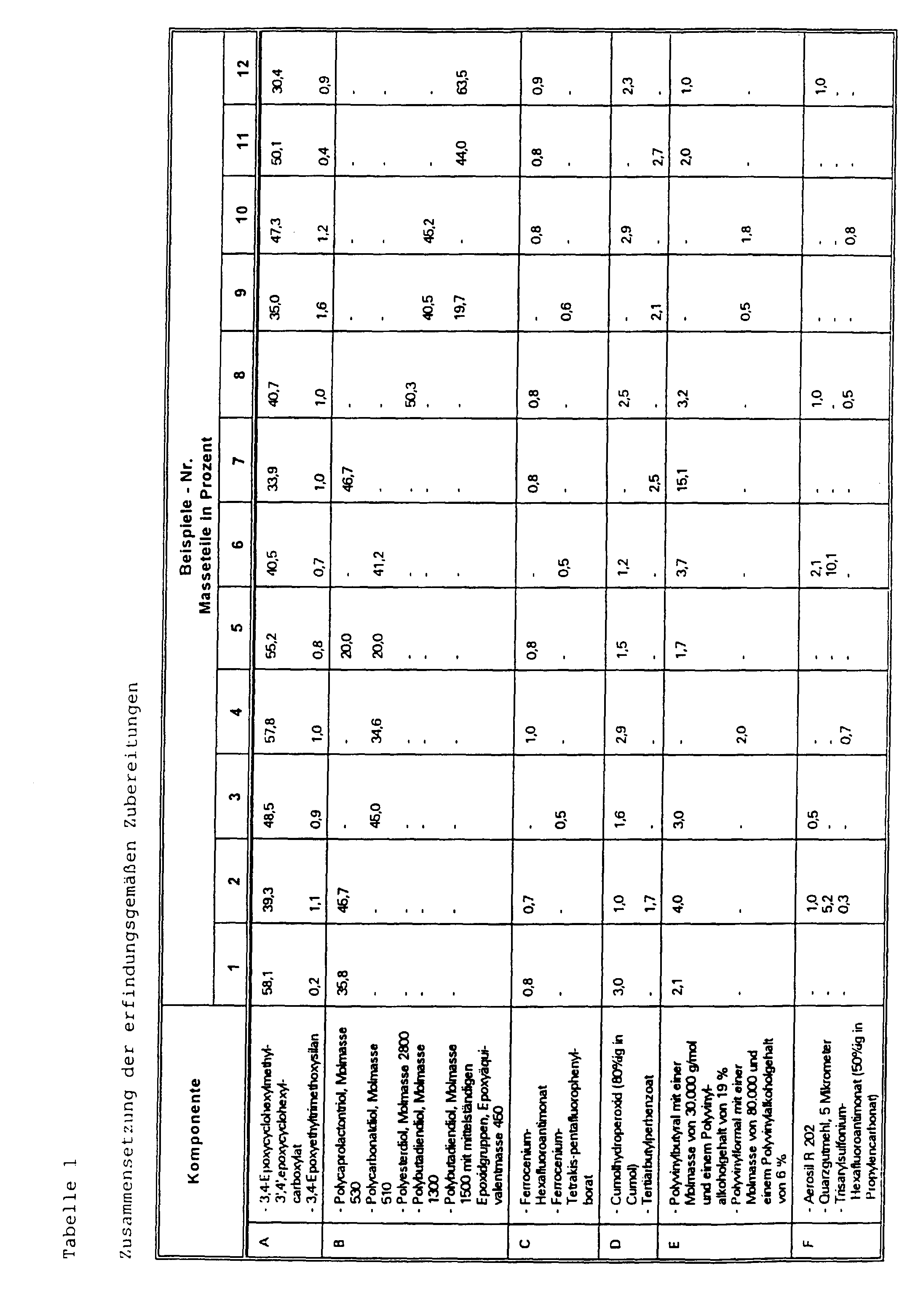
- composition of the compositions of the invention Preparations are included in Table 1.
- test specimens measuring 25 x 6 x 2 mm (Shoulder sticks; measuring distance: 10 x 2 x 2 mm)
- the production of the test specimens was done by exposing the masses poured into molds under the lamp Delolux 03 (one minute each front and back) and then stored for 24 hours at room temperature.
- This cycle was 28 times within the test period repeated.
Landscapes
- Chemical & Material Sciences (AREA)
- Health & Medical Sciences (AREA)
- Chemical Kinetics & Catalysis (AREA)
- Medicinal Chemistry (AREA)
- Polymers & Plastics (AREA)
- Organic Chemistry (AREA)
- Epoxy Resins (AREA)
- Compositions Of Macromolecular Compounds (AREA)
Description


- 4 Stunden:
- Kondenswasserprüfklima (40°C bei 98% relativer Luftfeuchtigkeit)
- 4 Stunden:
- Normalklima (23°C bei 50% relativer Luftfeuchtigkeit)
- 3 Stunden:
- Aufheizen auf 100°C bei nicht geregelter Luftfeuchtigkeit
- 4 Stunden:
- 100°C
- 3 Stunden:
- Abkühlen von 100°C bis -20°C
- 4 Stunden:
- -20°C
- 2 Stunden:
- Aufheizen auf Normalklima

Claims (15)
- Lichtinitiiert kationisch härtende, dauerflexible Epoxidharzmasse, bestehend auswobei die Summe aller Bestandteile 100 Masseteile beträgt.(A) 5 bis 95 Masseteilen mindestens einer cycloaliphatische Epoxidgruppen enthaltenden Verbindung,(B) 1 bis 90 Masseteilen mindestens eines Polyols mit Molmassen von 200 bis 8000 g/mol und OH-Äquivalentmassen von 60 bis 5000, ausgewählt aus der aus Polyesterpolyolen, Polycarbonatpolyolen und Polybutadienpolyolen bestehenden Gruppe,(C) 0,01 bis 10 Masseteilen eines Metalloceniumsalzes mit einem komplexen Anion, das die gleiche oder eine geringere Nucleophilie als das Hexafluoroantimonat-Anion besitzt,(D) 0,001 bis 10 Masseteilen eines oxidativen Beschleunigers,(E) 0,5 bis 30 Masseteilen eines Polyvinylacetals mit einer Molmasse von 5000 bis 100000 g/mol und OH-Äquivalentmassen von 50 bis 5000,(F) 0 bis 60 Masseteilen von Modifikatoren, ausgewählt aus der Gruppe der Füllstoffe, Farbstoffe, Stabilisatoren, Komplexbildner, Initiatoren, Thixotropiermittel und Verdickungsmittel,
- Masse nach Anspruch 1, dadurch gekennzeichnet, daß das Metalloceniumsalz der Komponente (C) ein Titanocenium- oder ein Ferroceniumsalz und der Beschleuniger (Komponente (D)) mindestens ein organisches Hydroperoxid ist.
- Masse nach Anspruch 1 oder 2, dadurch gekennzeichnet, daß der Beschleuniger (Komponente (D)) Cumolhydroperoxid ist.
- Masse nach einem der Ansprüche 1 bis 3, dadurch gekennzeichnet, daß sie als Komponente (A) 20 bis 90 Masseteile von mindestens zwei cycloaliphatische Epoxidgruppen tragenden Verbindungen enthält.
- Masse nach Anspruch 4, dadurch gekennzeichnet, daß die Epoxidgruppen tragende Verbindung 3,4-Epoxycyclohexylmethyl-3',4'-epoxycyclohexylcarboxylat ist.
- Masse nach einem der Ansprüche 1 bis 5, dadurch gekennzeichnet, daß sie als Komponente (B) 5 bis 80 Masseteile Polyesterpolyole mit Molmassen von 200 bis 6000 g/mol und Hydroxylgruppen-Äquivalentmassen von 80 bis 4000 enthält.
- Masse nach Anspruch 6, dadurch gekennzeichnet, daß sie als Komponente (B) 5 bis 80 Masseteile Polyesterpolyole mit Molmassen von 200 bis 5000 g/mol und Hydroxylgruppen-Äquivalentmassen von 80 bis 1000 enthält.
- Masse nach einem der Ansprüche 1 bis 5, dadurch gekennzeichnet, daß sie als Komponente (B) 5 bis 80 Masseteile von Polycarbonatdiolen der allgemeinen Formelenthält, wobei X und Y, die gleich oder verschieden sein können, Alkylen-, Arylen-, Alkarylen-, Aralkylen- oder Polyoxyalkylen bedeuten und n eine ganze Zahl von 1 bis 50 ist.

- Masse nach einem der Ansprüche 1 bis 5, dadurch gekennzeichnet, daß sie als Komponente (B) 5 bis 80 Masseteile von Polybutadiendiolen mit Molmassen von 500 bis 5000 g/mol und Hydroxylgruppen-Äquivalentmassen von 150 bis 2000 enthält.
- Masse nach Anspruch 9, dadurch gekennzeichnet, daß die Polybutadiendiole partiell epoxidiert sind und Epoxy-Äquivalentmassen von 250 bis 600 besitzen.
- Masse nach einem der Ansprüche 1 bis 10, dadurch gekennzeichnet, daß sie als Komponente (C) 0,01 bis 2 Masseteile eines Ferroceniumhexafluoroantimonates oder Ferroceniumtetrakis-pentafluorophenyl-borates enthält.
- Masse nach einem der Ansprüche 1 bis 11, dadurch gekennzeichnet, daß sie als Komponente (E) 0,5 bis 40 Masseteile eines zumindest partiell acetalisierten Polyvinylalkohols mit einem Rest an nicht verseiften Vinylacetat-Einheiten von 0,5 bis 10 % und Hydroxylgruppen-Äquivalentmassen von 80 bis 1200 enthält.
- Masse nach einem der Ansprüche 1 bis 12, dadurch gekennzeichnet, daß sie als Komponente (F) 0,01 bis 3 Masseteile von Photoinitiatoren enthalten, die unter Einwirkung von UV-Licht einer Wellenlänge von 250 bis 380 nm Brönstedsäuren oder Lewissäuren und/oder Radikale bilden.
- Masse nach einem der Ansprüche 1 bis 13, dadurch gekennzeichnet, daß ihre Bestandteile auf zwei Teilzubereitungen aufgeteilt sind, wobei die eine Teilzubereitung die Komponente (A), die andere Teilzubereitung die Komponente (C) enthält und die Gesamtmenge der Komponenten (B), (D), (E) und (F) in einer der beiden Teilzubereitungen enthalten oder auf beide Teilzubereitungen verteilt ist.
- Verwendung der lichtinitiiert kationisch härtenden, dauerflexiblen Epoxidharzmasse gemäß einem der Ansprüche 1 bis 14 für das Verkleben, Vergießen, Abdichten und Beschichten von Substraten.
Applications Claiming Priority (2)
| Application Number | Priority Date | Filing Date | Title |
|---|---|---|---|
| DE19534664 | 1995-09-19 | ||
| DE19534664A DE19534664A1 (de) | 1995-09-19 | 1995-09-19 | Lichtinitiiert kationisch härtende, dauerflexible Epoxidharzmasse und ihre Verwendung |
Publications (3)
| Publication Number | Publication Date |
|---|---|
| EP0764690A2 EP0764690A2 (de) | 1997-03-26 |
| EP0764690A3 EP0764690A3 (de) | 1997-06-11 |
| EP0764690B1 true EP0764690B1 (de) | 1999-06-02 |
Family
ID=7772533
Family Applications (1)
| Application Number | Title | Priority Date | Filing Date |
|---|---|---|---|
| EP96110294A Expired - Lifetime EP0764690B1 (de) | 1995-09-19 | 1996-06-26 | Lichtinitiiert kationisch härtende, dauerflexible Epoxidharzmasse und ihre Verwendung |
Country Status (3)
| Country | Link |
|---|---|
| EP (1) | EP0764690B1 (de) |
| AT (1) | ATE180817T1 (de) |
| DE (2) | DE19534664A1 (de) |
Cited By (1)
| Publication number | Priority date | Publication date | Assignee | Title |
|---|---|---|---|---|
| US8399099B1 (en) | 2008-05-23 | 2013-03-19 | Henkel Ireland Limited | Coating compositions |
Families Citing this family (21)
| Publication number | Priority date | Publication date | Assignee | Title |
|---|---|---|---|---|
| US6174932B1 (en) | 1998-05-20 | 2001-01-16 | Denovus Llc | Curable sealant composition |
| AU750635B2 (en) * | 1997-05-21 | 2002-07-25 | Denovus L.L.C. | Curable sealant composition |
| AU781714B2 (en) * | 1997-05-21 | 2005-06-09 | Denovus L.L.C. | Curable sealant composition |
| US6277898B1 (en) | 1997-05-21 | 2001-08-21 | Denovus Llc | Curable sealant composition |
| US6858260B2 (en) | 1997-05-21 | 2005-02-22 | Denovus Llc | Curable sealant composition |
| JP3120370B2 (ja) * | 1997-07-30 | 2000-12-25 | オーテックス株式会社 | 光潜在性重合開始剤 |
| DE19753461A1 (de) * | 1997-12-02 | 1999-06-10 | Espe Dental Ag | Lagerstabile kationisch polymerisierende Zubereitungen mit verbessertem Härtungsverhalten |
| US6133335A (en) * | 1998-12-31 | 2000-10-17 | 3M Innovative Properties Company | Photo-polymerizable compositions and articles made therefrom |
| US6265459B1 (en) | 1998-12-31 | 2001-07-24 | 3M Innovative Properties Company | Accelerators useful for energy polymerizable compositions |
| US6482868B1 (en) | 1998-12-31 | 2002-11-19 | 3M Innovative Properties Company | Accelerators useful for energy polymerizable compositions |
| DE19927949A1 (de) * | 1999-06-18 | 2000-12-21 | Delo Industrieklebstoffe Gmbh | Kationisch härtende Masse, ihre Verwendung sowie Verfahren zur Herstellung gehärteter Polymermassen |
| US6635689B1 (en) | 2000-06-26 | 2003-10-21 | 3M Innovative Properties Company | Accelerators for cationic polymerization catalyzed by iron-based catalysts |
| US7255926B2 (en) | 2002-02-01 | 2007-08-14 | Shell Oil Company | Barrier layer made of a curable resin containing polymeric polyol |
| DE102005032545A1 (de) * | 2005-07-12 | 2007-01-18 | Delo Industrieklebstoffe Gmbh & Co. Kg | Kationisch härtende Kleb- und Dichtmasse und ihre Verwendung |
| DE102006057142A1 (de) | 2006-12-01 | 2008-06-05 | Henkel Kgaa | Metallverbindungen als Initiatoren |
| DE102007043559B4 (de) | 2007-09-13 | 2012-05-31 | Carl Zeiss Vision Gmbh | Verwendung eines lichthärtenden thermoplastischen Epoxidharzklebstoffs zum Blocken oder Kleben von optischen Bauelementen |
| DE102008000721A1 (de) | 2008-03-18 | 2009-09-24 | Evonik Degussa Gmbh | Strahlenhärtbare Formulierungen |
| WO2010094634A1 (en) | 2009-02-17 | 2010-08-26 | Loctite (R & D) Limited | Cationically curable compositions and a primer therefor |
| JP2012517914A (ja) * | 2009-02-17 | 2012-08-09 | ヘンケル・アクチェンゲゼルシャフト・ウント・コムパニー・コマンディットゲゼルシャフト・アウフ・アクチェン | エポキシドに基づく接着剤を用いる金属−ポリマー結合 |
| CN106967347A (zh) * | 2017-02-27 | 2017-07-21 | 武汉金中海高新科技有限公司 | 一种彩钢瓦涂料 |
| DE102019112143A1 (de) * | 2019-05-09 | 2020-11-12 | OSRAM Opto Semiconductors Gesellschaft mit beschränkter Haftung | Harzzusammensetzung, verwendung der harzzusammensetzung, optoelektronisches bauelement und verfahren zur herstellung eines optoelektronischen bauelements |
Family Cites Families (10)
| Publication number | Priority date | Publication date | Assignee | Title |
|---|---|---|---|---|
| US4318766A (en) * | 1975-09-02 | 1982-03-09 | Minnesota Mining And Manufacturing Company | Process of using photocopolymerizable compositions based on epoxy and hydroxyl-containing organic materials |
| US4256828A (en) * | 1975-09-02 | 1981-03-17 | Minnesota Mining And Manufacturing Company | Photocopolymerizable compositions based on epoxy and hydroxyl-containing organic materials |
| EP0249201A3 (de) * | 1986-06-10 | 1989-07-19 | Union Carbide Corporation | Ablaufbeständige und hohen Feststoff enthaltende cycloalifatische Epoxydharzbeschichtungsmasse, die Polymere mit niedrigem Molekulargewicht und hohem Tg als ablaufwiderstandsfähiges Additiv enthalten |
| US4950696A (en) * | 1987-08-28 | 1990-08-21 | Minnesota Mining And Manufacturing Company | Energy-induced dual curable compositions |
| DE4023145A1 (de) * | 1990-07-20 | 1992-01-23 | Thera Ges Fuer Patente | Copolymerisierbare zusammensetzung, diese enthaltende haertbare harzmasse und ihre verwendung |
| KR100219955B1 (ko) * | 1992-01-22 | 1999-09-01 | 스프레이그 로버트 월터 | 광활성화 가능한 열경화성 에폭시 조성물 |
| US5256170A (en) * | 1992-01-22 | 1993-10-26 | Minnesota Mining And Manufacturing Company | Coated abrasive article and method of making same |
| TW269017B (de) * | 1992-12-21 | 1996-01-21 | Ciba Geigy Ag | |
| DE4324322B4 (de) * | 1993-07-20 | 2005-11-24 | Delo Industrieklebstoffe Gmbh & Co. Kg | Flexibilisierte, lichtinitiiert härtende Epoxidharzmassen, ihre Herstellung und Verwendung |
| DE4421623A1 (de) * | 1994-06-21 | 1996-01-04 | Thera Ges Fuer Patente | Mehrkomponentige, kationisch härtende Epoxidmassen und deren Verwendung sowie Verfahren zur Herstellung gehärteter Massen |
-
1995
- 1995-09-19 DE DE19534664A patent/DE19534664A1/de not_active Withdrawn
-
1996
- 1996-06-26 DE DE59602070T patent/DE59602070D1/de not_active Expired - Lifetime
- 1996-06-26 EP EP96110294A patent/EP0764690B1/de not_active Expired - Lifetime
- 1996-06-26 AT AT96110294T patent/ATE180817T1/de not_active IP Right Cessation
Cited By (1)
| Publication number | Priority date | Publication date | Assignee | Title |
|---|---|---|---|---|
| US8399099B1 (en) | 2008-05-23 | 2013-03-19 | Henkel Ireland Limited | Coating compositions |
Also Published As
| Publication number | Publication date |
|---|---|
| DE19534664A1 (de) | 1997-03-20 |
| EP0764690A3 (de) | 1997-06-11 |
| EP0764690A2 (de) | 1997-03-26 |
| DE59602070D1 (de) | 1999-07-08 |
| ATE180817T1 (de) | 1999-06-15 |
Similar Documents
| Publication | Publication Date | Title |
|---|---|---|
| EP0764690A2 (de) | Lichtinitiiert kationisch härtende, dauerflexible Epoxidharzmasse und ihre Verwendung | |
| DE2954646C2 (de) | ||
| DE60305743T2 (de) | Härtungsmittel für kationisch härtbare zusammensetzungen | |
| EP0580552B1 (de) | Ausgewählte neue Sulfoniumverbindungen, insbesondere geeignet als Initiatoren für die thermische Härtung kationisch polymerisierbaren Materials | |
| EP0755415B1 (de) | Epoxydierter kautschuk mit niedriger viscosität und seine verwendung zur änderung der zähigkeit von epoxydharzen | |
| EP1236765A1 (de) | Siliciumdioxiddispersion | |
| EP0764691B1 (de) | Kettenverlängerte Epoxidharze enthaltende, vorwiegend kationisch härtende Masse | |
| DE68922938T2 (de) | Härtbare Epoxydharzzusammensetzungen. | |
| EP0721477B1 (de) | Flexibilisierte, lichtinitiiert härtende epoxidharzmassen, ihre herstellung und verwendung | |
| DE3902114A1 (de) | Strahlungsempfindliche, ethylenisch ungesaettigte, copolymerisierbare sulfoniumsalze und verfahren zu deren herstellung | |
| DE19534594B4 (de) | Kationisch härtende, flexible Epoxidharzmassen und ihre Verwendung zum Auftragen dünner Schichten | |
| EP1213313B1 (de) | Lagerstabile kationisch polymerisierende Zubereitungen mit verbessertem Härtungsverhalten | |
| EP3707216B1 (de) | Verfahren zur erzeugung opaker beschichtungen, verklebungen und vergüsse sowie härtbare masse zur verwendung in dem verfahren | |
| KR100851263B1 (ko) | 경화성 수지 조성물 | |
| DE69727274T2 (de) | Photohärtbare Harzzusammensetzungen und Verfahren zur Herstellung von einer Form auf Harzbasis | |
| EP1061101B1 (de) | Kationisch härtende Masse, ihre Verwendung sowie Verfahren zur Herstellung gehärteter Polymermassen | |
| DE69205998T2 (de) | Photo-Aktivierbare Hitzhärtbare Epoxyzusammensetzungen. | |
| EP0688804A2 (de) | Mehrkomponentige, kationisch härtende Epoxidmassen sowie Verfahren zu ihrer Härtung | |
| DE3437531A1 (de) | Beschichtete optische glasfaser | |
| EP0467258B1 (de) | Copolymerisierbare Zusammensetzung, diese enthaltende härtbare Harzmasse und ihre Verwendung | |
| US4480059A (en) | Epoxy adhesives for poly(butylene terephthalate) | |
| JP3996334B2 (ja) | 光硬化型エポキシ樹脂組成物 | |
| DE102020118813A1 (de) | Wiederlösbare Zusammensetzungen auf Basis von Polyacetalen | |
| US4786705A (en) | Low viscosity adducts of a poly(active hydrogen) organic compound and a polyepoxide | |
| JPS6151024A (ja) | 封着用光硬化性樹脂組成物 |
Legal Events
| Date | Code | Title | Description |
|---|---|---|---|
| PUAI | Public reference made under article 153(3) epc to a published international application that has entered the european phase |
Free format text: ORIGINAL CODE: 0009012 |
|
| AK | Designated contracting states |
Kind code of ref document: A2 Designated state(s): AT CH DE FR GB IT LI |
|
| PUAL | Search report despatched |
Free format text: ORIGINAL CODE: 0009013 |
|
| AK | Designated contracting states |
Kind code of ref document: A3 Designated state(s): AT CH DE FR GB IT LI |
|
| 17P | Request for examination filed |
Effective date: 19970730 |
|
| GRAG | Despatch of communication of intention to grant |
Free format text: ORIGINAL CODE: EPIDOS AGRA |
|
| 17Q | First examination report despatched |
Effective date: 19980729 |
|
| GRAG | Despatch of communication of intention to grant |
Free format text: ORIGINAL CODE: EPIDOS AGRA |
|
| GRAH | Despatch of communication of intention to grant a patent |
Free format text: ORIGINAL CODE: EPIDOS IGRA |
|
| RAP1 | Party data changed (applicant data changed or rights of an application transferred) |
Owner name: DELO INDUSTRIEKLEBSTOFFE GMBH & CO. KG |
|
| GRAH | Despatch of communication of intention to grant a patent |
Free format text: ORIGINAL CODE: EPIDOS IGRA |
|
| GRAA | (expected) grant |
Free format text: ORIGINAL CODE: 0009210 |
|
| AK | Designated contracting states |
Kind code of ref document: B1 Designated state(s): AT CH DE FR GB IT LI |
|
| REF | Corresponds to: |
Ref document number: 180817 Country of ref document: AT Date of ref document: 19990615 Kind code of ref document: T |
|
| REG | Reference to a national code |
Ref country code: CH Ref legal event code: EP |
|
| REF | Corresponds to: |
Ref document number: 59602070 Country of ref document: DE Date of ref document: 19990708 |
|
| REG | Reference to a national code |
Ref country code: CH Ref legal event code: NV Representative=s name: TROESCH SCHEIDEGGER WERNER AG |
|
| GBT | Gb: translation of ep patent filed (gb section 77(6)(a)/1977) |
Effective date: 19990714 |
|
| ET | Fr: translation filed | ||
| PLBE | No opposition filed within time limit |
Free format text: ORIGINAL CODE: 0009261 |
|
| STAA | Information on the status of an ep patent application or granted ep patent |
Free format text: STATUS: NO OPPOSITION FILED WITHIN TIME LIMIT |
|
| 26N | No opposition filed | ||
| REG | Reference to a national code |
Ref country code: FR Ref legal event code: ST |
|
| PGFP | Annual fee paid to national office [announced via postgrant information from national office to epo] |
Ref country code: AT Payment date: 20010615 Year of fee payment: 6 |
|
| REG | Reference to a national code |
Ref country code: FR Ref legal event code: RN |
|
| PGFP | Annual fee paid to national office [announced via postgrant information from national office to epo] |
Ref country code: CH Payment date: 20010917 Year of fee payment: 6 |
|
| REG | Reference to a national code |
Ref country code: FR Ref legal event code: D3 |
|
| REG | Reference to a national code |
Ref country code: GB Ref legal event code: IF02 |
|
| PG25 | Lapsed in a contracting state [announced via postgrant information from national office to epo] |
Ref country code: AT Free format text: LAPSE BECAUSE OF NON-PAYMENT OF DUE FEES Effective date: 20020626 |
|
| PG25 | Lapsed in a contracting state [announced via postgrant information from national office to epo] |
Ref country code: LI Free format text: LAPSE BECAUSE OF NON-PAYMENT OF DUE FEES Effective date: 20020630 Ref country code: CH Free format text: LAPSE BECAUSE OF NON-PAYMENT OF DUE FEES Effective date: 20020630 |
|
| REG | Reference to a national code |
Ref country code: CH Ref legal event code: PL |
|
| PGFP | Annual fee paid to national office [announced via postgrant information from national office to epo] |
Ref country code: GB Payment date: 20060621 Year of fee payment: 11 |
|
| PGFP | Annual fee paid to national office [announced via postgrant information from national office to epo] |
Ref country code: IT Payment date: 20070612 Year of fee payment: 12 |
|
| GBPC | Gb: european patent ceased through non-payment of renewal fee |
Effective date: 20070626 |
|
| PG25 | Lapsed in a contracting state [announced via postgrant information from national office to epo] |
Ref country code: GB Free format text: LAPSE BECAUSE OF NON-PAYMENT OF DUE FEES Effective date: 20070626 |
|
| PG25 | Lapsed in a contracting state [announced via postgrant information from national office to epo] |
Ref country code: IT Free format text: LAPSE BECAUSE OF NON-PAYMENT OF DUE FEES Effective date: 20080626 |
|
| PGFP | Annual fee paid to national office [announced via postgrant information from national office to epo] |
Ref country code: FR Payment date: 20100706 Year of fee payment: 15 |
|
| REG | Reference to a national code |
Ref country code: FR Ref legal event code: ST Effective date: 20120504 |
|
| PG25 | Lapsed in a contracting state [announced via postgrant information from national office to epo] |
Ref country code: FR Free format text: LAPSE BECAUSE OF NON-PAYMENT OF DUE FEES Effective date: 20110630 |
|
| PGFP | Annual fee paid to national office [announced via postgrant information from national office to epo] |
Ref country code: DE Payment date: 20150623 Year of fee payment: 20 |
|
| REG | Reference to a national code |
Ref country code: DE Ref legal event code: R071 Ref document number: 59602070 Country of ref document: DE |