EP0762076A2 - Méthode et dispositif d'analyse de matériaux - Google Patents
Méthode et dispositif d'analyse de matériaux Download PDFInfo
- Publication number
- EP0762076A2 EP0762076A2 EP96111340A EP96111340A EP0762076A2 EP 0762076 A2 EP0762076 A2 EP 0762076A2 EP 96111340 A EP96111340 A EP 96111340A EP 96111340 A EP96111340 A EP 96111340A EP 0762076 A2 EP0762076 A2 EP 0762076A2
- Authority
- EP
- European Patent Office
- Prior art keywords
- sensor
- measuring device
- strand
- compressed air
- pin
- Prior art date
- Legal status (The legal status is an assumption and is not a legal conclusion. Google has not performed a legal analysis and makes no representation as to the accuracy of the status listed.)
- Withdrawn
Links
- 239000000463 material Substances 0.000 title claims abstract description 53
- 238000000034 method Methods 0.000 title claims description 37
- 238000004458 analytical method Methods 0.000 title claims description 17
- 238000006073 displacement reaction Methods 0.000 claims abstract description 14
- 238000009826 distribution Methods 0.000 claims abstract description 7
- XLYOFNOQVPJJNP-UHFFFAOYSA-N water Substances O XLYOFNOQVPJJNP-UHFFFAOYSA-N 0.000 claims description 12
- 238000005259 measurement Methods 0.000 claims description 7
- 238000002604 ultrasonography Methods 0.000 claims description 5
- 239000000919 ceramic Substances 0.000 claims description 4
- 238000005520 cutting process Methods 0.000 claims description 4
- 230000003628 erosive effect Effects 0.000 claims description 4
- 238000001228 spectrum Methods 0.000 claims description 4
- 230000001419 dependent effect Effects 0.000 claims description 3
- 230000000737 periodic effect Effects 0.000 claims description 3
- 238000007788 roughening Methods 0.000 claims description 2
- 239000004927 clay Substances 0.000 description 14
- 238000010276 construction Methods 0.000 description 2
- 238000004519 manufacturing process Methods 0.000 description 2
- 239000007921 spray Substances 0.000 description 2
- 238000011144 upstream manufacturing Methods 0.000 description 2
- 238000011156 evaluation Methods 0.000 description 1
- 238000011005 laboratory method Methods 0.000 description 1
- 239000002994 raw material Substances 0.000 description 1
- 238000007873 sieving Methods 0.000 description 1
Images
Classifications
-
- G—PHYSICS
- G01—MEASURING; TESTING
- G01N—INVESTIGATING OR ANALYSING MATERIALS BY DETERMINING THEIR CHEMICAL OR PHYSICAL PROPERTIES
- G01N3/00—Investigating strength properties of solid materials by application of mechanical stress
- G01N3/56—Investigating resistance to wear or abrasion
-
- G—PHYSICS
- G01—MEASURING; TESTING
- G01N—INVESTIGATING OR ANALYSING MATERIALS BY DETERMINING THEIR CHEMICAL OR PHYSICAL PROPERTIES
- G01N15/00—Investigating characteristics of particles; Investigating permeability, pore-volume or surface-area of porous materials
- G01N15/02—Investigating particle size or size distribution
-
- G—PHYSICS
- G01—MEASURING; TESTING
- G01N—INVESTIGATING OR ANALYSING MATERIALS BY DETERMINING THEIR CHEMICAL OR PHYSICAL PROPERTIES
- G01N21/00—Investigating or analysing materials by the use of optical means, i.e. using sub-millimetre waves, infrared, visible or ultraviolet light
- G01N21/84—Systems specially adapted for particular applications
- G01N21/85—Investigating moving fluids or granular solids
-
- G—PHYSICS
- G01—MEASURING; TESTING
- G01P—MEASURING LINEAR OR ANGULAR SPEED, ACCELERATION, DECELERATION, OR SHOCK; INDICATING PRESENCE, ABSENCE, OR DIRECTION, OF MOVEMENT
- G01P3/00—Measuring linear or angular speed; Measuring differences of linear or angular speeds
- G01P3/42—Devices characterised by the use of electric or magnetic means
- G01P3/50—Devices characterised by the use of electric or magnetic means for measuring linear speed
- G01P3/54—Devices characterised by the use of electric or magnetic means for measuring linear speed by measuring frequency of generated current or voltage
Definitions
- the invention relates to a method for material analysis, in particular for determining the grain size and / or consistency of a plastic or a pourable material, for example for material analysis of ceramic mass formed as a strand, and a device for using this method.
- the object of the invention is therefore to provide a method and a device for material analysis of a plastic or a pourable good, by means of which it is possible to continuously determine the grain size and / or the consistency of the good, so that deviations from the specified values can be reacted to immediately.
- the construction effort required for this should to be kept low, handling should also be easy to accomplish, but above all the surface profile of a plastic or pourable material, by means of which its grain size and / or consistency can be deduced, should be able to be detected and evaluated.
- the method for material analysis of a plastic or pourable good is characterized in that the good is moved with its surface relative to a measuring device in its longitudinal direction, and that the surface of the good for determining a surface profile during the relative movement with the help of one or more sensors associated with the measuring device is scanned mechanically and / or without contact.
- the material should be moved in its longitudinal direction relative to the measuring device and the high-frequency components of the surface profile moving past the measuring device should be detected for grain size analysis.
- the reference height of the surface of the goods should be checked using e.g. can be determined on this supporting wheel, preferably carrying the sensor, with the aid of the z. B. provided with a rotary encoder wheel during the adjustment movement of the goods a path-dependent signal.
- the surface of the goods can also be measured with the help of a light beam, preferably a laser triangulation displacement sensor.
- a light beam preferably a laser triangulation displacement sensor.
- a compressed air jet or an ultrasound jet can be scanned as a sensor.
- the relief of the surface of the good should furthermore be converted into a length dimension depending on the speed recorded by the measuring device, and the profile data of the surface of the good should be subjected to different filter algorithms such that surface waves are separated into grain fractions and a distribution of the relief heights and / or the peak areas are calculated.
- the surface of the goods should be moistened with water and then roughened or eroded by the compressed air jet.
- the pen or the air jet can act on the surface of the material with two different forces.
- a compressed air jet acts as a sensor of the measuring device on the surface of a plastically deformable material, a measurement of the consistency without water and a grain size analysis with previous moistening should be carried out alternately.
- the device for material analysis of a plastic or a pourable good is characterized by a preferably stationary measuring device, against which the good is relatively movable, and one or more sensors assigned to the measuring device, by means of which the surface of the good is mechanically and / or contactless during the relative movement is scanned and the vertical adjustment movements or reflections can be measured.
- the height and frequency resolution of the sensor should be in the range of the dimensions of the smallest grain sizes to be resolved.
- the senor of the measuring device can be held in a height-adjustable manner and guided in the direction of movement of the good, preferably by an adjustable force, lying on the surface of a strand-like good
- Low-mass pin are formed, which is held on a preferably arranged approximately parallel to the strand-shaped leaf spring and inclined in the direction of adjustment of the material, preferably at an angle of 30 to 60 °, should be attached to the leaf spring.
- the pin should have a diameter that corresponds to the size of the medium grain size spectrum.
- this can be assigned a displacement sensor, preferably an eddy current displacement sensor.
- the measuring device should also be equipped with a reference element, e.g. B. in the form of a rotatably supported wheel supported on the strand-like material, on which the sensor is suspended, the wheel should be provided with an angular momentum or rotational speed sensor to form a signal that can be generated as a function of the adjustment path of the material.
- the senor of the measuring device can be formed by a light beam, preferably a laser triangulation displacement sensor, a compressed air jet or an ultrasound beam.
- a laser light beam as a sensor, its diameter should be in the order of the mean grain size spectrum.
- a sensor which is preferably effective according to the laser Doppler method or designed as a rotation angle sensor can also be provided.
- a scraper should be arranged in front of the measuring device.
- the surface of the good is only to be scanned mechanically and / or without contact by means of a correspondingly designed measuring device in order to obtain a height profile of the surface of the good with the aid of further easily determinable measurement data, which allows conclusions to be drawn about the rigidity of the monitored good and / or the proportion of the different sized grains allowed. If there are deviations from the specified data, you can immediately intervene in a production process.
- the construction cost to be able to use the method according to the invention is extremely low, and it can also be used in a very versatile manner without difficulty.
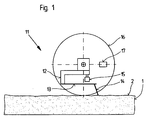
- the measuring device shown in FIG. 1 and designated 11 is used to determine the consistency and / or grain size distribution of a clay strand 1 moving past it in its longitudinal direction and consists essentially of a pin 14 suspended by means of a leaf spring 13 on a holder 12 with low mass Sensor, to which a contactlessly working displacement sensor 15, which is also attached to the holder 12, is assigned to determine the vertical adjustment movements.
- the measuring device 11 is provided with a wheel 16 which is supported on the surface 2 of the clay strand 1 and thus follows, by means of which the reference height of the surface 2 can be determined.
- the wheel 16, which is height-adjustable together with the holder 12 and thus also with the pin 14, is equipped with a rotary pulse generator 17 so that a path-dependent signal can be generated during the adjustment movements of the strand 1.
- the signals emitted by the thin, almost mass-free pin 14, which is rigidly guided in the direction of movement of the clay strand 1 as a sensor, and the rotary encoder 17 of the wheel 16, are subjected to different filter algorithms as profile data of the mechanically scanned surface 2 of the clay strand 1, such that surface waves can be separated into grain fractions and the distribution of the relief heights and / or the peak areas can be calculated.
- the grain size distribution in clay strand 1 can be concluded from the results of this evaluation. If the holder 12 is designed to be movable and, for example, is moved up and down on the wheel axis by an eccentric, then the force on the pin 14 is changed periodically and the consistency can also be inferred from the different sinking depth.
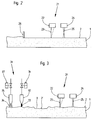
- the size of the grains enclosed in the clay strand 1 can be inferred from the measuring device 21 according to FIG.
- the surface 2 of the sound strand 1 is scanned by a light beam 23 as a sensor and thus without contact.
- the light beam 23 is emitted by a device 22 and the reflections are also detected by this.
- the diameter of the light beam 23 should be in the order of the grain diameter to be resolved, which is to be detected.
- the speed of the strand 1 is measured with the aid of a speed measuring device 24, which operates according to the laser Doppler method and emits and reflects a light beam 25.
- the size of the grains located in the clay strand 1 can be determined on the basis of the signals recorded by the devices 22 and 24.
- the surface 2 of the clay strand 1 is roughened and eroded by means of a scratch finger 26 arranged in front of the measuring device 21 in order to obtain reliable measurement results.
- the measuring device 21 is preceded by a device 31, by means of which a depression 3 can be worked into the surface 2 of the clay string 1 in order to obtain a different profile height, on the other hand, a contactless scanning of the surface 2 by means of a Compressed air jet 33 as a sensor, which emerges from a nozzle 32, possible.
- a contactless scanning of the surface 2 by means of a Compressed air jet 33 as a sensor which emerges from a nozzle 32, possible.
- the measuring device 21 would not be necessary.
- the nozzle 32 is controlled by means of a solenoid valve 34, a periodic application of the surface 2 is therefore easily accomplished.
- a spray nozzle 35 Upstream of the nozzle 32 is a spray nozzle 35, which can also be controlled by means of a solenoid valve 37 and from which a water jet 36 can be ejected for moistening the surface 2 of the clay strand 3.
- the compressed air jet 33 acts on the surface 2 as a compressed air pulse of constant duration in the range of a few tenths of a second, the consistency of the clay strand 1 can be detected.
- the compressed air jet 33 creates a depression which is evaluated together with the distance to the nozzle 32 without being acted upon.
- the measuring device 31 it is also possible to alternately measure the plasticity of the clay strand 1 without water and carry out a grain size analysis with water.
- the spray nozzle 35 is actuated by means of the solenoid valve 37 in a coordinated time sequence with the nozzle 32 emitting the compressed air jet 33.
Landscapes
- Physics & Mathematics (AREA)
- General Physics & Mathematics (AREA)
- Chemical & Material Sciences (AREA)
- Health & Medical Sciences (AREA)
- Life Sciences & Earth Sciences (AREA)
- Analytical Chemistry (AREA)
- Biochemistry (AREA)
- General Health & Medical Sciences (AREA)
- Immunology (AREA)
- Pathology (AREA)
- Dispersion Chemistry (AREA)
- Length Measuring Devices With Unspecified Measuring Means (AREA)
Applications Claiming Priority (2)
| Application Number | Priority Date | Filing Date | Title |
|---|---|---|---|
| DE19532547 | 1995-09-04 | ||
| DE1995132547 DE19532547A1 (de) | 1995-09-04 | 1995-09-04 | Verfahren und Einrichtung zur Materialanalyse |
Publications (2)
| Publication Number | Publication Date |
|---|---|
| EP0762076A2 true EP0762076A2 (fr) | 1997-03-12 |
| EP0762076A3 EP0762076A3 (fr) | 1997-10-08 |
Family
ID=7771178
Family Applications (1)
| Application Number | Title | Priority Date | Filing Date |
|---|---|---|---|
| EP96111340A Withdrawn EP0762076A3 (fr) | 1995-09-04 | 1996-07-13 | Méthode et dispositif d'analyse de matériaux |
Country Status (2)
| Country | Link |
|---|---|
| EP (1) | EP0762076A3 (fr) |
| DE (1) | DE19532547A1 (fr) |
Families Citing this family (1)
| Publication number | Priority date | Publication date | Assignee | Title |
|---|---|---|---|---|
| DE19959198A1 (de) * | 1999-12-08 | 2001-06-13 | Abb Patent Gmbh | Vorrichtung und Verfahren zur Erfassung der Oberflächenbeschaffenheit eines Transportgutes |
Family Cites Families (4)
| Publication number | Priority date | Publication date | Assignee | Title |
|---|---|---|---|---|
| FR2041432A5 (en) * | 1969-04-24 | 1971-01-29 | Polysius Gmbh | Grain size distribution determination for a - ground material |
| GB1318701A (en) * | 1970-01-30 | 1973-05-31 | Rank Organisation Ltd | Methods of waveform analysis and apparatus therefor |
| DE3412615C2 (de) * | 1984-04-04 | 1986-07-24 | Fraunhofer-Gesellschaft zur Förderung der angewandten Forschung e.V., 8000 München | Verfahren zur Korngrößenbestimmung in einem polykristallinen Werkstoff |
| DE3929172A1 (de) * | 1989-09-02 | 1991-03-07 | Bayer Ag | Vorrichtung zur bestimmung der groessenverteilung von pigmentkoernern in einer lackoberflaeche |
-
1995
- 1995-09-04 DE DE1995132547 patent/DE19532547A1/de not_active Withdrawn
-
1996
- 1996-07-13 EP EP96111340A patent/EP0762076A3/fr not_active Withdrawn
Non-Patent Citations (1)
| Title |
|---|
| None |
Also Published As
| Publication number | Publication date |
|---|---|
| EP0762076A3 (fr) | 1997-10-08 |
| DE19532547A1 (de) | 1997-03-06 |
Similar Documents
| Publication | Publication Date | Title |
|---|---|---|
| EP1990204B1 (fr) | Procédé et dispositif de revêtement d'une surface | |
| DE4134265C2 (de) | Vorrichtung und Verfahren zur Herstellung eines dreidimensionalen Objekts mittels Stereographie | |
| EP0494430B1 (fr) | Procédé pour mesurer le diamètre des cylindes, en particulier des tambours | |
| EP2106530A1 (fr) | Procédé et dispositif pour détecter la surface tridimensionnelle d'un objet, en particulier d'un pneu de véhicule | |
| DE3713279A1 (de) | Verfahren zum erfassen von dimensionsfehlern | |
| AT506313B1 (de) | Biegegesenk für eine biegepresse, insbesondere abkantpresse | |
| DE10224635A1 (de) | Verfahren und Vorrichtung zur Bestimmung der Exzentrizität eines Hohlblockes | |
| EP0706841A1 (fr) | Procédé et dispositif de réglage des cylindres de nettoyage pour cylindres de laminoir | |
| DE68922914T2 (de) | Vorrichtung zum Abschneiden der Speck- und/oder Fettschicht von Fleisch. | |
| DE69409748T2 (de) | Vorrichtung und Verfahren zum Messen der Form oder/und der Flachheit eines sich bewegenden Materials | |
| DE4139697C2 (de) | Vorrichtung zur Prüfung und Vermessung von Matratzen, Polstern oder ähnlichen flächig-elastischen Gegenständen | |
| EP0762076A2 (fr) | Méthode et dispositif d'analyse de matériaux | |
| DE4138837A1 (de) | Vorrichtung zum schneiden einer textilbahn, insbes. einer etikettenbahn | |
| DE4422691A1 (de) | Hochdruck-Wasserschneidvorrichtung | |
| EP0976509A3 (fr) | Méthode ansi que dispositif pour découper longitudinalement un matériau en bande | |
| DE3841177C2 (fr) | ||
| EP1919659B1 (fr) | Station de mesure destinee a une machine coupe-tubes | |
| DE10063786A1 (de) | Vorrichtung und Verfahren zum Vermessen eines Gegenstandes | |
| DE4300290A1 (fr) | ||
| EP0757788B1 (fr) | Procede et dispositif de detection de defauts de structure dans des matieres textiles plates en mouvement | |
| EP2865998A1 (fr) | Mesure matérialisée pour capteurs incrémentiels et son procédé de fabrication | |
| DE10023127B4 (de) | Verfahren zum Betreiben einer Abtastvorrichtung zur optischen Dichtemessung | |
| DE3705763C2 (fr) | ||
| EP0402779B1 (fr) | Procédé et dispositif de détermination de structures de surfaces | |
| DE3814697C2 (fr) |
Legal Events
| Date | Code | Title | Description |
|---|---|---|---|
| PUAI | Public reference made under article 153(3) epc to a published international application that has entered the european phase |
Free format text: ORIGINAL CODE: 0009012 |
|
| AK | Designated contracting states |
Kind code of ref document: A2 Designated state(s): DE FR GB IT |
|
| PUAL | Search report despatched |
Free format text: ORIGINAL CODE: 0009013 |
|
| AK | Designated contracting states |
Kind code of ref document: A3 Designated state(s): DE FR GB IT |
|
| 17P | Request for examination filed |
Effective date: 19971011 |
|
| 17Q | First examination report despatched |
Effective date: 19990706 |
|
| STAA | Information on the status of an ep patent application or granted ep patent |
Free format text: STATUS: THE APPLICATION HAS BEEN WITHDRAWN |
|
| 18W | Application withdrawn |
Withdrawal date: 19991113 |