EP0753501A2 - Verfahren zur Herstellung von 2-Ethylhexanal - Google Patents
Verfahren zur Herstellung von 2-Ethylhexanal Download PDFInfo
- Publication number
- EP0753501A2 EP0753501A2 EP96107035A EP96107035A EP0753501A2 EP 0753501 A2 EP0753501 A2 EP 0753501A2 EP 96107035 A EP96107035 A EP 96107035A EP 96107035 A EP96107035 A EP 96107035A EP 0753501 A2 EP0753501 A2 EP 0753501A2
- Authority
- EP
- European Patent Office
- Prior art keywords
- reactor
- hydrogenation
- carried out
- hydrogenation product
- process according
- Prior art date
- Legal status (The legal status is an assumption and is not a legal conclusion. Google has not performed a legal analysis and makes no representation as to the accuracy of the status listed.)
- Granted
Links
Images
Classifications
-
- C—CHEMISTRY; METALLURGY
- C07—ORGANIC CHEMISTRY
- C07C—ACYCLIC OR CARBOCYCLIC COMPOUNDS
- C07C45/00—Preparation of compounds having >C = O groups bound only to carbon or hydrogen atoms; Preparation of chelates of such compounds
- C07C45/61—Preparation of compounds having >C = O groups bound only to carbon or hydrogen atoms; Preparation of chelates of such compounds by reactions not involving the formation of >C = O groups
- C07C45/62—Preparation of compounds having >C = O groups bound only to carbon or hydrogen atoms; Preparation of chelates of such compounds by reactions not involving the formation of >C = O groups by hydrogenation of carbon-to-carbon double or triple bonds
Definitions
- the present invention relates to a process for the preparation of 2-ethylhexanal by catalytic hydrogenation of 2-ethylhex-2-enal.
- 2-ethylhexanal is used for the synthesis of fragrances and is a precursor for 2-ethylhexanoic acid.
- DE-OS 19 41 634 claims the hydrogenation over a specially produced Pd / SiO 2 catalyst.
- the reaction is carried out in a single stage in a loop mode.
- the throughputs are between 0.4-0.6 [kg / l catalyst ⁇ h].
- the selectivity for 2-ethylhexanal is 97.8% with a conversion of 99.1%.
- DE-OS 20 08 128 describes a single-stage loop process in which the use of a surface load on the catalyst of 10-50 m / h is highlighted as a particular advantage. With a throughput of 0.325 [l / kg catalyst ⁇ h], a conversion of 99.2% is achieved. No indication of selectivity can be found.
- the present invention was therefore based on the object of providing a process which, by catalytic hydrogenation of 2-ethylhex-2-enal, enables 2-ethylhexanal to be prepared economically and with high selectivity.
- the present process for example with a double loop procedure, has the advantage over the conventional process (1st stage loop; 2nd stage straight pass) that, with the same amount of catalyst (sum of the amounts in both reactors), the production amount increases by more than 30% can be. With sales of over 99.9%, the selectivities achieved for 2-ethylhexanal are over 99%.
- the present invention therefore relates to a process for the preparation of 2-ethylhexanal by catalytic hydrogenation of 2-ethylhex-2-enal, which is characterized in that the hydrogenation is carried out in a plurality of loops connected in series, 2-ethyl-hex-2 -enal together with part of the hydrogenation product of the 1st reactor passed to the top of the 1st reactor, the remaining part of the hydrogenation product of the 1st reactor together with a part of the hydrogenation product of the 2nd reactor passed to the top of the 2nd reactor and the remaining part of the hydrogenation product of the 2nd reactor together with a part of the hydrogenation product of the following reactor is passed to the head of the following reactor etc. and the 2-ethylhexanal from the remaining part of the Hydrogenation product of the last reactor is obtained.
- the hydrogenation is preferably carried out in two loops connected in series, 2-ethylhex-2-enal being passed together with a part of the hydrogenation product of the 1st reactor to the top of the 1st reactor, the remaining part of the hydrogenation product of the 1st reactor passed together with part of the hydrogenation product of the second reactor to the top of the second reactor and the 2-ethylhexanal is obtained from the remaining part of the hydrogenation product of the second reactor.
- the hydrogenation can be carried out in all reactors in both turbulent and laminar flow. It can also be advantageous to carry out the hydrogenation in turbulent flow, at least in the first reactor. In addition, hydrogenation is preferably carried out in the liquid phase in all reactors.
- the hydrogenation in the process according to the invention is preferably carried out at temperatures from 40 to 150 ° C., particularly preferably at temperatures from 80 to 130 ° C. It may also be advantageous to carry out the hydrogenation in the reactors at different temperature levels, for example by operating the second or subsequent reactor at a lower temperature than the first or preceding reactor.
- the process according to the invention is carried out under pressure. Hydrogenation in the reactors at pressures of 1 to 100 bar abs is preferred. carried out, particularly preferably at pressures from 5 to 20 bar abs. In addition, it may be advantageous to carry out the hydrogenation in the reactors of the process according to the invention at different levels, for example by using the second or subsequent ones Reactor operates at a lower pressure than the first or previous reactor.
- the hydrogenation in the reactors is preferably carried out on a palladium catalyst;
- the palladium catalyst is particularly preferably applied to a support made of aluminum oxide.
- the process according to the invention enables a particularly economical preparation of 2-ethylhexanal with a very good yield and outstandingly high selectivity.
- Technical 2-ethylhexenal (96% 2-ethylhexenal, 0.02% 2-ethylhexanol) is diluted with partially hydrogenated feed material (from bubble 1) and driven onto the head of the first reactor (1st loop). From bubble 1, hydrogenated material is fed into the loops of the second reactor in a level-controlled manner.
- Technical 2-ethylhexanal is run from bubble 2 in a level-controlled manner.
- Reactor 1 Reactor 2 Throughput 6.19 kg / h 6.26 kg / h Circulation 130 kg / h 65 kg / h H 2 pressure 15 bar 15 bar medium temperature 124 ° C 116 ° C
- Exhaust gas volume 220 Nl / h 110 Nl / h
Landscapes
- Chemical & Material Sciences (AREA)
- Organic Chemistry (AREA)
- Chemical Kinetics & Catalysis (AREA)
- Organic Low-Molecular-Weight Compounds And Preparation Thereof (AREA)
- Low-Molecular Organic Synthesis Reactions Using Catalysts (AREA)
- Acyclic And Carbocyclic Compounds In Medicinal Compositions (AREA)
Abstract
Description
- Die vorliegende Erfindung betrifft ein Verfahren zur Herstellung von 2-Ethylhexanal durch katalytische Hydrierung von 2-Ethylhex-2-enal.
- 2-Ethylhexanal wird für die Synthese von Riechstoffen verwendet und ist Vorstufe für 2-Ethylhexansäure.
- Verfahren zur kontinuierlichen Herstellung von 2-Ethylhexanal durch eine katalytische Hydrierung von 2-Ethylhexenal sind bekannt:
- Um bei einer kontinuierlichen Hydrierung einen nahezu vollständigen Umsatz zu erreichen, gibt es im Prinzip zwei Verfahren:
- a) Es wird im Rohrreaktor (Reaktionsrohr mit ausreichender Länge) im geraden Durchgang hydriert.
- b) Die Hydrierung wird in zwei Reaktoren durchgeführt. Dem ersten Reaktor, der meistens in Schlaufenfahrweise betrieben wird, ist ein zweiter Reaktor, in dem im geraden Durchgang hydriert wird, zum Finishen nachgeschaltet.
- In der DE-OS 19 41 634 wird die Hydrierung an einem speziell hergestellten Pd/SiO2-Katalysator beansprucht. Die Reaktion wird einstufig in Schlaufenfahrweise durchgeführt. Die Durchsätze liegen zwischen 0,4 - 0,6 [kg/l Katalysator · h]. Laut Beispiel beträgt bei einem Umsatz von 99,1 % die Selektivität für 2-Ethylhexanal 97,8 %.
- In der DE-OS 20 08 128 wird ein einstufiges Schlaufenverfahren beschrieben, bei dem als besonderer Vorteil die Anwendung einer Oberflächenbelastung des Katalysators von 10 - 50 m/h herausgestellt wird. Bei einem Durchsatz von 0,325 [l/kg Katalysator · h] wird ein Umsatz von 99,2 % erreicht. Eine Selektivitätsangabe ist nicht zu entnehmen.
- In den beiden vorangehenden Schriften ist die Raum-/Zeit-Ausbeute unter wirtschaftlichen Gesichtspunkten zu gering.
- In der Patentschrift US 4 018 831 wird die Flüssigphasehydrierung an einem Nickel-Katalysator beschrieben. Bei einem Durchsatz von 1,1 [kg/kg Katalysator · h] wird ein nahezu 100 %iger Umsatz und eine Selektivität von 97,5 % erreicht. Hier ist die Selektivität nicht zufriedenstellend.
- Der vorliegenden Erfindung lag daher die Aufgabe zugrunde, ein Verfahren bereitzustellen, das durch katalytische Hydrierung von 2-Ethylhex-2-enal ermöglicht, 2-Ethylhexanal in wirtschaftlicher Weise und mit hoher Selektivität herzustellen.
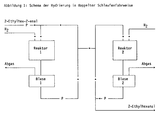
- Es wurde nun überraschend gefunden, daß ein nahezu vollständiger Umsatz und eine hervorragende Selektivität erreicht wird, wenn man die katalytische Hydrierung in mehreren hintereinander geschalteten Schlaufen, bevorzugt in doppelter Schlaufenfahrweise (vgl. Abbildung 1), durchführt. Geeigneterweise wird dabei 2-Ethylhex-2-enal in einen Teil des Hydrieraustrags des ersten Reaktors eingespeist und dieses Gemisch auf den Kopf des ersten Reaktors geleitet. Aus der Hydriervorlage des ersten Reaktors wird standgeregelt Hydrierprodukt in die Schlaufe des zweiten Reaktors gefahren. Dieses Gemisch fließt auf den Kopf des zweiten Reaktors. Aus der Hydriervorlage des zweiten Reaktors wird standgeregelt Hydriergut abgefahren.
- Das vorliegende Verfahren, beispielweise mit doppelter Schlaufenfahrweise, hat im Vergleich zur herkömmlichen Verfahrensweise (1. Stufe Schlaufe; 2. Stufe gerader Durchgang) den Vorteil, daß bei gleicher Katalysatormenge (Summe der Mengen in beiden Reaktoren) die Produktionsmenge um mehr als 30 % erhöht werden kann. Bei Umsätzen von über 99,9 % liegen die erreichten Selektivitäten für 2-Ethylhexanal bei über 99 %.
- Gegenstand der vorliegenden Erfindung ist daher ein Verfahren zur Herstellung von 2-Ethylhexanal durch katalytische Hydrierung von 2-Ethylhex-2-enal, das dadurch gekennzeichnet ist, daß die Hydrierung in mehreren hintereinander geschalteten Schlaufen durchgeführt wird, wobei 2-Ethyl-hex-2-enal zusammen mit einem Teil des Hydrierproduktes des 1. Reaktors auf den Kopf des 1. Reaktors geleitet, der restliche Teil des Hydrierproduktes des 1. Reaktors zusammen mit einem Teil des Hydrierproduktes des 2. Reaktors auf den Kopf des 2. Reaktors geleitet und der restliche Teil des Hydrierproduktes des 2. Reaktors zusammen mit einem Teil des Hydrierproduktes des folgenden Reaktors auf den Kopf des folgenden Reaktors geleitet wird usw. und das 2-Ethylhexanal aus dem restlichen Teil des Hydrierproduktes des letzten Reaktors gewonnen wird.
- Bevorzugt wird beim erfindungsgemäßen Verfahren die Hydrierung in zwei hintereinander geschalteten Schlaufen durchgeführt, wobei 2-Ethylhex-2-enal zusammen mit einem Teil des Hydrierproduktes des 1. Reaktors auf den Kopf des 1. Reaktors geleitet, der restliche Teil des Hydrierproduktes des 1. Reaktors zusammen mit einem Teil des Hydrierproduktes des 2. Reaktors auf den Kopf des zweiten Reaktors geleitet und das 2-Ethylhexanal aus dem restlichen Teil des Hydrierproduktes des 2. Reaktors gewonnen wird.
- Die Hydrierung kann beim erfindungsgemäßen Verfahren in allen Reaktoren sowohl in turbulenter als auch in laminarer Strömung durchgeführt werden. Es kann auch vorteilhaft sein, die Hydrierung zumindest im ersten Reaktor in turbulenter Strömung durchzuführen. Darüber hinaus wird hier in allen Reaktoren bevorzugt in flüssiger Phase hydriert.
- Vorzugsweise führt man die Hydrierung beim erfindungsgemäßen Verfahren bei Temperaturen von 40 bis 150 °C durch, besonders vorzugsweise bei Temperaturen von 80 bis 130 °C. Ferner kann es von Vorteil sein, die Hydrierung in den Reaktoren auf unterschiedlichen Temperaturniveaus durchzuführen, beispielsweise indem man den zweiten bzw. folgenden Reaktor bei einer niedrigeren Temperatur betreibt als den ersten bzw. vorangehenden Reaktor.
- Im allgemeinen arbeitet man beim erfindungsgemäßen Verfahren unter Druck. Bevorzugt wird hier die Hydrierung in den Reaktoren bei Drücken von 1 bis 100 bar abs. durchgeführt, besonders vorzugsweise bei Drücken von 5 bis 20 bar abs.. Darüber hinaus kann es von Vorteil sein, die Hydrierung in den Reaktoren des erfindungsgemäßen Verfahrens auf unterschiedlichen Niveaus durchzuführen, beispielsweise indem man den zweiten bzw. folgenden Reaktor bei einem niedrigeren Druck betreibt als den ersten bzw. vorangehenden Reaktor.
- Als Katalysatorbestückung in den Reaktoren können gängige, hierfür geeignete Hydrierkatalysatoren eingesetzt werden, beispielsweise 0,5 % Pd/Al2O3 (Fa. Engelhard).
- Bevorzugt wird beim erfindungsgemäßen Verfahren die Hydrierung in den Reaktoren an einem Palladium-Katalysator durchgeführt; besonders vorzugsweise ist dabei der Palladium-Katalysator auf einen Träger aus Aluminiumoxid aufgebracht.
- Das erfindungsgemäße Verfahren ermöglicht eine besonders wirtschaftliche Herstellung von 2-Ethylhexanal mit sehr guter Ausbeute und hervorragend hoher Selektivität.
- Das folgende Beispiel soll die vorliegende Erfindung näher erläutern, ohne ihren Anwendungsumfang einzuengen:
- Die Hydrierapparatur (vgl. Abbildung 1) hat zwei baugleiche Reaktoren mit folgenden Abmessungen: ⌀c = 42 mm; l = 1 500 mm. Beide Reaktoren sind jeweils mit 1,9 l Katalysator (0,5 % Pd/Al2O3) gefüllt.
- Technisches 2-Ethylhexenal (96 % 2-Ethylhexenal, 0,02 % 2-Ethylhexanol) wird verdünnt mit teilhydriertem Einsatzstoff (aus Blase 1) auf den Kopf des ersten Reaktors gefahren (1. Schlaufe). Aus Blase 1 wird Hydriergut standgeregelt in die Schlaufen des zweiten Reaktors gefahren. Aus der Blase 2 wird standgeregelt technisches 2-Ethylhexanal abgefahren.
- In den Reaktoren liegen folgende Reaktionsbedingungen vor:
Reaktor 1 Reaktor 2 Durchsatz 6,19 kg/h 6,26 kg/h Umlauf 130 kg/h 65 kg/h H2-Druck 15 bar 15 bar mittlere Temperatur 124 °C 116 °C Abgasmenge 220 Nl/h 110 Nl/h - Nach Einstellung des quasistationären Zustandes wird ein Hydriergut folgender Qualität erhalten:
2-Ethylhexenal 0,09 Gew.-% 2-Ethylhexanal 95,46 Gew.-% 2-Ethylhexanol 0,46 Gew.-% - Dies entspricht einem Umsatz von 99,9 % und einer Selektivität von 99,4 %.
- Im Gegensatz zum Beispiel 1 ist der Umlauf des zweiten Reaktors außer Betrieb (Umlaufmenge 0). Unter Einhaltung der Randbedingungen (Umsatz ≧ 99,9 % und Selektivität > 99 %) und Anstrebung des größtmöglichen Durchsatzes wurden folgende Reaktionsbedingungen gefunden:
Reaktor 1 Reaktor 2 Durchsatz 4,74 kg/h ≦ 4,79 kg/h Umlauf 130 kg/h 0 kg/h H2-Druck 15 bar 15 bar mittlere Temperatur 100 °C 90 °C Abgasmenge 160 Nl/h 60 Nl/h - Daraus geht hervor, daß bei Anwendung der doppelten Schlaufenfahrweise in der vorliegenden Apparatur 30 % mehr 2-Ethylhexanal erzeugt werden kann.
Claims (13)
- Verfahren zur Herstellung von 2-Ethylhexanal durch katalytische Hydrierung von 2-Ethylhex-2-enal,
dadurch gekennzeichnet,
daß die Hydrierung in mehreren hintereinander geschalteten Schlaufen durchgeführt wird, wobei 2-Ethylhex-2-enal zusammen mit einem Teil des Hydrierproduktes des 1. Reaktors auf den Kopf des 1. Reaktors geleitet, der restliche Teil des Hydrierproduktes des 1. Reaktors zusammen mit einem Teil des Hydrierproduktes des 2. Reaktors auf den Kopf des 2. Reaktors geleitet und der restliche Teil des Hydrierproduktes des 2. Reaktors zusammen mit einem Teil des Hydrierproduktes des folgenden Reaktors auf den Kopf des folgenden Reaktors geleitet wird usw. und das 2-Ethylhexanal aus dem restlichen Teil des Hydrierproduktes des letzten Reaktors gewonnen wird. - Verfahren nach Anspruch 1,
dadurch gekennzeichnet,
daß die Hydrierung in zwei hintereinander geschalteten Schlaufen durchgeführt wird, wobei 2-Ethylhex-2-enal zusammen mit einem Teil des Hydrierproduktes des 1. Reaktors auf den Kopf des 1. Reaktors geleitet, der restliche Teil des Hydrierproduktes des 1. Reaktors zusammen mit einem Teil des Hydrierproduktes des 2. Reaktors auf den Kopf des zweiten Reaktors geleitet und das 2-Ethylhexanal aus dem restlichen Teil des Hydrierproduktes des 2. Reaktors gewonnen wird. - Verfahren nach den Ansprüchen 1 und 2,
dadurch gekennzeichnet,
daß in allen Reaktoren in flüssiger Phase hydriert wird. - Verfahren nach den Ansprüchen 1 bis 3,
dadurch gekennzeichnet,
daß die Strömung in allen Reaktoren laminar ist. - Verfahren nach den Ansprüchen 1 bis 3,
dadurch gekennzeichnet,
daß die Strömung in allen Reaktoren turbulent ist. - Verfahren nach den Ansprüchen 1 bis 5,
dadurch gekennzeichnet,
daß die Hydrierung bei Temperaturen von 40 bis 150 °C durchgeführt wird. - Verfahren nach Anspruch 6,
dadurch gekennzeichnet,
daß die Hydrierung bei Temperaturen von 80 bis 130 °C durchgeführt wird. - Verfahren nach den Ansprüchen 1 bis 7,
dadurch gekennzeichnet,
daß die Hydrierung in den einzelnen Reaktoren auf unterschiedlichen Temperaturniveaus durchgeführt wird. - Verfahren nach den Ansprüchen 1 bis 8,
dadurch gekennzeichnet,
daß die Hydrierung bei Drücken von 1 bis 100 bar abs. durchgeführt wird. - Verfahren nach Anspruch 9,
dadurch gekennzeichnet,
daß die Hydrierung bei Drücken von 5 bis 20 bar abs. durchgeführt wird. - Verfahren nach den Ansprüchen 1 bis 10,
dadurch gekennzeichnet,
daß die Hydrierung in den einzelnen Reaktoren auf unterschiedlichen Druckniveaus durchgeführt wird. - Verfahren nach den Ansprüchen 1 bis 11,
dadurch gekennzeichnet,
daß die Hydrierung an einem Palladium-Katalysator durchgeführt wird. - Verfahren nach Anspruch 12,
dadurch gekennzeichnet,
daß die Hydrierung an einem Palladium-Katalysator durchgeführt wird, der auf einen Träger aus Aluminiumoxid aufgebracht ist.
Applications Claiming Priority (2)
| Application Number | Priority Date | Filing Date | Title |
|---|---|---|---|
| DE19524970 | 1995-07-08 | ||
| DE19524970A DE19524970A1 (de) | 1995-07-08 | 1995-07-08 | Verfahren zur Herstellung von 2-Ethylhexanal |
Publications (3)
| Publication Number | Publication Date |
|---|---|
| EP0753501A2 true EP0753501A2 (de) | 1997-01-15 |
| EP0753501A3 EP0753501A3 (de) | 1997-06-04 |
| EP0753501B1 EP0753501B1 (de) | 1998-11-04 |
Family
ID=7766379
Family Applications (1)
| Application Number | Title | Priority Date | Filing Date |
|---|---|---|---|
| EP96107035A Expired - Lifetime EP0753501B1 (de) | 1995-07-08 | 1996-05-04 | Verfahren zur Herstellung von 2-Ethylhexanal |
Country Status (6)
| Country | Link |
|---|---|
| US (1) | US5756856A (de) |
| EP (1) | EP0753501B1 (de) |
| JP (1) | JPH0920710A (de) |
| AT (1) | ATE172955T1 (de) |
| DE (2) | DE19524970A1 (de) |
| ES (1) | ES2124608T3 (de) |
Cited By (1)
| Publication number | Priority date | Publication date | Assignee | Title |
|---|---|---|---|---|
| WO2020048975A1 (de) * | 2018-09-05 | 2020-03-12 | Basf Se | Kontinuierliche herstellung einer optisch aktiven carbonylverbindung durch asymmetrische hydrierung |
Families Citing this family (16)
| Publication number | Priority date | Publication date | Assignee | Title |
|---|---|---|---|---|
| DE19842368A1 (de) | 1998-09-16 | 2000-03-23 | Oxeno Olefinchemie Gmbh | Verfahren zur Herstellung von höheren Oxoalkoholen aus Olefingemischen durch zweistufige Hydroformylierung |
| DE19842371A1 (de) | 1998-09-16 | 2000-03-23 | Oxeno Oelfinchemie Gmbh | Verfahren zur Herstellung von höheren Oxo-Alkoholen aus Olefingemischen |
| DE19842369A1 (de) * | 1998-09-16 | 2000-03-23 | Oxeno Oelfinchemie Gmbh | Verfahren zur Hydrierung von Hydroformylierungsgemischen |
| DE19842370A1 (de) | 1998-09-16 | 2000-03-23 | Oxeno Oelfinchemie Gmbh | Verfahren zur selektiven Hydrierung von Hydroformylierungsgemischen |
| RU2272804C1 (ru) * | 2004-11-10 | 2006-03-27 | Александр Петрович Хворов | Способ получения 2-этилгексаналя |
| US7294745B2 (en) * | 2004-12-30 | 2007-11-13 | Council Of Scientific And Industrial Research | Process for preparing aldol derivatives from alkenes using catalyst |
| TWI610913B (zh) * | 2016-08-30 | 2018-01-11 | 南亞塑膠工業股份有限公司 | 一種提高2-乙基己醛產率的製造方法 |
| EP3466938A1 (de) | 2017-10-05 | 2019-04-10 | Basf Se | 3,5-diethyl-2-propyl-tetrahydropyran und dessen stereoisomeren zur verwendung als aromastoffe |
| EP3597626A1 (de) | 2018-07-19 | 2020-01-22 | Basf Se | Alpha,alpha-disubstituierte carbonsäureestern zur verwendung als aromachemikalien |
| WO2020035600A1 (en) | 2018-08-17 | 2020-02-20 | Basf Se | Synthesis of chromanol derivatives |
| EP3837249B1 (de) | 2018-08-17 | 2025-04-02 | Basf Se | Synthese von chromanolderivaten |
| JP7131279B2 (ja) * | 2018-10-11 | 2022-09-06 | Jnc株式会社 | 不飽和カルボニル化合物からの飽和ホモエーテル製造法 |
| CN109438216B (zh) * | 2018-12-06 | 2021-07-23 | 万华化学集团股份有限公司 | 一种高纯度异辛酸的制备方法 |
| JP7192475B2 (ja) * | 2018-12-18 | 2022-12-20 | Jnc株式会社 | 不飽和カルボニル化合物からの飽和ホモエーテルの高効率な製造法 |
| CN109809973B (zh) * | 2018-12-19 | 2022-03-08 | 万华化学集团股份有限公司 | 一种制备2-乙基己醛的方法 |
| CN118005493B (zh) * | 2024-04-10 | 2024-07-19 | 张家港市华昌新材料科技有限公司 | 一种2-乙基己醛的制备方法、催化剂及其制备方法 |
Family Cites Families (12)
| Publication number | Priority date | Publication date | Assignee | Title |
|---|---|---|---|---|
| GB781405A (en) * | 1954-10-01 | 1957-08-21 | Celanese Corp | Hydrogenation of unsaturated carbonyl compounds |
| US2825743A (en) * | 1955-08-30 | 1958-03-04 | Celanese Corp | Catalytic hydrogenation of unsaturated aldehydes and ketones |
| NL132121C (de) * | 1963-04-27 | 1900-01-01 | ||
| US3304338A (en) * | 1964-05-05 | 1967-02-14 | Signal Oil & Gas Co | Two-stage hydrogenation of aromatic hydrocarbons |
| FR2078183A5 (de) * | 1970-02-21 | 1971-11-05 | Basf Ag | |
| US4018831A (en) * | 1975-09-11 | 1977-04-19 | Mallinckrodt, Inc. | Production of 2-ethyl hexanal |
| DE2832699A1 (de) * | 1978-07-26 | 1980-02-14 | Basf Ag | Verfahren zur herstellung von gesaettigten aliphatischen, cycloaliphatischen und araliphatischen aldehyden |
| CA1140065A (en) * | 1978-12-04 | 1983-01-25 | John G. Christy | Process for selective hydrogenation of dienes in pyrolysis gasoline |
| US4394525A (en) * | 1981-06-29 | 1983-07-19 | Gulf Research & Development Company | Process for hydrogenating aldehydes |
| US4450300A (en) * | 1981-12-23 | 1984-05-22 | Chemische Werke Huels Aktiengesellschaft | Process for the continuous manufacture of n-butyraldehyde by selective hydrogenation of crotonaldehyde in the liquid phase in the presence of a palladium-aluminum oxide catalyst |
| GB8613354D0 (en) * | 1986-06-03 | 1986-07-09 | Davy Mckee Ltd | Process |
| US5068484A (en) * | 1989-11-02 | 1991-11-26 | Uop | Process for the hydroconversion of a feedstock comprising organic compounds having a tendency to readily form polymer compounds |
-
1995
- 1995-07-08 DE DE19524970A patent/DE19524970A1/de not_active Withdrawn
-
1996
- 1996-05-04 ES ES96107035T patent/ES2124608T3/es not_active Expired - Lifetime
- 1996-05-04 EP EP96107035A patent/EP0753501B1/de not_active Expired - Lifetime
- 1996-05-04 AT AT96107035T patent/ATE172955T1/de not_active IP Right Cessation
- 1996-05-04 DE DE59600762T patent/DE59600762D1/de not_active Expired - Fee Related
- 1996-06-26 US US08/668,355 patent/US5756856A/en not_active Expired - Fee Related
- 1996-07-05 JP JP8176920A patent/JPH0920710A/ja active Pending
Cited By (2)
| Publication number | Priority date | Publication date | Assignee | Title |
|---|---|---|---|---|
| WO2020048975A1 (de) * | 2018-09-05 | 2020-03-12 | Basf Se | Kontinuierliche herstellung einer optisch aktiven carbonylverbindung durch asymmetrische hydrierung |
| US11242306B2 (en) | 2018-09-05 | 2022-02-08 | Basf Se | Continuous preparation of an optically active carbonyl compound by asymmetric hydrogenation |
Also Published As
| Publication number | Publication date |
|---|---|
| US5756856A (en) | 1998-05-26 |
| EP0753501A3 (de) | 1997-06-04 |
| JPH0920710A (ja) | 1997-01-21 |
| DE19524970A1 (de) | 1997-01-09 |
| EP0753501B1 (de) | 1998-11-04 |
| ES2124608T3 (es) | 1999-02-01 |
| ATE172955T1 (de) | 1998-11-15 |
| DE59600762D1 (de) | 1998-12-10 |
Similar Documents
| Publication | Publication Date | Title |
|---|---|---|
| EP0753501B1 (de) | Verfahren zur Herstellung von 2-Ethylhexanal | |
| DE69817356T2 (de) | Verfahren zur herstellung von 1,3-propandiol durch hydrierung von 3-hydroxypropanal | |
| EP0572812B1 (de) | Verfahren zur Herstellung von 1,3-Propandiol durch Hydrierung von Hydroxypropionaldehyd | |
| DE1668187B2 (de) | Verfahren zur katalytischen hydrierung von 1,4-butindiol zu 1,4-butandiol | |
| DE3232557A1 (de) | Verfahren zur herstellung eines alkohols durch hydroformylierung | |
| EP0411455B1 (de) | Verfahren zur kontinuierlichen Reinigung von Caprolactam | |
| DE3881012T2 (de) | Verfahren zur Produktion von 4,4'-Diaminodicyclohexylmethan mit niedrigem trans-trans-Isomergehalt durch katalytische Hydrogenierung von 4,4'-Diaminodiphenylmethan. | |
| DE2620554C3 (de) | Verfahren zur Herstellung eines Kupfer-Nickel-Siliciumoxid-Katalysators und seine Verwendung | |
| DE10065030A1 (de) | Verfahren zur Herstellung von 3-Aminomethyl-3,5,5-trimethylcyclohexylamin | |
| DE2536273C2 (de) | Katalysator zur Hydrierung von Acetylenalkoholen | |
| DE68904466T2 (de) | Verfahren zur herstellung von cyclohexanol und/oder cyclohexanon. | |
| DE4206992A1 (de) | Verfahren zur herstellung von tertiaerem butylamin | |
| EP0753502B1 (de) | Verfahren zur Herstellung von 3.3.5-Trimethylcyclohexanon | |
| DE19524971A1 (de) | Verfahren zur katalytischen Selektivhydrierung von mehrfach ungesättigten organischen Substanzen | |
| EP1523464B1 (de) | Verfahren zur kontinuierlichen hydrierung von citronellal zu citronellol | |
| DE69411492T2 (de) | Verfahren zur Reinigung von mittleren Olefinen | |
| DE2901912C2 (de) | ||
| DE69209934T2 (de) | Verfahren zur Herstellung von 2-Methylnaphthalin | |
| EP1523467B1 (de) | Verfahren zur herstellung von tetrahydrogeranylaceton | |
| EP0778261A1 (de) | Verfahren zur Herstellung eines Gemisches aus Cyclohexylamin und Dicyclohexylamin | |
| WO2004007414A1 (de) | Verfahren zur kontinuierlichen hydrierung von citral zu citronellal | |
| EP1400503B1 (de) | Verfahren zur Herstellung von Trimethylcyclohexyl-alkan-3-olen mit einem hohen Anteil an trans-Isomeren | |
| EP0691320B1 (de) | Verfahren zur kontinuierlichen Herstellung von Cyclohexen durch partielle Hydrierung von Benzol | |
| DE19936208A1 (de) | Kontinuierliches Verfahren zur Herstellung von 2-Phenylethanol aus Styroloxid | |
| DE1275042B (de) | Verfahren zur Herstellung von gesaettigten Alkoholen und Carbonylverbindungen |
Legal Events
| Date | Code | Title | Description |
|---|---|---|---|
| PUAI | Public reference made under article 153(3) epc to a published international application that has entered the european phase |
Free format text: ORIGINAL CODE: 0009012 |
|
| AK | Designated contracting states |
Kind code of ref document: A2 Designated state(s): AT DE ES FI FR GB IT PT SE |
|
| PUAL | Search report despatched |
Free format text: ORIGINAL CODE: 0009013 |
|
| AK | Designated contracting states |
Kind code of ref document: A3 Designated state(s): AT DE ES FI FR GB IT PT SE |
|
| 17P | Request for examination filed |
Effective date: 19970528 |
|
| 17Q | First examination report despatched |
Effective date: 19971021 |
|
| GRAG | Despatch of communication of intention to grant |
Free format text: ORIGINAL CODE: EPIDOS AGRA |
|
| GRAG | Despatch of communication of intention to grant |
Free format text: ORIGINAL CODE: EPIDOS AGRA |
|
| GRAH | Despatch of communication of intention to grant a patent |
Free format text: ORIGINAL CODE: EPIDOS IGRA |
|
| GRAH | Despatch of communication of intention to grant a patent |
Free format text: ORIGINAL CODE: EPIDOS IGRA |
|
| GRAA | (expected) grant |
Free format text: ORIGINAL CODE: 0009210 |
|
| AK | Designated contracting states |
Kind code of ref document: B1 Designated state(s): AT DE ES FI FR GB IT PT SE |
|
| REF | Corresponds to: |
Ref document number: 172955 Country of ref document: AT Date of ref document: 19981115 Kind code of ref document: T |
|
| GBT | Gb: translation of ep patent filed (gb section 77(6)(a)/1977) |
Effective date: 19981106 |
|
| REF | Corresponds to: |
Ref document number: 59600762 Country of ref document: DE Date of ref document: 19981210 |
|
| REG | Reference to a national code |
Ref country code: ES Ref legal event code: FG2A Ref document number: 2124608 Country of ref document: ES Kind code of ref document: T3 |
|
| ET | Fr: translation filed | ||
| REG | Reference to a national code |
Ref country code: PT Ref legal event code: SC4A Free format text: AVAILABILITY OF NATIONAL TRANSLATION Effective date: 19981111 |
|
| PLBE | No opposition filed within time limit |
Free format text: ORIGINAL CODE: 0009261 |
|
| STAA | Information on the status of an ep patent application or granted ep patent |
Free format text: STATUS: NO OPPOSITION FILED WITHIN TIME LIMIT |
|
| RAP2 | Party data changed (patent owner data changed or rights of a patent transferred) |
Owner name: DEGUSSA-HUELS AKTIENGESELLSCHAFT |
|
| 26N | No opposition filed | ||
| REG | Reference to a national code |
Ref country code: FR Ref legal event code: CD Ref country code: FR Ref legal event code: CA |
|
| REG | Reference to a national code |
Ref country code: PT Ref legal event code: TE4A Free format text: DEGUSSA-HULS AKTIENGESELLSCHAFT DE Effective date: 20010226 Ref country code: PT Ref legal event code: PD4A Free format text: DEGUSSA-HULS AKTIENGESELLSCHAFT DE Effective date: 20010226 |
|
| REG | Reference to a national code |
Ref country code: GB Ref legal event code: IF02 |
|
| PGFP | Annual fee paid to national office [announced via postgrant information from national office to epo] |
Ref country code: PT Payment date: 20020426 Year of fee payment: 7 |
|
| PGFP | Annual fee paid to national office [announced via postgrant information from national office to epo] |
Ref country code: SE Payment date: 20020502 Year of fee payment: 7 Ref country code: AT Payment date: 20020502 Year of fee payment: 7 |
|
| PGFP | Annual fee paid to national office [announced via postgrant information from national office to epo] |
Ref country code: FI Payment date: 20020503 Year of fee payment: 7 |
|
| PGFP | Annual fee paid to national office [announced via postgrant information from national office to epo] |
Ref country code: FR Payment date: 20020513 Year of fee payment: 7 |
|
| PGFP | Annual fee paid to national office [announced via postgrant information from national office to epo] |
Ref country code: ES Payment date: 20020516 Year of fee payment: 7 |
|
| REG | Reference to a national code |
Ref country code: GB Ref legal event code: 732E |
|
| REG | Reference to a national code |
Ref country code: PT Ref legal event code: PC4A Free format text: DEGUSSA AKTIENGESELLSCHAFT DE Effective date: 20030110 |
|
| PG25 | Lapsed in a contracting state [announced via postgrant information from national office to epo] |
Ref country code: FI Free format text: LAPSE BECAUSE OF NON-PAYMENT OF DUE FEES Effective date: 20030504 Ref country code: AT Free format text: LAPSE BECAUSE OF NON-PAYMENT OF DUE FEES Effective date: 20030504 |
|
| PG25 | Lapsed in a contracting state [announced via postgrant information from national office to epo] |
Ref country code: SE Free format text: LAPSE BECAUSE OF NON-PAYMENT OF DUE FEES Effective date: 20030505 Ref country code: ES Free format text: LAPSE BECAUSE OF NON-PAYMENT OF DUE FEES Effective date: 20030505 |
|
| REG | Reference to a national code |
Ref country code: FR Ref legal event code: TP |
|
| PG25 | Lapsed in a contracting state [announced via postgrant information from national office to epo] |
Ref country code: PT Free format text: LAPSE BECAUSE OF NON-PAYMENT OF DUE FEES Effective date: 20031130 |
|
| EUG | Se: european patent has lapsed | ||
| PG25 | Lapsed in a contracting state [announced via postgrant information from national office to epo] |
Ref country code: FR Free format text: LAPSE BECAUSE OF NON-PAYMENT OF DUE FEES Effective date: 20040130 |
|
| REG | Reference to a national code |
Ref country code: FR Ref legal event code: ST Ref country code: PT Ref legal event code: MM4A Free format text: LAPSE DUE TO NON-PAYMENT OF FEES Effective date: 20031130 |
|
| PGFP | Annual fee paid to national office [announced via postgrant information from national office to epo] |
Ref country code: GB Payment date: 20040427 Year of fee payment: 9 |
|
| PGFP | Annual fee paid to national office [announced via postgrant information from national office to epo] |
Ref country code: DE Payment date: 20040510 Year of fee payment: 9 |
|
| REG | Reference to a national code |
Ref country code: ES Ref legal event code: FD2A Effective date: 20030505 |
|
| PG25 | Lapsed in a contracting state [announced via postgrant information from national office to epo] |
Ref country code: IT Free format text: LAPSE BECAUSE OF NON-PAYMENT OF DUE FEES;WARNING: LAPSES OF ITALIAN PATENTS WITH EFFECTIVE DATE BEFORE 2007 MAY HAVE OCCURRED AT ANY TIME BEFORE 2007. THE CORRECT EFFECTIVE DATE MAY BE DIFFERENT FROM THE ONE RECORDED. Effective date: 20050504 Ref country code: GB Free format text: LAPSE BECAUSE OF NON-PAYMENT OF DUE FEES Effective date: 20050504 |
|
| PG25 | Lapsed in a contracting state [announced via postgrant information from national office to epo] |
Ref country code: DE Free format text: LAPSE BECAUSE OF NON-PAYMENT OF DUE FEES Effective date: 20051201 |
|
| GBPC | Gb: european patent ceased through non-payment of renewal fee |
Effective date: 20050504 |