EP0751952B1 - Displacement chromatography of proteins using low molecular weight displacers - Google Patents
Displacement chromatography of proteins using low molecular weight displacers Download PDFInfo
- Publication number
- EP0751952B1 EP0751952B1 EP95910281A EP95910281A EP0751952B1 EP 0751952 B1 EP0751952 B1 EP 0751952B1 EP 95910281 A EP95910281 A EP 95910281A EP 95910281 A EP95910281 A EP 95910281A EP 0751952 B1 EP0751952 B1 EP 0751952B1
- Authority
- EP
- European Patent Office
- Prior art keywords
- displacer
- protein
- stationary phase
- chromatography
- amides
- Prior art date
- Legal status (The legal status is an assumption and is not a legal conclusion. Google has not performed a legal analysis and makes no representation as to the accuracy of the status listed.)
- Expired - Lifetime
Links
- 108090000623 proteins and genes Proteins 0.000 title claims description 62
- 102000004169 proteins and genes Human genes 0.000 title claims description 62
- 238000002086 displacement chromatography Methods 0.000 title claims description 31
- 235000018102 proteins Nutrition 0.000 claims description 61
- 230000005526 G1 to G0 transition Effects 0.000 claims description 38
- 239000000412 dendrimer Substances 0.000 claims description 26
- 229920000736 dendritic polymer Polymers 0.000 claims description 26
- 238000000034 method Methods 0.000 claims description 21
- 239000002904 solvent Substances 0.000 claims description 19
- 150000001875 compounds Chemical class 0.000 claims description 15
- 238000005342 ion exchange Methods 0.000 claims description 15
- 229920000867 polyelectrolyte Polymers 0.000 claims description 15
- 235000001014 amino acid Nutrition 0.000 claims description 10
- 108090000765 processed proteins & peptides Proteins 0.000 claims description 10
- 125000000129 anionic group Chemical group 0.000 claims description 9
- 150000001408 amides Chemical class 0.000 claims description 8
- -1 aminoacid esters Chemical class 0.000 claims description 8
- 125000002091 cationic group Chemical group 0.000 claims description 7
- QAOWNCQODCNURD-UHFFFAOYSA-L Sulfate Chemical compound [O-]S([O-])(=O)=O QAOWNCQODCNURD-UHFFFAOYSA-L 0.000 claims description 5
- 125000005907 alkyl ester group Chemical group 0.000 claims description 5
- 238000011068 loading method Methods 0.000 claims description 5
- 102000004196 processed proteins & peptides Human genes 0.000 claims description 5
- NWUYHJFMYQTDRP-UHFFFAOYSA-N 1,2-bis(ethenyl)benzene;1-ethenyl-2-ethylbenzene;styrene Chemical compound C=CC1=CC=CC=C1.CCC1=CC=CC=C1C=C.C=CC1=CC=CC=C1C=C NWUYHJFMYQTDRP-UHFFFAOYSA-N 0.000 claims description 4
- KDXKERNSBIXSRK-YFKPBYRVSA-N L-lysine Chemical compound NCCCC[C@H](N)C(O)=O KDXKERNSBIXSRK-YFKPBYRVSA-N 0.000 claims description 4
- 239000003729 cation exchange resin Substances 0.000 claims description 4
- 239000003792 electrolyte Substances 0.000 claims description 4
- 229910052736 halogen Inorganic materials 0.000 claims description 4
- 229920001184 polypeptide Polymers 0.000 claims description 4
- 125000001453 quaternary ammonium group Chemical group 0.000 claims description 4
- QTBSBXVTEAMEQO-UHFFFAOYSA-M Acetate Chemical compound CC([O-])=O QTBSBXVTEAMEQO-UHFFFAOYSA-M 0.000 claims description 3
- 229910002651 NO3 Inorganic materials 0.000 claims description 3
- NHNBFGGVMKEFGY-UHFFFAOYSA-N Nitrate Chemical compound [O-][N+]([O-])=O NHNBFGGVMKEFGY-UHFFFAOYSA-N 0.000 claims description 3
- 229910019142 PO4 Inorganic materials 0.000 claims description 3
- 125000000217 alkyl group Chemical group 0.000 claims description 3
- 239000003957 anion exchange resin Substances 0.000 claims description 3
- 230000003115 biocidal effect Effects 0.000 claims description 3
- 150000002367 halogens Chemical class 0.000 claims description 3
- VLTRZXGMWDSKGL-UHFFFAOYSA-M perchlorate Inorganic materials [O-]Cl(=O)(=O)=O VLTRZXGMWDSKGL-UHFFFAOYSA-M 0.000 claims description 3
- VLTRZXGMWDSKGL-UHFFFAOYSA-N perchloric acid Chemical compound OCl(=O)(=O)=O VLTRZXGMWDSKGL-UHFFFAOYSA-N 0.000 claims description 3
- NBIIXXVUZAFLBC-UHFFFAOYSA-K phosphate Chemical compound [O-]P([O-])([O-])=O NBIIXXVUZAFLBC-UHFFFAOYSA-K 0.000 claims description 3
- 239000010452 phosphate Substances 0.000 claims description 3
- BDHFUVZGWQCTTF-UHFFFAOYSA-M sulfonate Chemical compound [O-]S(=O)=O BDHFUVZGWQCTTF-UHFFFAOYSA-M 0.000 claims description 3
- 239000004475 Arginine Substances 0.000 claims description 2
- KDXKERNSBIXSRK-UHFFFAOYSA-N Lysine Natural products NCCCCC(N)C(O)=O KDXKERNSBIXSRK-UHFFFAOYSA-N 0.000 claims description 2
- 239000004472 Lysine Substances 0.000 claims description 2
- 150000001450 anions Chemical class 0.000 claims description 2
- ODKSFYDXXFIFQN-UHFFFAOYSA-N arginine Natural products OC(=O)C(N)CCCNC(N)=N ODKSFYDXXFIFQN-UHFFFAOYSA-N 0.000 claims description 2
- 150000002148 esters Chemical class 0.000 claims description 2
- 150000001484 arginines Chemical class 0.000 claims 1
- 125000005843 halogen group Chemical group 0.000 claims 1
- 239000000203 mixture Substances 0.000 description 35
- 238000004587 chromatography analysis Methods 0.000 description 34
- ZMXDDKWLCZADIW-UHFFFAOYSA-N N,N-Dimethylformamide Chemical compound CN(C)C=O ZMXDDKWLCZADIW-UHFFFAOYSA-N 0.000 description 31
- VLKZOEOYAKHREP-UHFFFAOYSA-N n-Hexane Chemical compound CCCCCC VLKZOEOYAKHREP-UHFFFAOYSA-N 0.000 description 27
- 239000000243 solution Substances 0.000 description 26
- 238000010828 elution Methods 0.000 description 25
- OKKJLVBELUTLKV-UHFFFAOYSA-N Methanol Chemical compound OC OKKJLVBELUTLKV-UHFFFAOYSA-N 0.000 description 24
- 150000003839 salts Chemical class 0.000 description 23
- 238000006073 displacement reaction Methods 0.000 description 22
- RTZKZFJDLAIYFH-UHFFFAOYSA-N Diethyl ether Chemical compound CCOCC RTZKZFJDLAIYFH-UHFFFAOYSA-N 0.000 description 17
- WYURNTSHIVDZCO-UHFFFAOYSA-N Tetrahydrofuran Chemical compound C1CCOC1 WYURNTSHIVDZCO-UHFFFAOYSA-N 0.000 description 16
- 238000000926 separation method Methods 0.000 description 14
- XMBWDFGMSWQBCA-UHFFFAOYSA-N hydrogen iodide Chemical compound I XMBWDFGMSWQBCA-UHFFFAOYSA-N 0.000 description 12
- 239000000047 product Substances 0.000 description 11
- JUJWROOIHBZHMG-UHFFFAOYSA-N Pyridine Chemical compound C1=CC=NC=C1 JUJWROOIHBZHMG-UHFFFAOYSA-N 0.000 description 10
- 239000002244 precipitate Substances 0.000 description 10
- 239000005457 ice water Substances 0.000 description 9
- WXZMFSXDPGVJKK-UHFFFAOYSA-N pentaerythritol Chemical compound OCC(CO)(CO)CO WXZMFSXDPGVJKK-UHFFFAOYSA-N 0.000 description 9
- 238000002474 experimental method Methods 0.000 description 8
- 229920002521 macromolecule Polymers 0.000 description 8
- 238000010992 reflux Methods 0.000 description 8
- 239000000725 suspension Substances 0.000 description 8
- YLQBMQCUIZJEEH-UHFFFAOYSA-N tetrahydrofuran Natural products C=1C=COC=1 YLQBMQCUIZJEEH-UHFFFAOYSA-N 0.000 description 8
- XLYOFNOQVPJJNP-UHFFFAOYSA-N water Substances O XLYOFNOQVPJJNP-UHFFFAOYSA-N 0.000 description 8
- XGSBJIGRINMFSC-UHFFFAOYSA-N (1-methyl-2,6,7-trioxabicyclo[2.2.2]octan-4-yl)methanol Chemical compound O1CC2(CO)COC1(C)OC2 XGSBJIGRINMFSC-UHFFFAOYSA-N 0.000 description 7
- 108010038061 Chymotrypsinogen Proteins 0.000 description 7
- 238000001179 sorption measurement Methods 0.000 description 7
- YYROPELSRYBVMQ-UHFFFAOYSA-N 4-toluenesulfonyl chloride Chemical compound CC1=CC=C(S(Cl)(=O)=O)C=C1 YYROPELSRYBVMQ-UHFFFAOYSA-N 0.000 description 6
- LFQSCWFLJHTTHZ-UHFFFAOYSA-N Ethanol Chemical compound CCO LFQSCWFLJHTTHZ-UHFFFAOYSA-N 0.000 description 6
- XEKOWRVHYACXOJ-UHFFFAOYSA-N Ethyl acetate Chemical compound CCOC(C)=O XEKOWRVHYACXOJ-UHFFFAOYSA-N 0.000 description 6
- VEXZGXHMUGYJMC-UHFFFAOYSA-N Hydrochloric acid Chemical compound Cl VEXZGXHMUGYJMC-UHFFFAOYSA-N 0.000 description 6
- CSNNHWWHGAXBCP-UHFFFAOYSA-L Magnesium sulfate Chemical compound [Mg+2].[O-][S+2]([O-])([O-])[O-] CSNNHWWHGAXBCP-UHFFFAOYSA-L 0.000 description 6
- 238000003795 desorption Methods 0.000 description 6
- JHJLBTNAGRQEKS-UHFFFAOYSA-M sodium bromide Chemical compound [Na+].[Br-] JHJLBTNAGRQEKS-UHFFFAOYSA-M 0.000 description 6
- 150000001413 amino acids Chemical class 0.000 description 5
- 239000003242 anti bacterial agent Substances 0.000 description 5
- 229940088710 antibiotic agent Drugs 0.000 description 5
- 239000012300 argon atmosphere Substances 0.000 description 5
- 239000003480 eluent Substances 0.000 description 5
- 238000002844 melting Methods 0.000 description 5
- 230000008018 melting Effects 0.000 description 5
- NTTOTNSKUYCDAV-UHFFFAOYSA-N potassium hydride Chemical compound [KH] NTTOTNSKUYCDAV-UHFFFAOYSA-N 0.000 description 5
- 229910000105 potassium hydride Inorganic materials 0.000 description 5
- UMJSCPRVCHMLSP-UHFFFAOYSA-N pyridine Natural products COC1=CC=CN=C1 UMJSCPRVCHMLSP-UHFFFAOYSA-N 0.000 description 5
- 238000003756 stirring Methods 0.000 description 5
- UEEJHVSXFDXPFK-UHFFFAOYSA-N N-dimethylaminoethanol Chemical compound CN(C)CCO UEEJHVSXFDXPFK-UHFFFAOYSA-N 0.000 description 4
- VNWKTOKETHGBQD-UHFFFAOYSA-N methane Chemical compound C VNWKTOKETHGBQD-UHFFFAOYSA-N 0.000 description 4
- 230000008569 process Effects 0.000 description 4
- 230000008929 regeneration Effects 0.000 description 4
- 238000011069 regeneration method Methods 0.000 description 4
- 238000003786 synthesis reaction Methods 0.000 description 4
- OYSVBCSOQFXYHK-UHFFFAOYSA-N 1,3-dibromo-2,2-bis(bromomethyl)propane Chemical compound BrCC(CBr)(CBr)CBr OYSVBCSOQFXYHK-UHFFFAOYSA-N 0.000 description 3
- 102000018832 Cytochromes Human genes 0.000 description 3
- 108010052832 Cytochromes Proteins 0.000 description 3
- FXHOOIRPVKKKFG-UHFFFAOYSA-N N,N-Dimethylacetamide Chemical compound CN(C)C(C)=O FXHOOIRPVKKKFG-UHFFFAOYSA-N 0.000 description 3
- YXFVVABEGXRONW-UHFFFAOYSA-N Toluene Chemical compound CC1=CC=CC=C1 YXFVVABEGXRONW-UHFFFAOYSA-N 0.000 description 3
- 230000008901 benefit Effects 0.000 description 3
- 230000015572 biosynthetic process Effects 0.000 description 3
- 238000005341 cation exchange Methods 0.000 description 3
- 238000006243 chemical reaction Methods 0.000 description 3
- 239000012043 crude product Substances 0.000 description 3
- MTHSVFCYNBDYFN-UHFFFAOYSA-N diethylene glycol Chemical compound OCCOCCO MTHSVFCYNBDYFN-UHFFFAOYSA-N 0.000 description 3
- SBZXBUIDTXKZTM-UHFFFAOYSA-N diglyme Chemical compound COCCOCCOC SBZXBUIDTXKZTM-UHFFFAOYSA-N 0.000 description 3
- YQDHCCVUYCIGSW-LBPRGKRZSA-N ethyl (2s)-2-benzamido-5-(diaminomethylideneamino)pentanoate Chemical compound NC(=N)NCCC[C@@H](C(=O)OCC)NC(=O)C1=CC=CC=C1 YQDHCCVUYCIGSW-LBPRGKRZSA-N 0.000 description 3
- INQOMBQAUSQDDS-UHFFFAOYSA-N iodomethane Chemical compound IC INQOMBQAUSQDDS-UHFFFAOYSA-N 0.000 description 3
- 229910052943 magnesium sulfate Inorganic materials 0.000 description 3
- 239000000463 material Substances 0.000 description 3
- 150000003384 small molecules Chemical class 0.000 description 3
- 238000012799 strong cation exchange Methods 0.000 description 3
- LBLYYCQCTBFVLH-UHFFFAOYSA-M 2-methylbenzenesulfonate Chemical compound CC1=CC=CC=C1S([O-])(=O)=O LBLYYCQCTBFVLH-UHFFFAOYSA-M 0.000 description 2
- CSCPPACGZOOCGX-UHFFFAOYSA-N Acetone Chemical compound CC(C)=O CSCPPACGZOOCGX-UHFFFAOYSA-N 0.000 description 2
- QGZKDVFQNNGYKY-UHFFFAOYSA-N Ammonia Chemical compound N QGZKDVFQNNGYKY-UHFFFAOYSA-N 0.000 description 2
- XKRFYHLGVUSROY-UHFFFAOYSA-N Argon Chemical compound [Ar] XKRFYHLGVUSROY-UHFFFAOYSA-N 0.000 description 2
- HEDRZPFGACZZDS-UHFFFAOYSA-N Chloroform Chemical compound ClC(Cl)Cl HEDRZPFGACZZDS-UHFFFAOYSA-N 0.000 description 2
- 229920002307 Dextran Polymers 0.000 description 2
- ZDLDXNCMJBOYJV-YFKPBYRVSA-N L-arginine, methyl ester Chemical compound COC(=O)[C@@H](N)CCCN=C(N)N ZDLDXNCMJBOYJV-YFKPBYRVSA-N 0.000 description 2
- XBDQKXXYIPTUBI-UHFFFAOYSA-M Propionate Chemical compound CCC([O-])=O XBDQKXXYIPTUBI-UHFFFAOYSA-M 0.000 description 2
- FAPWRFPIFSIZLT-UHFFFAOYSA-M Sodium chloride Chemical compound [Na+].[Cl-] FAPWRFPIFSIZLT-UHFFFAOYSA-M 0.000 description 2
- KXKVLQRXCPHEJC-UHFFFAOYSA-N acetic acid trimethyl ester Natural products COC(C)=O KXKVLQRXCPHEJC-UHFFFAOYSA-N 0.000 description 2
- 230000009471 action Effects 0.000 description 2
- 239000003463 adsorbent Substances 0.000 description 2
- 239000007864 aqueous solution Substances 0.000 description 2
- 150000007942 carboxylates Chemical class 0.000 description 2
- 229940125782 compound 2 Drugs 0.000 description 2
- 239000012141 concentrate Substances 0.000 description 2
- 230000000875 corresponding effect Effects 0.000 description 2
- 238000011161 development Methods 0.000 description 2
- 230000018109 developmental process Effects 0.000 description 2
- 229960002086 dextran Drugs 0.000 description 2
- 229960000633 dextran sulfate Drugs 0.000 description 2
- 230000000694 effects Effects 0.000 description 2
- 125000001301 ethoxy group Chemical group [H]C([H])([H])C([H])([H])O* 0.000 description 2
- 238000007306 functionalization reaction Methods 0.000 description 2
- 239000007789 gas Substances 0.000 description 2
- 238000001879 gelation Methods 0.000 description 2
- 239000003999 initiator Substances 0.000 description 2
- 150000002500 ions Chemical class 0.000 description 2
- 238000002275 isocratic elution chromatography Methods 0.000 description 2
- 239000007788 liquid Substances 0.000 description 2
- 238000013178 mathematical model Methods 0.000 description 2
- 125000002496 methyl group Chemical group [H]C([H])([H])* 0.000 description 2
- NFHFRUOZVGFOOS-UHFFFAOYSA-N palladium;triphenylphosphane Chemical compound [Pd].C1=CC=CC=C1P(C=1C=CC=CC=1)C1=CC=CC=C1.C1=CC=CC=C1P(C=1C=CC=CC=1)C1=CC=CC=C1.C1=CC=CC=C1P(C=1C=CC=CC=1)C1=CC=CC=C1.C1=CC=CC=C1P(C=1C=CC=CC=1)C1=CC=CC=C1 NFHFRUOZVGFOOS-UHFFFAOYSA-N 0.000 description 2
- 229920000642 polymer Polymers 0.000 description 2
- 238000000746 purification Methods 0.000 description 2
- 230000000717 retained effect Effects 0.000 description 2
- 239000012266 salt solution Substances 0.000 description 2
- 239000002002 slurry Substances 0.000 description 2
- 229910001415 sodium ion Inorganic materials 0.000 description 2
- 239000007787 solid Substances 0.000 description 2
- 150000003871 sulfonates Chemical class 0.000 description 2
- 239000006188 syrup Substances 0.000 description 2
- 235000020357 syrup Nutrition 0.000 description 2
- 238000012360 testing method Methods 0.000 description 2
- 229920002554 vinyl polymer Polymers 0.000 description 2
- GLGNXYJARSMNGJ-VKTIVEEGSA-N (1s,2s,3r,4r)-3-[[5-chloro-2-[(1-ethyl-6-methoxy-2-oxo-4,5-dihydro-3h-1-benzazepin-7-yl)amino]pyrimidin-4-yl]amino]bicyclo[2.2.1]hept-5-ene-2-carboxamide Chemical compound CCN1C(=O)CCCC2=C(OC)C(NC=3N=C(C(=CN=3)Cl)N[C@H]3[C@H]([C@@]4([H])C[C@@]3(C=C4)[H])C(N)=O)=CC=C21 GLGNXYJARSMNGJ-VKTIVEEGSA-N 0.000 description 1
- SZUVGFMDDVSKSI-WIFOCOSTSA-N (1s,2s,3s,5r)-1-(carboxymethyl)-3,5-bis[(4-phenoxyphenyl)methyl-propylcarbamoyl]cyclopentane-1,2-dicarboxylic acid Chemical compound O=C([C@@H]1[C@@H]([C@](CC(O)=O)([C@H](C(=O)N(CCC)CC=2C=CC(OC=3C=CC=CC=3)=CC=2)C1)C(O)=O)C(O)=O)N(CCC)CC(C=C1)=CC=C1OC1=CC=CC=C1 SZUVGFMDDVSKSI-WIFOCOSTSA-N 0.000 description 1
- GHYOCDFICYLMRF-UTIIJYGPSA-N (2S,3R)-N-[(2S)-3-(cyclopenten-1-yl)-1-[(2R)-2-methyloxiran-2-yl]-1-oxopropan-2-yl]-3-hydroxy-3-(4-methoxyphenyl)-2-[[(2S)-2-[(2-morpholin-4-ylacetyl)amino]propanoyl]amino]propanamide Chemical compound C1(=CCCC1)C[C@@H](C(=O)[C@@]1(OC1)C)NC([C@H]([C@@H](C1=CC=C(C=C1)OC)O)NC([C@H](C)NC(CN1CCOCC1)=O)=O)=O GHYOCDFICYLMRF-UTIIJYGPSA-N 0.000 description 1
- QFLWZFQWSBQYPS-AWRAUJHKSA-N (3S)-3-[[(2S)-2-[[(2S)-2-[5-[(3aS,6aR)-2-oxo-1,3,3a,4,6,6a-hexahydrothieno[3,4-d]imidazol-4-yl]pentanoylamino]-3-methylbutanoyl]amino]-3-(4-hydroxyphenyl)propanoyl]amino]-4-[1-bis(4-chlorophenoxy)phosphorylbutylamino]-4-oxobutanoic acid Chemical compound CCCC(NC(=O)[C@H](CC(O)=O)NC(=O)[C@H](Cc1ccc(O)cc1)NC(=O)[C@@H](NC(=O)CCCCC1SC[C@@H]2NC(=O)N[C@H]12)C(C)C)P(=O)(Oc1ccc(Cl)cc1)Oc1ccc(Cl)cc1 QFLWZFQWSBQYPS-AWRAUJHKSA-N 0.000 description 1
- NDQXKKFRNOPRDW-UHFFFAOYSA-N 1,1,1-triethoxyethane Chemical compound CCOC(C)(OCC)OCC NDQXKKFRNOPRDW-UHFFFAOYSA-N 0.000 description 1
- ONBQEOIKXPHGMB-VBSBHUPXSA-N 1-[2-[(2s,3r,4s,5r)-3,4-dihydroxy-5-(hydroxymethyl)oxolan-2-yl]oxy-4,6-dihydroxyphenyl]-3-(4-hydroxyphenyl)propan-1-one Chemical compound O[C@@H]1[C@H](O)[C@@H](CO)O[C@H]1OC1=CC(O)=CC(O)=C1C(=O)CCC1=CC=C(O)C=C1 ONBQEOIKXPHGMB-VBSBHUPXSA-N 0.000 description 1
- UNILWMWFPHPYOR-KXEYIPSPSA-M 1-[6-[2-[3-[3-[3-[2-[2-[3-[[2-[2-[[(2r)-1-[[2-[[(2r)-1-[3-[2-[2-[3-[[2-(2-amino-2-oxoethoxy)acetyl]amino]propoxy]ethoxy]ethoxy]propylamino]-3-hydroxy-1-oxopropan-2-yl]amino]-2-oxoethyl]amino]-3-[(2r)-2,3-di(hexadecanoyloxy)propyl]sulfanyl-1-oxopropan-2-yl Chemical compound O=C1C(SCCC(=O)NCCCOCCOCCOCCCNC(=O)COCC(=O)N[C@@H](CSC[C@@H](COC(=O)CCCCCCCCCCCCCCC)OC(=O)CCCCCCCCCCCCCCC)C(=O)NCC(=O)N[C@H](CO)C(=O)NCCCOCCOCCOCCCNC(=O)COCC(N)=O)CC(=O)N1CCNC(=O)CCCCCN\1C2=CC=C(S([O-])(=O)=O)C=C2CC/1=C/C=C/C=C/C1=[N+](CC)C2=CC=C(S([O-])(=O)=O)C=C2C1 UNILWMWFPHPYOR-KXEYIPSPSA-M 0.000 description 1
- NAMDIHYPBYVYAP-UHFFFAOYSA-N 1-methoxy-2-(2-methoxyethoxy)ethane Chemical compound COCCOCCOC.COCCOCCOC NAMDIHYPBYVYAP-UHFFFAOYSA-N 0.000 description 1
- WEEMDRWIKYCTQM-UHFFFAOYSA-N 2,6-dimethoxybenzenecarbothioamide Chemical compound COC1=CC=CC(OC)=C1C(N)=S WEEMDRWIKYCTQM-UHFFFAOYSA-N 0.000 description 1
- BFSVOASYOCHEOV-UHFFFAOYSA-N 2-diethylaminoethanol Chemical compound CCN(CC)CCO BFSVOASYOCHEOV-UHFFFAOYSA-N 0.000 description 1
- QGZKDVFQNNGYKY-UHFFFAOYSA-O Ammonium Chemical compound [NH4+] QGZKDVFQNNGYKY-UHFFFAOYSA-O 0.000 description 1
- CPELXLSAUQHCOX-UHFFFAOYSA-M Bromide Chemical compound [Br-] CPELXLSAUQHCOX-UHFFFAOYSA-M 0.000 description 1
- 241000284156 Clerodendrum quadriloculare Species 0.000 description 1
- 108010026206 Conalbumin Proteins 0.000 description 1
- MQIUGAXCHLFZKX-UHFFFAOYSA-N Di-n-octyl phthalate Natural products CCCCCCCCOC(=O)C1=CC=CC=C1C(=O)OCCCCCCCC MQIUGAXCHLFZKX-UHFFFAOYSA-N 0.000 description 1
- DGAQECJNVWCQMB-PUAWFVPOSA-M Ilexoside XXIX Chemical compound C[C@@H]1CC[C@@]2(CC[C@@]3(C(=CC[C@H]4[C@]3(CC[C@@H]5[C@@]4(CC[C@@H](C5(C)C)OS(=O)(=O)[O-])C)C)[C@@H]2[C@]1(C)O)C)C(=O)O[C@H]6[C@@H]([C@H]([C@@H]([C@H](O6)CO)O)O)O.[Na+] DGAQECJNVWCQMB-PUAWFVPOSA-M 0.000 description 1
- ULEBESPCVWBNIF-BYPYZUCNSA-N L-arginine amide Chemical compound NC(=O)[C@@H](N)CCCNC(N)=N ULEBESPCVWBNIF-BYPYZUCNSA-N 0.000 description 1
- ODKSFYDXXFIFQN-BYPYZUCNSA-P L-argininium(2+) Chemical compound NC(=[NH2+])NCCC[C@H]([NH3+])C(O)=O ODKSFYDXXFIFQN-BYPYZUCNSA-P 0.000 description 1
- 102000015636 Oligopeptides Human genes 0.000 description 1
- 108010038807 Oligopeptides Proteins 0.000 description 1
- 108010058846 Ovalbumin Proteins 0.000 description 1
- 229920002873 Polyethylenimine Polymers 0.000 description 1
- 239000004721 Polyphenylene oxide Substances 0.000 description 1
- VYPSYNLAJGMNEJ-UHFFFAOYSA-N Silicium dioxide Chemical compound O=[Si]=O VYPSYNLAJGMNEJ-UHFFFAOYSA-N 0.000 description 1
- 239000002250 absorbent Substances 0.000 description 1
- 230000002745 absorbent Effects 0.000 description 1
- 238000010521 absorption reaction Methods 0.000 description 1
- 238000001042 affinity chromatography Methods 0.000 description 1
- PNEYBMLMFCGWSK-UHFFFAOYSA-N aluminium oxide Inorganic materials [O-2].[O-2].[O-2].[Al+3].[Al+3] PNEYBMLMFCGWSK-UHFFFAOYSA-N 0.000 description 1
- 150000001412 amines Chemical class 0.000 description 1
- 229910021529 ammonia Inorganic materials 0.000 description 1
- 238000012435 analytical chromatography Methods 0.000 description 1
- 238000004458 analytical method Methods 0.000 description 1
- 238000005571 anion exchange chromatography Methods 0.000 description 1
- 150000001483 arginine derivatives Chemical class 0.000 description 1
- 229910052786 argon Inorganic materials 0.000 description 1
- BJQHLKABXJIVAM-UHFFFAOYSA-N bis(2-ethylhexyl) phthalate Chemical compound CCCCC(CC)COC(=O)C1=CC=CC=C1C(=O)OCC(CC)CCCC BJQHLKABXJIVAM-UHFFFAOYSA-N 0.000 description 1
- 230000005587 bubbling Effects 0.000 description 1
- 230000008859 change Effects 0.000 description 1
- 239000003153 chemical reaction reagent Substances 0.000 description 1
- 238000013375 chromatographic separation Methods 0.000 description 1
- 239000012501 chromatography medium Substances 0.000 description 1
- 238000004440 column chromatography Methods 0.000 description 1
- 229940125904 compound 1 Drugs 0.000 description 1
- 229940125773 compound 10 Drugs 0.000 description 1
- 229940125797 compound 12 Drugs 0.000 description 1
- 229940126543 compound 14 Drugs 0.000 description 1
- 229940125758 compound 15 Drugs 0.000 description 1
- 229940126142 compound 16 Drugs 0.000 description 1
- 229940126214 compound 3 Drugs 0.000 description 1
- 229940125898 compound 5 Drugs 0.000 description 1
- 235000008504 concentrate Nutrition 0.000 description 1
- 238000011109 contamination Methods 0.000 description 1
- 230000002596 correlated effect Effects 0.000 description 1
- 229910052593 corundum Inorganic materials 0.000 description 1
- 125000004122 cyclic group Chemical group 0.000 description 1
- 230000003247 decreasing effect Effects 0.000 description 1
- 238000013461 design Methods 0.000 description 1
- 238000010790 dilution Methods 0.000 description 1
- 239000012895 dilution Substances 0.000 description 1
- 125000002147 dimethylamino group Chemical group [H]C([H])([H])N(*)C([H])([H])[H] 0.000 description 1
- 238000004821 distillation Methods 0.000 description 1
- 238000011143 downstream manufacturing Methods 0.000 description 1
- 238000011067 equilibration Methods 0.000 description 1
- 230000001747 exhibiting effect Effects 0.000 description 1
- 239000000284 extract Substances 0.000 description 1
- 239000012527 feed solution Substances 0.000 description 1
- 239000012530 fluid Substances 0.000 description 1
- 239000006260 foam Substances 0.000 description 1
- 150000004676 glycans Chemical class 0.000 description 1
- ZRALSGWEFCBTJO-UHFFFAOYSA-N guanidine group Chemical group NC(=N)N ZRALSGWEFCBTJO-UHFFFAOYSA-N 0.000 description 1
- 238000004128 high performance liquid chromatography Methods 0.000 description 1
- 150000002430 hydrocarbons Chemical group 0.000 description 1
- 239000012535 impurity Substances 0.000 description 1
- 238000011065 in-situ storage Methods 0.000 description 1
- 230000003993 interaction Effects 0.000 description 1
- 238000004255 ion exchange chromatography Methods 0.000 description 1
- 238000010829 isocratic elution Methods 0.000 description 1
- ZLVXBBHTMQJRSX-VMGNSXQWSA-N jdtic Chemical compound C1([C@]2(C)CCN(C[C@@H]2C)C[C@H](C(C)C)NC(=O)[C@@H]2NCC3=CC(O)=CC=C3C2)=CC=CC(O)=C1 ZLVXBBHTMQJRSX-VMGNSXQWSA-N 0.000 description 1
- 150000002605 large molecules Chemical class 0.000 description 1
- 230000014759 maintenance of location Effects 0.000 description 1
- 238000005259 measurement Methods 0.000 description 1
- 230000007246 mechanism Effects 0.000 description 1
- CZWJWNQZTSMVAZ-ZDUSSCGKSA-N methyl (2s)-6-amino-2-(phenylmethoxycarbonylamino)hexanoate Chemical compound NCCCC[C@@H](C(=O)OC)NC(=O)OCC1=CC=CC=C1 CZWJWNQZTSMVAZ-ZDUSSCGKSA-N 0.000 description 1
- 238000013508 migration Methods 0.000 description 1
- 230000005012 migration Effects 0.000 description 1
- 238000002156 mixing Methods 0.000 description 1
- 238000012986 modification Methods 0.000 description 1
- 230000004048 modification Effects 0.000 description 1
- 239000003607 modifier Substances 0.000 description 1
- 125000000962 organic group Chemical group 0.000 description 1
- 229940092253 ovalbumin Drugs 0.000 description 1
- 230000037361 pathway Effects 0.000 description 1
- 229920000768 polyamine Polymers 0.000 description 1
- 229920000447 polyanionic polymer Polymers 0.000 description 1
- 229920000570 polyether Polymers 0.000 description 1
- 229920001282 polysaccharide Polymers 0.000 description 1
- 239000005017 polysaccharide Substances 0.000 description 1
- 239000002243 precursor Substances 0.000 description 1
- 238000002360 preparation method Methods 0.000 description 1
- 238000011106 process-scale chromatography Methods 0.000 description 1
- 235000004252 protein component Nutrition 0.000 description 1
- ZDYVRSLAEXCVBX-UHFFFAOYSA-N pyridinium p-toluenesulfonate Chemical compound C1=CC=[NH+]C=C1.CC1=CC=C(S([O-])(=O)=O)C=C1 ZDYVRSLAEXCVBX-UHFFFAOYSA-N 0.000 description 1
- 238000012797 qualification Methods 0.000 description 1
- 150000003242 quaternary ammonium salts Chemical class 0.000 description 1
- 229920013730 reactive polymer Polymers 0.000 description 1
- 230000001172 regenerating effect Effects 0.000 description 1
- 229930195734 saturated hydrocarbon Chemical group 0.000 description 1
- 239000000741 silica gel Substances 0.000 description 1
- 229910002027 silica gel Inorganic materials 0.000 description 1
- 239000011734 sodium Substances 0.000 description 1
- 229910052708 sodium Inorganic materials 0.000 description 1
- 239000011780 sodium chloride Substances 0.000 description 1
- 230000003335 steric effect Effects 0.000 description 1
- 229960002385 streptomycin sulfate Drugs 0.000 description 1
- 229940041022 streptomycins Drugs 0.000 description 1
- XOAAWQZATWQOTB-UHFFFAOYSA-N taurine Chemical class NCCS(O)(=O)=O XOAAWQZATWQOTB-UHFFFAOYSA-N 0.000 description 1
- 150000003512 tertiary amines Chemical class 0.000 description 1
- 238000011282 treatment Methods 0.000 description 1
- GETQZCLCWQTVFV-UHFFFAOYSA-N trimethylamine Chemical compound CN(C)C GETQZCLCWQTVFV-UHFFFAOYSA-N 0.000 description 1
- CURCMGVZNYCRNY-UHFFFAOYSA-N trimethylazanium;iodide Chemical compound I.CN(C)C CURCMGVZNYCRNY-UHFFFAOYSA-N 0.000 description 1
- 238000000108 ultra-filtration Methods 0.000 description 1
- 238000005406 washing Methods 0.000 description 1
- 239000012610 weak anion exchange resin Substances 0.000 description 1
- 229910001845 yogo sapphire Inorganic materials 0.000 description 1
Images



Classifications
-
- B—PERFORMING OPERATIONS; TRANSPORTING
- B01—PHYSICAL OR CHEMICAL PROCESSES OR APPARATUS IN GENERAL
- B01D—SEPARATION
- B01D15/00—Separating processes involving the treatment of liquids with solid sorbents; Apparatus therefor
- B01D15/08—Selective adsorption, e.g. chromatography
- B01D15/42—Selective adsorption, e.g. chromatography characterised by the development mode, e.g. by displacement or by elution
- B01D15/422—Displacement mode
-
- C—CHEMISTRY; METALLURGY
- C07—ORGANIC CHEMISTRY
- C07C—ACYCLIC OR CARBOCYCLIC COMPOUNDS
- C07C215/00—Compounds containing amino and hydroxy groups bound to the same carbon skeleton
- C07C215/02—Compounds containing amino and hydroxy groups bound to the same carbon skeleton having hydroxy groups and amino groups bound to acyclic carbon atoms of the same carbon skeleton
- C07C215/40—Compounds containing amino and hydroxy groups bound to the same carbon skeleton having hydroxy groups and amino groups bound to acyclic carbon atoms of the same carbon skeleton with quaternised nitrogen atoms bound to carbon atoms of the carbon skeleton
-
- C—CHEMISTRY; METALLURGY
- C07—ORGANIC CHEMISTRY
- C07K—PEPTIDES
- C07K1/00—General methods for the preparation of peptides, i.e. processes for the organic chemical preparation of peptides or proteins of any length
- C07K1/14—Extraction; Separation; Purification
- C07K1/16—Extraction; Separation; Purification by chromatography
- C07K1/18—Ion-exchange chromatography
-
- G—PHYSICS
- G01—MEASURING; TESTING
- G01N—INVESTIGATING OR ANALYSING MATERIALS BY DETERMINING THEIR CHEMICAL OR PHYSICAL PROPERTIES
- G01N30/00—Investigating or analysing materials by separation into components using adsorption, absorption or similar phenomena or using ion-exchange, e.g. chromatography or field flow fractionation
- G01N30/02—Column chromatography
Definitions
- This invention relates to the displacement chromatography of proteins using low molecular weight displacers and to a novel class of dendritic polymer based polyelectrolytes useful for chromatography of proteins.
- elution chromatography a solution of the sample to be purified (in the case of the present invention, a protein) is applied to a stationary phase, commonly in a column.
- the mobile phase is chosen such that the sample is neither irreversibly adsorbed nor totally unadsorbed, but rather binds reversibly.
- an equilibrium is established between the mobile phase and the stationary phase whereby, depending upon the affinity for the stationary phase, the sample passes along the column at a speed which reflects its affinity relative to other components that may occur in the original sample.
- the differential migration process is outlined schematically Fig. 1, and a typical chromatogram is shown in Figure 2.
- a typical chromatogram is shown in Figure 2.
- step gradient chromatography wherein a series of eluents of varying composition are passed over the stationary phase.
- step changes in the mobile phase salt concentration and/or pH are employed to elute or desorb the proteins.
- Displacement chromatography is fundamentally different from desorption chromatography (e.g., affinity chromatography, step gradient chromatography).
- the displacer having an affinity higher than any of the feed components, competes effectively for the adsorption sites on the stationary phase.
- An important distinction between displacement and desorption is that the displacer front always remains behind the adjacent feed zones in the displacement train, while desorbents (e.g., salt, organic modifiers) move through the feed zones.
- desorbents e.g., salt, organic modifiers
- the eluent (i.e. the displacer) has a higher affinity for the stationary phase than does any of the components in the mixture to be separated. This is in contrast to elution chromatography, where the eluent usually has a lower affinity.
- the key operational feature which distinguishes displacement chromatography from elution or desorption chromatography is the use of a displacer molecule.
- displacement chromatography the column is first equilibrated with a carrier solvent under conditions in which the components to be separated all have a relatively high affinity for the stationary phase. A large volume of dilute feed mixture can be loaded onto the column and individual components will adsorb to the stationary phase. That is, they distribute from the feed solution onto the stationary phase, and remain there.
- each component on the column is correlated with its relative affinity for the stationary phase.
- each molecule of the component with the highest affinity for the stationary phase displacing a molecule of a component having a lower affinity at a site on the stationary phase so that the individual components will ultimately be arranged on the column in sequence from highest to lowest affinity.
- a displacer solution is introduced.
- the displacer solution comprises a displacer in a suitable solvent.
- the displacer is selected such that it has a higher affinity for the stationary phase than does any of the feed components.
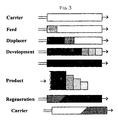
- the product components exit the column as adjacent squarewave zones of highly concentrated pure material in the order of increasing affinity of absorption. This is shown schematically in Fig. 3.
- the displacer emerges from the column.
- a typical chromatogram from a displacement chromatography is shown in Fig. 4. It is readily distinguished from the chromatogram of elution chromatography shown in Fig.
- Displacement chromatography has some particularly advantageous characteristics for process scale chromatography of biological macromolecules such as proteins.
- displacement chromatography can achieve product separation and concentration in a single step.
- isocratic elution chromatography results in product dilution during separation.
- Third, column development per se requires less solvent than a comparable elution process.
- displacement chromatography can concentrate and purify components from mixtures having low separation factors, while relatively large separation factors are required for satisfactory resolution in desorption chromatography.
- displacement chromatography As it is traditionally known, has a number of drawbacks vis-à-vis elution chromatography for the purification of proteins.
- Two of the major problems are (1) regeneration of the column and (2) the presence of displacer in some of the purified fractions.
- the displacement process uses a high affinity compound as the displacer, the time for regeneration and re-equilibration can be long compared to elution chromatography. Furthermore, relatively large amounts of solvent are often required during regeneration, effectively reducing any advantage over elution chromatography in solvent consumption.
- the invention relates to a method for purifying a protein, said protein being a polypeptide of 10kDa molecular weight or more, the method comprising loading the protein in a suitable loading solvent onto an ion exchange stationary phase and displacing the protein from the stationary phase by displacement chromatography using a displacer of molecular weight less than 1620.
- the stationary phase is a cation exchange resin and the displacer is a cationic species; in another embodiment the stationary phase is an anion exchange resin and the displacer is an anionic species.
- the displacer is a poly(quaternary ammonium) salt, or the displacer is an aminoacid ester, aminoacid amide, N-acylaminoacid, peptide ester, peptide amide or N-acyl peptide, preferably lower alkyl esters or amides of lysine, arginine, N ⁇ -acylated lysine, or N ⁇ -acylated arginine.
- Lower alkyl refers to linear, branched or cyclic, saturated hydrocarbon residues of six or fewer carbons.
- the displacer may also be a cationic or anionic antibiotic, or a dendritic polymer.
- a preferred displacer is wherein X - is a counter anion, for example halogen, sulfate, sulfonate, perchlorate, acetate, phosphate or nitrate.
- the displacer may be advantageously selected from electrolytes whose characteristic charge ( ⁇ ) and equilibrium constant (K) are such that when a coordinate system representing log K on the ordinate and ⁇ on the abscissa is created, a line constructed from a point A on the ordinate axis through a point defined by the K and the ⁇ of the displacer has a greater slope than a corresponding line constructed from the same point A through a point defined by the K and the ⁇ of the protein to be purified.
- the point A corresponds in value to the slope of the displacer operating line ( ⁇ ) in the system of interest. This will be explained in greater detail below.
- Displacers of molecular weight below 900 are particularly advantageous.
- the invention in another embodiment relates to a method for purifying a protein wherein the displacer is a dendritic polyelectrolyte displacer.
- the stationary phase can be a cation exchange resin, in which case the polyelectrolyte will be a polycation, for example a poly (quaternary ammonium) salt or the stationary phase can be an anion exchange resin, in which case the polyelectrolye will be a polyanion.
- the invention relates to compounds of formula wherein R 1 is lower alkyl, n is 2 to 6, and X is as before.
- the compounds are useful as displacers in displacement chromatography.
- the steric mass action (SMA) ion exchange model developed by one of the inventors unlike other models, explicitly accounts for steric effects in multicomponent protein equilibria and is able to predict complex behavior in ion exchange displacement systems.
- a macromolecular solute like a protein or a polyelectrolyte is presumed to have a multi-point attachment on an ion-exchange surface and the number of interactions between the absorbent surface and a single macromolecule is defined as the characteristic charge of the solute molecule.
- the characteristic charge of a solute is numerically equal to the number of salt counter-ions displaced by the solute from the ion-exchange surface upon adsorption.
- a large solute macromolecule bound to an ion-exchange surface also sterically hinders the adsorption of macromolecules of similar size onto sites underneath and adjoining the bound solute molecule.
- the number of sterically hindered salt counter-ions on the surface (per adsorbed solute molecule), unavailable for exchange with other solute molecules in the fluid phase is defined as the steric factor of the adsorbed macromolecule.
- Earlier treatments of mass action ion exchange equilibria assumed that the binding of a macromolecule to an adsorbent surface only affects a number of adsorbent sites equal to its characteristic charge. In fact, the steric shielding of the stationary phase sites plays an important role in the non-linear adsorption behavior of macromolecules in ion-exchange systems.
- the stoichiometric exchange of a solute molecule (protein or polyelectrolyte) and the exchangeable salt counter-ions can be represented by: C i + v i Q s - Q i + v i C s where C and Q are the mobile and stationary phase concentrations; v i is the characteristic charge of the solute, and subscripts i and s refer to the solute molecule and the salt counter-ion respectively.
- the overbar denotes bound salt counter-ions available for exchange with the solute macromolecule in solution.
- K i for the solute adsorbed on the ion-exchange surface is given by:
- the equilibrium constant is a measure of the affinity of the molecule.
- the electro-neutrality condition on the stationary phase is given by the following relation: ⁇ ⁇ Q s + ( v i + ⁇ i ) Q i where ⁇ i is the steric factor of the displacer or protein. Substituting equation 3 into equation 2 and rearranging yields the following equilibrium relation for a single protein or displacer:
- Ion-bed capacity, ⁇ can be measured in-situ using frontal chromatographic techniques [see Gadam et al. , J. Chromatog. 630 , 37-52 (1993)].
- linear elution chromatography can be employed to determine two of the three SMA model parameters (viz., characteristic charge and equilibrium constant) using well established relationships for ion-exchange systems [see Kopaciewicz et al., J. Chromatog. 266 , 3 (1983)].
- the remaining SMA parameter, viz. steric factor, ⁇ i for the proteins is determined independently from a single non-linear frontal chromatographic experiment according to the expression:
- ⁇ D ⁇ Q max D - n D
- ⁇ the ion bed capacity
- Q max / D the maximum stationary phase capacity of the polyelectrolyte displacer.
- the equilibrium constant for the ion-exchange process is defined by equation 2.
- the mathematical criterion for effective displacement chromatography can be reconstructed as a plot of log K i vs. v i (see Fig. 5).
- the elution order in the isotachic displacement train can be then graphically determined by constructing lines from the point on the ordinate axis corresponding to the slope of the displacer operating line, ⁇ , through each of the points defined by the equilibrium parameters (characteristic charge and equilibrium constant) of the solutes.
- the order of elution of the feed components corresponds to the counterclockwise order (i.e. increasing slopes) of these "affinity" lines.
- (C 1 ) d is the concentration of salt that the displacer encounters (i.e. the carrier salt concentration)
- Q d is the concentration of the displacer on the stationary phase
- C d is the concentration of displacer in the mobile phase.
- Dendritic polymers are three-dimensional, highly ordered oligomeric and polymeric compounds formed by reiterative reaction sequences starting from smaller molecules - "initiator cores" such as ammonia or pentaerythritol. With selected building blocks and propagation reactions, critical molecular design parameters such as size, shape, topology, flexibility and surface chemistry can be precisely controlled at the molecular level. The syntheses proceed via discrete stages referred to as generations.
- Dendrimers possess three distinguishing architectural features: (1) an initiator-core region, (2) interior zones containing cascading tiers of branch cells with radial connectivity to the intiator core, and (3) an exterior or surface region of terminal moieties attached to the outermost generation.
- the synthesis of a zero (12), first (14) and second [(16) shown in scheme 2] generation pentaerythritol based dendrimer was carried out as described in detail later.
- the zero generation dendrimer is referred to for convenience as PETMA4, PentaErythrityl (TriMethylAmmonium) 4 , the first generation as PETMA12, and the second as PETMA36.
- First and second generation pentaerythritol based dendrimers (PETMA12 and PETMA36) are discussed for exemplary purposes only and do not fall within the scope of the claimed invention.
- the SMA model equilibrium parameters for the zero, first and second generation dendrimers were estimated in a 50 x 5 mm I.D. SCX column using frontal chromatographic techniques.
- PETMA4 (480) 20 15 1.5 2.6 1.73 140 210 PETMA4 (480) 50 21 1.6 1.5 0.94 183 293 PETMA4 (480) 50 4.18 N.D. N.D. N.D. 177 N.D. PETMA12 (1620) 20 6.17 4.2 6.3 1.50 55.3 232 PETMA12 (1620) 75 6.17 4.2 N.D. N.D. 51.5 216 PETMA36 (5128) 20 1.96 11 16.7 1.52 20.9 230 PETMA36 (5128) 50 1.96 10.5 N.D. N.D. 18.3 192
- the second generation dendrimer PETMA36 has a relatively higher characteristic charge than the first generation dendrimer, but a similar ⁇ i /v i ratio. According to theory, PETMA36 should act as an efficient displacer, and that was indeed found to be the case.
- a two-protein displacement separation ( ⁇ -chymotrypsinogen A and cytochrome C) using PETMA36 was carried out in a 100 x 5 mm cation exchange column. There was a reasonably good match of theory and experiment. The experiment was repeated using purified (diafiltered) first generation pentaerythritol PETMA12 as the displacer.
- the zero, first and second generation dendritic polyelectrolytes function as efficient displacers of proteins in ion-exchange systems. More significantly the ability of a low molecular weight compound such as the 'zero' generation dendrimer (M.W. 480) to displace relatively high molecular weight proteins is quite exciting in the current context of understanding displacement phenomena. Since the molecular weight and number of charged groups on the dendrimers appear to have little effect on their efficacy as displacers, it may be more advantageous to use a 'zero' generation dendrimer as a displacer. The synthesis of these molecules is much easier and involves fewer steps; (hence they are cheaper). They have the additional advantage of easy separation from any feed component zones during post-displacement, size-based downstream processing.
- modified amino acids and charge-bearing antibiotics can be used as displacers.
- modified it is meant that the amino acid is altered so as to change it from amphoteric to either cationic (for cation exchange displacement chromatography) or anionic (for anion exchange chromatography). This is most conveniently accomplished by esterifying the carboxylate to produce cationic species or acylating the amine to produce anionic species.
- Displacers whose charge is derived from carboxylate tend not to be very effective anionic displacers because of their lower characteristic charge at a pH commonly used in chromatography; as a result, they would have to have an extremely high equilibrium constant to fall counterclockwise from most proteins of interest on the affinity plot. For this reason, among amino acids, acylated taurine derivatives are more likely candidates for anionic displacers.
- Carboxyl-derivatized amino acids provide very effective cationic displacers.
- carbobenzoxylysine methyl ester, benzoylarginine ethyl ester (BAEE), arginine methyl ester and argininamide are all effective displacers in the displacement chromatography of ⁇ -chymotrypsinogen and cytochrome-C. The first two have a single, positive charge; arginine methyl ester and amide have two positive charges, and as a result, a higher affinity for the stationary phase.
- the resolution of ⁇ -chymotrypsinogen and cytochrome-C in isotacic displacement is comparable to the resolution obtained using high molecular weight displacers such as DEAE dextran.
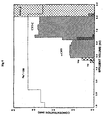
- An example of a displacement chromatogram of ⁇ -chymotrypsinogen A and cytochrome C on an 8 micron strong cation exchange column using 45 mM benzoyl arginine ethyl ester in a 50 mM salt solution at pH 6.0 is shown in Figure 7.
- the modified amino acid displacers can be purchased in a very pure form at a cost which is a small fraction of the cost of high molecular weight displacers. In addition, their small size provides them with better transport properties and faster kinetics.
- antibiotics have the virtue that they are small enough to be removed easily if found in desired protein fractions, but in addition, they can often be advantageously left in the protein fraction.
- antibiotics having one or more strongly dissociating functionalities are particularly useful.
- antibiotics include the streptomycins, which have two guanidine functionalities.
- An example of a displacement chromatogram of ⁇ -chymotrypsinogen A and cytochrome C on an 8 micron strong cation exchange column using 45 mM streptomycin sulfate (m.w. 581) in a 30 mM salt solution at pH 6.0 is shown in Figure 8.
- a displacement separation of a two-component protein mixture was also carried out using crude PETMA (12) as the displacer in a 100 x 5 mm cation-exchange column.
- the protein components were displaced and well separated in adjacent zones, the effluent profile exhibited similar characteristics to earlier displacements with impure DEAE-dextran displacers.
- the cytochrome-C zone was considerably less concentrated in relation to the ⁇ -chymotrypsinogen A zone.
- impurities in the displacer contributed to the desorption of the proteins and depression of their isotherms. It is therefore believed advantageous to purify the dendrimers.
- dendrimers One characteristic of dendrimers is that a variety of terminal moieties may reside on the surface of the dendrimer.
- the terminal groups can be readily converted to functionalities that provide the potential for different utilities, and dendrimers possess a very high density of these terminal moieties which reside in the final exterior layer.
- the organic groups on the surface of these compact molecules are functionalized to be charged groups, such as quaternary ammonium salts and sulfonates, they exhibit higher affinity toward chromatographic media than some proteins, making them useful as a new type of displacer in chromatographic separation.
- the synthesis of the backbone of a dendritic polyether is shown in Scheme 1 and its functionalization pathway to novel poly(ether-amine)s is illustrated in Scheme 2.
- the slurry was then added slowly to a vigorously stirred solution of 200 mL of water, 400 mL of methanol and 160 mL of concentrated hydrochloric acid.
- the crude white pentaerythrityl toluenesulfonate was further cooled by adding more ice, filtered with suction and washed with 1 L of water and 200 mL of cold methanol in two portions.
- Pentaerythritol (13.6 g, 0.1 mol), triethyl orthoacetate (16.22 g, 0.1 mol, 18.3 mL), pyridine p-toluenesulfonate (PPTS) (0.5 g, 2 mmol) and 100 mL of dioctyl phthalate were mixed in a 250 mL, round-bottom flask fitted with a regular distillation apparatus. The mixture was heated to 130-140°C and ethanol was slowly distilled. When the amount of ethanol was close to the theoretical value the pressure was reduced to ⁇ 0.1 torr and the product was distilled in vacuo.
- PPTS p-toluenesulfonate
- PE-MBO(4) (6.0 g, 8.53 mmol) was mixed with 100 mL of methanol and 1 mL of concentrated HCl. The mixture was heated slowly to reflux and kept under reflux for one hour. Methanol and methyl acetate were distilled off until only about 1/3 of the solvent remained. The white product was filtered and dried. Yield: 4.86 g (8.0 mmol), 94%. Mp: 180° C with shrinkage, 220-235° C melting.
- PE-OH(12) (2.24 g 3.68 mmol) was dissolved in 40 mL of pyridine and cooled to 0° C.
- PE-Tos (12) (8.0 g, 3.25 mmol) was dissolved in 50 mL of N,N-dimethylacetamide (DMAc) and 10.06 g of NaBr (98 mmol, 30 equiv) was then added. The resulting suspension was stirred and heated to 150° C and kept at this temperature for another hour. The mixture was cooled to room temperature and poured into ice water. The precipitate was filtered, dried under vacuum (1 torr) overnight and recrystallized from ethyl acetate. Yield: 3.40 g (77%). Mp: 150° C with shrinkage, 172-177° C melting.
- DMAc N,N-dimethylacetamide
- potassium hydride (1.6 g, 40 mmol, 4.57 g of 35% suspension) was washed with hexane twice, the washes were decanted and 100 mL of DMF was added. The mixture was cooled to 0° C and a solution of 5.76 g of MHTBO (compound 2) (36 mmol, 24 equiv) in 50 mL of DMF was added dropwise. The resulting suspension was stirred for three hours at room temperature.
- the dodecabromide (2.05 g, 1.5 mmol) was dissolved in 100 mL of DMF at 50° C and then was added rapidly dropwise to the reaction flask immediately while still warm. The mixture was heated to reflux for 24 hours and then poured into ice water containing about 50 g of sodium chloride. The precipitate was filtered and dried under vacuum (1 torr) at 40° C, overnight. The crude yield was quantitative (3.45 g) and the product was purified by column chromatography with silica gel as the stationary phase and a mixture of 1:1 ethyl acetate/hexane as the eluent. R f value: 0.42. Yield: 2.9 g (1.25 mmol), 82%. The Beilstein test for halogen was negative. Mp: 78° C with shrinkage, 88-90° C gelation, 170° C softening.
- PE-OH(36) (4.17 g, 2.05 mmol) was dissolved in 180 mL of pyridine and cooled to 0° C.
- the brown solution was poured into 2L of ice water and the precipitate was filtered and dried under vacuum (1 torr) at 40° C overnight. Yield: 14.36 g (1.88 mol), 92%.
- Mp 120° C with shrinkage, 220-245° C melting.
- the mixture was heated to reflux for 24 hours and poured into 300 mL of ice water. After all the DMF and water were evaporated, the residue was extracted with 800 mL of ether in several portions and dried over MgSO 4 .
- the ether solution was filtered and concentrated to about 200 mL. In a 300 mL, three necked flask, HCl gas was introduced to the solution and the solvent was decanted when no more salt was formed.
- the salt was washed with anhydrous ether twice, dried under argon for half an hour, dissolved in water and basified to pH>10.
- the resulting aqueous solution was dried on a rotavapor and the residue was extracted with 500 mL of ether and dried over MgSO 4 . After the ether was evaporated, 2.1 g of fairly pure product was obtained.
- the compound is a viscous oil; bp 220° C at 0.02 torr. Yield: 72%.
- PE-TMA iodide(4).
- PE-DMA (12) (2.04 g 1.4 mmol) was dissolved in 60 mL of THF. At 0° C a solution of 3.2 mL (7.12 g, 50 mmol, 36 equiv.) of CH 3 I in 20 mL THF was added dropwise. The mixture was stirred at room temperature for another three hours. The yellow precipitate was filtered and dried under vacuum (1 torr) at 60° C overnight. This salt cannot be recrystallized from methanol and was further purified by ultrafiltration before being tested as a displacer. Yield: 3.74 g, 84%.
- PE-DMA(36) (1.79 g, 0.39 mmol) was dissolved in 100 mL of THF and cooled to 0° C.
- the precipitate was then filtered and dried under vacuum (1 torr) at 60° C overnight. Yield: 2.8 g, 75%.
Landscapes
- Chemical & Material Sciences (AREA)
- Organic Chemistry (AREA)
- Analytical Chemistry (AREA)
- Medicinal Chemistry (AREA)
- Biochemistry (AREA)
- Biophysics (AREA)
- General Health & Medical Sciences (AREA)
- Genetics & Genomics (AREA)
- Life Sciences & Earth Sciences (AREA)
- Molecular Biology (AREA)
- Proteomics, Peptides & Aminoacids (AREA)
- Health & Medical Sciences (AREA)
- Chemical Kinetics & Catalysis (AREA)
- Peptides Or Proteins (AREA)
- Organic Low-Molecular-Weight Compounds And Preparation Thereof (AREA)
- Treatment Of Liquids With Adsorbents In General (AREA)
Applications Claiming Priority (3)
| Application Number | Priority Date | Filing Date | Title |
|---|---|---|---|
| US08/197,146 US5478924A (en) | 1994-02-16 | 1994-02-16 | Displacement chromatography of proteins using low molecular weight displacers |
| US197146 | 1994-02-16 | ||
| PCT/US1995/001966 WO1995022555A1 (en) | 1994-02-16 | 1995-02-16 | Displacement chromatography of proteins using low molecular weight displacers |
Publications (3)
| Publication Number | Publication Date |
|---|---|
| EP0751952A1 EP0751952A1 (en) | 1997-01-08 |
| EP0751952A4 EP0751952A4 (en) | 1997-12-17 |
| EP0751952B1 true EP0751952B1 (en) | 2003-07-02 |
Family
ID=22728236
Family Applications (1)
| Application Number | Title | Priority Date | Filing Date |
|---|---|---|---|
| EP95910281A Expired - Lifetime EP0751952B1 (en) | 1994-02-16 | 1995-02-16 | Displacement chromatography of proteins using low molecular weight displacers |
Country Status (7)
| Country | Link |
|---|---|
| US (2) | US5478924A (enExample) |
| EP (1) | EP0751952B1 (enExample) |
| JP (1) | JP3995260B2 (enExample) |
| CA (1) | CA2183160C (enExample) |
| DE (1) | DE69531197T2 (enExample) |
| NO (1) | NO317346B1 (enExample) |
| WO (1) | WO1995022555A1 (enExample) |
Families Citing this family (24)
| Publication number | Priority date | Publication date | Assignee | Title |
|---|---|---|---|---|
| US5478924A (en) * | 1994-02-16 | 1995-12-26 | Cramer; Steven M. | Displacement chromatography of proteins using low molecular weight displacers |
| NZ330867A (en) * | 1996-01-19 | 1998-11-25 | Cohesive Tech Inc | High performance liquid chromatography (hplc) method and apparatus |
| US6225352B1 (en) | 1996-08-14 | 2001-05-01 | Warner-Lambert Company | Low molecular weight dendritic compounds as pharmaceutical agents |
| US6239262B1 (en) * | 1998-01-07 | 2001-05-29 | Rensselaer Polytechnic Institute | Low molecular weight displacers for protein purification in hydrophobic interaction and reversed phase chromatographic systems |
| EP0943632A1 (en) * | 1998-03-18 | 1999-09-22 | Ecole Polytechnique Federale De Lausanne | Quaternary ammonium polymer, its preparation, its use for separating biomolecules |
| US6573373B1 (en) * | 1999-06-29 | 2003-06-03 | Isis Pharmaceuticals, Inc. | High affinity, low molecular weight displacers for oligonucleotide purification |
| US20050176937A1 (en) * | 2000-02-23 | 2005-08-11 | Rensselaer Polytechnic Institute | High throughput screening of potential displacer molecules |
| US6881540B2 (en) | 2000-02-23 | 2005-04-19 | Rensselaer Polytechnic Institute | High throughtput screening of potential displacer molecules |
| AU2003213642A1 (en) * | 2002-02-28 | 2003-09-16 | Rensselaer Polytechnic Institute | High-affinity, low-molecular-mass displacers for ion-exchange chromatography |
| US7473367B2 (en) | 2002-06-26 | 2009-01-06 | Dionex Corporation | Monolithic column |
| US6749749B2 (en) | 2002-06-26 | 2004-06-15 | Isco, Inc. | Separation system, components of a separation system and methods of making and using them |
| US7291395B2 (en) * | 2004-02-18 | 2007-11-06 | Dionex Corporation | Coated ion exchanged substrate and method of forming |
| WO2006028433A1 (en) * | 2004-09-07 | 2006-03-16 | Dyer Gordon W | Use of compounds for the inhibition of proteins and uv protection |
| GB2439875B (en) * | 2005-04-22 | 2010-10-20 | Waters Investments Ltd | Apparatus and methods for mass spectrometric directed purification of biopolymers |
| WO2007053235A1 (en) * | 2005-11-04 | 2007-05-10 | Sachem, Inc. | Cation-exchange displacement chromatography process and cationic organic compounds for use as displacer compounds in cation-exchange displacement chromatography process |
| CA2630806C (en) * | 2005-12-02 | 2015-01-06 | Sachem, Inc. | Anion-exchange displacement chromatography process and anionic organic compounds for use as displacer compounds in anion-exchange displacement chromatography process |
| KR101310815B1 (ko) * | 2006-03-16 | 2013-09-27 | 에치투엘 주식회사 | 중공사막 및 그의 제조방법 |
| JP5386354B2 (ja) * | 2006-09-08 | 2014-01-15 | ワイス・エルエルシー | アフィニティークロマトグラフィーを使用するタンパク質精製におけるアルギニン洗浄 |
| BR112015021495A2 (pt) | 2013-03-08 | 2017-07-18 | Genzyme Corp | fabricação contínua integrada de substâncias de droga de proteína terapêutica |
| WO2015100212A1 (en) * | 2013-12-23 | 2015-07-02 | Xmicrobial, Llc | Microbicidal polymers and methods of use thereof |
| TWI709569B (zh) | 2014-01-17 | 2020-11-11 | 美商健臻公司 | 無菌層析樹脂及其用於製造方法的用途 |
| TWI671312B (zh) | 2014-01-17 | 2019-09-11 | 美商健臻公司 | 無菌層析法及製法 |
| AU2019332764B2 (en) | 2018-08-31 | 2025-05-29 | Genzyme Corporation | Sterile chromatography resin and use thereof in manufacturing processes |
| JP7387155B2 (ja) * | 2019-11-21 | 2023-11-28 | 国立研究開発法人物質・材料研究機構 | イオン液体 |
Family Cites Families (7)
| Publication number | Priority date | Publication date | Assignee | Title |
|---|---|---|---|---|
| US2946757A (en) * | 1955-05-02 | 1960-07-26 | George B Butler | Quaternary ammonium ion exchange resins of improved properties |
| US3651231A (en) * | 1969-09-10 | 1972-03-21 | Upjohn Co | Process for preparing lactogenic factor |
| US4352919A (en) * | 1981-02-02 | 1982-10-05 | Milliken Research Corporation | Aminoalkoxypentaerythritols |
| US5156835A (en) * | 1987-01-30 | 1992-10-20 | Colgate-Palmolive Company | Antibacterial antiplaque oral composition |
| US5028696A (en) * | 1988-10-28 | 1991-07-02 | Torres Anthony R | Ion exchange and separation method |
| IT1232311B (it) * | 1989-09-04 | 1992-01-28 | Sclavo Spa | Metodo di purificazione di composti a struttura peptidica o pseudo peptidica a basso peso molecolare. |
| US5478924A (en) * | 1994-02-16 | 1995-12-26 | Cramer; Steven M. | Displacement chromatography of proteins using low molecular weight displacers |
-
1994
- 1994-02-16 US US08/197,146 patent/US5478924A/en not_active Expired - Lifetime
-
1995
- 1995-02-16 CA CA002183160A patent/CA2183160C/en not_active Expired - Lifetime
- 1995-02-16 JP JP52191295A patent/JP3995260B2/ja not_active Expired - Lifetime
- 1995-02-16 EP EP95910281A patent/EP0751952B1/en not_active Expired - Lifetime
- 1995-02-16 WO PCT/US1995/001966 patent/WO1995022555A1/en not_active Ceased
- 1995-02-16 DE DE69531197T patent/DE69531197T2/de not_active Expired - Lifetime
- 1995-10-19 US US08/545,457 patent/US5606033A/en not_active Expired - Lifetime
-
1996
- 1996-08-15 NO NO19963420A patent/NO317346B1/no not_active IP Right Cessation
Also Published As
| Publication number | Publication date |
|---|---|
| DE69531197D1 (de) | 2003-08-07 |
| EP0751952A4 (en) | 1997-12-17 |
| NO963420L (no) | 1996-08-15 |
| WO1995022555A1 (en) | 1995-08-24 |
| US5606033A (en) | 1997-02-25 |
| JP3995260B2 (ja) | 2007-10-24 |
| JPH09509178A (ja) | 1997-09-16 |
| CA2183160A1 (en) | 1995-08-24 |
| DE69531197T2 (de) | 2004-07-01 |
| US5478924A (en) | 1995-12-26 |
| EP0751952A1 (en) | 1997-01-08 |
| CA2183160C (en) | 1999-12-21 |
| NO317346B1 (no) | 2004-10-18 |
Similar Documents
| Publication | Publication Date | Title |
|---|---|---|
| US5478924A (en) | Displacement chromatography of proteins using low molecular weight displacers | |
| EP0337144B1 (de) | Trennmaterialien | |
| Wang et al. | Synthesis of cationic β-cyclodextrin derivatives and their applications as chiral stationary phases for high-performance liquid chromatography and supercritical fluid chromatography | |
| CN103958017B (zh) | 用于疏水性置换色谱法的阴离子置换剂分子 | |
| EP2212020B1 (en) | Imprinted polymers with affinity for phosphorylated peptides and proteins | |
| Dong et al. | Separation of ephedrine stereoisomers by molecularly imprinted polymers—influence of synthetic conditions and mobile phase compositions on the chromatographic performance | |
| Mansour et al. | Multimodal liquid chromatography of small molecules | |
| Chicz et al. | [32] High-performance liquid chromatography: Effective protein purification by various chromatographic modes | |
| Ferri et al. | Fragment-based design of zwitterionic, strong cation-and weak anion-exchange type mixed-mode liquid chromatography ligands and their chromatographic exploration | |
| JPWO1999061904A1 (ja) | 新規な特性を有するクロマトグラフィー用充填剤およびそれを用いた物質の分離方法 | |
| Lu et al. | Molecular recognition through the exact placement of functional groups on non-covalent molecularly imprinted polymers | |
| Franco et al. | Novel cinchona alkaloid carbamate C9-dimers as chiral anion-exchange type selectors for high-performance liquid chromatography | |
| CA2899387C (en) | Purification of organic compounds using surrogate stationary phases on reversed phase columns | |
| Preinerstorfer et al. | Stereoselective separations of chiral phosphinic acid pseudodipeptides by CEC using silica monoliths modified with an anion‐exchange‐type chiral selector | |
| Li et al. | High uptake rate and extremely salt-tolerant behavior of protein adsorption to 900 kDa poly (allylamine)-modified Sepharose FF | |
| Sun et al. | Molecularly imprinted polymer usingp‐hydroxybenzoic acid, p‐hydroxyphenylacetic acid and p‐hydroxyphenylpropionic acid as templates | |
| Hu et al. | Enantioseparation of nine indanone and tetralone derivatives by HPLC using carboxymethyl‐β‐cyclodextrin as the mobile phase additive | |
| US7320755B2 (en) | Method of preparing ligands for hydrophobic interaction chromatography | |
| JPH03118393A (ja) | ペプチド又はプソイドペプチド構造の低分子量化合物の精製方法 | |
| EP1192172B1 (en) | High affinity, low molecular weight displacers for oligonucleotide purification | |
| US6929747B2 (en) | High-affinity, low-molecular-mass displacers for ion-exchange chromatography | |
| US6489421B1 (en) | Quaternary ammonium polymer, its preparation, its use for separating biomolecules | |
| Xu et al. | Preparation of highly selective stationary phases for high-performance liquid chromatographic separation of enantiomers by direct copolymerization of monomers with single or twin chiral ligands | |
| US20160237112A1 (en) | Purification of organic compounds by surfactant mediated preparative hplc | |
| Chao et al. | Continuous Multiaffinity Separation of Proteins: Cyclic Processes |
Legal Events
| Date | Code | Title | Description |
|---|---|---|---|
| PUAI | Public reference made under article 153(3) epc to a published international application that has entered the european phase |
Free format text: ORIGINAL CODE: 0009012 |
|
| 17P | Request for examination filed |
Effective date: 19960905 |
|
| AK | Designated contracting states |
Kind code of ref document: A1 Designated state(s): DE FR GB IT NL SE |
|
| A4 | Supplementary search report drawn up and despatched |
Effective date: 19971030 |
|
| AK | Designated contracting states |
Kind code of ref document: A4 Designated state(s): DE FR GB IT NL SE |
|
| 17Q | First examination report despatched |
Effective date: 20000724 |
|
| GRAH | Despatch of communication of intention to grant a patent |
Free format text: ORIGINAL CODE: EPIDOS IGRA |
|
| GRAH | Despatch of communication of intention to grant a patent |
Free format text: ORIGINAL CODE: EPIDOS IGRA |
|
| GRAA | (expected) grant |
Free format text: ORIGINAL CODE: 0009210 |
|
| AK | Designated contracting states |
Designated state(s): DE FR GB IT NL SE |
|
| REG | Reference to a national code |
Ref country code: GB Ref legal event code: FG4D |
|
| REF | Corresponds to: |
Ref document number: 69531197 Country of ref document: DE Date of ref document: 20030807 Kind code of ref document: P |
|
| REG | Reference to a national code |
Ref country code: SE Ref legal event code: TRGR |
|
| PLBE | No opposition filed within time limit |
Free format text: ORIGINAL CODE: 0009261 |
|
| STAA | Information on the status of an ep patent application or granted ep patent |
Free format text: STATUS: NO OPPOSITION FILED WITHIN TIME LIMIT |
|
| ET | Fr: translation filed | ||
| 26N | No opposition filed |
Effective date: 20040405 |
|
| PGFP | Annual fee paid to national office [announced via postgrant information from national office to epo] |
Ref country code: NL Payment date: 20140217 Year of fee payment: 20 Ref country code: SE Payment date: 20140224 Year of fee payment: 20 |
|
| PGFP | Annual fee paid to national office [announced via postgrant information from national office to epo] |
Ref country code: FR Payment date: 20140219 Year of fee payment: 20 Ref country code: IT Payment date: 20140220 Year of fee payment: 20 |
|
| PGFP | Annual fee paid to national office [announced via postgrant information from national office to epo] |
Ref country code: GB Payment date: 20140218 Year of fee payment: 20 |
|
| PGFP | Annual fee paid to national office [announced via postgrant information from national office to epo] |
Ref country code: DE Payment date: 20140901 Year of fee payment: 20 |
|
| REG | Reference to a national code |
Ref country code: DE Ref legal event code: R071 Ref document number: 69531197 Country of ref document: DE |
|
| REG | Reference to a national code |
Ref country code: DE Ref legal event code: R071 Ref document number: 69531197 Country of ref document: DE |
|
| REG | Reference to a national code |
Ref country code: NL Ref legal event code: V4 Effective date: 20150216 |
|
| REG | Reference to a national code |
Ref country code: GB Ref legal event code: PE20 Expiry date: 20150215 |
|
| REG | Reference to a national code |
Ref country code: SE Ref legal event code: EUG |
|
| PG25 | Lapsed in a contracting state [announced via postgrant information from national office to epo] |
Ref country code: GB Free format text: LAPSE BECAUSE OF EXPIRATION OF PROTECTION Effective date: 20150215 |