EP0748853A2 - Polymerisierbare Azofarbstoffe mit Thiophenstruktur - Google Patents
Polymerisierbare Azofarbstoffe mit Thiophenstruktur Download PDFInfo
- Publication number
- EP0748853A2 EP0748853A2 EP96109164A EP96109164A EP0748853A2 EP 0748853 A2 EP0748853 A2 EP 0748853A2 EP 96109164 A EP96109164 A EP 96109164A EP 96109164 A EP96109164 A EP 96109164A EP 0748853 A2 EP0748853 A2 EP 0748853A2
- Authority
- EP
- European Patent Office
- Prior art keywords
- azo dyes
- hydrogen
- mol
- dyes according
- alkyl
- Prior art date
- Legal status (The legal status is an assumption and is not a legal conclusion. Google has not performed a legal analysis and makes no representation as to the accuracy of the status listed.)
- Withdrawn
Links
- 239000000987 azo dye Substances 0.000 title claims abstract description 21
- 229930192474 thiophene Natural products 0.000 title description 2
- YTPLMLYBLZKORZ-UHFFFAOYSA-N Thiophene Chemical compound C=1C=CSC=1 YTPLMLYBLZKORZ-UHFFFAOYSA-N 0.000 title 2
- 229910052739 hydrogen Inorganic materials 0.000 claims abstract description 16
- 239000001257 hydrogen Substances 0.000 claims abstract description 16
- 239000000975 dye Substances 0.000 claims abstract description 12
- UFHFLCQGNIYNRP-UHFFFAOYSA-N Hydrogen Chemical compound [H][H] UFHFLCQGNIYNRP-UHFFFAOYSA-N 0.000 claims abstract description 11
- 150000002431 hydrogen Chemical class 0.000 claims abstract description 8
- 125000001841 imino group Chemical group [H]N=* 0.000 claims abstract description 8
- 125000002496 methyl group Chemical group [H]C([H])([H])* 0.000 claims abstract description 8
- 125000004093 cyano group Chemical group *C#N 0.000 claims abstract description 6
- 229910052760 oxygen Inorganic materials 0.000 claims abstract description 6
- 239000001301 oxygen Substances 0.000 claims abstract description 6
- 125000003118 aryl group Chemical group 0.000 claims abstract description 5
- QVGXLLKOCUKJST-UHFFFAOYSA-N atomic oxygen Chemical compound [O] QVGXLLKOCUKJST-UHFFFAOYSA-N 0.000 claims abstract description 5
- 125000000449 nitro group Chemical group [O-][N+](*)=O 0.000 claims abstract description 5
- 125000001424 substituent group Chemical group 0.000 claims abstract description 5
- 125000004430 oxygen atom Chemical group O* 0.000 claims abstract description 4
- 229920000642 polymer Polymers 0.000 claims description 24
- 238000000034 method Methods 0.000 claims description 9
- 125000001495 ethyl group Chemical group [H]C([H])([H])C([H])([H])* 0.000 claims description 6
- 125000000217 alkyl group Chemical group 0.000 claims description 5
- CUONGYYJJVDODC-UHFFFAOYSA-N malononitrile Chemical compound N#CCC#N CUONGYYJJVDODC-UHFFFAOYSA-N 0.000 claims description 5
- 238000002360 preparation method Methods 0.000 claims description 5
- 125000002947 alkylene group Chemical group 0.000 claims description 4
- 239000000178 monomer Substances 0.000 claims description 4
- 125000000999 tert-butyl group Chemical group [H]C([H])([H])C(*)(C([H])([H])[H])C([H])([H])[H] 0.000 claims description 4
- 125000000484 butyl group Chemical group [H]C([*])([H])C([H])([H])C([H])([H])C([H])([H])[H] 0.000 claims description 3
- 125000001997 phenyl group Chemical group [H]C1=C([H])C([H])=C(*)C([H])=C1[H] 0.000 claims description 3
- 125000000753 cycloalkyl group Chemical group 0.000 claims description 2
- GLQWRXYOTXRDNH-UHFFFAOYSA-N thiophen-2-amine Chemical compound NC1=CC=CS1 GLQWRXYOTXRDNH-UHFFFAOYSA-N 0.000 claims description 2
- 125000002490 anilino group Chemical class [H]N(*)C1=C([H])C([H])=C([H])C([H])=C1[H] 0.000 claims 1
- 230000003287 optical effect Effects 0.000 abstract description 5
- 125000004400 (C1-C12) alkyl group Chemical group 0.000 abstract description 3
- 125000004191 (C1-C6) alkoxy group Chemical group 0.000 abstract description 3
- 229920001577 copolymer Polymers 0.000 abstract description 2
- -1 methylpentyl Chemical group 0.000 description 18
- 239000000203 mixture Substances 0.000 description 15
- WYURNTSHIVDZCO-UHFFFAOYSA-N Tetrahydrofuran Chemical compound C1CCOC1 WYURNTSHIVDZCO-UHFFFAOYSA-N 0.000 description 12
- 150000001875 compounds Chemical class 0.000 description 11
- QTBSBXVTEAMEQO-UHFFFAOYSA-N Acetic acid Chemical compound CC(O)=O QTBSBXVTEAMEQO-UHFFFAOYSA-N 0.000 description 10
- 150000003254 radicals Chemical class 0.000 description 9
- YMWUJEATGCHHMB-UHFFFAOYSA-N Dichloromethane Chemical compound ClCCl YMWUJEATGCHHMB-UHFFFAOYSA-N 0.000 description 7
- 238000009835 boiling Methods 0.000 description 7
- IJGRMHOSHXDMSA-UHFFFAOYSA-N Atomic nitrogen Chemical compound N#N IJGRMHOSHXDMSA-UHFFFAOYSA-N 0.000 description 6
- YLQBMQCUIZJEEH-UHFFFAOYSA-N tetrahydrofuran Natural products C=1C=COC=1 YLQBMQCUIZJEEH-UHFFFAOYSA-N 0.000 description 6
- XLYOFNOQVPJJNP-UHFFFAOYSA-N water Substances O XLYOFNOQVPJJNP-UHFFFAOYSA-N 0.000 description 6
- 229960000583 acetic acid Drugs 0.000 description 5
- 230000008878 coupling Effects 0.000 description 5
- 238000010168 coupling process Methods 0.000 description 5
- 238000005859 coupling reaction Methods 0.000 description 5
- 239000012362 glacial acetic acid Substances 0.000 description 5
- 239000002904 solvent Substances 0.000 description 5
- LFQSCWFLJHTTHZ-UHFFFAOYSA-N Ethanol Chemical compound CCO LFQSCWFLJHTTHZ-UHFFFAOYSA-N 0.000 description 4
- BZLVMXJERCGZMT-UHFFFAOYSA-N Methyl tert-butyl ether Chemical compound COC(C)(C)C BZLVMXJERCGZMT-UHFFFAOYSA-N 0.000 description 4
- PPBRXRYQALVLMV-UHFFFAOYSA-N Styrene Chemical compound C=CC1=CC=CC=C1 PPBRXRYQALVLMV-UHFFFAOYSA-N 0.000 description 4
- MVPPADPHJFYWMZ-UHFFFAOYSA-N chlorobenzene Chemical compound ClC1=CC=CC=C1 MVPPADPHJFYWMZ-UHFFFAOYSA-N 0.000 description 4
- XBDQKXXYIPTUBI-UHFFFAOYSA-N dimethylselenoniopropionate Natural products CCC(O)=O XBDQKXXYIPTUBI-UHFFFAOYSA-N 0.000 description 4
- 238000004519 manufacturing process Methods 0.000 description 4
- 229910052757 nitrogen Inorganic materials 0.000 description 4
- 238000000746 purification Methods 0.000 description 4
- VIMMECPCYZXUCI-MIMFYIINSA-N (4s,6r)-6-[(1e)-4,4-bis(4-fluorophenyl)-3-(1-methyltetrazol-5-yl)buta-1,3-dienyl]-4-hydroxyoxan-2-one Chemical compound CN1N=NN=C1C(\C=C\[C@@H]1OC(=O)C[C@@H](O)C1)=C(C=1C=CC(F)=CC=1)C1=CC=C(F)C=C1 VIMMECPCYZXUCI-MIMFYIINSA-N 0.000 description 3
- HIHOEGPXVVKJPP-JTQLQIEISA-N 5-fluoro-2-[[(1s)-1-(5-fluoropyridin-2-yl)ethyl]amino]-6-[(5-methyl-1h-pyrazol-3-yl)amino]pyridine-3-carbonitrile Chemical compound N([C@@H](C)C=1N=CC(F)=CC=1)C(C(=CC=1F)C#N)=NC=1NC=1C=C(C)NN=1 HIHOEGPXVVKJPP-JTQLQIEISA-N 0.000 description 3
- WFDIJRYMOXRFFG-UHFFFAOYSA-N Acetic anhydride Chemical compound CC(=O)OC(C)=O WFDIJRYMOXRFFG-UHFFFAOYSA-N 0.000 description 3
- IAZDPXIOMUYVGZ-UHFFFAOYSA-N Dimethylsulphoxide Chemical compound CS(C)=O IAZDPXIOMUYVGZ-UHFFFAOYSA-N 0.000 description 3
- XEKOWRVHYACXOJ-UHFFFAOYSA-N Ethyl acetate Chemical compound CCOC(C)=O XEKOWRVHYACXOJ-UHFFFAOYSA-N 0.000 description 3
- ZMXDDKWLCZADIW-UHFFFAOYSA-N N,N-Dimethylformamide Chemical compound CN(C)C=O ZMXDDKWLCZADIW-UHFFFAOYSA-N 0.000 description 3
- HEMHJVSKTPXQMS-UHFFFAOYSA-M Sodium hydroxide Chemical compound [OH-].[Na+] HEMHJVSKTPXQMS-UHFFFAOYSA-M 0.000 description 3
- YXFVVABEGXRONW-UHFFFAOYSA-N Toluene Chemical compound CC1=CC=CC=C1 YXFVVABEGXRONW-UHFFFAOYSA-N 0.000 description 3
- ZMANZCXQSJIPKH-UHFFFAOYSA-N Triethylamine Chemical compound CCN(CC)CC ZMANZCXQSJIPKH-UHFFFAOYSA-N 0.000 description 3
- 238000006243 chemical reaction Methods 0.000 description 3
- 125000000664 diazo group Chemical group [N-]=[N+]=[*] 0.000 description 3
- 239000012074 organic phase Substances 0.000 description 3
- 239000011541 reaction mixture Substances 0.000 description 3
- RWWYLEGWBNMMLJ-YSOARWBDSA-N remdesivir Chemical compound NC1=NC=NN2C1=CC=C2[C@]1([C@@H]([C@@H]([C@H](O1)CO[P@](=O)(OC1=CC=CC=C1)N[C@H](C(=O)OCC(CC)CC)C)O)O)C#N RWWYLEGWBNMMLJ-YSOARWBDSA-N 0.000 description 3
- 150000003577 thiophenes Chemical class 0.000 description 3
- PHDIJLFSKNMCMI-ITGJKDDRSA-N (3R,4S,5R,6R)-6-(hydroxymethyl)-4-(8-quinolin-6-yloxyoctoxy)oxane-2,3,5-triol Chemical compound OC[C@@H]1[C@H]([C@@H]([C@H](C(O1)O)O)OCCCCCCCCOC=1C=C2C=CC=NC2=CC=1)O PHDIJLFSKNMCMI-ITGJKDDRSA-N 0.000 description 2
- JNPGUXGVLNJQSQ-BGGMYYEUSA-M (e,3r,5s)-7-[4-(4-fluorophenyl)-1,2-di(propan-2-yl)pyrrol-3-yl]-3,5-dihydroxyhept-6-enoate Chemical compound CC(C)N1C(C(C)C)=C(\C=C\[C@@H](O)C[C@@H](O)CC([O-])=O)C(C=2C=CC(F)=CC=2)=C1 JNPGUXGVLNJQSQ-BGGMYYEUSA-M 0.000 description 2
- 0 *c1c[s]c(N)c1* Chemical compound *c1c[s]c(N)c1* 0.000 description 2
- QPFMBZIOSGYJDE-UHFFFAOYSA-N 1,1,2,2-tetrachloroethane Chemical compound ClC(Cl)C(Cl)Cl QPFMBZIOSGYJDE-UHFFFAOYSA-N 0.000 description 2
- RXQNKKRGJJRMKD-UHFFFAOYSA-N 5-bromo-2-methylaniline Chemical compound CC1=CC=C(Br)C=C1N RXQNKKRGJJRMKD-UHFFFAOYSA-N 0.000 description 2
- PAYRUJLWNCNPSJ-UHFFFAOYSA-N Aniline Chemical compound NC1=CC=CC=C1 PAYRUJLWNCNPSJ-UHFFFAOYSA-N 0.000 description 2
- NLZUEZXRPGMBCV-UHFFFAOYSA-N Butylhydroxytoluene Chemical compound CC1=CC(C(C)(C)C)=C(O)C(C(C)(C)C)=C1 NLZUEZXRPGMBCV-UHFFFAOYSA-N 0.000 description 2
- YNAVUWVOSKDBBP-UHFFFAOYSA-N Morpholine Chemical compound C1COCCN1 YNAVUWVOSKDBBP-UHFFFAOYSA-N 0.000 description 2
- NQRYJNQNLNOLGT-UHFFFAOYSA-N Piperidine Chemical compound C1CCNCC1 NQRYJNQNLNOLGT-UHFFFAOYSA-N 0.000 description 2
- JUJWROOIHBZHMG-UHFFFAOYSA-N Pyridine Chemical compound C1=CC=NC=C1 JUJWROOIHBZHMG-UHFFFAOYSA-N 0.000 description 2
- NIXOWILDQLNWCW-UHFFFAOYSA-N acrylic acid group Chemical group C(C=C)(=O)O NIXOWILDQLNWCW-UHFFFAOYSA-N 0.000 description 2
- 125000003545 alkoxy group Chemical group 0.000 description 2
- DMLAVOWQYNRWNQ-UHFFFAOYSA-N azobenzene Chemical class C1=CC=CC=C1N=NC1=CC=CC=C1 DMLAVOWQYNRWNQ-UHFFFAOYSA-N 0.000 description 2
- 235000010354 butylated hydroxytoluene Nutrition 0.000 description 2
- 238000004440 column chromatography Methods 0.000 description 2
- JHIVVAPYMSGYDF-UHFFFAOYSA-N cyclohexanone Chemical compound O=C1CCCCC1 JHIVVAPYMSGYDF-UHFFFAOYSA-N 0.000 description 2
- 125000004663 dialkyl amino group Chemical group 0.000 description 2
- 125000002887 hydroxy group Chemical group [H]O* 0.000 description 2
- 239000005457 ice water Substances 0.000 description 2
- 125000000959 isobutyl group Chemical group [H]C([H])([H])C([H])(C([H])([H])[H])C([H])([H])* 0.000 description 2
- 125000001449 isopropyl group Chemical group [H]C([H])([H])C([H])(*)C([H])([H])[H] 0.000 description 2
- 239000012280 lithium aluminium hydride Substances 0.000 description 2
- 238000002844 melting Methods 0.000 description 2
- 230000008018 melting Effects 0.000 description 2
- 239000000047 product Substances 0.000 description 2
- 235000019260 propionic acid Nutrition 0.000 description 2
- 125000001436 propyl group Chemical group [H]C([*])([H])C([H])([H])C([H])([H])[H] 0.000 description 2
- IUVKMZGDUIUOCP-BTNSXGMBSA-N quinbolone Chemical compound O([C@H]1CC[C@H]2[C@H]3[C@@H]([C@]4(C=CC(=O)C=C4CC3)C)CC[C@@]21C)C1=CCCC1 IUVKMZGDUIUOCP-BTNSXGMBSA-N 0.000 description 2
- 238000010992 reflux Methods 0.000 description 2
- 125000002914 sec-butyl group Chemical group [H]C([H])([H])C([H])([H])C([H])(*)C([H])([H])[H] 0.000 description 2
- JIAARYAFYJHUJI-UHFFFAOYSA-L zinc dichloride Chemical compound [Cl-].[Cl-].[Zn+2] JIAARYAFYJHUJI-UHFFFAOYSA-L 0.000 description 2
- 125000004178 (C1-C4) alkyl group Chemical group 0.000 description 1
- 125000004209 (C1-C8) alkyl group Chemical group 0.000 description 1
- RYHBNJHYFVUHQT-UHFFFAOYSA-N 1,4-Dioxane Chemical compound C1COCCO1 RYHBNJHYFVUHQT-UHFFFAOYSA-N 0.000 description 1
- AFFLGGQVNFXPEV-UHFFFAOYSA-N 1-decene Chemical group CCCCCCCCC=C AFFLGGQVNFXPEV-UHFFFAOYSA-N 0.000 description 1
- GOJUJUVQIVIZAV-UHFFFAOYSA-N 2-amino-4,6-dichloropyrimidine-5-carbaldehyde Chemical group NC1=NC(Cl)=C(C=O)C(Cl)=N1 GOJUJUVQIVIZAV-UHFFFAOYSA-N 0.000 description 1
- RDIMAGHZFJFCBW-UHFFFAOYSA-N 2-amino-5-formyl-4-phenylthiophene-3-carbonitrile Chemical compound N#CC1=C(N)SC(C=O)=C1C1=CC=CC=C1 RDIMAGHZFJFCBW-UHFFFAOYSA-N 0.000 description 1
- AMKPQMFZCBTTAT-UHFFFAOYSA-N 3-ethylaniline Chemical compound CCC1=CC=CC(N)=C1 AMKPQMFZCBTTAT-UHFFFAOYSA-N 0.000 description 1
- DPKTVUKEPNBABS-UHFFFAOYSA-N 3-tert-butylaniline Chemical compound CC(C)(C)C1=CC=CC(N)=C1 DPKTVUKEPNBABS-UHFFFAOYSA-N 0.000 description 1
- FKLJPTJMIBLJAV-UHFFFAOYSA-N Compound IV Chemical compound O1N=C(C)C=C1CCCCCCCOC1=CC=C(C=2OCCN=2)C=C1 FKLJPTJMIBLJAV-UHFFFAOYSA-N 0.000 description 1
- MYMOFIZGZYHOMD-UHFFFAOYSA-N Dioxygen Chemical compound O=O MYMOFIZGZYHOMD-UHFFFAOYSA-N 0.000 description 1
- 239000004593 Epoxy Substances 0.000 description 1
- JIGUQPWFLRLWPJ-UHFFFAOYSA-N Ethyl acrylate Chemical compound CCOC(=O)C=C JIGUQPWFLRLWPJ-UHFFFAOYSA-N 0.000 description 1
- IAYPIBMASNFSPL-UHFFFAOYSA-N Ethylene oxide Chemical compound C1CO1 IAYPIBMASNFSPL-UHFFFAOYSA-N 0.000 description 1
- YGYAWVDWMABLBF-UHFFFAOYSA-N Phosgene Chemical compound ClC(Cl)=O YGYAWVDWMABLBF-UHFFFAOYSA-N 0.000 description 1
- OAICVXFJPJFONN-UHFFFAOYSA-N Phosphorus Chemical compound [P] OAICVXFJPJFONN-UHFFFAOYSA-N 0.000 description 1
- 239000004793 Polystyrene Substances 0.000 description 1
- PMZURENOXWZQFD-UHFFFAOYSA-L Sodium Sulfate Chemical compound [Na+].[Na+].[O-]S([O-])(=O)=O PMZURENOXWZQFD-UHFFFAOYSA-L 0.000 description 1
- NINIDFKCEFEMDL-UHFFFAOYSA-N Sulfur Chemical compound [S] NINIDFKCEFEMDL-UHFFFAOYSA-N 0.000 description 1
- 238000010521 absorption reaction Methods 0.000 description 1
- 239000002253 acid Substances 0.000 description 1
- 238000005903 acid hydrolysis reaction Methods 0.000 description 1
- 230000002378 acidificating effect Effects 0.000 description 1
- 150000001299 aldehydes Chemical group 0.000 description 1
- 238000005904 alkaline hydrolysis reaction Methods 0.000 description 1
- 150000001408 amides Chemical group 0.000 description 1
- 125000003277 amino group Chemical group 0.000 description 1
- 238000006149 azo coupling reaction Methods 0.000 description 1
- 125000004369 butenyl group Chemical group C(=CCC)* 0.000 description 1
- 125000004744 butyloxycarbonyl group Chemical group 0.000 description 1
- 239000011248 coating agent Substances 0.000 description 1
- 238000000576 coating method Methods 0.000 description 1
- 125000000113 cyclohexyl group Chemical group [H]C1([H])C([H])([H])C([H])([H])C([H])(*)C([H])([H])C1([H])[H] 0.000 description 1
- 125000001511 cyclopentyl group Chemical group [H]C1([H])C([H])([H])C([H])([H])C([H])(*)C1([H])[H] 0.000 description 1
- 230000007547 defect Effects 0.000 description 1
- SBZXBUIDTXKZTM-UHFFFAOYSA-N diglyme Chemical compound COCCOCCOC SBZXBUIDTXKZTM-UHFFFAOYSA-N 0.000 description 1
- 238000004821 distillation Methods 0.000 description 1
- AQYFGWINIJJWBQ-UHFFFAOYSA-N dithiophen-2-yldiazene Chemical class C1=CSC(N=NC=2SC=CC=2)=C1 AQYFGWINIJJWBQ-UHFFFAOYSA-N 0.000 description 1
- 230000005684 electric field Effects 0.000 description 1
- 238000010894 electron beam technology Methods 0.000 description 1
- 238000005516 engineering process Methods 0.000 description 1
- 150000002148 esters Chemical class 0.000 description 1
- 125000003754 ethoxycarbonyl group Chemical group C(=O)(OCC)* 0.000 description 1
- 125000000816 ethylene group Chemical group [H]C([H])([*:1])C([H])([H])[*:2] 0.000 description 1
- 239000000706 filtrate Substances 0.000 description 1
- 230000009477 glass transition Effects 0.000 description 1
- 125000004051 hexyl group Chemical group [H]C([H])([H])C([H])([H])C([H])([H])C([H])([H])C([H])([H])C([H])([H])* 0.000 description 1
- HVTICUPFWKNHNG-UHFFFAOYSA-N iodoethane Chemical compound CCI HVTICUPFWKNHNG-UHFFFAOYSA-N 0.000 description 1
- 125000001972 isopentyl group Chemical group [H]C([H])([H])C([H])(C([H])([H])[H])C([H])([H])C([H])([H])* 0.000 description 1
- 230000007774 longterm Effects 0.000 description 1
- 238000005259 measurement Methods 0.000 description 1
- 125000005395 methacrylic acid group Chemical group 0.000 description 1
- VHRYZQNGTZXDNX-UHFFFAOYSA-N methacryloyl chloride Chemical compound CC(=C)C(Cl)=O VHRYZQNGTZXDNX-UHFFFAOYSA-N 0.000 description 1
- 125000001160 methoxycarbonyl group Chemical group [H]C([H])([H])OC(*)=O 0.000 description 1
- 238000002156 mixing Methods 0.000 description 1
- 125000004108 n-butyl group Chemical group [H]C([H])([H])C([H])([H])C([H])([H])C([H])([H])* 0.000 description 1
- 125000001971 neopentyl group Chemical group [H]C([*])([H])C(C([H])([H])[H])(C([H])([H])[H])C([H])([H])[H] 0.000 description 1
- 150000002825 nitriles Chemical class 0.000 description 1
- 239000003960 organic solvent Substances 0.000 description 1
- 125000001147 pentyl group Chemical group C(CCCC)* 0.000 description 1
- PNJWIWWMYCMZRO-UHFFFAOYSA-N pent‐4‐en‐2‐one Natural products CC(=O)CC=C PNJWIWWMYCMZRO-UHFFFAOYSA-N 0.000 description 1
- 229910052698 phosphorus Inorganic materials 0.000 description 1
- 239000011574 phosphorus Substances 0.000 description 1
- 229920003229 poly(methyl methacrylate) Polymers 0.000 description 1
- 229920000139 polyethylene terephthalate Polymers 0.000 description 1
- 239000005020 polyethylene terephthalate Substances 0.000 description 1
- 229920006254 polymer film Polymers 0.000 description 1
- 239000004926 polymethyl methacrylate Substances 0.000 description 1
- 229920002223 polystyrene Polymers 0.000 description 1
- 125000004368 propenyl group Chemical group C(=CC)* 0.000 description 1
- 125000004742 propyloxycarbonyl group Chemical group 0.000 description 1
- UMJSCPRVCHMLSP-UHFFFAOYSA-N pyridine Natural products COC1=CC=CN=C1 UMJSCPRVCHMLSP-UHFFFAOYSA-N 0.000 description 1
- 125000003548 sec-pentyl group Chemical group [H]C([H])([H])C([H])([H])C([H])([H])C([H])(*)C([H])([H])[H] 0.000 description 1
- 229910052938 sodium sulfate Inorganic materials 0.000 description 1
- 235000011152 sodium sulphate Nutrition 0.000 description 1
- 238000004528 spin coating Methods 0.000 description 1
- 238000003756 stirring Methods 0.000 description 1
- 229910052717 sulfur Inorganic materials 0.000 description 1
- 239000011593 sulfur Substances 0.000 description 1
- 125000001973 tert-pentyl group Chemical group [H]C([H])([H])C([H])([H])C(*)(C([H])([H])[H])C([H])([H])[H] 0.000 description 1
- 239000011592 zinc chloride Substances 0.000 description 1
- 235000005074 zinc chloride Nutrition 0.000 description 1
Classifications
-
- C—CHEMISTRY; METALLURGY
- C09—DYES; PAINTS; POLISHES; NATURAL RESINS; ADHESIVES; COMPOSITIONS NOT OTHERWISE PROVIDED FOR; APPLICATIONS OF MATERIALS NOT OTHERWISE PROVIDED FOR
- C09B—ORGANIC DYES OR CLOSELY-RELATED COMPOUNDS FOR PRODUCING DYES, e.g. PIGMENTS; MORDANTS; LAKES
- C09B29/00—Monoazo dyes prepared by diazotising and coupling
- C09B29/0025—Monoazo dyes prepared by diazotising and coupling from diazotized amino heterocyclic compounds
- C09B29/0059—Monoazo dyes prepared by diazotising and coupling from diazotized amino heterocyclic compounds the heterocyclic ring containing only sulfur as heteroatom
-
- C—CHEMISTRY; METALLURGY
- C08—ORGANIC MACROMOLECULAR COMPOUNDS; THEIR PREPARATION OR CHEMICAL WORKING-UP; COMPOSITIONS BASED THEREON
- C08F—MACROMOLECULAR COMPOUNDS OBTAINED BY REACTIONS ONLY INVOLVING CARBON-TO-CARBON UNSATURATED BONDS
- C08F20/00—Homopolymers and copolymers of compounds having one or more unsaturated aliphatic radicals, each having only one carbon-to-carbon double bond, and only one being terminated by only one carboxyl radical or a salt, anhydride, ester, amide, imide or nitrile thereof
- C08F20/02—Monocarboxylic acids having less than ten carbon atoms, Derivatives thereof
- C08F20/10—Esters
- C08F20/34—Esters containing nitrogen, e.g. N,N-dimethylaminoethyl (meth)acrylate
-
- C—CHEMISTRY; METALLURGY
- C09—DYES; PAINTS; POLISHES; NATURAL RESINS; ADHESIVES; COMPOSITIONS NOT OTHERWISE PROVIDED FOR; APPLICATIONS OF MATERIALS NOT OTHERWISE PROVIDED FOR
- C09B—ORGANIC DYES OR CLOSELY-RELATED COMPOUNDS FOR PRODUCING DYES, e.g. PIGMENTS; MORDANTS; LAKES
- C09B29/00—Monoazo dyes prepared by diazotising and coupling
- C09B29/06—Monoazo dyes prepared by diazotising and coupling from coupling components containing amino as the only directing group
- C09B29/08—Amino benzenes
- C09B29/0805—Amino benzenes free of acid groups
- C09B29/0807—Amino benzenes free of acid groups characterised by the amino group
- C09B29/0809—Amino benzenes free of acid groups characterised by the amino group substituted amino group
- C09B29/0811—Amino benzenes free of acid groups characterised by the amino group substituted amino group further substituted alkylamino, alkenylamino, alkynylamino, cycloalkylamino aralkylamino or arylamino
-
- C—CHEMISTRY; METALLURGY
- C09—DYES; PAINTS; POLISHES; NATURAL RESINS; ADHESIVES; COMPOSITIONS NOT OTHERWISE PROVIDED FOR; APPLICATIONS OF MATERIALS NOT OTHERWISE PROVIDED FOR
- C09B—ORGANIC DYES OR CLOSELY-RELATED COMPOUNDS FOR PRODUCING DYES, e.g. PIGMENTS; MORDANTS; LAKES
- C09B69/00—Dyes not provided for by a single group of this subclass
- C09B69/10—Polymeric dyes; Reaction products of dyes with monomers or with macromolecular compounds
- C09B69/106—Polymeric dyes; Reaction products of dyes with monomers or with macromolecular compounds containing an azo dye
-
- G—PHYSICS
- G02—OPTICS
- G02F—OPTICAL DEVICES OR ARRANGEMENTS FOR THE CONTROL OF LIGHT BY MODIFICATION OF THE OPTICAL PROPERTIES OF THE MEDIA OF THE ELEMENTS INVOLVED THEREIN; NON-LINEAR OPTICS; FREQUENCY-CHANGING OF LIGHT; OPTICAL LOGIC ELEMENTS; OPTICAL ANALOGUE/DIGITAL CONVERTERS
- G02F1/00—Devices or arrangements for the control of the intensity, colour, phase, polarisation or direction of light arriving from an independent light source, e.g. switching, gating or modulating; Non-linear optics
- G02F1/35—Non-linear optics
- G02F1/355—Non-linear optics characterised by the materials used
- G02F1/361—Organic materials
- G02F1/3613—Organic materials containing Sulfur
- G02F1/3614—Heterocycles having S as heteroatom
Definitions
- the invention further relates to a process for the preparation of these azo dyes, polymers from these azo dyes and, if desired, further monomers, and the use of these polymers in nonlinear optics.
- polymers which contain azo dyes as chromophores in the side chains.
- the azo dyes come from the azobenzene series.
- these polymers have defects when used in nonlinear optical systems.
- EP-A 535 490 discloses polymers which carry azo dyes from the azothiophene series in the side chains. These polymers are superior to those with dyes from the azobenzene series, but the dye residues leave something to be desired in terms of their solubility and their compatibility with the other polymer components.
- Suitable radicals R 1 are especially the phenyl group and, in addition, mono- to trisubstituted phenyl groups with C 1 -C 8 alkyl and / or alkoxy groups as substituents.
- alkyl groups in these radicals C 1 -C 4 -alkyl groups are preferred, for example methyl, ethyl, propyl, isopropyl, butyl, isobutyl, sec-butyl and tert-butyl, especially methyl.
- Suitable radicals R 2 are the nitro group, C 1 -C 4 alkoxycarbonyl groups such as methoxycarbonyl, ethoxycarbonyl, propoxycarbonyl and butoxycarbonyl and particularly preferably the cyano group.
- the radicals R 3 and R 4 can also be methyl, ethyl, propyl, isopropyl, butyl, isobutyl, sec-butyl, tert-butyl, pentyl, isopentyl, sec-pentyl, tert-pentyl, neopentyl, methylpentyl and hexyl and alkoxy groups mean with these alkyl radicals.
- Combinations in which one of the radicals is hydrogen are preferred.
- Combinations in which one of the radicals is hydrogen and the other is methyl, ethyl or t-butyl are particularly preferred.
- the preferred position for this alkyl radical is the o position to the diazo group.
- R 5 radicals are short alkyl radicals as described for R 3 and R 4 , short alkenyl radicals such as propenyl and the isomeric butenyls, and cycloalkyl radicals such as cyclopentyl, methylcyclopentyl, Cyclohexyl and methylcyclohexyl.
- Preferred radicals R 5 are the ethyl and the n-butyl radical.
- the group Y represents a bridge between the aromatic amino group and the ester or amide function.
- Suitable groups Y are, for example, unbranched ⁇ , ⁇ -C 2 -C 10 alkylene such as ethylene, propylene, butylene, pentylene, hexylene, heptylene, octylene, Nonylene and decylene, with the ethylene group, the 1,3-propylene group and the 1,6-hexylene group being particularly preferred.
- alkylene groups which are interrupted by 1 to 3 non-adjacent oxygen atoms or imino or C 1 -C 4 -alkylimino groups.
- Imino-, C 1 -C 4 -alkylimino and particularly preferably oxygen are suitable for the group W.
- Hydrogen is preferred as the radical R 6 .
- the thiophenes with a free 5-position can be formylated under Vilsmeier conditions (dimethylformamide, phosphorus oxitrichloride or phosgene):
- the compounds II are preferably diazotized at low temperature, especially at 0 to 5 ° C., with nitrosylsulfuric acid in a mixture of glacial acetic acid and propionic acid and then with an aniline component of the formula III coupled, which is also preferably done at low temperature.
- the coupling component III can be prepared, for example, by the methods described in EP-A 535 490.
- the proportion of the compounds according to the invention in these polymers is between 0.5 and 100 mol%, preferably 4 to 50 mol%, particularly preferably 8 to 25 mol%.
- the proportion of compound IV is preferably 51 to 96 mol%, particularly preferably 75 to 92 mol%
- the styrene proportion is preferably 0 to 30 mol%, particularly preferably 0 to 15 mol%
- the proportion of compound V is preferred 0 to 50 mol%, particularly preferably 0 to 25 mol%, in each case based on the polymer.
- the average molecular weight of the polymer is preferably 1500 to 50,000, particularly preferably 2,000 to 25,000.
- the polymers according to the invention are advantageously suitable for use in nonlinear optical systems (see, for example, Chemistry and Industry, October 1, 1990, pages 600 to 608).
- the suitability of the polymers in communications technology, in electro-optical modulators (e.g. Mach-Zehnder interferometers), in optical switches, in frequency mixing or in waveguides should be emphasized.
- Layers containing the polymers according to the invention are produced in a manner known per se, for example by wet coating (spin coating) with a 5 to 25% strength by weight solution of the polymer in a solvent (for example tetrachloroethane, tetrahydrofuran, diglyme, Chlorobenzene or cyclohexanone).
- a solvent for example tetrachloroethane, tetrahydrofuran, diglyme, Chlorobenzene or cyclohexanone.
- the new polymers can also be crosslinked photochemically, thermally or by the action of electron beams.
- the new polymers are characterized by good processability into thin layers, good orientation in the electrical field, good long-term stability, high glass transition temperatures Tg and high electro-optical coefficients.
- the diazo component 2-amino-3-cyano-4-phenyl-5-thiophenaldehyde was prepared analogously to the process described in DE 28 18 101.
- Dyes 1-6 are characterized by good solubility in organic solvents such as toluene, chlorobenzene or THF and are extremely compatible with polymers such as polymethyl methacrylate, polystyrene or polyethylene terephthalate.
- the molecular hyperpolarizability ⁇ of the dyes is above average.
- dye 2 for example, the solvatochromic shift ⁇ v ⁇ in dioxane ( ⁇ max : 628 nm) and DMSO ( ⁇ max : 672 nm) with 1043 cm- 1 (method see Z. Naturforschung, volume 20a, pages 1441-1471, 1965).
Landscapes
- Chemical & Material Sciences (AREA)
- Organic Chemistry (AREA)
- Physics & Mathematics (AREA)
- Nonlinear Science (AREA)
- Optics & Photonics (AREA)
- Health & Medical Sciences (AREA)
- Chemical Kinetics & Catalysis (AREA)
- Medicinal Chemistry (AREA)
- Polymers & Plastics (AREA)
- General Physics & Mathematics (AREA)
- Addition Polymer Or Copolymer, Post-Treatments, Or Chemical Modifications (AREA)
- Non-Silver Salt Photosensitive Materials And Non-Silver Salt Photography (AREA)
- Plural Heterocyclic Compounds (AREA)
- Heterocyclic Compounds Containing Sulfur Atoms (AREA)
Abstract
Polymerisierbare Azofarbstoffe I <IMAGE> in der die Substituenten folgende Bedeutung haben R<1>: eine Arylgruppe, R<2>: Cyano, C1-C4-Alkoxycarbonyl oder Nitro, R<3>,R<4>: Wasserstoff, C1-C12-Alkyl oder C1-C6-Alkoxy, R<5>: Wasserstoff, C1-C12-Alkyl, C5-C7-Cycloalkyl oder C3-C4-Alkenyl, R<6>: Wasserstoff oder Methyl, Y: C2-C10-Alkylen, das durch 1 bis 3 nichtbenachbarte Sauerstoffatome oder Imino- oder C1-C4-Alkyliminogruppen unterbrochen sein kann, W: Sauerstoff, Imino oder C1-C4-Alkylimino. Die Farbstoffe I dienen zur Herstellung von Copolymerisaten, die ihrerseits nichtlinear optische Eigenschaften zeigen.
Description
- Die vorliegende Erfindung betrifft neue Azofarbstoffe der allgemeinen Formel I

- R1
- eine Arylgruppe,
- R2
- Cyano, C1-C4-Alkoxycarbonyl oder Nitro,
- R3,R4
- Wasserstoff, C1-C12-Alkyl oder C1-C6-Alkoxy,
- R5
- Wasserstoff, C1-C12-Alkyl, C5-C7-Cycloalkyl oder C3-C4-Alkenyl,
- R6
- Wasserstoff oder Methyl,
- Y
- C2-C10-Alkylen, das durch 1 bis 3 nichtbenachbarte Sauerstoffatome oder Imino- oder C1-C4-Alkyliminogruppen unterbrochen sein kann,
- W
- Sauerstoff, Imino oder C1-C4-Alkylimino.
- Weiterhin betrifft die Erfindung ein Verfahren zur Herstellung dieser Azofarbstoffe, Polymerisate aus diesen Azofarbstoffen und gewünschtenfalls weiteren Monomeren sowie die Verwendung dieser Polymerisate in der nichtlinearen Optik.
- Aus J. Polymer Sci., Part A, Polymer Chem., Band 28, Seiten 1 bis 13, 1990 sind Polymerisate bekannt, die in den Seitenketten Azofarbstoffe als Chromophore enthalten. Die Azofarbstoffe stammen aus der Azobenzolreihe. Diese Polymerisate weisen jedoch bei ihrer Anwendung in nichtlinear optischen Systemen Mängel auf.
- Außerdem sind aus der EP-A 535 490 Polymerisate bekannt, die in den Seitenketten Azofarbstoffe aus der Azothiophenreihe tragen. Diese Polymerisate sind denen mit Farbstoffen aus der Azobenzolreihe überlegen, jedoch lassen die Farbstoffreste hinsichtlich ihrer Löslichkeit und ihrer Kompatibilität mit den anderen Polymerkomponenten zu wünschen übrig.
- Aufgabe der vorliegenden Erfindung war es daher, neue Azofarbstoffe bereitzustellen, die durch eine ausgeprägte Hyperpolarisierbarkeit und gute thermische Stabilität vorteilhaft zur Anwendung in nichtlinear optischen Systemen geeignet sind und die sich durch gute Löslichkeit und gute Kompatibilität mit anderen Polymerkomponenten besonders gut zu nichtlinear-optischen Polymerfilmen verarbeiten lassen.
- Demgemäß wurden die eingangs definierten Azofarbstoffe und deren Polymerisate gefunden.
- Weiterhin wurden Verfahren zu deren Herstellung und ihre Verwendung in der nichtlinearen Optik gefunden.
- Geeignete Reste R1 sind vor allem die Phenylgruppe sowie daneben ein- bis dreifach substituierte Phenylgruppen mit C1-C8-Alkyl- und/oder Alkoxygruppen als Substituenten. Als Alkylgruppen in diesen Resten werden C1-C4-Alkylgruppen bevorzugt, also z.B. Methyl, Ethyl, Propyl, Isopropyl, Butyl, Isobutyl, sec-Butyl und tert-Butyl, besonders Methyl.
- Als Reste R2 kommen die Nitrogruppe, C1-C4-Alkoxycarbonylgruppen wie Methoxycarbonyl, Ethoxycarbonyl, Propoxycarbonyl und Butoxycarbonyl sowie besonders bevorzugt die Cyanogruppe in Betracht.
- Die Reste R3 und R4 können neben Wasserstoff auch Methyl, Ethyl, Propyl, Isopropyl, Butyl, Isobutyl, sec-Butyl, tert-Butyl, Pentyl, Isopentyl, sec-Pentyl, tert-Pentyl, Neopentyl, Methylpentyl und Hexyl sowie Alkoxygruppen mit diesen Alkylresten bedeuten. Bevorzugt sind Kombinationen, bei denen einer der Reste Wasserstoff bedeutet. Besonders bevorzugt sind Kombinationen, in denen einer der Reste Wasserstoff und der andere Methyl, Ethyl oder t-Butyl bedeutet. Bevorzugte Stellung für diesen Alkylrest ist die o-Position zur Diazogruppe.
- Geeignete Reste R5 sind neben Wasserstoff kurze Alkylreste wie für R3 und R4 beschrieben, kurze Alkenylreste wie Propenyl und die isomeren Butenyle sowie Cycloalkylreste wie Cyclopentyl, Methylcyclopentyl, Cyclohexyl und Methylcyclohexyl. Bevorzugte Reste R5 sind der Ethyl- und der n-Butylrest.
- Die Gruppe Y stellt ein Brückenglied zwischen der aromatischen Aminogruppe und der Ester- oder Amidfunktion dar. Geeignete Gruppen Y sind beispielsweise unverzweigtes α,ω-C2-C10-Alkylen wie Ethylen, Propylen, Butylen, Pentylen, Hexylen, Heptylen, Octylen, Nonylen und Decylen, wobei die Ethylengruppe, die 1,3-Propylengruppe und die 1,6-Hexylengruppe besonders bevorzugt sind. Ebenfalls geeignet sind Alkylengruppen, die durch 1 bis 3 nicht benachbarte Sauerstoffatome oder Imino- oder C1-C4-Alkyliminogruppen unterbrochen sind.
- Für die Gruppe W kommen Imino-, C1-C4-Alkylimino sowie besonders bevorzugt Sauerstoff in Betracht.
- Als Rest R6 ist Wasserstoff bevorzugt.
- Zur Herstellung der erfindungsgemäßen Verbindungen geht man vorteilhaft von einem 2-Aminothiophen der Formel II, welches analog zu den in der DE 28 18 101 beschriebenen Verfahren hergestellt werden kann, aus


- Zur Herstellung der Verbindungen der Formel II werden beispielsweise, wie in der DDR-Patentschrift 159429 beschrieben, α-Cyan-β-arylcrotonsäurenitrile in Ethanol mit Schwefel und Morpholin zu den entsprechenden 2-Amino-4-arylthiophen-3-carbonitrilen umgesetzt:

- Die Herstellung weiterer Thiophenderivate wurde von K. Gewald in Chem. Ber. 99, 94 (1966) beschrieben.
- Die Thiophene mit freier 5-Position können unter Vilsmeier-Bedingungen (Dimethylformamid, Phosphoroxitrichlorid oder Phosgen) formyliert werden:

- Durch anschließende saure oder alkalische Hydrolyse wird die 2-N,N-Dimethylformamidinogruppe in die 2-Aminogruppe überführt und man erhält die Verbindungen der Formel II mit A=-CHO. Durch Umsetzung mit Malonsäuredinitril erhält man daraus die Verbindungen der Formel II mit A=-CH=C(CN)2.
- Die Verbindungen II werden vorzugsweise bei niederer Temperatur, besonders bei 0 bis 5°C, mit Nitrosylschwefelsäure in einem Gemisch aus Eisessig und Propionsäure, diazotiert und danach mit einer Anilinkomponente der Formel III

- Für den Fall, daß A eine Aldehydfunktion ist, setzt man anschließend mit Malonsäuredinitril um.
- Durch die in den erfindungsgemäßen Verbindungen enthaltene Acryl- bzw. Methacrylgruppe können die Farbstoffe polymerisiert oder als Monomerbestandteile in Polymerisate eingebaut werden. Als weitere Monomere für solche Copolymerisate kommen z.B. olefinisch ungesättigte Verbindungen wie vorzugsweise Styrol oder Acrylverbindungen der Strukturen IV und V
X-CO-C(R6)=CH2 IV

- X
- Hydroxy, C1-C6-Alkoxy, 2,3-Epoxypropoxy, Phenoxy, Amino oder C1-C4-Mono- oder Dialkylamino bedeutet.
- Der Anteil der erfindungsgemäßen Verbindungen in diesen Polymerisaten beträgt zwischen 0,5 und 100 mol-%, bevorzugt 4 bis 50 mol-%, besonders bevorzugt 8 bis 25 mol-%. Der Anteil der Verbindung IV beträgt bevorzugt 51 bis 96 mol-%, besonders bevorzugt 75 bis 92 mol-%, der Styrolanteil beträgt bevorzugt 0 bis 30 mol-%, besonders bevorzugt 0 bis 15 mol-%, der Anteil der Verbindung V beträgt bevorzugt 0 bis 50 mol-%, besonders bevorzugt 0 bis 25 mol-%, jeweils bezogen auf das Polymerisat. Das mittlere Molekulargewicht des Polymerisats beträgt bevorzugt 1500 bis 50000, besonders bevorzugt 2000 bis 25000.
- Die erfindungsgemäßen Polymerisate eignen sich in vorteilhafter Weise zur Anwendung in nichtlinear optischen Systemen (siehe z.B. Chemistry and Industry, 1. Oktober 1990, Seiten 600 bis 608). Insbesondere ist hierbei die Eignung der Polymeren in der Nachrichtentechnik, in elektrooptischen Modulatoren (z.B. Mach-Zehnder-Interferometer), in optischen Schaltern, bei der Frequenzmischung oder in Wellenleitern hervorzuheben.
- Die Herstellung von Schichten, die die erfindungsgemäßen Polymerisate enthalten, erfolgt dabei in an sich bekannter Weise, z.B. durch Naßbeschichtung (Spincoating) mit einer 5 bis 25-gew.-%igen Lösung des Polymerisats in einem Lösungsmittel (z.B. Tetrachlorethan, Tetrahydrofuran, Diglyme, Chlorbenzol oder Cyclohexanon).
- Enthalten die erfindungsgemäßen Verbindungen vernetzungsfähige Substituenten (z.B. Epoxystruktur) so können die neuen Polymerisate auch photochemisch, thermisch oder durch Einwirkung von Elektronenstrahlen vernetzt werden.
- Die neuen Polymerisate zeichnen sich durch gute Verarbeitbarkeit zu dünnen Schichten, gute Orientierung im elektrischen Feld, gute Langzeitstabilität, hohe Glasübergangstemperaturen Tg sowie hohe elektrooptische Koeffizienten aus.
-

- Die Herstellung der Diazokomponente 2-Amino-3-cyan-4-phenyl-5-thiophenaldehyd erfolgte analog dem in der DE 28 18 101 beschriebenen Verfahren.
-

- Eine Mischung aus 100 g (0,67 mol) 3-tert-Butylanilin, 72,1 g (0,72 mol) Acrylsäureethylester, 2 ml Eisessig und 0,4 g 2,6-Di-tert-butyl-p-Kresol wurde 4 Stunden bei 120°C gerührt und anschließend bei 0,2 mbar destilliert.
- Ausbeute:
- 102,5 g der Verbindung 1c
- Siedepunkt:
- 120-125°C (0,2 mbar)

- 10 g (0,26 mol) Lithiumaluminiumhydrid wurden unter Stickstoff in 120 ml Methyl-tert-butylether suspendiert. Die Mischung wurde zum Rückfluß erhitzt. Dann wurden 64,7 g (0,26 mol) der Verbindung 1c in 120 ml Methyl-tert-butylether zugetropft. Nach 24-stündigem Rühren wurde die Mischung auf Eiswasser gegeben und filtriert. Vom Filtrat wurde die organische Phase abgetrennt, zweimal mit Wasser gewaschen und mit MgSO4 getrocknet. Nach Entfernung des Lösungsmittels wurde das Produkt 1d überdestilliert.
- Ausbeute:
- 28 g der Verbindung 1d
- Siedepunkt:
- 125-128°C (0,3 mbar)

- Ein Gemisch aus 23,3 g (0,11 mol) der Verbindung 1d, 34,2 g (0,22 mol) Jodethan, 17,8 g (0,22 mol) Natronlauge, 90 ml Ethanol und 90 ml Wasser wurde 12 Stunden zum Sieden erhitzt. Anschließend wurde wie bei der Herstellung der Verbindung 1d aufgearbeitet.
- Ausbeute:
- 18 g der Verbindung 1e
- Siedepunkt:
- 115-125°C (0,3 mbar)

- Zu einer Mischung aus 18 g (0,076 mol) der Verbindung 1e in 90 ml Methylenchlorid, 7,2 g (0,091 mol) Pyridin und 0,5 g 2,6-Di-tert-butyl-p-Kresol wurden bei 0°C 10,5 g (0,09 mol) Methacrylsäurechlorid getropft. Das Gemisch wurde 24 Stunden bei Raumtemperatur gerührt und dann wie bei der Herstellung von 1d beschrieben aufgearbeitet. Nach Abdestillieren des Lösungsmittels wurde die Kopplungskomponente 1b als dunkles Öl erhalten, welches ohne weitere Reinigung zum Azofarbstoff umgesetzt wurde.
- Eine Lösung aus 14,8 g (65 mmol) des Thiophenderivates


- Ausbeute:
- 6,3 g.
- λmax (CH2Cl2):
- 590 nm
- 6,3 g (11,6 mmol) der unter c) erhaltenen Verbindung in 58 ml THF wurden mit 0,85 g (12,8 mol) Malonsäuredinitril, 2,9 ml Eisessig, 1,45 ml Piperidin und 1,45 g Natriumsulfat versetzt. Das Reaktionsgemisch wurde 1 Stunde zum Sieden erhitzt. Zur Aufarbeitung wurde mit Wasser extrahiert. Die organischen Phasen wurden getrocknet und unter vermindertem Druck vom Lösungsmittel befreit. Die Reinigung erfolgte durch Säulenchromatographie.
- Ausbeute
- 3,9 g
- Schmelzpunkt
- 224°C
- λmax (CH2Cl2):
- 666 nm
- Analog zu Beispiel 1 wurden folgende Farbstoffe hergestellt:
-

- Schmelzpunkt
- 224°C
- λmax (CH2Cl2):
- 666 nm
-

-

- Farbstoffe wie in diesem Beispiel, in denen n = 2 ist, wurden ebenfalls analog hergestellt, jedoch wurde die Kupplungskomponente auf andere Weise erhalten:
- Zu einer Mischung aus 121 g (1 mol) 3-Ethylanilin und 101 g (1 mol) Triethylamin wurden 102 g (1 mol) Acetanhydrid getropft. Das Gemisch wurde eine Stunde zum Sieden erhitzt. Die Lösung wurde auf Wasser gegeben, mit Essigester extrahiert, die organische Phase wurde mit Wasser gewaschen, getrocknet und unter vermindertem Druck vom Lösungsmittel befreit.
- Ausbeute:
- 160 g der Verbindung 4a
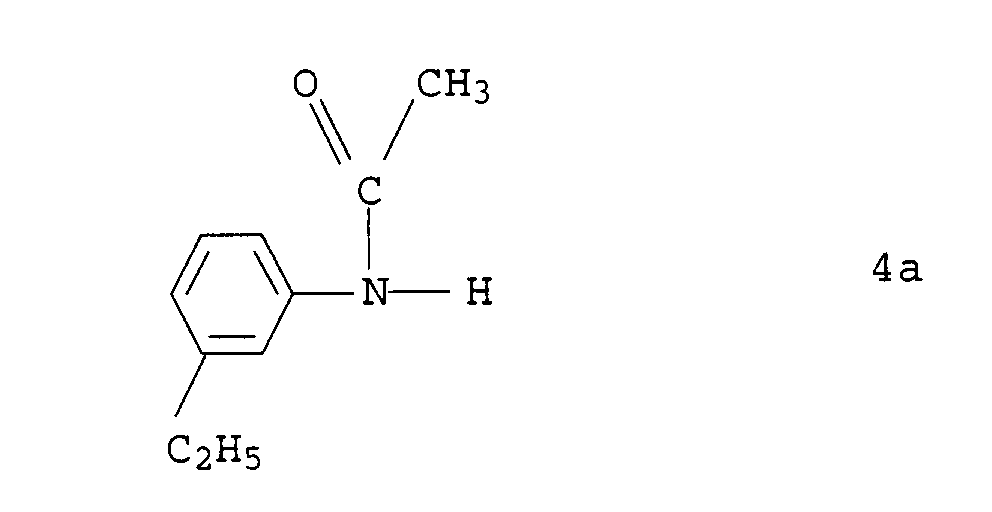
- 25 g (0,67 mol) Lithiumaluminiumhydrid wurden unter Stickstoff in 100 ml Tetrahydrofuran (THF) suspendiert. Dazu wurden 80 g (0,49 mol) der Verbindung 4a in 350 ml THF bei der Siedetemperatur zugegeben. Anschließend wurde 2 Stunden unter Rückfluß gerührt und dann das Gemisch auf Eiswasser gegeben. Das Gemisch wurde filtriert und weiter wie Verbindung 4a aufgearbeitet.
- Ausbeute:
- 48 g der Verbindung 4b

- 71,5 g (0,48 mol) der Verbindung 4b und 3,3 g (0,024 mol) Zinkchlorid wurden in einem Autoklaven mit Stickstoff gespült und dann unter Druck mit 25 ml Ethylenoxid versetzt. Die Mischung wurde 6 Stunden auf 110°C erhitzt. Die Reinigung erfolgte durch Destillation bei 0,5 mbar.
- Ausbeute:
- 52 g der Verbindung 4b
- Siedepunkt:
- 135-160°C (0,5 mbar)

- Die weiteren Umsetzungen erfolgten analog zu Beispiel 1.
- Analog zu Beispiel 4 wurden die folgenden Farbstoffe hergestellt:
-

-

- Die Farbstoffe 1 - 6 zeichnen sich durch eine gute Löslichkeit in organischen Lösungsmittel wie Toluol, Chlorbenzol oder THF aus und sind hervorragend verträglich mit Polymeren wie Polymethylmethacrylat, Polystyrol oder Polyethylenterephthalat. Die molekulare Hyperpolarisierbarkeit β der Farbstoffe ist überdurchschnittlich hoch. Für den Farbstoff 2 wurde z.B. die solvatochrome Verschiebung Δ

Claims (11)
- Azofarbstoffe der allgemeinen Formel I
 R1 eine Arylgruppe,R2 Cyano, C1-C4-Alkoxycarbonyl oder Nitro,R3,R4 Wasserstoff, C1-C12-Alkyl oder C1-C6-Alkoxy,R5 Wasserstoff, C1-C12-Alkyl, C5-C7-Cycloalkyl oder C3-C4-Alkenyl,R6 Wasserstoff oder Methyl,Y C2-C10-Alkylen, das durch 1 bis 3 nichtbenachbarte Sauerstoffatome oder Imino- oder C1-C4-Alkyliminogruppen unterbrochen sein kann,W Sauerstoff, Imino oder C1-C4-Alkylimino.
 - Azofarbstoffe nach Anspruch 1, in denen R1 Phenyl bedeutet.
- Azofarbstoffe nach Anspruch 1 oder 2, in denen R2 Cyano bedeutet.
- Azofarbstoffe nach den Ansprüchen 1 bis 3, in denen R3 Ethyl oder t-Butyl und R4 Wasserstoff bedeutet.
- Azofarbstoffe nach den Ansprüchen 1 bis 4, in denen R5 Ethyl oder Butyl bedeutet.
- Azofarbstoffe nach den Ansprüchen 1 bis 5, in denen Y -(CH2)2-, -(CH2)3- oder -(CH2)6- bedeutet.
- Azofarbstoffe nach den Ansprüchen 1 bis 6, in denen W Sauerstoff bedeutet.
- Azofarbstoffe nach den Ansprüchen 1 bis 7, in denen R6 Wasserstoff bedeutet.
- Verfahren zur Herstellung der Azofarbstoffe gemäß den Ansprüchen 1 bis 8, dadurch gekennzeichnet, daß man ein Aminothiophen der Formel II


- Polymerisate aus 0,5 bis 100 mol-% eines Farbstoffs gemäß den Ansprüchen 1 bis 8 und 0 bis 99,5 mol-% eines radikalisch copolymerisierenden Monomeren.
- Verwendung der Polymerisate gemäß Anspruch 10 für die Zwecke der nichtlinearen Optik.
Applications Claiming Priority (2)
| Application Number | Priority Date | Filing Date | Title |
|---|---|---|---|
| DE19521503 | 1995-06-13 | ||
| DE19521503A DE19521503A1 (de) | 1995-06-13 | 1995-06-13 | Polymerisierbare Azofarbstoffe mit Thiophenstruktur |
Publications (2)
| Publication Number | Publication Date |
|---|---|
| EP0748853A2 true EP0748853A2 (de) | 1996-12-18 |
| EP0748853A3 EP0748853A3 (de) | 1999-01-07 |
Family
ID=7764278
Family Applications (1)
| Application Number | Title | Priority Date | Filing Date |
|---|---|---|---|
| EP96109164A Withdrawn EP0748853A3 (de) | 1995-06-13 | 1996-06-07 | Polymerisierbare Azofarbstoffe mit Thiophenstruktur |
Country Status (4)
| Country | Link |
|---|---|
| US (1) | US5783649A (de) |
| EP (1) | EP0748853A3 (de) |
| JP (1) | JPH093345A (de) |
| DE (1) | DE19521503A1 (de) |
Cited By (1)
| Publication number | Priority date | Publication date | Assignee | Title |
|---|---|---|---|---|
| DE102017216789A1 (de) | 2017-09-22 | 2019-03-28 | Tesa Se | Laserbeschriftbare Folie |
Families Citing this family (9)
| Publication number | Priority date | Publication date | Assignee | Title |
|---|---|---|---|---|
| US6429023B1 (en) | 1998-07-20 | 2002-08-06 | Shayda Technologies, Inc. | Biosensors with polymeric optical waveguides |
| US6661942B1 (en) | 1998-07-20 | 2003-12-09 | Trans Photonics, Llc | Multi-functional optical switch (optical wavelength division multiplexer/demultiplexer, add-drop multiplexer and inter-connect device) and its methods of manufacture |
| AU2001286527A1 (en) * | 2000-08-17 | 2002-02-25 | Lumera Corporation | Design and synthesis of advanced nlo materials for electro-optic applications |
| US7019453B2 (en) * | 2000-08-17 | 2006-03-28 | Lumera Corporation | Polymers having pendant nonlinear optical chromophores and electro-optic devices therefrom |
| US7109355B2 (en) * | 2000-08-17 | 2006-09-19 | Lumera Corporation | Fluorinated π-bridge second order nonlinear optical chromophores and electro-optic devices therefrom |
| US6750603B2 (en) * | 2000-08-17 | 2004-06-15 | Lumera Corporation | Second order nonlinear optical chromophores and electro-optic devices therefrom |
| US7205347B2 (en) * | 2000-10-19 | 2007-04-17 | Trans Photonics, Llc. | Substituted-polyaryl chromophoric compounds |
| US7161726B2 (en) * | 2004-11-05 | 2007-01-09 | Lumera Corporation | Linear optical modulators and method of linear optical modulation |
| US8173045B2 (en) | 2008-05-28 | 2012-05-08 | University Of Washington | Diels-Alder crosslinkable dendritic nonlinear optic chromophores and polymer composites |
Family Cites Families (5)
| Publication number | Priority date | Publication date | Assignee | Title |
|---|---|---|---|---|
| DE159429C (de) * | ||||
| GB1583377A (en) * | 1977-04-25 | 1981-01-28 | Ici Ltd | Disperse azo dyestuffs derived from a 2-aminothiophene-5-aldehyde |
| DE4132685A1 (de) * | 1991-10-01 | 1993-04-08 | Basf Ag | Azofarbstoffe enthaltende polymerisate |
| DE4335496A1 (de) * | 1993-10-19 | 1995-04-20 | Basf Ag | Diphenylaminverbindungen |
| DE19525304A1 (de) * | 1995-07-12 | 1997-01-16 | Basf Ag | Copolymere mit Adamantyl- und Farbstoffseitenketten |
-
1995
- 1995-06-13 DE DE19521503A patent/DE19521503A1/de not_active Withdrawn
-
1996
- 1996-06-07 EP EP96109164A patent/EP0748853A3/de not_active Withdrawn
- 1996-06-10 US US08/633,404 patent/US5783649A/en not_active Expired - Fee Related
- 1996-06-11 JP JP8149393A patent/JPH093345A/ja not_active Withdrawn
Cited By (2)
| Publication number | Priority date | Publication date | Assignee | Title |
|---|---|---|---|---|
| DE102017216789A1 (de) | 2017-09-22 | 2019-03-28 | Tesa Se | Laserbeschriftbare Folie |
| WO2019057645A1 (de) | 2017-09-22 | 2019-03-28 | Tesa Se | Laserbeschriftbare folie |
Also Published As
| Publication number | Publication date |
|---|---|
| US5783649A (en) | 1998-07-21 |
| JPH093345A (ja) | 1997-01-07 |
| DE19521503A1 (de) | 1996-12-19 |
| EP0748853A3 (de) | 1999-01-07 |
Similar Documents
| Publication | Publication Date | Title |
|---|---|---|
| EP0535490B1 (de) | Azofarbstoffe enthaltende Polymerisate | |
| EP0007574A1 (de) | Flüssig-kristalline Polymerphase mit cholesterischer Struktur, Verfahren zu ihrer Herstellung und ihre Verwendung | |
| EP0675186A1 (de) | Photovernetzbare Flüssigkristalle | |
| US5334710A (en) | Compounds having non-linear optical properties | |
| US4508882A (en) | Benzotriazole compound and homopolymer or copolymers thereof | |
| FR2573082A1 (fr) | Polymeres thermotropes a chaines laterales ayant une structure chirale et leur procede de fabrication | |
| DE19720288A1 (de) | Homopolymere mit hoher photoinduzierbarer Doppelbrechung | |
| DE19521503A1 (de) | Polymerisierbare Azofarbstoffe mit Thiophenstruktur | |
| WO1995014957A1 (de) | Thienothienylazoaniline in der nichtlinearen optik | |
| DE69401791T2 (de) | Vernetzbares Polymer verwendbar in nicht linearen optischen Vorrichtungen und Verfahren zu seiner Herstellung | |
| EP0724609A1 (de) | Diphenylaminverbindungen | |
| EP0572898B1 (de) | Polymerisate, die Methin- oder Azamethinfarbstoffe enthalten | |
| DE19525304A1 (de) | Copolymere mit Adamantyl- und Farbstoffseitenketten | |
| EP0597277A1 (de) | Verfahren zur Herstellung von Polymeren mit NLO-aktiven Seitengruppen und deren Verwendung | |
| EP0755391A1 (de) | Phenolderivate, verfahren zu ihrer herstellung und ihre verwendung, insbesondere in der nichtlinearen optik | |
| DE4401911A1 (de) | Verwendung von Aryl- oder Heteroarylazoanilinen in der nichtlinearen Optik | |
| DE10133716A1 (de) | Organische Antireflex-Beschichtungspolymere, solche Polymere umfassende Antireflex-Beschichtungszusammensetzungen und Verfahren zur Herstellung derselben | |
| EP0569903B1 (de) | Verfahren zur Herstellung von Polymeren mit NLO-aktiven Seitengruppen und deren Verwendung | |
| US4997977A (en) | Process for the production of esters exhibiting nonlinear optical response | |
| Mahy et al. | Synthesis of novel photosensitive polymers and copolymers containing cinnamic groups as pendant photoreactive functions | |
| DE4422333A1 (de) | Methin- und Azomethinfarbstoffe auf Basis von Naphthochinonen in der nichtlinearen Optik | |
| DE4401912A1 (de) | Methinfarbstoffe in der nichtlinearen Optik | |
| FR2651237A1 (fr) | Copolymeres amorphes pour applications en optique non lineaire. | |
| Whitby et al. | Design, synthesis, and characterization of photoinitiators for two-photon polymerization | |
| KR20180133012A (ko) | 불소치환 아조벤젠계 비선형광학 발색단 |
Legal Events
| Date | Code | Title | Description |
|---|---|---|---|
| PUAI | Public reference made under article 153(3) epc to a published international application that has entered the european phase |
Free format text: ORIGINAL CODE: 0009012 |
|
| AK | Designated contracting states |
Kind code of ref document: A2 Designated state(s): CH DE FR GB IT LI |
|
| PUAL | Search report despatched |
Free format text: ORIGINAL CODE: 0009013 |
|
| AK | Designated contracting states |
Kind code of ref document: A3 Designated state(s): CH DE FR GB IT LI |
|
| STAA | Information on the status of an ep patent application or granted ep patent |
Free format text: STATUS: THE APPLICATION IS DEEMED TO BE WITHDRAWN |
|
| 18D | Application deemed to be withdrawn |
Effective date: 19990708 |