EP0745223B1 - Process for labelling acridinium to microparticles and application in an instrument - Google Patents
Process for labelling acridinium to microparticles and application in an instrument Download PDFInfo
- Publication number
- EP0745223B1 EP0745223B1 EP95909496A EP95909496A EP0745223B1 EP 0745223 B1 EP0745223 B1 EP 0745223B1 EP 95909496 A EP95909496 A EP 95909496A EP 95909496 A EP95909496 A EP 95909496A EP 0745223 B1 EP0745223 B1 EP 0745223B1
- Authority
- EP
- European Patent Office
- Prior art keywords
- acridinium
- microparticle
- methyl
- carboximide
- tosyl
- Prior art date
- Legal status (The legal status is an assumption and is not a legal conclusion. Google has not performed a legal analysis and makes no representation as to the accuracy of the status listed.)
- Expired - Lifetime
Links
- 239000011859 microparticle Substances 0.000 title claims abstract description 114
- 238000000034 method Methods 0.000 title claims abstract description 65
- DZBUGLKDJFMEHC-UHFFFAOYSA-O acridine;hydron Chemical compound C1=CC=CC2=CC3=CC=CC=C3[NH+]=C21 DZBUGLKDJFMEHC-UHFFFAOYSA-O 0.000 title description 17
- 238000002372 labelling Methods 0.000 title 1
- DZBUGLKDJFMEHC-UHFFFAOYSA-N acridine Chemical class C1=CC=CC2=CC3=CC=CC=C3N=C21 DZBUGLKDJFMEHC-UHFFFAOYSA-N 0.000 claims abstract description 51
- 150000001875 compounds Chemical class 0.000 claims abstract description 33
- 238000012360 testing method Methods 0.000 claims abstract description 31
- WLLGXSLBOPFWQV-UHFFFAOYSA-N MGK 264 Chemical compound C1=CC2CC1C1C2C(=O)N(CC(CC)CCCC)C1=O WLLGXSLBOPFWQV-UHFFFAOYSA-N 0.000 claims abstract description 24
- ITMCEJHCFYSIIV-UHFFFAOYSA-M triflate Chemical compound [O-]S(=O)(=O)C(F)(F)F ITMCEJHCFYSIIV-UHFFFAOYSA-M 0.000 claims abstract description 24
- 238000010168 coupling process Methods 0.000 claims abstract description 18
- 230000001745 anti-biotin effect Effects 0.000 claims abstract description 17
- 239000011248 coating agent Substances 0.000 claims abstract description 16
- 238000000576 coating method Methods 0.000 claims abstract description 16
- 230000008878 coupling Effects 0.000 claims abstract description 12
- 238000005859 coupling reaction Methods 0.000 claims abstract description 12
- 239000000872 buffer Substances 0.000 claims description 6
- 108091003079 Bovine Serum Albumin Proteins 0.000 claims description 2
- NQTADLQHYWFPDB-UHFFFAOYSA-N N-Hydroxysuccinimide Chemical compound ON1C(=O)CCC1=O NQTADLQHYWFPDB-UHFFFAOYSA-N 0.000 claims description 2
- 229940098773 bovine serum albumin Drugs 0.000 claims description 2
- 230000003213 activating effect Effects 0.000 claims 3
- 150000001718 carbodiimides Chemical class 0.000 claims 1
- 238000012546 transfer Methods 0.000 abstract description 12
- 239000011148 porous material Substances 0.000 abstract description 8
- 239000012528 membrane Substances 0.000 abstract description 3
- 239000002245 particle Substances 0.000 description 33
- 238000006243 chemical reaction Methods 0.000 description 26
- ZMXDDKWLCZADIW-UHFFFAOYSA-N N,N-Dimethylformamide Chemical compound CN(C)C=O ZMXDDKWLCZADIW-UHFFFAOYSA-N 0.000 description 11
- 239000002953 phosphate buffered saline Substances 0.000 description 11
- 239000000243 solution Substances 0.000 description 11
- 238000003556 assay Methods 0.000 description 10
- 238000005119 centrifugation Methods 0.000 description 10
- VXGOQVMIGNMUGC-UHFFFAOYSA-N 1-methylacridine Chemical class C1=CC=C2C=C3C(C)=CC=CC3=NC2=C1 VXGOQVMIGNMUGC-UHFFFAOYSA-N 0.000 description 9
- 238000011068 loading method Methods 0.000 description 9
- 239000000203 mixture Substances 0.000 description 8
- 239000000047 product Substances 0.000 description 7
- 239000000126 substance Substances 0.000 description 7
- 239000011159 matrix material Substances 0.000 description 6
- 238000005259 measurement Methods 0.000 description 6
- 239000006228 supernatant Substances 0.000 description 5
- FAPWRFPIFSIZLT-UHFFFAOYSA-M Sodium chloride Chemical compound [Na+].[Cl-] FAPWRFPIFSIZLT-UHFFFAOYSA-M 0.000 description 4
- 230000004913 activation Effects 0.000 description 4
- 238000004458 analytical method Methods 0.000 description 4
- 230000000694 effects Effects 0.000 description 4
- 239000000725 suspension Substances 0.000 description 4
- LMDZBCPBFSXMTL-UHFFFAOYSA-N 1-ethyl-3-(3-dimethylaminopropyl)carbodiimide Chemical compound CCN=C=NCCCN(C)C LMDZBCPBFSXMTL-UHFFFAOYSA-N 0.000 description 3
- 239000004793 Polystyrene Substances 0.000 description 3
- 239000012190 activator Substances 0.000 description 3
- 238000010586 diagram Methods 0.000 description 3
- 229920000126 latex Polymers 0.000 description 3
- 239000004816 latex Substances 0.000 description 3
- 229920002223 polystyrene Polymers 0.000 description 3
- 238000001878 scanning electron micrograph Methods 0.000 description 3
- 239000003085 diluting agent Substances 0.000 description 2
- 239000012895 dilution Substances 0.000 description 2
- 238000010790 dilution Methods 0.000 description 2
- 238000009826 distribution Methods 0.000 description 2
- 238000005516 engineering process Methods 0.000 description 2
- 230000007613 environmental effect Effects 0.000 description 2
- 239000003365 glass fiber Substances 0.000 description 2
- 238000003018 immunoassay Methods 0.000 description 2
- 238000001000 micrograph Methods 0.000 description 2
- 102000004169 proteins and genes Human genes 0.000 description 2
- 108090000623 proteins and genes Proteins 0.000 description 2
- 239000011780 sodium chloride Substances 0.000 description 2
- UMCMPZBLKLEWAF-BCTGSCMUSA-N 3-[(3-cholamidopropyl)dimethylammonio]propane-1-sulfonate Chemical compound C([C@H]1C[C@H]2O)[C@H](O)CC[C@]1(C)[C@@H]1[C@@H]2[C@@H]2CC[C@H]([C@@H](CCC(=O)NCCC[N+](C)(C)CCCS([O-])(=O)=O)C)[C@@]2(C)[C@@H](O)C1 UMCMPZBLKLEWAF-BCTGSCMUSA-N 0.000 description 1
- 238000007792 addition Methods 0.000 description 1
- 125000003277 amino group Chemical group 0.000 description 1
- 238000004164 analytical calibration Methods 0.000 description 1
- 244000309466 calf Species 0.000 description 1
- 230000003247 decreasing effect Effects 0.000 description 1
- LOKCTEFSRHRXRJ-UHFFFAOYSA-I dipotassium trisodium dihydrogen phosphate hydrogen phosphate dichloride Chemical compound P(=O)(O)(O)[O-].[K+].P(=O)(O)([O-])[O-].[Na+].[Na+].[Cl-].[K+].[Cl-].[Na+] LOKCTEFSRHRXRJ-UHFFFAOYSA-I 0.000 description 1
- 230000005284 excitation Effects 0.000 description 1
- 238000011534 incubation Methods 0.000 description 1
- 238000004519 manufacturing process Methods 0.000 description 1
- -1 methyl acridinium Chemical compound 0.000 description 1
- 238000005497 microtitration Methods 0.000 description 1
- 238000012986 modification Methods 0.000 description 1
- 230000004048 modification Effects 0.000 description 1
- 150000002978 peroxides Chemical class 0.000 description 1
- 239000008363 phosphate buffer Substances 0.000 description 1
- 229920000642 polymer Polymers 0.000 description 1
- 238000002360 preparation method Methods 0.000 description 1
- 238000000746 purification Methods 0.000 description 1
- 210000002966 serum Anatomy 0.000 description 1
- 238000004513 sizing Methods 0.000 description 1
- 229910000162 sodium phosphate Inorganic materials 0.000 description 1
- 239000001488 sodium phosphate Substances 0.000 description 1
- 238000001179 sorption measurement Methods 0.000 description 1
- 230000002123 temporal effect Effects 0.000 description 1
- 238000010998 test method Methods 0.000 description 1
- 238000004809 thin layer chromatography Methods 0.000 description 1
- 230000001960 triggered effect Effects 0.000 description 1
- RYFMWSXOAZQYPI-UHFFFAOYSA-K trisodium phosphate Chemical compound [Na+].[Na+].[Na+].[O-]P([O-])([O-])=O RYFMWSXOAZQYPI-UHFFFAOYSA-K 0.000 description 1
Images




Classifications
-
- G—PHYSICS
- G01—MEASURING; TESTING
- G01N—INVESTIGATING OR ANALYSING MATERIALS BY DETERMINING THEIR CHEMICAL OR PHYSICAL PROPERTIES
- G01N33/00—Investigating or analysing materials by specific methods not covered by groups G01N1/00 - G01N31/00
- G01N33/48—Biological material, e.g. blood, urine; Haemocytometers
- G01N33/50—Chemical analysis of biological material, e.g. blood, urine; Testing involving biospecific ligand binding methods; Immunological testing
- G01N33/58—Chemical analysis of biological material, e.g. blood, urine; Testing involving biospecific ligand binding methods; Immunological testing involving labelled substances
- G01N33/585—Chemical analysis of biological material, e.g. blood, urine; Testing involving biospecific ligand binding methods; Immunological testing involving labelled substances with a particulate label, e.g. coloured latex
Definitions
- the present invention relates to methods and compounds for use with an instrument for performing chemical assays and measurements and, more particularly, to methods and compounds for chemiluminescence-based tests on an instrument employed in performing chemical assays, such as those performing quantitative and qualitative tests on chemical and biochemical solutions.
- a variety of assay methods and compounds are employed in quantitative and qualitative analyses of chemical and biochemical mixtures. In some instances, those quantitative and qualitative analyses are performed by an instrument. Certain of the methods and compounds employed in analyses can be useful in testing the instrument employed in those analyses. Such tests may concern, for example, transfer efficiencies, instrument calibrations, membrane pore size measurements, and the like. A number of methods and compounds employed in these tests regarding instruments are known. New methods and compounds and improvements in existing methods and compounds, however, are being developed.
- Chemiluminescence is the emission of light as the result of a chemical reaction. Chemiluminescence occurs when products of a chemical reaction are excited and emit light.
- a step of the reaction is a chemiexcitation step (which may be unimolecular or bimolecular) which achieves conversion of chemical energy into electronic excitation energy.
- a product molecule receives chemical energy and converts it to an excited electronic state. This electronically excited product molecule then produces light or luminesces under reaction conditions.
- measurements and other determinations regarding the systems may be made periodically. These determinations may indicate the condition of the system involved.
- chemiluminescence may be useful in measuring transfer efficiencies and/or other aspects of instruments employed to perform assays which are measured or observed by chemiluminescent characteristics. Instruments which are capable of conforming to minute tolerances in these regards have relatively high transfer efficiencies. Instruments that do not yield accurate component measurements on transfer have relatively low transfer efficiencies. To perform accurate tests with some analytical instruments, knowledge of transfer efficiencies (and, thus, the inherent accuracies and inaccuracies of the instruments) is desirable.
- acridinium activated particles may be used as a standard sample. Acridinium, when reacted with alkaline peroxides, yields a light producing reaction.
- Some currently available acridinium activated particles used in testing chemiluminescence-based instruments have certain disadvantages. One such disadvantage involves the method of preparing these particles. In this prior method, latex particles are coated with anti-HBsAg labelled acridinium using passive adsorption. Then, activated acridinium is passively adsorbed onto the particle surfaces.
- the product activated acridinium microparticles obtained from some prior methods may be disadvantageous for use in testing some chemiluminescence-based instruments.
- the light emission profiles of particles may not be sufficiently identical to or closely resemble the actual light emission profiles of chemiluminescence-based immunoassays. It is desirable that a standard sample for testing perform substantially the same as an unknown will perform when tested. However, this may not always be the case.
- a possible reason for differences in light emission of some currently available product activated acridinium microparticles may be stearic hindrance effects caused by acridinium loading.
- a method of preparing an activated acridinium microparticle includes coating a microparticle with a proteinaceous compound and coupling a 10-methyl-N-tosyl-N-(2-carboxyethyl)-9-acridinium carboximide trifluoromethane sulfonate to the proteinaceous compound.
- another method of preparing an activated acridinium microparticle comprises coating a microparticle with a biotinylated proteinaceous compound. Then, the microparticle is reacted with an anti-biotin labelled 10-methyl-N-tosyl-N-(2-carboxyethyl)-9-acridinium carboximide trifluoromethane sulfonate.
- a method of testing an analytical instrument is provided.
- a microparticle is coated with a proteinaceous compound.
- a 10-methyl-N-tosyl-N-(2-carboxyethyl)-9-acridinium carboximide trifluoromethane sulfonate is coupled to the proteinaceous compound.
- the 10-methyl-N-tosyl-N-(2-carboxyethyl)-9-acridinium carboximide trifluoromethane sulfonate is activated to obtain an activated acridinium microparticle.
- the microparticle is prepared by coating it with a biotinylated proteinaceous compound.
- microparticle is reacted with an anti-biotin labelled 10-methyl-N-tosyl-N-(2-carboxyethyl)-9-acridinium carboximide trifluoromethane sulfonate.
- the thusly produced microparticle may be used in a test on the instrument.
- the test may determine or estimate transfer efficiency, calibrate instrument optics, measure membrane pore size or other tests.
- the instrument may be a chemiluminescence based instrument.
- test elements for use in an analytical instrument.
- the test element comprises a microparticle coated with a proteinaceous compound. Then a 10-methyl-N-tosyl-N-(2-carboxyethyl)-9-acridinium carboximide trifluoromethane sulfonate is coupled to the proteinaceous compound on the microparticle.
- a microparticle is coated with a biotinylated proteinaceous compound. Then, an anti-biotin labelled 10-methyl-N-tosyl-N-(2-carboxyethyl)-9-acridinium carboximide trifluoromethane sulfonate is reacted with the microparticle.
- Microparticles made according to these methods may be used with a variety of suitable instruments to perform desired tests.
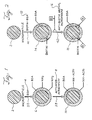
- the direct covalent coupling method in this embodiment comprises three steps.
- a first step (not shown in detail) is an activation step in which 10-Methyl-N-tosyl-N-(2-carboxyethyl)-9- acridinium carboximide trifluoromethane sulfonate (abbreviated as "methyl acridinium” herein) 8 is activated.
- a coating step 22 microparticles 2 are coated with BSA 4.
- a third step which is a coupling step 23 amino groups of the BSA coated on the surface of the microparticles 6 is covalently coupled to the activated methyl acridinium 8.
- the first (or activation) step is initiated by adding approximately 510 ⁇ l of N-Hydroxy succinimide solution (about 10mg/1.74ml dimethylformamide) and about 510 ⁇ l of 1-ethyl-3 (dimethylaminopropyl) carbodiimide (“EDAC”) (about 10mg/1.31ml dimethylformamide) to a solution containing about 10mg of methyl acridinium in about 1.04ml of dimethylformamide (“DMF").
- This mixture is stirred at ambient temperature in the absence of light for a period of about 12 to about 16 hours.
- the activation is monitored using thin layer chromatography. When the activated product 6 is obtained, the product is used for coupling to protein without purification.
- the coating step 22 begins with centrifugation of particles 2, such as polystyrene particles (for example, 2.5 ⁇ m, Spherotech, 1ml, 5% w/v) and the like.
- the particles 2 are centrifuged at about 11,000 x g for approximately 5 minutes and the supernatant is decanted. After centrifugation, the packed particles 2 are resuspended in about 1ml of phosphate buffered saline (“PBS”), which is about 0.01M sodium phosphate, about 0.15M sodium chloride, a pH of about 7.2, and the centrifugation step is repeated.
- PBS phosphate buffered saline
- Other buffers may be used.
- the packed particles 2 from this second centrifugation step are then resuspended in about 1ml of BSA solution 4 (about 2mg/ml in PBS) and the mixture is tumbled at ambient temperature for period of about 16 hours.
- the suspension obtained from the tumbling is then centrifuged at about 11,000 x g for about 5 minutes and the supernatant is decanted.
- Particles obtained from this tumbling are then washed, preferably three times, each with about 1ml of PBS by centrifugation and resuspension.
- the BSA coated particles 6 obtained are then resuspended in about 5ml of PBS to give an approximate 1% w/v suspension.
- the BSA coated particles 6 (for example 0.5ml, 1% w/v in an exemplary embodiment) obtained from the coating step 22 are added to about 72 ⁇ l of conjugate buffer (about 0.1 M PBS, with approximately 0.1% CHAPS, pH of about 6.3) and about 15 ⁇ l of the activated methyl acridinium 8 (about 5mg/l ml DMF) obtained from the activation step.
- the mixture is then gently tumbled for about 30 minutes at ambient temperature.
- the particles obtained 10 are then centrifuged at about 11,000 x g for about 5 minutes, washed by centrifugation, preferably three times, and then resuspended as before in the second (or coating) step.
- the particles are resuspended in about 1ml of PBS to give an approximate 0.5% w/v particles 10.
- the affinity format method includes two steps.
- the first of the steps, a coating step 41 involves the coating of biotinylated BSA 12 to microparticles 2.
- microparticles 2 preferably polystyrene particles (for example, about 2.5 ⁇ m, Spherotech, approximately 1ml of 5% w/v), are centrifuged at about 11,000 x g for about 5 minutes and the supernatant is decanted. The packed particles 2 from that centrifugation are then resuspended in about 1.5ml of biotinylated BSA solution 12 (for example, Sigma, about 1mg/ml in PBS, pH of approximately 7.2) and the mixture is tumbled at ambient temperature for about 20 hours.
- biotinylated BSA solution 12 for example, Sigma, about 1mg/ml in PBS, pH of approximately 7.2
- the suspension obtained from the tumbling is then centrifuged at about 11,000 x g for about 5 minutes and the supernatant is decanted. Particles obtained from this tumbling are then washed, preferably three times, each with about 1ml of PBS by centrifugation and resuspension. The BSA coated particles 14 obtained are then resuspended in about 5ml of PBS to give an approximate 1% w/v suspension.
- the biotinylated BSA coated particles 14 (about 1 ml of about 1% w/v) of the coating step 41 of the affinity reaction method are centrifuged at about 11,000 x g for approximately 5 minutes and the supernatant is decanted. The packed particles 14 obtained from the centrifugation are then resuspended in about 1ml of anti-biotin labelled with methyl acridinium 16.
- This amount of anti-biotin labelled with methyl acridinium 16 is obtained from a solution of about 40 ⁇ l of anti-biotin acridinium (approximately 250 ⁇ g/ml, protein concentration, Acridinium/IgG is about 1.8) added to approximately 9.960 ml of conjugate diluent, said conjugate diluent being comprised of about 40% calf serum, about 10% normal human plasma, about 100mM phosphate buffer, with a pH of about 6.3, and about 0.15 M NaCl in an exemplary embodiment.
- the mixture of packed particles resuspended in the anti-biotin labelled with methyl acridinium 16 is then tumbled for about 16 hours at ambient temperature in the absence of light.
- the particles 18 obtained from the tumbling are centrifuged at about 11,000 x g for about 5 minutes, washed, preferably three times, by centrifugation, and then resuspended as before in this affinity reaction step.
- the activated acridinium microparticles 18 are resuspended in about 10ml of PBS to give approximately 0.1% w/v particles.
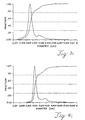
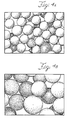
- FIGS. 3A-C and 4A-C certain scanning electron micrographs of 2.3 ⁇ m, 4.0 ⁇ m, and 3.5 ⁇ m and 6.0 ⁇ m activated acridinium microparticles and graphs tracking the size distribution of 4.0 ⁇ m and 3.5 ⁇ m are shown.
- the activated acridinium microparticles shown in the micrographs were prepared in accordance with the affinity format method.
- the micrographs shown in FIGS. 3A-B and 4A-B are provided, in particular, to show the high monodispersity and uniform size of the 2.3 ⁇ m, 4.0 ⁇ m, 3.5 ⁇ and 6.0 ⁇ m microparticles 18, respectively, obtained from the affinity format method.
- FIGS. 3C and 4C show, in particular, the size distribution of 4.0 ⁇ m and 3.5 ⁇ m activated acridinium microparticles 18, respectively.
- the read system 30 employs a millisecond read technique.
- the read system 30 comprises a microcomputer 32 based automated data acquisition system.
- the system is equipped with an electronic interface board 40 capable of acquiring photon count information, generated by optics, such as a reader 34.
- An interface 36 may also be used to synchronize the start of a data acquisition cycle, for example, with the dispensing of activator solution at the read station 38.
- the read system 30 accumulates a running sum of photon counts acquired during a read cycle of approximately 2 seconds with temporal acquisitions taken and recorded at about 10ms intervals.
- Accumulated data can be used, for example, to obtain incremental counts for every read interval, thus, yielding light emission profiles, generated, for example, at an off-line computer terminal 42, substantially similar to those obtained in a chemiluminescence reaction.
- FIG.'s 6, 7A, 7B, 8 and 9 may be obtained by subtracting subsequent approximately 10 ms intervals to arrive at the number of events per about 10ms interval, for example. The about 10 ms events are plotted over time to produce a rate reaction profile.
- a procedure for assessing performance of activated acridinium microparticles 10,18, for example, those prepared according to the affinity format method may be understood.
- This procedure is substantially similar to that which may be performed on an analytical instrument.
- the procedure may be initiated by pipetting about 50 ⁇ l of activated acridinium microparticle directly on a reaction matrix in one or more reaction vessels.
- the particles may then be washed by pipetting about 100 ⁇ l of wash solution directly on the matrix.
- the reaction vessels may then be transferred to a read station.
- chemiluminescence photon counts may be obtained.
- About 85 ⁇ l of an activator solution is dispensed onto the reaction tray matrix thus triggering the chemiluminescence reaction.
- net photon counts and incremental photon counts are each obtained from the read system 30.
- the net photon counts are the difference between the total activated counts and the previously recorded dark counts taken over, for example, about a 2 second read time.
- the net photon counts and incremental photon counts serve for comparison to chemiluminescence reactions observed by the read system 30 in order to assess performance of the activated acridinium particles 18.
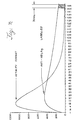
- FIG. 6 certain chemiluminescence light emission profiles are shown. These light emission profiles have been determined for activated acridinium microparticles prepared according to the direct covalent coupling method.
- the profiles in FIG. 6 illustrate varying concentrations of anti-biotin acridinium conjugate loading on the covalently coupled (about 0.002%) 2.5 ⁇ m biotinylated microparticles. Note that the profiles vary depending upon loading, in particular, with respect to the decay rate of the chemiluminescence light emission profile. Stearic hindrance effects caused by acridinium loading may cause light emission profiles of activated acridinium microparticles to be dissimilar to profiles of chemiluminescence reactions.
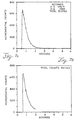
- FIG. 7A a chemiluminescence light emission profile for an anti-HBsAg assay positive sample is shown.
- FIGS. 7A and 7B light emission profiles for the chemiluminescence-based anti-HBsAg assay and a 2.5 ⁇ m affinity format labelled activated acridinium microparticle may be compared. Note the similarity of the two profiles.
- the chemiluminescence profiles for an affinity format labelled acridinium microparticle are shown having a decay time of approximately 1.52 seconds. Since the tail of the chemiluminescence profile resembles an exponential decay, the last about 20 to 30 ms of the approximately 1.52 second decay time contains less than about 0.02% of the total chemiluminescence counts. In comparison, the similar profiles for the anti-HBsAg coated microparticles have decay times substantially larger than about 2 seconds. As much as about 1% of the total chemiluminescence counts may be contained in the last about 20 to 30 ms of the same approximately 1.52 second decay time, i.e. the profile has not decayed completely.
- a number such as four, increasing levels of acridinium activated microparticles may be used and a slope may be obtained for each reader using chemiluminescence counts. If an about 1% error in timing the actual chemiluminescence profile were assumed, then error in estimating the slope for a given reader may be as large as 1.2% for the anti-HBsAg coated microparticle. It is notable that, under similar conditions, the error in estimating reader slope for an affinity format labelled microparticle is only about 0.023%.
- FIG. 8 additional chemiluminescence light emission profiles are shown. These profiles show the effect of varying concentrations of acridinium loading when activated acridinium microparticles are prepared in accordance with the affinity format method. These particular profiles are for (about 0.001%) 2.5 ⁇ m affinity format labelled particles. Note that acridinium loading does not significantly affect the chemiluminescence light emission profiles of activated acridinium microparticles. At each loading level (i.e., high, medium, low, and l_low), the light emission profile is approximately the same. For this reason, improved results and significant advantages are provided by particles prepared according to the embodiments of the methods described in detail herein.
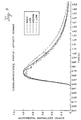
- FIG. 9 additional chemiluminescence light emission profiles are shown. Each of these profiles is for activated acridinium microparticles prepared according to the affinity format method. The profiles differ only because different microparticle sizes are employed in the chemiluminescence light emission measurements. Even given that the microparticle sizes vary, note the similarities in the chemiluminescence profiles for each of the (about 0.002%) 2.5 ⁇ m, 3.6 ⁇ m, 4.5 ⁇ m and 6.0 ⁇ m affinity format activated acridinium microparticles, respectively. These particular characteristics of the activated acridinium microparticles offer significant advantages in the technology.
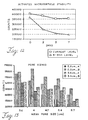
- FIG. 10 a bar graph demonstrates the feasibility of using different dilutions of 4.5 ⁇ m activated acridinium microparticles for optics calibration of a read system 30.
- FIGS. 11 and 12 embodiments of the invention provide advantages of environmental and over time stability of activated acridinium microparticles.
- FIG. 11 shows the approximately 2-8 degrees C stability over time of (about 0.1%) 4.5 ⁇ m affinity format activated acridinium microparticles.
- FIG. 12 also illustrates the environmental and time stability of activated acridinium microparticles. As shown in FIG. 12, about 45 degrees C stability over time of 4 ⁇ m affinity format activated acridinium microparticles is compared with the prior art anti-HBsAg coated activated acridinium microparticles. As is readily apparent, embodiments of the invention provide significant advantages over the prior technology with respect to stability of activated acridinium microparticles.
- the pore size determined may be physically present on a matrix cell or other read vessel having a capture element, such as a glass fiber matrix and the like. Feasibility of using chemiluminescence of 2.5 ⁇ m and 3.5 ⁇ m affinity format labelled acridinium activated microparticles for pore sizing is demonstrated. With increasing mean pore size, a decreasing trend in chemiluminescent counts is observed.
- Transfer efficiency is the ratio of chemiluminescence counts obtained by triggering about 100 ⁇ l of about 0.0033% activated microparticles dispensed directly on a microparticle capture element, such as a glass fiber matrix and the like, to the chemiluminescence counts obtained by dispensing a similar volume of microparticles in a separate area, such as an incubation well on a reaction tray and the like.
- the microparticles are transferred into a reaction well using about 600 ⁇ l of transfer solution, and the microparticles are triggered with about 85 ⁇ l of an activator solution.
Landscapes
- Life Sciences & Earth Sciences (AREA)
- Health & Medical Sciences (AREA)
- Engineering & Computer Science (AREA)
- Molecular Biology (AREA)
- Biomedical Technology (AREA)
- Chemical & Material Sciences (AREA)
- Hematology (AREA)
- Immunology (AREA)
- Urology & Nephrology (AREA)
- Cell Biology (AREA)
- Biochemistry (AREA)
- Biotechnology (AREA)
- Food Science & Technology (AREA)
- Medicinal Chemistry (AREA)
- Physics & Mathematics (AREA)
- Analytical Chemistry (AREA)
- Microbiology (AREA)
- General Health & Medical Sciences (AREA)
- General Physics & Mathematics (AREA)
- Pathology (AREA)
- Investigating Or Analysing Materials By The Use Of Chemical Reactions (AREA)
- Investigating Or Analysing Biological Materials (AREA)
- Dental Preparations (AREA)
Applications Claiming Priority (3)
| Application Number | Priority Date | Filing Date | Title |
|---|---|---|---|
| US196536 | 1994-02-15 | ||
| US08/196,536 US5468649A (en) | 1994-02-15 | 1994-02-15 | Process for labeling acridinium to microparticles and application in an instrument |
| PCT/US1995/001527 WO1995022059A1 (en) | 1994-02-15 | 1995-02-06 | Process for labelling acridinium to microparticles and application in an instrument |
Publications (2)
| Publication Number | Publication Date |
|---|---|
| EP0745223A1 EP0745223A1 (en) | 1996-12-04 |
| EP0745223B1 true EP0745223B1 (en) | 2001-10-04 |
Family
ID=22725805
Family Applications (1)
| Application Number | Title | Priority Date | Filing Date |
|---|---|---|---|
| EP95909496A Expired - Lifetime EP0745223B1 (en) | 1994-02-15 | 1995-02-06 | Process for labelling acridinium to microparticles and application in an instrument |
Country Status (9)
| Country | Link |
|---|---|
| US (1) | US5468649A (enExample) |
| EP (1) | EP0745223B1 (enExample) |
| JP (1) | JP3580821B2 (enExample) |
| AT (1) | ATE206523T1 (enExample) |
| AU (1) | AU1744395A (enExample) |
| CA (1) | CA2179310A1 (enExample) |
| DE (1) | DE69523040T2 (enExample) |
| ES (1) | ES2165907T3 (enExample) |
| WO (1) | WO1995022059A1 (enExample) |
Families Citing this family (33)
| Publication number | Priority date | Publication date | Assignee | Title |
|---|---|---|---|---|
| AU4698096A (en) * | 1995-01-18 | 1996-08-07 | First Medical, Inc. | Method for immobilizing haptens on a test article |
| US5650334A (en) * | 1995-08-31 | 1997-07-22 | First Medical, Inc. | Fluorescent labelling compositions and methods for their use |
| CA2255599C (en) | 1996-04-25 | 2006-09-05 | Bioarray Solutions, Llc | Light-controlled electrokinetic assembly of particles near surfaces |
| US7262063B2 (en) | 2001-06-21 | 2007-08-28 | Bio Array Solutions, Ltd. | Directed assembly of functional heterostructures |
| ES2661167T3 (es) | 2001-10-15 | 2018-03-27 | Bioarray Solutions Ltd. | Análisis multiplexado de loci polimórficos mediante consulta simultánea y detección mediada por enzimas |
| US6723851B2 (en) | 2001-10-31 | 2004-04-20 | Quest Diagnostics Investment Incorporated | Chemiluminescent compounds and use thereof |
| US7923260B2 (en) | 2002-08-20 | 2011-04-12 | Illumina, Inc. | Method of reading encoded particles |
| US7619819B2 (en) | 2002-08-20 | 2009-11-17 | Illumina, Inc. | Method and apparatus for drug product tracking using encoded optical identification elements |
| US7441703B2 (en) | 2002-08-20 | 2008-10-28 | Illumina, Inc. | Optical reader for diffraction grating-based encoded optical identification elements |
| JP2005536769A (ja) | 2002-08-20 | 2005-12-02 | シヴェラ コーポレイション | 回折格子をベースとする光学同定要素 |
| US7508608B2 (en) | 2004-11-17 | 2009-03-24 | Illumina, Inc. | Lithographically fabricated holographic optical identification element |
| US7164533B2 (en) | 2003-01-22 | 2007-01-16 | Cyvera Corporation | Hybrid random bead/chip based microarray |
| US7900836B2 (en) | 2002-08-20 | 2011-03-08 | Illumina, Inc. | Optical reader system for substrates having an optically readable code |
| US7872804B2 (en) | 2002-08-20 | 2011-01-18 | Illumina, Inc. | Encoded particle having a grating with variations in the refractive index |
| US7901630B2 (en) | 2002-08-20 | 2011-03-08 | Illumina, Inc. | Diffraction grating-based encoded microparticle assay stick |
| EP1575707A1 (en) | 2002-09-12 | 2005-09-21 | Cyvera Corporation | Method and apparatus for aligning elongated microbeads in order to interrogate the same |
| AU2003270726A1 (en) | 2002-09-12 | 2004-04-30 | Cidra Corporation | Diffraction grating-based encoded micro-particles for multiplexed experiments |
| US20100255603A9 (en) | 2002-09-12 | 2010-10-07 | Putnam Martin A | Method and apparatus for aligning microbeads in order to interrogate the same |
| US7092160B2 (en) | 2002-09-12 | 2006-08-15 | Illumina, Inc. | Method of manufacturing of diffraction grating-based optical identification element |
| EP1552475A1 (en) | 2002-09-12 | 2005-07-13 | Cyvera Corporation | Chemical synthesis using diffraction grating-based encoded optical elements |
| CA2499037A1 (en) | 2002-09-12 | 2004-03-25 | Cyvera Corporation | Method and apparatus for labelling using diffraction grating-based encoded optical identification elements |
| US7526114B2 (en) | 2002-11-15 | 2009-04-28 | Bioarray Solutions Ltd. | Analysis, secure access to, and transmission of array images |
| US7927796B2 (en) | 2003-09-18 | 2011-04-19 | Bioarray Solutions, Ltd. | Number coding for identification of subtypes of coded types of solid phase carriers |
| PT1664722E (pt) * | 2003-09-22 | 2011-12-28 | Bioarray Solutions Ltd | Polielectrólito imobilizado à superfície com grupos funcionais múltiplos capazes de se ligarem covalentemente às biomoléculas |
| JP2007521017A (ja) | 2003-10-28 | 2007-08-02 | バイオアレイ ソリューションズ リミテッド | 固定化捕捉プローブを用いる遺伝子発現分析法の最適化 |
| US7433123B2 (en) | 2004-02-19 | 2008-10-07 | Illumina, Inc. | Optical identification element having non-waveguide photosensitive substrate with diffraction grating therein |
| US7848889B2 (en) | 2004-08-02 | 2010-12-07 | Bioarray Solutions, Ltd. | Automated analysis of multiplexed probe-target interaction patterns: pattern matching and allele identification |
| US7602952B2 (en) | 2004-11-16 | 2009-10-13 | Illumina, Inc. | Scanner having spatial light modulator |
| CN101116086A (zh) | 2004-11-16 | 2008-01-30 | 伊路敏纳公司 | 读取编码微珠的方法和设备 |
| US7604173B2 (en) | 2004-11-16 | 2009-10-20 | Illumina, Inc. | Holographically encoded elements for microarray and other tagging labeling applications, and method and apparatus for making and reading the same |
| US7623624B2 (en) | 2005-11-22 | 2009-11-24 | Illumina, Inc. | Method and apparatus for labeling using optical identification elements characterized by X-ray diffraction |
| US7830575B2 (en) | 2006-04-10 | 2010-11-09 | Illumina, Inc. | Optical scanner with improved scan time |
| US7858924B2 (en) * | 2006-12-12 | 2010-12-28 | Abbott Laboratories, Inc. | Device for use in normalizing readings on a testing machine |
Family Cites Families (6)
| Publication number | Priority date | Publication date | Assignee | Title |
|---|---|---|---|---|
| US4351824A (en) * | 1981-02-05 | 1982-09-28 | Icl Scientific | Polystyrene latex reagents, methods of preparation, and use in immunological procedures |
| JPS6036962A (ja) * | 1983-08-09 | 1985-02-26 | Toray Ind Inc | 生物学的検査用微粒子 |
| US4774189A (en) * | 1984-12-24 | 1988-09-27 | Flow Cytometry Standards Corp. | Fluorescent calibration microbeads simulating stained cells |
| EP0273115B1 (en) * | 1986-10-22 | 1994-09-07 | Abbott Laboratories | Chemiluminescent acridinium and phenanthridinium salts |
| US5132242A (en) * | 1987-07-15 | 1992-07-21 | Cheung Sau W | Fluorescent microspheres and methods of using them |
| US5089424A (en) * | 1988-06-14 | 1992-02-18 | Abbott Laboratories | Method and apparatus for heterogeneous chemiluminescence assay |
-
1994
- 1994-02-15 US US08/196,536 patent/US5468649A/en not_active Expired - Lifetime
-
1995
- 1995-02-06 CA CA002179310A patent/CA2179310A1/en not_active Abandoned
- 1995-02-06 ES ES95909496T patent/ES2165907T3/es not_active Expired - Lifetime
- 1995-02-06 EP EP95909496A patent/EP0745223B1/en not_active Expired - Lifetime
- 1995-02-06 AU AU17443/95A patent/AU1744395A/en not_active Abandoned
- 1995-02-06 WO PCT/US1995/001527 patent/WO1995022059A1/en not_active Ceased
- 1995-02-06 DE DE69523040T patent/DE69523040T2/de not_active Expired - Fee Related
- 1995-02-06 AT AT95909496T patent/ATE206523T1/de not_active IP Right Cessation
- 1995-02-06 JP JP52128495A patent/JP3580821B2/ja not_active Expired - Fee Related
Also Published As
| Publication number | Publication date |
|---|---|
| WO1995022059A1 (en) | 1995-08-17 |
| EP0745223A1 (en) | 1996-12-04 |
| DE69523040T2 (de) | 2002-06-27 |
| JPH09509253A (ja) | 1997-09-16 |
| ATE206523T1 (de) | 2001-10-15 |
| ES2165907T3 (es) | 2002-04-01 |
| CA2179310A1 (en) | 1995-08-17 |
| DE69523040D1 (de) | 2001-11-08 |
| JP3580821B2 (ja) | 2004-10-27 |
| US5468649A (en) | 1995-11-21 |
| AU1744395A (en) | 1995-08-29 |
Similar Documents
| Publication | Publication Date | Title |
|---|---|---|
| US5468649A (en) | Process for labeling acridinium to microparticles and application in an instrument | |
| CA1335238C (en) | Method of assay | |
| EP0154734B1 (en) | Immediate ligand detection assay, a test kit and its formation | |
| US4067959A (en) | Indirect solid surface test for antigens or antibodies | |
| JP3257795B2 (ja) | 特異的結合アッセイ用の使用単位の試薬組成物 | |
| CA1036493A (en) | Method of detecting antigens or antibodies | |
| EP0713095B1 (en) | Specific binding assays and reagents therefore | |
| CA2240293A1 (en) | Assays using reference microparticles | |
| JPH09509248A (ja) | 検定方法 | |
| JPH09506973A (ja) | 粒子の2つの判別可能な型を用いた検定方法 | |
| EP0593956B1 (en) | Agglutination assays using multivalent ligands | |
| Schroeder et al. | Immunochemiluminometric assay for hepatitis B surface antigen. | |
| Weaver et al. | Correlations on radioimmunoassay, fluorescence polarization immunoassay, and enzyme immunoassay of cannabis metabolites with gas chromatography/mass spectrometry analysis of 11-nor-Δ9-tetrahydrocannabinol-9-carboxylic acid in urine specimens | |
| CA2321090C (en) | Method for measurement of total analyte | |
| EP0460097A4 (en) | Method and diagnostic test kit for detection of anti-cardiolipin | |
| JP4455688B2 (ja) | 分析物遊離段階を可能にするアッセイ用表面 | |
| AU6528399A (en) | Macro-complexed ligand binders | |
| EP0080108A1 (en) | Diagnostic reagent and use thereof | |
| JP3644704B2 (ja) | 免疫測定法 | |
| CA1083036A (en) | Indirect solid surface test for antigens or antibodies | |
| O'Brien | BASED IMMUNOASSAYS | |
| PAPANASTASIOU-DIAMANDIS | Time-Resolved Fluoroimmunoassay of Cortisol in Serum with a Europium Chelate as Label |
Legal Events
| Date | Code | Title | Description |
|---|---|---|---|
| PUAI | Public reference made under article 153(3) epc to a published international application that has entered the european phase |
Free format text: ORIGINAL CODE: 0009012 |
|
| 17P | Request for examination filed |
Effective date: 19960716 |
|
| AK | Designated contracting states |
Kind code of ref document: A1 Designated state(s): AT BE CH DE ES FR GB IT LI NL |
|
| GRAG | Despatch of communication of intention to grant |
Free format text: ORIGINAL CODE: EPIDOS AGRA |
|
| 17Q | First examination report despatched |
Effective date: 20001211 |
|
| GRAG | Despatch of communication of intention to grant |
Free format text: ORIGINAL CODE: EPIDOS AGRA |
|
| GRAH | Despatch of communication of intention to grant a patent |
Free format text: ORIGINAL CODE: EPIDOS IGRA |
|
| GRAH | Despatch of communication of intention to grant a patent |
Free format text: ORIGINAL CODE: EPIDOS IGRA |
|
| GRAA | (expected) grant |
Free format text: ORIGINAL CODE: 0009210 |
|
| AK | Designated contracting states |
Kind code of ref document: B1 Designated state(s): AT BE CH DE ES FR GB IT LI NL |
|
| REF | Corresponds to: |
Ref document number: 206523 Country of ref document: AT Date of ref document: 20011015 Kind code of ref document: T |
|
| REG | Reference to a national code |
Ref country code: CH Ref legal event code: EP |
|
| REF | Corresponds to: |
Ref document number: 69523040 Country of ref document: DE Date of ref document: 20011108 |
|
| REG | Reference to a national code |
Ref country code: GB Ref legal event code: IF02 |
|
| REG | Reference to a national code |
Ref country code: CH Ref legal event code: NV Representative=s name: A. BRAUN, BRAUN, HERITIER, ESCHMANN AG PATENTANWAE |
|
| ET | Fr: translation filed | ||
| REG | Reference to a national code |
Ref country code: ES Ref legal event code: FG2A Ref document number: 2165907 Country of ref document: ES Kind code of ref document: T3 |
|
| PLBE | No opposition filed within time limit |
Free format text: ORIGINAL CODE: 0009261 |
|
| STAA | Information on the status of an ep patent application or granted ep patent |
Free format text: STATUS: NO OPPOSITION FILED WITHIN TIME LIMIT |
|
| 26N | No opposition filed | ||
| PGFP | Annual fee paid to national office [announced via postgrant information from national office to epo] |
Ref country code: GB Payment date: 20040107 Year of fee payment: 10 |
|
| PGFP | Annual fee paid to national office [announced via postgrant information from national office to epo] |
Ref country code: AT Payment date: 20040108 Year of fee payment: 10 |
|
| PGFP | Annual fee paid to national office [announced via postgrant information from national office to epo] |
Ref country code: NL Payment date: 20040112 Year of fee payment: 10 |
|
| PGFP | Annual fee paid to national office [announced via postgrant information from national office to epo] |
Ref country code: FR Payment date: 20040202 Year of fee payment: 10 |
|
| PGFP | Annual fee paid to national office [announced via postgrant information from national office to epo] |
Ref country code: ES Payment date: 20040216 Year of fee payment: 10 |
|
| PGFP | Annual fee paid to national office [announced via postgrant information from national office to epo] |
Ref country code: DE Payment date: 20040227 Year of fee payment: 10 |
|
| PGFP | Annual fee paid to national office [announced via postgrant information from national office to epo] |
Ref country code: CH Payment date: 20040319 Year of fee payment: 10 |
|
| PGFP | Annual fee paid to national office [announced via postgrant information from national office to epo] |
Ref country code: BE Payment date: 20040518 Year of fee payment: 10 |
|
| PG25 | Lapsed in a contracting state [announced via postgrant information from national office to epo] |
Ref country code: IT Free format text: LAPSE BECAUSE OF NON-PAYMENT OF DUE FEES Effective date: 20050206 Ref country code: GB Free format text: LAPSE BECAUSE OF NON-PAYMENT OF DUE FEES Effective date: 20050206 Ref country code: AT Free format text: LAPSE BECAUSE OF NON-PAYMENT OF DUE FEES Effective date: 20050206 |
|
| PG25 | Lapsed in a contracting state [announced via postgrant information from national office to epo] |
Ref country code: ES Free format text: LAPSE BECAUSE OF NON-PAYMENT OF DUE FEES Effective date: 20050207 |
|
| PG25 | Lapsed in a contracting state [announced via postgrant information from national office to epo] |
Ref country code: LI Free format text: LAPSE BECAUSE OF NON-PAYMENT OF DUE FEES Effective date: 20050228 Ref country code: CH Free format text: LAPSE BECAUSE OF NON-PAYMENT OF DUE FEES Effective date: 20050228 Ref country code: BE Free format text: LAPSE BECAUSE OF NON-PAYMENT OF DUE FEES Effective date: 20050228 |
|
| BERE | Be: lapsed |
Owner name: *ABBOTT LABORATORIES Effective date: 20050228 |
|
| PG25 | Lapsed in a contracting state [announced via postgrant information from national office to epo] |
Ref country code: NL Free format text: LAPSE BECAUSE OF NON-PAYMENT OF DUE FEES Effective date: 20050901 Ref country code: DE Free format text: LAPSE BECAUSE OF NON-PAYMENT OF DUE FEES Effective date: 20050901 |
|
| GBPC | Gb: european patent ceased through non-payment of renewal fee |
Effective date: 20050205 |
|
| REG | Reference to a national code |
Ref country code: CH Ref legal event code: PL |
|
| PG25 | Lapsed in a contracting state [announced via postgrant information from national office to epo] |
Ref country code: FR Free format text: LAPSE BECAUSE OF NON-PAYMENT OF DUE FEES Effective date: 20051031 |
|
| NLV4 | Nl: lapsed or anulled due to non-payment of the annual fee |
Effective date: 20050901 |
|
| REG | Reference to a national code |
Ref country code: FR Ref legal event code: ST Effective date: 20051031 |
|
| REG | Reference to a national code |
Ref country code: ES Ref legal event code: FD2A Effective date: 20050207 |
|
| BERE | Be: lapsed |
Owner name: *ABBOTT LABORATORIES Effective date: 20050228 |