EP0744304A2 - Luftreifen mit gefärbter Markierung - Google Patents
Luftreifen mit gefärbter Markierung Download PDFInfo
- Publication number
- EP0744304A2 EP0744304A2 EP96107887A EP96107887A EP0744304A2 EP 0744304 A2 EP0744304 A2 EP 0744304A2 EP 96107887 A EP96107887 A EP 96107887A EP 96107887 A EP96107887 A EP 96107887A EP 0744304 A2 EP0744304 A2 EP 0744304A2
- Authority
- EP
- European Patent Office
- Prior art keywords
- dye
- weight
- black
- hydrocarbon
- solvent
- Prior art date
- Legal status (The legal status is an assumption and is not a legal conclusion. Google has not performed a legal analysis and makes no representation as to the accuracy of the status listed.)
- Granted
Links
Images
Classifications
-
- B—PERFORMING OPERATIONS; TRANSPORTING
- B60—VEHICLES IN GENERAL
- B60C—VEHICLE TYRES; TYRE INFLATION; TYRE CHANGING; CONNECTING VALVES TO INFLATABLE ELASTIC BODIES IN GENERAL; DEVICES OR ARRANGEMENTS RELATED TO TYRES
- B60C13/00—Tyre sidewalls; Protecting, decorating, marking, or the like, thereof
- B60C13/001—Decorating, marking or the like
-
- B—PERFORMING OPERATIONS; TRANSPORTING
- B29—WORKING OF PLASTICS; WORKING OF SUBSTANCES IN A PLASTIC STATE IN GENERAL
- B29D—PRODUCING PARTICULAR ARTICLES FROM PLASTICS OR FROM SUBSTANCES IN A PLASTIC STATE
- B29D30/00—Producing pneumatic or solid tyres or parts thereof
- B29D30/06—Pneumatic tyres or parts thereof (e.g. produced by casting, moulding, compression moulding, injection moulding, centrifugal casting)
- B29D30/72—Side-walls
- B29D2030/728—Decorating or marking the sidewalls after tyre vulcanization
Definitions
- the present invention relates to dyeing non-black solvent swellable elastomeric articles or products. More specifically, the present invention relates to a dye solution which is generally a hydrocarbon soluble dye dissolved in a hydrocarbon solvent, the dye solution being utilized to penetrate and dye a non-black swellable-hydrocarbon rubber.
- the non-black rubber may in general be integral or adhered to an elastomeric or thermoset substrate.
- An apparatus for applying the dye solution is provided as a dispenser comprised of a reservoir and an applicator such as a felt tip.
- the present invention is particularly directed to dyeing white sidewall portions or white lettering or indicia of pneumatic tires.
- colored vulcanized elastomers have often been prepared by mixing finely divided pigments with uncured rubber followed by vulcanizing the rubber composition.
- Such elastomers generally have a very uniform color which is resistant to abrasion in the sense that a pigment is dispersed throughout the rubber composition.
- U.S. Patent 3,577,261 provides a quick method for identifying uncured rubber stocks and rubber cements by the effect of a dye therein on an adherent layer applied thereto.
- the adherent layer includes particulate pigments and a solvent.
- the solvent picks up dye from the substrate of rubber stock or rubber cement and imparts the color of the dye to the adherent layer. It is implied that the color of the dye within the rubber stock or rubber cement is hard to visually perceive because of colored pigments (such as carbon black) in the substrate.
- White sidewalls and raised white letters on pneumatic tires are often composed of stain resistant elastomers, particularly elastomers having large amounts of isobutylene repeat units such as butyl rubber and halobutyl rubber, as well as EPDMs so that common contaminants on the roadways such as motor oils, salt, cinders, tars and also staining oils and vulcanisation accelerators within the adjoining black elastomer portions of the tire do not readily stain or discolor the white regions.
- stain resistant elastomers particularly elastomers having large amounts of isobutylene repeat units such as butyl rubber and halobutyl rubber, as well as EPDMs so that common contaminants on the roadways such as motor oils, salt, cinders, tars and also staining oils and vulcanisation accelerators within the adjoining black elastomer portions of the tire do not readily stain or discolor the white regions.
- a sulfur vulcanized rubber composition comprised of a white colored rubber composition which contains titanium dioxide pigment as a white colorant in the absence of carbon black, wherein at least one surface of said white rubber composition is subsequently colored by applying an organic solvent solution of an oil soluble dye to said vulcanized rubber composition surface. Said solution of dye penetrates and swells said rubber surface and colors at least one rubber surface with the dye. Said solvent subsequently evaporates.
- the hydrocarbon solvent of the said dye solution swells the vulcanized rubber composition to create a permeable rubber surface to permit a migration, or penetration of the dye into the white pigment-colored rubber.
- a dyed rubber penetration layer is thereby formed in the surface of the said rubber composition.
- a hydrocarbon solvent solution which is comprised of an oil soluble dye dissolved in a hydrocarbon solvent having a solubility parameter of from about 12 to about 20, [J/m 3 ] 1/2 ⁇ 10 -3. , said solvent desirably containing less than 10 parts by weight of polar atoms per 100 parts by weight of said solvent.
- Another aspect of the present invention relates to a dyed elastomer comprising a crosslinked, non-black swellable hydrocarbon rubber having less than 10 weight percent of polar groups, a white pigment, and a hydrocarbon soluble dye absorbed into at least one surface of said swellable hydrocarbon rubber.
- Yet another aspect of the present invention relates to a rubber article comprising a crosslinked or thermoset substrate and an adhered crosslinked, non-black rubber composition layer thereon having a swelling capacity of at least 75 percent, a penetration layer located in the exterior portion of said non-black rubber composition layer, said penetration layer having a thickness up to the thickness of said non-black rubber composition, and said penetration layer containing a dye therein.
- a still further aspect of the present invention relates to a process for dyeing a pneumatic rubber tire, comprising the steps of applying a dye solution to at least one selective external surface of a crosslinked non-black rubber composition integral with said pneumatic tire, said dye solution being comprised of a dye and a hydrocarbon solvent having a solubility parameter of from about 12 to about 20 [J/m 3 ] 1/2 ⁇ 10 -3 , said solvent containing less than 10 percent by weight of polar atoms other than halogen based upon the total weight of said solvent, said dye being soluble in said hydrocarbon solvent, forming a dye penetration layer in said crosslinked, non-black rubber composition at said selective surface, and evaporating said hydrocarbon solvent.
- a still further aspect of the present invention relates to a pneumatic tire comprising a toroidal shaped, carbon black filled vulcanized rubber composition having integral therewith, a crosslinked, non-black rubber composition comprising at least one hydrocarbon rubber having less than 10 weight percent of polar groups therein, a white pigment, and a hydrocarbon soluble dye absorbed into at least a portion of said crosslinked, non-black rubber composition, said non-black rubber composition having an exposed surface with a CIE 1976 L* value according to ASTM E-308-94a of at least 40.
- a still further aspect of the present invention relates to an apparatus for dyeing a swellable non-black rubber composition, comprising a dispenser having a receptacle containing a dye solution comprising a hydrocarbon soluble dye and a hydrocarbon solvent having a solubility parameter of from about 12 to about 20 [J/m 3 ] 1/2 ⁇ 10 -3 and having less than 10 percent by weight of polar atoms based upon the weight of said solvent, and an applicator in fluid communication with said receptacle.
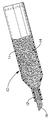
- the drawing relates to a cross-sectional view of a dispenser containing a dye solution therein for dyeing a non-black hydrocarbon rubber.
- the invention generally relates to any vulcanized rubber article, generally black because it contains carbon black therein, which has a non-black, solvent swellable, hydrocarbon rubber portion thereon or integral therewith.
- the present invention will be described with respect to a preferred embodiment of white tire sidewalls, the white sidewall region being a component in a toroidal-shaped pneumatic tire. It is to be understood that it can also be applied to numerous articles or products such as bumper strips, vehicle protection or trim strips, tennis shoes and the like.
- the white regions on a tire sidewall are generally prepared by assembling a white colored compounded rubber with the tire forming components during the assembly of a green (uncured) tire.
- the white colored rubber is desirably crosslinked in the mold with the other portions of the tire.
- the white colored component is formulated so that it is compatible with the other components and bonds well with the crosslinked elastomers of the tire.
- non-black any color or reflectivity which is greater than zero, on the CIE 1976 L* scale such as rubbers which have a CIE 1976 L* value, of at least 40, desirably at least 50, preferably at least 60, and more preferably at least 70, 80, or 85 before dyeing.
- a pure white color on the CIE 1976 L* scale has a value of 100, while a black color has a value of 0.
- Reference to the CIE 1976 L* scale can be readily found in ASTM E 308-94a.
- a preferred method of forming the white regions of the sidewall is to extrude the white colored component to another (generally black) tire component.
- the extruded white colored compound has a thin skin of a compounded rubber that matches the composition and color of the tire and which covers the white rubber component.
- this covered white component is cocured with the tire and thus adhered or chemically joined thereto, the entire tire sidewall appears to be one color irrespective of whether raised or depressed regions are present on the tire such as letters, or rings, logos, etc.
- the tire manufacturer can then expose the white component by grinding or abrading away the thin skin to remove the same and expose any desired regions of white rubber.
- letters spelling a trade name, tire sizes, shape designation, etc. are raised letters (protrude above the rest of the sidewall) while rings around the tire can be raised or recessed.
- Pneumatic tires generally comprise a tread region which is designed to contact the road or path, two or more sidewalls which help contain the air and provide lateral support, and bead areas which make contact with a rim.
- the dyeable, non-black, solvent swellable, hydrocarbon elastomers or rubber compositions of the present invention are either substantially free or completely free of polar groups other than small amounts of halogens as in butyl rubber.
- the one or more elastomers have an average of less than 10 weight percent, more desirably less than 5 weight percent, preferably less than 3 or 2 weight percent, and more preferably completely free (i.e, 0 percent) of polar groups.
- Such polar groups are carboxylic acids, sulfites, sulfates, alkali salts of carboxylic acids, esters, etc., and specifically include amine, sulfonyl, carbonyl, hydroxyl, nitrile, carboxyl, alcohol, ether linkages, and other groups.
- polar groups are carboxylic acids, sulfites, sulfates, alkali salts of carboxylic acids, esters, etc., and specifically include amine, sulfonyl, carbonyl, hydroxyl, nitrile, carboxyl, alcohol, ether linkages, and other groups.
- Desirably excluded (i.e., substantially free or completely free of) from this embodiment or used in such small amounts to result in an elastomer blend having less than the above specified amounts of polar groups are butadiene-acrylonitrile polymers, acrylate polymers and other polar elastomers.
- Suitable dyeable elastomers include copolymers having at least 50, desirably at least 80 and preferably at least 90 weight percent repeat units from C 4 to C 7 isomonoolefins, lightly halogenated versions thereof (e.g., less than 5 percent by weight halogen), polydiene (i.e., C 4 to C 12 ) homopolymers or copolymers; copolymers of diene (C 4 to C 12 ) and vinyl aromatic monomers (C 8 to C 15 ); natural rubber, ethylene propylene rubbers, hydrogenated polymers or copolymers of (C 4 to C 12 ) dienes, and the like.
- the lightly halogenated versions of the above polymers are used due to beneficial changes in cure behavior and are not considered as polar polymers.
- Preferable elastomer compositions for white sidewall portions comprise from about 20 to about 80 parts by weight of a copolymer having at least 50 weight percent repeat units from C 4 to C 7 isomonoolefin monomers (e.g., butyl rubber), more desirably from about 25 to about 65 parts by weight; optionally up to 30 parts by weight of an ethylene-propylene diene monomers rubber (EPDM), more desirably up to 25 parts by weight; and up to 80 parts by weight of a homopolymer or copolymer of one or more conjugated diene monomers and optionally with vinyl substituted aromatic monomers, more desirably from about 15 to about 75 parts by weight wherein all parts by weight are per 100 parts by weight (PHR) of total rubbers in the composition.
- a copolymer having at least 50 weight percent repeat units from C 4 to C 7 isomonoolefin monomers e.g., butyl rubber
- EPDM ethylene-propylene diene
- tire sidewall portions which are to be white or light colored are compounded with large amounts (e.g., greater than 30 PHR, more desirably greater than 40 PHR, and preferably greater than 50 PHR of rubbers having predominantly repeat units from one or more isomonoolefin (C 4 -C 7 ) monomers (e.g., butyl rubber).
- large amounts e.g., greater than 30 PHR, more desirably greater than 40 PHR, and preferably greater than 50 PHR of rubbers having predominantly repeat units from one or more isomonoolefin (C 4 -C 7 ) monomers (e.g., butyl rubber).
- the copolymer of at least 50 weight percent isomonoolefin is a copolymer of at least 50 weight percent isobutylene or halogenated isobutylene.
- the copolymer having at least 50 weight percent of a isomonoolefin comprises butyl rubber (typically a polymer with from about 95 to about 99 weight percent isobutylene repeat units and from about 1 to about 5 weight percent of diolefin repeat units) or chlorinated or brominated butyl rubber (having from about 0.25 to about 2.5 weight percent halogen, more desirably from about 0.5 to about 1.75 weight percent halogen).
- butyl rubber typically a polymer with from about 95 to about 99 weight percent isobutylene repeat units and from about 1 to about 5 weight percent of diolefin repeat units
- chlorinated or brominated butyl rubber having from about 0.25 to about 2.5 weight percent halogen, more desirably from about 0.5 to about 1.75 weight percent halogen.
- polymers having at least 50 weight percent of isomonoolefins are derived from polymerizations of C 4 to C 7 isomonoolefins with p-alkylstyrenes having from about 80 to about 99 weight percent, more desirably from 85 to 98 weight percent isomonoolefin repeat units and from about 1 to about 20 weight percent, and more desirably from about 2 to about 15 weight percent of p-alkylstyrenes.
- These polymers of isomonoolefins and p-alkylstyrenes are made by Exxon.
- a preferred copolymer is a brominated copolymer with up to 5 weight percent bromine, more desirably from about 0.2 to about 1.5 or 2.5 weight percent bromine, and from about 85 to about 98 weight percent isobutylene repeat units and from about 2 to about 15 weight percent p-methylstyrene.
- the predominate site of bromination is the p-methyl group.
- the ethylene propylene diene monomer (EPDM) copolymer comprises repeat units of from about 20 to about 90 weight percent, and more desirably from about 30 to about 85 weight percent ethylene, from about 10 to about 80 weight percent, more desirably from about 15 to about 70 weight percent of at least one alpha olefin having from 3 to 16 carbon atoms (usually mostly propylene) based on the total of ethylene and alpha olefins having from 3 to 16 carbon atoms, and from about 0.1 to about 0.8 moles of one or more nonconjugated dienes having from 6 to 12 carbon atoms per kilogram of EPDM polymer.
- EPDM ethylene propylene diene monomer
- the homopolymer or copolymer of a conjugated diene monomer is natural rubber or a synthetic polymer comprised of at least 50 and usually at least 70 weight percent repeat units derived from one or more conjugated diene monomers having from 4 to 8 or 12 carbon atoms. Natural rubber (comprising repeat units of isoprene) is preferred.
- a desirable comonomer for the residual of the copolymer is vinyl aromatic monomers of from 8 to 12 carbon atoms such as styrene.
- Preferred polymers include polybutadiene and polyisobutylene.
- Polar monomers such as acrylates, acrylics, itaconic acid, etc., if utilized at all, are only used in amounts so the total amount of polar groups do not exceed the specified percentages.
- Other non-polar monomers can also be used in the polymers or copolymers of this elastomer.
- the solvent swellable rubber compositions of the present invention are not dyed until they are cured (vulcanized or crosslinked).
- the crosslink density is generally measured by volume swelling capacity with a good solvent. Lower crosslink density is associated with fewer crosslinking occurrences per polymer chain, and low crosslink density results in greater swelling capacity of the cured rubber in a good solvent.
- Suitable swelling by percent volume in cyclohexane solvent is at least 50 percent, desirably at least 75 percent, 100 percent, or 125 percent, and preferably at least 150 percent or 175 percent by volume of the solvent swellable rubber after soaking overnight at room temperature, i.e., 24 hours at 25°C.
- crosslinking agents also known as curatives
- Sulfur accelerators include guanidines, thiurams, dithiocarbamates, thioureas, thiazoles, sulfenamides and xanthates.
- Peroxides include dialkyl peroxides, peresters, hydroperoxides, peroxydicarbonates, etc.
- Crosslinking agents also include zinc oxide, etc. The use of these crosslinking agents, their effective amounts, etc., are well known to the art. Vulcanization is a subset of the crosslinking process.
- Crosslinking agents are also known as curatives. Crosslinking is often called curing in the art of rubber processing.
- Fillers can be added to the non-black, solvent swellable rubber composition. Fillers generally are particulate material added to either reduce the total cost or to enhance the stiffness and/or chemical resistance of a composition. Reinforcing fillers tend to enhance the strength of a composition. While carbon black can be utilized, it is not desirable in non-black articles and hence is used in low amounts such as less than 2 PHR, more desirably less than 1.5 or 1 PHR, and preferably less than 0.5 or 0.25 PHR such that the composition would not be black and would be capable of reflecting some colored light as a result of dyeing.
- the dyed elastomers of the present invention are substantially free if not completely free, that is zero parts of carbon black per 100 parts of rubber. Rubber compositions with more than these amounts are generally referred to as black surfaces while those with less than these amounts are generally referred to as non-black.
- Suitable and desired fillers include talc, clay, silica, calcium carbonate, etc. These may function in addition as pigments or pigment extenders but their principal function is as fillers.
- Pigments are desirably added to the composition. Desirably only white pigments are added since white can be dyed to any other color. Thus, any white or non-black pigments which reflect light can be used in these rubber formulations. Desirably, the pigments used have good color retention during aging and resistance to discoloring or degrading on U.V. exposure or they are formulated with age resistors or U. V. protectors to provide color integrity in the final product.
- the pigments desirably are insoluble in the elastomer component and are consequently dispersed in particulate form. Desirable pigments include titanium dioxide, zinc oxide, white lead and antimony oxide, as well as precipitated silica, calcium silicate, calcium carbonate, treated clays, talc, and whiting.
- additives added to the solvent swellable hydrocarbon composition can include processing aids which generally enhance a composition's speed and ease of processing. They may function by reducing an elastomer's molecular weight or by lubricating the elastomer's surface. Age resistors and U.V. protectors may be added to the composition. Waxes are desirably used because they tend to bloom to the surface and protect the elastomer immediately below the waxy surface. The additives may absorb or neutralize harmful materials or energy or they function to block a mechanism of aging or degradation.
- processing oils are often used in rather large amounts in tires and other molded or shaped elastomer articles, if utilized in the non-black, solvent swellable rubber, they are desirably utilized in small amounts.
- the oil generally has the same solubility parameter as the elastomer and/or the solvent for the dye and thus are compatible therewith.
- Small amounts of oils are from about 1 or to about 15 PHR and desirably from about 2 to about 10 PHR.
- the process oils can include non-staining oils such as naphthenic, paraffinic, and the like.
- the hydrocarbon solvents which can be utilized to swell the non-black hydrocarbon rubber compositions generally have a solubility parameter of from about 12 to about 20, desirably from about 13 to about 18, and preferably from about 14 to about 17.5 [J/m 3 ] 1/2 ⁇ 10 -3.
- Such solvents can be identified in the Polymer Handbook, Second Edition, edited by J. Brandrup and E. H. Immergut, John Wiley and Sons, New York, NY (1975), pages IV-337-347, which is hereby fully incorporated by reference. If a blend of two or more different solvents is utilized, the solubility parameter of the overall blend generally lies within the above-noted ranges.
- solvents which have such suitable solubility parameters can be classified as terpene based solvents such as KNI Solvent-2000, and the like; various naphtha solvents such as high flash naphthas, petroleum naphtha, mineral spirits, and the like; various fuel oils such as kerosene, fuel oil no. 2, fuel oil no.
- various alkanes including halogenated alkanes such as cyclohexane, hexane, heptane, octene, decane, dodecane, methylene chloride, chloroform, and the like; and various aromatic solvents including halogenated aromatics such as toluene, various Tolusols generally containing C 7 hydrocarbons and significant amounts of aromatic compounds therein, xylene, dichlorobenzene, and the like.
- Another, but not highly desired class of solvents include the various ethers, desirably those having a high molecular weight such as diphenyl ether, and the like.
- a highly preferred solvent is RE-ENTRY® KNI Solvent-2000, a terpene based solvent from Envirosolv Inc., also d.b.a. Environmental Solvents Corporation of Jacksonville, Florida.
- the hydrocarbon solvents with the exception of halogenated solvents are generally substantially free or completely free of polar atoms and/or groups. That is, the weight of the total number of any polar atoms and/or groups therein is generally less than 10 percent by weight, desirably less than 5 percent by weight, more desirably less than 3 or 2 percent by weight, and preferably nil, that is, zero percent by weight based upon the total weight of the solvent.
- Polar atoms include oxygen, nitrogen, sulfur, and the like.
- Polar groups are defined with respect to the hydrocarbon elastomers.
- the desired non-polar solvents are generally poorly hydrogen bonded except for the ethers which are moderately hydrogen bonded. Otherwise, moderately hydrogen bonded and strongly hydrogen bonded solvents are avoided and thus are not within the scope of the present invention inasmuch as they generally do not effectively swell non-black rubber compositions.
- Moderately hydrogen bonded solvents which are avoided generally include various esters, ketones, glycol monoethers, and the like.
- Strongly hydrogen bonded solvents include various alcohols, amines, acids, amides, aldehydes, and the like. Numerous examples of solvents having the above noted solubility parameters as well as being characterized as poorly, moderately, or highly hydrogen bonded are set forth in the Polymer Handbook.
- hydrocarbon solvents of the present invention have a flash point of at least 100°F, (38°C) more desirably at least 125°F (52°C), and preferably at least 140°F (60°C); have no health effects at the typical exposure levels; and not be hazardous to the environment (desirably biodegradable).
- the solvent has low ratings such as a total rating of 5 or less, and desirably 3 or less based upon the National Fire Protection Association's classification on labelling and properties of flammable liquids (health, flammability, and reactivity ratings).
- Dyes are generally defined as compounds which contain groups that confer color, generally called chromophores. More information on dyes in general is available in "The Chemistry of Synthetic Dyes,” volumes I and II by K. Venkaktaraman, 1952, published by Academic Press, Inc., New York, and in “Organic Chemistry,” by W. T. Caldwell, 1943, published by Houghton Mifflin Company in its chapter entitled “Synthetic Dyes,” pages 702-725.
- the dyes desirably are soluble in the low polarity or non-polar hydrocarbon solvents and/or soluble in the poorly hydrogen bonded solvents and are generally free of pigments.
- these dyes are soluble to the extent of from about 0.0001 to about 1.0, desirably from about 0.001g to about 0.9, and preferably from about 0.01 to about 0.08 grams per 1.0 gram of solvent when the solvent has a solubility parameter of from about 12 to about 20, etc., with the solvent being further characterized as being generally a non-polar and/or a poorly hydrogen bonded solvent.
- Suitable dyes desirably include azo, diazo, quinoline, anthraquinone, indo, ketone imine/methine dyes or derivatives thereof, as well as combinations thereof.
- Preferred dyes include the azo and quinoline dyes.
- the synthetic dyes can also be derivatives of aromatic hydrocarbons such as benzene, toluene, naphthalene, and anthracene.
- Preferred dyes are AkrodyeTM oil violet IRS E-705 solvent violet 13 (9,10-anthracenedione)-; 1-hydroxy-4-[(4-methylphenyl)amino], AkrodyeTM oil orange #3 E-7174 solvent yellow 14, and AkrodyeTM oil brown E-8855 solvent red 2 available from Akrochem Corp. in Akron, Ohio.
- Morplas yellow 33 a quinoline type (2(2-quinolylmethylene) phthalide); Morplas red 46, an anthraquinone dye (9,10-anthracenedione, 1-(alkylamino)-; Automate® yellow 126, an azo dye, also known as solvent yellow (1-phenyl-3-methyl-4-(alkylphenylazo)-5-pyrazolone; Automate® red B, a diazo dye also known as solvent red 164 (2-naphthalenol[ (phenylazo)phenyl]azo alkyl derivatives); AkrodyeTM oil yellow #6, solvent yellow 56, a mono azo dye; AkrodyeTM oil red #1, solvent red 26, a diazo dye; AkrodyeTM oil green #1, solvent green, an azo anthraquinone dye; CeresTM red; AkrodyeTM E8855 brown powder; PylakromeTM Red LX-1903 (diazo, solvent red 24, 26)
- the present invention relates to dyeing generally any type of the above-noted non-black, solvent swellable, rubber compositions, including those contained on a crosslinked substrate such as vehicle bumpers or trim, shoes, e.g., tennis shoes, and the like.
- the crosslinked substrate can also be a tire, for example, e.g., pneumatic tires as used on vehicles (cars, trucks, etc.) construction equipment tires, agricultural equipment tires, cart tires, wheelbarrow tires, recreation equipment tires (all terrain vehicles, motorcycles), bicycles tires, and the like.
- non-black rubber compositions include the identification or origin of goods, the identification of trademarks or tradenames, the selective application of the dye for identifying marks (such as lot number, batch type, customer, supplier, and part number), and the like. Goods can also be customized or further colored by use of dyeing thereby enhancing their desirability and marketability.
- the dyeing of the non-black rubber compositions can be accomplished by any means which places the organic soluble dye solution in contact with the rubber article to be dyed.
- the dye solution is advantageously stored in a dispenser 10 having a receptacle portion 11 which can hold any desired amount of dye solution 14 depending upon the desired end application, frequency of usage, and the like.
- the receptacle is made of a suitable non-porous material such as metal, glass or plastic and has an applicator 16 in fluid communication, through matingly engagable nozzle 12, with the receptacle.
- the dye solution can be selectively applied to the non-black rubber through applicator 16 which can be a brush, a felt or fabric, a sponge, a cloth, a roller ball, or other devices or procedures used for dyeing.
- applicator 16 can be a brush, a felt or fabric, a sponge, a cloth, a roller ball, or other devices or procedures used for dyeing.
- the applicator optionally but preferably extends into the receptacle and typically fills a majority thereof as shown in the drawing.
- the non-black swellable elastomer can also be dyed by dipping. Should the non-black rubber contain oil extenders or plasticizers, the same may also aid in penetration of the dye.
- the dispenser includes a cap means (not shown) which seals the dye solution from exposure to the atmosphere when not in use.
- Very small quantities of the dye are usually necessary.
- the quantities needed to impart a desired or appealing, suitable, color is readily determined by one skilled in the art.
- Generally from about 0.5 to about 10 parts, desirably from about 0.75 to about 5 parts, and more desirably from about 1 to about 3 parts by weight are mixed with 100 parts by weight of the hydrocarbon solvent to form a dyeing solution.
- These dilute solutions are desirable as the swelling of the rubber by the solvent facilitates dye penetration.
- the dye solution that is the dye dissolved in the hydrocarbon solvent
- the solvent containing the dye penetrates and swells the rubber composition creating a permeable layer. That is, the dye solution is absorbed into the rubber with the dye therein. Subsequently, the solvent evaporates leaving the dye within the rubber.
- the result is a dye penetration layer which is located in the exterior of the non-black rubber composition.
- the depth thereof can vary depending upon the concentration of the dye, the amount of the dye solution applied and the number of applications of the dye solution. Generally, the depth ranges up to the thickness of the non-black rubber, or up to about 80 or 100 mils and desirably from about 5, 10, or 15 to about 20, 30, or 50 mils.
- the selective application and formation of a penetration dye layer in a rubber according to the present invention differs from painting since the dye solution penetrates into the swellable elastomer and the remaining dye cannot be removed by abrasion of the surface, as with paints or coatings.
- Table I shows a typical formulation for a white tire sidewall.
- a 6x"x6"x0.094" cured sheet of the white sidewall compound of Table I was prepared by molding in a bladder mold for 28 minutes/300°F/100 psi bladder pressure/30 tons platen pressure. Then 1"x1"x0.094" test pieces were clicked out from a bigger sheet for dyeing experiments.
- a 1"x1"x0.094" test piece of the white tire sidewall compounds disclosed in Table I was dipped into a solution of a mono azo dye, i.e., AkrodyeTM oil yellow #6 (E-6089) (2 g per 100 g solvent) at 40°C in a terpene based KNI Solvent-2000 for 5 minutes. The sample was then removed, dried, and a cross-section cut was made to determine the extent of penetration. The dye penetration under these conditions was total, i.e., about 47 mils (1.19mm).
- a mono azo dye i.e., AkrodyeTM oil yellow #6 (E-6089) (2 g per 100 g solvent)
- hydrocarbon solvents of the present invention having solubility parameters between 13 and 18 as well as low amounts of polar groups and generally poor hydrogen bonding resulted in good penetration of the dye as well as good volume swell of the non-black rubber.
- polar containing compounds such as alcohols, ketones, nitrogen containing compounds, and the like, resulted in poor dye penetration and low volume swell.
- volume percent swell test was conducted by soaking a 1"x1"x 0.1" (2.54x2.54x0.254cm) sample in toluene overnight and then measuring the increase in the largest dimension of the sample. The increase in the dimension was cubed to give volume percent swell.
- the dye penetration was conducted by dipping a 1"x1"x 0.1" (2.54x2.54x0.254 cm) sample in a solution of AkrodyeTM oil red #1 in KNI Solvent-2000 for 20 minutes. The dye concentration was 2 grams per 100 ml of solvent. After the sample was removed, the solvent was allowed to evaporate and the dyed sample was cut in half. The dye penetration was then measured using Vernier Calipers after drying at room temperature.
- the amounts of carbon black within the rubber are kept very low so that L* values before are at least 40. Otherwise, the rubber is simply not defined as a non-black rubber.
- Table VII relates to dyes that were in accordance with the concepts of the present invention and dyes that did not work. Approximately 2 grams of dye were dissolved/dispersed in 200 ml of KNI Solvent-2000. To this was added the 1"x1"x 0.14" of cured control white sidewall test pieces (prepared from 35 natural/65 Cl Butyl + EPDM), i.e., Table I. It was taken out after overnight soaking and then cut into two pieces to examine dye penetration. The dye is said to have worked if it penetrated totally, otherwise it did not work. Just surface coating and penetration less than total on overnight soaking is considered as non-dyeing. Dyes that worked and that did not work are tabulated below.
Landscapes
- Engineering & Computer Science (AREA)
- Mechanical Engineering (AREA)
- Tires In General (AREA)
- Compositions Of Macromolecular Compounds (AREA)
Applications Claiming Priority (2)
| Application Number | Priority Date | Filing Date | Title |
|---|---|---|---|
| US44863595A | 1995-05-23 | 1995-05-23 | |
| US448635 | 1995-05-23 |
Publications (3)
| Publication Number | Publication Date |
|---|---|
| EP0744304A2 true EP0744304A2 (de) | 1996-11-27 |
| EP0744304A3 EP0744304A3 (de) | 1997-11-19 |
| EP0744304B1 EP0744304B1 (de) | 2002-08-14 |
Family
ID=23781060
Family Applications (1)
| Application Number | Title | Priority Date | Filing Date |
|---|---|---|---|
| EP19960107887 Expired - Lifetime EP0744304B1 (de) | 1995-05-23 | 1996-05-17 | Luftreifen mit gefärbter Markierung |
Country Status (5)
| Country | Link |
|---|---|
| EP (1) | EP0744304B1 (de) |
| AU (1) | AU698488B2 (de) |
| BR (1) | BR9602249A (de) |
| CA (1) | CA2157997C (de) |
| DE (1) | DE69622926T2 (de) |
Cited By (4)
| Publication number | Priority date | Publication date | Assignee | Title |
|---|---|---|---|---|
| KR20000031879A (ko) * | 1998-11-11 | 2000-06-05 | 조충환 | 칼라 사이드월용 고무조성물 |
| US6093271A (en) * | 1995-05-23 | 2000-07-25 | The Goodyear Tire & Rubber Company | Tires with colored indicia |
| US6807995B1 (en) * | 2000-03-21 | 2004-10-26 | The Goodyear Tire & Rubber Company | Glow-in-the-dark tire sidewalls |
| EP1512523A1 (de) * | 2003-08-26 | 2005-03-09 | The Goodyear Tire & Rubber Company | Reifen mit Markierungen |
Family Cites Families (7)
| Publication number | Priority date | Publication date | Assignee | Title |
|---|---|---|---|---|
| US3607498A (en) * | 1967-05-17 | 1971-09-21 | Matsushita Electric Industrial Co Ltd | Method of producing tires having decorative sidewalls |
| US3577261A (en) * | 1968-11-25 | 1971-05-04 | Goodyear Tire & Rubber | Substrate with adherent layer having color imparted by said substrate |
| US3623900A (en) * | 1969-01-10 | 1971-11-30 | Minnesota Mining & Mfg | Method of facing tires with colored sidewalls |
| US3830274A (en) * | 1972-05-11 | 1974-08-20 | Goodyear Tire & Rubber | Elastomer blends and tire sidewalls prepared therefrom |
| CA1098773A (en) * | 1975-06-19 | 1981-04-07 | Durward T. Roberts, Jr. | Polyurethane tire sidewalls |
| JPS56131634A (en) * | 1980-03-07 | 1981-10-15 | Dainippon Toryo Co Ltd | Marking composition for rubber |
| JPH02293476A (ja) * | 1989-05-08 | 1990-12-04 | Fuji Rubber Co Ltd | シリコーンゴムの染色法 |
-
1995
- 1995-09-11 CA CA 2157997 patent/CA2157997C/en not_active Expired - Fee Related
-
1996
- 1996-05-14 BR BR9602249A patent/BR9602249A/pt not_active IP Right Cessation
- 1996-05-17 DE DE1996622926 patent/DE69622926T2/de not_active Expired - Fee Related
- 1996-05-17 EP EP19960107887 patent/EP0744304B1/de not_active Expired - Lifetime
- 1996-05-22 AU AU52448/96A patent/AU698488B2/en not_active Ceased
Cited By (6)
| Publication number | Priority date | Publication date | Assignee | Title |
|---|---|---|---|---|
| US6093271A (en) * | 1995-05-23 | 2000-07-25 | The Goodyear Tire & Rubber Company | Tires with colored indicia |
| KR20000031879A (ko) * | 1998-11-11 | 2000-06-05 | 조충환 | 칼라 사이드월용 고무조성물 |
| US6807995B1 (en) * | 2000-03-21 | 2004-10-26 | The Goodyear Tire & Rubber Company | Glow-in-the-dark tire sidewalls |
| US7112251B2 (en) * | 2000-03-21 | 2006-09-26 | The Goodyear Tire & Rubber Company | Glow-in-the-dark tire sidewalls |
| EP1512523A1 (de) * | 2003-08-26 | 2005-03-09 | The Goodyear Tire & Rubber Company | Reifen mit Markierungen |
| US7294376B2 (en) | 2003-08-26 | 2007-11-13 | The Goodyear Tire & Rubber Company | Tire with indicia |
Also Published As
| Publication number | Publication date |
|---|---|
| CA2157997C (en) | 2006-06-13 |
| BR9602249A (pt) | 1998-01-13 |
| EP0744304B1 (de) | 2002-08-14 |
| AU698488B2 (en) | 1998-10-29 |
| MX9601814A (es) | 1997-07-31 |
| AU5244896A (en) | 1996-12-05 |
| CA2157997A1 (en) | 1996-11-24 |
| DE69622926T2 (de) | 2003-04-03 |
| EP0744304A3 (de) | 1997-11-19 |
| DE69622926D1 (de) | 2002-09-19 |
Similar Documents
| Publication | Publication Date | Title |
|---|---|---|
| US6093271A (en) | Tires with colored indicia | |
| JP5525522B2 (ja) | インフレータブル物品用のセルフシーリング組成物 | |
| EP1533108B1 (de) | Luftreifen mit eingebauter gefärbter Dichtungsschicht und Verfahren zur Herstellung des Luftreifen | |
| US6807995B1 (en) | Glow-in-the-dark tire sidewalls | |
| US8646500B2 (en) | Multilayered gas-tight and anti-puncture laminate object including same | |
| JP5651109B2 (ja) | セルフシーリング組成物の製造方法 | |
| JP5738897B2 (ja) | セルフシーリング特性を有するインフレータブル物品用のエラストマー組成物 | |
| DE602004001129T2 (de) | Befestigung eines starren elements an einem reifen | |
| JP2011502856A (ja) | セルフシーリング組成物を備えた空気式物品 | |
| US7083695B2 (en) | Tires with non-black tread grooves | |
| JPH0317138A (ja) | 空気保持性インナーライナーを有する空気入りタイヤ | |
| EA026357B1 (ru) | Самозатягивающаяся композиция для пневматического изделия | |
| CN101428530A (zh) | 轮胎用内衬层及使用其的轮胎 | |
| US5320874A (en) | Rubber surface identification coating and rubber products prepared therefrom | |
| CA2157997C (en) | Tires with dyed indicia | |
| US2979099A (en) | Stain resistant white sidewall tire | |
| US12448499B2 (en) | Tyre for vehicle wheels | |
| US5904792A (en) | Solventless tread marking | |
| DE10101300A1 (de) | Runderneuerter Reifen | |
| CA2311604A1 (en) | Pneumatic tire having an outer layer of veneer covering the sidewall | |
| MXPA96001814A (en) | Tires with indications teñi | |
| RU2800092C2 (ru) | Шина для колес транспортных средств | |
| JP2002020542A (ja) | ゴム組成物及びそれを用いた空気入りタイヤ | |
| MXPA97008883A (es) | Llantas con marcas teñidas | |
| KR100332683B1 (ko) | 이형효과를 개선한 인너 고무조성물 |
Legal Events
| Date | Code | Title | Description |
|---|---|---|---|
| PUAI | Public reference made under article 153(3) epc to a published international application that has entered the european phase |
Free format text: ORIGINAL CODE: 0009012 |
|
| 17P | Request for examination filed |
Effective date: 19960517 |
|
| AK | Designated contracting states |
Kind code of ref document: A2 Designated state(s): DE FR GB IT |
|
| PUAL | Search report despatched |
Free format text: ORIGINAL CODE: 0009013 |
|
| AK | Designated contracting states |
Kind code of ref document: A3 Designated state(s): DE FR GB IT |
|
| 17Q | First examination report despatched |
Effective date: 19991007 |
|
| GRAG | Despatch of communication of intention to grant |
Free format text: ORIGINAL CODE: EPIDOS AGRA |
|
| GRAG | Despatch of communication of intention to grant |
Free format text: ORIGINAL CODE: EPIDOS AGRA |
|
| GRAG | Despatch of communication of intention to grant |
Free format text: ORIGINAL CODE: EPIDOS AGRA |
|
| GRAH | Despatch of communication of intention to grant a patent |
Free format text: ORIGINAL CODE: EPIDOS IGRA |
|
| GRAH | Despatch of communication of intention to grant a patent |
Free format text: ORIGINAL CODE: EPIDOS IGRA |
|
| GRAA | (expected) grant |
Free format text: ORIGINAL CODE: 0009210 |
|
| AK | Designated contracting states |
Kind code of ref document: B1 Designated state(s): DE FR GB IT |
|
| REG | Reference to a national code |
Ref country code: GB Ref legal event code: FG4D |
|
| REF | Corresponds to: |
Ref document number: 69622926 Country of ref document: DE Date of ref document: 20020919 |
|
| ET | Fr: translation filed | ||
| PLBE | No opposition filed within time limit |
Free format text: ORIGINAL CODE: 0009261 |
|
| STAA | Information on the status of an ep patent application or granted ep patent |
Free format text: STATUS: NO OPPOSITION FILED WITHIN TIME LIMIT |
|
| 26N | No opposition filed |
Effective date: 20030515 |
|
| PGFP | Annual fee paid to national office [announced via postgrant information from national office to epo] |
Ref country code: GB Payment date: 20040406 Year of fee payment: 9 |
|
| PG25 | Lapsed in a contracting state [announced via postgrant information from national office to epo] |
Ref country code: IT Free format text: LAPSE BECAUSE OF NON-PAYMENT OF DUE FEES;WARNING: LAPSES OF ITALIAN PATENTS WITH EFFECTIVE DATE BEFORE 2007 MAY HAVE OCCURRED AT ANY TIME BEFORE 2007. THE CORRECT EFFECTIVE DATE MAY BE DIFFERENT FROM THE ONE RECORDED. Effective date: 20050517 Ref country code: GB Free format text: LAPSE BECAUSE OF NON-PAYMENT OF DUE FEES Effective date: 20050517 |
|
| PGFP | Annual fee paid to national office [announced via postgrant information from national office to epo] |
Ref country code: FR Payment date: 20050517 Year of fee payment: 10 |
|
| GBPC | Gb: european patent ceased through non-payment of renewal fee |
Effective date: 20050517 |
|
| PGFP | Annual fee paid to national office [announced via postgrant information from national office to epo] |
Ref country code: DE Payment date: 20060531 Year of fee payment: 11 |
|
| REG | Reference to a national code |
Ref country code: FR Ref legal event code: ST Effective date: 20070131 |
|
| PG25 | Lapsed in a contracting state [announced via postgrant information from national office to epo] |
Ref country code: FR Free format text: LAPSE BECAUSE OF NON-PAYMENT OF DUE FEES Effective date: 20060531 Ref country code: DE Free format text: LAPSE BECAUSE OF NON-PAYMENT OF DUE FEES Effective date: 20071201 |