EP0742841B1 - Verfahren zur herstellung zweiphasiger stahlplatten - Google Patents
Verfahren zur herstellung zweiphasiger stahlplatten Download PDFInfo
- Publication number
- EP0742841B1 EP0742841B1 EP95942980A EP95942980A EP0742841B1 EP 0742841 B1 EP0742841 B1 EP 0742841B1 EP 95942980 A EP95942980 A EP 95942980A EP 95942980 A EP95942980 A EP 95942980A EP 0742841 B1 EP0742841 B1 EP 0742841B1
- Authority
- EP
- European Patent Office
- Prior art keywords
- steel
- temperature
- ferrite
- austenite
- cooling
- Prior art date
- Legal status (The legal status is an assumption and is not a legal conclusion. Google has not performed a legal analysis and makes no representation as to the accuracy of the status listed.)
- Expired - Lifetime
Links
Images

Classifications
-
- C—CHEMISTRY; METALLURGY
- C21—METALLURGY OF IRON
- C21D—MODIFYING THE PHYSICAL STRUCTURE OF FERROUS METALS; GENERAL DEVICES FOR HEAT TREATMENT OF FERROUS OR NON-FERROUS METALS OR ALLOYS; MAKING METAL MALLEABLE, e.g. BY DECARBURISATION OR TEMPERING
- C21D6/00—Heat treatment of ferrous alloys
- C21D6/02—Hardening by precipitation
-
- C—CHEMISTRY; METALLURGY
- C21—METALLURGY OF IRON
- C21D—MODIFYING THE PHYSICAL STRUCTURE OF FERROUS METALS; GENERAL DEVICES FOR HEAT TREATMENT OF FERROUS OR NON-FERROUS METALS OR ALLOYS; MAKING METAL MALLEABLE, e.g. BY DECARBURISATION OR TEMPERING
- C21D8/00—Modifying the physical properties of ferrous metals or ferrous alloys by deformation combined with, or followed by, heat treatment
- C21D8/02—Modifying the physical properties of ferrous metals or ferrous alloys by deformation combined with, or followed by, heat treatment during manufacturing of plates or strips
- C21D8/0221—Modifying the physical properties of ferrous metals or ferrous alloys by deformation combined with, or followed by, heat treatment during manufacturing of plates or strips characterised by the working steps
- C21D8/0226—Hot rolling
-
- C—CHEMISTRY; METALLURGY
- C21—METALLURGY OF IRON
- C21D—MODIFYING THE PHYSICAL STRUCTURE OF FERROUS METALS; GENERAL DEVICES FOR HEAT TREATMENT OF FERROUS OR NON-FERROUS METALS OR ALLOYS; MAKING METAL MALLEABLE, e.g. BY DECARBURISATION OR TEMPERING
- C21D2211/00—Microstructure comprising significant phases
- C21D2211/002—Bainite
-
- C—CHEMISTRY; METALLURGY
- C21—METALLURGY OF IRON
- C21D—MODIFYING THE PHYSICAL STRUCTURE OF FERROUS METALS; GENERAL DEVICES FOR HEAT TREATMENT OF FERROUS OR NON-FERROUS METALS OR ALLOYS; MAKING METAL MALLEABLE, e.g. BY DECARBURISATION OR TEMPERING
- C21D2211/00—Microstructure comprising significant phases
- C21D2211/005—Ferrite
-
- C—CHEMISTRY; METALLURGY
- C21—METALLURGY OF IRON
- C21D—MODIFYING THE PHYSICAL STRUCTURE OF FERROUS METALS; GENERAL DEVICES FOR HEAT TREATMENT OF FERROUS OR NON-FERROUS METALS OR ALLOYS; MAKING METAL MALLEABLE, e.g. BY DECARBURISATION OR TEMPERING
- C21D2211/00—Microstructure comprising significant phases
- C21D2211/008—Martensite
-
- C—CHEMISTRY; METALLURGY
- C21—METALLURGY OF IRON
- C21D—MODIFYING THE PHYSICAL STRUCTURE OF FERROUS METALS; GENERAL DEVICES FOR HEAT TREATMENT OF FERROUS OR NON-FERROUS METALS OR ALLOYS; MAKING METAL MALLEABLE, e.g. BY DECARBURISATION OR TEMPERING
- C21D7/00—Modifying the physical properties of iron or steel by deformation
- C21D7/02—Modifying the physical properties of iron or steel by deformation by cold working
- C21D7/10—Modifying the physical properties of iron or steel by deformation by cold working of the whole cross-section, e.g. of concrete reinforcing bars
- C21D7/12—Modifying the physical properties of iron or steel by deformation by cold working of the whole cross-section, e.g. of concrete reinforcing bars by expanding tubular bodies
-
- C—CHEMISTRY; METALLURGY
- C21—METALLURGY OF IRON
- C21D—MODIFYING THE PHYSICAL STRUCTURE OF FERROUS METALS; GENERAL DEVICES FOR HEAT TREATMENT OF FERROUS OR NON-FERROUS METALS OR ALLOYS; MAKING METAL MALLEABLE, e.g. BY DECARBURISATION OR TEMPERING
- C21D8/00—Modifying the physical properties of ferrous metals or ferrous alloys by deformation combined with, or followed by, heat treatment
- C21D8/10—Modifying the physical properties of ferrous metals or ferrous alloys by deformation combined with, or followed by, heat treatment during manufacturing of tubular bodies
Definitions
- This invention relates to high strength steel and its manufacture, the steel being useful in structural applications as well as being a precursor for linepipe. More particularly, this invention relates to the manufacture of dual phase, high strength steel plate comprising ferrite and martensite/bainite phases wherein the microstructure and mechanical properties are substantially uniform through the thickness of the plate, and the plate is characterized by superior toughness and weldability. Still more particularly this invention relates to the manufacture of dual phase, high strength steel which is producer friendly in its consistency, versitility and ease with which its microstructure can be established in a practical manner.
- Dual phase steel comprising ferrite, a relatively soft phase and martensite/bainite, a relatively strong phase, are produced by annealing at temperatures between the A r3 and A r1 transformation points, followed by cooling to room temperature at rates ranging from air cooling to water quenching.
- the selected annealing temperature is dependent on the the steel chemistry and the desired volume relationship between the ferrite and martensite/bainite phases.
- the volume of the martensite/bainite phase generally represents about 10-40% of the microstructure, the remainder being the softer ferrite phase.
- the one factor that has limited their widespread application is their rather strong sensitivity to process conditions and variability, often requiring stringent and tight temperature, and other processing to maintain their desirable properties. Outside these rather tight processing windows, most of the steels of the state of the art suffer rather dramatic and precipitous drop offs in properties. Because of this sensitivity, these steels cannot be produced in a constant fashion in practice, thus, limiting their production to a handful of steel mills worldwide.
- Dual phase steels for pipelines exhibiting high yield strength and good weldability are known from US-A-3 860 456 or JP-A-5 834 131.
- an object of this invention is utilizing the high work hardening capability of dual phase steel not for improving formability, but for achieving rather high yield strengths, after the 1-3% deformation imparted to plate steel during the formation of linepipe to ⁇ 100 ksi, preferably ⁇ 120 ksi.
- dual phase steel plate having the characteristics to be described herein is a precursor for linepipe.
- An object of this invention is to provide substantially uniform microstructure through the thickness of the plate for plate thickness of at least 10 mm.
- a further object is to provide for a fine scale distribution of constituent phases in the microstructure so as to expand the useful boundaries of volume percent bainite/martensite to about 75% and higher, thereby providing high strength, dual phase steel characterized by superior toughness.
- a still further object of this invention is to provide a high strength, dual phase steel having superior weldability and superior heat affected zone (HAZ) softening resistance.
- steel chemistry is balanced with thermomechanical control of the rolling process, thereby allowing the manufacture of high strength, i.e., yield strengths greater than 100 ksi, and at least 120 ksi after 1-3% deformation, dual phase steel useful as a precursor for linepipe, and having a microstructure comprising 40-80%, preferably 50-80% by volume of a martensite/bainite phase in a ferrite matrix, the bainite being less than about 50% of martensite/bainite phase.
- the ferrite matrix is further strengthened with a high density of dislocations, i.e., >10 10 cm/cm 3 , and a dispersion of fine sized precipitates of at least one and preferably all of vanadium and niobium carbides or carbonitrides, and molybdenum carbide, i.e., (V,Nb)(C,N) and Mo 2 C.
- the very fine ( ⁇ 50 ⁇ diameter) precipitates of vanadium, niobium and molybdenum carbides or carbonitrides are formed in the ferrite phase by interphase precipitation reactions which occur during austenite ferrite transformation below the A r3 temperature.
- the precipitates are primarily vanadium and niobium carbides and are referred to as (V,Nb)(C,N).
- dual phase steel can be produced in thicknesses of at least about 15 mm, preferably at least about 20 mm and having ultrahigh strength.
- the strength of the steel is related to the presence of the martensite/bainite phase, where increasing phase volume results in increasing strength. Nevertheless, a balance must be maintained between strength and toughness (ductility) where the toughness is provided by the ferrite phase. For example, yield strengths after 2% deformation of at least about 100 ksi are produced when the martensite/bainite phase is present in at least about 40 vol%, and at least about 120 ksi when the martensite/bainite phase is at least about 60 vol%.
- the preferred steel that is, with the high density of dislocations and vanadium and niobium precipitates in the ferrite phase is produced by a finish rolling reduction at temperatures above the A r3 transformation point air cooling to between the Ar 3 transformation point and about 500°C, followed by quenching to room temperature.
- the procedure therefore, is contrary to that for dual phase steels for the automotive industry, usually 10 mm or less thickness and 50-60 ksi yield strength, where the ferrite phase must be free of precipitates to ensure adequate formability.
- the precipitates form discontinuously at the moving interface between the ferrite and austenite. However, the precipitates form only if adequate amounts of vanadium or niobium or both are present and the rolling and heat treatment conditions are carefully controlled.
- vanadium and niobium are key elements of the steel chemistry.
- Figure 1 shows a plot volume % ferrite formed (ordinate) v. start-quench temperature, °C (abscissa) for typically available steels (dotted line) and the steel produced with this invention (solid line).
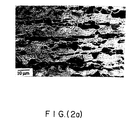
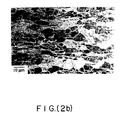
- Figures 2(a) and 2(b) show scanning electron micrographs of the dual phase microstructure produced by A1 process condition.
- Figure 2a is the near surface region and
- Figure 2b is the center (mid-thickness) region.
- the grey area is the ferrite phase and the lighter area is the martensite phase.
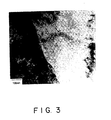
- Figure 3 shows a transmissions electron micrograph of niobium and vanadium carbonitride precipitates in the range of less than about 50 ⁇ diameter, preferably about 10-50 ⁇ diameter, in the ferrite phase.
- the dark region (left side) is the martensite phase and the light region (right side) is the ferrite phase.
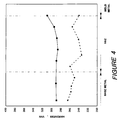
- Figure 4 shows plots of hardness (Vickers) data across the HAZ (ordinate) for the A1 steel produced by this invention (solid line) and a similar plot for a commercial X100 linepipe steel (dotted line).
- the steel of this invention shows no significant decrease in the HAZ strength at 3 kilo joules/mm heat input, whereas a significant decrease, approximately 15%, in HAZ strength (as indicated by the Vickers hardness) occurs for the X100 steel.
- the steel manufactured by the method of this invention provides high strength superior weldability and low temperature toughness and comprises, by weight:
- the sum of the vanadium and niobium concentrations is ⁇ 0.1 wt%, and more preferably vanadium and niobium concentrations each are ⁇ 0.04%.
- the well known contaminants N, P, S are minimized even though some N is desired, as explained below, for producing grain growth inhibiting titanium nitride particles.
- N concentration is about 0.001-0.01 wt%, S no more than 0.01 wt%, and P no more than 0.01 wt%.
- the steel is boron free in that there is no added boron, and boron concentration is ⁇ 5 ppm, preferably ⁇ 1 ppm.
- the material of this invention is prepared by forming a steel billet of the above composition in normal fashion; heating the billet to a temperature sufficient to dissolve substantially all, and preferably all vanadium carbonitrides and niobium carbonitrides, preferably in the range of 1150-1250°C.
- niobium, vanadium and molybdenum will be in solution; hot rolling the billet in one or more passes in a first reduction providing about 30-70% reduction at a first temperature range where austenite recrystallizes; hot rolling the reduced billet in one or more passes in a second rolling reduction providing about 30-70% reduction in a second and somewhat lower temperature range when austenite does not recrystallize but above the Ar 3 transformation point; air cooling to a temperature in the range between A r3 transformation point and about 500°C and where 20-60% of the austenite has transformed to ferrite; water cooling at a rate of at least 25°C/second, preferably at least about 35°C/second, thereby hardening the billet, to a temperature no higher than 400°C, where no further transformation to ferrite can occur and, if desired, air cooling the rolled, high strength steel plate, useful as a precursor for linepipe to room temperature.
- grain size is quite uniform and ⁇ 10 microns, preferably ⁇
- Carbon provides matrix strengthening in all steels and welds, whatever the microstructure, and also precipitation strengthening through the formation of small NbC and VC particles, if they are sufficiently fine and numerous.
- NbC precipitation during hot rolling serves to retard recrystallization and to inhibit grain growth, thereby providing a means of austenite grain refinement. This leads to an improvement in both strength and low temperature toughness.
- Carbon also assists hardenability, i.e., the ability to form harder and stronger microstructures on cooling the steel. If the carbon content is less than 0.01%, these strengthening effects will not be obtained. If the carbon content is greater than 0.12%, the steel will be susceptible to cold cracking on field welding and the toughness is lowered in the steel plate and its heat affected zone (HAZ) on welding.
- HZ heat affected zone
- Manganese is a matrix strengthener in steels and welds and it also contributes strongly to the hardenability. A minimum amount of 0.4% Mn is needed to achieve the necessary high strength. Like carbon, it is harmful to toughness of plates and welds when too high, and it also causes cold cracking on field welding, so an upper limit of 2.0% Mn is imposed. This limit is also needed to prevent severe center line segregation in continuously cast linepipe steels, which is a factor helping to cause hydrogen induced cracking (HIC).
- HIC hydrogen induced cracking
- Si is always added to steel for deoxidization purposes and at least 0.01% is needed in this role. In greater amounts Si has an adverse effect on HAZ toughness, which is reduced to unacceptable levels when more than 0.5% is present.
- Niobium is added to promote grain refinement of the rolled microstructure of the steel, which improves both the strength and the toughness.
- Niobium carbide precipitation during hot rolling serves to retard recrystallization and to inhibit grain growth, thereby providing a means of austenite grain refinement. It will give additional strengthening on tempering through the formation of NbC precipitates. However, too much niobium will be harmful to the weldability and HAZ toughness, so a maximum of 0.12% is imposed.
- Titanium when added as a small amount is effective in forming fine particles on TiN which refine the grain size in both the rolled structure and the HAZ of the steel. Thus, the toughness is improved. Titanium is added in such an amount that the ratio Ti/N ranges between 2.0 and 3.4. Excess titanium will deteriorate the toughness of the steel and welds by forming coarser TiN or TiC particles. A titanium content below 0.002% cannot provide a sufficiently fine grain size, while more than 0.04% causes a deterioration in toughness.
- Aluminum is added to these steels for the purpose of deoxidization. At least 0.002% A1 is required for this purpose. If the aluminum content is too high, i.e., above 0.05%, there is a tendency to form Al 2 O 3 type inclusions, which are harmful for the toughness of the steel and its HAZ.
- Vanadium is added to give precipitation strengthening, by forming fine VC particles in the steel on tempering and its HAZ on cooling after welding.
- vanadium When in solution, vanadium is potent in promoting hardenability of the steel.
- vanadium will be effective in maintaining the HAZ strength in a high strength steel.
- Vanadium is also a potent strengthener to eutectoidal ferrite via interphase precipitation of vanadium carbonitride particles of ⁇ 50 ⁇ diameter, preferably 10-50 ⁇ diameter.
- Molybdenum increases the hardenability of a steel on direct quenching, so that a strong matrix microstructure is produced and it also gives precipitation strengthening on reheating by forming Mo 2 C and NbMo particles. Excessive molybdenum helps to cause cold cracking on field welding, and also deteriorate the toughness of the steel and HAZ, so a maximum of 0.8% is specified.
- Chromium also increases the hardenability on direct quenching. It improves corrosion and HIC resistance. In particular, it is preferred for preventing hydrogen ingress by forming a Cr 2 O 3 rich oxide film on the steel surface. As for molybdenum, excessive chromium helps to cause cold cracking on field welding, and also deteriorate the toughness of the steel and its HAZ, so a maximum of 1.0% Cr is imposed.
- thermomechanical processing is two fold: producing a refined and flattened austenitic grain and introducing a high density of dislocations and shear bands in the two phases.
- the first objective is satisfied by heavy rolling at temperatures above and below the austenite recrystallization temperature but always above the A r3 .
- Rolling above the recrystallization temperature continuously refines the austenite grain size while rolling below the recrystallization temperature flattens the austenitic grain.
- cooling below the A r3 where austenite begins its transformation to ferrite results in the formation of a finely divided mixture of austenite and ferrite and, upon rapid cooling below the A r1 , to a finely divided mixture of ferrite and martensite/bainite.
- the second objective is satisfied by the third rolling reduction of the flattened austenite grains at temperatures between the A r1 and A r3 where 20% to 60% of the austenite has transformed to ferrite.
- thermomechanical processing practiced in this invention is important for inducing the desired fine distribution of constituent phases.
- the temperature that defines the boundary between the ranges where austentite recrystallizes and where austenite does not recrystallize depends on the heating temperature before rolling, the carbon concentration, the niobium concentration and the amount of reduction in the rolling passes. This temperature can be readily determined for each steel composition either by experiment or by model calculation.
- Linepipe is formed from plate by the well known U-O-E process in which plate is formed into a U shape, then formed into an O shape, and the O shape is expanded 1-3%.
- the forming and expansion with their concommitant work hardening effects leads to the highest strength for the linepipe.
- the alloy and the thermomechanical processing were designed to produce the following balance with regard to the strong carbonitride formers, particularly niobium and vanadium:
- thermomechanical rolling schedule for the 100 mm square initial forged slab is shown below: Starting Thickness: 100 mm Reheat Temperature: 1240°C Reheating Time: 2 hours Pass Thickness After Pass, mm Temperature °C 0 100 1240 1 85 1104 2 70 1082 3 57 1060 --------------------------------------------------------------------------- 8 20 750
- the ferrite phase includes both the proeutectoidal (or "retained ferrite") and the eutectoidal (or “transformed” ferrite) and signifies the total ferrite volume fraction.
- Quenching rate from finish temperature should be in the range 20 to 100°C/second and more preferably, in the range 30 to 40°C/second to induce the desired dual phase microstructure in thick sections exceeding 20 mm in thickness.
- the finding is that the austenite is transformed anywhere between 35 to 50% when the quench start temperature is lowered from 660°C to 560°C. Furthermore, the steel does not undergo any additional transformation when the quench start temperature is further lowered, the total staying at about 50%.
- Figure 3 shows a transmission electron micrograph revealing a very fine dispersion of interphase precipitates in the ferrite region of A1 steel.
- the eutectoidal ferrite is generally observed close to the interface at the second phase, dispersed uniformly throughout the sample and its volume fraction increases with lowering of the temperature from which the steel is quenched.
- a major discovery of the present invention is the finding that the austenite phase is remarkably stable to further transforamtion after about 50% transformation. This is attributed to a combination of austenite stabilization mechanisms and ausaging effects:
- Table 4 shows ambient tensile data of alloys processed by conditions A1, A2 and A3.
- Yield strength after 2% elongation in pipe forming will meet the minimum desired strength of at least 100 ksi, preferably at least 130 ksi, due to the excellent work hardening characteristics of these microstructures.
- Table 5 shows the Charpy-V-Notch impact toughness (ASTM specification E-23) at -40°C performed on longitudinal (L-T) and transverse (T) samples of alloys processed by A1 and A2 conditions.
- Designation Orientation Energy (Joules) A1 L-T 145 T 50
- a key aspect of the present invention is a high strength steel with good weldability and one that has excellent HAZ softening resistance.
- Laboratory single bead weld tests were performed to observe the cold cracking susceptibility and the HAZ softening.
- Figure 4 presents an example of the data for the steel of this invention. This plot dramatically illustrates that in contrast to the steels of the state of the art, for example commercial X100 linepipe steel, the dual phase steel of the present invention, does not suffer from any significant or measurable softening in the HAZ. In contrast X100 shows a 15% softening as compared to the base metal.
- the HAZ has at least about 95% of the strength of the base metal, preferably at least about 98% of the strength of the base metal. These strengths are obtained when the welding heat input ranges from about 1-5 kilo joules/mm.
Landscapes
- Chemical & Material Sciences (AREA)
- Engineering & Computer Science (AREA)
- Physics & Mathematics (AREA)
- Thermal Sciences (AREA)
- Crystallography & Structural Chemistry (AREA)
- Mechanical Engineering (AREA)
- Materials Engineering (AREA)
- Metallurgy (AREA)
- Organic Chemistry (AREA)
- Heat Treatment Of Steel (AREA)
- Heat Treatment Of Sheet Steel (AREA)
Claims (12)
- Verfahren zur Herstellung von zweiphasigem Stahl, der Ferrit und 40 bis 80 Vol% Martensit/Bainit-Phasen enthält und der eine Dehngrenze von mindestens 100 ksi (690 Pa) nach einer Deformation von 1 bis 3 % aufweist, wobei das Verfahren die Schritte umfasst:(a) Erhitzen eines Stahlblocks auf eine Temperatur, die ausreichend ist, um im Wesentlichen alle Vanadiumcarbonitride und Niobcarbonitride zu lösen;(b) Walzen des Blocks und Formen einer Platte, in einem oder mehreren Durchgängen bis zu einer ersten Reduktion in einem Temperaturbereich, in dem Austenit rekristallisiert;(c) Endwalzen der Platte in einem oder mehreren Durchgängen bis zu einer zweiten Reduktion in einem Temperaturbereich unterhalb der Rekristallisationstemperatur von Austenit und über dem Ar3-Umwandlungspunkt;(d) Kühlen der fertiggewalzten Platte auf eine Temperatur zwischen dem Ar3-Umwandlungspunkt und 500 °C bis sich 20 bis 60 Vol% des Stahls in eine Ferritphase umgewandelt haben; und(e) Wasserkühlen/Abschrecken der fertiggewalzten Platte auf eine Temperatur ≤ 400 °C.
- Verfahren nach Anspruch 1, worin die Temperatur des Schrittes (a) im Bereich von 1150 bis 1250 °C liegt.
- Verfahren nach Anspruch 1 oder 2, worin die Reduktion beim ersten Walzen 30 bis 70 % beträgt und die Reduktion beim zweiten Walzen ebenfalls 30 bis 70 % beträgt.
- Verfahren nach einem vorangehenden Anspruch, worin das Kühlen in Schritt (d) Luftkühlen ist.
- Verfahren nach einem vorangehenden Anspruch, worin das Wasserkühlen/Abschrecken in Schritt (e) mit einer Rate von mindestens 25 °C/Sekunde durchgeführt wird.
- Verfahren nach Anspruch 5, worin die Kühlrate im Bereich von 30 °C bis 40 °C/Sekunde liegt.
- Verfahren nach einem vorangehenden Anspruch, worin die Platte anschließend zu einem kreisförmigen oder leitungsrohrförmigen Material geformt wird.
- Verfahren nach Anspruch 7, worin das kreisförmige oder leitungsrohrförmige Material um 1 bis 3 % gedehnt wird.
- Verfahren nach einem vorangehenden Anspruch, worin die Stahlchemie in Gew.-% wie folgt ist:wobei der Rest Eisen und zufällige Verunreinigungen ist.0,05 - 0,12 C0,01 - 0,50 Si0,40 - 2,0 Mn0,03 - 0,12 Nb0,05 - 0,15 V0,2 - 0,8 Mo0,015 - 0,03 Ti0,01 - 0,03 AlPcm - ≤ 0,24
- Verfahren nach Anspruch 9, worin die Summe der Vanadium- und Niob-Konzentrationen ≥ 0,1 Gew.-% ist.
- Verfahren nach Anspruch 10, worin die Konzentrationen sowohl von Vanadium als auch von Niob ≥ 0,04 Gew.-% sind.
- Verfahren nach Anspruch 9, worin der Stahl weiterhin 0,3 bis 1,0 Gew.-% Chrom enthält.
Applications Claiming Priority (3)
| Application Number | Priority Date | Filing Date | Title |
|---|---|---|---|
| US349856 | 1994-12-06 | ||
| US08/349,856 US5531842A (en) | 1994-12-06 | 1994-12-06 | Method of preparing a high strength dual phase steel plate with superior toughness and weldability (LAW219) |
| PCT/US1995/015725 WO1996017965A1 (en) | 1994-12-06 | 1995-12-01 | Method of making dual phase steel plate |
Publications (3)
| Publication Number | Publication Date |
|---|---|
| EP0742841A1 EP0742841A1 (de) | 1996-11-20 |
| EP0742841A4 EP0742841A4 (de) | 1998-03-04 |
| EP0742841B1 true EP0742841B1 (de) | 2001-08-22 |
Family
ID=23374255
Family Applications (1)
| Application Number | Title | Priority Date | Filing Date |
|---|---|---|---|
| EP95942980A Expired - Lifetime EP0742841B1 (de) | 1994-12-06 | 1995-12-01 | Verfahren zur herstellung zweiphasiger stahlplatten |
Country Status (11)
| Country | Link |
|---|---|
| US (1) | US5531842A (de) |
| EP (1) | EP0742841B1 (de) |
| JP (1) | JP3990725B2 (de) |
| CN (1) | CN1060814C (de) |
| BR (1) | BR9506729A (de) |
| CA (1) | CA2182813C (de) |
| DE (1) | DE69522315T2 (de) |
| MX (1) | MX9603234A (de) |
| RU (1) | RU2147040C1 (de) |
| UA (1) | UA44265C2 (de) |
| WO (1) | WO1996017965A1 (de) |
Families Citing this family (35)
| Publication number | Priority date | Publication date | Assignee | Title |
|---|---|---|---|---|
| US5900075A (en) * | 1994-12-06 | 1999-05-04 | Exxon Research And Engineering Co. | Ultra high strength, secondary hardening steels with superior toughness and weldability |
| DE19639062A1 (de) * | 1996-09-16 | 1998-03-26 | Mannesmann Ag | Modellgestütztes Verfahren zur kontrollierten Kühlung von Warmband oder Grobblech in einem rechnergeführten Walz- und Kühlprozeß |
| JPH10237583A (ja) | 1997-02-27 | 1998-09-08 | Sumitomo Metal Ind Ltd | 高張力鋼およびその製造方法 |
| TW396253B (en) * | 1997-06-20 | 2000-07-01 | Exxon Production Research Co | Improved system for processing, storing, and transporting liquefied natural gas |
| TW396254B (en) | 1997-06-20 | 2000-07-01 | Exxon Production Research Co | Pipeline distribution network systems for transportation of liquefied natural gas |
| TW444109B (en) * | 1997-06-20 | 2001-07-01 | Exxon Production Research Co | LNG fuel storage and delivery systems for natural gas powered vehicles |
| TW359736B (en) * | 1997-06-20 | 1999-06-01 | Exxon Production Research Co | Systems for vehicular, land-based distribution of liquefied natural gas |
| WO1999005328A1 (en) * | 1997-07-28 | 1999-02-04 | Exxonmobil Upstream Research Company | Method for producing ultra-high strength, weldable steels with superior toughness |
| DE69834932T2 (de) * | 1997-07-28 | 2007-01-25 | Exxonmobil Upstream Research Co., Houston | Ultrahochfeste, schweissbare stähle mit ausgezeichneter ultratief-temperaturzähigkeit |
| WO1999005334A1 (en) * | 1997-07-28 | 1999-02-04 | Exxonmobil Upstream Research Company | Ultra-high strength, weldable, essentially boron-free steels wit h superior toughness |
| ATE260348T1 (de) * | 1997-07-28 | 2004-03-15 | Exxonmobil Upstream Res Co | Ultra-hochfeste, schweissbare, borenthaltende stähle mit ausgezeichneter zähigkeit |
| DZ2531A1 (fr) * | 1997-12-19 | 2003-02-08 | Exxon Production Research Co | Procédé de préparation d'une tôle d'acier double phase cette tôle et procédé pour renforcer la résistance à la propagation des fissures. |
| TW436597B (en) * | 1997-12-19 | 2001-05-28 | Exxon Production Research Co | Process components, containers, and pipes suitable for containign and transporting cryogenic temperature fluids |
| DZ2530A1 (fr) | 1997-12-19 | 2003-02-01 | Exxon Production Research Co | Procédé de préparation d'une tôle d'acier cette tôle d'acier et procédé pour renforcer la resistanceà la propagation des fissures d'une tôle d'acier. |
| US6254698B1 (en) * | 1997-12-19 | 2001-07-03 | Exxonmobile Upstream Research Company | Ultra-high strength ausaged steels with excellent cryogenic temperature toughness and method of making thereof |
| US6159312A (en) * | 1997-12-19 | 2000-12-12 | Exxonmobil Upstream Research Company | Ultra-high strength triple phase steels with excellent cryogenic temperature toughness |
| RU2156311C1 (ru) * | 2000-02-29 | 2000-09-20 | Открытое акционерное общество "НОСТА" | Способ производства катаных заготовок |
| NL1016042C2 (nl) * | 2000-08-29 | 2001-07-24 | Corus Technology B V | Warmgewalste stalen band, werkwijze voor het vervaardigen ervan, en een daarmee vervaardigde wielschijf. |
| JP4085583B2 (ja) | 2001-02-27 | 2008-05-14 | Jfeスチール株式会社 | 高強度冷延溶融亜鉛メッキ鋼板およびその製造方法 |
| JP2005525509A (ja) | 2001-11-27 | 2005-08-25 | エクソンモービル アップストリーム リサーチ カンパニー | 天然ガス車両のためのcng貯蔵及び送出システム |
| US6852175B2 (en) * | 2001-11-27 | 2005-02-08 | Exxonmobil Upstream Research Company | High strength marine structures |
| KR20040075971A (ko) * | 2002-02-07 | 2004-08-30 | 제이에프이 스틸 가부시키가이샤 | 고강도 강판 및 그 제조방법 |
| JP3869747B2 (ja) * | 2002-04-09 | 2007-01-17 | 新日本製鐵株式会社 | 変形性能に優れた高強度鋼板、高強度鋼管および製造方法 |
| JP4235030B2 (ja) * | 2003-05-21 | 2009-03-04 | 新日本製鐵株式会社 | 局部成形性に優れ溶接部の硬さ上昇を抑制した引張強さが780MPa以上の高強度冷延鋼板および高強度表面処理鋼板 |
| RU2251587C2 (ru) * | 2003-06-30 | 2005-05-10 | ООО "Уральская сталь" | Конструкционная сталь |
| EP1767659A1 (de) | 2005-09-21 | 2007-03-28 | ARCELOR France | Herstellungsverfahren eines Stahlwerkstücks mit mehrphasigem Mikrogefüge |
| DE102006054300A1 (de) * | 2006-11-14 | 2008-05-15 | Salzgitter Flachstahl Gmbh | Höherfester Dualphasenstahl mit ausgezeichneten Umformeigenschaften |
| US20090301613A1 (en) * | 2007-08-30 | 2009-12-10 | Jayoung Koo | Low Yield Ratio Dual Phase Steel Linepipe with Superior Strain Aging Resistance |
| JP2009235460A (ja) * | 2008-03-26 | 2009-10-15 | Sumitomo Metal Ind Ltd | 耐震性能及び溶接熱影響部の低温靭性に優れた高強度uoe鋼管 |
| FI20095528A7 (fi) * | 2009-05-11 | 2010-11-12 | Rautaruukki Oyj | Menetelmä kuumavalssatun nauhaterästuotteen valmistamiseksi sekä kuumavalssattu nauhaterästuote |
| FI20115702A7 (fi) * | 2011-07-01 | 2013-01-02 | Rautaruukki Oyj | Menetelmä suurlujuus- rakenneteräksen valmistamiseksi ja suurlujuusrakenneterästuote |
| MX352397B (es) * | 2011-07-29 | 2017-11-23 | Nippon Steel & Sumitomo Metal Corp | Lamina de acero de alta resistencia y lamina de acero galvanizada de alta resistencia excelentes en moldeabilidad y metodos de produccion de las mismas. |
| JP5608280B1 (ja) * | 2013-10-21 | 2014-10-15 | 大同工業株式会社 | チェーン用軸受部、その製造方法、及びそれを用いたチェーン |
| WO2023135550A1 (en) | 2022-01-13 | 2023-07-20 | Tata Steel Limited | Cold rolled low carbon microalloyed steel and method of manufacturing thereof |
| CN114657458B (zh) * | 2022-02-18 | 2022-10-25 | 山东钢铁集团日照有限公司 | 大厚度高强韧高热输入焊接用原油储罐钢板及其制备方法 |
Family Cites Families (11)
| Publication number | Priority date | Publication date | Assignee | Title |
|---|---|---|---|---|
| US3860456A (en) * | 1973-05-31 | 1975-01-14 | United States Steel Corp | Hot-rolled high-strength low-alloy steel and process for producing same |
| US4273838A (en) * | 1976-03-08 | 1981-06-16 | Combustion Engineering, Inc. | Weld metal resistant to neutron-bombardment embrittlement |
| JPS609086B2 (ja) * | 1981-02-14 | 1985-03-07 | 川崎製鉄株式会社 | 高靭性高張力鋼の製造法 |
| JPS57152421A (en) * | 1981-03-17 | 1982-09-20 | Kawasaki Steel Corp | Production of high-tensile hot-rolled steel plate having composite structure of ferrite and martensite |
| JPS5834131A (ja) * | 1981-08-25 | 1983-02-28 | Kawasaki Steel Corp | 靭性と溶接性の優れた非調質高張力鋼板の製造方法 |
| JPS59100214A (ja) * | 1982-11-29 | 1984-06-09 | Nippon Kokan Kk <Nkk> | 厚肉高張力鋼の製造方法 |
| JPS60177128A (ja) * | 1984-02-24 | 1985-09-11 | Nippon Kokan Kk <Nkk> | 耐腐食疲労特性の優れた海洋構造物用50キロ級鋼の製造法 |
| SU1447889A1 (ru) * | 1987-02-06 | 1988-12-30 | Центральный научно-исследовательский институт черной металлургии им.И.П.Бардина | Способ термомеханической обработки толстолистовой стали |
| SU1788758A1 (ru) * | 1988-06-17 | 1996-08-20 | И.В. Горынин | Способ получения листового проката из аустенитных марганцовистых сталей |
| JP3035040B2 (ja) * | 1991-11-01 | 2000-04-17 | 株式会社神戸製鋼所 | 深絞り性に優れる複合組織焼付硬化性鋼板 |
| RU2100471C1 (ru) * | 1996-06-14 | 1997-12-27 | Акционерное общество "Кузнецкий металлургический комбинат" | Рельсовая сталь |
-
1994
- 1994-12-06 US US08/349,856 patent/US5531842A/en not_active Expired - Lifetime
-
1995
- 1995-01-12 UA UA96083162A patent/UA44265C2/uk unknown
- 1995-12-01 WO PCT/US1995/015725 patent/WO1996017965A1/en not_active Ceased
- 1995-12-01 EP EP95942980A patent/EP0742841B1/de not_active Expired - Lifetime
- 1995-12-01 BR BR9506729A patent/BR9506729A/pt not_active IP Right Cessation
- 1995-12-01 CN CN95191983A patent/CN1060814C/zh not_active Expired - Fee Related
- 1995-12-01 RU RU96118108A patent/RU2147040C1/ru not_active IP Right Cessation
- 1995-12-01 CA CA002182813A patent/CA2182813C/en not_active Expired - Fee Related
- 1995-12-01 MX MX9603234A patent/MX9603234A/es not_active IP Right Cessation
- 1995-12-01 JP JP51768996A patent/JP3990725B2/ja not_active Expired - Fee Related
- 1995-12-01 DE DE69522315T patent/DE69522315T2/de not_active Expired - Lifetime
Non-Patent Citations (1)
| Title |
|---|
| Tamotsu Hashimoto et al "Recent Development of Large Diameter Line Pipe (X-80 and X-100 Grade)", The Sumitomo search, No 37, Nov.1998, Sumitomo Metal Industries,Ltd, Osaka& Tokio (JP) * |
Also Published As
| Publication number | Publication date |
|---|---|
| JP3990725B2 (ja) | 2007-10-17 |
| JPH09509224A (ja) | 1997-09-16 |
| UA44265C2 (uk) | 2002-02-15 |
| EP0742841A4 (de) | 1998-03-04 |
| CA2182813C (en) | 2002-11-12 |
| BR9506729A (pt) | 1997-09-23 |
| EP0742841A1 (de) | 1996-11-20 |
| WO1996017965A1 (en) | 1996-06-13 |
| DE69522315T2 (de) | 2002-05-16 |
| RU2147040C1 (ru) | 2000-03-27 |
| DE69522315D1 (de) | 2001-09-27 |
| CN1143393A (zh) | 1997-02-19 |
| CA2182813A1 (en) | 1996-06-13 |
| MX9603234A (es) | 1997-04-30 |
| CN1060814C (zh) | 2001-01-17 |
| US5531842A (en) | 1996-07-02 |
Similar Documents
| Publication | Publication Date | Title |
|---|---|---|
| EP0742841B1 (de) | Verfahren zur herstellung zweiphasiger stahlplatten | |
| US5545270A (en) | Method of producing high strength dual phase steel plate with superior toughness and weldability | |
| EP0796352B1 (de) | Ultrahochfeste stähle und verfahren zu deren herstellung | |
| US5900075A (en) | Ultra high strength, secondary hardening steels with superior toughness and weldability | |
| EP1017862B1 (de) | Herstellungsverfahren für ultra-hochfeste, schweissbare stähle mit ausgezeichneter zähigkeit | |
| US6264760B1 (en) | Ultra-high strength, weldable steels with excellent ultra-low temperature toughness | |
| EP1025271B1 (de) | Ultrahochfeste, schweissbare, im wesentlichen bor-freie stähle mit überragender zähigkeit | |
| EP1015651A1 (de) | Ultra-hochfeste, schweissbare, borenthaltende stähle mit ausgezeichneter zähigkeit | |
| US4826543A (en) | Process for producing high toughness, high strength steel having excellent resistance to stress corrosion cracking | |
| JPH0425343B2 (de) | ||
| JPH059576A (ja) | 低温靱性に優れた非調質棒鋼の製造方法 | |
| KR20250084344A (ko) | 수소취성 저항성이 우수한 초고강도 냉연강판 및 그 제조방법 | |
| US20210164066A1 (en) | Method for producing metallic components having adapted component properties | |
| MXPA97004091A (en) | Steel plate of double phase of high resistance with hardness and superior welding capacity |
Legal Events
| Date | Code | Title | Description |
|---|---|---|---|
| PUAI | Public reference made under article 153(3) epc to a published international application that has entered the european phase |
Free format text: ORIGINAL CODE: 0009012 |
|
| 17P | Request for examination filed |
Effective date: 19960806 |
|
| AK | Designated contracting states |
Kind code of ref document: A1 Designated state(s): DE FR GB IT |
|
| A4 | Supplementary search report drawn up and despatched |
Effective date: 19980119 |
|
| AK | Designated contracting states |
Kind code of ref document: A4 Designated state(s): DE FR GB IT |
|
| 17Q | First examination report despatched |
Effective date: 19990630 |
|
| GRAG | Despatch of communication of intention to grant |
Free format text: ORIGINAL CODE: EPIDOS AGRA |
|
| RAP1 | Party data changed (applicant data changed or rights of an application transferred) |
Owner name: EXXONMOBIL RESEARCH AND ENGINEERING COMPANY |
|
| GRAG | Despatch of communication of intention to grant |
Free format text: ORIGINAL CODE: EPIDOS AGRA |
|
| GRAH | Despatch of communication of intention to grant a patent |
Free format text: ORIGINAL CODE: EPIDOS IGRA |
|
| GRAH | Despatch of communication of intention to grant a patent |
Free format text: ORIGINAL CODE: EPIDOS IGRA |
|
| GRAA | (expected) grant |
Free format text: ORIGINAL CODE: 0009210 |
|
| AK | Designated contracting states |
Kind code of ref document: B1 Designated state(s): DE FR GB IT |
|
| REF | Corresponds to: |
Ref document number: 69522315 Country of ref document: DE Date of ref document: 20010927 |
|
| REG | Reference to a national code |
Ref country code: GB Ref legal event code: IF02 |
|
| ET | Fr: translation filed | ||
| PLBE | No opposition filed within time limit |
Free format text: ORIGINAL CODE: 0009261 |
|
| STAA | Information on the status of an ep patent application or granted ep patent |
Free format text: STATUS: NO OPPOSITION FILED WITHIN TIME LIMIT |
|
| 26N | No opposition filed | ||
| PGFP | Annual fee paid to national office [announced via postgrant information from national office to epo] |
Ref country code: GB Payment date: 20101123 Year of fee payment: 16 |
|
| PGFP | Annual fee paid to national office [announced via postgrant information from national office to epo] |
Ref country code: FR Payment date: 20111205 Year of fee payment: 17 |
|
| PGFP | Annual fee paid to national office [announced via postgrant information from national office to epo] |
Ref country code: DE Payment date: 20111230 Year of fee payment: 17 |
|
| PGFP | Annual fee paid to national office [announced via postgrant information from national office to epo] |
Ref country code: IT Payment date: 20111228 Year of fee payment: 17 |
|
| GBPC | Gb: european patent ceased through non-payment of renewal fee |
Effective date: 20121201 |
|
| REG | Reference to a national code |
Ref country code: FR Ref legal event code: ST Effective date: 20130830 |
|
| REG | Reference to a national code |
Ref country code: DE Ref legal event code: R119 Ref document number: 69522315 Country of ref document: DE Effective date: 20130702 |
|
| PG25 | Lapsed in a contracting state [announced via postgrant information from national office to epo] |
Ref country code: DE Free format text: LAPSE BECAUSE OF NON-PAYMENT OF DUE FEES Effective date: 20130702 |
|
| PG25 | Lapsed in a contracting state [announced via postgrant information from national office to epo] |
Ref country code: FR Free format text: LAPSE BECAUSE OF NON-PAYMENT OF DUE FEES Effective date: 20130102 Ref country code: GB Free format text: LAPSE BECAUSE OF NON-PAYMENT OF DUE FEES Effective date: 20121201 |
|
| PG25 | Lapsed in a contracting state [announced via postgrant information from national office to epo] |
Ref country code: IT Free format text: LAPSE BECAUSE OF NON-PAYMENT OF DUE FEES Effective date: 20121201 |