EP0732396B1 - Microorganism and deodorant containing cells thereof - Google Patents
Microorganism and deodorant containing cells thereof Download PDFInfo
- Publication number
- EP0732396B1 EP0732396B1 EP95902939A EP95902939A EP0732396B1 EP 0732396 B1 EP0732396 B1 EP 0732396B1 EP 95902939 A EP95902939 A EP 95902939A EP 95902939 A EP95902939 A EP 95902939A EP 0732396 B1 EP0732396 B1 EP 0732396B1
- Authority
- EP
- European Patent Office
- Prior art keywords
- microorganism
- microbial
- odor
- cultured
- microbial composition
- Prior art date
- Legal status (The legal status is an assumption and is not a legal conclusion. Google has not performed a legal analysis and makes no representation as to the accuracy of the status listed.)
- Expired - Lifetime
Links
Images

Classifications
-
- A—HUMAN NECESSITIES
- A61—MEDICAL OR VETERINARY SCIENCE; HYGIENE
- A61L—METHODS OR APPARATUS FOR STERILISING MATERIALS OR OBJECTS IN GENERAL; DISINFECTION, STERILISATION OR DEODORISATION OF AIR; CHEMICAL ASPECTS OF BANDAGES, DRESSINGS, ABSORBENT PADS OR SURGICAL ARTICLES; MATERIALS FOR BANDAGES, DRESSINGS, ABSORBENT PADS OR SURGICAL ARTICLES
- A61L9/00—Disinfection, sterilisation or deodorisation of air
- A61L9/01—Deodorant compositions
-
- A—HUMAN NECESSITIES
- A23—FOODS OR FOODSTUFFS; TREATMENT THEREOF, NOT COVERED BY OTHER CLASSES
- A23K—FODDER
- A23K10/00—Animal feeding-stuffs
- A23K10/10—Animal feeding-stuffs obtained by microbiological or biochemical processes
- A23K10/16—Addition of microorganisms or extracts thereof, e.g. single-cell proteins, to feeding-stuff compositions
-
- A—HUMAN NECESSITIES
- A23—FOODS OR FOODSTUFFS; TREATMENT THEREOF, NOT COVERED BY OTHER CLASSES
- A23K—FODDER
- A23K50/00—Feeding-stuffs specially adapted for particular animals
- A23K50/30—Feeding-stuffs specially adapted for particular animals for swines
-
- B—PERFORMING OPERATIONS; TRANSPORTING
- B01—PHYSICAL OR CHEMICAL PROCESSES OR APPARATUS IN GENERAL
- B01D—SEPARATION
- B01D53/00—Separation of gases or vapours; Recovering vapours of volatile solvents from gases; Chemical or biological purification of waste gases, e.g. engine exhaust gases, smoke, fumes, flue gases, aerosols
- B01D53/34—Chemical or biological purification of waste gases
- B01D53/74—General processes for purification of waste gases; Apparatus or devices specially adapted therefor
- B01D53/84—Biological processes
-
- C—CHEMISTRY; METALLURGY
- C12—BIOCHEMISTRY; BEER; SPIRITS; WINE; VINEGAR; MICROBIOLOGY; ENZYMOLOGY; MUTATION OR GENETIC ENGINEERING
- C12N—MICROORGANISMS OR ENZYMES; COMPOSITIONS THEREOF; PROPAGATING, PRESERVING, OR MAINTAINING MICROORGANISMS; MUTATION OR GENETIC ENGINEERING; CULTURE MEDIA
- C12N1/00—Microorganisms; Compositions thereof; Processes of propagating, maintaining or preserving microorganisms or compositions thereof; Processes of preparing or isolating a composition containing a microorganism; Culture media therefor
- C12N1/20—Bacteria; Culture media therefor
- C12N1/205—Bacterial isolates
-
- B—PERFORMING OPERATIONS; TRANSPORTING
- B01—PHYSICAL OR CHEMICAL PROCESSES OR APPARATUS IN GENERAL
- B01D—SEPARATION
- B01D2257/00—Components to be removed
- B01D2257/90—Odorous compounds not provided for in groups B01D2257/00 - B01D2257/708
-
- C—CHEMISTRY; METALLURGY
- C12—BIOCHEMISTRY; BEER; SPIRITS; WINE; VINEGAR; MICROBIOLOGY; ENZYMOLOGY; MUTATION OR GENETIC ENGINEERING
- C12R—INDEXING SCHEME ASSOCIATED WITH SUBCLASSES C12C - C12Q, RELATING TO MICROORGANISMS
- C12R2001/00—Microorganisms ; Processes using microorganisms
- C12R2001/01—Bacteria or Actinomycetales ; using bacteria or Actinomycetales
- C12R2001/07—Bacillus
-
- Y—GENERAL TAGGING OF NEW TECHNOLOGICAL DEVELOPMENTS; GENERAL TAGGING OF CROSS-SECTIONAL TECHNOLOGIES SPANNING OVER SEVERAL SECTIONS OF THE IPC; TECHNICAL SUBJECTS COVERED BY FORMER USPC CROSS-REFERENCE ART COLLECTIONS [XRACs] AND DIGESTS
- Y02—TECHNOLOGIES OR APPLICATIONS FOR MITIGATION OR ADAPTATION AGAINST CLIMATE CHANGE
- Y02A—TECHNOLOGIES FOR ADAPTATION TO CLIMATE CHANGE
- Y02A50/00—TECHNOLOGIES FOR ADAPTATION TO CLIMATE CHANGE in human health protection, e.g. against extreme weather
- Y02A50/20—Air quality improvement or preservation, e.g. vehicle emission control or emission reduction by using catalytic converters
-
- Y—GENERAL TAGGING OF NEW TECHNOLOGICAL DEVELOPMENTS; GENERAL TAGGING OF CROSS-SECTIONAL TECHNOLOGIES SPANNING OVER SEVERAL SECTIONS OF THE IPC; TECHNICAL SUBJECTS COVERED BY FORMER USPC CROSS-REFERENCE ART COLLECTIONS [XRACs] AND DIGESTS
- Y10—TECHNICAL SUBJECTS COVERED BY FORMER USPC
- Y10S—TECHNICAL SUBJECTS COVERED BY FORMER USPC CROSS-REFERENCE ART COLLECTIONS [XRACs] AND DIGESTS
- Y10S435/00—Chemistry: molecular biology and microbiology
- Y10S435/8215—Microorganisms
- Y10S435/822—Microorganisms using bacteria or actinomycetales
- Y10S435/832—Bacillus
Definitions
- Drying conditions can be selected by any method without killing spores, for example lyophilization, airation drying, spray drying and vacuum drying to prepare dried cells.
- Formulation of the deodorant microbial composition can be any type of preparation, for example. liquid, powder, granules and tablets. Microbial cells without drying can be used in the form of suspension or paste of cells.
- Usage of the deodorant of the present invention may be selected in any ways, for example administration by mixing with feeds or suspending in drinking water and directly spraying over or mixing with feces or putrefied organic substances.
- Yeast extract 3 g, peptone 10 g, sodium chloride 5 g. propionic acid 1 ml, n-butyric acid 1 ml and ammonium phosphate 2 g were dissolved in purified water 1000 ml and adjusted to pH 7.5 to prepare liquid medium.
- Medium was set in 2 lit. jar-fermenter, and Bacillus badius MA001 was inoculated therein and cultured at 37°C for 48 hours to obtain cultured mass.
- the same composition of the medium was prepared and set in the same size of jar-fermenter, and type culture Bacillus badius IAM 11059 was inoculated, then cultured at the same conditions hereinabove.
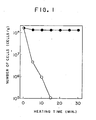
- Microbial cells were collected by centrifugation and suspended in sterilized water. 10 ml of the suspension in a test tube were heated in a water bath at 80°C for 30 minutes. Each sample collected every 5 min. was diluted with water and spread on the heart infusion agar plate to count number of viable cells.
- Fig. 1 Sporulated cells of Bacillus badius MA001 were very stable under heating at 80°C.
- Fig. 1 sporulated cells, ⁇ : non-sporulated cells. No difference on deodorizing effect was observed.
- Yeast extract 2 g sodium chloride 5 g, propionic acid 1 ml. n-butyric acid 1 ml, iso-valeric acid 1 ml, n-valeric acid 1 ml, ammonium phosphate 2 g. indol 10 mg and trimethylamine 1 ml were dissolved in 1000 ml of purified water and adjusted to pH 7.5 to prepare a liquid medium.
- the liquid medium 100 ml was dividedly set in 500 ml culture flask, sealed with cotton plug and autoclaved at 121 °C for 20 minutes.
- Bacillus badius MA001 of the present invention and Bacillus badius IAM 11059, each one loopful, were inoculated and cultured at 37°C for 36 hours in 150 rpm.
- Ammonium ion in the medium cultured for 36 hours was measured.
- the ammonium ion in the cultured mass was detected by adding Nessler reagent by the same way as described in Example 1.
- the 10-fold dilution of cultured mass of type culture Bacillus badius IAM 11059 became turbid with red brownish color to indicate existence of high concentration of ammonium ion.
- the 10-fold dilution of cultured mass of Bacillus badius MA001 of the present invention showed light orange color which indicated existence of trace ammonium ion. Therefore, the strain Bacillus badius MA001 was shown as low ammonium producing strain having low productivity of ammonia in the medium at cultivation.
- Yeast extract 2g. sodium chloride 5g, propionic acid 1 ml, n-butyric acid 1 ml, iso-valeric acid 1 ml, n-valeric acid 1 ml, ammonium phosphate 2 g and scatole 10 mg were dissolved in 1000 ml of purified water and adjusted to pH 7.5 to prepare a liquid medium.
- the liquid medium 100 ml was dividedly set in 500 ml culture flask, sealed with cotton plug and autoclaved at 121°C for 20 minutes.
- Bacillus badius MA001 of the present invention and Bacillus badius IAM 11059, each one loopful, were inoculated and cultured at 37°C for 36 hours in 150 rpm.
- VanUrk reagent was added to the cultured mass 15 ml in test tube and colorimetrically measured at 578 nm after 10 minutes. Trace scatole was detected in the type culture strain Bacillus badius IAM 11059 as indicated by a slight pinkish color of VanUrk reagent. On the contrary no scatole was detected in Bacillus badius MA001 of the present invention. Odor of scatole in the cultured mass of Bacillus badius MA001 was inspected by sensory testing, and no odor of scatole was detected after cultivation.
- Fresh feces 100 g obtained from pigs, 10 weeks age. grown with normal rearing were set in a 500 ml glass beaker. Liquid cultured mass 5 ml of Bacillus badius MA001 cultured for 48 hours in the same way as described in Example 1 was added thereto and mixed well. Similar fresh feces of pigs 100 g were set in a 500 ml beaker, added sterilized water 5 ml thereto to prepare control group.
- Rats were bred at 22°C ( ⁇ 0.5°C) supplying ad libitum with water and pellet feed for rats (CE-2. Nihon Clea Co.) for 1 week and no abnormal appearance and behavior were observed.
- Three test groups consisting of 10 rats (SD rats: Nihon Clea Co., male, body weight 200 g at the introduction date) in one group in the cage were set up.
- Samples 2 ml hereinbelow defined were administered orally once a day for 3 weeks. Acute toxicity test observing mortality, growth, behavior and appearance was conducted.
- Test samples were as follows. Sample 1: cultured mass of Bacillus badius MA001 cultured by the same way as described in Example 1 ; Sample 2 : microbial cells of Bacillus badius MA001 cultured by the same way as described in Example 1 were collected and washed twice with sterilized physiological saline. Equivalent weight of the sterilized physiological saline was added to the wet cells to prepare 50% cell suspension; and Sample 3: control with sterilized physiological saline.
- Feeding was made in the first 2 weeks with standard feed for pigs (Nihon Formula Feed Co.. Test feed for pork pigs SDS No.4) and thereafter commercially available feed added with feed additives (Zenno Corp.).
- Feeds were administered ad libitum and were kept to remain at any times in feed box. Water was supplied ad libitum.
- powdered microbial cells of Bacillus badius MA001 prepared in the same way as described in Example 1, 10 6 cells/g of feed, were supplied.
- microbial cell powder in the test group was replaced by calcium carbonate.
- Odor in the piggery and below the slotted floor was evaluated once a week by 7 panelists according to the same method as described in Example 1. Results are shown in Table 11 (six grade odor grading expression) and Table 12 (nine grade pleasure-displeasure expression). Test group supplied with powdered composition of Bacillus badius MA001 of the present invention showed extreme decrease in offensive odor and unpleasant atmosphere as compared with the control group, and the effect was unchanged after changing the feeds.
- Odor concentration A method of quantification of odor. Number of dilutions at the point of not to feel odor when the odor is diluted with fresh air is defined as odor concentration. (Ed. supervison by Environmental Pollution Dept., Air Quality Bureau, Environment Agency "Terms and commentary on odor", published by Assoc. of Research Corp. for odor. March 31. 1990) Start Week 1 Week 2 Week 3 Control Rearing room 30 50 50 75 Slotted floor 75 125 200 200 Test Rearing room 30 20 4 2 Slotted floor 75 30 10 5
- Oral administration of powdered microbial cells of Bacillus badius MA001 with feed in pigs showed marked deodorizing effect for environmental odor in piggery.
- a model sample of garbage was prepared.
- Mixture of tofu (bean-curd) refuse 100 g at the tofu production, fine cut strips of onions 25 g, boiled fine noodles 25 g and minced pork 25 g was put in 2 lit. beaker, covered with aluminium foil and allow to stand at room temperature for 1 week.
- the putrefied garbage model with extremely offensive odor was pressed through gauze to remove water. 100 g thereof was put in 1 lit. beaker and mixed well with powdered microbial cells of Bacillus badius MA001 3 g prepared by the same method as described in Example 1. and incubated at 30°C. Positive aeration was made by mixing the content once a day.
- Compost was prepared using porcine feces 20 kg bred with the same conditions as described in Example 6 (microbial composition of the present invention was added). Sawdust was mixed with feces to adjust water content to 60 %, and fermented to prepare compost. Fully fermented compost was prepared within 30 - 35 days, whereas conventionally 6 months to 1 year are required.
- vegetative cells of Bacillus badius MA001 having deodorizing activity of the present invention vegetative cells having endospores or spores and cultured mass containing the same, on odor sources resulted in good growth by assimilating with odorous substances in the organic sewage to show and continue deodorizing effect. It is effective for deodorizing garbage can, toilet, feces and urine and putrefied feed from animal industries, feces and urine of pets, fish odor of fishing nets, air-filter, sewage water and sewage plants.
- Deodorant of the present invention can be applied for reducing odor by direct spread of the microbial cells or cultured mass on offensive odor sources, or by setting the immobilized microbial cells or cultured mass on the deodorizer filters and deodorizing devices.
- oral administration of feed added with deodorizing microorganisms of the present invention can reduce odor of the excretion of the animals, as well as being effective for offensive odor sources generated from feces and urine or putrefied feeds adhered to the barn, and liquid sewage drains, transportation route of feces and urine or treatment plant therefor.
- Feces and urine added with the present microorganism reduces generation of offensive odor such as ammonia in the manufacture of compost and are changed to odorless compost.
- Deodorant of the present invention has made it possible to provide a very effective and reliable countermeasure for the treatment of offensive odor in atmosphere of rearing animals and animal industries and sewage plants.
- the present invention also makes it possible to suppress animal odor or to prevent adhering odor to the products such as eggs and milk by improving rearing circumstances.
Landscapes
- Life Sciences & Earth Sciences (AREA)
- Chemical & Material Sciences (AREA)
- Engineering & Computer Science (AREA)
- Health & Medical Sciences (AREA)
- Biomedical Technology (AREA)
- Zoology (AREA)
- Polymers & Plastics (AREA)
- Microbiology (AREA)
- Biotechnology (AREA)
- General Health & Medical Sciences (AREA)
- Food Science & Technology (AREA)
- Biochemistry (AREA)
- Organic Chemistry (AREA)
- Molecular Biology (AREA)
- Wood Science & Technology (AREA)
- Environmental & Geological Engineering (AREA)
- Genetics & Genomics (AREA)
- Bioinformatics & Cheminformatics (AREA)
- Animal Husbandry (AREA)
- Oil, Petroleum & Natural Gas (AREA)
- General Chemical & Material Sciences (AREA)
- Animal Behavior & Ethology (AREA)
- Chemical Kinetics & Catalysis (AREA)
- Public Health (AREA)
- Veterinary Medicine (AREA)
- Medicinal Chemistry (AREA)
- Tropical Medicine & Parasitology (AREA)
- Virology (AREA)
- Epidemiology (AREA)
- Analytical Chemistry (AREA)
- Physiology (AREA)
- General Engineering & Computer Science (AREA)
- Birds (AREA)
- Micro-Organisms Or Cultivation Processes Thereof (AREA)
- Disinfection, Sterilisation Or Deodorisation Of Air (AREA)
- Treating Waste Gases (AREA)
Description
| Morphological findings | Bacillus badius IAM 11059 | MA001 |
| Form of cell | rod | rod |
| Length of cell (µm) | 4 ∼ 5 | 3 ∼ 6 |
| Diameter of cell (µm) | 0.8 ∼ 1.2 | 0.8 ∼ 1.2 |
| Spore | Sporulation | Sporulation |
| Swelling of sporangium | None | None |
| Shape of spore | Oval | Oval |
| Position of spore | Center or edge | Center or edge |
| (Note : Morphological observation in culture of aerobic condition at 37°C for 72 hours in Heart-infusion agar) |
| Medium | Bacillus badius IAM 11059 | MA001 |
| DHL agar | no growth | no growth |
| MacConkey agar | no growth | no growth |
| Bouillon agar | Colony; round, elevated convex, smooth to wavy periphery, smooth to rough surface, homogeneous to curly structure, | Colony; round, elevated, convex, smooth to wavy periphery, smooth to rough surface, homogeneous to curly structure, |
| Hardness; fatty, | Hardness; fatty, | |
| Color; pale yellowish white to pale yellow with non-transparent. Good growth in the medium | Color; pale yellowish white to pale yellow with non-transparent. Good growth in the medium | |
| Bouillon broth | No surface growth, yellowish white, homogeneous turbid growth | No surface growth, yellowish white, homogeneous turbid growth |
| Bouillon gelatin | Growth with dish type, slight liquefaction of gelatin | Growth with dish type, no liquefaction of gelatin |
| Litmus milk | ||
| : acid production | + | - |
| : lab | - | - |
| Blood agar (10% defibrinated blood heart-infusion agar) | ||
| rabbit | Good growth, no hemolysis | No growth |
| sheep | Good growth, no hemolysis | No growth |
| horse | Good growth, no hemolysis | Good growth, no hemolysis |
| Physiological findings | Bacillus badius IAM 11059 | MA001 |
| Gram | Positive | Positive |
| Mobility | + | + |
| OF test | ||
| : Glucose | No growth | No growth |
| : Glycerine | F | No growth |
| : Fructose | F | No growth |
| Aerobic growth | + | + |
| Microaerophilic growth | + | + |
| Anaerobic growth | - | - |
| Growth temperature | ||
| : 15 °C | + | + |
| : 25 °C | + | + |
| : 35 °C | + | + |
| : 45 °C | + | + |
| : 55 °C | - | - |
| Halotolerance | ||
| : 0 % | + | + |
| : 2 % | + | + |
| : 5 % | + | - |
| : 7 % | + | - |
| : 10 % | - | - |
| Growth pH | 6.0 ∼ 9. 1 | 6.0 ∼ 9. 1 |
| Physiological findings | Bacillus badius IAM 11059 | MA001 | |
| Gelatin decomposition | + | - | |
| Starch decomposition | - | - | |
| Casein decomposition | + | - | |
| Esculin decomposition | - | - | |
| Cellulose decomposition | - | - | |
| Tyrosine decomposition | + | - | |
| Hippuric acid decomposition | - | + | |
| Catalase production | + | + | |
| Oxydase production | + | + | |
| LV reaction | - | No growth | |
| Lipase production | - | - | |
| DNase production | + | + | |
| Urease production ( C ) | - | - | |
| Indole production | - | - | |
| VP test : pH 6.5 | - | - | |
| VP test : pH 7.5 | - | - | |
| Pigment production | + | - | |
| Nitrate | ( N ) | - | - |
| ( NO 2 ) | - | - | |
| ( NO 3 ) | - | - | |
| Utilization : citrate ( S ) | - | - | |
| citrate (C) | - | + | |
| Utilization : malonic acid | + | + | |
| Utilization : acetic acid (pH 6.8) | - | - | |
| Coagulation test of milk | + | - | |
| Purple milk | violet, transparent | violet, turbid | |
| Protein digestion test | + black | - | |
| GC content ( HPLC ) | 44 % | 38 % | |
| Ref : Urease production ( C ); Christensen (1946) : J. Bcteriol., 52 : 461, Citrate ( S ); Simmons (1926) : J. Infect. Dis., 29 : 209, Citrate ( C ); Christensen (1949) : Research Bulletin, Greeley, Colo., Weld. County Health Dep., 1 : 3, |
| Physiological findings | Bacillus badius IAM 11059 | MA001 |
| Acid production | ||
| L-Arabinose | - | - |
| D-Fructose | + | - |
| D-Galactose | - | - |
| D-Glucose | - | - |
| Glycerin | + | - |
| Inositole | - | - |
| Lactose | - | - |
| Maltose | - | - |
| D-Mannose | - | - |
| Sorbitol | - | - |
| S. Starch | - | - |
| Sucrose | - | - |
| Trehalose | - | - |
| D-Xylose | - | - |
| Gas formation | ||
| L-Arabinose | - | - |
| D-Fructose | - | - |
| D-Galactose | - | - |
| D-Glucose | - | - |
| Glycerin | - | - |
| Inositole | - | - |
| Lactose | - | - |
| Maltose | - | - |
| D-Mannose | - | - |
| Sorbitol | - | - |
| S. Starch | - | - |
| Sucrose | - | - |
| Trehalose | - | - |
| D-Xylose | - | - |
- 0 :
- not odorous
- 1 :
- odor barely detectable
- 2 :
- weak detectable odor
- 3 :
- easily detectable odor
- 4 :
- strong odor
- 5 :
- intense odor
- -4 :
- intensive displeasure
- -3 :
- strong displeasure
- -2 :
- displeasure
- -1 :
- slight displeasure
- 0 :
- not so pleasure and not so displeasure
- +1 :
- slight pleasure
- +2 :
- pleasure
- +3 :
- strong pleasure
- +4 :
- intensive pleasure
| Test | Measuring time ( hour ) | ||||||
| 0 | 12 | 24 | 36 | 48 | 60 | 72 | |
| No addition | 4 | 5 | 5 | 5 | 5 | 4 | 4 |
| MA001 | 4 | 3 | 3 | 2 | 2 | 1 | 1 |
| IAM 11059 | 4 | 5 | 5 | 5 | 4 | 4 | 4 |
| Test | Measuring time ( hour ) | ||||||
| 0 | 12 | 24 | 36 | 48 | 60 | 72 | |
| No addition -3 | -3 | -3 | -3 | -4 | -4 | -4 | -4 |
| MA001 -3 | -3 | -3 | -2 | -2 | -1 | 0 | 0 |
| IAM 11059 -3 | -3 | -3 | -3 | -3 | -4 | -4 | -4 |
| Hour 0 | | | |
| Control | 5 | 5 | 5 |
| Test | 5 | 2 | 0 |
| Hour 0 | | | ||
| Control | propionic acid | 100 | 100 | 100 |
| n-butyric acid | 100 | 100 | 100 | |
| iso-valeric acid | 100 | 100 | 100 | |
| n-valeric acid | 100 | 100 | 100 | |
| Test | propionic acid | 100 | 86 | 16 |
| n-butyric acid | 100 | 56 | 9 | |
| iso-valeric acid | 100 | 22 | 20 | |
| n-valeric acid | 100 | 23 | 22 |
| Test | Day 0 | Day 1 | Day 2 | Day 3 |
| Control | 5 | 5 | 5 | 5 |
| MA001 | 5 | 3 | 2 | 2 |
| Day A | Day 5 | Day 6 | Day 7 | |
| Control | 4 | 4 | 5 | 5 |
| MA001 | 1 | 1 | 0 | 0 |
| Start | Week 1 | Week 2 | Week 3 | ||
| Control | Rearing room | 4 | 4 | 4 | 4 |
| Slotted floor | 4 | 4 | 5 | 5 | |
| Test | Rearing room | 4 | 2 | 1 | 1 |
| Slotted floor | 4 | 2 | 2 | 1 |
| Start | Week 1 | Week 2 | Week 3 | ||
| Control | Rearing room | -3 | -3 | -3 | -3 |
| Slotted floor | -3 | -4 | -4 | -4 | |
| Test | Rearing room | -3 | -1 | -1 | -1 |
| Slotted floor | -3 | -2 | -1 | -1 |
| Start | Week 1 | Week 2 | Week 3 | |||
| | Rearing room | 30 | 50 | 50 | 75 | |
| Slotted floor | 75 | 125 | 200 | 200 | ||
| | Rearing room | 30 | 20 | 4 | 2 | |
| Slotted floor | 75 | 30 | 10 | 5 |
Claims (17)
- A cultured microorganism of a Bacillus badius MA001 (FERM BP-4493) strain having deodorizing activity for odorous substance and sporogenic property.
- The microorganism according to claim 1 wherein odorous substance is one or above two odorous components selected from the group consisting of fatty acid of approximately 1-10 carbons, ammonia, indole, skatole and trimethylamine.
- The microorganism according to claim 1 wherein the microorganism has a property of low productivity of ammonia in the culture.
- The microorganism according to claim 1 wherein the cultured microorganism is spores thereof.
- The microorganism according to claim 1 wherein the microorganism is viable microbial cells.
- A microbial composition containing a cultured microorganism of a Bacillus badius MA001 (FERM BP-4493) strain having deodorizing activity for odorous substance and sporogenic property as the active ingredient.
- The microbial composition according to claim 6 wherein odorous substance is one or above two odorous components selected from the group consisting of fatty acid of approximately 1-10 carbons, ammonia, indole, skatole and trimethylamine.
- The microbial composition according to claim 6 wherein the microorganism has a property of low productivity of ammonia in the culture.
- The microbial composition according to claim 6 wherein the cultured microorganism is spores thereof.
- The microbial composition according to claim 6 wherein the cultured microorganism is viable microbial cells.
- The microbial composition according to claim 6 wherein the microbial composition is a deodorant composition.
- The microbial composition according to claim 6 wherein the microbial composition is the deodorant composition consisting of liquid, powder, granules, tablets, suspension or paste.
- The microbial composition according to claim 6 wherein the microbial composition is the deodorant composition consisting of feed preparation containing 1 × 10⁵ - 1 × 10¹⁰ microbial cells/g of the feed.
- The microbial composition according to claim 6 wherein the microbial composition is the preparation of deodorant composition for spread application which is spread 1 × 10⁵ - 1 × 10¹² microbial cells/100 g of offensive odor sources.
- A method of deodorizing offensive odor sources comprising treating offensive odor sources with a microbial composition containing a substantially pure cultured microorganism of a Bacillus badius MA001 (FERM BP-4493) strain having deodorizing activity for odorous substance and sporogenic property as the active ingredient.
- The method according to claim 15 wherein the offensive odor sources are feces and urine of animals and putrefied organic substances.
- The method of deodorizing offensive odor surces according to claim 15 wherein the treatments of offensive odor sources by the microbial composition are method of administering with mixing in feed or mixing directly with feces or putrefied organic substances.
Applications Claiming Priority (4)
| Application Number | Priority Date | Filing Date | Title |
|---|---|---|---|
| JP5312082A JP2810308B2 (en) | 1993-12-13 | 1993-12-13 | Deodorant containing microorganisms and their cells |
| JP31208293 | 1993-12-13 | ||
| JP312082/93 | 1993-12-13 | ||
| PCT/JP1994/002079 WO1995016769A1 (en) | 1993-12-13 | 1994-12-12 | Microorganism and deodorant containing cells thereof |
Publications (3)
| Publication Number | Publication Date |
|---|---|
| EP0732396A1 EP0732396A1 (en) | 1996-09-18 |
| EP0732396A4 EP0732396A4 (en) | 1997-05-07 |
| EP0732396B1 true EP0732396B1 (en) | 2003-10-29 |
Family
ID=18025024
Family Applications (1)
| Application Number | Title | Priority Date | Filing Date |
|---|---|---|---|
| EP95902939A Expired - Lifetime EP0732396B1 (en) | 1993-12-13 | 1994-12-12 | Microorganism and deodorant containing cells thereof |
Country Status (6)
| Country | Link |
|---|---|
| US (1) | US5811287A (en) |
| EP (1) | EP0732396B1 (en) |
| JP (1) | JP2810308B2 (en) |
| DE (1) | DE69433284T2 (en) |
| ES (1) | ES2204939T3 (en) |
| WO (1) | WO1995016769A1 (en) |
Families Citing this family (21)
| Publication number | Priority date | Publication date | Assignee | Title |
|---|---|---|---|---|
| US6068774A (en) * | 1997-03-17 | 2000-05-30 | Osprey Biotechnics, Inc. | Biological control of agricultural waste odor |
| EP2011579B1 (en) | 2006-03-31 | 2021-05-12 | Toyota Jidosha Kabushiki Kaisha | Method of treating biomass, compost, mulching material for livestock and agent for treating biomass |
| DE102006035287A1 (en) * | 2006-07-31 | 2008-02-07 | VTI Thüringer Verfahrenstechnisches Institut Saalfeld GmbH | Modified filter material for the purification of gases and exhaust air flow, comprises a mixture of fibrous substrate material and derivatization reagent, and mixture of auxiliary materials |
| US8383097B2 (en) | 2006-08-11 | 2013-02-26 | Novozymes Biologicals, Inc | Bacteria cultures and compositions comprising bacteria cultures |
| US7632493B2 (en) * | 2006-12-20 | 2009-12-15 | National Chung Hsing University | Method for preparing a composition containing Bacillus subtilis WG6-14 and related use |
| JP2010088302A (en) * | 2007-11-14 | 2010-04-22 | Shinjiro Kanazawa | Manufacturing method of odor-assimilating (decomposing) bacteria and compost, and utilization method thereof |
| FI20085371A0 (en) | 2008-04-25 | 2008-04-25 | Pellonpaja Oy | Process for the treatment and / or pretreatment of liquid manure or reject from biogasver for the elimination of pollutants, in particular nitrogen, phosphorus and odor molecules |
| JP5447348B2 (en) * | 2010-11-15 | 2014-03-19 | トヨタ自動車株式会社 | Deodorant containing microorganisms and their cells |
| KR102004375B1 (en) | 2011-02-15 | 2019-07-29 | 노보자임스 바이오로지컬스 인코포레이티드 | Mitigation of odor in cleaning machines and cleaning processes |
| CN102198284A (en) * | 2011-03-25 | 2011-09-28 | 江苏碧程环保设备有限公司 | Deodorant and preparation method thereof |
| CN102247611B (en) * | 2011-07-07 | 2013-10-02 | 贵州大学 | Microorganism deodorant and preparation method thereof |
| KR101515893B1 (en) | 2013-03-21 | 2015-05-04 | 엔비엠 주식회사 | A novel strain of bacillus methylotrophicus and a use of the same |
| CN103357056B (en) * | 2013-07-22 | 2016-03-23 | 上海绿博生物科技发展有限公司 | A kind of biological spray of health type removing abnormal flavour and preparation method thereof |
| US9974311B2 (en) | 2013-09-23 | 2018-05-22 | Stewart Group Trading Inc. | Impregnated odour control products and methods of making the same |
| EP2856896A1 (en) | 2013-09-23 | 2015-04-08 | Life Science TGO, SRL | Impregnated odour control products and methods of making the same |
| CN104841266B (en) * | 2014-09-03 | 2016-08-24 | 浙江神光大叶枸发展有限公司 | A kind of preparation method of the eliminating smell agent containing microorganism |
| JP6347430B2 (en) * | 2015-02-17 | 2018-06-27 | 正男 碇 | Microorganism having antibacterial ability and deodorizing ability, and antibacterial agent, deodorant, antibacterial method, and deodorizing method using the same |
| CN107400637B (en) * | 2017-02-24 | 2020-09-22 | 上海道多生物科技有限公司 | Bacillus coagulans and microbial preparation, preparation method and application thereof |
| CN108239614B (en) * | 2017-12-20 | 2020-12-04 | 华中农业大学 | A Bacillus strain for removing the odor of sheep manure and its application |
| CN111068505A (en) * | 2019-12-04 | 2020-04-28 | 陕西小葫芦生态科技有限公司 | Microbial deodorant and preparation method thereof |
| CN119709477B (en) * | 2024-11-18 | 2025-08-05 | 中国农业科学院农业资源与农业区划研究所 | A compost-promoting, phosphorus-dissolving and deodorizing bacterial agent as well as its preparation method and application |
Family Cites Families (4)
| Publication number | Priority date | Publication date | Assignee | Title |
|---|---|---|---|---|
| JPS60232086A (en) * | 1984-05-01 | 1985-11-18 | Yasuyuki Hayano | Method for deodorizing and drying organic waste |
| JPS6178352A (en) * | 1984-09-25 | 1986-04-21 | Tsubaki Toshio | Feed additive effective in preventing environmental pollution |
| JPH01144971A (en) * | 1987-12-01 | 1989-06-07 | Toyoaki Kubota | Useful microorganism |
| JP2719702B2 (en) * | 1988-08-15 | 1998-02-25 | 富山化学工業株式会社 | Microorganisms with Indole and Skatole Degradability and Microbial Degradation of Indole and Skatole |
-
1993
- 1993-12-13 JP JP5312082A patent/JP2810308B2/en not_active Expired - Fee Related
-
1994
- 1994-12-12 WO PCT/JP1994/002079 patent/WO1995016769A1/en not_active Ceased
- 1994-12-12 EP EP95902939A patent/EP0732396B1/en not_active Expired - Lifetime
- 1994-12-12 ES ES95902939T patent/ES2204939T3/en not_active Expired - Lifetime
- 1994-12-12 DE DE69433284T patent/DE69433284T2/en not_active Expired - Lifetime
- 1994-12-12 US US08/652,575 patent/US5811287A/en not_active Expired - Lifetime
Also Published As
| Publication number | Publication date |
|---|---|
| JPH07163336A (en) | 1995-06-27 |
| JP2810308B2 (en) | 1998-10-15 |
| US5811287A (en) | 1998-09-22 |
| DE69433284T2 (en) | 2004-08-19 |
| EP0732396A4 (en) | 1997-05-07 |
| ES2204939T3 (en) | 2004-05-01 |
| EP0732396A1 (en) | 1996-09-18 |
| DE69433284D1 (en) | 2003-12-04 |
| WO1995016769A1 (en) | 1995-06-22 |
Similar Documents
| Publication | Publication Date | Title |
|---|---|---|
| US5811287A (en) | Biologically pure Bacillus badius ferm BP-4493 having deodorizing activity | |
| He et al. | Microbial transformation of deoxynivalenol (vomitoxin) | |
| Dart | Microbiological aspects of pollution control | |
| KR101534891B1 (en) | Microorganism capable of reducing malodor and its uses | |
| KR101799750B1 (en) | Microbial agent for reducing ammonia odor and method for manufacturing the same | |
| Ohta et al. | Deodorization of pig feces by actinomycetes | |
| WO2013147426A1 (en) | Lactobacillus parafarraginis strain having functions of deodorization activity and purification of water in eel farm, and use thereof | |
| CN108902448A (en) | A kind of method of feces of livestock and poultry deodorization | |
| WO1999011756A1 (en) | Novel microorganism | |
| EP2640828B1 (en) | Microorganism and deodorizer containing the same | |
| CN109609394A (en) | A kind of deodorization fermentative microorganism microbial inoculum and the preparation method and application thereof | |
| JP2608524B2 (en) | Deodorants | |
| Mosier et al. | Odors and emissions from organic wastes | |
| JP2005130820A (en) | Live bacteria containing thermophilic bacteria | |
| CN106964253A (en) | A kind of toxic removing deodorization complex enzyme biological agent | |
| KR100426930B1 (en) | Novel Bacillus amyloliquefaciens B4 strain producing fermented swine feed utilizing food waste | |
| KR100293557B1 (en) | A Deodorizing Agent | |
| JP3122797B2 (en) | Manure odor generation suppressing or deodorizing agent and manure odor generation suppressing or deodorizing method | |
| KR20250057253A (en) | Method for manufacturing a microbial agent for reducing odor containing citrus juice and the microbial agent for reducing odor produced therefrom | |
| JP2005021010A (en) | Novel Bacillus strain and garbage treatment agent, garbage treatment method and apparatus using the same | |
| KR100403267B1 (en) | A novel microorganism Bacillus pumilus BS-019 absorbing dioxin and dioxin-like compounds and a biosorption method of the same | |
| Nagamine et al. | A comparison of features and the microbial constitution of the fresh feces of pigs fed diets supplemented with or without dietary microbes | |
| Biggart | Patentability in the United States of Microorganisms, Processes Utilizing Microoragnisms, Products Produced by Microorganisms and Microorganism Mutational and Genetic Modification Techniques | |
| Thom et al. | BIOLOGICAL SCIENCES | |
| CN119979418A (en) | A Pediococcus pentosaceus King33 for alleviating the odor of pet dog and cat feces, a bacterial agent and application thereof |
Legal Events
| Date | Code | Title | Description |
|---|---|---|---|
| PUAI | Public reference made under article 153(3) epc to a published international application that has entered the european phase |
Free format text: ORIGINAL CODE: 0009012 |
|
| 17P | Request for examination filed |
Effective date: 19960612 |
|
| AK | Designated contracting states |
Kind code of ref document: A1 Designated state(s): DE ES FR IT |
|
| A4 | Supplementary search report drawn up and despatched | ||
| AK | Designated contracting states |
Kind code of ref document: A4 Designated state(s): DE ES FR IT |
|
| 17Q | First examination report despatched |
Effective date: 19991229 |
|
| RAP1 | Party data changed (applicant data changed or rights of an application transferred) |
Owner name: ASAHI KASEI KABUSHIKI KAISHA |
|
| GRAH | Despatch of communication of intention to grant a patent |
Free format text: ORIGINAL CODE: EPIDOS IGRA |
|
| RIN1 | Information on inventor provided before grant (corrected) |
Inventor name: AOSHIMA, MUTSUMI |
|
| GRAS | Grant fee paid |
Free format text: ORIGINAL CODE: EPIDOSNIGR3 |
|
| GRAA | (expected) grant |
Free format text: ORIGINAL CODE: 0009210 |
|
| AK | Designated contracting states |
Kind code of ref document: B1 Designated state(s): DE ES FR IT |
|
| REF | Corresponds to: |
Ref document number: 69433284 Country of ref document: DE Date of ref document: 20031204 Kind code of ref document: P |
|
| REG | Reference to a national code |
Ref country code: ES Ref legal event code: FG2A Ref document number: 2204939 Country of ref document: ES Kind code of ref document: T3 |
|
| ET | Fr: translation filed | ||
| PLBE | No opposition filed within time limit |
Free format text: ORIGINAL CODE: 0009261 |
|
| STAA | Information on the status of an ep patent application or granted ep patent |
Free format text: STATUS: NO OPPOSITION FILED WITHIN TIME LIMIT |
|
| 26N | No opposition filed |
Effective date: 20040730 |
|
| REG | Reference to a national code |
Ref country code: FR Ref legal event code: TP |
|
| REG | Reference to a national code |
Ref country code: ES Ref legal event code: PC2A |
|
| PGFP | Annual fee paid to national office [announced via postgrant information from national office to epo] |
Ref country code: ES Payment date: 20091223 Year of fee payment: 16 |
|
| PGFP | Annual fee paid to national office [announced via postgrant information from national office to epo] |
Ref country code: IT Payment date: 20091223 Year of fee payment: 16 |
|
| PGFP | Annual fee paid to national office [announced via postgrant information from national office to epo] |
Ref country code: FR Payment date: 20100122 Year of fee payment: 16 |
|
| PGFP | Annual fee paid to national office [announced via postgrant information from national office to epo] |
Ref country code: DE Payment date: 20091216 Year of fee payment: 16 |
|
| REG | Reference to a national code |
Ref country code: FR Ref legal event code: ST Effective date: 20110831 |
|
| PG25 | Lapsed in a contracting state [announced via postgrant information from national office to epo] |
Ref country code: FR Free format text: LAPSE BECAUSE OF NON-PAYMENT OF DUE FEES Effective date: 20110103 |
|
| REG | Reference to a national code |
Ref country code: DE Ref legal event code: R119 Ref document number: 69433284 Country of ref document: DE Effective date: 20110701 |
|
| PG25 | Lapsed in a contracting state [announced via postgrant information from national office to epo] |
Ref country code: DE Free format text: LAPSE BECAUSE OF NON-PAYMENT OF DUE FEES Effective date: 20110701 |
|
| PG25 | Lapsed in a contracting state [announced via postgrant information from national office to epo] |
Ref country code: IT Free format text: LAPSE BECAUSE OF NON-PAYMENT OF DUE FEES Effective date: 20101212 |
|
| REG | Reference to a national code |
Ref country code: ES Ref legal event code: FD2A Effective date: 20120206 |
|
| PG25 | Lapsed in a contracting state [announced via postgrant information from national office to epo] |
Ref country code: ES Free format text: LAPSE BECAUSE OF NON-PAYMENT OF DUE FEES Effective date: 20101213 |