EP0727248B1 - Catalyst for purification of diesel engine exhaust gas - Google Patents
Catalyst for purification of diesel engine exhaust gas Download PDFInfo
- Publication number
- EP0727248B1 EP0727248B1 EP95102208A EP95102208A EP0727248B1 EP 0727248 B1 EP0727248 B1 EP 0727248B1 EP 95102208 A EP95102208 A EP 95102208A EP 95102208 A EP95102208 A EP 95102208A EP 0727248 B1 EP0727248 B1 EP 0727248B1
- Authority
- EP
- European Patent Office
- Prior art keywords
- range
- catalyst
- amount
- manganese
- iron
- Prior art date
- Legal status (The legal status is an assumption and is not a legal conclusion. Google has not performed a legal analysis and makes no representation as to the accuracy of the status listed.)
- Expired - Lifetime
Links
- 239000003054 catalyst Substances 0.000 title claims description 117
- 238000000746 purification Methods 0.000 title claims description 14
- KDLHZDBZIXYQEI-UHFFFAOYSA-N Palladium Chemical compound [Pd] KDLHZDBZIXYQEI-UHFFFAOYSA-N 0.000 claims description 72
- XEEYBQQBJWHFJM-UHFFFAOYSA-N Iron Chemical compound [Fe] XEEYBQQBJWHFJM-UHFFFAOYSA-N 0.000 claims description 63
- 229910052763 palladium Inorganic materials 0.000 claims description 32
- 229910052742 iron Inorganic materials 0.000 claims description 31
- 229910052809 inorganic oxide Inorganic materials 0.000 claims description 30
- 239000011572 manganese Substances 0.000 claims description 30
- 239000002245 particle Substances 0.000 claims description 30
- BASFCYQUMIYNBI-UHFFFAOYSA-N platinum Chemical compound [Pt] BASFCYQUMIYNBI-UHFFFAOYSA-N 0.000 claims description 30
- PWHULOQIROXLJO-UHFFFAOYSA-N Manganese Chemical compound [Mn] PWHULOQIROXLJO-UHFFFAOYSA-N 0.000 claims description 29
- 229910052748 manganese Inorganic materials 0.000 claims description 29
- 230000003197 catalytic effect Effects 0.000 claims description 26
- 229910052761 rare earth metal Inorganic materials 0.000 claims description 22
- RYGMFSIKBFXOCR-UHFFFAOYSA-N Copper Chemical compound [Cu] RYGMFSIKBFXOCR-UHFFFAOYSA-N 0.000 claims description 19
- 229910052802 copper Inorganic materials 0.000 claims description 19
- 239000010949 copper Substances 0.000 claims description 19
- 239000010948 rhodium Substances 0.000 claims description 17
- MHOVAHRLVXNVSD-UHFFFAOYSA-N rhodium atom Chemical compound [Rh] MHOVAHRLVXNVSD-UHFFFAOYSA-N 0.000 claims description 17
- 229910000510 noble metal Inorganic materials 0.000 claims description 16
- 229910052703 rhodium Inorganic materials 0.000 claims description 16
- 229910052697 platinum Inorganic materials 0.000 claims description 15
- 229910052751 metal Inorganic materials 0.000 claims description 14
- 239000002184 metal Substances 0.000 claims description 14
- 239000000919 ceramic Substances 0.000 claims description 10
- 239000002356 single layer Substances 0.000 claims description 6
- MCMNRKCIXSYSNV-UHFFFAOYSA-N Zirconium dioxide Chemical compound O=[Zr]=O MCMNRKCIXSYSNV-UHFFFAOYSA-N 0.000 description 89
- 239000000843 powder Substances 0.000 description 83
- AMWRITDGCCNYAT-UHFFFAOYSA-L hydroxy(oxo)manganese;manganese Chemical compound [Mn].O[Mn]=O.O[Mn]=O AMWRITDGCCNYAT-UHFFFAOYSA-L 0.000 description 58
- UQSXHKLRYXJYBZ-UHFFFAOYSA-N Iron oxide Chemical compound [Fe]=O UQSXHKLRYXJYBZ-UHFFFAOYSA-N 0.000 description 56
- GWEVSGVZZGPLCZ-UHFFFAOYSA-N Titan oxide Chemical compound O=[Ti]=O GWEVSGVZZGPLCZ-UHFFFAOYSA-N 0.000 description 50
- 239000002002 slurry Substances 0.000 description 48
- PNEYBMLMFCGWSK-UHFFFAOYSA-N aluminium oxide Inorganic materials [O-2].[O-2].[O-2].[Al+3].[Al+3] PNEYBMLMFCGWSK-UHFFFAOYSA-N 0.000 description 45
- 239000008367 deionised water Substances 0.000 description 35
- 229910021641 deionized water Inorganic materials 0.000 description 35
- XLYOFNOQVPJJNP-UHFFFAOYSA-N water Chemical compound O XLYOFNOQVPJJNP-UHFFFAOYSA-N 0.000 description 35
- 239000007864 aqueous solution Substances 0.000 description 31
- 238000000034 method Methods 0.000 description 22
- 230000015572 biosynthetic process Effects 0.000 description 21
- VYPSYNLAJGMNEJ-UHFFFAOYSA-N Silicium dioxide Chemical compound O=[Si]=O VYPSYNLAJGMNEJ-UHFFFAOYSA-N 0.000 description 20
- 239000000203 mixture Substances 0.000 description 20
- 239000000126 substance Substances 0.000 description 20
- QPLDLSVMHZLSFG-UHFFFAOYSA-N Copper oxide Chemical compound [Cu]=O QPLDLSVMHZLSFG-UHFFFAOYSA-N 0.000 description 18
- 239000005751 Copper oxide Substances 0.000 description 18
- RAHZWNYVWXNFOC-UHFFFAOYSA-N Sulphur dioxide Chemical compound O=S=O RAHZWNYVWXNFOC-UHFFFAOYSA-N 0.000 description 18
- 229910000431 copper oxide Inorganic materials 0.000 description 18
- 229910052878 cordierite Inorganic materials 0.000 description 12
- JSKIRARMQDRGJZ-UHFFFAOYSA-N dimagnesium dioxido-bis[(1-oxido-3-oxo-2,4,6,8,9-pentaoxa-1,3-disila-5,7-dialuminabicyclo[3.3.1]nonan-7-yl)oxy]silane Chemical compound [Mg++].[Mg++].[O-][Si]([O-])(O[Al]1O[Al]2O[Si](=O)O[Si]([O-])(O1)O2)O[Al]1O[Al]2O[Si](=O)O[Si]([O-])(O1)O2 JSKIRARMQDRGJZ-UHFFFAOYSA-N 0.000 description 12
- GPNDARIEYHPYAY-UHFFFAOYSA-N palladium(ii) nitrate Chemical compound [Pd+2].[O-][N+]([O-])=O.[O-][N+]([O-])=O GPNDARIEYHPYAY-UHFFFAOYSA-N 0.000 description 11
- XTVVROIMIGLXTD-UHFFFAOYSA-N copper(II) nitrate Chemical compound [Cu+2].[O-][N+]([O-])=O.[O-][N+]([O-])=O XTVVROIMIGLXTD-UHFFFAOYSA-N 0.000 description 10
- 239000000377 silicon dioxide Substances 0.000 description 10
- 230000000694 effects Effects 0.000 description 9
- 150000003467 sulfuric acid derivatives Chemical class 0.000 description 9
- 229930195733 hydrocarbon Natural products 0.000 description 8
- 150000002430 hydrocarbons Chemical class 0.000 description 8
- 238000005470 impregnation Methods 0.000 description 8
- MVFCKEFYUDZOCX-UHFFFAOYSA-N iron(2+);dinitrate Chemical compound [Fe+2].[O-][N+]([O-])=O.[O-][N+]([O-])=O MVFCKEFYUDZOCX-UHFFFAOYSA-N 0.000 description 7
- AKEJUJNQAAGONA-UHFFFAOYSA-N sulfur trioxide Chemical compound O=S(=O)=O AKEJUJNQAAGONA-UHFFFAOYSA-N 0.000 description 6
- 238000001354 calcination Methods 0.000 description 5
- 238000001035 drying Methods 0.000 description 5
- 239000000463 material Substances 0.000 description 5
- 150000002739 metals Chemical class 0.000 description 5
- 230000003647 oxidation Effects 0.000 description 5
- 238000007254 oxidation reaction Methods 0.000 description 5
- -1 platinum group metals Chemical class 0.000 description 5
- 239000010935 stainless steel Substances 0.000 description 5
- 229910001220 stainless steel Inorganic materials 0.000 description 5
- UGFAIRIUMAVXCW-UHFFFAOYSA-N Carbon monoxide Chemical compound [O+]#[C-] UGFAIRIUMAVXCW-UHFFFAOYSA-N 0.000 description 4
- NINIDFKCEFEMDL-UHFFFAOYSA-N Sulfur Chemical compound [S] NINIDFKCEFEMDL-UHFFFAOYSA-N 0.000 description 4
- 229910002091 carbon monoxide Inorganic materials 0.000 description 4
- 229910000420 cerium oxide Inorganic materials 0.000 description 4
- HSJPMRKMPBAUAU-UHFFFAOYSA-N cerium(3+);trinitrate Chemical compound [Ce+3].[O-][N+]([O-])=O.[O-][N+]([O-])=O.[O-][N+]([O-])=O HSJPMRKMPBAUAU-UHFFFAOYSA-N 0.000 description 4
- 239000011363 dried mixture Substances 0.000 description 4
- 239000000446 fuel Substances 0.000 description 4
- MRELNEQAGSRDBK-UHFFFAOYSA-N lanthanum(3+);oxygen(2-) Chemical compound [O-2].[O-2].[O-2].[La+3].[La+3] MRELNEQAGSRDBK-UHFFFAOYSA-N 0.000 description 4
- YIXJRHPUWRPCBB-UHFFFAOYSA-N magnesium nitrate Chemical compound [Mg+2].[O-][N+]([O-])=O.[O-][N+]([O-])=O YIXJRHPUWRPCBB-UHFFFAOYSA-N 0.000 description 4
- CPLXHLVBOLITMK-UHFFFAOYSA-N magnesium oxide Inorganic materials [Mg]=O CPLXHLVBOLITMK-UHFFFAOYSA-N 0.000 description 4
- 239000000395 magnesium oxide Substances 0.000 description 4
- AXZKOIWUVFPNLO-UHFFFAOYSA-N magnesium;oxygen(2-) Chemical compound [O-2].[Mg+2] AXZKOIWUVFPNLO-UHFFFAOYSA-N 0.000 description 4
- 229940071125 manganese acetate Drugs 0.000 description 4
- UOGMEBQRZBEZQT-UHFFFAOYSA-L manganese(2+);diacetate Chemical compound [Mn+2].CC([O-])=O.CC([O-])=O UOGMEBQRZBEZQT-UHFFFAOYSA-L 0.000 description 4
- MIVBAHRSNUNMPP-UHFFFAOYSA-N manganese(2+);dinitrate Chemical compound [Mn+2].[O-][N+]([O-])=O.[O-][N+]([O-])=O MIVBAHRSNUNMPP-UHFFFAOYSA-N 0.000 description 4
- 150000002823 nitrates Chemical class 0.000 description 4
- BMMGVYCKOGBVEV-UHFFFAOYSA-N oxo(oxoceriooxy)cerium Chemical compound [Ce]=O.O=[Ce]=O BMMGVYCKOGBVEV-UHFFFAOYSA-N 0.000 description 4
- 229910003445 palladium oxide Inorganic materials 0.000 description 4
- 239000007858 starting material Substances 0.000 description 4
- 239000011593 sulfur Substances 0.000 description 4
- 229910052717 sulfur Inorganic materials 0.000 description 4
- YMWUJEATGCHHMB-UHFFFAOYSA-N Dichloromethane Chemical compound ClCCl YMWUJEATGCHHMB-UHFFFAOYSA-N 0.000 description 3
- 150000001242 acetic acid derivatives Chemical class 0.000 description 3
- 239000002253 acid Substances 0.000 description 3
- 150000004649 carbonic acid derivatives Chemical class 0.000 description 3
- 238000002485 combustion reaction Methods 0.000 description 3
- 150000001875 compounds Chemical class 0.000 description 3
- 238000000151 deposition Methods 0.000 description 3
- 150000004679 hydroxides Chemical class 0.000 description 3
- 238000002347 injection Methods 0.000 description 3
- 239000007924 injection Substances 0.000 description 3
- WPBNNNQJVZRUHP-UHFFFAOYSA-L manganese(2+);methyl n-[[2-(methoxycarbonylcarbamothioylamino)phenyl]carbamothioyl]carbamate;n-[2-(sulfidocarbothioylamino)ethyl]carbamodithioate Chemical compound [Mn+2].[S-]C(=S)NCCNC([S-])=S.COC(=O)NC(=S)NC1=CC=CC=C1NC(=S)NC(=O)OC WPBNNNQJVZRUHP-UHFFFAOYSA-L 0.000 description 3
- VXNYVYJABGOSBX-UHFFFAOYSA-N rhodium(3+);trinitrate Chemical compound [Rh+3].[O-][N+]([O-])=O.[O-][N+]([O-])=O.[O-][N+]([O-])=O VXNYVYJABGOSBX-UHFFFAOYSA-N 0.000 description 3
- 239000000243 solution Substances 0.000 description 3
- 238000003756 stirring Methods 0.000 description 3
- 229910021380 Manganese Chloride Inorganic materials 0.000 description 2
- GLFNIEUTAYBVOC-UHFFFAOYSA-L Manganese chloride Chemical compound Cl[Mn]Cl GLFNIEUTAYBVOC-UHFFFAOYSA-L 0.000 description 2
- 229910052783 alkali metal Inorganic materials 0.000 description 2
- 150000001340 alkali metals Chemical class 0.000 description 2
- ZCCIPPOKBCJFDN-UHFFFAOYSA-N calcium nitrate Chemical compound [Ca+2].[O-][N+]([O-])=O.[O-][N+]([O-])=O ZCCIPPOKBCJFDN-UHFFFAOYSA-N 0.000 description 2
- 239000000969 carrier Substances 0.000 description 2
- PHFQLYPOURZARY-UHFFFAOYSA-N chromium trinitrate Chemical compound [Cr+3].[O-][N+]([O-])=O.[O-][N+]([O-])=O.[O-][N+]([O-])=O PHFQLYPOURZARY-UHFFFAOYSA-N 0.000 description 2
- 229910000365 copper sulfate Inorganic materials 0.000 description 2
- ARUVKPQLZAKDPS-UHFFFAOYSA-L copper(II) sulfate Chemical compound [Cu+2].[O-][S+2]([O-])([O-])[O-] ARUVKPQLZAKDPS-UHFFFAOYSA-L 0.000 description 2
- 229910052593 corundum Inorganic materials 0.000 description 2
- 230000003247 decreasing effect Effects 0.000 description 2
- 230000002950 deficient Effects 0.000 description 2
- 230000008021 deposition Effects 0.000 description 2
- 238000010790 dilution Methods 0.000 description 2
- 239000012895 dilution Substances 0.000 description 2
- 230000007613 environmental effect Effects 0.000 description 2
- 239000006260 foam Substances 0.000 description 2
- 150000003840 hydrochlorides Chemical class 0.000 description 2
- FBAFATDZDUQKNH-UHFFFAOYSA-M iron chloride Chemical compound [Cl-].[Fe] FBAFATDZDUQKNH-UHFFFAOYSA-M 0.000 description 2
- 239000007788 liquid Substances 0.000 description 2
- 239000011565 manganese chloride Substances 0.000 description 2
- 229940099607 manganese chloride Drugs 0.000 description 2
- 235000002867 manganese chloride Nutrition 0.000 description 2
- 239000006262 metallic foam Substances 0.000 description 2
- 239000007787 solid Substances 0.000 description 2
- 229910001845 yogo sapphire Inorganic materials 0.000 description 2
- 229910000505 Al2TiO5 Inorganic materials 0.000 description 1
- 239000004215 Carbon black (E152) Substances 0.000 description 1
- 229910002060 Fe-Cr-Al alloy Inorganic materials 0.000 description 1
- ZOKXTWBITQBERF-UHFFFAOYSA-N Molybdenum Chemical compound [Mo] ZOKXTWBITQBERF-UHFFFAOYSA-N 0.000 description 1
- QAOWNCQODCNURD-UHFFFAOYSA-L Sulfate Chemical compound [O-]S([O-])(=O)=O QAOWNCQODCNURD-UHFFFAOYSA-L 0.000 description 1
- WGLPBDUCMAPZCE-UHFFFAOYSA-N Trioxochromium Chemical compound O=[Cr](=O)=O WGLPBDUCMAPZCE-UHFFFAOYSA-N 0.000 description 1
- HCHKCACWOHOZIP-UHFFFAOYSA-N Zinc Chemical compound [Zn] HCHKCACWOHOZIP-UHFFFAOYSA-N 0.000 description 1
- MQRWBMAEBQOWAF-UHFFFAOYSA-N acetic acid;nickel Chemical compound [Ni].CC(O)=O.CC(O)=O MQRWBMAEBQOWAF-UHFFFAOYSA-N 0.000 description 1
- 229910052784 alkaline earth metal Inorganic materials 0.000 description 1
- 150000001342 alkaline earth metals Chemical class 0.000 description 1
- 229910000323 aluminium silicate Inorganic materials 0.000 description 1
- HEHRHMRHPUNLIR-UHFFFAOYSA-N aluminum;hydroxy-[hydroxy(oxo)silyl]oxy-oxosilane;lithium Chemical compound [Li].[Al].O[Si](=O)O[Si](O)=O.O[Si](=O)O[Si](O)=O HEHRHMRHPUNLIR-UHFFFAOYSA-N 0.000 description 1
- 230000033228 biological regulation Effects 0.000 description 1
- BRPQOXSCLDDYGP-UHFFFAOYSA-N calcium oxide Chemical compound [O-2].[Ca+2] BRPQOXSCLDDYGP-UHFFFAOYSA-N 0.000 description 1
- ODINCKMPIJJUCX-UHFFFAOYSA-N calcium oxide Inorganic materials [Ca]=O ODINCKMPIJJUCX-UHFFFAOYSA-N 0.000 description 1
- 239000000292 calcium oxide Substances 0.000 description 1
- 230000000711 cancerogenic effect Effects 0.000 description 1
- 231100000315 carcinogenic Toxicity 0.000 description 1
- 238000006243 chemical reaction Methods 0.000 description 1
- 229910000423 chromium oxide Inorganic materials 0.000 description 1
- UFMZWBIQTDUYBN-UHFFFAOYSA-N cobalt dinitrate Chemical compound [Co+2].[O-][N+]([O-])=O.[O-][N+]([O-])=O UFMZWBIQTDUYBN-UHFFFAOYSA-N 0.000 description 1
- 229910001981 cobalt nitrate Inorganic materials 0.000 description 1
- 229910000428 cobalt oxide Inorganic materials 0.000 description 1
- IVMYJDGYRUAWML-UHFFFAOYSA-N cobalt(ii) oxide Chemical compound [Co]=O IVMYJDGYRUAWML-UHFFFAOYSA-N 0.000 description 1
- 229910052681 coesite Inorganic materials 0.000 description 1
- ORTQZVOHEJQUHG-UHFFFAOYSA-L copper(II) chloride Chemical compound Cl[Cu]Cl ORTQZVOHEJQUHG-UHFFFAOYSA-L 0.000 description 1
- OPQARKPSCNTWTJ-UHFFFAOYSA-L copper(ii) acetate Chemical compound [Cu+2].CC([O-])=O.CC([O-])=O OPQARKPSCNTWTJ-UHFFFAOYSA-L 0.000 description 1
- 229910052906 cristobalite Inorganic materials 0.000 description 1
- 230000007423 decrease Effects 0.000 description 1
- 230000007812 deficiency Effects 0.000 description 1
- KZHJGOXRZJKJNY-UHFFFAOYSA-N dioxosilane;oxo(oxoalumanyloxy)alumane Chemical compound O=[Si]=O.O=[Si]=O.O=[Al]O[Al]=O.O=[Al]O[Al]=O.O=[Al]O[Al]=O KZHJGOXRZJKJNY-UHFFFAOYSA-N 0.000 description 1
- HNPSIPDUKPIQMN-UHFFFAOYSA-N dioxosilane;oxo(oxoalumanyloxy)alumane Chemical compound O=[Si]=O.O=[Al]O[Al]=O HNPSIPDUKPIQMN-UHFFFAOYSA-N 0.000 description 1
- 238000011156 evaluation Methods 0.000 description 1
- 238000000605 extraction Methods 0.000 description 1
- 238000010438 heat treatment Methods 0.000 description 1
- 238000010348 incorporation Methods 0.000 description 1
- RUTXIHLAWFEWGM-UHFFFAOYSA-H iron(3+) sulfate Chemical compound [Fe+3].[Fe+3].[O-]S([O-])(=O)=O.[O-]S([O-])(=O)=O.[O-]S([O-])(=O)=O RUTXIHLAWFEWGM-UHFFFAOYSA-H 0.000 description 1
- JEIPFZHSYJVQDO-UHFFFAOYSA-N iron(III) oxide Inorganic materials O=[Fe]O[Fe]=O JEIPFZHSYJVQDO-UHFFFAOYSA-N 0.000 description 1
- 229910000360 iron(III) sulfate Inorganic materials 0.000 description 1
- 229910052746 lanthanum Inorganic materials 0.000 description 1
- FZLIPJUXYLNCLC-UHFFFAOYSA-N lanthanum atom Chemical compound [La] FZLIPJUXYLNCLC-UHFFFAOYSA-N 0.000 description 1
- HCWCAKKEBCNQJP-UHFFFAOYSA-N magnesium orthosilicate Chemical compound [Mg+2].[Mg+2].[O-][Si]([O-])([O-])[O-] HCWCAKKEBCNQJP-UHFFFAOYSA-N 0.000 description 1
- 239000000391 magnesium silicate Substances 0.000 description 1
- 229910052919 magnesium silicate Inorganic materials 0.000 description 1
- 235000019792 magnesium silicate Nutrition 0.000 description 1
- 150000004706 metal oxides Chemical class 0.000 description 1
- 239000003595 mist Substances 0.000 description 1
- 238000002156 mixing Methods 0.000 description 1
- 229910052750 molybdenum Inorganic materials 0.000 description 1
- 239000011733 molybdenum Substances 0.000 description 1
- 229910052863 mullite Inorganic materials 0.000 description 1
- 229940078494 nickel acetate Drugs 0.000 description 1
- 229910000480 nickel oxide Inorganic materials 0.000 description 1
- GNRSAWUEBMWBQH-UHFFFAOYSA-N oxonickel Chemical compound [Ni]=O GNRSAWUEBMWBQH-UHFFFAOYSA-N 0.000 description 1
- 229910052670 petalite Inorganic materials 0.000 description 1
- AABBHSMFGKYLKE-SNAWJCMRSA-N propan-2-yl (e)-but-2-enoate Chemical compound C\C=C\C(=O)OC(C)C AABBHSMFGKYLKE-SNAWJCMRSA-N 0.000 description 1
- 238000010298 pulverizing process Methods 0.000 description 1
- 230000029058 respiratory gaseous exchange Effects 0.000 description 1
- 229910003450 rhodium oxide Inorganic materials 0.000 description 1
- 229910052682 stishovite Inorganic materials 0.000 description 1
- 230000001629 suppression Effects 0.000 description 1
- JUWGUJSXVOBPHP-UHFFFAOYSA-B titanium(4+);tetraphosphate Chemical compound [Ti+4].[Ti+4].[Ti+4].[O-]P([O-])([O-])=O.[O-]P([O-])([O-])=O.[O-]P([O-])([O-])=O.[O-]P([O-])([O-])=O JUWGUJSXVOBPHP-UHFFFAOYSA-B 0.000 description 1
- 229910052905 tridymite Inorganic materials 0.000 description 1
- 229910052720 vanadium Inorganic materials 0.000 description 1
- GPPXJZIENCGNKB-UHFFFAOYSA-N vanadium Chemical compound [V]#[V] GPPXJZIENCGNKB-UHFFFAOYSA-N 0.000 description 1
- 239000010457 zeolite Substances 0.000 description 1
- 229910052725 zinc Inorganic materials 0.000 description 1
- 239000011701 zinc Substances 0.000 description 1
Classifications
-
- B—PERFORMING OPERATIONS; TRANSPORTING
- B01—PHYSICAL OR CHEMICAL PROCESSES OR APPARATUS IN GENERAL
- B01D—SEPARATION
- B01D53/00—Separation of gases or vapours; Recovering vapours of volatile solvents from gases; Chemical or biological purification of waste gases, e.g. engine exhaust gases, smoke, fumes, flue gases, aerosols
- B01D53/34—Chemical or biological purification of waste gases
- B01D53/92—Chemical or biological purification of waste gases of engine exhaust gases
- B01D53/94—Chemical or biological purification of waste gases of engine exhaust gases by catalytic processes
- B01D53/944—Simultaneously removing carbon monoxide, hydrocarbons or carbon making use of oxidation catalysts
-
- B—PERFORMING OPERATIONS; TRANSPORTING
- B01—PHYSICAL OR CHEMICAL PROCESSES OR APPARATUS IN GENERAL
- B01J—CHEMICAL OR PHYSICAL PROCESSES, e.g. CATALYSIS OR COLLOID CHEMISTRY; THEIR RELEVANT APPARATUS
- B01J23/00—Catalysts comprising metals or metal oxides or hydroxides, not provided for in group B01J21/00
- B01J23/70—Catalysts comprising metals or metal oxides or hydroxides, not provided for in group B01J21/00 of the iron group metals or copper
- B01J23/89—Catalysts comprising metals or metal oxides or hydroxides, not provided for in group B01J21/00 of the iron group metals or copper combined with noble metals
- B01J23/8933—Catalysts comprising metals or metal oxides or hydroxides, not provided for in group B01J21/00 of the iron group metals or copper combined with noble metals also combined with metals, or metal oxides or hydroxides provided for in groups B01J23/02 - B01J23/36
- B01J23/8986—Catalysts comprising metals or metal oxides or hydroxides, not provided for in group B01J21/00 of the iron group metals or copper combined with noble metals also combined with metals, or metal oxides or hydroxides provided for in groups B01J23/02 - B01J23/36 with manganese, technetium or rhenium
-
- B—PERFORMING OPERATIONS; TRANSPORTING
- B01—PHYSICAL OR CHEMICAL PROCESSES OR APPARATUS IN GENERAL
- B01J—CHEMICAL OR PHYSICAL PROCESSES, e.g. CATALYSIS OR COLLOID CHEMISTRY; THEIR RELEVANT APPARATUS
- B01J37/00—Processes, in general, for preparing catalysts; Processes, in general, for activation of catalysts
- B01J37/02—Impregnation, coating or precipitation
- B01J37/024—Multiple impregnation or coating
- B01J37/0248—Coatings comprising impregnated particles
-
- Y—GENERAL TAGGING OF NEW TECHNOLOGICAL DEVELOPMENTS; GENERAL TAGGING OF CROSS-SECTIONAL TECHNOLOGIES SPANNING OVER SEVERAL SECTIONS OF THE IPC; TECHNICAL SUBJECTS COVERED BY FORMER USPC CROSS-REFERENCE ART COLLECTIONS [XRACs] AND DIGESTS
- Y02—TECHNOLOGIES OR APPLICATIONS FOR MITIGATION OR ADAPTATION AGAINST CLIMATE CHANGE
- Y02A—TECHNOLOGIES FOR ADAPTATION TO CLIMATE CHANGE
- Y02A50/00—TECHNOLOGIES FOR ADAPTATION TO CLIMATE CHANGE in human health protection, e.g. against extreme weather
- Y02A50/20—Air quality improvement or preservation, e.g. vehicle emission control or emission reduction by using catalytic converters
Definitions
- This invention relates to a catalyst for purification of diesel engine exhaust gas. More particularly, it relates to a catalyst which can purify the diesel engine exhaust gas of such harmful components as carbonaceous particulates, unburned hydrocarbons, and carbon monoxide by combustion from a low temperature upward and moreover suppress the formation of sulfate from sulfur dioxide.
- microfine substances mainly comprising solid carbonaceous particulates, sulfur type particulates such as of sulfates, and liquid or solid polymeric hydrocarbon particulates; hereinafter referred to collectively as "microfine substances" particularly in the diesel engine exhaust gas have been posing a problem from the viewpoint of environmental hygiene.
- the reason for this problem is that virtually all these microfine substances have diameters of not more than 1 ⁇ m and, therefore, are liable to be suspended in the open air and taken into human bodies by respiration.
- studies are now under way in the direction of increasingly exacting the regulations concerning the discharge of such microfine substances from diesel engines.
- a catalyst obtained by depositing a catalytic substance capable of burning carbonaceous particulates on such a refractory three-dimensional structure as, for example, a ceramic foam, a wire mesh, a metallic foam, a pore-sealed type ceramic honeycomb, an open flow type ceramic honeycomb, or a metallic honeycomb and under
- the catalyst for the purification of the diesel engine exhaust gas is desired to possess the qualities of (A) permitting highly efficient removal of harmful components including unburned hydrocarbons and carbon monoxide in addition to carbonaceous particulates from a low temperature upward, (B) avoiding obvious oxidation of sulfur dioxide (SO 2 ) arising from sulfur components copiously contained in gas oil as the fuel into sulfur trioxide (SO 3 ) and suppressing the formation of sulfates (such products of oxidation of sulfur dioxide as sulfur trioxide and sulfur mist), and (C) tolerating continuous service under high load, namely manifesting the so-called high durability to resist high temperature.
- SO 2 sulfur dioxide
- SO 3 sulfur trioxide
- sulfates such products of oxidation of sulfur dioxide as sulfur trioxide and sulfur mist
- EP-A-0092023 discloses a catalytic composition combining at least one member selected from the group consisting of copper, alkali metals, molybdenum, and vanadium with at least one member selected from the group consisting of platinum, rhodium, and palladium.
- the conventional catalysts mentioned above are invariably effective to a certain extent in removing carbonaceous particulates by combustion or removing SOF.
- those which contain platinum group metals manifest a great ability to oxidize sulfur dioxide under the conditions of discharge of gas at high temperatures and form sulfates in a notably large amount and, therefore, are at a disadvantage in entailing an environmental problem anew because of these sulfates.
- a catalyst which is fully endowed with the aforementioned qualities of (A) to (C) required for the catalytic purification of the diesel engine exhaust gas and further vested with an ample ability to remove SOF has not yet been developed.
- An object of this invention is to provide a catalyst for purification of diesel engine exhaust gas which permits highly efficient removal of microfine substances in the diesel engine exhaust gas.
- a further object of this invention is to provide a catalyst for purification of diesel engine exhaust gas which possesses an ability to remove such harmful components as unburned hydrocarbons and carbon monoxide in addition to carbonaceous particulates in the diesel engine exhaust gas by combustion from a low temperature upward and, moreover, avoids obvious oxidation of sulfur dioxide and suppresses the formation of sulfates.
- Another object of this invention is to provide a catalyst for purification of diesel engine exhaust gas which permits highly efficient removal of SOF in the diesel engine exhaust gas.
- Yet another object of this invention is to provide a catalyst for purification of diesel engine exhaust gas which manifests an ideal ability to resist high temperatures and operates effectively as mounted on a diesel car without entailing any practical problem.
- a catalyst for purification of diesel engine exhaust gas which comprises having (A) a first catalytic component comprising the two elements of iron and manganese and a refractory inorganic oxide and (B) a second catalytic component comprising at least one noble metal selected from the group consisting of palladium, platinum, and rhodium and a refractory inorganic oxide deposited in the form of a single layer on a refractory three-dimensional structure, wherein the total amount of said two elements of iron and manganese is in the range of from 0,5 to 60 g, wherein the amount of at least one noble metal is in the range of from 0,001 to 6 g, and wherein the total amount of said refractory inorganic oxide is in the range of from 1 to 300 g per liter of said three-dimensional structure.
- This invention further concerns the catalyst mentioned above, wherein a total amount of the two elements of iron and manganese deposited is in the range of from 0.5 to 50 g per liter of the three-dimensional strcture and a molar ratio of iron to manganese is in the range of from 10 : 1 to 1 : 10.
- said catalyst for purification of diesel engine exhaust gas which comprises having (A) a first catalytic component comprising the two elements of iron and manganese, a refractory inorganic oxide, and an alkaline earth element and/or a rare earth element and (B) a second catalytic component comprising at least one noble metal selected from the group consisting of palladium, platinum, and rhodium and a refractory inorganic oxide deposited in the form of a single layer on a refractory three-dimensional structure.
- This invention further concerns the catalyst mentioned above, wherein a total amount of the two elements of iron and manganese deposited is in the range of from 0.5 to 50 g, an amount of the alkaline earth element in the range of from 0 to 20 g, and an amount of the rare earth element in the range of from 0 to 30 g per liter of the three-dimensional structure, wherein a total amount of the alkaline earth element and the rare earth element is beyond 0g, and a molar ratio of iron to manganese is in the range of from 10 : 1 to 1 : 10.
- This invention further concerns the catalyst mentioned above, wherein an amount of the alkaline earth element per liter of the three-dimentional structure carried is in the range of from 0.1 to 10 g and the amount of the rare earth element per liter of the three-dimentional structure is in the range of from 0.1 to 10 g.
- said catalyst for purification of diesel engine exhaust gas which comprises having (A) a first catalytic component comprising the two elements of iron and manganese and a refractory inorganic oxide and (B) a second catalytic component comprising at least one noble metal selected from the group consisting of palladium, platinum, rhodium, and copper, and a refractory inorganic oxide deposited in the form of a single layer on a refractory three-dimensional structure.
- This invention further concerns the catalyst mentioned above, wherein a total amount of the two elements of iron and manganese deposited is in the range of from 0.5 to 50 g, and an amount of copper in the range of from 0.01 to 10 g and the molar ratio of iron to manganese is in the range of from 10 : 1 to 1 : 10.
- This invention further concerns the catalyst mentioned above, wherein an amount of copper per liter of the three-dimentional structure is in the range of from 0.1 to 3 g.
- said catalyst for purification of diesel engine exhaust gas which comprises having (A) a first catalytic component comprising the two elements of iron and manganese, a refractory inorganic oxide, and an alkaline earth element and/or a rare earth element and (B) a second catalytic component comprising at least one noble metal selected from the group consisting of palladium, platinum, rhodium, and copper, and a refractory inorganic oxide deposited in the form of a single layer on a refractory three-dimensional structure.
- This invention further concerns the catalyst mentioned above, wherein a total amount of the two elements of iron and manganese deposited is in the range of from 0.5 to 50 g, an amount of the alkaline earth element in the range of from 0 to 20 g, an amount of the rare earth element in the range of from 0 to 30 g, wherein a total amount of the alkaline earth element and the rare earth element is beyond 0g, and an amount of copper is in the range of 0.01 to 10g per liter of the three-dimensional structure and the molar ratio of iron to manganese is in the range of from 10 : 1 to 1 : 10.
- This invention further concerns the catalyst mentioned above, wherein the refractory inorganic oxide has an average particle diameter in the range of from 0.1 to 5 ⁇ m and a BET surface area in the range of from 1 to 200 m 2 /g.
- This invention further concerns the catalyst mentioned above, wherein a total amount of iron and manganese is in the range of from 0.1 to 98% by weight and an amount of the noble metal in the range of from 0.0003 to 80% by weight, based on the amount of the refractory inorganic oxide.
- This invention further concerns the catalyst mentioned above, wherein the three-dimensional structure is an open flow type ceramic honeycomb or metal honeycomb carrier.
- This invention further concerns the catalyst mentioned above, wherein an amount of the alkaline earth element per liter of the three-dimentional structure is in the range of from 0.1 to 10 g and an amount of the rare earth element per liter of the three-dimentional structure in the range of from 0.1 to 10 g.
- This invention further concerns the catalyst mentioned above, wherein an amount of copper per liter of the three-dimentional structure is in the range of 0.1 to 3g.
- the catalyst of this invention excels in ability to remove such harmful components as unburned hydrocarbons and carbon monoxide in addition to carbonaceous particulates and, because of deficiency in ability to oxidize sulfur dioxide in a high temperature range, permits suppression of the formation of sulfates.
- the catalyst of this invention therefore, functions excellently in decreasing the amount of microfine substances in the diesel engine exhaust gas.
- the diesel engine exhaust gas can be purified with high efficiency.
- the catalyst of this invention excels in ability to remove SOF, the purification of the diesel engine exhaust gas is attained with extremely high effectiveness.
- the catalyst of this invention further excels in durability to resist high temperatures, it can be operated effectively as mounted on a diesel car without entailing any practical problem.
- the catalyst of this invention therefore, possesses an ability to purify diesel engine exhaust gas by removing SOF and unburned hydrocarbons from a low temperature onward and manifests an excellent quality of suppressing the ratio of oxidation of sulfur dioxide to below 4% even at elevated temperatures up to 500 °C.
- the catalyst of this invention is highly useful as a purifying catalyst for diesel engine exhaust gas.
- the refractory inorganic oxides which are effectively used in this invention include activated alumina, silica, titania, zirconia, silica-alumina, alumina-zirconia, alumina-titania, silica-titania, silica-zirconia, titania-zirconia, and zeolites, for example.
- the refractory inorganic oxides have an average particle diameter in the range of from 0.1 to 5 ⁇ m, preferably from 0.5 to 2 ⁇ m.
- the BET (Brunaer-Emmett-Teller) surface area of the refractory inorganic oxides is in the range of from 1 to 200 m 2 /g, preferably from 10 to 150 m 2 /g.
- the total amount of the two elements of iron and manganese per liter of the three-dimentional structure to be carried is in the range of from 0.5 to 60 g, preferably from 2 to 20 g, per liter of the three-dimensional structure. If the amount per liter of the three-dimentional structure is less than 0.5 g, the two elements will be deficient in activity. Conversely, if this amount exceeds 50 g, the excess will not bring about a proportionate increase in the activity.
- the molar ratio of iron to manganese (Fe : Mn) is in the range of from 10 : 1 to 1 : 10, more preferably from 4 : 1 to 1 : 4, and most preferably 3 : 2.
- the starting materials for iron and manganese are not particularly restricted but may be selected from among those which are popularly used in the technical field pertinent hereto. As concrete examples of such materials, metals, oxides, carbonates, nitrates, hydroxides, hydrochlorides, and acetates may be cited.
- the total amount of the two elements of iron and manganese is in the range of from 0.1 to 98% by weight, preferably from 2 to 60% by weight, based on the amount of the refractory inorganic oxide mentioned above.
- This first catalytic component may additionally incorporate therein an alkaline earth element or a rare earth element.
- alkaline earth element refers to all the elements that belong to the alkaline earth group and the term "rare earth element” to all the elements that belong to the lanthanoide series.
- the amount of the alkaline earth element to be carried is in the range of from 0 to 20 g, preferably from 0.1 to 10 g, per liter of the refractory three-dimensional structure. If the amount of the alkaline earth element exceeds 20 g, the excess will bring about no proportionate increase in activity.
- the amount of the rare earth element is from 0 to 30 g, preferably from 0.1 to 10 g, per liter of the refractory three-dimensional structure. If the amount of the rare earth element exceeds 30 g, the excess will bring about no proportionate increase in activity.
- the starting materials for the alkaline earth element and the rare earth element are not particularly restricted but may be selected from among those which are popularly used in the technical field pertinent hereto. As concrete examples of such materials, metals, oxides, carbonates, nitrates, sulfates, hydroxides, hydrogenides, and acetates may be cited.
- the amount to be carried of at least one noble metal selected from the group consisting of palladium, platinum, and rhodium is in the range of from 0.001 to 6 g, preferably from 0.05 to 3 g, per liter of the three-dimensional structure. If this amount is less than 0.001 g, the catalyst will be deficient in activity. Conversely, if the amount exceeds 6 g, the excess will bring about no proportionate increase in the activity.
- the starting materials for the noble metal metals, nitrates, and hydrochlorides may be cited.
- the amount of the noble metal is in the range of from 0.0003 to 80% by weight, preferably from 0.04 to 20% by weight, based on the amount of the refractory inorganic oxide.
- the incorporation of the noble metal results in the formation of the second catalytic component.
- the second catalytic component may additionally incorporates therein copper.
- the amount of copper is in the range of from 0.01 to 10 g, preferably from 0.1 to 3 g, per liter of the refractory three-dimensional structure. If the amount of copper exceeds 10 g, the amount of sulfates to be formed at elevated temperatures exceeding 500 °C will be unduly large. Hence, the upper limit of 10 g.
- the starting materials for copper are not particularly restricted but may be selected from among those which are popularly used in the technical field pertinent hereto. As typical examples of such materials, metals, oxides, carbonates, nitrates, sulfates, hydroxides, hydrogenides, and acetates may be cited.
- the total amount of the refractory inorganic oxides is in the range of from 1 to 300 g, preferably 10 to 100 g, per liter of the catalyst. If this amount is less than 1 g, the contribution of the refractory inorganic oxide to the activity of the catalyst will be unduly small. Conversely, if the amount exceeds 300 g, the excess will bring about no proportionate increase in activity and the catalyst to be used in the form of a refractory three-dimensional structure will tend to incur an increased back pressure.
- the elements described above may be used herein as deposited on a refractory inorganic oxide or as mixed with the refractory inorganic oxide.
- the catalyst of this invention is so constructed that a catalytic component having the two elements of iron and manganese and optionally an alkaline earth element and/or a rare earth element deposited as dispersed on a refractory inorganic oxide and a catalytic component having at least one noble metal selected from among palladium, platinum, and rhodium and optionally elemental copper deposited as dispersed on a refractory inorganic oxide may be deposited in the form of a single layer on a refractory three-dimensional structure.
- the refractory three-dimensional structure to be used in this invention may be any of the well-known monolithic carriers such as, for example, ceramic foam, open flow ceramic honeycomb, wall flow type honeycomb monolith, open flow metal honeycomb, metal foam, and metal mesh.
- the open flow type ceramic honeycomb or the metal honeycomb is ideally used among other monolithic carriers mentioned above particularly when a given diesel engine exhaust gas contain not more than 100 mg of microfine substances per m 3 and the microfine substances have a SOF content of not less than 20%.
- the materials which are particularly preferably usable for the ceramic honeycomb carrier include cordierite, mullite, ⁇ -alumina, zirconia, titania, titanium phosphate, aluminum titanate, petalite, spondumene, aluminosilicate, and magnesium silicate, for example.
- the ceramic honeycomb carrier which is made of cordierite proves to be particularly desirable among other materials cited above.
- the metal honeycomb carrier which is obtained in a one-piece structure with such a metal as stainless steel or a Fe-Cr-Al alloy which is meagerly resistant to oxidation and highly resistant to heat is advantageously used.
- the term "element" found in the present specification is used as defined in a sense so broad as to embrace a metal and an oxide.
- the method for preparing the catalyst of this invention is not particularly restricted.
- This catalyst may be prepared, for example, by the following method.
- a refractory inorganic oxide is placed in and impregnated with an aqueous solution containing compounds respectively of iron and manganese and optionally a compound of an alkaline earth element and/or a rare earth element in prescribed amounts.
- the prepared wet catalyst was dried at a temperature in the range of from 80° to 250 °C, preferably 100° to 150 °C and then calcined at a temperature in the range of from 300° to 850 °C, preferably from 400° to 600 °C, to afford a powder having the oxides of the relevant metals deposited as dispersed on the refractory inorganic oxide.
- a powder is obtained by following the procedure described above while impregnating a refractory inorganic oxide with an aqueous solution containing at least one noble metal selected from the group consisting of palladium, platinum, and rhodium and optionally a compound of copper in prescribed amounts.
- a catalyst aimed at is obtained by wet pulverizing these powders until formation of a slurry, impregnating a refractory three-dimensional structure with the slurry, draining excess slurry from the prepared wet catalyst, then drying the prepared wet catalyst at a temperature in the range of from 80 to 250 °C, preferably from 100° to 150 °C, and calcining the dried catalyst at a temperature in the range of from 300 to 850 °C, preferably from 400° to 600 °C.
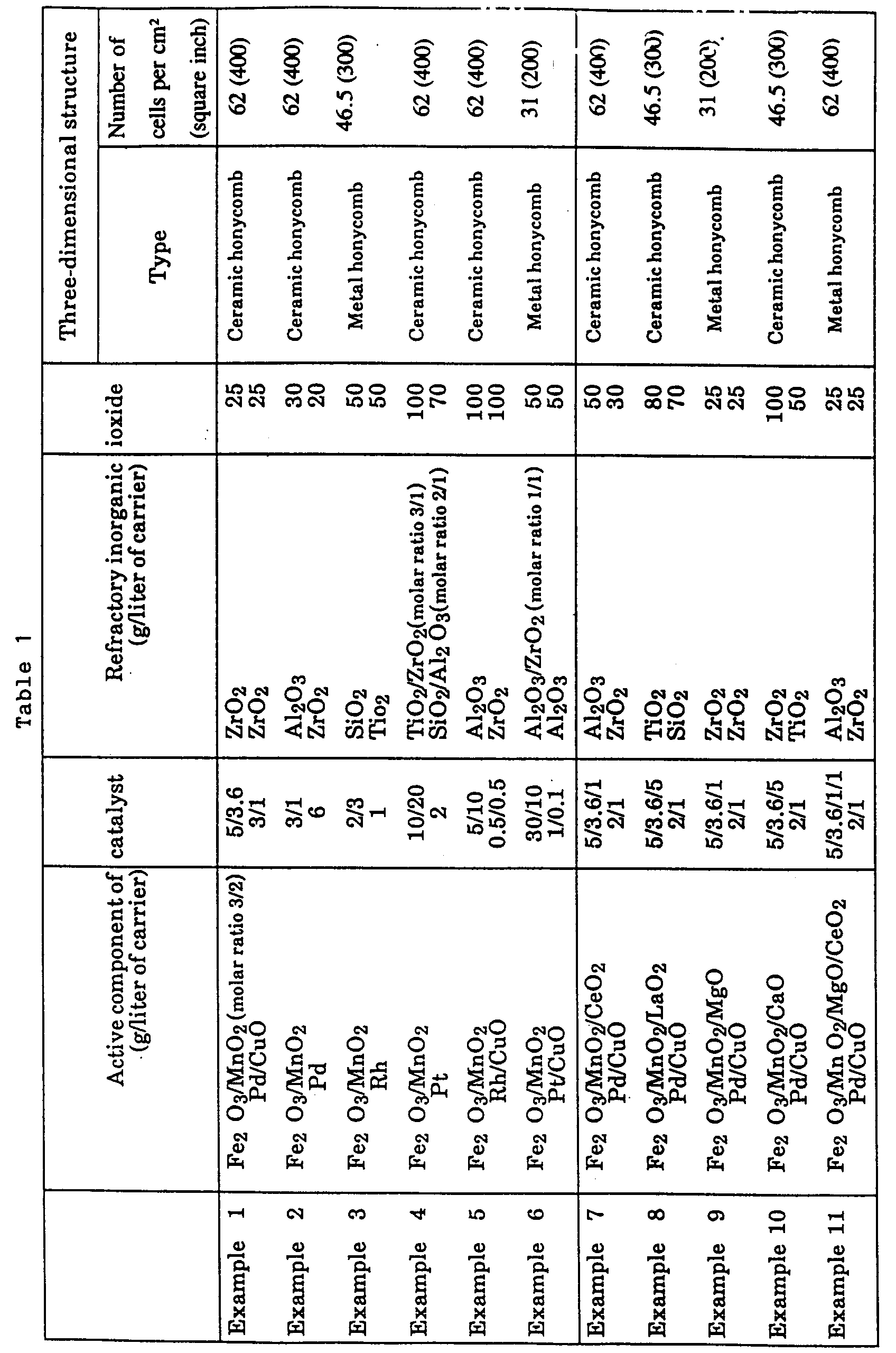
- aqueous solution prepared by dissolving 1012 g of iron nitrate and 406 g of manganese acetate in deionized water, 1 kg of zirconia powder (average particle diameter 2.0 ⁇ m) having a specific surface area of 56 m 2 /g was placed and thoroughly stirred. The prepared wet mixture was dried at 150 °C for 1 hour and then calcined at 500 °C for 1 hour to obtain a zirconia powder (average particle diameter 1.5 ⁇ m) having iron oxide (Fe 2 O 3 ) and manganese oxide (MnO 2 ) deposited as dispersed thereon.
- zirconia powder (average particle diameter 1.5 ⁇ m) was obtained by following the procedure described above while using an aqueous solution having palladium nitrate containing 80 g of palladium and 155 g of copper nitrate dissolved in deionized water instead. These zirconia powders were mixed and wet pulverized until formation of a slurry.
- a cylindrical honeycomb carrier of cordierite measuring 14.38 cm (5.66 inches) in diameter and 15.24 cm (6.00 inches) in length and containing about 400 open flow gas cells having a cross-sectional area of 6.452 cm 2 (1 square inch) was immersed in the slurry obtained as described above.
- the wet honeycomb carrier was made to drain off excess slurry, then dried at 150 °C for 2 hours, and subsequently calcined at 500 °C for 1 hour, to obtain a catalyst.
- the amounts of iron oxide, manganese oxide, palladium, and copper oxide deposited on the catalyst were found to be 5 g, 3.6 g, 2 g, and 1 g respectively per liter of the structure and the amount of zirconia was found to be 25 g respectively per liter of the structure.
- alumina powder (average particle diameter 1.0 ⁇ m) having a specific surface area of 118 m 2 /g, 120 g of iron oxide, and 40 g of manganese oxide were placed and thoroughly stirred.
- the prepared wet mixture was dried at 200 °C for 1 hour and further calcined at 600 °C for 2 hours, to obtain an alumina powder.
- 800 kg of zirconia powder (average particle diameter 1.2 ⁇ m) having a specific surface area of 80 m 2 /g was placed and thoroughly stirred in an aqueous solution prepared by dissolving palladium nitrate containing 240 g of palladium in deionized water.
- the prepared wet catalyst was dried at 150 °C for 1 hour and further calcined at 700 °C for 1 hour to obtain a zirconia powder having palladium deposited as dispersed thereon.
- the alumina powder and the zirconia powder were thoroughly mixed and wet pulverized until formation of a slurry.
- Example 2 The same honeycomb carrier of cordierite as used in Example 1 was immersed in the slurry obtained as described above. The resultant was made to drain off excess slurry, dried at 150 °C for 1 hour, and then calcined at 700 °C for 1 hour, to obtain a catalyst.
- the amounts of iron oxide, manganese oxide, palladium, alumina, and zirconia deposited on the catalyst were found to be 3 g, 1 g, 6 g, 30 g, and 20 g respectively per liter of the structure.
- aqueous solution prepared by dissolving 167 g of ferric sulfate and 325 g of manganese nitrate in deionized water, 1 kg of a silica powder (average particle diameter 1.2 ⁇ m) having a specific surface area was placed and thoroughly stirred. The prepared wet mixture was dried at 150 °C for 1 hour and further calcined at 550 °C for 2 hours to obtain a silica powder having iron oxide and manganese oxide deposited as dispersed thereon.
- a titania powder was obtained by following the procedure described above while causing impregnation of 1 kg of a titania powder (average particle diameter 1.2 ⁇ m) having a specific surface area of 100 m 2 /g in an aqueous solution prepared by dissolving rhodium nitrate containing 20 g of rhodium in deionized water.
- the silica powder and the titania powder were thoroughly mixed and wet pulverized until formation of a slurry.
- a cylindrical honeycomb carrier of stainless steel measuring 14.38 cm (5.66 inches) in diameter and 15.24 cm (6.00 inches) in length and containing about 300 open flow gas cells having a cross-sectional area of 6.452 cm 2 (1 square inch) was immersed in the slurry obtained as described above.
- the wet honeycomb carrier was made to drain off excess slurry, then dried at 150 °C for 1 hour, and subsequently calcined at 400 °C for 1 hour, to obtain a catalyst.
- the amounts of iron oxide, manganese oxide, rhodium, silica, and titania carried on the catalyst were found to be 2 g, 3 g, 1 g, 50 g, and 50 g respectively per liter of the structure.
- aqueous solution prepared by dissolving 506 g of iron nitrate and 1083 g of manganese nitrate in deionized water, 1 kg of titania-zirconia powder (average particle diameter 1.0 ⁇ m, TiO 2 /ZrO 2 molar ratio 3/1) having a specific surface area of 146 m 2 /g was placed and thoroughly stirred.
- the prepared wet mixture was dried at 150 °C for 2 hours and further calcined at 600 °C for 1 hour to obtain a titania-zirconia powder having iron oxide and manganese oxide deposited as dispersed thereon.
- a silica-alumina powder was obtained by following the procedure described above while causing impregnation of 700 g of silica-alumina powder (SiO 2 /Al 2 O 3 molar ratio 2/1) having a specific surface area of 116 m 2 /g in an aqueous solution prepared by dissolving chloroplatinic acid containing 20 g of platinum in deionized water.
- the titania-zirconia powder and the silica-alumina powder were thoroughly mixed and wet pulverized until formation of a slurry.
- the same honeycomb carrier of cordierite as used in Example 1 was immersed in the slurry obtained as described above. The wet honeycomb carrier was made to drain off excess slurry and then dried at 150 °C for 1 hour, to obtain a catalyst.
- the amounts of iron oxide, manganese oxide, platinum, titania-zirconia, and silica-alumina deposited on the catalyst were found to be 10 g, 20 g, 2 g, 100 g, and 70 g respectively per liter of the structure.
- An alumina powder was obtained by placing 1 kg of an alumina powder (average particle diameter 1.2 ⁇ m) having a specific surface area of 90 m 2 /g, 50 g of iron oxide, and 100 g of manganese oxide in deionized water, thoroughly stirring them in the deionized water, drying the prepared wet mixture at 180 °C for 1 hour, and further calcining the dried mixture at 500 °C for 2 hours.
- aqueous solution prepared by dissolving a rhodium nitrate solution containing 5 g of rhodium and 19 g of copper nitrate in deionized water, 1 kg of a zirconia powder (average particle diameter 1.2 ⁇ m) having a specific surface area of 100 m 2 /g was placed and thoroughly stirred.
- the prepared wet mixture was dried at 150 °C for 2 hours and further calcined at 650 °C for 1 hour to obtain a zirconia powder having rhodium and copper oxide deposited as dispersed thereon.
- the alumina powder and the zirconia powder were wet pulverized until formation of a slurry.
- honeycomb carrier of cordierite as used in Example 1 was immersed in the slurry obtained as described above, made to drain off excess slurry, and then dried at 150 °C for 1 hour to obtain a catalyst.
- the amounts of iron oxide, manganese oxide, rhodium, copper oxide, alumina, and zirconia deposited on this catalyst were found to be 5 g, 10 g, 0.5 g, 0.5 g, 100 g, and 100 g respectively per liter of the structure.
- aqueous solution prepared by dissolving 747 g of iron chloride and 456 g of manganese chloride in deionized water, 1 kg of an alumina-zirconia powder (average particle diameter 1.0 ⁇ m, Al 2 O 3 /ZrO 2 mol ratio 1/1) was placed and thoroughly stirred. The prepared wet mixture was dried at 180 °C for 2 hours and calcined at 600 °C for 1 hour to obtain an alumina-zirconia powder having iron oxide and manganese oxide deposited as dispersed thereon.
- an alumina powder was obtained by following the procedure described above while causing impregnation of 1kg of an alumina powder (average particle diameter 1.0 ⁇ m) having a specific surface area of 80m 2 /g in a solution of chloroplatinic acid containing 20 g of platinum and 3.4 g of copper chloride in deionized water instead.
- the alumina-zirconia powder and the alumina powder were thoroughly mixed and wet pulverized until formation of a slurry.
- a cylindrical honeycomb carrier of stainless steel measuring 14.38 cm (5.66 inches) in diameter and 15.24 cm (6.00 inches) in length and containing about 200 open flow gas cells having a cross-sectional area of 6.452 cm 2 (1 square inch) was immersed in the slurry obtained as described above.
- the wet honeycomb carrier was made to drain off excess slurry, then dried at 150 °C for 1 hour, and subsequently calcined at 400 °C for 1 hour, to obtain a complete catalyst.
- the amounts of iron oxide, manganese oxide, platinum, copper oxide, alumina-zirconia, and alumina deposited on the catalyst were found to be 30 g, 10 g, 1 g, 0.1 g, 50 g, and 50 g respectively per liter of the structure.
- aqueous solution prepared by dissolving 506 g of iron nitrate, 203 g of manganese acetate, and 50 g of cerium nitrate in deionized water, 1 kg of an alumina powder (average particle diameter 1.0 ⁇ m) having a specific surface area of 100 m 2 /g was placed and thoroughly stirred. The prepared wet mixture was dried at 200 °C for 2 hours and further calcined at 500 °C for 1 hour to obtain an alumina powder having iron oxide, manganese oxide, and cerium oxide deposited as dispersed thereon.
- a zirconia powder was obtained by following the procedure described above while causing impregnation of 600 g of a zirconia powder (average particle diameter 1.0 ⁇ m) having a specific surface area of 80 m 2 /g in an aqueous solution prepared by dissolving palladium nitrate containing 40 g of palladium and 77 g of copper nitrate in deionized water.
- the alumina powder and the zirconia powder were mixed and wet pulverized until formation of a slurry.
- a cylindrical honeycomb carrier of cordierite measuring 14.38 cm (5.66 inches) in diameter and 15.24 cm (6.00 inches) in length and containing about 400 open flow gas cells having a cross-sectional area of 6.452 cm 2 (1 square inch) was immersed in the slurry obtained as described above.
- the wet honeycomb carrier was made to drain off excess slurry, then dried at 150 °C for 2 hours, and subsequently calcined at 500 °C for 1 hour, to obtain a catalyst.
- the amounts of iron oxide, manganese oxide, cerium oxide, palladium, copper oxide, alumina, and zirconia deposited on this catalyst were found to be 5 g, 3.6 g, 1 g, 2 g, 1 g, 50 g, and 30 g respectively per liter of the structure.
- a titania powder was obtained by placing 800 g of a titania powder (average particle diameter 1.0 ⁇ m) having a specific surface area of 125 m 2 /g, 50 g of iron oxide, 36 g of manganese oxide, and 50 g of lanthanum oxide in deionized water, thoroughly mixing them, drying the resultant wet mixture at 150 °C for 2 hours, and further calcining the dried mixture at 600 °C for 1 hour.
- a silica powder was obtained by following the procedure described above while causing impregnation of 700 g of a silica powder (average particle diameter 0.8 ⁇ m) having a specific surface diameter of 150 m 2 /g in an aqueous solution prepared by dissolving palladium nitrate containing 20 g of palladium and 39 g of copper nitrate in deionized water.
- the titania powder and the silica powder were mixed and wet pulverized until formation of a slurry.
- a cylindrical honeycomb carrier of cordierite measuring 14.38 cm (5.66 inches) in diameter and 15.24 cm (6.00 inches) in length and containing about 300 open flow gas cells having a cross-sectional area of 6.452 cm 2 (1 square inch) was immersed in the slurry obtained as described above.
- the wet honeycomb carrier was made to drain off excess slurry, then dried at 150 °C for 2 hours, and subsequently calcined at 500 °C for 1 hour, to obtain a catalyst.
- the amounts of iron oxide, manganese oxide, lanthanum oxide, palladium, copper oxide, titania, and silica deposited on this catalyst were found to be 5 g, 3.6 g, 5 g, 2 g, 1 g, 80 g and 70 g respectively per liter of the structure.
- aqueous solution prepared by dissolving 1012 g of iron nitrate, 406 g of manganese acetate, and 254 g of magnesium nitrate in deionized water, 1 kg of a zirconia powder (average particle diameter 1.0 ⁇ m) having a specific surface area of 80 m 2 g was placed and thoroughly stirred. The prepared wet mixture was dried at 180 °C for 2 hours and further calcined at 500 °C for 1 hour to obtain a zirconia powder having iron oxide, manganese oxide, and magnesium oxide deposited as dispersed thereon.
- a zirconia powder was obtained by following the procedure described above while causing impregnation of 1 kg of a zirconia powder (average particle diameter 1.0 ⁇ m) having a specific surface area of 80 m 2 /g in an aqueous solution prepared by dissolving palladium nitrate containing 80 g of palladium and 113 g of copper nitrate in deionized water. These two zirconia powders were mixed and wet pulverized until formation of a slurry.
- a cylindrical honeycomb carrier of stainless steel measuring 14.38 cm (5.66 inches) in diameter and 15.24 cm (6.00 inches) in length and containing about 200 open flow gas cells having a cross-sectional area of 6.452 cm 2 (1 square inch) was immersed in the slurry obtained as described above.
- the wet honeycomb carrier was made to drain off excess slurry, then dried at 150 °C for 2 hours, and subsequently calcined at 500 °C for 1 hour, to obtain a catalyst.
- the amounts of iron oxide, manganese oxide, magnesium oxide, palladium, and copper oxide deposited on this catalyst were found to be 5 g, 3.6 g, 1 g, 2 g, and 1 g respectively per liter of the structure and the amount of zirconia was found to be 25g respectively per litter of the structure.
- a zirconia powder was obtained by placing 1 kg of a zirconia powder (average particle diameter 1.0 ⁇ m) having a specific surface area of 110 m 2 /g in an aqueous solution of 50 g of iron oxide, 36 g of manganese oxide, and 211 g of calcium nitrate in deionized water, thoroughly stirring them, drying the prepared wet mixture at 200 °C for 2 hours, and further calcining the dried mixture at 600 °C for 1 hour.
- a titania powder was obtained by following the procedure described above while causing impregnation of 500 g of a titania powder (average particle diameter 0.8 ⁇ m) having a specific surface area of 150 m 2 /g in an aqueous solution prepared by dissolving palladium nitrate containing 20 g of palladium and 39 g of copper nitrate in deionized water.
- the zirconia powder and the titania powder were mixed and wet pulverized until formation of a slurry.
- a cylindrical honeycomb carrier of cordierite measuring 14.38 cm (5.66 inches) in diameter and 15.24 cm (6.00 inches) in length and containing about 300 open flow gas cells having a cross-sectional area of 6.452 cm 2 (1 square inch) was immersed in the slurry obtained as described above.
- the wet honeycomb carrier was made to drain off excess slurry, then dried at 150 °C for 2 hours, and subsequently calcined at 500 °C for 1 hour, to obtain a catalyst.
- the amounts of iron oxide, manganese oxide, calcium oxide, palladium, copper oxide, zirconia, and titania deposited on this catalyst were found to be 5 g, 3.6 g, 5 g, 2 g, 1 g, 100 g, and 50 g respectively per liter of the structure.
- An alumina powder having iron oxide, manganese oxide, magnesium oxide, and cerium oxide deposited as dispersed thereon was obtained by placing 1 kg of an alumina powder (average particle diameter 1.0 ⁇ m) having a specific surface area of 100 m 2 /g, 1012 g of iron nitrate, 406 g of manganese acetate, 254 g of magnesium nitrate, and 101 g of cerium nitrate in deionized water, thoroughly stirring them, then drying the prepared wet mixture at 150 °C for 2 hours, and further calcining the dried mixture at 500 °C for 1 hour.
- a zirconia powder was obtained by following the procedure described above while causing impregnation of 1 kg of a zirconia powder (average particle diameter 1.0 ⁇ m) having a specific surface area of 80 m 2 /g in an aqueous solution prepared by dissolving palladium nitrate containing 80 g of palladium and 155 g of copper nitrate in deionized water.
- a cylindrical honeycomb carrier of stainless steel measuring 14.38 cm (5.66 inches) in diameter and 15.24 cm (6.00 inches) in length and containing about 400 open flow gas cells having a cross-sectional area of 6.452 cm 2 (1 square inch) was immersed in the slurry obtained as described above.
- the wet honeycomb carrier was made to drain off excess slurry, then dried at 150 °C for 2 hours, and subsequently calcined at 500 °C for 1 hour, to obtain a catalyst.
- the amounts of iron oxide, manganese oxide, magnesium oxide, cerium oxide, palladium, copper oxide, alumina, and zirconia deposited on this catalyst were found to be 5 g, 3.6 g, 1 g, 1 g, 2 g, 1 g, 25 g, and 25 g respectively per liter of the structure.
- aqueous solution prepared by dissolving palladium nitrate containing 30 g of palladium, 31.3 g of copper sulfate, 253 g of iron nitrate, and 195 g of manganese nitrate in deionized water, 1 kg of a titania powder (average particle diameter 1.2 ⁇ m) having a specific surface area of 100 m 2 /g was placed and thoroughly stirred.
- the prepared wet mixture was dried at 150 °C for 2 hours and further calcined at 550 °C for two hours to obtain a titania powder having palladium, copper oxide, iron oxide, and manganese oxide deposited as dispersed thereon.
- the titania powder was thoroughly wet pulverized until formation of a slurry.
- a cylindrical honeycomb carrier of cordierite measuring 14.38 cm (5.66 inches) in diameter and 15.24 cm (6.00 inches) in length and containing about 300 open flow gas cells having a cross-sectional area of 6.452 cm 2 (1 square inch) was immersed in the slurry obtained as described above.
- the wet honeycomb carrier was made to drain off excess slurry, then dried at 150 °C for 1 hour, and subsequently calcined at 500 °C for 1 hour, to obtain a catalyst.
- the amounts of palladium, copper oxide, iron oxide, manganese oxide, and titania deposited on this catalyst were found to be 3 g, 1 g, 5 g, 3.6 g and 100 g respectively per liter of the structure.
- aqueous solution prepared by dissolving palladium nitrate containing 1 g of palladium and 3.2 g of copper sulfate in deionized water, 1 kg of a zirconia powder (average particle diameter 2.0 ⁇ m) having a specific surface area of 45 m 2 /g was placed and thoroughly stirred.
- the prepared wet mixture was dried at 180 °C for 1 hour and calcined at 700 °C for 1 hour to obtain a zirconia powder having palladium and copper oxide deposited as dispersed thereon. This zirconia powder was thoroughly wet pulverized until formation of a slurry.
- a cylindrical honeycomb carrier of cordierite measuring 14.38 cm (5.66 inches) in diameter and 15.24 cm (6.00 inches) in length and containing about 200 open flow gas cells having a cross-sectional area of 6.452 cm 2 (1 square inch) was immersed in the slurry obtained as described above.
- the wet honeycomb carrier was made to drain off excess slurry, then dried at 150 °C for 2 hours, and subsequently calcined at 500 °C for 1 hour, to obtain a catalyst.
- an alumina powder (average particle diameter 1.0 ⁇ m) having a specific surface area of 95 m 2 /g was placed and thoroughly stirred.
- the prepared wet mixture was dried at 170 °C for 1 hour and calcined at 650 °C for 2 hours to obtain an alumina powder having iron oxide and manganese oxide deposited as dispersed thereon. This alumina powder was thoroughly wet pulverized until formation of a slurry.
- honeycomb carrier as mentioned above was immersed in the slurry obtained as described above and the prepared wet honeycomb carrier was treated to induce deposition of the alumina powder on the zirconia powder and produce a catalyst in the same manner as described above.
- the amounts of palladium, copper oxide, iron oxide, manganese oxide, zirconia, and alumina deposited on this catalyst were found to be 0.1 g, 0.1 g, 20 g, 10 g, 100 g, and 100 g respectively per liter of the structure.
- aqueous solution prepared by dissolving 253 g of iron nitrate and 271 g of manganese nitrate in deionized water, 1.5 kg of an alumina powder (average particle diameter 2.0 ⁇ m) having a specific surface area of 60 m 2 /g was placed and thoroughly stirred.
- the prepared wet mixture was dried at 160 °C for 1 hour and calcined at 500 °C for 2 hours to obtain an alumina powder having iron oxide and manganese oxide deposited as dispersed thereon. This alumina powder was wet pulverized until formation of a slurry.
- a cylindrical honeycomb carrier of cordierite measuring 14.38 cm (5.66 inches) in diameter and 15.24 cm (6.00 inches) in length and containing about 100 open flow gas cells having a cross-sectional area of 6.452 cm 2 (1 square inch) was immersed in the slurry obtained as described above.
- the wet honeycomb carrier was made to drain off excess slurry and then dried at 150 °C for 2 hours to obtain a catalyst.
- aqueous solution prepared by dissolving palladium nitrate containing 10 g of palladium and 7.7 g of copper nitrate in deionized water
- 500 g of a titania powder average particle diameter 1.0 ⁇ m
- the prepared wet mixture was dried at 150 °C for 1 hour and calcined at 600 °C for 1 hour to obtain a titania powder having palladium and copper oxide deposited as dispersed thereon.
- This titania powder was thoroughly wet pulverized until formation of a slurry.
- honeycomb carrier as mentioned above was immersed in the slurry obtained as described above and the resultant wet honeycomb carrier was treated to induce deposition of the titania powder on the alumina powder and produce a catalyst in the same manner as described above.
- the amounts of iron oxide, manganese oxide, palladium, copper oxide, alumina, and titania deposited on this catalyst were found to be 5 g, 5 g, 1 g, 0.2 g, 150 g, and 50 g respectively per liter of the structure.
- a catalyst was obtained by faithfully following the procedure of Control 1 while using an aqueous solution of 228 g of copper nitrate in deionized water instead.
- the amounts of alumina and copper oxide deposited on this catalyst were found to be 50 g and 3.0 g respectively per liter of the structure.
- a catalyst was obtained by faithfully following the procedure of Control 1 while using an aqueous solution of 158 g of chromium nitrate in deionized water instead.
- the amounts of alumina and chromium oxide deposited on this catalyst were found to be 50 g and 3.0 g respectively per liter of the structure.
- a catalyst was obtained by faithfully following the procedure of Control 1 while using an aqueous solution of palladium nitrate containing 20 g of palladium in deionized water instead.
- the amounts of alumina and palladium deposited on this catalyst were found to be 50 g and 0.1 g respectively per liter of the structure.
- a catalyst was obtained by faithfully following the procedure of Control 1 while using an aqueous solution of chloroplatinic acid containing 20 g of platinum in deionized water instead.
- the amounts of alumina and platinum deposited on this catalyst were found to be 50 g and 1.0 g respectively per liter of the structure.
- a catalyst was obtained by faithfully following the procedure of Control 1 while using an aqueous solution of rhodium nitrate containing 20 g of rhodium in deionized water instead.
- the amounts of alumina and rhodium deposited on this catalyst were found to be 50 g and 1.0 g respectively per liter of the structure.
- a catalyst was obtained by faithfully following the procedure of Control 1 while using an aqueous solution of 200 g of nickel acetate and 12.1 g of copper acetate in deionized water instead.
- the amounts of alumina, nickel oxide, and copper oxide deposited on this catalyst were found to be 50 g, 3.0 g, and 1.5 g respectively per liter of the structure.
- a catalyst was obtained by faithfully following the procedure of Control 1 while using an aqueous solution of 72.5 g of cobalt nitrate and 60.7 g of copper nitrate in deionized water instead.
- the amounts of alumina, cobalt oxide, and copper oxide deposited on this catalyst were found to be 50 g, 1.0 g, and 1.0 g respectively per liter of the structure.
- the catalysts were tested for ability to purify diesel engine exhaust gas by the following method.
- a sample catalyst was set in an exhaust gas tube from the engine mentioned above and subjected to a 300 hour's durability test under the conditions of 2500 rpm of full load of engine speed and 600 °C of catalyst inlet temperature.
- the exhaust gas was sampled before the entry into the catalyst bed (inlet) and after the departure from the catalyst bed (outlet) and analyzed for the content of microfine substances by the standard dilution tunnel method to determine the ratio of removal of the microfine substances (%).
- microfine substances seized by the sample catalyst with a dilution tunnel were extracted in a dichloromethane solution. And the amount of SOF discharged from the engine and the ratio of removal of SOF was determined by the change of weight of the microfine substances before and after the extraction .
Landscapes
- Chemical & Material Sciences (AREA)
- Engineering & Computer Science (AREA)
- Chemical Kinetics & Catalysis (AREA)
- Organic Chemistry (AREA)
- Materials Engineering (AREA)
- Health & Medical Sciences (AREA)
- Analytical Chemistry (AREA)
- General Chemical & Material Sciences (AREA)
- Oil, Petroleum & Natural Gas (AREA)
- Environmental & Geological Engineering (AREA)
- Biomedical Technology (AREA)
- Combustion & Propulsion (AREA)
- Catalysts (AREA)
- Exhaust Gas Treatment By Means Of Catalyst (AREA)
Description


Claims (13)
- A catalyst for purification of diesel engine exhaust gas, which comprises (A) a first catalytic component comprising the two elements of iron and manganese and a refractory inorganic oxide and (B) a second catalytic component comprising at least one noble metal selected from the group consisting of palladium, platinum, and rhodium and a refractory inorganic oxide, said two catalytic components being deposited in the form of a single layer on a refractory three-dimensional structure, wherein the total amount of said two elements of iron and manganese is in the range of from 0,5 to 60 g, wherein the amount of at least one noble metal is in the range of from 0,001 to 6 g, and wherein the total amount of said refractory inorganic oxide is in the range of from 1 to 300 g per liter of said three-dimensional structure.
- A catalyst according to claim 1, wherein said first catalytic component comprises an alkaline earth element and/or a rare earth element.
- A catalyst according to claim 1, wherein said second catalytic component comprises copper.
- A catalyst according to claim 1, wherein said first catalytic component comprises an alkaline earth element and/or a rare earth element and said second catalytic component comprises copper.
- A catalyst according to claim 1, wherein a total amount of said two elements of iron and manganese deposited is in the range of from 0.5 to 50 g per liter of said three-dimensional structure and a molar ratio of iron to manganese is in the range of from 10 : 1 to 1: 10.
- A catalyst according to claim 2, wherein a total amount of said two elements of iron and manganese deposited is in the range of from 0.5 to 50 g, an amount of said alkaline earth element in the range of from 0 to 20 g, and the amount of said rare earth element in the range of from 0 to 30 g per liter of said three-dimensional structure, wherein a total amount of the alkaline earth element and the rare earth element is beyond 0 g and a molar ratio of iron to manganese is in the range of from 10 : 1 to 1 : 10.
- A catalyst according to claim 3, wherein a total amount of said two elements of iron and manganese deposited is in the range of from 0.5 to 50 g, and an amount of copper in the range of from 0.01 to 10 g per liter of said three-dimensional structure and the molar ratio of iron to manganese is in the range of from 10 : 1 to 1 : 10.
- A catalyst according to claim 4, wherein a total amount of said two elements of iron and manganese deposited is in the range of from 0.5 to 50 g, the amount of said alkaline earth element in the range of from 0 to 20 g, the amount of said rare earth element in the range of from 0 to 30 g, wherein a total amount of the alkaline earth element and the rare earth element is beyond 0 g, and an amount of copper is in the range of 0.01 to 10 g per liter of said three-dimensional structure and the molar ratio of iron to manganese is in the range of from 10 : 1 to 1 : 10.
- A catalyst according to claims 1-8, wherein said refractory inorganic oxide has an average particle diameter in the range of from 0.1 to 5 µm and a BET surface area in the range of from 1 to 200 m2/g.
- A catalyst according to claims 1-8, wherein a total amount of said two elements of iron and manganese is in the range of from 0.1 to 98% by weight and an amount of said noble metal in the range of from 0.0003 to 80% by weight, based on the amount of said refractory inorganic oxide.
- A catalyst according to claims 1-10, wherein said three-dimensional structure is an open flow type ceramic honeycomb or metal honeycomb carrier.
- A catalyst according to claim 6, wherein an amount of said alkaline earth element carried is in the range of from 0.1 to 10 g and an amount of said rare earth element in the range of from 0.1 to 10 g per liter of said three-dimensional structure.
- A catalyst according to claim 3, wherein an amount of copper carried is in the range of from 0.1 to 3 g per liter of said three-dimensional structure.
Priority Applications (3)
| Application Number | Priority Date | Filing Date | Title |
|---|---|---|---|
| DE1995604174 DE69504174T2 (en) | 1995-02-17 | 1995-02-17 | Catalytic converter for cleaning diesel engine exhaust |
| EP95102208A EP0727248B1 (en) | 1995-02-17 | 1995-02-17 | Catalyst for purification of diesel engine exhaust gas |
| US08/392,381 US5610117A (en) | 1995-02-17 | 1995-02-22 | Catalyst for purification of diesel engine exhaust gas |
Applications Claiming Priority (2)
| Application Number | Priority Date | Filing Date | Title |
|---|---|---|---|
| EP95102208A EP0727248B1 (en) | 1995-02-17 | 1995-02-17 | Catalyst for purification of diesel engine exhaust gas |
| US08/392,381 US5610117A (en) | 1995-02-17 | 1995-02-22 | Catalyst for purification of diesel engine exhaust gas |
Publications (2)
| Publication Number | Publication Date |
|---|---|
| EP0727248A1 EP0727248A1 (en) | 1996-08-21 |
| EP0727248B1 true EP0727248B1 (en) | 1998-08-19 |
Family
ID=26138462
Family Applications (1)
| Application Number | Title | Priority Date | Filing Date |
|---|---|---|---|
| EP95102208A Expired - Lifetime EP0727248B1 (en) | 1995-02-17 | 1995-02-17 | Catalyst for purification of diesel engine exhaust gas |
Country Status (2)
| Country | Link |
|---|---|
| US (1) | US5610117A (en) |
| EP (1) | EP0727248B1 (en) |
Families Citing this family (30)
| Publication number | Priority date | Publication date | Assignee | Title |
|---|---|---|---|---|
| EP0666099B1 (en) * | 1993-04-28 | 2001-07-18 | Nippon Shokubai Co., Ltd. | Method of removing nitrogen oxides contained in exhaust gas |
| FR2729309B1 (en) * | 1995-01-13 | 1997-04-18 | Rhone Poulenc Chimie | CATALYTIC COMPOSITION BASED ON CERIUM OXIDE AND MANGANESE, IRON OR PRASEODYM OXIDE, METHOD FOR PREPARING SAME AND USE IN AUTOMOTIVE POST-COMBUSTION CATALYSIS |
| WO1997011779A1 (en) * | 1995-09-26 | 1997-04-03 | Kabushiki Kaisha Kobe Seiko Sho | Poisonous gas removing agent |
| JP3956437B2 (en) * | 1996-09-26 | 2007-08-08 | マツダ株式会社 | Exhaust gas purification catalyst |
| JPH10180110A (en) * | 1996-12-25 | 1998-07-07 | Toyota Motor Corp | Exhaust gas purification catalyst |
| JPH11169668A (en) | 1997-12-15 | 1999-06-29 | Sumitomo Electric Ind Ltd | Exhaust gas purification device and method of manufacturing the same |
| DE19815608A1 (en) * | 1998-04-07 | 1999-10-14 | Emitec Emissionstechnologie | Catalytically active structure |
| US6129898A (en) * | 1998-08-17 | 2000-10-10 | Ford Global Technologies, Inc. | NOx trap catalyst for lean burn engines |
| JP4703818B2 (en) * | 2000-06-20 | 2011-06-15 | 株式会社アイシーティー | Exhaust gas purification catalyst and exhaust gas purification method |
| IT1319198B1 (en) * | 2000-10-11 | 2003-09-26 | Sued Chemie Mt Srl | OXIDATION CATALYSTS. |
| JP4564645B2 (en) * | 2000-11-27 | 2010-10-20 | 株式会社キャタラー | Exhaust gas purification catalyst |
| JP2002224570A (en) * | 2001-02-05 | 2002-08-13 | Toyota Central Res & Dev Lab Inc | Catalyst for CO shift reaction |
| KR100392943B1 (en) | 2001-05-16 | 2003-07-28 | (주)케이에이치 케미컬 | Catalyst for purification of diesel engine exhaust gas |
| US20040176246A1 (en) * | 2003-03-05 | 2004-09-09 | 3M Innovative Properties Company | Catalyzing filters and methods of making |
| US7160832B2 (en) * | 2003-06-16 | 2007-01-09 | Umicore Ag & Co. Kg | Catalyst system for generating carbon monoxide for use with automotive catalysts |
| JP3912377B2 (en) * | 2003-12-25 | 2007-05-09 | 日産自動車株式会社 | Method for producing exhaust gas purification catalyst powder |
| JP4547930B2 (en) * | 2004-02-17 | 2010-09-22 | 日産自動車株式会社 | Catalyst, catalyst preparation method and exhaust gas purification catalyst |
| JP4547935B2 (en) * | 2004-02-24 | 2010-09-22 | 日産自動車株式会社 | Exhaust gas purification catalyst, exhaust gas purification catalyst, and catalyst manufacturing method |
| JP4513372B2 (en) * | 2004-03-23 | 2010-07-28 | 日産自動車株式会社 | Exhaust gas purification catalyst and exhaust gas purification catalyst |
| JP4513384B2 (en) * | 2004-03-31 | 2010-07-28 | 日産自動車株式会社 | High heat-resistant exhaust gas purification catalyst and method for producing the same |
| EP1786560A4 (en) * | 2004-09-01 | 2010-09-29 | Emisense Technologies Llc | CERAMIC CATALYST FOR NOX OXIDATION AND NOX CONVERSION IN EMISSION REDUCTION DEVICES |
| JP5200315B2 (en) * | 2004-12-22 | 2013-06-05 | 日産自動車株式会社 | Exhaust gas purification catalyst and method for producing exhaust gas purification catalyst |
| FR2887469B1 (en) * | 2005-06-27 | 2008-01-04 | Rhodia Chimie Sa | GAS TREATMENT PROCESS FOR CATALYTIC OXIDATION OF CARBON MONOXIDE AND HYDROCARBONS USING A METAL-BASED ZIRCONY-BASED COMPOSITION COMPRISING SILICA |
| JP4826207B2 (en) * | 2005-10-28 | 2011-11-30 | 日産自動車株式会社 | Exhaust gas purification catalyst and method for producing exhaust gas purification catalyst |
| US7797931B2 (en) * | 2006-03-20 | 2010-09-21 | Ford Global Technologies, Llc | Catalyst composition for diesel particulate filter |
| US7771669B2 (en) * | 2006-03-20 | 2010-08-10 | Ford Global Technologies, Llc | Soot oxidation catalyst and method of making |
| US8273154B2 (en) * | 2009-06-24 | 2012-09-25 | Johanshir Golchin | Fire brick mercury removal process from flue gas |
| WO2012121085A1 (en) | 2011-03-04 | 2012-09-13 | 株式会社アイシーティー | Catalyst for exhaust gas purification, method for producing same, and exhaust gas purification method using same |
| JP5746061B2 (en) | 2011-03-29 | 2015-07-08 | イビデン株式会社 | Honeycomb structure and method for manufacturing honeycomb structure |
| EP3932542A1 (en) * | 2020-07-03 | 2022-01-05 | BASF Corporation | Catalyst for particulate combustion in gasoline emission treatment systems |
Family Cites Families (16)
| Publication number | Priority date | Publication date | Assignee | Title |
|---|---|---|---|---|
| US3493325A (en) * | 1967-09-12 | 1970-02-03 | Monsanto Co | Process for catalytically treating exhaust gases |
| FR2186290B1 (en) * | 1972-02-23 | 1974-08-02 | Azote & Prod Chim | |
| FR2204454B1 (en) * | 1972-10-30 | 1975-09-12 | Pro Catalyse | |
| IT1003097B (en) * | 1973-03-28 | 1976-06-10 | Tokyo Electric Co Ltd | CATALYST TO TREAT EXHAUST GASES OF MOTOR VEHICLES |
| JPS55155739A (en) * | 1979-05-23 | 1980-12-04 | Toyota Central Res & Dev Lab Inc | Exhaust gas purifying catalyzer |
| FR2466278A1 (en) * | 1979-10-04 | 1981-04-10 | Pro Catalyse | CATALYST AND PROCESS FOR TREATING EXHAUST GASES OF INTERNAL COMBUSTION ENGINES |
| FR2495957B1 (en) * | 1980-12-17 | 1986-09-12 | Pro Catalyse | IMPROVED CATALYST AND METHOD FOR THE TREATMENT OF EXHAUST GASES FROM INTERNAL COMBUSTION ENGINES |
| EP0092023B1 (en) * | 1982-04-21 | 1986-07-30 | Bridgestone Tire Company Limited | Use of a catalyst for cleaning exhaust gas particulates |
| ZA837689B (en) * | 1982-10-18 | 1984-06-27 | Universal Matthey Prod | Oxidation catalysts |
| JPS61129030A (en) * | 1984-11-27 | 1986-06-17 | Toyota Motor Corp | Filter for collecting and purifying fine particles |
| JPS61146314A (en) * | 1984-12-20 | 1986-07-04 | Toyota Motor Corp | Purifying filter for collecting fine particle |
| JPS61149222A (en) * | 1984-12-21 | 1986-07-07 | Toyota Motor Corp | Purification filter for collecting fine particle |
| CA1260909A (en) * | 1985-07-02 | 1989-09-26 | Koichi Saito | Exhaust gas cleaning catalyst and process for production thereof |
| DE3729126A1 (en) * | 1987-09-01 | 1989-04-06 | Mototech Motoren Umweltschutz | Diesel soot-particle filter and process for the production thereof |
| JP3113662B2 (en) * | 1990-02-26 | 2000-12-04 | 株式会社日本触媒 | Catalyst for exhaust gas purification of diesel engines |
| JP2825420B2 (en) * | 1993-09-02 | 1998-11-18 | 株式会社アイシーティー | Diesel engine exhaust gas purification catalyst |
-
1995
- 1995-02-17 EP EP95102208A patent/EP0727248B1/en not_active Expired - Lifetime
- 1995-02-22 US US08/392,381 patent/US5610117A/en not_active Expired - Lifetime
Also Published As
| Publication number | Publication date |
|---|---|
| EP0727248A1 (en) | 1996-08-21 |
| US5610117A (en) | 1997-03-11 |
Similar Documents
| Publication | Publication Date | Title |
|---|---|---|
| US5610117A (en) | Catalyst for purification of diesel engine exhaust gas | |
| EP0494591B1 (en) | Diesel engine exhaust gas-purifying catalyst | |
| US5177041A (en) | Catalyst for purifying exhaust gas from diesel engines | |
| US5911961A (en) | Catalyst for purification of diesel engine exhaust gas | |
| EP0174495B1 (en) | Catalyst for purifying diesel engine exhaust gases | |
| EP0315896B1 (en) | Diesel engine exhaust gas purification catalyst | |
| KR950002223B1 (en) | Catalyst for purification of exhausted gas from diesel engine | |
| EP0714692B1 (en) | Catalyst for purification of diesel engine exhaust gas | |
| US5320998A (en) | Catalyst for purifying exhaust gases of diesel engine | |
| JPH0884911A (en) | Catalyst for decomposing nitrogen oxides and method for purifying exhaust gas of diesel engine using the same | |
| JPH1033985A (en) | Diesel engine exhaust gas purification catalyst | |
| JP2825420B2 (en) | Diesel engine exhaust gas purification catalyst | |
| JP2758616B2 (en) | Heat-resistant catalyst for catalytic combustion and its carrier | |
| KR0184718B1 (en) | Manufacturing method of catalytic purifier for exhaust gas purification of diesel engine | |
| JPH0523599A (en) | Catalyst for decontaminating exhaust gas | |
| EP0600442A1 (en) | Catalyst for purification of Diesel engine exhaust gas | |
| JP3503073B2 (en) | Catalyst for purifying diesel engine exhaust gas | |
| JP4380880B2 (en) | Exhaust gas purification catalyst | |
| JP3805079B2 (en) | Diesel engine exhaust gas purification catalyst and purification method | |
| JP3337081B2 (en) | Diesel engine exhaust gas purification catalyst | |
| JPH08229350A (en) | Catalyst for decomposing nitrogen oxide and purifying method of diesel engine exhaust gas using the same | |
| JP3436765B2 (en) | Diesel engine exhaust gas purification catalyst | |
| CA1323620C (en) | Catalyst for purifying exhaust gas and method for production thereof | |
| JPH08257405A (en) | Catalyst for decomposition of nitrogen oxide and method for removing nitrogen oxide in exhaust gas from diesel engine by using the same | |
| JP3559372B2 (en) | Diesel engine exhaust gas purification catalyst |
Legal Events
| Date | Code | Title | Description |
|---|---|---|---|
| PUAI | Public reference made under article 153(3) epc to a published international application that has entered the european phase |
Free format text: ORIGINAL CODE: 0009012 |
|
| 17P | Request for examination filed |
Effective date: 19950530 |
|
| AK | Designated contracting states |
Kind code of ref document: A1 Designated state(s): DE FR GB IT |
|
| 17Q | First examination report despatched |
Effective date: 19970707 |
|
| GRAG | Despatch of communication of intention to grant |
Free format text: ORIGINAL CODE: EPIDOS AGRA |
|
| GRAG | Despatch of communication of intention to grant |
Free format text: ORIGINAL CODE: EPIDOS AGRA |
|
| GRAH | Despatch of communication of intention to grant a patent |
Free format text: ORIGINAL CODE: EPIDOS IGRA |
|
| GRAH | Despatch of communication of intention to grant a patent |
Free format text: ORIGINAL CODE: EPIDOS IGRA |
|
| GRAA | (expected) grant |
Free format text: ORIGINAL CODE: 0009210 |
|
| AK | Designated contracting states |
Kind code of ref document: B1 Designated state(s): DE FR GB IT |
|
| REF | Corresponds to: |
Ref document number: 69504174 Country of ref document: DE Date of ref document: 19980924 |
|
| ET | Fr: translation filed | ||
| PLBE | No opposition filed within time limit |
Free format text: ORIGINAL CODE: 0009261 |
|
| STAA | Information on the status of an ep patent application or granted ep patent |
Free format text: STATUS: NO OPPOSITION FILED WITHIN TIME LIMIT |
|
| 26N | No opposition filed | ||
| REG | Reference to a national code |
Ref country code: GB Ref legal event code: IF02 |
|
| REG | Reference to a national code |
Ref country code: DE Ref legal event code: R082 Ref document number: 69504174 Country of ref document: DE Representative=s name: MAI DOERR BESIER PATENTANWAELTE, DE Effective date: 20120502 Ref country code: DE Ref legal event code: R082 Ref document number: 69504174 Country of ref document: DE Representative=s name: MAI DOERR BESIER PATENTANWAELTE, DE Effective date: 20130215 Ref country code: DE Ref legal event code: R081 Ref document number: 69504174 Country of ref document: DE Owner name: UMICORE SHOKUBAI JAPAN CO. LTD., JP Free format text: FORMER OWNER: ICT CO. LTD., OSAKA, JP Effective date: 20130215 |
|
| REG | Reference to a national code |
Ref country code: FR Ref legal event code: TP Owner name: UMICORE SHOKUBAI USA INC., US Effective date: 20130709 |
|
| REG | Reference to a national code |
Ref country code: GB Ref legal event code: 732E Free format text: REGISTERED BETWEEN 20130905 AND 20130911 |
|
| REG | Reference to a national code |
Ref country code: FR Ref legal event code: RM Effective date: 20140120 |
|
| PGFP | Annual fee paid to national office [announced via postgrant information from national office to epo] |
Ref country code: DE Payment date: 20140307 Year of fee payment: 20 |
|
| PGFP | Annual fee paid to national office [announced via postgrant information from national office to epo] |
Ref country code: IT Payment date: 20140224 Year of fee payment: 20 Ref country code: FR Payment date: 20140218 Year of fee payment: 20 |
|
| PGFP | Annual fee paid to national office [announced via postgrant information from national office to epo] |
Ref country code: GB Payment date: 20140220 Year of fee payment: 20 |
|
| REG | Reference to a national code |
Ref country code: DE Ref legal event code: R071 Ref document number: 69504174 Country of ref document: DE |
|
| REG | Reference to a national code |
Ref country code: GB Ref legal event code: PE20 Expiry date: 20150216 |
|
| PG25 | Lapsed in a contracting state [announced via postgrant information from national office to epo] |
Ref country code: GB Free format text: LAPSE BECAUSE OF EXPIRATION OF PROTECTION Effective date: 20150216 |
|
| P01 | Opt-out of the competence of the unified patent court (upc) registered |
Effective date: 20230602 |