EP0723255B1 - Percussion instrument with tone bars for exactly generating tones on a scale - Google Patents
Percussion instrument with tone bars for exactly generating tones on a scale Download PDFInfo
- Publication number
- EP0723255B1 EP0723255B1 EP96100772A EP96100772A EP0723255B1 EP 0723255 B1 EP0723255 B1 EP 0723255B1 EP 96100772 A EP96100772 A EP 96100772A EP 96100772 A EP96100772 A EP 96100772A EP 0723255 B1 EP0723255 B1 EP 0723255B1
- Authority
- EP
- European Patent Office
- Prior art keywords
- recess
- percussion instrument
- set forth
- order vibration
- recesses
- Prior art date
- Legal status (The legal status is an assumption and is not a legal conclusion. Google has not performed a legal analysis and makes no representation as to the accuracy of the status listed.)
- Expired - Lifetime
Links
- 238000009527 percussion Methods 0.000 title claims description 54
- 230000001105 regulatory effect Effects 0.000 claims description 7
- 239000002184 metal Substances 0.000 description 43
- 239000011295 pitch Substances 0.000 description 22
- 230000007423 decrease Effects 0.000 description 2
- 239000002023 wood Substances 0.000 description 2
- 241000333074 Eucalyptus occidentalis Species 0.000 description 1
- 241001523858 Felipes Species 0.000 description 1
- 230000003247 decreasing effect Effects 0.000 description 1
- 230000000694 effects Effects 0.000 description 1
- 230000004048 modification Effects 0.000 description 1
- 238000012986 modification Methods 0.000 description 1
- 238000001228 spectrum Methods 0.000 description 1
- 229920003002 synthetic resin Polymers 0.000 description 1
- 239000000057 synthetic resin Substances 0.000 description 1
- 210000002105 tongue Anatomy 0.000 description 1
Images



Classifications
-
- G—PHYSICS
- G10—MUSICAL INSTRUMENTS; ACOUSTICS
- G10D—STRINGED MUSICAL INSTRUMENTS; WIND MUSICAL INSTRUMENTS; ACCORDIONS OR CONCERTINAS; PERCUSSION MUSICAL INSTRUMENTS; AEOLIAN HARPS; SINGING-FLAME MUSICAL INSTRUMENTS; MUSICAL INSTRUMENTS NOT OTHERWISE PROVIDED FOR
- G10D13/00—Percussion musical instruments; Details or accessories therefor
- G10D13/01—General design of percussion musical instruments
- G10D13/08—Multi-toned musical instruments with sonorous bars, blocks, forks, gongs, plates, rods or teeth
Definitions
- This invention relates to a percussion instrument and, more particularly, to a percussion instrument having tone plates for exactly generating tones on a scale.
- a xylophone, a glockenspiel, a vibraphone and a marimba are classified into the percussion instrument of definite pitch, and a plurality of slabs or sound bars are arranged in the percussion instrument.
- the slabs or the sound bars are formed of wood or metal, and are usually supported by felt members or strings over a frame. While a player is selectively striking the sound bars with mallets, the sound bars vibrate, and generate the tones.
- the vibrations of a sound bar are broken down into longitudinal vibration components, transverse vibration components and torsional vibration components.
- the transverse vibration components contain transverse vibrations in the vertical plane and transverse vibrations in the horizontal plane.
- the designer mainly takes the transverse vibrations in the vertical plane into account, and tunes the sound bars.
- Figure 1 illustrates the vibrations generated in a sound bar upon an impact with a mallet.
- Plots f0 stands for the first-order or fundamental vibration
- the second-order and the third-order vibrations are represented by plots f1 and f2, respectively.
- the vibrations higher than the third-order vibration are deleted from figure 1.
- the first-order vibration to high-order vibrations are hereinbelow referred to as "first-order vibration mode", “the second-order vibration mode”, “the third-order vibration mode” and so forth.
- a musical instrument has various families, and the sounds generated by the families are largely broken down into a tone and an unpitched sound.
- the tone is defined as "vibrations consisting of the fundamental frequency and harmonics thereof", and a listener easily discriminates the fundamental pitch of the tone.
- the unpitched sound does not fall under the definition of the tone.
- a string instrument generates the sounds through vibrations of the strings, and the cross section of the string is approximated to zero. For this reason, the high-order harmonics have respective frequencies substantially multiples of the fundamental frequency, and the sounds generated by the string instrument fall under the definition of the tone.
- a wind instrument such as a clarinet generates a sound, a harmonic fi of which is given by equation 1.
- fi (c/ 21) x i
- c the acoustic velocity in the air
- i an integer.
- the frequencies of the high-order harmonics are integers of the fundamental frequency, and the harmonic distortion affects the timbre of the tone.
- the second-order harmonic differs from the fundamental frequency by an octave, and the third-order harmonic is spaced from the second-order harmonic by fifth. For this reason, the pitches of the sound is clearly discriminative by a listener, and the wind instrument generates the sounds having vibration pitches in the harmonic series.
- the sounds generated by the percussion do not fall under the strict definition of the tone.
- the percussion is of definite pitch or indefinite pitch.
- the xylophone, the glockenspiel, the vibraphone, the marimba and kettledrums (or timpani) are of the percussion of the definite pitch
- other drums, a triangle and a gong are examples of the percussion of the indefinite pitch.
- a sound generated by the percussion of the indefinite pitch is spread over a wide frequency range. Although a listener feels the sound high or low on the basis of strong frequency components, it is impossible to identify the pitch of the sound. Therefore, the sound generated by the percussion of the indefinite pitch does not fall under the definition of the tone, and is the intermediate zone between the tone and the unpitched sound.
- the kettledrum is tuned to a definite pitch by changing the tension exerted on the skin along the rim, and the sound generated by the kettledrum has a vibration pitches close to the harmonic series.
- the sound bars of the glockenspiel are equal in cross section, and are only different in length.
- the length of the sound bar mainly regulates the fundamental vibration, and, accordingly, determines the pitch of the tone.
- the frequency ratios of the second-order to fourth-order vibrations to the fundamental vibration are 2.765, 5.404, 8.933, and the high-order vibrations are not the multiples of the fundamental vibrations.
- the sounds generated by the glockenspiel are closer to the tone than the sounds generated by the percussion of the indefinite pitch, the sounds do not fall under the strict definition of the tone.
- the other percussion instruments of the definite pitch such as the xylophone and the marimba also do not generate the sound falling under the strict definition of the tone.
- Japanese Patent Publication of Unexamined Application No. 60-159894 discloses sound bars varied in cross section so as to make the frequency ratio of each vibration mode an integer.
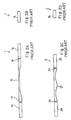
- Figures 2A and 2B illustrate a sound bar 1 incorporated in a marimba or a vibraphone, and the prior art sound bar 1 has side portions 1a and 1b thicker than a central portion 1c therebetween. Holes 1d and 1e are formed in the side portions 1a and 1b, respectively, and strings (not shown) pass through the holes 1d and 1e so as to support the sound bar 1.
- the prior art sound bar 1 is tuned in such a manner as to have the frequency ratio of the first-order to third-order vibration modes is 1 : 4 : 10.
- Figures 2C and 2D illustrate a sound bar 2 incorporated in a xylophone, and the prior art sound bar 2 has straight side portions 2a and 2b and a central portion 2c waved twice between the side portions 2a and 2b. Holes 2d and 2e are formed in the straight side portions 2a and 2b, and strings (not shown) also pass through the holes 2d and 2e.
- the prior art sound bar 2 is tuned in such a manner as to regulate the frequency ratio of the first-order to third-order vibration modes to 1 : 3 : 6 or 1 : 3 : 7. Although there is a possibility that the frequency of the third-order vibration mode is not tuned, the sound bars 1 and 2 shown in figures 2A/2B and 2C/2D approximate the frequencies to the above ratios.
- the sound bar 1 Comparing the sound bar 1 shown in figures 2A and 2B with the sound bar 2 shown in figures 2C and 2D, the sound bar 1 generates the second vibration mode 2 n times larger in frequency than the first vibration mode, and achieves a kind of consonant.
- the e frequency ratio of 2 n where n is 0, 1 and 2 and the vibration modes become close to the harmonic series.
- the undercut is assumed to have a parabolic shape described by two variable parameters related to its depth and width.
- the rest of the beam on each side of the undercut is assumed to be uniform. Seven pairs of optimal undercut parameters are found that bring the frequencies of the first three transverse modes into the harmonic (integer) ratios 1:3:6, 1:4:8-9, and 1:5:10-13.
- US-A-1 838 502 discloses a percussion musical instrument vibrant bar having undulating top and bottom surfaces and providing a plurality of sections of reduced thickness between the fundamental nodal points of the bar.
- US-A-5 198 602 discloses sound bars of marimbas and the like which are provided with one or more independently tuneable vibratable tongues extending under the tuning arches of such bars for producing one or more different tonal effects.
- US-A-1 632 751 discloses a musical bar so thinned at the anti-nodes of the fundamental tone and first overtone that the first overtone will be octavely spaced from the fundamental tone.
- the sound bar may have a central portion formed with a recess and end portions contiguous to the central portion and formed with respective recess so as to regulate the frequency ratio to 1 : 4 : 8.
- the sound bar may have a central portion formed with a multiple recess and end portions without a recess so as to regulate the frequency ratio to 1 : 4 : 8.
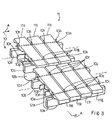
- a vibraphone embodying the present invention largely comprises a frame structure 10, a plurality of metal bars 11 and a plurality of resonators 12a and 12b.
- the plurality of metal bars 11 are laid out on the pattern of a keyboard incorporated in a standard piano, only seven metal bars 11a, 11b, 11c, 11d, 11e, 11f and 11g are mounted on the frame structure 10 in figure 3.
- the plurality of metal bars 11 serve as a plurality of sound bars.
- the frame structure 10 comprises two pairs of lateral bars 10a/10b and 10c/10d, a plurality of pin members 10e, 10f, 10g and 10h implanted into the lateral bars 10a to 10d at intervals, two pairs of braids 10i/10j and 10k/10m spread over the lateral bars 10a to 10d and two pairs of rail members 10n/10p and 10q/10r respectively extending inside of the two pairs of lateral bars 10a to 10d.
- the braids 10 o to 10m are respectively associated with the four lines of the pin members 10e to 10h, and pass through the holes formed in the associated pin members 10e to 10h.
- the braids 10i to 10m make knots (not shown) outside of the outermost pin members 10e to 10h, and the knots do not allow the braids 10i to 10m to slip out.
- the plurality of metal bars 11 cover a compass for three octaves, by way of example, and notes of a scale are respectively assigned to the plurality of metal bars 11.
- the plurality of metal bars 11 are arranged in two rows over the two pairs of lateral bars 10a/10b and 10c/10d, and a player stands in front of the first row including the metal bars 11d to 11g.
- the metal bars of the first row generate the natural tones.
- the metal bars of the second row generate the other tones usually represented by using sharp or flat.
- the metal bars 11a to 11c are staggered with respect to the metal bars 11d to 11g by half pitch, and each of the metal bars 11a to 11c is located between the adjacent two metal bars 11d/11e, 1e/11f or 11f/11g.
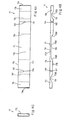
- Figures 4A to 4C illustrate one of the metal bars 11. All of the metal bars 11 are similar in configuration.
- the metal bars 11 are equal in width to one another, and are different in length depending upon the notes assigned thereto.
- the metal bar 11 is a generally rectangular parallelepiped configuration, and is divided into a central portion 11i and end portions 11j and 11k. Two holes 11m and 11n are respectively formed in a boundary between the end portion 11j and the central portion 11i and a boundary between the end portion 11k and the central portion 11i.
- the braids 10i and 10j respectively pass through the holes 11m and 11n, and support the metal bars 11 of the first row over the pair of lateral bars 10a/10b.
- the braids 10k and 10m pass through the holes 11m and 11n, and the metal bars 11 of the second row are supported through the braids 10k and 10m by the pin members 10g/10h over the pair of lateral bars 10c/10d.
- An upper surface 11p is flat, and a player beats the upper surface with a mallet (not shown).
- the lower surface 11q is partially curved, and forms recesses 11r, 11s and 11t in the end portion 11j, the central portion 11i and the other end portion 11k, respectively.
- the remaining lower surface 11q is flat between the recesses 11r and 11s and the recesses 11s and 11t, and are substantially parallel to the upper surface 11p.
- the lower surface 11q defining the recesses draws arcs 11qa and 11qb, and a flat sub-surface 11qc and round sub-surfaces 11qd and 11qe form the lower surface 11q defining the recess 11s.
- the flat sub-surface 11s is substantially in parallel to the upper surface 11p.
- the recess 11s makes the central portion 11i partially thinner than those on both sides thereof, and the part of the central portion 11i along the flat sub-surface 11qc is hereinbelow called as a flat central sub-portion 11
- the hole 11m is oblique with respect to side surfaces 11u and 11v, and the other hole 11n is normal to the side surfaces 11u and 11v. Additionally, the reason why one of the holes 11m obliquely extends is that the distance between the nodes N1 and N2 is decreased together with the length of the sound bar depending upon the pitch of the sound. End surfaces 11w and 11x are substantially in parallel to each other, and the peripheries of the end surfaces 11w and 11x are chamfered.
- the direction between the end surfaces is hereinbelow referred to as “longitudinal direction", and “length” represents the distance in the longitudinal direction.
- “width” is indicative of the distance between the side surfaces 11u and 11v, and the width is measured in a lateral direction of the metal bar 11.
- vibrations are generated in the metal bar 11, and contains a fundamental or first-order vibration, a second-order vibration and a third-order vibration.
- the first-order vibration mainly impresses the note assigned to the metal bar 11 beaten by the player, and high-order vibrations, i.e., the second-order vibration, the third-order vibration and so forth affect the timbre of the sound.
- the antinode of the first-order vibration takes place in the flat central sub-portion 11ia, and the nodes N1 and N2 of the first-order vibration take place in the holes 11m and 11n.
- the recesses 11r and 11t are located outside the nodes N1 and N2.
- the frequency ratio of the first-order to the third-order vibrations is regulable by changing the dimensions of the recesses 11r, 11s and 11t.
- the frequency ratio of the first-order vibration f0, the second-order vibration f1 and the third-order vibration f2 is 1 : 2.765 : 5.404.
- Each of the first-order to third-order vibrations has a node with the minimum amplitude and an antinode with the maximum amplitude.
- the recess has an influence on the frequencies of all the vibration modes to some extent. However, the power of the influence is different among the vibration modes. If a recess is located in a place where an antinode of a vibration takes place, the recess widely decreases the freqneucy of the vibration. On the other hand, if a recess is matched with a node of a vibration, the recess slightly decreases the frequency of the vibration. The recess 11s has the strongest influence on the first-order vibration.
- the second-order vibration is subsequently affected by the recess 11s, because the adjacent two antinodes takes place in or around the flat thin sub-portion 11ia.
- the recess 11s has the least influence on the third-order vibration among the first-order to third-order vibrations.
- the resonators 12a and 12b are implemented by metal tubes, and are supported beneath the metal bars 11 by the pairs of rails 10n/10p and 10q/10r (see figure 5).
- the metal bar 11 When the metal bar 11 is beaten, the metal bar 11 vibrates, and the associated resonator 12a/12b imparts a vibrating sound to the tone.
- the frequency ratio of the first-order vibration, the second-order vibration and the third-order vibration is regulated to 1 : 4 : 8.
- the second-order vibration is 2 octaves higher than the first-order vibration
- the third-order vibration is 3 octaves higher than the first-order vibration.
- the first-order vibration is 442 Hz
- the second-order vibration and the third-order vibration are corresponding to A3 two octaves higher than A1 and A4 three octaves higher than A1, respectively.
- the second-order vibration and the third-order vibration emphasizes the note of the first-order vibration, and the vibraphone according to the present invention clearly discriminative tones.
- the metal bar 11 generates the first-order vibration to the third-order vibration identical in the pitch name with one another, and the vibrations fall under the strict definition of the tone.
- the second-order vibration generated by the prior art sound bar 1 is four times larger in frequency than the first-order vibration
- the third-order vibration is ten times larger in frequency than the first-order vibration.
- the frequency ratio of the metal bar 11 is smaller than that of the prior art sound bar 1, and, accordingly, the frequency spectrum generated by the metal bar 11 is denser than that of the prior art sound bar 1.
- the tone generated by the prior art sound bar 1 is less consonant with related tones.
- the tone generated by the metal bar 11 is highly consonant with related tones. In general, the consonance takes place through gentle beat due to an interference between the frequency components close to one another.
- the prior art sound bars 1 vibrate for generating a chord
- the second-order vibration of the higher tone is seldom interfered with the third-order vibration of the lower tone.
- the higher tone and the lower tone hardly form the chord.
- the third-order vibration generated by the metal bar 11 is eight times larger in frequency than the first-order vibration.
- the metal bars 11 form a compass wider than the compass prior art sound bar 1.
- the standard pitch used in the tuning is A1 at 442 Hz, and the standard frequency analyzer can measure the frequency until C5 at 4205 Hz. If the frequency ratio is 1 : 4 : 10, the standard frequency analyzer can regulate until G#1 at 417.2 Hz, because the third-order vibration of the next tone exceeds the upper limit of the standard frequency analyzer.
- the metal bar 11 has the frequency ratio of 1 : 4 : 8, and the standard frequency analyzer can check C2 at 525.6 Hz.
- the metal bars 11 provide a wider compass.
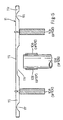
- FIGS 6A to 6C of the drawings illustrate a sound bar 21 incorporated in a percussion instrument embodying the present invention.
- the sound bar 21 is divided to a central portion 21a and end portions 21b and 21c, and holes 21d and 21e are formed in the boundary between the end portion 21b and the central portion 21a and between the central portion 21a and the end portion 21c.
- braids pass through the holes 21d and 21e, and the sound bar 21 floats over a frame structure (not shown).
- the sound bar 21 has a flat upper surface 21f beaten with a mallet (not shown), and a lower surface 21g is partially curved so as to form a multiple recess 21h in the central portion 21a.
- the end portions 21b and 21c have respective flat lower sub-surface 21ga and 21gb substantially in parallel to the upper surface 21f, and no recess is formed in the end portions 21b and 21c.
- the lower surface 21g defines the multiple recess 21h as follows.
- the lower surface 21g is curved to form an arc sub-surface 21gc at the mid portion of the sound bar 21, and flat lower sub-surfaces 21gd and 21ge are contiguous to the arc sub-surface 21gc in parallel to the upper surface 21f.
- Round sub-surfaces 21gf and 21gg extend between the flat lower sub-surface 21gd and the flat lower sub-surface 21ga and between the flat lower sub-surface 21ge and the flat lower sub-surface 21gb.
- the flat lower sub-surfaces 21gd/21ge and the round sub-surfaces 21gf and 21gg define a shallow recess 21ha
- the arch sub-surface 21gc defines a deep recess 21hb.
- the shallow recess 21ha and the deep recess 21hb form in combination the multiple recess 21h.
- a vibration changes the frequency depending upon the thickness of the sound bar at the antinode.
- the first-order vibration has the antinode in the thinnest portion defined by the arc sub-surface, and the second-order vibration and the third-order vibration have respective antinodes in the central portion 21a on bode sides of the thinnest portion. Therefore, the frequency of the first-order vibration is regulable independently from the second-order and third-order vibrations, and the central portion 21a on both sides of the thinnest portion has strong influence on the second-order vibration rather than the third-order vibration.
- the first-order and second-order vibrations are independently regulable, and the frequency ratio is adjusted to 1 : 4 : 8 without a recess of the end portions 21b/21c.
- the percussion instrument of the second embodiment achieves all of the advantages of the first embodiment.
- FIGS 7A to 7C of the drawings illustrate a sound bar 31 incorporated in a percussion instrument embodying the present invention.
- the sound bar 31 is divided to a central portion 31a and end portions 31b and 31c, and holes 31d and 31e are formed in the boundary between the end portion 31b and the central portion 31a and between the central portion 31a and the end portion 31c.
- braids pass through the holes 31d and 31e, and the sound bar 31 floats over a frame structure (not shown).
- the sound bar 31 has a flat upper surface 31f beaten with a mallet (not shown), and a lower surface 31g is partially curved so as to form a multiple recess 31h in the central portion 31a.
- the end portions 31b and 31c have respective flat lower sub-surface 31ga and 31gb substantially in parallel to the upper surface 31f, and no recess is formed in the end portions 31b and 31c.
- the lower surface 31g defines the multiple recess 31h as follows.
- the lower surface 31g is curved to form an arc sub-surface 31gc at the mid portion of the sound bar 31, and first flat lower sub-surfaces 31gd and 31ge are contiguous to the arc sub-surface 31gc in parallel to the upper surface 31f.
- First round sub-surfaces 31gf and 31gg extend between the first flat lower sub-surfaces 31gd/ 31ge and second flat power sub-surfaces 31gh and 31gi.
- Second round sub-surfaces 31gj and 31gk connect the second flat lower sub-surfaces 31gh and 31gi to the flat lower sub-surfaces 31ga and 31gb.
- the second flat lower sub-surfaces 31gh/31gi and the second round sub-surfaces 31gj and 31gk define a shallow recess 31ha, and the arch sub-surface 31gc defines a deep recess 31hb.
- the first flat lower sub-surfaces 31gd/31ge and the first round sub-surfaces 31gf/31gg define an intermediate recess 31hc, and the shallow recess 31ha, the intermediate recess 31hc and the deep recess 31hb form in combination the multiple recess 31h.
- the first-order vibration has the antinode in the thinnest portion defined by the deep recess 31hb
- the second-order vibration has the antinodes in the thinner portion defined by the intermediate recess 31hc
- the third-order vibration has antinodes in the thin portion defined by the shallow recess 31ha. Therefore, the frequency of the first-order vibration, the frequency of the second-order vibration and the frequency of the third-order vibration are independently regulable by selecting the thicknesses of the thinnest, thinner and thin portions, and the frequency ratio is adjusted to 1 : 4 : 8 without a recess of the end portions 31b/31c.
- the percussion instrument of the second embodiment achieves all of the advantages of the first embodiment.
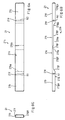
- FIGS 8A to 8C illustrate a sound bar 41 incorporated in still another percussion instrument embodying the present invention.
- the sound bar is divided into a central portion 41a and end portions 41b and 41c.
- the central portion 41a is similar to the central portion of the second embodiment, and surfaces and recesses are labeled with the same references designating the corresponding surfaces and recesses of the second embodiment without detailed description.
- the end portions 41b and 41c have respective recesses 41i and 41j.
- the recesses 41i and 41j have the same influence of the vibration characteristics on the sound bar 41 as the recesses 11r and 11t, and the frequency ratio is exactly regulated to 1 : 4 : 8.
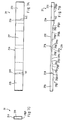
- FIGS 9A to 9C illustrate a sound bar 51 incorporated in a percussion instrument embodying the present invention.
- the sound bar 51 is divided into a central portion 51a and end portions 51b and 51c.
- the central portion 51a is similar to the central portion of the third embodiment, and surfaces and recesses are labeled with the same references designating the corresponding surfaces and recesses of the third embodiment without detailed description.
- the end portions 51b and 51c have respective recesses 51i and 51j.
- the recesses 51i and 51j have the same influence of the vibration characteristics on the sound bar 51 as the recesses 11r and 11t, and the frequency ratio is exactly regulated to 1 : 4 : 8.
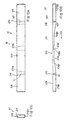
- FIGS 10A to 10C illustrates a sound bar 61 incorporated in a percussion instrument embodying the present invention.
- the sound bar 61 is divided into a central portion 61a and end portions 61b and 61c.
- the end portions 61b and 61c are similar to those of the second embodiment, and surfaces of the end portions are labeled with the same references designating the corresponding surfaces of the end portions 11j and 11k without detailed description.
- a multiple recesses 61h is formed in the central portion 61a, and a shallow recess 61ha and a deep recess 61hb form in combination the multiple recesses 61h.
- the deep recess 61hb is defined by the arc sub-surface 21gc, and the shallow recess 61ha is defined by another arc sub-surface 61ga.
- the radius of curvature of the arc sub-surface 61ga is larger than that of the arc sub-surface 21gc, and no flat surface is incorporated in the lower surface defining the central portion 61a.
- the sixth embodiment achieves all of the advantages of the second embodiment.
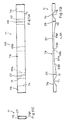
- FIGS 11A to 11C illustrate a sound bar 71 incorporated in a percussion instrument embodying the present invention.
- the sound bar 71 is divided into a central portion 71a and end portions 71b and 71c, and the central portion 71a is similar to the central portion 61a of the sixth embodiment.
- Surfaces and recesses of the central portion 71a are labeled with the same references as those of the sixth embodiment without detailed description.
- Recesses 71i and 71j are formed in the end portions 71b and 71c. Therefore, the frequency ratio is exactly regulated to 1 : 4 : 8.
- the recess or the multiple recess of the central portion regulates the frequencies of the first-order to third-order vibrations, and the recesses of the end portions differently changes the frequencies of the first-order to third-order vibrations.
- the frequency ratio of the first-order to third-order vibrations is regulated to 1 : 4 8.
- the sound bars thus regulated generates the tones exactly on the scale, and the tones of a chord beautifully harmonize with one another.
- the sound bar according to the present invention is available for a percussion instrument of a definite pitch such as, for example, a xylophone, a glockenspiel and a marimba.
- the sound bar may be formed of wood or synthetic resin.
Landscapes
- Physics & Mathematics (AREA)
- Engineering & Computer Science (AREA)
- Acoustics & Sound (AREA)
- Multimedia (AREA)
- Electrophonic Musical Instruments (AREA)
Applications Claiming Priority (3)
| Application Number | Priority Date | Filing Date | Title |
|---|---|---|---|
| JP767495 | 1995-01-20 | ||
| JP00767495A JP3552319B2 (ja) | 1995-01-20 | 1995-01-20 | 音板打楽器用音板 |
| JP7674/95 | 1995-01-20 |
Publications (3)
| Publication Number | Publication Date |
|---|---|
| EP0723255A2 EP0723255A2 (en) | 1996-07-24 |
| EP0723255A3 EP0723255A3 (en) | 1999-06-16 |
| EP0723255B1 true EP0723255B1 (en) | 2003-04-16 |
Family
ID=11672351
Family Applications (1)
| Application Number | Title | Priority Date | Filing Date |
|---|---|---|---|
| EP96100772A Expired - Lifetime EP0723255B1 (en) | 1995-01-20 | 1996-01-19 | Percussion instrument with tone bars for exactly generating tones on a scale |
Country Status (4)
| Country | Link |
|---|---|
| US (1) | US5686679A (enExample) |
| EP (1) | EP0723255B1 (enExample) |
| JP (1) | JP3552319B2 (enExample) |
| DE (1) | DE69627402T2 (enExample) |
Families Citing this family (19)
| Publication number | Priority date | Publication date | Assignee | Title |
|---|---|---|---|---|
| JPH1097241A (ja) * | 1996-09-20 | 1998-04-14 | Yamaha Corp | 音板打楽器用音板 |
| US5977465A (en) * | 1996-11-27 | 1999-11-02 | The Selmer Company, Inc. | Mallet percussion instruments |
| US6376757B1 (en) | 1999-06-11 | 2002-04-23 | Tor C. Clausen | Furniture incorporating a percussion instrument and method for forming the same |
| US6162976A (en) * | 1999-06-11 | 2000-12-19 | Clausen; Tor C. | Furniture incorporating a percussion instrument and method for forming the same |
| US6245978B1 (en) | 1999-12-15 | 2001-06-12 | Leigh Howard Stevens | Keyboard musical percussion instrument tone bar suspension |
| NL1016627C2 (nl) * | 2000-11-16 | 2002-05-17 | Adams Paukenfabriek B V | Vibrafoon met verbeterde aandrijving van kleppen. |
| US6750386B2 (en) | 2002-08-26 | 2004-06-15 | Trevor King | Cycle of fifths steel pan |
| DE102005015811B3 (de) * | 2005-04-06 | 2006-07-20 | Studio 49 Musikinstrumentenbau Gmbh | Bass-Stabspielinstrument |
| ITMI20051106A1 (it) * | 2005-06-13 | 2006-12-14 | Enrico Ciresa S R L | Pannello sonoro per la diffusione di suoni e musica e relativo procedimento di fabbricazione. |
| KR100859905B1 (ko) | 2005-12-13 | 2008-09-23 | 야마하 가부시키가이샤 | 건반식 음판 타악기, 상기 음판 타악기용의 공명 관 및공명 상자 |
| KR100869414B1 (ko) | 2005-12-13 | 2008-11-21 | 야마하 가부시키가이샤 | 건반식 음판 타악기용의 음판 및 그 제조방법, 음판타악기의 음원 유닛 및 건반식 타악기 |
| JP4632089B2 (ja) * | 2005-12-13 | 2011-02-16 | ヤマハ株式会社 | 音板打楽器の音源ユニット |
| JP4752481B2 (ja) * | 2005-12-13 | 2011-08-17 | ヤマハ株式会社 | 鍵盤式音板打楽器用の音源ユニット及びその製造方法 |
| JP4699553B2 (ja) * | 2009-12-10 | 2011-06-15 | 徳恵 遠藤 | 鍵盤楽器、音板を有する楽器 |
| JP6179536B2 (ja) * | 2015-02-23 | 2017-08-16 | ヤマハ株式会社 | 楽器用音板 |
| DE102019124903A1 (de) | 2019-09-16 | 2021-03-18 | SONOR GmbH | Stabspielinstrument aufweisend mindestens einen Klangstab |
| DE102019124890A1 (de) | 2019-09-16 | 2021-03-18 | SONOR GmbH | Klangstab eines Stabspielinstrumentes und damit verbundenes Verbindungselement |
| DE102019135565B3 (de) | 2019-12-20 | 2021-05-12 | SONOR GmbH | Stabspielinstrument mit mindestens zwei Klangstäben |
| CN117121088A (zh) | 2021-04-02 | 2023-11-24 | 雅马哈株式会社 | 音板和打击乐器 |
Family Cites Families (8)
| Publication number | Priority date | Publication date | Assignee | Title |
|---|---|---|---|---|
| US1632751A (en) * | 1923-01-22 | 1927-06-14 | Leedy Mfg Company | Musical bar |
| US1838502A (en) * | 1930-10-30 | 1931-12-29 | J C Deagan Inc | Vibrant bar for musical instruments |
| US2133712A (en) * | 1937-09-20 | 1938-10-18 | Musser Clair Omar | Musical instrument |
| US2703504A (en) * | 1949-01-07 | 1955-03-08 | Maas Rowe Electromusic Corp | Tone adjustment for vibrant bars |
| US2655069A (en) * | 1950-10-06 | 1953-10-13 | Stromberg Carlson Co | Means for and method of tuning vibrating bars or rods |
| US3013461A (en) * | 1955-08-19 | 1961-12-19 | Schulmerich Electronics Inc | Method of tuning a musical tone generator bar |
| JPS60159894A (ja) * | 1984-01-31 | 1985-08-21 | ヤマハ株式会社 | 音板打楽器 |
| US5198602A (en) * | 1991-12-09 | 1993-03-30 | Roper Daleth F | Sound bar for percussive musical instrument |
-
1995
- 1995-01-20 JP JP00767495A patent/JP3552319B2/ja not_active Expired - Fee Related
-
1996
- 1996-01-16 US US08/588,065 patent/US5686679A/en not_active Expired - Fee Related
- 1996-01-19 DE DE69627402T patent/DE69627402T2/de not_active Expired - Lifetime
- 1996-01-19 EP EP96100772A patent/EP0723255B1/en not_active Expired - Lifetime
Also Published As
| Publication number | Publication date |
|---|---|
| JPH08202351A (ja) | 1996-08-09 |
| DE69627402D1 (de) | 2003-05-22 |
| US5686679A (en) | 1997-11-11 |
| EP0723255A2 (en) | 1996-07-24 |
| DE69627402T2 (de) | 2004-03-25 |
| EP0723255A3 (en) | 1999-06-16 |
| JP3552319B2 (ja) | 2004-08-11 |
Similar Documents
| Publication | Publication Date | Title |
|---|---|---|
| US5686679A (en) | Percussion instrument with tone bars for exactly generating tones on a scale | |
| US6426454B1 (en) | Stringed musical instruments and method therefor | |
| Fletcher | The nonlinear physics of musical instruments | |
| US6610915B2 (en) | Soundboard of composite fibre material construction | |
| US7863507B2 (en) | Semi-hollow body for stringed instruments | |
| US5902945A (en) | Percussion instrument having tone bars for generating clear tones exactly tuned along scale | |
| US1838502A (en) | Vibrant bar for musical instruments | |
| US7750218B2 (en) | Vibrato based percussion instrument | |
| Pierce | 14 Consonance and Scales | |
| US7518050B2 (en) | Folded percussion instruments | |
| US7288706B2 (en) | Stringed musical instrument with multiple bridge-soundboard units | |
| US20080000342A1 (en) | Soundboard for Acoustic Guitar | |
| JP3503247B2 (ja) | 音板および音板打楽器 | |
| US5198602A (en) | Sound bar for percussive musical instrument | |
| US5883318A (en) | Device for changing the timbre of a stringed instrument | |
| US4004482A (en) | Method of tuning fretted instruments | |
| US7709715B2 (en) | Keyboard percussion instrument including improved tone bar resonator | |
| CN120584373A (zh) | 打击乐器以及振动舌片元件 | |
| US20060288841A1 (en) | Stringed musical instrument | |
| Bucur | Idiophones Made of Wood and Played with Mallets: Marimbas and Xylophones | |
| RU2219592C2 (ru) | Струнный щипковый музыкальный инструмент | |
| Henderson et al. | RINGING THE CHANGES | |
| JPH07506679A (ja) | 打楽器 | |
| WO2024156363A1 (en) | Idiophone | |
| Worland | Experimental study of vibraphone pitch bending using electronic speckle-pattern interferometry |
Legal Events
| Date | Code | Title | Description |
|---|---|---|---|
| PUAI | Public reference made under article 153(3) epc to a published international application that has entered the european phase |
Free format text: ORIGINAL CODE: 0009012 |
|
| AK | Designated contracting states |
Kind code of ref document: A2 Designated state(s): DE FR GB NL |
|
| PUAL | Search report despatched |
Free format text: ORIGINAL CODE: 0009013 |
|
| AK | Designated contracting states |
Kind code of ref document: A3 Designated state(s): DE FR GB NL |
|
| 17P | Request for examination filed |
Effective date: 19991213 |
|
| 17Q | First examination report despatched |
Effective date: 20010627 |
|
| GRAH | Despatch of communication of intention to grant a patent |
Free format text: ORIGINAL CODE: EPIDOS IGRA |
|
| GRAH | Despatch of communication of intention to grant a patent |
Free format text: ORIGINAL CODE: EPIDOS IGRA |
|
| GRAA | (expected) grant |
Free format text: ORIGINAL CODE: 0009210 |
|
| AK | Designated contracting states |
Designated state(s): DE FR GB NL |
|
| REG | Reference to a national code |
Ref country code: GB Ref legal event code: FG4D |
|
| REF | Corresponds to: |
Ref document number: 69627402 Country of ref document: DE Date of ref document: 20030522 Kind code of ref document: P |
|
| PGFP | Annual fee paid to national office [announced via postgrant information from national office to epo] |
Ref country code: FR Payment date: 20040108 Year of fee payment: 9 |
|
| PGFP | Annual fee paid to national office [announced via postgrant information from national office to epo] |
Ref country code: GB Payment date: 20040114 Year of fee payment: 9 |
|
| ET | Fr: translation filed | ||
| PLBE | No opposition filed within time limit |
Free format text: ORIGINAL CODE: 0009261 |
|
| STAA | Information on the status of an ep patent application or granted ep patent |
Free format text: STATUS: NO OPPOSITION FILED WITHIN TIME LIMIT |
|
| 26N | No opposition filed |
Effective date: 20040119 |
|
| PG25 | Lapsed in a contracting state [announced via postgrant information from national office to epo] |
Ref country code: GB Free format text: LAPSE BECAUSE OF NON-PAYMENT OF DUE FEES Effective date: 20050119 |
|
| GBPC | Gb: european patent ceased through non-payment of renewal fee |
Effective date: 20050119 |
|
| PG25 | Lapsed in a contracting state [announced via postgrant information from national office to epo] |
Ref country code: FR Free format text: LAPSE BECAUSE OF NON-PAYMENT OF DUE FEES Effective date: 20050930 |
|
| REG | Reference to a national code |
Ref country code: FR Ref legal event code: ST |
|
| PGFP | Annual fee paid to national office [announced via postgrant information from national office to epo] |
Ref country code: DE Payment date: 20120111 Year of fee payment: 17 |
|
| PGFP | Annual fee paid to national office [announced via postgrant information from national office to epo] |
Ref country code: NL Payment date: 20120117 Year of fee payment: 17 |
|
| REG | Reference to a national code |
Ref country code: NL Ref legal event code: V1 Effective date: 20130801 |
|
| PG25 | Lapsed in a contracting state [announced via postgrant information from national office to epo] |
Ref country code: DE Free format text: LAPSE BECAUSE OF NON-PAYMENT OF DUE FEES Effective date: 20130801 Ref country code: NL Free format text: LAPSE BECAUSE OF NON-PAYMENT OF DUE FEES Effective date: 20130801 |
|
| REG | Reference to a national code |
Ref country code: DE Ref legal event code: R119 Ref document number: 69627402 Country of ref document: DE Effective date: 20130801 |