EP0721279A2 - Analytische Konstruktion von Halbtonbildpunkten für einen Drucker mit Hyperauflösung - Google Patents
Analytische Konstruktion von Halbtonbildpunkten für einen Drucker mit Hyperauflösung Download PDFInfo
- Publication number
- EP0721279A2 EP0721279A2 EP96300071A EP96300071A EP0721279A2 EP 0721279 A2 EP0721279 A2 EP 0721279A2 EP 96300071 A EP96300071 A EP 96300071A EP 96300071 A EP96300071 A EP 96300071A EP 0721279 A2 EP0721279 A2 EP 0721279A2
- Authority
- EP
- European Patent Office
- Prior art keywords
- halftone
- intensity
- scan
- dot
- printer
- Prior art date
- Legal status (The legal status is an assumption and is not a legal conclusion. Google has not performed a legal analysis and makes no representation as to the accuracy of the status listed.)
- Granted
Links
- 238000010276 construction Methods 0.000 title description 3
- 238000013507 mapping Methods 0.000 claims abstract description 13
- 238000005259 measurement Methods 0.000 claims abstract description 10
- 238000000034 method Methods 0.000 claims description 13
- 230000004044 response Effects 0.000 claims description 3
- 238000012886 linear function Methods 0.000 abstract 2
- 239000010432 diamond Substances 0.000 description 10
- 229910003460 diamond Inorganic materials 0.000 description 8
- 230000008901 benefit Effects 0.000 description 7
- 230000006870 function Effects 0.000 description 3
- 230000007704 transition Effects 0.000 description 3
- 230000008569 process Effects 0.000 description 2
- 241001270131 Agaricus moelleri Species 0.000 description 1
- 230000007423 decrease Effects 0.000 description 1
- 238000004519 manufacturing process Methods 0.000 description 1
- 239000000049 pigment Substances 0.000 description 1
- 230000009466 transformation Effects 0.000 description 1
Images




Classifications
-
- H—ELECTRICITY
- H04—ELECTRIC COMMUNICATION TECHNIQUE
- H04N—PICTORIAL COMMUNICATION, e.g. TELEVISION
- H04N1/00—Scanning, transmission or reproduction of documents or the like, e.g. facsimile transmission; Details thereof
- H04N1/40—Picture signal circuits
- H04N1/407—Control or modification of tonal gradation or of extreme levels, e.g. background level
- H04N1/4076—Control or modification of tonal gradation or of extreme levels, e.g. background level dependent on references outside the picture
- H04N1/4078—Control or modification of tonal gradation or of extreme levels, e.g. background level dependent on references outside the picture using gradational references, e.g. grey-scale test pattern analysis
-
- H—ELECTRICITY
- H04—ELECTRIC COMMUNICATION TECHNIQUE
- H04N—PICTORIAL COMMUNICATION, e.g. TELEVISION
- H04N1/00—Scanning, transmission or reproduction of documents or the like, e.g. facsimile transmission; Details thereof
- H04N1/40—Picture signal circuits
- H04N1/405—Halftoning, i.e. converting the picture signal of a continuous-tone original into a corresponding signal showing only two levels
- H04N1/4055—Halftoning, i.e. converting the picture signal of a continuous-tone original into a corresponding signal showing only two levels producing a clustered dots or a size modulated halftone pattern
- H04N1/4058—Halftoning, i.e. converting the picture signal of a continuous-tone original into a corresponding signal showing only two levels producing a clustered dots or a size modulated halftone pattern with details for producing a halftone screen at an oblique angle
Definitions
- the present invention relates to the halftoning arts. It finds particular application in conjunction with printing devices having halftone patterns for simulating gray value intensities and will be described with particular reference thereto.
- printers do not produce true gray values. Rather, they only produce dots of black ink.
- bunches of dots are outputted at various frequencies. The lower the number of black dots per unit area, the lighter the gray tone. The larger the number of black dots per unit area, the darker the resulting gray tone. The frequency controls the graininess of the gray tone area.
- a halftone cell is a predetermined number of dots used to simulate a level of gray. Dots are arranged in a particular manner within the halftone cell to define a desired halftone spot shape (e.g., circle, square, triangle, etc.) or the dots are randomly scattered.
- each halftone cell different gray level intensities are produced by changing the size of the halftone spot.
- a complete halftone pattern is formed from a multiplicity of halftone cells ranging from a cell with no dots on representing white to a halftone cell with all dots on representing black. Between the white and black cell, there is a variety of halftone spot sizes creating the different levels of gray.
- the human eye integrates the black dots and perceives gray areas, instead of the individual black dots.
- the quality of images produced by a printer will depend on the proper arrangement of dots within each halftone cell of the halftone pattern.
- many printing devices use customized halftone patterns.
- a customized halftone pattern improves the quality of a printer's images since the printer does not produce a linearly distributed range of intensities without the use of the halftone pattern.
- a skilled halftone artist typically creates the halftone pattern by hand. Viewing the printer characteristics on a computer terminal, the artist turns on each bit of each halftone cell to create halftone shapes which visually appears to give the fewest artifacts for the specific printer. This process is laborious and time-consuming. It is also prone to human errors based on the subjective nature of creating each halftone cell.
- each halftone cell is broken down into a fine grid, e.g., a 32x32 grid of scan positions which can be black or white.
- a dot of the preselected size and shape e.g., circle, square, triangle, etc. is defined.
- the scanning laser is turned on and off to determine whether each scan position is black or white.
- an ink drop is ejected or not to determine whether each position is black or white.
- an analytical halftone dot construction system which creates highly accurate halftone patterns automatically.
- a method and apparatus for constructing halftone dot patterns for a printing device measures printer intensity levels of a printing device which are output in response to selected gray scale printer commands.
- a spline or other interpolator interpolates the actually measured intensity levels into a best fit smooth curve which are output in response to selected gray scale printer commands.
- a mapping means generates a series of halftone intensity values which correspond linearly to the smooth curve.
- a dot area parameter calculator calculates parameters of a halftone dot pattern for each halftone cell of the set of halftone intensity values.
- a gray value calculator determines a value for each position in each of the halftone cells based on the parameters calculated.
- a look-up table stores the values. The values from the look-up table are provided to the printing device to control intensity levels during a subsequent printing operation.
- a position scanner scans through a plurality of scan positions within each halftone cell along a scan angle direction.
- a measurement processor calculates an edge distance to the nearest edge of the halftone dot of the printing intensity level in a scan angle direction.
- the measurement processor further calculates an edge angle from the scan angle to the nearest edge.
- the gray value for the scan position is produced by combining at least the edge distance value and the edge angle value.
- the gray value is stored in a look-up table at an address location which is a combination of the x,y-coordinate and the halftone intensity level of the halftone cell.
- a halftone dot pattern printing system is provided.
- An image input device inputs a series of intensity levels.
- a screen counter provides a series of scan positions within a halftone cell for each input intensity level. Each scan position and the intensity level of the corresponding halftone cell form a look-up table address.
- a look-up table is addressed by the look-up table address to retrieve a corresponding gray value.
- a printer device is controlled in accordance with the series of retrieved gray values to cause corresponding spots to be printed.
- the printing system further provides software and hardware for loading the look-up table uniquely for each printing device.
- Each halftone cell of a predetermined halftone pattern has a characteristic intensity level.
- a position scanner indexes a scan position through the corresponding halftone cell.
- a measurement processor measures a dot pattern intensity characteristic for each index scanned position.
- a gray value calculator calculates a gray value in accordance with the dot pattern intensity characteristic for each scan position of each of the halftone cells.
- the gray values are loaded into the look-up table at an address corresponding to the scan position and the intensity level of the halftone cell. In this manner, the look-up table is preprogrammed to define the halftone cells uniquely for each printing device.
- the invention further provides a method for constructing a halftone dot patter, according to claim 7 of the appended claims.
- the method preferably further includes: (h) generating a tone reproduction curve from the plurality of printer intensity levels of the printing device, the tone reproduction curve representing a linear mapping of area to the plurality of printer intensity levels; and (i) mapping the printer intensity levels based on the tone reproduction curve to the set of halftone intensity values.
- a method of halftone dot pattern printing comprising the steps of: (j) storing a family of halftone dot patterns; (k) printing a selected portion of the family of halftone dot patterns with a selected printing device; (I) determining an intensity level for each printed dot pattern of the family; (m) dividing each dot pattern into a preselected array of scan positions; (n) for each scan position of each dot pattern, determining a corresponding value; (o) loading each gray value into a look-up table; (p) in subsequent printing operations, the look-up table is addressed by (i) a corresponding scan position and (ii) the intensity level of the corresponding dot pattern.
- the method preferably further includes the steps of: (q) receiving a series of intensity levels which describe a picture to be printed; (r) addressing the look-up table with the received intensity levels and the preselected array of scan positions for each intensity level to retrieve corresponding gray values; (s) controlling the selected printing device to print the corresponding gray values.
- the method preferably further includes the steps of: (t) determining a linear relationship between the intensity levels of the printed dot patterns and a density of the corresponding stored dot pattern; (u) adjusting the gray values in accordance with the linear relationship.
- the step of determining a corresponding gray value for each scan position includes determining a distance between each scan position and a nearest edge point on a dot of the dot pattern of the corresponding intensity.
- the step of determining the corresponding gray value further includes determining an angle between a normal to the nearest edge point and a direction of scanning through the scan positions.
- One advantage of the present invention is that it customizes the dot pattern of the halftone cells to each printing device.
- Another advantage of the present invention is that it corrects for nonlinear intensity level distribution.
- Another advantage of the present invention resides in its automatic and discontinuity-free transition between dot printers.
- Another advantage of the present invention resides in the high fidelity of the generated dots.
- Another advantage is that the dot patterns can be generated semiautomatically with scan angle and frequency being used as parameters.
- a hard copy output device such as a printer 10 responds to input intensity or gray scale commands to produce a corresponding hardcopy dot.
- a printer typically responds to input intensity or gray scale commands to produce a corresponding hardcopy dot.
- laser and inkjet printers are preferred, other halftone printers and devices such as computer generated engraving plate devices, electrostatic printers, and the like are also contemplated.
- the printer has a preselected range of gray scale commands, e.g., 0 to 255.
- An intensity measuring device 12 preferably a microdensitometer, measures each of the gray scale samples to determine its actual intensity L. If L equals v, for all v and L, an ideal or linear relationship 14 would be achieved. However, due to printer characteristics, hardware and software designs, manufacturing tolerances, when the actually measured values of L are plotted against v, the resultant points 16 fall off the linear curve 14.
- An interpolator 20, preferably a cubic spline interpolator, provides a best fit smooth curve 22 through the points 16.
- an intensity to density converter 24b determines a corresponding density value based on the linear mapping of FIGURE 2C.
- the density value for an intensity value v represents an area of the halftone cell required to be filled by a halftone dot creating the intensity value v.
- the new density values are loaded into a look-up table 26.
- the look-up table is addressed in equal steps L to retrieve the corresponding fractional v.
- each halftone cell is divided into a grid of 1's and 0's or ink on and off spots.
- the grid is a 32x32 grid.
- Each grid or memory plane is addressed by a 5-bit x-value along one axis and a 5-bit y-value along the other axis.
- the 5-bit x and y-values for each of the fractional v memory planes are generated efficiently in equation space.
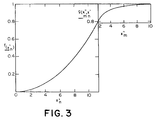
- a circle-diamond tone reproduction curve of FIGURE 3 the vertical axis represents the density values f(x' n ) and the horizontal axis represents the corresponding radius x' n of a circular halftone dot required to produce the corresponding density.
- x" m represents a power value used to transform the circle halftone dot into a diamond halftone dot in the highest density range from 0.8 to 1.0 (80% to 100% of cell is filled in). It is to be appreciated that other halftone patterns may be used which would require a different tone reproduction curve based on the shape of the halftone dot.
- a mapping of intensity level to area of the black halftone dot circle corresponding to the intensity level increases linearly from 0 to 127, and the area of the white dot decreases linearly from 127 to 255 as shown in FIGURE 2C.
- the circle-diamond-circle pattern the circle inverses in the high intensity range, i.e., all but white circles are blackened in the high intensity range.
- dot area parameter calculator 28 calculates parameters for each halftone dot of each intensity level v based on the tone reproduction curve.
- the dot parameters calculated are radius r and power p. Power p controls the transformation of the circle to the diamond shape. Alternately, for a different halftone dot pattern, the dot area parameter calculator 28 would calculate a different set of dot parameters based on the selected configuration of the halftone dot.
- the dot parameters for each halftone cell are inputted to a measurement processor 30.
- the 8-bit value v represents the selected halftone intensity range which, in the preferred embodiment, has 256 values from 0 to 255, some of which may be fractional values after being adjusted by the spline tone adjuster.
- Each of 256 halftone cells 32 represents one plane or intensity of the intensity range.
- a 5-bit x-address and a 5-bit y-address define a 32x32 halftone cell.
- a 6-bit x-address and y-address would define a 64x64 halftone cell.
- a position scanner 34 traverses each x,y-coordinate or scan position in a scan direction S in the halftone cell.
- the measurement processor 30 locates a nearest edge E of the halftone dot for the current intensity v defined by the dot parameters of the circular, square, triangular, or other selected shape dot to a current scan position (a,b).
- the nearest edge of interest E to the current scan position (a,b) is located in the screen angle direction.
- the nearest edge is defined by an edge normal E n which intersects the current scan position (a,b) and a point (x,y) on the edge or surface of the dot, for the given intensity value v.
- the halftone cell is created on the basis of a predetermined halftone dot pattern.
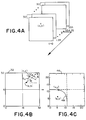
- the halftone dot pattern has a circular dot 36 in highlight regions (FIGURE 5A). As the regions become darker, larger numbers of the 32x32 scan positions are turned on to define circular dots of larger diameters, such as circular dots 36' and 36".
- the circular dots continue getting larger to a mid-range in which the circular dot 38 is tangent to a square or diamond 40 that fills half of the region of the halftone cell 32. Thereafter, as the dot becomes larger, it becomes a diamond or square with progressively less rounded corners 42, 42', 42" constrained within the diamond 40.
- the halftone cell is half black when the diamond 40 is completely filled. Thereafter, the black region fills out along patterns 44, 44', 44", progressively.
- the shape of the expansion is such that where four cells come together, a white circle is defined, when all four halftone cells have the same intensity (FIGURE 5D).
- dots of various other shapes may be selected.
- FIGURE 6 illustrates for each of the dot shapes or patterns, halftone cells with a minimal frequency or intensity on the left and a maximal intensity or frequency on the right.
- the family of 256 cells in the preferred embodiment, spans the range illustrated in FIGURE 6 and further.
- the measurement processor 30 calculates the x,y-coordinates of the nearest edge by: In this manner, g(x) evaluates to the difference in slopes of the normal to the edge E at (x,y), and a line through both (x,y) and (a,b). The root of the g(x) function gives the x-coordinate for the nearest edge E of the halftone dot.
- Equation (1) Equation (1):
- the intensity level v 120 being just under half of the 256 possible levels of the preferred embodiment, one can expect a dot shape generally as shown in FIGURE 5B by dot 42".
- the measurement processor 30 calculates a Euclidean distance from the scan position (a,b) along the edge normal E n to the (x,y) on the edge.
- An angle ⁇ by which the edge normal E n is offset from the screen angle ⁇ is also determined with the scan position (a,b) being the vertex.
- the position of the nearest edge E is located by mapping the (x,y) coordinate system of the halftone cell 32 into equation space.
- a corresponding equation space map 46 shows the relative positions of the scan position and edge E mapped into equation space.
- the edge distance and edge angle ⁇ are inputted to a gray value calculator 50.
- a gray value for the intensity level v at scan position (a,b) is calculated as a function of the edge angle and edge distance in equation space.
- the gray value is determined by: where:
- the gray value can be determined by: where:
- the position scanner 34 cycles through all possible permutations of the 5-bit x-coordinate of each halftone cell, the 5-bit y-coordinate, and the 8-bit intensity value, i.e., 32x32x256 or 2 18 permutations.
- a gray value typically 0 through 15, is produced for each permutation.
- a look-up table 26 stores the determined gray values. In the preferred embodiment, the look-up table has 2 18 memory locations. Each memory location is accessed by an address which is a combination of the 5-bit x-coordinate of a halftone cell, the 5-bit y-coordinate of the halftone cell, and the 8-bit intensity value v for the halftone cell, together providing an 18-bit address.
- the completed look-up table contains the gray values for each halftone cell for the selected intensity range. Alternately, the entire dot construction process may be repeated to generate more accurate halftone dots.
- a screen generator counter 52 inputs a series of x,y-coordinates to define the positions within each halftone cell as an input image 54 provides a corresponding series of intensity levels v.
- the look-up table 26 is connected with the screen generator counters 52 and the intensity lines of the input image data 54.
- the screen counters 52 count for the x and y-coordinates along a predetermined screen angle, for example 45°. Thus, the counters count at the sine and cosine of 45° through the halftone look-up table 26.
- a corresponding gray value from a location corresponding to the combined values of (x,y,v) is outputted from the look-up table 26 to a laser diode controller 56 of printer 10 for printing the particular intensities and screen positions, i.e., printing the spots which, taken together over the whole cell, form the dot of proper size and shape.
- the gray value again typically 0-15, can be fed to a digital-to-analog converter directly or can be converted to a code to drive a pulse width and position modulator (PWPM).
- PWPM pulse width and position modulator
- the input image 54 and the screen counter 52 are connected to an address generator which generates the look-up table address and outputs the address to the look-up table 26.
Landscapes
- Engineering & Computer Science (AREA)
- Multimedia (AREA)
- Signal Processing (AREA)
- Facsimile Image Signal Circuits (AREA)
- Color, Gradation (AREA)
- Image Processing (AREA)
Applications Claiming Priority (2)
| Application Number | Priority Date | Filing Date | Title |
|---|---|---|---|
| US368459 | 1995-01-04 | ||
| US08/368,459 US5696604A (en) | 1995-01-04 | 1995-01-04 | Analytical halftone dot construction for a hyperacuity printer |
Publications (3)
| Publication Number | Publication Date |
|---|---|
| EP0721279A2 true EP0721279A2 (de) | 1996-07-10 |
| EP0721279A3 EP0721279A3 (de) | 1998-05-20 |
| EP0721279B1 EP0721279B1 (de) | 2003-06-25 |
Family
ID=23451289
Family Applications (1)
| Application Number | Title | Priority Date | Filing Date |
|---|---|---|---|
| EP96300071A Expired - Lifetime EP0721279B1 (de) | 1995-01-04 | 1996-01-03 | Analytische Konstruktion von Halbtonbildpunkten für einen Drucker mit Hyperauflösung |
Country Status (4)
| Country | Link |
|---|---|
| US (1) | US5696604A (de) |
| EP (1) | EP0721279B1 (de) |
| JP (1) | JPH08256265A (de) |
| DE (1) | DE69628771T2 (de) |
Cited By (2)
| Publication number | Priority date | Publication date | Assignee | Title |
|---|---|---|---|---|
| EP0838941A3 (de) * | 1996-10-22 | 1999-02-10 | Canon Kabushiki Kaisha | Bildverarbeitungsvorrichtung, Bildausgabevorrichtung, Verfahren zu deren Steuerung und Bildausgabesystem |
| EP1054559A3 (de) * | 1999-05-21 | 2004-07-14 | Fuji Photo Film Co., Ltd. | Verfahren zur Tonwiedergabe mit Halbtonpunkten |
Families Citing this family (21)
| Publication number | Priority date | Publication date | Assignee | Title |
|---|---|---|---|---|
| JPH10301370A (ja) * | 1997-04-28 | 1998-11-13 | Nec Niigata Ltd | 電子写真装置 |
| EP1027679B1 (de) | 1997-11-03 | 2003-04-23 | Kodak Polychrome Graphics LLC | Verfahren und vorrichtung zur kalibrierung eines bilderzeugungsgeräts mit mehreren bildausgängen |
| US6092732A (en) * | 1998-01-29 | 2000-07-25 | Xerox Corporation | Selectively accented serpentine halftone patterns for embedding human readable information in images |
| US6201560B1 (en) | 1998-05-28 | 2001-03-13 | Xerox Corporation | Multibeam modulation driver for a hyperacuity printer |
| US6346993B1 (en) | 1999-02-05 | 2002-02-12 | Xerox Corporation | Tone-variation-resistant phase-shiftable halftone screen system and method of using |
| DE60035549T2 (de) * | 1999-06-07 | 2008-04-17 | Canon K.K. | Bildaufzeichnungsgerät und Verfahren |
| JP4392082B2 (ja) * | 1999-08-06 | 2009-12-24 | ヒューレット・パッカード・カンパニー | 彫版風ハーフトーン画像生成方法・装置 |
| US6781720B1 (en) | 1999-11-30 | 2004-08-24 | Xerox Corporation | Gradient-based trapping using patterned trap zones |
| US7089420B1 (en) | 2000-05-24 | 2006-08-08 | Tracer Detection Technology Corp. | Authentication method and system |
| US7152047B1 (en) | 2000-05-24 | 2006-12-19 | Esecure.Biz, Inc. | System and method for production and authentication of original documents |
| US7162035B1 (en) | 2000-05-24 | 2007-01-09 | Tracer Detection Technology Corp. | Authentication method and system |
| US6763144B1 (en) * | 2000-06-01 | 2004-07-13 | Creo Il, Ltd. | Halftone image reproduction |
| US6741751B1 (en) | 2000-08-18 | 2004-05-25 | Xerox Corporation | Logic based tagging for hyperacuity rendering of an input image with a 5×5 context |
| US6956676B2 (en) * | 2000-12-28 | 2005-10-18 | Xerox Corporation | Methods and systems for providing halftone screens |
| US7492480B2 (en) * | 2001-08-27 | 2009-02-17 | Phototype Engraving Company | System for halftone screen production |
| US8171567B1 (en) | 2002-09-04 | 2012-05-01 | Tracer Detection Technology Corp. | Authentication method and system |
| JP2005193384A (ja) * | 2003-12-26 | 2005-07-21 | Ricoh Co Ltd | 画像処理方法、装置、および画像形成装置 |
| US7283619B2 (en) * | 2004-06-15 | 2007-10-16 | Cisco Technology, Inc. | System and method for end-to-end communications tracing |
| US7557962B2 (en) * | 2004-07-13 | 2009-07-07 | Toshiba Corporation | System and method for tone-dependent multi-frequency halftone screening |
| JP4490412B2 (ja) * | 2006-12-28 | 2010-06-23 | 京セラミタ株式会社 | 画像処理装置、濃度調整方法 |
| US7995196B1 (en) | 2008-04-23 | 2011-08-09 | Tracer Detection Technology Corp. | Authentication method and system |
Family Cites Families (11)
| Publication number | Priority date | Publication date | Assignee | Title |
|---|---|---|---|---|
| US4651287A (en) * | 1984-06-14 | 1987-03-17 | Tsao Sherman H | Digital image processing algorithm for output devices with discrete halftone gray scale capability |
| US5029107A (en) * | 1989-03-31 | 1991-07-02 | International Business Corporation | Apparatus and accompanying method for converting a bit mapped monochromatic image to a grey scale image using table look up operations |
| US5041920A (en) * | 1989-11-15 | 1991-08-20 | Xerox Corporation | Image halftone generation by static RAM look-up table |
| US5583660A (en) * | 1990-09-14 | 1996-12-10 | Minnesota Mining And Manufacturing Company | Non-perpendicular, equal frequency non-conventional screen patterns for electronic halftone generation |
| US5253084A (en) * | 1990-09-14 | 1993-10-12 | Minnesota Mining And Manufacturing Company | General kernel function for electronic halftone generation |
| JPH04126462A (ja) * | 1990-09-18 | 1992-04-27 | Canon Inc | 画像形成装置 |
| US5287209A (en) * | 1990-10-09 | 1994-02-15 | Matsushita Electric Industrial Co., Ltd. | Image forming device for enhancing tone reproduction by changing dot size |
| US5414531A (en) * | 1991-02-22 | 1995-05-09 | Canon Kabushiki Kaisha | Image forming control based on a stored operation condition |
| US5291311A (en) * | 1992-06-29 | 1994-03-01 | Eastman Kodak Company | Apparatus and method for generating multi-level output values for pixels in a halftone cell |
| US5444551A (en) * | 1992-07-22 | 1995-08-22 | Eastman Kodak Company | Process for specifying mean-preserving mutli-level halftone matrices with varying amounts of modulation |
| JPH07264411A (ja) * | 1994-03-25 | 1995-10-13 | Canon Inc | 画像形成装置 |
-
1995
- 1995-01-04 US US08/368,459 patent/US5696604A/en not_active Expired - Lifetime
- 1995-12-28 JP JP7353528A patent/JPH08256265A/ja active Pending
-
1996
- 1996-01-03 EP EP96300071A patent/EP0721279B1/de not_active Expired - Lifetime
- 1996-01-03 DE DE69628771T patent/DE69628771T2/de not_active Expired - Fee Related
Non-Patent Citations (1)
| Title |
|---|
| None |
Cited By (4)
| Publication number | Priority date | Publication date | Assignee | Title |
|---|---|---|---|---|
| EP0838941A3 (de) * | 1996-10-22 | 1999-02-10 | Canon Kabushiki Kaisha | Bildverarbeitungsvorrichtung, Bildausgabevorrichtung, Verfahren zu deren Steuerung und Bildausgabesystem |
| US6046820A (en) * | 1996-10-22 | 2000-04-04 | Canon Kabushiki Kaisha | Image forming device and computer which share the generation of a function for correcting image data based on an image forming condition of the image forming device |
| EP1054559A3 (de) * | 1999-05-21 | 2004-07-14 | Fuji Photo Film Co., Ltd. | Verfahren zur Tonwiedergabe mit Halbtonpunkten |
| US6970273B1 (en) | 1999-05-21 | 2005-11-29 | Fuji Photo Film Co., Ltd. | Method of tone reproduction with halftone dots, apparatus for outputting halftone plate, halftone plate, and printed material |
Also Published As
| Publication number | Publication date |
|---|---|
| JPH08256265A (ja) | 1996-10-01 |
| EP0721279A3 (de) | 1998-05-20 |
| EP0721279B1 (de) | 2003-06-25 |
| DE69628771D1 (de) | 2003-07-31 |
| US5696604A (en) | 1997-12-09 |
| DE69628771T2 (de) | 2004-02-12 |
Similar Documents
| Publication | Publication Date | Title |
|---|---|---|
| US5696604A (en) | Analytical halftone dot construction for a hyperacuity printer | |
| EP0808055B1 (de) | Verbessertes Fehlerdiffusionsverfahren zur Farb- oder Schwarzweisswiedergabe | |
| EP0493445B1 (de) | Verfahren und vorrichtung zur erzeugung gerasterter halbtonbilder | |
| EP0740458B1 (de) | Punktgrössensteuerverfahren bei digitaler Halbtonrasterung mit mehrzelligen Schwellenmatrix | |
| EP0772347B1 (de) | Farbdrucker mit Zittermuster | |
| US20050094212A1 (en) | Halftone dot formation method, halftone dot formation apparatus, threshold matrix generation method used therefor and halftone dot recording medium | |
| EP0670654B1 (de) | Erzeugung von Mehrfachtonbildern | |
| EP0977424B1 (de) | Drucken gerasterter Halbtöne unter Verwendung von torischen Filtern | |
| US6704123B1 (en) | Method for applying tonal correction to a binary halftone image | |
| US20030081258A1 (en) | Method of generating halftone threshold data, apparatus for generating halftone image, and recording medium | |
| EP1067763B1 (de) | Systeme und Verfahren zur Erzeugung von Bildern mit hoher Adressierbarkeit | |
| EP0670653B1 (de) | Erzeugung von Mehrfachtonbildern | |
| US5150225A (en) | Apparatus for generating a screened reproduction of an image | |
| US7557962B2 (en) | System and method for tone-dependent multi-frequency halftone screening | |
| EP0461250B1 (de) | Fehlerhafte dichtekonturunterdrückung, die zufallsmodifizierte eingangssignale für den vergleich mit schwellenwerten benutzt | |
| EP0789325B1 (de) | Verfahren und Gerät zur wirkungsvollen Bildinterpolation | |
| CA2169399C (en) | Analytical halftone dot construction for a hyperacuity printer | |
| EP0457519B1 (de) | Gerät zur Erzeugung einer gerasterten Reproduktion eines Bildes | |
| EP0488324B1 (de) | Verfahren und Vorrichtung zur Herstellung von Halbtonbildern | |
| US6798541B2 (en) | Systems and methods for generating binary clustered, irrational halftone dots | |
| US7310168B2 (en) | Method and apparatus for controlling a spot function for digital halftoning | |
| EP0588566B1 (de) | Gerät und Verfahren zur Erzeugung einer gerasterten Reproduktion eines Bildes | |
| US6201560B1 (en) | Multibeam modulation driver for a hyperacuity printer | |
| US5600448A (en) | Apparatus and method for generating a screened reproduction of an image | |
| JP2000341521A (ja) | 閾値マトリクスの作成方法 |
Legal Events
| Date | Code | Title | Description |
|---|---|---|---|
| PUAI | Public reference made under article 153(3) epc to a published international application that has entered the european phase |
Free format text: ORIGINAL CODE: 0009012 |
|
| AK | Designated contracting states |
Kind code of ref document: A2 Designated state(s): DE FR GB |
|
| PUAL | Search report despatched |
Free format text: ORIGINAL CODE: 0009013 |
|
| AK | Designated contracting states |
Kind code of ref document: A3 Designated state(s): DE FR GB |
|
| 17P | Request for examination filed |
Effective date: 19981120 |
|
| 17Q | First examination report despatched |
Effective date: 20020718 |
|
| GRAH | Despatch of communication of intention to grant a patent |
Free format text: ORIGINAL CODE: EPIDOS IGRA |
|
| GRAH | Despatch of communication of intention to grant a patent |
Free format text: ORIGINAL CODE: EPIDOS IGRA |
|
| GRAA | (expected) grant |
Free format text: ORIGINAL CODE: 0009210 |
|
| AK | Designated contracting states |
Designated state(s): DE FR GB |
|
| REG | Reference to a national code |
Ref country code: GB Ref legal event code: FG4D |
|
| REF | Corresponds to: |
Ref document number: 69628771 Country of ref document: DE Date of ref document: 20030731 Kind code of ref document: P |
|
| PG25 | Lapsed in a contracting state [announced via postgrant information from national office to epo] |
Ref country code: GB Free format text: LAPSE BECAUSE OF NON-PAYMENT OF DUE FEES Effective date: 20040103 |
|
| ET | Fr: translation filed | ||
| PLBE | No opposition filed within time limit |
Free format text: ORIGINAL CODE: 0009261 |
|
| STAA | Information on the status of an ep patent application or granted ep patent |
Free format text: STATUS: NO OPPOSITION FILED WITHIN TIME LIMIT |
|
| 26N | No opposition filed |
Effective date: 20040326 |
|
| PG25 | Lapsed in a contracting state [announced via postgrant information from national office to epo] |
Ref country code: DE Free format text: LAPSE BECAUSE OF NON-PAYMENT OF DUE FEES Effective date: 20040803 |
|
| GBPC | Gb: european patent ceased through non-payment of renewal fee |
Effective date: 20040103 |
|
| PG25 | Lapsed in a contracting state [announced via postgrant information from national office to epo] |
Ref country code: FR Free format text: LAPSE BECAUSE OF NON-PAYMENT OF DUE FEES Effective date: 20040930 |
|
| REG | Reference to a national code |
Ref country code: FR Ref legal event code: ST |