EP0720106A2 - Vorrichtung und Verfahren zum Erzeugen von natursprachlicher Information aus durch Konzepte definierter Information - Google Patents
Vorrichtung und Verfahren zum Erzeugen von natursprachlicher Information aus durch Konzepte definierter Information Download PDFInfo
- Publication number
- EP0720106A2 EP0720106A2 EP95309436A EP95309436A EP0720106A2 EP 0720106 A2 EP0720106 A2 EP 0720106A2 EP 95309436 A EP95309436 A EP 95309436A EP 95309436 A EP95309436 A EP 95309436A EP 0720106 A2 EP0720106 A2 EP 0720106A2
- Authority
- EP
- European Patent Office
- Prior art keywords
- knowledge
- natural language
- concept
- input
- language processing
- Prior art date
- Legal status (The legal status is an assumption and is not a legal conclusion. Google has not performed a legal analysis and makes no representation as to the accuracy of the status listed.)
- Ceased
Links
Images







Classifications
-
- G—PHYSICS
- G06—COMPUTING OR CALCULATING; COUNTING
- G06F—ELECTRIC DIGITAL DATA PROCESSING
- G06F40/00—Handling natural language data
- G06F40/30—Semantic analysis
- G06F40/35—Discourse or dialogue representation
-
- G—PHYSICS
- G06—COMPUTING OR CALCULATING; COUNTING
- G06F—ELECTRIC DIGITAL DATA PROCESSING
- G06F40/00—Handling natural language data
- G06F40/40—Processing or translation of natural language
- G06F40/55—Rule-based translation
- G06F40/56—Natural language generation
Definitions
- the present invention relates to a system for inputting conceptual information, and generating and outputting natural language information, and a method therefor.
- the present invention which achieves these objectives relates to a natural language processing system, comprising: input means for inputting information expressed by a concept; a knowledge base having the knowledge of languages, general knowledge, and the knowledge of specific areas; selecting means for selecting the expression form of a concept which is input from the input means by referring to the knowledge base; and output means for outputting the expression form selected by the selecting means.
- the present invention which achieves these objectives relates to a natural language processing system, comprising: input means for inputting information expressed by a concept; a knowledge base having the knowledge of languages, general knowledge, and the knowledge of specific areas; determination means for determining information to be added to input information from the input means by referring to the knowledge base; and output means for adding the information determined by the determination means to the input information and outputting the information.
- the present invention which achieves these objectives relates to a natural language processing system, comprising: input means for inputting information expressed by a concept; a knowledge base having the knowledge of languages, general knowledge, and the knowledge of specific areas; connecting means for connecting a plurality of concepts from the input means by referring to the knowledge base; and output means for outputting the concept connected by the connecting means as one concept.
- the present invention which achieves these objectives relates to a natural language processing system, comprising: input means for inputting information expressed by a concept; splitting means for splitting the input information from the input means into individual concepts by referring to the knowledge base; selecting means for selecting one natural language expression from one or more natural language expressions with respect to individual concepts split by the splitting means by referring to the knowledge base; and output means for outputting a natural language expression selected by the selecting means.
- the present invention which achieves these objectives relates to a natural language processing method, comprising: input step of inputting information expressed by a concept; selecting step of storing the form of expressing the concept input from the inputting step by referring to a knowledge base having the knowledge of languages, general knowledge, and the knowledge of specific areas; and output step of outputting the expression form selected in the selecting step.
- the present invention which achieves these objectives relates to a natural language processing method, comprising: input step of inputting information expressed by a concept; determining step of determining information to be added to the input information from the input step by referring to a knowledge base having the knowledge of languages, general knowledge, and the knowledge of specific areas; and output step of adding the information determined in the determining step and outputting the information.
- the present invention which achieves these objectives relates to a natural language processing method, comprising: input step of inputting information expressed by a concept; connecting step of connecting a plurality of concepts from the input means by referring to a knowledge base having the knowledge of languages, general knowledge, and the knowledge of specific areas; and output step of outputting the concept connected in the connecting step as one concept.
- the present invention which achieves these objectives relates to a natural language processing method, comprising: input step of inputting information expressed by a concept; splitting step of splitting input information input in the input step into individual concepts by referring to a knowledge base having the knowledge of languages, general knowledge, and the knowledge of specific areas; and selecting step of selecting one natural language expression from one or more natural language expressions with respect to individual concepts split in the splitting step; output step of outputting the natural language expression selected in the selecting step.
- Fig. 1 is a block diagram illustrating the hardware configuration of an embodiment of a natural language processing apparatus in accordance the present invention.
- an input unit 1 inputs information in the form of natural language information.
- input information is referred to as a sentence.
- a sentence if it has a fixed ordered structure, can be made to be a processing object even if the sentence is not a grammatically complete sentence.
- the input unit 1 is a unit for inputting information.
- Examples of the input unit 1 are voice recognition apparatus for inputting and recognizing voice, a keyboard for inputting characters, a character recognition apparatus for optically reading characters from a document and recognizing them, an online/offline handwriting character recognition apparatus, and a receiving apparatus for receiving information from another system, for example, an apparatus for receiving a recognition result from a character recognition apparatus.
- Information generated from another process in the same apparatus may be an input in this case.
- two or more of these apparatuses may be provided and used selectively.
- a CPU 2 performs operations, logical decisions, etc., for various processes, and controls each of the components connected to a bus 6.
- An output unit 3 is a unit for outputting information.
- Examples of the output unit 3 are a speech synthesis apparatus for synthesizing a speech from character information and outputting it, a display apparatus, such as a CRT or a liquid-crystal display unit, a printer for printing out characters on a document, and a transmitting apparatus for transmitting information to another apparatus, such as a database.
- An output in this case may be an input to another process in the same apparatus, for example, a concept analyzer.
- two or more of these apparatuses may be provided and used selectively.
- a program memory 4 is a memory for storing programs for control effected by the CPU 2, including procedural steps to be described later in accordance with a flowchart.
- the program memory 4 may be a ROM or RAM in which programs are loaded from an external storage apparatus.
- a data memory 5 stores the contents of a knowledge base to be described later.
- the data memory 5 is made of, for example, RAM. It is assumed that the knowledge of the knowledge base is loaded from a non-volatile external storage medium prior to processing, or a reference is made thereto each time it becomes necessary.
- the bus 6 transfers an address signal indicating a component to be controlled by the input unit 1, a control signal for controlling each component, and data exchanged between the component apparatuses.
- Fig. 2 is a block diagram illustrating the functional structure of a natural language processing system.
- preparation refers to that the internal expression of a computer, such as conceptual expression, is converted into the expression of natural language, such as English.
- a combination of such internal expression and a template can also be processed.
- a pregenerator 21 adds or changes the internal expression of the concept or the like input from a text preparator in order to prepare an well-organized output sentence in accordance with the style of a person or difference in the rank relation between the speaker and the reader, and outputs it to a generator 23.
- a knowledge base 22 has prepared therein knowledge necessary for that addition or change.
- the generator 23 converts a sentence such that factors, such as the style of a person or the rank relation between the speaker and the listener, are included by the pregenerator 21, and generates a well-organized, high-quality sentence.
- the pregenerator 21 is able to perform processes, such as combining short sentences into a complex sentence, or splitting a complex sentence, in order to improve readability.
- the pregenerator 21 is also able to use long/short expressions according to the user's taste, and determines the expression form, such as a suggestive or imperative form, and the relationship between the speaker and the listener. As described above, the pregenerator 21 transforms the internal expression and outputs it, and the generator 23 generates a sentence from the internal expression of the transformed word.
- Figs. 3 to 8 show examples of a concept structure.
- Fig. 3 shows the structure of concepts of an action.
- Fig. 4 shows an example of an action.
- Fig. 5 shows the structure of the concept of MEET.
- Fig. 6 shows the structure of the concept of MTRANS.
- Fig. 7 shows the structure of the concept of PTRANS.
- Fig. 8 shows the structure of the concept of AGREEMENT.
- Figs. 9 to 12 show examples of language knowledge of a knowledge base.
- Fig. 9 shows the structure of a linguistic knowledge base (LKB).
- Fig. 10 shows an example of a form dictionary.
- Fig. 11 shows an example of a concept dictionary.
- Fig. 12 shows an example of grammar.
- Fig. 13 is a flowchart of the procedural steps of the pregenerator 21 of this embodiment.
- the pregenerator 21 has a plurality of mutually different functions.
- continuous concepts are connected (step S301), a complex, incomprehensible concepts is split (step S302), and the concepts are qualified according to the features of each language, the style of the person, social and cultural rules, etc. (step S303).
- qualifiify is meant to not only add information, but also delete unnecessary or redundant portions.
- Fig. 14 is a detailed flowchart of a process for connecting concepts.
- two or more concepts are connected according to a certain rule.
- a special structure called Coord or condn is created.
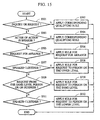
- Fig. 15 is a flowchart of a process for qualifying an action.
- the process proceeds to step S505; if the action is a request of arrange, the rule for qualifying the arrange request is applied in step S506. If the action is neither an inquiry nor request, a related rule is applied according to the status relationship between the speaker and the listener (steps S507 to S512). Here, the status relationship is assumed to be prestored as knowledge in the knowledge base.
- the relative relationship when a person is seen from another person, such as his/her teacher, his/her superior, or his/her subordinate, may be described as being attributes of the other person, or, the organization to which each person belongs, the rank, etc. may be provided as knowledge.
- Fig. 16 shows an example of rules for a case of an arrange request. These rules depend upon the closeness between the speaker and the listener.
- Fig. 17 shows an example of rules for a case of a request to a person in an upper rank (his/her seniors).
- Fig. 18 shows an example of rules for a case of a request to a person in the same rank.
- Fig. 19 shows an example of rules for a case of a request to a person in a lower rank.
- Con1 indicates “I am coming to USA on business in May”
- Con2 indicates “I would like to meet you on 10th May”. Therefore, these two concepts can be grouped into one.
- the pregenerator 21 outputs one concept Coord1 shown in Fig. 21.
- the pregenerator 21 adds the phrase of "it so happens” at the beginning of the sentence.
- Coordl which is finally output indicates "It so happens that I am coming to USA on business in May and I shall be extremely ashamed if I could meet you on 10th May 93".
- Con3 indicates "arrange accommodation for me”.
- Con3 of Fig. 24 is output.
- Con3 indicates "Could you kindly arrange for my accommodation?".
- a weather forecast system Next, an example of a weather forecast system will be considered.
- the sentence of a) in Fig. 27 is assumed to be an input.
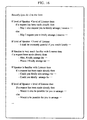
- An actual input to the system is in the form of an internal expression, but is expressed by English in this example. This sentence is hard to read because several things are described. Therefore, the pregenerator 21 applies a rule for trimming the connected actions. As a result, an output such as that shown in b) of Fig. 27 is obtained.
- Tense and mood are features of a language.
- an action has an absolute time.
- the pregenerator 21 selects proper tense and mood in the expression of the target language on the basis of the absolute time, context, and the relationship and friendship between the speaker and the listener.
- Fig. 28 shows an example of rules of the mood.
- the input shown in Fig. 29 is assumed to be an input. This input indicates "I write to you about my plan”.
- the pregenerator 21 obtains Con7 of Fig. 30 with the tense as the future and with the mode as the objective. This indicates "I shall write to you about my plan”.
- a) of Fig. 31 is assumed to be an input from the sentence generator.
- the input is expressed by a natural language for easy understanding; however, an actual input is formed in an internal expression.
- the pregenerator 21 needs to provide a hint to make the sentence easy to read to a module which follows the pregenerator, such as a generator which converts a concept expression into natural language.
- Fig. 32 is a block diagram illustrating a detailed structure of the generator.
- the generator 23 consists of a preprocessor 231, a sentence generator 232, and a postprocessor 233.
- a list of internal expressions e.g., Action(s), Action(s) + Templates, Concepts
- the output of the preprocessor 231 is processed by the sentence generator 232 for converting the internal expression into natural language, such as English.
- the postprocessor 233 performs post-editing, internal feedback, and the like.
- Fig. 33 is a flowchart illustrating the procedural steps of the preprocessor 231.
- the main function of the preprocessor 231 is to generate a linguistic concept for adding a feature dependent upon the language to the input concept (step S3303).
- Features dependent upon the language include gender, number, case (nominative case, objective%), and person (first person, second person).
- the preprocessor 231 determines the style and the expression form while seeing through the entire concept to be described, and passes the style and the expression form to the sentence generator 232 with the style and the expression form as guidelines.
- the guideline includes the form of the pronoun and the approximate center of the contents.
- Fig. 34 is a flowchart illustrating the detailed procedural steps of a process (step S3304) for satisfying parameters dependent upon a language.
- the concept is a human being
- the person is determined (steps S3401 and S3402)
- the number is filled with the count (step S3403)
- the gender is filled (step S3404).
- Fig. 35 is a flowchart illustrating the procedural steps of the sentence generator 232.
- step S3501 the input concept is added to GLIST, and SENTENCE is set to null.
- step S3502 a check is made to determine if GLIST is null. If it is null, SENTENCE is output, and the process is terminated. If the GLIST is not null, a check is made in step S3503 to determine if the leading item of GLIST is a word. If the leading item of GLIST is a word, the word is added to the SENTENCE in step S3504, and the process returns to step S3502.
- step S3505 a check is made to determine if a special condition is satisfied. If so, the process returns to step S3502. If a special condition is not satisfied, the process proceeds to step S3506 where a check is made to determine if the condition is the first concept to be expressed. If not so, the process returns to step S3502, and if so, in step S3507, a word corresponding to the first concept in the GLIST is searched, and in step S3508, a subconcept is set on the GLIST using position information, and the process returns to step S3502.
- Fig. 36 is a flowchart illustrating the procedural steps regarding the condition of an infinitive, which is one of the special conditions.
- the condition of the infinitive determines whether a tag is attached to indicate whether a certain concept should be written in an infinitive form, or an infinitive form should be used if the surface word or phrase of the verb is identified. For example, if the current concept and the object thereof is an action, it should be expressed in an infinitive form. If the actor of the filled action is the same as the actor of the action or Iobject, the actor of the filled action should be omitted.
- Fig. 37 is a flowchart illustrating the procedural steps regarding the conditions of an inquiry. If the concept of the action is described in an interrogative tone, a proper Wh-phrase (Who, When, etc.) is determined on the basis of the slot of the problem. In the case of an interrogative form, a polite sentence is generated. The tag is also set in the inversion between the subject and the auxiliary verb. This is because in English, usually, the subject is before the auxiliary verb, whereas this order is reversed in the interrogative form.
- Fig. 38 is a flowchart illustrating the procedural steps for determining a Wh-phrase with respect to English.
- Fig. 39 is a flowchart illustrating the procedural steps for determining a Wh-phrase on the basis of the concept.
- Fig. 40 is a flowchart illustrating the procedural steps for seeking a surface word of a concept. Initially, a check is made to determine if the concept has already been stated, or the concept has been marked by a pronoun (step S1001). If so, a pronoun capable of describing the concept is used (step S1002). If not so, the knowledge base of the language is searched, and all words corresponding to the concept are extracted (step S1005). The generator searches a personal database or a user entry dictionary in order to obtain words desired by the user. This search is performed as described below.
- the concept dictionary shown in Fig. 41 is searched for each concept. All the related word tags are retrieved together with their respective use conditions and limitations. These conditions and limitations are interpreted, and a word tag which matches best is searched (step S1005). When this is detected, the synonyms thereof are retrieved (step S1006), and stored together with the grammar information of the concept.
- Fig. 41 is a flowchart illustrating the procedural steps for determining a pronoun. Initially, a check is made to determine if the concept can be expressed using a pronoun (step S1101). If, for example, ambiguity increases as a result of using the pronoun, the pronoun is not used. The pronoun which is used actually is determined in accordance with parameters, such as the type of the concept, the gerund, or the person (steps S1102 to S1107).
- Fig. 42 is a flowchart illustrating the procedural steps for determining a surface word. If the concept is an action, the form of expressing the verb is determined (step S1202). If the concept is not an action, the base form is determined from the word tag by retrieving the form dictionary shown in Fig. 10 (step S1203), and related position information is obtained (step S1204). The position information and the syntax determines the form of expressing the subconcept and the slot of the concept. A preposition is determined for the slot requiring a preposition (step S1205). The final surface word is determined from the base form on the basis of the language parameters. For example, in the case of a noun, whether the noun should be in a single form or a plural form is determined on the basis of the number, the gender, etc.
- Fig. 43 is a flowchart illustrating the procedural steps for determining a surface word in the case of a verb.
- the base form is determined from the word tag by retrieving the form dictionary shown in Fig. 10 (step S1301).
- Related position information and the syntax also determines the form of expressing the subconcept and the slot of the concept (step S1302).
- a preposition is determined for the slot requiring a preposition by applying a grammar rule (step S1203).
- the verb is a reason (object) for a certain action
- there are two expression forms in English: the infinitive form and the gerund form, and which one of the forms should be taken is determined (step S1305).
- Which form the final surface word should take is determined on the basis of the mood, the auxiliary verb, and the tense (step S1306).
- the surface word is also affected by any one of the infinitive form and the gerund form the verb is expressed.
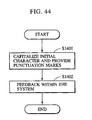
- Fig. 44 is a flowchart illustrating the procedural steps of a postprocessor 233.
- the postprocessor 233 after the sentence generator 232-generates an output sentence of natural language, performs post-editing, for example, capitalizing the initial character of the sentence, or providing punctuation marks in step S1401.
- the postprocessor 233 in addition to these functions, checks the fitness of the generated sentence by feedback within the system on the basis of the supplied input and the system's understanding.
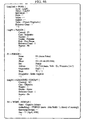
- Fig. 45 illustrates an input example showing an action of type of WORK.
- the preprocessor 231 converts this input into a linguistic action structure shown in Fig. 46.
- linguistic parameters such as the gender, the person, the case, etc., are determined and added. Also, the number of times the concept has been expressed is determined and added.
- step S3501 LingCon1 is added to GLIST, and, as a result, the following is obtained: 101) GLIST: (LingCon1) SENTENCE:()
- step S3507 is performed.
- the details of searching the word corresponding to the concept are shown in the flowchart of Fig. 40.
- the output is stored in the SENTENCE. Since this concept has not been mentioned before, an appropriate verb for the action is obtained from LKB of Fig. 9. This search is performed as described below.
- the concept dictionary shown in Fig. 11 is searched, and all the verbs (word tags) matching this concept are obtained together with the related condition and rule.
- the generator 23 evaluates this rule in order to check whether each verb can be used.
- the word tag obtained in this case is workl.
- the form dictionary shown in Fig. 10 the form of the surface word is determined on the basis of the mood and the tense. Here, "am working" is formed.
- position information i.e., syntax information, Actor, Verb, Object, Support, IobjReason, and Time are obtained.
- grammar rule prepositions for each slot are determined, and transformed position information Actor, Verb, on Object, Support, IobjReason, and Time are obtained.
- GLIST ('on'Object,Support,IobjReason,Time) SENTENCE: (I am working)
- the surface form which expresses the Work area is Name, and the related position information obtained from LKB shown in Fig. 9 are Name, Methodology, and Since.
- Name, using, Methodology, Since is formed.
- GLIST ('on' Name, 'using' Methodology, Since, Support, IobjReason,Time) SENTENCE:(I am working) 107) GLIST:('on Cognitive Science','using'Methodology, Support,IobjReason,Time) SENTENCE: (I am working) 108) GLIST; ('using'methodology, Support,IobjReason,Time) SENTENCE: (I am working on Cognitive Science) 109) GLIST: ('using'Methodology,Support, IobjReason, Time) SENTENCE: (I am working on Cognitive Science)
- the preprocessor 231 converts this input into a linguistic action structure shown in Fig. 48.
- linguistic parameters such as the gender, the person, the case, etc., are determined and added. Also, the number of times the concept has been expressed is determined and added.
- GLIST is not null, but a concept, and a special condition is checked.
- the expression form is determined that the verb is described with a tag indicating an infinitive form. Since the actor of WANT is the same as that of MTRANS, the actor of the embedded MTRANS is not expressed.
- the retrieval of the word corresponding to MTRANS is performed in the same way as for the other verbs.
- the surface word is determined to be "discuss", and position information becomes "Actor,Verb,Object,with IobjectBenf, IobjReason,Instrument,Time".
- GLIST (Actor, 'to discuss',Object,with IobjectBenf, IobjReason,Instrument,Time)
- SENTENCE (I would like)
- the Work area is expressed in the same manner as in the above-described embodiment. Assuming that an input is continued, a pronoun is used, and as an appropriate pronoun, "it" is selected. 209) GLIST: (with IobjectBenf, IobjReason, Instrument,Time) SENTENCE: (I would like to discuss it) 210) GLIST: (with IobjectBenf,IobjReason,Instrument,Time) SENTENCE: (I would like to discuss it) 211) GLIST: (with you,IobjReason,Instrument,Time) SENTENCE: (I would like to discuss it) 212) GLIST: (IobjReason,Instrument,Time) SENTENCE: (I would like to discuss it with you)
- the preprocessor 231 converts this input into a linguistic action structure shown in Fig. 50.
- the processing results at each stage are shown below. The processing steps are the same as those of the above-described embodiment. 301) GLIST: (LingCon8) SENTENCE: ()
- Iobj-reason is expressed in the form of a gerund. 310) GLIST: ('for attending',Conf1,LingCon4) SENTENCE:(since I am coming to USA) 311) GLIST:('IJCAI conference',LingCon4) SENTENCE:(since I am coming to USA for attending) 312) GLIST: (LingCon4) SENTENCE: (since I am coming to USA for attending IJCAI conference)
- the preprocessor 231 converts this input into a linguistic action structure shown in Fig. 52.
- the processing results at each stage are shown below. The processing steps are the same as those of the above-described embodiment. 401) GLIST: (Coord1) SENTENCE: ()
- the surface word for LingCon9 is made to be "am coming" from the LKB, and position information becomes "Actor,Verb,Iobj-direction,Iobj-reason,Time”.
- GLIST is transformed as described below: 403) GLIST:('it so happens',Actor,Verb,Iobj-direction, Iobj-reason, Time,and,LingCon10) SENTENCE: () 404) GLIST:(Actor, Verb,Iobj-direction,Iobj-reason, Time, and,LingCon10) SENTENCE: (it so happens)
- a plurality of concepts can be connected. Also, a complex, incomprehensible concept can be split. A sentence can be qualified on the basis of various factors. It is possible to generate a sentence of the expression form desired by the individual user.
- the present invention described above may be applied to a system constituted of a plurality of computers, or a specific computer within a system. Also, the present invention may be applied to a case in which an achievement is made by a computer executing a program.
- This program may be supplied from an external storage medium, and the storage medium for storing this program is within the scope of the present invention.
Landscapes
- Engineering & Computer Science (AREA)
- Theoretical Computer Science (AREA)
- Health & Medical Sciences (AREA)
- Artificial Intelligence (AREA)
- Audiology, Speech & Language Pathology (AREA)
- Computational Linguistics (AREA)
- General Health & Medical Sciences (AREA)
- Physics & Mathematics (AREA)
- General Engineering & Computer Science (AREA)
- General Physics & Mathematics (AREA)
- Machine Translation (AREA)
Applications Claiming Priority (4)
| Application Number | Priority Date | Filing Date | Title |
|---|---|---|---|
| JP6327448A JPH08185406A (ja) | 1994-12-28 | 1994-12-28 | 自然言語処理システム及びその方法 |
| JP327448/94 | 1994-12-28 | ||
| JP327449/94 | 1994-12-28 | ||
| JP6327449A JPH08185404A (ja) | 1994-12-28 | 1994-12-28 | 自然言語処理システム及びその方法 |
Publications (2)
| Publication Number | Publication Date |
|---|---|
| EP0720106A2 true EP0720106A2 (de) | 1996-07-03 |
| EP0720106A3 EP0720106A3 (de) | 1997-07-23 |
Family
ID=26572508
Family Applications (1)
| Application Number | Title | Priority Date | Filing Date |
|---|---|---|---|
| EP95309436A Ceased EP0720106A3 (de) | 1994-12-28 | 1995-12-27 | Vorrichtung und Verfahren zum Erzeugen von natursprachlicher Information aus durch Konzepte definierter Information |
Country Status (2)
| Country | Link |
|---|---|
| US (1) | US6023669A (de) |
| EP (1) | EP0720106A3 (de) |
Cited By (2)
| Publication number | Priority date | Publication date | Assignee | Title |
|---|---|---|---|---|
| EP0841625A1 (de) * | 1996-11-08 | 1998-05-13 | Softmark Limited | Eingabe- und Ausgabekommunikation in einem Datenverarbeitungssystem |
| EP0841624A1 (de) * | 1996-11-08 | 1998-05-13 | Softmark Limited | Eingabe- und Ausgabekommunikation in einem Datenverarbeitungssystem |
Families Citing this family (43)
| Publication number | Priority date | Publication date | Assignee | Title |
|---|---|---|---|---|
| US6167411A (en) * | 1998-06-22 | 2000-12-26 | Lucent Technologies Inc. | User interface for entering and editing data in data entry fields |
| US20020073111A1 (en) * | 2000-06-27 | 2002-06-13 | Heyliger David Kern | Computer software system and method to expedite data entry for databases |
| US7085723B2 (en) * | 2001-01-12 | 2006-08-01 | International Business Machines Corporation | System and method for determining utterance context in a multi-context speech application |
| US6950793B2 (en) * | 2001-01-12 | 2005-09-27 | International Business Machines Corporation | System and method for deriving natural language representation of formal belief structures |
| US7249018B2 (en) * | 2001-01-12 | 2007-07-24 | International Business Machines Corporation | System and method for relating syntax and semantics for a conversational speech application |
| US7257537B2 (en) * | 2001-01-12 | 2007-08-14 | International Business Machines Corporation | Method and apparatus for performing dialog management in a computer conversational interface |
| US7127402B2 (en) * | 2001-01-12 | 2006-10-24 | International Business Machines Corporation | Method and apparatus for converting utterance representations into actions in a conversational system |
| US20020194187A1 (en) * | 2001-05-16 | 2002-12-19 | Mcneil John | Multi-paradigm knowledge-bases |
| US7613666B1 (en) | 2004-04-23 | 2009-11-03 | Microsoft Corporation | Generating a class model from a business vocabulary to represent facts expressible in the business vocabulary |
| US7802231B2 (en) * | 2004-04-30 | 2010-09-21 | Microsoft Corporation | Generating programmatic interfaces from natural language expressions of authorizations for provision of information |
| US7620935B2 (en) | 2004-04-30 | 2009-11-17 | Microsoft Corporation | Generating programmatic interfaces from natural language expressions of authorizations for request of information |
| US7499850B1 (en) * | 2004-06-03 | 2009-03-03 | Microsoft Corporation | Generating a logical model of objects from a representation of linguistic concepts for use in software model generation |
| US7562008B2 (en) * | 2004-06-23 | 2009-07-14 | Ning-Ping Chan | Machine translation method and system that decomposes complex sentences into two or more sentences |
| US7613676B2 (en) | 2004-07-27 | 2009-11-03 | Microsoft Corporation | Generating a database model from natural language expressions of business rules |
| US8050907B2 (en) | 2004-07-30 | 2011-11-01 | Microsoft Corporation | Generating software components from business rules expressed in a natural language |
| US7930169B2 (en) * | 2005-01-14 | 2011-04-19 | Classified Ventures, Llc | Methods and systems for generating natural language descriptions from data |
| US8346555B2 (en) * | 2006-08-22 | 2013-01-01 | Nuance Communications, Inc. | Automatic grammar tuning using statistical language model generation |
| US20090326925A1 (en) * | 2008-06-27 | 2009-12-31 | Microsoft Corporation | Projecting syntactic information using a bottom-up pattern matching algorithm |
| US20090326924A1 (en) * | 2008-06-27 | 2009-12-31 | Microsoft Corporation | Projecting Semantic Information from a Language Independent Syntactic Model |
| US9223859B2 (en) * | 2011-05-11 | 2015-12-29 | Here Global B.V. | Method and apparatus for summarizing communications |
| US9116885B2 (en) * | 2012-01-16 | 2015-08-25 | Google Inc. | Techniques for a gender weighted pinyin input method editor |
| US9405448B2 (en) | 2012-08-30 | 2016-08-02 | Arria Data2Text Limited | Method and apparatus for annotating a graphical output |
| US8762134B2 (en) | 2012-08-30 | 2014-06-24 | Arria Data2Text Limited | Method and apparatus for situational analysis text generation |
| US8762133B2 (en) | 2012-08-30 | 2014-06-24 | Arria Data2Text Limited | Method and apparatus for alert validation |
| US9336193B2 (en) | 2012-08-30 | 2016-05-10 | Arria Data2Text Limited | Method and apparatus for updating a previously generated text |
| US9355093B2 (en) | 2012-08-30 | 2016-05-31 | Arria Data2Text Limited | Method and apparatus for referring expression generation |
| US9135244B2 (en) | 2012-08-30 | 2015-09-15 | Arria Data2Text Limited | Method and apparatus for configurable microplanning |
| US9600471B2 (en) | 2012-11-02 | 2017-03-21 | Arria Data2Text Limited | Method and apparatus for aggregating with information generalization |
| WO2014076525A1 (en) | 2012-11-16 | 2014-05-22 | Data2Text Limited | Method and apparatus for expressing time in an output text |
| WO2014076524A1 (en) | 2012-11-16 | 2014-05-22 | Data2Text Limited | Method and apparatus for spatial descriptions in an output text |
| US10095692B2 (en) * | 2012-11-29 | 2018-10-09 | Thornson Reuters Global Resources Unlimited Company | Template bootstrapping for domain-adaptable natural language generation |
| WO2014102569A1 (en) | 2012-12-27 | 2014-07-03 | Arria Data2Text Limited | Method and apparatus for motion description |
| WO2014102568A1 (en) | 2012-12-27 | 2014-07-03 | Arria Data2Text Limited | Method and apparatus for motion detection |
| US10776561B2 (en) | 2013-01-15 | 2020-09-15 | Arria Data2Text Limited | Method and apparatus for generating a linguistic representation of raw input data |
| US10037317B1 (en) | 2013-07-17 | 2018-07-31 | Yseop Sa | Techniques for automatic generation of natural language text |
| US9411804B1 (en) * | 2013-07-17 | 2016-08-09 | Yseop Sa | Techniques for automatic generation of natural language text |
| WO2015028844A1 (en) | 2013-08-29 | 2015-03-05 | Arria Data2Text Limited | Text generation from correlated alerts |
| US9244894B1 (en) * | 2013-09-16 | 2016-01-26 | Arria Data2Text Limited | Method and apparatus for interactive reports |
| US9396181B1 (en) | 2013-09-16 | 2016-07-19 | Arria Data2Text Limited | Method, apparatus, and computer program product for user-directed reporting |
| US10664558B2 (en) | 2014-04-18 | 2020-05-26 | Arria Data2Text Limited | Method and apparatus for document planning |
| US10445432B1 (en) | 2016-08-31 | 2019-10-15 | Arria Data2Text Limited | Method and apparatus for lightweight multilingual natural language realizer |
| US10467347B1 (en) | 2016-10-31 | 2019-11-05 | Arria Data2Text Limited | Method and apparatus for natural language document orchestrator |
| US10635862B2 (en) * | 2017-12-21 | 2020-04-28 | City University Of Hong Kong | Method of facilitating natural language interactions, a method of simplifying an expression and a system thereof |
Family Cites Families (14)
| Publication number | Priority date | Publication date | Assignee | Title |
|---|---|---|---|---|
| US4829423A (en) * | 1983-01-28 | 1989-05-09 | Texas Instruments Incorporated | Menu-based natural language understanding system |
| US5083268A (en) * | 1986-10-15 | 1992-01-21 | Texas Instruments Incorporated | System and method for parsing natural language by unifying lexical features of words |
| US4914590A (en) * | 1988-05-18 | 1990-04-03 | Emhart Industries, Inc. | Natural language understanding system |
| JPH0289166A (ja) * | 1988-09-26 | 1990-03-29 | Sharp Corp | 文書作成支援装置 |
| US5282265A (en) * | 1988-10-04 | 1994-01-25 | Canon Kabushiki Kaisha | Knowledge information processing system |
| JPH02297188A (ja) * | 1989-03-14 | 1990-12-07 | Sharp Corp | 文書作成支援装置 |
| US5329446A (en) * | 1990-01-19 | 1994-07-12 | Sharp Kabushiki Kaisha | Translation machine |
| JPH04235672A (ja) * | 1991-01-10 | 1992-08-24 | Sharp Corp | 翻訳装置 |
| US5377103A (en) * | 1992-05-15 | 1994-12-27 | International Business Machines Corporation | Constrained natural language interface for a computer that employs a browse function |
| US5675815A (en) * | 1992-11-09 | 1997-10-07 | Ricoh Company, Ltd. | Language conversion system and text creating system using such |
| US5384702A (en) * | 1993-09-19 | 1995-01-24 | Tou Julius T | Method for self-correction of grammar in machine translation |
| US5510981A (en) * | 1993-10-28 | 1996-04-23 | International Business Machines Corporation | Language translation apparatus and method using context-based translation models |
| JP3960562B2 (ja) * | 1994-09-30 | 2007-08-15 | 株式会社東芝 | 機械翻訳の学習方法 |
| SG49804A1 (en) * | 1996-03-20 | 1998-06-15 | Government Of Singapore Repres | Parsing and translating natural language sentences automatically |
-
1995
- 1995-12-27 EP EP95309436A patent/EP0720106A3/de not_active Ceased
- 1995-12-28 US US08/580,311 patent/US6023669A/en not_active Expired - Lifetime
Cited By (3)
| Publication number | Priority date | Publication date | Assignee | Title |
|---|---|---|---|---|
| EP0841625A1 (de) * | 1996-11-08 | 1998-05-13 | Softmark Limited | Eingabe- und Ausgabekommunikation in einem Datenverarbeitungssystem |
| EP0841624A1 (de) * | 1996-11-08 | 1998-05-13 | Softmark Limited | Eingabe- und Ausgabekommunikation in einem Datenverarbeitungssystem |
| US6269329B1 (en) | 1996-11-08 | 2001-07-31 | Softmark Limited | Input and output communication in a data processing system |
Also Published As
| Publication number | Publication date |
|---|---|
| EP0720106A3 (de) | 1997-07-23 |
| US6023669A (en) | 2000-02-08 |
Similar Documents
| Publication | Publication Date | Title |
|---|---|---|
| US6023669A (en) | System for generating natural language information from information expressed by concept and method therefor | |
| JP5166661B2 (ja) | 計画に基づくダイアログを実行する方法および装置 | |
| US20180061408A1 (en) | Using paraphrase in accepting utterances in an automated assistant | |
| US7860705B2 (en) | Methods and apparatus for context adaptation of speech-to-speech translation systems | |
| CN112185361B (zh) | 一种语音识别模型训练方法、装置、电子设备及存储介质 | |
| US10713288B2 (en) | Natural language content generator | |
| Dilawari et al. | Neural attention model for abstractive text summarization using linguistic feature space | |
| CN112579733A (zh) | 规则匹配方法、规则匹配装置、存储介质及电子设备 | |
| CN113221545A (zh) | 一种文本处理方法、装置、设备及介质、程序产品 | |
| US12287816B1 (en) | Reducing latency by processing parts of a language model query in parallel | |
| CN107077462A (zh) | 来自声音的对数字文档元素的动作 | |
| CN113971212B (zh) | 多语种问答方法、装置、电子设备及存储介质 | |
| JP7684500B1 (ja) | 情報処理システム、情報処理方法及びプログラム | |
| Ghosh et al. | QueryMintAI: Multipurpose multimodal large language models for personal data | |
| KR20220160358A (ko) | 상담문에 대한 요약문을 생성하는 서버, 방법 및 컴퓨터 프로그램 | |
| Galley et al. | Hybrid natural language generation for spoken dialogue systems | |
| JPH0798708A (ja) | 文書処理システムおよびその方法 | |
| EP4604015A1 (de) | Anpassung von informationen unter verwendung eines lokalen sprachmodells auf der basis eines profils | |
| Batista | Learn OpenAI Whisper: Transform your understanding of GenAI through robust and accurate speech processing solutions | |
| Zarinbal et al. | A new social robot for interactive query-based summarization: Scientific document summarization | |
| KR102189568B1 (ko) | 자연어 처리 기반 전자문서 제어 장치 및 방법 | |
| US20250225173A1 (en) | Automatic generation of presentations from documents | |
| EP3552114B1 (de) | Generator von inhalt mit natürlicher sprache | |
| Levelt et al. | Studies in the perception of language | |
| KR102894447B1 (ko) | 답변 후보군 재순위화를 통한 정확도 높은 답변 제공이 가능한 챗봇 서비스 제공 방법 |
Legal Events
| Date | Code | Title | Description |
|---|---|---|---|
| PUAI | Public reference made under article 153(3) epc to a published international application that has entered the european phase |
Free format text: ORIGINAL CODE: 0009012 |
|
| AK | Designated contracting states |
Kind code of ref document: A2 Designated state(s): DE FR GB IT NL |
|
| PUAL | Search report despatched |
Free format text: ORIGINAL CODE: 0009013 |
|
| AK | Designated contracting states |
Kind code of ref document: A3 Designated state(s): DE FR GB IT NL |
|
| 17P | Request for examination filed |
Effective date: 19971203 |
|
| 17Q | First examination report despatched |
Effective date: 19991118 |
|
| APAB | Appeal dossier modified |
Free format text: ORIGINAL CODE: EPIDOS NOAPE |
|
| APAB | Appeal dossier modified |
Free format text: ORIGINAL CODE: EPIDOS NOAPE |
|
| APAA | Appeal reference recorded |
Free format text: ORIGINAL CODE: EPIDOS REFN |
|
| APBT | Appeal procedure closed |
Free format text: ORIGINAL CODE: EPIDOSNNOA9E |
|
| APAF | Appeal reference modified |
Free format text: ORIGINAL CODE: EPIDOSCREFNE |
|
| STAA | Information on the status of an ep patent application or granted ep patent |
Free format text: STATUS: THE APPLICATION HAS BEEN REFUSED |
|
| 18R | Application refused |
Effective date: 20011115 |
|
| 18R | Application refused |
Effective date: 20011115 |
|
| R18R | Application refused (corrected) |
Effective date: 20050922 |