EP0717131B1 - Verfahren zum Recycling von gefärbten, cellulosischen Abfallprodukten - Google Patents
Verfahren zum Recycling von gefärbten, cellulosischen Abfallprodukten Download PDFInfo
- Publication number
- EP0717131B1 EP0717131B1 EP95119048A EP95119048A EP0717131B1 EP 0717131 B1 EP0717131 B1 EP 0717131B1 EP 95119048 A EP95119048 A EP 95119048A EP 95119048 A EP95119048 A EP 95119048A EP 0717131 B1 EP0717131 B1 EP 0717131B1
- Authority
- EP
- European Patent Office
- Prior art keywords
- cellulose
- alkali
- pyrimidinyl
- cellulose material
- viscose
- Prior art date
- Legal status (The legal status is an assumption and is not a legal conclusion. Google has not performed a legal analysis and makes no representation as to the accuracy of the status listed.)
- Expired - Lifetime
Links
Classifications
-
- C—CHEMISTRY; METALLURGY
- C08—ORGANIC MACROMOLECULAR COMPOUNDS; THEIR PREPARATION OR CHEMICAL WORKING-UP; COMPOSITIONS BASED THEREON
- C08J—WORKING-UP; GENERAL PROCESSES OF COMPOUNDING; AFTER-TREATMENT NOT COVERED BY SUBCLASSES C08B, C08C, C08F, C08G or C08H
- C08J5/00—Manufacture of articles or shaped materials containing macromolecular substances
- C08J5/18—Manufacture of films or sheets
-
- C—CHEMISTRY; METALLURGY
- C08—ORGANIC MACROMOLECULAR COMPOUNDS; THEIR PREPARATION OR CHEMICAL WORKING-UP; COMPOSITIONS BASED THEREON
- C08B—POLYSACCHARIDES; DERIVATIVES THEREOF
- C08B9/00—Cellulose xanthate; Viscose
-
- D—TEXTILES; PAPER
- D01—NATURAL OR MAN-MADE THREADS OR FIBRES; SPINNING
- D01F—CHEMICAL FEATURES IN THE MANUFACTURE OF ARTIFICIAL FILAMENTS, THREADS, FIBRES, BRISTLES OR RIBBONS; APPARATUS SPECIALLY ADAPTED FOR THE MANUFACTURE OF CARBON FILAMENTS
- D01F2/00—Monocomponent artificial filaments or the like of cellulose or cellulose derivatives; Manufacture thereof
- D01F2/06—Monocomponent artificial filaments or the like of cellulose or cellulose derivatives; Manufacture thereof from viscose
-
- D—TEXTILES; PAPER
- D06—TREATMENT OF TEXTILES OR THE LIKE; LAUNDERING; FLEXIBLE MATERIALS NOT OTHERWISE PROVIDED FOR
- D06M—TREATMENT, NOT PROVIDED FOR ELSEWHERE IN CLASS D06, OF FIBRES, THREADS, YARNS, FABRICS, FEATHERS OR FIBROUS GOODS MADE FROM SUCH MATERIALS
- D06M15/00—Treating fibres, threads, yarns, fabrics, or fibrous goods made from such materials, with macromolecular compounds; Such treatment combined with mechanical treatment
- D06M15/01—Treating fibres, threads, yarns, fabrics, or fibrous goods made from such materials, with macromolecular compounds; Such treatment combined with mechanical treatment with natural macromolecular compounds or derivatives thereof
- D06M15/03—Polysaccharides or derivatives thereof
- D06M15/035—Polymeric alcohol xanthates
-
- C—CHEMISTRY; METALLURGY
- C08—ORGANIC MACROMOLECULAR COMPOUNDS; THEIR PREPARATION OR CHEMICAL WORKING-UP; COMPOSITIONS BASED THEREON
- C08J—WORKING-UP; GENERAL PROCESSES OF COMPOUNDING; AFTER-TREATMENT NOT COVERED BY SUBCLASSES C08B, C08C, C08F, C08G or C08H
- C08J2301/00—Characterised by the use of cellulose, modified cellulose or cellulose derivatives
- C08J2301/02—Cellulose; Modified cellulose
Definitions
- DD-A-137 367 describes a process for Production of regenerated silk or cellulose-based fiber described, where the dry in the textile departments during production Waste is used. According to this procedure, one becomes known A viscose made from high-quality pulp is made from dry Waste from the textile departments obtained viscose with a viscosity of smaller than 31 "KF continuously mixed in a ratio of 1:25.
- Linters are short-fiber cotton fibers and are used for viscose production an expensive raw material, which is mostly used only in the copper process, for the production of hollow membranes is used for dialysis.
- the input products mentioned come directly from the pulp industry, i.e. Processes for the production of viscose currently require technology always as new raw materials.
- the object of the present invention was to find a way to solve to find the mentioned disposal problem.
- the present invention relates to a method for producing Viscose, characterized in that one is colored with reactive dyes Cellulose material, optionally in a mixture with cellulose, in an alkaline solution suspended (alkali cellulose), possibly a reducing one Sulfur compound at a temperature of 20 to 80 ° C on the Allows alkali cellulose to act, then the alkali cellulose for at least The alkali cellulose ripens for 30 minutes at temperatures of 30 to 80 ° C by reaction with carbon disulfide to the xanthate at a Brings temperature of 10 to 30 ° C in solution and the xanthogenized Alkali cellulose spun into fibers or processed into foils.
- alkali cellulose alkaline solution suspended
- the spinning solution When spinning, the spinning solution is expediently in through fine nozzles a felling bath pressed. In this precipitation bath, the xanthate is destroyed and the regressed viscose precipitated in acid.
- the precipitation bath usually contains Sulfuric acid and zinc sulfate. Other conventional additives can also contain be.
- the xanthated alkali cellulose is released usual methods, for example from funnel-like containers by fine, adjustable slits that plunge into the precipitation bath flow out, similar to Viscose fibers are hardened (Ullmann (4) 11, 678 ff., 436 f., A5, 401-404).
- waste textiles come from cellulose fibers, especially cotton, used viscose material and other regenerated celluloses and through Amination modified viscose and cotton materials, like them for example in EP-A-0 546 476, DE-A-2 930 738, EP-A-0 276 597, the Japanese Patent Application Publication Hei-5-5279, CA-A-1 267 490 and CA-A-2 084 585, which are used with reactive dyes, especially those with vinyl sulfone anchors have been colored.
- the dyes can belong to a wide variety of dye classes, such as the Class of monoazo, disazo, polyazo, metal complex azo, such as 1: 1 copper, 1: 2 chromium and 1: 2 cobalt complex monoazo and disazo dyes, continue the range of anthraquinone dyes, copper, nickel and Cobalt phthalocyanine dyes, copper formazan dyes, azomethine, Nitroaryl, dioxazin, triphendioxazin, phenazin and stilbene dyes.
- Class of monoazo, disazo, polyazo, metal complex azo such as 1: 1 copper, 1: 2 chromium and 1: 2 cobalt complex monoazo and disazo dyes
- cellulose material it is expedient to use the cellulose material to be used before suspending mechanically crushed in caustic soda.
- Mechanical crushing can be carried out with any methods, for example by tearing and / or Grinding, tearing or cutting.
- DP degree average degree of polymerization
- the alkali cellulose is preferably produced with 15 to 20% by weight Alkali solution, for example sodium hydroxide solution or potassium hydroxide solution, preferably Sodium hydroxide solution, at a temperature of 20 to 40 ° C. Conveniently 1000 to 3000 wt .-% parts of alkali hydroxide solution per 100 parts by weight of fibers used.
- the Alkali cellulose is an alkali hydrogen sulfite or alkalidithionite, preferably Sodium bisulfite or sodium dithionite, in an amount of 5 to 30% by weight, preferably 10 to 20% by weight, based on the cellulose material used, added and to a temperature of 30 to 100 ° C, preferably 40 to 80 ° C, heated until the alkali cellulose suspension decolors. Subsequently is, if necessary, filtered and the crumbly material for "maturing" for 1/2 to 24 hours, preferably 1 to 5 hours, at a temperature of 30 to 80 ° C, preferably 40 to 60 ° C, slowly moved.
- alkali hydrogen sulfite or alkalidithionite preferably Sodium bisulfite or sodium dithionite
- the maturing time in the alkali bath serves to adjust the degree of polymerization of the cellulose chains and must be adapted to the cellulose material used in each case and the desired degree of polymerization in the viscose fiber. It is also possible to carry out the ripening in the presence of cellulose-degrading enzymes (cellulases) which are well known to the person skilled in the art and are also commercially available in order to accelerate the setting of the desired degree of polymerization. Degradation of the celluloses with dilute H 2 SO 4 is also possible, but this leads to large amounts of Na 2 SO 4 in the subsequent neutralization.
- the colored or possibly with a reducing sulfur compound decolorized alkali cellulose is made with 1.5 to 4% by weight of carbon disulphide, based on the cellulose material used, added so that the temperature Not exceed 30 ° C.
- the resulting xanthate is diluted in Alkaline solution entered and stirred to a homogeneous mass, the for example in a conventional viscose spinning process sulfuric acid, sodium and zinc sulfate-containing precipitation bath to viscose fibers spun, stretched in acidic baths, cut, washed, prepared and is dried.
- the solution is spun in said precipitation bath a colored or possibly colorless thread precipitates, which according to Stretch can be woven or knitted. Nonwovens can also be generated.
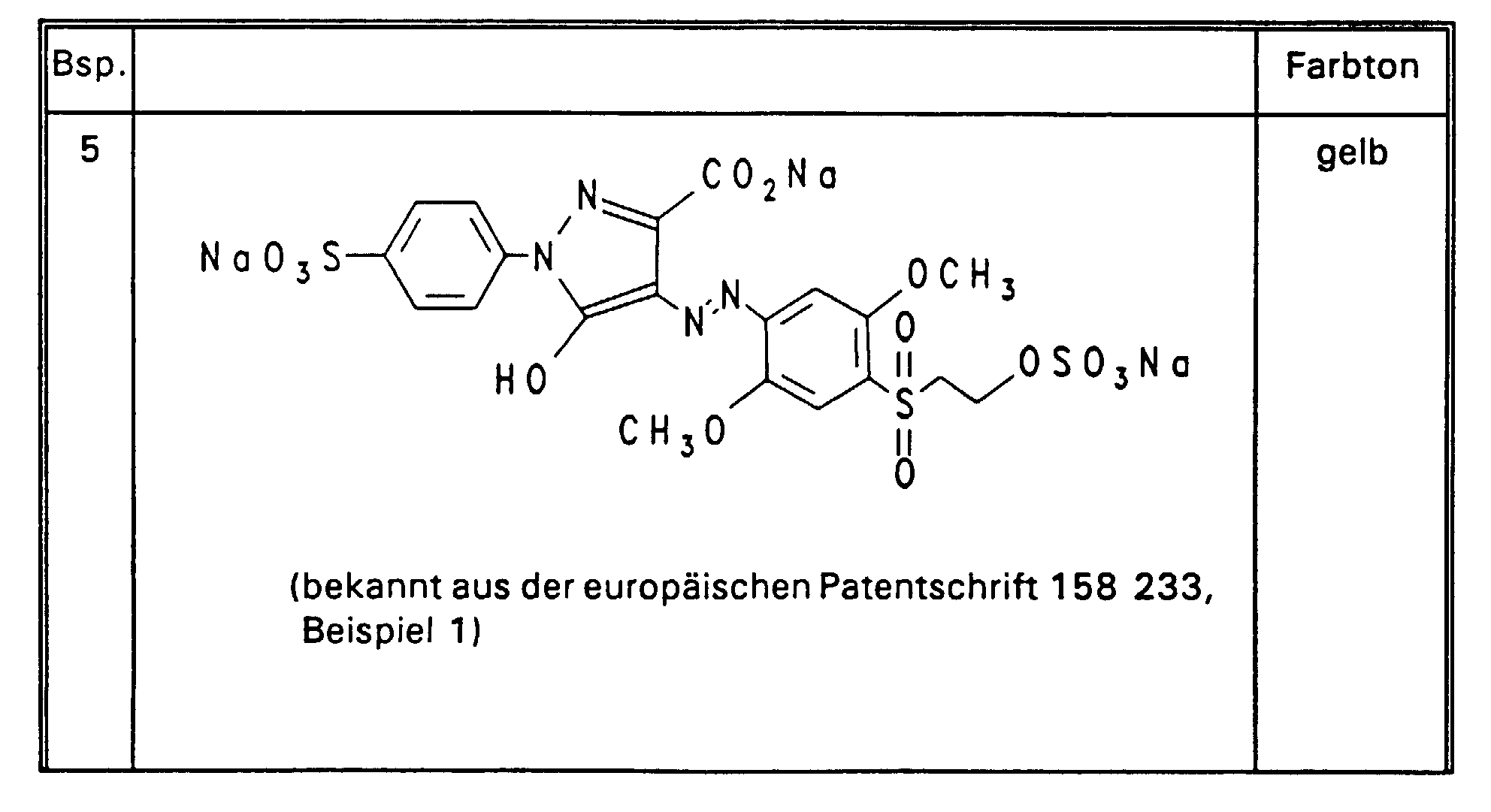
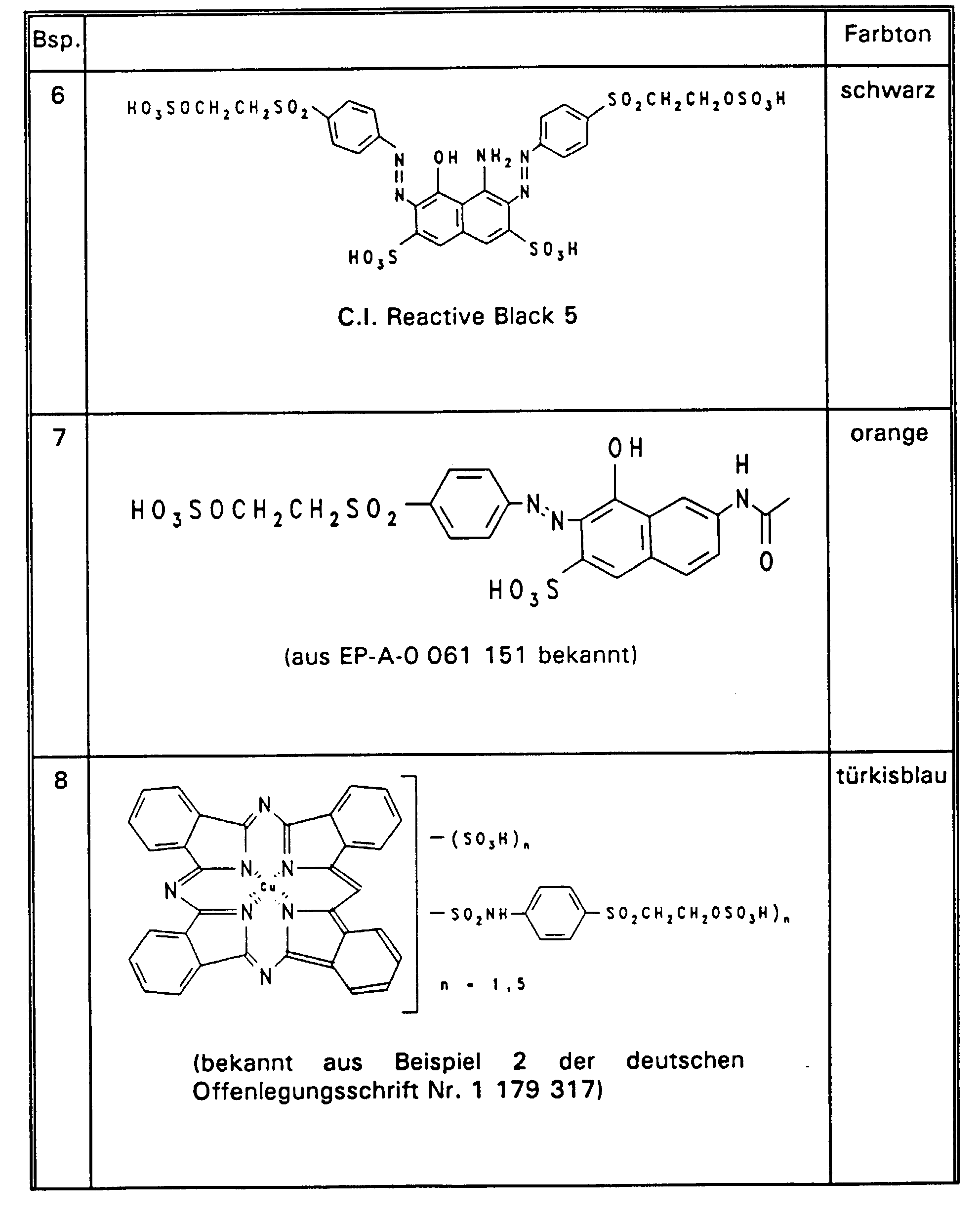
- Cotton waste textiles which have been dyed with the reactive dyes mentioned in the table below are brought into solution analogously to Example 2 or 3, xanthogenized and spun into fibers.
- the fastness properties obtained correspond to those of the starting material.
Landscapes
- Chemical & Material Sciences (AREA)
- Engineering & Computer Science (AREA)
- Chemical Kinetics & Catalysis (AREA)
- Organic Chemistry (AREA)
- Health & Medical Sciences (AREA)
- Materials Engineering (AREA)
- Medicinal Chemistry (AREA)
- Polymers & Plastics (AREA)
- Manufacturing & Machinery (AREA)
- Textile Engineering (AREA)
- Biochemistry (AREA)
- Life Sciences & Earth Sciences (AREA)
- General Chemical & Material Sciences (AREA)
- Coloring (AREA)
- Manufacture Of Porous Articles, And Recovery And Treatment Of Waste Products (AREA)
- Separation, Recovery Or Treatment Of Waste Materials Containing Plastics (AREA)
- Compositions Of Macromolecular Compounds (AREA)
- Artificial Filaments (AREA)
- Polysaccharides And Polysaccharide Derivatives (AREA)
Description

60 Teile dieser zerkleinerten und entfärbten Baumwollfasern werden mit 1000 Teilen einer 18 gew.-%igen Natronlauge versetzt und 45 Minuten vermengt. Nach dieser Zeit wird die überschüssige Lauge über eine Glasfritte abgesaugt. Die so erzeugte Alkalicellulose beläßt man zum Reifen 60 Minuten bei 60°C, kühlt auf 15°C ab und setzt 20 Teile Schwefelkohlenstoff so zu, daß die Temperatur 30°C nicht übersteigt. Nach 45 Minuten Reaktionszeit trägt man die gelbliche Masse in 450 Teile einer 4 gew.-%igen Natronlauge ein und verrührt das Xanthogenat zu einer homogenen, viskosen Masse. Nach dem Entgasen wird die Spinnmasse nach betriebsüblichen Viskosespinnverfahren in ein schwefelsaures, Natrium- und Zinksulfat-haltiges Bad zu farblosen Fasern versponnen, in sauren Bädern verstreckt, geschnitten, gewaschen, präpariert und getrocknet.
Nach dem Entgasen wird die Spinnmasse nach betriebsüblichen Viskosespinnverfahren in ein schwefelsaures, Natrium- und Zinksulfat-haltiges Bad zu farblosen Fasern versponnen, in sauren Bädern verstreckt, geschnitten, gewaschen, präpariert und getrocknet.
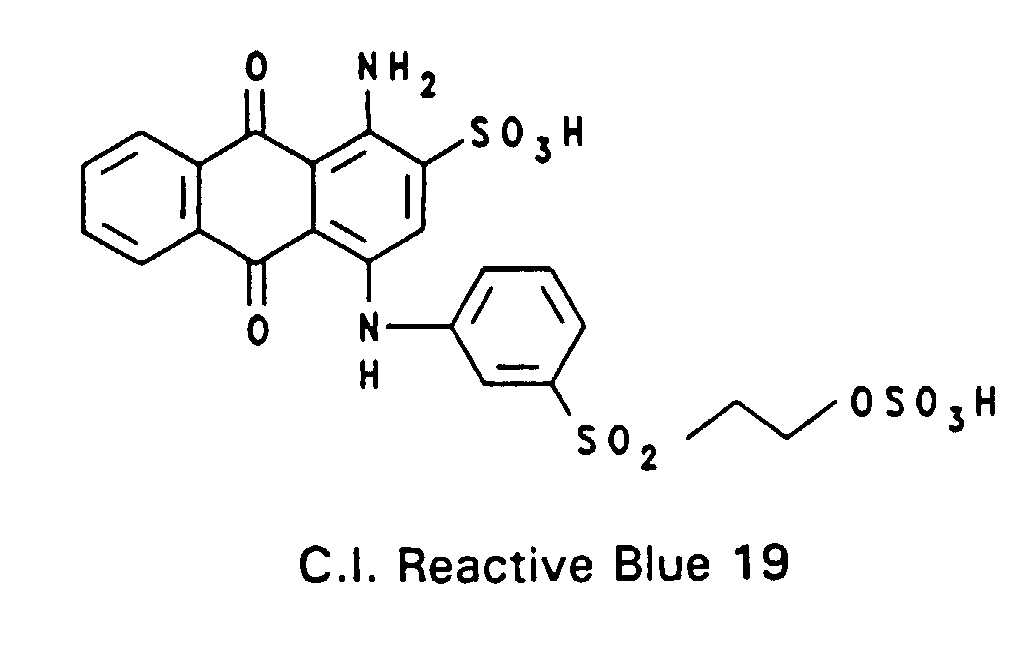
Nach dem Entgasen wird die Spinnmasse nach betriebsüblichen Viskosespinnverfahren in ein schwefelsaures, Natrium- und Zinksulfat-haltiges Bad zu Fasern versponnen, in sauren Bädern verstreckt, geschnitten, gewaschen, präpariert und getrocknet. Auf diese Weise erhält man eine blaue Faser, ohne erneut färben zu müssen. Die resultierenden Echtheiten entsprechen den ursprünglichen Echtheiten des Ausgangsmaterials.


Claims (14)
- Verfahren zur Herstellung von Viskose, dadurch gekennzeichnet, daß man ein mit Reaktivfarbstoffen gefärbtes Cellulosematerial in Alkalilauge suspendiert, die gebildete Alkalicellulose für mindestens 30 Minuten bei Temperaturen von 30 bis 80°C reifen läßt, sie sodann durch Umsetzung mit Schwefelkohlenstoff zum Xanthogenat bei einer Temperatur von 10 bis 30°C in Lösung bringt und die xanthogenierte Alkalicellulose zu Fasern verspinnt oder zu Folien verarbeitet.
- Verfahren nach Anspruch 1, dadurch gekennzeichnet, daß das mit Reaktivfarbstoff gefärbte Cellulosematerial mit Zellstoff vermischt ist.
- Verfahren nach Anspruch 1 oder 2, dadurch gekennzeichnet, daß man nach der Bildung der Alkalicellulose eine reduzierende Schwefelverbindung bei einer Temperatur von 20 bis 80°C auf die Alkalicellulose einwirken läßt.
- Verfahren nach mindestens einem der Ansprüche 1 bis 3, dadurch gekennzeichnet, daß das Cellulosematerial Alttextilien aus Cellulosefasern sind.
- Verfahren nach mindestens einem der Ansprüche 1 bis 3, dadurch gekennzeichnet, daß das Cellulosematerial Alttextilien aus Baumwolle sind.
- Verfahren nach mindestens einem der Ansprüche 1 bis 3, dadurch gekennzeichnet, daß das Cellulosematerial Alttextilien aus aminierten Viskose- oder Baumwollfasern sind.
- Verfahren nach mindestens einem der Ansprüche 1 bis 6, dadurch gekennzeichnet, daß mechanisch zerkleinertes Cellulosematerial eingesetzt wird.
- Verfahren nach mindestens einem der Ansprüche 1 bis 7, dadurch gekennzeichnet, daß einfarbiges und nach Farben getrenntes Cellulosematerial eingesetzt wird.
- Verfahren nach mindestens einem der Ansprüche 1 bis 8, dadurch gekennzeichnet, daß man ein mit einem Reaktivfarbstoff vom Vinylsulfon-Typ gefärbtes Cellulosematerial in Alkalilauge suspendiert und eine reduzierende Schwefelverbindung bei einer Temperatur von 20 bis 80°C darauf einwirken läßt.
- Verfahren nach Anspruch 9, dadurch gekennzeichnet, daß der Reaktivfarbstoff einen Vinylsulfonyl-, β-Chlorethylsulfonyl-, β-Sulfatoethylsulfonyl-, β-Acetoxy-ethylsulfonyl-, β-Phosphatoethylsulfonyl- oder β-Thiosulfatoethylsulfonyl-Rest hat.
- Verfahren nach Anspruch 9 oder 10, dadurch gekennzeichnet, daß die reduzierende Schwefelverbindung ein Alkalihydrogensulfit oder ein Alkalidithionit ist.
- Verfahren nach Anspruch 11, dadurch gekennzeichnet, daß die reduzierende Schwefelverbindung in einer Menge von 5 bis 30 Gew.-%, bezogen auf das eingesetzte Cellulosematerial, eingesetzt wird.
- Verfahren nach mindestens einem der Ansprüche 1 bis 12, dadurch gekennzeichnet, daß man die Alkalicellulose für 1/2 bis 24 Stunden reifen läßt.
- Verfahren nach mindestens einem der Ansprüche 1 bis 13, dadurch gekennzeichnet, daß man die Alkalicellulose in Gegenwart von Cellulose abbauenden Enzymen reifen läßt.
Applications Claiming Priority (2)
| Application Number | Priority Date | Filing Date | Title |
|---|---|---|---|
| DE4444245 | 1994-12-13 | ||
| DE4444245A DE4444245C1 (de) | 1994-12-13 | 1994-12-13 | Verfahren zum Recycling von gefärbten, cellulosischen Abfallprodukten zu Fasern |
Publications (2)
| Publication Number | Publication Date |
|---|---|
| EP0717131A1 EP0717131A1 (de) | 1996-06-19 |
| EP0717131B1 true EP0717131B1 (de) | 1998-11-04 |
Family
ID=6535609
Family Applications (1)
| Application Number | Title | Priority Date | Filing Date |
|---|---|---|---|
| EP95119048A Expired - Lifetime EP0717131B1 (de) | 1994-12-13 | 1995-12-04 | Verfahren zum Recycling von gefärbten, cellulosischen Abfallprodukten |
Country Status (5)
| Country | Link |
|---|---|
| US (1) | US5609676A (de) |
| EP (1) | EP0717131B1 (de) |
| JP (1) | JPH08239504A (de) |
| BR (1) | BR9505753A (de) |
| DE (2) | DE4444245C1 (de) |
Cited By (4)
| Publication number | Priority date | Publication date | Assignee | Title |
|---|---|---|---|---|
| WO2015077807A1 (en) | 2013-11-26 | 2015-06-04 | Lenzing Ag | Process for pretreating reclaimed cotton fibres to be used in the production of moulded bodies from regenerated cellulose |
| US9822188B2 (en) | 2013-10-15 | 2017-11-21 | Lenzing Ag | Cellulose suspension, method for the production and use thereof |
| US10093790B2 (en) | 2013-10-15 | 2018-10-09 | Lenzing Aktiengesellschaft | Three-dimensional cellulose molded body, method for the production thereof and use of the same |
| US10370778B2 (en) | 2015-02-06 | 2019-08-06 | Lenzing Aktiengesellschaft | Recycling of man-made cellulosic fibers |
Families Citing this family (14)
| Publication number | Priority date | Publication date | Assignee | Title |
|---|---|---|---|---|
| US7081217B2 (en) * | 2002-06-13 | 2006-07-25 | Dan Treleaven | Method for making plastic materials using recyclable plastics |
| US20050148922A1 (en) * | 2003-12-31 | 2005-07-07 | Reeves William G. | Thermoplastic composition and products made therefrom |
| AT502993B1 (de) * | 2005-12-19 | 2008-07-15 | Chemiefaser Lenzing Ag | Verfahren zur herstellung eines gefärbten cellulosischen formkörpers |
| CN103562277A (zh) * | 2011-05-20 | 2014-02-05 | 伊诺维亚薄膜有限公司 | 用于加工纤维素膜或成形制品的方法 |
| US11034817B2 (en) | 2013-04-17 | 2021-06-15 | Evrnu, Spc | Methods and systems for processing mixed textile feedstock, isolating constituent molecules, and regenerating cellulosic and polyester fibers |
| US12281441B2 (en) | 2013-04-17 | 2025-04-22 | Evrnu, Spc | Methods and systems for forming composite fibers |
| ITUB20154827A1 (it) * | 2015-10-29 | 2017-04-29 | Andrea Venier | Procedimento per produrre un colorante, e procedimento di colorazione di tessuti. |
| SE541675C2 (en) | 2016-10-19 | 2019-11-26 | Re Newcell Ab | Recycling of cellulosic textiles |
| FI3551790T3 (sv) | 2016-12-06 | 2023-07-05 | Re Newcell Ab | Cellulosafibrer |
| FI129105B (en) * | 2017-04-27 | 2021-07-15 | Teknologian Tutkimuskeskus Vtt Oy | Treatment procedure for textile-based materials |
| CN110678485B (zh) * | 2017-05-14 | 2021-11-23 | 华盛顿州立大学 | 环境友好的纤维素废料再循环 |
| EP4400540A3 (de) | 2018-01-15 | 2024-10-30 | Lenzing Aktiengesellschaft | Funktionalisierung von fremdstoffen in lyocell-verfahren |
| CN111304767B (zh) * | 2020-02-17 | 2022-10-04 | 河北吉藁化纤有限责任公司 | 一种利用废旧纺织品再生浆粕生产再生纤维素纤维的制备方法及再生纤维素纤维 |
| JP2024178623A (ja) * | 2023-06-13 | 2024-12-25 | レンゴー株式会社 | アルカリセルロース材料、ビスコース及びビスコースの製造方法 |
Family Cites Families (12)
| Publication number | Priority date | Publication date | Assignee | Title |
|---|---|---|---|---|
| DE137367C (de) * | ||||
| FR837886A (fr) * | 1937-07-23 | 1939-02-22 | Snia Viscosa | Procédé pour la fabrication de fibres textiles artificielles ayant des caractèressemblables à ceux de la rayonne |
| US2337928A (en) * | 1940-06-24 | 1943-12-28 | Sylvania Ind Corp | Process for reutilizing waste material |
| CH376221A (de) * | 1956-12-13 | 1964-03-31 | Zellwolle Lenzing Aktiengesell | Verfahren und Anlage zur Rückgewinnung von Viskose aus Abfallviskosen |
| US2979500A (en) * | 1958-05-13 | 1961-04-11 | Phrix Werke Ag | Method of producing viscose |
| DE1045387B (de) * | 1957-05-16 | 1958-12-04 | Phrix Werke Ag | Verfahren zur Herstellung von Viskose |
| US3817983A (en) * | 1972-05-01 | 1974-06-18 | Du Pont | Process using diverse types of cellulose for preparing viscose |
| DD137367A1 (de) * | 1978-06-23 | 1979-08-29 | Werner Hillmann | Verfahren zur herstellung von regeneratseide oder-faser auf zellulosebasis |
| DE2906138A1 (de) * | 1979-02-17 | 1980-09-04 | Hoechst Ag | Verfahren zum waschen von gefaerbten oder bedruckten textilmaterialien |
| EP0151370B1 (de) * | 1984-01-03 | 1990-03-14 | Sandoz Ag | Färben und Bedrucken von Fasern |
| DD229141A1 (de) * | 1984-11-19 | 1985-10-30 | Zellstoff Und Zellwollewerke V | Verfahren zum wiedereinsatz von abfaellen aus regenerierter cellulose |
| TW211595B (de) * | 1991-12-07 | 1993-08-21 | Hoechst Ag |
-
1994
- 1994-12-13 DE DE4444245A patent/DE4444245C1/de not_active Expired - Fee Related
-
1995
- 1995-12-04 EP EP95119048A patent/EP0717131B1/de not_active Expired - Lifetime
- 1995-12-04 DE DE59504138T patent/DE59504138D1/de not_active Expired - Fee Related
- 1995-12-08 US US08/569,510 patent/US5609676A/en not_active Expired - Fee Related
- 1995-12-11 JP JP7321884A patent/JPH08239504A/ja not_active Withdrawn
- 1995-12-12 BR BR9505753A patent/BR9505753A/pt not_active Application Discontinuation
Cited By (6)
| Publication number | Priority date | Publication date | Assignee | Title |
|---|---|---|---|---|
| US9822188B2 (en) | 2013-10-15 | 2017-11-21 | Lenzing Ag | Cellulose suspension, method for the production and use thereof |
| US10093790B2 (en) | 2013-10-15 | 2018-10-09 | Lenzing Aktiengesellschaft | Three-dimensional cellulose molded body, method for the production thereof and use of the same |
| US10513564B2 (en) | 2013-10-15 | 2019-12-24 | Lenzing Aktiengesellschaft | Cellulose suspension, method for the production and use thereof |
| WO2015077807A1 (en) | 2013-11-26 | 2015-06-04 | Lenzing Ag | Process for pretreating reclaimed cotton fibres to be used in the production of moulded bodies from regenerated cellulose |
| US10316467B2 (en) | 2013-11-26 | 2019-06-11 | Lenzing Aktiengesellschaft | Process for pretreating reclaimed cotton fibers to be used in the production of molded bodies from regenerated cellulose |
| US10370778B2 (en) | 2015-02-06 | 2019-08-06 | Lenzing Aktiengesellschaft | Recycling of man-made cellulosic fibers |
Also Published As
| Publication number | Publication date |
|---|---|
| DE59504138D1 (de) | 1998-12-10 |
| DE4444245C1 (de) | 1996-07-04 |
| BR9505753A (pt) | 1998-01-06 |
| JPH08239504A (ja) | 1996-09-17 |
| US5609676A (en) | 1997-03-11 |
| EP0717131A1 (de) | 1996-06-19 |
Similar Documents
| Publication | Publication Date | Title |
|---|---|---|
| DE4444245C1 (de) | Verfahren zum Recycling von gefärbten, cellulosischen Abfallprodukten zu Fasern | |
| EP0692559B1 (de) | Mit polymeren Aminverbindungen modifizierte synthetische cellulosische Fasern | |
| AT515152B1 (de) | Verfahren zum Vorbehandeln von rückgewonnenen Baumwollfasern zur Verwendung bei der Herstellung von Formkörpern aus regenerierter Cellulose | |
| CH642390A5 (de) | Anthrachinonfarbstoffe. | |
| DE2326935B2 (de) | Verfahren zur Herstellung von Lignin-Addukten mit blockierten Hydroxylgruppen und diese Addukte enthaltende Farbstoffmasse | |
| DE19549409A1 (de) | Sulfonierte Regeneratcellulosefasern | |
| CH664370A5 (de) | Verfahren zur herstellung eines farbstoffpraeparates. | |
| EP0683251B1 (de) | Aminierung von cellulosischen Synthesefasern | |
| EP0828870B1 (de) | Verfahren zur spinnfärbung mit farbsalzen | |
| DE10126244B4 (de) | Verfahren zur Herstellung eines cellulosischen Faser- oder Flächengebildes sowie die Verwendung des danach erhaltenen Gewebes, Gestricks oder Vliesstoffs | |
| AT505476A1 (de) | Verfahren zur herstellung von cellulosischen formkörpern unter verwendung von bambuszellstoff und formkörper aus diesem verfahren | |
| DE69227039T2 (de) | Faserreaktive farbstoffe - färbeverfahren mit geringem salzzusatz | |
| EP0744446A2 (de) | Textilfarbstoffpräparationen | |
| AT502993B1 (de) | Verfahren zur herstellung eines gefärbten cellulosischen formkörpers | |
| DE19719610A1 (de) | Alkalisystem zum Färben von cellulosischen Textilien nach Klotzmethoden | |
| AT230015B (de) | Verfahren zur Herstellung gefärbter Viskosekunstseidefäden | |
| DE875942C (de) | Verfahren zur Mattierung bzw. Faerbung von Faserstoffen | |
| DE19519021C2 (de) | Polysaccharid-Farbstoff-Formulierung | |
| DE1644365C3 (de) | Monoazoverbindungen, Verfahren zu lh rer Herstellung und ihre Verwendung zum Farben von Textilien auf Basis von Cellulo se sowie Polyvinylalkohol | |
| US2132491A (en) | Manufacture of artificial silk | |
| US2966390A (en) | Process for the production of etched textile material containing synthetic cellulosefibers | |
| US3179486A (en) | Propylene dyeing method | |
| AT223813B (de) | Polymermischung mit verbesserter Farbaffinität | |
| EP0346280A2 (de) | Dicyanobenzanthronverbindungen | |
| NO166095B (no) | Fremgangsmaate for fremstilling av en forbindelsesinnretning for bygningsenheter. |
Legal Events
| Date | Code | Title | Description |
|---|---|---|---|
| PUAI | Public reference made under article 153(3) epc to a published international application that has entered the european phase |
Free format text: ORIGINAL CODE: 0009012 |
|
| AK | Designated contracting states |
Kind code of ref document: A1 Designated state(s): CH DE FR GB IT LI |
|
| 17P | Request for examination filed |
Effective date: 19961219 |
|
| 17Q | First examination report despatched |
Effective date: 19970625 |
|
| RAP1 | Party data changed (applicant data changed or rights of an application transferred) |
Owner name: DYSTAR TEXTILFARBEN GMBH & CO. DEUTSCHLAND KG |
|
| GRAG | Despatch of communication of intention to grant |
Free format text: ORIGINAL CODE: EPIDOS AGRA |
|
| GRAG | Despatch of communication of intention to grant |
Free format text: ORIGINAL CODE: EPIDOS AGRA |
|
| GRAH | Despatch of communication of intention to grant a patent |
Free format text: ORIGINAL CODE: EPIDOS IGRA |
|
| GRAH | Despatch of communication of intention to grant a patent |
Free format text: ORIGINAL CODE: EPIDOS IGRA |
|
| GRAA | (expected) grant |
Free format text: ORIGINAL CODE: 0009210 |
|
| AK | Designated contracting states |
Kind code of ref document: B1 Designated state(s): CH DE FR GB IT LI |
|
| REG | Reference to a national code |
Ref country code: CH Ref legal event code: EP |
|
| REF | Corresponds to: |
Ref document number: 59504138 Country of ref document: DE Date of ref document: 19981210 |
|
| GBT | Gb: translation of ep patent filed (gb section 77(6)(a)/1977) |
Effective date: 19981202 |
|
| ET | Fr: translation filed | ||
| ITF | It: translation for a ep patent filed | ||
| PLBE | No opposition filed within time limit |
Free format text: ORIGINAL CODE: 0009261 |
|
| STAA | Information on the status of an ep patent application or granted ep patent |
Free format text: STATUS: NO OPPOSITION FILED WITHIN TIME LIMIT |
|
| 26N | No opposition filed | ||
| PGFP | Annual fee paid to national office [announced via postgrant information from national office to epo] |
Ref country code: DE Payment date: 20001109 Year of fee payment: 6 |
|
| PGFP | Annual fee paid to national office [announced via postgrant information from national office to epo] |
Ref country code: FR Payment date: 20001123 Year of fee payment: 6 |
|
| PGFP | Annual fee paid to national office [announced via postgrant information from national office to epo] |
Ref country code: GB Payment date: 20001124 Year of fee payment: 6 |
|
| PGFP | Annual fee paid to national office [announced via postgrant information from national office to epo] |
Ref country code: CH Payment date: 20001127 Year of fee payment: 6 |
|
| PG25 | Lapsed in a contracting state [announced via postgrant information from national office to epo] |
Ref country code: GB Free format text: LAPSE BECAUSE OF NON-PAYMENT OF DUE FEES Effective date: 20011204 |
|
| PG25 | Lapsed in a contracting state [announced via postgrant information from national office to epo] |
Ref country code: LI Free format text: LAPSE BECAUSE OF NON-PAYMENT OF DUE FEES Effective date: 20011231 Ref country code: CH Free format text: LAPSE BECAUSE OF NON-PAYMENT OF DUE FEES Effective date: 20011231 |
|
| REG | Reference to a national code |
Ref country code: GB Ref legal event code: IF02 |
|
| PG25 | Lapsed in a contracting state [announced via postgrant information from national office to epo] |
Ref country code: DE Free format text: LAPSE BECAUSE OF NON-PAYMENT OF DUE FEES Effective date: 20020702 |
|
| GBPC | Gb: european patent ceased through non-payment of renewal fee |
Effective date: 20011204 |
|
| REG | Reference to a national code |
Ref country code: CH Ref legal event code: PL |
|
| PG25 | Lapsed in a contracting state [announced via postgrant information from national office to epo] |
Ref country code: FR Free format text: LAPSE BECAUSE OF NON-PAYMENT OF DUE FEES Effective date: 20020830 |
|
| REG | Reference to a national code |
Ref country code: FR Ref legal event code: ST |
|
| PG25 | Lapsed in a contracting state [announced via postgrant information from national office to epo] |
Ref country code: IT Free format text: LAPSE BECAUSE OF NON-PAYMENT OF DUE FEES;WARNING: LAPSES OF ITALIAN PATENTS WITH EFFECTIVE DATE BEFORE 2007 MAY HAVE OCCURRED AT ANY TIME BEFORE 2007. THE CORRECT EFFECTIVE DATE MAY BE DIFFERENT FROM THE ONE RECORDED. Effective date: 20051204 |