EP0712422B1 - Verfahren zur herstellung einer wässrigen gelartigen zusammensetzung und so erhaltene zusammensetzung - Google Patents
Verfahren zur herstellung einer wässrigen gelartigen zusammensetzung und so erhaltene zusammensetzung Download PDFInfo
- Publication number
- EP0712422B1 EP0712422B1 EP94923770A EP94923770A EP0712422B1 EP 0712422 B1 EP0712422 B1 EP 0712422B1 EP 94923770 A EP94923770 A EP 94923770A EP 94923770 A EP94923770 A EP 94923770A EP 0712422 B1 EP0712422 B1 EP 0712422B1
- Authority
- EP
- European Patent Office
- Prior art keywords
- surfactant
- process according
- polymer
- temperature
- chain
- Prior art date
- Legal status (The legal status is an assumption and is not a legal conclusion. Google has not performed a legal analysis and makes no representation as to the accuracy of the status listed.)
- Expired - Lifetime
Links
Images





Classifications
-
- A—HUMAN NECESSITIES
- A61—MEDICAL OR VETERINARY SCIENCE; HYGIENE
- A61Q—SPECIFIC USE OF COSMETICS OR SIMILAR TOILETRY PREPARATIONS
- A61Q19/00—Preparations for care of the skin
-
- A—HUMAN NECESSITIES
- A61—MEDICAL OR VETERINARY SCIENCE; HYGIENE
- A61K—PREPARATIONS FOR MEDICAL, DENTAL OR TOILETRY PURPOSES
- A61K8/00—Cosmetics or similar toiletry preparations
- A61K8/02—Cosmetics or similar toiletry preparations characterised by special physical form
- A61K8/14—Liposomes; Vesicles
-
- A—HUMAN NECESSITIES
- A61—MEDICAL OR VETERINARY SCIENCE; HYGIENE
- A61K—PREPARATIONS FOR MEDICAL, DENTAL OR TOILETRY PURPOSES
- A61K8/00—Cosmetics or similar toiletry preparations
- A61K8/18—Cosmetics or similar toiletry preparations characterised by the composition
- A61K8/72—Cosmetics or similar toiletry preparations characterised by the composition containing organic macromolecular compounds
- A61K8/81—Cosmetics or similar toiletry preparations characterised by the composition containing organic macromolecular compounds obtained by reactions involving only carbon-to-carbon unsaturated bonds
- A61K8/8141—Compositions of homopolymers or copolymers of compounds having one or more unsaturated aliphatic radicals, each having only one carbon-to-carbon double bond, and at least one being terminated by only one carboxyl radical, or of salts, anhydrides, esters, amides, imides or nitriles thereof; Compositions of derivatives of such polymers
- A61K8/8158—Homopolymers or copolymers of amides or imides, e.g. (meth) acrylamide; Compositions of derivatives of such polymers
-
- A—HUMAN NECESSITIES
- A61—MEDICAL OR VETERINARY SCIENCE; HYGIENE
- A61K—PREPARATIONS FOR MEDICAL, DENTAL OR TOILETRY PURPOSES
- A61K9/00—Medicinal preparations characterised by special physical form
- A61K9/10—Dispersions; Emulsions
- A61K9/127—Synthetic bilayered vehicles, e.g. liposomes or liposomes with cholesterol as the only non-phosphatidyl surfactant
-
- A—HUMAN NECESSITIES
- A61—MEDICAL OR VETERINARY SCIENCE; HYGIENE
- A61K—PREPARATIONS FOR MEDICAL, DENTAL OR TOILETRY PURPOSES
- A61K9/00—Medicinal preparations characterised by special physical form
- A61K9/10—Dispersions; Emulsions
- A61K9/127—Synthetic bilayered vehicles, e.g. liposomes or liposomes with cholesterol as the only non-phosphatidyl surfactant
- A61K9/1271—Non-conventional liposomes, e.g. PEGylated liposomes or liposomes coated or grafted with polymers
- A61K9/1272—Non-conventional liposomes, e.g. PEGylated liposomes or liposomes coated or grafted with polymers comprising non-phosphatidyl surfactants as bilayer-forming substances, e.g. cationic lipids or non-phosphatidyl liposomes coated or grafted with polymers
-
- C—CHEMISTRY; METALLURGY
- C08—ORGANIC MACROMOLECULAR COMPOUNDS; THEIR PREPARATION OR CHEMICAL WORKING-UP; COMPOSITIONS BASED THEREON
- C08J—WORKING-UP; GENERAL PROCESSES OF COMPOUNDING; AFTER-TREATMENT NOT COVERED BY SUBCLASSES C08B, C08C, C08F, C08G or C08H
- C08J3/00—Processes of treating or compounding macromolecular substances
- C08J3/02—Making solutions, dispersions, lattices or gels by other methods than by solution, emulsion or suspension polymerisation techniques
- C08J3/03—Making solutions, dispersions, lattices or gels by other methods than by solution, emulsion or suspension polymerisation techniques in aqueous media
- C08J3/075—Macromolecular gels
Definitions
- the present invention relates to a new preparation process of an aqueous composition in the form of a gel as well as compositions news likely to be obtained by this process, especially compositions containing vesicles, in particular liposomes.
- water-soluble polymers find many applications in a wide variety of industrial fields such as cosmetology, enhanced oil recovery, food additives.
- Associative polymers are polymers made up of a chain main hydrophilic and hydrophobic side chains in relatively number weak compared to the hydrophilic patterns of the main chain. Their behaviour in solution results from the competition between hydrophobic properties and hydrophilic structure. Hydrophobic patterns tend to form aggregates constituting crosslinking points between the macromolecular chains.
- associative water-soluble polymers have a very high viscosifying power in water, good behavior of their viscosity in a saline environment and a reversible behavior towards stress (shear thinning).
- mixed polymer / surfactant aggregates can form, established by different types of interactions: electrostatic, dipolar, hydrogen bond.
- Associative water-soluble polymers can interact with surfactants more specifically thanks to their hydrophobic parts.
- US Patent 4,432,881 describes an aqueous liquid medium with viscosity increased, obtained by dispersing in this medium a water-soluble polymer having hydrophobic pendant groups and a surfactant, which can be used in particular in enhanced oil recovery.
- the surfactant is a surfactant of the monoalkylether type of polyethylene glycol corresponding to the formula: H (CH 2 ) i (OCH 2 CH 2 ) j OH and noted below symbolically C i E j where i represents the number of carbon atoms in the alkyl chain and j the number of ethylene oxide groups contained in the polar head of the surfactant.
- surfactants have the distinction of having a lower temperature demixing: there is a temperature above which the solution micellar separates into two phases, one diluted, the other concentrated in surfactant. This temperature is called the cloud point. This phenomenon is due to a decrease hydration of ethylene oxide groups when the temperature increases. Therefore, the longer the ethylene glycol chain, the longer the demixing temperature is high.
- crystalline liquid phases are observed (which constitutes another specificity of these surfactants): a lamellar phase, noted L a , which persists up to extremely high dilution rates (for concentrations of the order of 1% by mass for C 12 E 5 ), two phases denoted L 3 and L a + consisting of bilayers, and finally several regions of liquid-liquid coexistence could be highlighted.
- L a lamellar phase
- L 3 and L a + consisting of bilayers
- the L 3 phase which appears on phase diagrams is often called abnormal phase or sponge phase. It can be birefringent with stirring and very opalescent. These characteristics will be all the more marked as the solution is diluted. Its structure is defined as a continuous three-dimensional bilayer. In fact, the bilayers constitute a sort of randomly connected network which divides the volume of the solution into two equal parts.
- phase L 3 another phase containing bilayers, called L ⁇ + .
- surfactants such as C 12 E 3 , C 12 E 4 , C 14 E 5 , and its exact structure is currently unknown. It has the optical appearance of phase L 3 , that is to say that it can be birefringent with stirring in certain cases, but it is often more viscous than phase L 3 .
- the L a + phase can currently be defined as a dispersion of bilayers: either in the form of vesicles (single or multilayer), or in the form of a two-phase system in which a lamellar phase and an aqueous phase are in equilibrium. The structure remains to be specified.
- compositions capable of being obtained by the process of the invention and in which the surfactant is capable of forming liposomes or vesicles.
- the invention relates to a method of preparation of an aqueous composition in the form of a gel at a given temperature characterized in that one puts in the presence in said composition an associative water-soluble polymer consisting of a main chain hydrophilic and hydrophobic pendant groups with at least one surfactant in the form of bilayers, when in aqueous solution in the same conditions of temperature and concentration.
- phase diagrams As we saw earlier, a number of surfactants have is the subject of detailed studies as to the appearance of their phase diagrams in aqueous solution. For these surfactants, we will refer to the data of the literature to place themselves in conditions where they are in the form of bilayers. For other surfactants or aqueous media containing other components that the surfactant capable of modifying the transition temperature of phases, we will experimentally determine their phase diagram so as to place in conditions where the surfactants are in the form of bilayers.
- phase diagram will look for areas of birefringence that indicate the location of a bilayer area.
- Microscopy electronic can also be used to confirm the presence vesicles and / or liposomes.
- the bilayers can form lamellar phases, dispersed or not.
- the gels according to the invention will be obtained by simple introduction of associative water-soluble polymers in the dispersion of vesicles, such as liposomes.
- soy lecithin or egg saturated or unsaturated monoalkyl ethers of polyethylene glycol or linear or branched polyglycerol, or any other ionic or nonionic surfactant likely to form vesicles.
- Associative polymers which can be used in the process of the invention are all the associative polymers mentioned above.
- the main hydrophilic chain of these polymers can, in particular, result from the polymerization of a hydrophilic monomer comprising functional groups allowing the subsequent grafting of hydrophobic chains, for example functions acids.
- It can also be a water-soluble polymer of natural origin or a natural polymer made water-soluble by chemical modification.
- Associative polymers can also result from the copolymerization of hydrophilic monomers and hydrophobic monomers. These hydrophobic monomers introduced into the reaction medium in a much smaller amount than the hydrophilic polymers, generally comprise a fatty hydrocarbon chain.
- hydrophilic monomers and hydrophobic monomers introduced into the reaction medium in a much smaller amount than the hydrophilic polymers, generally comprise a fatty hydrocarbon chain.
- acrylic polymers By way of example of such polymers, mention will be made of acrylic polymers, polyethers, optionally partially substituted polysaccharide chains.
- the main hydrophilic chain is constituted as we saw previously of a succession of hydrophilic monomer units, and of a fraction of monomers carrying very hydrophobic pendant groups.
- This rate is advantageously between 0.1 and 10%, preferably between 0.5 and 5%, even more preferably between 1 and 3 %.
- the hydrophobic pendant groups can be any group hydrophobic pendant conventionally used to prepare associative polymers. Hydrophobic groups preferably comprising a skeleton will be chosen. comprising at least 8 carbon atoms, preferably 12 to 18.
- hydrophobic groups By way of example of such hydrophobic groups, particular mention will be made linear hydrocarbon chains, branched, saturated or not, containing or not cycles.
- hydrocarbon chains in particular alkyl, comprising from 8 to 28 atoms of carbon, preferably 12 to 18.
- the modified patterns are advantageously in the form of ether, of ester or amide. This is particularly the case when the main polymer chain associative is an acrylic chain.
- the associative polymers used in the process of the invention can have a weight-average molar mass of between 10 4 and 10 7 , preferably between 10 5 and 10 6 .
- the concentration of the associative polymer in the aqueous composition is generally between 0.5 and 10% by weight, when the polymer has a weight average molar mass of the order of 150,000. Of course, this concentration may be lower for a polymer of average molar mass bigger.
- the surfactant can be any surfactant capable of being present in form of bilayers at the temperature and under the conditions in which it is proposed to prepare the gel.
- Nonionic surfactant for example a polyethylene glycol monoalkyl ether of general formula: C i H 2i + 1 (OCH 2 CH 2 ) j OH symbolically represented by CiEj.
- i between 8 and 18, preferably equal to 12 or 14 and j between 1 and 10, preferably between 3 and 5.
- the surfactant C 12 E 4 is of very particular interest according to the invention because of its thermal behavior.
- i is preferably between 12 and 24, more preferably i is equal to 18; and j is between 1 and 20 and preferably is equal to 10.
- the surfactant can also be an ionic surfactant.
- soaps such as oleate sodium, lecithin, such as soy or egg lecithin, derivatives of quaternary ammonium such as those of the dialkyldimethylammonium type, the alkyl group being a fatty chain of at least 8 carbons.
- This is, by example, dioctadecyldimethylammonium bromide.
- a class of particularly interesting surfactants according to the invention consists of those capable of forming liposomes.
- surfactants include phospholipids, soy lecithin or egg.
- compositions aqueous solutions contain 0.1 to 20%, preferably 0.1 to 10% by weight of surfactant or mixture of surfactants.
- fatty alcohol whose function will also be to modify the phase transition temperature.
- fatty alcohol usable in for this purpose mention will be made of hexanol. Its concentration will advantageously be from 0.1 to 2%.
- the method according to the invention provides a means of considerably varying the viscosity of an aqueous composition containing an associative polymer by introducing into said composition a surfactant and by choosing conditions such that this surfactant is found under form of bilayers.
- This process for increasing the viscosity of an aqueous composition finds a particularly interesting application in the stabilization of suspensions aqueous particles, especially in the stabilization of suspensions used in the field of cosmetics, paints or food additives.
- the invention relates to the application of the previously described process for stabilizing an aqueous suspension of liquid or solid particles.
- any suspension of particles will be mentioned whose size is between 0.02 and 50 microns, more particularly suspensions of pigments, talcs, micas. These particles can possibly have undergone a surface treatment.
- suspensions of liquid particles particular mention will be made emulsions, especially emulsions of droplets of sizes between 0.05 and 10 microns, for example oil emulsions in water.
- particle suspensions according to the invention mention will be made of dispersions organized in the form of bilayers, such as phases lamellar, vesicles, liposomes.
- a particularly advantageous use of the process of the invention is the transformation of a suspension of liposomes into a gel by introduction into said suspension of a water-soluble associative polymer.
- the invention thus provides a means of stabilizing, at any temperature, a suspension of liposomes.
- compositions containing liposomes and a polymer associative water-soluble constitute new compositions and therefore the invention also relates, by way of new products, compositions containing liposomes and a polymer associative water-soluble.
- Modified acrylic polymers with the following structures are prepared where x is the rate of modification in mole% and n the number of carbon atoms in the alkyl chain, from polyacrylic acid (PAA) with an average molecular weight of 150,000.
- PAA polyacrylic acid
- the modified derivatives are prepared according to the process described by TK Wang, I. Iliopoulos, R. Audebert, Polym. Bull. 1988, 20.577.
- the polymers symbolically modified by x-Cn will be denoted below (by way of example 1-C18 denotes the modified polyacrylate containing 1% by mole of N-octadecyl-acrylamide units).
- the modified polymers have the same degree of polymerization as the precursor PAA and a statistical distribution of the alkyl groups along the chain.
- solutions of samples containing mixtures of C 12 E 4 and C 12 E 5 in variable proportions are prepared, and on the other hand, a polymer solution of PAA 1-C18 of average molar mass by weight. of 150,000, noted below PAR-150-1-C 18 , at a concentration twice that of the final solution obtained after mixing, so that the final composition in the mixture of the surfactant is 2% by mass in nonionic surfactant and in the polymer composition is 1% by mass in polymer.
- transition temperature 2 ⁇ -L a also decreases regularly when the proportion of C 12 E 4 increases. It is therefore entirely possible to control the temperature of this transition since it is governed by the composition of the mixture C 12 E 4 / C 12 E 5 .
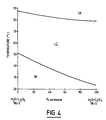
- FIG. 4 gives the phase diagram of the same system in the presence of PAR-150-1-C 18 , that the addition of PAR-150-1-C 18 , at 1% by mass in the solution , considerably modifies the phase diagram: the two-phase zone disappears in favor of a large clear isotropic monophasic zone.
- the samples become birefringent with stirring only, which seems to indicate the appearance of the L a + phase.
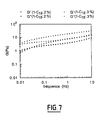
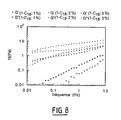
- the shape of the module curves depends little on the sample considered: a line with a slope close to 2 for G ', a line with slope close to 1 for G ".
- these lines become superimposable by simple translation along the frequency axis.
- Example 4 Demonstration of viscosity variations with temperature.
- Example 5 Mixtures Containing 4% of Surfactants and 1% of Polymer 1-C 18
- the mixture is homogenized by ultrasound for 15 min at 4 ° C with a power of 150 W.
- An aqueous suspension is prepared containing 2% by mass of liposomes obtained from soy lecithin and ⁇ -sitosterol taken in a report 9/1 weight.
- Three suspensions A, B, C of liposomes containing respectively are prepared 3%, 2% and 1% soy lecithin (Alcolec F100).
- polymer 1-C 18 causes an increase in viscosity as a function of the respective concentrations of phospholipids and of polymer. Whatever the temperature considered, the phospholipids are organized in bilayers. The parameter which conditions the rheological behavior of the solutions is therefore no longer the temperature, but the respective contents of phospholipids and of polymer 1-C 18 , and, the ratio between these two concentrations.
- This suspension is mixed in 1/1 proportion with a solution 2% by weight of the associative polymer previously designated by PAA-150-3C18.
Landscapes
- Health & Medical Sciences (AREA)
- Life Sciences & Earth Sciences (AREA)
- Chemical & Material Sciences (AREA)
- Animal Behavior & Ethology (AREA)
- Veterinary Medicine (AREA)
- Public Health (AREA)
- General Health & Medical Sciences (AREA)
- Dispersion Chemistry (AREA)
- Epidemiology (AREA)
- Medicinal Chemistry (AREA)
- Birds (AREA)
- Pharmacology & Pharmacy (AREA)
- Molecular Biology (AREA)
- Biophysics (AREA)
- Chemical Kinetics & Catalysis (AREA)
- Polymers & Plastics (AREA)
- Organic Chemistry (AREA)
- Dermatology (AREA)
- Compositions Of Macromolecular Compounds (AREA)
- Cosmetics (AREA)
- Colloid Chemistry (AREA)
- Medicinal Preparation (AREA)
- Emulsifying, Dispersing, Foam-Producing Or Wetting Agents (AREA)
- Processes Of Treating Macromolecular Substances (AREA)
- Manufacturing Of Micro-Capsules (AREA)
- Materials For Medical Uses (AREA)
Claims (26)
- Verfahren zur Herstellung einer wässerigen Zusammensetzung, die bei einer gegebenen Temperatur in Form eines Gels vorliegt, dadurch gekennzeichnet, daß in dieser Zusammensetzung ein assoziatives wasserlösliches Polymer, das aus einer hydrophilen Hauptkette und hydrophoben Seitengruppen besteht, mit zumindest einem grenzflächenaktiven Stoff in Berührung gebracht wird, der in Form einer Doppelschicht vorliegt, wenn er sich in wässeriger Lösung unter denselben Bedingungen der Temperatur und Konzentration befindet.
- Verfahren nach Anspruch 1, dadurch gekennzeichnet, daß die Doppelschichten aus gegebenenfalls dispergierten lamellaren Lipidphasen gebildet werden.
- Verfahren nach Anspruch 1, dadurch gekennzeichnet, daß die Doppelschichten Vesikel wie Liposomen bilden.
- Verfahren nach einem der Ansprüche 1 bis 3, dadurch gekennzeichnet, daß die hydrophile Hauptkette aus der Polymerisation eines hydrophilen Monomers erhalten wird, oder aus einem wasserlöslichen Polymer natürlichen Ursprungs oder einem natürlichen Polymer, das durch chemische Modifikation wasserlöslich gemacht wurde, besteht.
- Verfahren nach einem der Ansprüche 1 bis 4, dadurch gekennzeichnet, daß die hydrophile Hauptkette eine Acryl-Kette, ein Polyether oder eine gegebenenfalls teilweise substituierte Polyosid-Kette ist.
- Verfahren nach einem der Ansprüche 1 bis 5, dadurch gekennzeichnet, daß der Modifikationsgrad der hydrophilen Kette, der als Prozentsatz an hydrophilen Monomer-Gruppen, die hydrophobe Gruppen tragen, definiert wird, zwischen 0,1 und 10 %, vorzugsweise zwischen 0,5 und 5 %, bevorzugter zwischen 1 und 3 % beträgt.
- Verfahren nach einem der Ansprüche 1 bis 6, dadurch gekennzeichnet, daß die hydrophoben Gruppen ein Kohlenstoffgerüst mit zumindest 8 Kohlenstoffatomen umfassen.
- Verfahren nach Anspruch 7, dadurch gekennzeichnet, daß die hydrophoben Gruppen Kohlenwasserstoff-Ketten, insbesondere Alkyl, mit 8 bis 28 Kohlenstoffatomen, vorzugsweise 12 bis 18 Kohlenstoffatomen sind.
- Verfahren nach einem der Ansprüche 1 bis 8, dadurch gekennzeichnet, daß die hydrophoben Gruppen mit der Hauptkette durch Ether-, Ester- oder Amid-Gruppen verbunden sind.
- Verfahren nach einem der Ansprüche 1 bis 9, dadurch gekennzeichnet, daß die mittlere Molmasse, bezogen auf die Masse des assoziativen Polymers, zwischen 104 und 107, vorzugsweise zwischen 105 und 106 liegt.
- Verfahren nach einem der Ansprüche 1 bis 10, dadurch gekennzeichnet, daß die Konzentration des assoziativen Polymers zwischen 0,5 und 10 Masse-% beträgt, wenn das Polymer eine mittlere Molmasse in der Größenordnung von 150 000 aufweist, wobei diese Konzentration für eine höhere mittlere Molmasse schwächer ist.
- Verfahren nach einem der Ansprüche 1 bis 11, dadurch gekennzeichnet, daß der grenzflächenaktive Stoff ein nicht-ionischer oder ionischer grenzflächenaktiver Stoff ist.
- Verfahren nach einem der Ansprüche 1 bis 12, dadurch gekennzeichnet, daß der grenzflächenaktive Stoff ausgewählt wird aus der Gruppe von Monoalkylethern von Polyethylenglykol der allgemeinen Formel:
- Verfahren nach einem der Ansprüche 1 bis 12, dadurch gekennzeichnet, daß der grenzflächenaktive Stoff ausgewählt wird aus der Gruppe von Monoalkylethern von Polyglycerin, insbesondere der Formel:(i) C3H5(OH)O durch eine der folgenden Strukturen, gemischt oder getrennt, dargestellt wird:
 (ii) n ein statistischer Mittelwert zwischen 1 und 6 ist;(iii) Ro bedeutet:a) eine aliphatische, lineare oder verzweigte, gesättigte oder ungesättigte Kette mit 12 bis 30 Kohlenstoffatomen; oder einen Kohlenwasserstoffrest eines Lanolinalkohols; oder einen Rest eines langkettigen α-Diols;b) einen Rest R1CO, wobei R1 ein aliphatischer, linearer oder verzweigter C11-C17-Rest ist;c) einen Rest R2-[OC2H3(R3)-], wobeioder es sich auch um einen linearen oder verzweigten Polyglycerinether mit zwei Fettsäureketten handeln kann.R2 die für Ro angegebene Bedeutung a) oder b) haben kann;OC2H3(R3)- durch eine der folgenden Strukturen, gemischt oder getrennt, dargestellt wird:wobei R3 die für Ro angegebene Bedeutung a) hat;
- Verfahren nach einem der Ansprüche 1 bis 12, dadurch gekennzeichnet, daß der grenzflächenaktive Stoff ein ionischer grenzflächenaktiver Stoff ist, wie eine Seife, beispielsweise Natriumoleat, Lecithin, wie Soja- oder Eilecithin, ein quaternäres Ammonium-Derivat, wie vom Typ Dialkyldimethylammonium, wobei die Alkyl-Gruppe eine Fettsäurekette mit zumindest 8 Kohlenstoffatomen ist, beispielsweise Dioctadecyldimethylammoniumbromid.
- Verfahren nach einem der Ansprüche 1 bis 15, dadurch gekennzeichnet, daß der grenzflächenaktive Stoff Liposomen, Vesikel oder lamellare Phasen bilden kann.
- Verfahren nach einem der Ansprüche 1 bis 16, dadurch gekennzeichnet, daß die Konzentration an grenzflächenaktivem Stoff bzw. grenzflächenaktiven Stoffen der wässerigen Zusammensetzung zwischen 0,1 und 20 Masse-%, vorzugsweise zwischen 0,1 und 10 % beträgt.
- Verfahren nach einem der Ansprüche 1 bis 17, dadurch gekennzeichnet, daß die Zusammensetzung außerdem eine Verbindung zur Steuerung der Bildung von Doppelschichten, beispielsweise einen zweiten grenzflächenaktiven Stoff, einen Fettalkohol, ein Sterin, ein Fettalkoholphosphat, ein Fettalkohol- oder Sterinsulfat, eine Fettsäure, ein Fettsäureamin, ein Saponin, ein Triterpen-Derivat, ein Ceramid, ein Sphingosin, enthält.
- Verfahren zur Herstellung einer Zusammensetzung, die ein assoziatives wasserlösliches Polymer enthält, das bei einer gegebenen Temperatur, die als untere Temperatur bezeichnet wird, flüssig ist, und in einem Temperaturbereich über dieser Temperatur geliert, welches Verfahren darin besteht, daß in die Zusammensetzung ein grenzflächenaktiver Stoff eingebracht wird, dessen Phasendiagramm eine Zone der lamellaren Phase in diesem Temperaturbereich aufweist, wenn er eine zweiphasige Zone bei der unteren Temperatur hat.
- Verwendung des Verfahrens nach einem der Ansprüche 1 bis 19 zur Stabilisation einer wässerigen Suspension flüssiger oder fester Teilchen.
- Verwendung nach Anspruch 20, dadurch gekennzeichnet, daß die Teilchen aus flüssigen Tröpfchen bestehen, die mit Wasser nicht mischbar sind und eine Größe zwischen 0,05 und 10 um aufweisen, und daß es sich beispielsweise um eine Öl-in-Wasser-Emulsion handelt.
- Verwendung nach Anspruch 20, dadurch gekennzeichnet, daß die Teilchen feste Teilchen, insbesondere Pigmente oder Talke, oder Micas, die gegebenenfalls oberflächenbehandelt wurden, mit Abmessungen zwischen 0,02 und 50 µm sind.
- Verwendung nach Anspruch 20, dadurch gekennzeichnet, daß die Suspension eine in Form von Doppelschichten organisierte Dispersion, wie in lamellaren Lipidphasen, in Vesikeln oder in Liposomen, ist.
- Verwendung nach einem der Ansprüche 20 bis 23, dadurch gekennzeichnet, daß sie zur Herstellung einer kosmetischen Zusammensetzung erfolgt.
- Wässerige Zusammensetzung, die ein wasserlösliches assoziatives Polymer, wie in einem der vorhergehenden Ansprüche definiert, und einen grenzflächenaktiven Stoff in Form von Vesikeln, wie Liposomen, enthält.
- Verfahren zur Stabilisation einer Suspension von Vesikeln, insbesondere einer Liposomen-Suspension, dadurch gekennzeichnet, daß es darin besteht, daß der Suspension ein assoziatives Polymer, wie in einem der vorhergehenden Ansprüche definiert, zugesetzt wird.
Applications Claiming Priority (3)
| Application Number | Priority Date | Filing Date | Title |
|---|---|---|---|
| FR9309607 | 1993-08-04 | ||
| FR9309607A FR2708616B1 (fr) | 1993-08-04 | 1993-08-04 | Procédé de préparation d'une composition aqueuse sous forme de gel et compositions susceptibles d'être obtenues par ce procédé, notamment composition contenant des vésicules, en particulier des liposomes. |
| PCT/FR1994/000971 WO1995004774A1 (fr) | 1993-08-04 | 1994-08-02 | Procede de preparation d'une composition aqueuse sous forme de gel et composition ainsi obtenue |
Publications (3)
| Publication Number | Publication Date |
|---|---|
| EP0712422A1 EP0712422A1 (de) | 1996-05-22 |
| EP0712422B1 true EP0712422B1 (de) | 1999-01-13 |
| EP0712422B2 EP0712422B2 (de) | 2003-08-13 |
Family
ID=9449934
Family Applications (1)
| Application Number | Title | Priority Date | Filing Date |
|---|---|---|---|
| EP94923770A Expired - Lifetime EP0712422B2 (de) | 1993-08-04 | 1994-08-02 | Verfahren zur herstellung einer wässrigen gelartigen zusammensetzung und dessen verwendung |
Country Status (7)
| Country | Link |
|---|---|
| US (2) | US6288137B1 (de) |
| EP (1) | EP0712422B2 (de) |
| JP (1) | JP3288046B2 (de) |
| DE (1) | DE69415985T3 (de) |
| ES (1) | ES2129660T3 (de) |
| FR (1) | FR2708616B1 (de) |
| WO (1) | WO1995004774A1 (de) |
Families Citing this family (14)
| Publication number | Priority date | Publication date | Assignee | Title |
|---|---|---|---|---|
| FR2708616B1 (fr) * | 1993-08-04 | 1995-10-27 | Lvmh Rech | Procédé de préparation d'une composition aqueuse sous forme de gel et compositions susceptibles d'être obtenues par ce procédé, notamment composition contenant des vésicules, en particulier des liposomes. |
| AU6385796A (en) * | 1995-06-16 | 1997-01-15 | Medlogic Global Corporation | Responsive polymer networks and methods of their use |
| JP2000514052A (ja) * | 1996-07-01 | 2000-10-24 | ハンス・シュヴァルツコプフ・ゲゼルシャフト・ミット・ベシュレンクテル・ハフツング・ウント・コンパニー・コマンディットゲゼルシャフト | ケラチン繊維を処理するためのヒドロゲル形成剤および配合物の使用 |
| DE19640092A1 (de) * | 1996-09-28 | 1998-04-16 | Beiersdorf Ag | Strukturen mit Lipid-Doppelmembranen, in deren lipophilen Bereich längerkettige Moleküle eintauchen oder durch hydrophobe Wechselwirkungen an solche Moleküle angedockt sind |
| FR2815637B1 (fr) * | 2000-10-20 | 2006-08-04 | Rhodia Chimie Sa | Procede de preparation d'une emulsion dont la phase huileuse est de forte viscosite |
| FR2815550B1 (fr) * | 2000-10-20 | 2003-08-29 | Rhodia Chimie Sa | Granules obtenus par sechage d'une emulsion multiple |
| KR100439068B1 (ko) * | 2001-09-07 | 2004-07-05 | 주식회사 코리아나화장품 | 레티놀을 3중으로 안정화한 화장료 |
| ATE404614T1 (de) * | 2001-12-12 | 2008-08-15 | Rhodia Chimie Sa | Wässrige dispersionen von ionischen polymerpartikeln mit interner mesophase, ihre herstelllung und verwendung |
| US8876532B2 (en) | 2002-07-31 | 2014-11-04 | Dentsply International Inc. | Bone repair putty |
| FR2870673B1 (fr) * | 2004-05-28 | 2006-07-14 | Rhodia Chimie Sa | Formulation solide comprenant un produit phytosanitaire |
| US8277788B2 (en) | 2005-08-03 | 2012-10-02 | Conopco, Inc. | Quick dispersing hair conditioning composition |
| US7798219B1 (en) * | 2008-03-25 | 2010-09-21 | Harnoy Gideon N | Enhanced oil recovery techniques using liposomes |
| WO2010135714A2 (en) | 2009-05-22 | 2010-11-25 | The Methodist Hospital Research Institute | Methods for modulating adipocyte expression using microrna compositions |
| EA025071B1 (ru) | 2010-12-16 | 2016-11-30 | Акцо Нобель Кемикалз Интернэшнл Б.В. | Композиции вязкоупругого поверхностно-активного вещества и гидрофобно-модифицированного полимера в качестве водных загустителей |
Family Cites Families (13)
| Publication number | Priority date | Publication date | Assignee | Title |
|---|---|---|---|---|
| US4432881A (en) | 1981-02-06 | 1984-02-21 | The Dow Chemical Company | Water-dispersible hydrophobic thickening agent |
| US4535098A (en) * | 1984-03-12 | 1985-08-13 | The Dow Chemical Company | Material for absorbing aqueous fluids |
| FR2571963B1 (fr) * | 1984-10-24 | 1987-07-10 | Oreal | Composition a usage cosmetique ou pharmaceutique contenant des niosomes et au moins un polyamide hydrosoluble et procede de preparation de cette composition. |
| IL88054A0 (en) * | 1987-10-19 | 1989-06-30 | Union Carbide Corp | Stable aqueous dispersions of water-insoluble particulate solids and processes for the preparation thereof |
| GB8813978D0 (en) † | 1988-06-13 | 1988-07-20 | Unilever Plc | Liquid detergents |
| BR9007879A (pt) † | 1989-12-01 | 1992-09-29 | Unilever Nv | Composicao detergente liquida e processo para o tratamento de tecidos e para a preparacao de uma composicao detergente e de um polimero desfloculante |
| US5204105A (en) * | 1990-04-10 | 1993-04-20 | Chanel, Inc. | Cosmetic composition |
| DE69101474T2 (de) * | 1990-07-11 | 1994-07-21 | Quest Int | Stabilisiertes Emulsionssystem. |
| FR2668930B1 (fr) * | 1990-11-09 | 1995-02-17 | Oreal | Composition cosmetique, pharmaceutique ou alimentaire comportant une dispersion aqueuse de vesicules lipidiques. |
| EP0512270B1 (de) * | 1991-04-08 | 1999-11-03 | Kao Corporation | Kosmetische Zusammensetzung |
| US5274018A (en) * | 1991-05-24 | 1993-12-28 | Massachusetts Institute Of Technology | Salt tolerant super absorbents |
| FR2708616B1 (fr) * | 1993-08-04 | 1995-10-27 | Lvmh Rech | Procédé de préparation d'une composition aqueuse sous forme de gel et compositions susceptibles d'être obtenues par ce procédé, notamment composition contenant des vésicules, en particulier des liposomes. |
| EP0679700A3 (de) * | 1994-04-28 | 1996-02-21 | Toyo Ink Mfg Co | Wässrige Beschichtungszusammensetzung. |
-
1993
- 1993-08-04 FR FR9309607A patent/FR2708616B1/fr not_active Expired - Lifetime
-
1994
- 1994-08-02 ES ES94923770T patent/ES2129660T3/es not_active Expired - Lifetime
- 1994-08-02 JP JP50624795A patent/JP3288046B2/ja not_active Expired - Fee Related
- 1994-08-02 DE DE69415985T patent/DE69415985T3/de not_active Expired - Fee Related
- 1994-08-02 WO PCT/FR1994/000971 patent/WO1995004774A1/fr not_active Ceased
- 1994-08-02 EP EP94923770A patent/EP0712422B2/de not_active Expired - Lifetime
-
1997
- 1997-05-12 US US08/854,413 patent/US6288137B1/en not_active Expired - Fee Related
-
2001
- 2001-04-30 US US09/845,963 patent/US6469084B2/en not_active Expired - Fee Related
Also Published As
| Publication number | Publication date |
|---|---|
| WO1995004774A1 (fr) | 1995-02-16 |
| DE69415985T2 (de) | 1999-08-19 |
| DE69415985T3 (de) | 2004-08-26 |
| EP0712422A1 (de) | 1996-05-22 |
| US20020042453A1 (en) | 2002-04-11 |
| JP3288046B2 (ja) | 2002-06-04 |
| EP0712422B2 (de) | 2003-08-13 |
| US6288137B1 (en) | 2001-09-11 |
| FR2708616A1 (fr) | 1995-02-10 |
| JPH09501196A (ja) | 1997-02-04 |
| DE69415985D1 (de) | 1999-02-25 |
| US6469084B2 (en) | 2002-10-22 |
| ES2129660T3 (es) | 1999-06-16 |
| FR2708616B1 (fr) | 1995-10-27 |
Similar Documents
| Publication | Publication Date | Title |
|---|---|---|
| EP0712422B2 (de) | Verfahren zur herstellung einer wässrigen gelartigen zusammensetzung und dessen verwendung | |
| Cao et al. | Interfacial activity of a novel family of polymeric surfactants | |
| Zhao et al. | Properties and microstructure of pickering emulsion synergistically stabilized by silica particles and soy hull polysaccharides | |
| Artiga-Artigas et al. | Effect of sodium alginate incorporation procedure on the physicochemical properties of nanoemulsions | |
| EP2699335B1 (de) | Verfahren zur herstellung einer emulsion mit einer in einer kontinuierlichen hydrophilen phase dispergierten inneren hydrophoben phase | |
| Wang et al. | Influence of carboxymethyl cellulose on the stability, rheology, and curcumin bioaccessibility of high internal phase Pickering emulsions | |
| Vethamuthu et al. | Aggregate structure, gelling, and coacervation within the L1 phase of the quasi-ternary system alkyltrimethylammonium bromide-sodium desoxycholate-water | |
| Atanase et al. | Stabilization of non-aqueous emulsions by poly (2-vinylpyridine)-b-poly (butadiene) block copolymers | |
| Atanase et al. | Rational design of tetrahydrogeraniol-based hydrophobically modified poly (acrylic acid) as emulsifier of terpene-in-water transparent nanoemulsions | |
| Hou et al. | High internal phase emulsions stabilized by soybean protein amyloid fibril-dextran-epigallocatechin gallate composites: Formation, stability, and properties | |
| Wu et al. | Characterization of zein/hyaluronic acid complex colloidal nanoparticles stabilized Pickering emulsions as a delivery vehicle of curcumin | |
| Nowicki et al. | Formation, properties and rheology of paraffin wax oil-in-water emulsions. Stabilizing effect of novel EO/PO/EO block copolymer fatty acid monoesters | |
| Calderó et al. | Modulating size and surface charge of ethylcellulose nanoparticles through the use of cationic nano-emulsion templates | |
| Jia et al. | Innovative production of phosphoric acid-hydrolyzed chitin nanocrystals for Pickering emulsion stabilization | |
| KR20180022243A (ko) | 고-유화안정도를 발휘하는 경피전달용 회합형 나노에멀젼 | |
| Häntzschel et al. | Phase behaviour of quaternary systems containing carbohydrate surfactants–water–oil–cosurfactant | |
| CA2387607C (fr) | Utilisation de galactomannanes comme agent emulsifiant | |
| Atanase et al. | Water-dispersible non-aqueous emulsions stabilized by a poly (butadiene)-b-poly (2-vinylpyridine) block copolymer | |
| Carlotti et al. | Optimization of parameters in the emulsification process by two different methods | |
| FR2811911A1 (fr) | Dispersions comprenant au moins un agent emulsifiant choisi parmi les polysaccharides, le polysaccharide etant un heteroxylane | |
| Liu et al. | Convenient fabrication of shellac-chitosan composite nanoparticles by antisolvent precipitation for efficiently stabilizing Pickering emulsions and encapsulating peppermint essential oil | |
| Holmberg et al. | Oil-continuous microemulsions mixed with an amphiphilic graft copolymer or with the parent homopolymer: Polymer–droplet interactions as revealed by phase behavior and light scattering | |
| Nave et al. | Ternary phase diagrams of a thermoreversible chelating non-ionic surfactant | |
| Milutinov et al. | Insights into interactions between tragacanth gum and gum arabic in aqueous solutions: surface characteristics, viscosity and aggregation properties | |
| WO2008040770A1 (fr) | Cristaux a base de distearate d'ethylene glycol, leur procede de preparation et leurs utilisations |
Legal Events
| Date | Code | Title | Description |
|---|---|---|---|
| PUAI | Public reference made under article 153(3) epc to a published international application that has entered the european phase |
Free format text: ORIGINAL CODE: 0009012 |
|
| 17P | Request for examination filed |
Effective date: 19960202 |
|
| AK | Designated contracting states |
Kind code of ref document: A1 Designated state(s): BE CH DE ES FR GB IT LI |
|
| GRAG | Despatch of communication of intention to grant |
Free format text: ORIGINAL CODE: EPIDOS AGRA |
|
| 17Q | First examination report despatched |
Effective date: 19980403 |
|
| GRAG | Despatch of communication of intention to grant |
Free format text: ORIGINAL CODE: EPIDOS AGRA |
|
| GRAG | Despatch of communication of intention to grant |
Free format text: ORIGINAL CODE: EPIDOS AGRA |
|
| GRAH | Despatch of communication of intention to grant a patent |
Free format text: ORIGINAL CODE: EPIDOS IGRA |
|
| GRAH | Despatch of communication of intention to grant a patent |
Free format text: ORIGINAL CODE: EPIDOS IGRA |
|
| GRAA | (expected) grant |
Free format text: ORIGINAL CODE: 0009210 |
|
| AK | Designated contracting states |
Kind code of ref document: B1 Designated state(s): BE CH DE ES FR GB IT LI |
|
| PG25 | Lapsed in a contracting state [announced via postgrant information from national office to epo] |
Ref country code: GB Free format text: LAPSE BECAUSE OF FAILURE TO SUBMIT A TRANSLATION OF THE DESCRIPTION OR TO PAY THE FEE WITHIN THE PRESCRIBED TIME-LIMIT Effective date: 19990113 |
|
| REG | Reference to a national code |
Ref country code: CH Ref legal event code: EP |
|
| REF | Corresponds to: |
Ref document number: 69415985 Country of ref document: DE Date of ref document: 19990225 |
|
| ITF | It: translation for a ep patent filed | ||
| GBT | Gb: translation of ep patent filed (gb section 77(6)(a)/1977) |
Effective date: 19990414 |
|
| REG | Reference to a national code |
Ref country code: ES Ref legal event code: FG2A Ref document number: 2129660 Country of ref document: ES Kind code of ref document: T3 |
|
| PG25 | Lapsed in a contracting state [announced via postgrant information from national office to epo] |
Ref country code: LI Free format text: LAPSE BECAUSE OF NON-PAYMENT OF DUE FEES Effective date: 19990831 Ref country code: CH Free format text: LAPSE BECAUSE OF NON-PAYMENT OF DUE FEES Effective date: 19990831 Ref country code: BE Free format text: LAPSE BECAUSE OF NON-PAYMENT OF DUE FEES Effective date: 19990831 |
|
| PLBQ | Unpublished change to opponent data |
Free format text: ORIGINAL CODE: EPIDOS OPPO |
|
| PLBI | Opposition filed |
Free format text: ORIGINAL CODE: 0009260 |
|
| PLBF | Reply of patent proprietor to notice(s) of opposition |
Free format text: ORIGINAL CODE: EPIDOS OBSO |
|
| 26 | Opposition filed |
Opponent name: THE PROCTER & GAMBLE COMPANY Effective date: 19991005 |
|
| BERE | Be: lapsed |
Owner name: LVMH RECHERCHE Effective date: 19990831 |
|
| PLBF | Reply of patent proprietor to notice(s) of opposition |
Free format text: ORIGINAL CODE: EPIDOS OBSO |
|
| REG | Reference to a national code |
Ref country code: CH Ref legal event code: PL |
|
| PLBF | Reply of patent proprietor to notice(s) of opposition |
Free format text: ORIGINAL CODE: EPIDOS OBSO |
|
| PLBF | Reply of patent proprietor to notice(s) of opposition |
Free format text: ORIGINAL CODE: EPIDOS OBSO |
|
| REG | Reference to a national code |
Ref country code: GB Ref legal event code: IF02 |
|
| PGFP | Annual fee paid to national office [announced via postgrant information from national office to epo] |
Ref country code: GB Payment date: 20020726 Year of fee payment: 9 |
|
| PGFP | Annual fee paid to national office [announced via postgrant information from national office to epo] |
Ref country code: ES Payment date: 20020808 Year of fee payment: 9 |
|
| PLAW | Interlocutory decision in opposition |
Free format text: ORIGINAL CODE: EPIDOS IDOP |
|
| PLAW | Interlocutory decision in opposition |
Free format text: ORIGINAL CODE: EPIDOS IDOP |
|
| RTI2 | Title (correction) |
Free format text: METHOD FOR PREPARING A GELLED AQUEOUS COMPOSITION AND USE THEREOF |
|
| PUAH | Patent maintained in amended form |
Free format text: ORIGINAL CODE: 0009272 |
|
| STAA | Information on the status of an ep patent application or granted ep patent |
Free format text: STATUS: PATENT MAINTAINED AS AMENDED |
|
| 27A | Patent maintained in amended form |
Effective date: 20030813 |
|
| AK | Designated contracting states |
Designated state(s): BE CH DE ES FR GB IT LI |
|
| PG25 | Lapsed in a contracting state [announced via postgrant information from national office to epo] |
Ref country code: ES Free format text: LAPSE BECAUSE OF FAILURE TO SUBMIT A TRANSLATION OF THE DESCRIPTION OR TO PAY THE FEE WITHIN THE PRESCRIBED TIME-LIMIT Effective date: 20031124 |
|
| GBV | Gb: ep patent (uk) treated as always having been void in accordance with gb section 77(7)/1977 [no translation filed] |
Effective date: 19990113 |
|
| PG25 | Lapsed in a contracting state [announced via postgrant information from national office to epo] |
Ref country code: IT Free format text: LAPSE BECAUSE OF NON-PAYMENT OF DUE FEES;WARNING: LAPSES OF ITALIAN PATENTS WITH EFFECTIVE DATE BEFORE 2007 MAY HAVE OCCURRED AT ANY TIME BEFORE 2007. THE CORRECT EFFECTIVE DATE MAY BE DIFFERENT FROM THE ONE RECORDED. Effective date: 20050802 |
|
| PGFP | Annual fee paid to national office [announced via postgrant information from national office to epo] |
Ref country code: DE Payment date: 20070809 Year of fee payment: 14 |
|
| PG25 | Lapsed in a contracting state [announced via postgrant information from national office to epo] |
Ref country code: DE Free format text: LAPSE BECAUSE OF NON-PAYMENT OF DUE FEES Effective date: 20090303 |
|
| PGFP | Annual fee paid to national office [announced via postgrant information from national office to epo] |
Ref country code: FR Payment date: 20120830 Year of fee payment: 19 |
|
| REG | Reference to a national code |
Ref country code: FR Ref legal event code: ST Effective date: 20140430 |
|
| PG25 | Lapsed in a contracting state [announced via postgrant information from national office to epo] |
Ref country code: FR Free format text: LAPSE BECAUSE OF NON-PAYMENT OF DUE FEES Effective date: 20130902 |