EP0711812A1 - Verfahren zur Herstellung von Perylenimiden, neue di-, tri- und tetrachromophore Perylenfarbstoffe und deren Verwendung - Google Patents
Verfahren zur Herstellung von Perylenimiden, neue di-, tri- und tetrachromophore Perylenfarbstoffe und deren Verwendung Download PDFInfo
- Publication number
- EP0711812A1 EP0711812A1 EP95810688A EP95810688A EP0711812A1 EP 0711812 A1 EP0711812 A1 EP 0711812A1 EP 95810688 A EP95810688 A EP 95810688A EP 95810688 A EP95810688 A EP 95810688A EP 0711812 A1 EP0711812 A1 EP 0711812A1
- Authority
- EP
- European Patent Office
- Prior art keywords
- perylene
- formula
- tetracarboximide
- radical
- reaction
- Prior art date
- Legal status (The legal status is an assumption and is not a legal conclusion. Google has not performed a legal analysis and makes no representation as to the accuracy of the status listed.)
- Granted
Links
Classifications
-
- C—CHEMISTRY; METALLURGY
- C07—ORGANIC CHEMISTRY
- C07D—HETEROCYCLIC COMPOUNDS
- C07D471/00—Heterocyclic compounds containing nitrogen atoms as the only ring hetero atoms in the condensed system, at least one ring being a six-membered ring with one nitrogen atom, not provided for by groups C07D451/00 - C07D463/00
- C07D471/02—Heterocyclic compounds containing nitrogen atoms as the only ring hetero atoms in the condensed system, at least one ring being a six-membered ring with one nitrogen atom, not provided for by groups C07D451/00 - C07D463/00 in which the condensed system contains two hetero rings
- C07D471/06—Peri-condensed systems
-
- C—CHEMISTRY; METALLURGY
- C09—DYES; PAINTS; POLISHES; NATURAL RESINS; ADHESIVES; COMPOSITIONS NOT OTHERWISE PROVIDED FOR; APPLICATIONS OF MATERIALS NOT OTHERWISE PROVIDED FOR
- C09D—COATING COMPOSITIONS, e.g. PAINTS, VARNISHES OR LACQUERS; FILLING PASTES; CHEMICAL PAINT OR INK REMOVERS; INKS; CORRECTING FLUIDS; WOODSTAINS; PASTES OR SOLIDS FOR COLOURING OR PRINTING; USE OF MATERIALS THEREFOR
- C09D11/00—Inks
- C09D11/50—Sympathetic, colour changing or similar inks
-
- C—CHEMISTRY; METALLURGY
- C07—ORGANIC CHEMISTRY
- C07D—HETEROCYCLIC COMPOUNDS
- C07D403/00—Heterocyclic compounds containing two or more hetero rings, having nitrogen atoms as the only ring hetero atoms, not provided for by group C07D401/00
- C07D403/02—Heterocyclic compounds containing two or more hetero rings, having nitrogen atoms as the only ring hetero atoms, not provided for by group C07D401/00 containing two hetero rings
- C07D403/04—Heterocyclic compounds containing two or more hetero rings, having nitrogen atoms as the only ring hetero atoms, not provided for by group C07D401/00 containing two hetero rings directly linked by a ring-member-to-ring-member bond
-
- C—CHEMISTRY; METALLURGY
- C08—ORGANIC MACROMOLECULAR COMPOUNDS; THEIR PREPARATION OR CHEMICAL WORKING-UP; COMPOSITIONS BASED THEREON
- C08K—Use of inorganic or non-macromolecular organic substances as compounding ingredients
- C08K5/00—Use of organic ingredients
- C08K5/16—Nitrogen-containing compounds
- C08K5/34—Heterocyclic compounds having nitrogen in the ring
- C08K5/3412—Heterocyclic compounds having nitrogen in the ring having one nitrogen atom in the ring
- C08K5/3432—Six-membered rings
- C08K5/3437—Six-membered rings condensed with carbocyclic rings
-
- C—CHEMISTRY; METALLURGY
- C09—DYES; PAINTS; POLISHES; NATURAL RESINS; ADHESIVES; COMPOSITIONS NOT OTHERWISE PROVIDED FOR; APPLICATIONS OF MATERIALS NOT OTHERWISE PROVIDED FOR
- C09B—ORGANIC DYES OR CLOSELY-RELATED COMPOUNDS FOR PRODUCING DYES, e.g. PIGMENTS; MORDANTS; LAKES
- C09B5/00—Dyes with an anthracene nucleus condensed with one or more heterocyclic rings with or without carbocyclic rings
- C09B5/62—Cyclic imides or amidines of peri-dicarboxylic acids of the anthracene, benzanthrene, or perylene series
-
- C—CHEMISTRY; METALLURGY
- C09—DYES; PAINTS; POLISHES; NATURAL RESINS; ADHESIVES; COMPOSITIONS NOT OTHERWISE PROVIDED FOR; APPLICATIONS OF MATERIALS NOT OTHERWISE PROVIDED FOR
- C09K—MATERIALS FOR MISCELLANEOUS APPLICATIONS, NOT PROVIDED FOR ELSEWHERE
- C09K11/00—Luminescent materials, e.g. electroluminescent or chemiluminescent
- C09K11/06—Luminescent materials, e.g. electroluminescent or chemiluminescent containing organic luminescent materials
-
- C—CHEMISTRY; METALLURGY
- C09—DYES; PAINTS; POLISHES; NATURAL RESINS; ADHESIVES; COMPOSITIONS NOT OTHERWISE PROVIDED FOR; APPLICATIONS OF MATERIALS NOT OTHERWISE PROVIDED FOR
- C09K—MATERIALS FOR MISCELLANEOUS APPLICATIONS, NOT PROVIDED FOR ELSEWHERE
- C09K9/00—Tenebrescent materials, i.e. materials for which the range of wavelengths for energy absorption is changed as a result of excitation by some form of energy
- C09K9/02—Organic tenebrescent materials
-
- G—PHYSICS
- G03—PHOTOGRAPHY; CINEMATOGRAPHY; ANALOGOUS TECHNIQUES USING WAVES OTHER THAN OPTICAL WAVES; ELECTROGRAPHY; HOLOGRAPHY
- G03G—ELECTROGRAPHY; ELECTROPHOTOGRAPHY; MAGNETOGRAPHY
- G03G5/00—Recording-members for original recording by exposure, e.g. to light, to heat or to electrons; Manufacture thereof; Selection of materials therefor
- G03G5/02—Charge-receiving layers
- G03G5/04—Photoconductive layers; Charge-generation layers or charge-transporting layers; Additives therefor; Binders therefor
- G03G5/06—Photoconductive layers; Charge-generation layers or charge-transporting layers; Additives therefor; Binders therefor characterised by the photoconductive material being organic
- G03G5/0622—Heterocyclic compounds
- G03G5/0644—Heterocyclic compounds containing two or more hetero rings
- G03G5/0661—Heterocyclic compounds containing two or more hetero rings in different ring systems, each system containing at least one hetero ring
-
- G—PHYSICS
- G03—PHOTOGRAPHY; CINEMATOGRAPHY; ANALOGOUS TECHNIQUES USING WAVES OTHER THAN OPTICAL WAVES; ELECTROGRAPHY; HOLOGRAPHY
- G03G—ELECTROGRAPHY; ELECTROPHOTOGRAPHY; MAGNETOGRAPHY
- G03G9/00—Developers
- G03G9/08—Developers with toner particles
- G03G9/09—Colouring agents for toner particles
- G03G9/0906—Organic dyes
Definitions
- the invention relates to new di-, tri- and tetrachromophoric perylene dyes, a process for their preparation by reacting perylene-3,4: 9,10-tetracarboxylic acid-3,4-anhydride-9,10-imides with formamides of the corresponding primary di -, Tri- or tetraamines, and their use, and a specific process for the preparation of perylene-3,4: 9,10-tetracarboxylic acid bisimides by reacting perylene-3,4: 9,10-tetracarboxylic acid bisanhydrides or of perylene -3.4: 9,10-tetracarboxylic acid anhydride imides with formamides of primary amines.
- Perylene dyes perylene-3,4: 9,10-tetracarboxylic acid bisimides, are usually made from the technically easily accessible perylene-3,4: 9,10-tetracarboxylic acid bisanhydride or perylene-3,4: 9,10-tetracarboxylic acid 3,4-anhydride -9,10-imides and from primary aliphatic or aromatic amines.
- the reaction takes place with particularly electron-rich amines, in particular with electron-rich aromatic amines, such as e.g. 1,3,5-triaminobenzene, other than the expected products.
- electron-rich aromatic or heteroaromatic amines are generally very sensitive to oxidation, especially in the presence of bases, which makes their handling considerably more difficult. Examples are amines which carry one or more amino groups, alkoxy groups, phenoxy groups and / or are derived from electron-rich heteroaromatics such as pyrrole or furan.
- One way to reduce the sensitivity to oxidation of these amines, especially in the presence of bases, e.g. by derivatization would be a significant step forward in the synthesis of perylene dyes.
- formamides instead of the amines in question has considerable advantages in certain cases.
- the formamides are generally completely stable in storage with respect to the free amines, while in the latter case oxidation is a considerable problem in many cases (see, for example, the well-known brown color when aniline is stored, if no complete absence of oxygen is taken into account).
- significant progress is made when the primary amine is very electron-rich.
- the reaction of 1,3,5-triaminobenzene with the N- (1-hexylheptyl) perylene-3,4: 9,10-tetracarboxylic acid-3,4-anhydride-9,10-imide is considerable because of the sensitivity of the amine to oxidation Problems.
- the trichromophoric perylene dye has the usual absorption and fluorescence spectrum, but it has a fast intramolecular energy transfer - this has consequences in terms of fluorescence depolarization, so that dyes of this type can be analytically detected alongside monofluorophoric perylene dyes via linear dichroism or analytically determined.
- the free non-formamide-derivatized triaminopyrimidine is used for the reaction with N- (1-hexylheptyl) perylene-3,4: 9,10-tetracarboxylic acid-3,4-anhydride-9,10-imide, the triaminopyrimidine obtained is not obtained trichromophores but only the dichromophoric perylene dye.
- the present application relates to perylene-3,4: 9,10-tetracarboximides of the formula I.
- A represents a di-, tri- or tetravalent carbocyclic or heterocyclic aromatic radical
- R represents H, an alkyl, aralkyl or cycloalkyl group or a carbocyclic or heterocyclic aromatic radical
- m is 2, 3 or 4 with which Provided that when m is 2 and R is phenethyl, A is not 1,4-phenylene.
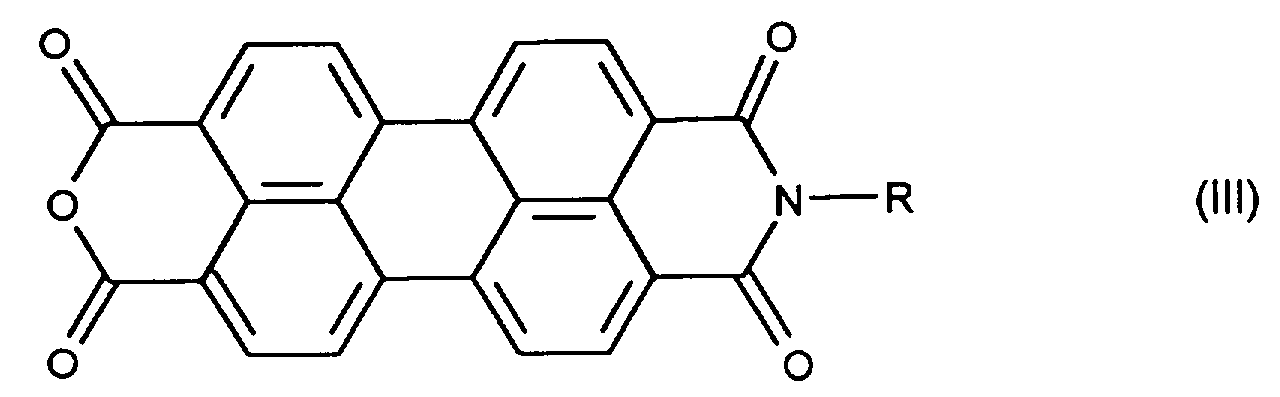
- the compounds according to the invention can be reacted with a perylene-3,4: 9,10-tetracarboxylic acid monoahydride monoimide of the formula III with a formamide of formula IV A (NHCHO) m (IV) are prepared, wherein A, R and m have the meaning given above.
- This manufacturing method is also the subject of the present invention.
- the reaction is preferably carried out at a temperature of 150-250 ° C. and in the presence of a nitrogen-containing heterocycle, a carboxylic acid or a glycol.
- Perylene-3,4 9,10-tetracarboxylic acid monoahydride monoimides of the formula III are known or can be prepared by known methods. Some of these compounds are described, for example, in the above-mentioned article in Chem. Ber. 124 , 529 (1991).
- the di-, tri- or tetravalent carbocyclic or heterocyclic aromatic radicals A are derived from primary di-, tri- or tetra-amines.
- Suitable carbocyclic amines are, for example, mono- to tetracyclic, in particular mono- or bicyclic amines, preferably derived from benzene, preferably in the positions 1,4-, 1,3,5- or 1,2,4,5-substituted; of biphenyl, preferably in positions 4,4'- or of naphthalene, preferably in positions 2,7-.
- Suitable heterocyclic aromatic amines can be purely heterocyclic or contain a heterocyclic ring and one or more fused benzene rings. Examples of heterocyclic ring systems are pyridine, preferably in the positions 2,4- or 2,4,6-substituted; Pyrimidine and s-triazine, each preferably in the positions 2,4,6-substituted.
- Preferred residues A are derived from benzene, biphenyl, naphthalene, anthracene, phenanthrene, pyridine, pyridazine, pyrimidine, pyrazine or triazine, in particular residues of the formula
- perylene-3,4: 9,10-tetracarboximides of the formula I according to the invention are preferred, in which R denotes a secondary C7-C41 alkyl radical or a radical of the formula II wherein R1 is a branched C3-C8 alkyl radical and n is 0, 1, 2 or 3.
- R is -CH (R2) 2 and R2 is C4-C18 alkyl, preferably C6-C10 alkyl, or in which R is a radical of the formula II shown above with R1 being tert-butyl .
- R is 2,5-di-tert-butylphenyl or -CH (R2) 2 and R2 is a straight-chain radical, preferably n-hexyl, n-heptyl, is n-octyl, n-nonyl or n-decyl.
- R2 is a straight-chain radical, preferably n-hexyl, n-heptyl, is n-octyl, n-nonyl or n-decyl.
- Another object of the invention is a process for the preparation of perylene-3,4: 9,10-tetracarboxylic acid bisimides of the formula V. by reaction of the perylene-3,4: 9,10-tetracarboxylic acid bisanhydride or of perylene-3,4: 9,10-tetracarboxylic acid monoanhydride monoimides of the formula III with a formamide of the formula VI, RNHCHO (VI), in which the radicals R independently of one another are H, an alkyl, aralkyl or cycloalkyl group or a carbocyclic or heterocyclic aromatic radical, characterized in that the reaction at a temperature of 150- 250 ° C and in the presence of a nitrogen-containing heterocycle, a carboxylic acid or a glycol.
- Preferred radicals R are the preferred radicals described for the compounds of the formula I above.
- Both the process for the preparation of compounds of the formula I and the last-mentioned process for the preparation of bisimides of the formula V are preferably carried out in the presence of a nitrogen-containing heterocycle selected from the group consisting of pyridine, picoline, lutidine and in particular imidazole or quinoline. If production is in a carboxylic acid, this is preferably acetic acid, while the preferred glycol is ethylene glycol.
- the reaction can be carried out without further components in the reaction mixture or suitably in the presence of a zinc, lead, calcium or magnesium salt as a catalyst.
- Preferred catalysts are lead acetate, zinc chloride or in particular zinc acetate.
- the compounds of the formula I according to the invention are preferably not substituted in the perylene ring system. However, they can also have one or more, but generally at most six, substituents in the ring system, the substituents independently of one another being alkyl, aralkyl, cycloalkyl, alkoxy, aryloxy, alkylaryl, alkylmercapto, arylmercapto, a carbocyclic or heterocyclic aromatic radical or chloro, bromo , Nitro, -SO3H (and their metal salts or their ammonium salts) or -SO3R (where R is alkyl or aryl), amino, acylaminomethyl, such as Acetylaminomethyl, alkylamino, arylamino, phthalimidomethyl, aminomethyl, dimethylaminomethyl (prepared, for example, by cleavage of the corresponding phthalimido derivative), pyrazolomethyl.
- substituents in the ring system the substituents
- sulfo or amino substituted perylene derivatives are particularly suitable as rheology improvers.
- Corresponding derivatives of other pigment systems, e.g. the phthalocyanine pigments or the quinacridone pigments and their preparation are known, for example, from US 4,981,888, EP-A 356,390, EP-A 508,704, US5,212,221 or EP-A 485,337.
- the present substituted perylene derivatives can be prepared in an analogous manner.
- the substituent or the substituents are preferably in the 1- or 1.6-, 2.5-, 7.12- or 8.11-position.
- the substituted perylene derivatives preferably have one or two substituents in the ring system, and for disubstituted compounds the substituents are preferably the same.
- the substituted perylene derivatives can be prepared from the corresponding unsubstituted compounds by generally known methods.
- the properties of the compounds according to the invention are suitable for a large number of applications.
- Suitable plastics are e.g. Polyolefins, polyvinyl chloride, fluoropolymers, e.g. Polyfluoroethylene, polytrifluorochloroethylene or tetrafluoroethylene / hexafluoropropylene copolymer, silicone resins, but especially engineering materials, such as e.g. Polycarbonates, polyacrylates, polymethacrylates, polystyrene, ABS, polyester, in particular polyalkylene terephthalates, such as polybutylene terephthalate (PBT) or polyethylene terephthalate (PET), polyamides, polyether ketones, polyurethanes, individually or in mixtures.
- the compounds according to the invention are expediently used in a concentration of 0.01 to 10, preferably 0.01-5,% by weight, based on the polymer.
- the dyeing is carried out by the customary methods, for example by mixing a compound according to the invention or a mixture of such compounds with the plastic granulate or powder without having to incorporate it into a preparation beforehand, and extruding the mixture into fibers, films or granules.
- the latter can then be molded into objects, for example by injection molding.
- the red fluorescent colorations obtained have high purity and high saturation and are distinguished by good transparency and good resistance, in particular to light.
- Another object of the invention is the use of the compounds according to the invention in security printing, as fluorescent dyes for machine-readable markings, as laser dyes, and for the production of non-impact printing toners, color filters, organic photoreceptors, electroluminescent and photoluminescent elements or solar panels.
- Example 1 Synthesis of a bichromophoric perylene dye by reacting the 2,4,6-triaminopyrimidine with N- (1-hexylheptyl) perylene-3,4: 9,10-tetracarboxylic acid-3,4-anhydride-9,10-carboximide
- the intensely violet colored silica gel of the first third of the column is boiled under reflux with stirring for 30 min after removal of the eluent and drying of the column filling with a mixture of chloroform and 30% glacial acetic acid, the dye dissolving.
- the mixture is now suctioned off through a D-4 frit and the remaining silica gel is washed with chloroform / glacial acetic acid (10: 3).
- the intensely red-violet dye solution is concentrated using the rotary evaporator and the precipitated dye after the addition of dist. Aspirated water, washed neutral and dried at 100 ° C for 8 h. Educ. 2.3 g (86%) crude product.
- Example 2 Synthesis of a trichromophoric perylene dye by reacting 1,3,5-triaminobenzene-trisformamide with N- (1-hexylheptyl) -3.4: 9,10-perylenetetracarboxylic acid-3,4-anhydride-9,10-carboximide
- 1,3,5-Triaminobenzene is according to the instructions in Chem. Abstr. 1954, 49, 9036a by reduction of 1,3,5-trinitrobenzene with powdered iron in hydrochloric acid. After treatment with 2 N HCl, 14.6 g (37%) of yellowish needles are obtained - mp. 300 ° C. (hydrochloride).
- 1,3,5-triaminobenzene trisformamide 1.0 g (4.3 mmol) 1,3,5-triaminobenzene hydrochloride is concentrated in 20 ml. Formic acid entered and the solution is heated to boiling for 30 min. The cooled solution is distilled in 250 ml.
- the crude product is taken up in 30 ml CHCl3 / n-butanol 10: 1 and chromatographed over Al2O3 (activity I) with CHCl3 / n-butanol 10: 1.
- a yellow-green fluorescent forerun is discarded and the second fraction, which is characterized by red fluorescence, is separated off.
- a number of impurities remain firmly adsorbed on the column in the first third.
- the dye fraction which is uniform by thin layer chromatography, is passed over a D-5 frit suctioned off and evaporated with the rotary evaporator. The dye that precipitates is distilled. Washed water and dried in vacuo at 50 ° C for 5h. Educ.
- the relatively stable dye hydrate can be dehydrated by drying for 8 hours at 100 ° C in a high vacuum.
- the synthesis is repeated using the same approach, with 200 mg of zinc acetate being added.
- the reaction time is increased to 8 h and 25 g of imidazole are used as the solvent.
- a product is produced which has identical IR, 1 H-NMR, 13 C-NMR spectra, but whose elemental analysis values differ more.
- the extinction coefficients of the product are 18% lower, which indicates a lower purity.
- N-Hexylheptylformamide 20.0 g (100 mmol) 1-hexylheptylamine are refluxed with 20.0 g (400 mmol) 92 percent.
- the excess formic acid is distilled off via a 10 cm Vigreux column and the remaining reaction product is fractionally distilled in vacuo.
- Educ. 18.1 g (79%) - bp 165 ° C (1Torr) - n D 20 1.4577.
- the reaction product contains a small proportion of bisformamide, which is difficult to separate by distillation, but does not interfere with the further reactions.
- Example 6 Synthesis of a trichromophoric perylene dye by reacting the 1,3,5-triaminobenzene-trisformamide with N- (1-heptyloctyl) -3,4: 9,10-perylenetetracarboxylic acid-3,4-anhydride-9,10-carboximide
- the precipitated crude dye product is separated off by suction through a D-4 frit, with distilled water. Washed water neutral and dried at 120 ° C for 2 h. Educ. 1.4 g (crude product).
- the crude product is taken up in 15 ml CHCl3 / n-butanol 10: 1 and chromatographed over Al2O3 (activity I) with CHCl3 / n-butanol 10: 1.
- a yellow-green fluorescent forerun is discarded and the second fraction, which is characterized by red fluorescence, is separated off.
- Example 7 Synthesis of a trichromophoric perylene dye by reacting the 1,3,5-triaminobenzene-trisformamide with N- (1-nonyldecyl) -3,4: 9,10-perylenetetracarboxylic acid-3,4-anhydride-9,10-carboximide
Landscapes
- Chemical & Material Sciences (AREA)
- Organic Chemistry (AREA)
- Engineering & Computer Science (AREA)
- Materials Engineering (AREA)
- Physics & Mathematics (AREA)
- General Physics & Mathematics (AREA)
- Health & Medical Sciences (AREA)
- Chemical Kinetics & Catalysis (AREA)
- Medicinal Chemistry (AREA)
- Polymers & Plastics (AREA)
- Life Sciences & Earth Sciences (AREA)
- Wood Science & Technology (AREA)
- Nitrogen Condensed Heterocyclic Rings (AREA)
- Compositions Of Macromolecular Compounds (AREA)
- Optical Filters (AREA)
- Indole Compounds (AREA)
Abstract
Description
- Die Erfindung betrifft neue di-, tri- und tetrachromophore Perylenfarbstoffe, ein Verfahren zu deren Herstellung durch Umsetzung von Perylen-3,4:9,10-tetracarbonsäure-3,4-anhydrid-9,10-imiden mit Formamiden der entsprechenden primären Di-, Tri- oder Tetraamine, und deren Verwendung, sowie ein spezifisches Verfahren zur Herstellung von Perylen-3,4:9,10-tetracarbonsäure-bisimiden durch Umsetzung von Perylen-3,4:9,10-tetracarbonsäure-bisanhydriden oder von Perylen-3,4:9,10-tetracarbonsäure-anhydrid-imiden mit Formamiden primärer Amine.
- Perylenfarbstoffe, Perylen-3,4:9,10-tetracarbonsäurebisimide, werden üblicherweise aus dem technisch gut zugänglichen Perylen- 3,4:9,10-tetracarbonsäurebisanhydrid oder Perylen-3,4:9,10-tetracarbonsäure-3,4-anhydrid-9,10-imiden und aus primären aliphatischen oder aromatischen Aminen dargestellt.
- Während die Umsetzung bei gewöhnlichen primären Aminen unter den üblichen Reaktionsbedingungen glatt gelingt, erfolgt die Umsetzung mit besonders elektronenreichen Aminen, insbesondere mit elektronenreichen aromatischen Aminen, wie z.B. dem 1,3,5-Triaminobenzol, zu anderen als den erwarteten Produkten. Die glatte Umsetzung dieser Amine mit Perylen-peri-Anhydrid-Einheiten ist ein ungelöstes synthetisches Problem. Die elektronenreichen aromatischen oder heteroaromatischen Amine sind darüber hinaus im allgemeinen sehr oxydationsempfindlich, insbesondere in Gegenwart von Basen, was ihre Handhabung erheblich erschwert. Beispiele sind Amine, die eine oder mehrere Amino-Gruppen, Alkoxy-Gruppen, Phenoxy-Gruppen tragen und/oder sich von elektronenreichen Heteroaromaten wie Pyrrol oder Furan ableiten. Ein Weg, die Oxydationsempfindlichkeit dieser Amine, insbesondere in Gegenwart von Basen, zu verringern, z.B. durch eine Derivatisierung, wäre daher für die Synthese der Perylenfarbstoffe ein erheblicher Fortschritt.
- Werden für die Kondensation von Perylen-3,4:9,10-tetracarbonsäure-bisanhydrid oder - monoanhydrid-monoimiden statt der primären Amine nun die Formamide der betreffenden Amine eingesetzt, so findet man unter den üblichen Reaktionsbedinungen erstaunlicherweise eine glatte Umsetzung zu den Bisimiden. Die Formamide reagieren dabei unter Entwicklung von CO₂ (nach Oxydation) zu den gleichen Produkten als würde man die entsprechenden freien Amine für die Reaktion einsetzen.
- Obwohl die Umsetzung von Carbonsäureanhydriden, wie z.B. Phthalanhydrid, Naphthalindicarbonsäureanhydrid, Trimellithsäureanhydrid oder Pyrromelithsäuredianhydrid, mit Formamid oder mit N-Methylformamid im allgemeinen bekannt ist [siehe z.B. H. Schindlbauer, Monatshefte für Chemie 104, 848(1973)], ist diese Reaktion bisher nur einmal, in der GB-B 1,370,433, für die Herstellung eines bestimmten Perylentetracarbonsäure-bisimids beschrieben worden.
- Bei der erfindungsgemässen Umsetzung der Formamide werden diese nicht, wie man zunächst vermuten könnte, und wie in der oben erwähnten GB-B 1,370,433 für die Synthese von N,N'-Dimethylperylen-3,4:9,10-tetracarbonsäure-bisimid in wässrigen Lösungen beschrieben ist, zu den freien Aminen verseift, die dann, wie üblich, abreagieren könnten. Vielmehr liegt hier ein neuer Reaktionstyp vor - die Formamid-Gruppierung greift aktiv in das Reaktionsgeschehen ein. Ein Beleg hierfür ist die erhöhte Reaktivität der Formamide verglichen mit den Aminen, wie auch die im allgemeinen verbesserte Ausbeute bei der Reaktion mit den Formamiden. So können aromatische Formamide glatt umgesetzt werden, auch wenn die entsprechenden Amine nicht oder nur sehr langsam reagieren.
- Die Verwendung von Formamiden statt der betreffenden Amine hat in bestimten Fällen erhebliche Vorteile. So sind die Formamide im allgemeinen gegenüber den freien Aminen völlig lagerbeständig, während bei den letzteren die Oxydation in vielen Fällen ein erhebliches Problem darstellt (vgl. z.B. die bekannte Braunfärbung bei der Lagerung von Anilin, wenn nicht auf völlige Abwesenheit von Sauerstoff geachtet wird). Ein ganz wesentlicher Fortschritt wird aber erreicht, wenn das primäre Amin sehr elektronenreich ist. So bereitet die Umsetzung von 1,3,5-Triaminobenzol mit dem N-(1-Hexylheptyl)perylen-3,4:9,10-tetracarbonsäure-3,4-anhydrid-9,10-imid wegen der Oxydationsempfindlichkeit des Amins erhebliche Probleme. Erfolgt dagegen die Kondensation mit dem Tris-Formamid des 1,3,5-Triaminobenzols, so reagieren alle drei Aminogruppen glatt, und es wird der entsprechende trichromophore Farbstoff erhalten, der der erste Perylenfarbstoff mit Y-förmiger Anordnung der Chromophore ist.
- Der trichromophore Perylenfarbstoff hat das übliche Absorptions- und Fluoreszenzspektrum, er weist aber eine schnelle intramolekulare Energieübertragung auf - dies hat Folgen in bezug auf die Fluoreszenzdepolarisation, so dass Farbstoffe dieses Typs analytisch problemlos neben monofluorophoren Perylenfarbstoffen über den Lineardichroismus nachgewiesen bzw. analytisch bestimmt werden können.
- Setzt man dagegen für die Umsetzung mit N-(1-Hexylheptyl)perylen-3,4:9,10-tetracarbonsäure-3,4-anhydrid-9,10-imid beispielsweise das freie nicht formamidderivatisierte Triaminopyrimidin ein, so erhält man nicht den trichromophoren sondern nur den dichromophoren Perylenfarbstoff.
- Di- beziehungsweise tri- und tetrachromophore Perylenfarbstoffe sind bisher kaum, beziehungsweise noch gar nicht, beschrieben worden. Zum Stand der Technik gehören einzig zwei Vertreter der dichromophoren Farbstoffe, welche beide auf konventionelle Art, durch Umsetzung eines Perylen-3,4:9,10-tetracarbonsäure-3,4-anhydrid-9,10-imids mit dem freien primären Diamin hergestellt wurden.
- H. Kaiser, J. Lindner und H. Langhals beschreiben in Chem. Ber. 124, 529 (1991) die Synthese von nichtsymmetrisch substituierten Perylen-Fluoreszenzfarbstoffen. Dabei wird auch die Herstellung des dichromophoren Produktes der Umsetzung von 1,4-Diaminobutan mit N-(2,5-Di-tert-butylphenyl)-perylen-3,4:9,10-tetracarbonsäure-monoanhydrid-monoimid beschrieben.
- Die US 4,968,571 und die EP-A 443,566 beschreiben die Verwendung von photoleitfähigen Perylenderivaten in elektrophotographischen Aufzeichnungsmaterialien. Dabei wird auch das dichromophore Produkt der Umsetzung von 1,4-Phenylendiamin mit N-Phenethyl-perylen-3,4:9,10-tetracarbonsäure-monoanhydrid-monoimid erwähnt.
- Gegenstand vorliegender Anmeldung sind Perylen-3,4:9,10-tetracarbonsäureimide der Formel I

- Die erfindungsgemässen Verbindungen können durch Umsetzung eines Perylen-3,4:9,10-tetracarbonsäure-monoahydrids-monoimids der Formel III

A(NHCHO)m (IV)
hergestellt werden, wobei A, R und m die oben angegebene Bedeutung haben. Dieses Herstellungsverfahren ist ebenfalls Gegenstand vorliegender Erfindung. Vorzugsweise wird die Umsetzung bei einer Temperatur von 150-250°C und in Gegenwart eines stickstoffhaltigen Heterocyclus, einer Carbonsäure oder eines Glykols durchgeführt. - Perylen-3,4:9,10-tetracarbonsäure-monoahydride-monoimide der Formel III sind bekannt oder können nach bekannten Methoden hergestellt werden. Einige dieser Verbindungen sind beispielsweise im oben erwähnten Artikel in Chem. Ber. 124, 529 (1991) beschrieben.
- Die zwei-, drei- oder vierwertigen carbocyclischen oder heterocyclischen aromatischen Reste A sind von primären di-, tri- oder tetra-Aminen abgeleitet. Geeignete carbocyclische Amine sind zum Beispiel mono- bis tetracyclische, insbesondere mono- oder bicyclische Amine, vorzugsweise abgeleitet von Benzol, bevorzugt in den Positionen 1,4-, 1,3,5- oder 1,2,4,5-substituiert; von Biphenyl, bevorzugt in den Positionen 4,4'- substituiert oder von Naphthalin, bevorzugt in den Positionen 2,7- substituiert. Geignete heterocyclische aromatische Amine können rein heterocyclisch sein oder einen heterocyclischen Ring und einen oder mehrere ankondensierte Benzolringe enthalten. Beispiele für heterocyclische Ringsysteme sind Pyridin, bevorzugt in den Positionen 2,4- oder 2,4,6-substituiert; Pyrimidin und s-Triazin, jeweils bevorzugt in den Positionen 2,4,6-substituiert.
- Bevorzugte Reste A sind von Benzol, Biphenyl, Naphthalin, Anthracen, Phenanthren, Pyridin, Pyridazin, Pyrimidin, Pyrazin oder Triazin abgeleitet, insbesondere Reste der Formel

- Ferner werden erfindungsgemässe Perylen-3,4:9,10-tetracarbonsäureimide der Formel I bevorzugt, worin R einen sekundären C₇-C₄₁-Alkylrest oder einen Rest der Formel II bedeutet

- Weitere bevorzugte Verbindungen sind solche, worin R -CH(R₂)₂ bedeutet, und R₂ C₄-C₁₈--Alkyl, vorzugsweise C₆-C₁₀-Alkyl ist, oder worin R einen Rest der oben dargestellten Formel II mit R₁ gleich tert-Butyl bedeutet.
- Ganz besonders bevorzugt werden Verbindungen der Formel I, worin R 2,5-Di-tert-butylphenyl oder -CH(R₂)₂ bedeutet und R₂ ein geradkettiger Rest, vorzugsweise n-Hexyl, n-Heptyl, n-Octyl, n-Nonyl oder n-Decyl ist. Ganz besonders bevorzugt sind auch die in den Herstellungsbeispielen beschriebenen Verbindungen.
- Ein weiterer Gegenstand der Erfindung ist ein Verfahren zur Herstellung von Perylen-3,4:9,10-tetracarbonsäure-bisimiden der Formel V


- Sowohl das Verfahren zur Herstellung von Verbindungen der Formel I als auch das zuletzt erwähnte Verfahren zur Herstellung von Bisimiden der Formel V werden vorzugsweise in Gegenwart eines stickstoffhaltigen Heterocyclus ausgewählt aus der Gruppe Pyridin, Picolin, Lutidin und insbesondere Imidazol oder Chinolin durchgeführt. Falls die Herstellung in einer Carbonsäure verläuft ist dies vorzugsweise Essigsäure, während das bevorzugte Glykol Ethylenglykol ist.
- Die Umsetzung kann ohne weitere Komponenten im Reaktionsgemisch oder geeigneterweise in Gegenwart eines Zink-, Blei-, Calcium- oder Magnesiumsalzes als Katalysator durchgeführt werden. Bevorzugte Katalysatoren sind Bleiacetat, Zinkchlorid oder insbesondere Zinkacetat.
- Nicht nur die Reaktionsgeschwindigkeit der Umsetzung, sondem auch die Ausbeuten werden durch Zusatz der oben erwähnten Metallsalze bzw. Katalysatoren erhöht. Optimale Ausbeuten symmetrisch oder unsymmetrisch substituierter Perylenfarbstoffe werden bei Reaktionszeiten von 8-10 h bei einer Temperatur von etwa 180°C unter Zusatz von Zinkacetat erreicht.
- Die erfindungsgemässen Verbindungen der Formel I sind vorzugsweise im Perylen-Ringsystem nicht substituiert. Sie können aber auch einen oder mehrere, in der Regel jedoch höchstens sechs Substituenten im Ringsystem aufweisen, wobei die Substituenten unabhängig voneinander Alkyl, Aralkyl, Cycloalkyl, Alkoxy, Aryloxy, Alkylaryl, Alkylmercapto, Arylmercapto, einen carbocyclischen oder heterocyclischen aromatischen Rest oder Chloro, Bromo, Nitro, -SO₃H (sowie deren Metallsalze oder deren Ammoniumsalze) oder -SO₃R (wobei R für Alkyl oder Aryl steht), Amino, Acylaminomethyl, wie z.B. Acetylaminomethyl, Alkylamino, Arylamino, Phthalimidomethyl, Aminomethyl, Dimethylaminomethyl (hergestellt zum Beispiel durch Spaltung des entsprechenden Phthalimido-Derivats), Pyrazolomethyl, sein können.
- Die letztgenannten sulfo- bzw. amino-substituierten Perylen-Derivate eignen sich insbesondere als Rheologieverbesserer. Entsprechende Derivate anderer Pigmentsysteme, wie z.B. der Phthalocyaninpigmente oder der Chinacridonpigmente sowie deren Herstellung sind beispielsweise aus US 4,981,888, EP-A 356,390, EP-A 508,704, US5,212,221 oder EP-A 485,337 bekannt. Die vorliegenden substituierten Perylenderivate können auf analoge Weise hergestellt werden.
- Vorzugsweise sind der Substituent bzw. die Substituenten in 1-, bzw. 1,6-, 2,5-, 7,12-, oder 8,11-Stellung. Die substituierten Perylenderivate weisen vorzugsweise einen oder zwei Substituenten im Ringsystem auf, und bei disubstituierten Verbindungen sind die Substituenten vorzugsweise gleich.
- Die substituierten Perylenderivate können aus den entsprechenden nicht substituierten Verbindungen nach allgemein bekannten Methoden hergestellt werden.
- Die erfindungsgemässen Verbindungen eignen sich anhand ihrer Eigenschaften für eine Vielzahl von Anwendungen.
- So können sie beispielsweise als Pigmente für die Massefärbung von Kunststoffen oder Lacken eingesetzt werden. Weitere Gegenstände der Erfindung sind daher in der Masse eingefärbtes hochmolekulares organisches Material enthaltend eine Verbindung der Formel I, sowie ein Verfahren zum Färben von hochmolekularem organischem Material in der Masse unter Verwendung dieser Verbindungen.
- Geeignete Kunststoffe sind z.B. Polyolefine, Polyvinylchlorid, Fluorpolymerisate, wie z.B. Polyfluorethylen, Polytrifluorchlorethylen oder Tetrafluorethylen/Hexafluorpropylen-Mischpolymerisat, Silikonharze, insbesondere aber Ingenieurwerkstoffe (Engineering Plastics), wie z.B. Polycarbonate, Polyacrylate, Polymethacrylate, Polystyrol, ABS, Polyester, insbesondere Polyalkylenterephthalate, wie Polybutylenterephthalat (PBT) oder Polyethylenterephthalat (PET), Polyamide, Polyetherketone, Polyurethane, einzeln oder in Mischungen. Zweckmässig werden die erfindungsgemässen Verbindungen in einer Konzentration von 0.01 bis 10, vorzugsweise 0.01-5 Gew.%, bezogen auf das Polymere, eingesetzt.
- Als Beispiele für Polyolefine, die mit den erfindungsgemässen Verbindungen gefärbt werden können, seien Polyethylen hoher und niederer Dichte (HD-PE, LD-PE und LLD-PE), Polyisobutylen und insbesondere Polypropylen, sowie Copolymere von Polyolefinen mit z.B. Polyethern, Polyetherketonen oder Polyurethanen, erwähnt. Bevorzugt ist Polypropylen.
- Die Färbung erfolgt nach den üblichen Verfahren, beispielsweise durch Mischen einer erfindungsgemässen Verbindung oder eines Gemisches solcher Verbindungen mit dem Kunststoffgranulat oder -pulver, ohne es vorher in ein Präparat einarbeiten zu müssen, und Extrudieren der Mischung zu Fasern, Folien oder Granulaten. Letztere können dann beispielsweise im Spritzgussverfahren zu Gegenständen verformt werden.
- Die erhaltenen rot fluoreszierenden Ausfärbungen weisen hohe Reinheit und hohe Sättigung auf und zeichnen sich durch gute Transparenz sowie durch gute Beständigkeit, insbesondere gegen Licht, aus.
- Ein weiterer Gegenstand der Erfindung ist die Verwendung der erfindungsgemässen Verbindungen im Sicherheitsdruck, als Fluoreszenzfarbstoffe für maschinenlesbare Markierungen, als Laserfarbstoffe, sowie für die Herstellung von Druck-Tonem ("non-impact printing toners"), Farbfiltem, organischen Photorezeptoren, Elektrolumineszenz- und Photolumineszenzelementen oder Sonnenkollektoren.
- Erfindungsgemässe Verbindungen, welche einen oder mehrere Substituenten ausgewählt aus der Gruppe -SO₃H (sowie deren Metallsalze oder deren Ammoniumsalze) oder -SO₃R (wobei R für Alkyl oder Aryl steht), Amino, Acylaminomethyl, wie z.B. Acetylaminomethyl, Alkylamino, Arylamino, Phthalimidomethyl, Aminomethyl, Dimethylaminomethyl (hergestellt zum Beispiel durch Spaltung des entsprechenden Phthalimido-Derivats) oder Pyrazolomethyl aufweisen, können zudem als Rheologieverbesserer eingesetzt werden.
- Die nachfolgenden Beispiele erläutern die Erfindung.
- 3.70 g (6.45 mmol) N-(1-Hexylheptyl)-perylen-3,4:9,10-tetracarbonsäure-3,4-anhydrid-9,10-carboximid (hergestellt gemäss H. Kaiser, J. Lindner, H. Langhals, Chem. Ber. 1991, 124, 529) werden in 10 g Imidazol unter Zusatz von 200 mg (0.90 mmol) Zinkacetat und 270 mg (2.16 mmol) 2,4,6,-Triaminopyrimidin 3 h bei 200°C unter Argon- Schutzgas umgesetzt. Das zähflüssige Reaktionsprodukt wird in 500 ml Ethanol aufgenommen, mit 100 ml konz. HCl versetzt und 8 h gerührt. Nach Absaugen über eine D-4 Fritte wird der Farbstoff mit dest. Wasser neutralgewaschen und getrocknet (3.2 g). Er wird über Kieselgel mit CHCl₃/Eisessig 10:1 als Laufmittel chromatographiert, wobei eine geringe Menge eines Vorlaufes verworfen wird. Das rötlich fluoreszierende Produkt wird dabei im ersten Drittel der Säule so fest adsorbiert, dass ein Eluieren auch nach Erhöhung der Eisessig-Konzentration im Lösungsmittel nicht möglich ist. Das intensiv violett gefärbte Kieselgel des ersten Drittels der Säule wird nach Entfemung des Laufmittels und Trocknung der Säulenfüllung mit einem Gemisch von Chloroform und 30 % Eisessig unter Rühren 30 min unter Rückfluss gekocht, wobei der Farbstoff in Lösung geht. Das Gemisch wird nun über eine D-4 Fritte abgesaugt und das verbleibende Kieselgel wird mit Chloroform/Eisessig (10:3) gewaschen. Die intensiv rotviolette Farbstofflösung wird mit dem Rotationsverdampfer eingeengt und der ausfallende Farbstoff nach Zusatz von dest. Wasser abgesaugt, neutralgewaschen und 8 h bei 100°C getrocknet. Ausb. 2.3 g (86 %) Rohprodukt. Aus dem erhaltenen Rohprodukt kann durch erneute Chromatographie an Kieselgel mit CHCl₃ unter Zusatz von 10 % Eisessig oder 10 % Ethanol (Säule 80x4 cm) kein elementaranalysenreines Produkt gewonnen werden, auch nicht nach mehrfacher Chromatographie. Ausb. 1.2 g (45%). UV (CHCl₃): λmax(∈) = 568 nm (188422), 529 (154867), 492 (90339), 460 (33552). Fluoreszenz (CHCl₃): λmax = 532 nm, 575 , 620. MS (70eV): m/z(%)= 1234 (0.1), 1052 (0.2), 871 (2), 870 (1), 497 (1), 435 (0.9), 412 (1), 389 (2), 183 (4), 182 (33), 154 (2), 112 (7), 111 (16), 98 (15), 97 (39), 85 (9), 84 (31), 83 (59), 82 (13), 70 (65), 69 (100), 55 (89), 43 (40), 28 (9), 27 (13). - MS (FAB/3-NBA/Xe 8KV,10W): m/z= 1254 [M⁺+H₂O], 1237 [M⁺], 681, 596 (100), 520, 499, 414,373, 345, 300, 275, 262, 250, 154, 136, 107. Da das Produkt nicht analysenrein ist, werden 100 mg des Produktgemisches an basischem Al₂O₃ (Aktivität I) mit CHCl₃/n- Butanol 40:1 chromatographiert (Säule 30x1cm). 1.Fraktion: Ausb. 0.64 g (64% bezogen auf eingesetzte Menge). MS (FAB/CHCl₃m-NBA): m/z (%)= 1254 (20), 1237 (100), 1236 (45), 596 (26), 414 (100), 358 (30), 275 (18), 237 (8).
-
C₇₈H₇₃N₇O₈H₂O (1254.4) Ber. C 74.76 H 6.03 N 7.81 Gef. C 74.93 H 6.28 N 7.76 -
(1) 1,3,5-Triaminobenzol wird gemäss Vorschrift in Chem. Abstr. 1954, 49,9036a durch Reduktion von 1,3,5-Trinitrobenzol mit pulverisiertem Eisen in Salzsäure hergestellt. Nach Behandeln mit 2 N HCl erhält man 14.6 g (37%) gelbliche Nadeln - Schmp. 300°C (Hydrochlorid).
(2) 1,3,5-Triaminobenzol-trisformamid
1.0 g (4.3 mmol) 1,3,5-Triaminobenzolhydrochlorid wird in 20 ml konz. Ameisensäure eingetragen und die Lösung wird 30 min zum Sieden erhitzt. Die erkaltete Lösung wird in 250 ml dest. Wasser eingetropft und das ausfallende Produkt wird über eine D-4 Fritte abgesaugt, mit dest. Wasser neutralgewaschen und im Vakuum 2 h bei 50°C getrocknet. Ausb. 550 mg (62%) graues Pulver - Schmp. 265°C.C₉H₉N₃O₃ (207.2) Ber. C 52.17 H 4.38 N 20.23 Gef. C 51.14 H 4.43 N 20.04
(3) Synthese des trichromophoren Perylenfarbstoffes
3.0 g (5.2 mmol) N-(1-Hexylheptyl)-3,4:9,10-perylentetracarbonsäure-3,4-anhydrid-9,10-carboximid (hergestellt gemäss H. Kaiser, J. Lindner, H. Langhals, Chem. Ber. 1991, 124, 529) werden in 12 g Imidazol mit 359 mg (1.73 mmol) 1,3,5- Triaminobenzoltrisformamid unter Argonschutzgas 5 h bei 180°C umgesetzt. Nach dem Erkalten wird die Reaktionsmischung in 1 l Ethanol aufgenommen, mit 100 ml konz. HCl versetzt und 2 h gerührt. Das ausfallende Farbstoffrohprodukt wird durch Absaugen über eine D-4 Fritte abgetrennt, mit dest. Wasser neutralgewaschen und 2 h bei 100°C getrocknet. Ausb. 2.8 g (Rohprodukt). Zur Reinigung wird das Rohprodukt in 30 ml CHCl₃/n-Butanol 10:1 aufgenommen und über Al₂O₃ (Aktivität I) mit CHCl₃/n-Butanol 10:1 chromatographiert. Ein gelbgrün fluoreszierender Vorlauf wird dabei verworfen und die zweite Fraktion, die sich durch eine rote Fluoreszenz auszeichnet, wird abgetrennt. Auf der Säule bleiben eine Reihe von Verunreinigungen im ersten Drittel fest adsorbiert zurück. Die dünnschichtchromatographisch einheitliche Farbstofffraktion wird über eine D-5 Fritte abgesaugt und mit dem Rotationsverdampfer eingedampft. Der ausfallende Farbstoff wird mit dest. Wasser gewaschen und 5h bei 50°C im Vakuum getrocknet. Ausb. 800 mg (26%) - Schmp. 285-300°C (Zersetzung) - Rf (Kieselgel/CHCl₃/Eisessig 10:1)= 0.85 - Rf (Al₂O₃/CHCl₃/n-BuOH 40:1) 0.52. UV (CHCl₃): λmax(∈) = 433 nm (17136), 461 (53243), 492,5 (155141), 530 (298654). Fluoreszenz (CHCl₃):
λmax= 538 nm, 578.C₁₁₇H₁₀₈N₆O₁₂H₂O(1808.1) Ber. C 77.72 H 6.13 N 4.64 Gef. C 77.99 H 6.27 N 4.84 - Das verhältnismäßig stabile Farbstoff-Hydrat kann durch 8 h Trocknen bei 100°C im Hochvakuum dehydratisiert werden.
C₁₁₇H₁₀₈N₆O₁₂(1790.1) Ber. C 78.49 H 6.08 N 4.69 Gef. C 78.25 H 6.08 N 4.84 - Die Synthese wird mit dem gleichen Ansatz wiederholt, wobei 200 mg Zinkacetat zugesetzt werden. Die Reaktionsdauer wird auf 8 h erhöht und 25 g Imidazol werden als Lösungsmittel verwendet. Es entsteht bei gleicher Aufarbeitung ein Produkt, das identische IR-, ¹H-NMR-, ¹³C-NMR-Spektren aufweist, dessen Elementaranalysenwerte aber stärker abweichen. Die Extinktionskoeffizienten des Produktes sind um 18 % niedriger, was auf eine geringere Reinheit hinweist.
-
(1) N-Hexylheptyl-formamid
20.0 g (100 mmol) 1-Hexylheptylamin werden unter Rückfluss mit 20.0 g (400 mmol) 92 proz. Ameisensäure 1 h erhitzt. Die überschüssige Ameisensäure wird über eine 10 cm Vigreuxkolonne abdestilliert und das verbleibende Reaktionsprodukt wird im Vakuum fraktioniert destilliert. Ausb. 18.1 g (79 %) - Sdp. 165°C(1Torr) - nD20 = 1.4577. Das Reaktionsprodukt enthält einen geringen Anteil an Bisformamid, der destillativ nur schwierig abzutrennen ist, aber bei den weiteren Umsetzungen nicht stört.C₁₄H₂₉NO (227.4) Ber. C 73.75 H 12.86 N 6.16 Gef. C 71.29 H 12.43 N 5.94
(2) Synthese des N,N'-(1-Hexylheptyl)-3,4:9,10-perylenbis(dicarboximid) unter Verwendung des Formamids
3.0 g (7.6 mmol) Perylen-3,4:9,10-tetracarbonsäurebisanhydrid werden in 20 g Imidazol mit 200 mg (0.90 mmol) Zinkacetat und 2.60 g (11.4 mmol) Formamid des 1-Hexyl-heptylamins 8 h bei 180°C unter Argonschutzgas gerührt. Ausb. 3.8 g (66%) chromatographiert an Kieselgel mit CHCl₃ (Säule 80x4 cm). Schmp. 157°C - Rf(Kieselgel/CHCl₃)= 0.75. UV (CHCl₃): λmax(∈) = 460 nm (18239), 492 (52285), 528 (87547). Fluoreszenz (CHCl₃): λmax = 538 nm, 573. MS (70eV): m/z (%)= 756 (13), 755 (47), 754 (88) [M⁺], 737 (8), 669 (4), 575 (3), 574 (16), 573 (43), 572 (49), 555 (5),404 (4), 403 (7), 392 (26), 391 (75), 390 (100), 374 (5), 373 (14), 345 (9), 69 (7), 55 (10), 43 (4), 41 (5), 29 (1). - 2.0 g (5.1 mmol) Perylen-3,4:9,10-tetracarbonsäurebisanhydrid werden in 8 g Imidazol mit 100 mg (0.45 mmol) Zinkacetat und 1.85 g (13.68 mmol) Formanilid unter Argonschutzgas 4 h bei 180°C unter Rühren umgesetzt. Ausb. 2.0 g (72%) extraktiv umkristallisiert aus Methanol.
- 2.00 g (3.48 mmol) N-(1Hexylheptyl)-3,4:9,10-perylentetracarbonsäure-3,4-anhydrid-9,10-carboximid werden mit 847 mg (6.26 mmol) Formanilid und 100 mg (0.45 mmol) Zinkacetat in 10 g Imidazol 10 h bei 180°C unter Argonschutzgas umgesetzt. Das Rohprodukt wird gemäss allgemeiner Vorschrift aufgearbeitet. Ausb. 2.15 g (95%). Zur Reinigung wird der Farbstoff über Kieselgel mit CHCl₃ als Laufmittel chromatographiert (Säule 80x4 cm). Die Farbstofffraktion wird mit dem Rotationsverdampfer eingedampft, der ausfallende Farbstoff wird mit Wasser gewaschen und 4 h bei 50°C im Vakuum getrocknet. Ausb. 1.40 g (62%) - Rf(CHCl₃) = 0.53. - UV (CHCl₃): λmax(∈) = 492 nm (18750), 492(52272), 528(86727). Fluoreszenz (CHCl₃): λmax = 538 nm, 578.


- 1.5 g (2.49 mmol) N-(1-Heptyloctyl)-3,4:9,10-perylentetracarbonsäure-3,4-anhydrid-9,10-carboximid (hergestellt gemäss H. Kaiser, J. Lindner, H. Langhals, Chem. Ber. 1991, 124, 529) werden in 6 g Imidazol mit 172 mg (0.83 mmol) 1,3,5-Triaminobenzoltrisformamid unter Argonschutzgas 5 h bei 185°C umgesetzt. Nach dem Erkalten wird die Reaktionsmischung in 0.5 l Ethanol aufgenommen, mit 50 ml konz. HCl versetzt und 2 h gerührt. Das ausfallende Farbstoffrohprodukt wird durch Absaugen über eine D-4 Fritte abgetrennt, mit dest. Wasser neutralgewaschen und 2 h bei 120°C getrocknet. Ausb. 1.4 g (Rohprodukt). Zur Reinigung wird das Rohprodukt in 15 ml CHCl₃/n-Butanol 10:1 aufgenommen und über Al₂O₃ (Aktivität I) mit CHCl₃/n-Butanol 10:1 chromatographiert. Ein gelbgrün fluoreszierender Vorlauf wird dabei verworfen und die zweite Fraktion, die sich durch eine rote Fluoreszenz auszeichnet, wird abgetrennt. Dieses Produkt wird noch mehrmals chromatographisch gereinigt (CHCl₃/Eisessig 20:1 auf Kieselgel; CHCl₃/Ethanol 10:1 auf Kieselgel; noch einmal CHCl₃/Eisessig 20:1 auf Kieselgel), bis eine dünnschichtchromatographisch einheitliche Farbstofffraktion erhalten wird. Diese wird über eine D-5 Fritte abgesaugt und mit dem Rotationsverdampfer eingedampft. Der ausfallende Farbstoff wird mit dest. Wasser gewaschen und 14h bei 115°C im Vakuum getrocknet. Ausb. 200 mg (13%) - Schmp. 280°C (Zersetzung) - Rf (Kieselgel/CHCl₃/Ethanol 10:1)= 0.58. UV (CHCl₃): λmax(∈) = 437 nm (13499), 460 (48343), 492 (148632), 530 (294607). Fluoreszenz (CHCl₃): λmax= 535 nm, 575.
-
C₁₂₃H₁₂₀N₆O₁₂(1874.3) Ber. C 78.82 H 6.45 N 4.48 Gef. C 79.10 H 6.74 N 4.72 - Verfährt man analog wie in Beispiel 6, verwendet aber statt N-(1-Heptyloctyl)-3,4:9,10-perylentetracarbonsäure-3,4-anhydrid-9,10-carboximid das entsprechende N-(1-Nonyldecyl)-Derivat, erhält man mit 1,3,5-Triaminobenzol-trisformamid N-(1-Nonyldecyl)-3,4:9,10-perylentetracarbonsäure-3,4-anhydrid-9,10-carboximid.
Claims (14)
- Perylen-3,4:9,10-tetracarbonsäureimid der Formel I

- Perylen-3,4:9,10-tetracarbonsäureimid nach Anspruch 1, worin R einen sekundären C₇-C₄₁-Alkylrest oder einen Rest der Formel II bedeutet

- Perylen-3,4:9,10-tetracarbonsäureimid nach Anspruch 1 oder 2, worin R -CH(R₂)₂ bedeutet, und R₂ C₄-C₁₈-Alkyl, vorzugsweise C₆-C₁₀-Alkyl ist, oder worin R einen Rest der Formel II mit R₁ gleich tert-Butyl bedeutet.
- Perylen-3,4:9,10-tetracarbonsäureimid nach einem der Ansprüche 1 bis 3, worin R 2,5-Di-tert-butylphenyl oder -CH(R₂)₂ bedeutet und R₂ ein geradkettiger Rest, vorzugsweise n-Hexyl, n-Heptyl, n-Octyl, n-Nonyl oder n-Decyl, ist.
- Perylen-3,4:9,10-tetracarbonsäureimid nach einem der Ansprüche 1 bis 4, worin A ein von Benzol, Biphenyl, Naphthalin, Anthracen, Phenanthren, Pyridin, Pyridazin, Pyrimidin, Pyrazin oder Triazin abgeleiteter Rest ist.
- Perylen-3,4:9,10-tetracarbonsäureimid nach einem der Ansprüche 1 bis 5, worin A einen Rest der Formel

- Verfahren zur Herstellung eines Perylen-3,4:9,10-tetracarbonsäureimids der Formel I nach Anspruch 1 durch Umsetzung eines Perylen-3,4:9,10-tetracarbonsäure-monoahydrids-monoimids der Formel III
A(NHCHO)m (IV)
wobei A, R und m die im Anspruch 1 angegebene Bedeutung haben. - Verfahren nach Anspruch 7, worin die Umsetzung bei einer Temperatur von 150-250°C und in Gegenwart eines stickstoffhaltigen Heterocyclus, einer Carbonsäure oder eines Glykols durchgeführt wird.
- Verfahren zur Herstellung eines Perylen-3,4:9,10-tetracarbonsäure-bisimids der Formel V


- Verfahren nach einem der Ansprüche 7 bis 9, worin der stickstoffhaltige Heterocyclus Pyridin, Picolin, Lutidin und insbesondere Imidazol oder Chinolin ist, die Carbonsäure Essigsäure und das Glykol Ethylenglykol ist.
- Verfahren nach einem der Ansprüche 7 bis 10, worin die Umsetzung in Gegenwart eines Zink-, Blei-, Calcium- oder Magnesiumsalzes, vorzugsweise Bleiacetat, Zinkchlorid oder insbesondere Zinkacetat, durchgeführt wird.
- In der Masse eingefärbtes hochmolekulares organisches Material enthaltend ein Perylen-3,4:9,10-tetracarbonsäureimid nach einem der Ansprüche 1 bis 6.
- Verfahren zum Färben von hochmolekularem organischem Material in der Masse, gekennzeichnet durch Verwendung einer Verbindung nach einem der Ansprüche 1 bis 6.
- Verwendung einer Verbindung nach einem der Ansprüche 1 bis 6 im Sicherheitsdruck, als Fluoreszenzfarbstoffe für maschinenlesbare Markierungen, als Laserfarbstoffe, sowie für die Herstellung von Druck-Tonern ("non-impact printing toners"), Farbfiltern, organischen Photorezeptoren, Elektrolumineszenz- und Photolumineszenzelementen oder Sonnenkollektoren.
Applications Claiming Priority (3)
| Application Number | Priority Date | Filing Date | Title |
|---|---|---|---|
| CH337694 | 1994-11-10 | ||
| CH337694 | 1994-11-10 | ||
| CH3376/94 | 1994-11-10 |
Publications (2)
| Publication Number | Publication Date |
|---|---|
| EP0711812A1 true EP0711812A1 (de) | 1996-05-15 |
| EP0711812B1 EP0711812B1 (de) | 2001-08-29 |
Family
ID=4254627
Family Applications (1)
| Application Number | Title | Priority Date | Filing Date |
|---|---|---|---|
| EP95810688A Expired - Lifetime EP0711812B1 (de) | 1994-11-10 | 1995-11-01 | Verfahren zur Herstellung von Perylenimiden, neue di-, tri- und tetrachromophore Perylenfarbstoffe und deren Verwendung |
Country Status (6)
| Country | Link |
|---|---|
| US (1) | US5693808A (de) |
| EP (1) | EP0711812B1 (de) |
| JP (1) | JP3856859B2 (de) |
| KR (1) | KR960017666A (de) |
| CA (1) | CA2162448A1 (de) |
| DE (1) | DE59509556D1 (de) |
Cited By (7)
| Publication number | Priority date | Publication date | Assignee | Title |
|---|---|---|---|---|
| EP0826740A1 (de) * | 1996-08-08 | 1998-03-04 | Xerox Corporation | Symmetrische Perylendimer |
| WO1998032799A1 (en) * | 1997-01-27 | 1998-07-30 | Ciba Specialty Chemicals Holding Inc. | Bifluorophoric perylene colourants |
| EP0861878A1 (de) * | 1997-02-26 | 1998-09-02 | Xerox Corporation | Unsymmetrische Perylendimer |
| EP0990951A1 (de) * | 1998-10-02 | 2000-04-05 | Xerox Corporation | Unsymmetrische Perylendimere |
| US6060601A (en) * | 1997-07-24 | 2000-05-09 | Ciba Specialty Chemicals Corporation | Fluorescence-derivatisation of carbonyl compounds-novel carbonyl reagents |
| EP1110996A1 (de) * | 1999-12-24 | 2001-06-27 | BUNDESDRUCKEREI GmbH | Verfahren und Mittel zur Codierung von thermoplastischen Kunststoffteilen |
| US8481736B2 (en) | 2006-04-07 | 2013-07-09 | Basf Se | Liquid crystalline rylene tetracarboxylic acid derivatives and use thereof |
Families Citing this family (10)
| Publication number | Priority date | Publication date | Assignee | Title |
|---|---|---|---|---|
| US6350895B1 (en) | 1999-03-26 | 2002-02-26 | E. I. Du Pont De Nemours And Company | Transesterification process using yttrium and samarium compound catalystis |
| US6331264B1 (en) | 1999-03-31 | 2001-12-18 | E. I. Du Pont De Nemours And Company | Low emission polymer compositions |
| US6464902B1 (en) * | 2000-05-25 | 2002-10-15 | Xerox Corporation | Perylene mixtures |
| WO2005078023A2 (de) † | 2004-02-11 | 2005-08-25 | Basf Aktiengesellschaft | Schwarze perylenpigmente |
| US8129906B1 (en) | 2004-04-26 | 2012-03-06 | Imaging Systems Technology, Inc. | Lumino-shells |
| DE102004029385A1 (de) * | 2004-06-17 | 2006-06-08 | Wella Ag | Verwendung von fluoreszierenden Perylenverbindungen zur Behandlung menschlicher Haare |
| US9287419B2 (en) | 2011-01-05 | 2016-03-15 | Nitto Denko Corporation | Wavelength conversion perylene diester chromophores and luminescent films |
| WO2013049062A2 (en) | 2011-09-26 | 2013-04-04 | Nitto Denko Corporation | Highly-fluorescent and photo-stable chromophores for enhanced solar harvesting efficiency |
| WO2013052381A2 (en) | 2011-10-05 | 2013-04-11 | Nitto Denko Corporation | Wavelength conversion film having pressure sensitive adhesive layer to enhance solar harvesting efficiency |
| US9024526B1 (en) | 2012-06-11 | 2015-05-05 | Imaging Systems Technology, Inc. | Detector element with antenna |
Citations (4)
| Publication number | Priority date | Publication date | Assignee | Title |
|---|---|---|---|---|
| GB1370433A (en) * | 1970-10-26 | 1974-10-16 | Ciba Geigy Ag | Process for the manufacture of a red pigment of the perylene series |
| US4968571A (en) * | 1989-07-21 | 1990-11-06 | Eastman Kodak Company | Electrophotographic recording elements containing a combination of photoconductive perylene materials |
| EP0443566A1 (de) * | 1990-02-23 | 1991-08-28 | Eastman Kodak Company | Verfahren zur Herstellung von Beschichtungsmassen, die photoleitfähige Perylen-Pigmente enthalten |
| DE4018830A1 (de) * | 1990-06-12 | 1991-12-19 | Langhals Heinz | Synthese und verwendung von nicht-symmetrisch substituierten perylen-fluoreszenzfarbstoffen |
Family Cites Families (1)
| Publication number | Priority date | Publication date | Assignee | Title |
|---|---|---|---|---|
| DE3814647A1 (de) * | 1988-03-22 | 1989-10-05 | Langhals Heinz | Perylenfarbstoffe mit hoher dielektrizitaetskonstante - verwendung der farbstoffe als dielektikum |
-
1995
- 1995-11-01 EP EP95810688A patent/EP0711812B1/de not_active Expired - Lifetime
- 1995-11-01 DE DE59509556T patent/DE59509556D1/de not_active Expired - Fee Related
- 1995-11-06 US US08/554,214 patent/US5693808A/en not_active Expired - Fee Related
- 1995-11-08 CA CA002162448A patent/CA2162448A1/en not_active Abandoned
- 1995-11-09 KR KR1019950040514A patent/KR960017666A/ko not_active Withdrawn
- 1995-11-10 JP JP29157595A patent/JP3856859B2/ja not_active Expired - Fee Related
Patent Citations (4)
| Publication number | Priority date | Publication date | Assignee | Title |
|---|---|---|---|---|
| GB1370433A (en) * | 1970-10-26 | 1974-10-16 | Ciba Geigy Ag | Process for the manufacture of a red pigment of the perylene series |
| US4968571A (en) * | 1989-07-21 | 1990-11-06 | Eastman Kodak Company | Electrophotographic recording elements containing a combination of photoconductive perylene materials |
| EP0443566A1 (de) * | 1990-02-23 | 1991-08-28 | Eastman Kodak Company | Verfahren zur Herstellung von Beschichtungsmassen, die photoleitfähige Perylen-Pigmente enthalten |
| DE4018830A1 (de) * | 1990-06-12 | 1991-12-19 | Langhals Heinz | Synthese und verwendung von nicht-symmetrisch substituierten perylen-fluoreszenzfarbstoffen |
Cited By (12)
| Publication number | Priority date | Publication date | Assignee | Title |
|---|---|---|---|---|
| EP0826740A1 (de) * | 1996-08-08 | 1998-03-04 | Xerox Corporation | Symmetrische Perylendimer |
| WO1998032799A1 (en) * | 1997-01-27 | 1998-07-30 | Ciba Specialty Chemicals Holding Inc. | Bifluorophoric perylene colourants |
| AU730392B2 (en) * | 1997-01-27 | 2001-03-08 | Ciba Specialty Chemicals Holding Inc. | Bifluorophoric perylene colourants |
| CN1104469C (zh) * | 1997-01-27 | 2003-04-02 | 西巴特殊化学品控股有限公司 | 双荧光团苝显色剂 |
| EP0861878A1 (de) * | 1997-02-26 | 1998-09-02 | Xerox Corporation | Unsymmetrische Perylendimer |
| US6060601A (en) * | 1997-07-24 | 2000-05-09 | Ciba Specialty Chemicals Corporation | Fluorescence-derivatisation of carbonyl compounds-novel carbonyl reagents |
| EP0990951A1 (de) * | 1998-10-02 | 2000-04-05 | Xerox Corporation | Unsymmetrische Perylendimere |
| US6162571A (en) * | 1998-10-02 | 2000-12-19 | Xerox Corporation | Unsymmetrical perylene dimers |
| US6403796B1 (en) | 1998-10-02 | 2002-06-11 | Xerox Corporation | Methods and intermediates for forming perylene dimers |
| EP1110996A1 (de) * | 1999-12-24 | 2001-06-27 | BUNDESDRUCKEREI GmbH | Verfahren und Mittel zur Codierung von thermoplastischen Kunststoffteilen |
| DE19962953B4 (de) * | 1999-12-24 | 2006-01-26 | Bundesdruckerei Gmbh | Verfahren zur Codierung von thermoplastischen Kunststoffprodukten |
| US8481736B2 (en) | 2006-04-07 | 2013-07-09 | Basf Se | Liquid crystalline rylene tetracarboxylic acid derivatives and use thereof |
Also Published As
| Publication number | Publication date |
|---|---|
| US5693808A (en) | 1997-12-02 |
| KR960017666A (ko) | 1996-06-17 |
| JP3856859B2 (ja) | 2006-12-13 |
| JPH08253694A (ja) | 1996-10-01 |
| EP0711812B1 (de) | 2001-08-29 |
| CA2162448A1 (en) | 1996-05-11 |
| DE59509556D1 (de) | 2001-10-04 |
Similar Documents
| Publication | Publication Date | Title |
|---|---|---|
| EP0657436B1 (de) | Verfahren zur Herstellung von Perylen-3,4-dicarbonsäurederivaten | |
| EP0711812B1 (de) | Verfahren zur Herstellung von Perylenimiden, neue di-, tri- und tetrachromophore Perylenfarbstoffe und deren Verwendung | |
| EP1373272B1 (de) | Tert.-alkylphenoxysubstituierte polycyclische verbindungen | |
| EP0638613B1 (de) | Perylenamidinimid-Farbstoffe, ein Verfahren zu deren Herstellung und deren Verwendung | |
| DE60210120T2 (de) | Verfahren zur direkten herstellung von pyrrol/3,4-c/pyrrolen | |
| DE3434059A1 (de) | Verfahren zur flaechenmaessigen konzentrierung von licht und neue perylen-3,4,9,10-tetracarbonsaeurediimide | |
| DE19848555A1 (de) | Neue Fluoreszenzfarbstoffe durch Kern-Erweiterung von Perylen-3,4:9,10-tetracarbonsäurebisimiden | |
| EP0504872A1 (de) | Innere Salze von Perylenverbindungen, Verfahren zu deren Herstellung und ihre Verwendung | |
| DE4338784A1 (de) | Perylen-3,4-dicarbonsäureimide - neue hoch lichtechte Fluoreszenzfarbstoffe | |
| WO2001016109A1 (de) | Thermochrome rylenfarbstoffe | |
| EP0769532B1 (de) | Naphthalinlactamimid-Fluoreszenzfarbstoffe | |
| DE2533676C2 (de) | Verfahren zur Herstellung von Bisazomethin-Metallkomplexfarbstoffen | |
| EP0896964A2 (de) | Perylenhydrazidimide als Carbonylderivatisierungsreagenzien | |
| EP0098808B1 (de) | Herstellung von 1,4-Diketopyrrolo-(3,4-c)-pyrrolen | |
| EP1501897B1 (de) | Verfahren zur herstellung von perylen-3,4:9,10-tetracarbonsäurediimiden und perylen-3,4:9,10-tetracarbonsäuredianhydrid sowie von naphthalin-1,8-dicarbonsäureimiden | |
| EP0122442B1 (de) | Perylen-3,4,9,10-tetracarbonsäure-monoanhydrid-monoimid- und -monoimidazolid-Verbindungen, Verfahren zu ihrer Herstellung und ihre Verwendung | |
| DE4440242A1 (de) | Verfahren zur Darstellung von Perylenfarbstoffen aus Formamiden und neue di- und trichromophore Perylenfarbstoffe | |
| DE69902818T2 (de) | Naphthalenehydrazamimide und perylenhydrazamimide | |
| DE2157547C3 (de) | ||
| EP0632108A1 (de) | Pigmentzubereitungen mit Anthrachinonderivaten als Dispergiermittel | |
| EP0206281B1 (de) | Verfahren zum überführen von rohen Isoindolinpigmenten in eine Pigmentform | |
| EP0036834A1 (de) | Verfahren zur Herstellung von Metallkomplexen von Isoindolinazinen | |
| US5164496A (en) | Tricycle pyrazine dyes | |
| EP0337945A1 (de) | Monoketo-pyrrolopyrrole | |
| US4256901A (en) | Phthalone derivatives utilizable as pigments |
Legal Events
| Date | Code | Title | Description |
|---|---|---|---|
| PUAI | Public reference made under article 153(3) epc to a published international application that has entered the european phase |
Free format text: ORIGINAL CODE: 0009012 |
|
| AK | Designated contracting states |
Kind code of ref document: A1 Designated state(s): CH DE FR GB IT LI NL |
|
| 17P | Request for examination filed |
Effective date: 19960731 |
|
| RAP1 | Party data changed (applicant data changed or rights of an application transferred) |
Owner name: CIBA SC HOLDING AG |
|
| RAP3 | Party data changed (applicant data changed or rights of an application transferred) |
Owner name: CIBA SPECIALTY CHEMICALS HOLDING INC. |
|
| 17Q | First examination report despatched |
Effective date: 19990419 |
|
| GRAG | Despatch of communication of intention to grant |
Free format text: ORIGINAL CODE: EPIDOS AGRA |
|
| GRAG | Despatch of communication of intention to grant |
Free format text: ORIGINAL CODE: EPIDOS AGRA |
|
| GRAH | Despatch of communication of intention to grant a patent |
Free format text: ORIGINAL CODE: EPIDOS IGRA |
|
| GRAH | Despatch of communication of intention to grant a patent |
Free format text: ORIGINAL CODE: EPIDOS IGRA |
|
| GRAA | (expected) grant |
Free format text: ORIGINAL CODE: 0009210 |
|
| AK | Designated contracting states |
Kind code of ref document: B1 Designated state(s): CH DE FR GB IT LI NL |
|
| REG | Reference to a national code |
Ref country code: CH Ref legal event code: EP |
|
| GBT | Gb: translation of ep patent filed (gb section 77(6)(a)/1977) |
Effective date: 20010831 |
|
| REF | Corresponds to: |
Ref document number: 59509556 Country of ref document: DE Date of ref document: 20011004 |
|
| REG | Reference to a national code |
Ref country code: GB Ref legal event code: IF02 |
|
| ET | Fr: translation filed | ||
| PLBE | No opposition filed within time limit |
Free format text: ORIGINAL CODE: 0009261 |
|
| STAA | Information on the status of an ep patent application or granted ep patent |
Free format text: STATUS: NO OPPOSITION FILED WITHIN TIME LIMIT |
|
| 26N | No opposition filed | ||
| PGFP | Annual fee paid to national office [announced via postgrant information from national office to epo] |
Ref country code: FR Payment date: 20021017 Year of fee payment: 8 |
|
| PGFP | Annual fee paid to national office [announced via postgrant information from national office to epo] |
Ref country code: CH Payment date: 20021018 Year of fee payment: 8 |
|
| PGFP | Annual fee paid to national office [announced via postgrant information from national office to epo] |
Ref country code: NL Payment date: 20021022 Year of fee payment: 8 |
|
| PGFP | Annual fee paid to national office [announced via postgrant information from national office to epo] |
Ref country code: GB Payment date: 20021105 Year of fee payment: 8 |
|
| PG25 | Lapsed in a contracting state [announced via postgrant information from national office to epo] |
Ref country code: GB Free format text: LAPSE BECAUSE OF NON-PAYMENT OF DUE FEES Effective date: 20031101 |
|
| PG25 | Lapsed in a contracting state [announced via postgrant information from national office to epo] |
Ref country code: LI Free format text: LAPSE BECAUSE OF NON-PAYMENT OF DUE FEES Effective date: 20031130 Ref country code: CH Free format text: LAPSE BECAUSE OF NON-PAYMENT OF DUE FEES Effective date: 20031130 |
|
| PG25 | Lapsed in a contracting state [announced via postgrant information from national office to epo] |
Ref country code: NL Free format text: LAPSE BECAUSE OF NON-PAYMENT OF DUE FEES Effective date: 20040601 |
|
| GBPC | Gb: european patent ceased through non-payment of renewal fee |
Effective date: 20031101 |
|
| REG | Reference to a national code |
Ref country code: CH Ref legal event code: PL |
|
| PG25 | Lapsed in a contracting state [announced via postgrant information from national office to epo] |
Ref country code: FR Free format text: LAPSE BECAUSE OF NON-PAYMENT OF DUE FEES Effective date: 20040730 |
|
| NLV4 | Nl: lapsed or anulled due to non-payment of the annual fee |
Effective date: 20040601 |
|
| REG | Reference to a national code |
Ref country code: FR Ref legal event code: ST |
|
| PG25 | Lapsed in a contracting state [announced via postgrant information from national office to epo] |
Ref country code: IT Free format text: LAPSE BECAUSE OF NON-PAYMENT OF DUE FEES Effective date: 20051101 |
|
| PGFP | Annual fee paid to national office [announced via postgrant information from national office to epo] |
Ref country code: DE Payment date: 20061026 Year of fee payment: 12 |
|
| PG25 | Lapsed in a contracting state [announced via postgrant information from national office to epo] |
Ref country code: DE Free format text: LAPSE BECAUSE OF NON-PAYMENT OF DUE FEES Effective date: 20080603 |