EP0708083B1 - Verfahren zur Herstellung von Isopropylidenamino-oxyessigsäure(methoxycarbonylmethylen)ester - Google Patents
Verfahren zur Herstellung von Isopropylidenamino-oxyessigsäure(methoxycarbonylmethylen)ester Download PDFInfo
- Publication number
- EP0708083B1 EP0708083B1 EP95116248A EP95116248A EP0708083B1 EP 0708083 B1 EP0708083 B1 EP 0708083B1 EP 95116248 A EP95116248 A EP 95116248A EP 95116248 A EP95116248 A EP 95116248A EP 0708083 B1 EP0708083 B1 EP 0708083B1
- Authority
- EP
- European Patent Office
- Prior art keywords
- toluene
- treating
- acetone oxime
- acetone
- methoxycarbonylmethylene
- Prior art date
- Legal status (The legal status is an assumption and is not a legal conclusion. Google has not performed a legal analysis and makes no representation as to the accuracy of the status listed.)
- Expired - Lifetime
Links
Classifications
-
- C—CHEMISTRY; METALLURGY
- C07—ORGANIC CHEMISTRY
- C07C—ACYCLIC OR CARBOCYCLIC COMPOUNDS
- C07C249/00—Preparation of compounds containing nitrogen atoms doubly-bound to a carbon skeleton
- C07C249/04—Preparation of compounds containing nitrogen atoms doubly-bound to a carbon skeleton of oximes
- C07C249/12—Preparation of compounds containing nitrogen atoms doubly-bound to a carbon skeleton of oximes by reactions not involving the formation of oxyimino groups
-
- C—CHEMISTRY; METALLURGY
- C07—ORGANIC CHEMISTRY
- C07C—ACYCLIC OR CARBOCYCLIC COMPOUNDS
- C07C249/00—Preparation of compounds containing nitrogen atoms doubly-bound to a carbon skeleton
- C07C249/04—Preparation of compounds containing nitrogen atoms doubly-bound to a carbon skeleton of oximes
- C07C249/08—Preparation of compounds containing nitrogen atoms doubly-bound to a carbon skeleton of oximes by reaction of hydroxylamines with carbonyl compounds
-
- C—CHEMISTRY; METALLURGY
- C07—ORGANIC CHEMISTRY
- C07C—ACYCLIC OR CARBOCYCLIC COMPOUNDS
- C07C251/00—Compounds containing nitrogen atoms doubly-bound to a carbon skeleton
- C07C251/32—Oximes
- C07C251/50—Oximes having oxygen atoms of oxyimino groups bound to carbon atoms of substituted hydrocarbon radicals
- C07C251/60—Oximes having oxygen atoms of oxyimino groups bound to carbon atoms of substituted hydrocarbon radicals of hydrocarbon radicals substituted by carboxyl groups
-
- Y—GENERAL TAGGING OF NEW TECHNOLOGICAL DEVELOPMENTS; GENERAL TAGGING OF CROSS-SECTIONAL TECHNOLOGIES SPANNING OVER SEVERAL SECTIONS OF THE IPC; TECHNICAL SUBJECTS COVERED BY FORMER USPC CROSS-REFERENCE ART COLLECTIONS [XRACs] AND DIGESTS
- Y02—TECHNOLOGIES OR APPLICATIONS FOR MITIGATION OR ADAPTATION AGAINST CLIMATE CHANGE
- Y02P—CLIMATE CHANGE MITIGATION TECHNOLOGIES IN THE PRODUCTION OR PROCESSING OF GOODS
- Y02P20/00—Technologies relating to chemical industry
- Y02P20/10—Process efficiency
Definitions
- the present invention relates to a process for the preparation of isopropylidene aminooxyacetic acid (methoxycarbonylmethylene) ester of the formula I.
- Compound I serves as a bioregulator to lower the endogenous Ethylene level in plants (EP-A 243 834).
- compound I can be obtained via the individual steps 1) to 3) shown in the diagram below.
- the first reaction step (step a)) in the one-pot process according to the invention is in a conventional manner in an aqueous medium performed and then the acetone oxime with toluene from the reaction mixture extracted or advantageous the implementation already in Presence of toluene.
- the amount of toluene expediently at about 150 to 900 ml, based on 1 mol formed acetone oxime.
- reaction mixture thus obtained is without further purification mixed with sodium hydroxide solution.
- reaction procedure designed in this way are surprisingly none for the subsequent methylation high excesses of acetone oxime required. Instead be 1.0 to 1.5 mol, in particular 1.0 to 1.2 mol, sodium hydroxide solution based on acetone oxime, added.
- Water of reaction formed during salt formation and through Caustic soda water is introduced during the reaction or thereafter azeotropically removed from the reaction mixture, for example at temperatures from 50 to 110 ° C and pressures between 100 mbar and 1 bar.
- a solvent change is then carried out, e.g. by mixing the toluene suspension with a suitable dipolar aprotic solvents such as e.g. N-methylpyrrolidone or in particular Dimethylformamide, the better the acetone oxime sodium salt can dissolve and react. At the same time or then toluene is removed by distillation.
- a suitable dipolar aprotic solvents such as e.g. N-methylpyrrolidone or in particular Dimethylformamide
- the amount of dipolar aprotic solvent added corresponds expediently the amounts of toluene distilled off, i.e. is approximately between 150 to 900 ml per mole of acetone oxime sodium salt.
- the crystal mash thus obtained is used in the next step (Step d)) first with the sodium salt of chloroacetic acid (approx 1 mol equivalent implemented and then from the sodium salt of isopropylideneaminoacetic acid with methyl chloroacetate the product I formed.
- the first reaction step is, for example at temperatures of 20 to 150 ° C, in particular 50 to 100 ° C. Have for the last reaction step temperatures of 20 to 150 ° C, in particular 50 to 80 ° C, proven to be useful.
- the reactants can roughly stoichiometric amount, i.e. Amounts from 1 to 1.2 moles per mole Na salt are present. A higher excess of one or the other Reaction partner would be possible, but hardly economical.
- the product of value I can be obtained from the reaction mixture in a manner known per se be separated.
- the following workup turned out to be distilled Solvent at 50 to 80 ° C and 20 to 200 mbar decreases the residue in toluene, the mixture washes with water and distilled fractionally.
- Acetone oxime can be produced in about 90% yield.
- the alkylation with chloroacetic acid Na salt is described in a yield of 49% (Zhurn. Obshch. Khim. 52 (1), 223).
- yields of around 80 are achieved % achieved, but only using a large excess of oxime.
- the second alkylation step is carried out according to EP-A 234 834 with bromoacetic ester in 75% yield. Even lower yields are obtained when using methyl chloroacetate.
Landscapes
- Chemical & Material Sciences (AREA)
- Organic Chemistry (AREA)
- Chemical Kinetics & Catalysis (AREA)
- Organic Low-Molecular-Weight Compounds And Preparation Thereof (AREA)
Description


- auf Reinigungsschritte von Zwischenstufen verzichtet werden kann,
- auf einen Überschuß an Acetonoxim verzichtet werden kann,
- alle Stufen prinzipiell in einem Reaktionskessel durchgeführt werden können.

Claims (3)
- Verfahren zur Herstellung von Isopropylidenaminooxyessigsäure(methoxycarbonylmethylen)ester der Formel Idadurch gekennzeichnet, daß man in einem integrierten Prozeß, ohne Isolierung von Zwischenstufen
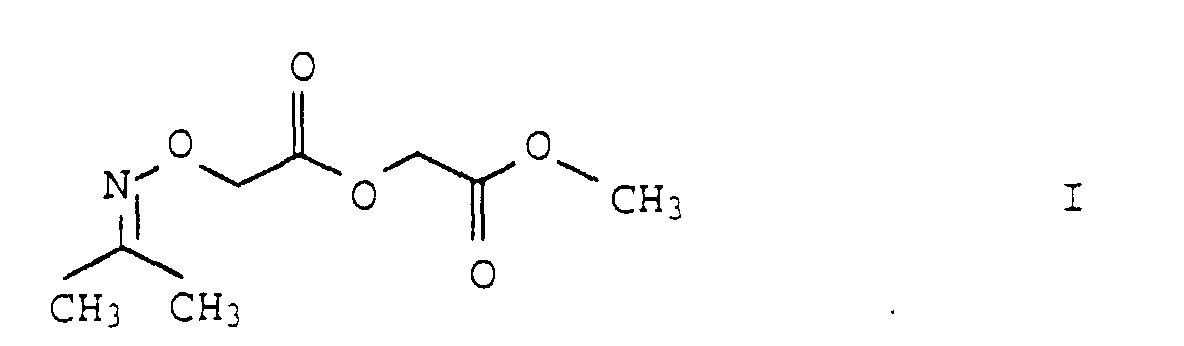 a) Aceton mit Hydroxylammoniumsulfat und Natronlauge zum Acetonoxim umsetzt, wobei die Umsetzung in Gegenwart von Toluol vorgenommen und/oder das Acetonoxim aus dem Reaktionsgemisch mit Toluol extrahiert wird,b) die so erhaltene toluolische Lösung mit 1,0 bis 1,5 mol, bezogen auf Acetonoxim, Natronlauge versetzt und Wasser auskreist,c) Toluol destillativ gegen ein dipolar aprotisches Lösungsmittel austauscht,d) die so erhaltene Kristallmaische mit dem Natriumsalz von Chloressigsäure zum Natriumsalz der Isopropylidenaminooxyessigsäure umsetzt und das Reaktionsgemisch anschließend mit Chloressigsäuremethylester versetzt unde) den Isopropylidenaminooxyessigsäure (methoxycarbonylmethylen)ester in an sich bekannter Weise isoliert.
 - Verfahren nach Anspruch 1, dadurch gekennzeichnet, daß man als dipolar aprotisches Lösungsmittel in Stufe c) Dimethylformamid verwendet.
- Verfahren nach Anspruch 1, dadurch gekennzeichnet, daß man die Verbindung I aus dem Reaktionsgemisch isoliert, indem man das Lösungsmittel abdestilliert, den Rückstand mit Toluol versetzt, mit Wasser wäscht und destilliert.
Applications Claiming Priority (2)
| Application Number | Priority Date | Filing Date | Title |
|---|---|---|---|
| DE4437904 | 1994-10-22 | ||
| DE4437904A DE4437904A1 (de) | 1994-10-22 | 1994-10-22 | Verfahren zur Herstellung von Isopropylidenaminooxyessigsäure(methoxycarbonylmethylen)ester I |
Publications (2)
| Publication Number | Publication Date |
|---|---|
| EP0708083A1 EP0708083A1 (de) | 1996-04-24 |
| EP0708083B1 true EP0708083B1 (de) | 1998-08-19 |
Family
ID=6531521
Family Applications (1)
| Application Number | Title | Priority Date | Filing Date |
|---|---|---|---|
| EP95116248A Expired - Lifetime EP0708083B1 (de) | 1994-10-22 | 1995-10-16 | Verfahren zur Herstellung von Isopropylidenamino-oxyessigsäure(methoxycarbonylmethylen)ester |
Country Status (7)
| Country | Link |
|---|---|
| US (1) | US5696283A (de) |
| EP (1) | EP0708083B1 (de) |
| JP (1) | JPH08225505A (de) |
| AT (1) | ATE169901T1 (de) |
| CA (1) | CA2161063A1 (de) |
| DE (2) | DE4437904A1 (de) |
| ES (1) | ES2119286T3 (de) |
Families Citing this family (3)
| Publication number | Priority date | Publication date | Assignee | Title |
|---|---|---|---|---|
| CN1276701A (zh) * | 1997-10-20 | 2000-12-13 | 巴斯福股份公司 | 植物生长调节组合物 |
| CN103193672B (zh) * | 2013-03-11 | 2014-09-17 | 浙江圣安化工有限公司 | 一种肟的蒸馏方法 |
| JP7370152B2 (ja) * | 2019-03-27 | 2023-10-27 | 東ソー株式会社 | α-(アミノオキシ)カルボン酸類の製造方法 |
Family Cites Families (5)
| Publication number | Priority date | Publication date | Assignee | Title |
|---|---|---|---|---|
| DE2927117A1 (de) * | 1979-07-05 | 1981-01-08 | Basf Ag | Verfahren zur herstellung von o-substituierten ketoximen |
| DE3473593D1 (en) * | 1983-04-04 | 1988-09-29 | Allied Corp | Process for the production of o-substituted oximes |
| DE3565398D1 (en) * | 1984-04-12 | 1988-11-10 | Allied Signal Inc | Process for the synthesis of o-substituted oxime compounds and the conversion thereof into the corresponding hydroxylamine o-substituted |
| DE3613649A1 (de) * | 1986-04-23 | 1987-10-29 | Basf Ag | Substituierte oximether, ihre verwendung als bioregulatoren zur senkung des endzogenen ethylenspiegels in pflanzen |
| KR900701742A (ko) * | 1988-05-27 | 1990-12-04 | 제라드 피. 루우니 | O-치환옥심 화합물의 제조방법 |
-
1994
- 1994-10-22 DE DE4437904A patent/DE4437904A1/de not_active Withdrawn
-
1995
- 1995-10-16 ES ES95116248T patent/ES2119286T3/es not_active Expired - Lifetime
- 1995-10-16 AT AT95116248T patent/ATE169901T1/de not_active IP Right Cessation
- 1995-10-16 DE DE59503253T patent/DE59503253D1/de not_active Expired - Lifetime
- 1995-10-16 EP EP95116248A patent/EP0708083B1/de not_active Expired - Lifetime
- 1995-10-19 US US08/545,910 patent/US5696283A/en not_active Expired - Fee Related
- 1995-10-20 CA CA002161063A patent/CA2161063A1/en not_active Abandoned
- 1995-10-20 JP JP7272462A patent/JPH08225505A/ja not_active Withdrawn
Also Published As
| Publication number | Publication date |
|---|---|
| DE4437904A1 (de) | 1996-04-25 |
| ATE169901T1 (de) | 1998-09-15 |
| JPH08225505A (ja) | 1996-09-03 |
| CA2161063A1 (en) | 1996-04-23 |
| US5696283A (en) | 1997-12-09 |
| EP0708083A1 (de) | 1996-04-24 |
| DE59503253D1 (de) | 1998-09-24 |
| ES2119286T3 (es) | 1998-10-01 |
Similar Documents
| Publication | Publication Date | Title |
|---|---|---|
| EP0708083B1 (de) | Verfahren zur Herstellung von Isopropylidenamino-oxyessigsäure(methoxycarbonylmethylen)ester | |
| EP0019227B1 (de) | Verfahren zur Herstellung von Cyanhydrinacylaten von Aldehyden | |
| EP1241157B1 (de) | Verfahren zur Herstellung von 2,7-Dimethyl-2,4,6-octatrienal-monoacetalen | |
| EP0176026A1 (de) | Verfahren zur Herstellung von 2,4-Dichlor-5-fluor-benzoesäure | |
| EP0032374B1 (de) | Verfahren zur Herstellung von p-Hydroxyphenylessigsäure | |
| EP1658259B1 (de) | VERFAHREN ZUR HERSTELLUNG VON a-FLUOR-MALONSÄUREDIALKYLESTERN | |
| EP0038972A1 (de) | Verfahren zur Herstellung von Alkylarylketoximethern | |
| EP0439745A2 (de) | Verfahren zur Herstellung von 2-Chlor-5-methyl-pyridin | |
| DE3729094C2 (de) | ||
| EP0063767A1 (de) | 2-Ketosulfonamide und Verfahren zu ihrer Herstellung | |
| EP0497210B1 (de) | Verfahren zur Herstellung von Dialkylaminopropandiol | |
| EP0166685B1 (de) | Verfahren zur Herstellung von Alpha-Chloracetessigsäuremonomethylamid | |
| EP0125533B1 (de) | Verfahren zur Herstellung von Tartronsäureestern | |
| WO1991000269A1 (de) | Verfahren zur herstellung von niederen alkansulfonsäuren aus ihren alkalisalzen | |
| AT372939B (de) | Verfahren zur herstellung von (d)-(-)-phydroxyphenylglycylchlorid-hydrochlorid | |
| DE19730848A1 (de) | Verfahren zur Herstellung von 3-Hydroxy-2-methylbenzoesäure | |
| EP0971937A1 (de) | Verfahren zur herstellung von alkyl-1-alkoxyethylphosphinsäuren | |
| DE1929731C (de) | ||
| DE3147150A1 (de) | Neues verfahren zur herstellung von epoxypropanderivaten | |
| DE2537891A1 (de) | Neue benzofurane und verfahren zu ihrer herstellung | |
| DE3228868A1 (de) | Verfahren zur herstellung von o,s-dimethylthiolophosphorsaeureamid | |
| DE2726128A1 (de) | Verfahren zur herstellung von 2-dialkoxyphosphinylimino-1,3-dithietanen | |
| DE1468526A1 (de) | Verfahren zur Herstellung von Bis-Cyanformimidoestern und von Bis-Cyanameisensaeureestern | |
| DD252609A1 (de) | Verfahren zur herstellung von ureidophosphorsaeuredialkylestern | |
| DE2647977A1 (de) | Verfahren zur herstellung von pyridiniumchloriden |
Legal Events
| Date | Code | Title | Description |
|---|---|---|---|
| PUAI | Public reference made under article 153(3) epc to a published international application that has entered the european phase |
Free format text: ORIGINAL CODE: 0009012 |
|
| 17P | Request for examination filed |
Effective date: 19960201 |
|
| AK | Designated contracting states |
Kind code of ref document: A1 Designated state(s): AT BE CH DE ES FR GB IT LI NL |
|
| 17Q | First examination report despatched |
Effective date: 19970502 |
|
| GRAG | Despatch of communication of intention to grant |
Free format text: ORIGINAL CODE: EPIDOS AGRA |
|
| GRAG | Despatch of communication of intention to grant |
Free format text: ORIGINAL CODE: EPIDOS AGRA |
|
| GRAH | Despatch of communication of intention to grant a patent |
Free format text: ORIGINAL CODE: EPIDOS IGRA |
|
| GRAH | Despatch of communication of intention to grant a patent |
Free format text: ORIGINAL CODE: EPIDOS IGRA |
|
| GRAA | (expected) grant |
Free format text: ORIGINAL CODE: 0009210 |
|
| AK | Designated contracting states |
Kind code of ref document: B1 Designated state(s): AT BE CH DE ES FR GB IT LI NL |
|
| REF | Corresponds to: |
Ref document number: 169901 Country of ref document: AT Date of ref document: 19980915 Kind code of ref document: T |
|
| REG | Reference to a national code |
Ref country code: CH Ref legal event code: EP |
|
| GBT | Gb: translation of ep patent filed (gb section 77(6)(a)/1977) |
Effective date: 19980828 |
|
| REF | Corresponds to: |
Ref document number: 59503253 Country of ref document: DE Date of ref document: 19980924 |
|
| REG | Reference to a national code |
Ref country code: ES Ref legal event code: FG2A Ref document number: 2119286 Country of ref document: ES Kind code of ref document: T3 |
|
| ET | Fr: translation filed | ||
| PLBE | No opposition filed within time limit |
Free format text: ORIGINAL CODE: 0009261 |
|
| STAA | Information on the status of an ep patent application or granted ep patent |
Free format text: STATUS: NO OPPOSITION FILED WITHIN TIME LIMIT |
|
| 26N | No opposition filed | ||
| PGFP | Annual fee paid to national office [announced via postgrant information from national office to epo] |
Ref country code: FR Payment date: 20010914 Year of fee payment: 7 |
|
| PGFP | Annual fee paid to national office [announced via postgrant information from national office to epo] |
Ref country code: CH Payment date: 20010917 Year of fee payment: 7 |
|
| PGFP | Annual fee paid to national office [announced via postgrant information from national office to epo] |
Ref country code: NL Payment date: 20010921 Year of fee payment: 7 Ref country code: AT Payment date: 20010921 Year of fee payment: 7 |
|
| PGFP | Annual fee paid to national office [announced via postgrant information from national office to epo] |
Ref country code: ES Payment date: 20011008 Year of fee payment: 7 |
|
| PGFP | Annual fee paid to national office [announced via postgrant information from national office to epo] |
Ref country code: GB Payment date: 20011015 Year of fee payment: 7 |
|
| PGFP | Annual fee paid to national office [announced via postgrant information from national office to epo] |
Ref country code: DE Payment date: 20011018 Year of fee payment: 7 |
|
| PGFP | Annual fee paid to national office [announced via postgrant information from national office to epo] |
Ref country code: BE Payment date: 20011119 Year of fee payment: 7 |
|
| REG | Reference to a national code |
Ref country code: GB Ref legal event code: IF02 |
|
| PG25 | Lapsed in a contracting state [announced via postgrant information from national office to epo] |
Ref country code: GB Free format text: LAPSE BECAUSE OF NON-PAYMENT OF DUE FEES Effective date: 20021016 Ref country code: AT Free format text: LAPSE BECAUSE OF NON-PAYMENT OF DUE FEES Effective date: 20021016 |
|
| PG25 | Lapsed in a contracting state [announced via postgrant information from national office to epo] |
Ref country code: ES Free format text: LAPSE BECAUSE OF NON-PAYMENT OF DUE FEES Effective date: 20021017 |
|
| PG25 | Lapsed in a contracting state [announced via postgrant information from national office to epo] |
Ref country code: LI Free format text: LAPSE BECAUSE OF NON-PAYMENT OF DUE FEES Effective date: 20021031 Ref country code: CH Free format text: LAPSE BECAUSE OF NON-PAYMENT OF DUE FEES Effective date: 20021031 Ref country code: BE Free format text: LAPSE BECAUSE OF NON-PAYMENT OF DUE FEES Effective date: 20021031 |
|
| PG25 | Lapsed in a contracting state [announced via postgrant information from national office to epo] |
Ref country code: DE Free format text: LAPSE BECAUSE OF THE APPLICANT RENOUNCES Effective date: 20021116 |
|
| BERE | Be: lapsed |
Owner name: *BASF A.G. Effective date: 20021031 |
|
| PG25 | Lapsed in a contracting state [announced via postgrant information from national office to epo] |
Ref country code: NL Free format text: LAPSE BECAUSE OF NON-PAYMENT OF DUE FEES Effective date: 20030501 |
|
| GBPC | Gb: european patent ceased through non-payment of renewal fee |
Effective date: 20021016 |
|
| REG | Reference to a national code |
Ref country code: CH Ref legal event code: PL |
|
| PG25 | Lapsed in a contracting state [announced via postgrant information from national office to epo] |
Ref country code: FR Free format text: LAPSE BECAUSE OF NON-PAYMENT OF DUE FEES Effective date: 20030630 |
|
| NLV4 | Nl: lapsed or anulled due to non-payment of the annual fee |
Effective date: 20030501 |
|
| REG | Reference to a national code |
Ref country code: FR Ref legal event code: ST |
|
| REG | Reference to a national code |
Ref country code: ES Ref legal event code: FD2A Effective date: 20031112 |
|
| PG25 | Lapsed in a contracting state [announced via postgrant information from national office to epo] |
Ref country code: IT Free format text: LAPSE BECAUSE OF NON-PAYMENT OF DUE FEES Effective date: 20051016 |