EP0705268B1 - Phosphorhaltige calixarene - Google Patents
Phosphorhaltige calixarene Download PDFInfo
- Publication number
- EP0705268B1 EP0705268B1 EP94921615A EP94921615A EP0705268B1 EP 0705268 B1 EP0705268 B1 EP 0705268B1 EP 94921615 A EP94921615 A EP 94921615A EP 94921615 A EP94921615 A EP 94921615A EP 0705268 B1 EP0705268 B1 EP 0705268B1
- Authority
- EP
- European Patent Office
- Prior art keywords
- phosphorus
- hydroformylation
- hydrogen
- alkyl
- formula
- Prior art date
- Legal status (The legal status is an assumption and is not a legal conclusion. Google has not performed a legal analysis and makes no representation as to the accuracy of the status listed.)
- Expired - Lifetime
Links
- VTJUKNSKBAOEHE-UHFFFAOYSA-N calixarene Chemical class COC(=O)COC1=C(CC=2C(=C(CC=3C(=C(C4)C=C(C=3)C(C)(C)C)OCC(=O)OC)C=C(C=2)C(C)(C)C)OCC(=O)OC)C=C(C(C)(C)C)C=C1CC1=C(OCC(=O)OC)C4=CC(C(C)(C)C)=C1 VTJUKNSKBAOEHE-UHFFFAOYSA-N 0.000 title claims abstract description 42
- BHEPBYXIRTUNPN-UHFFFAOYSA-N hydridophosphorus(.) (triplet) Chemical compound [PH] BHEPBYXIRTUNPN-UHFFFAOYSA-N 0.000 title abstract 3
- 239000010948 rhodium Substances 0.000 claims abstract description 21
- 229910052703 rhodium Inorganic materials 0.000 claims abstract description 20
- MHOVAHRLVXNVSD-UHFFFAOYSA-N rhodium atom Chemical compound [Rh] MHOVAHRLVXNVSD-UHFFFAOYSA-N 0.000 claims abstract description 20
- 239000003446 ligand Substances 0.000 claims abstract description 16
- -1 carbonyl ruthenium/carbonyl complexes Chemical class 0.000 claims abstract description 13
- 229910052698 phosphorus Inorganic materials 0.000 claims description 41
- 239000011574 phosphorus Substances 0.000 claims description 39
- 238000007037 hydroformylation reaction Methods 0.000 claims description 35
- OAICVXFJPJFONN-UHFFFAOYSA-N Phosphorus Chemical compound [P] OAICVXFJPJFONN-UHFFFAOYSA-N 0.000 claims description 34
- 238000000034 method Methods 0.000 claims description 23
- 239000001257 hydrogen Substances 0.000 claims description 16
- 229910052739 hydrogen Inorganic materials 0.000 claims description 16
- 150000007942 carboxylates Chemical class 0.000 claims description 12
- 239000002904 solvent Substances 0.000 claims description 12
- 150000001336 alkenes Chemical class 0.000 claims description 11
- 150000001875 compounds Chemical class 0.000 claims description 11
- 239000000203 mixture Substances 0.000 claims description 11
- UFHFLCQGNIYNRP-UHFFFAOYSA-N Hydrogen Chemical compound [H][H] UFHFLCQGNIYNRP-UHFFFAOYSA-N 0.000 claims description 9
- 150000002431 hydrogen Chemical class 0.000 claims description 9
- 238000002360 preparation method Methods 0.000 claims description 7
- BDHFUVZGWQCTTF-UHFFFAOYSA-M sulfonate Chemical compound [O-]S(=O)=O BDHFUVZGWQCTTF-UHFFFAOYSA-M 0.000 claims description 7
- 125000004169 (C1-C6) alkyl group Chemical group 0.000 claims description 6
- 125000004191 (C1-C6) alkoxy group Chemical group 0.000 claims description 5
- ZAMOUSCENKQFHK-UHFFFAOYSA-N Chlorine atom Chemical compound [Cl] ZAMOUSCENKQFHK-UHFFFAOYSA-N 0.000 claims description 4
- 239000000460 chlorine Substances 0.000 claims description 4
- 229910052801 chlorine Inorganic materials 0.000 claims description 4
- 125000000951 phenoxy group Chemical group [H]C1=C([H])C([H])=C(O*)C([H])=C1[H] 0.000 claims description 4
- WKBOTKDWSSQWDR-UHFFFAOYSA-N Bromine atom Chemical compound [Br] WKBOTKDWSSQWDR-UHFFFAOYSA-N 0.000 claims description 3
- PXGOKWXKJXAPGV-UHFFFAOYSA-N Fluorine Chemical compound FF PXGOKWXKJXAPGV-UHFFFAOYSA-N 0.000 claims description 3
- GDTBXPJZTBHREO-UHFFFAOYSA-N bromine Substances BrBr GDTBXPJZTBHREO-UHFFFAOYSA-N 0.000 claims description 3
- 229910052794 bromium Inorganic materials 0.000 claims description 3
- 229910052731 fluorine Inorganic materials 0.000 claims description 3
- 239000011737 fluorine Substances 0.000 claims description 3
- 239000007789 gas Substances 0.000 claims description 3
- PNDPGZBMCMUPRI-UHFFFAOYSA-N iodine Chemical compound II PNDPGZBMCMUPRI-UHFFFAOYSA-N 0.000 claims description 3
- JRZJOMJEPLMPRA-UHFFFAOYSA-N olefin Natural products CCCCCCCC=C JRZJOMJEPLMPRA-UHFFFAOYSA-N 0.000 claims description 3
- 125000001997 phenyl group Chemical group [H]C1=C([H])C([H])=C(*)C([H])=C1[H] 0.000 claims description 3
- 239000004711 α-olefin Substances 0.000 claims description 3
- 238000009835 boiling Methods 0.000 claims description 2
- NQZFAUXPNWSLBI-UHFFFAOYSA-N carbon monoxide;ruthenium Chemical group [Ru].[Ru].[Ru].[O+]#[C-].[O+]#[C-].[O+]#[C-].[O+]#[C-].[O+]#[C-].[O+]#[C-].[O+]#[C-].[O+]#[C-].[O+]#[C-].[O+]#[C-].[O+]#[C-].[O+]#[C-] NQZFAUXPNWSLBI-UHFFFAOYSA-N 0.000 claims description 2
- 125000003837 (C1-C20) alkyl group Chemical group 0.000 claims 5
- 125000003860 C1-C20 alkoxy group Chemical group 0.000 claims 4
- 125000002485 formyl group Chemical class [H]C(*)=O 0.000 claims 3
- 238000006482 condensation reaction Methods 0.000 claims 1
- 125000004435 hydrogen atom Chemical group [H]* 0.000 claims 1
- 150000001299 aldehydes Chemical class 0.000 abstract description 8
- 238000004519 manufacturing process Methods 0.000 abstract description 4
- YXFVVABEGXRONW-UHFFFAOYSA-N Toluene Chemical compound CC1=CC=CC=C1 YXFVVABEGXRONW-UHFFFAOYSA-N 0.000 description 21
- 238000006243 chemical reaction Methods 0.000 description 19
- 239000003054 catalyst Substances 0.000 description 10
- GYHFUZHODSMOHU-UHFFFAOYSA-N nonanal Chemical compound CCCCCCCCC=O GYHFUZHODSMOHU-UHFFFAOYSA-N 0.000 description 10
- 229910052707 ruthenium Inorganic materials 0.000 description 10
- KJTLSVCANCCWHF-UHFFFAOYSA-N Ruthenium Chemical compound [Ru] KJTLSVCANCCWHF-UHFFFAOYSA-N 0.000 description 9
- KWKAKUADMBZCLK-UHFFFAOYSA-N 1-octene Chemical compound CCCCCCC=C KWKAKUADMBZCLK-UHFFFAOYSA-N 0.000 description 8
- 239000002585 base Substances 0.000 description 7
- TVMXDCGIABBOFY-UHFFFAOYSA-N n-Octanol Natural products CCCCCCCC TVMXDCGIABBOFY-UHFFFAOYSA-N 0.000 description 7
- 239000000047 product Substances 0.000 description 7
- UHOVQNZJYSORNB-UHFFFAOYSA-N Benzene Chemical compound C1=CC=CC=C1 UHOVQNZJYSORNB-UHFFFAOYSA-N 0.000 description 6
- ZMANZCXQSJIPKH-UHFFFAOYSA-N Triethylamine Chemical compound CCN(CC)CC ZMANZCXQSJIPKH-UHFFFAOYSA-N 0.000 description 6
- 150000001340 alkali metals Chemical class 0.000 description 5
- 125000001273 sulfonato group Chemical group [O-]S(*)(=O)=O 0.000 description 5
- UGFAIRIUMAVXCW-UHFFFAOYSA-N Carbon monoxide Chemical compound [O+]#[C-] UGFAIRIUMAVXCW-UHFFFAOYSA-N 0.000 description 4
- OFBQJSOFQDEBGM-UHFFFAOYSA-N Pentane Chemical compound CCCCC OFBQJSOFQDEBGM-UHFFFAOYSA-N 0.000 description 4
- 229910002091 carbon monoxide Inorganic materials 0.000 description 4
- AQSJGOWTSHOLKH-UHFFFAOYSA-N phosphite(3-) Chemical class [O-]P([O-])[O-] AQSJGOWTSHOLKH-UHFFFAOYSA-N 0.000 description 4
- DAFHKNAQFPVRKR-UHFFFAOYSA-N (3-hydroxy-2,2,4-trimethylpentyl) 2-methylpropanoate Chemical compound CC(C)C(O)C(C)(C)COC(=O)C(C)C DAFHKNAQFPVRKR-UHFFFAOYSA-N 0.000 description 3
- WEVYAHXRMPXWCK-UHFFFAOYSA-N Acetonitrile Chemical compound CC#N WEVYAHXRMPXWCK-UHFFFAOYSA-N 0.000 description 3
- RTZKZFJDLAIYFH-UHFFFAOYSA-N Diethyl ether Chemical compound CCOCC RTZKZFJDLAIYFH-UHFFFAOYSA-N 0.000 description 3
- 229910000272 alkali metal oxide Inorganic materials 0.000 description 3
- 125000003545 alkoxy group Chemical group 0.000 description 3
- 125000000217 alkyl group Chemical group 0.000 description 3
- 239000013522 chelant Substances 0.000 description 3
- FAIAAWCVCHQXDN-UHFFFAOYSA-N phosphorus trichloride Chemical compound ClP(Cl)Cl FAIAAWCVCHQXDN-UHFFFAOYSA-N 0.000 description 3
- 239000004014 plasticizer Substances 0.000 description 3
- 150000003304 ruthenium compounds Chemical class 0.000 description 3
- 150000003839 salts Chemical group 0.000 description 3
- ZTQSAGDEMFDKMZ-UHFFFAOYSA-N Butyraldehyde Chemical compound CCCC=O ZTQSAGDEMFDKMZ-UHFFFAOYSA-N 0.000 description 2
- XTHFKEDIFFGKHM-UHFFFAOYSA-N Dimethoxyethane Chemical compound COCCOC XTHFKEDIFFGKHM-UHFFFAOYSA-N 0.000 description 2
- VQTUBCCKSQIDNK-UHFFFAOYSA-N Isobutene Chemical compound CC(C)=C VQTUBCCKSQIDNK-UHFFFAOYSA-N 0.000 description 2
- BZLVMXJERCGZMT-UHFFFAOYSA-N Methyl tert-butyl ether Chemical compound COC(C)(C)C BZLVMXJERCGZMT-UHFFFAOYSA-N 0.000 description 2
- NBIIXXVUZAFLBC-UHFFFAOYSA-N Phosphoric acid Chemical compound OP(O)(O)=O NBIIXXVUZAFLBC-UHFFFAOYSA-N 0.000 description 2
- WYURNTSHIVDZCO-UHFFFAOYSA-N Tetrahydrofuran Chemical compound C1CCOC1 WYURNTSHIVDZCO-UHFFFAOYSA-N 0.000 description 2
- CUJRVFIICFDLGR-UHFFFAOYSA-N acetylacetonate Chemical compound CC(=O)[CH-]C(C)=O CUJRVFIICFDLGR-UHFFFAOYSA-N 0.000 description 2
- 150000001298 alcohols Chemical class 0.000 description 2
- 229910052783 alkali metal Inorganic materials 0.000 description 2
- 229910052784 alkaline earth metal Inorganic materials 0.000 description 2
- 229910001860 alkaline earth metal hydroxide Inorganic materials 0.000 description 2
- VSCWAEJMTAWNJL-UHFFFAOYSA-K aluminium trichloride Chemical compound Cl[Al](Cl)Cl VSCWAEJMTAWNJL-UHFFFAOYSA-K 0.000 description 2
- 125000004432 carbon atom Chemical group C* 0.000 description 2
- 150000002009 diols Chemical class 0.000 description 2
- 230000000694 effects Effects 0.000 description 2
- 230000007062 hydrolysis Effects 0.000 description 2
- 238000006460 hydrolysis reaction Methods 0.000 description 2
- 239000000178 monomer Substances 0.000 description 2
- 125000004437 phosphorous atom Chemical group 0.000 description 2
- 239000000843 powder Substances 0.000 description 2
- 230000035484 reaction time Effects 0.000 description 2
- 230000035945 sensitivity Effects 0.000 description 2
- 239000000126 substance Substances 0.000 description 2
- 229910052723 transition metal Inorganic materials 0.000 description 2
- GETQZCLCWQTVFV-UHFFFAOYSA-N trimethylamine Chemical compound CN(C)C GETQZCLCWQTVFV-UHFFFAOYSA-N 0.000 description 2
- RIOQSEWOXXDEQQ-UHFFFAOYSA-N triphenylphosphine Chemical compound C1=CC=CC=C1P(C=1C=CC=CC=1)C1=CC=CC=C1 RIOQSEWOXXDEQQ-UHFFFAOYSA-N 0.000 description 2
- GGQQNYXPYWCUHG-RMTFUQJTSA-N (3e,6e)-deca-3,6-diene Chemical compound CCC\C=C\C\C=C\CC GGQQNYXPYWCUHG-RMTFUQJTSA-N 0.000 description 1
- RYHBNJHYFVUHQT-UHFFFAOYSA-N 1,4-Dioxane Chemical compound C1COCCO1 RYHBNJHYFVUHQT-UHFFFAOYSA-N 0.000 description 1
- SLUKQUGVTITNSY-UHFFFAOYSA-N 2,6-di-tert-butyl-4-methoxyphenol Chemical compound COC1=CC(C(C)(C)C)=C(O)C(C(C)(C)C)=C1 SLUKQUGVTITNSY-UHFFFAOYSA-N 0.000 description 1
- ZKPFRIDJMMOODR-UHFFFAOYSA-N 2-Methyloctanal Chemical compound CCCCCCC(C)C=O ZKPFRIDJMMOODR-UHFFFAOYSA-N 0.000 description 1
- XGFJTLRIXGSGFE-UHFFFAOYSA-N 2-ethylheptanal Chemical compound CCCCCC(CC)C=O XGFJTLRIXGSGFE-UHFFFAOYSA-N 0.000 description 1
- IREORVYCKDQFMD-UHFFFAOYSA-N 2-propylhexanal Chemical compound CCCCC(C=O)CCC IREORVYCKDQFMD-UHFFFAOYSA-N 0.000 description 1
- QGZKDVFQNNGYKY-UHFFFAOYSA-O Ammonium Chemical compound [NH4+] QGZKDVFQNNGYKY-UHFFFAOYSA-O 0.000 description 1
- LSNNMFCWUKXFEE-UHFFFAOYSA-M Bisulfite Chemical compound OS([O-])=O LSNNMFCWUKXFEE-UHFFFAOYSA-M 0.000 description 1
- ZAFNJMIOTHYJRJ-UHFFFAOYSA-N Diisopropyl ether Chemical compound CC(C)OC(C)C ZAFNJMIOTHYJRJ-UHFFFAOYSA-N 0.000 description 1
- LFQSCWFLJHTTHZ-UHFFFAOYSA-N Ethanol Chemical compound CCO LFQSCWFLJHTTHZ-UHFFFAOYSA-N 0.000 description 1
- 238000005727 Friedel-Crafts reaction Methods 0.000 description 1
- JGFZNNIVVJXRND-UHFFFAOYSA-N N,N-Diisopropylethylamine (DIPEA) Chemical compound CCN(C(C)C)C(C)C JGFZNNIVVJXRND-UHFFFAOYSA-N 0.000 description 1
- PHSPJQZRQAJPPF-UHFFFAOYSA-N N-alpha-Methylhistamine Chemical compound CNCCC1=CN=CN1 PHSPJQZRQAJPPF-UHFFFAOYSA-N 0.000 description 1
- CTQNGGLPUBDAKN-UHFFFAOYSA-N O-Xylene Chemical compound CC1=CC=CC=C1C CTQNGGLPUBDAKN-UHFFFAOYSA-N 0.000 description 1
- ISWSIDIOOBJBQZ-UHFFFAOYSA-N Phenol Chemical compound OC1=CC=CC=C1 ISWSIDIOOBJBQZ-UHFFFAOYSA-N 0.000 description 1
- 238000005882 aldol condensation reaction Methods 0.000 description 1
- 229910000287 alkaline earth metal oxide Inorganic materials 0.000 description 1
- 150000001342 alkaline earth metals Chemical class 0.000 description 1
- 229910000147 aluminium phosphate Inorganic materials 0.000 description 1
- 150000001412 amines Chemical class 0.000 description 1
- 238000004458 analytical method Methods 0.000 description 1
- 239000012736 aqueous medium Substances 0.000 description 1
- 150000001491 aromatic compounds Chemical class 0.000 description 1
- 150000004945 aromatic hydrocarbons Chemical class 0.000 description 1
- QVGXLLKOCUKJST-UHFFFAOYSA-N atomic oxygen Chemical compound [O] QVGXLLKOCUKJST-UHFFFAOYSA-N 0.000 description 1
- 230000015572 biosynthetic process Effects 0.000 description 1
- 239000006227 byproduct Substances 0.000 description 1
- 229910052799 carbon Inorganic materials 0.000 description 1
- 238000001460 carbon-13 nuclear magnetic resonance spectrum Methods 0.000 description 1
- 150000004649 carbonic acid derivatives Chemical class 0.000 description 1
- 238000005810 carbonylation reaction Methods 0.000 description 1
- 125000002843 carboxylic acid group Chemical group 0.000 description 1
- 229910017052 cobalt Inorganic materials 0.000 description 1
- 239000010941 cobalt Substances 0.000 description 1
- GUTLYIVDDKVIGB-UHFFFAOYSA-N cobalt atom Chemical compound [Co] GUTLYIVDDKVIGB-UHFFFAOYSA-N 0.000 description 1
- 239000007859 condensation product Substances 0.000 description 1
- 125000004122 cyclic group Chemical group 0.000 description 1
- 230000003247 decreasing effect Effects 0.000 description 1
- 238000007323 disproportionation reaction Methods 0.000 description 1
- 238000004821 distillation Methods 0.000 description 1
- 238000000921 elemental analysis Methods 0.000 description 1
- 230000008030 elimination Effects 0.000 description 1
- 238000003379 elimination reaction Methods 0.000 description 1
- 150000002148 esters Chemical class 0.000 description 1
- 150000002170 ethers Chemical class 0.000 description 1
- NLFBCYMMUAKCPC-KQQUZDAGSA-N ethyl (e)-3-[3-amino-2-cyano-1-[(e)-3-ethoxy-3-oxoprop-1-enyl]sulfanyl-3-oxoprop-1-enyl]sulfanylprop-2-enoate Chemical compound CCOC(=O)\C=C\SC(=C(C#N)C(N)=O)S\C=C\C(=O)OCC NLFBCYMMUAKCPC-KQQUZDAGSA-N 0.000 description 1
- 230000002349 favourable effect Effects 0.000 description 1
- 235000019256 formaldehyde Nutrition 0.000 description 1
- 238000004817 gas chromatography Methods 0.000 description 1
- 229930195733 hydrocarbon Natural products 0.000 description 1
- 150000002430 hydrocarbons Chemical class 0.000 description 1
- 238000005984 hydrogenation reaction Methods 0.000 description 1
- 125000002887 hydroxy group Chemical group [H]O* 0.000 description 1
- 229910052500 inorganic mineral Inorganic materials 0.000 description 1
- 238000001819 mass spectrum Methods 0.000 description 1
- 239000002609 medium Substances 0.000 description 1
- WSFSSNUMVMOOMR-NJFSPNSNSA-N methanone Chemical compound O=[14CH2] WSFSSNUMVMOOMR-NJFSPNSNSA-N 0.000 description 1
- 239000011707 mineral Substances 0.000 description 1
- 150000002894 organic compounds Chemical class 0.000 description 1
- SJLOMQIUPFZJAN-UHFFFAOYSA-N oxorhodium Chemical compound [Rh]=O SJLOMQIUPFZJAN-UHFFFAOYSA-N 0.000 description 1
- 239000001301 oxygen Substances 0.000 description 1
- 229910052760 oxygen Inorganic materials 0.000 description 1
- 150000002989 phenols Chemical class 0.000 description 1
- 150000004714 phosphonium salts Chemical class 0.000 description 1
- XRBCRPZXSCBRTK-UHFFFAOYSA-N phosphonous acid Chemical class OPO XRBCRPZXSCBRTK-UHFFFAOYSA-N 0.000 description 1
- OJMIONKXNSYLSR-UHFFFAOYSA-N phosphorous acid Chemical compound OP(O)O OJMIONKXNSYLSR-UHFFFAOYSA-N 0.000 description 1
- 238000001394 phosphorus-31 nuclear magnetic resonance spectrum Methods 0.000 description 1
- 238000000425 proton nuclear magnetic resonance spectrum Methods 0.000 description 1
- 239000012495 reaction gas Substances 0.000 description 1
- 239000011541 reaction mixture Substances 0.000 description 1
- 238000010992 reflux Methods 0.000 description 1
- 230000000754 repressing effect Effects 0.000 description 1
- 150000003283 rhodium Chemical class 0.000 description 1
- 229910003450 rhodium oxide Inorganic materials 0.000 description 1
- 229910001925 ruthenium oxide Inorganic materials 0.000 description 1
- OJLCQGGSMYKWEK-UHFFFAOYSA-K ruthenium(3+);triacetate Chemical compound [Ru+3].CC([O-])=O.CC([O-])=O.CC([O-])=O OJLCQGGSMYKWEK-UHFFFAOYSA-K 0.000 description 1
- WOCIAKWEIIZHES-UHFFFAOYSA-N ruthenium(iv) oxide Chemical compound O=[Ru]=O WOCIAKWEIIZHES-UHFFFAOYSA-N 0.000 description 1
- 238000007086 side reaction Methods 0.000 description 1
- 239000007858 starting material Substances 0.000 description 1
- 238000003786 synthesis reaction Methods 0.000 description 1
- 125000000999 tert-butyl group Chemical group [H]C([H])([H])C(*)(C([H])([H])[H])C([H])([H])[H] 0.000 description 1
- 150000003510 tertiary aliphatic amines Chemical class 0.000 description 1
- 150000003512 tertiary amines Chemical class 0.000 description 1
- YLQBMQCUIZJEEH-UHFFFAOYSA-N tetrahydrofuran Natural products C=1C=COC=1 YLQBMQCUIZJEEH-UHFFFAOYSA-N 0.000 description 1
- 239000012485 toluene extract Substances 0.000 description 1
- 150000003624 transition metals Chemical class 0.000 description 1
- IMFACGCPASFAPR-UHFFFAOYSA-N tributylamine Chemical compound CCCCN(CCCC)CCCC IMFACGCPASFAPR-UHFFFAOYSA-N 0.000 description 1
- ILWRPSCZWQJDMK-UHFFFAOYSA-N triethylazanium;chloride Chemical compound Cl.CCN(CC)CC ILWRPSCZWQJDMK-UHFFFAOYSA-N 0.000 description 1
- RKBCYCFRFCNLTO-UHFFFAOYSA-N triisopropylamine Chemical compound CC(C)N(C(C)C)C(C)C RKBCYCFRFCNLTO-UHFFFAOYSA-N 0.000 description 1
- 150000004072 triols Chemical group 0.000 description 1
- YFTHZRPMJXBUME-UHFFFAOYSA-N tripropylamine Chemical compound CCCN(CCC)CCC YFTHZRPMJXBUME-UHFFFAOYSA-N 0.000 description 1
- HGBOYTHUEUWSSQ-UHFFFAOYSA-N valeric aldehyde Natural products CCCCC=O HGBOYTHUEUWSSQ-UHFFFAOYSA-N 0.000 description 1
- XLYOFNOQVPJJNP-UHFFFAOYSA-N water Substances O XLYOFNOQVPJJNP-UHFFFAOYSA-N 0.000 description 1
- 239000008096 xylene Substances 0.000 description 1
Classifications
-
- B—PERFORMING OPERATIONS; TRANSPORTING
- B01—PHYSICAL OR CHEMICAL PROCESSES OR APPARATUS IN GENERAL
- B01J—CHEMICAL OR PHYSICAL PROCESSES, e.g. CATALYSIS OR COLLOID CHEMISTRY; THEIR RELEVANT APPARATUS
- B01J31/00—Catalysts comprising hydrides, coordination complexes or organic compounds
- B01J31/02—Catalysts comprising hydrides, coordination complexes or organic compounds containing organic compounds or metal hydrides
- B01J31/06—Catalysts comprising hydrides, coordination complexes or organic compounds containing organic compounds or metal hydrides containing polymers
- B01J31/063—Polymers comprising a characteristic microstructure
- B01J31/066—Calixarenes and hetero-analogues, e.g. thiacalixarenes
-
- B—PERFORMING OPERATIONS; TRANSPORTING
- B01—PHYSICAL OR CHEMICAL PROCESSES OR APPARATUS IN GENERAL
- B01J—CHEMICAL OR PHYSICAL PROCESSES, e.g. CATALYSIS OR COLLOID CHEMISTRY; THEIR RELEVANT APPARATUS
- B01J31/00—Catalysts comprising hydrides, coordination complexes or organic compounds
- B01J31/16—Catalysts comprising hydrides, coordination complexes or organic compounds containing coordination complexes
- B01J31/165—Polymer immobilised coordination complexes, e.g. organometallic complexes
- B01J31/1658—Polymer immobilised coordination complexes, e.g. organometallic complexes immobilised by covalent linkages, i.e. pendant complexes with optional linking groups, e.g. on Wang or Merrifield resins
- B01J31/1683—Polymer immobilised coordination complexes, e.g. organometallic complexes immobilised by covalent linkages, i.e. pendant complexes with optional linking groups, e.g. on Wang or Merrifield resins the linkage being to a soluble polymer, e.g. PEG or dendrimer, i.e. molecular weight enlarged complexes
-
- B—PERFORMING OPERATIONS; TRANSPORTING
- B01—PHYSICAL OR CHEMICAL PROCESSES OR APPARATUS IN GENERAL
- B01J—CHEMICAL OR PHYSICAL PROCESSES, e.g. CATALYSIS OR COLLOID CHEMISTRY; THEIR RELEVANT APPARATUS
- B01J31/00—Catalysts comprising hydrides, coordination complexes or organic compounds
- B01J31/16—Catalysts comprising hydrides, coordination complexes or organic compounds containing coordination complexes
- B01J31/18—Catalysts comprising hydrides, coordination complexes or organic compounds containing coordination complexes containing nitrogen, phosphorus, arsenic or antimony as complexing atoms, e.g. in pyridine ligands, or in resonance therewith, e.g. in isocyanide ligands C=N-R or as complexed central atoms
- B01J31/1845—Catalysts comprising hydrides, coordination complexes or organic compounds containing coordination complexes containing nitrogen, phosphorus, arsenic or antimony as complexing atoms, e.g. in pyridine ligands, or in resonance therewith, e.g. in isocyanide ligands C=N-R or as complexed central atoms the ligands containing phosphorus
- B01J31/185—Phosphites ((RO)3P), their isomeric phosphonates (R(RO)2P=O) and RO-substitution derivatives thereof
-
- B—PERFORMING OPERATIONS; TRANSPORTING
- B01—PHYSICAL OR CHEMICAL PROCESSES OR APPARATUS IN GENERAL
- B01J—CHEMICAL OR PHYSICAL PROCESSES, e.g. CATALYSIS OR COLLOID CHEMISTRY; THEIR RELEVANT APPARATUS
- B01J31/00—Catalysts comprising hydrides, coordination complexes or organic compounds
- B01J31/16—Catalysts comprising hydrides, coordination complexes or organic compounds containing coordination complexes
- B01J31/18—Catalysts comprising hydrides, coordination complexes or organic compounds containing coordination complexes containing nitrogen, phosphorus, arsenic or antimony as complexing atoms, e.g. in pyridine ligands, or in resonance therewith, e.g. in isocyanide ligands C=N-R or as complexed central atoms
- B01J31/1845—Catalysts comprising hydrides, coordination complexes or organic compounds containing coordination complexes containing nitrogen, phosphorus, arsenic or antimony as complexing atoms, e.g. in pyridine ligands, or in resonance therewith, e.g. in isocyanide ligands C=N-R or as complexed central atoms the ligands containing phosphorus
- B01J31/1865—Phosphonites (RP(OR)2), their isomeric phosphinates (R2(RO)P=O) and RO-substitution derivatives thereof
-
- C—CHEMISTRY; METALLURGY
- C07—ORGANIC CHEMISTRY
- C07C—ACYCLIC OR CARBOCYCLIC COMPOUNDS
- C07C45/00—Preparation of compounds having >C = O groups bound only to carbon or hydrogen atoms; Preparation of chelates of such compounds
- C07C45/49—Preparation of compounds having >C = O groups bound only to carbon or hydrogen atoms; Preparation of chelates of such compounds by reaction with carbon monoxide
- C07C45/50—Preparation of compounds having >C = O groups bound only to carbon or hydrogen atoms; Preparation of chelates of such compounds by reaction with carbon monoxide by oxo-reactions
-
- C—CHEMISTRY; METALLURGY
- C07—ORGANIC CHEMISTRY
- C07F—ACYCLIC, CARBOCYCLIC OR HETEROCYCLIC COMPOUNDS CONTAINING ELEMENTS OTHER THAN CARBON, HYDROGEN, HALOGEN, OXYGEN, NITROGEN, SULFUR, SELENIUM OR TELLURIUM
- C07F15/00—Compounds containing elements of Groups 8, 9, 10 or 18 of the Periodic Table
- C07F15/0006—Compounds containing elements of Groups 8, 9, 10 or 18 of the Periodic Table compounds of the platinum group
- C07F15/0073—Rhodium compounds
- C07F15/008—Rhodium compounds without a metal-carbon linkage
-
- C—CHEMISTRY; METALLURGY
- C07—ORGANIC CHEMISTRY
- C07F—ACYCLIC, CARBOCYCLIC OR HETEROCYCLIC COMPOUNDS CONTAINING ELEMENTS OTHER THAN CARBON, HYDROGEN, HALOGEN, OXYGEN, NITROGEN, SULFUR, SELENIUM OR TELLURIUM
- C07F9/00—Compounds containing elements of Groups 5 or 15 of the Periodic Table
- C07F9/02—Phosphorus compounds
- C07F9/547—Heterocyclic compounds, e.g. containing phosphorus as a ring hetero atom
- C07F9/6564—Heterocyclic compounds, e.g. containing phosphorus as a ring hetero atom having phosphorus atoms, with or without nitrogen, oxygen, sulfur, selenium or tellurium atoms, as ring hetero atoms
- C07F9/6571—Heterocyclic compounds, e.g. containing phosphorus as a ring hetero atom having phosphorus atoms, with or without nitrogen, oxygen, sulfur, selenium or tellurium atoms, as ring hetero atoms having phosphorus and oxygen atoms as the only ring hetero atoms
-
- C—CHEMISTRY; METALLURGY
- C07—ORGANIC CHEMISTRY
- C07F—ACYCLIC, CARBOCYCLIC OR HETEROCYCLIC COMPOUNDS CONTAINING ELEMENTS OTHER THAN CARBON, HYDROGEN, HALOGEN, OXYGEN, NITROGEN, SULFUR, SELENIUM OR TELLURIUM
- C07F9/00—Compounds containing elements of Groups 5 or 15 of the Periodic Table
- C07F9/02—Phosphorus compounds
- C07F9/547—Heterocyclic compounds, e.g. containing phosphorus as a ring hetero atom
- C07F9/6564—Heterocyclic compounds, e.g. containing phosphorus as a ring hetero atom having phosphorus atoms, with or without nitrogen, oxygen, sulfur, selenium or tellurium atoms, as ring hetero atoms
- C07F9/6571—Heterocyclic compounds, e.g. containing phosphorus as a ring hetero atom having phosphorus atoms, with or without nitrogen, oxygen, sulfur, selenium or tellurium atoms, as ring hetero atoms having phosphorus and oxygen atoms as the only ring hetero atoms
- C07F9/657163—Heterocyclic compounds, e.g. containing phosphorus as a ring hetero atom having phosphorus atoms, with or without nitrogen, oxygen, sulfur, selenium or tellurium atoms, as ring hetero atoms having phosphorus and oxygen atoms as the only ring hetero atoms the ring phosphorus atom being bound to at least one carbon atom
- C07F9/65719—Heterocyclic compounds, e.g. containing phosphorus as a ring hetero atom having phosphorus atoms, with or without nitrogen, oxygen, sulfur, selenium or tellurium atoms, as ring hetero atoms having phosphorus and oxygen atoms as the only ring hetero atoms the ring phosphorus atom being bound to at least one carbon atom the ring phosphorus atom and, at least, one ring oxygen atom being part of a (thio)phosphonous acid derivative
-
- C—CHEMISTRY; METALLURGY
- C07—ORGANIC CHEMISTRY
- C07F—ACYCLIC, CARBOCYCLIC OR HETEROCYCLIC COMPOUNDS CONTAINING ELEMENTS OTHER THAN CARBON, HYDROGEN, HALOGEN, OXYGEN, NITROGEN, SULFUR, SELENIUM OR TELLURIUM
- C07F9/00—Compounds containing elements of Groups 5 or 15 of the Periodic Table
- C07F9/02—Phosphorus compounds
- C07F9/547—Heterocyclic compounds, e.g. containing phosphorus as a ring hetero atom
- C07F9/6564—Heterocyclic compounds, e.g. containing phosphorus as a ring hetero atom having phosphorus atoms, with or without nitrogen, oxygen, sulfur, selenium or tellurium atoms, as ring hetero atoms
- C07F9/6571—Heterocyclic compounds, e.g. containing phosphorus as a ring hetero atom having phosphorus atoms, with or without nitrogen, oxygen, sulfur, selenium or tellurium atoms, as ring hetero atoms having phosphorus and oxygen atoms as the only ring hetero atoms
- C07F9/6574—Esters of oxyacids of phosphorus
- C07F9/65746—Esters of oxyacids of phosphorus the molecule containing more than one cyclic phosphorus atom
-
- B—PERFORMING OPERATIONS; TRANSPORTING
- B01—PHYSICAL OR CHEMICAL PROCESSES OR APPARATUS IN GENERAL
- B01J—CHEMICAL OR PHYSICAL PROCESSES, e.g. CATALYSIS OR COLLOID CHEMISTRY; THEIR RELEVANT APPARATUS
- B01J2531/00—Additional information regarding catalytic systems classified in B01J31/00
- B01J2531/80—Complexes comprising metals of Group VIII as the central metal
- B01J2531/82—Metals of the platinum group
- B01J2531/821—Ruthenium
-
- B—PERFORMING OPERATIONS; TRANSPORTING
- B01—PHYSICAL OR CHEMICAL PROCESSES OR APPARATUS IN GENERAL
- B01J—CHEMICAL OR PHYSICAL PROCESSES, e.g. CATALYSIS OR COLLOID CHEMISTRY; THEIR RELEVANT APPARATUS
- B01J2531/00—Additional information regarding catalytic systems classified in B01J31/00
- B01J2531/80—Complexes comprising metals of Group VIII as the central metal
- B01J2531/82—Metals of the platinum group
- B01J2531/822—Rhodium
Definitions
- the present invention relates to phosphorus-containing calixarenes.
- Carbonylation reactions are understood to mean the production of oxygen-containing products by reacting an organic compound with carbon monoxide and preferably another reaction partner - especially hydrogen - in the presence of a catalyst.
- a technically particularly important reaction is the hydroformylation of olefins by reaction with carbon monoxide and hydrogen to form aldehydes which contain one carbon atom more than the starting materials.
- Group VIII transition metal complexes containing phosphorus ligands, e.g. B. contain phosphites (see J. Falbe, New Synthesis with Carbon Monoxide, Springer Verlag, New York 1980).
- rhodium catalysts for the hydroformylation of lower ⁇ -olefins have become increasingly important in recent years because they allow the reaction to be carried out at a lower pressure.
- Triphenylphosphine in excess is generally used as the phosphorus ligand, a high ligand / rhodium ratio being required in order to increase the selectivity of the reaction to the commercially desired n-aldehyde product.
- EP-A 213 639 describes chelate bisphosphites which have diorgano functionality on one phosphorus atom and triorganophosphite functionality in the second phosphorus atom. From EP-A 155 508 the use of bisaryldiol-substituted monophosphites in the rhodium-catalyzed hydroformylation of sterically hindered olefins, for. B. isobutene known.
- EP-A 472 071 discloses chelate bisphosphite ligands in which bisaryl diols are linked to alkane diols or o-aryl diols via bisphosphite ester bridges are. Finally, diol and triol substituted monophosphites and their use in hydroformylation are described in EP-A 149 894, EP-A 96 988 and EP-A 96 986.
- n-proportion that of iso-aldehyde in the hydroformylation product
- hydroformylation products with a very high n content of up to 96% can be obtained in the rhodium-catalyzed hydroformylation of olefins.
- the object of the present compound was to find ligands for the rhodium- or ruthenium-catalyzed hydroformylation of olefins, with the aid of which the n content in the hydroformylation product can be increased still further.
- a process for the preparation of phosphorus-containing calixarenes of the formula I was found, which is characterized in that a calixarene of the general formula IV in which n and the radicals R 1 and R 2 have the meaning given above, with a phosphorus compound of the general formula V.
- XPHal 2 V in which X has the abovementioned meaning and Hal represents fluorine, chlorine, bromine or iodine, in the presence of a base.
- the phosphorus-containing calixarenes according to the invention are cyclic phosphites and phosphonites of hydroxylated calixarenes.
- the radical R 1 can be hydrogen or a C 1 to C 20 , preferably a C 1 to C 6 alkyl group, a C 1 to C 20 , preferably a C 1 to C 6 alkoxy group, a sulfonate group or a carboxylate group.
- the tert-butyl group, the sulfonate group or the carboxylate group is particularly preferred as the radical R 1 .
- the radicals R 2 in the phosphorus-containing calixarenes of the formula I can be identical or different and can be hydrogen or C 1 - to C 20 -, preferably a C 1 - to C 6 -alkyl group. R 2 is particularly preferably hydrogen.
- the radical X in the phosphorus-containing calixarenes of the formula I according to the invention can be hydrogen, a C 1 to C 20 , preferably a C 1 to C 6 alkyl group, a C 1 to C 20 , preferably a C 1 to C 6 -alkoxy group or an unsubstituted or with 1 to 3, preferably with 1 or 2, C 1 - to C 20 -, preferably C 1 - to C 6 -alkyl groups, C 1 - to C 20 -, preferably C 1 - to C 6 -alkoxy groups, C 1 - to C 20 -, preferably C 1 - to C 6 -alkylthio groups, C 2 - to C 20 -, preferably C 2 - to C 10 -dialkylamino groups, sulfonate groups or carboxylate groups may be substituted phenyl or phenoxy groups.
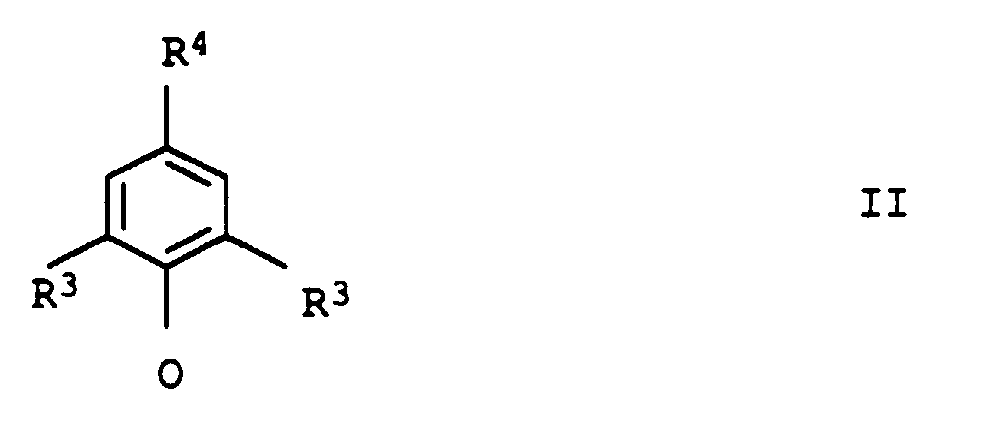
- Preferred phosphorus-containing calixarenes are those in which the group X is a phenoxy group of the general formula II in which the radicals R 3 and R 4 may be the same or different, and for hydrogen, for C 1 - to C 20 -, preferably for C 1 - to C 6 -alkyl groups, for C 1 - to C 20 -, preferably for C 1 - to C 6 -alkoxy groups, for C 1 - to C 20 -, preferably for C 1 - to C 6 -alkylthio groups and / or for C 2 - to C 20 -, preferably C 2 to C 10 -dialkylamino groups can, wherein the radical R 4 can additionally represent a sulfonate or carboxylate group.
- the sulfonate and carboxylate groups in the calixarene derivatives according to the invention can be present both in protonated form, ie as sulfonic acid or carboxylic acid groups, preference is given to those calixarenes in which these groups are in salt form, for example as alkali metal, alkaline earth metal or onium salt, in particular as ammonium or phosphonium salt.
- the presence of sulfonate or carboxylate groups in the phosphorus-containing calixarenes according to the invention increases their water solubility and in this way promotes the implementation of the hydroformylation in an aqueous medium.
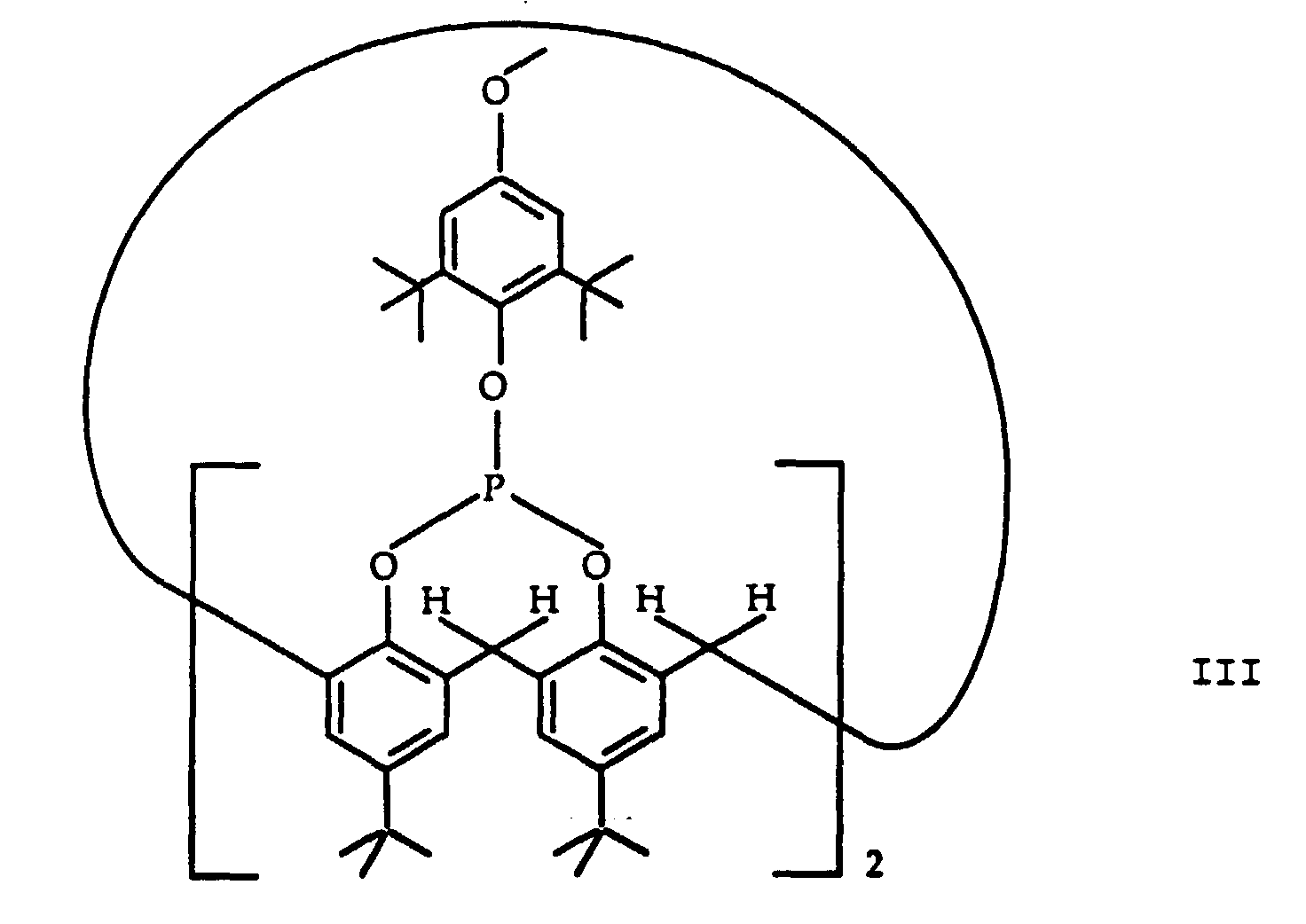
- a particularly preferred phosphorus-containing calixarene is shown in formula III.
- the phosphorus-containing calixarenes according to the invention can by the reaction of hydroxyl-bearing calixarenes of the general formula IV in which n and the radicals R 1 and R 2 have the meaning given above, with a phosphorus compound of the general formula V.
- XPHal 2 V in which the radical X has the meaning given above and Hal represents fluorine, chlorine, bromine or iodine, preferably chlorine, can be obtained in the presence of a base.
- Cyclic condensation products from parasubstituted phenols and aldehydes, preferably formaldehyde, are referred to as calixarenes (cf. Chemistry in our time 25 , 195 (1991)). They can be prepared by processes known per se, as described, for example, in Gutsche, "Calixarenes", Chapter 2, pp. 27 to 66, The Royal Society of Chemistry, Cambridge 1989.
- the phosphorus-containing compounds of the formula V required for the preparation of the calixarene phosphites can be prepared by processes known per se (cf. Houben Weyl, Methods of Org. Chemie Volume XII / 2, Chapter 2, Thieme, Stuttgart 1964), for example by reacting a phosphorus trihalide, such as Phosphorus trichloride, phosphorus tribromide or phosphorus triodide with an alcohol or phenol in the presence of a base such as alkali metal or alkaline earth metal hydroxides or carbonates or preferably tert. Amines.
- a phosphorus trihalide such as Phosphorus trichloride, phosphorus tribromide or phosphorus triodide
- a base such as alkali metal or alkaline earth metal hydroxides or carbonates or preferably tert. Amines.
- the phosphorus-containing compounds of the formula V required for the preparation of the calixarene phosphonites can also be prepared by known methods (cf. Houben-Weyl, Methods of Org. Chemie Volume XII / 1, pp. 302-318, Thieme, Stuttgart 1963), for example by the reaction of a phosphorus trihalide, such as phosphorus trichloride, with aromatic compounds, such as benzene, in the presence of Friedel-Crafts catalysts, such as aluminum chloride.
- the calixarenes IV in question are reacted with preferably stoichiometric amounts of the phosphorus-containing compound V per monomer unit of the calixarenes used.
- the formula unit as shown in the square brackets according to formula IV is defined as the monomer unit of calixarene.
- the reaction of the calixarenes IV with the phosphorus compound V is carried out in the presence of a base.
- Mineral bases for example alkali metal or alkaline earth metal oxides, alkali metal or alkaline earth metal hydroxides or alkali metal or alkaline earth metal carbonates, can be used as bases, but the reaction is preferred in the presence of tertiary amines, preferably tertiary aliphatic amines having 3 to 30 carbon atoms, for example with trimethylamine, trieth Tri-n-propylamine, ethyldiisopropylamine, triisopropylamine, tributylamine, etc.
- the base is added in a molar ratio of 1 to 200, preferably 1.5 to 100 and particularly preferably 2 to 10, based on the amount of phosphorus compound V used.
- the calixarenes according to the invention are expediently prepared in a solvent.
- All solvents which are inert under the reaction conditions can be used as solvents, preferably aromatic hydrocarbons, such as benzene, toluene, xylene, or ethers, such as diethyl ether, diisopropyl ether, methyl tert-butyl ether, tetrahydrofuran, dioxane, ethylene glycol dimethyl ether, etc.
- the reaction is generally carried out at temperatures from -40 ° C to 100 ° C.
- the pressure used is generally not critical for the reaction, but it is expedient to work at atmospheric pressure or under the autogenous pressure of the reaction system.
- the phosphorus-containing calixarenes according to the invention serve as ligands for rhodium and ruthenium in the hydroformylation of C 3 -C 20 -olefins catalyzed by rhodium or ruthenium.
- Olefins with an internal double bond can be used as olefins; ⁇ -olefins are preferably hydroformylated by the present process.
- the rhodium and the ruthenium are introduced into the process according to the invention in a conventional manner in the form of salts, for example as rhodium or ruthenium acetate or acetonylacetonate, as rhodium oxide or ruthenium oxide or as rhodium or ruthenium carbonyls.
- the type of compound in which the rhodium or ruthenium is used in the process according to the invention is generally not critical since these compounds are all present under the applied hydroformylation conditions in the presence of the CO / H 2 reaction gas in the catalytically active rhodium which is homogeneously dissolved in the hydroformylation medium.
- the catalytically active rhodium or ruthenium compounds are real catalysts, i. H. are practically not consumed in the reaction and as such have a high activity, very small amounts of rhodium or ruthenium compounds are sufficient to catalyze the hydroformylation with satisfactory conversions.
- the rhodium or ruthenium molar ratio with respect to the olefin used in the steady state of the reaction is 1: 1000 to 1: 50000, preferably 1: 1000 to 1: 5000.
- the phosphorus-containing calixarenes according to the invention are generally 1: 1 to 100: 1, preferably 1: 1 to 20: 1 and particularly preferably 1: 1 to 5: 1 in terms of the molar ratio of calixarene / rhodium or ruthenium, with respect to the rhodium or ruthenium used used.
- the CO / H 2 molar ratio of the CO / H 2 mixture fed to the hydroformylation can be 20: 1 to 1:20, preferably 1: 1 to 20: 1 and particularly preferably 1: 1.
- the hydroformylation process according to the invention is generally carried out in the presence of a solvent.
- solvents which are inert under the conditions of the hydroformylation, e.g. As hydrocarbons, esters or alcohols, but preferably the aldehydes which are formed in the hydroformylation of the olefin in question are used as solvents in the hydroformylation.
- Another particularly preferred solvent are so-called "high boilers", which are mixtures of high-boiling compounds such as those formed as a by-product during the hydroformylation reaction in a series of side reactions, such as aldol condensation, eliminations, disproportionation and hydrogenation, from the aldehydes formed in the hydroformylation.
- high boilers are mixtures of high-boiling compounds such as those formed as a by-product during the hydroformylation reaction in a series of side reactions, such as aldol condensation, eliminations, disproportionation and hydrogenation, from the aldehydes formed in the hydroform
- the process according to the invention is generally carried out at from 30 to 150 ° C., preferably from 60 to 130 ° C., particularly preferably from 90 to 110 ° C. and at a pressure of in general 1 x 10 3 to 1 x 10 7 Pa, preferably from 1 x 10 5 to 5 x 10 6 Pa and particularly preferably from 5 x 10 5 to 3 x 10 6 Pa.
- the hydroformylation process according to the invention can be carried out batchwise, preferably it is operated continuously.
- Process techniques known per se, as described for example in US Pat. No. 4,148,830, US Pat. No. 4,329,511 or EP-A 313 559, can be used.
- the hydroformylation process according to the invention surprisingly succeeds in increasing the n content in the hydroformylation product up to 99.5%.
- the precipitated triethylammonium chloride was then filtered off from the reaction solution and washed with toluene.
- the toluene was removed by distillation from the combined toluene extracts, leaving a light brown, viscous residue. This was washed with pentane and then extracted with 400 ml of acetonitrile under reflux. After part of the residue had dissolved, the remaining powder was filtered off, washed with pentane and dried.
- the 1 H and 13 C NMR spectra confirmed the structure according to formula III.
- the main component of the mass spectrum of III was the molecular peak at 1176 daltons.
- the conversion can be increased further by increasing the reaction time without the n-aldehyde selectivity of the catalyst decreasing.
Landscapes
- Chemical & Material Sciences (AREA)
- Organic Chemistry (AREA)
- Chemical Kinetics & Catalysis (AREA)
- Inorganic Chemistry (AREA)
- Engineering & Computer Science (AREA)
- Materials Engineering (AREA)
- Health & Medical Sciences (AREA)
- Life Sciences & Earth Sciences (AREA)
- Biochemistry (AREA)
- General Health & Medical Sciences (AREA)
- Molecular Biology (AREA)
- Crystallography & Structural Chemistry (AREA)
- Organic Low-Molecular-Weight Compounds And Preparation Thereof (AREA)
- Low-Molecular Organic Synthesis Reactions Using Catalysts (AREA)
- Catalysts (AREA)
Abstract
Description
- Die vorliegende Erfindung betrifft phosphorhaltige Calixarene.
- Unter Carbonylierungsreaktionen versteht man die Produktion von sauerstoffhaltigen Produkten durch Umsetzung einer organischen Verbindung mit Kohlenmonoxid und vorzugsweise einem weiteren Reaktionspartner - vor allem Wasserstoff - in Anwesenheit eines Katalysators. Eine technisch besonders wichtige Reaktion ist die Hydroformylierung von Olefinen durch Umsetzung mit Kohlenmonoxid und Wasserstoff unter Bildung von Aldehyden, die ein Kohlenstoffatom mehr als die Edukte enthalten. Als Katalysatoren verwendet man Gruppe-VIII-Übergangsmetallkomplexe, die phosphorhaltige Liganden, z. B. Phosphite enthalten (s. J. Falbe, New Synthesis with Carbon Monoxide, Springer Verlag, New York 1980).
- Neben Cobaltkatalysatoren haben in den letzten Jahren zunehmend Rhodiumkatalysatoren zur Hydroformylierung niederer α-Olefine Bedeutung erlangt, da sie eine Reaktionsführung bei einem niedrigeren Druck zulassen. Als Phosphorligand wird in der Regel Triphenylphosphin im Überschuß verwendet, wobei ein hohes Ligand/ Rhodium-Verhältnis erforderlich ist, um die Selektivität der Reaktion zum kommerziell erwünschten n-Aldehydprodukt zu erhöhen.
- In den letzten Jahren wurde der Versuch unternommen, wirksamere Phosphorliganden für die Hydroformylierung zu finden. Neben unterschiedlich substituierten Phosphiten wurden auch Phosphite auf ihre Eignung als Katalysatoren untersucht. Phosphite ergeben bei ihrer Koordination an ein Übergangsmetallzentrum Katalysatoren von gesteigerter Aktivität, doch ist das Standzeitverhalten dieser Katalysatorsysteme wegen der starken Hydrolyseempfindlichkeit der Phosphitliganden unbefriedigend. Eine drastisch verringerte Hydrolyseempfindlichkeit sollen durch Bisaryldiole substituierte chelatisierende Polyphosphite aufweisen, wie sie in EP-A 21 46 22 beschrieben werden. Die Rhodiumkomplexe dieser Liganden sollen äußerst aktive Hydroformylierungskatalysatoren bilden. EP-A 213 639 beschreibt Chelat-Bisphosphite, die an einem Phosphoratom Diorgano- in der zweiten Phosphoratom Triorganophosphit-Funktionalität aufweisen. Aus EP-A 155 508 ist ferner die Verwendung von bisaryldiolsubstituierten Monophosphiten bei der rhodiumkatalysierten Hydroformylierung von sterisch gehinderten Olefinen, z. B. Isobuten bekannt. In EP-A 472 071 werden Chelat-Bisphosphit-Liganden offenbart, in denen Bisaryldiole über Bisphosphitester-Brücken mit Alkandiolen oder o-Aryldiolen verknüpft sind. Diol- und Triol-substituierte Monophosphite und ihr Einsatz bei der Hydroformylierung werden schließlich in EP-A 149 894, EP-A 96 988 und EP-A 96 986, beschrieben.
- Bei der Hydroformylierung von Olefinen bilden sich, je nach dem an welcher Position der Doppelbindung das Kohlenmonoxid addiert wird, geradkettige Aldehyde, die als n-Aldehyde bezeichnet werden, oder verzweigtkettige Aldehyde, sogenannte iso-Aldehyde. Dies ist schematisch in Gleichung (1) dargestellt:

- Es ist nun aber in der Regel erwünscht, daß der Anteil des n-Al-dehyds den des iso-Aldehyds im Hydroformylierungsprodukt, im folgenden als n-Anteil bezeichnet, möglichst groß ist, da bei der Weiterverarbeitung der Aldehyde zu Weichmacher-Alkoholen und Weichmachern, die n-Aldehyde zu Produkten mit besonders günstigen Weichmachereigenschaften führen (vgl. z. B. US-A 4 426 542).
- Bei Anwendung der Chelat-Bisphosphit-Liganden des zuvor genannten Standes der Technik können bei der Rhodium-katalysierten Hydroformylierung von Olefinen Hydroformylierungsprodukte mit einem sehr hohen n-Anteil von bis zu 96 % erhalten werden.
- Der vorliegenden Verbindung lag nun die Aufgabe zugrunde, Liganden für die Rhodium- oder Ruthenium-katalysierte Hydroformylierung von Olefinen zu finden, mit deren Hilfe sich der n-Anteil im Hydroformylierungsprodukt noch weiter erhöhen läßt.
- Dementsprechend wurden phosphorhaltige Calixarene der allgemeinen Formel I

- R1
- Wasserstoff, eine C1- bis C20-Alkylgruppe, eine C1- bis C20-Alkoxygruppe, eine Sulfonatgruppe oder eine Carboxylatgruppe bedeutet, die Reste
- R2
- gleich oder verschieden sind und für Wasserstoff oder eine C1- bis C20-Alkylgruppe stehen, und
- X
- Wasserstoff, eine C1- bis C20-Alkylgruppe, eine C1- bis C20-Alkoxygruppe oder eine unsubstituierte oder mit 1 bis 3 C1- bis C20-Alkylgruppen, C1- bis C20-Alkoxygruppen, Sulfonatgruppen, Carboxylatgruppen, C1- bis C20-Alkyl-thiogruppen und/oder C2- bis C20-Dialkylaminogruppen substituierte Phenyl- oder Phenoxygruppe ist.
- Des weiteren wurde ein Verfahren zur Herstellung der phosphorhaltigen Calixarene der Formel I gefunden, das dadurch gekennzeichnet ist, daß man ein Calixaren der allgemeinen Formel IV

XPHal2 V
in der X die obengenannte Bedeutung hat und Hal für Fluor, Chlor, Brom oder Jod steht, in Gegenwart einer Base umsetzt. - Weiterhin wurde ein Verfahren zur Herstellung von Aldehyden durch die Hydroformylierung von C2- bis C20-Olefinen mittels eines CO/H2-Gasgemisches in Gegenwart von Rhodium- oder Ruthenium-Carbonylkomplexen mit einem phosphorhaltigen Liganden und in Gegenwart eines Lösungsmittels gefunden, das dadurch gekennzeichnet ist, daß man als Liganden die phosphorhaltigen Calixarene der Formel I verwendet.
- Bei den erfindungsgemäßen phosphorhaltigen Calixarenen handelt es sich um cyclische Phosphite und Phosphonite von hydroxylierten Calixarenen.
- In den erfindungsgemäßen phosphorhaltigen Calixarenen der allgemeinen Formel I kann der Rest R1 Wasserstoff oder eine C1- bis C20-, vorzugsweise eine C1- bis C6-Alkylgruppe, eine C1- bis C20-, vorzugsweise eine C1- bis C6-Alkoxygruppe, eine Sulfonatgruppe oder eine Carboxylatgruppe sein. Besonders bevorzugt ist als Rest R1 die tert.-Butylgruppe, die Sulfonatgruppe oder die Carboxylatgruppe.
- Die Reste R2 in den erfindungsgemäßen phosphorhaltigen Calixarenen der Formel I können gleich oder verschieden sein und Wasserstoff oder C1- bis C20-, vorzugsweise eine C1- bis C6-Alkylgruppe bedeuten. Besonders bevorzugt ist R2 Wasserstoff.
- Der Rest X in den erfindungsgemäßen phosphorhaltigen Calixarenen der Formel I kann Wasserstoff, eine C1- bis C20-, vorzugsweise eine C1- bis C6-Alkylgruppe, eine C1- bis C20-, vorzugsweise eine C1- bis C6-Alkoxygruppe oder eine unsubstituierte oder mit 1 bis 3, vorzugsweise mit 1 oder 2, C1- bis C20-, vorzugsweise C1- bis C6-Alkylgruppen, C1- bis C20-, vorzugsweise C1- bis C6-Alkoxygruppen, C1- bis C20-, vorzugsweise C1- bis C6-Alkylthiogruppen, C2- bis C20-, vorzugsweise C2- bis C10-Dialkylaminoqruppen, Sulfonatgruppen oder Carboxylatgruppen substituierte Phenyl- oder Phenoxygruppe sein. Bevorzugte phosphorhaltige Calixarene sind solche, in denen die Gruppe X eine Phenoxygruppe der allgemeinen Formel II ist

- Die Sulfonat- und Carboxylatgruppen in den erfindungsgemäßen Calixarenderivaten können sowohl in protonierter Form, d. h. als Sulfonsäure- oder Carbonsäuregruppen, vorliegen, bevorzugt sind solche Calixarene, in denen diese Gruppen in Salzform, beispielsweise als Alkalimetall-, Erdalkalimetall- oder Oniumsalz, insbesondere als Ammonium- oder Phosphoniumsalz vorliegen. Das Vorliegen von Sulfonat- oder Carboxylatgruppen in den erfindungsgemäßen phosphorhaltigen Calixarenen erhöht deren Wasserlöslichkeit und fördert auf diese Weise die Durchführung der Hydroformylierung in wäßrigem Medium.
- Ein besonders bevorzugtes phosphorhaltiges Calixaren ist in Formel III dargestellt.

- Die erfindungsgemäßen phosphorhaltigen Calixarene können durch die Umsetzung von Hydroxylgruppen-tragenden Calixarenen der allgemeinen Formel IV

XPHal2 V
in der der Rest X die obengenannte Bedeutung hat und Hal für Fluor, Chlor, Brom oder Jod, vorzugsweise für Chlor, steht, in Gegenwart einer Base erhalten werden. - Als Calixarene werden cyclische Kondensationsprodukte aus parasubstituierten Phenolen und Aldehyden, vorzugsweise Formaldehyd, bezeichnet (vgl. Chemie in unserer Zeit 25, 195 (1991)). Sie können nach an sich bekannten Verfahren hergestellt werden, wie sie beispielsweise in Gutsche, "Calixarenes", Kapitel 2, S. 27 bis 66, The Royal Society of Chemistry, Cambridge 1989 beschrieben sind.
- Die zur Herstellung der Calixarenphosphite benötigten phosphorhaltigen Verbindungen der Formel V können nach an sich bekannten Verfahren (vgl. Houben Weyl, Methoden der Org. Chemie Band XII/2, Kapitel 2, Thieme, Stuttgart 1964), beispielsweise durch die Umsetzung eines Phosphortrihalogenids, wie Phosphortrichlorid, Phosphortribromid oder Phosphortriodid mit einem Alkohol oder Phenol in Gegenwart einer Base, wie Alkalimetall oder Erdalkalimetallhydroxiden oder -Carbonaten oder vorzugsweise tert. Aminen, hergestellt werden.
- Die zur Herstellung der Calixarenphosphonite benötigten phosphorhaltigen Verbindungen der Formel V können ebenfalls nach bekannten Methoden (vgl. Houben-Weyl, Methoden der Org. Chemie Band XII/1, S. 302-318, Thieme, Stuttgart 1963), beispielsweise durch die Umsetzung von eines Phosphortrihalogenids, wie Phosphortrichlorid, mit aromatischen Verbindungen, wie Benzol, in Gegenwart von Friedel-Crafts-Katalysatoren, wie Aluminiumchlorid, erzeugt werden.
- Zur Herstellung der erfindungsgemäßen Calixarenderivate werden die betreffenden Calixarene IV mit vorzugsweise stöchiometrischen Mengen der phosphorhaltigen Verbindung V pro Monomereinheit des eingesetzten Calixarens umgesetzt. Als Monomereinheit des Calixarens wird die Formeleinheit, wie sie in der eckigen Klammer gemäß Formel IV dargestellt ist, definiert.
- Die Umsetzung des Calixarens IV mit der Phosphorverbindung V wird in Gegenwart einer Base durchgeführt.
- Als Basen können Mineralbasen, beispielsweise Alkalimetall- oder Erdalkalimetalloxide, Alkalimetall- oder Erdalkalimetallhydroxide oder Alkalimetall- oder Erdalkalimetallcarbonate, verwendet werden, bevorzugt wird die Umsetzung jedoch in Gegenwart tertiärer Amine, vorzugsweise tertiärer aliphatischer Amine mit 3 bis 30 Kohlenstoffatomen, beispielsweise mit Trimethylamin, Triethylamin, Tri-n-propylamin, Ethyldiisopropylamin, Triisopropylamin, Tributylamin usw., durchgeführt. Die Base wird bezogen auf die Menge der eingesetzten Phosphorverbindung V in einem Molverhältnis von 1 bis 200, vorzugsweise von 1,5 bis 100 und besonders bevorzugt von 2 bis 10 zugesetzt.
- Die Herstellung der erfindungsgemäßen Calixarenderivate erfolgt zweckmäßigerweise in einem Lösungsmittel. Als Lösungsmittel können alle Lösungsmittel verwendet werden, die sich unter den Reaktionsbedingungen inert verhalten, vorzugsweise aromatische Kohlenwasserstoffe, wie Benzol, Toluol, Xylol, oder Ether, wie Diethylether, Diisopropylether, Methyl-tert.-Butylether, Tetrahydrofuran, Dioxan, Ethylenglykoldimethylether usw.
- Die Umsetzung wird im allgemeinen bei Temperaturen von -40°C bis 100°C durchgeführt. Der angewandte Druck ist für die Umsetzung im allgemeinen nicht kritisch, zweckmäßigerweise wird aber bei Atmosphärendruck oder unter dem Eigendruck des Reaktionssystems gearbeitet.
- Die erfindungsgemäßen phosphorhaltigen Calixarene dienen als Liganden für Rhodium und Ruthenium bei der von Rhodium oder Ruthenium katalysierten Hydroformylierung von C3- bis C20-Olefinen. Als Olefine können Olefine mit interner Doppelbindung verwendet werden, bevorzugt werden nach dem vorliegenden Verfahren α-Olefine hydroformyliert.
- Das Rhodium und das Ruthenium werden in an sich üblicher Weise in Form von Salzen, beispielsweise als Rhodium- oder Rutheniumacetat, oder -acetonylacetonat, als Rhodiumoxid oder Rutheniumoxid oder als Rhodium- oder Rutheniumcarbonyle in das erfindungsgemäße Verfahren eingebracht. Die Art der Verbindung in welcher das Rhodium oder Ruthenium im erfindungsgemäßen Verfahren eingesetzt wird, ist im allgemeinen nicht kritisch, da diese Verbindungen allesamt unter den angewandten Hydroformylierungsbedingungen in Gegenwart des CO/H2-Reaktionsgases in die katalytisch aktive, homogen im Hydroformylierungsmedium gelöste Rhodium- oder Rutheniumspecies umgewandelt werden, die dann von den phosphorhaltigen Calixarenen komplexiert und stabilisiert werden. Die chemische Natur dieser katalytisch aktiven Rhodium- und Rutheniumspecies konnte nicht abschließend aufgeklärt werden, gleichwohl es in der Fachwelt eine Reihe von Vermutungen bezüglich ihrer chemischen Struktur gibt, die aber letztendlich alle noch nicht bewiesen werden konnten.
- Da die katalytisch aktiven Rhodium- oder Rutheniumverbindungen echte Katalysatoren sind, d. h. bei der Umsetzung praktisch nicht verbraucht werden und als solche eine hohe Aktivität haben, reichen sehr geringe Mengen an Rhodium- oder Rutheniumverbindungen aus, um die Hydroformylierung mit zufriedenstellenden Umsätzen zu katalysieren. Im allgemeinen beträgt das Rhodium- bzw. Ruthenium-Molverhältnis bezüglich des eingesetzten Olefins im stationären Zustand der Umsetzung 1:1000 bis 1:50000 vorzugsweise 1:1000 bis 1:5000.
- Die erfindungsgemäßen phosphorhaltigen Calixarene werden bezüglich des eingesetzten Rhodiums oder Rutheniums im Molverhältnis Calixaren/Rhodium bzw. Ruthenium von im allgemeinen 1 : 1 bis 100 : 1, vorzugsweise von 1:1 bis 20:1 und besonders bevorzugt von 1:1 bis 5:1 eingesetzt.
- Das CO/H2-Molverhältnis des der Hydroformylierung zugeführten CO/H2-Gemisches kann 20:1 bis 1:20, vorzugsweise 1:1 bis 20:1 und besonders bevorzugt 1:1 betragen.
- Das erfindungsgemäße Hydroformylierungsverfahren wird im allgemeinen in Gegenwart eines Lösungsmittels durchgeführt. Als Lösungsmittel können praktisch alle Lösungsmittel verwendet werden, die sich unter den Bedingungen der Hydroformylierung inert verhalten, z. B. Kohlenwasserstoffe, Ester oder Alkohole, bevorzugt werden jedoch die Aldehyde, die bei der Hydroformylierung des betreffenden Olefins entstehen, als Lösungsmittel bei der Hydroformylierung verwendet. Ein anderes besonders bevorzugtes Lösungsmittel sind sogenannte "Hochsieder", das sind Gemische aus hochsiedenden Verbindungen, wie sie während der Hydroformylierungsreaktion als Nebenprodukt in einer Reihe von Nebenreaktionen, wie Aldolkondensationen, Eliminierungen, Disproportionierungen und Hydrierungen, aus den bei der Hydroformylierung entstandenen Aldehyden gebildet werden. Eine Reihe solcher Hochsieder und die Art und Weise ihrer Entstehung werden in US-A 4 148 830 für den Fall der Herstellung von Butyraldehyd exemplarisch beschrieben.
- Das erfindungsgemäße Verfahren wird im allgemeinen bei Temperaturen von 30 bis 150°C, vorzugsweise von 60 bis 130°C, besonders bevorzugt von 90 bis 110°C und bei einem Druck von im allgemeinen 1 x 10³ bis 1 x 10⁷ Pa, vorzugsweise von 1 x 10⁵ bis 5 x 10⁶ Pa und besonders bevorzugt von 5 x 10⁵ bis 3 x 10⁶ Pa ausgeführt.
- Das erfindungsgemäße Hydroformylierungsverfahren kann diskontinuierlich ausgeübt werden, vorzugsweise wird es kontinuierlich betrieben. Dabei können an sich bekannte Verfahrenstechniken, wie sie beispielsweise in US-A 4 148 830, US-A 4 329 511 oder EP-A 313 559 beschrieben sind, angewandt werden.
- Mit den erfindungsgemäßen phosphorhaltigen Calixarenen als Liganden für die katalytisch aktiven Rhodium- oder Rutheniumverbindungen gelingt es im erfindungsgemäßen Hydroformylierungsverfahren überraschenderweise den n-Anteil im Hydroformylierungsprodukt bis auf 99,5 % zu steigern.
- Herstellung des phosphorhaltigen Calixarens III


- Die 1H- und 13C-NMR-Spektren belegten die Struktur gemäß Formel III. Im 31P-NMR-Spektren wurde ein Signal bei 121 ppm, bezogen auf Phosphorsäure als Standard, beobachtet.
- Elementaranalyse [Ergebnis (Theorie)]: C 75,5 % (76,2 %); H 8,3 % (8,9 %); 0 10,9 % (9,9 %); P 5,3 % (5,1 %).
- Das Massenspektrum von III hatte als Hauptkomponente den Molekülpeak bei 1176 Dalton.
- In einem 0,35 l Autoklaven wurde ein Gemisch aus 56,9 g 1-Octen (508 mmol), 0,032 g (0,124 mmol) Rhodium in Form der Komplexverbindung Rh(CO)2(acac) (acac - Acetylacetonat) und 0,7098 g (0,604 mmol) der Verbindung III in 70 ml Texanol® (2,2,4-Trimethylpentan-1,3-diolmonoisobutyrat) auf 100°C erhitzt und durch Einleiten eines CO/H2-Gemisches (Volumenverhältnis CO/H2 = 1/1) in den Autoklaven ein Druck von 2 x 10⁶Pa eingestellt, der während der gesamten Umsetzungsdauer durch Nachpressen dieses Gasgemisches konstant gehalten wurde. Nach einer Reaktionszeit von 8 Stunden wurde das Hydroformylierungsgemisch gaschromatographisch analysiert. Das Ergebnis dieser Analyse ist in der Tabelle dargestellt.
Tabelle int. C8-Olefine 3,41 Gew.-% 0,0386 Mol 1-Octen 16,58 " 0,1879 Mol Oktan 7,84 " 0,0873 Mol 2-Propylhexanal 0,00 " 2-Ethylheptanal 0,00 " 2-Methyloctanal 0,11 " 0,0010 Mol n-Nonanal 21,84 " 0,1952 Mol Texanol 45,8 " Sonstige 0,0 " Summe 95,6 " Umsatz 63 Mol.-% Nonanal Ausbeute 39 Mol.-% Oktan Ausbeute 17 Mol.-% Selektivität (berechnet auf umgesetztes 1-Octen) Nonanale 61 % Oktan 27 % interne Olefine 12 % - Der Umsatz kann durch eine Erhöhung der Reaktionszeit weiter erhöht werden, ohne daß dabei die n-Aldehyd-Selektivität des Katalysators abnimmt.
Claims (11)
- Phosphorhaltige Calixarene der allgemeinen Formel I
 R1 Wasserstoff, eine C1- bis C20-Alkylgruppe, eine C1- bis C20-Alkoxygruppe, eine Sulfonatgruppe oder eine Carboxylatgruppe bedeutet, die ResteR2 gleich oder verschieden sind und für Wasserstoff oder eine C1- bis C20-Alkylgruppe stehen undX Wasserstoff, eine C1- bis C20-Alkylgruppe, eine C1- bis C20-Alkoxygruppe oder eine unsubstituierte oder mit 1 bis 3 C1- bis C20-Alkylgruppen, C1- bis C20-Alkoxygruppen, Sulfonatgruppen, Carboxylatgruppen, C1- bis C20-Alkylthio- und/oder C2- bis C20-Dialkylaminogruppen substituierte Phenyl- oder Phenoxygruppe ist.
 - Phosphorhaltige Calixarene nach Anspruch 1, in denen der Rest X eine Phenyloxygruppe der allgemeinen Formel II
- Phosphorhaltige Calixarene nach Anspruch 1, in denen der Rest R1 Wasserstoff, eine C1- bis C6-Alkylgruppe, eine C1- bis C6-Alkoxygruppe, eine Sulfonatgruppe oder eine Carboxylatgruppe ist, der Rest R2 für Wasserstoff steht und X die in Anspruch 2 genannte Bedeutung hat.
- Phosphorhaltiges Calixaren nach Anspruch 1, der Formel III
- Verfahren zur Herstellung der phosphorhaltigen Calixarene gemäß Anspruch 1, dadurch gekennzeichnet, daß man ein Calixaren der allgemeinen Formel IV

XPHal2 V
in der X die in Anspruch 1 genannte Bedeutung hat und Hal für Fluor, Chlor, Brom und Jod steht, in Gegenwart einer Base umsetzt. - Verfahren nach Anspruch 5, dadurch gekennzeichnet, daß man als Base ein C3- bis C30-Trialkylamin verwendet.
- Verfahren zur Herstellung von Aldehyden durch die Hydroformylierung von C3- bis C20-Olefinen mittels eines CO/H2-Gasgemisches in Gegenwart von Rhodium- oder Ruthenium-Carbonylkomplexen mit einem phosphorhaltigen Liganden und in Gegenwart eines Lösungsmittels, dadurch gekennzeichnet, daß man als Liganden die phosphorhaltigen Calixarene gemäß den Ansprüchen 1 bis 4 verwendet.
- Verfahren nach Anspruch 7, dadurch gekennzeichnet, daß man die Hydroformylierung bei einer Temperatur von 30 bis 150°C und ein Druck von 1 x 10³ bis 1 x 10⁷ Pa ausführt.
- Verfahren nach den Ansprüchen 7 und 8, dadurch gekennzeichnet, daß man als Lösungsmittel die Aldehyde verwendet, die durch die Hydroformylierung des jeweils eingesetzten Olefins entstehen.
- Verfahren nach den Ansprüchen 7 und 8, dadurch gekennzeichnet, daß man als Lösungsmittel die hochsiedenden Verbindungen verwendet, die durch Kondensationsreaktionen der während der Hydroformylierung gebildeten Aldehyde im Zuge der Hydroformylierung entstehen, verwendet.
- Verfahren nach den Ansprüchen 7 bis 10, dadurch gekennzeichnet, daß man α-Olefine hydroformyliert.
Applications Claiming Priority (3)
| Application Number | Priority Date | Filing Date | Title |
|---|---|---|---|
| DE4321194A DE4321194A1 (de) | 1993-06-25 | 1993-06-25 | Phosphorhaltige Calixarene |
| DE4321194 | 1993-06-25 | ||
| PCT/EP1994/001999 WO1995000525A1 (de) | 1993-06-25 | 1994-06-20 | Phosphorhaltige calixarene |
Publications (2)
| Publication Number | Publication Date |
|---|---|
| EP0705268A1 EP0705268A1 (de) | 1996-04-10 |
| EP0705268B1 true EP0705268B1 (de) | 1997-01-22 |
Family
ID=6491247
Family Applications (1)
| Application Number | Title | Priority Date | Filing Date |
|---|---|---|---|
| EP94921615A Expired - Lifetime EP0705268B1 (de) | 1993-06-25 | 1994-06-20 | Phosphorhaltige calixarene |
Country Status (8)
| Country | Link |
|---|---|
| US (1) | US5717126A (de) |
| EP (1) | EP0705268B1 (de) |
| JP (1) | JPH08511788A (de) |
| KR (1) | KR960703129A (de) |
| CN (1) | CN1045300C (de) |
| DE (2) | DE4321194A1 (de) |
| ES (1) | ES2097056T3 (de) |
| WO (1) | WO1995000525A1 (de) |
Families Citing this family (17)
| Publication number | Priority date | Publication date | Assignee | Title |
|---|---|---|---|---|
| FR2729958A1 (fr) * | 1995-02-01 | 1996-08-02 | Commissariat Energie Atomique | Derives de calixarenes , leur procede de preparation et leur utilisation pour l'extraction des actinides et des lanthanides. |
| US6003640A (en) * | 1997-05-09 | 1999-12-21 | The B.F. Goodrich Company | Electronic braking system with brake wear measurement and running clearance adjustment |
| DE19740180A1 (de) | 1997-09-12 | 1999-03-18 | Basf Ag | Katalysator, umfassend wenigstens einen Nickel(0)Komplex auf Basis eines Phosphonitliganden und Verfahren zur Herstellung von Nitrilen |
| FR2786487B1 (fr) * | 1998-11-26 | 2001-01-05 | Commissariat Energie Atomique | Derives de calixarenes, leur procede de preparation et leur utilisation pour l'extraction des actinides et des lanthanides |
| FR2788523B1 (fr) * | 1999-01-18 | 2001-02-16 | Commissariat Energie Atomique | Derives de calixarenes, leur procede de preparation et leur utilisation pour l'extraction des actinides et des lanthanides |
| US6350819B1 (en) | 2000-10-27 | 2002-02-26 | Union Carbide Chemicals & Plastics Technology Corporation | Dendritic macromolecules for metal-ligand catalyzed processes |
| WO2008124468A1 (en) * | 2007-04-05 | 2008-10-16 | Dow Global Technologies Inc. | A calixarene bisphosphite ligand for use in hydroformylation processes |
| CN102123978B (zh) * | 2008-08-19 | 2014-03-19 | 陶氏技术投资有限公司 | 用于改进对产物异构体的控制的使用对称的二亚磷酸酯配体的加氢甲酰化方法 |
| US20100051554A1 (en) * | 2008-08-28 | 2010-03-04 | Dong June Ahn | Molecular basket coated micro particles |
| US8741173B2 (en) * | 2010-10-05 | 2014-06-03 | Dow Technology Investments Llc | Hydroformylation process |
| EP3424897A4 (de) | 2016-03-01 | 2019-10-09 | Kuraray Co., Ltd. | Verfahren zur herstellung einer dialdehydverbindung |
| RU2646763C1 (ru) * | 2016-12-30 | 2018-03-07 | Федеральное государственное бюджетное образовательное учреждение высшего образования "Московский государственный университет имени М.В. Ломоносова" (МГУ) | Фосфинсодержащие каликсареновые лиганды, способ их получения и применения |
| EP4499654A1 (de) | 2022-08-02 | 2025-02-05 | INVISTA Textiles (U.K.) Limited | Zweizähnige phosphitliganden, katalytische zusammensetzungen mit solchen liganden und katalytische verfahren mit solchen katalytischen zusammensetzungen |
| US12698299B2 (en) | 2022-08-02 | 2026-08-04 | Inv Nylon Chemicals Americas, Llc | Bidentate phosphite ligands, catalytic compositions containing such ligands, and catalytic processes utilizing such catalytic compositions |
| CN119156371A (zh) * | 2022-08-02 | 2024-12-17 | 英威达纺织(英国)有限公司 | 产生腈的方法和用于此类方法的含磷催化剂 |
| EP4499657A1 (de) | 2022-08-02 | 2025-02-05 | INVISTA Textiles (U.K.) Limited | Zweizähnige phosphitliganden, katalytische zusammensetzungen mit solchen liganden und katalytische verfahren mit solchen katalytischen zusammensetzungen |
| WO2024028717A1 (en) | 2022-08-02 | 2024-02-08 | Inv Nylon Chemicals Americas, Llc | Arsenic-containing ligands, catalytic compositions containing such ligands, and catalytic processes utilizing such catalytic compositions |
Family Cites Families (4)
| Publication number | Priority date | Publication date | Assignee | Title |
|---|---|---|---|---|
| US4416829A (en) * | 1982-10-06 | 1983-11-22 | Standard Oil Company (Indiana) | Poly-hindered phenol-phosphites and process for preparation |
| JPH075881B2 (ja) * | 1987-10-02 | 1995-01-25 | 旭硝子株式会社 | 作動媒体混合物 |
| US5059710A (en) * | 1988-08-05 | 1991-10-22 | Union Carbide Chemicals And Plastics Technology Corporation | Ionic phosphites and their use in homogeneous transition metal catalyzed processes |
| IT1252043B (it) * | 1990-11-20 | 1995-05-29 | Himont Inc | Fosfiti organici adatti come stabilizzanti e composizioni polimeriche comprendenti gli stessi. |
-
1993
- 1993-06-25 DE DE4321194A patent/DE4321194A1/de not_active Withdrawn
-
1994
- 1994-06-20 ES ES94921615T patent/ES2097056T3/es not_active Expired - Lifetime
- 1994-06-20 JP JP7502429A patent/JPH08511788A/ja active Pending
- 1994-06-20 CN CN94192576A patent/CN1045300C/zh not_active Expired - Fee Related
- 1994-06-20 KR KR1019950705879A patent/KR960703129A/ko not_active Withdrawn
- 1994-06-20 US US08/505,220 patent/US5717126A/en not_active Expired - Fee Related
- 1994-06-20 WO PCT/EP1994/001999 patent/WO1995000525A1/de not_active Ceased
- 1994-06-20 DE DE59401665T patent/DE59401665D1/de not_active Expired - Lifetime
- 1994-06-20 EP EP94921615A patent/EP0705268B1/de not_active Expired - Lifetime
Also Published As
| Publication number | Publication date |
|---|---|
| JPH08511788A (ja) | 1996-12-10 |
| US5717126A (en) | 1998-02-10 |
| ES2097056T3 (es) | 1997-03-16 |
| CN1045300C (zh) | 1999-09-29 |
| DE59401665D1 (en) | 1997-03-06 |
| KR960703129A (ko) | 1996-06-19 |
| WO1995000525A1 (de) | 1995-01-05 |
| EP0705268A1 (de) | 1996-04-10 |
| CN1125950A (zh) | 1996-07-03 |
| DE4321194A1 (de) | 1995-01-05 |
Similar Documents
| Publication | Publication Date | Title |
|---|---|---|
| EP0472071B1 (de) | Rhodiumhydroformylierungskatalysatoren mit Bis-phosphit-Liganden | |
| EP1064093B1 (de) | Katalysator, umfassend einen rhodium-komplex auf der basis eines phosphonitliganden und verfahren zur hydroformylierung | |
| EP1201675B1 (de) | Bisphosphitverbindungen und deren Metallkomplexe | |
| EP1209164B1 (de) | Neue Phosphininverbindung und deren Metallkomplexe | |
| EP1417212B1 (de) | NEUE PHOSPHITVERBINDUNGEN UND DEREN Rh-KOMPLEXE | |
| EP2748174B1 (de) | Neue organophosphorverbindungen auf basis von anthracentriol | |
| WO1995000525A1 (de) | Phosphorhaltige calixarene | |
| EP2091958A1 (de) | Bisphosphitliganden für die übergangsmetallkatalysierte hydroformylierung | |
| EP1529769B1 (de) | Verfahren zur Herstellung von TCD-Dialdehyd | |
| EP1539666B1 (de) | Verfahren zur herstellung von dialdehyden und/oder ethylenisch ungesättigten monoaldehyden durch hydroformylierung ethylenisch ungesättigter verbindungen | |
| EP0761635A1 (de) | Verfahren zur Hydroformylierung olefinisch ungesättigter Verbindungen | |
| EP1732872A1 (de) | Verfahren zur hydroformylierung von olefinen in anwesenheit von phosphororganischen verbindungen | |
| DE19946475A1 (de) | Binuclearer Rhodium-Komplex mit zweizähnigem Chelat-Liganden und dessen Verwendung in einem Verfahren zur Herstellung eines Aldehyds | |
| EP0906261A1 (de) | Verfahren zur hydroformylierung und dafür geeignete katalysatoren, die phosphorverbindungen als liganden enthalten | |
| CH629175A5 (en) | Process for preparing alkyl alpha-formylpropionates | |
| WO2010022837A1 (de) | Verfahren zur gewinnung von aliphatischen c3- bis c10-aldehyden aus hochsiedern durch thermische behandlung | |
| DE102007052640A1 (de) | Verfahren zur Hydroformylierung | |
| DE2758473A1 (de) | Verfahren zur herstellung von butandiol oder substituierten butandiolen | |
| DE102007023514A1 (de) | Stabile Katalysatorvorstufe von Rh-Komplexkatalysatoren | |
| EP0186075B1 (de) | Verfahren zur Herstellung von 8- und 9-Formyl-tricyclo-(5,2,1,0, 2,6)-decen-3 | |
| EP0257445B1 (de) | Verfahren zur Herstellung von 1,1,2-Trialkoxyethan | |
| DE2317625C3 (de) | Verfahren zur Herstellung von aliphatischen oder cycloaliphatischen Dialdehyden und/oder deren Acetale | |
| DE2317625B2 (de) | Verfahren zur Herstellung von aliphatischen oder cycloaliphatlschen Dialdehyden und/oder deren Acetale |
Legal Events
| Date | Code | Title | Description |
|---|---|---|---|
| PUAI | Public reference made under article 153(3) epc to a published international application that has entered the european phase |
Free format text: ORIGINAL CODE: 0009012 |
|
| 17P | Request for examination filed |
Effective date: 19950804 |
|
| AK | Designated contracting states |
Kind code of ref document: A1 Designated state(s): BE DE ES FR GB NL |
|
| GRAG | Despatch of communication of intention to grant |
Free format text: ORIGINAL CODE: EPIDOS AGRA |
|
| 17Q | First examination report despatched |
Effective date: 19960507 |
|
| GRAH | Despatch of communication of intention to grant a patent |
Free format text: ORIGINAL CODE: EPIDOS IGRA |
|
| GRAH | Despatch of communication of intention to grant a patent |
Free format text: ORIGINAL CODE: EPIDOS IGRA |
|
| GRAA | (expected) grant |
Free format text: ORIGINAL CODE: 0009210 |
|
| AK | Designated contracting states |
Kind code of ref document: B1 Designated state(s): BE DE ES FR GB NL |
|
| GBT | Gb: translation of ep patent filed (gb section 77(6)(a)/1977) |
Effective date: 19970207 |
|
| REF | Corresponds to: |
Ref document number: 59401665 Country of ref document: DE Date of ref document: 19970306 |
|
| REG | Reference to a national code |
Ref country code: ES Ref legal event code: FG2A Ref document number: 2097056 Country of ref document: ES Kind code of ref document: T3 |
|
| ET | Fr: translation filed | ||
| PLBE | No opposition filed within time limit |
Free format text: ORIGINAL CODE: 0009261 |
|
| STAA | Information on the status of an ep patent application or granted ep patent |
Free format text: STATUS: NO OPPOSITION FILED WITHIN TIME LIMIT |
|
| 26N | No opposition filed | ||
| PGFP | Annual fee paid to national office [announced via postgrant information from national office to epo] |
Ref country code: FR Payment date: 20010515 Year of fee payment: 8 |
|
| PGFP | Annual fee paid to national office [announced via postgrant information from national office to epo] |
Ref country code: NL Payment date: 20010522 Year of fee payment: 8 |
|
| PGFP | Annual fee paid to national office [announced via postgrant information from national office to epo] |
Ref country code: ES Payment date: 20010606 Year of fee payment: 8 |
|
| PGFP | Annual fee paid to national office [announced via postgrant information from national office to epo] |
Ref country code: GB Payment date: 20010618 Year of fee payment: 8 |
|
| PGFP | Annual fee paid to national office [announced via postgrant information from national office to epo] |
Ref country code: DE Payment date: 20010628 Year of fee payment: 8 |
|
| PGFP | Annual fee paid to national office [announced via postgrant information from national office to epo] |
Ref country code: BE Payment date: 20010713 Year of fee payment: 8 |
|
| REG | Reference to a national code |
Ref country code: GB Ref legal event code: IF02 |
|
| PG25 | Lapsed in a contracting state [announced via postgrant information from national office to epo] |
Ref country code: DE Free format text: LAPSE BECAUSE OF THE APPLICANT RENOUNCES Effective date: 20020615 |
|
| PG25 | Lapsed in a contracting state [announced via postgrant information from national office to epo] |
Ref country code: GB Free format text: LAPSE BECAUSE OF NON-PAYMENT OF DUE FEES Effective date: 20020620 |
|
| PG25 | Lapsed in a contracting state [announced via postgrant information from national office to epo] |
Ref country code: ES Free format text: LAPSE BECAUSE OF NON-PAYMENT OF DUE FEES Effective date: 20020621 |
|
| PG25 | Lapsed in a contracting state [announced via postgrant information from national office to epo] |
Ref country code: BE Free format text: LAPSE BECAUSE OF NON-PAYMENT OF DUE FEES Effective date: 20020630 |
|
| BERE | Be: lapsed |
Owner name: *BASF A.G. Effective date: 20020630 |
|
| PG25 | Lapsed in a contracting state [announced via postgrant information from national office to epo] |
Ref country code: NL Free format text: LAPSE BECAUSE OF NON-PAYMENT OF DUE FEES Effective date: 20030101 |
|
| GBPC | Gb: european patent ceased through non-payment of renewal fee |
Effective date: 20020620 |
|
| PG25 | Lapsed in a contracting state [announced via postgrant information from national office to epo] |
Ref country code: FR Free format text: LAPSE BECAUSE OF NON-PAYMENT OF DUE FEES Effective date: 20030228 |
|
| NLV4 | Nl: lapsed or anulled due to non-payment of the annual fee |
Effective date: 20030101 |
|
| REG | Reference to a national code |
Ref country code: FR Ref legal event code: ST |
|
| REG | Reference to a national code |
Ref country code: ES Ref legal event code: FD2A Effective date: 20030711 |