EP0703945B1 - Zelluloseesterzusammensetzungen - Google Patents
Zelluloseesterzusammensetzungen Download PDFInfo
- Publication number
- EP0703945B1 EP0703945B1 EP94918004A EP94918004A EP0703945B1 EP 0703945 B1 EP0703945 B1 EP 0703945B1 EP 94918004 A EP94918004 A EP 94918004A EP 94918004 A EP94918004 A EP 94918004A EP 0703945 B1 EP0703945 B1 EP 0703945B1
- Authority
- EP
- European Patent Office
- Prior art keywords
- blend
- weight
- cellulose acetate
- cellulose
- group
- Prior art date
- Legal status (The legal status is an assumption and is not a legal conclusion. Google has not performed a legal analysis and makes no representation as to the accuracy of the status listed.)
- Expired - Lifetime
Links
- 0 C[C@@]1C(*)=CC(*O*)(OC)OC1CO* Chemical compound C[C@@]1C(*)=CC(*O*)(OC)OC1CO* 0.000 description 1
Classifications
-
- C—CHEMISTRY; METALLURGY
- C08—ORGANIC MACROMOLECULAR COMPOUNDS; THEIR PREPARATION OR CHEMICAL WORKING-UP; COMPOSITIONS BASED THEREON
- C08L—COMPOSITIONS OF MACROMOLECULAR COMPOUNDS
- C08L1/00—Compositions of cellulose, modified cellulose or cellulose derivatives
- C08L1/08—Cellulose derivatives
- C08L1/10—Esters of organic acids, i.e. acylates
-
- C—CHEMISTRY; METALLURGY
- C08—ORGANIC MACROMOLECULAR COMPOUNDS; THEIR PREPARATION OR CHEMICAL WORKING-UP; COMPOSITIONS BASED THEREON
- C08L—COMPOSITIONS OF MACROMOLECULAR COMPOUNDS
- C08L1/00—Compositions of cellulose, modified cellulose or cellulose derivatives
- C08L1/08—Cellulose derivatives
- C08L1/10—Esters of organic acids, i.e. acylates
- C08L1/12—Cellulose acetate
Definitions
- This invention concerns novel cellulose ester blends which are useful in the preparation of environmentally nonpersistent, dimensionally stable articles.
- dimensionally stable articles include fibers, nonwovens prepared from said fibers, films, and molded items.
- disposable articles include infant diapers, incontinence briefs, sanitary napkins, tampons, bed liners, bedpans, bandages, food containers, agricultural compost sheets, plastic forks, plastic knives, plastic spoons, plastic plates, foamed cups, plastic trays, garbage bags, cigarette filters, and syringes.
- other disposable items include razor blade handles, toothbrush handles, disposable fishing lines, fishing nets, packaging, cups, clamshells, and numerous other items. Such disposable items commonly enter the municipal solid waste stream. Due to inadequate treatment of the solid waste and the durable composition of the items, these items accumulate in landfills.
- cellulose esters such as cellulose acetate
- cellulose esters are in fact copolymers whose physical properties dramatically depend upon the monomer composition of the copolymer (Buchanan, et al., Macromolecules , 1991 , 24 , 3050; Ibid., 3060; "Polymer Blends, Vol. 1", D.R. Paul and S. Newman, Academic Press, 1978.).
- cellulose acetate is in fact a copolymer which can contain up to eight monomers ( Figure 1) while a cellulose mixed ester such as cellulose acetate propionate, is a copolymer which can contain up to 27 monomers.
- Miscible polymer blends often called alloys, are homogeneous mixtures of two or more polymers. Miscible polymer blends typically are optically clear resins having a single composition-dependent glass transition temperature. Miscible blends can be viewed as a subset of compatible blends which results when two materials are combined to give a resin with beneficial properties. Blends of two or more cellulose esters are generally unknown and believed to be incompatible with little useful properties.
- DS refers to the number of substituents per anhydroglucose unit where the maximum DS is three
- Slonimskii J. Polym. Sci. , 1958 , 30 , 625 discloses that blends of cellulose acetate I (DS ca. 3) and cellulose acetate II (DS Ca. 2.5) are incompatible (i.e., phase separated in solution).
- U.S. Patent 3,668,157 discloses that block copolymers of polyether-polyesters form miscible blends with some cellulose esters. The use of an elastomeric block copolymer was reported to be critical. U.S. Patent 3,668,157 also discloses that the corresponding homopolymeric elastomers were incompatible with cellulose esters.
- U.S. Patent 4,506,045 discloses that polyester-carbonates and polyether-carbonates copolymers form miscible blends with many cellulose esters and are useful as thermoplastic resins.
- U.S. Patent 4,533,397 discloses that contact lenses can be prepared from blends consisting of (A) 97-70% by weight of cellulose esters and (B) 3-30% by weight of an aliphatic polymeric compound having ester moieties, carbonate moieties, or both ester and carbonate moieties in the same polymer chain.
- the disclosure in U.S. Patent 4,533,397 is limited to aliphatic polymeric compounds; no reference is made to random copolymers consisting of aliphatic diacids, aromatic diacids, and suitable diols or polyols.
- the present invention concerns blends of cellulose esters containing cellulose esters having a high degree of substitution (DS) combined with other cellulose esters having an intermediate degree of substitution.
- the present invention also concerns dimensionally stable shaped articles prepared from the cellulose ester blends. More particularly, the present invention relates to blends comprising:
- the present invention also relates to a blend of
- the invention is also related to dimensionally stable shaped articles prepared from the blends of the invention.
- One objective of this invention is to provide a composition of matter which can be used in the construction of disposable items which will degrade under appropriate conditions such as those typically found in municipal composting facilities.
- Another objective of this invention is the use of the cellulose ester blends of the invention in the preparation of dimensionally stable articles including fibers, nonwovens, films, and molded items.
- Still another objective of the invention is to provide cellulose ester blends with low material and manufacturing costs while still maintaining physical properties commonly associated with cellulose esters.
- the advantages of this invention include a high degree of compatibility and, in many instances, miscibility.
- This invention relates to blends of cellulose esters having a high degree of substitution with other cellulose esters having an intermediate degree of substitution.
- the blends of the invention can also be combined with aliphatic polyester and/or aliphatic-aromatic polyesters to form cellulose esters/cellulose ester/polyester blends with unique and/or enhanced physical properties.
- These enhanced physical properties include biodegradation and easier thermal processing conditions as compared with blends which do not include two or more cellulose esters.
- These blends are particularly useful as dimensionally stable, shaped articles, especially in applications where the shaped article is used as a disposable item.
- biodegradable is reserved for that type of degradability which is brought about by microorganisms and/or their enzymes when a substrate is exposed to said microorganisms under conditions which promote assimilation of the substrate by the microorganisms.
- Cellulose is degraded in the environment by both anaerobic or aerobic microorganisms. Typical endproducts of this microbial degradation include cell biomass, methane (anaerobic only), carbon dioxide, water, and other fermentation products. The ultimate endproducts will depend upon the type of environment as well as the type of microbial population that is present.
- Polyesters prepared from aliphatic diacids or the corresponding carboxylic ester of lower alcohols and diols have also been reported to be biodegradable.
- Fields and Rodriguez prepared polyesters from C 2 -C 12 diacids coupled with C 4 -C 12 diols and found that many were biodegradable.
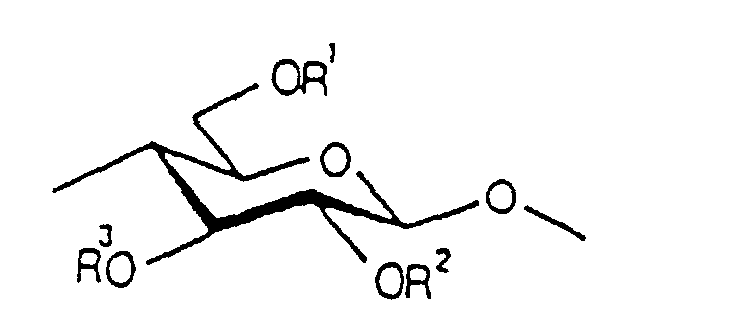
- the cellulose esters of the present invention generally comprise repeating units of the structure: wherein R 1 , R 2 , and R 3 are selected independently from the group consisting of hydrogen or straight chain alkanoyl having from 2 to 10 carbon atoms.
- the cellulose esters of the invention include cellulose acetate, cellulose acetate propionate, and cellulose acetate butyrate. These cellulose esters are described in U.S. Patents 1,698,049; 1,683,347; 1,880,808; 1,880,560; 1,984,147; 2,129,052; and 3,617,201, incorporated herein by reference in their entirety.
- cellulose esters useful in the present invention can be prepared using techniques known in the art or are commercially available from Eastman Chemical Company, Inc., Kingsport, TN, U.S.A.
- the cellulose esters useful in the present invention have at least 2 anhydroglucose rings and typically have between 2 and 5,000 anhydroglucose rings; also, such polymers typically have an inherent viscosity (I.V.) of 0.2 to 3.0 deciliters/gram, preferably 1 to 1.6, as measured at a temperature of 25°C for a 0.5 gram sample in 100 ml of a 60/40 by weight solution of phenol/tetrachloroethane.
- I.V. inherent viscosity
- Preferred esters of cellulose include cellulose acetate (CA), cellulose propionate (CP), cellulose butyrate (CB), cellulose acetate propionate (CAP), cellulose acetate butyrate (CAB), cellulose propionate butyrate (CPB), and the like.
- the preferred cellulose esters having a high degree of substitution include cellulose acetates, cellulose acetate propionates and cellulose acetate butyrate having a DS of 3.0 to 2.3.
- a preferred CE-H is cellulose acetate having a DS of 2.6 to 2.4 and an I.V. of 1.1 to 1.5.
- Another preferred CE-H is CAP having a DS of 2.75 to 2.45 in which acetyl comprises 1-90% of the acyl substituents.
- a more preferred CE-H is CAP having a DS of 2.75 to 2.45 in which acetyl comprises 50-90% of the acyl substituents.
- Still another preferred CE-H is CAB having a DS of 2.75 to 2.45 in which acetyl comprises 1-90% of the acyl substituents.
- a more preferred CE-H is CAB having a DS of 2.75 to 2.45 in which acetyl comprises 50-90% of the acyl substituents.
- the preferred cellulose esters having an intermediate degree of substitution include cellulose acetates, cellulose acetate propionates and cellulose acetate butyrates having a DS of 2.2 to 1.5.
- a preferred CE-L is cellulose acetate having a DS of 2.1 to 1.7 and an IV of 1.1 to 1.5.
- Another preferred CE-L is CAP having a DS of 2.2 to 1.5 in which acetyl comprises 1-90% of the acyl substituents.
- a more preferred CE-L is CAP having a DS of 2.1 to 1.7 in which acetyl comprises 50-90% of the acyl substituents.
- Still another preferred CE-L is CAB having a DS of 2.2 to 1.5 in which acetyl comprises 1-90% of the acyl substituents.
- a more preferred CE-L is CAB having a DS of 2.1 to 1.7 in which acetyl comprises 50-90% of the acyl substituents.
- the aliphatic-aromatic copolyesters that are useful in blends in the present invention are random copolymers and preferably comprise repeating units of: wherein R 4 and R 7 are selected from one or more of the following groups consisting of C 2 -C 12 alkylene or oxyalkylene; C 2 -C 12 alkylene or oxyalkylene substituents independently selected from the group consisting of halo, C 6 -C 10 aryl, and C 1 -C 4 alkoxy; cycloalkylene having 5 to 10 carbon atoms; C 5 -C 10 cycloalkylene substituted with one to four substituents independently selected from the group consisting of halo, C 6 -C 10 aryl, and C 1 -C 4 ; R 5 is selected from one or more of the following groups consisting of C 0 -C 12 alkylene; C 2 -C 12 oxyalkylene; C 1 -C 12 alkylene substituted with one to four substituents independently selected from the group
- said aliphatic-aromatic copolyester comprises 10 to 1,000 repeating units. It is more preferred that said aliphatic-aromatic copolyester comprises 15 to 600 repeating units.
- compositions of aliphatic-aromatic copolyesters of the invention the sum of R 4 and R 7 , the part derived from diols, and the sum of R 5 and R 6 , usually derived from diacids or diesters, will each be 100%.
- the mole % of R 5 in the copolymer can range from 30 to 97%, and the mole % of R 6 can range from 3 to 70%.
- a more preferred range is when the mole % of R 5 is from 45 to 85% and the mole % of R 6 is from 15-55 %.
- the most preferred ranges in general, depend upon the needed level of miscibility of the copolyester with the cellulose esters and the physical properties desired.
- the most preferred ranges for miscible blends is when R 5 is glutaric and the mole % of R 5 in the copolyester ranges from 70 to 85% and the mole % of R 6 range from 15-30 mole %.
- the most preferred ranges for partially miscible blends is when R 5 is glutaric and the mole % of R 5 in the copolyester ranges from 45 to 60% and the mole % of R 6 ranges from 40-55 %.
- alkyl and alkylene refer to either straight or branched chain moieties such as -CH 2 -CH 2 -CH 2 -CH 2 - and -CH 2 CH(X)-CH 2 -. Also, all of the carbon atoms of the cycloalkyl and cycloalkylene moieties are not necessarily in the ring structure, e.g., a cycloalkyl having 8 carbon atoms group can be cyclooctyl or dimethylcyclohexyl.
- oxyalkylene refers to alkylene chains containing 1 to 4 ether oxygen groups.
- One type of aliphatic polyester useful in the present invention preferably comprises repeating units of: wherein R 8 is selected from one or more of the following groups consisting of C2-C12 alkylene or oxyalkylene; C2-C12 alkylene or oxyalkylene substituted with one to four substituents independently selected from the group consisting of halo, C6-C10 aryl, and C1-C4 alkoxy; C5-C10 cycloalkylene; C5-C10 cycloalkylene substituted with one to four substituents independently selected from the group consisting of halo, C6-C10 aryl, and C1-C4 alkoxy; R 9 is selected from one or more of the following groups consisting of C0-C12 alkylene or oxyalkylene; C1-C12 alkylene substituted with one to four substituents independently selected from the group consisting of halo, C6-C10 aryl, and C1-C4 alkoxy; C5-C10 cycloal
- a second type of aliphatic polyester is polyhyroxyalkanoates which are comprised of repeat units of the following structure: wherein m is an integer or 0 to 10, and R 10 is selected from the group consisting of hydrogen; C1-C12 alkyl; C1-C12 alkyl substituted with one to four substituents independently selected from the group consisting of halo, C6-C10 aryl, and C1-C4 alkoxy; C5-C10 cycloalkyl; and C5-C10 cycloalkyl substituted with one to four substituents independently selected from the group consisting of halo, C6-C10 aryl, and C1-C4 alkoxy.
- aliphatic polyester is defined as an aliphatic polyester which does not contain significant quantities of carbonate linkages.
- polyester is defined as a polyester prepared by a condensation process, a ring-opening process, or by a biological process.
- polyesters and copolyesters are well known in the art (U.S. Patent 2,012,267, incorporated herein by reference in its entirety). Such reactions are usually carried out at temperatures from 150°C to 300°C in the presence of polycondensation catalysts such as titanium tetrachloride, manganese diacetate, antimony oxide, dibutyl tin diacetate, zinc chloride, or combinations thereof.
- the catalysts are typically employed in amounts between 10 to 1000 ppm, based on total weight of the reactants.
- a representative aliphatic polyester is the polycondensation product of dimethyl-glutarate and 1,6-hexanediol.
- This polyester poly-(hexamethylene glutarate) is produced when dimethylglutarate and 1,6-hexanediol are heated at approximately 210°C for 4 hours and then at 260°C for 1.5 hours under vacuum in the presence of 100 ppm of Ti.
- a representative aliphatic-aromatic copolyester is poly(tetramethylene glutarate-co-terephthalate) containing 30 mole per cent terephthalate.
- This polyester is produced when dimethylglutarate, dimethyl terephthalate, and 1,4-butanediol are heated at 200°C for 1 hour then at 245°C for 0.9 hour under vacuum in the presence of 100 ppm of Ti present initially as Ti(OiPr) 4 .
- said aliphatic-aromatic copolyester for use in blending is prepared from any polyester-forming combination of dicarboxylic acids or derivatives thereof, and diols.
- Said dicarboxylic acids are selected from the group consisting of the following diacids: oxalic, malonic, succinic, glutaric, adipic, pimelic, azelaic, sebacic, fumaric, 2,2-dimethyl glutaric, suberic, 1,3-cyclo-pentanedicarboxylic, 1,4-cyclohexanedicarboxylic, 1,3-cyclohexanedicarboxylic, diglycolic, itaconic, maleic, 2,5-norbornanedicarboxylic, 1,4-terephthalic, 1,3-terephthalic, 2,6-naphthoic, 1,5-naphthoic, and ester forming derivatives thereof, and combinations thereof; and said diols are
- Preferred aliphatic-aromatic polyesters for blending with CAP-H/CAP-L or CAB-H/CAB-L blends are poly (tetramethylene glutarate-co-terephthalate), poly-(tetramethylene adipate-co-terephthalate), poly(ethylene glutarate-co-terephthalate), and poly(ethylene adipate-co-terephthalate) where the mole % of aromatic dicarboxylate can vary from 10-60 mole percent.
- the preferred polyesters for blending with CAP-H/CAP-L or CAB-H/CAB-L blends consist of glutaric or adipic dicarboxylates and ethylene glycol, trimethylene glycol, or tetramethylene glycol.
- Preferred aliphatic-aromatic polyesters for blending with CA-H/CA-L blends are poly (ethylene glutarate-co-5-sulfoisophthalate) where the mole % of aromatic dicarboxylate can vary from 3-12 mole percent.
- Preferred aliphatic polyesters for blending with CA-H/CA-L blends are aliphatic copolyesters consisting of succinic dicarboxylate and two or more diols selected from ethylene glycol, tetramethylene glycol, or diethylene glycol.
- a preferred blend composition is when CE-H ranges from 10 weight % to 50 weight % and CE-L ranges from 90 weight % to 50 weight %.
- a more preferred composition is when the blend consists of 20 weight % to 35 weight % CE-H and from 80 weight % to 65 weight % CE-L.
- a preferred composition is when the blend consists of 6 weight % to 30 weight % CE-H (component (c)), 84 weight % to 30 weight % CE-L (component (d)), and 40 weight % to 10 weight % polyester (component (e)).
- a more preferred composition is when the blend consists of 15 weight % to 30 weight % CE-H (component (c)), 75 weight % to 50 weight % CE-L (component (d)), and 20 weight % to 10 weight % polyester (IIC).
- any of the blends of this invention can optionally additionally comprise 0.001 to 50 weight per cent, based on the total weight of the composition, of one or more additional additives selected from a plasticizer, a thermal stabilizer, an antioxidant, a pro-oxidant, an acid scavenger, an ultraviolet light stabilizer, a promoter of photodegradation, inorganics, hydrophilic additives, hydrophobic additives, and colorants.
- additional additives selected from a plasticizer, a thermal stabilizer, an antioxidant, a pro-oxidant, an acid scavenger, an ultraviolet light stabilizer, a promoter of photodegradation, inorganics, hydrophilic additives, hydrophobic additives, and colorants.
- Typical plasticizers include citrates, adipates, phosphates, glycols, and phthalates.
- Representative inorganics include talc, TiO 2 , CaCO 3 , NH 4 Cl, and silica. Colorants can be monomeric, oligomeric
- Preferred polymeric colorants are aliphatic polyesters, aliphatic-aromatic copolyesters, or aromatic polyesters in which the color producing monomer, i.e., a dye, is covalently incorporated into the polymer.
- a dye i.e., a dye
- Such representative polymeric colorants are described by Weaver et al., in U.S. Patents 4,892,922, 4,892,923, 4,882,412, 4,845,188, 4,826,903, and 4,749,773 and are incorporated herein by reference in their entirety.
- These polymeric dyes are represented by poly(tetramethylene terephthalate) containing 10% 1,5-bis-(O-carboxyanilino) anthraquinone.
- the blends of this invention can be formed into a shaped article either by a solvent casting process or by a thermal process.
- a solvent process include spinning of fibers or casting of film from the appropriate solvent (e.g., acetone, THF, CH 2 Cl 2 /MeOH, CHCl 3 , dioxane, DMF, DMSO, AcOMe, AcOEt, pyridine).
- the choice of solvent depends upon the blend composition.
- the preferred solvent for a cellulose acetate blend where the CE-H is a CA having a DS of 2.5 and the CE-L is a CA having a DS of 2.0 is acetone containing 9-15% water.
- the blend In the thermal process, it is preferred that the blend have a melt temperature of 120°C to 250°C. A more preferred melt temperature is from 160°C to 220°C.
- suitable plasticizers for use in a thermal process include, but are not limited to, dimethyl phthalate, triethyl citrate, trimethyl citrate, tripropyl citrate, tributyl citrate, trihexyl citrate, diethyl phthalate, dipropyl phthalate, dibutyl phthalate, triacetin, dihexyl adipate, polyethylene glycol-400, dioctyl adipate, or mixtures thereof.
- plasticizers are polyethylene glycol-400, triethylcitrate, diethyl phthalate, or dioctyl adipate. We have found that in the practice of this invention that it is particularly desirable to have additives which can serve dual functions. In this context, plasticizers such as polyethylene glycol-400 are preferred for the practice of this invention as they can both serve as plasticizers and as an additive that is particularly useful in modifying the surface or bulk water content of the blend.
- the blend components can be mixed by thermally compounding.
- the most preferred method is by thermally compounding in an apparatus such as a torque rheometer, a single screw extruder, or a twin screw extruder.
- the blends produced by thermally compounding can be converted to thin films by a number of methods known to those skilled in the art.
- thin films can be formed by dipcoating as described in U.S. Patent 4,372,311, by compression molding as described in U.S. Patent 4,427,614, by melt extrusion as described in U.S. Patent 4,880,592, by melt blowing, or by other similar methods.
- the blends can be converted to molded plastic objects by injection molding as well as by extrusion into a sheet from which an object is cut or stamped.
- the thermally compounded blends can be used for melt extrusion of fiber are can be blow molded into bottles as well.
- the cellulose ester blends can also be premixed by coprecipitation from a common solvent. Blends isolated by coprecipitation can then be thermally or solvent processed as described above. In the thermal process, plasticizers and other additives can be added as previously described. Polyesters and other additives can be added to the coprecipitated blend by the thermal process to form the ternary blends of (II).
- Preferred solvents for coprecipitation include acetone, acetone/water, propionic acid, acetic acid, or butyric acid. Particularly preferred is mixing of the cellulose ester reaction mixtures at the end of preparation of the cellulose esters followed by coprecipitation.
- the blends of this invention can be used to prepare shaped articles such as films, fibers, bottles, etc., which are dimensionally stable and which are especially useful in disposable items.
- the blends of this invention are useful in packaging applications where thin films are desirable. Many of the blends of this invention are particularly useful as thin barrier films where they must function as a barrier and/or be biodegradable. For example, these resins are useful as protective barrier films and may be used in disposable absorbent articles such as infant diapers, incontinence briefs, sanitary napkins, tampons, bed liners, bedpan liners, bandages, and the like.
- the films of the invention have a tangent modulus of 1.8 x 10 4 kg/cm 2 to 7.0 x 10 1 kg/cm 2 (2.5 x 10 5 psi to 0.01 x 10 5 psi), a tensile strength of at least 3.5 x 10 1 kg/cm 2 (0.5 x 10 3 psi), an average tear force of at least 7.0 g/mil, and an elongation at break of at least 10%. Also preferred is wherein said films have a thickness of 0.1 mil to 20 mil and a water vapor transmission rate less than 2000 g mil/m 2 -24 hours.
- blends of this invention can also be used in the other parts of disposable diapers.
- these blends can be used as tabs, nonwovens, fibers, tape, and other parts needed in the construction of a diaper.
- the blends of this invention are also useful as molded plastic parts or as solid, foamed plastic objects.
- examples of such parts include disposable knives, forks, spoons, plates, cups, straws as well as eyeglass frames, toothbrush handles, toys, automotive trim, tool handles, camera parts, razor parts, ink pen barrels, disposable syringes, bottles, and the like.
- the plastic parts, especially those made by a foamed method which gives the plastic part increased surface area, of this invention are particularly useful in applications were it is desired that the plastic part be environmentally non-persistent.
- Injection molding bars made from the resins of the invention typically have a flexural modulus of 3.5 x 10 4 kg/cm 2 to 7.0 x 10 3 kg/cm 2 (5.0 x 10 5 psi to 0.1 x 10 5 psi), a flexural strength of 9.1 x 10 2 kg/cm 2 to 7.0 x 10 1 kg/cm 2 (13 x 10 3 psi to 0.1 x 10 3 psi), and a notched Izod (23°C) of 53.4 to 1334.5 Newton-m/m (1.0 to 25 ft-lb/in).
- the molding bars have a flexural modulus of 2.7 x 10 4 kg/cm 2 to 1.1 x 10 4 kg/cm 2 (3.8 x 10 5 psi to 1.5 x 10 5 psi), a flexural strength of 8.0 x 10 2 kg/cm 2 to 2.8 x 10 2 kg/cm 2 (11.4 x 10 3 psi to 4 x 10 3 psi), and a notched Izod (23 °C) of 106.8 to 800.7 Newton-m/m(2 to 15 ft-lb/in).
- the blends of this invention are also useful as fibers.
- fiber applications include cigarette filters, diaper topsheet, sanitary napkins, fishing line, fishing nets, fiber for producing surgical clothing, hygiene articles, absorbent fibers, fibers for conveying liquids, and the like.
- the fibers of this invention can be melt-spun to produce fibers with excellent strength.
- the fibers can be oriented by drawing the fiber after spinning or by orientation during the spinning (cabinet orientation). Fibers produced from the blends have excellent shape retention even for fibers with complex cross-sectional shapes. We have also found that the fibers can be readily crimped. Fiber produced from the resins typically have a denier/filament (DPF) of 30-0.1. The preferred DPF is 10-1.5.
- DSC differential scanning calorimetry
- g is gram
- psi pounds per square inch
- cc cubic centimeter
- m is meter
- rpm revolutions per minute
- vol. or v volume
- wt.” is weight
- mm is micrometer
- CE cellulose ester
- cm is 0.001 inch.
- CA-L is cellulose acetate having an intermediate degree of substitution
- CA-H is cellulose acetate having a high degree of substitution
- CA is cellulose acetate
- CAP is cellulose acetate propionate.
- PEG400 is poly(ethylene glycol) with a MW of 400
- PE is polyester
- DOA is dioctyl adipate.
- PES is poly(ethylene succinate)
- PEG is poly (ethylene glutarate)
- PGT is poly (tetramethylene glutarate).
- the DSC spectra were collected using a Du Pont 912 Differential Scanning Calorimeter Spectrometer. The sample was heated from room temperature to 135°C at a heating rate of 20° min -1 and held for 30 seconds before cooling rapidly to 0°C. Second scan heating curves were then collected by heating from 0°C to 275°C at 20° min -1 . After cooling rapidly, third scan heating curves were then collected by heating from 0°C to 275°C at 20° min -1 .
- the tensile strength, elongation at break, and tangent modulus of the films are measured by ASTM method D882; the tear force is measured by ASTM method D1938.
- the tensile strength and elongation at break for molded pieces are measured by ASTM method D638; the flexural strength and modulus by ASTM method D790; the Izod impact strength by ASTM method D256.
- melt pressed films were prepared from blends of cellulose acetate of high degree (CA-H) and intermediate (CA-L) of substitution using polyethylene glycol-400 as a plasticizer according to general thermal method (i).
- This example illustrates the useful properties of these blends and demonstrates how a range of unexpectedly useful properties can be obtained by proper selection of the blend components. For example, a range of modulus from 2.4 to 1.3 is available without having to alter the plasticizer content and, even though the (CA-H) is the low modulus blend component, the softest film (low modulus) occurs when the blend composition is 50/50 CA-L/CA-H. Such a composition will degrade more rapidly than a 100% (CA-H).
- the 50/50 blend has a combination of unexpected high impact strength and low flexural modulus.
- the blend was prepared according to general thermal method (iv) using a processing temperature of 210°C and a molding temperature of 210°C.
- Composting can be defined as the microbial degradation and conversion of solid organic waste into soil.
- One of the key characteristics of compost piles is that they are self heating; heat is a natural by-product of the metabolic break down of organic matter. Depending upon the size of the pile, or its ability to insulate, the heat can be trapped and cause the internal temperature to rise.
- small-scale compost units were employed to simulate the active treatment processes found in a municipal solid waste composter. These bench-scale units displayed the same key features that distinguish the large-scale municipal compost plants.
- the starting organic waste was formulated to be representative of that found in municipal solid waste streams: a carbon to nitrogen of 25:1 ratio, a 55% moisture content, a neutral pH, a source of readily degradable organic carbon (e.g., cellulose, protein, simple carbohydrates, and lipids), and had a particle size that allowed good air flow through the mass.
- a carbon to nitrogen of 25:1 ratio a carbon to nitrogen of 25:1 ratio
- a 55% moisture content e.g., cellulose, protein, simple carbohydrates, and lipids
- a source of readily degradable organic carbon e.g., cellulose, protein, simple carbohydrates, and lipids
- HPLC high pressure liquid chromatography
- the films were optically clear and flexible. This example illustrates the useful resins obtained when aliphatic polyesters are incorporated into the cellulose ester blends.
- the films were optically clear and flexible. This example illustrates the useful resins obtained when aliphatic polyesters are incorporated into the cellulose ester blends.
Landscapes
- Chemical & Material Sciences (AREA)
- Health & Medical Sciences (AREA)
- Chemical Kinetics & Catalysis (AREA)
- Medicinal Chemistry (AREA)
- Polymers & Plastics (AREA)
- Organic Chemistry (AREA)
- Compositions Of Macromolecular Compounds (AREA)
- Polysaccharides And Polysaccharide Derivatives (AREA)
- Manufacture Of Porous Articles, And Recovery And Treatment Of Waste Products (AREA)
- Artificial Filaments (AREA)
- Manufacture Of Macromolecular Shaped Articles (AREA)
Claims (70)
- Mischung, umfassend:(a) 2 bis 98 Gew.-% mindestens eines Esters von Cellulose, der eine Alkanoylkette mit 1 bis 10 Kohlenstoffatomen umfaßt und einen S.G. von 2,3 bis 3,0 und eine innere Viskosität von 0,2 bis 3,0 Deziliter/Gramm, gemessen bei einer Temperatur von 25°C an einer 0,5 g-Probe in 100 ml einer Lösung von 60/40 Gewichtsteilen Phenol/Tetrachlorethan, aufweist, und(b) 98 bis 2 Gew.-% mindestens eines Esters von Cellulose, der eine Alkanoylkette mit 1 bis 10 Kohlenstoffatomen umfaßt und einen S.G. von 1,5 bis 2,2 und eine innere Viskosität von 0,2 bis 3,0 Deziliter/Gramm, gemessen bei einer Temperatur von 25°C an einer 0,5 g-Probe in 100 ml einer Lösung von 60/40 Gewichtsteilen Phenol/Tetrachlorethan, aufweist, wobei die Prozentsätze auf das Gewicht der Komponente (a) plus der Komponente (b) bezogen sind, und(b') 0,001 bis 50 Gew.-% der Gesamtzusammensetzung eines Weichmachers, der aus der Gruppe ausgewählt ist, die aus Citraten, Adipaten, Phosphaten, Glycolen und Phthalaten besteht.
- Mischung nach Anspruch 1, in der die Celluloseester der Komponenten (a) und (b) Wiederholungseinheiten der Struktur:umfassen, in der R1, R2 und R3 unabhängig aus der Gruppe ausgewählt sind, die aus Wasserstoff oder geradkettigem Alkanoyl mit 2 bis 10 Kohlenstoffatomen besteht.
- Mischung nach Anspruch 1, in der die Celluloseester der Komponenten (a) und (b) sekundäre Celluloseester sind.
- Mischung nach Anspruch 1, in der die Celluloseester der Komponente (a) aus der Gruppe ausgewählt sind, die aus Celluloseacetat, Celluloseacetatpropionat und Celluloseacetatbutyrat besteht.
- Mischung nach Anspruch 1, in der die Celluloseester der Komponente (b) aus der Gruppe ausgewählt sind, die aus Celluloseacetat, Celluloseacetatpropionat und Celluloseacetatbutyrat besteht.
- Mischung nach Anspruch 1, in der die Celluloseester 2 bis 5000 Anhydroglucose-Ringe enthalten.
- Mischung nach Anspruch 6, in der das Celluloseacetat der Komponente (a) von Anspruch 1 einen S.G. von 2,6 bis 2,4 und eine I.V. von 1,1 bis 1,5 aufweist.
- Mischung nach Anspruch 6, in der das Celluloseacetatpropionat der Komponente (a) einen S.G. von 2,75 bis 2,45 aufweist, wobei Acetyl 1 - 90 Gew.-% der Acyl-Substituenten umfaßt.
- Mischung nach Anspruch 6, in der das Celluloseacetatpropionat der Komponente (a) einen S.G. von 2,75 bis 2,45 aufweist, wobei Acetyl 50 - 90 Gew.-% der Acyl-Substituenten umfaßt.
- Mischung nach Anspruch 6, in der das Celluloseacetatbutyrat der Komponente (a) einen S.G. von 2,75 bis 2,45 aufweist, wobei Acetyl 1 - 90 Gew.-% der Acyl-Substituenten umfaßt.
- Mischung nach Anspruch 10, in der das Celluloseacetatbutyrat einen S.G. von 2,75 bis 2,45 aufweist, wobei Acetyl 50 - 90 Gew.-% der Acyl-Substituenten umfaßt.
- Mischung nach Anspruch 5, in der das Celluloseacetat einen S.G. von 2,2 bis 1,5 aufweist.
- Mischung nach Anspruch 12, in der das Celluloseacetat eine I.V. von 1,1 bis 1,5 aufweist.
- Mischung nach Anspruch 5, in der das Celluloseacetatpropionat einen S.G. von 2,2 bis 1,5 aufweist.
- Mischung nach Anspruch 14, in der Acetyl 1 bis 90 Gew.-% der Acyl-Substituenten umfaßt.
- Mischung nach Anspruch 14, in der das Celluloseacetatpropionat einen S.G. von 2,1 bis 1,7 aufweist, wobei Acetyl 50 - 90 Gew.-% der Acyl-Substituenten umfaßt.
- Mischung nach Anspruch 5, in der das Celluloseacetatbutyrat einen S.G. von 2,2 bis 1,5 aufweist, wobei Acetyl 1 bis 90 Gew.-% der Acyl-Substituenten umfaßt.
- Mischung nach Anspruch 5, in der Celluloseacetatbutyrat einen S.G. von 2,1 bis 1,7 aufweist, wobei Acetyl 50 bis 90 Gew.-% der Acyl-Substituenten umfaßt.
- Mischung nach Anspruch 1, die zusätzlich 0,001 bis 50 Gew.-%, bezogen auf das Gesamtgewicht der Zusammensetzung, einschließlich der Komponente b', mindestens eines zusätzlichen Additivs umfaßt, das aus einem Wärmestabilisator, einem Antioxidans, einem Prooxidans, einem Säure-Abfänger, einem Ultraviolettlicht-Stabilisator, einem Beschleuniger für Photoabbau, anorganischen Stoffen und Färbemitteln ausgewählt ist.
- Mischung nach Anspruch 19, in der die anorganischen Stoffe aus der Gruppe ausgewählt sind, die aus Talk, TiO2, CaCO3, NH4Cl und Siliciumdioxid besteht.
- Mischung nach Anspruch 19, in der die Mischungen verwendet werden, um Formkörper zu bilden.
- Mischung nach Anspruch 21 mit der Form eines Kunststoffilmes, der einen Tangentenmodul von 1,7 x 10⁴ kg/cm2 bis 7,0 x 101 kg/cm2 (2,5 x 10⁵ psi bis 0,01 x 10⁵ psi), eine Zugfestigkeit von mindestens 3,5 x 101 kg/cm2 (0,5 x 10³ psi), eine durchschnittliche Zerreißkraft von mindestens 7,0 g/mil und eine Reißdehnung von mindestens 10% aufweist.
- Mischung nach Anspruch 21, in der der Formkörper ein formgepreßter Gegenstand ist.
- Mischung nach Anspruch 21, in der der Formkörper eine Faser ist.
- Mischung nach Anspruch 21, in der der Formkörper ein geschäumter Gegenstand ist.
- Mischung, umfassendwobei die Prozentsätze auf das Gewicht der Komponente (c) plus der Komponente (d) plus der Komponente (e) bezogen sind.(c) 4 bis 97 Gew.-% eines oder mehrerer C1-C10-Ester von Cellulose mit einem hohem S.G. von 2,3 bis 3,0 und einer inneren Viskosität von 0,2 bis 3,0 Deziliter/Gramm, gemessen bei einer Temperatur von 25°C an einer 0,5 g-Probe in 100 ml einer Lösung von 60/40 Gewichtsteilen Phenol/Tetrachlorethan,(d) 2 - 95 Gew.-% eines oder mehrerer C1-C10-Ester von Cellulose mit einem mittleren S.G. von 1,5 bis 2,2 und einer inneren Viskosität von 0,2 bis 3,0 Deziliter/Gramm, gemessen bei einer Temperatur von 25°C an einer 0,5 g-Probe in 100 ml einer Lösung von 60/40 Gewichtsteilen Phenol/Tetrachlorethan, und(e) 1 bis 94% eines oder mehrerer aliphatischer Polyester oder aliphatisch-aromatischer Polyester,
- Mischung nach Anspruch 26, in der die Celluloseester der Komponente (c) und (d) Wiederholungseinheiten der Struktur:umfassen, in der R1, R2 und R3 unabhängig aus der Gruppe ausgewählt sind, die aus Wasserstoff oder geradkettigem Alkanoyl mit 2 bis 10 Kohlenstoffatomen besteht.

- Mischung nach Anspruch 26, in der die Celluloseester der Komponenten (c) und (d) sekundäre Celluloseester sind.
- Mischung nach Anspruch 26, in der der Celluloseester der Komponente (c) aus der Gruppe ausgewählt ist, die aus Celluloseacetat, Celluloseacetatpropionat und Celluloseacetatbutyrat besteht.
- Mischung nach Anspruch 26, in der der Celluloseester der Komponente (d) aus der Gruppe ausgewählt ist, die aus Celluloseacetat, Celluloseacetatpropionat und Celluloseacetatbutyrat besteht.
- Mischung nach Anspruch 26, in der der Celluloseester 2 bis 5000 Anhydroglucose-Ringe enthält.
- Mischung nach Anspruch 29, in der das Celluloseacetat der Komponente (c) einen S.G. von 2,6 bis 2,4 und eine I.V. von 1,1 bis 1,5 aufweist.
- Mischung nach Anspruch 29, in der das Celluloseacetatpropionat einen S.G. von 2,75 bis 2,45 aufweist, wobei Acetyl 1 - 90 Gew.-% der Acyl-Substituenten umfaßt.
- Mischung nach Anspruch 29, in der das Celluloseacetatpropionat einen S.G. von 2,75 bis 2,45 aufweist, wobei Acetyl 50 - 90 Gew.-% der Acyl-Substituenten umfaßt.
- Mischung nach Anspruch 29, in der das Celluloseacetatbutyrat einen S.G. von 2,75 bis 2,45 aufweist, wobei Acetyl 1 - 90 Gew.-% der Acyl-Substituenten umfaßt.
- Mischung nach Anspruch 35, in der das Celluloseacetatbutyrat einen S.G. von 2,75 bis 2,55 aufweist, wobei Acetyl 50 - 90 Gew.-% der Acyl-Substituenten umfaßt.
- Mischung nach Anspruch 30, in der das Celluloseacetat einen S.G. von 2,2 bis 1,5 aufweist.
- Mischung nach Anspruch 37, in der das Celluloseacetat eine I.V. von 1,1 bis 1,5 aufweist.
- Mischung nach Anspruch 30, in der das Celluloseacetatpropionat einen S.G. von 2,2 bis 1,5 aufweist.
- Mischung nach Anspruch 39, in der Acetyl 1 - 90 Gew.-% der Acyl-Substituenten umfaßt.
- Mischung nach Anspruch 39, in der das Celluloseacetatpropionat einen S.G. von 2,1 bis 1,7 aufweist, wobei Acetyl 50 - 90 Gew.-% der Acyl-Substituenten umfaßt.
- Mischung nach Anspruch 30, in der das Celluloseacetatbutyrat einen S.G. von 2,2 bis 1,5 aufweist, wobei Acetyl 1 bis 90 Gew.-% der Acyl-Substituenten umfaßt.
- Mischung nach Anspruch 30, in der das Celluloseacetatbutyrat einen S.G. von 2,1 bis 1,7 aufweist, wobei Acetyl 50 bis 90 Gew.-% der Acyl-Substituenten umfaßt.
- Mischung nach Anspruch 26, in der der aliphatisch-aromatische Copolyester Wiederholungseinheiten von:
- Mischung nach Anspruch 26, in der der atiphatisch-aromatische Copolyester 10 bis 1000 Wiederholungseinheiten umfaßt.
- Mischung nach Anspruch 45, in der der aliphatisch-aromatische Copolyester 15 bis 600 Wiederholungseinheiten umfaßt.
- Mischung nach Anspruch 44, in der R4 oder R7 aus C2-C6-Alkylen, C4-C8-Oxyalkylen oder C5-C10-Cycloalkylen ausgewählt ist und R5 aus C2-C6-Alkylen oder C5-C10-Cycloalkylen ausgewählt ist; R6 aus C6-C10-Aryl ausgewählt ist.
- Mischung nach Anspruch 47, in der die Mol.-% von R5 in dem Copolymer 30 bis 97% sind und die Mol.-% von R6 3 bis 70% sind.
- Mischung nach Anspruch 48, in der die Mol.-% von R5 in dem Copolymer 45 bis 85% sind und die Mol.-% von R6 15 - 55% sind.
- Mischung nach Anspruch 44, in der der aliphatisch-aromatische Copolyester aus irgendeinem Polyester hergestellt ist, der eine Kombination oder Kombinationen von Dicarbonsäuren oder deren Derivaten und Diolen bildet, wobei die Dicarbonsäuren aus der Gruppe ausgewählt sind, die aus den folgenden Disäuren: Oxal-, Malon-, Bernstein-, Glutar-, Adipin-, Pimelin-, Azelain-, Sebacin-, Fumar-, 2,2-Dimethylglutar-, Suberin-, 1,3-Cyclopentandicarbon-, 1,4-Cyclohexandicarbon-, 1,3-Cyclohexandicarbon-, Diglycol-, Itacon-, Malein-, 2,5-Norbornandicarbon-, 1,4-Terephthal-, 1,3-Terephthal-, 2,6-Naphthalindicarbon-, 1,5-Naphthalindicarbonsäure und Ester-bildenden Derivaten derselben und Kombinationen derselben besteht; und die Diole aus der Gruppe ausgewählt sind, die aus Ethylenglycol, Diethylenglycol, Propylenglycol, 1,3-Propandiol, 2,2-Dimethyl-1,3-propandiol, 1,3-Butandiol, 1,4-Butandiol, 1,5-Pentandiol, 1,6-Hexandiol, 2,2,4-Trimethyl-1,6-hexandiol, Thiodiethanol, 1,3-Cyclohexandimethanol, 1,4-Cyclohexandimethanol, 2,2,4,4-Tetramethyl-1,3-cyclobutandiol, Triethylenglycol, Tetraethylenglycol, Di-, Tri-, Tetrapropylenglycol und deren Kombinationen besteht.
- Mischung nach Anspruch 49, in der R5 für -CH2CH2CH2- steht und die Mol.-% der Komponente R5 im Copolyester im Bereich von 70 bis 85% liegen und die Mol.-% der Komponente R6 im Bereich von 15 - 30 Mol.-% liegen.
- Mischung nach Anspruch 49, in der R5 für -CH2CH2CH2- steht und die Mol.-% der Komponente R5 in dem Copolyester im Bereich von 45 bis 60% liegen und die Mol.-% der Komponente R6 im Bereich von 40 - 55 Mol.-% liegen.
- Mischung nach Anspruch 49, in der der aliphatisch-aromatische Copolyester Poly(tetramethylenglutarat-co-terephthalat) ist, der 30 Mol.-% Terephthalat und 70 Mol.-% Glutarat enthält.
- Mischung nach Anspruch 50, in der der aliphatisch-aromatische Copolyester aus Poly(tetramethylenglutarat-co-terephthalat-co-diglycolat) [50/45/5], Poly(tetramethylenglutarat-co-terephthalat) [50/50], Poly(tetramethylenglutarat-co-terephthalat) [60/40], Poly(tetramethylenglutarat-co-terephthalat) [70/30], Poly(tetramethylenglutarat-co-terephthalat) [85/15], Poly(ethylenglutarat-co-terephthalat) [70/30], Poly(tetramethylenadipat-co-terephthalat) [85/15], Poly(tetramethylensuccinat-co-terephthalat) [85/15] und Poly(tetramethylen-co-ethylenglutarat-co-terephthalat) [50/50, 70/30] ausgewählt ist.
- Mischung nach Anspruch 26, in der der Celluloseester mit hohem S.G. 6 bis 30 Gew.-% ausmacht, der Celluloseester mit mittlerem S.G. 84 bis 30 Gew.-% ausmacht und der Polyester 40 bis 10 Gew.-% ausmacht.
- Mischung nach Anspruch 26, in der der Celluloseester mit hohem S.G. 15 bis 30 Gew.-% ausmacht, der Celluloseester mit mittlerem S.G. 75 bis 50 Gew.-% ausmacht, und der Polyester 20 bis 10 Gew.-% ausmacht.
- Mischung nach Anspruch 26, in der der aliphatische Polyester Wiederholungseinheiten von
- Mischung nach Anspruch 57, in der der aliphatische Polyester 10 bis 1000 Wiederholungseinheiten umfaßt.
- Mischung nach Anspruch 58, in der der aliphatische Polyester 15 bis 600 Wiederholungseinheiten umfaßt.
- Mischung nach Anspruch 57, in der R8 aus C2-C6-Alkylen und C2-C8-Oxyalkylen ausgewählt ist und R9 aus C2- bis C6-Alkylen ausgewählt ist.
- Mischung nach Anspruch 26, in der der aliphatische Polyester Wiederholungseinheiten von
- Mischung nach Anspruch 26, die zusätzlich 0,001 bis 50 Gew.-%, bezogen auf das Gesamtgewicht der Zusammensetzung, mindestens eines zusätzlichen Additivs umfaßt, das aus einem nicht-polymeren Weichmacher, einem Wärmestabilisator, einem Antioxidans, einem Prooxidans, einem Säure-Abfänger, einem Ultraviolettlicht-Stabilisator, einem Beschleuniger für Photoabbau, anorganischen Stoffen und Färbemitteln ausgewählt ist.
- Mischung nach Anspruch 62, in der der Weichmacher Citrate, Adipate, Phosphate, Glycole und Phthalate umfaßt.
- Mischung nach Anspruch 63, in der die Mischungen zur Bildung von Formkörpern verwendet werden.
- Mischung nach Anspruch 62, in der die anorganischen Stoffe Talk, TiO2, CaCO3, NH4Cl und Siliciumdioxid umfassen.
- Mischung nach Anspruch 26, in der die Mischungen zur Bildung von Formkörpern verwendet werden.
- Mischung nach Anspruch 26 mit der Form eines Kunststoffilms, der einen Tangentenmodul von 1,8 x 10⁴ kg/cm2 bis 7,0 x 101 kg/cm2 (2,5 x 10⁵ psi bis 0,01 x 10⁵ psi), eine Zugfestigkeit von mindestens 3,5 x 101 kg/cm2 (0,5 x 10³ psi), eine durchschnittliche Zerreißkraft von mindestens 7,0 g/mil und eine Reißdehnung von mindestens 10% aufweist.
- Mischung nach Anspruch 66, in der die Formerzeugnisse preßgeformte Stäbe sind, die aus den Mischungen hergestellt sind und einen Biegemodul von 3,5 x 10⁴ kg/cm2 bis 7,0 x 10² kg/cm2 (5,0 bis 105 psi bis 0,1 x 10⁵ psi), eine Biegefestigkeit von 9,1 x 10² bis 7,0 kg/cm2 (13 x 103 bis 0,1 x 10³ psi) und eine Izod-Kerbschlagzähigkeit (23°C) von 53,4 bis 1334,5 Newton·m/m (1,0 bis 25 ft.-lb./in) aufweisen.
- Mischung nach Anspruch 66, in der der Formkörper eine Faser ist.
- Mischung nach Anspruch 66, in der der Formkörper ein geschäumter Gegenstand ist.
Applications Claiming Priority (3)
| Application Number | Priority Date | Filing Date | Title |
|---|---|---|---|
| US08/069,246 US6313202B1 (en) | 1993-05-28 | 1993-05-28 | Cellulose ester blends |
| US69246 | 1993-05-28 | ||
| PCT/US1994/005465 WO1994028062A1 (en) | 1993-05-28 | 1994-05-19 | Cellulose ester blends |
Publications (2)
| Publication Number | Publication Date |
|---|---|
| EP0703945A1 EP0703945A1 (de) | 1996-04-03 |
| EP0703945B1 true EP0703945B1 (de) | 2000-07-12 |
Family
ID=22087679
Family Applications (1)
| Application Number | Title | Priority Date | Filing Date |
|---|---|---|---|
| EP94918004A Expired - Lifetime EP0703945B1 (de) | 1993-05-28 | 1994-05-19 | Zelluloseesterzusammensetzungen |
Country Status (7)
| Country | Link |
|---|---|
| US (2) | US6313202B1 (de) |
| EP (1) | EP0703945B1 (de) |
| JP (2) | JPH08510782A (de) |
| AT (1) | ATE194639T1 (de) |
| CA (1) | CA2162490A1 (de) |
| DE (1) | DE69425260T2 (de) |
| WO (1) | WO1994028062A1 (de) |
Cited By (2)
| Publication number | Priority date | Publication date | Assignee | Title |
|---|---|---|---|---|
| US20130341665A1 (en) * | 2010-12-20 | 2013-12-26 | Solvay Acetow Gmbh | LED (Light-Emitting Diode) Luminous Source Module |
| CN109415158A (zh) * | 2016-06-29 | 2019-03-01 | 富士胶片株式会社 | 蔬果用包装材料 |
Families Citing this family (52)
| Publication number | Priority date | Publication date | Assignee | Title |
|---|---|---|---|---|
| US5844654A (en) * | 1997-05-28 | 1998-12-01 | Shimadzu Corporation | Biodegradable resin for forming spectacle-molded body and spectacle-molded body |
| US5973139A (en) * | 1998-02-06 | 1999-10-26 | Eastman Chemical Company | Carboxylated cellulose esters |
| JP3931210B2 (ja) * | 1998-03-23 | 2007-06-13 | ダイセル化学工業株式会社 | セルロースエステル組成物 |
| US6462120B2 (en) | 1999-06-07 | 2002-10-08 | Eastman Chemical Company | Agricultural mulch films with triggered degradation |
| USRE44145E1 (en) | 2000-07-07 | 2013-04-09 | A.V. Topchiev Institute Of Petrochemical Synthesis | Preparation of hydrophilic pressure sensitive adhesives having optimized adhesive properties |
| CA2447302C (en) * | 2001-05-01 | 2008-07-29 | A.V. Topchiev Institute Of Petrochemical Synthesis | Two-phase, water-absorbent bioadhesive composition |
| US20050215727A1 (en) | 2001-05-01 | 2005-09-29 | Corium | Water-absorbent adhesive compositions and associated methods of manufacture and use |
| US8541021B2 (en) | 2001-05-01 | 2013-09-24 | A.V. Topchiev Institute Of Petrochemical Synthesis | Hydrogel compositions demonstrating phase separation on contact with aqueous media |
| US8840918B2 (en) | 2001-05-01 | 2014-09-23 | A. V. Topchiev Institute of Petrochemical Synthesis, Russian Academy of Sciences | Hydrogel compositions for tooth whitening |
| US20050113510A1 (en) * | 2001-05-01 | 2005-05-26 | Feldstein Mikhail M. | Method of preparing polymeric adhesive compositions utilizing the mechanism of interaction between the polymer components |
| RU2276998C2 (ru) * | 2001-05-01 | 2006-05-27 | Институт Нефтехимического Синтеза Имени А.В. Топчиева Российской Академии Наук | Гидрогелевые композиции |
| US8206738B2 (en) * | 2001-05-01 | 2012-06-26 | Corium International, Inc. | Hydrogel compositions with an erodible backing member |
| WO2003020060A1 (en) * | 2001-08-30 | 2003-03-13 | Japan Tobacco Inc. | Cigarette filter |
| US8124676B2 (en) | 2003-03-14 | 2012-02-28 | Eastman Chemical Company | Basecoat coating compositions comprising low molecular weight cellulose mixed esters |
| US7893138B2 (en) | 2003-03-14 | 2011-02-22 | Eastman Chemical Company | Low molecular weight carboxyalkylcellulose esters and their use as low viscosity binders and modifiers in coating compositions |
| US8461234B2 (en) | 2003-03-14 | 2013-06-11 | Eastman Chemical Company | Refinish coating compositions comprising low molecular weight cellulose mixed esters |
| US8039531B2 (en) | 2003-03-14 | 2011-10-18 | Eastman Chemical Company | Low molecular weight cellulose mixed esters and their use as low viscosity binders and modifiers in coating compositions |
| CN1886427B (zh) * | 2003-11-28 | 2012-05-23 | 伊士曼化工公司 | 纤维素共聚体和氧化方法 |
| EP1713450B1 (de) | 2004-01-30 | 2021-10-06 | Corium, Inc. | Schnell auflösender film zur abgabe eines wirkstoffs |
| DE102004007941B4 (de) * | 2004-02-18 | 2006-04-27 | Fraunhofer-Gesellschaft zur Förderung der angewandten Forschung e.V. | Biologisch abbaubares Compound, das sich für Spritzguss, Folienextrusion und zum Blasformen eignet, Verfahren zu seiner Herstellung und seine Verwendung, insbesondere im Lebensmittelbereich |
| JP4566189B2 (ja) * | 2004-03-15 | 2010-10-20 | テルモ株式会社 | 癒着防止材 |
| US7776020B2 (en) * | 2004-03-19 | 2010-08-17 | Kimberly-Clark Worldwide, Inc. | Absorbent articles having an aliphatic-aromatic copolyester film |
| US7153569B2 (en) * | 2004-03-19 | 2006-12-26 | Kimberly-Clark Worldwide, Inc. | Biodegradable aliphatic-aromatic copolyester films |
| CN101039706A (zh) * | 2004-08-05 | 2007-09-19 | 考里安国际公司 | 粘合剂组合物 |
| JP4825988B2 (ja) * | 2005-03-25 | 2011-11-30 | コニカミノルタオプト株式会社 | 光学補償フィルムの製造方法 |
| JPWO2007043358A1 (ja) * | 2005-10-07 | 2009-04-16 | コニカミノルタオプト株式会社 | セルロースエステルフィルムの製造方法、セルロースエステルフィルム、偏光板及び液晶表示装置 |
| KR101245388B1 (ko) * | 2005-12-12 | 2013-03-19 | 코니카 미놀타 어드밴스드 레이어즈 인코포레이티드 | 셀룰로오스에스테르 필름의 제조 방법, 셀룰로오스에스테르필름, 편광판 및 액정 표시 장치 |
| US7896011B2 (en) * | 2006-08-08 | 2011-03-01 | Philip Morris Usa, Inc. | Method of forming a filter component |
| ES2466369T3 (es) | 2008-10-29 | 2014-06-10 | Toray Industries, Inc. | Composición termoplástica de éster de celulosa y fibras hechas de la misma |
| AU2010204986B2 (en) | 2009-01-14 | 2016-06-02 | Corium International, Inc. | Transdermal administration of tamsulosin |
| JP5177039B2 (ja) * | 2009-03-23 | 2013-04-03 | 東レ株式会社 | 高伸度セルロース繊維およびその製造方法 |
| US9708415B2 (en) | 2009-09-21 | 2017-07-18 | Virginia Tech Intellectual Properties, Inc. | Esters of cellulosic materials and diacids and method of making thereof |
| JP5470031B2 (ja) * | 2009-12-25 | 2014-04-16 | 富士フイルム株式会社 | 成形材料、成形体、及びその製造方法、並びに電気電子機器用筐体 |
| JP2011132438A (ja) * | 2009-12-25 | 2011-07-07 | Fujifilm Corp | 成形材料、成形体、及びその製造方法、並びに電気電子機器用筐体 |
| US9068063B2 (en) | 2010-06-29 | 2015-06-30 | Eastman Chemical Company | Cellulose ester/elastomer compositions |
| US9273195B2 (en) | 2010-06-29 | 2016-03-01 | Eastman Chemical Company | Tires comprising cellulose ester/elastomer compositions |
| IT1400983B1 (it) * | 2010-07-05 | 2013-07-05 | Mazzucchelli 1849 Spa | Materiale a base di acetato di cellulosa con plastificanti e manufatto ottenuto con tale prodotto. |
| WO2012014571A1 (ja) * | 2010-07-30 | 2012-02-02 | コニカミノルタオプト株式会社 | セルロースアセテートフィルム、セルロースアセテートフィルムの製造方法、偏光板及び液晶表示装置とその製造方法 |
| GB2489491A (en) * | 2011-03-31 | 2012-10-03 | British American Tobacco Co | Cellulose acetate and plasticizer blends |
| US9708474B2 (en) | 2011-12-07 | 2017-07-18 | Eastman Chemical Company | Cellulose esters in pneumatic tires |
| JP6062199B2 (ja) * | 2012-09-28 | 2017-01-18 | ユニ・チャーム株式会社 | 吸収性物品 |
| TWI586857B (zh) * | 2012-11-29 | 2017-06-11 | 財團法人紡織產業綜合研究所 | 複合纖維及包含複合纖維的織物 |
| US9605140B2 (en) | 2014-09-26 | 2017-03-28 | Fuji Xerox Co., Ltd. | Resin composition and resin shaped product |
| JP6439356B2 (ja) * | 2014-09-26 | 2018-12-19 | 富士ゼロックス株式会社 | 樹脂組成物、及び樹脂成形体 |
| US10077343B2 (en) | 2016-01-21 | 2018-09-18 | Eastman Chemical Company | Process to produce elastomeric compositions comprising cellulose ester additives |
| WO2019130828A1 (ja) * | 2017-12-27 | 2019-07-04 | 富士フイルム株式会社 | 包装材およびその使用方法 |
| FI20185381A1 (en) | 2018-04-23 | 2019-10-24 | Welmu Int Oy | POLYMER COMPOSITION, RELATED METHOD AND ITS USE |
| WO2021014561A1 (ja) * | 2019-07-23 | 2021-01-28 | 株式会社ダイセル | 酢酸セルロース繊維の製造方法、及び酢酸セルロース繊維 |
| EP4072354A1 (de) * | 2019-12-10 | 2022-10-19 | Ticona LLC | Emissionsarme zelluloseesterzusammensetzung und daraus hergestellte gegenstände |
| US20230075066A1 (en) * | 2020-01-20 | 2023-03-09 | Eastman Chemical Company | Biodegradable compositions and articles made from cellulose acetate |
| CN120239774A (zh) * | 2022-11-24 | 2025-07-01 | 株式会社可乐丽 | 乙酸纤维素纤维及乙酸纤维素纤维的制造方法 |
| WO2024132989A1 (en) | 2022-12-18 | 2024-06-27 | KHAN, Shauk Muntaha Murshid | A production process for totally biodegradable biopolymer from jute |
Family Cites Families (36)
| Publication number | Priority date | Publication date | Assignee | Title |
|---|---|---|---|---|
| US1880808A (en) | 1927-03-28 | 1932-10-04 | Eastman Kodak Co | Process of making cellulose esters of carboxylic acids |
| US1683347A (en) | 1927-08-25 | 1928-09-04 | Eastman Kodak Co | Process of making chloroform-soluble cellulose acetate |
| US1698049A (en) | 1928-01-18 | 1929-01-08 | Eastman Kodak Co | Process of making cellulosic esters containing halogen-substituted fatty-acid groups |
| US2012267A (en) | 1929-08-01 | 1935-08-27 | Du Pont | Alkylene ester of polybasic acids |
| US1984147A (en) | 1929-10-22 | 1934-12-11 | Eastman Kodak Co | Process for the production of cellulose esters and corresponding alkyl esters |
| US1880560A (en) | 1929-12-14 | 1932-10-04 | Eastman Kodak Co | Process for the hydrolysis of cellulose acetate |
| US2129052A (en) | 1936-02-04 | 1938-09-06 | Eastman Kodak Co | Hydrolyzed cellulose acetate |
| US3493319A (en) | 1967-05-26 | 1970-02-03 | Us Agriculture | Esterification of cellulosic textiles with unsaturated long chain fatty acids in the presence of trifluoroacetic anhydride using controlled cellulose-acid-anhydride ratios |
| US3668157A (en) | 1970-07-23 | 1972-06-06 | Eastman Kodak Co | Blend containing at least a cellulose ester and a block copolymer elastomer |
| US3684648A (en) * | 1971-02-09 | 1972-08-15 | Roland Keith Kunkel | Multicomponent filamentary material formed from waste material |
| US3781381A (en) | 1971-05-06 | 1973-12-25 | Union Carbide Corp | Nylon polymers blended with cyclic ester polymers |
| JPS5245590A (en) * | 1975-09-12 | 1977-04-11 | Kobe Steel Ltd | Method of producing semipermeable membrane |
| JPS5323347A (en) * | 1976-08-17 | 1978-03-03 | Daicel Chem Ind Ltd | Cellulosic thermoplastic resin moldings |
| EP0078609B1 (de) | 1980-04-30 | 1987-05-06 | Imperial Chemical Industries Plc | 3-Hydroxybuttersäure-Polymere |
| US4372311A (en) | 1980-09-12 | 1983-02-08 | Union Carbide Corporation | Disposable articles coated with degradable water insoluble polymers |
| JPS58103538A (ja) * | 1981-12-14 | 1983-06-20 | Daicel Chem Ind Ltd | 酢酸セルロ−ス組成物 |
| DE3314188A1 (de) | 1983-04-19 | 1984-10-25 | Bayer Ag, 5090 Leverkusen | Verwendung von polymerlegierungen auf basis von celluloseestern in der augen-kontaktoptik und aus den polymerlegierungen hergestellte kontaktlinsen und -schalen |
| US4506045A (en) | 1982-10-02 | 1985-03-19 | Bayer Aktiengesellschaft | Cellulose ester-aliphatic polycarbonate thermoplastic moulding compositions |
| DE3300345A1 (de) * | 1983-01-07 | 1984-07-12 | Bayer Ag, 5090 Leverkusen | Hydrophilierte celluloseester, verfahren zu deren herstellung, deren verwendung als biomedizinische materialien und hieraus hergestellte kontaktlinsen und -schalen |
| AU603076B2 (en) | 1985-12-09 | 1990-11-08 | W.R. Grace & Co.-Conn. | Polymeric products and their manufacture |
| US4770931A (en) | 1987-05-05 | 1988-09-13 | Eastman Kodak Company | Shaped articles from polyester and cellulose ester compositions |
| US4749773A (en) | 1987-07-27 | 1988-06-07 | Eastman Kodak Company | Condensation polymers containing methine ultraviolet radiation-absorbing residues and shaped articles produced therefrom |
| US4795641A (en) | 1987-08-20 | 1989-01-03 | Eastman Kodak Company | Polymer blends having reverse phase morphology for controlled delivery of bioactive agents |
| US4882412A (en) | 1987-11-30 | 1989-11-21 | Eastman Kodak Company | Polyester polymer containing the residue of the UV absorbing benzopyran compound and shaped articles produced therefrom |
| US4892922A (en) | 1987-11-30 | 1990-01-09 | Eastman Kodak Company | Polyester polymer containing the residue of a benzopyran colorant compound and shaped articles produced therefrom |
| US4826903A (en) | 1988-02-22 | 1989-05-02 | Eastman Kodak Company | Condensation polymer containing the residue of an acyloxystyrl compound and shaped articles produced therefrom |
| US4892923A (en) | 1988-02-22 | 1990-01-09 | Eastman Kodak Company | Polyester compositions containing the residue of a naphthopyran compound and shaped articles produced therefrom |
| US4845188A (en) | 1988-08-19 | 1989-07-04 | Eastman Kodak Company | Condensation polymers containing methine ultraviolet radiation-absorbing residues and shaped articles produced therefrom |
| US4983730A (en) | 1988-09-02 | 1991-01-08 | Hoechst Celanese Corporation | Water soluble cellulose acetate composition having improved processability and tensile properties |
| US5075114A (en) * | 1990-05-23 | 1991-12-24 | Mcneil-Ppc, Inc. | Taste masking and sustained release coatings for pharmaceuticals |
| JP3090677B2 (ja) * | 1990-09-26 | 2000-09-25 | エテルナ―リヒテ ゲーエムベーハー ウント コンパニ.カーゲー. | 生物学的に分解可能な合成樹脂材料及びその包装材 |
| US5104450A (en) * | 1990-09-26 | 1992-04-14 | Eastman Kodak Company | Formulations of cellulose esters with arylene-bis(diaryl phosphate)s |
| DE69132548T2 (de) | 1990-11-30 | 2001-06-28 | Eastman Chemical Co., Kingsport | Aliphatisch-aromatische Copolyester |
| US5292783A (en) * | 1990-11-30 | 1994-03-08 | Eastman Kodak Company | Aliphatic-aromatic copolyesters and cellulose ester/polymer blends |
| WO1992020738A1 (en) | 1991-05-21 | 1992-11-26 | Battelle Memorial Institute | Degradable cellulose polymers |
| EP0592706B1 (de) | 1992-10-13 | 1997-02-19 | Deutsche Carbone Ag | Verwendung von Zelluloseestermischung-Membranen |
-
1993
- 1993-05-28 US US08/069,246 patent/US6313202B1/en not_active Expired - Fee Related
-
1994
- 1994-05-19 CA CA002162490A patent/CA2162490A1/en not_active Abandoned
- 1994-05-19 WO PCT/US1994/005465 patent/WO1994028062A1/en not_active Ceased
- 1994-05-19 AT AT94918004T patent/ATE194639T1/de not_active IP Right Cessation
- 1994-05-19 DE DE69425260T patent/DE69425260T2/de not_active Expired - Fee Related
- 1994-05-19 EP EP94918004A patent/EP0703945B1/de not_active Expired - Lifetime
- 1994-05-19 JP JP7500740A patent/JPH08510782A/ja not_active Withdrawn
-
1995
- 1995-06-05 US US08/462,717 patent/US5594068A/en not_active Expired - Fee Related
-
2007
- 2007-07-31 JP JP2007199061A patent/JP2007277582A/ja active Pending
Cited By (3)
| Publication number | Priority date | Publication date | Assignee | Title |
|---|---|---|---|---|
| US20130341665A1 (en) * | 2010-12-20 | 2013-12-26 | Solvay Acetow Gmbh | LED (Light-Emitting Diode) Luminous Source Module |
| CN109415158A (zh) * | 2016-06-29 | 2019-03-01 | 富士胶片株式会社 | 蔬果用包装材料 |
| EP3480134B1 (de) * | 2016-06-29 | 2024-08-14 | FUJIFILM Corporation | Obst- und gemüseverpackungsmaterial |
Also Published As
| Publication number | Publication date |
|---|---|
| ATE194639T1 (de) | 2000-07-15 |
| US6313202B1 (en) | 2001-11-06 |
| WO1994028062A1 (en) | 1994-12-08 |
| CA2162490A1 (en) | 1994-12-08 |
| DE69425260T2 (de) | 2000-11-30 |
| JPH08510782A (ja) | 1996-11-12 |
| US5594068A (en) | 1997-01-14 |
| DE69425260D1 (de) | 2000-08-17 |
| JP2007277582A (ja) | 2007-10-25 |
| EP0703945A1 (de) | 1996-04-03 |
Similar Documents
| Publication | Publication Date | Title |
|---|---|---|
| US6313202B1 (en) | Cellulose ester blends | |
| EP0559785B1 (de) | Mischungen von aliphatisch-aromatischen Copolyestern mit Celluloseester-Polymeren | |
| US5292783A (en) | Aliphatic-aromatic copolyesters and cellulose ester/polymer blends | |
| US6495656B1 (en) | Copolyesters and fibrous materials formed therefrom | |
| EP0711326B1 (de) | Bioabbaubare formbare erzeugnisse und filme enthaltend mischungen von stärkeestern und polyestern | |
| Chiellini et al. | Biodegradable polymeric materials | |
| WO1994010238A1 (en) | Method for increasing the biodegradability of cellulose esters | |
| MXPA94007528A (en) | Aromatic copolyesters-alifati |
Legal Events
| Date | Code | Title | Description |
|---|---|---|---|
| PUAI | Public reference made under article 153(3) epc to a published international application that has entered the european phase |
Free format text: ORIGINAL CODE: 0009012 |
|
| 17P | Request for examination filed |
Effective date: 19951128 |
|
| AK | Designated contracting states |
Kind code of ref document: A1 Designated state(s): AT BE CH DE DK ES FR GB GR IE IT LI LU NL PT SE |
|
| 17Q | First examination report despatched |
Effective date: 19961217 |
|
| GRAG | Despatch of communication of intention to grant |
Free format text: ORIGINAL CODE: EPIDOS AGRA |
|
| GRAG | Despatch of communication of intention to grant |
Free format text: ORIGINAL CODE: EPIDOS AGRA |
|
| GRAH | Despatch of communication of intention to grant a patent |
Free format text: ORIGINAL CODE: EPIDOS IGRA |
|
| GRAH | Despatch of communication of intention to grant a patent |
Free format text: ORIGINAL CODE: EPIDOS IGRA |
|
| GRAA | (expected) grant |
Free format text: ORIGINAL CODE: 0009210 |
|
| AK | Designated contracting states |
Kind code of ref document: B1 Designated state(s): AT BE CH DE DK ES FR GB GR IE IT LI LU NL PT SE |
|
| PG25 | Lapsed in a contracting state [announced via postgrant information from national office to epo] |
Ref country code: NL Free format text: LAPSE BECAUSE OF FAILURE TO SUBMIT A TRANSLATION OF THE DESCRIPTION OR TO PAY THE FEE WITHIN THE PRESCRIBED TIME-LIMIT Effective date: 20000712 Ref country code: LI Free format text: LAPSE BECAUSE OF FAILURE TO SUBMIT A TRANSLATION OF THE DESCRIPTION OR TO PAY THE FEE WITHIN THE PRESCRIBED TIME-LIMIT Effective date: 20000712 Ref country code: GR Free format text: LAPSE BECAUSE OF NON-PAYMENT OF DUE FEES Effective date: 20000712 Ref country code: ES Free format text: THE PATENT HAS BEEN ANNULLED BY A DECISION OF A NATIONAL AUTHORITY Effective date: 20000712 Ref country code: CH Free format text: LAPSE BECAUSE OF FAILURE TO SUBMIT A TRANSLATION OF THE DESCRIPTION OR TO PAY THE FEE WITHIN THE PRESCRIBED TIME-LIMIT Effective date: 20000712 Ref country code: BE Free format text: LAPSE BECAUSE OF FAILURE TO SUBMIT A TRANSLATION OF THE DESCRIPTION OR TO PAY THE FEE WITHIN THE PRESCRIBED TIME-LIMIT Effective date: 20000712 Ref country code: AT Free format text: LAPSE BECAUSE OF FAILURE TO SUBMIT A TRANSLATION OF THE DESCRIPTION OR TO PAY THE FEE WITHIN THE PRESCRIBED TIME-LIMIT Effective date: 20000712 |
|
| REF | Corresponds to: |
Ref document number: 194639 Country of ref document: AT Date of ref document: 20000715 Kind code of ref document: T |
|
| REG | Reference to a national code |
Ref country code: CH Ref legal event code: EP |
|
| REG | Reference to a national code |
Ref country code: IE Ref legal event code: FG4D |
|
| ITF | It: translation for a ep patent filed | ||
| REF | Corresponds to: |
Ref document number: 69425260 Country of ref document: DE Date of ref document: 20000817 |
|
| PG25 | Lapsed in a contracting state [announced via postgrant information from national office to epo] |
Ref country code: SE Free format text: LAPSE BECAUSE OF FAILURE TO SUBMIT A TRANSLATION OF THE DESCRIPTION OR TO PAY THE FEE WITHIN THE PRESCRIBED TIME-LIMIT Effective date: 20001012 Ref country code: PT Free format text: LAPSE BECAUSE OF FAILURE TO SUBMIT A TRANSLATION OF THE DESCRIPTION OR TO PAY THE FEE WITHIN THE PRESCRIBED TIME-LIMIT Effective date: 20001012 Ref country code: DK Free format text: LAPSE BECAUSE OF FAILURE TO SUBMIT A TRANSLATION OF THE DESCRIPTION OR TO PAY THE FEE WITHIN THE PRESCRIBED TIME-LIMIT Effective date: 20001012 |
|
| ET | Fr: translation filed | ||
| NLV1 | Nl: lapsed or annulled due to failure to fulfill the requirements of art. 29p and 29m of the patents act | ||
| REG | Reference to a national code |
Ref country code: CH Ref legal event code: PL |
|
| PLBE | No opposition filed within time limit |
Free format text: ORIGINAL CODE: 0009261 |
|
| STAA | Information on the status of an ep patent application or granted ep patent |
Free format text: STATUS: NO OPPOSITION FILED WITHIN TIME LIMIT |
|
| PG25 | Lapsed in a contracting state [announced via postgrant information from national office to epo] |
Ref country code: LU Free format text: LAPSE BECAUSE OF NON-PAYMENT OF DUE FEES Effective date: 20010519 |
|
| PG25 | Lapsed in a contracting state [announced via postgrant information from national office to epo] |
Ref country code: IE Free format text: LAPSE BECAUSE OF NON-PAYMENT OF DUE FEES Effective date: 20010521 |
|
| 26N | No opposition filed | ||
| REG | Reference to a national code |
Ref country code: GB Ref legal event code: IF02 |
|
| REG | Reference to a national code |
Ref country code: IE Ref legal event code: MM4A |
|
| PGFP | Annual fee paid to national office [announced via postgrant information from national office to epo] |
Ref country code: DE Payment date: 20070531 Year of fee payment: 14 |
|
| PGFP | Annual fee paid to national office [announced via postgrant information from national office to epo] |
Ref country code: GB Payment date: 20070410 Year of fee payment: 14 |
|
| PGFP | Annual fee paid to national office [announced via postgrant information from national office to epo] |
Ref country code: IT Payment date: 20070519 Year of fee payment: 14 |
|
| PGFP | Annual fee paid to national office [announced via postgrant information from national office to epo] |
Ref country code: FR Payment date: 20070503 Year of fee payment: 14 |
|
| GBPC | Gb: european patent ceased through non-payment of renewal fee |
Effective date: 20080519 |
|
| REG | Reference to a national code |
Ref country code: FR Ref legal event code: ST Effective date: 20090119 |
|
| PG25 | Lapsed in a contracting state [announced via postgrant information from national office to epo] |
Ref country code: FR Free format text: LAPSE BECAUSE OF NON-PAYMENT OF DUE FEES Effective date: 20080602 Ref country code: DE Free format text: LAPSE BECAUSE OF NON-PAYMENT OF DUE FEES Effective date: 20081202 |
|
| PG25 | Lapsed in a contracting state [announced via postgrant information from national office to epo] |
Ref country code: GB Free format text: LAPSE BECAUSE OF NON-PAYMENT OF DUE FEES Effective date: 20080519 |
|
| PG25 | Lapsed in a contracting state [announced via postgrant information from national office to epo] |
Ref country code: IT Free format text: LAPSE BECAUSE OF NON-PAYMENT OF DUE FEES Effective date: 20080519 |