EP0702012B1 - Substituted isoxazole sulfonamides and their use as endothelin antagonists - Google Patents
Substituted isoxazole sulfonamides and their use as endothelin antagonists Download PDFInfo
- Publication number
- EP0702012B1 EP0702012B1 EP95113383A EP95113383A EP0702012B1 EP 0702012 B1 EP0702012 B1 EP 0702012B1 EP 95113383 A EP95113383 A EP 95113383A EP 95113383 A EP95113383 A EP 95113383A EP 0702012 B1 EP0702012 B1 EP 0702012B1
- Authority
- EP
- European Patent Office
- Prior art keywords
- dimethyl
- isoxazolyl
- biphenyl
- oxazolyl
- sulfonamide
- Prior art date
- Legal status (The legal status is an assumption and is not a legal conclusion. Google has not performed a legal analysis and makes no representation as to the accuracy of the status listed.)
- Expired - Lifetime
Links
- 0 CC[C@](CCC1(CC(**)CC1)I)C=NO Chemical compound CC[C@](CCC1(CC(**)CC1)I)C=NO 0.000 description 4
- XDTMQSROBMDMFD-UHFFFAOYSA-N C1CCCCC1 Chemical compound C1CCCCC1 XDTMQSROBMDMFD-UHFFFAOYSA-N 0.000 description 1
- ZGSUGYVENSLNFY-UHFFFAOYSA-N CCC(CCC(C)[Br]=C)C1NOCC1 Chemical compound CCC(CCC(C)[Br]=C)C1NOCC1 ZGSUGYVENSLNFY-UHFFFAOYSA-N 0.000 description 1
- NOISFCQMZQLMTK-UHFFFAOYSA-N Cc1c(NS(c(cccc2)c2-c(cc2)c(CNC(C(F)(F)F)=O)cc2-c2ncc[o]2)(=O)=O)[o]nc1C Chemical compound Cc1c(NS(c(cccc2)c2-c(cc2)c(CNC(C(F)(F)F)=O)cc2-c2ncc[o]2)(=O)=O)[o]nc1C NOISFCQMZQLMTK-UHFFFAOYSA-N 0.000 description 1
- SDGUZYOOEXYZPU-UHFFFAOYSA-N Cc1c(NS(c(cccc2)c2-c(cc2)c(CNC(NC=[IH])=O)cc2-c2ncc[o]2)(=O)=O)[o]nc1C=[IH] Chemical compound Cc1c(NS(c(cccc2)c2-c(cc2)c(CNC(NC=[IH])=O)cc2-c2ncc[o]2)(=O)=O)[o]nc1C=[IH] SDGUZYOOEXYZPU-UHFFFAOYSA-N 0.000 description 1
- BXODLGZHBMJIOK-UHFFFAOYSA-N Cc1c(NS(c2ccccc2-c(ccc(-c2ncc[o]2)c2)c2-c2ncc[o]2)(=O)=O)[o]nc1C Chemical compound Cc1c(NS(c2ccccc2-c(ccc(-c2ncc[o]2)c2)c2-c2ncc[o]2)(=O)=O)[o]nc1C BXODLGZHBMJIOK-UHFFFAOYSA-N 0.000 description 1
Classifications
-
- C—CHEMISTRY; METALLURGY
- C07—ORGANIC CHEMISTRY
- C07D—HETEROCYCLIC COMPOUNDS
- C07D231/00—Heterocyclic compounds containing 1,2-diazole or hydrogenated 1,2-diazole rings
- C07D231/02—Heterocyclic compounds containing 1,2-diazole or hydrogenated 1,2-diazole rings not condensed with other rings
- C07D231/10—Heterocyclic compounds containing 1,2-diazole or hydrogenated 1,2-diazole rings not condensed with other rings having two or three double bonds between ring members or between ring members and non-ring members
- C07D231/12—Heterocyclic compounds containing 1,2-diazole or hydrogenated 1,2-diazole rings not condensed with other rings having two or three double bonds between ring members or between ring members and non-ring members with only hydrogen atoms, hydrocarbon or substituted hydrocarbon radicals, directly attached to ring carbon atoms
-
- A—HUMAN NECESSITIES
- A61—MEDICAL OR VETERINARY SCIENCE; HYGIENE
- A61P—SPECIFIC THERAPEUTIC ACTIVITY OF CHEMICAL COMPOUNDS OR MEDICINAL PREPARATIONS
- A61P1/00—Drugs for disorders of the alimentary tract or the digestive system
-
- A—HUMAN NECESSITIES
- A61—MEDICAL OR VETERINARY SCIENCE; HYGIENE
- A61P—SPECIFIC THERAPEUTIC ACTIVITY OF CHEMICAL COMPOUNDS OR MEDICINAL PREPARATIONS
- A61P1/00—Drugs for disorders of the alimentary tract or the digestive system
- A61P1/04—Drugs for disorders of the alimentary tract or the digestive system for ulcers, gastritis or reflux esophagitis, e.g. antacids, inhibitors of acid secretion, mucosal protectants
-
- A—HUMAN NECESSITIES
- A61—MEDICAL OR VETERINARY SCIENCE; HYGIENE
- A61P—SPECIFIC THERAPEUTIC ACTIVITY OF CHEMICAL COMPOUNDS OR MEDICINAL PREPARATIONS
- A61P1/00—Drugs for disorders of the alimentary tract or the digestive system
- A61P1/12—Antidiarrhoeals
-
- A—HUMAN NECESSITIES
- A61—MEDICAL OR VETERINARY SCIENCE; HYGIENE
- A61P—SPECIFIC THERAPEUTIC ACTIVITY OF CHEMICAL COMPOUNDS OR MEDICINAL PREPARATIONS
- A61P1/00—Drugs for disorders of the alimentary tract or the digestive system
- A61P1/16—Drugs for disorders of the alimentary tract or the digestive system for liver or gallbladder disorders, e.g. hepatoprotective agents, cholagogues, litholytics
-
- A—HUMAN NECESSITIES
- A61—MEDICAL OR VETERINARY SCIENCE; HYGIENE
- A61P—SPECIFIC THERAPEUTIC ACTIVITY OF CHEMICAL COMPOUNDS OR MEDICINAL PREPARATIONS
- A61P11/00—Drugs for disorders of the respiratory system
-
- A—HUMAN NECESSITIES
- A61—MEDICAL OR VETERINARY SCIENCE; HYGIENE
- A61P—SPECIFIC THERAPEUTIC ACTIVITY OF CHEMICAL COMPOUNDS OR MEDICINAL PREPARATIONS
- A61P11/00—Drugs for disorders of the respiratory system
- A61P11/08—Bronchodilators
-
- A—HUMAN NECESSITIES
- A61—MEDICAL OR VETERINARY SCIENCE; HYGIENE
- A61P—SPECIFIC THERAPEUTIC ACTIVITY OF CHEMICAL COMPOUNDS OR MEDICINAL PREPARATIONS
- A61P13/00—Drugs for disorders of the urinary system
- A61P13/02—Drugs for disorders of the urinary system of urine or of the urinary tract, e.g. urine acidifiers
-
- A—HUMAN NECESSITIES
- A61—MEDICAL OR VETERINARY SCIENCE; HYGIENE
- A61P—SPECIFIC THERAPEUTIC ACTIVITY OF CHEMICAL COMPOUNDS OR MEDICINAL PREPARATIONS
- A61P15/00—Drugs for genital or sexual disorders; Contraceptives
-
- A—HUMAN NECESSITIES
- A61—MEDICAL OR VETERINARY SCIENCE; HYGIENE
- A61P—SPECIFIC THERAPEUTIC ACTIVITY OF CHEMICAL COMPOUNDS OR MEDICINAL PREPARATIONS
- A61P17/00—Drugs for dermatological disorders
-
- A—HUMAN NECESSITIES
- A61—MEDICAL OR VETERINARY SCIENCE; HYGIENE
- A61P—SPECIFIC THERAPEUTIC ACTIVITY OF CHEMICAL COMPOUNDS OR MEDICINAL PREPARATIONS
- A61P25/00—Drugs for disorders of the nervous system
- A61P25/04—Centrally acting analgesics, e.g. opioids
-
- A—HUMAN NECESSITIES
- A61—MEDICAL OR VETERINARY SCIENCE; HYGIENE
- A61P—SPECIFIC THERAPEUTIC ACTIVITY OF CHEMICAL COMPOUNDS OR MEDICINAL PREPARATIONS
- A61P25/00—Drugs for disorders of the nervous system
- A61P25/08—Antiepileptics; Anticonvulsants
-
- A—HUMAN NECESSITIES
- A61—MEDICAL OR VETERINARY SCIENCE; HYGIENE
- A61P—SPECIFIC THERAPEUTIC ACTIVITY OF CHEMICAL COMPOUNDS OR MEDICINAL PREPARATIONS
- A61P27/00—Drugs for disorders of the senses
- A61P27/02—Ophthalmic agents
-
- A—HUMAN NECESSITIES
- A61—MEDICAL OR VETERINARY SCIENCE; HYGIENE
- A61P—SPECIFIC THERAPEUTIC ACTIVITY OF CHEMICAL COMPOUNDS OR MEDICINAL PREPARATIONS
- A61P27/00—Drugs for disorders of the senses
- A61P27/02—Ophthalmic agents
- A61P27/14—Decongestants or antiallergics
-
- A—HUMAN NECESSITIES
- A61—MEDICAL OR VETERINARY SCIENCE; HYGIENE
- A61P—SPECIFIC THERAPEUTIC ACTIVITY OF CHEMICAL COMPOUNDS OR MEDICINAL PREPARATIONS
- A61P29/00—Non-central analgesic, antipyretic or antiinflammatory agents, e.g. antirheumatic agents; Non-steroidal antiinflammatory drugs [NSAID]
-
- A—HUMAN NECESSITIES
- A61—MEDICAL OR VETERINARY SCIENCE; HYGIENE
- A61P—SPECIFIC THERAPEUTIC ACTIVITY OF CHEMICAL COMPOUNDS OR MEDICINAL PREPARATIONS
- A61P3/00—Drugs for disorders of the metabolism
- A61P3/08—Drugs for disorders of the metabolism for glucose homeostasis
-
- A—HUMAN NECESSITIES
- A61—MEDICAL OR VETERINARY SCIENCE; HYGIENE
- A61P—SPECIFIC THERAPEUTIC ACTIVITY OF CHEMICAL COMPOUNDS OR MEDICINAL PREPARATIONS
- A61P35/00—Antineoplastic agents
-
- A—HUMAN NECESSITIES
- A61—MEDICAL OR VETERINARY SCIENCE; HYGIENE
- A61P—SPECIFIC THERAPEUTIC ACTIVITY OF CHEMICAL COMPOUNDS OR MEDICINAL PREPARATIONS
- A61P37/00—Drugs for immunological or allergic disorders
- A61P37/08—Antiallergic agents
-
- A—HUMAN NECESSITIES
- A61—MEDICAL OR VETERINARY SCIENCE; HYGIENE
- A61P—SPECIFIC THERAPEUTIC ACTIVITY OF CHEMICAL COMPOUNDS OR MEDICINAL PREPARATIONS
- A61P43/00—Drugs for specific purposes, not provided for in groups A61P1/00-A61P41/00
-
- A—HUMAN NECESSITIES
- A61—MEDICAL OR VETERINARY SCIENCE; HYGIENE
- A61P—SPECIFIC THERAPEUTIC ACTIVITY OF CHEMICAL COMPOUNDS OR MEDICINAL PREPARATIONS
- A61P7/00—Drugs for disorders of the blood or the extracellular fluid
-
- A—HUMAN NECESSITIES
- A61—MEDICAL OR VETERINARY SCIENCE; HYGIENE
- A61P—SPECIFIC THERAPEUTIC ACTIVITY OF CHEMICAL COMPOUNDS OR MEDICINAL PREPARATIONS
- A61P9/00—Drugs for disorders of the cardiovascular system
-
- A—HUMAN NECESSITIES
- A61—MEDICAL OR VETERINARY SCIENCE; HYGIENE
- A61P—SPECIFIC THERAPEUTIC ACTIVITY OF CHEMICAL COMPOUNDS OR MEDICINAL PREPARATIONS
- A61P9/00—Drugs for disorders of the cardiovascular system
- A61P9/06—Antiarrhythmics
-
- A—HUMAN NECESSITIES
- A61—MEDICAL OR VETERINARY SCIENCE; HYGIENE
- A61P—SPECIFIC THERAPEUTIC ACTIVITY OF CHEMICAL COMPOUNDS OR MEDICINAL PREPARATIONS
- A61P9/00—Drugs for disorders of the cardiovascular system
- A61P9/08—Vasodilators for multiple indications
-
- A—HUMAN NECESSITIES
- A61—MEDICAL OR VETERINARY SCIENCE; HYGIENE
- A61P—SPECIFIC THERAPEUTIC ACTIVITY OF CHEMICAL COMPOUNDS OR MEDICINAL PREPARATIONS
- A61P9/00—Drugs for disorders of the cardiovascular system
- A61P9/10—Drugs for disorders of the cardiovascular system for treating ischaemic or atherosclerotic diseases, e.g. antianginal drugs, coronary vasodilators, drugs for myocardial infarction, retinopathy, cerebrovascula insufficiency, renal arteriosclerosis
-
- A—HUMAN NECESSITIES
- A61—MEDICAL OR VETERINARY SCIENCE; HYGIENE
- A61P—SPECIFIC THERAPEUTIC ACTIVITY OF CHEMICAL COMPOUNDS OR MEDICINAL PREPARATIONS
- A61P9/00—Drugs for disorders of the cardiovascular system
- A61P9/12—Antihypertensives
-
- C—CHEMISTRY; METALLURGY
- C07—ORGANIC CHEMISTRY
- C07D—HETEROCYCLIC COMPOUNDS
- C07D233/00—Heterocyclic compounds containing 1,3-diazole or hydrogenated 1,3-diazole rings, not condensed with other rings
- C07D233/54—Heterocyclic compounds containing 1,3-diazole or hydrogenated 1,3-diazole rings, not condensed with other rings having two double bonds between ring members or between ring members and non-ring members
- C07D233/56—Heterocyclic compounds containing 1,3-diazole or hydrogenated 1,3-diazole rings, not condensed with other rings having two double bonds between ring members or between ring members and non-ring members with only hydrogen atoms or radicals containing only hydrogen and carbon atoms, attached to ring carbon atoms
-
- C—CHEMISTRY; METALLURGY
- C07—ORGANIC CHEMISTRY
- C07D—HETEROCYCLIC COMPOUNDS
- C07D249/00—Heterocyclic compounds containing five-membered rings having three nitrogen atoms as the only ring hetero atoms
- C07D249/02—Heterocyclic compounds containing five-membered rings having three nitrogen atoms as the only ring hetero atoms not condensed with other rings
- C07D249/08—1,2,4-Triazoles; Hydrogenated 1,2,4-triazoles
-
- C—CHEMISTRY; METALLURGY
- C07—ORGANIC CHEMISTRY
- C07D—HETEROCYCLIC COMPOUNDS
- C07D261/00—Heterocyclic compounds containing 1,2-oxazole or hydrogenated 1,2-oxazole rings
- C07D261/02—Heterocyclic compounds containing 1,2-oxazole or hydrogenated 1,2-oxazole rings not condensed with other rings
- C07D261/06—Heterocyclic compounds containing 1,2-oxazole or hydrogenated 1,2-oxazole rings not condensed with other rings having two or more double bonds between ring members or between ring members and non-ring members
- C07D261/10—Heterocyclic compounds containing 1,2-oxazole or hydrogenated 1,2-oxazole rings not condensed with other rings having two or more double bonds between ring members or between ring members and non-ring members with hetero atoms or with carbon atoms having three bonds to hetero atoms with at the most one bond to halogen, e.g. ester or nitrile radicals, directly attached to ring carbon atoms
- C07D261/14—Nitrogen atoms
- C07D261/16—Benzene-sulfonamido isoxazoles
-
- C—CHEMISTRY; METALLURGY
- C07—ORGANIC CHEMISTRY
- C07D—HETEROCYCLIC COMPOUNDS
- C07D413/00—Heterocyclic compounds containing two or more hetero rings, at least one ring having nitrogen and oxygen atoms as the only ring hetero atoms
- C07D413/02—Heterocyclic compounds containing two or more hetero rings, at least one ring having nitrogen and oxygen atoms as the only ring hetero atoms containing two hetero rings
- C07D413/10—Heterocyclic compounds containing two or more hetero rings, at least one ring having nitrogen and oxygen atoms as the only ring hetero atoms containing two hetero rings linked by a carbon chain containing aromatic rings
-
- C—CHEMISTRY; METALLURGY
- C07—ORGANIC CHEMISTRY
- C07D—HETEROCYCLIC COMPOUNDS
- C07D413/00—Heterocyclic compounds containing two or more hetero rings, at least one ring having nitrogen and oxygen atoms as the only ring hetero atoms
- C07D413/02—Heterocyclic compounds containing two or more hetero rings, at least one ring having nitrogen and oxygen atoms as the only ring hetero atoms containing two hetero rings
- C07D413/12—Heterocyclic compounds containing two or more hetero rings, at least one ring having nitrogen and oxygen atoms as the only ring hetero atoms containing two hetero rings linked by a chain containing hetero atoms as chain links
-
- C—CHEMISTRY; METALLURGY
- C07—ORGANIC CHEMISTRY
- C07D—HETEROCYCLIC COMPOUNDS
- C07D413/00—Heterocyclic compounds containing two or more hetero rings, at least one ring having nitrogen and oxygen atoms as the only ring hetero atoms
- C07D413/14—Heterocyclic compounds containing two or more hetero rings, at least one ring having nitrogen and oxygen atoms as the only ring hetero atoms containing three or more hetero rings
-
- C—CHEMISTRY; METALLURGY
- C07—ORGANIC CHEMISTRY
- C07D—HETEROCYCLIC COMPOUNDS
- C07D417/00—Heterocyclic compounds containing two or more hetero rings, at least one ring having nitrogen and sulfur atoms as the only ring hetero atoms, not provided for by group C07D415/00
- C07D417/02—Heterocyclic compounds containing two or more hetero rings, at least one ring having nitrogen and sulfur atoms as the only ring hetero atoms, not provided for by group C07D415/00 containing two hetero rings
- C07D417/12—Heterocyclic compounds containing two or more hetero rings, at least one ring having nitrogen and sulfur atoms as the only ring hetero atoms, not provided for by group C07D415/00 containing two hetero rings linked by a chain containing hetero atoms as chain links
Definitions
- This invention relates to endothelin antagonists useful, inter alia, for treatment of hypertension.
- EP-A-0 569 193 discloses biphenyl isoxazol sulfonamides which are endothelin antagonists. Chan M. F. et al., Biochem. Biophys. Res. Commun., 201 , 228 (1994), Stein P. D. et al., J. Med. Chem., 37 , 229 (1994), EP-A-0 558 258, EP-A-0 526 708, EP-A-0 510 526, WO-A-94/27979 published December 8, 1994, EP-A-0 626 174 published November 30, 1994 and EP-A-0 640 596 published March 1, 1995 disclose further sulfonamide endothelin antagonists and their analogs.
- R 11 and R 12 are each independently hydrogen, hydroxy, amino, oxazolyl optionally substituted with 1-3 alkyl groups, alkenyl optionally substituted with 1-3 alkyl groups, carboxamide or a substituted C 1 -to-C 4 -alkyl as defined above.
- R 1 and R 2 are each independently hydrogen or C 1 -to-C 4 -alkyl.
- R 3 and R 4 are each independently C 1 -to-C 4 -alkyl, more preferably R 3 and R 4 are each methyl.
- R 11 and R 12 are preferably each independently hydrogen, hydroxy, oxazolyl optionally substituted with 1-3 alkyl groups, alkenyl optionally substituted with 1-3 alkyl groups, carboxamide or a substituted C 1 -to C 4 -alkyl as defined above.
- R 1 and R 2 are preferably each independently hydrogen or C 1 -to-C 4 -alkyl; R 3 and R 4 are each independently C 1 -to-C 4 -alkyl; and R 11 and R 12 are each independently hydrogen, hydroxy, oxazolyl optionally substituted with 1-3 alkyl groups, alkenyl optionally substituted with 1-3 alkyl groups, carboxamide or a substituted C 1 -to-C 4 -alkyl as defined above.
- R 1 and R 2 are preferably each independently hydrogen or C 1 -to-C 4 -alkyl; R 3 and R 4 are each methyl; and R 11 and R 12 are each independently hydrogen, hydroxy, oxazolyl optionally substituted with 1-3 alkyl groups, alkenyl optionally substituted with 1-3 alkyl groups, carboxamide or a substituted C 1 -to-C 4 -alkyl as defined in Claim 1.
- p is 0. In a further embodiment, p is 1.
- R 1 and R 2 are each independently hydrogen or C 1 -to-C 4 -alkyl; R 3 and R 4 are each methyl; and R 11 and R 12 are each independently hydrogen, hydroxy, oxazolyl optionally substituted with 1-3 alkyl groups, alkenyl optionally substituted with 1-3 alkyl groups, carboxamide or a substituted C 1 -to-C 4 -alkyl as above.
- One compound of the invention is N-(3,4-Dimethyl-5-isoxazolyl)-4'-(2-oxazolyl)[1,1'-biphenyl]-2-sulfonamide, or a pharmaceutically acceptable salt thereof, in particular the sodium salt thereof.
- the invention also relates to a pharmaceutical composition for the treatment of an endothelin-related disorder comprising a compound as defined above, in an amount effective therefor and a physiologically acceptable vehicle or carrier.
- the invention furthermore relates to a pharmaceutical composition as defined above further comprising at least one angiotensin II (All) receptor antagonist, renin inhibitor, angiotensin converting (ACE) inhibitor, or dual neutral endopeptidase (NEP)-ACE inhibitor.
- All angiotensin II
- ACE angiotensin converting
- NEP dual neutral endopeptidase
- said composition for the treatment of an endothelin-related disorder, comprises the compound N-(3,4-Dimethyl-5-isoxazolyl)-4'-(2-oxazolyl)[1,1'-biphenyl]-2-sulfonamide, or a pharmaceutically acceptable salt thereof, in an amount effective therefor and a physiologically acceptable vehicle or carrier.
- the invention relates to the use of a compound generally defined above for manufacturing a medicament for treating endothelin-related disorders in a mammal, and also to sich use wherein said compound is used in combination with at least one angiotensin II (All) receptor antagonist, renin inhibitor, angiotensin converting (ACE) inhibitor, or dual neutral endopeptidase (NEP)-ACE inhibitor.
- All angiotensin II
- ACE angiotensin converting
- NEP dual neutral endopeptidase
- the invention relates to the use of a compound as generally disclosed above for manufacturing a medicament for treating disorders selected from hypertension, pulmonary hypertension.
- renal, glomerular or mesangial cell disorders endotoxemia, ischemia, atherosclerosis, restenosis, subarachnoid hemorrhage, and benign prostatic hypertrophy.
- the invention relates to the use of a compound as generally disclosed above for manufacturing a medicament for treating congestive heart failure in a mammal.
- the invention also relates to the use of a compound as generally disclosed above for manufacturing a medicament for inhibiting cell growth.
- the invention furthermore relates to the use of the compound N-(3,4-Dimethyl-5-isoxazolyl)-4'-(2-oxazolyl)[1,1 '-biphenyl]-2-sutfonamide, or a pharmaceutically acceptable salt thereof, for manufacturing a medicament for treating congestive heart failure in a mammal, or for manufacturing a medicament for treating hypertension, pulmonary hypertension, primary pulmonary hypertension, benign prostatic hypertrophy, cancer, migraine, renal, glomerular or mesangial cell disorders, or asthma.
- alkyl refers to straight or branched chain hydrocarbon groups having 1 to 10 carbon atoms, preferably 1 to 7 carbon atoms.
- alkoxy refers to alkyl-O-.
- aryl refers to phenyl, naphthyl and biphenyl.
- alkenyl refers to straight or branched chain hydrocarbon groups of 2 to 10 carbon atoms having at least one double bond. Groups of two to four carbon atoms are preferred.
- cycloalkyl refers to cyclic hydrocarbon groups of 3 to 8 carbon atoms.
- halogen and halo refer to fluorine, chlorine, bromine and iodine.
- the compounds of formula I form salts which are also within the scope of this invention.
- Pharmaceutically acceptable (i.e., non-toxic, physiologically acceptable) salts are preferred, although other salts are also useful, e.g. , in isolating or purifying the compounds of this invention.
- the compounds of formula I may form salts with alkali metals such as sodium, potassium and lithium; with alkaline earth metals such as calcium and magnesium, with organic bases such as dicyclohexylamine, t-butyl amine, benzathine, N-methyl-D-glucamide and hydrabamine, and with amino acids such as arginine, lysine and the like.
- alkali metals such as sodium, potassium and lithium
- alkaline earth metals such as calcium and magnesium
- organic bases such as dicyclohexylamine, t-butyl amine, benzathine, N-methyl-D-glucamide and hydrabamine, and with amino acids such as arginine, lysine and the like.
- Such salts may be obtained by reacting compound I with the desired ion in a medium in which the salt precipitates or in an aqueous medium followed by lyophilization.
- compound I may form salts with a variety of organic and inorganic acids.
- Such salts include those formed with hydrochloric acid, hydrogen bromide, methanesulfonic acid, sulfuric acid, acetic acid, maleic acid, benzenesulfonate, toluenesulfonate and various other sulfonates, nitrates, phosphates, borates, acetates, tartrates, maleates, citrates, succinates, benzoates, ascorbates, salicylates and the like.
- Such salts may be formed by reacting compound I in an equivalent amount of the acid in a medium in which the salt precipitates or in an aqueous medium followed by lyophilization.
- R 1 to R 2 or R 11 to R 14 substituents comprise a basic moiety such as amino, zwitterions ("inner salts”) may be formed.
- R 1 to R 4 and R 11 to R 14 substituents of compound I may contain asymmetric carbon atoms. Such compounds of formula I may exist, therefore, in enantiomeric and diastereomeric forms and in racemic mixtures thereof. All are within the scope of this invention. Additionally, compound I may exist as enantiomers even in the absence of asymmetric carbons. All such enantiomers are within the scope of this invention.
- the compounds of formula I are antagonists of ET-1, ET-2 and/or ET-3 and are useful in treatment of conditions associated with increased ET levels (e.g., dialysis, trauma and surgery) and of all endothelin-dependent disorders. They are thus useful as antihypertensive agents.
- a composition having one (or a combination) of the compounds of this invention By the administration of a composition having one (or a combination) of the compounds of this invention, the blood pressure of a hypertensive mammalian (e.g., human) host is reduced. They are also useful in pregnancy-induced hypertension and coma (preeclampsia and eclampsia), acute portal hypertension and hypertension secondary to treatment with erythropoietin.
- the compounds of the present invention are also useful in the treatment of disorders related to renal, glomerular and mesangial cell function, including acute and chronic renal failure, glomerular injury, renal damage secondary to old age or related to dialysis, nephrosclerosis (especially hypertensive nephrosclerosis), nephrotoxicity (including nephrotoxicity related to imaging and contrast agents and to cyclosporine), renal ischemia, primary vesicoureteral reflux, glomerulosclerosis and the like.
- the compounds of this invention may also be useful in the treatment of disorders related to paracrine and endocrine function.
- the compounds of the present invention are also useful in the treatment of endotoxemia or endotoxin shock as well as hemorrhagic shock.
- the compounds of the present invention are also useful in hypoxic and ischemic disease and as anti-ischemic agents for the treatment of, for example, cardiac, renal and cerebral ischemia and reperfusion (such as that occurring following cardiopulmonary bypass surgery), coronary and cerebral vasospasm, and the like.
- the compounds of this invention may also be useful as anti-arrhythmic agents; anti-anginal agents; anti-fibrillatory agents; antiasthmatic agents; anti-atherosclerotic and anti-arteriosclerotic agents; additives to cardioplegic solutions for cardiopulmonary bypasses; adjuncts to thrombolytic therapy; and anti-diarrheal agents.
- the compounds of this invention may be useful in therapy for myocardial infarction; therapy for peripheral vascular disease (e.g., Raynaud's disease and Takayashu's disease); treatment of cardiac hypertrophy (e.g., hypertrophic cardiomyopathy); treatment of primary pulmonary hypertension (e.g., plexogenic, embolic) in adults and in the newborn and pulmonary hypertension secondary to heart failure, radiation and chemotherapeutic injury, or other trauma; treatment of central nervous system vascular disorders, such as stroke, migraine and subarachnoid hemorrhage; treatment of central nervous system behavioral disorders; treatment of gastrointestinal diseases such as ulcerative colitis, Crohn's disease, gastric mucosal damage, ulcer and ischemic bowel disease; treatment of gall bladder or bile duct-based diseases such as cholangitis; treatment of pancreatitis; regulation of cell growth; treatment of benign prostatic hypertrophy; restenosis following angioplasty or following any procedures including transplantation; therapy for congestive heart failure including inhibition of
- the compounds of this invention may be useful in the treatment of sickle cell disease including the initiation and/or evolution of the pain crises of this disease; treatment of the deleterious consequences of ET-producing tumors such as hypertension resulting from hemangiopericytoma; treatment of early and advanced liver disease and injury including attendant complications (e.g., hepatotoxicity, fibrosis and cirrhosis); treatment of spastic diseases of the urinary tract and/or bladder; treatment of hepatorenal syndrome; treatment of immunological diseases involving vasculitis such as lupus, systemic sclerosis, mixed cryoglobulinemia; and treatment of fibrosis associated with renal dysfunction and hepatotoxicity.
- the compounds of this invention may be useful in therapy for metabolic and neurological disorders; cancer; insulin-dependent and non insulin-dependent diabetes mellitus; neuropathy; retinopathy; maternal respiratory distress syndrome; dysmenorrhea; epilepsy; hemorrhagic and ischemic stroke; bone remodeling; psoriasis; and chronic inflammatory diseases such as rheumatoid arthritis, osteoarthritis, sarcoidosis and eczematous dermatitis (all types of dermatitis).
- the compounds of this invention can also be formulated in combination with endothelin converting enzyme (ECE) inhibitors, such as phosphoramidon; thromboxane receptor antagonists; potassium channel openers; thrombin inhibitors (e.g., hirudin and the like); growth factor inhibitors such as modulators of PDGF activity; platelet activating factor (PAF) antagonists; angiotensin II (AII) receptor antagonists; renin inhibitors; angiotensin converting enzyme (ACE) inhibitors such as captopril, zofenopril, fosinopril, ceranapril, alacepril, enalapril, delapril, pentopril, quinapril, ramipril, lisinopril and salts of such compounds; neutral endopeptidase (NEP) inhibitors; dual NEP-ACE inhibitors; HMG CoA reductase inhibitors such as pravastatin and mevacor; s
- such combination products employ the compounds of this invention within the dosage range described below and the other pharmaceutically active agent within its approved dosage range.
- the compounds of this invention may also be formulated with, or useful in conjunction with, antifungal and immunosuppressive agents such as amphotericin B, cyclosporins and the like to counteract the glomerular contraction and nephrotoxicity secondary to such compounds.
- antifungal and immunosuppressive agents such as amphotericin B, cyclosporins and the like to counteract the glomerular contraction and nephrotoxicity secondary to such compounds.
- the compounds of this invention may also be used in conjunction with hemodialysis.
- the compounds of the invention can be administered orally or parenterally to various mammalian species known to be subject to such maladies, e.g., humans, in an effective amount within the dosage range of about 0.1 to about 100 mg/kg, preferably about 0.2 to about 50 mg/kg and more preferably about 0.5 to about 25 mg/kg (or from about 1 to about 2500 mg, preferably from about 5 to about 2000 mg) in single or 2 to 4 divided daily doses.
- the active substance can be utilized in a composition such as tablet, capsule, solution or suspension containing about 5 to about 500 mg per unit dosage of a compound or mixture of compounds of formula I or in topical form for wound healing (0.01 to 5% by weight compound of formula I, 1 to 5 treatments per day). They may be compounded in a conventional manner with a physiologically acceptable vehicle or carrier, excipient, binder, preservative, stabilizer, flavor, etc., or with a topical carrier such as Plastibase (mineral oil gelled with polyethylene) as called for by accepted pharmaceutical practice.
- a physiologically acceptable vehicle or carrier excipient, binder, preservative, stabilizer, flavor, etc.
- a topical carrier such as Plastibase (mineral oil gelled with polyethylene) as called for by accepted pharmaceutical practice.
- the compounds of the invention may also be administered topically to treat peripheral vascular diseases and as such may be formulated as a cream or ointment.
- the compounds of formula I can also be formulated in compositions such as sterile solutions or suspensions for parenteral administration. About 0.1 to 500 milligrams of a compound of formula I is compounded with a physiologically acceptable vehicle, carrier, excipient, binder, preservative, stabilizer, etc., in a unit dosage form as called for by accepted pharmaceutical practice. The amount of active substance in these compositions or preparations is such that a suitable dosage in the range indicated is obtained.
- the compounds of the present invention may be prepared as follows.
- the title compounds 4 may be prepared by a Pd(O) catalyzed coupling of an appropriately protected phenylsulfonamide-2-boronic acid intermediate 2 with a 4-heterocyclic aryl halide 1 in the presence of a suitable base, such as aqueous potassium carbonate, and solvent, such as a mixture of toluene and ethanol.
- a suitable base such as aqueous potassium carbonate
- solvent such as a mixture of toluene and ethanol.
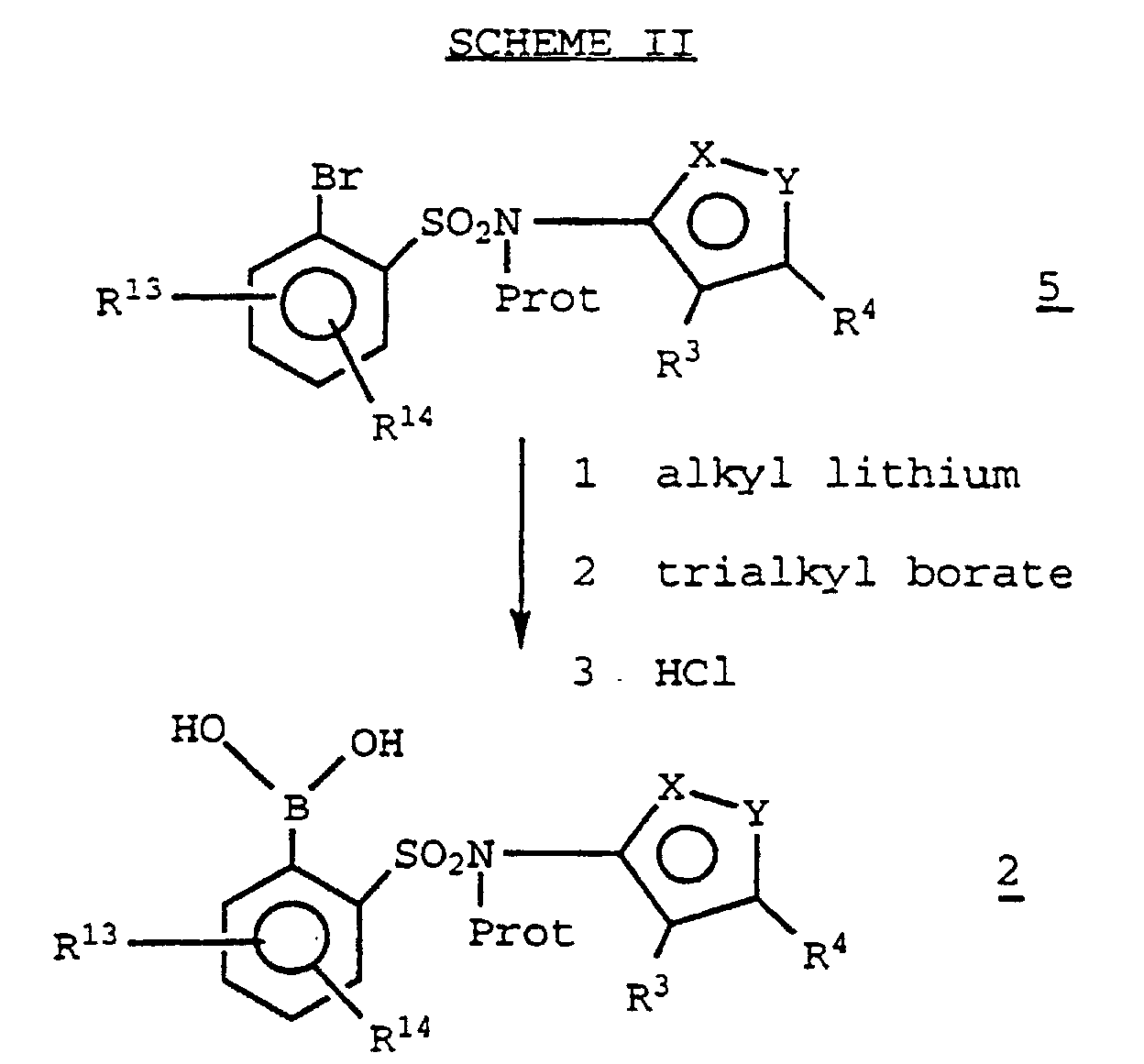
- a boronic acid intermediate 2 may be prepared from a 2-bromophenylsulfonamide 5 (preparation of which is described in EP Publication number 0,569,193 (1993)) by lithiation with a suitable alkyl lithium (such as n-butyl lithium), subsequent treatment with a trialkylborate (e.g. , triisopropyl borate) and finally adding an aqueous acid such as aqueous hydrochloric acid (SCHEME II): "Prot” is an appropriate protecting group for the sulfonamide function, also described in EP Publication number 0,569,193 (1993).
- a 4'-Heterocyclic aryl halide 6 (see also compound 1 ) can be converted to a boronic acid intermediate 7 via the sequence shown.
- This compound 7 upon Pd(O) catalyzed coupling with a compound 5 can provide a biaryl analog 3 , which upon deprotection can lead to the title compound 4 .
- the heteroatoms J and K or L may require protection to prepare the boronic acid 7 , and/or to facilitate the coupling reaction to make compound 3 .
- one of the groups may be protected by a suitable protecting group such as t-butoxycarbonyl, etc.
- the boronic acid may be replaced with a tin species and/or the halo group may be replaced by a -OSO 2 CF 3 moiety to perform the Pd-catalyzed coupling reaction.
- biaryl synthesis see: Bringmann et al., Angew. Chem. Inst. , Ed. Engl. 29 (1990) 977 - 991.
- R 11 - R 14 groups are chosen to be compatible with the reaction conditions shown. Additionally, specific R 11 - R 14 groups may be converted into alternative R 11 - R 14 groups, either before or after coupling of Compound 1 with Compound 2, or Compound 5 with Compound 7, using methods known in the art.
- acyl amino compound 9 is prepared as depicted above and may be cyclized to an oxazole 10 using a variety of dehydrating agents.
- dehydrating agents For a review of this and other methods of oxazole synthesis, see: Lakhan et al., Adv. Het. Chem. , 17 (1974), 99.
- An ester 15 can be prepared either by allowing an ⁇ -haloketone to react with a benzoic acid 14 in the presence of a base such as triethylamine, or by esterification with an appropriate ⁇ -hydroxyketone.
- Compound 15 upon treatment with ammonium acetate in acetic acid, provides an oxazole 16 .
- Certain acetylenic carbinols such as compound 17 can react directly with an arylnitrile 18 to provide a 5-methyl oxazole, 19 .
- an arylnitrile 18 can react directly with an arylnitrile 18 to provide a 5-methyl oxazole, 19 .
- An acetylenic amide 22 upon heating, cyclizes to an oxazole derivative 23 .
- a 4,5-unsubstituted oxazole 26 may be prepared by condensing a 4-bromobenzamide 11 with a vinylene carbonate 25 at high temperature in the presence of an agent such as polyphosphoric acid.
- an agent such as polyphosphoric acid.
- Heating together a mixture of aroylchloride 21 with an oxime 29 where R 1 and R 2 are alkyl, prepared by methods known in the art, may provide the oxazole derivative 10 .
- aroylchloride 21 with an oxime 29 where R 1 and R 2 are alkyl prepared by methods known in the art, may provide the oxazole derivative 10 .
- Heating together a mixture of aroylchloride 21 with a triazole 25' where R is trimethylsilyl, prepared by methods known in the art, in a suitable solvent such as toluene may provide the oxazole derivative 26 .
- a suitable solvent such as toluene
- oxazole derivative 26 by treatment of aroylchloride 21 with triazole (where R is hydrogen) in the presence of suitable base such as potassium carbonate followed by heating the mixture to an optimal temperature.
- suitable base such as potassium carbonate
- Certain ⁇ -metallated isonitriles 32 prepared by methods known in the art, react with acyl halides, imidazoles or other activated acyl groups, to provide 2-unsubstituted oxazoles 33 where R 2 is alkyl.
- a 4-Halobenzaldehyde 37 is treated with tosylmethylisocyanide 38 in the presence of a base, such as potassium carbonate, in a suitable solvent, such as methanol, to provide a 5-aryloxazole derivative 39 .
- a base such as potassium carbonate
- a suitable solvent such as methanol
- a 4-Bromophenyl boronic acid 41 can be coupled with an appropriately substituted 2-bromothiazole 42 in the presence of a Pd(O) catalyst and a suitable base (e.g. , aqueous potassium carbonate) and solvent to provide a thiazole 40 .
- a Pd(O) catalyst e.g. , aqueous potassium carbonate
- a suitable base e.g. , aqueous potassium carbonate
- 2-Phenylalkyloxazoles 48 where p is 1 or 2, unsubstituted at the 4 and 5 positions, may be prepared by heating together a phenylalkylamide 47 with vinylene carbonate 25 in the presence of an agent such as polyphosphoric acid.
- 2-Arylalkyl-4-substituted-oxazole 51 may be prepared starting from a nitrile 49 as shown above. (See, for example, U.S. Patent No. 4,168,379.)
- the pyrazole derivative 52 may be prepared by heating together the aryl hydrazine 53 with epichlorohydrin in the presence of a suitable base such as triethyl amine.
- Treatment of the oxime 54 prepared by methods know in the art, with HCl/Oxone, and subsequent treatment with a base such as triethylamine, provides an arylnitrile oxide.
- the arylnitrile oxide typically is not isolated, but is reacted with vinylacetate, and then the mixture is heated in an acid (e.g., HCl) in a suitable solvent such as ethanol to provide the 3-aryl isoxazole derivative 55 .
- ⁇ , ⁇ -unsaturated ketone 56 prepared by methods known in the art, upon treatment with hydroxylamine provides the corresponding oxime derivative. Cyclization of this material in the presence of iodine and potassium iodide provides the 5-arylisoxazole derivative 57 .
- R 1 in this scheme is alkyl, (See for example, J. Het. Chem. , 30 , 467 (1993).)
- the N-arylimidazole analog 59 may be prepared by a standard Ullmann coupling, known in the art, of the 1,4-dibromobenzene 58 with imidazole in the presence of a copper salt such as CuBr.
- This material was purified by reverse phase preparative HPLC on 30 x 500 mm ODS S10 column using 68% solvent A (90% methanol, 10% water, 0.1% trifluoroacetic acid) and 32% solvent B (10% methanol, 90% water, 0.1% trifluoroacetic acid). The appropriate fractions were collected and neutralized with aqueous sodium bicarbonate to pH 7 and concentrated to 10 mL. The solution was acidified to pH 4 using glacial acetic acid and the white solid was filtered and dried to provide 0.33 g (54%) of the title compound. M.p. 85 - 93°C (amorphous).
- Example 10 To the title compound of Example 10 (120 mg, 0.25 mmol) in 2.5 mL dichloromethane at 0°C, boron tribromide (1M solution in dichloromethane, 0.37 mL, 0.37 mmol) was added dropwise. The reaction mixture was stirred at 0-3°C for 45 minutes. 5 mL saturated aqueous sodium bicarbonate was added and stirred for 10 minutes. The mixture was then acidified to pH 5 with glacial acetic acid and extracted with 3 x 40 ml 100:5 dichloromethane/methanol. The combined organic extracts were dried and concentrated.
- Example 31 To the title compound of Example 31 (87 mg, 0.19 mmol) in 1.9 mL THF at 0°C, methylmagnesium bromide (1.4M in toluene/THF 75:25, 0.43 mL, 0.60 mmol) was added. The reaction was stirred at 0°C for 10 minutes and at room temperature for 3 hours. Additional methylmagnesium bromide (1.4M in toluene/THF 75:25, 0.069 mL, 0.096 mmol) was added and stirred for an additional 10 minutes. The reaction was quenched with ice-water and acetic acid (45 mg, 0.77 mmol) and stirred for 10 minutes.
Landscapes
- Organic Chemistry (AREA)
- Chemical & Material Sciences (AREA)
- Health & Medical Sciences (AREA)
- Animal Behavior & Ethology (AREA)
- Veterinary Medicine (AREA)
- Public Health (AREA)
- Chemical Kinetics & Catalysis (AREA)
- General Chemical & Material Sciences (AREA)
- Nuclear Medicine, Radiotherapy & Molecular Imaging (AREA)
- General Health & Medical Sciences (AREA)
- Life Sciences & Earth Sciences (AREA)
- Pharmacology & Pharmacy (AREA)
- Medicinal Chemistry (AREA)
- Engineering & Computer Science (AREA)
- Bioinformatics & Cheminformatics (AREA)
- Cardiology (AREA)
- Heart & Thoracic Surgery (AREA)
- Pain & Pain Management (AREA)
- Diabetes (AREA)
- Pulmonology (AREA)
- Hematology (AREA)
- Biomedical Technology (AREA)
- Ophthalmology & Optometry (AREA)
- Neurosurgery (AREA)
- Endocrinology (AREA)
- Urology & Nephrology (AREA)
- Neurology (AREA)
- Obesity (AREA)
- Immunology (AREA)
- Emergency Medicine (AREA)
- Vascular Medicine (AREA)
- Rheumatology (AREA)
- Dermatology (AREA)
- Gastroenterology & Hepatology (AREA)
- Reproductive Health (AREA)
- Heterocyclic Carbon Compounds Containing A Hetero Ring Having Nitrogen And Oxygen As The Only Ring Hetero Atoms (AREA)
- Pharmaceuticals Containing Other Organic And Inorganic Compounds (AREA)
- Plural Heterocyclic Compounds (AREA)
- Nitrogen And Oxygen Or Sulfur-Condensed Heterocyclic Ring Systems (AREA)
Abstract
Description
- This invention relates to endothelin antagonists useful, inter alia, for treatment of hypertension.
- As background art, EP-A-0 569 193 discloses biphenyl isoxazol sulfonamides which are endothelin antagonists. Chan M. F. et al., Biochem. Biophys. Res. Commun., 201, 228 (1994), Stein P. D. et al., J. Med. Chem., 37, 229 (1994), EP-A-0 558 258, EP-A-0 526 708, EP-A-0 510 526, WO-A-94/27979 published December 8, 1994, EP-A-0 626 174 published November 30, 1994 and EP-A-0 640 596 published March 1, 1995 disclose further sulfonamide endothelin antagonists and their analogs.
- Compounds of the invention of the formula I

- Its enantiomers and diastereomers, and pharmaceutically acceptable salts thereof are endothelin receptor antagonists useful, inter alia, as antihypertensive agents. Throughout this specification, the above symbols are defined as follows:
- one of X and Y is N and the other is O;
- R1 and R2 are each directly bonded to a ring carbon and are each
independently
- (a) hydrogen,
- (b) alkyl, or
- (c) -C(O)-NH2;
- R3 and R4 are each directly bonded to a ring carbon and are each independently alkyl;
- R11, R12, R13 and R14 are each independently selected from
- (a) hydrogen,
- (b) hydroxy,
- (c) alkyl,
- (d) alkyl substituted with 1-3 hydroxy groups,
- (e) amino,
- (f) alkenyl,
- (g) carboxamide,
- (h) oxazolyl,
- (i) oxazolyl substituted with 1-3 alkyl groups,
- (j) oxazolylalkyl,
- (k) arylalkenyl,
- (l) aryl,
- (m) aryl substituted with 1-3 alkyl groups,
- (n) alkoxyalkyl,
- (o) -(alkyl)N(H)(COH),
- (p) -(alkyl)N(H)(CO2-alkyl),
- (q) -(alkyl)N(H)(CO-N(H)-alkyl),
- (r) -(alkyl)N(H)(SO2-alkyl),
- (s) -(alkyl)N(H)(CO-alkyl),
- (t) -(alkyl)N(H)(CO-N(H)-aryl),
- (u) -(alkyl)N(alkyl)(CO-alkyl),
- (v) -(alkyl)N(haloalkyl)(CO-alkyl) wherein haloalkyl has 1-3 halo groups,
- (w) -(alkyl)N(cycloalkyl)(CO-alkyl),
- (x) -(alkyl)N(H)(CO-aryl),
- (y) -CO2-alkyl,
- (z) -(alkyl)N(H)(CO-haloalkyl) wherein haloalkyl has 1-3 halo groups,
- (aa) -C(O)NH-alkyl,
- (bb) -(alkyl)N(H)(CO-haloaryl) wherein haloaryl has 1-3 halo groups,
- (cc) -(alkyl)N(alkyl)(CO-aryl),
- (dd) -(alkyl)N(alkyl)(CO-cycloalkyl),
- (ee) alkenyl substituted with 1-3 alkyl groups,
- (ff) -(alkyl)cycloalkyl wherein cycloalkyl is substituted with 1-3 alkyl groups, and
- (gg) -(alkyl)(SO2)(alkyl);
- J is O, S, N or NR15;
- K and L are N or C, provided that at least one of K or L is C;
- R15 is hydrogen, alkyl, hydroxyethoxymethyl or methoxyethoxymethyl; and
- p is 0 or an integer from 1 to 2.
-
- Preferably, R11 and R12 are each independently hydrogen, hydroxy, amino, oxazolyl optionally substituted with 1-3 alkyl groups, alkenyl optionally substituted with 1-3 alkyl groups, carboxamide or a substituted C1-to-C4-alkyl as defined above.
- Preferably, R1 and R2 are each independently hydrogen or C1-to-C4-alkyl.
- Preferably, R3 and R4 are each independently C1-to-C4-alkyl, more preferably R3 and R4 are each methyl.
- R11 and R12 are preferably each independently hydrogen, hydroxy, oxazolyl optionally substituted with 1-3 alkyl groups, alkenyl optionally substituted with 1-3 alkyl groups, carboxamide or a substituted C1-to C4-alkyl as defined above.
- R1 and R2 are preferably each independently hydrogen or C1-to-C4-alkyl; R3 and R4 are each independently C1-to-C4-alkyl; and R11 and R12 are each independently hydrogen, hydroxy, oxazolyl optionally substituted with 1-3 alkyl groups, alkenyl optionally substituted with 1-3 alkyl groups, carboxamide or a substituted C1-to-C4-alkyl as defined above.
- R1 and R2 are preferably each independently hydrogen or C1-to-C4-alkyl; R3 and R4 are each methyl; and R11 and R12 are each independently hydrogen, hydroxy, oxazolyl optionally substituted with 1-3 alkyl groups, alkenyl optionally substituted with 1-3 alkyl groups, carboxamide or a substituted C1-to-C4-alkyl as defined in Claim 1.
- In a preferred embodiment p is 0. In a further embodiment, p is 1.
- Accordingly, in a preferred embodiment, p is 0; R1 and R2 are each independently hydrogen or C1-to-C4-alkyl; R3 and R4 are each methyl; and R11 and R12 are each independently hydrogen, hydroxy, oxazolyl optionally substituted with 1-3 alkyl groups, alkenyl optionally substituted with 1-3 alkyl groups, carboxamide or a substituted C1-to-C4-alkyl as defined in Claim 1.
- In a further embodiment, p is 1; R1 and R2 are each independently hydrogen or C1-to-C4-alkyl; R3 and R4 are each methyl; and R11 and R12 are each independently hydrogen, hydroxy, oxazolyl optionally substituted with 1-3 alkyl groups, alkenyl optionally substituted with 1-3 alkyl groups, carboxamide or a substituted C1-to-C4-alkyl as above.
- One compound of the invention is N-(3,4-Dimethyl-5-isoxazolyl)-4'-(2-oxazolyl)[1,1'-biphenyl]-2-sulfonamide, or a pharmaceutically acceptable salt thereof, in particular the sodium salt thereof.
- The invention also relates to a pharmaceutical composition for the treatment of an endothelin-related disorder comprising a compound as defined above, in an amount effective therefor and a physiologically acceptable vehicle or carrier.
- The invention furthermore relates to a pharmaceutical composition as defined above further comprising at least one angiotensin II (All) receptor antagonist, renin inhibitor, angiotensin converting (ACE) inhibitor, or dual neutral endopeptidase (NEP)-ACE inhibitor.
- In a particular embodiment of the pharmaceutical composition for the treatment of an endothelin-related disorder, said composition comprises the compound N-(3,4-Dimethyl-5-isoxazolyl)-4'-(2-oxazolyl)[1,1'-biphenyl]-2-sulfonamide, or a pharmaceutically acceptable salt thereof, in an amount effective therefor and a physiologically acceptable vehicle or carrier.
- The invention relates to the use of a compound generally defined above for manufacturing a medicament for treating endothelin-related disorders in a mammal, and also to sich use wherein said compound is used in combination with at least one angiotensin II (All) receptor antagonist, renin inhibitor, angiotensin converting (ACE) inhibitor, or dual neutral endopeptidase (NEP)-ACE inhibitor.
- As different embodiments, the invention relates to the use of a compound as generally disclosed above for manufacturing a medicament for treating disorders selected from hypertension, pulmonary hypertension. renal, glomerular or mesangial cell disorders, endotoxemia, ischemia, atherosclerosis, restenosis, subarachnoid hemorrhage, and benign prostatic hypertrophy.
- Moreover, the invention relates to the use of a compound as generally disclosed above for manufacturing a medicament for treating congestive heart failure in a mammal.
- The invention also relates to the use of a compound as generally disclosed above for manufacturing a medicament for inhibiting cell growth.
- The invention furthermore relates to the use of the compound N-(3,4-Dimethyl-5-isoxazolyl)-4'-(2-oxazolyl)[1,1 '-biphenyl]-2-sutfonamide, or a pharmaceutically acceptable salt thereof, for manufacturing a medicament for treating congestive heart failure in a mammal, or for manufacturing a medicament for treating hypertension, pulmonary hypertension, primary pulmonary hypertension, benign prostatic hypertrophy, cancer, migraine, renal, glomerular or mesangial cell disorders, or asthma.
- Listed below are definitions of terms used in this specification. These definitions apply to the terms as used throughout this specification, individually as part of another group, unless otherwise limited in specific instances.
- The term "alkyl" refers to straight or branched chain hydrocarbon groups having 1 to 10 carbon atoms, preferably 1 to 7 carbon atoms.
- The term "alkoxy" refers to alkyl-O-.
- The term "aryl" refers to phenyl, naphthyl and biphenyl.
- The term "alkenyl" refers to straight or branched chain hydrocarbon groups of 2 to 10 carbon atoms having at least one double bond. Groups of two to four carbon atoms are preferred.
- The term "cycloalkyl" refers to cyclic hydrocarbon groups of 3 to 8 carbon atoms.
- The terms "halogen" and "halo" refer to fluorine, chlorine, bromine and iodine.
- Throughout the specification, groups and substituents thereof are chosen to provide stable moieties and compounds.
- The compounds of formula I form salts which are also within the scope of this invention. Pharmaceutically acceptable (i.e., non-toxic, physiologically acceptable) salts are preferred, although other salts are also useful, e.g., in isolating or purifying the compounds of this invention.
- The compounds of formula I may form salts with alkali metals such as sodium, potassium and lithium; with alkaline earth metals such as calcium and magnesium, with organic bases such as dicyclohexylamine, t-butyl amine, benzathine, N-methyl-D-glucamide and hydrabamine, and with amino acids such as arginine, lysine and the like. Such salts may be obtained by reacting compound I with the desired ion in a medium in which the salt precipitates or in an aqueous medium followed by lyophilization.
- When the R1 to R2 or R11 to R14 substituents comprise a basic moiety, such as amino or substituted amino, compound I may form salts with a variety of organic and inorganic acids. Such salts include those formed with hydrochloric acid, hydrogen bromide, methanesulfonic acid, sulfuric acid, acetic acid, maleic acid, benzenesulfonate, toluenesulfonate and various other sulfonates, nitrates, phosphates, borates, acetates, tartrates, maleates, citrates, succinates, benzoates, ascorbates, salicylates and the like. Such salts may be formed by reacting compound I in an equivalent amount of the acid in a medium in which the salt precipitates or in an aqueous medium followed by lyophilization.
- In addition, when the R1 to R2 or R11 to R14 substituents comprise a basic moiety such as amino, zwitterions ("inner salts") may be formed.
- Certain of the R1 to R4 and R11 to R14 substituents of compound I may contain asymmetric carbon atoms. Such compounds of formula I may exist, therefore, in enantiomeric and diastereomeric forms and in racemic mixtures thereof. All are within the scope of this invention. Additionally, compound I may exist as enantiomers even in the absence of asymmetric carbons. All such enantiomers are within the scope of this invention.
- The compounds of formula I are antagonists of ET-1, ET-2 and/or ET-3 and are useful in treatment of conditions associated with increased ET levels (e.g., dialysis, trauma and surgery) and of all endothelin-dependent disorders. They are thus useful as antihypertensive agents. By the administration of a composition having one (or a combination) of the compounds of this invention, the blood pressure of a hypertensive mammalian (e.g., human) host is reduced. They are also useful in pregnancy-induced hypertension and coma (preeclampsia and eclampsia), acute portal hypertension and hypertension secondary to treatment with erythropoietin.
- The compounds of the present invention are also useful in the treatment of disorders related to renal, glomerular and mesangial cell function, including acute and chronic renal failure, glomerular injury, renal damage secondary to old age or related to dialysis, nephrosclerosis (especially hypertensive nephrosclerosis), nephrotoxicity (including nephrotoxicity related to imaging and contrast agents and to cyclosporine), renal ischemia, primary vesicoureteral reflux, glomerulosclerosis and the like. The compounds of this invention may also be useful in the treatment of disorders related to paracrine and endocrine function.
- The compounds of the present invention are also useful in the treatment of endotoxemia or endotoxin shock as well as hemorrhagic shock.
- The compounds of the present invention are also useful in hypoxic and ischemic disease and as anti-ischemic agents for the treatment of, for example, cardiac, renal and cerebral ischemia and reperfusion (such as that occurring following cardiopulmonary bypass surgery), coronary and cerebral vasospasm, and the like.
- In addition, the compounds of this invention may also be useful as anti-arrhythmic agents; anti-anginal agents; anti-fibrillatory agents; antiasthmatic agents; anti-atherosclerotic and anti-arteriosclerotic agents; additives to cardioplegic solutions for cardiopulmonary bypasses; adjuncts to thrombolytic therapy; and anti-diarrheal agents. The compounds of this invention may be useful in therapy for myocardial infarction; therapy for peripheral vascular disease (e.g., Raynaud's disease and Takayashu's disease); treatment of cardiac hypertrophy (e.g., hypertrophic cardiomyopathy); treatment of primary pulmonary hypertension (e.g., plexogenic, embolic) in adults and in the newborn and pulmonary hypertension secondary to heart failure, radiation and chemotherapeutic injury, or other trauma; treatment of central nervous system vascular disorders, such as stroke, migraine and subarachnoid hemorrhage; treatment of central nervous system behavioral disorders; treatment of gastrointestinal diseases such as ulcerative colitis, Crohn's disease, gastric mucosal damage, ulcer and ischemic bowel disease; treatment of gall bladder or bile duct-based diseases such as cholangitis; treatment of pancreatitis; regulation of cell growth; treatment of benign prostatic hypertrophy; restenosis following angioplasty or following any procedures including transplantation; therapy for congestive heart failure including inhibition of fibrosis; inhibition of left ventricular dilatation, remodeling and dysfunction; and treatment of hepatotoxicity and sudden death. The compounds of this invention may be useful in the treatment of sickle cell disease including the initiation and/or evolution of the pain crises of this disease; treatment of the deleterious consequences of ET-producing tumors such as hypertension resulting from hemangiopericytoma; treatment of early and advanced liver disease and injury including attendant complications (e.g., hepatotoxicity, fibrosis and cirrhosis); treatment of spastic diseases of the urinary tract and/or bladder; treatment of hepatorenal syndrome; treatment of immunological diseases involving vasculitis such as lupus, systemic sclerosis, mixed cryoglobulinemia; and treatment of fibrosis associated with renal dysfunction and hepatotoxicity. The compounds of this invention may be useful in therapy for metabolic and neurological disorders; cancer; insulin-dependent and non insulin-dependent diabetes mellitus; neuropathy; retinopathy; maternal respiratory distress syndrome; dysmenorrhea; epilepsy; hemorrhagic and ischemic stroke; bone remodeling; psoriasis; and chronic inflammatory diseases such as rheumatoid arthritis, osteoarthritis, sarcoidosis and eczematous dermatitis (all types of dermatitis).
- The compounds of this invention can also be formulated in combination with endothelin converting enzyme (ECE) inhibitors, such as phosphoramidon; thromboxane receptor antagonists; potassium channel openers; thrombin inhibitors (e.g., hirudin and the like); growth factor inhibitors such as modulators of PDGF activity; platelet activating factor (PAF) antagonists; angiotensin II (AII) receptor antagonists; renin inhibitors; angiotensin converting enzyme (ACE) inhibitors such as captopril, zofenopril, fosinopril, ceranapril, alacepril, enalapril, delapril, pentopril, quinapril, ramipril, lisinopril and salts of such compounds; neutral endopeptidase (NEP) inhibitors; dual NEP-ACE inhibitors; HMG CoA reductase inhibitors such as pravastatin and mevacor; squalene synthetase inhibitors; bile acid sequestrants such as questran; calcium channel blockers; potassium channel activators; beta-adrenergic agents; antiarrhythmic agents; diuretics, such as chlorothiazide, hydrochlorothiazide, flumethiazide, hydroflumethiazide, bendroflumethiazide, methylchlorothiazide, trichloromethiazide, polythiazide or benzothiazide as well as ethacrynic acid, tricrynafen, chlorthalidone, furosemide, musolimine, bumetanide, triamterene, amiloride and spironolactone and salts of such compounds; and thrombolytic agents such as tissue plasminogen activator (tPA), recombinant tPA, streptokinase, urokinase, prourokinase and anisoylated plasminogen streptokinase activator complex (APSAC). If formulated as a fixed dose, such combination products employ the compounds of this invention within the dosage range described below and the other pharmaceutically active agent within its approved dosage range. The compounds of this invention may also be formulated with, or useful in conjunction with, antifungal and immunosuppressive agents such as amphotericin B, cyclosporins and the like to counteract the glomerular contraction and nephrotoxicity secondary to such compounds. The compounds of this invention may also be used in conjunction with hemodialysis.
- The compounds of the invention can be administered orally or parenterally to various mammalian species known to be subject to such maladies, e.g., humans, in an effective amount within the dosage range of about 0.1 to about 100 mg/kg, preferably about 0.2 to about 50 mg/kg and more preferably about 0.5 to about 25 mg/kg (or from about 1 to about 2500 mg, preferably from about 5 to about 2000 mg) in single or 2 to 4 divided daily doses.
- The active substance can be utilized in a composition such as tablet, capsule, solution or suspension containing about 5 to about 500 mg per unit dosage of a compound or mixture of compounds of formula I or in topical form for wound healing (0.01 to 5% by weight compound of formula I, 1 to 5 treatments per day). They may be compounded in a conventional manner with a physiologically acceptable vehicle or carrier, excipient, binder, preservative, stabilizer, flavor, etc., or with a topical carrier such as Plastibase (mineral oil gelled with polyethylene) as called for by accepted pharmaceutical practice.
- The compounds of the invention may also be administered topically to treat peripheral vascular diseases and as such may be formulated as a cream or ointment.
- The compounds of formula I can also be formulated in compositions such as sterile solutions or suspensions for parenteral administration. About 0.1 to 500 milligrams of a compound of formula I is compounded with a physiologically acceptable vehicle, carrier, excipient, binder, preservative, stabilizer, etc., in a unit dosage form as called for by accepted pharmaceutical practice. The amount of active substance in these compositions or preparations is such that a suitable dosage in the range indicated is obtained.
- The compounds of the present invention may be prepared as follows.
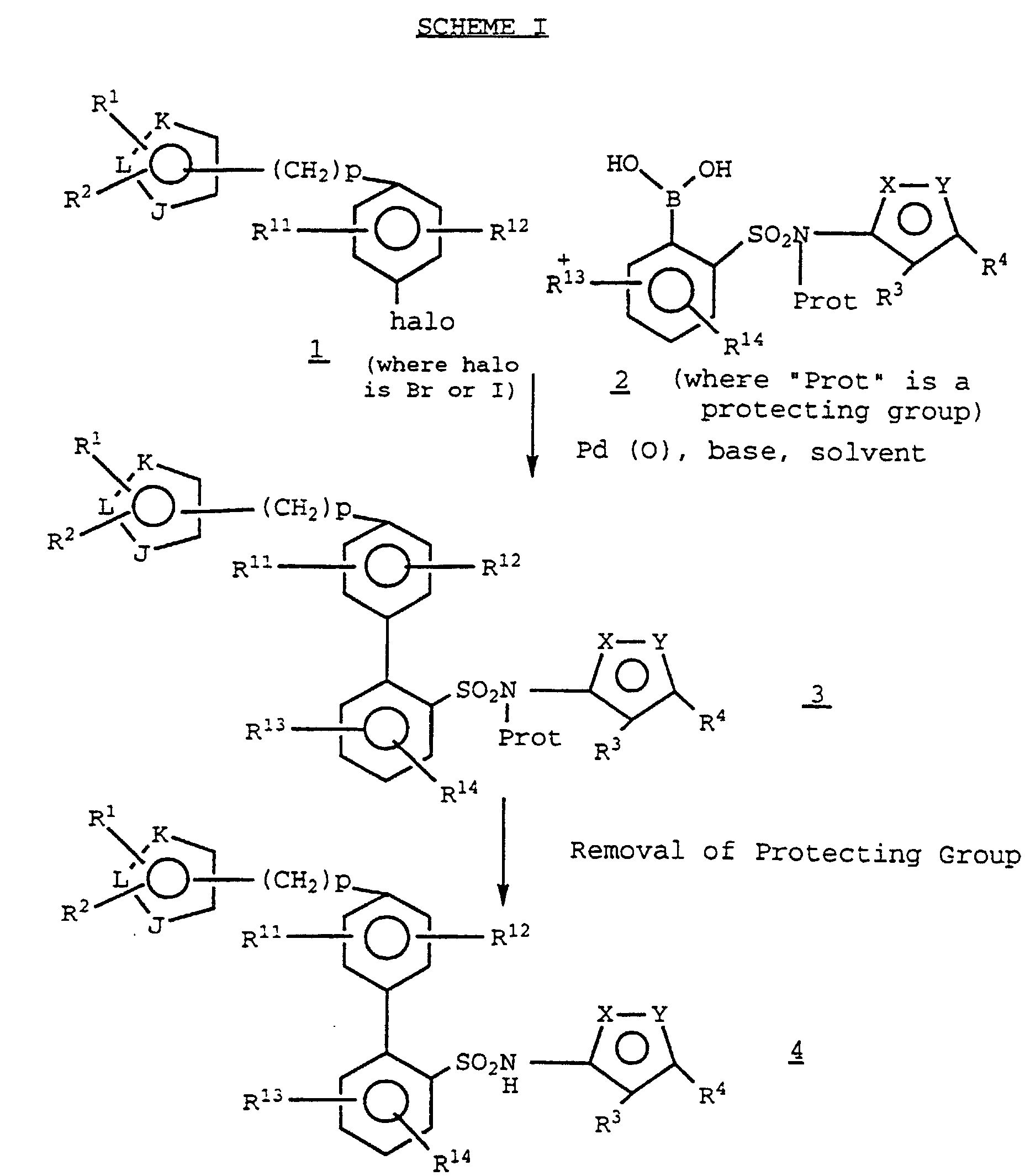
- As depicted by the above Scheme I, the title compounds 4 may be prepared by a Pd(O) catalyzed coupling of an appropriately protected phenylsulfonamide-2-boronic acid intermediate 2 with a 4-heterocyclic aryl halide 1 in the presence of a suitable base, such as aqueous potassium carbonate, and solvent, such as a mixture of toluene and ethanol.
- A boronic acid intermediate 2 may be prepared from a 2-bromophenylsulfonamide 5 (preparation of which is described in EP Publication number 0,569,193 (1993)) by lithiation with a suitable alkyl lithium (such as n-butyl lithium), subsequent treatment with a trialkylborate (e.g., triisopropyl borate) and finally adding an aqueous acid such as aqueous hydrochloric acid (SCHEME II):"Prot" is an appropriate protecting group for the sulfonamide function, also described in EP Publication number 0,569,193 (1993).
- The title compounds may also be synthesized by an alternate route shown below (SCHEME III):

- As depicted above, a 4'-Heterocyclic aryl halide 6 (see also compound 1) can be converted to a boronic acid intermediate 7 via the sequence shown. This compound 7, upon Pd(O) catalyzed coupling with a compound 5 can provide a biaryl analog 3, which upon deprotection can lead to the title compound 4.
- In certain instances, the heteroatoms J and K or L may require protection to prepare the boronic acid 7, and/or to facilitate the coupling reaction to make compound 3. (For example, when J and K or L are N, one of the groups may be protected by a suitable protecting group such as t-butoxycarbonyl, etc). Also, in certain instances, the boronic acid may be replaced with a tin species and/or the halo group may be replaced by a -OSO2CF3 moiety to perform the Pd-catalyzed coupling reaction. For general strategies in biaryl synthesis, see: Bringmann et al., Angew. Chem. Inst., Ed. Engl. 29 (1990) 977 - 991.
- In the above schemes, specific R11 - R14 groups are chosen to be compatible with the reaction conditions shown. Additionally, specific R11 - R14 groups may be converted into alternative R11 - R14 groups, either before or after coupling of Compound 1 with Compound 2, or Compound 5 with Compound 7, using methods known in the art.
- Compounds 1 and 6 can be prepared by the following Schemes. 2-Aryloxazoles are prepared as depicted by SCHEME IV, Methods A-H; 4-Aryloxazoles are prepared as depicted by SCHEME V, Methods A - B; 5-Aryloxazoles are prepared as depicted by SCHEME VI, Methods A-B; Thiazoles are prepared as depicted by SCHEME VII, Methods A-B; Imidazoles are prepared as depicted by SCHEME VIII; 2-Phenylalkyloxazoles are prepared as depicted by SCHEME IX, Methods A-B; Pyrazoles are prepared as depicted by SCHEME X; 3-Arylisoxazoles are prepared as depicted by SCHEME XI; 5-Arylisoxazoles are prepared as depicted by SCHEME XII; and N-Arylimidazoles are prepared as depicted by SCHEME XIII. In these schemes, R11 and R12 are also chosen to be compatible with the reaction conditions shown.
-
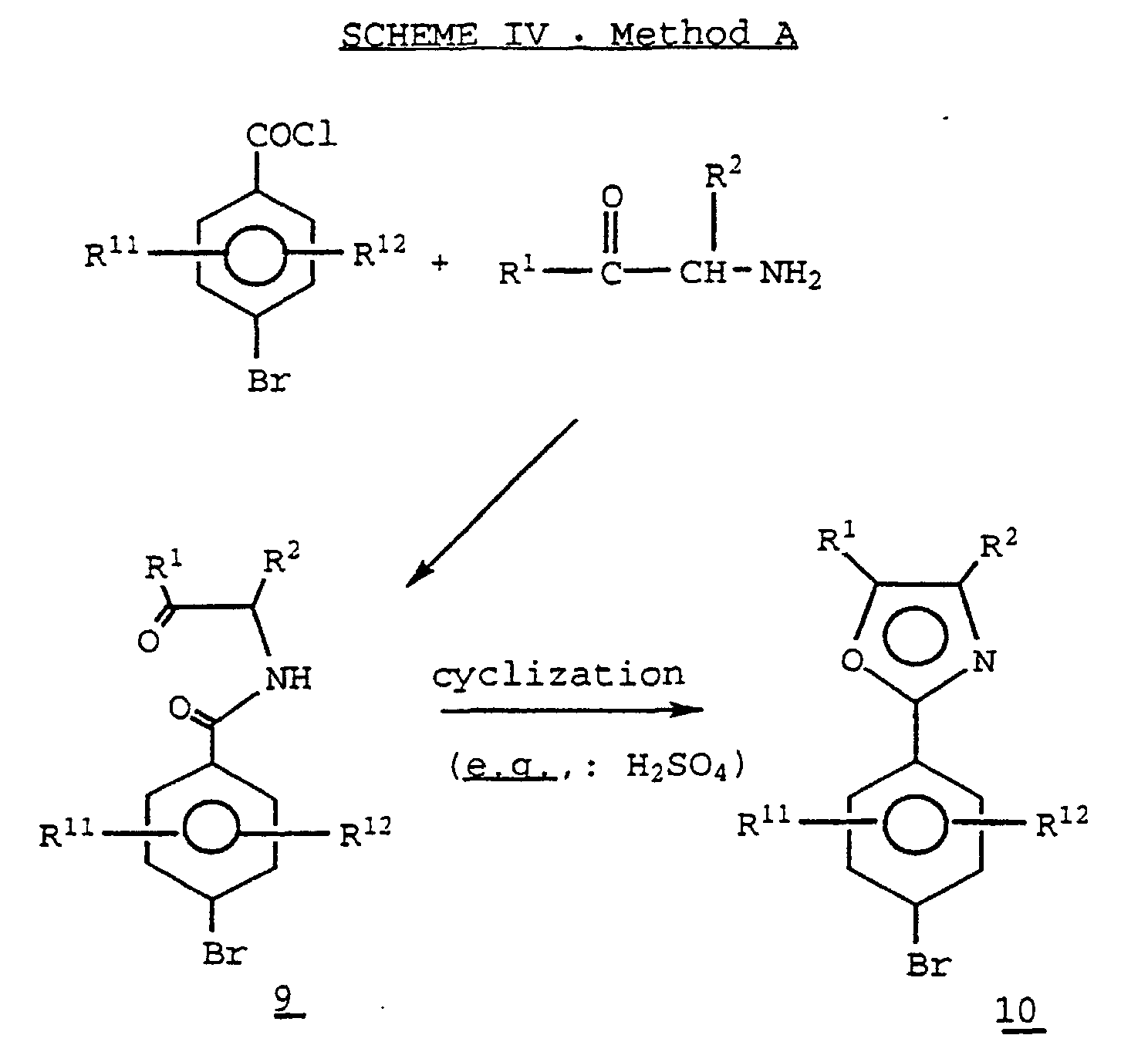
- An acyl amino compound 9 is prepared as depicted above and may be cyclized to an oxazole 10 using a variety of dehydrating agents. For a review of this and other methods of oxazole synthesis, see: Lakhan et al., Adv. Het. Chem., 17 (1974), 99.

- As shown, heating together a mixture of a benzamide 11 and an α-halo carbonyl compound 12 provides the corresponding oxazole 13. This method has been used extensively to provide 2,4-disubstituted oxazoles. For a review, see: Lakhan et al., Adv. Het. Chem., 17, (1979) 99 - 211.

- An ester 15 can be prepared either by allowing an α-haloketone to react with a benzoic acid 14 in the presence of a base such as triethylamine, or by esterification with an appropriate α-hydroxyketone. Compound 15, upon treatment with ammonium acetate in acetic acid, provides an oxazole 16.

- Certain acetylenic carbinols such as compound 17 can react directly with an arylnitrile 18 to provide a 5-methyl oxazole, 19. (See, for example, Y. Yura, Japanese Patent 29849 (1964).)
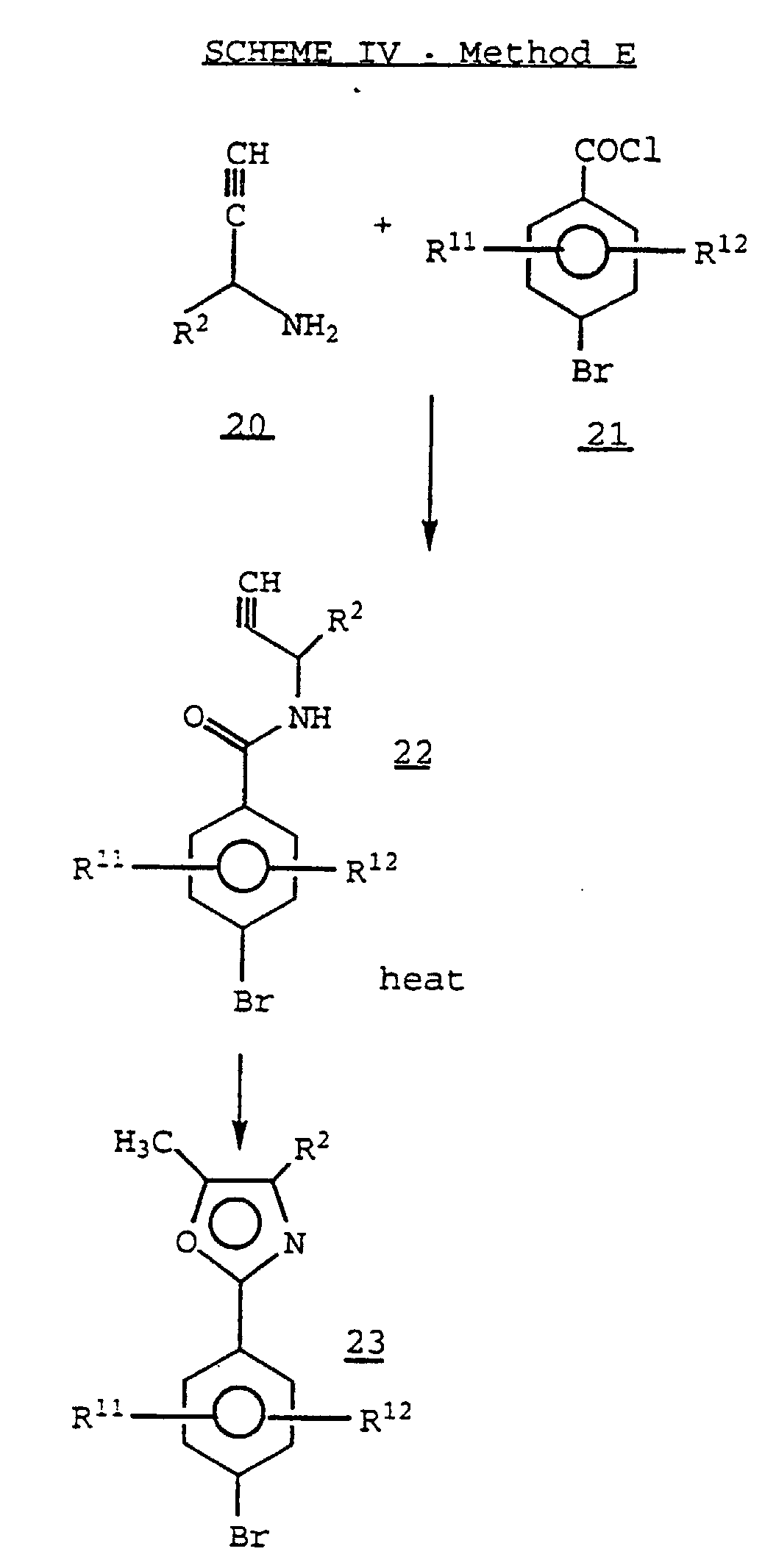
- An acetylenic amide 22, upon heating, cyclizes to an oxazole derivative 23.
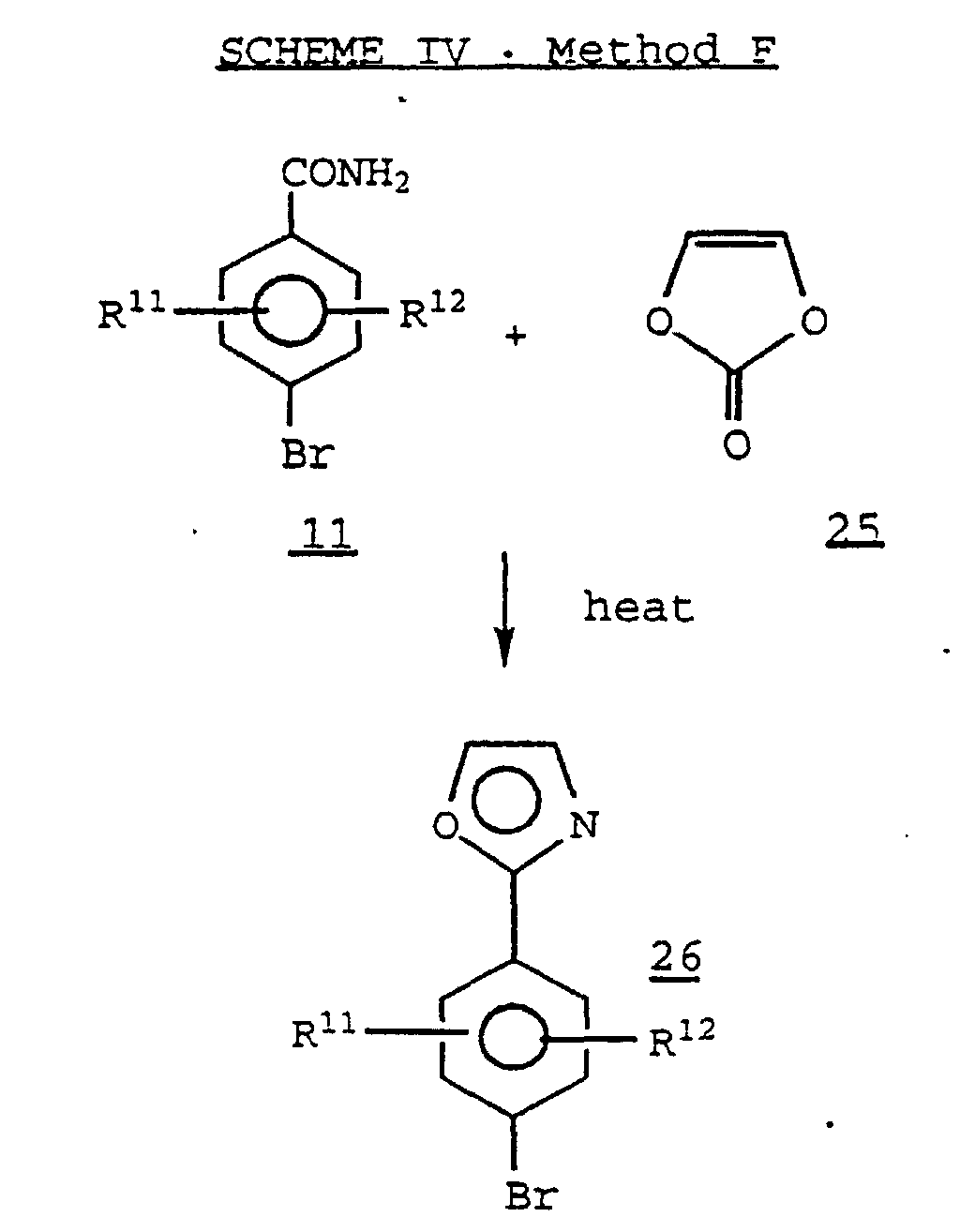
- A 4,5-unsubstituted oxazole 26 may be prepared by condensing a 4-bromobenzamide 11 with a vinylene carbonate 25 at high temperature in the presence of an agent such as polyphosphoric acid. (See, for example, Ferrini, et al., Angew. Chem. Internat. Ed., Vol. 2, 1963, 99.)
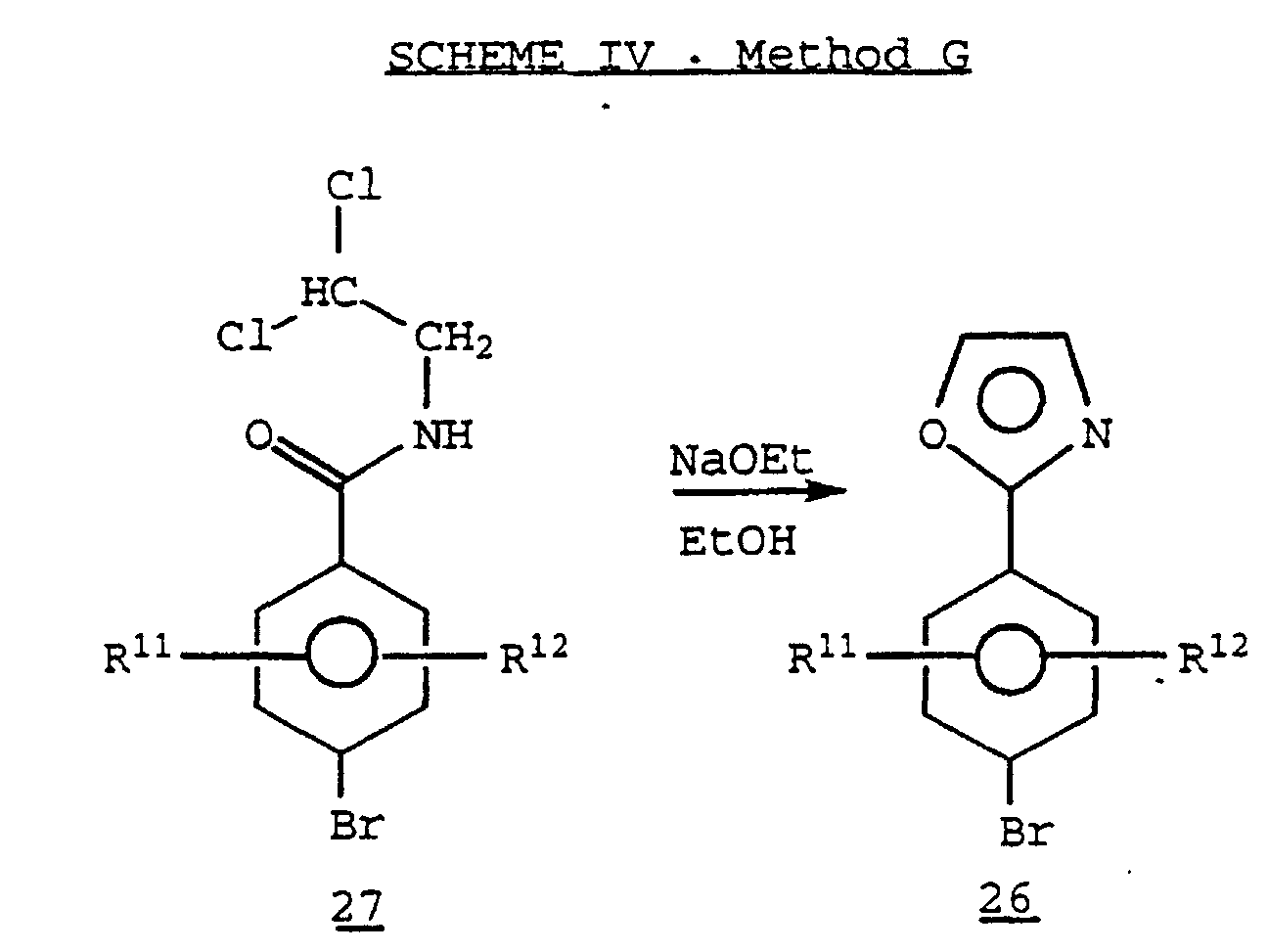
- Cyclization of the N-(2,2-dichloroethyl)amide derivative 27, prepared by methods known in the art, in the presence of a suitable base such as sodium ethoxide, may also provide the oxazole derivative 26. (See, for example, U.S. Patent No. 3,953,465.)
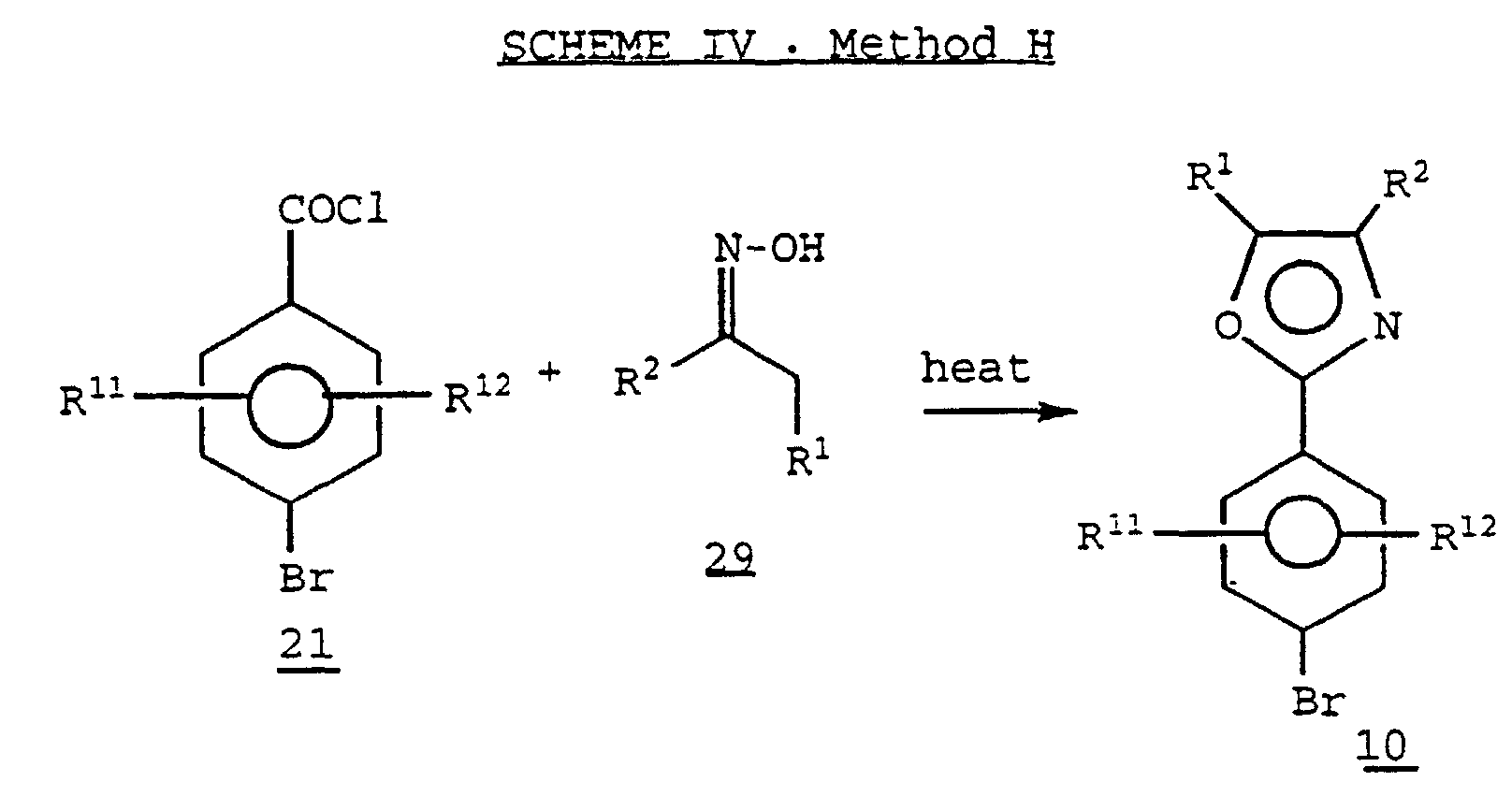
- Heating together a mixture of aroylchloride 21 with an oxime 29 where R1 and R2 are alkyl, prepared by methods known in the art, may provide the oxazole derivative 10. (See, for example, Bhatt, M.V. and Reddy, A.S., Tet. Lett., 21, 2359 (1980).)

- Heating together a mixture of aroylchloride 21 with a triazole 25' where R is trimethylsilyl, prepared by methods known in the art, in a suitable solvent such as toluene may provide the oxazole derivative 26. (See, for example, Williams, E.L., Tet. Lett., 33, 1033 - 1036 (1992).)
- It is also possible to prepare the oxazole derivative 26 by treatment of aroylchloride 21 with triazole (where R is hydrogen) in the presence of suitable base such as potassium carbonate followed by heating the mixture to an optimal temperature.
-

- Treatment of an α-Bromoacetophenone derivative 30 with an amide at high temperatures (typically 130 - 150°C) provides a 4-aryl oxazole 31.
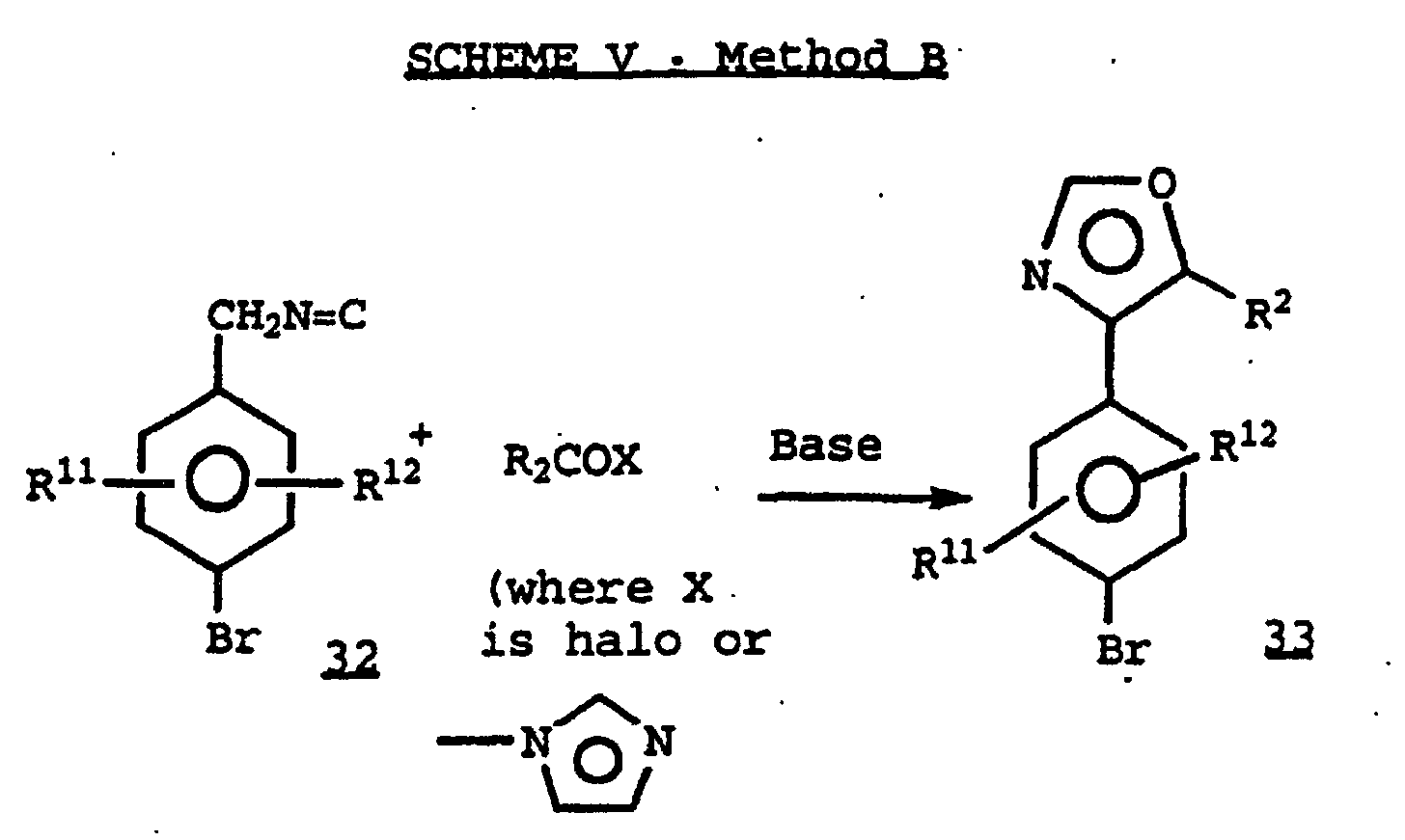
- Certain α-metallated isonitriles 32, prepared by methods known in the art, react with acyl halides, imidazoles or other activated acyl groups, to provide 2-unsubstituted oxazoles 33 where R2 is alkyl.
-

- Acylation of an α-aminoacetophenone 34, with an acyl chloride, provides compound 35. Compound 35, upon cyclization using a suitable dehydrating agent such as sulfuric acid, provides an oxazole 36. (This method is similar to the one described in SCHEME IV, Method A).
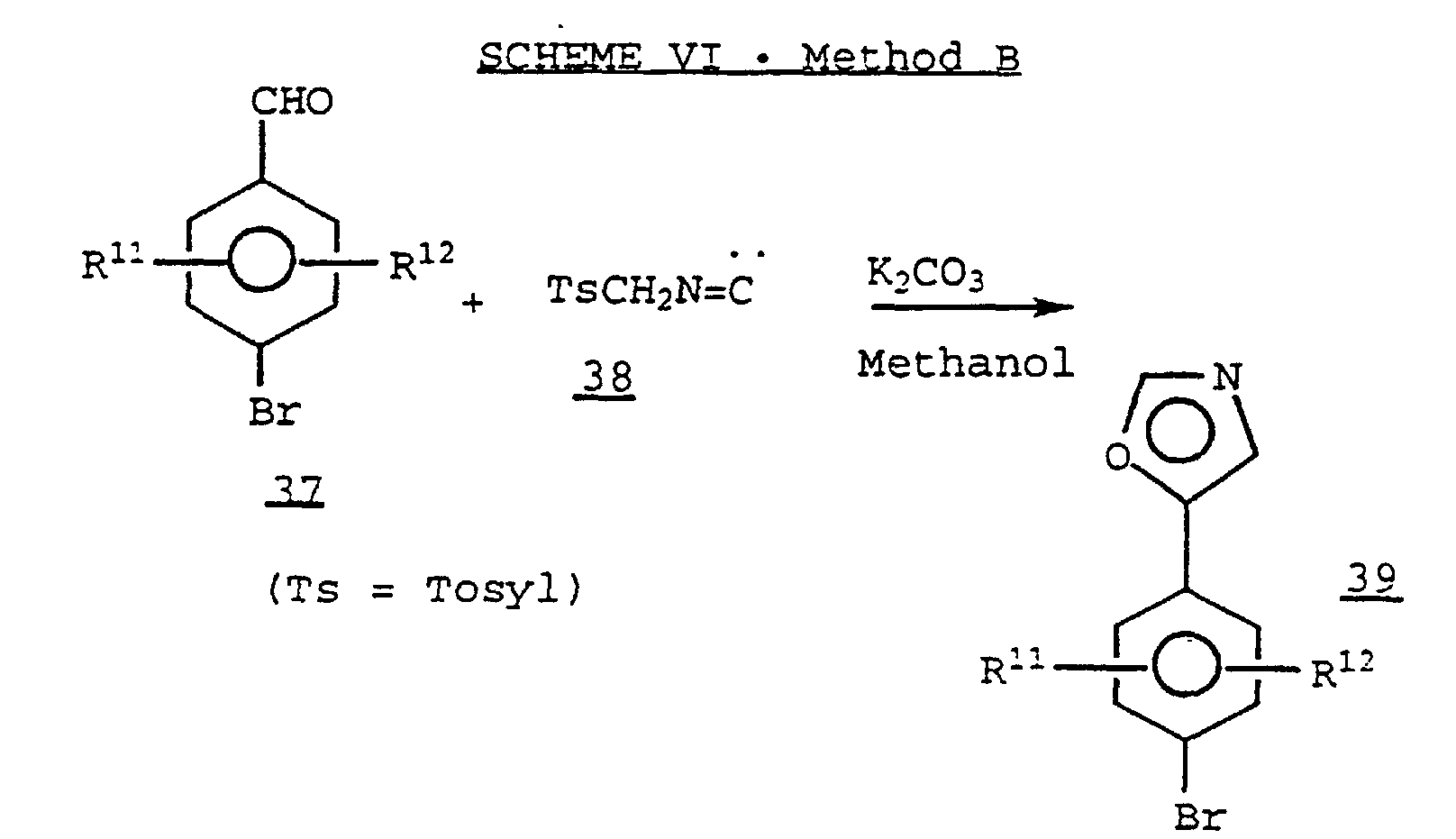
- A 4-Halobenzaldehyde 37 is treated with tosylmethylisocyanide 38 in the presence of a base, such as potassium carbonate, in a suitable solvent, such as methanol, to provide a 5-aryloxazole derivative 39. (See, for example, A.M. Van Leusen, et al., Tet. Lett., 2369 (1972).)
-
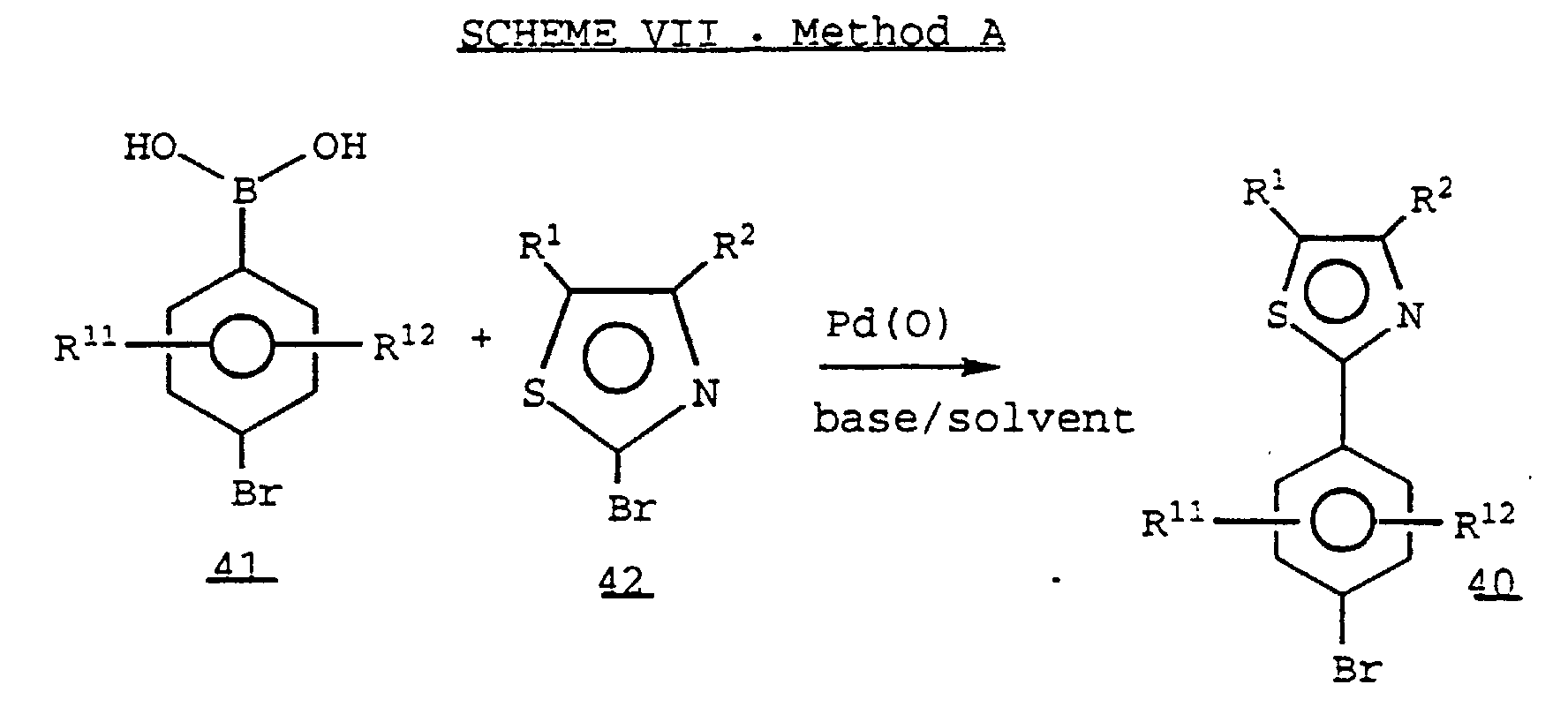
- A 4-Bromophenyl boronic acid 41 can be coupled with an appropriately substituted 2-bromothiazole 42 in the presence of a Pd(O) catalyst and a suitable base (e.g., aqueous potassium carbonate) and solvent to provide a thiazole 40.

- Condensation of p-bromobenzonitrile 18 with an α-thioketone directly provides a thiazole derivative 44.
-

- Condensation of a benzaldehyde derivative 37 with glyoxal and ammonia provides a 2-aryl imidazole derivative 45. (see, e.g., U.S. Patent No. 3,682,949:) This compound can be further substituted by reacting it with an alkyl halide in the presence of a suitable base to provide, e.g., an N-alkylderivative 46.
- For a review on imidazole synthesis, see: Adv. Het. Chem., 27, (1980), 241 - 323.
-
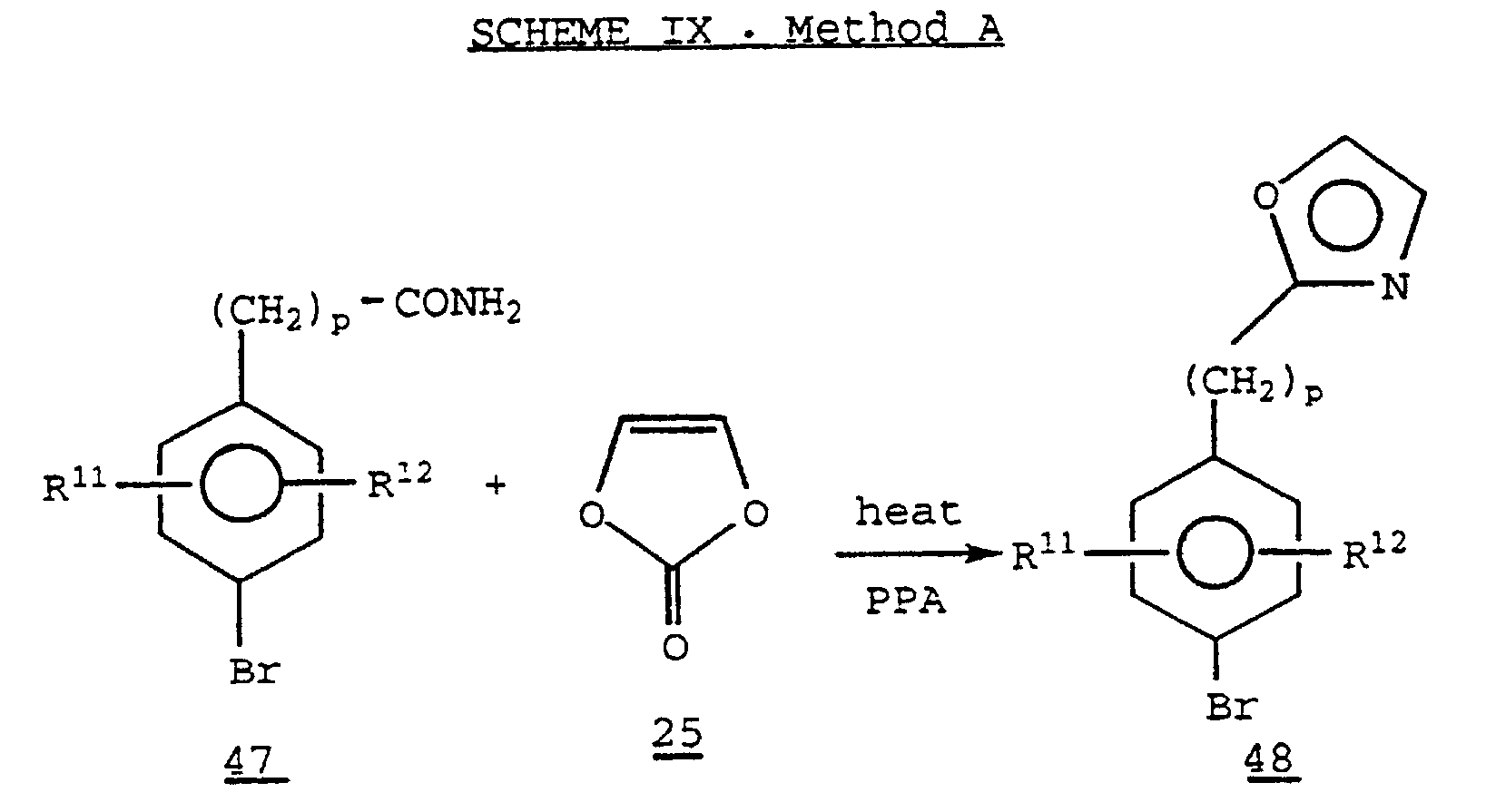
- 2-Phenylalkyloxazoles 48, where p is 1 or 2, unsubstituted at the 4 and 5 positions, may be prepared by heating together a phenylalkylamide 47 with vinylene carbonate 25 in the presence of an agent such as polyphosphoric acid.

- 2-Arylalkyl-4-substituted-oxazole 51, where R1 is alkyl and n is 1 or 2, may be prepared starting from a nitrile 49 as shown above. (See, for example, U.S. Patent No. 4,168,379.)
-

- The pyrazole derivative 52 may be prepared by heating together the aryl hydrazine 53 with epichlorohydrin in the presence of a suitable base such as triethyl amine.
-
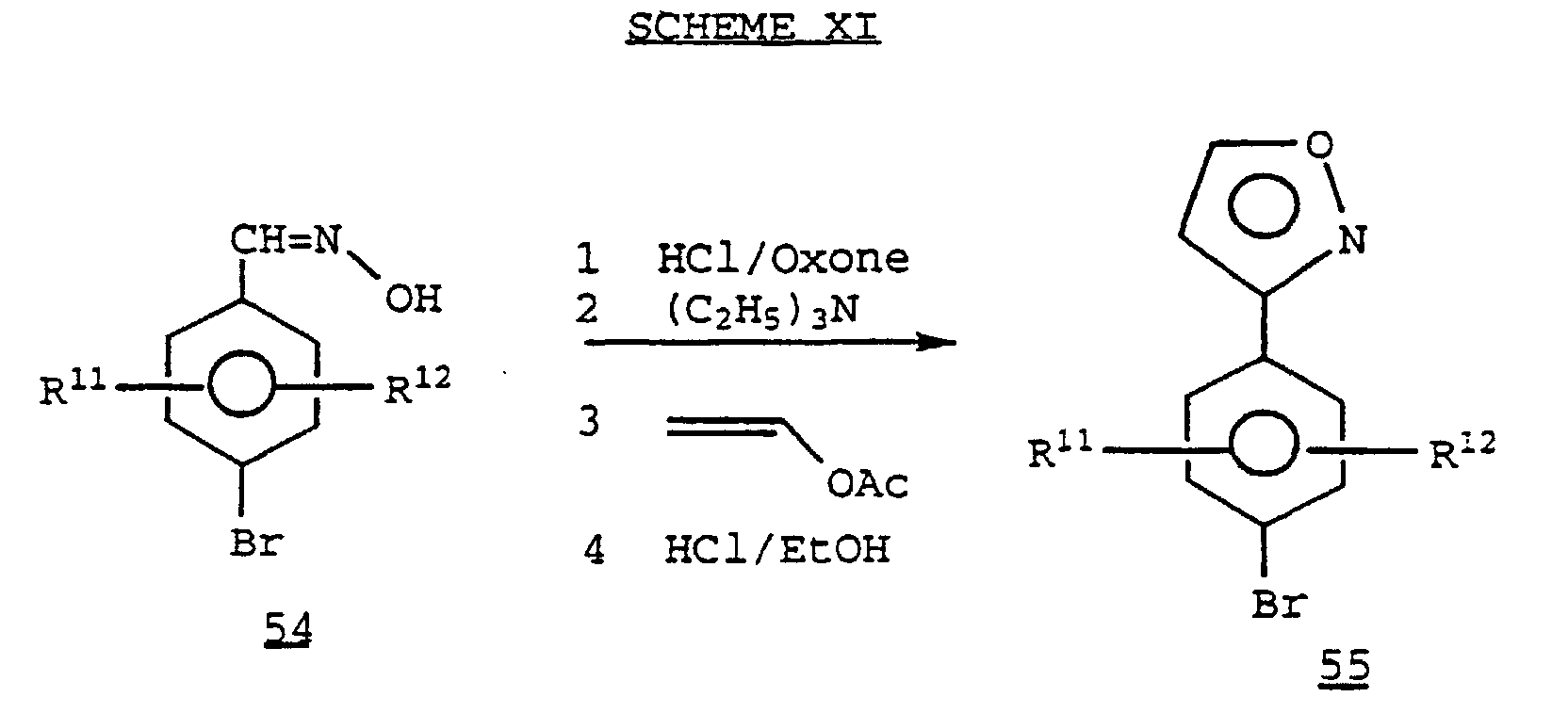
- Treatment of the oxime 54, prepared by methods know in the art, with HCl/Oxone, and subsequent treatment with a base such as triethylamine, provides an arylnitrile oxide. The arylnitrile oxide typically is not isolated, but is reacted with vinylacetate, and then the mixture is heated in an acid (e.g., HCl) in a suitable solvent such as ethanol to provide the 3-aryl isoxazole derivative 55.
-

- An α,β-unsaturated ketone 56, prepared by methods known in the art, upon treatment with hydroxylamine provides the corresponding oxime derivative. Cyclization of this material in the presence of iodine and potassium iodide provides the 5-arylisoxazole derivative 57. R1 in this scheme is alkyl, (See for example, J. Het. Chem., 30, 467 (1993).)
-
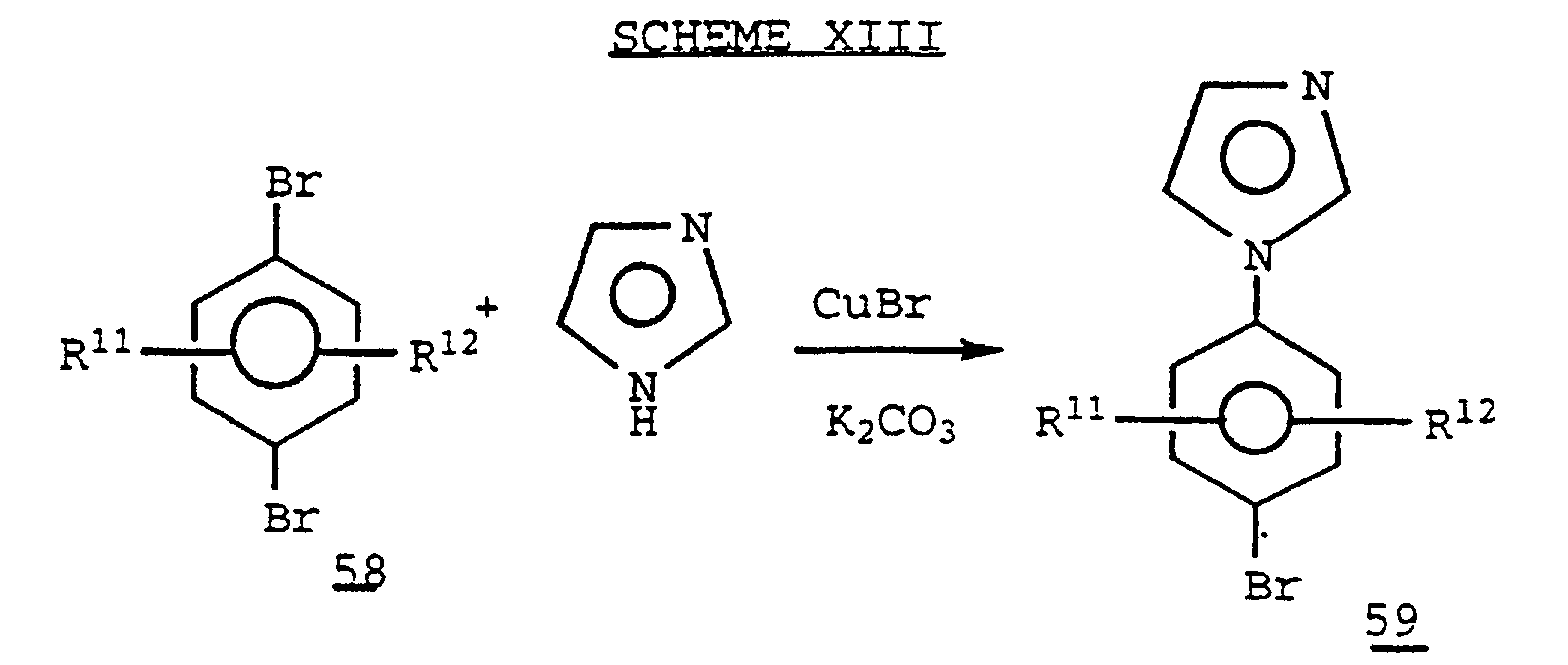
- The N-arylimidazole analog 59 may be prepared by a standard Ullmann coupling, known in the art, of the 1,4-dibromobenzene 58 with imidazole in the presence of a copper salt such as CuBr.
- The invention will now be further described by the following working examples, which are preferred embodiments of the invention. These examples are meant to be illustrative rather than limiting.
-
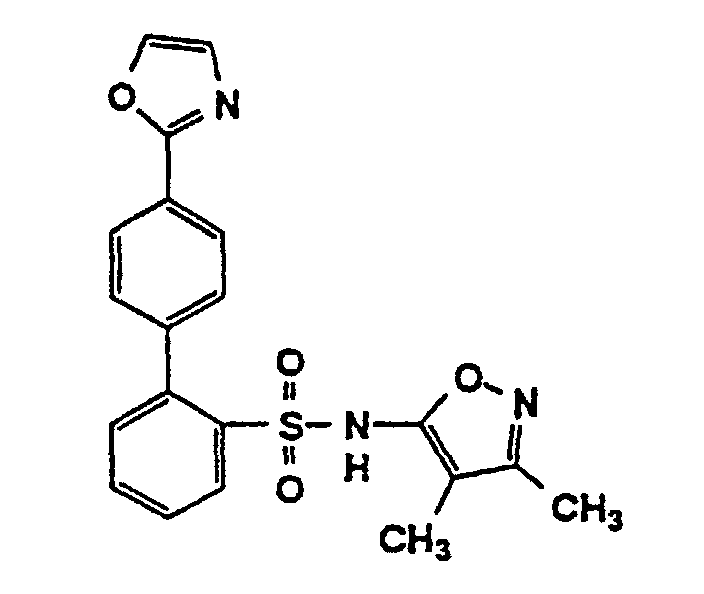
- A mixture of 4-bromobenzenecarboxamide (4 g, 20 mmol), vinylene carbonate (1.72 g, 20 mmol) and 10 g polyphosphoric acid was heated at 170°C for 3 hours. After cooling, the mixture was partitioned between 200 mL water and 200 mL ethyl acetate. The aqueous layer was extracted with 2 x 150 mL ethyl acetate. The combined organic liquid was washed with 100 mL water and 50 mL brine, dried and concentrated. The residue was chromatographed on silica gel using 10:1 hexane/ethyl acetate to afford compound A (2.49 g, 56%) as a white solid.
- To a solution of 2-Bromo-N-(3,4-dimethyl-5-isoxazolyl)-N'-(methoxyethoxymethyl)benzenesulfonamide (5.67 g, 13.52 mmol, prepared as described in EP 0,569,193 (1993)) in 70 mL of tetrahydrofuran at -78°C, n-butyl lithium (2M solution in cyclohexane, 8.11 mL, 16.23 mmol) was added over 10 minutes. The resulting solution was stirred at -78°C for 15 minutes and triisopropylborate (1.52 g, 8.06 mmol) was added. The mixture was then warmed to room temperature and stirred for 2 hours. The mixture was cooled to 0°C, 10% aqueous hydrochloric acid (120 mL) was added, and the solution was stirred for 10 minutes. The mixture was concentrated to 120 mL and extracted with 4 x 60 mL ethyl acetate. The combined organic extracts were washed once with 100 mL brine, dried (MgSO4) and concentrated to give compound B (4.25 g, 82%) as a light yellow gum.
- To a solution of compound B (315 mg, 0.82 mmol), compound A (456 mg, 2.05 mmol) in 7.5 ml of toluene and 6 mL of 95% ethanol under argon, tetrakis(triphenylphosphine)palladium(0) (95 mg, 0.082 mmol) was added, followed by 4.5 mL of 2M aqueous sodium carbonate. The reaction mixture was heated at 75°C for 4 hours, cooled and diluted with 50 mL of ethyl acetate. The organic liquid was separated and washed with 10 mL water and 10 mL brine, dried and concentrated. The residue was chromatographed on silica gel using 2:1 hexane/ethyl acetate to afford compound C (279 mg, 70%) as a colorless gum.
- To a solution of compound C (276 mg, 0.57 mmol) in 10 mL of 95% ethanol, 10 mL of 6N aqueous hydrochloric acid was added and refluxed for 1 hour and 10 minutes. The reaction mixture was concentrated and the pH of the solution was adjusted to 8 using sodium bicarbonate solution. It was then acidified to pH 5 with glacial acetic acid. The mixture was extracted with 3 x 40 mL ethyl acetate. The organic liquid was washed with 10 mL water and 10 mL brine, dried and concentrated. The residue was chromatographed on silica gel using 100:1 dichloromethane/methanol to afford the title compound (117 mg, 52%) as a white solid.
M.p. 90-98°C(amorphous).
Analysis calculated for C20H17N3O4S:
Calculated: C, 60.75; H, 4.33; N, 10.63; S, 8.11;
Found: C, 60.80; H, 4.15; N, 10.38; S, 8.12. -
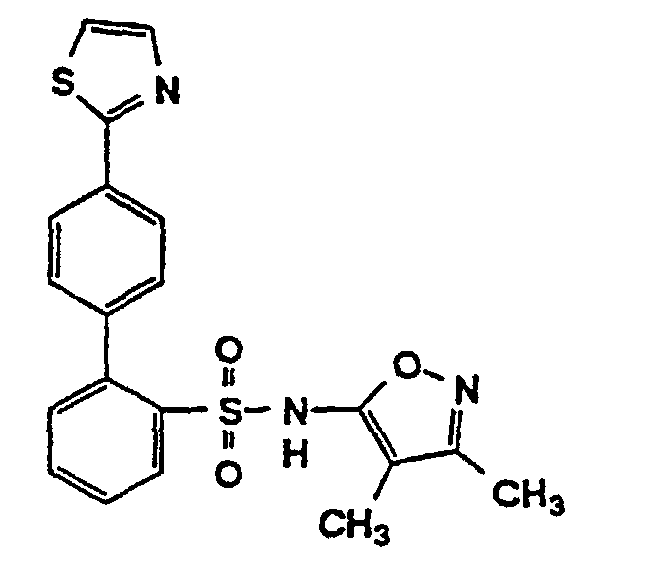
- To a solution of 4-Bromophenylboronic acid (3.01 g, 15 mmol), 2-bromothiazole (9.84 g, 60 mmol) in 120 mL of toluene and 96 mL of 95% ethanol under argon, tetrakis (triphenylphosphine)-palladium(0) (1.04 g, 0.9 mmol) was added, followed by 72 mL of 2M aqueous sodium carbonate. The reaction mixture was heated at 75°C for 1 hour and 15 minutes, cooled and diluted with 300 mL of ethyl acetate. The organic liquid was separated and washed with 100 mL water and 100 mL brine, dried and concentrated. The residue was chromatographed on silica gel using 30:1 Hexane/ethyl acetate to afford compound A (2.0 g, 56 %) as a white solid.
- To a solution of compound B from Example 1 (320 mg, 0.83 mmol) and compound A (400 mg, 1.67 mmol) in 7.5 mL of toluene and 6 mL of 95% ethanol under argon, tetrakis(triphenylphosphine)palladium(0) (96 mg, 0.083 mmol) was added, followed by 4.5 mL of 2M aqueous sodium carbonate. The reaction mixture was heated at 75°C for 3 hours cooled and diluted with 50 ml of ethyl acetate. The organic liquid was separated and washed with 10 mL water and 10 mL brine, dried and concentrated. The residue was chromatographed on silica gel using 2.5 :1 hexane/ethyl acetate to afford compound B (291 mg, 70%) as a colorless gum.
- To a solution of compound B (290 mg, 0.58 mmol) in 10 mL of 95% ethanol, 10 mL of 6N aqueous hydrochloric acid was added and refluxed for 1 hour. The reaction mixture was concentrated and the pH of the solution was adjusted to 8 using sodium bicarbonate solution. It was then acidified to pH 5 with glacial acetic acid. The mixture was extracted with 3 x 40 mL ethyl acetate. The organic liquid was washed with 10 mL water and 10 mL brine, dried and concentrated. The residue was chromatographed on silica gel using 100:1 dichloromethane/methanol to afford the title compound (180 mg, 75%) as an off-white solid.
M.p. 87-97°C(amorphous).
Analysis calculated for C20H17N3O3S2 · 0.34H2O:
Calculated: C, 57.52; H, 4.27; N, 10.06; S, 15.35;
Found: C, 57.68; H, 4.08; N, 9.90; S, 15.06. -
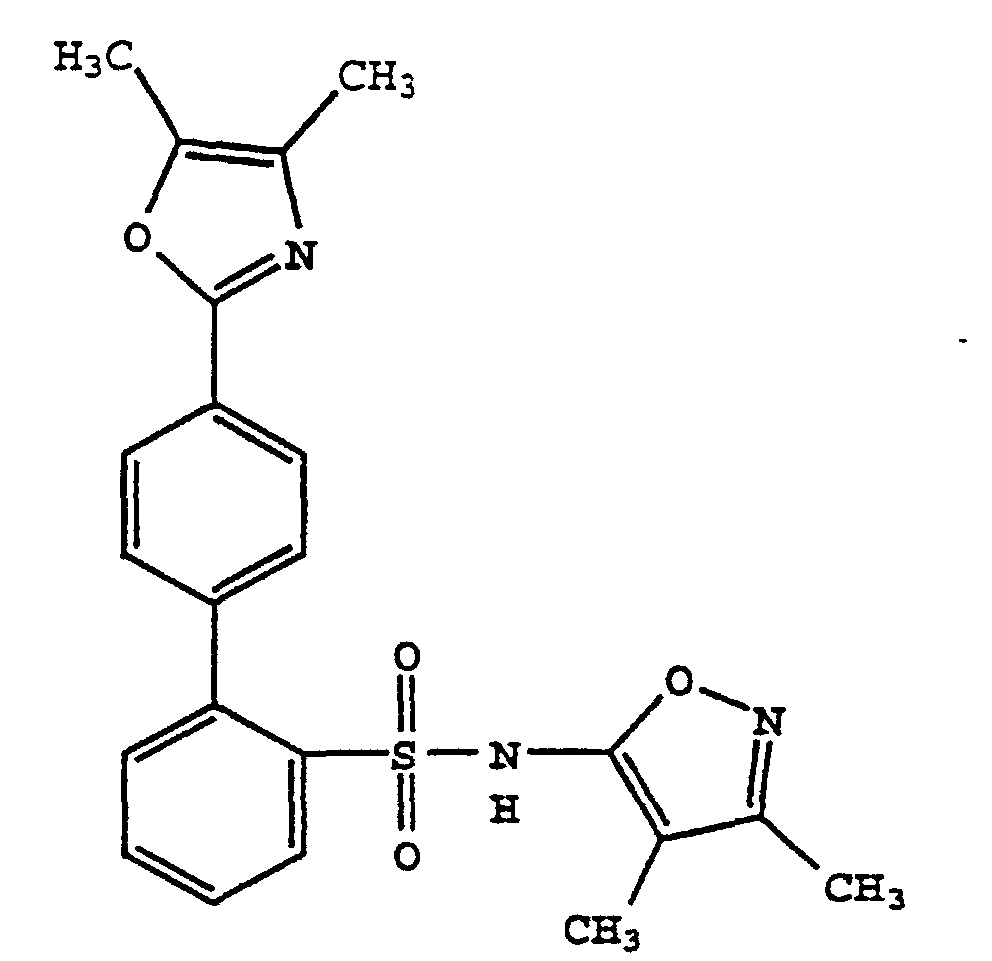
- To 3-hydroxy-2-butanone (1.32 g, 15 mmol) and 4-bromobenzoyl chloride (3.29 g, 15 mmol) in 15 mL dichloromethane at 0°C, 5 mL pyridine was added dropwise. The reaction was stirred at room temperature for 5 hours, 150 mL ethyl acetate was added and filtered. The filtrate was washed with 2 x 50 mL 10% hydrochloric acid, 30 mL water and 30 mL brine, dried and concentrated. The residue was chromatographed on silica gel using 10:1 hexane/ethyl acetate to afford compound A (3.4 g, 84%) as a white solid.
- A mixture of compound A (3.4 g, 12.54 mmol), ammonium acetate (9.67 g, 125.4 mmol) and 10 mL acetic acid was heated at 100°C for 4 hours. After cooling, the mixture was partitioned between 150 mL water and 200 mL ethyl acetate. The organic liquid was washed with 50 mL water and 50 mL brine, dried and concentrated. The residue was chromatographed on silica gel using 25:1 hexane/ethyl acetate to afford compound B (1.52 g, 48%) as a white solid.
- To a solution of compound B from Example 1 (320 mg, 0.83 mmol) and compound B above (420 mg, 1.67 mmol) in 7.5 mL of toluene and 6 ml of 95% ethanol under argon, tetrakis(triphenylphosphine)palladium(0) (96 mg, 0.083 mmol) was added, followed by 4.5 mL of 2M aqueous sodium carbonate. The reaction mixture was heated at 75°C for 4 hours, cooled and diluted with 50 mL of ethyl acetate. The organic liquid was separated and washed with 10 mL water and 10 mL brine, dried and concentrated. The residue was chromatographed on silica gel using 2:1 hexane/ethanol to afford compound C (300 mg, 70%) as a colorless gum.
- To a solution of'compound C (300 mg, 0.59 mmol) in 10 mL of 95% ethanol, 10 mL of 6N aqueous hydrochloric acid was added and refluxed for 1 hour. The reaction mixture was concentrated, and the pH of the solution was adjusted to 8 using sodium bicarbonate solution. It was then acidified to pH 5 with glacial acetic acid. The mixture was extracted with 3 x 40 ml ethyl acetate. The organic liquid was washed with 10 mL water and 10 mL brine, dried and concentrated. The residue was chromatographed on silica gel using 1:1 hexane/ethyl acetate to afford the title compound (178 mg, 72%) as a white solid.
M.p. 96-102°C(amorphous).
Analysis calculated for C22H21N3O4S · 0.24H2O:
Calculated: C, 61.76; H, 5.06; N, 9.82; S, 7.49;
Found: C, 61.67; H, 4.76; N, 9.91; S, 7.59. -
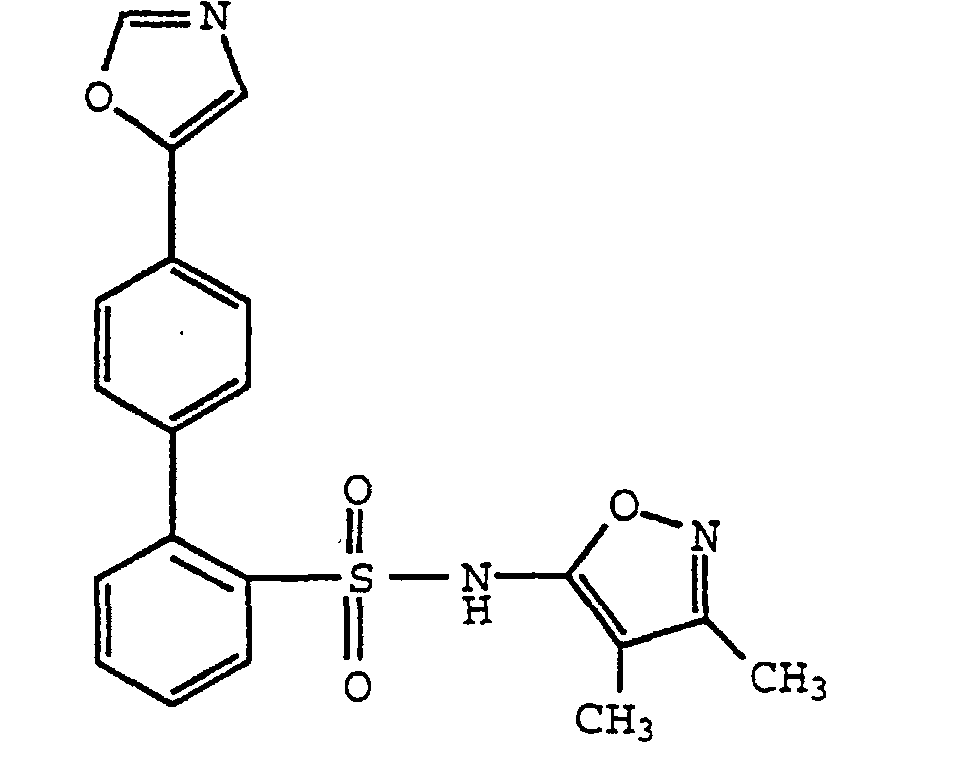
- A mixture of 4.74 g (25.6 mmol) of p-bromobenzaldehyde, 5.0 g (25.6 mmol) of tosylmethyl isocyanide and 4.25 g (30.7 mmol) of anhydrous potassium carbonate in 150 mL of methanol was refluxed for 3 hours. The solvent was then evaporated, and 150 mL of water was added to the residual solid. The tan-white solid was filtered and washed several times with water and then dried to yield compound A (3.65 g, 64%).
- To a solution of 0.8 g (2.08 mmol) compound B from Example 1 and 0.12 g (0.1 mmol) of tetrakis(triphenylphosphine)-palladium(0) in 25 mL of toluene under argon, 15 mL of 2M aqueous sodium carbonate was added followed by 0.70 g (3.12 mmol) of compound A in 15 mL of 95% ethanol. The mixture was refluxed for 3 hours, diluted with 100 mL of water and extracted with 3 x 75 mL of ethyl acetate. The combined organic extracts were washed once with 100 mL of brine, dried and evaporated. The residue was chromatographed on 50 g of silica gel using Hexanes/ethyl acetate 2:1 to afford 0.49 g (49%) of compound B as a colorless gum.
- To a solution of 0.49 g (1.01 mmol) of compound B in 10 mL of 95% ethanol, 10 mL of 6N aqueous hydrochloric acid was added and refluxed for 1 hour. The mixture was then concentrated and diluted with 50 mL of water. The solution was neutralized to pH 7 using saturated aqueous sodium bicarbonate and then acidified to pH 4 using glacial acetic acid. The white solid obtained was filtered and dried (0.37 g). Crystallization from dichloromethane/ethyl acetate/Hexanes afforded 0.23 g (58%) of the title compound as a white solid. M.p. 189-191°C.
Analysis Calculated for
C20H17N3O4S.0.28 H2O:Calculated C, 60.00; H, 4.42; N, 10.49; S, 8.01; Found C, 60.10; H, 4.17; N, 10.39; S, 8.04. -

- A mixture of 5.0 g (18 mmol) of α,p-dibromoacetophenone and 4.05 g (89.9 mmol) of formamide was stirred in an oil bath at 130°C for 3 hours. The mixture was then poured into 150 mL of ice/water and the solution was extracted with 3 x 100 mL of ether. The combined ether extracts were washed once with water; dried and evaporated. The residue was chromatographed on 200 mL of silica gel using Hexanes/ethyl acetate 3:1 to afford 1.3 g (32%) of compound A as a light brown solid.
- To a solution of 0.668 g (1.74 mmol) of compound B from Example 1 and 0.104 g (0.09 mmol) of tetrakis(tri-phenylphosphine)palladium(0) in 25 mL of toluene under argon, 15 mL of 2M aqueous sodium carbonate was added followed by 0.52 g (2.32 mmol) of compound A in 15 mL of 95% ethanol. The mixture was refluxed for 3 hours, diluted with 100 mL of water and extracted with 3 x 75 mL of ethyl acetate. The combined organic extracts were washed once with 100 mL of brine, dried and evaporated. The residue was chromatographed on 50 g of silica gel using Hexanes/ethyl acetate 2:1 to afford 0.43 g (51%) of compound B as a colorless gum.
- To a solution of 0.75 g (1.55 mmol) of compound B in 8 mL of acetonitrile at 0°C under argon, trimethylsilyl chloride (2.01 g) and sodium iodide (2.73 g) were added and the mixture was stirred at room temperature for 1 hour. The mixture was then diluted with 10 mL of water and extracted with 100 mL of ethyl acetate. The organic layer was washed with 10 mL of saturated aqueous sodium thiosulfate, dried and evaporated. This material was purified by reverse phase preparative HPLC on 30 x 500 mm ODS S10 column using 68% solvent A (90% methanol, 10% water, 0.1% trifluoroacetic acid) and 32% solvent B (10% methanol, 90% water, 0.1% trifluoroacetic acid). The appropriate fractions were collected and neutralized with aqueous sodium bicarbonate to pH 7 and concentrated to 10 mL. The solution was acidified to pH 4 using glacial acetic acid and the white solid was filtered and dried to provide 0.33 g (54%) of the title compound.
M.p. 85 - 93°C (amorphous).Analysis Calculated for
C20H17N3O4S.0.21 H2O:Calculated C, 60.18; H, 4.40; N, 10.53; S, 8.03; Found C, 60.27; H, 4.05; N, 10.44; S, 7.88. -
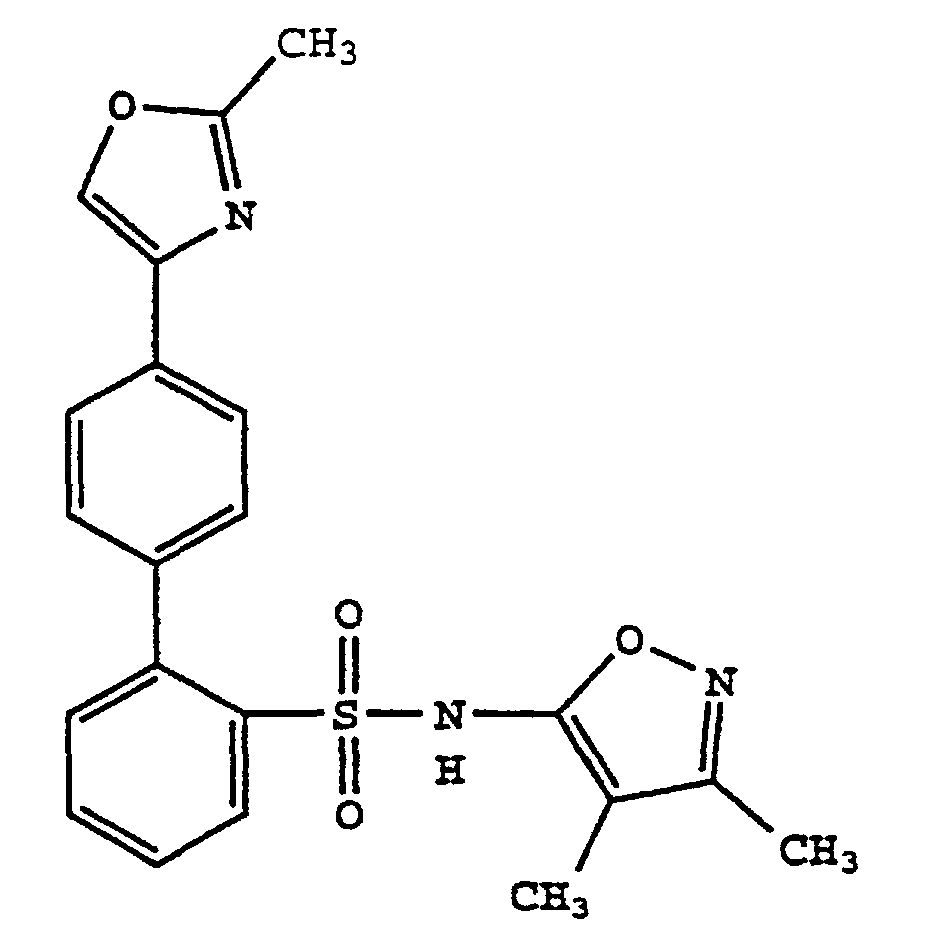
- A mixture of 2,4-dibromoacetophenone (2.78 g, 10 mmol) and acetamide (1.48 g, 25 mmol) was heated at 130°C for 3 hours. This mixture was poured onto 30 g ice, and 150 mL ethyl acetate was added. The organic layer was separated and washed with 30 mL 1N sodium hydroxide, 30 mL 1N hydrochloric acid and 30 mL brine, dried and concentrated. The residue was chromatographed on silica gel using 15:1 hexane/ethyl acetate to afford compound A (1.29 g, 54%) as a white solid.
- To a solution of compound A (402 mg, 1.7 mmol) and compound B from Example 1 (259 mg, 0.68 mmol) in 6.5 mL of toluene and 5.2 mL of 95% ethanol under argon, tetrakis(triphenylphosphine)palladium(0) (78 mg, 0.068 mmol) was added and followed by 3.9 mL of 2M aqueous sodium carbonate. The reaction mixture was heated at 75°C for 3.5 hours, cooled and diluted with 40 mL of ethyl acetate. The organic liquid was separated and washed with 10 mL water and 10 mL brine, dried and concentrated. The residue was chromatographed on silica gel using 2:1 hexane/ethyl acetate to afford compound B (183 mg, 54%) as a colorless gum.
- To a solution of compound B (180 mg, 0.36 mmol) in 6 mL of 95% ethanol, 6 mL of 6N aqueous hydrochloric acid was added and the combination was refluxed for 55 minutes. The reaction mixture was concentrated and the pH of the solution was adjusted to 8 using sodium bicarbonate solution. It was then acidified to pH 5 with glacial acetic acid. The mixture was extracted with 3 x 30 mL ethyl acetate. The organic liquid was washed with 10 mL brine, dried and concentrated. The residue was chromatographed on silica gel using 100:1 dichloromethane/methanol to afford the title compound (56 mg, 38%) as a light yellow solid.
M.p. 90-100°C (amorphous).
Analysis calculated for C21H19N3O4S:
Calculated: C, 61.60; H, 4.68; N, 10.26; S, 7.83;
Found: C, 61.56; H, 4.33; N, 9.85; S, 7.94. -
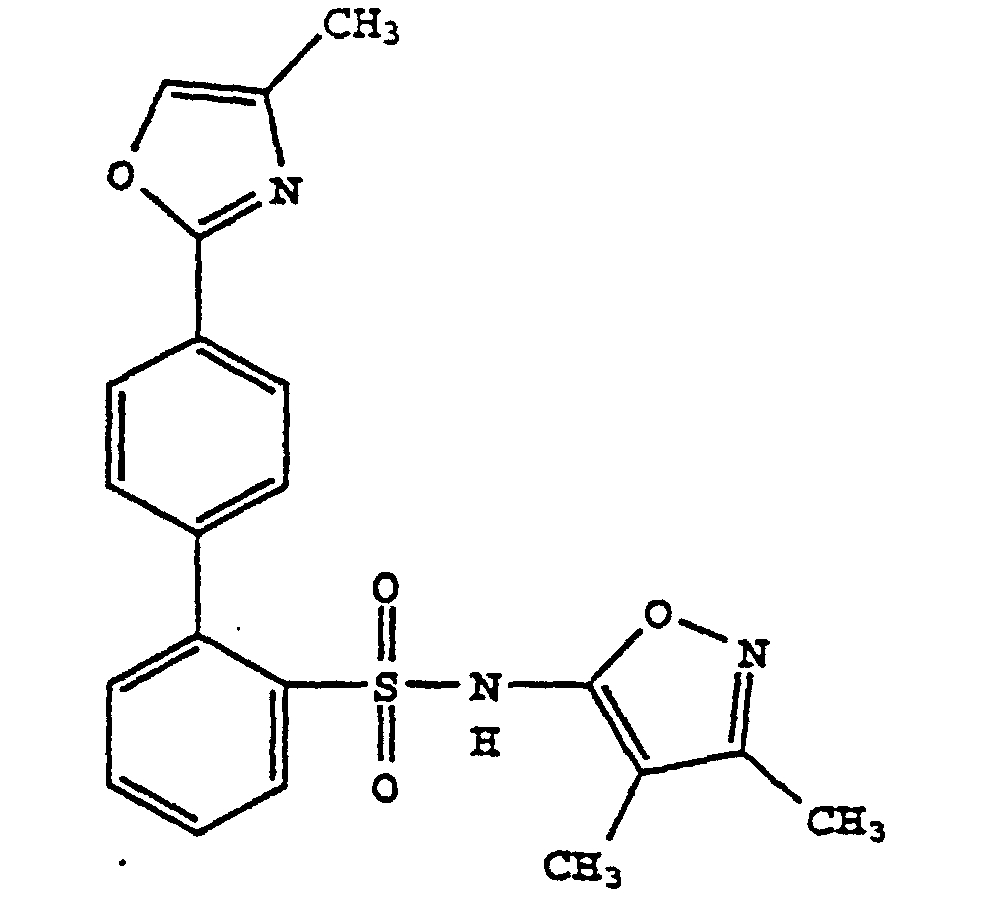
- 4-bromobenzonitrile (9.1 g, 50 mmol) and propargyl alcohol (2.8 g, 50 mmol) were added portionwise into 12.5 mL concentrated sulfuric acid at -15°C. The reaction was stirred at 0°C for 3 hours, warmed to room temperature slowly and stirred overnight. The mixture was poured into 200 mL ice water, neutralized with sodium bicarbonate and extracted with 3 x 200 mL ethyl acetate. The combined organic liquid was washed with 50 mL brine, dried and concentrated. The residue was chromatographed on silica gel using 30:1 Hexane/ethyl acetate to afford compound A (1.44 g, 12%) as a white solid.
- To a solution of compound B from Example 1 (320 mg, 0.83 mmol) and compound A (397 mg, 1.67 mmol) in 7.5 mL of toluene and 6 mL of 95% ethanol under argon, tetrakis (triphenylphosphine)palladium(0) (96 mg, 0.083 mmol) was added, followed by 4.5 mL of 2M aqueous sodium carbonate. The reaction mixture was heated at 75°C for 4 hours, cooled and diluted with 50 mL of ethyl acetate. The organic liquid was separated, washed with 10 mL water and 10 mL brine, dried and concentrated. The residue was chromatographed on silica gel using 2:1 Hexane/ethyl acetate to afford compound B (300 mg, 72%) as a colorless gum.
- To a solution of compound B (300 mg, 0.60 mmol) in 10 mL of 95% ethanol, 10 mL of 6N aqueous hydrochloric acid was added and refluxed for 1 hour. The reaction mixture was concentrated and the pH of the solution was adjusted to 8 using sodium bicarbonate solution. It was then acidified to pH 5 with glacial acetic acid. The mixture was extracted with 3 x 40 mL ethyl acetate. The organic liquid was washed with 10 mL water and 10 mL brine, dried and concentrated. The residue was chromatographed on silica gel using 100:1 dichloromethane/methanol to afford the title compound (200 mg, 81%) as a white solid.
M.p. 85-95°C(amorphous).
Analysis calculated for C21H19N3O4S · 0.25 H2O:
Calculated: C, 60.92; H, 4.75; N, 10.15; S, 7.74;
Found: C, 61.15; H, 4.60; N, 9.89; S, 7.62. -

- To 4-bromobenzoyl chloride (4.39 g, 20 mmol) in 40 mL dichloromethane at 0°C, propargylamine (1.10 g, 20 mmol) was added, followed by triethylamine (4.05 g, 40 mmol). The mixture was stirred at room temperature for 40 minutes. 150 mL ethyl acetate was added and filtered. The filtrate was washed with 2 x 40 mL water and 40 mL brine, dried and concentrated to give 4-Bromo-N-(2-propynyl)benzamide. 4-Bromo-N-(2-propynyl)benzamide was added into ice cooled 47 mL concentrated sulfuric acid. The reaction was stirred at 5-10°C for 3 hours and at room temperature overnight. The mixture was poured into 500 mL ice water, neutralized with sodium carbonate to pH 8 and extracted with 3 x 250 mL ethyl acetate. The combined organic extracts were washed with 200 mL water and 100 mL brine, dried and concentrated to afford compound A (4.5 g, 95%) as a light yellow solid.
M.p. 61-63°C. - To a solution of compound B from Example 1 (320 mg, 0.83 mmol) and compound A (397 mg, 1.67 mmol) in 7.5 mL of toluene and 6 mL of 95% ethanol under argon,
tetrakis(triphenylphosphine)palladium(0) (96 mg, 0.083 mmol) was added, followed by 4.5 mL of 2M aqueous sodium carbonate. The reaction mixture was heated at 75°C for 3 hours, cooled and diluted with 50 mL of ethyl acetate. The organic liquid was separated and washed with 10 mL water and 10 mL brine, dried and concentrated. The residue was chromatographed on silica gel using 2:1 Hexane/ethyl acetate to afford compound B (298 mg, 72%) as a colorless gum. - To a solution of compound B (298 mg, 0.60 mmol) in 10 mL of 95% ethanol, 10 mL of 6N aqueous hydrochloric acid was added and refluxed for 1 hour. The reaction mixture was concentrated and the pH of the solution was adjusted to 8 using sodium bicarbonate solution. It was then acidified to pH 5 with glacial acetic acid. The mixture was extracted with 3 x 40 mL ethyl acetate. The organic liquid was washed with 10 mL water and 10 mL brine, dried and concentrated. The residue was chromatographed on silica gel using 100:1 dichloromethane/methanol to afford the title compound (147 mg, 60%) as an off-white solid.
M.p. 90-100°C (amorphous).
Analysis calculated for C21H19N3O4S:
Calculated: C, 61.60; H, 4.68; N, 10.26; S, 7.83;
Found: C, 61.39; H, 4.11; N, 10.03; S, 7.61. -

- To epichlorohydrin (4 g, 43.23 mmol) and 4-bromophenyl hydrazine hydrochloride (19.32 g, 86.46 mmol) in 20 mL 60% ethanol, triethylamine (8.75 g, 12.05 mmol) was added dropwise. The mixture was warmed slowly and then refluxed for 1 hour. The solvent was evaporated, and the residue was heated at 170°C for 30 minutes and at 200°C for a further 10 minutes. 150 mL water was added, and the mixture was extracted with 3 x 200 mL ethyl acetate. The combined organic liquid was washed with 50 mL brine, dried and concentrated. The residue was chromatographed on silica gel using 40:1 Hexane/ethyl acetate to afford compound A (2.92 g, 30%) which was crystallized from hexane to give yellow needles.
M.p. 72-74°C. - To a solution of compound B from Example 1 (320 mg, 0.83 mmol) and compound A (372 mg, 1.67 mmol) in 7.5 mL of toluene and 6 mL of 95% ethanol under argon, tetrakis(triphenylphosphine)-palladium(0) (96 mg, 0.083 mmol) was added, followed by 4.5 mL of 2M aqueous sodium carbonate. The reaction mixture was heated at 75°C for 2.5 hour, cooled and diluted with 50 mL of ethyl acetate. The organic liquid was separated, washed with 10 mL water and 10 mL brine, dried and concentrated. The residue was chromatographed on silica gel using 2.5:1 Hexane/ethyl acetate to afford compound B (280 mg, 70%) as a colorless gum.
- To a solution of compound B (280 mg, 0.58 mmol) in 10 mL of 95% ethanol, 10 mL of 6N aqueous hydrochloric acid was added and refluxed for 1 hour. The reaction mixture was concentrated and the pH of the solution was adjusted to 8 using sodium bicarbonate solution. It was then acidified to pH 5 with glacial acetic acid. The mixture was extracted with 3 x 40 mL ethyl acetate. The organic liquid was washed with 10 mL water and 10 mL brine, dried and concentrated. The residue was chromatographed on silica gel using 100:0.8 dichloromethane/methanol to afford the title compound (161 mg, 70%) as an off-white solid.
M.p. 88-98°C (amorphous).
Analysis calculated for C20H18N4O3S · 0.12H2O:
Calculated: C, 60.56; H, 4.64; N, 14.12; S, 8.08;
Found: C, 61.26; H, 4.52; N, 13.96; S, 8.06. -
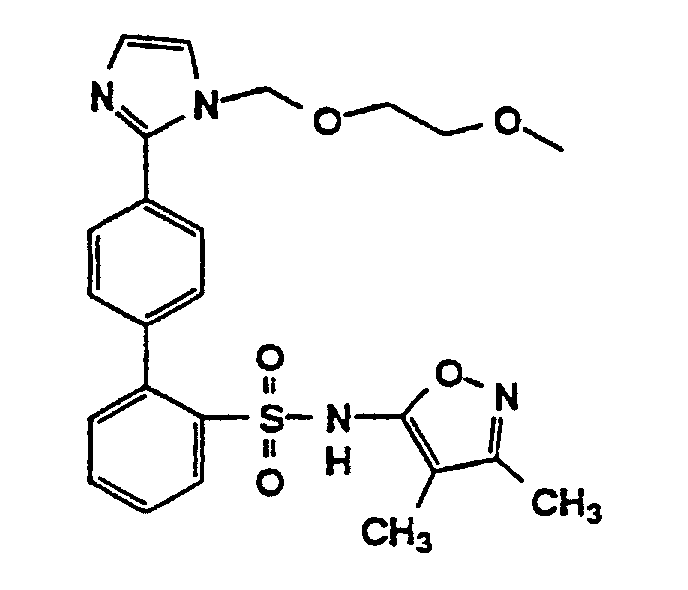
- To 4-Bromobenzaldehyde (9.25 g, 50 mmol) and glyoxal (40% wt. aqueous solution, 11.6 mL, 80 mmol) in 20 mL methanol, 60 mL 30% aqueous ammonium hydroxide was added dropwise. The mixture was stirred at room temperature overnight. The solvent was evaporated under vacuum. The residue was made slightly alkaline by the addition of aqueous sodium hydroxide, and extracted with 3 x 300 mL ethyl acetate. The combined organic extracts were dried and concentrated. The residue was dissolved in 100 mL methanol and filtered. The filtrate was concentrated and the residue was triturated with 20 mL ethyl ether to give compound A as a brown solid as (1.8 g, 16%).
- To compound A (400 mg, 1.79 mmol) in 18 mL tetrahydrofuran, sodium hydride (60% in mineral oil, 86 mg, 2.15 mmol) was added. The mixture was stirred at room temperature for 10 minutes. Methoxyethoxymethyl chloride (335 mg, 2.59 mmol) was added dropwise. The reaction was stirred at room temperature for 2 hours, and concentrated. 100 mL ethyl acetate was added and the organic liquid was washed with 20 mL water and 10 mL brine, dried and concentrated. The residue was chromatographed on silica gel using 100:400:1 Hexane/ethyl acetate/triethylamine to afford compound B (390 mg, 70%).
- To a solution of compound B from Example 1 (722 mg, 1.88 mmol) and compound B above (390 mg, 1.25 mmol) in 11.25 mL of toluene and 9 mL of 95% ethanol under argon, tetrakis(triphenylphosphine)palladium(0) (145 mg, 0.125 mmol) was added, followed by 6.75 mL of 2M aqueous sodium carbonate. The reaction mixture was heated at 75°C for 3 hours, cooled and diluted with 75 mL of ethyl acetate. The organic liquid was separated, washed with 15 mL water and 15 mL brine, dried and concentrated. The residue was chromatographed on silica gel using 100:0.2 ethyl acetate/triethylamine to afford compound C (400 mg, 56%) as a colorless gum.
- To a solution of compound C (400 mg, 0.70 mmol) in 12 mL of 95% ethanol, 12 mL of 6N aqueous hydrochloric acid was added and refluxed for 1 hour. The reaction mixture was concentrated and the pH of the solution was adjusted to 8 using sodium bicarbonate solution. It was then acidified to pH 5 with glacial acetic acid. 200 mL ethyl acetate was added, and the organic liquid was washed with 20 mL water and 20 mL brine, dried and concentrated. The residue was chromatographed on silica gel using 100:4:0.2 dichloromethane/methanol/ammonium hydroxide to afford the title compound (210 mg, 62%), which was crystallized from ethyl acetate/Hexane to provide white crystals.
M.p. 81-84°C.Analysis calculated for C24H26N4O5S · 0.24 H2O: Calculated C, 59.20; H, 5.48; N, 11.51; S, 6.58; Found C, 59.25; H, 5.42; N, 11.46; S, 6.39. -
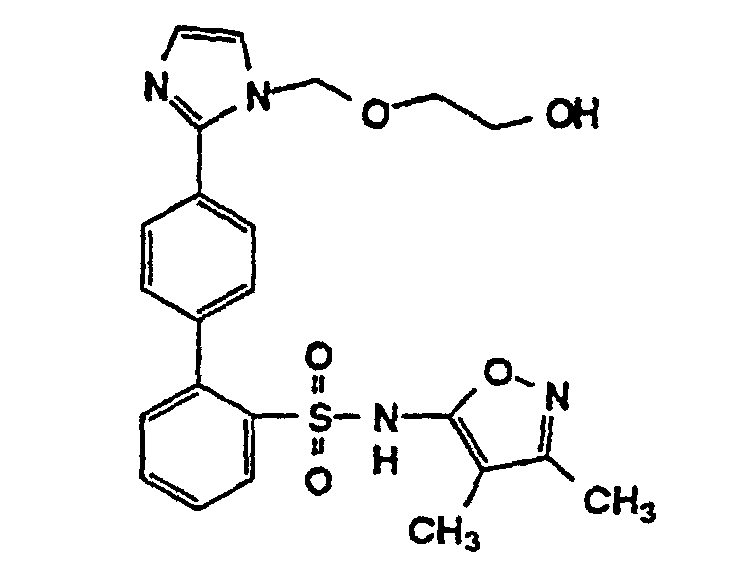
- To the title compound of Example 10 (120 mg, 0.25 mmol) in 2.5 mL dichloromethane at 0°C, boron tribromide (1M solution in dichloromethane, 0.37 mL, 0.37 mmol) was added dropwise. The reaction mixture was stirred at 0-3°C for 45 minutes. 5 mL saturated aqueous sodium bicarbonate was added and stirred for 10 minutes. The mixture was then acidified to pH 5 with glacial acetic acid and extracted with 3 x 40 ml 100:5 dichloromethane/methanol. The combined organic extracts were dried and concentrated. The residue was purified by preparative HPLC on a 30 x 500 mm ODS S10 column using 62% solvent A (10% methanol, 90% water, 0.1% trifluoroacetic acid) and 38% solvent B (90% methanol, 10% water, 0.1% tetrahydrofuran) to provide the title compound (80 mg, 69%) as a white solid.
M.p. 93-103°C.
Analysis calculated for C23H24N4O5S · 0.75 H2O:
Calculated: C, 57.31; H, 5.33; N, 11.62; S, 6.65;
Found: C, 57.61; H, 5.04; N, 11.33; S, 6.55. -

- To compound A from Example 10 (700 mg, 3.14 mmol) in 7.8 mL tetrahydrofuran and 7.8 mL dimethylformamide, sodium hydride (60% in mineral oil, 151 mg, 3.77 mmol) was added. The mixture was stirred at room temperature for 10 minutes. Iodomethane (891 mg, 6.28 mmol) was added dropwise. The reaction mixture was stirred at room temperature for 1 hour, and concentrated. 100 mL ethyl acetate was added and the organic liquid was washed with 20 mL water and 20 mL brine, dried and concentrated. The residue was chromatographed on silica gel using 100:1:0.1 dichloromethane/methanol/ammonium hydroxide to afford compound A (500 mg, 67%).
- To a solution of compound B from Example 1 (320 mg, 0.83 mmol) and compound A (395 mg, 1.67 mmol) in 7.5 mL of toluene and 6 mL of 95% ethanol under argon, tetrakis(triphenylphosphine)-palladium(0) (96 mg, 0.083 mmol) was added, followed by 4.5 mL of 2M aqueous sodium carbonate. The reaction mixture was heated at 75°C for 3 hours, cooled and diluted with 50 mL of ethyl acetate. The organic liquid was separated and washed with 10 mL water and 10 mL brine, dried and concentrated. The residue was chromatographed on silica gel using 100:1.5:0.1 dichloromethane/methanol/ammonium bicarbonate to afford compound A (254 mg, 61%) as a colorless gum.
- To a solution of compound B (250 mg, 0.50 mmol) in 9 mL of 95% ethanol, 9 mL of 6N aqueous hydrochloric acid was added and refluxed for 1 hour. The reaction mixture was concentrated and the pH of the solution was adjusted to 8 using sodium bicarbonate solution. It was then acidified to pH 5 with glacial acetic acid. The mixture was extracted with 200 mL ethyl acetate and the organic layer was washed with 20 mL water and 20 mL brine, dried and concentrated. The residue was chromatographed on silica gel using 100:6:0.3 dichloromethane/methanol/ammonium bicarbonate to afford N-(3,4-Dimethyl-5-isoxazolyl)-4'-(1-methyl-1H-imidazol-2-1)[1,1'-biphenyl] -2-sulfonamide (189 mg, 92%), which was dissolved in 1N lithium hydroxide, added on to a HP-20 column and eluted with water and then 10:3 water/methanol to provide the title compound as a white solid.
M.p. >200°C dec.
Analysis calculated for C21H19N4O3SLi · 2.75H2O:
Calculated: C, 54.37; H, 5.32; N, 12.08; S, 6.91;
Found: C, 54.58; H, 5.05; N, 11.87; S, 6.80. -

- To compound A from Example 10 (446 mg, 2 mmol) in 20 mL acetonitrile, di-t-butyl dicarbonate (524 mg, 2.4 mmol) and 4-dimethylaminopyridine (24.4 mg, 0.2 mmol) were added. The reaction mixture was stirred at room temperature overnight and concentrated. The residue was chromatographed on silica gel using 6:1 hexane/ethyl acetate to afford compound A (500 mg, 77%) as a light yellow oil.
- To a solution of compound B from Example 1 (496 mg, 1.29 mmol) and compound A (500 mg, 1.55 mmol) in 11.25 mL of toluene and 9 mL of 95% ethanol under argon, tetrakis(triphenylphosphine)palladium(0) (149 mg, 0.129 mmol) was added, followed by 6.75 mL of 2M aqueous sodium carbonate. The reaction mixture was heated at 75°C for 3 hours, cooled and diluted with 75 mL of ethyl acetate. The organic liquid was separated and washed with 15 mL water and 15 mL brine, dried and concentrated. The residue was chromatographed on silica gel using 40:60:0.2 hexane/ethyl acetate/triethylamine to afford compound B (380 mg, 51%) as a colorless gum.
- To a solution of compound B (380 mg, 0.65 mmol) in 12 mL of 95% ethanol, 12 mL of 6N aqueous hydrochloric acid was added and refluxed for 1 hour and 45 minutes. The reaction mixture was concentrated and the pH of the solution was adjusted to 8 using sodium bicarbonate solution. It was then acidified to pH 5 with glacial acetic acid, extracted with 3 x 80 mL 100:5 dichloromethane/methanol. The organic extracts were dried and concentrated. The residue was dissolved in 1N lithium hydroxide and chromatographed on HP-20 column eluted with water and then 10:2 water/methanol to provide the title compound as a white solid (180 mg, 69%).
M.p. >220°C dec.
Analysis calculated for C20H17N4O3SLi · 2.06H2O:
Calculated: C, 54.91; H, 4.87; N, 12.81; S, 7.33;
Found: C, 54.99; H, 4.78; N, 12.73; S, 6.95. -

- To 4'-Bromopropiophenone (3.52 g, 16.5 mmol) and formamide (10.81 g, 240 mmol) at 50°C, bromine (2.40 g, 15 mmol) was added dropwise over 10 minutes. The reaction mixture was heated from 50°C to 130°C over 20 minutes and then heated at 130°C for 4 hours. After cooling, 150 mL ethyl acetate was added and the liquid was washed with 2 x 20 mL water and 20 mL brine, dried and concentrated. The residue was chromatographed on silica gel using 40:1 Hexane/ethyl acetate to afford compound A (1.59 g, 45%).
- To a solution of compound B from Example 1 (384 mg, 1.0 mmol) and compound A (408 mg, 1.7 mmol) in 9 mL of toluene and 7.2 mL of 95% ethanol under argon, tetrakis(triphenylphosphine)palladium(0) (116 mg, 0.10 mmol) was added, followed by 5.4 mL of 2M aqueous sodium carbonate. The reaction mixture was heated at 75°C for 3 hours, cooled and diluted with 60 mL of ethyl acetate. The organic liquid was separated and washed with 15 mL water and 15 mL brine, dried and concentrated. The residue was chromatographed on silica gel using 2.5:1 Hexane/ethyl acetate to afford compound B (317 mg, 64%) as a colorless gum.
- To a solution of compound B (300 mg, 0.60 mmol) in 10 mL of 95% ethanol, 10 mL of 6N aqueous hydrochloric acid was added and refluxed for 1 hour. The reaction mixture was concentrated and the pH of the solution was adjusted to 8 using sodium bicarbonate solution. It was then acidified to pH 5 with glacial acetic acid. The mixture was extracted with 3 x 40 mL ethyl acetate and the organic extracts were washed with 10 mL water and 10 mL brine, dried and concentrated. The residue was purified by preparative HPLC on a 30 x 500 mm ODS S10 column using 30% solvent A (10% methanol, 90% water, 0.1% trifluoroacetic acid) and 70% solvent B (90% methanol, 10% water, 0.1% tetrahydrofuran) to provide the title compound (150 mg, 61%) as a white solid.
M.p. 86-96°C(amorphous).
Analysis calculated for C21H19N3O4S · 0.16H2O:
Calculated: C, 61.17; H, 4.72; N, 10.19; S, 7.77;
Found: C, 61.20; H, 4.35; N, 10.16; S, 7.58. -

- To a solution of 3.0 g (11.74 mmol) of 2-bromobenzenesulfonyl chloride in 10 mL of pyridine was added 1.32 g (11.74 mmol) of 3,4-dimethyl-5-isoxazolamine. The mixture was stirred at room temperature under argon overnight, added to 150 mL of ice water and filtered. The filtrate was acidified to pH 2 using 6N aqueous hydrochloric acid and the grey solid was filtered and dried. The solid was crystallized from methanol/water to afford 4.0 g (>100%) of compound A as tan crystalline needles (m.p. 125 - 126°C; Rf = 0.51 (10% methanol/dichloromethane)).
- To a solution of 1.1 g (3.33 mmol) of compound A in 15 mL of THF at room temperature under argon was added 0.19 g (4.8 mmol) of sodium hydride (60% suspension in mineral oil) in portions, and the solution was stirred at room temperature for 10 minutes. Methoxyethoxymethyl chloride (0.55 g, 4.4 mmol) was then added and the solution was stirred overnight. The mixture was concentrated and diluted with 30 mL of water, and extracted with 40 mL of ethyl acetate. The combined organic extracts were washed with 50 mL of brine, dried and evaporated to provide 1.2 g (87%) of compound B as a brown gum.
- To a solution of compound B, 4-methylbenzeneboronic acid (4.76 g, 35 mmol) in 250 mL of toluene and 200 mL of 95% ethanol under argon, tetrakis(triphenylphosphine)palladium(0) (2.43 g, 2.1 mmol) was added, followed by 150 mL of 2M aqueous sodium carbonate. The reaction mixture was heated at 80°C for 2.5 hours, cooled and diluted with 300 mL of ethyl acetate. The organic liquid was separated and washed with 200 mL water and 200 ml of brine, dried and concentrated. The residue was chromatographed on silica gel using 5:1 hexane/ethyl acetate to afford compound C (9.0 g, 60%) as a colorless gum.
Rf = 0.74, silica gel, 1:1 Hexane/ethyl acetate. - To compound C (7.7 g, 17.89 mmol) in 180 mL carbon tetrachloride, n-bromosuccinimide (4.14 g, 23.25 mmol) and benzoyl peroxide (385 mg, 1.59 mmol) were added. The reaction was refluxed for 1.5 hours. After cooling, the reaction mixture was diluted with 200 mL dichloromethane, washed with 2 x 100 mL water and 100 mL brine, dried and concentrated. The residue was chromatographed on silica gel eluting with 4:1 hexane/ethyl acetate to provide compound D (3.64 g, 40%) as a colorless gum.
Rf = 0.38, silica gel, 2:1 Hexane/ethyl acetate. - To compound D (400 mg, 0.79 mmol) and imidazole (133 mg, 1.95 mmol) potassium carbonate (K2CO3) (326 mg, 2.36 mmol) was added. The reaction was stirred at room temperature for 10 hours and then at 50°C for 1 hour. The mixture was diluted with 50 mL ethyl acetate, washed with 10 mL water and 10 mL brine, dried and concentrated. The residue was chromatographed on silica gel using 100:1.5 dichloromethane/methanol to afford compound E (220 mg, 56%) as a colorless gum.
Rf = 0.52, silica gel, 10:1 trichloromethane/methanol. - To a solution of compound E (220 mg, 0.44 mmol) in 6 mL of 95% ethanol, 6 mL of 6N aqueous HCl was added. The reaction was refluxed for 2 hours, cooled and concentrated. The reaction mixture was neutralized with saturated aqueous sodium bicarbonate (NaHCO3), and then acidified to pH <5 with acetic acid. Filtration of the mixture provided a white solid (91 mg, 50%) which was dissolved in 1N HCl and concentrated under vacuum to give the hydrochloride salt of the title compound as a white solid (m.p. 150°C dec.)
Rf = 0.27, silica gel, 10:1 dichloromethane/methanol.Analysis calculated for C21H20N4O3S 1.1 H2O · 0.8 HCl: Calculated: Cl, 6.19. C, 55.02; H, 5.28; N, 12.22; S, 6.99; Found: Cl, 6.30. C, 54.67; H, 4.88; N, 11.97; S, 6.93; -
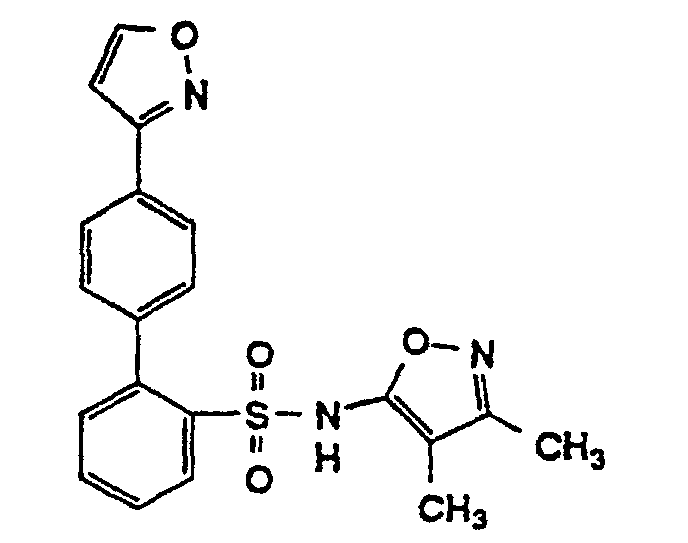
- To a 0.5M solution of hydrochloric acid in dimethylformamide, 8.5g (42.5 mmol) of 4-Bromobenzaldehyde oxime was added and cooled to 5°C. 13g of oxone was then added in portions. The mixture was slowly warmed to room temperature and stirred for 8 hours. The reaction mixture was poured into 300 mL of cold water and extracted with 2 x 150 mL of ether. The combined organic extracts were washed once with 150 mL of 0.5N aqueous hydrochloric acid and brine (150 mL), dried and evaporated to provide 7.9g (79%) of compound A.
- A mixture of 4.0g (17.06 mmol) of compound A, 7.34g (85.3 mmol) of vinyl acetate and 1.9g (18.76 mmol) of triethylamine in 50 mL of toluene was stirred at 75°C for 2 hours. The mixture was cooled and added to 150 mL of water. The organic layer was separated and the aqueous layer was extracted with 2 x 50 mL of ethyl acetate. The combined organic extracts were washed once with 100 mL of brine, dried and evaporated. The residue was crystallized from Hexanes/ethyl acetate to afford 3.6g (74%) of compound B as a white solid.
- To a solution of 3.0g (10.56 mmol) of compound B in 100 mL of absolute ethanol, 5 mL of 6N aqueous hydrochloric acid was added and the solution was refluxed for 3 hours. The mixture was concentrated to about 10 mL and the solution was neutralized using aqueous sodium bicarbonate. The resulting mixture was extracted with 2 x 50 mL of ether. The combined organic extracts were washed once with 100 mL of brine, dried and evaporated. The residue was chromatographed on 100g of silica gel using Hexanes/ethyl acetate 9:1 to afford 1.6g (68%) of compound C as a white solid.
- To a solution of 0.45g (1.17 mmol) of compound B from Example 1 and 0.058g (0.05 mmol) of tetrakis(triphenylphosphine)palladium(0) in 20 mL of toluene under argon, 12 mL of 2M aqueous sodium carbonate was added followed by 0.315g (1.4 mmol) of compound C in 12 mL of 95% ethanol. The mixture was refluxed for 2 hours, diluted with 100 mL of water and extracted with 3 x 50 mL of ethyl acetate. The combined organic extracts were washed once with 100 mL of brine, dried and evaporated. The residue was chromatographed on 50g of silica gel using Hexanes/ethyl acetate 2:1 to afford 0.27g (56%) of compound D as a colorless gum.
- To a solution of 0.26g (0.54 mmol) of compound D in 10 mL of 95% ethanol, 10 mL of 6N aqueous hydrochloric acid was added and refluxed for 1 hour. The mixture was then concentrated, diluted with 50 mL of water and extracted with 3 x 25 mL of ethyl acetate. The combined organic extracts were washed once with water, dried and evaporated (0.21g). This material was purified by reverse phase preparative HPLC on a 30 x 500 mm ODS S10 column using 67% solvent B (90% methanol, 10% water, 0.1% trifluoroacetic acid) and 33% solvent A (10% methanol, 90% water, 0.1% trifluoroacetic acid). The appropriate fractions were collected, neutralized with aqueous sodium bicarbonate to pH 7 and concentrated to 10 mL. The solution was then acidified to pH 4 using glacial acetic acid and the white solid was filtered and dried to provide 0.13g (61%) of the title compound.
M.p. 85-90°C.Analysis Calculated for C20H17N3O4S. 0.26 H2O: Calculated C,60.04; H,4.41; N,10.50; S,8.01; Found C,60.04; H,4.30; N,10.50; S,8.15. -

- To a solution of 6g (27.9 mmol) of 4-bromophenylacetic acid in 200 mL of dichloromethane under argon, 14 mL of 2M solution of oxalyl chloride in dichloromethane was added. Then four drops of dimethylformamide was added and the mixture was stirred at room temperature for 1 hour. The solution was evaporated and dried in vacuo. The residue was dissolved in 150 mL of methanol, and 30 mL of 28% aqueous ammonium hydroxide was added to the mixture. The solution was stirred at room temperature overnight and then diluted with 150 mL of water. The resulting white solid was filtered, washed with water and dried to afford 5.1g (85%) of compound A.
- A mixture of compound A (2g, 9.34 mmol) and vinylene carbonate (0.9g, 10.45 mmol) in 6g of polyphosphoric acid was heated at 170°C for 3 hours. The residue was added to 100 mL of water and extracted with 2 x 100 mL of ethyl acetate. The combined organic extracts were washed once with water, dried and evaporated. The residue was chromatographed on 200 mL of silica gel using Hexanes/ethyl acetate 2:1 to provide 1.12g (50%) of compound C as a white solid.
- To a solution of 0.6g (1.56 mmol) of compound B from Example 1 and 0.092g (0.08 mmol) of tetrakis(triphenylphosphine)palladium(0) in 30 mL of toluene under argon, 15 mL of 2M aqueous sodium carbonate was added followed by 0.45g (1.87 mmol) of compound B above in 15 mL of 95% ethanol. The mixture was refluxed for 2 hours, diluted with 100 mL of water and extracted with 3 x 50 mL of ethyl acetate. The combined organic extracts were washed once with 100 mL of brine, dried and evaporated. The residue was chromatographed on 200 mL of silica gel using Hexanes/ethyl acetate 2:1 to afford 0.72g (93%) of compound C as a colorless gum.
- To a solution of 0.7g (1.41 mmol) of compound C in 15 mL of 95% ethanol, 15 mL of 6N aqueous hydrochloric acid was added and refluxed for 1 hour. The mixture was then concentrated, diluted with 250 mL of water and extracted with 3 x 50 mL of ethyl acetate. The combined organic extracts were washed once with water, dried and evaporated to provide 0.41g of a colorless gum.
- The residue was purified by reverse phase preparative HPLC on a 30 x 500 mm ODS S10 column using 67% solvent B (90% methanol, 10% water, 0.1% trifluoroacetic acid) and 23% solvent A (10% methanol, 90% water, 0.1% trifluoroacetic acid). The appropriate fractions were collected and neutralized with aqueous sodium bicarbonate to pH 7 and concentrated to 10 mL. The solution was then acidified to pH 4 using dilute hydrochloric acid and the resulting white solid was filtered and dried to provide 0.098g (17%) of the title compound.
M.p. 65-70°C.
1H NMR (CDCl3): δ 1.80 (s,3H), 2.11 (s, 3H), 4.16 (s,2H), 7.04 (s, 1H), 7.27 - 8.02 (m, 10H).
13C NMR (CDCl3): δ 6.99, 11.20, 34.67, 108.10, 127.54, 128.32, 128.92, 129.47, 130.82, 133.15, 133.44, 135.95, 137.91, 138.51, 139.37, 141.25, 154.69, 162.27, 163.42. -
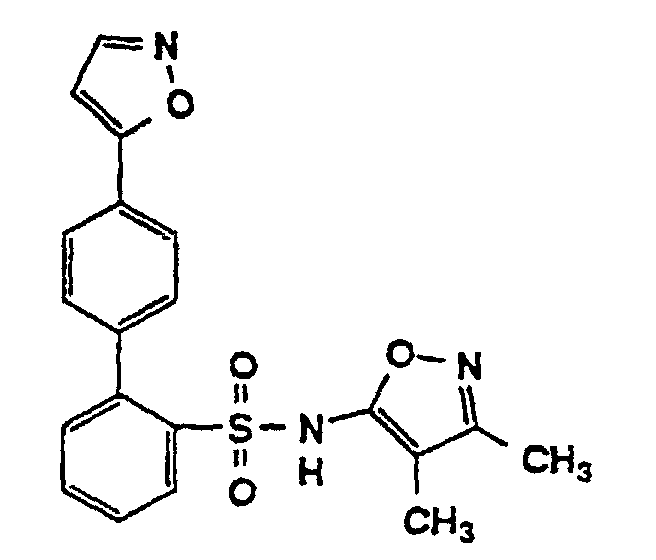
- A solution of 7.0g (35.2 mmol) of 4-bromoacetophenone in 7 mL of N,N-dimethylformamide diethyl acetal was refluxed for 20 hours. The solution was then diluted with 100 mL ether and cooled to 0°C. The yellow crystalline solid was filtered and dried to provide compound A (6.85g, 77%).
- To a solution of 6.2g (24.4 mmol) of compound A in 70 mL of methanol at 0°C was added a solution of 3.31g (29.27 mmol) of hydroxylamine-O-sulfonic acid in 20 mL of methanol over a period of 3 minutes. After stirring at room temperature for 1 hour, the reaction mixture was poured into a mixture of cold saturated sodium bicarbonate solution (200 mL) and ice-water (200 mL). The resulting mixture deposited 5.1g of a light yellow solid. Recrystallization of this material in Hexane/ethyl acetate then provided 3.12g (57%) of compound B as an off-white solid.
- To a solution of 0.56g (1.46 mmol) of compound 1 from Example 1 and 0.081g (0.07 mmol) of tetrakis(triphenylphosphine)palladium(0) in 25 mL of toluene under argon, 15 mL of 2M aqueous sodium carbonate was added followed by 0.49g (2.18 mmol) of compound B in 15 mL of 95% ethanol. The mixture was refluxed for 2 hours, diluted with 100 mL of water and extracted with 3 x 50 mL of ethyl acetate. The combined organic extracts were washed once with 100 mL of brine, dried and evaporated. The residue was chromatographed on 50g of silica gel using Hexanes/ethyl acetate 2:1 to afford 0.26g (37%) of compound C as a colorless gum.
- To a solution of 0.25g (0.52 mmol) of compound C in 10 mL of 95% ethanol, 10 mL of 6N aqueous hydrochloric acid was added and refluxed for 1 hour. The mixture was then concentrated, diluted with 100 mL of water and extracted with 3 x 50 mL of ethyl acetate. The combined organic extracts were washed once with water, dried and evaporated (0.21g). This material was purified by reverse phase preparative HPLC on a 30 x 500 mm ODS S10 column using 69% solvent B (90% methanol, 10% water, 0.1% trifluoroacetic acid) and 31% solvent A (10% methanol, 90% water, 0.1% trifluroacetic acid). The appropriate fractions were collected and neutralized with aqueous sodium bicarbonate to pH 7 and concentrated to 10 mL. The solution was acidified to pH 4 using glacial acetic acid and the white solid was filtered and dried to provide 0.11g (53%) of the title compound.
M.p. 85-90°C.Analysis Calculated for C20H17N3O4S. 0.27 H2O: Calculated C,60.02; H,4.42; N,10.50; S,8.01; Found C,60.16; H,4.24; N,10.36; S,8.17. -
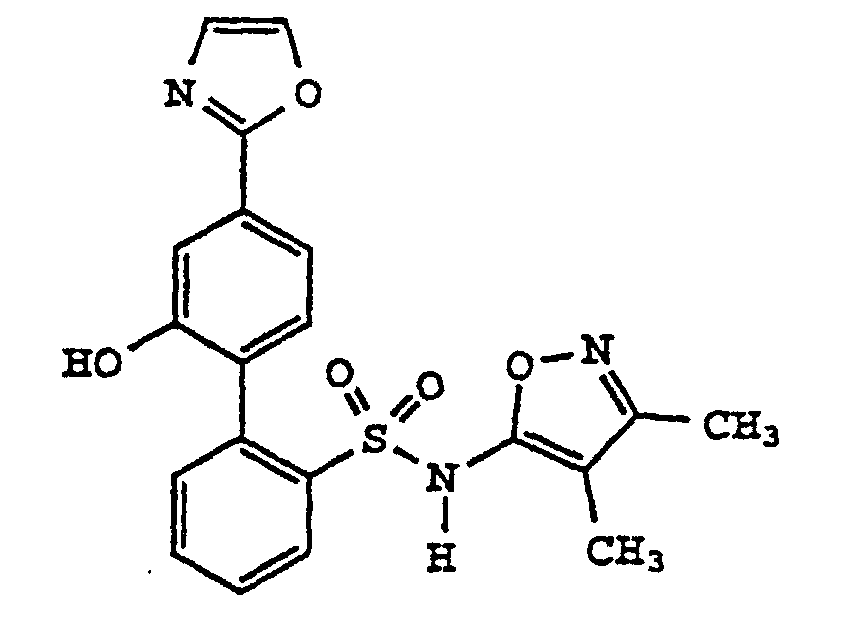
- Bromine (58 g, 19 mL, 0.36 mol) in acetic acid (50 mL) was slowly added over 2 hours to a solution of 3-hydroxybenzoic acid (50 g, 0.36 mol) in acetic acid (145 mL) with stirring at 15°C. After stirring at 15°C for an additional hour and then at ambient temperature for 17 hours, the solid formed was filtered and rinsed with acetic acid (20 mL). Drying by pulling air through the filter pack for 4 hours afforded 23.5 g (30%) of compound A.
- Sulfuric acid (concentrated, 9.4 mL) was added to a solution of compound A (23.5 g, 0.11 mol) in methanol (350 mL). After refluxing for 19 hours, the reaction was allowed to cool to room temperature and the pH was brought to about 4 with saturated sodium bicarbonate. After evaporating the methanol, the remaining solution was transferred to a separatory funnel. Extraction with ether (2 x 200 mL), washing the combined organic layers with brine (50 mL), and drying over magnesium sulfate afforded 25 g of crude product after evaporation of the solvent. Recrystallization from ether/hexane afforded 13.3 g (53%) of compound B.
- Dimethyl sulfate (6.4 mL, 67 mmol) and potassium carbonate (10 g) were added to a solution of compound B (13.3 g, 57 mmol) in acetone (86 mL). After refluxing for 19 hours, the reaction was cooled, the precipitate filtered off and the filtrate evaporated in vacuo to afford 14.7 g of crude product. Flash chromatography (silica, 50 mm diameter, 10% ethyl acetate/hexane) afforded 13.9 g of compound C (100%).
- Potassium hydroxide (2N, 120 mL, 240 mmol) was added to a solution of compound C (19 g, 79 mmol) in methanol (670 mL). After stirring at ambient temperature for 5.5 hours, water (100 mL) was added and the methanol removed in vacuo. The remaining solution was extracted with methylene chloride and then acidified with 6N hydrochloric acid to pH 1.5. Extraction with methylene chloride (1 x 500 mL and 2 x 200 mL) afforded 17 g (93%) of compound D after evaporation of the solvent.
- A solution of compound D (17 g, 73 mmol) and dimethylformamide (0.3 mL) in thionyl chloride (18 mL, 3.5 mol) was heated at 60°C for 2 hours. After evaporating the reaction in vacuo and azeotroping with toluene (twice), the residue was dissolved in tetrohydrofuran (30 mL) and added slowly to a vigorously stirring concentrated ammonium hydroxide solution (95 mL). The precipitate was filtered, washed with water and dried in a vacuum desiccator overnight to afford 17 g (100%) of compound E.
- Polyphosphoric acid (18 g) was added to compound E (8.5 g, 37 mmol) and the mixture was heated and stirred until it was homogeneous. Vinylene carbonate (3.2 g, 2.4 mL, 37 mmol) was added and the reaction mixture was stirred at 160°C for 2 hours during which time the reaction mixture evolved gas and turned black and gummy. After cooling, water and ether were added, mixed and decanted (three times). The decanted layers were filtered through Celite® and the filtrate transferred to a separatory funnel. The organic layer was washed with water (10 mL) and 1N sodium hydroxide (30 mL), and dried over magnesium sulfate to afford crude product after evaporation of the solvent. Any solid remaining in the reaction flask and the Celite® filter pad were rinsed with dichloromethane (3 x 10 mL) which was then washed with 1N sodium hydroxide (30 mL) and dried over magnesium sulfate. The two portions of crude product totaled 3.6 g. Flash chromatography (silica, 50 mm diameter, 30% ethyl acetate/hexane) afforded 2.3 g (24%) of compound F.
M.p. 68.5-70.5°C. - A solution of compound B from Example 1 (2.3 g, 2.9 mmol) in ethanol (sparged with argon 20 minutes, 16 mL) was added to a solution of compound F (1.1 g, 4.4 mmol) in toluene (sparged with argon 20 minutes, 32 mL). To this solution was added a solution of sodium carbonate (1.0 g) in water (sparged with argon 20 min, 16 mL) followed by tetrakis(triphenylphosphine)palladium(0) (0.28 g, 0.24 mmol). After refluxing under argon for 2 hours, the solution was cooled and poured into brine (40 mL). Extraction with ethyl acetate (2 x 150 mL) and drying the combined organic layers over magnesium sulfate afforded 4.1 g of crude product after evaporation of the solvent. Flash chromatography (silica, 50 mm diameter, 40% ethyl acetate/hexane) afforded 0.50 g (34%) of compound G.
- A solution of compound G (0.45 g, 0.88 mmol) in ethanol (13.4 mL) and 6N hydrochloric acid (13.4 mL) was stirred at 90°C. After 3.5 hours, the ethanol was evaporated in vacuo, and the residue transferred to a separatory funnel with dichloromethane/water. Extraction with dichloromethane (2 x 50 mL) and drying over magnesium sulfate afforded 0.37 g (100%) of compound H after evaporation of the solvent.
- Boron tribromide (1 M in dichloromethane, 6.2 mL, 6.2 mmol) was added to a solution of compound H (0.33 g, 0.77 mmol) in methylene chloride (27 mL) with stirring at -78°C. After stirring at -78°C for 30 minutes, the cold bath was removed. After stirring a total of 2.5 hours, the reaction mixture was transferred to a separatory funnel with dichloromethane/water. The pH was brought to 3.5 with saturated sodium bicarbonate. Extraction with dichloromethane (2 x 70 mL), and drying over magnesium sulfate afforded 0.68 g of crude product after evaporation of the solvent. Two flash chromatographies (silica, 25 mm diameter, 6% methanol/dichloromethane and silica, 15 mm diameter, 50% ethyl acetate/dichloromethane) afforded 60 mg (19%) of the title ocmpound.
M.p. 111.0-115.0°C.Analysis calculated for C20H17N3O5S · 0.15 C4H8O2 · 0.40 H2O: Calculated C, 57.29; H, 4.43; N, 9.73; S, 7.42; Found C, 57.30; H, 4.58; N, 9.37; S, 7.18. -
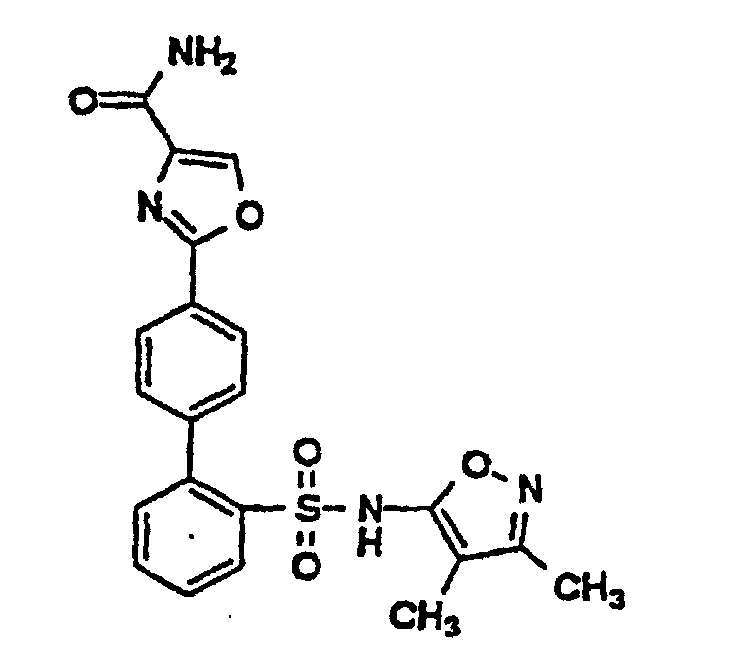
- A mixture of compound A from Example 7 (810 mg, 3.40 mmol) selenium dioxide (1.89 g, 17 mmol) and 6.8 mL dioxane was refluxed for 24 hours. After cooling the mixture was filtered and the filtrate was concentrated. The residue was chromatographed on silica gel using 60:1 dichloromethane/ethyl acetate to afford compound A (406 mg, 47%) as a light yellow solid.
- To a solution of compound B from Example 1 (772 mg, 2.0 mmol), compound A (390 mg, 1.55 mmol) in 15 mL of toluene and 12 mL of 95% ethanol under argon, tetrakis(triphenylphosphine)palladium(0) (116 mg, 0.1 mmol) was added, followed by 9 mL of 2M aqueous sodium carbonate. The reaction mixture was heated at 75°C for 1 hour, cooled and diluted with 80 mL of ethyl acetate. The organic liquid was separated, washed with 15 mL water and 15 mL brine, dried and concentrated. The residue was chromatographed on silica gel using 3:2 hexane/ethyl acetate to afford compound B (290 mg, 37%) as a colorless gum.
- To compound B (285 mg, 0.56 mmol) above and sulfamic acid (108 mg, 1.11 mmol) in 5.6 mL tetrahydrofuran at 0°C, an ice cooled solution of sodium chlorite (101 mg, 1.11 mmol) in 5.6 mL water was added. The mixture was stirred at 0°C for 3 minutes. 50 mL dichloromethane was added and the organic liquid was washed with 10 mL brine, dried and concentrated to give 2-[2'-[[(3,4-Dimethyl-5-isoxazolyl)[(2-methoxyethoxy)methyl]amino]-sulfonyl][1,1'-biphenyl]-4-yl]-4-oxazolecarboxylic acid.
- To 2-[2'-[[(3,4-Dimethyl-5-isoxazolyl)[(2-methoxyethoxy)methyl]amino]sulfonyl][1,1'-biphenyl]-4-yl]-4-oxazolecarboxylic acid and 0.014 mL dimethylformamide in 5.6 mL dichloromethane, oxalyl chloride (2M in dichloromethane, 0.56 mL, 1.11 mmol) was added, stirred for 0.5 hours and concentrated. To this mixture, 10 mL tetrahydrofuran and 2 mL concentrated ammonium hydroxide were added. The reaction mixture was stirred at room temperature for 50 minutes and concentrated. The organic liquid was washed with 15 mL water and 15 mL brine, dried and evaporated. The residue was chromatographed on silica gel using 1:4 hexane/ethyl acetate to afford compound C (245 mg, 84% for three steps) as a colorless gum.
- To a solution of compound C (240 mg, 0.46 mmol) in 4.6 mL acetonitrile at 0°C, trimethylsilicon chloride (297 mg, 2.74 mmol) was added followed by sodium iodide (410 mg, 2.74 mmol). The mixture was stirred at room temperature for 1 hour. 5 mL water was added and extracted with 50 mL ethyl acetate. The organic liquid was washed with 5 mL saturated aqueous sodium thiosulfate and 5 mL brine, dried and concentrated. The residue was purified by preparative HPLC on a 30 x 500 mm ODS S10 column using 37% solvent A (10% methanol, 90% water, 0.1% trifluoroacetic acid) and 63% solvent B (90% methanol, 10% water, 0.1% tetrahydrofuran) to provide the title compound (122 mg, 61%) as a white solid.
M.p. 195°C dec.Analysis calculated for C21H18N4O5S · 0.23H2O: Calculated C, 57.00; H, 4.20; N, 12.66; S, 7.24; Found C, 57.01; H, 4.10; N, 12.65; S, 7.18. -

- To a solution of 10g (46.5 mmol) of 4-bromo-3-methyl benzoic acid in 200 mL of dichloromethane under argon, 30 mL of 2M solution of oxalyl chloride in dichloromethane was added. Four drops of dimethylformamide was then added and the mixture was stirred at room temperature for 1 hour. The soltion was evaporated and dried in vacuo. The residue was dissolved in 100 mL of methanol, and 25 mL of 28% aqueous ammonium hydroxide was added to the mixture. The solution was stirred at room temperature for 3 hours, and then diluted with 500 mL of water. The resulting white solid was filtered, washed with water and dried to afford 8.9g (89%) of compound A.
- A mixture of compound A (12g, 56 mmol) and vinylene carbonate (6.5g, 75.5 mmol) in 25g of polyphosphoric acid was heated at 170°C for 3 hours. The residue was then added to 700 mL of water and extracted with 3 x 250 mL of ethyl acetate. The combined organic extracts were washed once with water, dried and evaporated. The residue was chromatographed on 200g of silica gel using dichloromethane to provide 6.7g (50%) of compound B as a white solid.
- A mixture of compound B (6.5g, 27.3 mmol), N-bromosuccinimide (9.72g, 54.6 mmol) and benzoyl peroxide (250 mg) in 250 mL of carbon tetrachloride was refluxed for 8 hours while illuminating the solution with a sun lamp. The mixture was then cooled and filtered. The filtrate was concentrated to provide 10g of a light yellow solid which was used in the next step without any furtur purification.
- To a solution of 7g of crude compound C in 15 mL of anhydrous dimethylsulfoxide under argon, 5.5g of anhydrous trimethylamine N-oxide (prepared as described in Soderquist et. al. Tet. Letters., 27, 3961(1986)) was added and the mixture was stirred at 55°C for 6 hours. The mixture was then cooled, added to 150 mL of ice/water and extracted with 3 x 100 mL of ethyl acetate. The combined organic extracts were washed once with 100 mL of brine, dried and evaporated. The residue was chromatographed on 300 mL of silica gel using Hexanes/ethyl acetate 8:1 to afford 2.2g (46% for two steps) of compound D as a white solid.
- To a solution of 2.3g (6 mmol) of compound B from Example 1 and 0.3g (0.26 mmol) of tetrakis(triphenylphosphine)palladium(0) in 40 mL of toluene under argon, 20 mL of 2M aqueous sodium carbonate was added followed by 1.0g (6.28 mmol) of compound D in 20 mL of 95% ethanol. The mixture was refluxed for 2 hours, diluted with 100 mL of water and extracted with 3 x 50 mL of ethyl acetate. The combined organic extracts were washed once with 100 mL of brine, dried and evaporated. The residue was chromatographed on 200 mL of silica gel using Hexanes/ethyl acetate 1:1 to afford 1.69g (55%) of compound E as a colorless gum.
- To a solution of 1.68g (3.28 mmol) of compound E in 30 mL of 95% ethanol, 30 mL of 6N aqueous hydrochloric acid was added and refluxed for 1 hour. The mixture was then concentrated and diluted with 250 mL of water and extracted with 3 x 150 mL of ethyl acetate. The combined organic extracts were then washed once with water, dried and evaporated to provide 1.46g (90%) of compound F as a colorless gum.
- To a solution of 0.28g (0.66 mmol) of compound F in 25 mL of methanol, 5g of ammonium acetate and 1g of 3Å molecular sieves were added and stirred at room tempertaure for 1 hour. Sodium triacetoxyborohydride (0.42g, 1.98 mmol) was added and the mixture was stirred for an additional 45 minutes. The solution was filtered, concentrated to 10 mL, diluted with 25 mL of water and extracted with 3 x 25 mL of ethyl acetate. The combined organic extracts were then washed once with water, dried and evaporated. The residue was chromatographed on 15g of silica gel using 5% methanol in dichloromethane to afford 0.1g (36%) of compound G as a white solid.
- To a solution of 0.06g (0.14 mmol) of compound G in 10 mL of dichloromethane at 0°C, 0.02g of acetic formic anhydride and 0.02 g triethylamine were added. The mixture was slowly warmed to room temperature and stirred for 1 hour. The mixture was diluted with 10 mL of dichloromethane, washed with 20 mL of 0.1N aqueous hydrochloric acid and then with 20 mL of water. The organic layer was dried and evaporated. The residue was purified by reverse phase preparative HPLC on a 30 x 500 mm ODS S10 column using 56% solvent B (90% methanol, 10% water, 0.1% trifluroacetic acid) and 44% solvent A (10% methanol, 90% water, 0.1% trifluroacetic acid). The appropriate fractions were collected, neutralized with aqueous sodium bicarbonate to pH 7 and concentrated to 10 mL. The solution was then acidified to pH 4 using dilute hydrochloric acid, and the white solid was filtered and dried to provide 0.013g (21%) of the title compound.
M.p. 105-109°C.
1HNMR(CDCl3): δ 1.87 (s, 3H), 2.12 (s, 3H), 3.89 (ABq, J = 4.1, 15.8 Hz, 1H), 4.50 (ABq, J = 7.6, 15.8 Hz, 1H), 6.63 (br s, 1H), 7.03 - 7.93 (m, 10 H), 8.14 (s, 1H).
13C NMR (CDCl3): δ 6.83, 10.90, 39.80, 108.68, 124.26, 124.95, 127.29, 128.18, 128.79, 129.77, 130.26, 130.26, 130.52, 132.19, 133.58, 137.44, 137.61, 138.42, 138.88; 139.58, 154.37, 161.53, 162.25. -
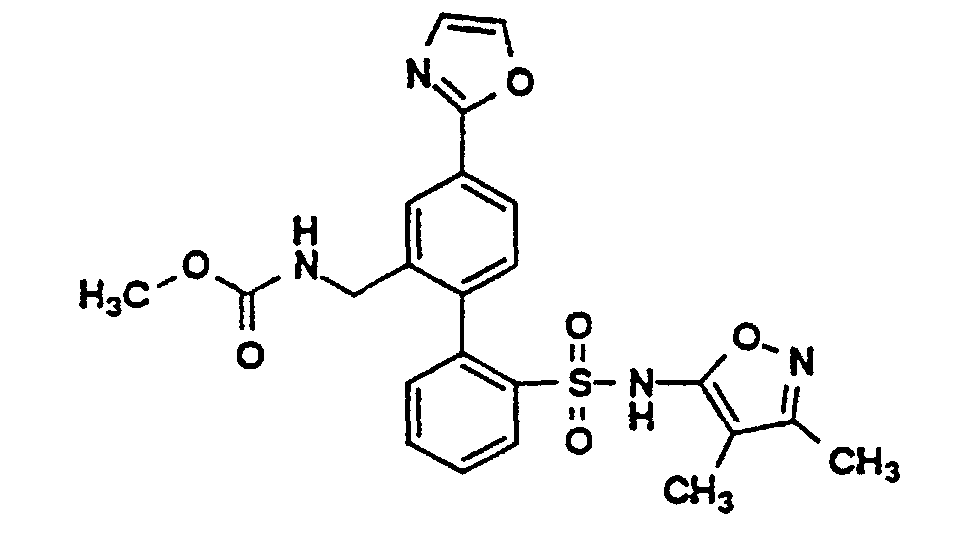
- To compound G from Example 21 (75 mg, 0.18 mmol) in 3.5 mL tetrahydrofuran, triethylamine (35 mg, 0.35 mmol) was added, followed by methyl chloroformate (17 mg, 0.18 mmol). The reaction was stirred at room temperature for 1 hour. Additional triethylamine (18 mg, 0.18 mmol) and methyl chloroformate (17 mg, 0.18 mmol) were added and the reaction was stirred at 40°C for another 1.5 hours. The reaction mixture was concentrated and the residue was purified by preparative HPLC on a 30 x 500 mm ODS S10 column using 42% solvent A (10% methanol, 90% water, 0.1% trifluoroacetic acid) and 58% solvent B (90% methanol, 10% water, 0.1% trifluoroacetic acid) to provide the title compound (30 mg, 35%) as a white solid.
M.p. 110-120°C (amorphous).Analysis calculated for C23H22N4O6S · 0.41H2O: Calculated C, 56.39; H, 4.69; N, 11.44; S, 6.54; Found C, 56.11; H, 4.48; N, 11.19; S, 6.49. -

- To compound G from Example 21 (75 mg, 0.18 mmol) in 7.1 mL tetrahydrofuran, methyl isocyanate (71 mg, 1.24 mmol) was added. The reaction was stirred at room temperature overnight and concentrated. The residue was purified by preparative HPLC on a 30 x 500 mm ODS S10 column using 46% solvent A (10% methanol, 90% water, 0.1% trifluoroacetic acid) and 54% solvent B (90% methanol, 10% water, 0.1% trifluoroacetic acid) to provide the title compound (38 mg, 45%) as a white solid.
M.p. >150°C, dec.Analysis calculated for C23H23N5O5S · 0.45H2O 0.2CH2Cl2: Calculated C, 55.00; H, 4.83; N, 13.82; S, 6.33; Found C, 54.57; H, 4.58; N, 13.61; S, 5.95. -

- To compound G from Example 21 (75 mg, 0.18 mmol) and triethylamine (54 mg, 0.53 mmol) in 7.1 ml tetrahydrofuran, methanesulfonyl chloride (57 mg, 0.5 mmol) was added. The reaction was stirred at 45°C for 2 hours. The reaction mixture was concentrated and the pH of the solution was adjusted to 8 using sodium bicarbonate solution. It was then acidified to pH 5 with glacial acetic acid. The mixture was extracted with dichloromethane. The organic liquid was concentrated and the residue was purified by preparative HPLC on a 30 x 500 mm ODS S10 column using 47% solvent A (10% methanol, 90% water, 0.1% trifluoroacetic acid) and 53% solvent B (90% methanol, 10% water, 0.1% trifluoroacetic acid) to provide the title compound (27 mg, 30%) as a white solid.
M.p. 110-120°C (amorphous).Analysis calculated for C22H22N4O6S2 · 0.14CH3COOH: Calculated: C, 52.37; H, 4.45; N, 10.96; S, 12.56; Found: C, 52.43; H, 4.37; N, 10.76; S, 12.11. -
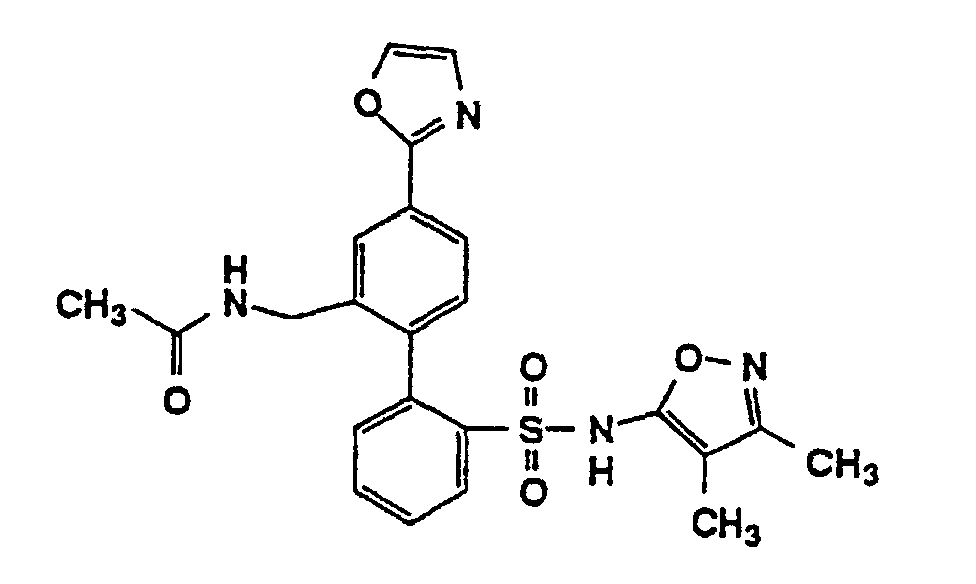
- To a solution of 0.075g (0.177 mmol) of compound G from Example 21 in 10 mL of dichloromethane at 0°C, 0.019g (0.19 mmol) of acetic anhydride and 0.019g triethylamine were added. The mixture was then slowly warmed to room temperature and stirred for 1 hour. The mixture was diluted with 10 mL of dichloromethane and washed with 20 mL of 0.1N aqueous hydrochloric acid and then with 20 mL of water. The organic layer was dried and evaporated. The residue was purified by reverse phase preparative HPLC on a 30 x 500 mm ODS S10 column using 58% solvent B (90% methanol, 10% water, 0.1% trifluoroacetic acid) and 42% solvent A (10% methanol, 90% water, 0.1% trifluoroacetic acid). The appropriate fractions were collected and neutralized with aqueous sodium bicarbonate to pH 7 and concentrated to 10 mL. The solution was acidified to pH 4 using dilute hydrochloric acid, and the white solid was filtered and dried to provide 0.041g (50%) of the title compound.
M.p. 105-107°C.Analysis calculated for C23H22N4O5S. 0.42 H2O: Calculated C,58.27; H,4.86; N,11.82; S,6.76; Found C,58.38; H,4.71; N,11.71; S,6.93. -

- To compound G from Example 21 (25 mg, 0.059 mmol) in 3 mL tetrahydrofuran, phenyl isocyanate(56 mg, 0.47 mmol) was added. The reaction was stirred at room temperature overnight and concentrated. The residue was purified by preparative HPLC on a 30 x 500 mm ODS S10 column using 33% solvent A (10% methanol, 90% water, 0.1% trifluoroacetic acid) and 67% solvent B (90% methanol, 10% water, 0.1% trifluoroacetic acid) to provide the title compound (18 mg, 56%) as a white solid.
1HNMR(CDCl3): δ 1.82 (s, 3H), 2.16 (s, 3H), 3.99 - 4.38 (m, 2H), 6.06 (s, br, 1H), 6.91 - 8.03 (m, 15H).
13C NMR (CDCl3): δ 7.60, 11.81, 42.65, 109.39, 119.92, 123.29, 124.13; 127.10, 128.26, 129.61, 130.68, 130.79. 132.96, 134.80, 137.72, 139.56, 140.00, 140.25, 140.43, 155.63, 156.58. -

- To compound G from Example 21 (20 mg, 0.047 mmol) in 3 mL tetrahydrofuran, propyl isocyanate (36 mg, 0.424 mmol) was added. The reaction mixture was stirred at room temperature overnight and concentrated. The residue was chromatographed on silica gel using 100:4.5 dichloromethane/methanol to provide the title compound (16 mg, 67%) as a light yellow solid.
1H NMR (CD3OD ): δ 0.89 (t, J=7Hz, 3H), 1.46 (m, 2H), 1.70 (s, 3H), 2.10 (s, 3H), 3.06 (t, J=7Hz, 2H), 4.08 (s, 2H), 7.10-8.12 (m, 9H).
13C NMR (CD3OD ): δ 6.57, 10.58, 11.62, 24.37, 42.91, 124.83, 125.06, 127.97, 129.10, 129.62, 130.34, 131.67, 133.11, 133.74, 139.83, 140.44, 140.87, 141.24, 141.96, 160.91, 162.99, 163.42. -
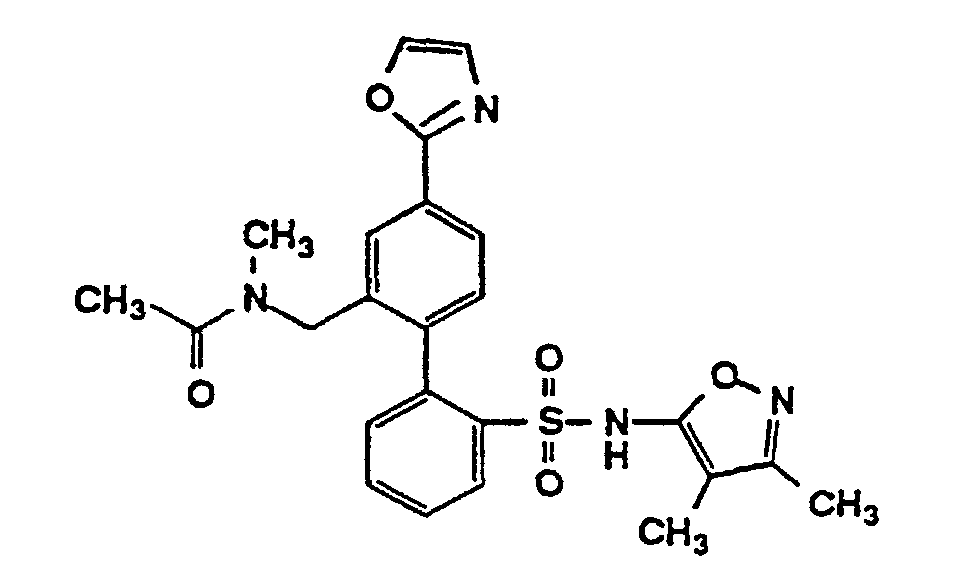
- To a solution of 0.15 g (0.35 mmol) of compound F from Example 21 in 15 mL of dichloromethane, methyl amine (33% solution in absolute ethanol, 0.13 mL, 1.06 mmol), glacial acetic acid (0.12 g, 2 mmol) and 1 g of 3 Å molecular sieves were added. The mixture was stirred at room temperature for 1 hour. Sodium triacetoxyborohydride (0.22 g, 1.06 mmol) was added and the mixture was stirred overnight. The solution was then filtered, washed once with water, dried and evaporated. The residue thus obtained was dissolved in 10 mL of dichloromethane, and 0.072 g (0.70 mmol) of acetic anhydride and 0.071 g (0.70 mmol) of triethylamine were added. The mixture was stirred at room temperature for 16 hours and evaporated. The residue was purified by reverse phase preparative HPLC on a 30 x 500 mm ODS S10 column using 58% solvent B (90% methanol, 10% water, 0.1% trifluoroacetic acid) and 42% solvent A (10% methanol, 90% water, 0.1% trifluoroacetic acid). The appropriate fractions were collected, neutralized with aqueous sodium bicarbonate to pH 7 and concentrated to 10 mL. The solution was acidified to pH 4 using glacial acetic acid and the white solid was filtered and dried to provide 0.069 g (41%) of the title compound as a light yellow solid.
M.p. 105-115°C. -
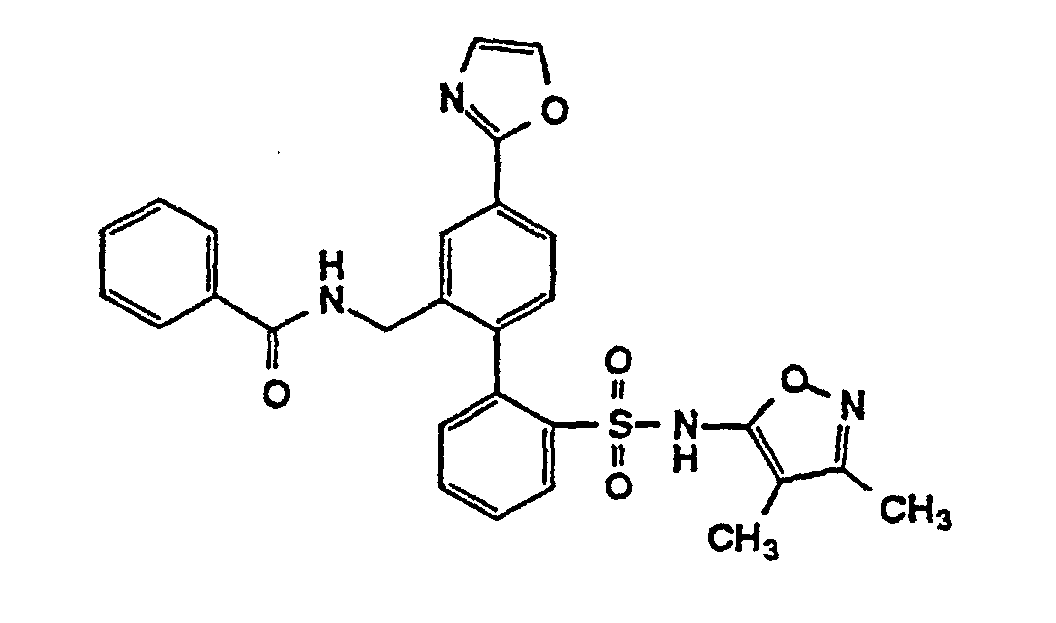
- To compound G from Example 21 (70 mg, 0.17 mmol) and benzoyl chloride (23 mg, 0.17 mmol) in 3.3 mL dichloromethane, triethylamine (37 mg, 0.36 mmol) was added. The reaction was stirred at room temperature for 1.5 hours and concentrated. The residue was purified by preparative HPLC on a 30 x 500 mm ODS S10 column using 33% solvent A (10% methanol, 90% water, 0.1% trifluoroacetic acid) and 67% solvent B (90% methanol, 10% water, 0.1% trifluoroacetic acid) to provide the title compound (30 mg, 34%) as a white solid.
M.p. 128-135°C (amorphous)
1H NMR (CDCl3): δ1.91 (s, 3H), 2.18 (s, 3H), 4.16-4.76 (m, 2H), 7.13-8.13 (m, 14H). -
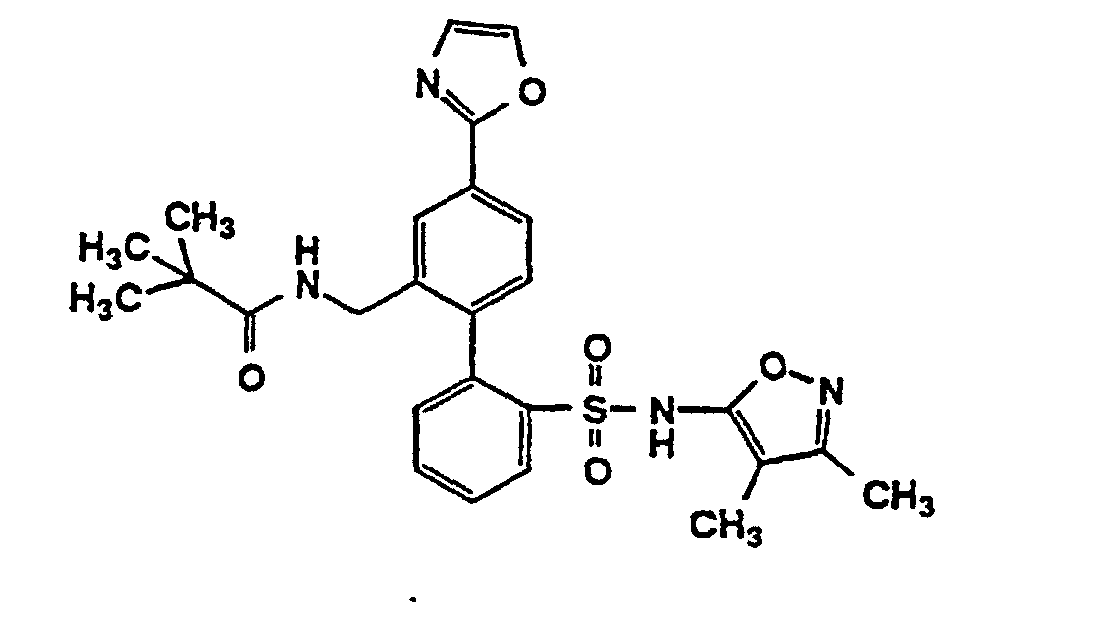
- To compound G from Example 21 (105 mg, 0.25 mmol) and trimethylacetyl chloride (30 mg, 0.25 mmol) in 4.9 mL dichloromethane, triethylamine (55 mg, 0.54 mmol) was added. The reaction was stirred at room temperature overnight and concentrated. The residue was purified by preparative HPLC on a 30 x 500 mm ODS S10 column using 33% solvent A (10% methanol, 90% water, 0.1% trifluoroacetic acid) and 67% solvent B (90% methanol, 10% water, 0.1% trifluoroacetic acid) to provide the title compound (52 mg, 34%) as a white solid.
M.p. 122-128°C
1H NMR (CDCl3): δ 1.18 (s, 9H), 1.93 (s, 3H), 2.18 (s, 3H), 3.96-4.46 (m, 2H), 7.24-8.05 (m, 9H). -
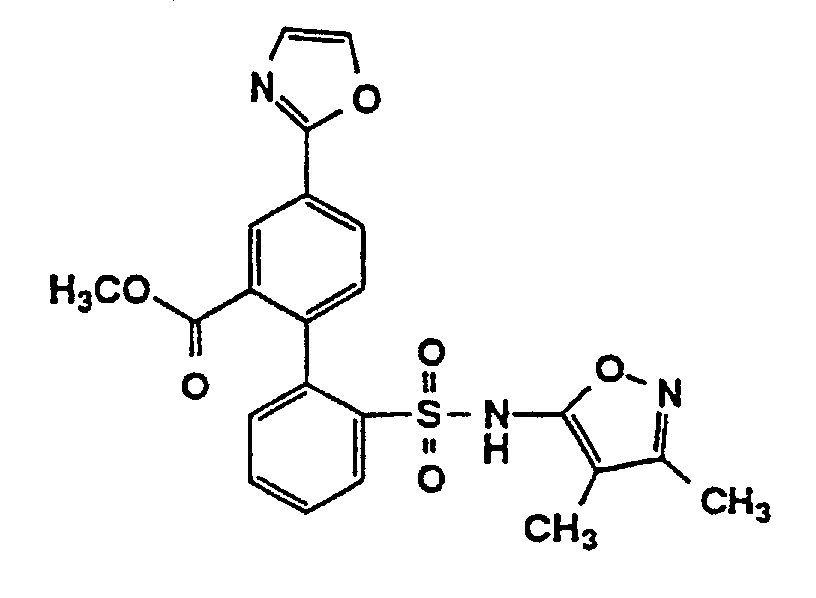
- To compound F from Example 21 (2.20 g, 5.20 mmol) and sulfamic acid (1.01 g, 10.39 mmol) in 52 mL THF at 0°C, an ice cooled solution of sodium chlorite (940 mg, 10.39 mmol) in 52 mL water was added. The mixture was stirred at 0°C for 2 minutes and then diluted with 150 ml dichloromethane. The organic liquid was separated and washed with brine, dried and concentrated. The residue was purified by preparative HPLC on an ODS S10 column using 43% solvent A(10% methanol, 90% water, 0.1% trifluoroacetic acid) and 57% solvent B (90% methanol, 10% water, 0.1% trifluoroacetic acid) to provide compound A (503 mg, 22%) as a white solid.
- To compound A (258 mg, 0.59 mmol) in 5.9 mL THF at 0°C. 1,1'-carbonyldiimidazole (209 mg, 1.29 mmol) was added. After stirring at room temperature for 1 hour, 1 mL methanol was added and the reaction mixture was stirred at room temperature overnight. An additional 3 mL methanol was added and the mixture was heated at 50°C for an additional 1 hour. After cooling to room temperature, 10 mL 0.5N aqueous HCl was added and stirred for 10 minutes. 60 mL ethyl acetate was added and the organic liquid was separated and washed with brine, dried and concentrated. The residue was purified by preparative HPLC on an ODS S10 column using 34% solvent A (10% methanol, 90% water, 0.1% trifluoroacetic acid) and 66% solvent B (90% methanol, 10% water, 0.1% trifluoroacetic acid) to provide the title compound (98 mg, 37%) as a white solid.
M.p. 106-112°C (amorphous). Rf=0.54, silica gel, 20:1 dichloromethane/methanol.
1H NMR (CDCl3): δ 1.84 (s, 3H), 2.17 (s, 3H), 3.73 (s, 3H), 7.27-8.62 (m, 10H). -

- To the title compound of Example 31 (87 mg, 0.19 mmol) in 1.9 mL THF at 0°C, methylmagnesium bromide (1.4M in toluene/THF 75:25, 0.43 mL, 0.60 mmol) was added. The reaction was stirred at 0°C for 10 minutes and at room temperature for 3 hours. Additional methylmagnesium bromide (1.4M in toluene/THF 75:25, 0.069 mL, 0.096 mmol) was added and stirred for an additional 10 minutes. The reaction was quenched with ice-water and acetic acid (45 mg, 0.77 mmol) and stirred for 10 minutes. The mixture was extracted with ethyl acetate and the organic extract was washed with brine, dried and concentrated. The residue was purified by preparative HPLC on an ODS S10 column using 37% solvent A (10% methanol, 90% water, 0.1% trifluoroacetic acid) and 63% solvent B (90% methanol, 10% water, 0.1% trifluoroacetic acid) to provide the title compound (40 mg, 46%) as a white solid.
M.p. 112-118°C (amorphous). Rf=0.27, silica gel, 20:1 dichloromethane/methanol.
1H NMR (CDCl3): δ 1.46 (s, 3H), 1.76 (s, 3H), 1.91 (s, 3H), 2.19 (s, 3H), 7.11-8.08 (m, 10H). -
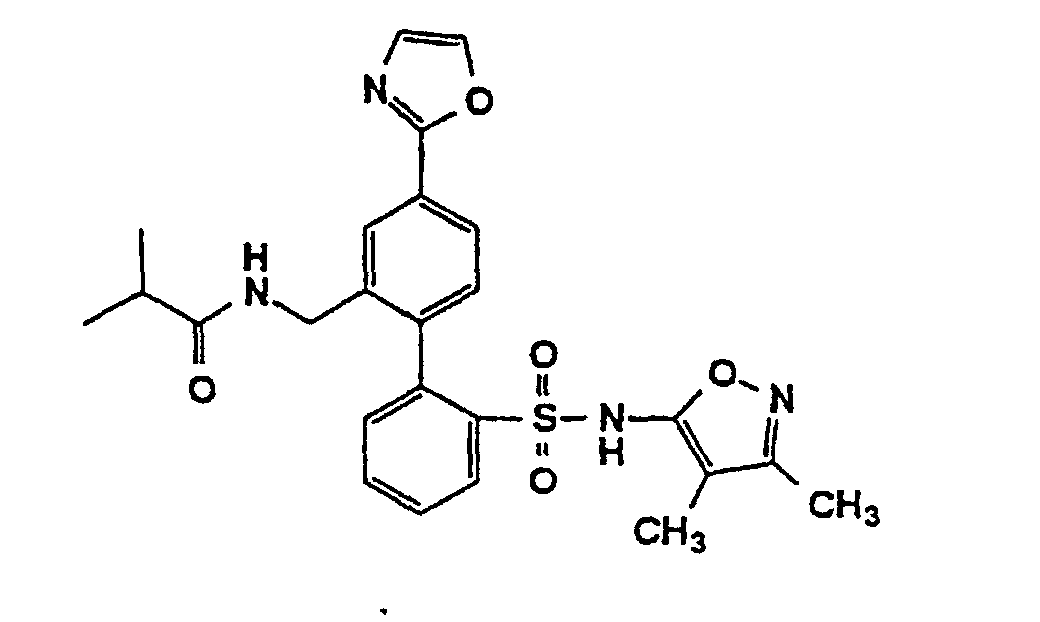
- To compound G from Example 21 (70 mg, 0.17 mmol) and isobutyryl chloride (18 mg, 0.17 mmol) in 3.3 mL dichloromethane, triethylamine (37 mg, 0.36 mmol) was added. The reaction was stirred at room temperature for 2 hours and concentrated. The residue was purified by preparative HPLC on a 30 x 500 mm ODS S10 column using 38% solvent A (10% methanol, 90% water, 0.1% trifluoroacetic acid) and 62% solvent B (90% methanol, 10% water, 0.1% trifluoroacetic acid) to provide the title compound (36 mg, 44%) as a white solid.
M.p. 112-120°C (amorphous). Rf=0.31, silica gel, 20:1 dichloromethane/methanol.
1H NMR (CDCl3): δ 1.13 (m, 6H), 1.93 (s, 3H), 2.19 (s, 3H), 2.42 (m, 1H), 4.04-4.43 (m, 2H), 6.56-8.40 (m, 11H). -
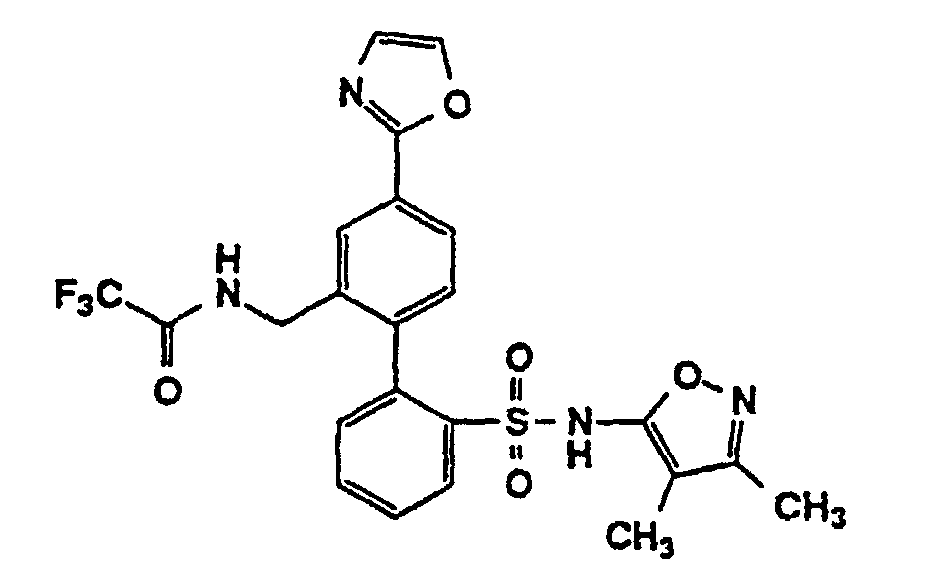
- To compound G from Example 21 (40 mg, 0.094 mmol) in 1.9 mL dichloromethane, triethylamine (19 mg, 0.19 mmol) was added and followed by trifluoroacetic anhydride (20 mg, 0.094 mmol). The reaction was stirred at room temperature for 2 hours and concentrated. The residue was purified by preparative HPLC on a 30 x 500 mm ODS S10 column using 37% solvent A (10% methanol, 90% water, 0.1% trifluoroacetic acid) and 63% solvent B (90% methanol, 10% water, 0.1% trifluoroacetic acid) to provide the title compound (20 mg, 41%) as a white solid. M.p. 112-120°C (amorphous). Rf=0.31, silica gel, 20:1 dichloromethane/methanol.
1H NMR (CDCl3) : δ 1.94 (s, 3H), 2.19 (s, 3H), 4.03-4.56 (m, 2H), 7.06-8.06 (m, 10H). -

- To compound A from Example 31 (124 mg, 0.28 mmol) in 2.8 mL THF at 0°C, 1,1'-carbonyldiimidazole (101 mg, 0.62 mmol) was added. After stirring at room temperature for 2 hours, 1 mL methylamine (40% in water) was added and the reaction was stirred at room temperature for 3 hours. 10 mL 1N HCl was added and stirred for 3 minutes. The mixture was extracted with 50 mL ethyl acetate and the organic extract was washed with water and brine, dried and concentrated. The residue was dissolved in 3 mL saturated sodium bicarbonate water solution and filtered. The filtrate was acidified to pH<5 with sodium bisulfate, and it was then filtered to give the title compound as a white solid (80 mg, 63%).
M.p. 122-131°C.
Rf=0.11, silica gel, 20:1 dichloromethane/methanol.
1H NMR (CDCl3): δ 1.89 (s, 3H), 2.20 (s, 3H), 3.73 (s,3H), 2.76 (d, J=3.5Hz, 3H), 6.53-8.16 (m, 11H). -
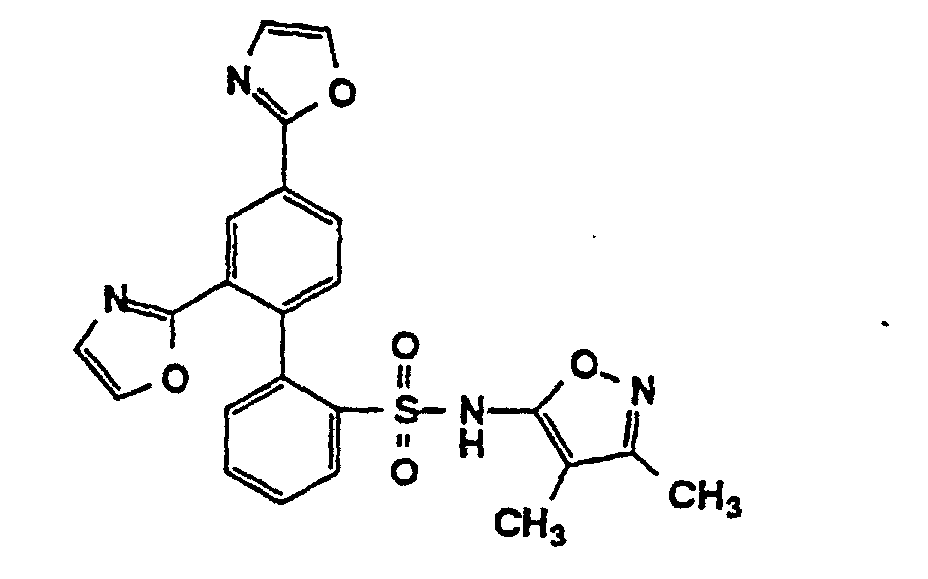
- To compound E from Example 21 (525 mg, 1.03 mmol) and sulfamic acid (199 mg, 2.05 mmol) in 14.7 mL THF at 0°C, an ice cooled solution of sodium chlorite (186 mg, 2.05 mmol) in 14.7 mL water was added. The mixture was stirred at 0°C for 2 minutes and then diluted with 100 mL dichloromethane. The organic liquid was separated and washed with brine, dried and concentrated to provide compound A as a gum, which was used without further purification.
- To compound A and 0.026 mL DMF in dichloromethane, oxalyl chloride (2M in dichloromethane, 1.3 mL, 2.6 mmol) was added. The reaction was stirred at room temperature for 1 hour and concentrated to give compound B.
- A mixture of compound B, 1H-1,2,3-triazole (71 mg, 1.03 mmol) and potassium carbonate (936 mg, 6.8 mmol) in 4.1 mL sulfolane was heated at 140°C for 3 hours. The mixture was diluted with 100 mL ethyl acetate, washed with water and brine, dried and concentrated. The residue was chromatographed on silica gel using 50:70:0.1 hexane/ethyl acetate/triethylamine to afford compound C.
- To compound C in 10 mL 95% ethanol, 10 mL 6N HCl was added. The mixture was refluxed for 1 hour and concentrated. The residue was neutralized to pH-5 with sodium bicarbonate and extracted with ethyl acetate. The organic extracts were washed with brine, dried and concentrated. The residue was purified by preparative HPLC on an ODS S10 column using 35% solvent A (10% methanol, 90% water, 0.1% trifluoroacetic acid) and 65% solvent B (90% methanol, 10% water, 0.1% trifluoroacetic acid) to provide the title compound (56 mg, 12% for four steps) as a white solid.
M.p. 108-113°C (amorphous). Rf=0.30, silica gel, 20:1 dichloromethane/methanol.
1H NMR (CDCl3): δ 1.90 (s, 3H), 2.19 (s, 3H), 7.02-9.61 (m, 12H). - and

-
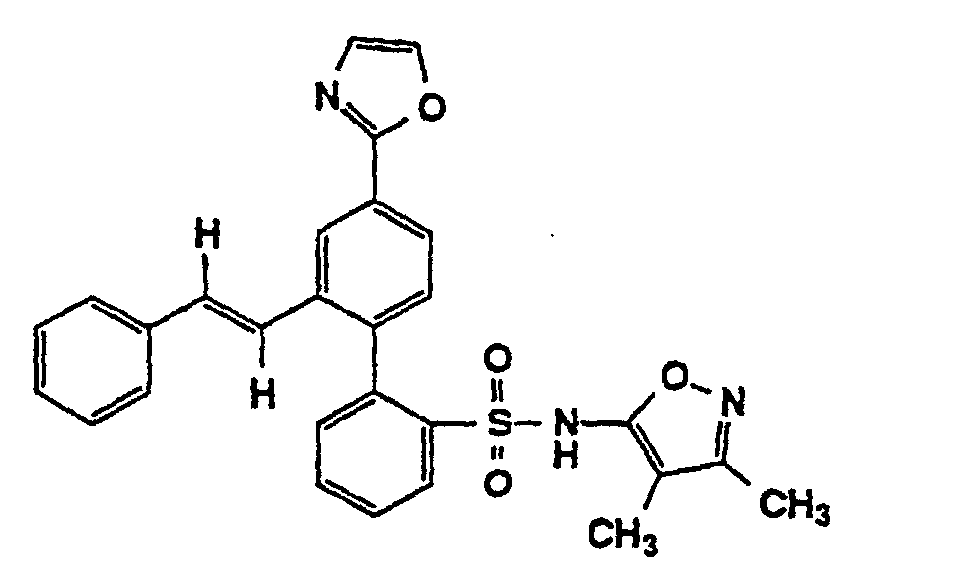
- and
- To benzyltriphenylphosphonium chloride(300 mg, 0.77 mmol) in 7.7 mL THF at -78°C, n-butyl lithium (2M in pentane, 0.39 mL, 0.78 mmol) was added. The cold bath was removed and the mixture was stirred at room temperature for 45 minutes before cooling to -78°C again. Compound E from Example 21 (304 mg, 0.59 mmol) was added at -78°C and the reaction was then stirred at room temperature for 2.5 hours. 10 mL water and 40 mL ethyl acetate were added. The organic liquid was separated and washed with saturated aqueous ammonium chloride and brine, dried and concentrated. The residue was chromatographed on silica gel using 2:1 hexane/ethyl acetate to afford a mixture of compounds A and B.
- and
- To a solution of compounds A and B in 6 mL of 95% ethanol, 6 mL of 6N aqueous hydrochloric acid was added and refluxed for 1 hour. The reaction mixture was concentrated and 80 mL ethyl acetate was added. The organic liquid was separated and washed with brine, dried and concentrated. The residue was purified by preparative HPLC on an ODS S10 column using 22% solvent A (10% methanol, 90% water, 0.1% trifluoroacetic acid) and 78% solvent B (90% methanol, 10% water, 0.1% trifluoroacetic acid) to provide compound C, the title compound of Example 37 (73 mg, 19% for two steps) as a white solid. M.p. 102-109°C (amorphous), Rf=0.32(silica gel, 20:1 dichloromethane/methanol).
- The HPLC column was eluted with the same solvents further to provide a mixture, which was chromatographed on silica gel using 100:2 dichloromethane/methanol to give compound D, the title compound of Example 38 (27 mg, 7% for two steps) as a light yellow solid.
M.p. 109-116°C (amorphous), Rf=0.32(silica gel, 20:1 dichloromethane/methanol).
1H NMR (CDCl3) of the title compound of Example 37: δ 1.86 (s, 3H), 2.16(s, 3H), 6.38-6.51 (m, J=12.3Hz, 2H), 6.60-7.98 (m, 15H).
1H NMR (CDCl3) of the title compound of Example 38: δ 1.74 (s, 3H), 2.01(s, 3H), 6.72-7.10 (m, J=16.4Hz, 2H), 7.17-7.98 (m, 15H). -
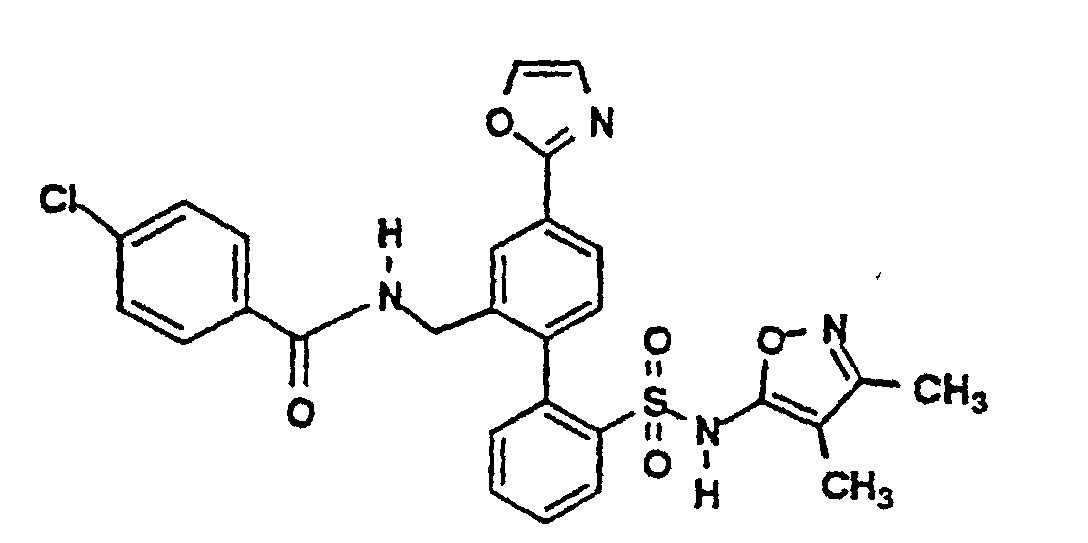
- To a solution of 0.20 g (0.47 mmol) of compound G from Example 21 in 15 mL of dichloromethane, 0.082 g (0.47 mmol) of 4-chlorobenzoyl chloride and 0.104 g (1.03 mmol) of triethylamine were added. The mixture was then stirred at room temperature for 16 hours and evaporated. The residue was purified by reverse phase preparative HPLC on a 30 x 500 mm ODS S10 column using 79% solvent B (90% methanol, 10% water, 0.1% trifluoroacetic acid) and 21% solvent A (10% methanol, 90% water, 0.1% trifluoroacetic acid). The appropriate fractions were collected and neutralized with aqueous sodium bicarbonate to pH 7 and concentrated to 10 mL. The solution was then acidified to pH 4 using glacial acetic acid and the white solid was filtered and dried to provide 0.033 g (12.5%) of the title compound as a white solid.
M.p. 130-134°C. -
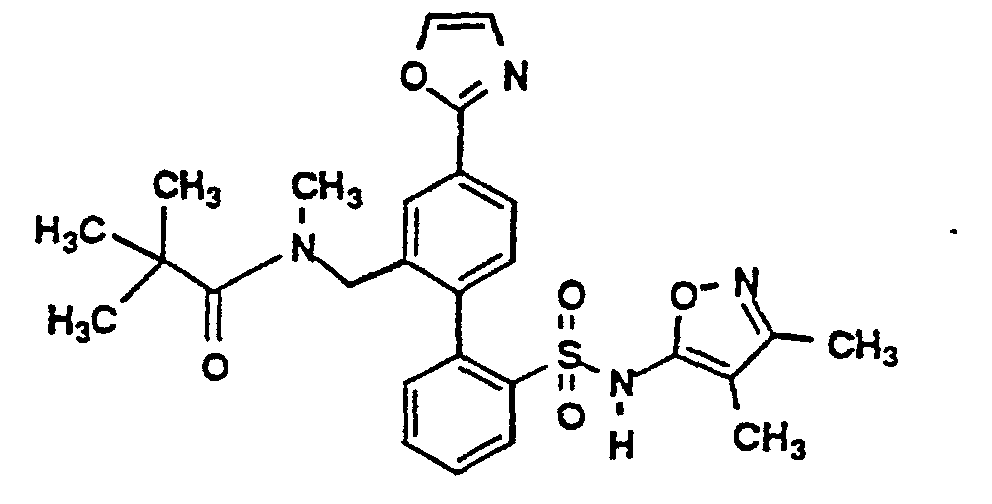
- To a solution of 0.25 g (0.59 mmol) of the intermediate formed in the preparation of compound A from Example 28 in 10 mL of dichloromethane, 0.078 g (0.65 mmol) of pivaloyl chloride and 0.131 g (1.30 mmol) of triethylamine were added. The mixture was then stirred at room temperature for 16 hours and evaporated. The residue was purified by reverse phase preparative HPLC on a 30 x 500 mm ODS S10 column using 75% solvent B (90% methanol, 10% water, 0.1% trifluoroacetic acid) and 25% solvent A (10% methanol, 90% water, 0.1% trifluoroacetic acid). The appropriate fractions were collected and neutralized with aqueous sodium bicarbonate to pH 7 and concentrated to 10 mL. The solution was then acidified to pH 4 using aqueous sodium bisulfate and the white solid was filtered and dried to provide 0.036 g (12%) of the title compound as a white solid.
M.p. 125-130°C. -

- To a solution of 0.25 g (0.59 mmol) of the intermediate formed in the preparation of compound A from Example 28 in 10 mL of dichloromethane, 0.10 g (0.71 mmol) of benzoyl chloride and 0.13 g (1.3 mmol) of triethylamine were added. The mixture was then stirred at room temperature for 16 hours and evaporated. The residue was purified by reverse phase preparative HPLC on a 30 x 500 mm ODS S10 column using 68% solvent B (90% methanol, 10% water, 0.1% trifluoroacetic acid) and 32% solvent A (10% methanol, 90% water, 0.1% trifluoroacetic acid). The appropriate fractions were collected and neutralized with aqueous sodium bicarbonate to pH 7 and concentrated to 10 mL. The solution was then acidified to pH 4 using aqueous sodium bisulfate and the white solid was filtered and dried to provide 0.075 g (23%) of the title compound as a white solid.
M.p. 132-140°C. -
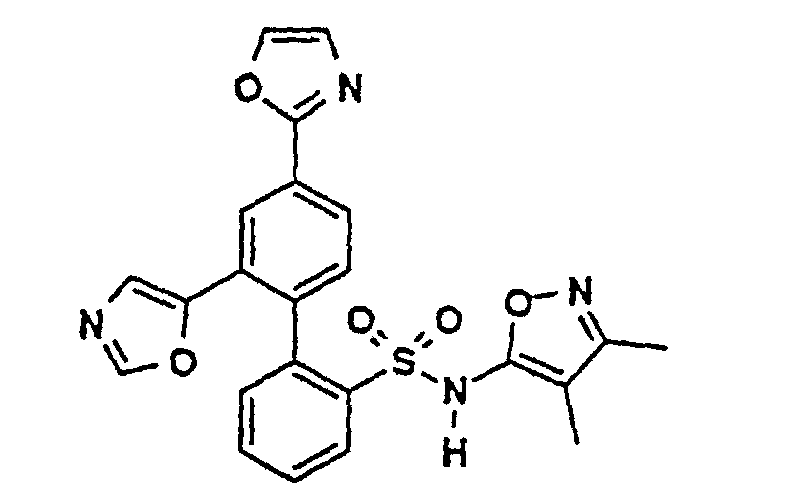
- A solution of Compound F from Example 21 (300 mg, 0.57 mmol), tosylmethylisocyanide (112 mg, 0.57 mmol) and potassium carbonate (95 mg, 0.69 mmol) in 4 mL of methanol was refluxed for two hours. After cooling to room temperature, the reaction mixture was preabsorbed on Celite® and the resulting powder was loaded onto a 2.5 x 20 cm silica gel column. Elution was with a stepwise gradient of 200 mL of ethyl acetate:hexane, 50:50 to ethyl acetate in 10% intervals. The pure fractions were concentrated to afford 96 mg (30%) of compound A as light yellow oil.
- A mixture of compound A (90 mg, 0.16 mmol), 6N HCl (1.6 ml) and ethanol (1.6 mL) was refluxed for 2.5 hours. After cooling to room temperature, the solvent was removed in vacuo and the residue was partitioned between ethyl acetate (75 mL) and saturated ammonium chloride solution (50 mL). The organic layer was washed with water (50 mL) and brine (50 mL). Drying (MgSO4) and concentration afforded a pink solid. Attempts to dissolve this solid in saturated NaHCO3 solution were unsuccessful and the resulting suspension was filtered and washed thoroughly with water. Drying under high vacuum afforded 30 mg (41%) of the title compound as a light pink solid.
Mp 212-218 °C. (dec.)
1H NMR (DMSO-d6): δ 1.56 (s, 3H), 2.06 (s, 3H), 5.82 (s, 1H), 7.21 (d, J= 8 Hz, 1H), 7.36 (m, 1H), 7.47 (s, 1H), 7.79 (m, 2H), 7.92 (d, J= 8 Hz, 1H), 8.13 (m, 1H), 8.32 s, 2H), 8.34 (s, 1H). - Other compounds contemplated by the present invention include the following compounds:
- 1. N-[[2'-[[(3,4-Dimethyl-5-isoxazolyl)-amino]sulfonyl]-4-(2-oxazolyl)[1,1'-biphenyl]-2-yl]methyl]-N-methylcyclopropanamide;
- 2. N-[[2'-[[(3,4-Dimethyl-5-isoxazolyl)-amino]sulfonyl]-4-(2-oxazolyl)[1,1'-biphenyl]-2-yl]methyl]-2,2-dimethyl-N-(1-methylethyl)propanamide;
- 3. N-Cyclopropyl-N-[[2'-[[(3,4-dimethyl-5-isoxazolyl)amino]sulfonyl]-4-(2-oxazolyl)[1,1'-biphenyl)-2-yl]methyl]-2,2-dimethylpropanamide;
- 4. N-[[2'-[[(3,4-Dimethyl-5-isoxazolyl)-amino]sulfonyl]-4-(2-oxazolyl)[1,1'-biphenyl]-2-yl]methyl]-2,2-dimethyl-N-(2,2,2-trifluoroethyl)propanamide;
- 5. N-(3,4-Dimethyl-5-isoxazolyl)-2'-[2-(1-methylethyl)-5-oxazolyl]-4'-(2-oxazolyl)[1,1'-biphenyl]-2-sulfonamide;
- 6. N-(3,4-Dimethyl-5-isoxazolyl)-2'-(4-oxazolyl)-4'-(2-oxazolyl)[1,1'-biphenyl]-2-sulfonamide;
- 7. N-(3,4-Dimethyl-5-isoxazolyl)-2'-[2-(1-methylethyl)-4-oxazolyl]-4'-(2-oxazolyl)[1,1'-biphenyl]-2-sulfonamide;
- 8. N-(3,4-Dimethyl-5-isoxazolyl)-4'-(2-oxazolyl)-2'-(2-oxazolylmethyl)[1,1'-biphenyl]-2-sulfonamide;
- 9. N-(3,4-Dimethyl-5-isoxazolyl)-4'-(2-oxazolyl)-2'-[[5-(1-methylethyl)-2-oxazolyl]-methyl][1,1'-biphenyl]-2-sulfonamide;
- 10. N-(3,4-Dimethyl-5-isoxazolyl)-4'-(2-oxazolyl)-2'-[[4-(1-methylethyl)-2-oxazolyl]-methyl][1,1'-biphenyl] -2-sulfonamide;
- 11. (E)-N-(3,4-Dimethyl-5-isoxazolyl)-2'-(4-methyl-2-pentenyl)-4'-(2-oxazolyl)[1,1'-biphenyl]2-sulfonamide;
- 12. (Z)-N-(3,4-Dimethyl-5-isoxazolyl)-2'-(4-methyl-2-pentenyl)-4'-(2-oxazolyl)[1,1'-biphenyl]-2-sulfonamide;
- 13. N-(3,4-Dimethyl-5-isoxazolyl)-2'-(4-methylpentyl)-4'-(2-oxazolyl)[1,1'-biphenyl]-2-sulfonamide;
- 14. trans-N-(3,4-Dimethyl-5-isoxazolyl)-2'-[[2-(1-methylethyl)cyclopropyl]methyl]-4'-(2-oxazolyl)[1,1'-biphenyl]-2-sulfonamide;
- 15. cis-N-(3,4-Dimethyl-5-isoxazolyl)-2'-[[2-(1-methylethyl)cyclopropyl]methyl]-4'-(2-oxazolyl)-[1,1'-biphenyl]-2-sulfonamide;
- 16. N-(3,4-Dimethyl-5-isoxazolyl)-4'-(2-oxazolyl)[1,1':2',1''-terphenyl]-2-sulfonamide;
- 17. N-(3,4-Dimethyl-5-isoxazolyl)-3''-(1-methylethyl)-4'-(2-oxazolyl)[1,1':2',1''-terphenyl]-2-sulfonamide;
- 18. N-(3,4-Dimethyl-5-isoxazolyl)-4''-(1-methylethyl)-4'-(2-oxazolyl)[1,1':2',1''-terphenyl]-2-sulfonamide;
- 19. N-(3,4-Dimethyl-5-isoxazolyl)-2'-[(2-methylpropoxy)methyl]-4'-(2-oxazolyl)[1,1'-biphenyl]-2-sulfonamide;
- 20. N-(3,4-Dimethyl-5-isoxazolyl)-2'-[2-(1-methylethoxy)ethyl]-4'-(2-oxazolyl)[1,1'-biphenyl]-2-sulfonamide; and
- 21. N-(3,4-Dimethyl-5-isoxazolyl)-2'-[2-[(1-methylethyl)sulfonyl]ethyl]-4'-(2-oxazolyl)[1,1'-biphenyl]-2-sulfonamide.
-
- The above compounds correspond (by number) to the following structures:
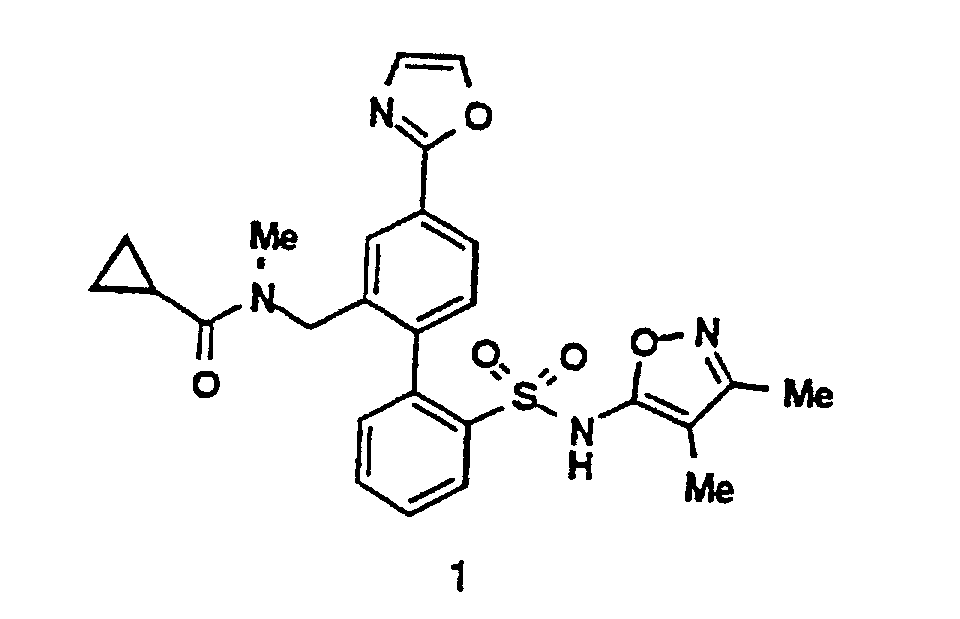


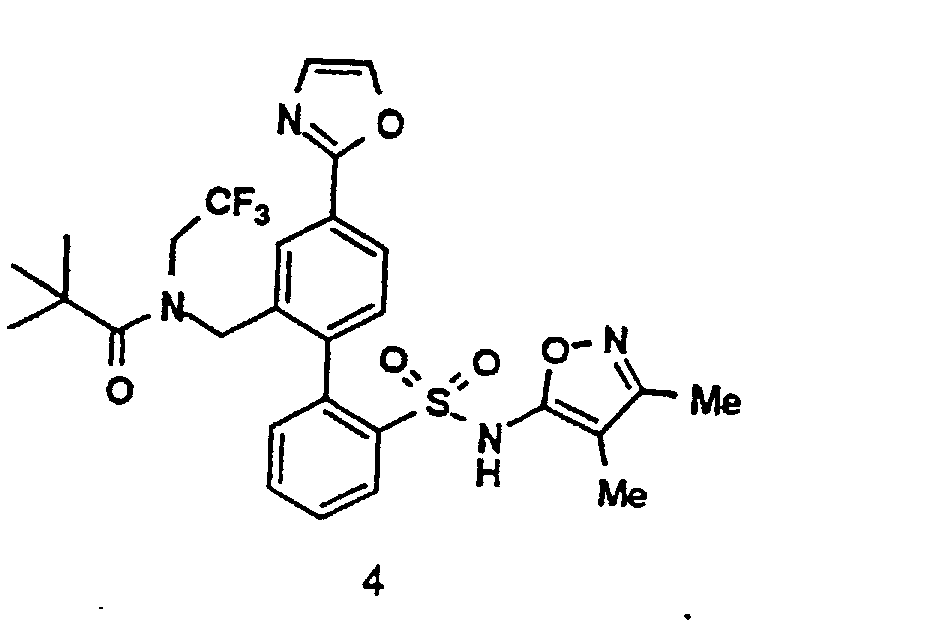
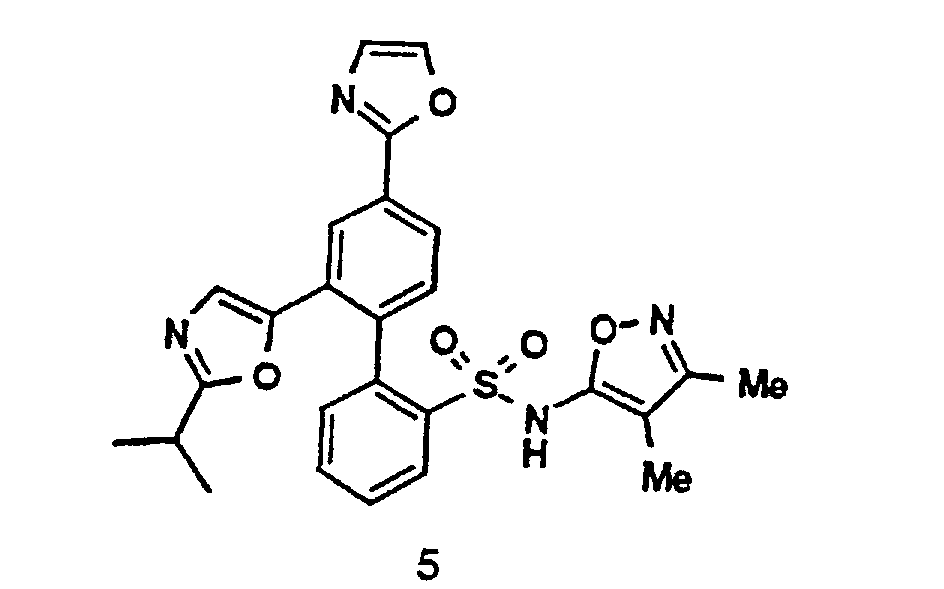

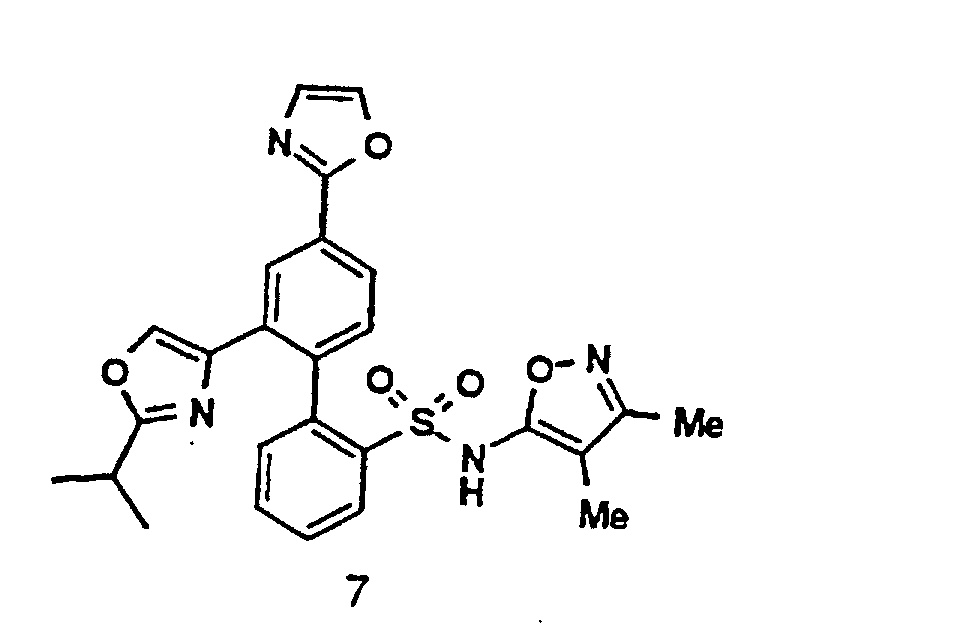
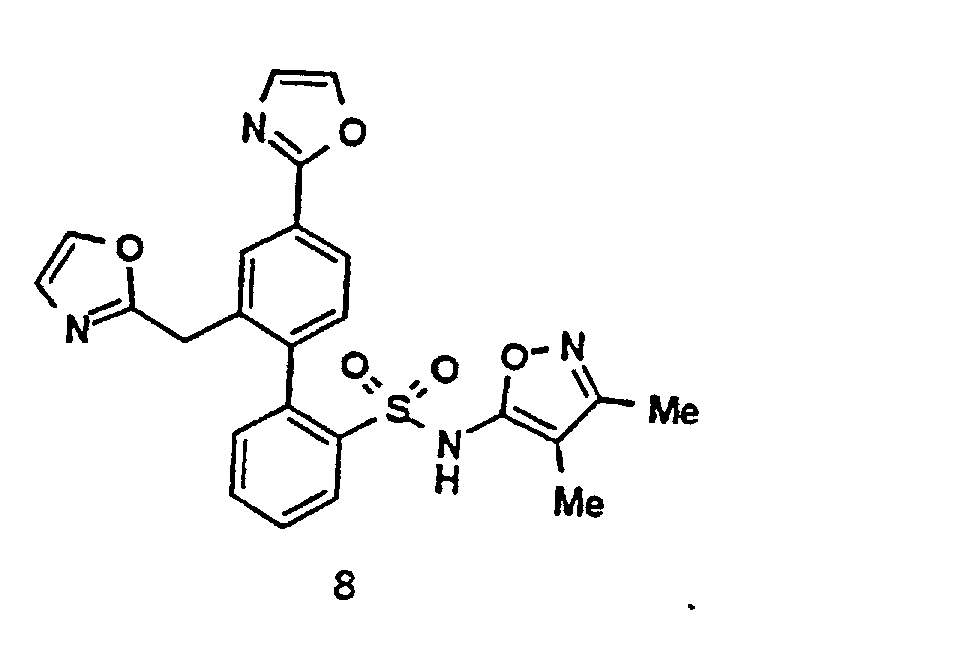
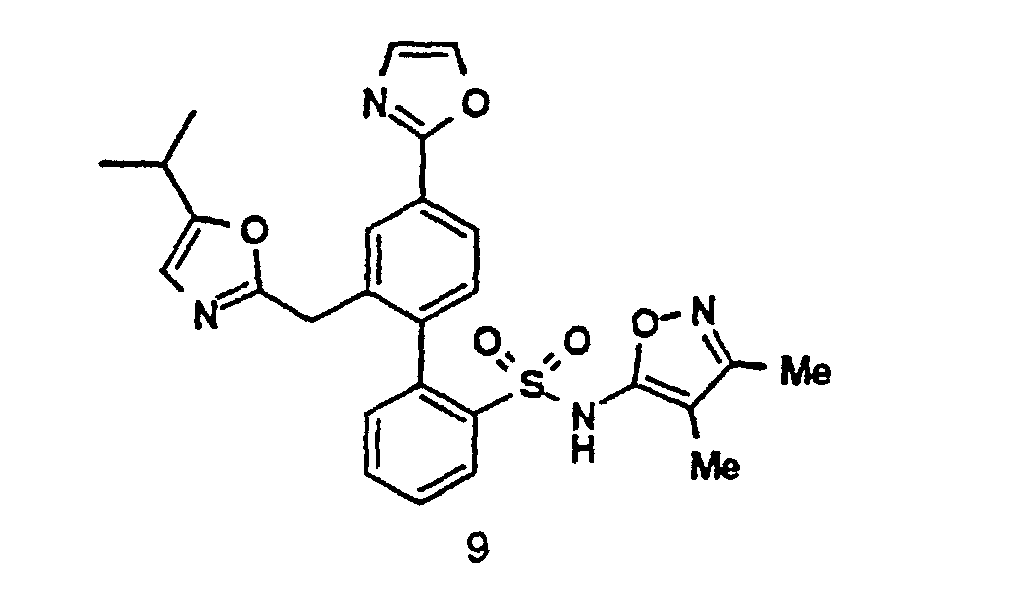


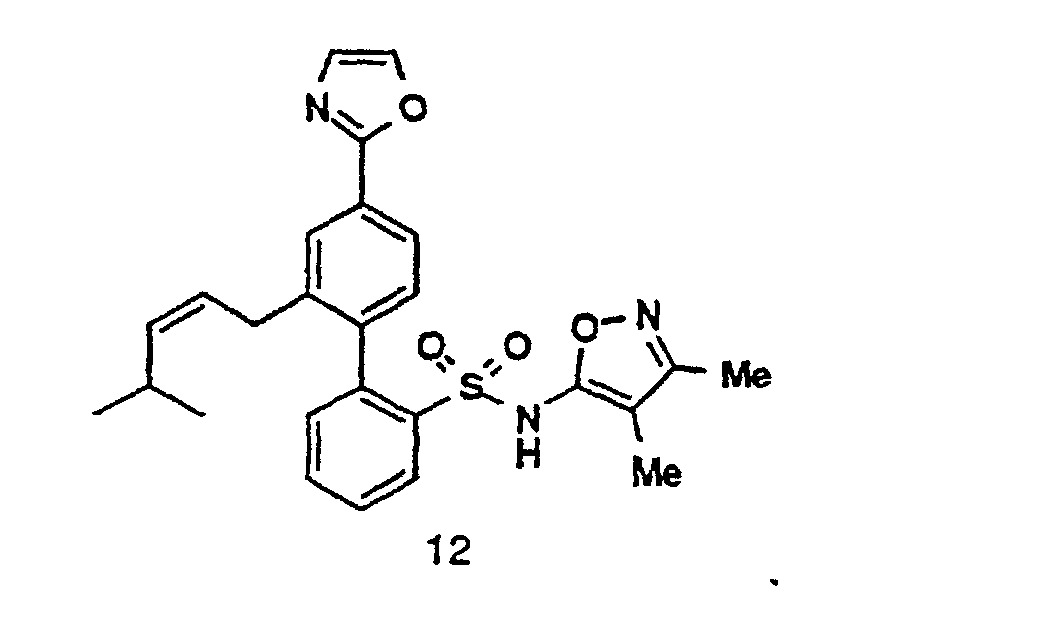


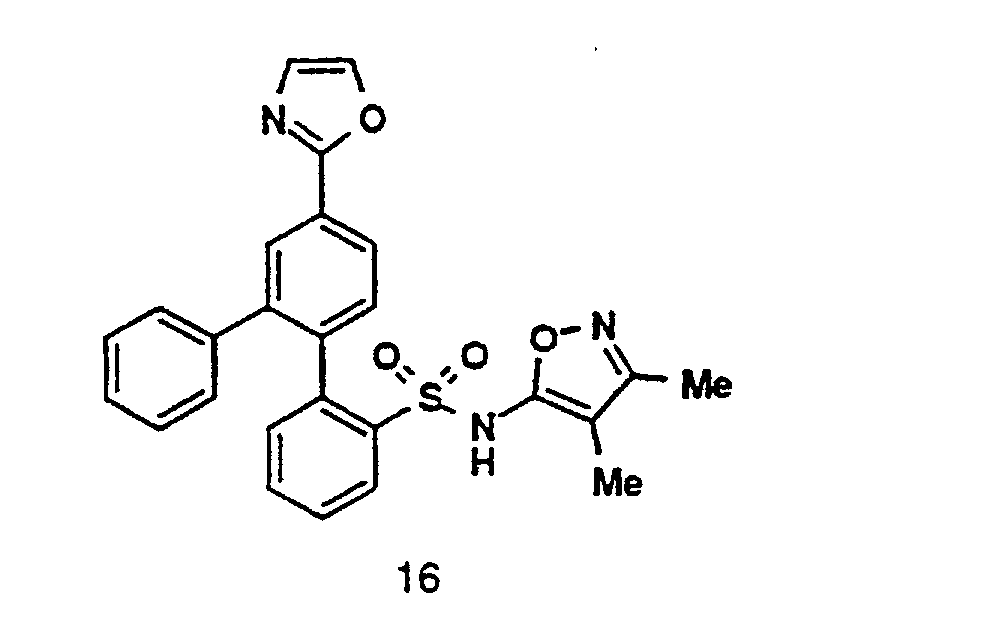
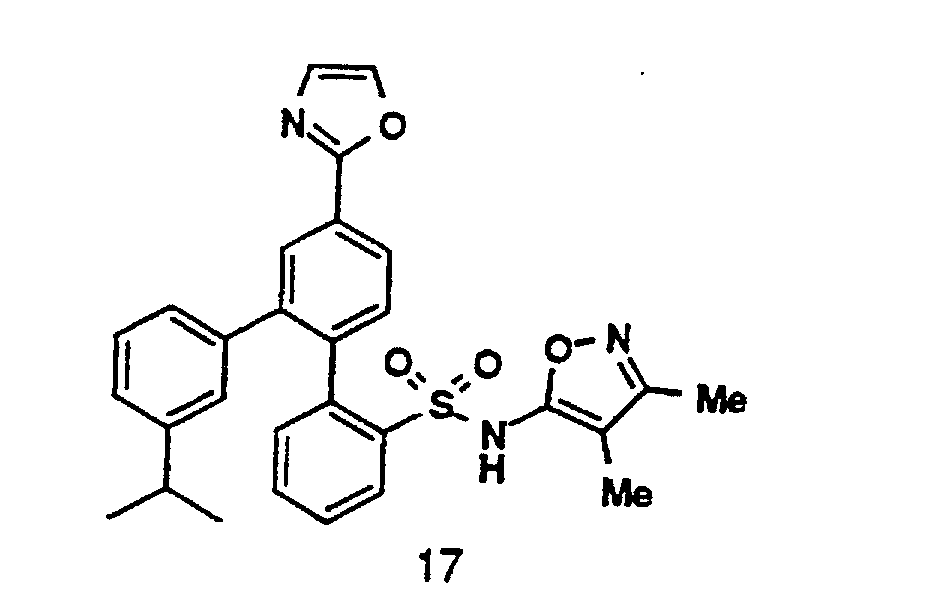
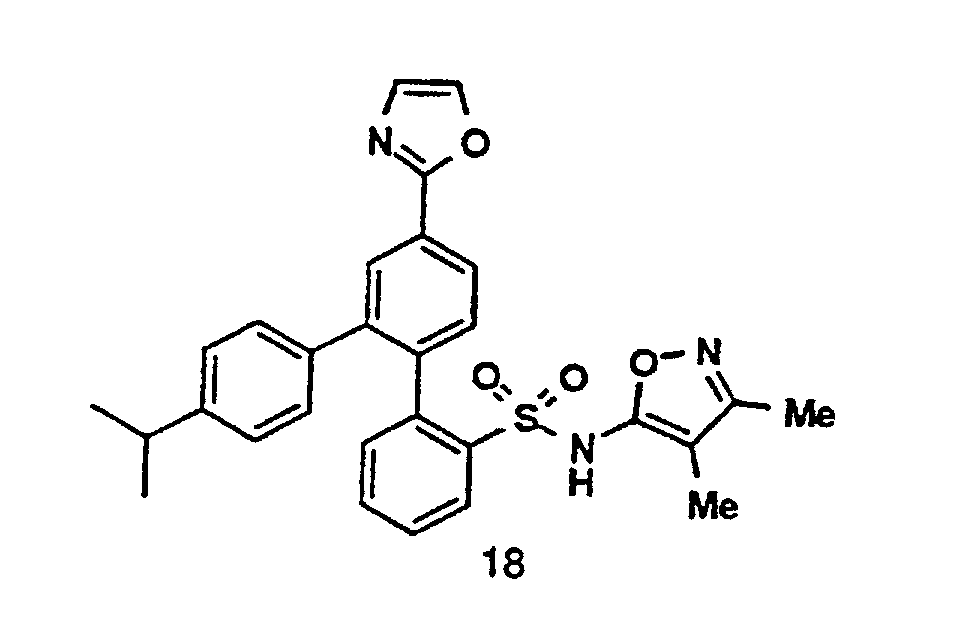
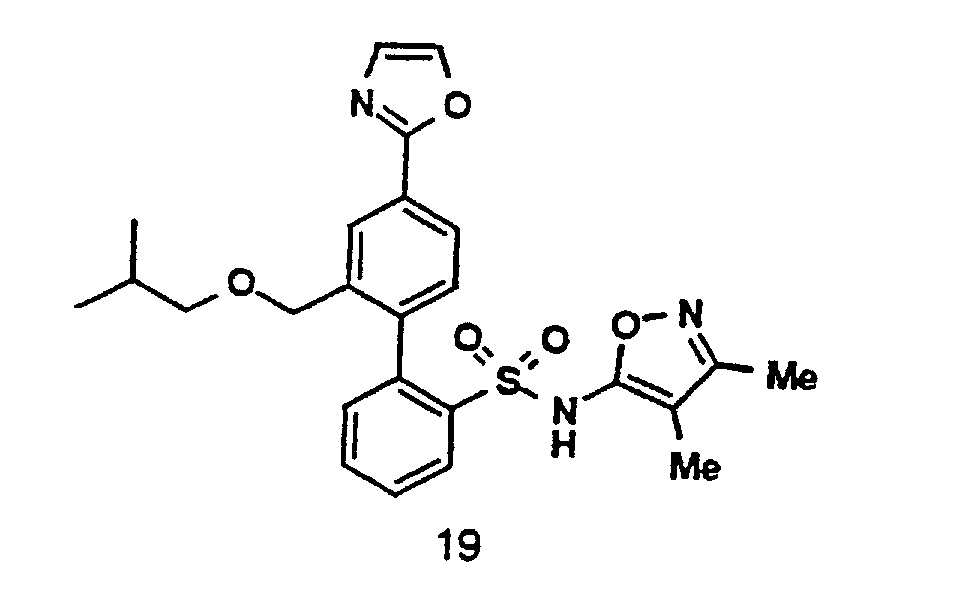
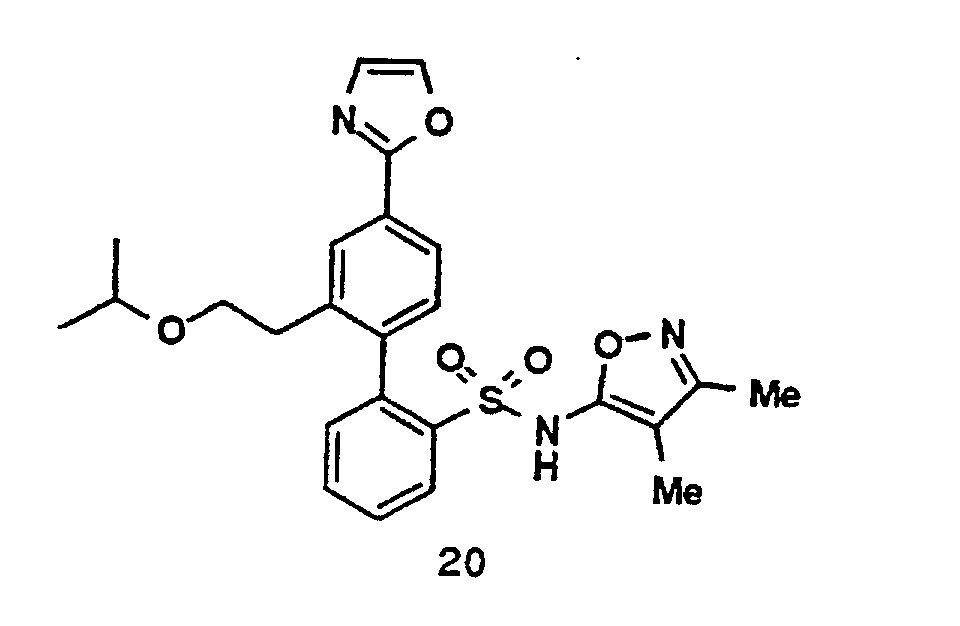
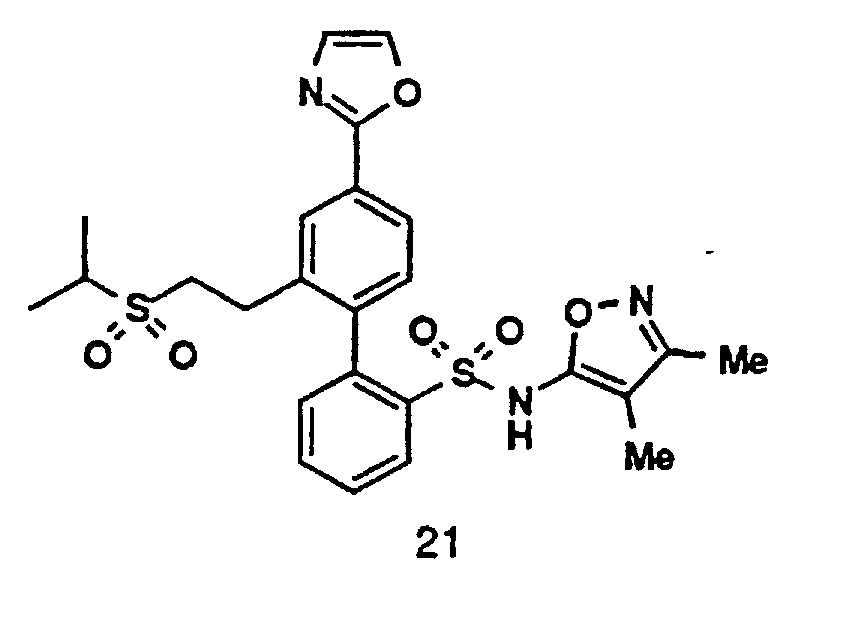
Claims (45)
- A compound of the formulaor an enantiomer, diastereomer or pharmaceutically acceptable salt thereof,
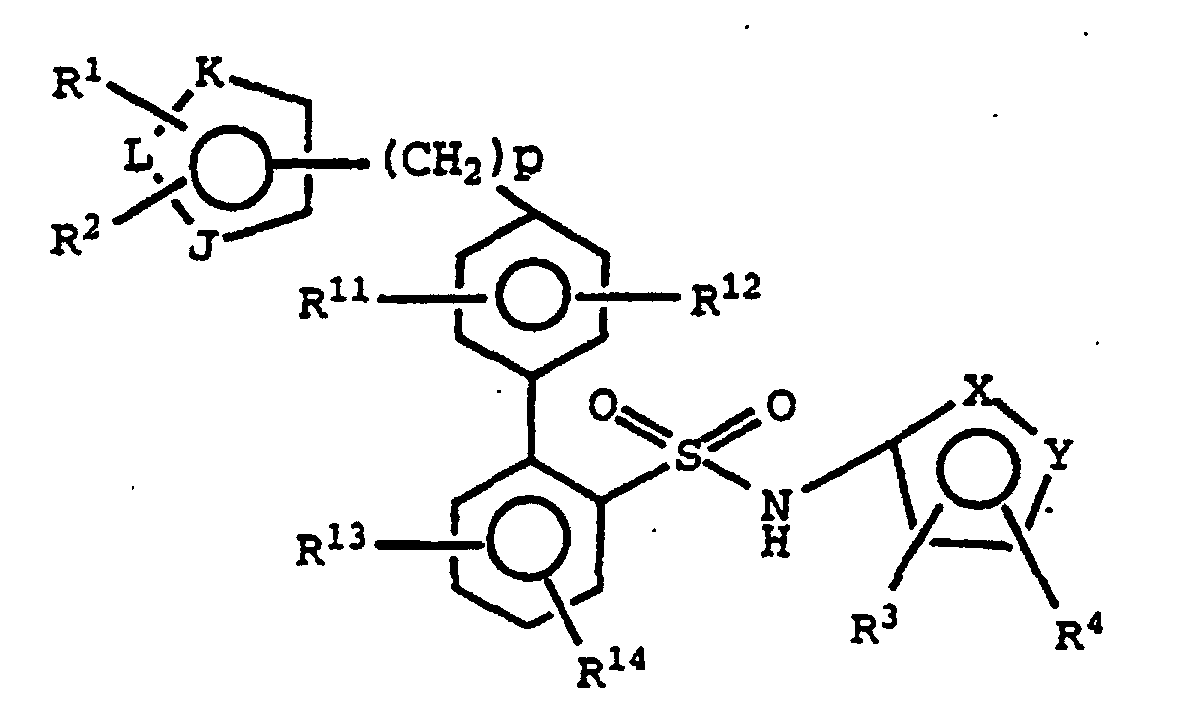
wherein:one of X and Y is N and the other is O;R1 and R2 are each directly bonded to a ring carbon and are each independently(a) hydrogen,(b) alkyl, or(c) -C(O)-NH2;R3 and R4 are each directly bonded to a ring carbon and are each independently alkyl;R11, R12, R13 and R14 are each independently selected from(a) hydrogen,(b) hydroxy,(c) alkyl,(d) alkyl substituted with 1-3 hydroxy groups,(e) amino,(f) alkenyl,(g) carboxamide,(h) oxazolyl,(i) oxazolyl substituted with 1-3 alkyl groups,(j) oxazolylalkyl,(k) arylalkenyl,(l) aryl,(m) aryl substituted with 1-3 alkyl groups,(n) alkoxyalkyl,(o) -(alkyl)N(H)(COH),(P) -(alkyl)N(H)(CO2-alkyl),(q) -(alkyl)N(H)(CO-N(H) -alkyl),(r) -(alkyl)N(H)(SO2-alkyl),(s) -(alkyl)N(H)(CO-alkyl),(t) -(alkyl)N(H)(CO-N(H)-aryl),(u) -(alkyl)N(alkyl)(CO-alkyl),(v) -(alkyl)N(haloalkyl)(CO-alkyl) wherein haloalkyl has 1-3 halo groups.(w) -(alkyl)N(cycloalkyl )(CO-alkyl),(x) -(alkyl)N(H)(CO-aryl),(y) -CO2-alkyl,(z) -(alkyl)N(H)(CO-haloalkyl) wherein haloalkyl has 1-3 halo groups,(aa) -C(O)NH-alkyl,(bb) -(alkyl)N(H)(CO-haloaryl) wherein haloaryl has 1-3 halo groups,(cc) -(alkyl)N(alkyl)(CO-aryl),(dd) -(alkyl)N(alkyl)(CO-cycloalkyl),(ee) alkenyl substituted with 1-3 alkyl groups,(ff) -(alkyl)cycloalkyl wherein cycloalkyl is substituted with 1-3 alkyl groups, and(gg) -(alkyl)(SO2)(alkyl);J is O, S, N or NR15;K and L are N or C, provided that at least one of K or L is C;R15 is hydrogen, alkyl, hydroxyethoxymethyl or methoxyethoxymethyl; andp is 0 or an integer from 1 to 2. - A compound of Claim 1, wherein R11 and R12 are each independently hydrogen, hydroxy, amino, oxazolyl optionally substituted with 1-3 alkyl groups, alkenyl optionally substituted with 1-3 alkyl groups, carboxamide or a substituted C1-to-C4-alkyl as defined in Claim 1.
- A compound of Claim 1, wherein R1 and R2 are each independently hydrogen or C1-to-C4-alkyl.
- A compound of Claim 1, wherein R3 and R4 are each independently C1-to-C4-alkyl.
- A compound of Claim 1, wherein R3 and R4 are each methyl.
- A compound of Claim 1, wherein R11 and R12 are each independently hydrogen, hydroxy, oxazolyl optionally substituted with 1-3 alkyl groups, alkenyl optionally substituted with 1-3 alkyl groups, carboxamide or a substituted C1-to C4-alkyl as defined in Claim 1.
- A compound of Claim 1, wherein R1 and R2 are each independently hydrogen or C1-to-C4-alkyl; R3 and R4 are each independently C1-to-C4-alkyl; and R11 and R12 are each independently hydrogen, hydroxy, oxazolyl optionally substituted with 1-3 alkyl groups, alkenyl optionally substituted with 1-3 alkyl groups, carboxamide or a substituted C1-to-C4-alkyl as defined in Claim 1.
- A compound of Claim 1, wherein R1 and R2 are each independently hydrogen or C1-to-C4-alkyl; R3 and R4 are each methyl; and R11 and R12 are each independently hydrogen, hydroxy, oxazolyl optionally substituted with 1-3 alkyl groups, alkenyl optionally substituted with 1-3 alkyl groups, carboxamide or a substituted C1-to-C4-alkyl as defined in Claim 1.
- A compound of Claim 1, wherein p is 0.
- A compound of Claim 1, wherein p is 1.
- A compound of Claim 1, wherein p is 0; R1 and R2 are each independently hydrogen or C1-to-C4-alkyl; R3 and R4 are each methyl; and R11 and R12 are each independently hydrogen, hydroxy, oxazolyl optionally substituted with 1-3 alkyl groups, alkenyl optionally substituted with 1-3 alkyl groups, carboxamide or a substituted C1-to-C4-alkyl as defined in Claim 1.
- A compound of Claim 1, wherein p is 1; R1 and R2 are each independently hydrogen or C1-to-C4-alkyl; R3 and R4 are each methyl; and R11 and R12 are each independently hydrogen, hydroxy, oxazolyl optionally substituted with 1-3 alkyl groups, alkenyl optionally substituted with 1-3 alkyl groups, carboxamide or a substituted C1-to-C4-alkyl as defined in Claim 1.
- A compound of Claim 1, selected from the group consisting of:2'-[[(3,4-Dimethyl-5-isoxazolyl)amino]-sulfonyl]-4-(2-oxazolyl)[1,1'-biphenyl]-2-carboxylic acid methyl ester;N-(3,4-Dimethyl-5-isoxazolyl)-2'-(1-hydroxy-1-methylethyl)-4'-(2-oxazolyl)[1,1'-biphenyl]-2-sulfonamide;N-[[2'-[[(3,4-Dimethyl-5-isoxazolyl)-amino]sulfonyl]-4-(2-oxazolyl)[1,1'-biphenyl]-2-yl]methyl]-2-methylpropanamide;N-[[2'-[[(3,4-Dimethyl-5-isoxazolyl)-amino]sulfonyl]-4-(2-oxazolyl)[1,1'-biphenyl]-2-yl]methyl]-2,2,2-trifluoroacetamide;N-(3,4-Dimethyl-5-isoxazolyl)-2'-[(methylamino)carbonyl]-4'-(2-oxazolyl)[1,1'-biphenyl]-2-sulfonamide;N-(3,4-Dimethyl-5-isoxazolyl)-2',4'-bis(2-oxazolyl)[1,1'-biphenyl]-2-sulfonamide;(Z)-N-(3,4-Dimethyl-5-isoxazolyl)-4'-(2-oxazolyl)-2'-(2-phenylethenyl)[1.1'-biphenyl]-2-sulfonamide;(E)-N-(3,4-Dimethyl-5-isoxazolyl)-4'-(2-oxazolyl)-2'-(2-phenylethenyl) [1,1'-biphenyl]-2-sulfonamide;4-Chloro-N-[[2'-[[(3,4-dimethyl-5-isoxazolyl)-amino]sulfonyl]-4-(2-oxazolyl)[1,1'-biphenyl]-2-yl]methyl]phenylacetamide;N-[[2'-[[(3,4-Dimethyl-5-isoxazolyl)amino]-sulfonyl]-4-(2-oxazolyl)[1,1'-biphenyl]-2-yl]methyl]-N,2,2-trimethylpropanamide;N-[[2'-[[(3,4-Dimethyl-5-isoxazolyl)amino]-sulfonyl]-4-(2-oxazolyl)(1,1'-biphenyl]-2-yl]methyl]-N-methylbenzamide;N-(3,4-Dimethyl-5-isoxazolyl)-2'-oxazolyl-5-yl-4'-oxazol-2-yl-[1,1'-biphenyl]-2-sulfonamide;N-[[2'-[[(3,4-Dimethyl-5-isoxazolyl)-amino]sulfonyl]-4-(2-oxazolyl) [1,1'-biphenyl]-2-yl]methyl]-N-methylcyclopropanamide;N-[[2'-[[(3,4-Dimethyl-5-isoxazolyl)-amino]sulfonyl]-4-(2-oxazolyl)[1,1'-biphenyl]-2-yl]methyl]-2,2-dimethyl-N-(1-methylethyl)propanamide;N-Cyclopropyl-N-[[2'-[[(3,4-dimethyl-5-isoxazolyl)amino]sulfonyl]-4-(2-oxazolyl)[1,1'-biphenyl]-2-yl]methyl]-2,2-dimethylpropanamide;N-[[2'-[[(3,4-Dimethyl-5-isoxazolyl)-amino]sulfonyl]-4-(2-oxazolyl) [1,1'-biphenyl]-2-yl]methyl]-2,2-dimethyl-N-(2,2,2-trifluoroethyl)propanamide;N-(3,4-Dimethyl-5-isoxazolyl)-2'-[2-(1-methylethyl)-5-oxazolyl]-4'-(2-oxazolyl)[1,1'-biphenyl]-2-sulfonamide;N-(3,4-Dimethyl-5-isoxazolyl)-2'-(4-oxazolyl)-4'-(2-oxazolyl)[1,1'-biphenyl]-2-sulfonamide;N-(3,4-Dimethyl-5-isoxazolyl)-2'-[2-(1-methylethyl)-4-oxazolyl]-4'-(2-oxazolyl)[1,1'-biphenyl]-2-sulfonamide;N-(3,4-Dimethyl-5-isoxazolyl)-4'-(2-oxazolyl)-2'-(2-oxazolylmethyl)[1,1'-biphenyl]-2-sulfonamide;N-(3,4-Dimethyl-5-isoxazolyl)-4'-(2-oxazolyl)-2'-[[5-(1-methylethyl)-2-oxazolyl]-methyl][1,1'-biphenyl]-2-sulfonamide;N-(3,4-Dimethyl-5-isoxazolyl)-4'-(2-oxazolyl)-2'-[[4-(1-methylethyl)-2-oxazolyl]-methyl][1,1'-biphenyl]-2-sulfonamide;(E)-N-(3,4-Dimethyl-5-isoxazolyl)-2'-(4-methyl-2-pentenyl)-4'-(2-oxazolyl)[1,1'-biphenyl]-2-sulfonamide;(Z)-N-(3,4-Dimethyl-5-isoxazolyl)-2'-(4-methyl-2-pentenyl)-4'-(2-oxazolyl)[1,1'-biphenyl]-2-sulfonamide;N-(3,4-Dimethyl-5-isoxazolyl)-2'-(4-methylpentyl)-4'-(2-oxazolyl)[1,1'-biphenyl]-2-sulfonamide;trans-N-(3,4-Dimethyl-5-isoxazolyl)-2'-[[2-(1-methylethyl)cyclopropyl]methyl]-4'-(2-oxazolyl) [1,1'-biphenyl]-2-sulfonamide;cis-N-(3,4-Dimethyl-5-isoxazolyl)-2"-[[2-(1-methylethyl)cyclopropyl]methyl]-4'-(2-oxazolyl)-[1,1'-biphenyl]-2-sulfonamide;N-(3,4-Dimethyl-5-isoxazolyl)-4'-(2-oxazolyl)[1,1':2',1''-terphenyl]-2-sulfonamide;N-(3,4-Dimethyl-5-isoxazolyl)-3''-(1-methylethyl)-4'-(2-oxazolyl)[1,1':2',1''-terphenyl]-2-sulfonamide;N-(3,4-Dimethyl-5-isoxazolyl)-4''-(1-methylethyl)-4'-(2-oxazolyl)[1,1':2',1''-terphenyl]-2-sulfonamide;N-(3,4-Dimethyl-5-isoxazolyl)-2'-[(2-methylpropoxy)methyl]-4'-(2-oxazolyl)[1,1'-biphenyl]-2-sulfonamide;N-(3,4-Dimethyl-5-isoxazolyl)-2'-[2-(1-methylethoxy)ethyl]-4'-(2-oxazolyl)[1,1'-biphenyl]-2-sulfonamide; andN-(3,4-Dimethyl-5-isoxazolyl)-2'-[2-[(1-methylethyl)sulfonyl]ethyl]-4'-(2-oxazolyl)[1,1'-biphenyl]-2-sulfonamide.
- A compound of Claim 1, selected from the group consisting of:N-(3,4-Dimethyl-5-isoxazolyl)-4'-(2-oxazolyl)[1,1'-biphenyl]-2-sulfonamide;N-(3,4-Dimethyl-5-isoxazolyl)-4'-(2-thiazolyl)[1,1'-biphenyl]-2-sulfonamide;N-(3,4-Dimethyl-5-isoxazolyl)-4'-(4,5-dimethyl-2-oxazolyl)[1,1'-biphenyl]-2-sulfonamide;N-(3,4-Dimethyl-5-isoxazolyl)-4'-(5-oxazolyl)[1,1'-biphenyl]-2-sulfonamide;N-(3,4-Dimethyl-5-isoxazolyl)-4'-(4-oxazolyl)[1,1'-biphenyl]-2-sulfonamide;N-(3,4-Dimethyl-5-isoxazolyl)-4'-(2-methyl-4-oxazolyl)[1,1'-biphenyl]-2-sulfonamide;N-(3,4-Dimethyl-5-isoxazolyl)-4'-(4-methyl-2-oxazolyl)[1,1'-biphenyl]-2-sulfonamide;N-(3,4-Dimethyl-5-isoxazolyl)-4'-(5-methyl-2-oxazolyl)[1,1'-biphenyl]-2-sulfonamide;N-(3,4-Dimethyl-5-isoxazolyl)-4'-(1H-pyrazol-1-yl)[1,1'-biphenyl]-2-sulfonamide;N-(3,4-Dimethyl-5-isoxazolyl)-4'-[1-[(2-methoxyethoxy)methyl]-1H-imidazol-2-yl][1,1'-biphenyl]-2-sulfonamide;N-(3,4-Dimethyl-5-isoxazolyl)-4'-[1-[(2-hydroxyethoxy)methyl]-1H-imidazol-2-yl][1,1'-biphenyl]-2-sulfonamide;N-(3,4-Dimethyl-5-isoxazolyl)-4'-(1-methyl-1H-imidazol-2-yl)[1,1'-biphenyl]-2-sulfonamide;N-(3,4-Dimethyl-5-isoxazolyl)-4'-(1H-imidazol-2-yl)[1,1'-biphenyl]-2-sulfonamide;N-(3,4-Dimethyl-5-isoxazolyl)-4'-(5-methyl-4-oxazolyl)[1,1'-biphenyl]-2-sulfonamide;N-(3,4-Dimethyl-5-isoxazolyl)-4'-(1H-imidazol-1-ylmethyl)[1,1'-biphenyl] -2-sulfonamide;N-(3,4-Dimethyl-5-isoxazolyl)-4'-(3-isoxazolyl)[1,1'-biphenyl]-2-sulfonamide;N-(3,4-Dimethyl-5-isoxazolyl)-4'-(2-oxazolylmethyl)[1,1'-biphenyl]-2-sulfonamide;N-(3,4-Dimethyl-5-isoxazolyl)-4'-(5-isoxazolyl)[1,1'-biphenyl]-2-sulfonamide;N-(3,4-Dimethyl-5-isoxazolyl)-2'-hydroxy-4'-(2-oxazolyl)[1,1'-biphenyl]-2-sulfonamide;2-[2'-[[(3,4-Dimethyl-5-isoxazolyl)amino]-sulfonyl][1,1'-biphenyl]-4-yl]-4-oxazole-carboxamide;N-(3,4-Dimethyl-5-isoxazolyl)-2'-[(formylamino)methyl]-4'-(2-oxazolyl)[1,1'-biphenyl]-2-sulfonamide;N-(3,4-Dimethyl-5-isoxazolyl)-2'-[[(methoxycarbonyl)amino]methyl]-4'-(2-oxazolyl)[1.1'-biphenyl]-2-sulfonamide;N-[[2'-[[(3,4-Dimethyl-5-isoxazolyl)amino]-sulfonyl]-4-(2-oxazolyl)[1,1'-biphenyl]-2-yl]-methyl]-N'-methylurea;N-(3,4-Dimethyl-5-isoxazolyl)-2'[[(methylsulfonyl)amino]methyl]-4'-(2-oxazolyl)-[1,1'-biphenyl]-2-sulfonamide;N-[[2'-[[(3,4-Dimethyl-5-isoxazolyl)amino]sulfonyl]-4-(2-oxazolyl)[1,1'-biphenyl]-2-yl]methyl]acetamide;N-[[2'-[[(3,4-Dimethyl-5-isoxazolyl)amino]-sulfonyl]-4-(2-oxazolyl) [1,1'-biphenyl]-2-yl]methyl]-N-phenylurea;N-[[2'-[[(3,4-Dimethyl-5-isoxazolyl)-amino]-sulfonyl]-4-(2-oxazolyl) [1,1'-biphenyl]-2-yl]methyl]-N'-propylurea;N-[[2'-[[(3,4-Dimethyl-5-isoxazolyl)amino]-sulfonyl]-4-(2-oxazolyl)[1,1'-biphenyl]-2-yl]-methyl]-N-methylacetamide;N-[[2'-[[(3,4-Dimethyl-5-isoxazolyl)amino]-sulfonyl]-4-(2-oxazolyl)[1,1'-biphenyl]-2-yl]-methyl]benzamide; andN-[[2'-[[(3,4-Dimethyl-5-isoxazolyl)amino]-sulfonyl]-4-(2-oxazolyl) [1,1'-biphenyl]-2-yl]-methyl]-2,2-dimethylpropanamide.
- A compound of Claim 1, selected from the group consisting of:N-(3,4-Dimethyl-5-isoxazolyl)-4'-(2-oxazolyl)[1,1'-biphenyl]-2-sulfonamide;N-(3,4-Dimethyl-5-isoxazolyl)-4'-(2-thiazolyl) [1,1'-biphenyl] -2-sulfonamide;N-(3,4-Dimethyl-5-isoxazolyl)-4'-(5-oxazolyl)[1,1'-biphenyl]-2-sulfonamide;N-(3,4-Dimethyl-5-isoxazolyl)-4'-(4-oxazolyl) [1,1'-biphenyl]-2-sulfonamide;N-(3,4-Dimethyl-5-isoxazolyl)-4'-(1H-pyrazol-1-yl)[1,1'-biphenyl]-2-sulfonamide;N-(3,4-Dimethyl-5-isoxazolyl)-4'-(1-methyl-1H-imidazol-2-yl)[1,1'-biphenyl]-2-sulfonamide;N-(3,4-Dimethyl-5-isoxazolyl)-2'-hydroxy-4'-(2-oxazolyl)[1,1'-biphenyl]-2-sulfonamide;2-[2'-[[(3,4-Dimethyl-5-isoxazoyl)amino]-sulfonyl][1,1'-biphenyl]-4-yl]-4-oxazole-carboxamide;N-(3,4-Dimethyl-5-isoxazolyl)-2'-[(formylamino)methyl]-4'-(2-oxazolyl)[1,1'-biphenyl]-2-sulfonamide;N-(3,4-Dimethyl-5-isoxazolyl)-2'-[[(methoxycarbonyl)amino]methyl]-4'-(2-oxazolyl)[1,1'-biphenyl]-2-sulfonamide;N-[[2'-[[(3,4-Dimethyl-5-isoxazolyl)amino]-sulfonyl]-4-(2-oxazolyl)[1,1'-biphenyl]-2-yl]-methyl]-N'-methylurea;N-(3,4-Dimethyl-5-isoxazolyl)-2'[[(methylsulfonyl)amino]methyl]-4'-(2-oxazolyl)-[1,1'-biphenyl]-2-sulfonamide;N-[[2'-[[(3,4-Dimethyl-5-isoxazolyl)-amino]sulfonyl]-4-(2-oxazolyl)[1,1'-biphenyl]-2-yl]methyl]acetamide;N-[[2'-[[(3,4-Dimethyl-5-isoxazolyl)amino]sulfonyl]-4-(2-oxazolyl)[1,1'-biphenyl]-2-yl]-methyl]-N'-phenylurea;N-[[2'-[[(3,4-Dimethyl-5-isoxazolyl)-amino]-sulfonyl]-4-(2-oxazolyl)[1,1'-biphenyl]-2-yl]methyl]-N'-propylurea;N-[[2'-[[(3,4-Dimethyl-5-isoxazolyl)amino]-sulfonyl]-4-(2-oxazolyl)[1,1'-biphenyl]-2-yl]-methyl]-N-methylacetamide;N-[[2'-[[(3,4-Dimethyl-5-isoxazolyl)amino]-sulfonyl]-4-(2-oxazolyl)[1,1'-biphenyl]-2-yl]-methyl]benzamide; andN-[[2'-[[(3,4-Dimethyl-5-isoxazolyl)amino]-sulfonyl]-4-(2-oxazolyl)[1.1'-biphenyl]-2-yl]-methyl]-2,2-dimethylpropanamide.
- A compound of Claim 1, selected from the group consisting of:2'-[[(3,4-Dimethyl-5-isoxazolyl)amino]-sulfonyl]-4-(2-oxazolyl)[1.1'-biphenyl]-2-carboxylic acid methyl ester;N-(3,4-Dimethyl-5-isoxazolyl)-2'-(1-hydroxy-1-methylethyl)-4'-(2-oxazolyl)[1,1'-biphenyl]-2-sulfonamide;N-[[2'-[[(3,4-Dimethyl-5-isoxazolyl)-amino]sulfonyl]-4-(2-oxazolyl)[1,1'-biphenyl]-2-yl]methyl]-2-methylpropanamide;N-[[2'-[[(3,4-Dimethyl-5-isoxazolyl)-amino]sulfonyl]-4-(2-oxazolyl)[1,1'-biphenyl]-2-yl]methyl]-2,2,2-trifluoroacetamide;N-(3,4-Dimethyl-5-isoxazolyl)-2'-[(methylamino)carbonyl]-4'-(2-oxazolyl)[1,1'-biphenyl]-2-sulfonamide;N-(3,4-Dimethyl-5-isoxazolyl)-2',4'-bis(2-oxazolyl)[1,1'-biphenyl]-2-sulfonamide;(Z)-N-(3,4-Dimethyl-5-isoxazolyl)-4'-(2-oxazolyl)-2'-(2-phenylethenyl)[1,1'-biphenyl]-2-sulfonamide;(E)-N-(3,4-Dimethyl-5-isoxazolyl)-4'-(2-oxazolyl)-2'-(2-phenylethenyl)[1,1'-biphenyl]-2-sulfonamide;4-Chloro-N-[[2'-[[(3,4-dimethyl-5-isoxazolyl)a mino]sulfonyl]-4-(2-oxazolyl)-[1,1'-biphenyl]-2-yl]methyl]phenylacetamide;N-[[2'-[[(3,4-Dimethyl-5-isoxazolyl)amino]-sulfonyl]-4-(2-oxazolyl)[1,1'-biphenyl]-2-yl]methyl]-N,2,2-trimethylpropanamide;N-[[2'-[[(3,4-Dimethyl-5-isoxazolyl)amino]-sulfonyl]-4-(2-oxazolyl)[1,1'-biphenyl]-2-yl]methyl]-N-methylbenzamide; andN-(3,4-Dimethyl-5-isoxazolyl)-2'-oxazolyl-5-yl-4'-oxazol-2-yl-[1,1'-biphenyl]-2-sulfonamide.
- A compound of Claim 1 which is N-(3,4-Dimethyl-5-isoxazolyl)-4'-(2-oxazolyl)[1,1'-biphenyl]-2-sulfonamide, or a pharmaceutically acceptable salt thereof.
- The compound of Claim 17 which is N-(3,4-Dimethyl-5-isoxazolyl)-4'-(2-oxazolyl)[1,1'-biphenyl]-2-sulfonamide.
- The compound of Claim 17 which is the sodium salt of N-(3,4-Dimethyl-5-isoxazolyl)-4'-(2-oxazolyl)[1,1'-biphenyl]-2-sulfonamide.
- A pharmaceutical composition for the treatment of an endothelin-related disorder comprising a compound of Claim 1 in an amount effective therefor and a physiologically acceptable vehicle or carrier.
- The pharmaceutical composition of Claim 20 further comprising at least one angiotensin II (All) receptor antagonist, renin inhibitor, angiotensin converting (ACE) inhibitor, or dual neutral endopeptidase (NEP)-ACE inhibitor.
- A pharmaceutical composition for the treatment of an endothelin-related disorder comprising a compound of Claim 17 in an amount effective therefor and a physiologically acceptable vehicle or carrier.
- A compound according to Claim 1 or 17 for use as a therapeutic agent.
- Use of a compound according to Claim 1 for manufacturing a medicament for treating endothelin-related disorders in a mammal.
- Use according to Claim 24, wherein said compound of Claim 1 is used in combination with at least one angiotensin II (All) receptor antagonist, renin inhibitor, angiotensin converting (ACE) inhibitor, or dual neutral endopeptidase (NEP)-ACE inhibitor.
- Use of a compound according to Claim 1 for manufacturing a medicament for treating hypertension.
- Use of a compound according to Claim 1 for manufacturing a medicament for treating pulmonary hypertension.
- Use of a compound according to Claim 1 for manufacturing a medicament for treating renal, glomerular or mesangial cell disorders.
- Use of a compound according to Claim 1 for manufacturing a medicament for treating endotoxemia.
- Use of a compound according to Claim 1 for manufacturing a medicament for treating ischemia.
- Use of a compound according to Claim 1 for manufacturing a medicament for inhibiting cell growth.
- Use of a compound according to Claim 1 for manufacturing a medicament for treating atherosclerosis.
- Use of a compound according to Claim 1 for manufacturing a medicament for treating restenosis.
- Use of a compound according to Claim 1 for manufacturing a medicament for treating subarachnoid hemorrhage.
- Use of a compound according to Claim 1 for manufacturing a medicament for treating benign prostatic hypertrophy.
- Use of a compound according to Claim 1 for manufacturing a medicament for treating congestive heart failure in a mammal.
- Use of a compound according to Claim 17 for manufacturing a medicament for treating congestive heart failure in a mammal.
- Use of a compound according to Claim 17 for manufacturing a medicament for treating hypertension.
- Use of a compound according to Claim 17 for manufacturing a medicament for treating pulmonary hypertension.
- Use of a compound according to Claim 17 for manufacturing a medicament for treating primary pulmonary hypertension.
- Use of a compound according to Claim 17 for manufacturing a medicament for treating benign prostatic hypertrophy.
- Use of a compound according to Claim 17 for manufacturing a medicament for treating cancer.
- Use of a compound according to Claim 17 for manufacturing a medicament for treating migraine.
- Use of a compound according to Claim 17 for manufacturing a medicament for treating renal, glomerular or mesangial cell disorders.
- Use of a compound according to Claim 17 for manufacturing a medicament for treating asthma.
Applications Claiming Priority (4)
| Application Number | Priority Date | Filing Date | Title |
|---|---|---|---|
| US29718794A | 1994-08-26 | 1994-08-26 | |
| US297187 | 1994-08-26 | ||
| US36828595A | 1995-01-04 | 1995-01-04 | |
| US368285 | 1995-01-04 |
Publications (2)
| Publication Number | Publication Date |
|---|---|
| EP0702012A1 EP0702012A1 (en) | 1996-03-20 |
| EP0702012B1 true EP0702012B1 (en) | 2003-10-15 |
Family
ID=26970023
Family Applications (1)
| Application Number | Title | Priority Date | Filing Date |
|---|---|---|---|
| EP95113383A Expired - Lifetime EP0702012B1 (en) | 1994-08-26 | 1995-08-25 | Substituted isoxazole sulfonamides and their use as endothelin antagonists |
Country Status (22)
| Country | Link |
|---|---|
| US (2) | US5612359A (en) |
| EP (1) | EP0702012B1 (en) |
| JP (1) | JPH08183786A (en) |
| KR (1) | KR100368370B1 (en) |
| CN (1) | CN1060171C (en) |
| AT (1) | ATE252098T1 (en) |
| AU (1) | AU699138B2 (en) |
| CA (1) | CA2155447A1 (en) |
| CZ (1) | CZ216395A3 (en) |
| DE (1) | DE69531918T2 (en) |
| DK (1) | DK0702012T3 (en) |
| ES (1) | ES2208663T3 (en) |
| FI (1) | FI954008A7 (en) |
| HU (1) | HU222277B1 (en) |
| IL (1) | IL114829A (en) |
| NO (1) | NO307461B1 (en) |
| NZ (1) | NZ272812A (en) |
| PL (1) | PL183008B1 (en) |
| PT (1) | PT702012E (en) |
| RU (1) | RU2174979C2 (en) |
| SG (1) | SG46142A1 (en) |
| TW (1) | TW461890B (en) |
Cited By (2)
| Publication number | Priority date | Publication date | Assignee | Title |
|---|---|---|---|---|
| US6683103B2 (en) | 1997-04-28 | 2004-01-27 | Texas Biotechnology Corporation | Sulfonamides for treatment of endothelin-mediated disorders |
| US11498903B2 (en) | 2017-08-17 | 2022-11-15 | Bristol-Myers Squibb Company | 2-(1,1′-biphenyl)-1H-benzodimidazole derivatives and related compounds as apelin and APJ agonists for treating cardiovascular diseases |
Families Citing this family (320)
| Publication number | Priority date | Publication date | Assignee | Title |
|---|---|---|---|---|
| US5962490A (en) | 1987-09-25 | 1999-10-05 | Texas Biotechnology Corporation | Thienyl-, furyl- and pyrrolyl-sulfonamides and derivatives thereof that modulate the activity of endothelin |
| US6613804B2 (en) | 1993-05-20 | 2003-09-02 | Encysive Pharmaceuticals, Inc. | Biphenylsulfonamides and derivatives thereof that modulate the activity of endothelin |
| US6541498B2 (en) | 1993-05-20 | 2003-04-01 | Texas Biotechnology | Benzenesulfonamides and the use thereof to modulate the activity of endothelin |
| US6342610B2 (en) | 1993-05-20 | 2002-01-29 | Texas Biotechnology Corp. | N-aryl thienyl-, furyl-, and pyrrolyl-sulfonamides and derivatives thereof that modulate the activity of endothelin |
| US6030991A (en) * | 1993-05-20 | 2000-02-29 | Texas Biotechnology Corp. | Benzenesulfonamides and the use thereof to modulate the activity of endothelin |
| US6376523B1 (en) | 1994-05-20 | 2002-04-23 | Texas Biotechnology Corporation | Benzenesulfonamides and the use thereof to modulate the activity of endothelin |
| GB9504854D0 (en) * | 1994-03-31 | 1995-04-26 | Zeneca Ltd | Nitrogen derivatives |
| US5612359A (en) * | 1994-08-26 | 1997-03-18 | Bristol-Myers Squibb Company | Substituted biphenyl isoxazole sulfonamides |
| US5760038A (en) * | 1995-02-06 | 1998-06-02 | Bristol-Myers Squibb Company | Substituted biphenyl sulfonamide endothelin antagonists |
| US5780473A (en) * | 1995-02-06 | 1998-07-14 | Bristol-Myers Squibb Company | Substituted biphenyl sulfonamide endothelin antagonists |
| EP0819125B1 (en) * | 1995-04-04 | 2003-06-18 | Texas Biotechnology Corporation | Thienyl-, furyl-, pyrrolyl- and biphenylsulfonamides and derivatives thereof that modulate the activity of endothelin |
| UA58494C2 (en) * | 1995-06-07 | 2003-08-15 | Зенека Лімітед | N-heteroaryl-pyridinesulfonamide derivatives, pharmaceutical composition, process for preparing thereof and method for endothelin influence counteraction |
| GB9512697D0 (en) * | 1995-06-22 | 1995-08-23 | Zeneca Ltd | Heterocyclic compounds |
| US5846990A (en) * | 1995-07-24 | 1998-12-08 | Bristol-Myers Squibb Co. | Substituted biphenyl isoxazole sulfonamides |
| AU6944696A (en) * | 1995-09-14 | 1997-04-01 | Shionogi & Co., Ltd. | Novel phenylacetic acid derivatives and medicinal composition containing the same |
| JPH09124620A (en) * | 1995-10-11 | 1997-05-13 | Bristol Myers Squibb Co | Substituted biphenyl sulfonamide endothelin antagonist |
| US5977117A (en) | 1996-01-05 | 1999-11-02 | Texas Biotechnology Corporation | Substituted phenyl compounds and derivatives thereof that modulate the activity of endothelin |
| AU717230B2 (en) * | 1996-02-20 | 2000-03-23 | Bristol-Myers Squibb Company | Methods for the preparation of biphenyl isoxazole sulfonamides |
| US5856507A (en) * | 1997-01-21 | 1999-01-05 | Bristol-Myers Squibb Co. | Methods for the preparation of biphenyl isoxazole sulfonamides |
| AU2074297A (en) * | 1996-03-12 | 1997-10-01 | Bristol-Myers Squibb Company | Substituted biphenyl isoxazole sulfonamides |
| US5939446A (en) * | 1996-04-09 | 1999-08-17 | Bristol-Myers Squibb Co. | Heteroaryl substituted phenyl isoxazole sulfonamide endothelin antagonists |
| US5804585A (en) | 1996-04-15 | 1998-09-08 | Texas Biotechnology Corporation | Thieno-pyridine sulfonamides derivatives thereof and related compounds that modulate the activity of endothelin |
| US6187797B1 (en) | 1996-12-23 | 2001-02-13 | Dupont Pharmaceuticals Company | Phenyl-isoxazoles as factor XA Inhibitors |
| US6548512B1 (en) | 1996-12-23 | 2003-04-15 | Bristol-Myers Squibb Pharma Company | Nitrogen containing heteroaromatics as factor Xa inhibitors |
| US6020357A (en) * | 1996-12-23 | 2000-02-01 | Dupont Pharmaceuticals Company | Nitrogen containing heteroaromatics as factor Xa inhibitors |
| WO1998033781A1 (en) * | 1997-01-30 | 1998-08-06 | Bristol-Myers Squibb Company | Method for preventing or treating low renin hypertension by administering an endothelin antagonist |
| TW536540B (en) * | 1997-01-30 | 2003-06-11 | Bristol Myers Squibb Co | Endothelin antagonists: N-[[2'-[[(4,5-dimethyl-3-isoxazolyl)amino]sulfonyl]-4-(2-oxazolyl)[1,1'-biphenyl]-2-yl]methyl]-N,3,3-trimethylbutanamide and N-(4,5-dimethyl-3-isoxazolyl)-2'-[(3,3-dimethyl-2-oxo-1-pyrrolidinyl)methyl]-4'-(2-oxazolyl)[1,1'-biphe |
| US5783705A (en) | 1997-04-28 | 1998-07-21 | Texas Biotechnology Corporation | Process of preparing alkali metal salys of hydrophobic sulfonamides |
| GR1002847B (en) | 1997-05-06 | 1998-01-27 | Use of micropostol and/or micropostol acid for the preparation of a medicine for the therapeutic treatiment of problems related to the erection | |
| US5886191A (en) * | 1997-08-18 | 1999-03-23 | Dupont Pharmaceuticals Company | Amidinoindoles, amidinoazoles, and analogs thereof |
| US6268388B1 (en) * | 1997-08-22 | 2001-07-31 | Bristol-Myers Squibb Company | Method for preventing or treating erectile dysfunction by administering an endothelin antagonist |
| US6147109A (en) * | 1997-10-14 | 2000-11-14 | The General Hospital Corporation | Upregulation of Type III endothelial cell Nitric Oxide Synthase by HMG-CoA reductase inhibitors |
| ES2238770T5 (en) | 1997-10-17 | 2012-01-17 | Ark Therapeutics Limited | USE OF INHIBITORS OF THE RENIN-ANGIOTENSIN SYSTEM FOR THE TREATMENT OF HYPOXIA OR DECREASE OF METABOLIC FUNCTION. |
| GB9725141D0 (en) * | 1997-11-27 | 1998-01-28 | Pharmacia & Upjohn Spa | Benzenesulfonamide compounds |
| US6180597B1 (en) | 1998-03-19 | 2001-01-30 | Brigham And Women's Hospital, Inc. | Upregulation of Type III endothelial cell nitric oxide synthase by rho GTPase function inhibitors |
| ID26984A (en) * | 1998-07-06 | 2001-02-22 | Bristol Myers Squibb Co | SULFONAMIDE COMPOUNDS AS DOUBLE ENDOTELINE ANGIOTENSIN RECEPTOR ANTAGONISTS |
| US6638937B2 (en) | 1998-07-06 | 2003-10-28 | Bristol-Myers Squibb Co. | Biphenyl sulfonamides as dual angiotensin endothelin receptor antagonists |
| US6423751B1 (en) | 1998-07-14 | 2002-07-23 | The Brigham And Women's Hospital, Inc. | Upregulation of type III endothelial cell nitric oxide synthase by agents that disrupt actin cytoskeletal organization |
| GR1003199B (en) | 1998-08-14 | 1999-09-01 | Use of micropostol and/or micropostol acid for the preparation of a medicine for the therapeutic threatment of problemes related to the female sexual malfunction | |
| US6326379B1 (en) | 1998-09-16 | 2001-12-04 | Bristol-Myers Squibb Co. | Fused pyridine inhibitors of cGMP phosphodiesterase |
| US7358254B2 (en) * | 2001-07-13 | 2008-04-15 | Bristol-Myers Squibb Company | Method for treating atherosclerosis employing an aP2 inhibitor and combination |
| EE200100155A (en) * | 1998-09-17 | 2002-08-15 | Bristol-Myers Squibb Company | A method of treating atherosclerosis using an a2 inhibitor and a combination thereof |
| CA2367916A1 (en) * | 1999-03-19 | 2000-09-28 | Ambarish Singh | Methods for the preparation of biphenyl isoxazole sulfonamides |
| SE9903028D0 (en) | 1999-08-27 | 1999-08-27 | Astra Ab | New use |
| DK1216038T3 (en) * | 1999-08-30 | 2005-12-27 | Sanofi Aventis Deutschland | Use of inhibitors of the renin angiotensin system in the prevention of cardiovascular events |
| MY125533A (en) * | 1999-12-06 | 2006-08-30 | Bristol Myers Squibb Co | Heterocyclic dihydropyrimidine compounds |
| WO2001044239A2 (en) * | 1999-12-15 | 2001-06-21 | Bristol-Myers Squibb Co. | Biphenyl sulfonamides as dual angiotensin endothelin receptor antagonists |
| SK9532002A3 (en) | 1999-12-31 | 2003-06-03 | Texas Biotechnology Corp | Sulfonamides and derivatives thereof that modulate the activity of endothelin |
| US7645898B2 (en) * | 2000-08-24 | 2010-01-12 | University Of Tennessee Research Foundation | Selective androgen receptor modulators and method of use thereof |
| US7622503B2 (en) | 2000-08-24 | 2009-11-24 | University Of Tennessee Research Foundation | Selective androgen receptor modulators and methods of use thereof |
| US7919647B2 (en) | 2000-08-24 | 2011-04-05 | University Of Tennessee Research Foundation | Selective androgen receptor modulators and methods of use thereof |
| US7855229B2 (en) * | 2000-08-24 | 2010-12-21 | University Of Tennessee Research Foundation | Treating wasting disorders with selective androgen receptor modulators |
| US6639082B2 (en) * | 2000-10-17 | 2003-10-28 | Bristol-Myers Squibb Company | Methods for the preparation of biphenyl isoxazole sulfonamides |
| US8168616B1 (en) | 2000-11-17 | 2012-05-01 | Novartis Ag | Combination comprising a renin inhibitor and an angiotensin receptor inhibitor for hypertension |
| US6573285B2 (en) * | 2000-12-21 | 2003-06-03 | Bristol-Myers Squibb Co. | Method for preventing or treating pain by administering an endothelin antagonist |
| AU2002341693B2 (en) | 2001-09-21 | 2008-05-29 | Bristol-Myers Squibb Holdings Ireland Unlimited Company | Lactam-containing compounds and derivatives thereof as factor Xa inhibitors |
| US7238671B2 (en) * | 2001-10-18 | 2007-07-03 | Bristol-Myers Squibb Company | Human glucagon-like-peptide-1 mimics and their use in the treatment of diabetes and related conditions |
| GEP20063908B (en) * | 2001-10-18 | 2006-08-25 | Bristol Myers Squibb Co | Human glucagon-like-peptide-1 mimics and their use in the treatment of diabetes and related conditions |
| EP2060259B1 (en) | 2001-11-01 | 2010-01-20 | Spectrum Pharmaceuticals, Inc. | Medical compositions for intravesical treatment of bladder cancer |
| US8563592B2 (en) | 2001-11-01 | 2013-10-22 | Spectrum Pharmaceuticals, Inc. | Bladder cancer treatment and methods |
| EP1443919A4 (en) * | 2001-11-16 | 2006-03-22 | Bristol Myers Squibb Co | Dual inhibitors of adipocyte fatty acid binding protein and keratinocyte fatty acid binding protein |
| US7973064B2 (en) * | 2001-11-27 | 2011-07-05 | The Board Of Trustees Of The University Of Illinois | Method and composition for potentiating an opiate analgesic |
| US20070066568A1 (en) | 2005-08-31 | 2007-03-22 | Dalton James T | Treating renal disease, burns, wounds and spinal cord injury with selective androgen receptor modulators |
| US8853266B2 (en) * | 2001-12-06 | 2014-10-07 | University Of Tennessee Research Foundation | Selective androgen receptor modulators for treating diabetes |
| US20070161608A1 (en) * | 2001-12-06 | 2007-07-12 | Dalton James T | Selective androgen receptor modulators for treating muscle wasting |
| US6831102B2 (en) * | 2001-12-07 | 2004-12-14 | Bristol-Myers Squibb Company | Phenyl naphthol ligands for thyroid hormone receptor |
| TW200307539A (en) | 2002-02-01 | 2003-12-16 | Bristol Myers Squibb Co | Cycloalkyl inhibitors of potassium channel function |
| US7772433B2 (en) * | 2002-02-28 | 2010-08-10 | University Of Tennessee Research Foundation | SARMS and method of use thereof |
| US7338969B2 (en) * | 2002-03-08 | 2008-03-04 | Quonova, Llc | Modulation of pathogenicity |
| US7335779B2 (en) * | 2002-03-08 | 2008-02-26 | Quonova, Llc | Modulation of pathogenicity |
| TW200403058A (en) | 2002-04-19 | 2004-03-01 | Bristol Myers Squibb Co | Heterocyclo inhibitors of potassium channel function |
| US7435824B2 (en) * | 2002-04-19 | 2008-10-14 | Bristol-Myers Squibb Company | Prodrugs of potassium channel inhibitors |
| US7405234B2 (en) * | 2002-05-17 | 2008-07-29 | Bristol-Myers Squibb Company | Bicyclic modulators of androgen receptor function |
| TW200407324A (en) * | 2002-05-17 | 2004-05-16 | Bristol Myers Squibb Co | Bicyclic modulators of androgen receptor function |
| US7057046B2 (en) * | 2002-05-20 | 2006-06-06 | Bristol-Myers Squibb Company | Lactam glycogen phosphorylase inhibitors and method of use |
| WO2003106628A2 (en) * | 2002-06-17 | 2003-12-24 | Bristol-Myers Squibb Company | Benzodiazepine inhibitors of mitochondial f1f0 atp hydrolase and methods of inhibiting f1f0 atp hydrolase |
| US7351692B2 (en) * | 2002-06-19 | 2008-04-01 | The Board Of Trustees Of The University Of Illinois | Method and composition for potentiating the antipyretic action of a nonopioid analgesic |
| MY139563A (en) * | 2002-09-04 | 2009-10-30 | Bristol Myers Squibb Co | Heterocyclic aromatic compounds useful as growth hormone secretagogues |
| AU2003270446A1 (en) * | 2002-09-25 | 2004-04-19 | The Board Of Trustees Of The University Of Illinois | Method and composition for treating alzheimer's disease and dementias of vascular origin |
| ATE469645T1 (en) * | 2002-10-23 | 2010-06-15 | Bristol Myers Squibb Co | GLYCINENITRIL BASED INHIBITORS OF DIPEPTIDYLPEPTIDASE IV |
| US8217010B2 (en) | 2002-10-24 | 2012-07-10 | The Board Of Trustees Of The University Of Illinois | Methods, compositions and articles of manufacture for contributing to the treatment of solid tumors |
| US8026216B2 (en) | 2002-10-24 | 2011-09-27 | Spectrum Pharmaceuticals, Inc. | Methods and compositions for contributing to the treatment of cancers |
| CN1729012B (en) * | 2002-10-24 | 2013-05-22 | 伊利诺伊大学评议会 | Composition for treating solid tumors |
| US20070032422A1 (en) | 2002-10-24 | 2007-02-08 | Spectrum Pharmaceuticals, Inc. | Methods, compositions and articles of manufacture for contributing to the treatment of cancers |
| US7098235B2 (en) | 2002-11-14 | 2006-08-29 | Bristol-Myers Squibb Co. | Triglyceride and triglyceride-like prodrugs of glycogen phosphorylase inhibiting compounds |
| EP1567487A4 (en) * | 2002-11-15 | 2005-11-16 | Bristol Myers Squibb Co | Open chain prolyl urea-related modulators of androgen receptor function |
| US8309603B2 (en) | 2004-06-07 | 2012-11-13 | University Of Tennessee Research Foundation | SARMs and method of use thereof |
| WO2004066929A2 (en) * | 2003-01-24 | 2004-08-12 | Bristol-Myers Squibb Company | Cycloalkyl containing anilide ligands for the thyroid receptor |
| TW200504021A (en) * | 2003-01-24 | 2005-02-01 | Bristol Myers Squibb Co | Substituted anilide ligands for the thyroid receptor |
| US7557143B2 (en) | 2003-04-18 | 2009-07-07 | Bristol-Myers Squibb Company | Thyroid receptor ligands |
| US6846836B2 (en) * | 2003-04-18 | 2005-01-25 | Bristol-Myers Squibb Company | N-substituted phenylurea inhibitors of mitochondrial F1F0 ATP hydrolase |
| US20070196340A1 (en) * | 2003-05-06 | 2007-08-23 | Aldo Ammendola | Modulation of Pathogenicity |
| US7459474B2 (en) | 2003-06-11 | 2008-12-02 | Bristol-Myers Squibb Company | Modulators of the glucocorticoid receptor and method |
| US6995183B2 (en) | 2003-08-01 | 2006-02-07 | Bristol Myers Squibb Company | Adamantylglycine-based inhibitors of dipeptidyl peptidase IV and methods |
| US20050054731A1 (en) * | 2003-09-08 | 2005-03-10 | Franco Folli | Multi-system therapy for diabetes, the metabolic syndrome and obesity |
| US7371759B2 (en) * | 2003-09-25 | 2008-05-13 | Bristol-Myers Squibb Company | HMG-CoA reductase inhibitors and method |
| US7256208B2 (en) * | 2003-11-13 | 2007-08-14 | Bristol-Myers Squibb Company | Monocyclic N-Aryl hydantoin modulators of androgen receptor function |
| US7420059B2 (en) * | 2003-11-20 | 2008-09-02 | Bristol-Myers Squibb Company | HMG-CoA reductase inhibitors and method |
| GB0327839D0 (en) | 2003-12-01 | 2003-12-31 | Novartis Ag | Organic compounds |
| US7273881B2 (en) | 2004-01-16 | 2007-09-25 | Bristol-Myers Squibb Company | Modulators of glucocorticoid receptor, AP-1, and/or NF-κB activity and use thereof |
| US7820702B2 (en) | 2004-02-04 | 2010-10-26 | Bristol-Myers Squibb Company | Sulfonylpyrrolidine modulators of androgen receptor function and method |
| US20050182105A1 (en) * | 2004-02-04 | 2005-08-18 | Nirschl Alexandra A. | Method of using 3-cyano-4-arylpyridine derivatives as modulators of androgen receptor function |
| US7378426B2 (en) | 2004-03-01 | 2008-05-27 | Bristol-Myers Squibb Company | Fused heterotricyclic compounds as inhibitors of 17β-hydroxysteroid dehydrogenase 3 |
| US7696241B2 (en) * | 2004-03-04 | 2010-04-13 | Bristol-Myers Squibb Company | Bicyclic compounds as modulators of androgen receptor function and method |
| US7388027B2 (en) * | 2004-03-04 | 2008-06-17 | Bristol-Myers Squibb Company | Bicyclic compounds as modulators of androgen receptor function and method |
| US7625923B2 (en) | 2004-03-04 | 2009-12-01 | Bristol-Myers Squibb Company | Bicyclic modulators of androgen receptor function |
| RU2426532C2 (en) | 2004-03-17 | 2011-08-20 | Новартис Аг | Application of organic compounds |
| US7772232B2 (en) * | 2004-04-15 | 2010-08-10 | Bristol-Myers Squibb Company | Quinazolinyl compounds as inhibitors of potassium channel function |
| US7550499B2 (en) * | 2004-05-12 | 2009-06-23 | Bristol-Myers Squibb Company | Urea antagonists of P2Y1 receptor useful in the treatment of thrombotic conditions |
| WO2005118166A2 (en) | 2004-06-04 | 2005-12-15 | Teva Pharmaceutical Industries, Ltd. | Pharmaceutical composition containing irbesartan |
| US9884038B2 (en) | 2004-06-07 | 2018-02-06 | University Of Tennessee Research Foundation | Selective androgen receptor modulator and methods of use thereof |
| US9889110B2 (en) | 2004-06-07 | 2018-02-13 | University Of Tennessee Research Foundation | Selective androgen receptor modulator for treating hormone-related conditions |
| US20110237664A1 (en) * | 2004-06-07 | 2011-09-29 | Dalton James T | Selective androgen receptor modulators for treating diabetes |
| US7534763B2 (en) | 2004-07-02 | 2009-05-19 | Bristol-Myers Squibb Company | Sustained release GLP-1 receptor modulators |
| US7145040B2 (en) * | 2004-07-02 | 2006-12-05 | Bristol-Myers Squibb Co. | Process for the preparation of amino acids useful in the preparation of peptide receptor modulators |
| TW200611704A (en) * | 2004-07-02 | 2006-04-16 | Bristol Myers Squibb Co | Human glucagon-like-peptide-1 modulators and their use in the treatment of diabetes and related conditions |
| US20070021346A1 (en) * | 2005-05-26 | 2007-01-25 | Ewing William R | N-terminally modified GLP-1 receptor modulators |
| US7572805B2 (en) | 2004-07-14 | 2009-08-11 | Bristol-Myers Squibb Company | Pyrrolo(oxo)isoquinolines as 5HT ligands |
| US7754755B2 (en) | 2004-09-23 | 2010-07-13 | Bristol-Myers Squibb Company | Inhibitors of 15-lipoxygenase |
| US7429611B2 (en) * | 2004-09-23 | 2008-09-30 | Bristol-Myers Squibb Company | Indole inhibitors of 15-lipoxygenase |
| AR051446A1 (en) * | 2004-09-23 | 2007-01-17 | Bristol Myers Squibb Co | C-ARYL GLUCOSIDS AS SELECTIVE INHIBITORS OF GLUCOSE CONVEYORS (SGLT2) |
| US7517991B2 (en) * | 2004-10-12 | 2009-04-14 | Bristol-Myers Squibb Company | N-sulfonylpiperidine cannabinoid receptor 1 antagonists |
| US8143425B2 (en) * | 2004-10-12 | 2012-03-27 | Bristol-Myers Squibb Company | Heterocyclic aromatic compounds useful as growth hormone secretagogues |
| US20060128726A1 (en) * | 2004-11-24 | 2006-06-15 | Xuebao Wang | Process for preparing novel crystalline forms of (2S)-1-[[(7R)-7-(3,4-dichlorophenyl)-4,7-dihydro-5-methylpyrazolo[1,5]pyrimidine-6-yl]carbonyl]-2-(4-fluorophenyl)pyrrolidine, novel stable forms produced therein and formulations |
| US7589088B2 (en) * | 2004-12-29 | 2009-09-15 | Bristol-Myers Squibb Company | Pyrimidine-based inhibitors of dipeptidyl peptidase IV and methods |
| US7635699B2 (en) * | 2004-12-29 | 2009-12-22 | Bristol-Myers Squibb Company | Azolopyrimidine-based inhibitors of dipeptidyl peptidase IV and methods |
| WO2006076597A1 (en) * | 2005-01-12 | 2006-07-20 | Bristol-Myers Squibb Company | Bicyclic heterocycles as cannabinoid receptor modulators |
| US7314882B2 (en) | 2005-01-12 | 2008-01-01 | Bristol-Myers Squibb Company | Bicyclic heterocycles as cannabinoid receptor modulators |
| US7220859B2 (en) | 2005-01-12 | 2007-05-22 | Bristol-Myers Squibb Company | Bicyclic heterocycles as cannabinoid receptor modulators |
| CN101137412B (en) | 2005-01-13 | 2012-11-07 | 布里斯托尔-迈尔斯·斯奎布公司 | Substituted biaryl compounds as factor xia inhibitors |
| US20060160850A1 (en) * | 2005-01-18 | 2006-07-20 | Chongqing Sun | Bicyclic heterocycles as cannabinoid receptor modulators |
| MX2007008434A (en) * | 2005-01-19 | 2007-07-25 | Squibb Bristol Myers Co | 2-phenoxy-n- (1, 3 , 4-thiadizol-2-yl) pyridin-3-amine derivatives and related compounds as p2y1 receptor inhibitors for the treatment of thromboembolic disorders. |
| WO2006086464A2 (en) * | 2005-02-10 | 2006-08-17 | Bristol-Myers Squibb Company | Dihydroquinazolinones as 5ht modulators |
| EP1879881A2 (en) | 2005-04-14 | 2008-01-23 | Bristol-Myers Squibb Company | Inhibitors of 11-beta hydroxysteroid dehydrogenase type i |
| US7521557B2 (en) | 2005-05-20 | 2009-04-21 | Bristol-Myers Squibb Company | Pyrrolopyridine-based inhibitors of dipeptidyl peptidase IV and methods |
| US7888381B2 (en) | 2005-06-14 | 2011-02-15 | Bristol-Myers Squibb Company | Modulators of glucocorticoid receptor, AP-1, and/or NF-κB activity, and use thereof |
| US7317012B2 (en) * | 2005-06-17 | 2008-01-08 | Bristol-Myers Squibb Company | Bicyclic heterocycles as cannabinoind-1 receptor modulators |
| US20060287342A1 (en) * | 2005-06-17 | 2006-12-21 | Mikkilineni Amarendra B | Triazolopyrimidine heterocycles as cannabinoid receptor modulators |
| US7452892B2 (en) * | 2005-06-17 | 2008-11-18 | Bristol-Myers Squibb Company | Triazolopyrimidine cannabinoid receptor 1 antagonists |
| US7629342B2 (en) * | 2005-06-17 | 2009-12-08 | Bristol-Myers Squibb Company | Azabicyclic heterocycles as cannabinoid receptor modulators |
| US7632837B2 (en) * | 2005-06-17 | 2009-12-15 | Bristol-Myers Squibb Company | Bicyclic heterocycles as cannabinoid-1 receptor modulators |
| TW200726765A (en) * | 2005-06-17 | 2007-07-16 | Bristol Myers Squibb Co | Triazolopyridine cannabinoid receptor 1 antagonists |
| AR056867A1 (en) * | 2005-06-27 | 2007-10-31 | Bristol Myers Squibb Co | HETEROCICLIC ANTAGONISTS N- LINKED TO THE RECEIVER OF P2Y1 USEFUL IN THE TREATMENT OF THROMBOTIC CONDITIONS. PHARMACEUTICAL COMPOSITIONS. |
| ATE485269T1 (en) * | 2005-06-27 | 2010-11-15 | Bristol Myers Squibb Co | C-LINKED CYCLIC ANTAGONISTS OF THE P2Y1 RECEPTOR USEFUL IN THE TREATMENT OF THROMBOTIC DISORDERS |
| WO2007002584A1 (en) | 2005-06-27 | 2007-01-04 | Bristol-Myers Squibb Company | Linear urea mimics antagonists of p2y1 receptor useful in the treatment of thrombotic conditions |
| WO2007002634A1 (en) * | 2005-06-27 | 2007-01-04 | Bristol-Myers Squibb Company | Carbocycle and heterocycle antagonists of p2y1 receptor useful in the treatment of thrombotic conditions |
| US20070015839A1 (en) * | 2005-07-14 | 2007-01-18 | Franco Folli | Daily Dosage Regimen for Treating Diabetes, Obesity, Metabolic Syndrome and Polycystic Ovary Syndrome |
| MX2008000811A (en) * | 2005-07-28 | 2008-03-18 | Squibb Bristol Myers Co | Substituted tetrahydro-1h-pyrido[4,3,b]indoles as serotonin receptor agonists and antagonists. |
| EP1757290A1 (en) | 2005-08-16 | 2007-02-28 | Zentaris GmbH | Novel triazole derivatives as ghrelin analogue ligands of growth hormone secretagogue receptors |
| US7534804B2 (en) * | 2005-08-24 | 2009-05-19 | Bristol-Myers Squibb Company | Benzoxazole inhibitors of 15-lipoxygenase |
| US7795436B2 (en) * | 2005-08-24 | 2010-09-14 | Bristol-Myers Squibb Company | Substituted tricyclic heterocycles as serotonin receptor agonists and antagonists |
| WO2007027454A1 (en) * | 2005-08-30 | 2007-03-08 | Bristol-Myers Squibb Company | Heterocyclic dihydropyrimidine compounds |
| US8618115B2 (en) | 2005-10-26 | 2013-12-31 | Bristol-Myers Squibb Company | Substituted thieno[3,2-d]pyrimidinones as MCHR1 antagonists and methods for using them |
| EP2487154B1 (en) | 2005-10-31 | 2013-10-16 | Bristol-Myers Squibb Company | Pyrrolidinyl beta-amino amide-based inhibitors of dipeptidyl peptidase IV and methods |
| US7592461B2 (en) | 2005-12-21 | 2009-09-22 | Bristol-Myers Squibb Company | Indane modulators of glucocorticoid receptor, AP-1, and/or NF-κB activity and use thereof |
| US20070238669A1 (en) * | 2006-01-11 | 2007-10-11 | Bristol-Myers Squibb Company | Human glucagon-like-peptide-1 modulators and their use in the treatment of diabetes related conditions |
| US7553836B2 (en) * | 2006-02-06 | 2009-06-30 | Bristol-Myers Squibb Company | Melanin concentrating hormone receptor-1 antagonists |
| JP5457036B2 (en) * | 2006-02-09 | 2014-04-02 | スペクトラム ファーマシューティカルズ インコーポレイテッド | Treatment of bladder cancer including determination of tumor enzyme levels |
| EP1996588A4 (en) * | 2006-03-03 | 2011-10-05 | Torrent Pharmaceuticals Ltd | Novel dual action receptors antagonists (dara) at the ati and eta receptors |
| BRPI0708879A2 (en) * | 2006-03-13 | 2011-06-14 | Encysive Pharmaceuticals | processes and compositions for the treatment of diastolic heart failure |
| WO2007106468A2 (en) * | 2006-03-13 | 2007-09-20 | Encysive Pharmaceuticals, Inc. | Formulations of sitaxsentan sodium |
| AU2007227202B2 (en) * | 2006-03-21 | 2013-08-22 | Amylin Pharmaceuticals, Llc | Peptide-peptidase inhibitor conjugates and methods of using same |
| US20070238770A1 (en) * | 2006-04-05 | 2007-10-11 | Bristol-Myers Squibb Company | Process for preparing novel crystalline forms of peliglitazar, novel stable forms produced therein and formulations |
| WO2007119214A2 (en) * | 2006-04-13 | 2007-10-25 | Actelion Pharmaceuticals Ltd | Endothelin receptor antagonists for early stage idiopathic pulmonary fibrosis |
| EP2021014A1 (en) * | 2006-05-26 | 2009-02-11 | Brystol-Myers Squibb Company | Sustained release glp-1 receptor modulators |
| US7919598B2 (en) | 2006-06-28 | 2011-04-05 | Bristol-Myers Squibb Company | Crystal structures of SGLT2 inhibitors and processes for preparing same |
| US20080044326A1 (en) * | 2006-07-04 | 2008-02-21 | Esencia Co., Ltd. | Sterilizer for baby products |
| US7795291B2 (en) | 2006-07-07 | 2010-09-14 | Bristol-Myers Squibb Company | Substituted acid derivatives useful as anti-atherosclerotic, anti-dyslipidemic, anti-diabetic and anti-obesity agents and method |
| ES2780193T3 (en) | 2006-07-12 | 2020-08-24 | Univ Tennessee Res Found | Compound to treat breast cancer and progestin-dependent conditions |
| US9844528B2 (en) | 2006-08-24 | 2017-12-19 | University Of Tennessee Research Foundation | SARMs and method of use thereof |
| US10010521B2 (en) | 2006-08-24 | 2018-07-03 | University Of Tennessee Research Foundation | SARMs and method of use thereof |
| AU2007287070C1 (en) | 2006-08-24 | 2013-02-14 | University Of Tennessee Research Foundation | Substituted acylanilides and methods of use thereof |
| US9730908B2 (en) | 2006-08-24 | 2017-08-15 | University Of Tennessee Research Foundation | SARMs and method of use thereof |
| US7727978B2 (en) | 2006-08-24 | 2010-06-01 | Bristol-Myers Squibb Company | Cyclic 11-beta hydroxysteroid dehydrogenase type I inhibitors |
| ES2541657T3 (en) | 2006-08-31 | 2015-07-23 | Spectrum Pharmaceuticals, Inc. | Sensitization of tumor cells to radiation therapy through the administration of endothelin agonists |
| US7960569B2 (en) * | 2006-10-17 | 2011-06-14 | Bristol-Myers Squibb Company | Indole antagonists of P2Y1 receptor useful in the treatment of thrombotic conditions |
| US7994190B2 (en) | 2006-11-01 | 2011-08-09 | Bristol-Myers Squibb Company | Modulators of glucocorticoid receptor, AP-1, and/or NF-κB activity and use thereof |
| US7968577B2 (en) | 2006-11-01 | 2011-06-28 | Bristol-Myers Squibb Company | Modulators of glucocorticoid receptor, AP-1, and/or NF-κB activity and use thereof |
| JP2010508358A (en) | 2006-11-01 | 2010-03-18 | ブリストル−マイヤーズ スクイブ カンパニー | Glucocorticoid receptor, AP-1 and / or modulator of NF-κB activity, and use thereof |
| KR101638035B1 (en) | 2007-01-22 | 2016-07-11 | 지티엑스, 인코포레이티드 | Nuclear receptor binding agents |
| US9623021B2 (en) * | 2007-01-22 | 2017-04-18 | Gtx, Inc. | Nuclear receptor binding agents |
| US9604931B2 (en) | 2007-01-22 | 2017-03-28 | Gtx, Inc. | Nuclear receptor binding agents |
| BRPI0807942A2 (en) * | 2007-02-16 | 2014-07-01 | Ono Pharmaceutical Co | THERAPEUTIC AGENT FOR URINARY EXCRETION DISORDER |
| TW200904405A (en) | 2007-03-22 | 2009-02-01 | Bristol Myers Squibb Co | Pharmaceutical formulations containing an SGLT2 inhibitor |
| US8546394B2 (en) | 2007-04-17 | 2013-10-01 | Bristol-Myers Squibb Company | Substituted [1,2,4]triazolo[4,3-A]pyrazine 11-beta-hydroxysteroid dehydrogenase inhibitors |
| PE20090696A1 (en) * | 2007-04-20 | 2009-06-20 | Bristol Myers Squibb Co | CRYSTALLINE FORMS OF SAXAGLIPTIN AND PROCESSES FOR PREPARING THEM |
| CA2684644A1 (en) * | 2007-04-23 | 2008-10-30 | Sanofi-Aventis | Quinoline-carboxamide derivatives as p2y12 antagonists |
| EP2152707B1 (en) * | 2007-05-04 | 2012-06-20 | Bristol-Myers Squibb Company | [6,5]-bicyclic gpr119 g protein-coupled receptor agonists |
| PE20090222A1 (en) * | 2007-05-04 | 2009-03-27 | Bristol Myers Squibb Co | [6,6] AND [6,7] -BICYCLIC COMPOUNDS AS AGONISTS OF THE RECEPTOR COUPLED TO PROTEIN G GPR119 |
| US20080287529A1 (en) * | 2007-05-18 | 2008-11-20 | Bristol-Myers Squibb Company | Crystal structures of sglt2 inhibitors and processes for preparing same |
| US8969514B2 (en) | 2007-06-04 | 2015-03-03 | Synergy Pharmaceuticals, Inc. | Agonists of guanylate cyclase useful for the treatment of hypercholesterolemia, atherosclerosis, coronary heart disease, gallstone, obesity and other cardiovascular diseases |
| WO2008151257A2 (en) | 2007-06-04 | 2008-12-11 | Synergy Pharmaceuticals Inc. | Agonists of guanylate cyclase useful for the treatment of gastrointestinal disorders, inflammation, cancer and other disorders |
| ES2569660T3 (en) | 2007-06-08 | 2016-05-12 | Mannkind Corporation | IRE-1alpha inhibitors |
| US20090011994A1 (en) * | 2007-07-06 | 2009-01-08 | Bristol-Myers Squibb Company | Non-basic melanin concentrating hormone receptor-1 antagonists and methods |
| PL2170864T3 (en) | 2007-07-17 | 2012-02-29 | Bristol Myers Squibb Co | Pyridone gpr119 g protein-coupled receptor agonists |
| CN101808995A (en) * | 2007-07-27 | 2010-08-18 | 百时美施贵宝公司 | Novel glucokinase activators and methods of use thereof |
| US7968603B2 (en) | 2007-09-11 | 2011-06-28 | University Of Tennessee Research Foundation | Solid forms of selective androgen receptor modulators |
| US8598314B2 (en) * | 2007-09-27 | 2013-12-03 | Amylin Pharmaceuticals, Llc | Peptide-peptidase-inhibitor conjugates and methods of making and using same |
| EP2238128B1 (en) | 2007-12-26 | 2012-08-22 | Sanofi | Heterocyclic pyrazole-carboxamides as p2y12 antagonists |
| EP2103602A1 (en) | 2008-03-17 | 2009-09-23 | AEterna Zentaris GmbH | Novel 1,2,4-triazole derivatives and process of manufacturing thereof |
| JP5504259B2 (en) | 2008-05-19 | 2014-05-28 | メルク・シャープ・アンド・ドーム・コーポレーション | Heterocyclic compounds as factor IXA inhibitors |
| PE20091928A1 (en) * | 2008-05-29 | 2009-12-31 | Bristol Myers Squibb Co | HAVE HYDROXYSUSTITUTED PYRIMIDINES AS NON-BASIC MELANIN-CONCENTRATING HORMONE RECEPTOR-1 ANTAGONISTS |
| ES2627848T3 (en) | 2008-06-04 | 2017-07-31 | Synergy Pharmaceuticals Inc. | Guanylate cyclase agonists useful for the treatment of gastrointestinal disorders, inflammation, cancer and other disorders |
| EP2334671A1 (en) | 2008-06-24 | 2011-06-22 | Bristol-Myers Squibb Company | Cyclopentathiophene modulators of the glucocorticoid receptor, ap-1, and/or nf-kappa b activity and use thereof |
| ES2624828T3 (en) | 2008-07-16 | 2017-07-17 | Synergy Pharmaceuticals Inc. | Guanylate cyclase agonists useful for the treatment of gastrointestinal disorders, inflammation, cancer and others |
| TW201006821A (en) | 2008-07-16 | 2010-02-16 | Bristol Myers Squibb Co | Pyridone and pyridazone analogues as GPR119 modulators |
| US8455499B2 (en) | 2008-12-11 | 2013-06-04 | Amira Pharmaceuticals, Inc. | Alkyne antagonists of lysophosphatidic acid receptors |
| GB2466121B (en) | 2008-12-15 | 2010-12-08 | Amira Pharmaceuticals Inc | Antagonists of lysophosphatidic acid receptors |
| KR20110135411A (en) | 2009-03-27 | 2011-12-16 | 브리스톨-마이어스 스큅 컴퍼니 | How Do You Prevent Major Harmful Cardiovascular Events With DPP-IV Inhibitors? |
| WO2010114801A1 (en) | 2009-03-31 | 2010-10-07 | Ligand Pharmaceuticals Inc. | Oral formulations of diphenylsulfonamide endothelin and angiotensin ii receptor agonists to treat elevated blood pressure and diabetic nephropathy |
| GB2470833B (en) | 2009-06-03 | 2011-06-01 | Amira Pharmaceuticals Inc | Polycyclic antagonists of lysophosphatidic acid receptors |
| SMT202000093T1 (en) | 2009-06-16 | 2020-03-13 | Pfizer | Dosage forms of apixaban |
| EP2462123B1 (en) | 2009-08-04 | 2013-10-02 | Merck Sharp & Dohme Corp. | 4,5,6-trisubstituted pyrimidine derivatives as factor ixa inhibitors |
| JP2013501064A (en) | 2009-08-04 | 2013-01-10 | アミラ ファーマシューティカルス,インコーポレーテッド | Compounds as lysophosphatidic acid receptor antagonists |
| GB2474120B (en) | 2009-10-01 | 2011-12-21 | Amira Pharmaceuticals Inc | Compounds as Lysophosphatidic acid receptor antagonists |
| GB2474748B (en) | 2009-10-01 | 2011-10-12 | Amira Pharmaceuticals Inc | Polycyclic compounds as lysophosphatidic acid receptor antagonists |
| BR112012011274A2 (en) | 2009-11-13 | 2016-04-12 | Astrazeneca Uk Ltd | reduced mass metformin formulation and its combination |
| CN102711739B (en) | 2009-11-13 | 2015-12-16 | 阿斯利康(瑞典)有限公司 | Bilayer tablet |
| CA3002948C (en) | 2009-11-13 | 2020-10-27 | Astrazeneca Uk Limited | Immediate release tablet formulations |
| TWI562775B (en) | 2010-03-02 | 2016-12-21 | Lexicon Pharmaceuticals Inc | Methods of using inhibitors of sodium-glucose cotransporters 1 and 2 |
| WO2011116115A1 (en) | 2010-03-16 | 2011-09-22 | Novartis Ag | Aliskiren composition comprising a medium chain fatty acid, their process of manufacturing |
| US8415367B2 (en) | 2010-04-08 | 2013-04-09 | Bristol-Myers Squibb Company | Pyrimidinylpiperidinyloxypyridinone analogues as GPR119 modulators |
| EP2558461B1 (en) | 2010-04-14 | 2015-12-02 | Bristol-Myers Squibb Company | Novel glucokinase activators and methods of using same |
| EP2566862B1 (en) | 2010-05-06 | 2015-09-16 | Bristol-Myers Squibb Company | Benzofuranyl analogues as gpr119 modulators |
| CN102971311B (en) | 2010-05-06 | 2015-07-08 | 百时美施贵宝公司 | Bicyclic heteroaryl compounds as GPR119 modulators |
| US9616097B2 (en) | 2010-09-15 | 2017-04-11 | Synergy Pharmaceuticals, Inc. | Formulations of guanylate cyclase C agonists and methods of use |
| EP2431035A1 (en) | 2010-09-16 | 2012-03-21 | Æterna Zentaris GmbH | Novel Triazole Derivatives with Improved Receptor Activity and Bioavailability Properties as Ghrelin Antagonists of Growth Hormone Secretagogue Receptors |
| US8993631B2 (en) | 2010-11-16 | 2015-03-31 | Novartis Ag | Method of treating contrast-induced nephropathy |
| PH12013501345A1 (en) | 2010-12-23 | 2022-10-24 | Purdue Pharma Lp | Tamper resistant solid oral dosage forms |
| TWI631963B (en) | 2011-01-05 | 2018-08-11 | 雷西肯製藥股份有限公司 | Composition and application method comprising inhibitors of sodium-glucose co-transporters 1 and 2 |
| CN103596947A (en) | 2011-04-05 | 2014-02-19 | 艾米拉医药股份有限公司 | 3- or 5 - bi phenyl - 4 - ylisoxazole - based compounds useful for the treatment of fibrosis, pain, cancer and respiratory, allergic, nervous system or cardiovascular disorders |
| AU2012335220B2 (en) | 2011-11-11 | 2017-06-01 | Pfizer Inc. | 2-thiopyrimidinones |
| AU2013245353A1 (en) | 2012-04-06 | 2014-09-25 | Pfizer Inc. | Diacylglycerol acyltransferase 2 inhibitors |
| US9308235B2 (en) | 2012-05-09 | 2016-04-12 | Spectrum Pharmaceuticals, Inc. | Treatment of primary and metastatic carcinoma |
| US9174965B2 (en) | 2012-05-16 | 2015-11-03 | Bristol-Myers Squibb Company | Pyrimidinylpiperidinyloxypyridone analogues as GPR119 modulators |
| PT2858987T (en) | 2012-06-11 | 2018-07-04 | Bristol Myers Squibb Co | Phosphoramidic acid prodrugs of 5-[5-phenyl-4-(pyridin-2-ylmethylamino)quinazolin-2-yl]pyridine-3-sulfonamide |
| US9744149B2 (en) | 2012-07-13 | 2017-08-29 | Gtx, Inc. | Method of treating androgen receptor (AR)-positive breast cancers with selective androgen receptor modulator (SARMs) |
| US10314807B2 (en) | 2012-07-13 | 2019-06-11 | Gtx, Inc. | Method of treating HER2-positive breast cancers with selective androgen receptor modulators (SARMS) |
| US9622992B2 (en) | 2012-07-13 | 2017-04-18 | Gtx, Inc. | Method of treating androgen receptor (AR)-positive breast cancers with selective androgen receptor modulator (SARMs) |
| EP3733170A1 (en) | 2012-07-13 | 2020-11-04 | Oncternal Therapeutics, Inc. | A method of treating androgen receptor (ar) -positive breast cancers with selective androgen receptor modulator (sarms) |
| US12685719B2 (en) | 2012-07-13 | 2026-07-21 | University Of Tennessee Research Foundation | Treatment of breast cancer with selective androgen receptor modulators and cyclin-dependent kinase 4/6 inhibitors |
| US9969683B2 (en) | 2012-07-13 | 2018-05-15 | Gtx, Inc. | Method of treating estrogen receptor (ER)-positive breast cancers with selective androgen receptor modulator (SARMS) |
| US10987334B2 (en) | 2012-07-13 | 2021-04-27 | University Of Tennessee Research Foundation | Method of treating ER mutant expressing breast cancers with selective androgen receptor modulators (SARMs) |
| US10258596B2 (en) | 2012-07-13 | 2019-04-16 | Gtx, Inc. | Method of treating HER2-positive breast cancers with selective androgen receptor modulators (SARMS) |
| EP2892896B1 (en) | 2012-09-05 | 2016-06-29 | Bristol-Myers Squibb Company | Pyrrolone or pyrrolidinone melanin concentrating hormore receptor-1 antagonists |
| WO2014039412A1 (en) | 2012-09-05 | 2014-03-13 | Bristol-Myers Squibb Company | Pyrrolone or pyrrolidinone melanin concentrating hormone receptor-1 antagonists |
| TR201908247T4 (en) | 2012-11-20 | 2019-06-21 | Lexicon Pharmaceuticals Inc | Sodium glucose co-transporter 1 inhibitors. |
| CN105008366B (en) | 2013-03-11 | 2017-11-14 | 百时美施贵宝公司 | Pyrrolopyridazine class compound as potassium channel inhibitors |
| US9242966B2 (en) | 2013-03-11 | 2016-01-26 | Bristol-Myers Squibb Company | Phthalazines as potassium ion channel inhibitors |
| US9403834B2 (en) | 2013-03-11 | 2016-08-02 | Bristol-Myers Squibb Company | Pyrrolotriazines as potassium ion channel inhibitors |
| US9050345B2 (en) | 2013-03-11 | 2015-06-09 | Bristol-Myers Squibb Company | Pyrrolotriazines as potassium ion channel inhibitors |
| JP2016516691A (en) | 2013-03-11 | 2016-06-09 | ブリストル−マイヤーズ スクイブ カンパニーBristol−Myers Squibb Company | Isoquinolines as potassium ion channel inhibitors |
| US9708367B2 (en) | 2013-03-15 | 2017-07-18 | Synergy Pharmaceuticals, Inc. | Agonists of guanylate cyclase and their uses |
| EP2968439A2 (en) | 2013-03-15 | 2016-01-20 | Synergy Pharmaceuticals Inc. | Compositions useful for the treatment of gastrointestinal disorders |
| PL3004138T3 (en) | 2013-06-05 | 2024-07-29 | Bausch Health Ireland Limited | Ultra-pure agonists of guanylate cyclase c, method of making and using same |
| WO2015027021A1 (en) | 2013-08-22 | 2015-02-26 | Bristol-Myers Squibb Company | Imide and acylurea derivatives as modulators of the glucocorticoid receptor |
| ES2665153T3 (en) | 2013-10-09 | 2018-04-24 | Pfizer Inc. | Prostaglandin EP3 receptor antagonists |
| WO2015061272A1 (en) | 2013-10-22 | 2015-04-30 | Bristol-Myers Squibb Company | Isotopically labeled triazolopyridine 11-beta hydroxysteroid dehydrogenase type i inhibitors |
| CU24395B1 (en) | 2014-03-17 | 2019-04-04 | Pfizer | DIACILGLICEROL ACILTRANSFERASA 2 INHIBITORS |
| PL3536685T3 (en) | 2014-04-04 | 2022-05-16 | Pfizer Inc. | Bicyclic-fused heteroaryl or aryl compounds and their use as irak4 inhibitors |
| WO2015160636A1 (en) | 2014-04-16 | 2015-10-22 | Merck Sharp & Dohme Corp. | Factor ixa inhibitors |
| ES2864079T3 (en) | 2014-05-30 | 2021-10-13 | Pfizer | Carbonitrile derivatives as selective androgen receptor modulators |
| EP3237401B1 (en) | 2014-12-22 | 2019-03-06 | Pfizer Inc | Antagonists of prostaglandin ep3 receptor |
| SG11201708407TA (en) | 2015-05-05 | 2017-11-29 | Pfizer | 2-thiopyrimidinones |
| WO2016193844A1 (en) | 2015-05-29 | 2016-12-08 | Pfizer Inc. | Novel heterocyclic compounds as inhibitors of vanin-1 enzyme |
| DK3310784T3 (en) | 2015-06-17 | 2020-11-09 | Pfizer | Tricyclic compounds and their use as phosphodiesterase inhibitors |
| WO2016203335A1 (en) | 2015-06-18 | 2016-12-22 | Pfizer Inc. | Novel pyrido[2,3-b]pyrazinones as bet-family bromodomain inhibitors |
| US20180230127A1 (en) | 2015-08-13 | 2018-08-16 | Pfizer Inc. | Bicyclic-Fused Heteroaryl Or Aryl Compounds |
| HRP20210472T1 (en) | 2015-08-27 | 2021-05-14 | Pfizer Inc. | Bicyclic-fused heteroaryl or aryl compounds as irak4 modulators |
| WO2017037567A1 (en) | 2015-09-03 | 2017-03-09 | Pfizer Inc. | Regulators of frataxin |
| TN2018000198A1 (en) | 2015-12-29 | 2019-10-04 | Pfizer | Substituted 3-azabicyclo[3.1.0]hexanes as ketohexokinase inhibitors |
| US10906888B2 (en) | 2016-07-14 | 2021-02-02 | Pfizer Inc. | Pyrimidine carboxamides as inhibitors of Vanin-1 enzyme |
| CN109715637B (en) | 2016-07-22 | 2022-04-05 | 百时美施贵宝公司 | Glucokinase activator and method of use |
| AR109179A1 (en) | 2016-08-19 | 2018-11-07 | Pfizer | DIACILGLICEROL ACILTRANSFERASA 2 INHIBITORS |
| LT3716979T (en) | 2017-11-30 | 2025-07-10 | Idorsia Pharmaceuticals Ltd | Combination of a 4-pyrimidinesulfamide derivative with an sglt-2 inhibitor for the treatment of endothelin related diseases |
| WO2019133445A1 (en) | 2017-12-28 | 2019-07-04 | Inception Ibd, Inc. | Aminothiazoles as inhibitors of vanin-1 |
| JOP20210009A1 (en) | 2018-07-19 | 2021-01-12 | Astrazeneca Ab | Methods of treating hfpef employing dapagliflozin and compositions comprising the same |
| JP7161605B2 (en) | 2018-08-31 | 2022-10-26 | ファイザー・インク | Combinations for the treatment of NASH/NAFLD and related disorders |
| KR20210065974A (en) | 2018-09-26 | 2021-06-04 | 렉시컨 파마슈티컬스 인코퍼레이티드 | N-(1-((2-(dimethylamino)ethyl)amino)-2-methyl-1-oxopropan-2-yl)-4-(4-(2-methyl-5-((2S,3R, Crystalline forms of 4R,5S,6R)-3,4,5-trihydroxy-6-(methylthio)tetrahydro-2H-pyran-2-yl)benzyl)phenyl)butanamide and methods for their synthesis |
| WO2020102575A1 (en) | 2018-11-16 | 2020-05-22 | Inception Ibd, Inc. | Heterocyclic aminothiazoles and uses thereof |
| CA3140972C (en) | 2019-05-20 | 2024-06-18 | Pfizer Inc. | Combinations comprising benzodioxol as glp-1r agonists for use in the treatment of nash/nafld and related diseases |
| TW202115086A (en) | 2019-06-28 | 2021-04-16 | 美商輝瑞大藥廠 | Bckdk inhibitors |
| JP7498199B2 (en) | 2019-06-28 | 2024-06-11 | ファイザー・インク | 5-(thiophen-2-yl)-1H-tetrazole derivatives as BCKDK inhibitors useful for treating various diseases - Patents.com |
| TWI771766B (en) | 2019-10-04 | 2022-07-21 | 美商輝瑞股份有限公司 | Diacylglycerol acyltransferase 2 inhibitor |
| CN112876424B (en) * | 2019-11-29 | 2023-06-30 | 上海拓界生物医药科技有限公司 | Angiotensin II receptor and endothelin receptor dual antagonists |
| PT4097099T (en) | 2020-02-07 | 2024-07-19 | Gasherbrum Bio Inc | Heterocyclic glp-1 agonists |
| JP2022058085A (en) | 2020-02-24 | 2022-04-11 | ファイザー・インク | Combination of inhibitors of diacylglycerol acyltransferase 2 and inhibitors of acetyl-coa carboxylase |
| WO2021219019A1 (en) | 2020-04-29 | 2021-11-04 | Gasherbrum Bio, Inc. | Heterocyclic glp-1 agonists |
| LT4161927T (en) | 2020-06-09 | 2024-09-25 | Pfizer Inc. | Spiro compounds as melanocortin 4 receptor antagonists and uses thereof |
| JP2023536009A (en) | 2020-07-27 | 2023-08-23 | アストラゼネカ・アクチエボラーグ | Methods of treating chronic kidney disease with dapagliflozin |
| CN117255791B (en) | 2021-06-22 | 2026-06-19 | 亚克医药株式会社 | Compounds, endothelin A receptor antagonists and pharmaceutical compositions |
| WO2023275715A1 (en) | 2021-06-30 | 2023-01-05 | Pfizer Inc. | Metabolites of selective androgen receptor modulators |
| WO2023026180A1 (en) | 2021-08-26 | 2023-03-02 | Pfizer Inc. | Amorphous form of (s)-2-(5-((3-ethoxypyridin-2-yl)oxy)pyridin-3-yl)-n-(tetrahydrofuran-3- yl)pyrimidine-5-carboxamide |
| IL312296A (en) | 2021-12-01 | 2024-06-01 | Pfizer | 3-phenyl-1-benzothiophene-2-carboxylic acid derivatives as branched-chain alpha keto acid dehydrogenase kinase inhibitors for the treatment of diabetes, kidney diseases, nash and heart failure |
| WO2023105387A1 (en) | 2021-12-06 | 2023-06-15 | Pfizer Inc. | Melanocortin 4 receptor antagonists and uses thereof |
| WO2023144722A1 (en) | 2022-01-26 | 2023-08-03 | Astrazeneca Ab | Dapagliflozin for use in the treatment of prediabetes or reducing the risk of developing type 2 diabetes |
| EP4490155A1 (en) | 2022-03-09 | 2025-01-15 | Gasherbrum Bio, Inc. | Heterocyclic glp-1 agonists |
| US20250250269A1 (en) | 2022-04-14 | 2025-08-07 | Gasherbrum Bio, Inc. | Heterocyclic glp-1 agonists |
| AU2023358062A1 (en) | 2022-10-07 | 2025-03-20 | Pfizer Inc. | Hsd17b13 inhibitors and/or degraders |
| IL319392A (en) | 2022-10-18 | 2025-05-01 | Pfizer | Patatin-like phospholipase domain-containing protein 3 (pnpla3) modifiers |
| US12637461B2 (en) | 2022-10-18 | 2026-05-26 | Pfizer Inc. | Compounds for the activation of AMPK |
| JP2025183466A (en) * | 2022-11-11 | 2025-12-17 | 株式会社アークメディスン | Compound, endothelin A receptor antagonist, angiotensin II type 1 receptor antagonist, and pharmaceutical composition |
| CN121002014A (en) | 2022-12-15 | 2025-11-21 | 加舒布鲁姆生物公司 | Salts and solid forms of compounds with GLP-1 agonist activity |
| WO2024127297A1 (en) | 2022-12-16 | 2024-06-20 | Pfizer Inc. | 3-fluoro-4-hydroxybenzmide-containing inhibitors and/or degraders and uses thereof |
| CN121311466A (en) | 2023-04-14 | 2026-01-09 | 辉瑞大药厂 | Glucose-dependent insulinotropic peptide receptor antagonists and their uses |
| WO2025099566A1 (en) | 2023-11-08 | 2025-05-15 | Pfizer Inc. | A crystalline form of 6-fluoro-3-(2,4,5-trifluoro-3-methoxyphenyl)-1-benzothiophene-2-carboxylic acid |
| KR102835917B1 (en) | 2023-12-14 | 2025-07-18 | (주)알레스테크 | Valve drive device and valve assembly having the same |
| TW202539633A (en) | 2024-02-01 | 2025-10-16 | 美商輝瑞股份有限公司 | Glucose-dependent insulinotropic polypeptide receptor antagonists and uses thereof |
| WO2025224599A1 (en) | 2024-04-22 | 2025-10-30 | Pfizer Inc. | Pyrrolidine-based glucose-dependent insulinotropic polypeptide receptor antagonists and uses thereof |
| WO2026013531A1 (en) | 2024-07-10 | 2026-01-15 | Pfizer Inc. | Spiro[2.5]octane compounds |
| WO2026033382A1 (en) | 2024-08-07 | 2026-02-12 | Pfizer Inc. | Heterocyclic glp-1r modulators |
| WO2026042018A1 (en) | 2024-08-21 | 2026-02-26 | Pfizer Inc. | 4-{4-[(1-{[4-(propan-2-yl)phenyl]carbamoyl)-d-prolyl)amino]cyclohexyl}benzoic acid derivatives as gipr antagonists for the treatment of diabetes |
| WO2026078617A1 (en) | 2024-10-11 | 2026-04-16 | Pfizer Inc. | Glucose-dependent insulinotropic polypeptide receptor antagonists and uses thereof |
| WO2026078670A1 (en) | 2024-10-13 | 2026-04-16 | Pfizer Inc. | Heterocyclic derivatives as glucose-dependent insulinotropic polypeptide receptor antagonists |
| WO2026078672A1 (en) | 2024-10-13 | 2026-04-16 | Pfizer Inc. | Glucose-dependent insulinotropic polypeptide receptor antagonists and uses thereof |
| WO2026078674A1 (en) | 2024-10-13 | 2026-04-16 | Pfizer Inc. | Heterocyclic derivatives as glucose-dependent insulinotropic polypeptide receptor antagonists and uses thereof |
| WO2026078671A1 (en) | 2024-10-13 | 2026-04-16 | Pfizer Inc. | Heterocyclic compounds as glucose-dependent insulinotropic polypeptide receptor antagonists |
| WO2026078673A1 (en) | 2024-10-13 | 2026-04-16 | Pfizer Inc. | Glucose-dependent insulinotropic polypeptide receptor antagonists and uses thereof |
| WO2026088071A1 (en) | 2024-10-23 | 2026-04-30 | Pfizer Inc. | Substituted fused heteroaryl lactam compounds |
| WO2026154417A1 (en) | 2025-01-17 | 2026-07-23 | Pfizer Inc. | Fused heterocyclic amide/sulfonamide compounds as agonists of the calcitonin/amylin receptors for the treatment of obesity |
Family Cites Families (45)
| Publication number | Priority date | Publication date | Assignee | Title |
|---|---|---|---|---|
| GB804036A (en) * | 1956-03-02 | 1958-11-05 | Hoffmann La Roche | A process for the manufacture of a sulphanilamide of the isoxazole series |
| CH364506A (en) * | 1956-09-04 | 1962-09-30 | Shionogi & Co | Process for the preparation of the therapeutically active 3-sulfanilamido-5-methyl-isoxazole |
| DE1059459B (en) * | 1956-09-04 | 1959-06-18 | Shionogi & Co | Process for the preparation of the therapeutically useful 3-sulfanilamido-5-methylisoxazole |
| US2888455A (en) * | 1956-09-04 | 1959-05-26 | Shionogi & Co | New sulfonamide and process for producing the same |
| GB897440A (en) * | 1960-02-08 | 1962-05-30 | Shionogi & Co | Improvements in or relating to sulfonamides |
| US3660383A (en) * | 1968-08-14 | 1972-05-02 | Shionogi & Co | Production of iodoisoxazole compounds |
| GB1473433A (en) * | 1975-10-09 | 1977-05-11 | Banyu Pharmaceutical Co Ltd Hi | |
| US4415496A (en) * | 1981-03-23 | 1983-11-15 | Merck & Co., Inc. | Bicyclic lactams |
| EP0076072B1 (en) * | 1981-09-24 | 1987-05-13 | BEECHAM - WUELFING GmbH & Co. KG | Sulphonamides |
| US4661479A (en) * | 1982-02-19 | 1987-04-28 | Merck And Co., Inc. | Bicyclic lactams as antihypertensives |
| EP0194548A3 (en) * | 1985-03-12 | 1988-08-17 | Dr. Karl Thomae GmbH | Sulfonylaminoethyl compounds, medicines containing these compounds and process for their preparation |
| US5594021A (en) * | 1993-05-20 | 1997-01-14 | Texas Biotechnology Corporation | Thienyl-, furyl- and pyrrolyl sulfonamides and derivatives thereof that modulate the activity of endothelin |
| US5464853A (en) * | 1993-05-20 | 1995-11-07 | Immunopharmaceutics, Inc. | N-(5-isoxazolyl)biphenylsulfonamides, N-(3-isoxazolyl)biphenylsulfonamides and derivatives thereof that modulate the activity of endothelin |
| US5591761A (en) * | 1993-05-20 | 1997-01-07 | Texas Biotechnology Corporation | Thiophenyl-, furyl-and pyrrolyl-sulfonamides and derivatives thereof that modulate the activity of endothelin |
| US5514691A (en) * | 1993-05-20 | 1996-05-07 | Immunopharmaceutics, Inc. | N-(4-halo-isoxazolyl)-sulfonamides and derivatives thereof that modulate the activity of endothelin |
| US5571821A (en) * | 1993-05-20 | 1996-11-05 | Texas Biotechnology Corporation | Sulfonamides and derivatives thereof that modulate the activity of endothelin |
| CA2005741C (en) * | 1988-12-26 | 1998-06-02 | Hiroyoshi Hidaka | Quinoline sulfonoamino compounds having vessel smooth muscle relaxation activity |
| US5082838A (en) * | 1989-06-21 | 1992-01-21 | Takeda Chemical Industries, Ltd. | Sulfur-containing fused pyrimidine derivatives, their production and use |
| EP0443983B1 (en) * | 1990-02-19 | 1996-02-28 | Ciba-Geigy Ag | Acyl compounds |
| JPH05505822A (en) * | 1990-03-30 | 1993-08-26 | メルク・エンド・カムパニー・インコーポレーテツド | Pyrazoles, isoxazoles and isothiazole substituted products |
| US5236928A (en) * | 1991-03-19 | 1993-08-17 | Merck & Co., Inc. | Imidazole derivatives bearing acidic functional groups at the 5-position, their compositions and methods of use as angiotensin II antagonists |
| TW270116B (en) * | 1991-04-25 | 1996-02-11 | Hoffmann La Roche | |
| RU2086544C1 (en) * | 1991-06-13 | 1997-08-10 | Хоффманн-Ля Рош АГ | Benzenesulfonamide derivatives of pyrimidine or their salts, pharmaceutical composition for treatment of diseases associated with endothelin activity |
| FI942059L (en) * | 1991-11-05 | 1994-07-04 | Smithkline Beecham Corp | Endothelin receptor antagonists |
| SE9103397D0 (en) * | 1991-11-18 | 1991-11-18 | Kabi Pharmacia Ab | NEW SUBSTITUTED SALICYL ACIDS |
| TW224462B (en) * | 1992-02-24 | 1994-06-01 | Squibb & Sons Inc | |
| US5378715A (en) * | 1992-02-24 | 1995-01-03 | Bristol-Myers Squibb Co. | Sulfonamide endothelin antagonists |
| TW215434B (en) * | 1992-03-07 | 1993-11-01 | Hoechst Ag | |
| US5514696A (en) * | 1992-05-06 | 1996-05-07 | Bristol-Myers Squibb Co. | Phenyl sulfonamide endothelin antagonists |
| NZ247440A (en) * | 1992-05-06 | 1995-04-27 | Squibb & Sons Inc | Phenyl sulphonamide derivatives, preparation and pharmaceutical compositions thereof |
| AU4376893A (en) * | 1992-05-19 | 1993-12-13 | Immunopharmaceutics, Inc. | Compounds that modulate endothelin activity |
| TW287160B (en) * | 1992-12-10 | 1996-10-01 | Hoffmann La Roche | |
| ES2141197T3 (en) * | 1993-03-19 | 2000-03-16 | Merck & Co Inc | DERIVATIVES OF PHENOXYPHENYLACETIC ACID. |
| FI941826L (en) * | 1993-04-21 | 1994-10-22 | Takeda Chemical Industries Ltd | Methods and compositions for preventing and/or therapeutically treating organ hypofunction |
| TW394761B (en) * | 1993-06-28 | 2000-06-21 | Hoffmann La Roche | Novel Sulfonylamino Pyrimidines |
| ES2154277T3 (en) * | 1993-07-15 | 2001-04-01 | Hoffmann La Roche | PHARMACEUTICAL COMBINATION CONTAINING AN INHIBITOR OF THE RENINE-ANGIOTENSIN SYSTEM AND AN ENDOTHELINE ANTAGONIST. |
| US5965732A (en) * | 1993-08-30 | 1999-10-12 | Bristol-Myers Squibb Co. | Sulfonamide endothelin antagonists |
| GB9504854D0 (en) * | 1994-03-31 | 1995-04-26 | Zeneca Ltd | Nitrogen derivatives |
| GB9409618D0 (en) * | 1994-05-13 | 1994-07-06 | Zeneca Ltd | Pyridine derivatives |
| US5612359A (en) * | 1994-08-26 | 1997-03-18 | Bristol-Myers Squibb Company | Substituted biphenyl isoxazole sulfonamides |
| IL116916A (en) * | 1995-02-06 | 2000-09-28 | Bristol Myers Squibb Co | Substituted biphenyl sulfonamide derivatives and pharmaceutical compositions containing the same |
| DE19509950A1 (en) * | 1995-03-18 | 1996-09-19 | Merck Patent Gmbh | Endothelin receptor antagonists |
| EP0819125B1 (en) * | 1995-04-04 | 2003-06-18 | Texas Biotechnology Corporation | Thienyl-, furyl-, pyrrolyl- and biphenylsulfonamides and derivatives thereof that modulate the activity of endothelin |
| UA58494C2 (en) * | 1995-06-07 | 2003-08-15 | Зенека Лімітед | N-heteroaryl-pyridinesulfonamide derivatives, pharmaceutical composition, process for preparing thereof and method for endothelin influence counteraction |
| GB9512697D0 (en) * | 1995-06-22 | 1995-08-23 | Zeneca Ltd | Heterocyclic compounds |
-
1995
- 1995-06-07 US US08/487,358 patent/US5612359A/en not_active Expired - Lifetime
- 1995-07-28 TW TW084107851A patent/TW461890B/en not_active IP Right Cessation
- 1995-08-03 IL IL11482995A patent/IL114829A/en active IP Right Grant
- 1995-08-04 CA CA002155447A patent/CA2155447A1/en not_active Abandoned
- 1995-08-18 NZ NZ272812A patent/NZ272812A/en unknown
- 1995-08-23 CZ CZ952163A patent/CZ216395A3/en unknown
- 1995-08-24 HU HU9502483A patent/HU222277B1/en not_active IP Right Cessation
- 1995-08-25 KR KR1019950026527A patent/KR100368370B1/en not_active Expired - Fee Related
- 1995-08-25 EP EP95113383A patent/EP0702012B1/en not_active Expired - Lifetime
- 1995-08-25 CN CN95109400A patent/CN1060171C/en not_active Expired - Fee Related
- 1995-08-25 DE DE69531918T patent/DE69531918T2/en not_active Expired - Fee Related
- 1995-08-25 NO NO953361A patent/NO307461B1/en unknown
- 1995-08-25 PT PT95113383T patent/PT702012E/en unknown
- 1995-08-25 PL PL95310191A patent/PL183008B1/en not_active IP Right Cessation
- 1995-08-25 RU RU95114395/04A patent/RU2174979C2/en not_active IP Right Cessation
- 1995-08-25 DK DK95113383T patent/DK0702012T3/en active
- 1995-08-25 FI FI954008A patent/FI954008A7/en not_active IP Right Cessation
- 1995-08-25 AU AU30261/95A patent/AU699138B2/en not_active Ceased
- 1995-08-25 ES ES95113383T patent/ES2208663T3/en not_active Expired - Lifetime
- 1995-08-25 AT AT95113383T patent/ATE252098T1/en not_active IP Right Cessation
- 1995-08-26 SG SG1995001225A patent/SG46142A1/en unknown
- 1995-08-28 JP JP7218836A patent/JPH08183786A/en active Pending
-
1996
- 1996-12-09 US US08/762,547 patent/US5827869A/en not_active Expired - Lifetime
Cited By (2)
| Publication number | Priority date | Publication date | Assignee | Title |
|---|---|---|---|---|
| US6683103B2 (en) | 1997-04-28 | 2004-01-27 | Texas Biotechnology Corporation | Sulfonamides for treatment of endothelin-mediated disorders |
| US11498903B2 (en) | 2017-08-17 | 2022-11-15 | Bristol-Myers Squibb Company | 2-(1,1′-biphenyl)-1H-benzodimidazole derivatives and related compounds as apelin and APJ agonists for treating cardiovascular diseases |
Also Published As
| Publication number | Publication date |
|---|---|
| DK0702012T3 (en) | 2004-02-16 |
| KR960007587A (en) | 1996-03-22 |
| NZ272812A (en) | 1997-11-24 |
| DE69531918D1 (en) | 2003-11-20 |
| DE69531918T2 (en) | 2004-08-19 |
| JPH08183786A (en) | 1996-07-16 |
| RU2174979C2 (en) | 2001-10-20 |
| CN1060171C (en) | 2001-01-03 |
| US5827869A (en) | 1998-10-27 |
| PT702012E (en) | 2004-02-27 |
| ATE252098T1 (en) | 2003-11-15 |
| EP0702012A1 (en) | 1996-03-20 |
| US5612359A (en) | 1997-03-18 |
| PL183008B1 (en) | 2002-05-31 |
| NO307461B1 (en) | 2000-04-10 |
| HUT74097A (en) | 1996-11-28 |
| FI954008L (en) | 1996-02-27 |
| ES2208663T3 (en) | 2004-06-16 |
| CA2155447A1 (en) | 1996-02-27 |
| NO953361L (en) | 1996-02-27 |
| AU3026195A (en) | 1996-03-07 |
| CZ216395A3 (en) | 1996-03-13 |
| KR100368370B1 (en) | 2003-03-28 |
| HU9502483D0 (en) | 1995-10-30 |
| TW461890B (en) | 2001-11-01 |
| SG46142A1 (en) | 1998-02-20 |
| HU222277B1 (en) | 2003-05-28 |
| IL114829A (en) | 1999-11-30 |
| FI954008A7 (en) | 1996-02-27 |
| PL310191A1 (en) | 1996-03-04 |
| NO953361D0 (en) | 1995-08-25 |
| IL114829A0 (en) | 1995-12-08 |
| AU699138B2 (en) | 1998-11-26 |
| CN1128262A (en) | 1996-08-07 |
| FI954008A0 (en) | 1995-08-25 |
Similar Documents
| Publication | Publication Date | Title |
|---|---|---|
| US5612359A (en) | Substituted biphenyl isoxazole sulfonamides | |
| EP0921800B1 (en) | Substituted biphenyl isoxazole sulfonamides | |
| US6080774A (en) | Substituted biphenylsulfonamide endothelin antagonists | |
| AU730111B2 (en) | Endothelin antagonists: N-((2'-(((4,5-Dimethyl-3-isoxazolyl) amino)sulfonyl)-4-(2-oxazolyl) (11'-biphenyl)-2-yl]methyl] N,3,3-trimethylbutanamide and N-(4,5-Dimethyl-3-isoxazolyl) 2'-((3,3-Dimethyl-2-oxo-1-pyrrolidinyl) methyl)-4' (2-oxazolyl)(1,1'-Biphenyl)-2-sulfonamide and salts thereof | |
| US5514696A (en) | Phenyl sulfonamide endothelin antagonists | |
| US5378715A (en) | Sulfonamide endothelin antagonists | |
| AU708926B2 (en) | Substituted biphenyl sulfonamide endothelin antagonists | |
| US5780473A (en) | Substituted biphenyl sulfonamide endothelin antagonists | |
| EP0558258A1 (en) | N-isoxazole-naphthylsulfonamide derivatives and their use as endothelin antagonists | |
| JP2005170939A (en) | Prophylactic/therapeutic agent for diabetes | |
| EP0725067A1 (en) | Substituted biphenyl sulfonamide endothelin antagonists | |
| JP3218045B2 (en) | Novel thiophene derivative and pharmaceutical composition thereof | |
| US5846985A (en) | Substituted biphenyl isoxazole sulfonamides | |
| US6639082B2 (en) | Methods for the preparation of biphenyl isoxazole sulfonamides | |
| US5856507A (en) | Methods for the preparation of biphenyl isoxazole sulfonamides | |
| JP4148672B2 (en) | Isoxazole derivatives | |
| HK1014709A (en) | Substituted isoxazole sulfonamides and their use as endothelin antagonists | |
| HK1014711A (en) | Substituted biphenyl sulfonamide endothelin antagonists |
Legal Events
| Date | Code | Title | Description |
|---|---|---|---|
| PUAI | Public reference made under article 153(3) epc to a published international application that has entered the european phase |
Free format text: ORIGINAL CODE: 0009012 |
|
| AK | Designated contracting states |
Kind code of ref document: A1 Designated state(s): AT BE CH DE DK ES FR GB GR IE IT LI LU MC NL PT SE |
|
| 17P | Request for examination filed |
Effective date: 19960910 |
|
| 17Q | First examination report despatched |
Effective date: 19971002 |
|
| GRAH | Despatch of communication of intention to grant a patent |
Free format text: ORIGINAL CODE: EPIDOS IGRA |
|
| GRAH | Despatch of communication of intention to grant a patent |
Free format text: ORIGINAL CODE: EPIDOS IGRA |
|
| GRAA | (expected) grant |
Free format text: ORIGINAL CODE: 0009210 |
|
| AK | Designated contracting states |
Kind code of ref document: B1 Designated state(s): AT BE CH DE DK ES FR GB GR IE IT LI LU MC NL PT SE |
|
| REG | Reference to a national code |
Ref country code: GB Ref legal event code: FG4D Ref country code: CH Ref legal event code: EP |
|
| REG | Reference to a national code |
Ref country code: CH Ref legal event code: NV Representative=s name: KELLER & PARTNER PATENTANWAELTE AG |
|
| REG | Reference to a national code |
Ref country code: IE Ref legal event code: FG4D |
|
| REF | Corresponds to: |
Ref document number: 69531918 Country of ref document: DE Date of ref document: 20031120 Kind code of ref document: P |
|
| REG | Reference to a national code |
Ref country code: SE Ref legal event code: TRGR |
|
| REG | Reference to a national code |
Ref country code: DK Ref legal event code: T3 |
|
| REG | Reference to a national code |
Ref country code: GR Ref legal event code: EP Ref document number: 20040400144 Country of ref document: GR |
|
| REG | Reference to a national code |
Ref country code: ES Ref legal event code: FG2A Ref document number: 2208663 Country of ref document: ES Kind code of ref document: T3 |
|
| ET | Fr: translation filed | ||
| PLBE | No opposition filed within time limit |
Free format text: ORIGINAL CODE: 0009261 |
|
| STAA | Information on the status of an ep patent application or granted ep patent |
Free format text: STATUS: NO OPPOSITION FILED WITHIN TIME LIMIT |
|
| 26N | No opposition filed |
Effective date: 20040716 |
|
| REG | Reference to a national code |
Ref country code: HK Ref legal event code: WD Ref document number: 1014709 Country of ref document: HK |
|
| PGFP | Annual fee paid to national office [announced via postgrant information from national office to epo] |
Ref country code: DE Payment date: 20080905 Year of fee payment: 14 Ref country code: CH Payment date: 20080918 Year of fee payment: 14 Ref country code: PT Payment date: 20080819 Year of fee payment: 14 Ref country code: NL Payment date: 20080803 Year of fee payment: 14 Ref country code: LU Payment date: 20080902 Year of fee payment: 14 Ref country code: ES Payment date: 20080922 Year of fee payment: 14 Ref country code: DK Payment date: 20080815 Year of fee payment: 14 |
|
| PGFP | Annual fee paid to national office [announced via postgrant information from national office to epo] |
Ref country code: MC Payment date: 20080731 Year of fee payment: 14 Ref country code: IT Payment date: 20080827 Year of fee payment: 14 Ref country code: IE Payment date: 20080818 Year of fee payment: 14 Ref country code: FR Payment date: 20080818 Year of fee payment: 14 Ref country code: AT Payment date: 20080814 Year of fee payment: 14 |
|
| PGFP | Annual fee paid to national office [announced via postgrant information from national office to epo] |
Ref country code: GB Payment date: 20080903 Year of fee payment: 14 |
|
| PGFP | Annual fee paid to national office [announced via postgrant information from national office to epo] |
Ref country code: SE Payment date: 20080807 Year of fee payment: 14 |
|
| PGFP | Annual fee paid to national office [announced via postgrant information from national office to epo] |
Ref country code: GR Payment date: 20080716 Year of fee payment: 14 |
|
| PGFP | Annual fee paid to national office [announced via postgrant information from national office to epo] |
Ref country code: BE Payment date: 20090119 Year of fee payment: 14 |
|
| BERE | Be: lapsed |
Owner name: *BRISTOL-MYERS SQUIBB CY Effective date: 20090831 |
|
| REG | Reference to a national code |
Ref country code: PT Ref legal event code: MM4A Free format text: LAPSE DUE TO NON-PAYMENT OF FEES Effective date: 20100225 |
|
| PG25 | Lapsed in a contracting state [announced via postgrant information from national office to epo] |
Ref country code: MC Free format text: LAPSE BECAUSE OF NON-PAYMENT OF DUE FEES Effective date: 20090831 |
|
| REG | Reference to a national code |
Ref country code: NL Ref legal event code: V1 Effective date: 20100301 Ref country code: CH Ref legal event code: PL |
|
| REG | Reference to a national code |
Ref country code: DK Ref legal event code: EBP |
|
| GBPC | Gb: european patent ceased through non-payment of renewal fee |
Effective date: 20090825 |
|
| PG25 | Lapsed in a contracting state [announced via postgrant information from national office to epo] |
Ref country code: PT Free format text: LAPSE BECAUSE OF NON-PAYMENT OF DUE FEES Effective date: 20100225 Ref country code: LI Free format text: LAPSE BECAUSE OF NON-PAYMENT OF DUE FEES Effective date: 20090831 Ref country code: CH Free format text: LAPSE BECAUSE OF NON-PAYMENT OF DUE FEES Effective date: 20090831 |
|
| REG | Reference to a national code |
Ref country code: FR Ref legal event code: ST Effective date: 20100430 |
|
| REG | Reference to a national code |
Ref country code: IE Ref legal event code: MM4A |
|
| PG25 | Lapsed in a contracting state [announced via postgrant information from national office to epo] |
Ref country code: BE Free format text: LAPSE BECAUSE OF NON-PAYMENT OF DUE FEES Effective date: 20090831 Ref country code: AT Free format text: LAPSE BECAUSE OF NON-PAYMENT OF DUE FEES Effective date: 20090825 |
|
| PG25 | Lapsed in a contracting state [announced via postgrant information from national office to epo] |
Ref country code: NL Free format text: LAPSE BECAUSE OF NON-PAYMENT OF DUE FEES Effective date: 20100301 Ref country code: IE Free format text: LAPSE BECAUSE OF NON-PAYMENT OF DUE FEES Effective date: 20090825 Ref country code: FR Free format text: LAPSE BECAUSE OF NON-PAYMENT OF DUE FEES Effective date: 20090831 Ref country code: DK Free format text: LAPSE BECAUSE OF NON-PAYMENT OF DUE FEES Effective date: 20090831 Ref country code: DE Free format text: LAPSE BECAUSE OF NON-PAYMENT OF DUE FEES Effective date: 20100302 |
|
| REG | Reference to a national code |
Ref country code: ES Ref legal event code: FD2A Effective date: 20090826 |
|
| PG25 | Lapsed in a contracting state [announced via postgrant information from national office to epo] |
Ref country code: GR Free format text: LAPSE BECAUSE OF NON-PAYMENT OF DUE FEES Effective date: 20100303 |
|
| PG25 | Lapsed in a contracting state [announced via postgrant information from national office to epo] |
Ref country code: GB Free format text: LAPSE BECAUSE OF NON-PAYMENT OF DUE FEES Effective date: 20090825 |
|
| PG25 | Lapsed in a contracting state [announced via postgrant information from national office to epo] |
Ref country code: IT Free format text: LAPSE BECAUSE OF NON-PAYMENT OF DUE FEES Effective date: 20090825 |
|
| PG25 | Lapsed in a contracting state [announced via postgrant information from national office to epo] |
Ref country code: LU Free format text: LAPSE BECAUSE OF NON-PAYMENT OF DUE FEES Effective date: 20090825 |
|
| PG25 | Lapsed in a contracting state [announced via postgrant information from national office to epo] |
Ref country code: SE Free format text: LAPSE BECAUSE OF NON-PAYMENT OF DUE FEES Effective date: 20090826 |
|
| PG25 | Lapsed in a contracting state [announced via postgrant information from national office to epo] |
Ref country code: ES Free format text: LAPSE BECAUSE OF NON-PAYMENT OF DUE FEES Effective date: 20090826 |