EP0693135B1 - Procede rapide de determination d'une sequence d'adn et application au sequen age et au diagnostic - Google Patents
Procede rapide de determination d'une sequence d'adn et application au sequen age et au diagnostic Download PDFInfo
- Publication number
- EP0693135B1 EP0693135B1 EP94913139A EP94913139A EP0693135B1 EP 0693135 B1 EP0693135 B1 EP 0693135B1 EP 94913139 A EP94913139 A EP 94913139A EP 94913139 A EP94913139 A EP 94913139A EP 0693135 B1 EP0693135 B1 EP 0693135B1
- Authority
- EP
- European Patent Office
- Prior art keywords
- dna
- rna
- energy
- hybrid
- sequence
- Prior art date
- Legal status (The legal status is an assumption and is not a legal conclusion. Google has not performed a legal analysis and makes no representation as to the accuracy of the status listed.)
- Expired - Lifetime
Links
- 238000000034 method Methods 0.000 title claims abstract description 90
- 108091028043 Nucleic acid sequence Proteins 0.000 title claims abstract description 27
- 238000012163 sequencing technique Methods 0.000 title claims description 18
- 108020004414 DNA Proteins 0.000 claims abstract description 159
- 102000053602 DNA Human genes 0.000 claims abstract description 33
- 108091032973 (ribonucleotides)n+m Proteins 0.000 claims abstract description 27
- 102000040650 (ribonucleotides)n+m Human genes 0.000 claims abstract description 4
- 230000005291 magnetic effect Effects 0.000 claims description 27
- 239000000523 sample Substances 0.000 claims description 20
- 108091034117 Oligonucleotide Proteins 0.000 claims description 15
- 230000000295 complement effect Effects 0.000 claims description 11
- 238000005259 measurement Methods 0.000 claims description 10
- 239000002245 particle Substances 0.000 claims description 6
- 238000012360 testing method Methods 0.000 claims description 5
- 239000013614 RNA sample Substances 0.000 claims description 2
- 125000003636 chemical group Chemical group 0.000 claims description 2
- 238000011534 incubation Methods 0.000 claims description 2
- 239000012528 membrane Substances 0.000 claims description 2
- 125000004122 cyclic group Chemical group 0.000 claims 1
- 239000011324 bead Substances 0.000 description 29
- YBJHBAHKTGYVGT-ZKWXMUAHSA-N (+)-Biotin Chemical compound N1C(=O)N[C@@H]2[C@H](CCCCC(=O)O)SC[C@@H]21 YBJHBAHKTGYVGT-ZKWXMUAHSA-N 0.000 description 24
- JLCPHMBAVCMARE-UHFFFAOYSA-N [3-[[3-[[3-[[3-[[3-[[3-[[3-[[3-[[3-[[3-[[3-[[5-(2-amino-6-oxo-1H-purin-9-yl)-3-[[3-[[3-[[3-[[3-[[3-[[5-(2-amino-6-oxo-1H-purin-9-yl)-3-[[5-(2-amino-6-oxo-1H-purin-9-yl)-3-hydroxyoxolan-2-yl]methoxy-hydroxyphosphoryl]oxyoxolan-2-yl]methoxy-hydroxyphosphoryl]oxy-5-(5-methyl-2,4-dioxopyrimidin-1-yl)oxolan-2-yl]methoxy-hydroxyphosphoryl]oxy-5-(6-aminopurin-9-yl)oxolan-2-yl]methoxy-hydroxyphosphoryl]oxy-5-(6-aminopurin-9-yl)oxolan-2-yl]methoxy-hydroxyphosphoryl]oxy-5-(6-aminopurin-9-yl)oxolan-2-yl]methoxy-hydroxyphosphoryl]oxy-5-(6-aminopurin-9-yl)oxolan-2-yl]methoxy-hydroxyphosphoryl]oxyoxolan-2-yl]methoxy-hydroxyphosphoryl]oxy-5-(5-methyl-2,4-dioxopyrimidin-1-yl)oxolan-2-yl]methoxy-hydroxyphosphoryl]oxy-5-(4-amino-2-oxopyrimidin-1-yl)oxolan-2-yl]methoxy-hydroxyphosphoryl]oxy-5-(5-methyl-2,4-dioxopyrimidin-1-yl)oxolan-2-yl]methoxy-hydroxyphosphoryl]oxy-5-(5-methyl-2,4-dioxopyrimidin-1-yl)oxolan-2-yl]methoxy-hydroxyphosphoryl]oxy-5-(6-aminopurin-9-yl)oxolan-2-yl]methoxy-hydroxyphosphoryl]oxy-5-(6-aminopurin-9-yl)oxolan-2-yl]methoxy-hydroxyphosphoryl]oxy-5-(4-amino-2-oxopyrimidin-1-yl)oxolan-2-yl]methoxy-hydroxyphosphoryl]oxy-5-(4-amino-2-oxopyrimidin-1-yl)oxolan-2-yl]methoxy-hydroxyphosphoryl]oxy-5-(4-amino-2-oxopyrimidin-1-yl)oxolan-2-yl]methoxy-hydroxyphosphoryl]oxy-5-(6-aminopurin-9-yl)oxolan-2-yl]methoxy-hydroxyphosphoryl]oxy-5-(4-amino-2-oxopyrimidin-1-yl)oxolan-2-yl]methyl [5-(6-aminopurin-9-yl)-2-(hydroxymethyl)oxolan-3-yl] hydrogen phosphate Polymers Cc1cn(C2CC(OP(O)(=O)OCC3OC(CC3OP(O)(=O)OCC3OC(CC3O)n3cnc4c3nc(N)[nH]c4=O)n3cnc4c3nc(N)[nH]c4=O)C(COP(O)(=O)OC3CC(OC3COP(O)(=O)OC3CC(OC3COP(O)(=O)OC3CC(OC3COP(O)(=O)OC3CC(OC3COP(O)(=O)OC3CC(OC3COP(O)(=O)OC3CC(OC3COP(O)(=O)OC3CC(OC3COP(O)(=O)OC3CC(OC3COP(O)(=O)OC3CC(OC3COP(O)(=O)OC3CC(OC3COP(O)(=O)OC3CC(OC3COP(O)(=O)OC3CC(OC3COP(O)(=O)OC3CC(OC3COP(O)(=O)OC3CC(OC3COP(O)(=O)OC3CC(OC3COP(O)(=O)OC3CC(OC3COP(O)(=O)OC3CC(OC3CO)n3cnc4c(N)ncnc34)n3ccc(N)nc3=O)n3cnc4c(N)ncnc34)n3ccc(N)nc3=O)n3ccc(N)nc3=O)n3ccc(N)nc3=O)n3cnc4c(N)ncnc34)n3cnc4c(N)ncnc34)n3cc(C)c(=O)[nH]c3=O)n3cc(C)c(=O)[nH]c3=O)n3ccc(N)nc3=O)n3cc(C)c(=O)[nH]c3=O)n3cnc4c3nc(N)[nH]c4=O)n3cnc4c(N)ncnc34)n3cnc4c(N)ncnc34)n3cnc4c(N)ncnc34)n3cnc4c(N)ncnc34)O2)c(=O)[nH]c1=O JLCPHMBAVCMARE-UHFFFAOYSA-N 0.000 description 15
- 238000004873 anchoring Methods 0.000 description 14
- 229960002685 biotin Drugs 0.000 description 12
- 235000020958 biotin Nutrition 0.000 description 12
- 239000011616 biotin Substances 0.000 description 12
- 108010090804 Streptavidin Proteins 0.000 description 11
- 239000002773 nucleotide Substances 0.000 description 11
- 125000003729 nucleotide group Chemical group 0.000 description 11
- 230000008569 process Effects 0.000 description 11
- SHIBSTMRCDJXLN-KCZCNTNESA-N digoxigenin Chemical compound C1([C@@H]2[C@@]3([C@@](CC2)(O)[C@H]2[C@@H]([C@@]4(C)CC[C@H](O)C[C@H]4CC2)C[C@H]3O)C)=CC(=O)OC1 SHIBSTMRCDJXLN-KCZCNTNESA-N 0.000 description 10
- 108090000623 proteins and genes Proteins 0.000 description 10
- SHIBSTMRCDJXLN-UHFFFAOYSA-N Digoxigenin Natural products C1CC(C2C(C3(C)CCC(O)CC3CC2)CC2O)(O)C2(C)C1C1=CC(=O)OC1 SHIBSTMRCDJXLN-UHFFFAOYSA-N 0.000 description 9
- QONQRTHLHBTMGP-UHFFFAOYSA-N digitoxigenin Natural products CC12CCC(C3(CCC(O)CC3CC3)C)C3C11OC1CC2C1=CC(=O)OC1 QONQRTHLHBTMGP-UHFFFAOYSA-N 0.000 description 9
- 239000000758 substrate Substances 0.000 description 9
- 239000012634 fragment Substances 0.000 description 8
- 102000004169 proteins and genes Human genes 0.000 description 8
- 125000003277 amino group Chemical group 0.000 description 7
- 125000003178 carboxy group Chemical group [H]OC(*)=O 0.000 description 7
- 238000009396 hybridization Methods 0.000 description 7
- 239000000539 dimer Substances 0.000 description 6
- 150000007523 nucleic acids Chemical class 0.000 description 6
- 230000000737 periodic effect Effects 0.000 description 6
- 239000011521 glass Substances 0.000 description 5
- 230000003287 optical effect Effects 0.000 description 5
- 238000001712 DNA sequencing Methods 0.000 description 4
- 241000701959 Escherichia virus Lambda Species 0.000 description 4
- 229910019142 PO4 Inorganic materials 0.000 description 4
- FAPWRFPIFSIZLT-UHFFFAOYSA-M Sodium chloride Chemical compound [Na+].[Cl-] FAPWRFPIFSIZLT-UHFFFAOYSA-M 0.000 description 4
- 150000001412 amines Chemical class 0.000 description 4
- 238000013459 approach Methods 0.000 description 4
- 238000006243 chemical reaction Methods 0.000 description 4
- 229910017052 cobalt Inorganic materials 0.000 description 4
- 239000010941 cobalt Substances 0.000 description 4
- GUTLYIVDDKVIGB-UHFFFAOYSA-N cobalt atom Chemical compound [Co] GUTLYIVDDKVIGB-UHFFFAOYSA-N 0.000 description 4
- 238000010276 construction Methods 0.000 description 4
- OPTASPLRGRRNAP-UHFFFAOYSA-N cytosine Chemical compound NC=1C=CNC(=O)N=1 OPTASPLRGRRNAP-UHFFFAOYSA-N 0.000 description 4
- 238000007306 functionalization reaction Methods 0.000 description 4
- UYTPUPDQBNUYGX-UHFFFAOYSA-N guanine Chemical compound O=C1NC(N)=NC2=C1N=CN2 UYTPUPDQBNUYGX-UHFFFAOYSA-N 0.000 description 4
- 102000039446 nucleic acids Human genes 0.000 description 4
- 108020004707 nucleic acids Proteins 0.000 description 4
- 239000010452 phosphate Substances 0.000 description 4
- 239000013612 plasmid Substances 0.000 description 4
- RWQNBRDOKXIBIV-UHFFFAOYSA-N thymine Chemical compound CC1=CNC(=O)NC1=O RWQNBRDOKXIBIV-UHFFFAOYSA-N 0.000 description 4
- 108090000790 Enzymes Proteins 0.000 description 3
- 102000004190 Enzymes Human genes 0.000 description 3
- LFQSCWFLJHTTHZ-UHFFFAOYSA-N Ethanol Chemical compound CCO LFQSCWFLJHTTHZ-UHFFFAOYSA-N 0.000 description 3
- HEMHJVSKTPXQMS-UHFFFAOYSA-M Sodium hydroxide Chemical compound [OH-].[Na+] HEMHJVSKTPXQMS-UHFFFAOYSA-M 0.000 description 3
- 230000008901 benefit Effects 0.000 description 3
- 230000027455 binding Effects 0.000 description 3
- 238000001514 detection method Methods 0.000 description 3
- 238000002405 diagnostic procedure Methods 0.000 description 3
- 230000003993 interaction Effects 0.000 description 3
- 239000004816 latex Substances 0.000 description 3
- 229920000126 latex Polymers 0.000 description 3
- 239000000463 material Substances 0.000 description 3
- 239000011325 microbead Substances 0.000 description 3
- NBIIXXVUZAFLBC-UHFFFAOYSA-K phosphate Chemical compound [O-]P([O-])([O-])=O NBIIXXVUZAFLBC-UHFFFAOYSA-K 0.000 description 3
- 239000007787 solid Substances 0.000 description 3
- LMDZBCPBFSXMTL-UHFFFAOYSA-N 1-ethyl-3-(3-dimethylaminopropyl)carbodiimide Chemical compound CCN=C=NCCCN(C)C LMDZBCPBFSXMTL-UHFFFAOYSA-N 0.000 description 2
- MCTWTZJPVLRJOU-UHFFFAOYSA-N 1-methyl-1H-imidazole Chemical compound CN1C=CN=C1 MCTWTZJPVLRJOU-UHFFFAOYSA-N 0.000 description 2
- SXGZJKUKBWWHRA-UHFFFAOYSA-N 2-(N-morpholiniumyl)ethanesulfonate Chemical compound [O-]S(=O)(=O)CC[NH+]1CCOCC1 SXGZJKUKBWWHRA-UHFFFAOYSA-N 0.000 description 2
- GFFGJBXGBJISGV-UHFFFAOYSA-N Adenine Chemical compound NC1=NC=NC2=C1N=CN2 GFFGJBXGBJISGV-UHFFFAOYSA-N 0.000 description 2
- 229930024421 Adenine Natural products 0.000 description 2
- 108090001008 Avidin Proteins 0.000 description 2
- 102000004594 DNA Polymerase I Human genes 0.000 description 2
- 108010017826 DNA Polymerase I Proteins 0.000 description 2
- 108060003951 Immunoglobulin Proteins 0.000 description 2
- KFZMGEQAYNKOFK-UHFFFAOYSA-N Isopropanol Chemical compound CC(C)O KFZMGEQAYNKOFK-UHFFFAOYSA-N 0.000 description 2
- 241001494479 Pecora Species 0.000 description 2
- 229960000643 adenine Drugs 0.000 description 2
- 239000000853 adhesive Substances 0.000 description 2
- 230000001070 adhesive effect Effects 0.000 description 2
- 150000001718 carbodiimides Chemical class 0.000 description 2
- 238000005119 centrifugation Methods 0.000 description 2
- 238000004140 cleaning Methods 0.000 description 2
- 229940104302 cytosine Drugs 0.000 description 2
- 238000003745 diagnosis Methods 0.000 description 2
- 238000010586 diagram Methods 0.000 description 2
- 238000006073 displacement reaction Methods 0.000 description 2
- 239000012153 distilled water Substances 0.000 description 2
- 230000000694 effects Effects 0.000 description 2
- 239000000499 gel Substances 0.000 description 2
- 230000002068 genetic effect Effects 0.000 description 2
- 229910052739 hydrogen Inorganic materials 0.000 description 2
- 239000001257 hydrogen Substances 0.000 description 2
- 102000018358 immunoglobulin Human genes 0.000 description 2
- 239000006249 magnetic particle Substances 0.000 description 2
- 230000005415 magnetization Effects 0.000 description 2
- 244000045947 parasite Species 0.000 description 2
- 230000003071 parasitic effect Effects 0.000 description 2
- 108090000765 processed proteins & peptides Proteins 0.000 description 2
- 230000002285 radioactive effect Effects 0.000 description 2
- 239000011780 sodium chloride Substances 0.000 description 2
- 229940113082 thymine Drugs 0.000 description 2
- XLYOFNOQVPJJNP-UHFFFAOYSA-N water Chemical compound O XLYOFNOQVPJJNP-UHFFFAOYSA-N 0.000 description 2
- ISCMYZGMRHODRP-UHFFFAOYSA-N 3-(iminomethylideneamino)-n,n-dimethylpropan-1-amine Chemical compound CN(C)CCCN=C=N ISCMYZGMRHODRP-UHFFFAOYSA-N 0.000 description 1
- 229920000936 Agarose Polymers 0.000 description 1
- USFZMSVCRYTOJT-UHFFFAOYSA-N Ammonium acetate Chemical compound N.CC(O)=O USFZMSVCRYTOJT-UHFFFAOYSA-N 0.000 description 1
- 239000005695 Ammonium acetate Substances 0.000 description 1
- 101100453459 Arabidopsis thaliana KAS1 gene Proteins 0.000 description 1
- 108091003079 Bovine Serum Albumin Proteins 0.000 description 1
- OKTJSMMVPCPJKN-UHFFFAOYSA-N Carbon Chemical group [C] OKTJSMMVPCPJKN-UHFFFAOYSA-N 0.000 description 1
- 108020004635 Complementary DNA Proteins 0.000 description 1
- 230000004568 DNA-binding Effects 0.000 description 1
- 108010010803 Gelatin Proteins 0.000 description 1
- 241000447437 Gerreidae Species 0.000 description 1
- 102000003960 Ligases Human genes 0.000 description 1
- 108090000364 Ligases Proteins 0.000 description 1
- 206010028980 Neoplasm Diseases 0.000 description 1
- 108091000080 Phosphotransferase Proteins 0.000 description 1
- 239000004793 Polystyrene Substances 0.000 description 1
- 229910052581 Si3N4 Inorganic materials 0.000 description 1
- 108020004682 Single-Stranded DNA Proteins 0.000 description 1
- 102000004357 Transferases Human genes 0.000 description 1
- 108090000992 Transferases Proteins 0.000 description 1
- 238000005411 Van der Waals force Methods 0.000 description 1
- 208000036142 Viral infection Diseases 0.000 description 1
- 241000700605 Viruses Species 0.000 description 1
- 230000001133 acceleration Effects 0.000 description 1
- 239000002253 acid Substances 0.000 description 1
- 229940043376 ammonium acetate Drugs 0.000 description 1
- 235000019257 ammonium acetate Nutrition 0.000 description 1
- 230000003321 amplification Effects 0.000 description 1
- 238000004458 analytical method Methods 0.000 description 1
- 230000001580 bacterial effect Effects 0.000 description 1
- 238000002306 biochemical method Methods 0.000 description 1
- 230000003115 biocidal effect Effects 0.000 description 1
- 230000015572 biosynthetic process Effects 0.000 description 1
- 238000010804 cDNA synthesis Methods 0.000 description 1
- 238000004364 calculation method Methods 0.000 description 1
- 201000011510 cancer Diseases 0.000 description 1
- 210000004027 cell Anatomy 0.000 description 1
- 229920002678 cellulose Polymers 0.000 description 1
- 239000001913 cellulose Substances 0.000 description 1
- 238000012512 characterization method Methods 0.000 description 1
- 239000003153 chemical reaction reagent Substances 0.000 description 1
- 210000000349 chromosome Anatomy 0.000 description 1
- 239000002299 complementary DNA Substances 0.000 description 1
- 238000011109 contamination Methods 0.000 description 1
- 230000008878 coupling Effects 0.000 description 1
- 238000010168 coupling process Methods 0.000 description 1
- 238000005859 coupling reaction Methods 0.000 description 1
- RGWHQCVHVJXOKC-SHYZEUOFSA-J dCTP(4-) Chemical compound O=C1N=C(N)C=CN1[C@@H]1O[C@H](COP([O-])(=O)OP([O-])(=O)OP([O-])([O-])=O)[C@@H](O)C1 RGWHQCVHVJXOKC-SHYZEUOFSA-J 0.000 description 1
- HAAZLUGHYHWQIW-KVQBGUIXSA-N dGTP Chemical compound C1=NC=2C(=O)NC(N)=NC=2N1[C@H]1C[C@H](O)[C@@H](COP(O)(=O)OP(O)(=O)OP(O)(O)=O)O1 HAAZLUGHYHWQIW-KVQBGUIXSA-N 0.000 description 1
- 230000001419 dependent effect Effects 0.000 description 1
- 238000011161 development Methods 0.000 description 1
- 238000001962 electrophoresis Methods 0.000 description 1
- 230000008030 elimination Effects 0.000 description 1
- 238000003379 elimination reaction Methods 0.000 description 1
- 230000002255 enzymatic effect Effects 0.000 description 1
- 239000000284 extract Substances 0.000 description 1
- 238000000605 extraction Methods 0.000 description 1
- 230000005294 ferromagnetic effect Effects 0.000 description 1
- 238000001914 filtration Methods 0.000 description 1
- 239000005357 flat glass Substances 0.000 description 1
- 230000008014 freezing Effects 0.000 description 1
- 238000007710 freezing Methods 0.000 description 1
- 125000000524 functional group Chemical group 0.000 description 1
- 230000004927 fusion Effects 0.000 description 1
- 239000008273 gelatin Substances 0.000 description 1
- 229920000159 gelatin Polymers 0.000 description 1
- 235000019322 gelatine Nutrition 0.000 description 1
- 235000011852 gelatine desserts Nutrition 0.000 description 1
- 238000012268 genome sequencing Methods 0.000 description 1
- 239000003292 glue Substances 0.000 description 1
- 208000006454 hepatitis Diseases 0.000 description 1
- 231100000283 hepatitis Toxicity 0.000 description 1
- 238000003384 imaging method Methods 0.000 description 1
- 230000001900 immune effect Effects 0.000 description 1
- 229940072221 immunoglobulins Drugs 0.000 description 1
- 208000015181 infectious disease Diseases 0.000 description 1
- 238000003780 insertion Methods 0.000 description 1
- 230000037431 insertion Effects 0.000 description 1
- 238000002372 labelling Methods 0.000 description 1
- 238000005339 levitation Methods 0.000 description 1
- 230000004807 localization Effects 0.000 description 1
- 229920002521 macromolecule Polymers 0.000 description 1
- 238000000386 microscopy Methods 0.000 description 1
- 239000000203 mixture Substances 0.000 description 1
- 238000003199 nucleic acid amplification method Methods 0.000 description 1
- QYSGYZVSCZSLHT-UHFFFAOYSA-N octafluoropropane Chemical compound FC(F)(F)C(F)(F)C(F)(F)F QYSGYZVSCZSLHT-UHFFFAOYSA-N 0.000 description 1
- 230000005298 paramagnetic effect Effects 0.000 description 1
- 125000002467 phosphate group Chemical group [H]OP(=O)(O[H])O[*] 0.000 description 1
- 102000020233 phosphotransferase Human genes 0.000 description 1
- 238000000053 physical method Methods 0.000 description 1
- 229920000642 polymer Polymers 0.000 description 1
- 239000002157 polynucleotide Substances 0.000 description 1
- 229920002223 polystyrene Polymers 0.000 description 1
- 239000000843 powder Substances 0.000 description 1
- 238000001556 precipitation Methods 0.000 description 1
- 125000002924 primary amino group Chemical group [H]N([H])* 0.000 description 1
- 238000002407 reforming Methods 0.000 description 1
- 108091008146 restriction endonucleases Proteins 0.000 description 1
- 230000002441 reversible effect Effects 0.000 description 1
- 229910000938 samarium–cobalt magnet Inorganic materials 0.000 description 1
- 125000000467 secondary amino group Chemical class [H]N([*:1])[*:2] 0.000 description 1
- 230000035945 sensitivity Effects 0.000 description 1
- 238000000926 separation method Methods 0.000 description 1
- 210000002966 serum Anatomy 0.000 description 1
- HQVNEWCFYHHQES-UHFFFAOYSA-N silicon nitride Chemical compound N12[Si]34N5[Si]62N3[Si]51N64 HQVNEWCFYHHQES-UHFFFAOYSA-N 0.000 description 1
- 230000007480 spreading Effects 0.000 description 1
- 239000000126 substance Substances 0.000 description 1
- 238000010408 sweeping Methods 0.000 description 1
- 238000003786 synthesis reaction Methods 0.000 description 1
- 238000013518 transcription Methods 0.000 description 1
- 230000035897 transcription Effects 0.000 description 1
- 238000011282 treatment Methods 0.000 description 1
- 230000009385 viral infection Effects 0.000 description 1
Images


Classifications
-
- C—CHEMISTRY; METALLURGY
- C12—BIOCHEMISTRY; BEER; SPIRITS; WINE; VINEGAR; MICROBIOLOGY; ENZYMOLOGY; MUTATION OR GENETIC ENGINEERING
- C12Q—MEASURING OR TESTING PROCESSES INVOLVING ENZYMES, NUCLEIC ACIDS OR MICROORGANISMS; COMPOSITIONS OR TEST PAPERS THEREFOR; PROCESSES OF PREPARING SUCH COMPOSITIONS; CONDITION-RESPONSIVE CONTROL IN MICROBIOLOGICAL OR ENZYMOLOGICAL PROCESSES
- C12Q1/00—Measuring or testing processes involving enzymes, nucleic acids or microorganisms; Compositions therefor; Processes of preparing such compositions
- C12Q1/68—Measuring or testing processes involving enzymes, nucleic acids or microorganisms; Compositions therefor; Processes of preparing such compositions involving nucleic acids
- C12Q1/6869—Methods for sequencing
-
- Y—GENERAL TAGGING OF NEW TECHNOLOGICAL DEVELOPMENTS; GENERAL TAGGING OF CROSS-SECTIONAL TECHNOLOGIES SPANNING OVER SEVERAL SECTIONS OF THE IPC; TECHNICAL SUBJECTS COVERED BY FORMER USPC CROSS-REFERENCE ART COLLECTIONS [XRACs] AND DIGESTS
- Y10—TECHNICAL SUBJECTS COVERED BY FORMER USPC
- Y10S—TECHNICAL SUBJECTS COVERED BY FORMER USPC CROSS-REFERENCE ART COLLECTIONS [XRACs] AND DIGESTS
- Y10S977/00—Nanotechnology
- Y10S977/84—Manufacture, treatment, or detection of nanostructure
- Y10S977/849—Manufacture, treatment, or detection of nanostructure with scanning probe
- Y10S977/852—Manufacture, treatment, or detection of nanostructure with scanning probe for detection of specific nanostructure sample or nanostructure-related property
- Y10S977/853—Biological sample
-
- Y—GENERAL TAGGING OF NEW TECHNOLOGICAL DEVELOPMENTS; GENERAL TAGGING OF CROSS-SECTIONAL TECHNOLOGIES SPANNING OVER SEVERAL SECTIONS OF THE IPC; TECHNICAL SUBJECTS COVERED BY FORMER USPC CROSS-REFERENCE ART COLLECTIONS [XRACs] AND DIGESTS
- Y10—TECHNICAL SUBJECTS COVERED BY FORMER USPC
- Y10T—TECHNICAL SUBJECTS COVERED BY FORMER US CLASSIFICATION
- Y10T436/00—Chemistry: analytical and immunological testing
- Y10T436/14—Heterocyclic carbon compound [i.e., O, S, N, Se, Te, as only ring hetero atom]
- Y10T436/142222—Hetero-O [e.g., ascorbic acid, etc.]
- Y10T436/143333—Saccharide [e.g., DNA, etc.]
Definitions
- the present invention relates to a method for determining rapid sequence of a nucleic acid, DNA or RNA, useful in particular for the sequencing of an unknown DNA or RNA or for the detection a specific DNA or RNA sequence for diagnosis.
- DNA sequencing is a major objective in biology molecular and is at the center of the genome sequencing project human.
- diagnostic methods currently include so-called “direct hybridization” methods which will detect the presence of this sequence by direct hybridization of a probe with the sample.
- the method is cumbersome and imprecise, in particular because it requires a detection by freezing and exposure on photosensitive film or counting radioactive.
- Methods using amplification including PCR method, which before the demonstration of the sequence by hybridization, will first amplify the corresponding part of the DNA by using examples of primers and a polymerase, are excessively sensitive to contaminations.
- the method according to the present invention allows the implementation evidence of hybridization or nucleotide sequence if this is necessary. There can therefore be no bias or ambiguity. This progress considerable is due to the fact that, for the first time, it is almost as quick to directly highlight the nucleotide structure of the sequence sought only to die indirectly, using a probe for example.
- Nucleic acid sequencing is today essentially made by the so-called Sanger method well known to biologists.
- the DNA to be sequenced is first cut into small segments (about 5 kb), which are then cloned into plasmids inserted into a bacterial strain. Plasmids are amplified in this strain and extracts. The inserted DNA is then copied from a promoter plasmid. This transcription is interrupted after the insertion of a random number of nucleotides. We thus have a population of all possible interrupted copies of the original DNA. This population is separated on gel by electrophoresis according to the molecular weight of the multiples copies. The position of the nucleotides along the DNA is read directly on the gel for each DNA fragment.
- the present invention relates to a method for determining a DNA or RNA sequence, characterized in that one determines the pairing or mismatching energy between each base pair DNA or a double-stranded RNA / DNA hybrid corresponding to the DNA or RNA sequence to be determined and in that we compare this energy at predetermined values.
- This process presents several modes of implementation.
- we can assign a value to each energy measured predetermined which corresponds to a base pair in the presence of bases corresponding neighbors, we reconstitute the sequence nucleotide of the DNA or RNA involved.
- a third embodiment of the method we determines the overall energy required to mismatch double stranded DNA or the double-stranded DNA / RNA hybrid and we compare this overall energy to a threshold value of this energy corresponding to the same sequences fully matched, which makes it possible to rule out DNA / DNA complexes or RNA / DNA not fully matched whose mismatch energy is lower than the threshold value; we will call the "imprint" in question “global footprint", or signal.
- pairing or mismatching energy is meant essentially designate the energy required to separate or recover by reforming ("re-pairing") two base pairs paired on two strands complementary DNA or a DNA / RNA hybrid.
- the invention is based on the demonstration that it is possible to measure, quickly and reliably, the bond strength of each pair of base of a double stranded DNA or a DNA / RNA hybrid and assign to each of these values a specific sequence, the bond strength dependent not only on the base pair involved but also on its environment, in particular neighboring bases and possibly experimental conditions under which the pairing takes place, or the mismatch.
- DNA is a double helix formed by two strands composed of the nucleic acids adenine, thymine, guanine and cytosine, whose cohesion is achieved, on the one hand, by the hydrogen bonds between the base pairs adenine (A) / thymine (T) -two bonds- and the guanine (G) / cytosine (C) -three bonds- pairs; on the other hand, by the connections due to the stacking energies of the different base pairs.
- Table 1 gives an idea of the corresponding energies for DNA. It can be seen that these energies vary considerably as a function of the base pairs and of the neighboring bases.
- results of this table correspond to the energies measured to dissociate dimers formed from two contingent bases.
- the arrows in the table represent the direction of DNA reading.
- This process has two essential variants.
- the energy of mismatch between each base pair of DNA or of DNA / RNA hybrid by fixing at least one base of each strand of DNA or the DNA / RNA hybrid on a support and distance from the supports in order to tear off, one after the other, each base pair by measuring at each mismatch the energy necessary for the mismatch and in the comparing with predetermined values.
- the energy is determined pairing between each DNA base pair or DNA / RNA hybrid by attaching at least one base to each strand of DNA or hybrid DNA / RNA on a support and reconciliation of supports in order to match each base pair by measuring the energy at each pairing necessary for pairing and comparing it with values predetermined.
- each DNA strand to a support by at least a base can be produced by direct fixing of said base on the support but also by indirect fixing via an arm which can be for example a peptide or an inert carbon chain, this for avoid the effects linked to the surface of the support.
- the method according to the invention can be used for different applications.
- the predetermined values of matching and mismatch energies are measured beforehand for each base pair depending on their environment and we can then directly assign one of the possible bases to each mismatch or pairing according to the measured energy.
- the method according to the present invention can also be used for diagnostic purposes to allow in particular the sequencing of variable regions of DNA corresponding to the anomalies sought, the technique is then similar to that described above for the sequencing.
- a simpler variant of the process described above can be used. It is not a question of measuring sequentially the energy required to unpair the pairs of bases, but the total energy required to unpair two segments hybridized by pulling on their ends.
- a probe complementary to the target sequence sought in a sample of DNA / RNA is grafted onto a support (by known methods).
- the DNA / single-stranded RNA of the sample is then hybridized with the probe, then one of its ends anchored on a second adequate surface (by example a magnetic ball covered with streptavidin allowing a quasi-covalent bond with previously biotinylated DNA).
- Energy total necessary to "tear" the two hybridized segments serves of "imprint” allowing the identification of the hybridization.
- the atomic force microscope is a device marketed by different companies (Park, Digital, etc.). It is used in general to visualize a surface by sweeping it with a very fine point placed at the end of a lever.
- AFM force microscope atomic
- Bustamante et al. described in Science (1992, vol. 258, p. 1122) a method of measuring the elasticity of double-stranded DNA using using a different means of stretching DNA, based on forces viscous and magnetic.
- the tube By modifying the electric voltage applied to the AFM tube, the tube moves and can thus cause one of the ends of the DNA if it has been previously fixed on one side to the lever and on the other to support.
- the traction thus imposed on the paired bases is transmitted to the lever of the AFM, whose deflection allows a precise measurement of this force.
- the typical elastic constant of the lever of an AFM being approximately 3.10 -2 N / m and the precision on the deflection measurement of the lever being able to reach for example 0.2 ⁇ , the precision on the force measured is better than 0.6.10 - 12 N, which is about 100 times weaker than the inter-strand pairing forces (produced by hydrogen bonds).
- AFM is a convenient tool for measuring this type of force, but it is not essential and can be replaced by any other sensitive method of force measurement, such as capacitive detection methods or magnetic levitation. Force measurements by the latter method are described by B. Gauthier-Manuel, Europhys. Conf. 14C C34, 199O.
- the frequency of base pairs along the DNA molecule is 3.4 ⁇ and limits the influence of parasites.
- the force measured will have a periodic component (of period around 6.8 ⁇ ), modulated by the forces of interbrand cohesion which reflect the nucleic acid sequence in DNA.
- This periodic component can therefore be used for the DNA sequencing after calibration of these modulations with known sequences of DNA or RNA but also makes it possible to eliminate the parasites.
- the pulling force on the lever depends on various parasitic effects (for example the Van-der Waals forces between the lever and surface, etc.), in addition to the tensile force due to the unwinding of DNA.
- the pulling force of the DNA molecule on the lever is periodic with a period of about 6.8 ⁇ .
- Filtering techniques signal eliminate parasitic effects with frequencies different.
- DNA comes to anchor itself directly on the support, for example the tip of the AFM, which involves a functionalization of this surface. For example by covering it with streptavidin, COOH group, etc. able to react with the tip functionalized DNA.
- DNA is anchored to a particle, for example powder or adequate microbead (possibly magnetic), which is then linked to support, for example to the lever of the AFM.
- a particle for example powder or adequate microbead (possibly magnetic)
- microbead possibly magnetic
- One of the methods to make this connection consists in magnetizing the lever. This can be done by different direct techniques or by sticking a small magnet to his end. The indirect method notably allows hanging reversible. By pulling hard enough, the microbead detaches from the lever and it is free to hang a new microbead.
- This method makes it possible to sequence or test in series a heterogeneous population of DNA molecules (already anchored to the support mobile), by hooking them (reversibly) one after the other to the measurement surface (the AFM lever).
- Direct methods generally require functionalize DNA or RNA, in particular the 3 'and 5' ends, i.e. to graft on it suitable chemical groups. It is, moreover, better to connect the two other free ends of the molecule by a loop to prevent the strands from dissociating at the end of the operation, to be able to repeat it if necessary. For this we can proceed from different ways.
- the simplest is to functionalize using oligonucleotides of synthesis one end of a double stranded DNA with two functions different (biotin and amine, for example), which allow anchoring to two different pretreated surfaces.
- the two strands at the other end can be linked using a partially paired synthetic nucleotide in loop.
- the advantage of this method is its ability to functionalize a heterogeneous population of large fragments DNA (as obtained by splitting a gene or a chromosome), which can then be analyzed simultaneously.
- the DNA sample is split using two (or more) enzymes restriction, which allows obtaining a subpopulation with two sites different restriction at its similar ends on all fragments.
- This allows the two ends to be treated differently (for example example by connecting one of them by a loop oligonucleotide having at its end the adequate restriction site).
- the downside of this method lies in steric constraints between the two groups adjoining functional areas which can make it difficult to hang onto surfaces.
- Double stranded DNA (symbolized here: a / a ') is transformed into dimer aa '/ a'a thanks to the addition at the end of the chain of oligonucleotides complementary, as shown in Figure 2 (b).
- two populations of a / a 'DNA are considered.
- the 5 'end of the strand a is functionalized by a reactive group A and its 3 ′ end by a oligonucleotide b.
- the 3 'end of strand a' is functionalized by a reactive group B different from A and its 5 ′ end by a oligonucleotide complementary to b: b '.
- Hybridization and ligation of these two populations produces aba '/ a'b'a DNA of which one of the strands (aba') is functionalized at both ends by two reactive groups different A and B allowing its anchoring to two different surfaces.
- anchoring techniques themselves, they are numerous and derive from the techniques for anchoring macromolecules (proteins, DNA, etc.) to commercially available pretreated surfaces. Most of these techniques have been developed for immunology tests and bind proteins (immunoglobulins) to surfaces carrying groups (-COOH, -NH 2 , -OH, etc.) capable of reacting with the carboxyl ends (- COOH) or amine (-NH 2 ) proteins.
- the covalent anchoring of DNA can be done directly, via the free phosphate from the 5 'end of the molecule which reacts with an amine secondary (-NH Covalink TM surface marketed by Polylabo in France) to form a covalent bond. Can also functionalize DNA with an amine group and then proceed as for a protein.
- Patent EP 146,815 also describes various methods of DNA fixation on support.
- patent WO 92 16659 proposes a method using a polymer to fix DNA.
- DNA can be attached directly to the support but when necessary, especially to limit influence surfaces, DNA can be attached to the end of an inert peptide arm or other, as for example described in patent EP 329,198.
- the present invention also relates to a useful intermediary for process calibration. It is a double stranded DNA whose ends 5 'and 3' normally contiguous are, for some, connected by a oligonucleotide in a covalent or quasi-covalent loop, and for the others, connected to one or more distinct solid supports.
- the DNA chosen is the DNA of phage ⁇ (DNA- ⁇ ) which includes 48502 base pairs, the sequence of which is known. Both strands a and a of this DNA in its linear (open) configuration have 12 bases unpaired at their 5 'end.
- the functionalized DNA is anchored (by biotin, amine or digoxigenin groups) to the surface of pretreated polystyrene beads (marketed among others by Dynal and Rhône-Poulenc under the brand Estapor TM). These are covered either with streptavidin, which has an almost covalent affinity with biotin, or with a monoclonal antibody allowing the binding with another antibody directed against digoxigenin (DIG), or also with carboxyl groups (COOH) which form a covalent bond with an amine group (NH 2 ), as described below in Materials and Methods.
- DIG digoxigenin
- COOH carboxyl groups
- the DNA- ⁇ comes from Boehringer-Mannheim.
- the oligonucleotides complementary to the cos end of the DNA of phage lambda were synthesized (oligo1: 5'-AGGTCGCCGCCC-3 '12-mer; oligo2: 5'-GGGCGGCGACCT-3' 12-mer). All the enzymes used come from Boehringer-Mannheim and Bio-Labs. Nucleotides 32 P are from Amersham. All magnetic beads are from Dynal (Dynabeads M-280 Streptavidin: Dynabeads TM M-450 sheep anti-Mouse IgG). The latex particles come from Rhône-Poulenc (Estapor TM).
- Immunoglobulin monoclonal antibody (anti-DIG comes from Boehringer-Mannheim.
- the Covalink NH TM modules come from Nunc, and platelets from different lots were used. All reagents come from Sigma. The labeled material was purified on a P-6 spin TM column (Bio-Rad).
- 0.08 nmole (2.5 ⁇ g) of DNA- ⁇ are labeled at their ends with 2 units of Klenow fragment in the presence of 2 nmoles of biotin-dUTP (or Dig-dUTP or amino-dUTP) and radioactive nucleotides, dCTP or dGTP (3000 Ci / mmole), in order to assess the performance of the different reactions.
- the reactions are carried out under standard conditions of marking of the ends.
- Labeled DNAs are purified from nucleotides free on a spin column. Labeled DNA is fragmented in two fragments (45 kbp and 3 kbp) with 4 units of restriction enzyme KAS1 to 37 ° C for 4 to 6 hours.
- the two fragments are separated on agarose weak fusion at 1.5%, eluted and concentrated with an Elutip TM column.
- the fragments thus obtained have two different ends (one with a 5'-phosphate and another with a biotin, DIG or a close amino group from the end 3 '). They can be linked to activated surfaces as described below or used to perform dimer constructions by ligation of two fragments: one with the biotin end (for example) and the other with a DIG group on the other end.
- oligonucleotides 10 nmoles of oligonucleotides homologous to the two cos ends of the ⁇ -DNA are modified at their end. All the oligonucleotides are phosphorylated in 5 ′ by a Kinase reaction. 1 nmole of oligonucleotides is incubated at 37 ° C for 3 to 4 hours in the presence of 200 nmoles of ATP (radioactively labeled with 16 pmoles of ⁇ -ATP 32 - 3000Ci / mmol) and 10 ⁇ l of Kinase-polynucleotide T 4 . These 5 'phosphorylated oligonucleotides are purified from free nucleotides on a spin column.
- Their 3 'end is then modified by incorporating biotin-dUTP, DIG-dUTP or amino-dUTP.
- 10 pmol of 5 'phosphorylated oligonucleotides are incubated at 37 ° C for 1 to 2 hours in the presence of 10 nmol of biotin-dUTP (DIG-UTP or amino-dUTP) and 2 units of terminal enzyme deoxy transferase.
- the modified oligonucleotides are purified from free nucleotides on a spin column.
- the functionalized DNAs described above can have 4 different functional groups (5 ′ phosphate, biotin, DIG and NH 2 ) which are capable of reacting with pretreated surfaces available on the market.
- Dynal M-280 beads coated with streptavidin are washed three times in a solution 1 x PBS (pH 7.4) + 0.1% BSA.
- the balls are collected with a Dynal magnetic particle concentrator, returned suspended in a TE solution + 2 moles of NaCl and incubated in a rotator with modified DNA (at different DNA molecule / bead ratios) to room temperature for 1 to 2 hours.
- the Dynal M-450 beads coated with a sheep anti-mouse IgG are cleaned according to the instructions given by Dynal. 100 ml of a solution of beads (approximately 4.10 7 beads) are incubated in a rotator at 4 ° C for 12 hours with 10 ⁇ g of anti-DIG IgG (approximately 10 -10 mole). The beads are then cleaned in a PBS / BSA solution and resuspended in PBS. The DIG-labeled DNA is then incubated with the beads (at different ratios) in a rotator at room temperature for 4 hours.
- the Estapor TM COOH latex particles are cleaned twice by centrifugation in distilled water and preactivated with 3-dimethylaminopropyl carbodiimide (CDI). This step is carried out by incubating 0.1 ml of the beads cleaned with 0.1 mg of CDI at 50 ° C. for 1 hour. The preactivated particles are cleaned three times by centrifugation of a 0.05 mole solution of morpholino ethane sulfonic acid (MES) at pH 5.5. The precipitated beads are resuspended in 100 ⁇ l of TPG (0.05 mole NaH 2 PO 4 , 2H 2 O; O, 1% NaCl; 2% gelatin; pH 6.6).
- TPG 0.05 mole NaH 2 PO 4 , 2H 2 O; O, 1% NaCl; 2% gelatin; pH 6.6.
- the beads can then form covalent bonds with the amino groups present in the protein and the amino groups of the modified DNAs.
- 100 ⁇ l of a latex solution (approximately 10 9 beads) are incubated in the presence of 0.5 mg of avidin (or 0.5 mg of protein A or 0.25 pmol of amino-modified oligo2) at 50 ° C for 1 hour and then kept rotating at room temperature for 12 hours.
- the bound beads are then cleaned 3 times with a TPG buffer, resuspended in 100 ⁇ l of TPG and maintained at 4 ° C.
- the avidin coated beads are linked to biotin-modified DNA, as described above.
- the protein A covered beads are coated with anti-DIG IgG, by incubation with 0.1 mg / ml of antibody at room temperature for 12 hours. Finally, the binding with the DIG-modified DNA is carried out as described above.
- ⁇ -DNA from 50 ng to 0.005 ng
- ⁇ -DNA Different amounts of ⁇ -DNA (from 50 ng to 0.005 ng) are dissolved in 75 ⁇ l of a 10 mmol solution of 1-methylimidazole (1-MeIM) and 25 ⁇ l of 0.2 M 1-ethyl-3-dimethylaminopropyl-carbodiimide (EDC).
- This solution is loaded into a Nunc Covalink TM well. Modules are incubated at 50 ° C for 5 to 6 hours, followed by 3 cleanings with a 5 x SSC solution, 0.25% SDS (preheated to 50 ° C) and 3 cleanings with 0.1 x YOU.
- a 0.1% BSA solution is added and incubated at room temperature for 12 hours.
- Wells are cleaned 3 to 5 times with 0.1 x TE.
- DNA labeled with biotin is denatured in 0.25 mole NaOH solution so as to release the 3 'ends of the biotin.
- the M-280 beads coated with streptavidin are then added to bind with the biotin end and are incubated at temperature room for 0.5 hour. Unbound logs are harvested by a magnetic means. DNA bound by its 5 'phosphate end to the surface of the well and by its 3 'end marked by biotin on the surface of the beads is now ready for manipulation.
- the AFM lever is magnetized as follows: using a micropipette at the end of a micromanipulator (Leitz) and under microscope (Reichert-Jung Polyvar), a small drop of an adhesive curable with ultraviolet (Norland Optical Adhesive) is deposited at the tip of AFM cantilever (Park). A small magnetic particle (radius about 7 ⁇ m) (a cobalt ball or a grain of SmCo magnet sprayed) is taken with the micropipette, placed on the drop of glue and polymerized by UV light for about 20 minutes. The magnetic lever is used to collect particles bound to the covalink surface, placed in a magnetic field under an inverted optical microscope (Nikon) or an AFM (Park Scientific Instruments, USA).
- An atomic force microscope is essentially used consisting of a small elastic lever (cantilever) 100 to 200 ⁇ m long and 0.6 ⁇ m thick.
- the position of the fixed end of the lever is checked at some 10 -11 m from the sample by means of a piezoelectric tube.
- the deflection of the mobile end measured optically, makes it possible to detect the force applied with a sensitivity of around 10 -12 N.
- the conventional AFM probe was replaced (a point of silicon nitride of a few tens nanometers of radius of curvature) by a cobalt ball, ferromagnetic 7 ⁇ m in diameter.
- This assembly constitutes a magnetic force sensor.
- This magnetic sensor can be attracted by a 2.8 ⁇ m Dynal ball fixed to a solid substrate, which gives rise to a deflection of the spring. Conversely, the sensor can attract a Dynal ball in solution or partially free at the end of a strand of DNA. There is then little or no deflection and the ball spontaneously sticks to the sensor.
- the first type of interaction is directly measurable by AFM, the second is visually observable by light microscopy.
- Dynal beads can be made integral with the activated substrate (Nunc-Covalink TM modules) by direct biochemical bond or by non-specific adhesion. This adhesion is reinforced by the field gradients of a small magnet located a few millimeters below the substrate. The force of attraction between the sensor and a ball, maximum at the limit of contact, reaches 10 -8 to 10 -9 N. In the absence of magnetic field the range of the interaction (permanent dipole - induced dipole) is very small compared to the diameters of the balls and is therefore difficult to measure. On the other hand, a small field saturates the magnetization of the induced dipoles, thus increasing the range which reaches approximately 4 ⁇ .
- FIG. 4 We can then produce images by scanning with the sensor a plane located 1 or 2 ⁇ above the ball (see Figure 4). This allows very fine localization of the balls which can then be approached.
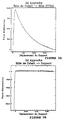
- Figure 5 shows approaches made vertically from the center of a ball and / or the blank support. We see in (a), from right to left, the magnetic attraction at a distance and then the contact of the sensor with the ball. In (b), only the contact of the sensor with the support is detected. In the absence of a field, no significant attraction is observed on this scale but only the contact interactions.
- Loose beads can be micromanipulated with the AFM sensor cobalt. This is not currently possible under the AFM even, for lack of optical access for the control of the operation, but perhaps simulated using a sensor attached to a micromanipulator in the field of an inverted optical microscope.
- AFM integrated into a microscope is being studied. We essentially observe that the free balls are attracted by the sensor within a radius of 1 or 2 ⁇ and stick to it. This is the most basic means of capture that we intend to apply to DNA-ball system.
- the bonding force between the two balls is the sum of the magnetic attraction force described above and a contact force essentially a function of surface conditions: the bond is strong enough on an untreated sensor and cannot be easily broken. However, if the sensor is soaked in a solution of bovine albumin serum (BSA) (about 2%) the contact force is greatly reduced and the ball can be released by sudden acceleration of the sensor or brief friction against the substrate.
- BSA bovine albumin serum
- the operational device for DNA analysis with a view to its sequencing is typically formed around the transparent substrate (Nunc-Covalink) where the DNA molecules are grafted.
- This substrate is integral with a piezoelectric system or equivalent which moves it in the three directions of space.
- a magnetic force sensor allows quantitative measurements.
- Below an optical microscope allows observe the surface and the force sensor in their relative movement.
- the whole is in the field of an electromagnet which, depending on the field applied, can press the beads on the surface, allowing imaging magnetic, move them away from the surface (elimination of ungrafted beads to facilitate the choice of the operator) or, with a null field, leave freely evolve the DNA so that it sticks to the sensor.
- This example is for quantitative force measurements on the molecule during a pull.
- the attachment of the DNA molecule follows a protocol similar to the one described above.
- the attachment of each end of the DNA molecule is done in separate steps; this is to prevent two ends of a single molecule do not bind, either to the ball, evening to the glass surface by forming a loop.
- the end where you want attaching the magnetic ball is first selectively grafted with biotin, which will bind to the streptavidin with which the magnetic ball is covered.
- the second end is attached to a Digoxygenin molecule (DIG-dUTP) which forms a bond with its anti-DIG antibody with a plaque on it glass previously treated with protein A.
- DIG-dUTP Digoxygenin molecule
- the number of molecules of DNA that connects a bead to the glass plate can vary, so you have to determine a posteriori the number of molecules involved in the bond.
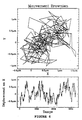
- the shape of the observed fluctuations is reproduced in FIG. 6. corresponding to the case where the bead is linked by a single DNA molecule.
- nk ⁇ x 2 ⁇ K B T
- k the stiffness of a DNA molecule
- k B the Boltzmann constant
- T the temperature
- n the number of molecules.
Landscapes
- Life Sciences & Earth Sciences (AREA)
- Chemical & Material Sciences (AREA)
- Proteomics, Peptides & Aminoacids (AREA)
- Organic Chemistry (AREA)
- Zoology (AREA)
- Wood Science & Technology (AREA)
- Health & Medical Sciences (AREA)
- Engineering & Computer Science (AREA)
- Microbiology (AREA)
- Biochemistry (AREA)
- Biotechnology (AREA)
- Molecular Biology (AREA)
- Biophysics (AREA)
- Analytical Chemistry (AREA)
- Physics & Mathematics (AREA)
- Immunology (AREA)
- Bioinformatics & Cheminformatics (AREA)
- General Engineering & Computer Science (AREA)
- General Health & Medical Sciences (AREA)
- Genetics & Genomics (AREA)
- Measuring Or Testing Involving Enzymes Or Micro-Organisms (AREA)
- Saccharide Compounds (AREA)
- Investigating Or Analysing Biological Materials (AREA)
Description

- La figure 1 est un schéma du procédé mettant en oeuvre un microscope à force atomique.
- La figure 2 schématise deux méthodes de fonctionnalisation de l'ADN par des groupes terminaux.
- La figure 3 schématise la construction du dimère d'ADN décrit en 2(b) appliquée à l'ADN du phage lambda.
- La figure 4 montre une image magnétique effectuée entre environ 3 et 3 µm au-dessus du substrat. Les billes du bas de l'image, blanches, sont observées sans contact direct (attraction magnétique) tandis que celles du haut, noires, le sont par contact direct (force répulsive de contact). Les billes imagées ont un diamètre de 2,8 µm.
- La figure 5 montre des approches effectuées avec le capteur de force a la verticale du centre d'une bille (a) ou du substrat vierge (b). Un champ magnétique est appliqué. Sur chaque graphe la courbe en trait continu représente l'approche depuis une position éloignée de quelques microns du substrat ; la courbe en pointillés représente le retour. En (a) l'attraction magnétique se manifeste par une montée de la courbe au-dessus de la valeur à grande distance. En (a) et (b) la répulsion (au contact) se manifeste par une baisse rapide de la valeur de la force.
- La figure 6 montre les déplacements du centre de la bille pendant un peu plus de 5 minutes ; en haut, déplacements dans le plan d'observation, en bas évolution temporelle de la position suivant X de la bille au cours du temps.
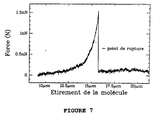
- La figure 7 montre un diagramme d'étirement d'une molécule d'ADN-λ par extension en utilisant un microscope à force atomique. Lorsque la molécule est presque complètement étendue, elle exerce une force de l'ordre de quelques nN avant de casser.
Claims (19)
- Procédé de détermination d'une séquence d'ADN ou d'ARN, caractérisé en ce qu'on détermine l'énergie d'appariement ou de désappariement entre chaque paire de bases de l'ADN ou d'un hybride ARN/ADN double brin correspondant à la séquence d'ADN ou d'ARN à déterminer et en ce que l'on compare cette énergie à une valeur prédéterminée.
- Procédé selon la revendication 1, caractérisé en ce que ladite valeur prédéterminée correspond à l'énergie d'appariement ou de désappariement d'une paire de bases connue en présence de bases avoisinantes données.
- Procédé pour la mise en évidence de la présence ou de l'absence d'une séquence d'ADN ou d'ARN déterminée dans un échantillon à tester, caractérisé en ce qu'on détermine ses éléments essentiels en déterminant l'énergie d'appariement ou de désappariement de chaque paire de bases de ladite séquence connue pour en faire une empreinte et on contrôle si ladite séquence d'ADN ou d'ARN, présente dans ledit échantillon, possède la même empreinte ou non.
- Procédé pour la mise en évidence de la présence ou de l'absence d'une séquence d'ADN ou d'ARN déterminée dans un échantillon à tester, caractérisé en ce qu'on détermine l'énergie globale nécessaire pour désapparier un ADN comportant une partie double brin ou un hybride ADN/ARN correspondant à la séquence d'ADN ou d'ARN dont on souhaite mettre en évidence la présence ou l'absence et on compare l'énergie globale à une valeur de seuil de cette énergie correspondant à ladite séquence totalement appariée.
- Procédé selon l'une des revendications 1 à 4, caractérisé en ce qu'on détermine l'énergie de désappariement entre chaque paire de bases de l'ADN ou d'hybride ADN/ARN par fixation d'au moins une base de chaque brin de l'ADN ou de l'hybride ADN/ARN sur un support et éloignement des supports afin de désapparier, l'une après l'autre, chaque paire de bases en mesurant à chaque désappariement l'énergie nécessaire au désappariement et en la comparant avec des valeurs prédéterminées.
- Procédé selon l'une des revendications 1 à 4, caractérisé en ce qu'on détermine l'énergie d'appariement entre chaque paire de bases de l'ADN ou d'hybride ADN/ARN par fixation d'au moins une base de chaque brin de l'ADN ou de l'hybride ADN/ARN sur un support et rapprochement des supports afin d'apparier chaque paire de bases en mesurant à chaque appariement l'énergie nécessaire à l'appariement et en la comparant avec des valeurs prédéterminées.
- Procédé selon l'une des revendications 1 à 6, caractérisé en ce qu'il est mis en oeuvre pour le séquençage d'un ADN ou d'un hybride ADN/ARN de constitution non déterminée, les valeurs prédéterminées étant mesurées au préalable pour chaque paire de bases en fonction de son environnement.
- Procédé selon l'une des revendications 1 à 7, caractérisé en ce que les extrémités non fixées sur supports de l'ADN double brin ou d'un hybride, avant appariement ou désappariement, sont reliées entre elles de manière covalente ou quasi covalente.
- Procédé selon l'une des revendications 1 à 8, caractérisé en ce que la séquence d'ADN double brin ou d'hybride ADN/ARN, après désappariement des deux brins, est réappariée puis de nouveau arrachée à plusieurs reprises afin d'accumuler les mesures et augmenter le rapport signal/bruit.
- Procédé selon l'une des revendications 1 à 9, caractérisé en ce que chaque brin d'ADN ou de l'hybride est fixé par plusieurs bases contiguës.
- Procédé selon l'une des revendications 1 à 10, caractérisé en ce que l'une des bases de l'un des brins de l'ADN ou d'un hybride est fixée directement ou indirectement sur une surface mobile et en ce qu'une base de l'autre brin d'ADN ou d'hybride est fixée sur un capteur de force et en ce que l'on éloigne la surface mobile en déterminant la valeur des forces mesurées par le capteur de force lors du désappariement des bases.
- Procédé selon la revendication 11, caractérisé en ce que pour fixer indirectement l'une des bases sur une surface mobile, on utilise un aimant fixé sur la surface et une particule magnétisable fixée sur une base.
- Procédé selon la revendication 12, caractérisé en ce que le capteur de force est le levier d'un microscope à force atomique et la surface mobile est un dispositif de déplacement nanométrique.
- Procédé selon l'une des revendications 11 à 13, caractérisé en ce que le capteur de force est un aimant dont on asservit la position par un champ magnétique.
- Procédé selon l'une des revendications 11 à 14, caractérisé en ce que le capteur de force est un levier ou une membrane associé à un capteur de déplacement.
- Procédé selon l'une des revendications 1 à 15, caractérisé en ce qu'on place un échantillon d'ADN ou d'ARN à tester, préalablement fixé sur un support, pour la présence d'une séquence spécifique, dans un récipient contenant la séquence complémentaire de ladite séquence spécifique, fixée elle-aussi sur un support, et en ce qu'après incubation on détermine l'énergie de liaison entre l'ADN double brin ou l'hybride.
- Application du procédé selon l'une des revendications 1,2 et 5 à 16 au séquençage d'un ADN inconnu.
- Application du procédé selon l'une des revendications 1 à 16 à la mise en évidence de la présence ou de l'absence d'une séquence d'ADN déterminée dans un échantillon à tester.
- ADN double brin ou hybride ADN/ARN double brin destiné à la mise en oeuvre du procédé selon l'une des revendications 1 à 16, caractérisé en ce que deux des extrémités libres 5' et 3' sont reliées par un oligonucléotide en boucle de manière covalente ou quasi-covalente, les deux autres extrémités libres étant fonctionnalisées par des groupements chimiques distincts.
Applications Claiming Priority (3)
| Application Number | Priority Date | Filing Date | Title |
|---|---|---|---|
| FR9304056 | 1993-04-06 | ||
| FR9304056A FR2703693B1 (fr) | 1993-04-06 | 1993-04-06 | Procédé rapide de détermination d'une séquence d'ADN et application au séquençage et au diagnostic. |
| PCT/FR1994/000382 WO1994023065A1 (fr) | 1993-04-06 | 1994-04-06 | Procede rapide de determination d'une sequence d'adn et application au sequençage et au diagnostic |
Publications (2)
| Publication Number | Publication Date |
|---|---|
| EP0693135A1 EP0693135A1 (fr) | 1996-01-24 |
| EP0693135B1 true EP0693135B1 (fr) | 2000-03-08 |
Family
ID=9445800
Family Applications (1)
| Application Number | Title | Priority Date | Filing Date |
|---|---|---|---|
| EP94913139A Expired - Lifetime EP0693135B1 (fr) | 1993-04-06 | 1994-04-06 | Procede rapide de determination d'une sequence d'adn et application au sequen age et au diagnostic |
Country Status (8)
| Country | Link |
|---|---|
| US (1) | US5866328A (fr) |
| EP (1) | EP0693135B1 (fr) |
| JP (1) | JPH08510898A (fr) |
| AT (1) | ATE190357T1 (fr) |
| CA (1) | CA2160031A1 (fr) |
| DE (1) | DE69423346T2 (fr) |
| FR (1) | FR2703693B1 (fr) |
| WO (1) | WO1994023065A1 (fr) |
Families Citing this family (37)
| Publication number | Priority date | Publication date | Assignee | Title |
|---|---|---|---|---|
| US6118124A (en) * | 1996-01-18 | 2000-09-12 | Lockheed Martin Energy Research Corporation | Electromagnetic and nuclear radiation detector using micromechanical sensors |
| US7094531B1 (en) * | 1997-01-15 | 2006-08-22 | Xzillion Gmbh Co. | Nucleic acid sequencing |
| FR2760024B1 (fr) | 1997-02-21 | 1999-05-14 | Centre Nat Rech Scient | Procede de caracterisation de duplex d'acide nucleique |
| US5958701A (en) * | 1999-01-27 | 1999-09-28 | The United States Of America As Represented By The Secretary Of The Navy | Method for measuring intramolecular forces by atomic force |
| US20030073250A1 (en) * | 1999-05-21 | 2003-04-17 | Eric Henderson | Method and apparatus for solid state molecular analysis |
| US20020042081A1 (en) * | 2000-10-10 | 2002-04-11 | Eric Henderson | Evaluating binding affinities by force stratification and force panning |
| US20030186311A1 (en) * | 1999-05-21 | 2003-10-02 | Bioforce Nanosciences, Inc. | Parallel analysis of molecular interactions |
| US6573369B2 (en) * | 1999-05-21 | 2003-06-03 | Bioforce Nanosciences, Inc. | Method and apparatus for solid state molecular analysis |
| US6248537B1 (en) | 1999-05-28 | 2001-06-19 | Institut Pasteur | Use of the combing process for the identification of DNA origins of replication |
| US6897015B2 (en) * | 2000-03-07 | 2005-05-24 | Bioforce Nanosciences, Inc. | Device and method of use for detection and characterization of pathogens and biological materials |
| AU2001293747A1 (en) * | 2000-08-11 | 2002-02-25 | Nanotype Gmbh | Method and device for characterising and/or for detecting a bonding complex |
| EP1348113B1 (fr) * | 2000-08-15 | 2008-07-30 | Bioforce Nanosciences, Inc. | Appareil de formation de reseaux moleculaires nanometriques |
| DE10126798A1 (de) * | 2001-06-01 | 2002-12-19 | Nanotype Gmbh | Verfahren zur Bestimmung einer Probe |
| WO2003008941A2 (fr) * | 2001-07-17 | 2003-01-30 | Bioforce Nanosciences, Inc. | Detection de liaison moleculaire combinee au moyen de la microscopie a force atomique et de la spectrometrie de masse |
| JP2005516586A (ja) * | 2001-07-20 | 2005-06-09 | ボード オブ トラスティーズ オブ ザ ユニヴァースティ オブ イリノイ | 癌の処置に対する遺伝子標的を同定するための試薬および方法 |
| US7042488B2 (en) | 2001-09-27 | 2006-05-09 | Fujinon Corporation | Electronic endoscope for highlighting blood vessel |
| US20030108935A1 (en) * | 2001-10-24 | 2003-06-12 | Wang Michelle D. | Probing binding interactions between molecules and nucleic acids by unzipping a nucleic acid molecule double helix |
| US20030215816A1 (en) * | 2002-05-20 | 2003-11-20 | Narayan Sundararajan | Method for sequencing nucleic acids by observing the uptake of nucleotides modified with bulky groups |
| US20050239193A1 (en) * | 2002-05-30 | 2005-10-27 | Bioforce Nanosciences, Inc. | Device and method of use for detection and characterization of microorganisms and microparticles |
| US7270952B2 (en) * | 2002-09-24 | 2007-09-18 | Intel Corporation | Detecting molecular binding by monitoring feedback controlled cantilever deflections |
| DE60309903T2 (de) * | 2002-09-24 | 2007-10-18 | Intel Corporation, Santa Clara | Nachweis von molekularbindung durch überwachung von rückkopplung kontrollierten auslegerablenkungen |
| CN1745179A (zh) * | 2003-01-02 | 2006-03-08 | 拜澳富斯毫微科学有限公司 | 在小样品体积中分子分析的方法和装置 |
| JP4638431B2 (ja) | 2003-08-06 | 2011-02-23 | ブリッジャー テクノロジーズ,インク. | 目標物質検出用の架橋型要素部品 |
| ATE390562T1 (de) * | 2004-11-19 | 2008-04-15 | Ebm Papst St Georgen Gmbh & Co | Anordnung mit einem luefter und einer pumpe |
| EP3269824A1 (fr) | 2008-03-28 | 2018-01-17 | Pacific Biosciences Of California, Inc. | Compositions et procédés deséquençage d'acide nucléique |
| WO2010086622A1 (fr) * | 2009-01-30 | 2010-08-05 | Oxford Nanopore Technologies Limited | Adaptateurs pour des constructions d'acide nucléique dans le séquençage de séquences transmembranaires |
| EP2390351A1 (fr) * | 2010-05-27 | 2011-11-30 | Centre National de la Recherche Scientifique (CNRS) | Procédé de séquençage de l'ADN par hybridisation |
| EP2390350A1 (fr) * | 2010-05-27 | 2011-11-30 | Centre National de la Recherche Scientifique (CNRS) | Procédé de séquençage de l'ADN par polymérisation |
| IN2014DN00221A (fr) | 2011-07-25 | 2015-06-05 | Oxford Nanopore Tech Ltd | |
| WO2013065881A1 (fr) * | 2011-10-31 | 2013-05-10 | Lg Electronics Inc. | Appareil et procédé permettant de déterminer des séquences d'acides nucléiques au moyen d'un microscope à force atomique |
| WO2014013259A1 (fr) | 2012-07-19 | 2014-01-23 | Oxford Nanopore Technologies Limited | Procédé ssb |
| GB201314695D0 (en) | 2013-08-16 | 2013-10-02 | Oxford Nanopore Tech Ltd | Method |
| BR112015021788B1 (pt) | 2013-03-08 | 2023-02-28 | Oxford Nanopore Technologies Plc | Métodos para mover uma ou mais helicases imobilizadas, para controlar o movimento de um polinucleotídeo alvo, para caracterizar um polinucleotídeo alvo e para controlar o carregamento de uma ou mais helicases em um polinucleotídeo alvo, uso de um poro de transmembrana e de um potencial aplicado e de um ou mais espaçadores, complexo, e, kit |
| GB201403096D0 (en) | 2014-02-21 | 2014-04-09 | Oxford Nanopore Tech Ltd | Sample preparation method |
| GB201418159D0 (en) | 2014-10-14 | 2014-11-26 | Oxford Nanopore Tech Ltd | Method |
| GB201609220D0 (en) | 2016-05-25 | 2016-07-06 | Oxford Nanopore Tech Ltd | Method |
| GB201807793D0 (en) | 2018-05-14 | 2018-06-27 | Oxford Nanopore Tech Ltd | Method |
Family Cites Families (7)
| Publication number | Priority date | Publication date | Assignee | Title |
|---|---|---|---|---|
| GB8910566D0 (en) * | 1989-05-08 | 1989-06-21 | Amersham Int Plc | Imaging apparatus and method |
| US5106729A (en) * | 1989-07-24 | 1992-04-21 | Arizona Board Of Regents Acting On Behalf Of Arizona State University | Method for visualizing the base sequence of nucleic acid polymers |
| US5372930A (en) * | 1992-09-16 | 1994-12-13 | The United States Of America As Represented By The Secretary Of The Navy | Sensor for ultra-low concentration molecular recognition |
| CA2153387A1 (fr) * | 1993-01-07 | 1994-07-21 | Hubert Koester | Sequencage de l'adn par spectrometrie de masse |
| WO1995006138A1 (fr) * | 1993-08-25 | 1995-03-02 | The Regents Of The University Of California | Procede microscopique pour la detection de micro-mouvements |
| US5624711A (en) * | 1995-04-27 | 1997-04-29 | Affymax Technologies, N.V. | Derivatization of solid supports and methods for oligomer synthesis |
| DE69637317T2 (de) * | 1995-08-09 | 2008-10-16 | Simon, Adam J. | Molekulare ausrichtung von makromolekuelen mit hilfe eines fluessigkeitsmeniskus auf einer hochspezifischen oberflaeche |
-
1993
- 1993-04-06 FR FR9304056A patent/FR2703693B1/fr not_active Expired - Fee Related
-
1994
- 1994-04-06 DE DE69423346T patent/DE69423346T2/de not_active Expired - Fee Related
- 1994-04-06 WO PCT/FR1994/000382 patent/WO1994023065A1/fr not_active Ceased
- 1994-04-06 US US08/532,751 patent/US5866328A/en not_active Expired - Fee Related
- 1994-04-06 EP EP94913139A patent/EP0693135B1/fr not_active Expired - Lifetime
- 1994-04-06 AT AT94913139T patent/ATE190357T1/de not_active IP Right Cessation
- 1994-04-06 CA CA002160031A patent/CA2160031A1/fr not_active Abandoned
- 1994-04-06 JP JP6521768A patent/JPH08510898A/ja not_active Ceased
Also Published As
| Publication number | Publication date |
|---|---|
| WO1994023065A1 (fr) | 1994-10-13 |
| FR2703693A1 (fr) | 1994-10-14 |
| ATE190357T1 (de) | 2000-03-15 |
| DE69423346T2 (de) | 2000-08-10 |
| CA2160031A1 (fr) | 1994-10-13 |
| FR2703693B1 (fr) | 1995-07-13 |
| JPH08510898A (ja) | 1996-11-19 |
| US5866328A (en) | 1999-02-02 |
| DE69423346D1 (de) | 2000-04-13 |
| EP0693135A1 (fr) | 1996-01-24 |
Similar Documents
| Publication | Publication Date | Title |
|---|---|---|
| WO1994023065A1 (fr) | Procede rapide de determination d'une sequence d'adn et application au sequençage et au diagnostic | |
| EP0744028B1 (fr) | Surfaces hautement specifiques pour reactions biologiques, procede pour leur preparation et procede pour leur utilisation | |
| Carvalho et al. | Atomic force microscopy‐based force spectroscopy—biological and biomedical applications | |
| CA2225547C (fr) | Appareillage d'alignement parallele de macromolecules et utilisation | |
| US7060448B2 (en) | Evaluating binding affinities by force stratification and force panning | |
| US12535477B2 (en) | Single-molecule electronic multiplex nanopore immunoassays for biomarker detection | |
| JP2019503485A (ja) | 分子センサーおよび関連方法 | |
| WO2004106928A1 (fr) | Procede de detection et de quantification multiplex d’analyses dans un echantillon a l’aide de microspheres | |
| FR2962221A1 (fr) | Procede de detection d'interactions moleculaires | |
| WO1998037234A1 (fr) | Procede de caracterisation de duplex d'acide nucleique | |
| El-Kirat-Chatel et al. | Probing bacterial adhesion at the single-molecule and single-cell levels by AFM-based force spectroscopy | |
| FR2829580A1 (fr) | Procede de lecture, de detection ou de quantification, hybrides ou complexes utilises dans ce procede et biopuce mettant en oeuvre ledit procede | |
| EP3728632B1 (fr) | Molecule d'adn double-brin pour la detection et la caracterisation des interactions moleculaires | |
| EP4314278A2 (fr) | Intégration d'un dispositif de colocalisation de protéines (pcd) sur un dispositif microfluidique | |
| US20260133177A1 (en) | Single-molecule electronic multiplex nanopore immunoassays for biomarker detection | |
| Lee et al. | Whole-cell sensing for a harmful bloom-forming microscopic alga by measuring antibody–antigen forces | |
| Ahmed | AFM Force Spectroscopy of Living Bacteria | |
| FR2716206A1 (fr) | Surfaces hautement spécifiques pour réactions biologiques, procédé pour leur préparation et procédé de dosage d'une molécule utilisant ces surfaces. | |
| FR2802550A1 (fr) | Biopuces, preparation et utilisations | |
| Mak et al. | Electro-magnetic biosensor for binding force measurements on ligand–receptor complexes |
Legal Events
| Date | Code | Title | Description |
|---|---|---|---|
| PUAI | Public reference made under article 153(3) epc to a published international application that has entered the european phase |
Free format text: ORIGINAL CODE: 0009012 |
|
| 17P | Request for examination filed |
Effective date: 19951023 |
|
| AK | Designated contracting states |
Kind code of ref document: A1 Designated state(s): AT BE CH DE DK ES FR GB GR IE IT LI LU MC NL PT SE |
|
| 17Q | First examination report despatched |
Effective date: 19960311 |
|
| GRAG | Despatch of communication of intention to grant |
Free format text: ORIGINAL CODE: EPIDOS AGRA |
|
| GRAG | Despatch of communication of intention to grant |
Free format text: ORIGINAL CODE: EPIDOS AGRA |
|
| GRAH | Despatch of communication of intention to grant a patent |
Free format text: ORIGINAL CODE: EPIDOS IGRA |
|
| GRAH | Despatch of communication of intention to grant a patent |
Free format text: ORIGINAL CODE: EPIDOS IGRA |
|
| GRAA | (expected) grant |
Free format text: ORIGINAL CODE: 0009210 |
|
| AK | Designated contracting states |
Kind code of ref document: B1 Designated state(s): AT BE CH DE DK ES FR GB GR IE IT LI LU MC NL PT SE |
|
| PG25 | Lapsed in a contracting state [announced via postgrant information from national office to epo] |
Ref country code: SE Free format text: THE PATENT HAS BEEN ANNULLED BY A DECISION OF A NATIONAL AUTHORITY Effective date: 20000308 Ref country code: GR Free format text: LAPSE BECAUSE OF NON-PAYMENT OF DUE FEES Effective date: 20000308 Ref country code: ES Free format text: THE PATENT HAS BEEN ANNULLED BY A DECISION OF A NATIONAL AUTHORITY Effective date: 20000308 Ref country code: AT Free format text: LAPSE BECAUSE OF FAILURE TO SUBMIT A TRANSLATION OF THE DESCRIPTION OR TO PAY THE FEE WITHIN THE PRESCRIBED TIME-LIMIT Effective date: 20000308 |
|
| REF | Corresponds to: |
Ref document number: 190357 Country of ref document: AT Date of ref document: 20000315 Kind code of ref document: T |
|
| REG | Reference to a national code |
Ref country code: CH Ref legal event code: EP |
|
| ITF | It: translation for a ep patent filed | ||
| PG25 | Lapsed in a contracting state [announced via postgrant information from national office to epo] |
Ref country code: LU Free format text: LAPSE BECAUSE OF NON-PAYMENT OF DUE FEES Effective date: 20000406 |
|
| REF | Corresponds to: |
Ref document number: 69423346 Country of ref document: DE Date of ref document: 20000413 |
|
| GBT | Gb: translation of ep patent filed (gb section 77(6)(a)/1977) |
Effective date: 20000330 |
|
| PG25 | Lapsed in a contracting state [announced via postgrant information from national office to epo] |
Ref country code: LI Free format text: LAPSE BECAUSE OF NON-PAYMENT OF DUE FEES Effective date: 20000430 Ref country code: CH Free format text: LAPSE BECAUSE OF NON-PAYMENT OF DUE FEES Effective date: 20000430 Ref country code: BE Free format text: LAPSE BECAUSE OF NON-PAYMENT OF DUE FEES Effective date: 20000430 |
|
| REG | Reference to a national code |
Ref country code: IE Ref legal event code: FG4D Free format text: FRENCH |
|
| PG25 | Lapsed in a contracting state [announced via postgrant information from national office to epo] |
Ref country code: PT Free format text: LAPSE BECAUSE OF FAILURE TO SUBMIT A TRANSLATION OF THE DESCRIPTION OR TO PAY THE FEE WITHIN THE PRESCRIBED TIME-LIMIT Effective date: 20000608 Ref country code: DK Free format text: LAPSE BECAUSE OF FAILURE TO SUBMIT A TRANSLATION OF THE DESCRIPTION OR TO PAY THE FEE WITHIN THE PRESCRIBED TIME-LIMIT Effective date: 20000608 |
|
| REG | Reference to a national code |
Ref country code: FR Ref legal event code: TP |
|
| BERE | Be: lapsed |
Owner name: CENTRE NATIONAL DE LA RECHERCHE SCIENTIFIQUE Effective date: 20000430 Owner name: INSTITUT PASTEUR Effective date: 20000430 |
|
| PG25 | Lapsed in a contracting state [announced via postgrant information from national office to epo] |
Ref country code: MC Free format text: LAPSE BECAUSE OF NON-PAYMENT OF DUE FEES Effective date: 20001031 |
|
| REG | Reference to a national code |
Ref country code: CH Ref legal event code: PL |
|
| PLBE | No opposition filed within time limit |
Free format text: ORIGINAL CODE: 0009261 |
|
| STAA | Information on the status of an ep patent application or granted ep patent |
Free format text: STATUS: NO OPPOSITION FILED WITHIN TIME LIMIT |
|
| 26N | No opposition filed | ||
| REG | Reference to a national code |
Ref country code: GB Ref legal event code: IF02 |
|
| PGFP | Annual fee paid to national office [announced via postgrant information from national office to epo] |
Ref country code: NL Payment date: 20020325 Year of fee payment: 9 |
|
| PGFP | Annual fee paid to national office [announced via postgrant information from national office to epo] |
Ref country code: GB Payment date: 20020327 Year of fee payment: 9 |
|
| PGFP | Annual fee paid to national office [announced via postgrant information from national office to epo] |
Ref country code: DE Payment date: 20020412 Year of fee payment: 9 |
|
| PGFP | Annual fee paid to national office [announced via postgrant information from national office to epo] |
Ref country code: FR Payment date: 20020426 Year of fee payment: 9 |
|
| PG25 | Lapsed in a contracting state [announced via postgrant information from national office to epo] |
Ref country code: GB Free format text: LAPSE BECAUSE OF NON-PAYMENT OF DUE FEES Effective date: 20030406 |
|
| PG25 | Lapsed in a contracting state [announced via postgrant information from national office to epo] |
Ref country code: NL Free format text: LAPSE BECAUSE OF NON-PAYMENT OF DUE FEES Effective date: 20031101 Ref country code: DE Free format text: LAPSE BECAUSE OF NON-PAYMENT OF DUE FEES Effective date: 20031101 |
|
| GBPC | Gb: european patent ceased through non-payment of renewal fee |
Effective date: 20030406 |
|
| NLV4 | Nl: lapsed or anulled due to non-payment of the annual fee |
Effective date: 20031101 |
|
| PG25 | Lapsed in a contracting state [announced via postgrant information from national office to epo] |
Ref country code: FR Free format text: LAPSE BECAUSE OF NON-PAYMENT OF DUE FEES Effective date: 20031231 |
|
| REG | Reference to a national code |
Ref country code: FR Ref legal event code: ST |
|
| PG25 | Lapsed in a contracting state [announced via postgrant information from national office to epo] |
Ref country code: IT Free format text: LAPSE BECAUSE OF NON-PAYMENT OF DUE FEES;WARNING: LAPSES OF ITALIAN PATENTS WITH EFFECTIVE DATE BEFORE 2007 MAY HAVE OCCURRED AT ANY TIME BEFORE 2007. THE CORRECT EFFECTIVE DATE MAY BE DIFFERENT FROM THE ONE RECORDED. Effective date: 20050406 |