EP0691308B1 - Lamella lepidocrocite particles and process for producing the same - Google Patents
Lamella lepidocrocite particles and process for producing the same Download PDFInfo
- Publication number
- EP0691308B1 EP0691308B1 EP95304631A EP95304631A EP0691308B1 EP 0691308 B1 EP0691308 B1 EP 0691308B1 EP 95304631 A EP95304631 A EP 95304631A EP 95304631 A EP95304631 A EP 95304631A EP 0691308 B1 EP0691308 B1 EP 0691308B1
- Authority
- EP
- European Patent Office
- Prior art keywords
- particles
- titanium
- oxide
- lamella
- lepidocrocite
- Prior art date
- Legal status (The legal status is an assumption and is not a legal conclusion. Google has not performed a legal analysis and makes no representation as to the accuracy of the status listed.)
- Expired - Lifetime
Links
Images

Classifications
-
- B—PERFORMING OPERATIONS; TRANSPORTING
- B01—PHYSICAL OR CHEMICAL PROCESSES OR APPARATUS IN GENERAL
- B01J—CHEMICAL OR PHYSICAL PROCESSES, e.g. CATALYSIS OR COLLOID CHEMISTRY; THEIR RELEVANT APPARATUS
- B01J23/00—Catalysts comprising metals or metal oxides or hydroxides, not provided for in group B01J21/00
- B01J23/70—Catalysts comprising metals or metal oxides or hydroxides, not provided for in group B01J21/00 of the iron group metals or copper
- B01J23/74—Iron group metals
- B01J23/745—Iron
-
- B—PERFORMING OPERATIONS; TRANSPORTING
- B82—NANOTECHNOLOGY
- B82Y—SPECIFIC USES OR APPLICATIONS OF NANOSTRUCTURES; MEASUREMENT OR ANALYSIS OF NANOSTRUCTURES; MANUFACTURE OR TREATMENT OF NANOSTRUCTURES
- B82Y30/00—Nanotechnology for materials or surface science, e.g. nanocomposites
-
- C—CHEMISTRY; METALLURGY
- C01—INORGANIC CHEMISTRY
- C01G—COMPOUNDS CONTAINING METALS NOT COVERED BY SUBCLASSES C01D OR C01F
- C01G49/00—Compounds of iron
- C01G49/0018—Mixed oxides or hydroxides
-
- C—CHEMISTRY; METALLURGY
- C01—INORGANIC CHEMISTRY
- C01G—COMPOUNDS CONTAINING METALS NOT COVERED BY SUBCLASSES C01D OR C01F
- C01G49/00—Compounds of iron
- C01G49/02—Oxides; Hydroxides
- C01G49/06—Ferric oxide [Fe2O3]
-
- C—CHEMISTRY; METALLURGY
- C02—TREATMENT OF WATER, WASTE WATER, SEWAGE, OR SLUDGE
- C02F—TREATMENT OF WATER, WASTE WATER, SEWAGE, OR SLUDGE
- C02F1/00—Treatment of water, waste water, or sewage
- C02F1/72—Treatment of water, waste water, or sewage by oxidation
- C02F1/725—Treatment of water, waste water, or sewage by oxidation by catalytic oxidation
-
- C—CHEMISTRY; METALLURGY
- C01—INORGANIC CHEMISTRY
- C01P—INDEXING SCHEME RELATING TO STRUCTURAL AND PHYSICAL ASPECTS OF SOLID INORGANIC COMPOUNDS
- C01P2002/00—Crystal-structural characteristics
- C01P2002/50—Solid solutions
- C01P2002/52—Solid solutions containing elements as dopants
- C01P2002/54—Solid solutions containing elements as dopants one element only
-
- C—CHEMISTRY; METALLURGY
- C01—INORGANIC CHEMISTRY
- C01P—INDEXING SCHEME RELATING TO STRUCTURAL AND PHYSICAL ASPECTS OF SOLID INORGANIC COMPOUNDS
- C01P2002/00—Crystal-structural characteristics
- C01P2002/70—Crystal-structural characteristics defined by measured X-ray, neutron or electron diffraction data
- C01P2002/72—Crystal-structural characteristics defined by measured X-ray, neutron or electron diffraction data by d-values or two theta-values, e.g. as X-ray diagram
-
- C—CHEMISTRY; METALLURGY
- C01—INORGANIC CHEMISTRY
- C01P—INDEXING SCHEME RELATING TO STRUCTURAL AND PHYSICAL ASPECTS OF SOLID INORGANIC COMPOUNDS
- C01P2004/00—Particle morphology
- C01P2004/01—Particle morphology depicted by an image
- C01P2004/03—Particle morphology depicted by an image obtained by SEM
-
- C—CHEMISTRY; METALLURGY
- C01—INORGANIC CHEMISTRY
- C01P—INDEXING SCHEME RELATING TO STRUCTURAL AND PHYSICAL ASPECTS OF SOLID INORGANIC COMPOUNDS
- C01P2004/00—Particle morphology
- C01P2004/10—Particle morphology extending in one dimension, e.g. needle-like
-
- C—CHEMISTRY; METALLURGY
- C01—INORGANIC CHEMISTRY
- C01P—INDEXING SCHEME RELATING TO STRUCTURAL AND PHYSICAL ASPECTS OF SOLID INORGANIC COMPOUNDS
- C01P2004/00—Particle morphology
- C01P2004/20—Particle morphology extending in two dimensions, e.g. plate-like
-
- C—CHEMISTRY; METALLURGY
- C01—INORGANIC CHEMISTRY
- C01P—INDEXING SCHEME RELATING TO STRUCTURAL AND PHYSICAL ASPECTS OF SOLID INORGANIC COMPOUNDS
- C01P2004/00—Particle morphology
- C01P2004/60—Particles characterised by their size
- C01P2004/62—Submicrometer sized, i.e. from 0.1-1 micrometer
-
- C—CHEMISTRY; METALLURGY
- C01—INORGANIC CHEMISTRY
- C01P—INDEXING SCHEME RELATING TO STRUCTURAL AND PHYSICAL ASPECTS OF SOLID INORGANIC COMPOUNDS
- C01P2004/00—Particle morphology
- C01P2004/60—Particles characterised by their size
- C01P2004/64—Nanometer sized, i.e. from 1-100 nanometer
-
- C—CHEMISTRY; METALLURGY
- C01—INORGANIC CHEMISTRY
- C01P—INDEXING SCHEME RELATING TO STRUCTURAL AND PHYSICAL ASPECTS OF SOLID INORGANIC COMPOUNDS
- C01P2006/00—Physical properties of inorganic compounds
- C01P2006/12—Surface area
Definitions
- the present invention relates to lamella lepidocrocite particles ( ⁇ -FeOOH), a process for producing them and their use in the production of an oxidation catalyst for waste water treatment.
- a large amount of waste water containing various components depending on the kind of industry is discharged from factories.
- a wet oxidation treatment process called Zimmermann's method is known. This method is put to practical use because it is advantageous in that organic substances are decomposed in a short time as compared with a biochemical method called an activated sludge process, and in that since it is not necessary to dilute waste water to a concentration which is suitable for the growth of bacteria, it is possible to miniaturize a waste water treatment facility.
- a wet oxidation treatment process is a method of treating waste water so as to decompose the organic substances in the waste water by passing an oxygen-containing gas at a high temperature and under a high pressure which can maintain the liquid-phase state of the waste water.
- the catalyst (I) is composed of a precious metal compound such as palladium and platinum which are carried on a carrier such as alumina, silica, silica gel and activated carbon.
- the catalyst (II) (hereinunder referred to as "oxidation catalyst containing the components A and B”) is composed of 90 to 99.95 wt% of an oxide (hereinunder referred to as "component A”) comprising iron and at least one element (hereinunder referred to as “titanium, etc.”) selected from the group consisting of titanium, silicon and zirconium, and 0.05 to 10 wt% of at least one element (hereinunder referred to as “component B”) selected from the group consisting of cobalt, nickel, cerium, silver, gold, platinum, palladium, rhodium, ruthenium and iridium (Japanese Patent Application Laid-Open (KOKAI) No. 138027/1993).
- the said component A contains 4.95 to 95 wt% of iron as an oxide, 4.95 to 95 wt% of titanium, etc. as an oxide, and the total sum of the iron oxide and the oxide of titanium, etc. is 90 to 99.95 wt%.
- the catalyst (II) is usable not only for waste water which does not contain a nitrogen-containing compound such as amine compound, amide compound and amino acid compound but also for waste water which contains those compounds, and it has an adequate treating capability in the COD (Cr) removal ratio, total nitrogen removal ratio, etc. as compared with the catalyst (I).
- the composition of the oxidation catalyst is as homogeneous as possible, and in order to increase the contact area of the oxidation catalyst with waste water as much as possible, it is necessary that the BET specific surface area of the oxidation catalyst is as large as possible.
- An oxidation catalyst containing the components A and B is produced by heat-treating a mixture containing an iron oxide and an oxide of titanium, etc. in a predetermined weight ratio in a temperature range of about 300 to 750°C to obtain an oxide containing iron and titanium, etc., and adding a molding assistant to the oxide containing iron and titanium, etc., mixing and kneading the oxide while adding an appropriate amount of water, molding the oxide into a predetermined shape, drying the molded material, heat-treating the molded material in a temperature range of 300 to 750°C to obtain a molded product, impregnating the molded product with an aqueous solution of a metal salt as the component B, and further drying and heat-treating the molded product.
- the properties of an oxidation catalyst containing the components A and B have a close relationship with the properties of an oxide containing iron and titanium, etc. which constitute a molded product to be impregnated with the component B.
- the oxide containing iron and titanium, etc. has as homogeneous a composition as possible and as large a BET specific surface area as possible.
- An oxide containing iron and titanium, etc. is conventionally produced, for example, by a method comprising the steps of mixing an iron oxide and an oxide of titanium, etc. by a dry process, drying the mixed particles and heat-treating the mixed particles at 300 to 750°C, or by a method comprising the steps of adding an aqueous alkali solution to a mixed solution of an aqueous solution containing ferric salt and an aqueous solution containing titanium, etc. to produce a coprecipitate from the aqueous solution, filtering the coprecipitate, washing it with water, drying and heat-treating it at 300 to 750°C.
- the iron oxide particles used as an iron material of the oxidation catalyst are generally produced by passing an oxygen-containing gas into a suspension containing an iron-containing precipitate obtained by reacting an aqueous ferrous salt solution and an aqueous alkali solution, and the iron oxide particles of various iron compounds are produced depending on the temperature, the pH, and the presence or absence of an additive.
- lepidocrocite ⁇ -FeOOH
- an additive such as phosphate, oxycarboxylate and EDTA is added to an aqueous ferrous salt solution so as to allow an oxidation reaction under neutral or weak acid conditions.
- the BET specific surface area of an iron oxide as the raw material of the oxidation catalyst is generally as small as about 2 to 20 m 2 /g in the case of granular magnetite particles or hematite particles, 10 to 100 m 2 /g in the case of acicular ferric hydrated oxide particles, and 10 to 60 m 2 /g in the case of acicular magnetite particles, maghemite particles and hematite particles, so that when such iron oxide particles are heated to 300 to 750°C, especially to not lower than 500°C, sintering causes in and between particles, and as a result, the BET specific surface area further lowers.
- a process for producing lamella lepidocrocite particles which process comprises:
- Lepidocrocite particles according to the present invention will first be described.
- the lepidocrocite particles according to the present invention are lamella and have a BET specific surface area of 150 to 350 m 2 /g. Lepidocrocite particles having a BET specific surface area of less than 150 m 2 /g are also obtained, but when they are heat-treated at a high temperature, especially at 500°C, the BET specific surface area unfavorably lowers to not more than 95 m 2 /g, so that they are not favorable as an iron material for an oxidation catalyst.
- Lepidocrocite particles having a BET specific surface area of more than 350 m 2 /g are also obtained, but the particles are so fine that it is difficult to filter the lepidocrocite particles from the reaction mother liquid so as to separate them and to wash the particles with water, so that such particles are not industrially advantageous.
- the lamella lepidocrocite particles according to the present invention have an approximately rectangular plate-like surface.
- the average major axial particle diameter is 0.05 to 0.2 ⁇ m
- the average minor axial particle diameter is 0.01 to 0.05 ⁇ m
- the thickness is 3 to 10 nm (30 to 100 ⁇ ).
- the average major axial particle diameter is preferably 0.08 to 0.15 ⁇ m
- the average minor axial particle diameter is preferably 0.02 to 0.05 ⁇ m
- the thickness is preferably 3 to 7 nm (30 to 70 ⁇ ).
- the lamella lepidocrocite particles according to the present invention contain 10 to 30 atm% of titanium [calculated as Ti/(Ti + Fe)].
- the lamella lepidocrocite particles according to the present invention homogeneously contain titanium and have a homogeneous composition as is obvious from the result of X-ray diffraction in later-described Example 1 in which only ⁇ -FeOOH type peaks are recognized.
- the heat resistance is unfavorable.
- the titanium content exceeds 30 atm%, lepidocrocite particles containing titanium are mixed with a large amount of TiO 2 .H 2 O particles produced as a by-product, so that the composition cannot be said to be homogeneous.
- the particles of the invention find use in the production of an oxidation catalyst for waste water treatment.
- the present invention provides a process for producing such a catalyst, which process comprises:
- An oxide of at least one element selected from titanium, silicon and zirconium can also be present in step (a).
- a method according to the invention of treating waste water comprises passing an oxygen-containing gas through water in the presence of an oxidation catalyst obtainable by the above process of the invention at an elevated temperature and at a pressure sufficient to maintain the liquid-phase state of the waste water.
- the oxidation catalyst for waste water treatment comprises 90 to 99.95 wt% of an iron oxide derived from the lamella lepidocrocite particles according to the present invention and, if necessary, an oxide of at least one element selected from titanium, silicon and zirconium; and 0.05 to 10 wt% of at least one element selected from cobalt, nickel, cerium, silver, gold, platinum, palladium, rhodium, ruthenium and iridium.
- the said oxides contain 4.95 to 95 wt% of iron as an oxide, 4.95 to 95 wt% of titanium, silicon and zirconium as an oxide, and the total sum of the iron oxide and the oxide of titanium, silicon and zirconium is 90 to 99.95 wt% based on the oxidation catalyst.
- an aqueous ferrous sulfate solution, an aqueous ferrous chloride solution, etc. are usable as the aqueous ferrous salt solution.
- an aqueous titanyl sulfate solution, an aqueous titanium tetrachloride solution, an aqueous titanium trichloride solution, etc. are usable.
- the amount of aqueous titanium solution used is 10 to 30 atm% [calculated as Ti/(Ti + Fe)] based on the Fe in the aqueous ferrous salt solution. If it is less than 10 atm%, it is impossible to obtain lepidocrocite particles containing titanium having a large BET specific surface area, especially a BET specific surface area of not less than 150 m 2 /g. On the other hand, if it exceeds 30 atm%, lepidocrocite particles containing titanium are mixed with a large amount of TiO 2 -H 2 O particles produced as a by-product.
- aqueous alkali carbonate solution in the present invention an aqueous sodium carbonate solution, an aqueous potassium carbonate solution, etc. are usable.
- an aqueous ferrous salt solution an aqueous titanium solution and an aqueous alkali carbonate solution is not restricted, and they may also be mixed simultaneously.
- a titanium compound is difficult to solve when the pH is not less than 8.0, it is most preferable that an aqueous titanium solution is first mixed with an aqueous ferrous salt solution, and the resultant solution is added to an aqueous alkali carbonate solution in consideration of the homogeneity of the composition.
- the pH of the suspension in which an iron-containing precipitate containing titanium is produced is adjusted to 8.0 to 10.0. If the pH is less than 8.0, the CO 3 2- ion concentration in the reaction solution becomes so small that it is impossible to obtain lepidocrocite particles containing titanium. If the pH exceeds 10.0, lepidocrocite particles containing titanium are mixed with acicular goethite particles produced as a by-product.
- the temperature of the suspension in which an iron-containing precipitate containing titanium is produced is in the range of 5 to 40°C. Even if the temperature is lower than 5°C, lepidocrocite particles containing titanium are produced, but it is neither industrially advantageous nor economical. If the temperature exceeds 40°C, lepidocrocite particles containing titanium are mixed with acicular goethite particles produced as a by-product.
- the suspension in which an iron-containing precipitate containing titanium is produced is oxidized by passing an oxygen-containing gas (e.g., air) into the suspension.
- an oxygen-containing gas e.g., air
- the air flow rate is different depending upon the volume of the reaction solution, the concentration of iron, the reaction temperature, the method of passing air, etc. If the volume of the reaction solution and the method of passing air are the same, it is necessary to increase the air flow rate in order to produce lepidocrocite particles containing titanium as more as the concentration of iron increases and the reaction temperature is elevated.
- the oxidation reaction rate of ferrous iron in the present invention is preferably 0.05 to 0.25 M/hr. If the oxidation reaction rate is too high, hydrotalcite-type particles are apt to be produced as a by-product in addition to lepidocrocite particles containing titanium. If the oxidation reaction rate is too low, acicular goethite particles are apt to be produced as a by-product in addition to lepidocrocite particles containing titanium.
- the pH of the suspension during the oxidation reaction in the present invention is in the range of 8.0 to 10.0. If the pH is less than 8.0, the CO 3 2- ion concentration in the reaction solution becomes so small that it is impossible to obtain lepidocrocite particles containing titanium. If the pH exceeds 10.0, lepidocrocite particles containing titanium are mixed with acicular goethite particles produced as a by-product.
- the CO 3 2- ion concentration is preferably not less than 1.5 [calculated as the molar ratio of Na 2 CO 3 /(Ti + Fe)].
- the upper limit of the CO 3 2- ion concentration is preferably about 4.0 [calculated as the molar ratio of Na 2 CO 3 /(Ti + Fe)].
- the temperature of the suspension during the oxidation reaction is in the range of 5 to 40°C. Even if the temperature is lower than 5°C, lepidocrocite particles containing titanium are produced, but it is neither industrially advantageous nor economical. If the temperature exceeds 40°C, lepidocrocite particles containing titanium are mixed with acicular goethite particles produced as a by-product.
- the lepidocrocite particles containing titanium according to the present invention are produced from an aqueous solution, as seen from the later-described examples, the composition is homogeneous.
- the size of the plate-like surface is larger than the known coprecipitate or lepidocrocite particles in the prior art, the thickness of a particle is thin, so that the BET specific surface area is large.
- the contact points with respect to other particles are few due to the lamella shape, so that the lepidocrocite particles have an excellent heat resistance.
- oxide (hematite) particles containing iron and titanium having a large BET specific surface area even if they are heated to 300 to 750°C, especially to a high temperature such as not lower than 500°C.
- the lepidocrocite particles containing titanium according to the present invention dehydrate and transform into hematite particles at about 250°C.
- Fig. 1 shows the kinds of products obtained under the same conditions as in Example 1 except for varying the amount of titanium added in the range of 0 to 30 atm% [calculated as Ti/(Ti + Fe)], and the reaction temperature.
- the conditions are that the concentration of (Ti + Fe) is 0.3 mol/l, the molar ratio of Na 2 CO 3 /(Ti + Fe) is 3.0, the air flow rate during oxidation is 40 l/min.
- ⁇ represents a region in which lepidocrocite ( ⁇ -FeOOH) particles are produced
- the mark: ⁇ represents a region in which plate-like hydrotalcite particles containing titanium are produced
- the mark: ⁇ represents a region in which a mixture of acicular goethite ( ⁇ -FeOOH) particles containing titanium and lepidocrocite ( ⁇ -FeOOH) particles containing titanium is produced
- the mark: ⁇ represents a region in which acicular goethite ( ⁇ -FeOOH) particles containing titanium are produced.
- the lepidocrocite particles containing titanium are produced when the amount of titanium added is about not less than 10 atm% [calculated as Ti/(Ti + Fe)]
- the value of the BET specific surface area when heat-treated at 300°C for 60 minutes is more than 140 m 2 /g, and the value of the BET specific surface area when heat-treated at 500°C for 60 minutes is more than 95 m 2 /g. That is, the lamella lepidocrocite particles of the present invention have an excellent heat resistance.
- the lamella lepidocrocite particles of the present invention have a homogeneous composition and a large specific surface area, especially a BET specific surface area of 150 to 350 m 2 /g and an excellent heat resistance, as shown in later-described examples, the lamella lepidocrocite particles are suitable as an iron material for an oxidation catalyst for waste water treatment.
- the oxide (hematite, ⁇ -Fe 2 O 3 ) particles containing iron and titanium obtained by heat-treating the lepidocrocite particles also have a homogeneous composition and a large BET specific surface area. Therefore, a catalyst obtained by producing a molded product from the hematite particles and impregnating the molded product with the component B also have a homogeneous composition and a large BET specific surface area, so that the enhancement of the capability of the catalyst such as an improvement of the COD (Cr) removal ratio and the total nitrogen removal ratio, and an improvement of the catalyst life (durability) can be expected.
- the enhancement of the capability of the catalyst such as an improvement of the COD (Cr) removal ratio and the total nitrogen removal ratio, and an improvement of the catalyst life (durability) can be expected.
- the lamella lepidocrocite particles of the present invention are an oxide
- the lamella lepidocrocite particles are stable to oxidation by air and the like, and since the lamella lepidocrocite particles assume a yellowish brown color and have transparency due to the fine particle size, the lamella lepidocrocite particles can be expected to be used as a material of coatings, resin coatings, printing ink, coloring agents for cosmetics, etc.
- the lamella lepidocrocite particles of the present invention are an oxide containing titanium and iron in the form of a solid solution, there are many strong acidic point on the surfaces of the particles, and the degree of strong acidity is high, they are also expected to be used as a catalyst for isomerization for, for example, butene.
- the shape of a particle, the average major axial diameter and the average minor axial diameter of the plate-like surface of particles are expressed by the average values measured in transmission electron microphotographs, and the thickness of a particle is expressed by the value obtained from the half-width of the crystal plane (020) by using Scherrer formula.
- the BET specific surface area of particle is expressed by the value measured by a BET method.
- the Ti content in the lepidocrocite particles is expressed by the value measured by fluorescent X-ray spectroscopy.
- the suspension was oxidized by blowing air at a rate of 40 l/min while maintaining the reaction temperature at 32°C, thereby producing a yellowish brown precipitate.
- the pH of the suspension during the oxidation reaction was in the range of 9.6 to 8.8.
- the yellowish brown precipitate was washed and dried at 120°C for 12 hours to obtain yellowish brown particles.
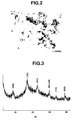
- the particles obtained were lamella particles having an average major axial diameter of 0.1 ⁇ m, an average minor axial diameter of 0.03 ⁇ m on a plate-like surface, and a thickness of 40 ⁇ , as shown in the electron micrograph (x 50000) in Fig. 2.
- the structure of the particles was ⁇ -FeOOH type, as shown in the X-ray diffraction pattern in Fig. 3, and proved to be lepidocrocite particles.
- the BET specific surface area of the lepidocrocite particles was 230 m 2 /g and the lepidocrocite particles contained 15.1 atm% of titanium [calculated as Ti/(Ti + Fe)] according to fluorescent X-ray spectroscopy.
- the obtained particles contained titanium, since only the peaks of lepidocrocite ( ⁇ -FeOOH) were recognized and no peak of titanium was recognized in the X-ray diffraction pattern in Fig. 3, the particles proved to have a homogeneous composition.
- the BET specific surface area of the particles when they were heat-treated at 300°C for 60 minutes was 150 m 2 /g, and the BET specific surface area of the particles when they were heat-treated at 500°C for 60 minutes was 112 m 2 /g. In both cases, the BET specific surface area was as large as not less than 95 m 2 , which proved that the lepidocrocite particles produced had an excellent heat resistance.
- Products were obtained in the same procedure as in Example 1 except for varying the kind, the concentration and the temperature of an aqueous alkali carbonate solution, the kind, the concentration and the temperature of an aqueous ferrous salt solution, the kind, the concentration and the temperature of an aqueous titanium solution, the pH and the temperature of the suspension, and the oxidation reaction rate and the pH in the oxidation reaction.
- the particles obtained in Examples 2 to 9 proved to be lepidocrocite particles.
- the shape of the lepidocrocite particles was found to be a lamella by observation through an electron microscope
- Example 3 Since the hydrotalcite-type peaks were recognized in X-ray diffraction, and lamella particles were observed through an electron microscope, the particles obtained in Comparative Example 3 proved to be lamella hydrotalcite particles. The particles obtained in Example 3 were dried at 60°C.
Landscapes
- Chemical & Material Sciences (AREA)
- Organic Chemistry (AREA)
- Engineering & Computer Science (AREA)
- Nanotechnology (AREA)
- Chemical Kinetics & Catalysis (AREA)
- Inorganic Chemistry (AREA)
- Materials Engineering (AREA)
- Condensed Matter Physics & Semiconductors (AREA)
- Crystallography & Structural Chemistry (AREA)
- General Physics & Mathematics (AREA)
- Physics & Mathematics (AREA)
- Composite Materials (AREA)
- Life Sciences & Earth Sciences (AREA)
- Hydrology & Water Resources (AREA)
- Environmental & Geological Engineering (AREA)
- Water Supply & Treatment (AREA)
- Catalysts (AREA)
- Compounds Of Iron (AREA)
Applications Claiming Priority (2)
| Application Number | Priority Date | Filing Date | Title |
|---|---|---|---|
| JP17601494A JP3427854B2 (ja) | 1994-07-04 | 1994-07-04 | 薄片状レピドクロサイト粒子粉末及びその製造法 |
| JP176014/94 | 1994-07-04 |
Publications (2)
| Publication Number | Publication Date |
|---|---|
| EP0691308A1 EP0691308A1 (en) | 1996-01-10 |
| EP0691308B1 true EP0691308B1 (en) | 1998-09-09 |
Family
ID=16006218
Family Applications (1)
| Application Number | Title | Priority Date | Filing Date |
|---|---|---|---|
| EP95304631A Expired - Lifetime EP0691308B1 (en) | 1994-07-04 | 1995-07-03 | Lamella lepidocrocite particles and process for producing the same |
Country Status (4)
| Country | Link |
|---|---|
| US (1) | US5686378A (enExample) |
| EP (1) | EP0691308B1 (enExample) |
| JP (1) | JP3427854B2 (enExample) |
| DE (1) | DE69504595T2 (enExample) |
Families Citing this family (7)
| Publication number | Priority date | Publication date | Assignee | Title |
|---|---|---|---|---|
| WO1997034830A1 (en) | 1996-03-21 | 1997-09-25 | Dowa Mining Co., Ltd. | Powder for lower layer of coating type magnetic recording medium |
| DE69703521T2 (de) * | 1996-08-09 | 2001-05-17 | Toda Kogyo Corp., Hiroshima | Rechteckige, parallelopipedale Lepidokrokitteilchen und Verfahren zu ihrer Herstellung |
| FR2764399A1 (fr) * | 1997-06-05 | 1998-12-11 | Eastman Kodak Co | Depollution d'un effluent photographique par traitement avec un alumino-silicate polymere fibreux |
| US6800260B2 (en) * | 2002-02-11 | 2004-10-05 | Millennium Inorganic Chemicals, Inc. | Processes for treating iron-containing waste streams |
| US7358211B2 (en) * | 2004-11-24 | 2008-04-15 | E.I. Du Pont De Nemours And Company | Catalyst for the production of 1,3-propanediol by catalytic hydrogenation of 3-hydroxypropanal |
| US7709541B2 (en) * | 2006-07-14 | 2010-05-04 | Headwaters Technology Innovation, Llc | Fischer-Tropsch catalysts incorporating promoter for increasing yields of C5+ hydrocarbons and methods for making and using same |
| CN113106433B (zh) * | 2021-03-11 | 2022-07-05 | 同济大学 | 一种铁离子促进铁屑表面快速形成γ-FeOOH层的改性方法 |
Family Cites Families (2)
| Publication number | Priority date | Publication date | Assignee | Title |
|---|---|---|---|---|
| JP2963816B2 (ja) * | 1991-05-14 | 1999-10-18 | 株式会社日本触媒 | 廃水処理用触媒、その製造方法、および、その触媒を用いた廃水の処理方法 |
| US5399541A (en) * | 1991-05-14 | 1995-03-21 | Nippon Shokubai Co., Ltd. | Catalyst for treating wastewater |
-
1994
- 1994-07-04 JP JP17601494A patent/JP3427854B2/ja not_active Expired - Fee Related
-
1995
- 1995-07-03 DE DE69504595T patent/DE69504595T2/de not_active Expired - Fee Related
- 1995-07-03 EP EP95304631A patent/EP0691308B1/en not_active Expired - Lifetime
- 1995-07-03 US US08/498,277 patent/US5686378A/en not_active Expired - Fee Related
Also Published As
| Publication number | Publication date |
|---|---|
| EP0691308A1 (en) | 1996-01-10 |
| DE69504595T2 (de) | 1999-01-28 |
| US5686378A (en) | 1997-11-11 |
| JP3427854B2 (ja) | 2003-07-22 |
| DE69504595D1 (de) | 1998-10-15 |
| JPH0812338A (ja) | 1996-01-16 |
Similar Documents
| Publication | Publication Date | Title |
|---|---|---|
| AU691224B2 (en) | Titanium oxide for photocatalyst and method of producing the same | |
| EP0797481B1 (en) | Restructured iron oxide | |
| CA2068680C (en) | Catalyst for treating wastewater, process for producing it, and process for treating wastewater with the catalyst | |
| EP1663855B1 (en) | High temperature shift catalyst prepared with a high purity iron precursor | |
| EP0164251B1 (en) | Barium ferrite particles for magnetic recording media | |
| US5686378A (en) | Lamella lepidocrocite particles and process for producing the same | |
| GB2064502A (en) | Chromium oxide protected magnetic particles | |
| EP0145229B1 (en) | Production of barium ferrite particles | |
| JPS6122428A (ja) | 鉄磁性顔料の製造と使用 | |
| WO2001028929A1 (en) | Method for production of iron oxide pigments | |
| DE60221443T2 (de) | Mit hochreinem eisenvorläufer hergestellter fischer-tropsch-katalysator und herstellungsverfahren | |
| CA1149582A (en) | Synthetic rhombohedrol magnetite pigment | |
| US4115106A (en) | Method for producing metallic oxide compounds | |
| JP3427856B2 (ja) | 粒状ゲータイト微粒子粉末及びその製造法並びに該微粒子粉末を用いた粒状酸化鉄微粒子粉末の製造法 | |
| Konishi et al. | Preparation and characterization of fine magnetite particles from iron (III) carboxylate dissolved in organic solvent | |
| JPH0812338A5 (enExample) | ||
| EP0406633B1 (de) | Synthetisches grobteiliges Eisenoxid, Verfahren zu seiner Herstellung sowie dessen Verwendung | |
| EP0691307B1 (en) | Pigmentary material | |
| JPS62128930A (ja) | ヘマタイト粒子粉末の製造法 | |
| JP2767484B2 (ja) | 微粒子状金属酸化物の製造方法 | |
| JPH05137995A (ja) | 粒子のフエライト被覆方法 | |
| CN115228472B (zh) | 一种类水滑石脱硫催化剂及其制备方法、应用 | |
| JPS61219720A (ja) | 微粒子状マグネトプランバイト型フエライトの製造法 | |
| JPH08119635A (ja) | 粒状マグネタイト微粒子粉末の製造法 | |
| JPH05262529A (ja) | 酸化鉄粒子粉末の製造法 |
Legal Events
| Date | Code | Title | Description |
|---|---|---|---|
| PUAI | Public reference made under article 153(3) epc to a published international application that has entered the european phase |
Free format text: ORIGINAL CODE: 0009012 |
|
| AK | Designated contracting states |
Kind code of ref document: A1 Designated state(s): DE FR GB NL |
|
| 17P | Request for examination filed |
Effective date: 19960619 |
|
| GRAG | Despatch of communication of intention to grant |
Free format text: ORIGINAL CODE: EPIDOS AGRA |
|
| GRAG | Despatch of communication of intention to grant |
Free format text: ORIGINAL CODE: EPIDOS AGRA |
|
| 17Q | First examination report despatched |
Effective date: 19970922 |
|
| GRAG | Despatch of communication of intention to grant |
Free format text: ORIGINAL CODE: EPIDOS AGRA |
|
| GRAH | Despatch of communication of intention to grant a patent |
Free format text: ORIGINAL CODE: EPIDOS IGRA |
|
| GRAH | Despatch of communication of intention to grant a patent |
Free format text: ORIGINAL CODE: EPIDOS IGRA |
|
| GRAA | (expected) grant |
Free format text: ORIGINAL CODE: 0009210 |
|
| AK | Designated contracting states |
Kind code of ref document: B1 Designated state(s): DE FR GB NL |
|
| REF | Corresponds to: |
Ref document number: 69504595 Country of ref document: DE Date of ref document: 19981015 |
|
| ET | Fr: translation filed | ||
| PLBE | No opposition filed within time limit |
Free format text: ORIGINAL CODE: 0009261 |
|
| STAA | Information on the status of an ep patent application or granted ep patent |
Free format text: STATUS: NO OPPOSITION FILED WITHIN TIME LIMIT |
|
| 26N | No opposition filed | ||
| REG | Reference to a national code |
Ref country code: GB Ref legal event code: IF02 |
|
| PGFP | Annual fee paid to national office [announced via postgrant information from national office to epo] |
Ref country code: GB Payment date: 20040630 Year of fee payment: 10 |
|
| PGFP | Annual fee paid to national office [announced via postgrant information from national office to epo] |
Ref country code: NL Payment date: 20040704 Year of fee payment: 10 |
|
| PGFP | Annual fee paid to national office [announced via postgrant information from national office to epo] |
Ref country code: FR Payment date: 20040708 Year of fee payment: 10 |
|
| PGFP | Annual fee paid to national office [announced via postgrant information from national office to epo] |
Ref country code: DE Payment date: 20040715 Year of fee payment: 10 |
|
| PG25 | Lapsed in a contracting state [announced via postgrant information from national office to epo] |
Ref country code: GB Free format text: LAPSE BECAUSE OF NON-PAYMENT OF DUE FEES Effective date: 20050703 |
|
| PG25 | Lapsed in a contracting state [announced via postgrant information from national office to epo] |
Ref country code: NL Free format text: LAPSE BECAUSE OF NON-PAYMENT OF DUE FEES Effective date: 20060201 Ref country code: DE Free format text: LAPSE BECAUSE OF NON-PAYMENT OF DUE FEES Effective date: 20060201 |
|
| GBPC | Gb: european patent ceased through non-payment of renewal fee |
Effective date: 20050703 |
|
| PG25 | Lapsed in a contracting state [announced via postgrant information from national office to epo] |
Ref country code: FR Free format text: LAPSE BECAUSE OF NON-PAYMENT OF DUE FEES Effective date: 20060331 |
|
| NLV4 | Nl: lapsed or anulled due to non-payment of the annual fee |
Effective date: 20060201 |
|
| REG | Reference to a national code |
Ref country code: FR Ref legal event code: ST Effective date: 20060331 |