EP0691192A1 - Verfahren und Vorrichtung zur Herstellung von Polymeren - Google Patents
Verfahren und Vorrichtung zur Herstellung von Polymeren Download PDFInfo
- Publication number
- EP0691192A1 EP0691192A1 EP95420192A EP95420192A EP0691192A1 EP 0691192 A1 EP0691192 A1 EP 0691192A1 EP 95420192 A EP95420192 A EP 95420192A EP 95420192 A EP95420192 A EP 95420192A EP 0691192 A1 EP0691192 A1 EP 0691192A1
- Authority
- EP
- European Patent Office
- Prior art keywords
- die
- cooling
- polymer
- temperature
- casting
- Prior art date
- Legal status (The legal status is an assumption and is not a legal conclusion. Google has not performed a legal analysis and makes no representation as to the accuracy of the status listed.)
- Granted
Links
- 229920000642 polymer Polymers 0.000 title claims abstract description 55
- 238000000034 method Methods 0.000 title claims description 26
- 238000004519 manufacturing process Methods 0.000 title claims description 18
- 238000001816 cooling Methods 0.000 claims abstract description 26
- 238000010438 heat treatment Methods 0.000 claims abstract description 15
- 229920001169 thermoplastic Polymers 0.000 claims abstract description 9
- 230000005674 electromagnetic induction Effects 0.000 claims abstract description 6
- 238000005266 casting Methods 0.000 claims description 32
- 238000006116 polymerization reaction Methods 0.000 claims description 16
- 230000001105 regulatory effect Effects 0.000 claims description 5
- 239000012809 cooling fluid Substances 0.000 claims description 4
- 239000000853 adhesive Substances 0.000 claims description 2
- 230000001070 adhesive effect Effects 0.000 claims description 2
- 238000011084 recovery Methods 0.000 claims 1
- 238000005520 cutting process Methods 0.000 abstract description 2
- 230000006698 induction Effects 0.000 abstract description 2
- 239000008188 pellet Substances 0.000 abstract 1
- 239000008187 granular material Substances 0.000 description 7
- 229920000728 polyester Polymers 0.000 description 7
- 230000015556 catabolic process Effects 0.000 description 5
- 238000006731 degradation reaction Methods 0.000 description 5
- XLYOFNOQVPJJNP-UHFFFAOYSA-N water Substances O XLYOFNOQVPJJNP-UHFFFAOYSA-N 0.000 description 5
- 238000009434 installation Methods 0.000 description 4
- -1 polyethylene terephthalates Polymers 0.000 description 4
- 239000004952 Polyamide Substances 0.000 description 3
- 238000006243 chemical reaction Methods 0.000 description 3
- 239000012530 fluid Substances 0.000 description 3
- 229920002647 polyamide Polymers 0.000 description 3
- RYGMFSIKBFXOCR-UHFFFAOYSA-N Copper Chemical compound [Cu] RYGMFSIKBFXOCR-UHFFFAOYSA-N 0.000 description 2
- CPLXHLVBOLITMK-UHFFFAOYSA-N Magnesium oxide Chemical compound [Mg]=O CPLXHLVBOLITMK-UHFFFAOYSA-N 0.000 description 2
- 229910052802 copper Inorganic materials 0.000 description 2
- 239000010949 copper Substances 0.000 description 2
- 238000002425 crystallisation Methods 0.000 description 2
- 230000008025 crystallization Effects 0.000 description 2
- 229920000139 polyethylene terephthalate Polymers 0.000 description 2
- 229910052582 BN Inorganic materials 0.000 description 1
- PZNSFCLAULLKQX-UHFFFAOYSA-N Boron nitride Chemical compound N#B PZNSFCLAULLKQX-UHFFFAOYSA-N 0.000 description 1
- 229920001634 Copolyester Polymers 0.000 description 1
- 239000000654 additive Substances 0.000 description 1
- QVGXLLKOCUKJST-UHFFFAOYSA-N atomic oxygen Chemical compound [O] QVGXLLKOCUKJST-UHFFFAOYSA-N 0.000 description 1
- 238000010923 batch production Methods 0.000 description 1
- 230000033228 biological regulation Effects 0.000 description 1
- 230000015572 biosynthetic process Effects 0.000 description 1
- 229920002301 cellulose acetate Polymers 0.000 description 1
- 239000000919 ceramic Substances 0.000 description 1
- 150000001875 compounds Chemical class 0.000 description 1
- 239000004020 conductor Substances 0.000 description 1
- 238000011109 contamination Methods 0.000 description 1
- 238000010924 continuous production Methods 0.000 description 1
- 239000002826 coolant Substances 0.000 description 1
- 230000003247 decreasing effect Effects 0.000 description 1
- 238000010586 diagram Methods 0.000 description 1
- 230000005672 electromagnetic field Effects 0.000 description 1
- 230000008030 elimination Effects 0.000 description 1
- 238000003379 elimination reaction Methods 0.000 description 1
- LYCAIKOWRPUZTN-UHFFFAOYSA-N ethylene glycol Natural products OCCO LYCAIKOWRPUZTN-UHFFFAOYSA-N 0.000 description 1
- 238000001125 extrusion Methods 0.000 description 1
- 239000000835 fiber Substances 0.000 description 1
- WGCNASOHLSPBMP-UHFFFAOYSA-N hydroxyacetaldehyde Natural products OCC=O WGCNASOHLSPBMP-UHFFFAOYSA-N 0.000 description 1
- 239000011810 insulating material Substances 0.000 description 1
- 239000012212 insulator Substances 0.000 description 1
- 239000000395 magnesium oxide Substances 0.000 description 1
- 238000005259 measurement Methods 0.000 description 1
- 238000002844 melting Methods 0.000 description 1
- 230000008018 melting Effects 0.000 description 1
- 239000002991 molded plastic Substances 0.000 description 1
- 239000000178 monomer Substances 0.000 description 1
- 229910052760 oxygen Inorganic materials 0.000 description 1
- 239000001301 oxygen Substances 0.000 description 1
- 229920001748 polybutylene Polymers 0.000 description 1
- 238000006068 polycondensation reaction Methods 0.000 description 1
- 239000005020 polyethylene terephthalate Substances 0.000 description 1
- 239000000843 powder Substances 0.000 description 1
- 239000002994 raw material Substances 0.000 description 1
- 239000012429 reaction media Substances 0.000 description 1
- 239000011541 reaction mixture Substances 0.000 description 1
- 239000003507 refrigerant Substances 0.000 description 1
- 238000007493 shaping process Methods 0.000 description 1
- 238000007873 sieving Methods 0.000 description 1
- 238000003756 stirring Methods 0.000 description 1
- 239000004753 textile Substances 0.000 description 1
- 238000010792 warming Methods 0.000 description 1
Images
Classifications
-
- B—PERFORMING OPERATIONS; TRANSPORTING
- B29—WORKING OF PLASTICS; WORKING OF SUBSTANCES IN A PLASTIC STATE IN GENERAL
- B29B—PREPARATION OR PRETREATMENT OF THE MATERIAL TO BE SHAPED; MAKING GRANULES OR PREFORMS; RECOVERY OF PLASTICS OR OTHER CONSTITUENTS OF WASTE MATERIAL CONTAINING PLASTICS
- B29B13/00—Conditioning or physical treatment of the material to be shaped
- B29B13/02—Conditioning or physical treatment of the material to be shaped by heating
- B29B13/022—Melting the material to be shaped
-
- B—PERFORMING OPERATIONS; TRANSPORTING
- B29—WORKING OF PLASTICS; WORKING OF SUBSTANCES IN A PLASTIC STATE IN GENERAL
- B29C—SHAPING OR JOINING OF PLASTICS; SHAPING OF MATERIAL IN A PLASTIC STATE, NOT OTHERWISE PROVIDED FOR; AFTER-TREATMENT OF THE SHAPED PRODUCTS, e.g. REPAIRING
- B29C48/00—Extrusion moulding, i.e. expressing the moulding material through a die or nozzle which imparts the desired form; Apparatus therefor
- B29C48/03—Extrusion moulding, i.e. expressing the moulding material through a die or nozzle which imparts the desired form; Apparatus therefor characterised by the shape of the extruded material at extrusion
- B29C48/05—Filamentary, e.g. strands
-
- B—PERFORMING OPERATIONS; TRANSPORTING
- B29—WORKING OF PLASTICS; WORKING OF SUBSTANCES IN A PLASTIC STATE IN GENERAL
- B29C—SHAPING OR JOINING OF PLASTICS; SHAPING OF MATERIAL IN A PLASTIC STATE, NOT OTHERWISE PROVIDED FOR; AFTER-TREATMENT OF THE SHAPED PRODUCTS, e.g. REPAIRING
- B29C48/00—Extrusion moulding, i.e. expressing the moulding material through a die or nozzle which imparts the desired form; Apparatus therefor
- B29C48/03—Extrusion moulding, i.e. expressing the moulding material through a die or nozzle which imparts the desired form; Apparatus therefor characterised by the shape of the extruded material at extrusion
- B29C48/06—Rod-shaped
-
- B—PERFORMING OPERATIONS; TRANSPORTING
- B29—WORKING OF PLASTICS; WORKING OF SUBSTANCES IN A PLASTIC STATE IN GENERAL
- B29C—SHAPING OR JOINING OF PLASTICS; SHAPING OF MATERIAL IN A PLASTIC STATE, NOT OTHERWISE PROVIDED FOR; AFTER-TREATMENT OF THE SHAPED PRODUCTS, e.g. REPAIRING
- B29C48/00—Extrusion moulding, i.e. expressing the moulding material through a die or nozzle which imparts the desired form; Apparatus therefor
- B29C48/03—Extrusion moulding, i.e. expressing the moulding material through a die or nozzle which imparts the desired form; Apparatus therefor characterised by the shape of the extruded material at extrusion
- B29C48/09—Articles with cross-sections having partially or fully enclosed cavities, e.g. pipes or channels
-
- B—PERFORMING OPERATIONS; TRANSPORTING
- B29—WORKING OF PLASTICS; WORKING OF SUBSTANCES IN A PLASTIC STATE IN GENERAL
- B29C—SHAPING OR JOINING OF PLASTICS; SHAPING OF MATERIAL IN A PLASTIC STATE, NOT OTHERWISE PROVIDED FOR; AFTER-TREATMENT OF THE SHAPED PRODUCTS, e.g. REPAIRING
- B29C48/00—Extrusion moulding, i.e. expressing the moulding material through a die or nozzle which imparts the desired form; Apparatus therefor
- B29C48/25—Component parts, details or accessories; Auxiliary operations
- B29C48/30—Extrusion nozzles or dies
- B29C48/345—Extrusion nozzles comprising two or more adjacently arranged ports, for simultaneously extruding multiple strands, e.g. for pelletising
-
- B—PERFORMING OPERATIONS; TRANSPORTING
- B29—WORKING OF PLASTICS; WORKING OF SUBSTANCES IN A PLASTIC STATE IN GENERAL
- B29C—SHAPING OR JOINING OF PLASTICS; SHAPING OF MATERIAL IN A PLASTIC STATE, NOT OTHERWISE PROVIDED FOR; AFTER-TREATMENT OF THE SHAPED PRODUCTS, e.g. REPAIRING
- B29C48/00—Extrusion moulding, i.e. expressing the moulding material through a die or nozzle which imparts the desired form; Apparatus therefor
- B29C48/25—Component parts, details or accessories; Auxiliary operations
- B29C48/78—Thermal treatment of the extrusion moulding material or of preformed parts or layers, e.g. by heating or cooling
- B29C48/86—Thermal treatment of the extrusion moulding material or of preformed parts or layers, e.g. by heating or cooling at the nozzle zone
-
- B—PERFORMING OPERATIONS; TRANSPORTING
- B29—WORKING OF PLASTICS; WORKING OF SUBSTANCES IN A PLASTIC STATE IN GENERAL
- B29C—SHAPING OR JOINING OF PLASTICS; SHAPING OF MATERIAL IN A PLASTIC STATE, NOT OTHERWISE PROVIDED FOR; AFTER-TREATMENT OF THE SHAPED PRODUCTS, e.g. REPAIRING
- B29C48/00—Extrusion moulding, i.e. expressing the moulding material through a die or nozzle which imparts the desired form; Apparatus therefor
- B29C48/25—Component parts, details or accessories; Auxiliary operations
- B29C48/78—Thermal treatment of the extrusion moulding material or of preformed parts or layers, e.g. by heating or cooling
- B29C48/86—Thermal treatment of the extrusion moulding material or of preformed parts or layers, e.g. by heating or cooling at the nozzle zone
- B29C48/865—Heating
-
- B—PERFORMING OPERATIONS; TRANSPORTING
- B29—WORKING OF PLASTICS; WORKING OF SUBSTANCES IN A PLASTIC STATE IN GENERAL
- B29C—SHAPING OR JOINING OF PLASTICS; SHAPING OF MATERIAL IN A PLASTIC STATE, NOT OTHERWISE PROVIDED FOR; AFTER-TREATMENT OF THE SHAPED PRODUCTS, e.g. REPAIRING
- B29C48/00—Extrusion moulding, i.e. expressing the moulding material through a die or nozzle which imparts the desired form; Apparatus therefor
- B29C48/25—Component parts, details or accessories; Auxiliary operations
- B29C48/78—Thermal treatment of the extrusion moulding material or of preformed parts or layers, e.g. by heating or cooling
- B29C48/86—Thermal treatment of the extrusion moulding material or of preformed parts or layers, e.g. by heating or cooling at the nozzle zone
- B29C48/87—Cooling
-
- B—PERFORMING OPERATIONS; TRANSPORTING
- B29—WORKING OF PLASTICS; WORKING OF SUBSTANCES IN A PLASTIC STATE IN GENERAL
- B29C—SHAPING OR JOINING OF PLASTICS; SHAPING OF MATERIAL IN A PLASTIC STATE, NOT OTHERWISE PROVIDED FOR; AFTER-TREATMENT OF THE SHAPED PRODUCTS, e.g. REPAIRING
- B29C48/00—Extrusion moulding, i.e. expressing the moulding material through a die or nozzle which imparts the desired form; Apparatus therefor
- B29C48/03—Extrusion moulding, i.e. expressing the moulding material through a die or nozzle which imparts the desired form; Apparatus therefor characterised by the shape of the extruded material at extrusion
- B29C48/04—Particle-shaped
Definitions
- the present invention relates to a method and a device for manufacturing polymers.
- It relates more particularly to a device and a method for extruding polymers in the form of rods, and more particularly the extrusion of thermoplastic polymers.
- Thermoplastic polymers such as polyesters, polyamides are generally manufactured in reactors operating continuously or discontinuously, the end of the reaction being controlled by the viscosity of the reaction medium.
- the polymers are poured through a casting die comprising holes of diameter equal to a few millimeters, to form rods.
- These rods are generally cooled after leaving the die, for example with water, then cut to form granules.
- These granules are used as raw materials by the shaping industries such as the textile industry or the manufacture of yarns or fibers, the industry for producing compounds for the manufacture of molded plastic parts.
- the user or processing industries demand a high quality of the polymer, and in particular a high regularity of the quality.
- certain granules have a poor quality, such as a poor degree of polymerization, a high degree of degradation, a different degree of crystallinity, these irregularities can cause breaks during the manufacture of fine-titer yarns or points of mechanical weakness in molded parts, or larger yarns such as monofilaments.
- the casting die and the bottom valve of the polymerization reactor retain a certain quantity of polymer at the end of casting of an operation.
- This polymer is in contact with the oxygen in the air and therefore undergoes degradation between two flows.
- this degraded polymer must be ejected and rejected by the flow of the new polymer.
- the temperature of the die is not uniformly controlled, which can cause the presence of plugged holes at the start of casting, and differences in properties between the rods.
- the object of the invention is in particular to remedy these drawbacks, by proposing a method for manufacturing a thermoplastic polymer making it possible to control the temperature of the casting die in order to improve the quality and the homogeneity of the polymer produced and to reduce or even eliminate polymer releases at the start and end of the operation.
- the invention provides a method of manufacturing thermoplastic polymers consisting in carrying out the polymerization to a determined degree of polymerization then in casting the molten polymer through the holes of a casting die to form wires or rods and recover them to, for example, produce granules by cutting rods.
- This method is characterized in that the temperature of the casting die, at least in the vicinity of the die holes, is controlled and regulated by one or more heating and / or cooling means arranged in the vicinity of the die holes.
- the die can be brought to temperature before the start of a polymer casting to limit the formation of plugs.
- the temperature of the die is regulated by electromagnetic induction heating, the heating and / or cooling means comprising at least one electromagnetic inductor.
- heating by electromagnetic induction can allow very rapid or even instantaneous heating, thereby reducing the thermal inertia problems of the die.
- the flow of the polymer is improved because its temperature is at least maintained at the temperature of the polycondensation reactor.
- electromagnetic induction heating is that it regulates the temperature of the die.
- the electromagnetic inductors include a cooling circuit, in particular a cooling circuit by circulation of water or air. Consequently, these inductors make it possible to heat the die but also to cool it.
- the cooling means are distinct from the heating means.
- the temperature of the polymer in the die holes can be controlled and kept homogeneous.
- the die can be heated very quickly to a temperature close to the polymer casting temperature, thereby allowing rapid ejection of the polymer contained in the die holes and residue from the previous casting.
- the die is cooled to a temperature such that the polymer is in a frozen state, that is to say does not flow under its own weight, but that its surface remains adhesive to the wall of the die hole.
- this temperature will be called the cooling temperature.
- the die Before the next pouring, the die is heated to a temperature close to the pouring temperature, the plugs being ejected instantaneously as soon as the bottom valve of the polymerization reactor is opened.
- the invention also relates to a die comprising a temperature regulation device comprising at least one electromagnetic inductor.
- the electromagnetic inductor is advantageously coated with an insulating layer resistant to high temperatures, for example much higher than the melting temperature of thermoplastic polymers.
- the electromagnetic inductor or inductors are arranged in the vicinity of the through ends of the holes in the die, for example in a groove formed on the outer face of the rod rushes outlet.
- the inductors are arranged in such a way that the holes in the die are in the electromagnetic field generated by them.
- the electromagnetic inductors comprise a cooling circuit, preferably the coolant is water.
- the process and the device of the invention can be applied to the manufacture of numerous polymers, both in continuous and discontinuous processes.
- polyesters such as polyethylene terephthalates, polybutylene glycol terephthalates, copolyesters, thermotropic polyesters, etc.
- polyamides such as polyamides 6.6, 6, 6.12, 6.10, etc., cellulose acetate.
- the process applies to the manufacture of polymers in which the polymer is poured into a die at the outlet of the polymerization reactor.
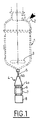
- the polymer is poured through the nozzle 4a and the die 4b by opening the bottom valve 5.
- the nozzle 4a and die 4b assembly constitutes the die block 4.
- the rods 6 leaving the die are cooled by a curtain of water 7 and fed into a granulator 8 which cuts the rods into granules a few millimeters in length.
- the granules are then dried and then stored in silos after possible sieving.
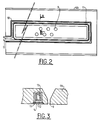
- the die 4b shown in FIGS. 2 and 3 is a metallic mass, for example a parallelepiped, comprising holes 9 in the die in which the rods 6 are formed.
- the outlet face of the die comprises a groove 10 in the vicinity of the die holes 9.
- An electromagnetic inductor 11 is disposed in this groove, advantageously closed by a plate 14.
- This inductor illustrated in FIG. 3, is coated with a layer 12 that is electrically insulating but advantageously a good conductor of heat. Furthermore, this insulating layer 12 will have to withstand the casting temperatures of the polymers, that is to say temperatures of the order of 250 ° C. to 400 ° C.
- Ceramic powders such as magnesia or boron nitride.
- the inductor 11 is disposed in the groove 10, the latter being filled with an insulator 12.
- the inductors 11 are devices comprising a solenoid which may be a single-coil inductor arranged around a magnetic element, allowing homogeneous heating of the die and mainly of the part of the die comprising the tap holes.
- This solenoid is advantageously a copper tube.
- a circulation 13 of cooling fluid is provided in the inductors. This circulation can be ensured by the use of a hollow copper inductor.
- the cooling fluid is advantageously either air or water, or any refrigerant fluids.
- the inductor 11 is connected to a generator (not shown) delivering an appropriate power and advantageously comprising a servo means which makes it possible to regulate the operation and the supply of the inductor by measuring the temperature of the die.
- This power supply is carried out with a frequency current any such as low frequencies, medium frequencies or high frequencies, depending on the geometry of the die to be heated.
- the example below illustrates the operation of a discontinuous polyester production installation equipped with a die heated by an electromagnetic inductor in accordance with the invention.
- the polymerization reactor 1 contains a charge of polymer under development, at a temperature of 285 ° C. Valve 5 is closed.
- the die 4b When the degree of polymerization is reached, the die 4b is heated to a temperature between 270 and 290 ° C. by supplying the inductor 11 with a frequency current at 500 Hz. This warming up takes place in a few seconds.
- the bottom valve 5 is open, the polymer can flow immediately through the holes 9 of the die, because the polymer which could be trapped in the holes has been made fluid and ejectable by the prior temperature setting of the die.
- the die at the end of casting the die is rapidly cooled to a cooling temperature defined above, for example 250 ° C.
- a cooling temperature defined above, for example 250 ° C. This cooling is obtained in the embodiment described by stopping the current supply to the inductor, but maintains the circulation of the cooling fluid.
- the polymer is fixed in the holes of the die and forms a tight plug.
- the temperature of the die is then maintained at a temperature above the crystallization temperature of the polymer, namely for polyethylene terephthalate, at a temperature above 200 ° C.
- a temperature above the crystallization temperature of the polymer namely for polyethylene terephthalate
- cooling to a too low temperature can cause the polymer to shrink or at least suppress the adhesion of the polymer to the surface of the die holes, the plug then no longer being tight.
- the polyester obtained has a constant quality during casting with an index of yellow varying slightly from one granule to another, the total index of the polymer cast (statistical measurement of the total casting ) having a value lower than that of a polymer obtained with casting in a die not heated by induction. This gain on the yellow index can be evaluated at several points.
- Another advantage of the process of the invention is the possibility of working at a die temperature higher than the temperature of the polymer in the reactor.
- the casting speed of the polymer is increased, decreasing the casting time.
- the degradation phenomena of the polymer in the reactor occurring especially at the end of casting are also reduced.
Landscapes
- Engineering & Computer Science (AREA)
- Mechanical Engineering (AREA)
- Physics & Mathematics (AREA)
- Thermal Sciences (AREA)
- Manufacturing & Machinery (AREA)
- Processing And Handling Of Plastics And Other Materials For Molding In General (AREA)
- Polyesters Or Polycarbonates (AREA)
- Extrusion Moulding Of Plastics Or The Like (AREA)
- Multicomponent Fibers (AREA)
Applications Claiming Priority (2)
| Application Number | Priority Date | Filing Date | Title |
|---|---|---|---|
| FR9408781A FR2722133B1 (fr) | 1994-07-08 | 1994-07-08 | Procede et dispositif de fabrication de polymeres |
| FR9408781 | 1994-07-08 |
Publications (2)
| Publication Number | Publication Date |
|---|---|
| EP0691192A1 true EP0691192A1 (de) | 1996-01-10 |
| EP0691192B1 EP0691192B1 (de) | 2000-03-22 |
Family
ID=9465418
Family Applications (1)
| Application Number | Title | Priority Date | Filing Date |
|---|---|---|---|
| EP95420192A Expired - Lifetime EP0691192B1 (de) | 1994-07-08 | 1995-07-07 | Verfahren und Vorrichtung zur Herstellung von Polymeren |
Country Status (4)
| Country | Link |
|---|---|
| EP (1) | EP0691192B1 (de) |
| AT (1) | ATE190903T1 (de) |
| DE (1) | DE69515745D1 (de) |
| FR (1) | FR2722133B1 (de) |
Cited By (2)
| Publication number | Priority date | Publication date | Assignee | Title |
|---|---|---|---|---|
| EP0753392A1 (de) * | 1995-07-13 | 1997-01-15 | RIETER AUTOMATIK GmbH | Vorrichtung zum Absperren einer Schmelze insbesondere aus Kunststoff |
| EP0754536A1 (de) * | 1995-07-18 | 1997-01-22 | RIETER AUTOMATIK GmbH | Vorrichtung zum Absperren einer Schmelze insbesondere aus Kunststoff |
Citations (7)
| Publication number | Priority date | Publication date | Assignee | Title |
|---|---|---|---|---|
| US3521325A (en) * | 1967-02-15 | 1970-07-21 | Barmag Barmer Maschf | Inductively heated extrusion die |
| JPS5726420A (en) * | 1980-07-24 | 1982-02-12 | Fuji Electric Co Ltd | Cooling device for induction coil |
| JPS57167209A (en) * | 1981-04-07 | 1982-10-15 | Nippon Koshuha Kk | Quick formation of plastic film |
| JPS62177207A (ja) * | 1986-01-27 | 1987-08-04 | Toray Ind Inc | 溶融紡糸方法 |
| JPS63309408A (ja) * | 1987-06-12 | 1988-12-16 | Inoue Japax Res Inc | 加熱成形用型装置 |
| JPH02301505A (ja) * | 1989-05-16 | 1990-12-13 | Kawasaki Steel Corp | 金属溶解炉からの溶融金属排出制御方法 |
| JPH0544105A (ja) * | 1991-02-18 | 1993-02-23 | Toray Ind Inc | 溶融紡糸方法 |
-
1994
- 1994-07-08 FR FR9408781A patent/FR2722133B1/fr not_active Expired - Fee Related
-
1995
- 1995-07-07 DE DE69515745T patent/DE69515745D1/de not_active Expired - Lifetime
- 1995-07-07 AT AT95420192T patent/ATE190903T1/de not_active IP Right Cessation
- 1995-07-07 EP EP95420192A patent/EP0691192B1/de not_active Expired - Lifetime
Patent Citations (7)
| Publication number | Priority date | Publication date | Assignee | Title |
|---|---|---|---|---|
| US3521325A (en) * | 1967-02-15 | 1970-07-21 | Barmag Barmer Maschf | Inductively heated extrusion die |
| JPS5726420A (en) * | 1980-07-24 | 1982-02-12 | Fuji Electric Co Ltd | Cooling device for induction coil |
| JPS57167209A (en) * | 1981-04-07 | 1982-10-15 | Nippon Koshuha Kk | Quick formation of plastic film |
| JPS62177207A (ja) * | 1986-01-27 | 1987-08-04 | Toray Ind Inc | 溶融紡糸方法 |
| JPS63309408A (ja) * | 1987-06-12 | 1988-12-16 | Inoue Japax Res Inc | 加熱成形用型装置 |
| JPH02301505A (ja) * | 1989-05-16 | 1990-12-13 | Kawasaki Steel Corp | 金属溶解炉からの溶融金属排出制御方法 |
| JPH0544105A (ja) * | 1991-02-18 | 1993-02-23 | Toray Ind Inc | 溶融紡糸方法 |
Non-Patent Citations (6)
| Title |
|---|
| DATABASE WPI Week 8212, Derwent World Patents Index; AN 82-D2150E * |
| DATABASE WPI Week 8905, Derwent World Patents Index; AN 89-036031 * |
| DATABASE WPI Week 9105, Derwent World Patents Index; AN 91-032472 * |
| PATENT ABSTRACTS OF JAPAN vol. 12, no. 28 (C - 471) 27 January 1988 (1988-01-27) * |
| PATENT ABSTRACTS OF JAPAN vol. 17, no. 349 (C - 1078) 2 July 1993 (1993-07-02) * |
| PATENT ABSTRACTS OF JAPAN vol. 7, no. 9 (M - 185) 14 January 1983 (1983-01-14) * |
Cited By (2)
| Publication number | Priority date | Publication date | Assignee | Title |
|---|---|---|---|---|
| EP0753392A1 (de) * | 1995-07-13 | 1997-01-15 | RIETER AUTOMATIK GmbH | Vorrichtung zum Absperren einer Schmelze insbesondere aus Kunststoff |
| EP0754536A1 (de) * | 1995-07-18 | 1997-01-22 | RIETER AUTOMATIK GmbH | Vorrichtung zum Absperren einer Schmelze insbesondere aus Kunststoff |
Also Published As
| Publication number | Publication date |
|---|---|
| FR2722133A1 (fr) | 1996-01-12 |
| EP0691192B1 (de) | 2000-03-22 |
| FR2722133B1 (fr) | 1996-08-23 |
| DE69515745D1 (de) | 2000-04-27 |
| ATE190903T1 (de) | 2000-04-15 |
Similar Documents
| Publication | Publication Date | Title |
|---|---|---|
| JP5726406B2 (ja) | ワックス及びワックス状の材料を造粒する装置及び方法 | |
| JP5176036B2 (ja) | ポリマーの水中ペレット化のためのプロセスおよび装置 | |
| EP0275228B1 (de) | Verfahren und Anlage zum Schmelzen und Stranggiessen von Metallen | |
| CA2082240A1 (fr) | Procede de fabrication d'un produit composite par moulage | |
| JP4085419B2 (ja) | プラスチック押し出し材を供給し処理する方法及び装置 | |
| EP0579821A1 (de) | Vorrichtung zum umhullen von faserformigen material mit einem schmelzbaren material. | |
| EP0691192B1 (de) | Verfahren und Vorrichtung zur Herstellung von Polymeren | |
| Oliveira et al. | Structure-properties relationships in rotationally moulded polyethylene | |
| CA1303356C (fr) | Procede et dispositif de fabrication de fibres en matieres thermoplastiques en particulier de fibres de verre | |
| US6409491B1 (en) | Extrusion die assembly | |
| WO1987007546A1 (fr) | Procede et dispositif de granulation d'un materiau fondu | |
| EP0399928A1 (de) | Kalter Tiegel mit Bodenentleerung | |
| EP0586481B1 (de) | Verfahren und vorrichtung zur herstellung von amorphem metalldraht auf eisenbasis | |
| FR2517666A1 (fr) | Procede de chauffage d'une masselotte de materiau refractaire en fusion | |
| CA2018205C (fr) | Dispositif pour recuperer par fusion le metal constitutif d'un noyau fusible | |
| EP1103361B1 (de) | Produktionslinie für elektrische Kabel mit Rückgewinnung von thermoplastischen Abfallmaterialien, und entsprechendes Rückgewinnungsverfahren | |
| FR2565887A1 (fr) | Ligne de vulcanisation et/ou reticulation continue, notamment pour la realisation de couches synthetiques isolantes sur des cables | |
| EP0958073A1 (de) | Verfahren und anlage stranggiessen von metall | |
| CH297508A (fr) | Procédé de fabrication d'un objet de forme allongée en polyamide et appareillage pour la mise en oeuvre de ce procédé. | |
| EP0240482B1 (de) | Vorrichtung zum Giessen von Stahl | |
| EP0290423A2 (de) | Vorrichtung zur kontinuierlichen Herstellung eines dünnen Metallbands | |
| CA2204548C (en) | Heated die lips system | |
| FR2514688A1 (fr) | Materiau compose de fibres de carbone et d'une matiere thermoplastique, procede de preparation et application dudit materiau | |
| BE390381A (de) | ||
| FR2459122A1 (fr) | Procede et dispositif pour la fabrication de profiles en matiere plastique expansee en mousse |
Legal Events
| Date | Code | Title | Description |
|---|---|---|---|
| PUAI | Public reference made under article 153(3) epc to a published international application that has entered the european phase |
Free format text: ORIGINAL CODE: 0009012 |
|
| AK | Designated contracting states |
Kind code of ref document: A1 Designated state(s): AT BE CH DE ES GB GR IE IT LI LU NL PT |
|
| K1C1 | Correction of patent application (title page) published |
Effective date: 19960110 |
|
| 17P | Request for examination filed |
Effective date: 19960607 |
|
| RAP1 | Party data changed (applicant data changed or rights of an application transferred) |
Owner name: RHODIA CHIMIE |
|
| 17Q | First examination report despatched |
Effective date: 19980602 |
|
| GRAG | Despatch of communication of intention to grant |
Free format text: ORIGINAL CODE: EPIDOS AGRA |
|
| GRAG | Despatch of communication of intention to grant |
Free format text: ORIGINAL CODE: EPIDOS AGRA |
|
| GRAH | Despatch of communication of intention to grant a patent |
Free format text: ORIGINAL CODE: EPIDOS IGRA |
|
| GRAH | Despatch of communication of intention to grant a patent |
Free format text: ORIGINAL CODE: EPIDOS IGRA |
|
| GRAA | (expected) grant |
Free format text: ORIGINAL CODE: 0009210 |
|
| AK | Designated contracting states |
Kind code of ref document: B1 Designated state(s): AT BE CH DE ES GB GR IE IT LI LU NL PT |
|
| PG25 | Lapsed in a contracting state [announced via postgrant information from national office to epo] |
Ref country code: NL Free format text: LAPSE BECAUSE OF FAILURE TO SUBMIT A TRANSLATION OF THE DESCRIPTION OR TO PAY THE FEE WITHIN THE PRESCRIBED TIME-LIMIT Effective date: 20000322 Ref country code: IT Free format text: LAPSE BECAUSE OF FAILURE TO SUBMIT A TRANSLATION OF THE DESCRIPTION OR TO PAY THE FEE WITHIN THE PRE;WARNING: LAPSES OF ITALIAN PATENTS WITH EFFECTIVE DATE BEFORE 2007 MAY HAVE OCCURRED AT ANY TIME BEFORE 2007. THE CORRECT EFFECTIVE DATE MAY BE DIFFERENT FROM THE ONE RECORDED.SCRIBED TIME-LIMIT Effective date: 20000322 Ref country code: GR Free format text: LAPSE BECAUSE OF NON-PAYMENT OF DUE FEES Effective date: 20000322 Ref country code: GB Free format text: LAPSE BECAUSE OF FAILURE TO SUBMIT A TRANSLATION OF THE DESCRIPTION OR TO PAY THE FEE WITHIN THE PRESCRIBED TIME-LIMIT Effective date: 20000322 Ref country code: ES Free format text: THE PATENT HAS BEEN ANNULLED BY A DECISION OF A NATIONAL AUTHORITY Effective date: 20000322 Ref country code: AT Free format text: LAPSE BECAUSE OF FAILURE TO SUBMIT A TRANSLATION OF THE DESCRIPTION OR TO PAY THE FEE WITHIN THE PRESCRIBED TIME-LIMIT Effective date: 20000322 |
|
| REF | Corresponds to: |
Ref document number: 190903 Country of ref document: AT Date of ref document: 20000415 Kind code of ref document: T |
|
| REG | Reference to a national code |
Ref country code: CH Ref legal event code: EP |
|
| REF | Corresponds to: |
Ref document number: 69515745 Country of ref document: DE Date of ref document: 20000427 |
|
| REG | Reference to a national code |
Ref country code: IE Ref legal event code: FG4D Free format text: FRENCH |
|
| PG25 | Lapsed in a contracting state [announced via postgrant information from national office to epo] |
Ref country code: PT Free format text: LAPSE BECAUSE OF FAILURE TO SUBMIT A TRANSLATION OF THE DESCRIPTION OR TO PAY THE FEE WITHIN THE PRESCRIBED TIME-LIMIT Effective date: 20000623 |
|
| PG25 | Lapsed in a contracting state [announced via postgrant information from national office to epo] |
Ref country code: DE Free format text: LAPSE BECAUSE OF FAILURE TO SUBMIT A TRANSLATION OF THE DESCRIPTION OR TO PAY THE FEE WITHIN THE PRESCRIBED TIME-LIMIT Effective date: 20000624 |
|
| PG25 | Lapsed in a contracting state [announced via postgrant information from national office to epo] |
Ref country code: LU Free format text: LAPSE BECAUSE OF NON-PAYMENT OF DUE FEES Effective date: 20000707 |
|
| PG25 | Lapsed in a contracting state [announced via postgrant information from national office to epo] |
Ref country code: LI Free format text: LAPSE BECAUSE OF NON-PAYMENT OF DUE FEES Effective date: 20000731 Ref country code: CH Free format text: LAPSE BECAUSE OF NON-PAYMENT OF DUE FEES Effective date: 20000731 Ref country code: BE Free format text: LAPSE BECAUSE OF NON-PAYMENT OF DUE FEES Effective date: 20000731 |
|
| NLV1 | Nl: lapsed or annulled due to failure to fulfill the requirements of art. 29p and 29m of the patents act | ||
| GBV | Gb: ep patent (uk) treated as always having been void in accordance with gb section 77(7)/1977 [no translation filed] |
Effective date: 20000322 |
|
| PLBQ | Unpublished change to opponent data |
Free format text: ORIGINAL CODE: EPIDOS OPPO |
|
| PLBI | Opposition filed |
Free format text: ORIGINAL CODE: 0009260 |
|
| PLBF | Reply of patent proprietor to notice(s) of opposition |
Free format text: ORIGINAL CODE: EPIDOS OBSO |
|
| BERE | Be: lapsed |
Owner name: RHODIA CHIMIE Effective date: 20000731 |
|
| 26 | Opposition filed |
Opponent name: BASF AKTIENGESELLSCHAFT Effective date: 20001222 |
|
| REG | Reference to a national code |
Ref country code: IE Ref legal event code: FD4D |
|
| REG | Reference to a national code |
Ref country code: CH Ref legal event code: PL |
|
| PLBF | Reply of patent proprietor to notice(s) of opposition |
Free format text: ORIGINAL CODE: EPIDOS OBSO |
|
| PLBD | Termination of opposition procedure: decision despatched |
Free format text: ORIGINAL CODE: EPIDOSNOPC1 |
|
| PLBM | Termination of opposition procedure: date of legal effect published |
Free format text: ORIGINAL CODE: 0009276 |
|
| STAA | Information on the status of an ep patent application or granted ep patent |
Free format text: STATUS: OPPOSITION PROCEDURE CLOSED |
|
| 27C | Opposition proceedings terminated |
Effective date: 20061022 |
|
| PLAB | Opposition data, opponent's data or that of the opponent's representative modified |
Free format text: ORIGINAL CODE: 0009299OPPO |