EP0683138B1 - Process for making photoprocessing waste solution harmless - Google Patents
Process for making photoprocessing waste solution harmless Download PDFInfo
- Publication number
- EP0683138B1 EP0683138B1 EP19950107548 EP95107548A EP0683138B1 EP 0683138 B1 EP0683138 B1 EP 0683138B1 EP 19950107548 EP19950107548 EP 19950107548 EP 95107548 A EP95107548 A EP 95107548A EP 0683138 B1 EP0683138 B1 EP 0683138B1
- Authority
- EP
- European Patent Office
- Prior art keywords
- solution
- activated carbon
- treatment
- waste solution
- ppm
- Prior art date
- Legal status (The legal status is an assumption and is not a legal conclusion. Google has not performed a legal analysis and makes no representation as to the accuracy of the status listed.)
- Expired - Lifetime
Links
- 238000000034 method Methods 0.000 title claims description 149
- 239000002699 waste material Substances 0.000 title claims description 113
- OKTJSMMVPCPJKN-UHFFFAOYSA-N Carbon Chemical compound [C] OKTJSMMVPCPJKN-UHFFFAOYSA-N 0.000 claims description 210
- 238000011282 treatment Methods 0.000 claims description 175
- KXDHJXZQYSOELW-UHFFFAOYSA-N Carbamic acid Chemical class NC(O)=O KXDHJXZQYSOELW-UHFFFAOYSA-N 0.000 claims description 21
- 239000003245 coal Substances 0.000 claims description 9
- 235000013162 Cocos nucifera Nutrition 0.000 claims description 6
- 244000060011 Cocos nucifera Species 0.000 claims description 6
- 239000000243 solution Substances 0.000 description 211
- 239000010802 sludge Substances 0.000 description 49
- IJGRMHOSHXDMSA-UHFFFAOYSA-N Atomic nitrogen Chemical compound N#N IJGRMHOSHXDMSA-UHFFFAOYSA-N 0.000 description 33
- OKKJLVBELUTLKV-UHFFFAOYSA-N Methanol Chemical compound OC OKKJLVBELUTLKV-UHFFFAOYSA-N 0.000 description 30
- 244000005700 microbiome Species 0.000 description 29
- 241000894006 Bacteria Species 0.000 description 28
- 229910052757 nitrogen Inorganic materials 0.000 description 25
- 239000000126 substance Substances 0.000 description 25
- LMSDCGXQALIMLM-UHFFFAOYSA-N 2-[2-[bis(carboxymethyl)amino]ethyl-(carboxymethyl)amino]acetic acid;iron Chemical compound [Fe].OC(=O)CN(CC(O)=O)CCN(CC(O)=O)CC(O)=O LMSDCGXQALIMLM-UHFFFAOYSA-N 0.000 description 23
- 239000012528 membrane Substances 0.000 description 22
- 239000011572 manganese Substances 0.000 description 20
- 239000002253 acid Substances 0.000 description 19
- 230000015556 catabolic process Effects 0.000 description 19
- 238000006731 degradation reaction Methods 0.000 description 19
- QGZKDVFQNNGYKY-UHFFFAOYSA-N Ammonia Chemical compound N QGZKDVFQNNGYKY-UHFFFAOYSA-N 0.000 description 18
- XEEYBQQBJWHFJM-UHFFFAOYSA-N Iron Chemical compound [Fe] XEEYBQQBJWHFJM-UHFFFAOYSA-N 0.000 description 17
- KCXVZYZYPLLWCC-UHFFFAOYSA-N EDTA Chemical compound OC(=O)CN(CC(O)=O)CCN(CC(O)=O)CC(O)=O KCXVZYZYPLLWCC-UHFFFAOYSA-N 0.000 description 16
- 238000012545 processing Methods 0.000 description 16
- 239000000463 material Substances 0.000 description 15
- 230000000813 microbial effect Effects 0.000 description 14
- -1 silver halide Chemical class 0.000 description 14
- OAICVXFJPJFONN-UHFFFAOYSA-N Phosphorus Chemical compound [P] OAICVXFJPJFONN-UHFFFAOYSA-N 0.000 description 13
- 229910052698 phosphorus Inorganic materials 0.000 description 13
- 239000011574 phosphorus Substances 0.000 description 13
- NHNBFGGVMKEFGY-UHFFFAOYSA-N Nitrate Chemical compound [O-][N+]([O-])=O NHNBFGGVMKEFGY-UHFFFAOYSA-N 0.000 description 11
- 238000001914 filtration Methods 0.000 description 11
- 150000003839 salts Chemical class 0.000 description 11
- XLYOFNOQVPJJNP-UHFFFAOYSA-N water Substances O XLYOFNOQVPJJNP-UHFFFAOYSA-N 0.000 description 11
- 230000001546 nitrifying effect Effects 0.000 description 10
- GCLGEJMYGQKIIW-UHFFFAOYSA-H sodium hexametaphosphate Chemical compound [Na]OP1(=O)OP(=O)(O[Na])OP(=O)(O[Na])OP(=O)(O[Na])OP(=O)(O[Na])OP(=O)(O[Na])O1 GCLGEJMYGQKIIW-UHFFFAOYSA-H 0.000 description 10
- 229910002651 NO3 Inorganic materials 0.000 description 9
- 229910052799 carbon Inorganic materials 0.000 description 9
- 229910052742 iron Inorganic materials 0.000 description 9
- 239000000203 mixture Substances 0.000 description 9
- 230000001105 regulatory effect Effects 0.000 description 9
- 230000000593 degrading effect Effects 0.000 description 8
- 230000000694 effects Effects 0.000 description 8
- 239000012071 phase Substances 0.000 description 8
- 229910052709 silver Inorganic materials 0.000 description 8
- 239000004332 silver Substances 0.000 description 8
- QTBSBXVTEAMEQO-UHFFFAOYSA-N acetic acid Substances CC(O)=O QTBSBXVTEAMEQO-UHFFFAOYSA-N 0.000 description 7
- 229910021529 ammonia Inorganic materials 0.000 description 7
- 229910017053 inorganic salt Inorganic materials 0.000 description 7
- 230000003647 oxidation Effects 0.000 description 7
- 238000007254 oxidation reaction Methods 0.000 description 7
- 238000001556 precipitation Methods 0.000 description 7
- 238000011084 recovery Methods 0.000 description 7
- 238000000926 separation method Methods 0.000 description 7
- 239000000725 suspension Substances 0.000 description 7
- 239000002351 wastewater Substances 0.000 description 7
- QGZKDVFQNNGYKY-UHFFFAOYSA-O Ammonium Chemical compound [NH4+] QGZKDVFQNNGYKY-UHFFFAOYSA-O 0.000 description 6
- NINIDFKCEFEMDL-UHFFFAOYSA-N Sulfur Chemical compound [S] NINIDFKCEFEMDL-UHFFFAOYSA-N 0.000 description 6
- 238000005273 aeration Methods 0.000 description 6
- 238000006243 chemical reaction Methods 0.000 description 6
- 239000007788 liquid Substances 0.000 description 6
- 150000002894 organic compounds Chemical class 0.000 description 6
- 239000007787 solid Substances 0.000 description 6
- 229910052717 sulfur Inorganic materials 0.000 description 6
- 239000011593 sulfur Substances 0.000 description 6
- BQCADISMDOOEFD-UHFFFAOYSA-N Silver Chemical compound [Ag] BQCADISMDOOEFD-UHFFFAOYSA-N 0.000 description 5
- QVGXLLKOCUKJST-UHFFFAOYSA-N atomic oxygen Chemical compound [O] QVGXLLKOCUKJST-UHFFFAOYSA-N 0.000 description 5
- 239000002738 chelating agent Substances 0.000 description 5
- 239000002131 composite material Substances 0.000 description 5
- 229910052760 oxygen Inorganic materials 0.000 description 5
- 239000001301 oxygen Substances 0.000 description 5
- 239000011148 porous material Substances 0.000 description 5
- HRPVXLWXLXDGHG-UHFFFAOYSA-N Acrylamide Chemical compound NC(=O)C=C HRPVXLWXLXDGHG-UHFFFAOYSA-N 0.000 description 4
- CURLTUGMZLYLDI-UHFFFAOYSA-N Carbon dioxide Chemical compound O=C=O CURLTUGMZLYLDI-UHFFFAOYSA-N 0.000 description 4
- 241000196324 Embryophyta Species 0.000 description 4
- LFQSCWFLJHTTHZ-UHFFFAOYSA-N Ethanol Chemical compound CCO LFQSCWFLJHTTHZ-UHFFFAOYSA-N 0.000 description 4
- 241000589516 Pseudomonas Species 0.000 description 4
- XSQUKJJJFZCRTK-UHFFFAOYSA-N Urea Chemical compound NC(N)=O XSQUKJJJFZCRTK-UHFFFAOYSA-N 0.000 description 4
- 235000010724 Wisteria floribunda Nutrition 0.000 description 4
- 239000000969 carrier Substances 0.000 description 4
- 238000011161 development Methods 0.000 description 4
- 238000005516 engineering process Methods 0.000 description 4
- 230000007613 environmental effect Effects 0.000 description 4
- 229920005989 resin Polymers 0.000 description 4
- 239000011347 resin Substances 0.000 description 4
- 241000588986 Alcaligenes Species 0.000 description 3
- 241000193830 Bacillus <bacterium> Species 0.000 description 3
- WVDDGKGOMKODPV-UHFFFAOYSA-N Benzyl alcohol Chemical compound OCC1=CC=CC=C1 WVDDGKGOMKODPV-UHFFFAOYSA-N 0.000 description 3
- GRYLNZFGIOXLOG-UHFFFAOYSA-N Nitric acid Chemical compound O[N+]([O-])=O GRYLNZFGIOXLOG-UHFFFAOYSA-N 0.000 description 3
- IOVCWXUNBOPUCH-UHFFFAOYSA-M Nitrite anion Chemical compound [O-]N=O IOVCWXUNBOPUCH-UHFFFAOYSA-M 0.000 description 3
- IOVCWXUNBOPUCH-UHFFFAOYSA-N Nitrous acid Chemical compound ON=O IOVCWXUNBOPUCH-UHFFFAOYSA-N 0.000 description 3
- 229920000297 Rayon Polymers 0.000 description 3
- HEMHJVSKTPXQMS-UHFFFAOYSA-M Sodium hydroxide Chemical compound [OH-].[Na+] HEMHJVSKTPXQMS-UHFFFAOYSA-M 0.000 description 3
- 235000011054 acetic acid Nutrition 0.000 description 3
- 239000000919 ceramic Substances 0.000 description 3
- 239000003610 charcoal Substances 0.000 description 3
- KRKNYBCHXYNGOX-UHFFFAOYSA-N citric acid Chemical compound OC(=O)CC(O)(C(O)=O)CC(O)=O KRKNYBCHXYNGOX-UHFFFAOYSA-N 0.000 description 3
- 238000005345 coagulation Methods 0.000 description 3
- 230000015271 coagulation Effects 0.000 description 3
- MTHSVFCYNBDYFN-UHFFFAOYSA-N diethylene glycol Chemical compound OCCOCCO MTHSVFCYNBDYFN-UHFFFAOYSA-N 0.000 description 3
- 238000010790 dilution Methods 0.000 description 3
- 239000012895 dilution Substances 0.000 description 3
- 229910001873 dinitrogen Inorganic materials 0.000 description 3
- ZPWVASYFFYYZEW-UHFFFAOYSA-L dipotassium hydrogen phosphate Chemical compound [K+].[K+].OP([O-])([O-])=O ZPWVASYFFYYZEW-UHFFFAOYSA-L 0.000 description 3
- 239000000852 hydrogen donor Substances 0.000 description 3
- 239000008235 industrial water Substances 0.000 description 3
- 238000005342 ion exchange Methods 0.000 description 3
- 229910052751 metal Inorganic materials 0.000 description 3
- 239000002184 metal Substances 0.000 description 3
- 229910017604 nitric acid Inorganic materials 0.000 description 3
- 230000000050 nutritive effect Effects 0.000 description 3
- 239000011368 organic material Substances 0.000 description 3
- DHCDFWKWKRSZHF-UHFFFAOYSA-N sulfurothioic S-acid Chemical compound OS(O)(=O)=S DHCDFWKWKRSZHF-UHFFFAOYSA-N 0.000 description 3
- IXPNQXFRVYWDDI-UHFFFAOYSA-N 1-methyl-2,4-dioxo-1,3-diazinane-5-carboximidamide Chemical compound CN1CC(C(N)=N)C(=O)NC1=O IXPNQXFRVYWDDI-UHFFFAOYSA-N 0.000 description 2
- QZTKDVCDBIDYMD-UHFFFAOYSA-N 2,2'-[(2-amino-2-oxoethyl)imino]diacetic acid Chemical compound NC(=O)CN(CC(O)=O)CC(O)=O QZTKDVCDBIDYMD-UHFFFAOYSA-N 0.000 description 2
- XNCSCQSQSGDGES-UHFFFAOYSA-N 2-[2-[bis(carboxymethyl)amino]propyl-(carboxymethyl)amino]acetic acid Chemical compound OC(=O)CN(CC(O)=O)C(C)CN(CC(O)=O)CC(O)=O XNCSCQSQSGDGES-UHFFFAOYSA-N 0.000 description 2
- 241000590020 Achromobacter Species 0.000 description 2
- OYPRJOBELJOOCE-UHFFFAOYSA-N Calcium Chemical compound [Ca] OYPRJOBELJOOCE-UHFFFAOYSA-N 0.000 description 2
- SRBFZHDQGSBBOR-IOVATXLUSA-N D-xylopyranose Chemical compound O[C@@H]1COC(O)[C@H](O)[C@H]1O SRBFZHDQGSBBOR-IOVATXLUSA-N 0.000 description 2
- 241000589565 Flavobacterium Species 0.000 description 2
- 229920000544 Gore-Tex Polymers 0.000 description 2
- QIGBRXMKCJKVMJ-UHFFFAOYSA-N Hydroquinone Chemical compound OC1=CC=C(O)C=C1 QIGBRXMKCJKVMJ-UHFFFAOYSA-N 0.000 description 2
- DGAQECJNVWCQMB-PUAWFVPOSA-M Ilexoside XXIX Chemical class C[C@@H]1CC[C@@]2(CC[C@@]3(C(=CC[C@H]4[C@]3(CC[C@@H]5[C@@]4(CC[C@@H](C5(C)C)OS(=O)(=O)[O-])C)C)[C@@H]2[C@]1(C)O)C)C(=O)O[C@H]6[C@@H]([C@H]([C@@H]([C@H](O6)CO)O)O)O.[Na+] DGAQECJNVWCQMB-PUAWFVPOSA-M 0.000 description 2
- 239000007836 KH2PO4 Substances 0.000 description 2
- FYYHWMGAXLPEAU-UHFFFAOYSA-N Magnesium Chemical compound [Mg] FYYHWMGAXLPEAU-UHFFFAOYSA-N 0.000 description 2
- CPLXHLVBOLITMK-UHFFFAOYSA-N Magnesium oxide Chemical compound [Mg]=O CPLXHLVBOLITMK-UHFFFAOYSA-N 0.000 description 2
- 241000605122 Nitrosomonas Species 0.000 description 2
- 239000004372 Polyvinyl alcohol Substances 0.000 description 2
- VYPSYNLAJGMNEJ-UHFFFAOYSA-N Silicium dioxide Chemical compound O=[Si]=O VYPSYNLAJGMNEJ-UHFFFAOYSA-N 0.000 description 2
- 241001478894 Sphaerotilus Species 0.000 description 2
- QAOWNCQODCNURD-UHFFFAOYSA-N Sulfuric acid Chemical compound OS(O)(=O)=O QAOWNCQODCNURD-UHFFFAOYSA-N 0.000 description 2
- 241000605118 Thiobacillus Species 0.000 description 2
- 241000589651 Zoogloea Species 0.000 description 2
- BFNBIHQBYMNNAN-UHFFFAOYSA-N ammonium sulfate Chemical compound N.N.OS(O)(=O)=O BFNBIHQBYMNNAN-UHFFFAOYSA-N 0.000 description 2
- 229910052921 ammonium sulfate Inorganic materials 0.000 description 2
- HUMNYLRZRPPJDN-UHFFFAOYSA-N benzaldehyde Chemical compound O=CC1=CC=CC=C1 HUMNYLRZRPPJDN-UHFFFAOYSA-N 0.000 description 2
- 210000000988 bone and bone Anatomy 0.000 description 2
- 239000004327 boric acid Substances 0.000 description 2
- 239000011575 calcium Substances 0.000 description 2
- 229910052791 calcium Inorganic materials 0.000 description 2
- 239000004202 carbamide Substances 0.000 description 2
- 239000001569 carbon dioxide Substances 0.000 description 2
- 229910002092 carbon dioxide Inorganic materials 0.000 description 2
- 239000000679 carrageenan Substances 0.000 description 2
- 229920001525 carrageenan Polymers 0.000 description 2
- 229940113118 carrageenan Drugs 0.000 description 2
- 239000003599 detergent Substances 0.000 description 2
- 230000006866 deterioration Effects 0.000 description 2
- 229910000396 dipotassium phosphate Inorganic materials 0.000 description 2
- BNIILDVGGAEEIG-UHFFFAOYSA-L disodium hydrogen phosphate Chemical compound [Na+].[Na+].OP([O-])([O-])=O BNIILDVGGAEEIG-UHFFFAOYSA-L 0.000 description 2
- 229910000397 disodium phosphate Inorganic materials 0.000 description 2
- 230000008030 elimination Effects 0.000 description 2
- 238000003379 elimination reaction Methods 0.000 description 2
- 238000007710 freezing Methods 0.000 description 2
- 239000007789 gas Substances 0.000 description 2
- 238000004255 ion exchange chromatography Methods 0.000 description 2
- 239000011777 magnesium Substances 0.000 description 2
- 229910052749 magnesium Inorganic materials 0.000 description 2
- 230000014759 maintenance of location Effects 0.000 description 2
- 238000002156 mixing Methods 0.000 description 2
- 229910000402 monopotassium phosphate Inorganic materials 0.000 description 2
- 230000001590 oxidative effect Effects 0.000 description 2
- 239000008188 pellet Substances 0.000 description 2
- 229920002239 polyacrylonitrile Polymers 0.000 description 2
- 229920002451 polyvinyl alcohol Polymers 0.000 description 2
- GNSKLFRGEWLPPA-UHFFFAOYSA-M potassium dihydrogen phosphate Chemical compound [K+].OP(O)([O-])=O GNSKLFRGEWLPPA-UHFFFAOYSA-M 0.000 description 2
- 238000007639 printing Methods 0.000 description 2
- 238000011165 process development Methods 0.000 description 2
- 238000003672 processing method Methods 0.000 description 2
- 230000002035 prolonged effect Effects 0.000 description 2
- BDERNNFJNOPAEC-UHFFFAOYSA-N propan-1-ol Chemical compound CCCO BDERNNFJNOPAEC-UHFFFAOYSA-N 0.000 description 2
- 238000011160 research Methods 0.000 description 2
- 238000001223 reverse osmosis Methods 0.000 description 2
- 239000011734 sodium Substances 0.000 description 2
- 229910052708 sodium Inorganic materials 0.000 description 2
- 239000000661 sodium alginate Substances 0.000 description 2
- 235000010413 sodium alginate Nutrition 0.000 description 2
- 229940005550 sodium alginate Drugs 0.000 description 2
- 238000001179 sorption measurement Methods 0.000 description 2
- 239000003381 stabilizer Substances 0.000 description 2
- JOXIMZWYDAKGHI-UHFFFAOYSA-N toluene-4-sulfonic acid Chemical compound CC1=CC=C(S(O)(=O)=O)C=C1 JOXIMZWYDAKGHI-UHFFFAOYSA-N 0.000 description 2
- 238000000108 ultra-filtration Methods 0.000 description 2
- 238000005406 washing Methods 0.000 description 2
- 238000009279 wet oxidation reaction Methods 0.000 description 2
- HFVMEOPYDLEHBR-UHFFFAOYSA-N (2-fluorophenyl)-phenylmethanol Chemical compound C=1C=CC=C(F)C=1C(O)C1=CC=CC=C1 HFVMEOPYDLEHBR-UHFFFAOYSA-N 0.000 description 1
- ASROJPLUDOXWBL-UHFFFAOYSA-N 2-(1-carboxyethylamino)butanedioic acid Chemical compound OC(=O)C(C)NC(C(O)=O)CC(O)=O ASROJPLUDOXWBL-UHFFFAOYSA-N 0.000 description 1
- HZAXFHJVJLSVMW-UHFFFAOYSA-N 2-Aminoethan-1-ol Chemical compound NCCO HZAXFHJVJLSVMW-UHFFFAOYSA-N 0.000 description 1
- ZRZZITRXMDEZGW-UHFFFAOYSA-N 2-[(1-carboxy-2-phenylethyl)amino]butanedioic acid Chemical compound OC(=O)CC(C(O)=O)NC(C(O)=O)CC1=CC=CC=C1 ZRZZITRXMDEZGW-UHFFFAOYSA-N 0.000 description 1
- VKZRWSNIWNFCIQ-UHFFFAOYSA-N 2-[2-(1,2-dicarboxyethylamino)ethylamino]butanedioic acid Chemical compound OC(=O)CC(C(O)=O)NCCNC(C(O)=O)CC(O)=O VKZRWSNIWNFCIQ-UHFFFAOYSA-N 0.000 description 1
- LFRNILFAAAGYIF-UHFFFAOYSA-N 2-[2-[2-carboxy-6-(carboxymethylamino)phenyl]ethylamino]pentanedioic acid Chemical compound OC(=O)CCC(C(O)=O)NCCC1=C(NCC(O)=O)C=CC=C1C(O)=O LFRNILFAAAGYIF-UHFFFAOYSA-N 0.000 description 1
- URDCARMUOSMFFI-UHFFFAOYSA-N 2-[2-[bis(carboxymethyl)amino]ethyl-(2-hydroxyethyl)amino]acetic acid Chemical compound OCCN(CC(O)=O)CCN(CC(O)=O)CC(O)=O URDCARMUOSMFFI-UHFFFAOYSA-N 0.000 description 1
- OJUGWSIQSZTOLE-UHFFFAOYSA-N 2-[3-[bis(carboxymethyl)amino]-n-(carboxymethyl)anilino]acetic acid Chemical compound OC(=O)CN(CC(O)=O)C1=CC=CC(N(CC(O)=O)CC(O)=O)=C1 OJUGWSIQSZTOLE-UHFFFAOYSA-N 0.000 description 1
- DMQQXDPCRUGSQB-UHFFFAOYSA-N 2-[3-[bis(carboxymethyl)amino]propyl-(carboxymethyl)amino]acetic acid Chemical compound OC(=O)CN(CC(O)=O)CCCN(CC(O)=O)CC(O)=O DMQQXDPCRUGSQB-UHFFFAOYSA-N 0.000 description 1
- ZIMXAFGAUMQPMG-UHFFFAOYSA-N 2-[4-[bis(carboxymethyl)amino]butyl-(carboxymethyl)amino]acetic acid Chemical compound OC(=O)CN(CC(O)=O)CCCCN(CC(O)=O)CC(O)=O ZIMXAFGAUMQPMG-UHFFFAOYSA-N 0.000 description 1
- FCKYPQBAHLOOJQ-UWVGGRQHSA-N 2-[[(1s,2s)-2-[bis(carboxymethyl)amino]cyclohexyl]-(carboxymethyl)amino]acetic acid Chemical compound OC(=O)CN(CC(O)=O)[C@H]1CCCC[C@@H]1N(CC(O)=O)CC(O)=O FCKYPQBAHLOOJQ-UWVGGRQHSA-N 0.000 description 1
- RQZVICARGUBJIY-UHFFFAOYSA-N 2-[[3-[[bis(carboxymethyl)amino]methyl]phenyl]methyl-(carboxymethyl)amino]acetic acid Chemical compound OC(=O)CN(CC(O)=O)CC1=CC=CC(CN(CC(O)=O)CC(O)=O)=C1 RQZVICARGUBJIY-UHFFFAOYSA-N 0.000 description 1
- SVQRAHWQZYQCHF-UHFFFAOYSA-N 2-[[carboxy(phenyl)methyl]amino]butanedioic acid Chemical compound OC(=O)CC(C(O)=O)NC(C(O)=O)C1=CC=CC=C1 SVQRAHWQZYQCHF-UHFFFAOYSA-N 0.000 description 1
- IKEUZCGOPYSHNN-UHFFFAOYSA-N 2-[bis(carboxymethyl)amino]benzoic acid Chemical compound OC(=O)CN(CC(O)=O)C1=CC=CC=C1C(O)=O IKEUZCGOPYSHNN-UHFFFAOYSA-N 0.000 description 1
- CIEZZGWIJBXOTE-UHFFFAOYSA-N 2-[bis(carboxymethyl)amino]propanoic acid Chemical compound OC(=O)C(C)N(CC(O)=O)CC(O)=O CIEZZGWIJBXOTE-UHFFFAOYSA-N 0.000 description 1
- XWSGEVNYFYKXCP-UHFFFAOYSA-N 2-[carboxymethyl(methyl)amino]acetic acid Chemical compound OC(=O)CN(C)CC(O)=O XWSGEVNYFYKXCP-UHFFFAOYSA-N 0.000 description 1
- KWYJDIUEHHCHCZ-UHFFFAOYSA-N 3-[2-[bis(2-carboxyethyl)amino]ethyl-(2-carboxyethyl)amino]propanoic acid Chemical compound OC(=O)CCN(CCC(O)=O)CCN(CCC(O)=O)CCC(O)=O KWYJDIUEHHCHCZ-UHFFFAOYSA-N 0.000 description 1
- IWTIBPIVCKUAHK-UHFFFAOYSA-N 3-[bis(2-carboxyethyl)amino]propanoic acid Chemical compound OC(=O)CCN(CCC(O)=O)CCC(O)=O IWTIBPIVCKUAHK-UHFFFAOYSA-N 0.000 description 1
- OSWFIVFLDKOXQC-UHFFFAOYSA-N 4-(3-methoxyphenyl)aniline Chemical compound COC1=CC=CC(C=2C=CC(N)=CC=2)=C1 OSWFIVFLDKOXQC-UHFFFAOYSA-N 0.000 description 1
- YCPXWRQRBFJBPZ-UHFFFAOYSA-N 5-sulfosalicylic acid Chemical compound OC(=O)C1=CC(S(O)(=O)=O)=CC=C1O YCPXWRQRBFJBPZ-UHFFFAOYSA-N 0.000 description 1
- 241000589158 Agrobacterium Species 0.000 description 1
- 208000035404 Autolysis Diseases 0.000 description 1
- 108010017443 B 43 Proteins 0.000 description 1
- 229920001342 Bakelite® Polymers 0.000 description 1
- BHPQYMZQTOCNFJ-UHFFFAOYSA-N Calcium cation Chemical compound [Ca+2] BHPQYMZQTOCNFJ-UHFFFAOYSA-N 0.000 description 1
- 206010057248 Cell death Diseases 0.000 description 1
- 229920001661 Chitosan Polymers 0.000 description 1
- 235000008733 Citrus aurantifolia Nutrition 0.000 description 1
- FCKYPQBAHLOOJQ-UHFFFAOYSA-N Cyclohexane-1,2-diaminetetraacetic acid Chemical compound OC(=O)CN(CC(O)=O)C1CCCCC1N(CC(O)=O)CC(O)=O FCKYPQBAHLOOJQ-UHFFFAOYSA-N 0.000 description 1
- FBPFZTCFMRRESA-FSIIMWSLSA-N D-Glucitol Natural products OC[C@H](O)[C@H](O)[C@@H](O)[C@H](O)CO FBPFZTCFMRRESA-FSIIMWSLSA-N 0.000 description 1
- FBPFZTCFMRRESA-KVTDHHQDSA-N D-Mannitol Chemical compound OC[C@@H](O)[C@@H](O)[C@H](O)[C@H](O)CO FBPFZTCFMRRESA-KVTDHHQDSA-N 0.000 description 1
- FBPFZTCFMRRESA-JGWLITMVSA-N D-glucitol Chemical compound OC[C@H](O)[C@@H](O)[C@H](O)[C@H](O)CO FBPFZTCFMRRESA-JGWLITMVSA-N 0.000 description 1
- YCKRFDGAMUMZLT-UHFFFAOYSA-N Fluorine atom Chemical compound [F] YCKRFDGAMUMZLT-UHFFFAOYSA-N 0.000 description 1
- 108700042658 GAP-43 Proteins 0.000 description 1
- WQZGKKKJIJFFOK-GASJEMHNSA-N Glucose Natural products OC[C@H]1OC(O)[C@H](O)[C@@H](O)[C@@H]1O WQZGKKKJIJFFOK-GASJEMHNSA-N 0.000 description 1
- SXRSQZLOMIGNAQ-UHFFFAOYSA-N Glutaraldehyde Chemical compound O=CCCCC=O SXRSQZLOMIGNAQ-UHFFFAOYSA-N 0.000 description 1
- 239000005909 Kieselgur Substances 0.000 description 1
- JLVVSXFLKOJNIY-UHFFFAOYSA-N Magnesium ion Chemical compound [Mg+2] JLVVSXFLKOJNIY-UHFFFAOYSA-N 0.000 description 1
- 229930195725 Mannitol Natural products 0.000 description 1
- QPCDCPDFJACHGM-UHFFFAOYSA-N N,N-bis{2-[bis(carboxymethyl)amino]ethyl}glycine Chemical compound OC(=O)CN(CC(O)=O)CCN(CC(=O)O)CCN(CC(O)=O)CC(O)=O QPCDCPDFJACHGM-UHFFFAOYSA-N 0.000 description 1
- JYXGIOKAKDAARW-UHFFFAOYSA-N N-(2-hydroxyethyl)iminodiacetic acid Chemical compound OCCN(CC(O)=O)CC(O)=O JYXGIOKAKDAARW-UHFFFAOYSA-N 0.000 description 1
- 229910019142 PO4 Inorganic materials 0.000 description 1
- 239000001888 Peptone Substances 0.000 description 1
- 108010080698 Peptones Proteins 0.000 description 1
- 239000004698 Polyethylene Substances 0.000 description 1
- 239000004721 Polyphenylene oxide Substances 0.000 description 1
- ZLMJMSJWJFRBEC-UHFFFAOYSA-N Potassium Chemical class [K] ZLMJMSJWJFRBEC-UHFFFAOYSA-N 0.000 description 1
- 241000191023 Rhodobacter capsulatus Species 0.000 description 1
- 241000191043 Rhodobacter sphaeroides Species 0.000 description 1
- 241000190984 Rhodospirillum rubrum Species 0.000 description 1
- KDYFGRWQOYBRFD-UHFFFAOYSA-N Succinic acid Natural products OC(=O)CCC(O)=O KDYFGRWQOYBRFD-UHFFFAOYSA-N 0.000 description 1
- QAOWNCQODCNURD-UHFFFAOYSA-L Sulfate Chemical compound [O-]S([O-])(=O)=O QAOWNCQODCNURD-UHFFFAOYSA-L 0.000 description 1
- 241001509286 Thiobacillus denitrificans Species 0.000 description 1
- 235000011941 Tilia x europaea Nutrition 0.000 description 1
- BZHJMEDXRYGGRV-UHFFFAOYSA-N Vinyl chloride Chemical compound ClC=C BZHJMEDXRYGGRV-UHFFFAOYSA-N 0.000 description 1
- 240000008042 Zea mays Species 0.000 description 1
- 235000005824 Zea mays ssp. parviglumis Nutrition 0.000 description 1
- 235000002017 Zea mays subsp mays Nutrition 0.000 description 1
- 150000001243 acetic acids Chemical class 0.000 description 1
- WDJHALXBUFZDSR-UHFFFAOYSA-M acetoacetate Chemical compound CC(=O)CC([O-])=O WDJHALXBUFZDSR-UHFFFAOYSA-M 0.000 description 1
- 150000007513 acids Chemical class 0.000 description 1
- 150000003926 acrylamides Chemical class 0.000 description 1
- 150000001298 alcohols Chemical class 0.000 description 1
- 150000001299 aldehydes Chemical class 0.000 description 1
- 229910052783 alkali metal Inorganic materials 0.000 description 1
- 229910052782 aluminium Inorganic materials 0.000 description 1
- XAGFODPZIPBFFR-UHFFFAOYSA-N aluminium Chemical compound [Al] XAGFODPZIPBFFR-UHFFFAOYSA-N 0.000 description 1
- PNEYBMLMFCGWSK-UHFFFAOYSA-N aluminium oxide Inorganic materials [O-2].[O-2].[O-2].[Al+3].[Al+3] PNEYBMLMFCGWSK-UHFFFAOYSA-N 0.000 description 1
- 150000001413 amino acids Chemical class 0.000 description 1
- 150000003863 ammonium salts Chemical class 0.000 description 1
- RHZUVFJBSILHOK-UHFFFAOYSA-N anthracen-1-ylmethanolate Chemical compound C1=CC=C2C=C3C(C[O-])=CC=CC3=CC2=C1 RHZUVFJBSILHOK-UHFFFAOYSA-N 0.000 description 1
- 239000003830 anthracite Substances 0.000 description 1
- 239000000729 antidote Substances 0.000 description 1
- 229910052586 apatite Inorganic materials 0.000 description 1
- 239000007864 aqueous solution Substances 0.000 description 1
- PYMYPHUHKUWMLA-UHFFFAOYSA-N arabinose Natural products OCC(O)C(O)C(O)C=O PYMYPHUHKUWMLA-UHFFFAOYSA-N 0.000 description 1
- 230000001580 bacterial effect Effects 0.000 description 1
- 230000006399 behavior Effects 0.000 description 1
- 235000019445 benzyl alcohol Nutrition 0.000 description 1
- SRBFZHDQGSBBOR-UHFFFAOYSA-N beta-D-Pyranose-Lyxose Natural products OC1COC(O)C(O)C1O SRBFZHDQGSBBOR-UHFFFAOYSA-N 0.000 description 1
- WQZGKKKJIJFFOK-VFUOTHLCSA-N beta-D-glucose Chemical compound OC[C@H]1O[C@@H](O)[C@H](O)[C@@H](O)[C@@H]1O WQZGKKKJIJFFOK-VFUOTHLCSA-N 0.000 description 1
- 230000033228 biological regulation Effects 0.000 description 1
- 238000004061 bleaching Methods 0.000 description 1
- 239000007844 bleaching agent Substances 0.000 description 1
- 229910001424 calcium ion Inorganic materials 0.000 description 1
- 229940041514 candida albicans extract Drugs 0.000 description 1
- 239000003054 catalyst Substances 0.000 description 1
- 239000001913 cellulose Substances 0.000 description 1
- 229920002678 cellulose Polymers 0.000 description 1
- 239000013522 chelant Substances 0.000 description 1
- 229910017052 cobalt Inorganic materials 0.000 description 1
- 239000010941 cobalt Substances 0.000 description 1
- GUTLYIVDDKVIGB-UHFFFAOYSA-N cobalt atom Chemical compound [Co] GUTLYIVDDKVIGB-UHFFFAOYSA-N 0.000 description 1
- 239000000571 coke Substances 0.000 description 1
- 239000000356 contaminant Substances 0.000 description 1
- 238000007796 conventional method Methods 0.000 description 1
- 235000005822 corn Nutrition 0.000 description 1
- 239000002537 cosmetic Substances 0.000 description 1
- 239000013078 crystal Substances 0.000 description 1
- 238000002425 crystallisation Methods 0.000 description 1
- 230000008025 crystallization Effects 0.000 description 1
- 238000013461 design Methods 0.000 description 1
- 235000014113 dietary fatty acids Nutrition 0.000 description 1
- ZBCBWPMODOFKDW-UHFFFAOYSA-N diethanolamine Chemical compound OCCNCCO ZBCBWPMODOFKDW-UHFFFAOYSA-N 0.000 description 1
- 230000029087 digestion Effects 0.000 description 1
- 238000007865 diluting Methods 0.000 description 1
- AIUDWMLXCFRVDR-UHFFFAOYSA-N dimethyl 2-(3-ethyl-3-methylpentyl)propanedioate Chemical class CCC(C)(CC)CCC(C(=O)OC)C(=O)OC AIUDWMLXCFRVDR-UHFFFAOYSA-N 0.000 description 1
- 239000000386 donor Substances 0.000 description 1
- 229940079593 drug Drugs 0.000 description 1
- 239000003814 drug Substances 0.000 description 1
- 238000004043 dyeing Methods 0.000 description 1
- 238000003912 environmental pollution Methods 0.000 description 1
- ZZGUZQXLSHSYMH-UHFFFAOYSA-N ethane-1,2-diamine;propanoic acid Chemical compound NCCN.CCC(O)=O.CCC(O)=O ZZGUZQXLSHSYMH-UHFFFAOYSA-N 0.000 description 1
- DEFVIWRASFVYLL-UHFFFAOYSA-N ethylene glycol bis(2-aminoethyl)tetraacetic acid Chemical compound OC(=O)CN(CC(O)=O)CCOCCOCCN(CC(O)=O)CC(O)=O DEFVIWRASFVYLL-UHFFFAOYSA-N 0.000 description 1
- IFQUWYZCAGRUJN-UHFFFAOYSA-N ethylenediaminediacetic acid Chemical compound OC(=O)CNCCNCC(O)=O IFQUWYZCAGRUJN-UHFFFAOYSA-N 0.000 description 1
- 238000012851 eutrophication Methods 0.000 description 1
- 238000002474 experimental method Methods 0.000 description 1
- 239000000284 extract Substances 0.000 description 1
- 239000000194 fatty acid Substances 0.000 description 1
- 229930195729 fatty acid Natural products 0.000 description 1
- 150000004665 fatty acids Chemical class 0.000 description 1
- 239000000835 fiber Substances 0.000 description 1
- 244000144992 flock Species 0.000 description 1
- 239000011737 fluorine Substances 0.000 description 1
- 229910052731 fluorine Inorganic materials 0.000 description 1
- 235000013305 food Nutrition 0.000 description 1
- 239000011521 glass Substances 0.000 description 1
- 239000008103 glucose Substances 0.000 description 1
- 150000002334 glycols Chemical class 0.000 description 1
- 238000005469 granulation Methods 0.000 description 1
- 239000003102 growth factor Substances 0.000 description 1
- 239000012760 heat stabilizer Substances 0.000 description 1
- 239000012510 hollow fiber Substances 0.000 description 1
- BHEPBYXIRTUNPN-UHFFFAOYSA-N hydridophosphorus(.) (triplet) Chemical compound [PH] BHEPBYXIRTUNPN-UHFFFAOYSA-N 0.000 description 1
- NBZBKCUXIYYUSX-UHFFFAOYSA-N iminodiacetic acid Chemical compound OC(=O)CNCC(O)=O NBZBKCUXIYYUSX-UHFFFAOYSA-N 0.000 description 1
- 239000012535 impurity Substances 0.000 description 1
- 239000010842 industrial wastewater Substances 0.000 description 1
- 238000011081 inoculation Methods 0.000 description 1
- 229910010272 inorganic material Inorganic materials 0.000 description 1
- 239000011147 inorganic material Substances 0.000 description 1
- 239000004571 lime Substances 0.000 description 1
- 239000007791 liquid phase Substances 0.000 description 1
- 229910001425 magnesium ion Inorganic materials 0.000 description 1
- 239000000395 magnesium oxide Substances 0.000 description 1
- 150000002696 manganese Chemical class 0.000 description 1
- WPBNNNQJVZRUHP-UHFFFAOYSA-L manganese(2+);methyl n-[[2-(methoxycarbonylcarbamothioylamino)phenyl]carbamothioyl]carbamate;n-[2-(sulfidocarbothioylamino)ethyl]carbamodithioate Chemical compound [Mn+2].[S-]C(=S)NCCNC([S-])=S.COC(=O)NC(=S)NC1=CC=CC=C1NC(=S)NC(=O)OC WPBNNNQJVZRUHP-UHFFFAOYSA-L 0.000 description 1
- 239000000594 mannitol Substances 0.000 description 1
- 235000010355 mannitol Nutrition 0.000 description 1
- 235000013372 meat Nutrition 0.000 description 1
- 150000002739 metals Chemical class 0.000 description 1
- VUZPPFZMUPKLLV-UHFFFAOYSA-N methane;hydrate Chemical compound C.O VUZPPFZMUPKLLV-UHFFFAOYSA-N 0.000 description 1
- 238000001471 micro-filtration Methods 0.000 description 1
- MGFYIUFZLHCRTH-UHFFFAOYSA-N nitrilotriacetic acid Chemical compound OC(=O)CN(CC(O)=O)CC(O)=O MGFYIUFZLHCRTH-UHFFFAOYSA-N 0.000 description 1
- 229910017464 nitrogen compound Inorganic materials 0.000 description 1
- 150000002830 nitrogen compounds Chemical class 0.000 description 1
- 239000007800 oxidant agent Substances 0.000 description 1
- QNGNSVIICDLXHT-UHFFFAOYSA-N para-ethylbenzaldehyde Natural products CCC1=CC=C(C=O)C=C1 QNGNSVIICDLXHT-UHFFFAOYSA-N 0.000 description 1
- VSIIXMUUUJUKCM-UHFFFAOYSA-D pentacalcium;fluoride;triphosphate Chemical compound [F-].[Ca+2].[Ca+2].[Ca+2].[Ca+2].[Ca+2].[O-]P([O-])([O-])=O.[O-]P([O-])([O-])=O.[O-]P([O-])([O-])=O VSIIXMUUUJUKCM-UHFFFAOYSA-D 0.000 description 1
- 229960003330 pentetic acid Drugs 0.000 description 1
- 235000019319 peptone Nutrition 0.000 description 1
- 229940066779 peptones Drugs 0.000 description 1
- 239000010452 phosphate Substances 0.000 description 1
- NBIIXXVUZAFLBC-UHFFFAOYSA-K phosphate Chemical compound [O-]P([O-])([O-])=O NBIIXXVUZAFLBC-UHFFFAOYSA-K 0.000 description 1
- 241000512250 phototrophic bacterium Species 0.000 description 1
- 238000011197 physicochemical method Methods 0.000 description 1
- 239000004033 plastic Substances 0.000 description 1
- 229920003023 plastic Polymers 0.000 description 1
- 238000007747 plating Methods 0.000 description 1
- 229920001495 poly(sodium acrylate) polymer Polymers 0.000 description 1
- 229920000058 polyacrylate Polymers 0.000 description 1
- 229920000570 polyether Polymers 0.000 description 1
- 229920000573 polyethylene Polymers 0.000 description 1
- 239000002952 polymeric resin Substances 0.000 description 1
- 239000003505 polymerization initiator Substances 0.000 description 1
- 229920000098 polyolefin Polymers 0.000 description 1
- 239000011591 potassium Chemical class 0.000 description 1
- 229910052700 potassium Inorganic materials 0.000 description 1
- 239000012286 potassium permanganate Substances 0.000 description 1
- 159000000001 potassium salts Chemical class 0.000 description 1
- 238000002203 pretreatment Methods 0.000 description 1
- 239000008262 pumice Substances 0.000 description 1
- 238000010926 purge Methods 0.000 description 1
- 238000000746 purification Methods 0.000 description 1
- 238000012827 research and development Methods 0.000 description 1
- 239000004576 sand Substances 0.000 description 1
- 229920006395 saturated elastomer Polymers 0.000 description 1
- 238000004062 sedimentation Methods 0.000 description 1
- 230000028043 self proteolysis Effects 0.000 description 1
- 239000010865 sewage Substances 0.000 description 1
- 239000000344 soap Substances 0.000 description 1
- NNMHYFLPFNGQFZ-UHFFFAOYSA-M sodium polyacrylate Chemical compound [Na+].[O-]C(=O)C=C NNMHYFLPFNGQFZ-UHFFFAOYSA-M 0.000 description 1
- 239000000600 sorbitol Substances 0.000 description 1
- 239000001384 succinic acid Substances 0.000 description 1
- 235000000346 sugar Nutrition 0.000 description 1
- 150000005846 sugar alcohols Chemical class 0.000 description 1
- 150000008163 sugars Chemical class 0.000 description 1
- 150000003460 sulfonic acids Chemical class 0.000 description 1
- 239000000271 synthetic detergent Substances 0.000 description 1
- 229920003051 synthetic elastomer Polymers 0.000 description 1
- 229920003002 synthetic resin Polymers 0.000 description 1
- 239000000057 synthetic resin Substances 0.000 description 1
- 239000005061 synthetic rubber Substances 0.000 description 1
- 239000008399 tap water Substances 0.000 description 1
- 235000020679 tap water Nutrition 0.000 description 1
- 238000011071 total organic carbon measurement Methods 0.000 description 1
- 238000013519 translation Methods 0.000 description 1
- YWYZEGXAUVWDED-UHFFFAOYSA-N triammonium citrate Chemical compound [NH4+].[NH4+].[NH4+].[O-]C(=O)CC(O)(CC([O-])=O)C([O-])=O YWYZEGXAUVWDED-UHFFFAOYSA-N 0.000 description 1
- QORWJWZARLRLPR-UHFFFAOYSA-H tricalcium bis(phosphate) Chemical compound [Ca+2].[Ca+2].[Ca+2].[O-]P([O-])([O-])=O.[O-]P([O-])([O-])=O QORWJWZARLRLPR-UHFFFAOYSA-H 0.000 description 1
- ZIBGPFATKBEMQZ-UHFFFAOYSA-N triethylene glycol Chemical compound OCCOCCOCCO ZIBGPFATKBEMQZ-UHFFFAOYSA-N 0.000 description 1
- 238000011144 upstream manufacturing Methods 0.000 description 1
- 238000004065 wastewater treatment Methods 0.000 description 1
- 238000003911 water pollution Methods 0.000 description 1
- 239000012138 yeast extract Substances 0.000 description 1
Classifications
-
- C—CHEMISTRY; METALLURGY
- C02—TREATMENT OF WATER, WASTE WATER, SEWAGE, OR SLUDGE
- C02F—TREATMENT OF WATER, WASTE WATER, SEWAGE, OR SLUDGE
- C02F3/00—Biological treatment of water, waste water, or sewage
- C02F3/30—Aerobic and anaerobic processes
-
- C—CHEMISTRY; METALLURGY
- C02—TREATMENT OF WATER, WASTE WATER, SEWAGE, OR SLUDGE
- C02F—TREATMENT OF WATER, WASTE WATER, SEWAGE, OR SLUDGE
- C02F1/00—Treatment of water, waste water, or sewage
- C02F1/28—Treatment of water, waste water, or sewage by sorption
- C02F1/283—Treatment of water, waste water, or sewage by sorption using coal, charred products, or inorganic mixtures containing them
-
- C—CHEMISTRY; METALLURGY
- C02—TREATMENT OF WATER, WASTE WATER, SEWAGE, OR SLUDGE
- C02F—TREATMENT OF WATER, WASTE WATER, SEWAGE, OR SLUDGE
- C02F3/00—Biological treatment of water, waste water, or sewage
- C02F3/02—Aerobic processes
- C02F3/12—Activated sludge processes
- C02F3/1205—Particular type of activated sludge processes
- C02F3/121—Multistep treatment
-
- C—CHEMISTRY; METALLURGY
- C02—TREATMENT OF WATER, WASTE WATER, SEWAGE, OR SLUDGE
- C02F—TREATMENT OF WATER, WASTE WATER, SEWAGE, OR SLUDGE
- C02F3/00—Biological treatment of water, waste water, or sewage
- C02F3/02—Aerobic processes
- C02F3/08—Aerobic processes using moving contact bodies
- C02F3/085—Fluidized beds
-
- Y—GENERAL TAGGING OF NEW TECHNOLOGICAL DEVELOPMENTS; GENERAL TAGGING OF CROSS-SECTIONAL TECHNOLOGIES SPANNING OVER SEVERAL SECTIONS OF THE IPC; TECHNICAL SUBJECTS COVERED BY FORMER USPC CROSS-REFERENCE ART COLLECTIONS [XRACs] AND DIGESTS
- Y02—TECHNOLOGIES OR APPLICATIONS FOR MITIGATION OR ADAPTATION AGAINST CLIMATE CHANGE
- Y02W—CLIMATE CHANGE MITIGATION TECHNOLOGIES RELATED TO WASTEWATER TREATMENT OR WASTE MANAGEMENT
- Y02W10/00—Technologies for wastewater treatment
- Y02W10/10—Biological treatment of water, waste water, or sewage
Definitions
- This invention relates to a process for making a waste solution containing organic aminocarboxylic acids (for example, ethylenediaminetetraacetic acid (hereinafter referred to simply as EDTA)) which are used in a large amount in various industries.
- EDTA ethylenediaminetetraacetic acid
- This invention relates to a process for making a waste solution harmless, which solution results from processing of silver halide photosensitive materials and is discharged from color and black-and-white photographic laboratories, plate-making and printing offices, hospitals, etc.
- Organic aminocarboxylic acids such as EDTA have been used in various fields, for example, mainly paper (bleaching agents), fibers (dyeing aids), detergents such as soaps and synthetic detergents, detergents for cleansing boilers, metallic surface of machineries and glass surfaces, plating, photography and processing solutions therefor, cosmetics, foods (stabilizers), drugs (stabilizers), synthetic rubbers (polymerization initiators) and vinyl chloride resins (heat stabilizers). Waste water and waste solutions from these plants, which cannot be dumped into the environment as such, are treated by some methods.
- a waste solution which results from processing of silver halide photosensitive materials (hereinafter referred to simply as a photoprocessing waste solution) and is discharged from color and black-and-white photographic laboratories, plate-making and printing offices, hospitals, etc. is recovered from the discharge sites by waste material collectors, subjected to the recovery of silver and then mostly dumped into the sea at the present stage.
- waste material collectors subjected to the recovery of silver and then mostly dumped into the sea at the present stage.
- the ion exchange process and the reverse osmosis process each fails to achieve any satisfactory effect when employed alone.
- the electrolytic oxidation process and the chemical oxidation process suffer from serious problems of the consumption of much electric power and the high cost of chemicals, respectively.
- the wet oxidation is performed in the presence of an oxidation catalyst and thus the COD components and the ammonia concentration in the waste solution can be largely reduced. It is also proposed to biologically treat the waste solution, which has been thus treated, to thereby completely degrade the organic matters in the waste solution to the level of carbon dioxide or water. Although this process is an excellent one from the viewpoint of the achievement of a high harmlessness, it suffers from a problem of requiring a high cost for the equipment.
- Biological treatments which are typically exemplified by the activated sludge method and biological filtration, scarcely exhibit any effect on materials with low biodegradability.
- the treatment can be completed at a ratio of about 80 % (expressed in the treatment ratio of COD Mn , the term "COD Mn " means a chemical oxygen demand measured with the use of potassium permanganate as an oxidizing agent).
- COD Mn the term “COD Mn” means a chemical oxygen demand measured with the use of potassium permanganate as an oxidizing agent.
- hardly degradable components such as EDTA remaining in the photoprocessing waste solution can be hardly degraded thereby.
- a photoprocessing waste solution can be made harmless exclusively by biological treatments, a highly advantageous processing method (i.e., consuming less energy, requiring a low operation cost, enabling a clean treatment by taking advantage of purification system in nature, etc.) will be established.
- JP-A-58-43782 a method wherein a microorganism belonging to the genus Pseudomonas or Alcaligenes is used
- JP-A a method wherein a microorganism belonging to the genus Agrobacterium is used
- a method wherein a gram-negative isolate is used
- Applied And Environmental Microbiology, vol. 58, No. 2, p. 671 - 676 (Feb, 1992) Applied And Environmental Microbiology, vol. 58, No. 2, p. 671 - 676 (Feb, 1992)
- none of these methods makes it possible to biologically degrade organic aminocarboxylic acids in a stable state and at a high degradation efficiency.
- these methods cannot be easily carried out, since a specific bacterium should be isolated and used therein.
- the present invention aims at providing a novel method for effectively solving the above-described problems encountering in the process for biologically treating a waste solution containing organic aminocarboxylic acids (for example, a photoprocessing waste solution)(hereinafter referred to as "that waste solution").
- a waste solution containing organic aminocarboxylic acids for example, a photoprocessing waste solution
- that waste solution a waste solution containing organic aminocarboxylic acids
- the present invention aims at establishing a means for making that waste solution harmless comprising degrading hardly degradable components in that waste solution through biological treatments and thus reducing the COD value of that waste solution, which means contaminates neither water nor the atmosphere, can be effectively performed at a low cost and causes no environmental pollution.
- this object can be achieved by a process for making a waste solution containing organic aminocarboxylic acids harmless which comprises biologically treating the waste solution containing organic aminocarboxylic acids followed by another biological treatment in the presence of activated carbon.
- the waste solution is a photoprocessing waste solution.
- the process according to the present invention preferably comprises a step of biological nitrification and denitrification.
- the denitrification step is carried out before the nitrification step and the solution obtained from said nitrification step is returned to said denitrification step to thereby perform nitrification and denitrification.
- the biological treatment in the presence of activated carbon is preferably performed under aerobic conditions.
- the biological treatment in the presence of activated carbon is performed by an activated carbon fluidized bed method.
- the biological treatment in the presence of activated carbon is performed by using a combination of an activated carbon made from pitch with an activated carbon made from coal or coconut shell.
- the present invention will be explained, taking the case of a photoprocessing waste solution as a waste solution containing organic aminocarboxylic acids.
- the photoprocessing waste solution to be used in the present invention is a waste solution formed during the process of the development of various silver halide photosensitive materials.
- a waste solution is separated into a fixing-series solution (i.e., silver-recovery system) containing silver and a development-series solution free from silver prior to the recovery.
- silver is recovered from the fixing-series solution by a collector and then the residual fixing-series solution is combined with the development-series solution and treated as a photoprocessing waste solution.
- a process for the biological treatment of such a photoprocessing waste solution is disclosed in JP-A-4-200798.
- This method comprises mixing a waste solution from the silver-recovery system with one from the development-series solution at a ratio of 1 : 1, diluting the mixture with water so as to give an inorganic salt concentration of 1 to 3 weight/volume % (that is, 1 to 3 g of the inorganic salt per 100 ml of the diluted waste solution) and aerobically treating the waste solution with activated sludge containing sulfur-oxidizing bacteria to thereby treat about 80 % of COD Mn thereof.
- the solution thus treated still contains residual components at about 800 ppm of COD Mn . Therefore, it is required to further purify or antidote this treated solution before dumping it into the environment. Also, this treated solution contains a large amount of materials which are hardly degradable by biological treatments, for example, chelating agents (ethylenediaminetetraacetic acid (EDTA) amounting the major part) and residues of the degradation with the aerobic activated sludge.
- chelating agents ethylenediaminetetraacetic acid (EDTA) amounting the major part
- the present inventors have conducted extensive studies and, as a result, found out that hardly degradable components contained in a treated solution obtained by treating a photoprocessing waste solution with, for example, aerobic activated sludge can be effectively degraded by biological treatments in the presence of activated carbon.
- the process for making a photoprocessing waste solution harmless according to the present invention involves at least two biological treatment steps. It is characterized in that the first biological treatment is followed by the second biological treatment which is performed in the presence of activated carbon.
- the present inventors have found out that hardly degradable components can be effectively degraded by a process wherein components of the photoprocessing waste solution which are highly degradable biologically (hereinafter referred to as highly degradable components) are degraded or made harmless in the first step, a biological treatment step (hereinafter referred to as the first step) and, subsequently, the hardly degradable component remaining in the photoprocessing waste solution are biologically treated in the presence of activated carbon.
- the hardly degradable components can be very effectively degraded, compared with the conventional case wherein a photoprocessing waste solution containing highly degradable components together with the hardly degradable components is biologically treated in the presence of activated carbon from the beginning.
- any method may be selected so long as components in the photoprocessing waste solution which are highly degradable biologically can be degraded or made harmless thereby.
- Either an anaerobic treatment or an aerobic one is usable therefor.
- the biological treatment usable herein include microbial suspension methods such as activated sludge method, anaerobic digestion, sponge-carrier method, and three-phase fluidized bed method; biofilm methods such as biological filtration, submerged bed method, fluidized bed method, rotating disc method and trickling filter method; entrapment immobilization; and auto-granulation.
- These treatments may be performed either continuously or batchwise. Also, an anaerobic treatment, an aerobic one or a combination thereof may be used.
- Aerobic treatments are preferable as the biological treatment to be used in the first step and, among all, the aerobic activated sludge treatment is particularly preferable therefor.
- a microbial suspension method for example, three-phase fluidized bed method, treatment with activated sludge containing activated carbon powder
- a carrier having microorganisms adhering thereto for example, three-phase fluidized bed method, treatment with activated sludge containing activated carbon powder
- the microorganism to be used in the first biological treatment of the present invention may be selected from among publicly known bacteria such as Zoogloea , Sphaerotilus, Pseudomonas, Bacillus, Alcaligenes, Achromobacter, Flavobacterium and Thiobacillus.
- a high-load treatment it is also effective to add phototrophic bacteria such as Rhodopseudomonas capsulatus , Rhodopseudomonas spheroides and Rhodospirillum rubrum.
- phototrophic bacteria such as Rhodopseudomonas capsulatus , Rhodopseudomonas spheroides and Rhodospirillum rubrum.
- the inorganic salt concentration of the solution to be subjected to the biological treatment of the first step does not exceed 3 weight/volume % (that is, not exceed 3 g per 100 ml of the solution).
- a photoprocessing waste solution usually contains from 12 to 14 weight/volume % of inorganic salts. It is therefore preferable in usual to dilute the photoprocessing waste solution to be subjected to the first step with water so as to give an inorganic salt concentration of 1 to 3 weight/volume %.
- the dilution ratio preferably ranges from 5 to 10-fold, still preferably from 8 to 10-fold. In the case of a photoprocessing waste solution with an inorganic salt concentration of 3 weight/volume % or less, no dilution is required any more.
- oxidized waste solution components inhibit the activity in the biological treatment of the first step. It is, therefore, preferable to suppress the progress of the oxidation of the waste solution components as far as possible until the photoprocessing waste solution is fed into the first step.
- the progress of the oxidation may be suppressed by, for example, making the upper space in an influent (waste solution to be treated) tank oxygen-free by purging with a gas such as carbon dioxide or nitrogen.
- a pre-treatment such as a treatment for eliminating metals may be performed.
- the mixed liquor suspended solid (MLSS) preferably ranges from 3,000 to 9,000 ppm, still preferably from 4,000 to 7,000 ppm.
- the treatment is preferably effected for 1 to 2 days, still preferably 2 days.
- the treatment load (expressed in COD Mn load) preferably ranges from 2 to 4 kg/(m 3 ⁇ day), still preferably from 2 to 3 kg/(m 3 ⁇ day).
- MLSS ranges from 6,000 to 15,000 ppm, still preferably from 8,000 to 12,000 ppm.
- the treatment time preferably ranges from 0.5 to 1.5 days, more preferably from 0.7 to 1.2 days.
- the treatment load (expressed in COD Mn load) preferably ranges from 3 to 9 kg/(m 3 ⁇ day), still preferably from 4 to 6 kg/(m 3 ⁇ day).
- the biological treatment of the first step is preferably effected at a temperature of from 10 to 40°C, still preferably from 20 to 35°C, and at a pH value of from 6.5 to 8.0, still preferably from 6.5 to 7.0.
- This method is advantageous in that the sludge concentration (MLSS) in the treatment tank can be maintained at a higher level (several to thirty thousand ppm) than the one achieved by the conventional solid/liquid separation method with the use of a sedimentation tank.
- the use of the UF membrane or MF membrane brings about some advantages such as requiring only a small-sized equipment and causing no bulking.
- the membranes may be one made of, for example, polyacrylonitrile-series, polysulfone-series, cellulose acetate-series, polyether sulfone-series, polyolefin-series, polyimide-series or fluorine-series materials.
- Examples of commercially available UF membranes include those made of polysulfone-series membrane materials (manufactured by Asahi Chemical Industry, Co., Ltd., Kurary Chemical Co., Ltd., Mitsubishi Rayon Co., Ltd., Nitto Denko Corporation, Sumitomo Bakelite Co., Ltd., ROMICON, INC., AMICON DIVISION, Millipore Corp., etc.), those made of fluorine-series membrane materials (manufactured by Rhône-Poulene, Millipore Corp., etc.), those made of polyolefin-series membrane materials (manufactured by Nitto Denko Corporation) and those made of polyacrylonitrile (PAN)-series membrane materials (manufactured by Asahi Chemical Industry, Co., Ltd., Daicel Chemical Industry, Ltd., Mitsubishi Rayon Co., Ltd. Mitsui Petrochemical Industries, Ltd., Rhône-Poulene, etc.).
- polysulfone-series membrane materials
- MF membrane examples include various Yumicron membranes (manufactured by Yuasa Kabushiki Kaisha), Millipore filters such as Millipore AA, DA, HA, PH, GS, FG, UC, UM, US, GU, HP, etc. (manufactured by Millipore Corp.), micro-filtration filters such as SF-301, SF-101, SF-401, etc.
- Nitrogen may be in any form so long as microorganisms can utilize the same.
- (NH 4 ) 2 SO 4 and urea are usable therefor.
- phosphorus may be in any form so long as microorganisms can utilize the same.
- K 2 HPO 4 , KH 2 PO 4 and Na 2 HPO 4 are usable therefor.
- the phosphorus concentration preferably ranges from 1 to 3 % by weight, still preferably from 2 to 3 % by weight, of BOD.
- the biological treatment in the presence of activated carbon to be performed in the second step or thereafter may be any one so long as it is a biological treatment effected in the coexistence of activated carbon.
- the activated carbon to be used in the present invention may be an arbitrary one, so long as it contains activated carbon as a part of a carrier. It is also possible to use a microorganism/activated carbon composite carrier formed by the entrapment immobilization of activated carbon and a microorganism therefor. Furthermore, it is possible to use bone black, charcoal, etc. in place of activated carbon.
- the activated carbon to be used in the present invention may be either granular, powdery or fibrous one. These activated carbons may be those made from any material, for example, coal, pitch, coconut shell, timber, charcoal, coke, or synthetic resin.
- Examples of the activated carbon usable in the present invention include F400, F300, PCB, BPL, CAL, CANECAL, CPG, APC (manufactured by TOYO CALGON), Kuraray Coal KW (manufactured by Kuraray Chemical Co., Ltd.), BAC (manufactured by Kureha Chemical Industry Co., Ltd.), FX-300 (manufactured by Toho Rayon Co., Ltd.) and M-30 (manufactured by Osaka Gas Co., Ltd.).
- the bulk volume of the activated carbon in the biological treatment tank may range from 0.1 to 100 %, preferably from 10 to 80 %.
- any method may be employed so long as the activated carbon and the microorganism can be entrapped without causing any deterioration in the activity of the activated carbon and the composite carrier has a high physical strength and endures prolonged use in the treatment tank while sustaining the microbial activity.
- Examples of such a method include PVA-boric acid method, PVA-freezing method, sodium alginate method and K-carrageenan method.
- the entrapment immobilization method is characterized in that the microbial cells can be maintained at a high concentration and thus the treatment efficiency can be elevated and that a microorganism growing slowly can be immobilized. Additional advantages of this method reside in that the composite carrier is highly resistant against changes in pH value and temperature over a wide range and endures high-load operation. It is also characterized by forming less sludge.
- the entrapment immobilization of activated carbon and a microorganism achieves another advantage that no powdery activated carbon flows out from the treatment tank.
- granular activated carbon In the biological treatment in the presence of activated carbon according to the present invention, use can be made of the above-mentioned granular activated carbon, powdery activated carbon, a microorganism/activated carbon composite carrier and a carrier containing activated carbon as a part thereof which are suspended in a treatment tank.
- granular activated carbon, powdery activated carbon, a microorganism/activated carbon composite carrier or a carrier containing activated carbon as a part thereof may be used as a carrier in various biofilm methods such as biological filtration, submerged bed method, fluidized bed method and trickling filter method.
- These treatments may be performed either continuously or batchwise. Also, an anaerobic treatment, an aerobic one or a combination thereof may be employed therefor.
- a method wherein microorganisms adhering to the surface of the activated carbon can be easily refreshed from among those described above.
- Specific examples of such a preferable method include the fluidized bed method with the use of granular activated carbon and a method wherein granular activated carbon or a carrier containing granular activated carbon as a part thereof is suspended (for example, three-phase fluidized bed method).
- the "aerobic condition" as used herein can be established through the aeration of the solution in the biological treatment tank with, for example, air.
- the dissolved oxygen concentration in the tank preferably ranges from 0.5 to 7 mg/l, and more preferably from 3 to 7 mg/l.
- cometabolism means a biological degradation whereby a substance is degraded at an elevated rate in the coexistence of another organic material compared with the case where it is degraded as the only one carbon source for microorganisms.
- the present inventors have found out that the hardly degradable components in an aerobically treated solution of the photoprocessing waste solution to be degraded are degraded at a higher rate in the coexistence of a material which can be degraded by microorganisms, i.e., under cometabolism conditions, compared with a case where the hardly degradable components exist exclusively. They have further found out that, under the cometabolism conditions, a higher degradation efficiency can be achieved in an aerobic state than the one in an anaerobic state (i.e., no aeration with air, etc.).
- any one may be used so long as it can be biologically degraded.
- sugars such as glucose and xylose; sugar alcohols such as sorbitol and mannitol; lower fatty acids such as acetic acid and citric acid; alcohols such as methanol, ethanol, propanol and benzyl alcohol; glycols such as triethylene glycol and diethylene glycol; hydroquinone or its derivatives; aldehydes such as glutaraldehyde and benzaldehyde; sulfonic acids such as p-toluenesulfonic acid and 5-sulfosalicylic acid; monoethanolamine, diethanolamine or N-alkyl derivatives thereof; amino acids; peptones; meat extract; yeast extract; corn steep liquor; and a waste solution which contains highly degradable components (for example, sewage).
- sugars such as glucose and xylose
- sugar alcohols such as sorbitol and mannitol
- lower fatty acids
- the treatment may be performed either aerobically or anaerobically. However, an aerobic treatment is preferable.
- organic aminocarboxylic acids for example, EDTA
- an inorganic material such as activated carbon.
- a degradition treatment by using exclusively activated carbon may be used together with the above-mentioned biological treatments.
- metal (iron, calcium, magnesium, manganese, etc.) complex salts of organic aminocarboxylic acids are converted into salts of sodium, potassium, etc. prior to the treatment.
- the present inventors have further found out that when the hardly degradable components of an aerobically treated photoprocessing waste solution are degraded by a biological treatment in the presence of activated carbon, the degradition behaviors differ depending on the activated carbon employed.
- an activated carbon made from pitch for example, BAC manufactured by Kureha Chemical Industry Co., Ltd.
- BAC for example, BAC manufactured by Kureha Chemical Industry Co., Ltd.
- activated carbons made from coal or coconut shell for example, F400, BPL, CAL, etc. made from coal, PCB, etc. made from coconut shell, each manufactured by TOYO CALGON
- chelating agents such as EDTA
- activated carbons made from coal or coconut shell for example, F400, BPL, CAL, etc. made from coal, PCB, etc. made from coconut shell, each manufactured by TOYO CALGON
- an activated carbon made from pitch is first employed for degrading chelating agents followed by the use of at least one activated carbon made from coal or coconut shell.
- BAC manufactured by Kureha Chemical Industry Co., Ltd.
- F400 manufactured by TOYO CALGON
- these activated carbons are fed into separate tanks and the tank containing CALGON F400 is provided in the upstream of the treatment system, while the one containing Kureha BAC is provided in the downstream.
- the biological treatment in the presence of activated carbon is performed preferably at a temperature of from 10 to 40°C, still preferably from 20 to 35°C. It is preferable to continue the treatment for 1 to 6 days, more preferably for 2 to 4 days.
- the treatment load (expressed in COD Mn load) preferably ranges from 0.07 to 0.5 kg/(m 3 ⁇ day), more preferably from 0.1 to 0.2 kg/(m 3 ⁇ day).
- the pH value for the treatment preferably ranges from 3 to 8, still preferably from 5 to 7.
- Nitrogen may be in any form so long as microorganisms can utilize the same.
- (NH 4 ) 2 SO 4 and urea are usable therefor.
- phosphorus may be in any form so long as microorganisms can utilize the same.
- K 2 HPO 4 , KH 2 PO 4 and Na 2 HPO 4 are usable therefor.
- the nitrogen concentration preferably ranges from 1 to 5 % by weight, more preferably from 2 to 3 % by weight, of BOD, while the phosphorus concentration preferably ranges from 0.5 to 3 % by weight, more preferably from 2 to 3 % by weight, of BOD.
- microorganisms to be used in the biological treatment in the presence of activated carbon according to the present invention include publicly known bacteria employed in general such as Zoogloea , Sphaerotilus , Pseudomonas , Bacillus , Alcaligenes , Achromobacter , Flavobacterium and Thiobacillus .
- inoculation source a microbial flock or a biofilm in an existing biological treatment equipment may be used.
- the photoprocessing waste solution which has been biologically treated to thereby decompose highly degradable components and which contains hardly degradable components
- a long period (1 to 10 months, preferably 2 to 6 months.
- activated carbon for 1 to 10 months, still preferably 2 to 6 months.
- a bacteria capable of degrading organic aminocarboxylic acids it is also possible to inoculate a bacteria capable of degrading organic aminocarboxylic acids to thereby elevate the degradition efficiency of the organic aminocarboxylic acids.
- a bacteria capable of degrading organic aminocarboxylic acids include Pseudomonas editabidus and Bacillus editabidus . These bacteria capable of degrading organic aminocarboxylic acids are disclosed in JP-A-6-261771, JP-A-6-296990 and JP-A-6-335384, though the bacterium capable of degrading organic aminocarboxylic acids to be used herein is not restricted thereto.
- a step of nitrification and denitrification may be employed as the second step or thereafter in the treatment system of the present invention.
- the nitrogen can be biologically removed.
- Nitrous acid and nitric acid may be removed in the form of nitrogen by denitrifying bacteria under anaerobic conditions.
- nitrification is first required. The nitrification involves conversion into nitrite and nitrate. The conversion into nitrite is carried out by Nitrosomonas , while the conversion into nitrate is carried out by Nitrobactor . Nitrosomonas and Nitrobactor are called nitrifying bacteria in general.
- Means therefor include prolonging the sludge retention time (SRT) in the activated sludge method, adhering the nitrifying bacteria onto a carrier to thereby immobilize the same, or using pellets having the nitrifying bacteria entrapped and immobilized therein to thereby elevate the nitrifying bacteria concentration in the treatment tank.
- SRT sludge retention time
- Growth factors for the nitrifying bacteria include water temperature, pH value, dissolved oxygen concentration and BOD load.
- pH value is a particularly important factor and preferably ranges from 6.5 to 8.5.
- organic compound serving as a hydrogen donor.
- organic carbon source organic matters contained in the influent (waste water to be treated) may be used.
- methanol, acetic acid, etc. may be added. From a practical viewpoint, it is required to add, for example, methanol in an amount of about thrice as much as 1 Kg of nitrogen in the nitrate form (NO 3 -N) in terms of BOD.
- the sulfur denitrifying bacterium reduces, as an electron receptor, a nitrate or a nitrite into nitrogen gas, and also oxidizes, as an electron donor, sulfur in the elemental form or thiosulfuric acid into a sulfate.
- the nitrification can be effected either before or after the biological treatment in the presence of activated carbon.
- Both of the solution obtained by biologically treating a photoprocessing waste solution under aerobic conditions and a solution obtained by further biologically treating said solution in the presence of activated carbon can be quickly nitrified in a biological treatment tank containing a sufficient amount of nitrifying bacteria.
- the nitrification step may be performed with the use of, for example, microbial suspension methods such as activated sludge method, three-phase fluidized bed method and sponge-carrier method; biofilm methods such as biological filtration, submerged bed method and fluidized bed method; and entrapment immobilization.
- microbial suspension methods such as activated sludge method, three-phase fluidized bed method and sponge-carrier method
- biofilm methods such as biological filtration, submerged bed method and fluidized bed method
- entrapment immobilization are preferable.
- the biofilm methods the submerged bed method, the fluidized bed method and the biological filtration are preferable.
- a carrier in the biofilm methods use can be made of, for example, porous ceramics, activated carbon, bone black, charcoal, sponges, chitosan, string carriers, plastics, honeycomb carriers, liquid carriers, net carriers, anthracite, gravel, sand, pumice and diatomaceous earth either singly or in the form of a combination.
- the degradition of the hardly degradable components and the nitrification can be carried out simultaneously by regulating the pH value in the treatment tank to 6.5 to 7.5. It is preferable to effect this regulation, since the load in the nitrification step following the biological treatment in the presence of activated carbon can be relieved thereby.
- any method may be employed so long as a microorganism can be entrapped while maintaining its microbial activity and sustaining a high physical strength so as to endure prolonged use in the treatment tank.
- a method include acrylamide method, agar-acrylamide method, polyoinyl alcohol (PVA)-boric acid method, PVA-freezing, photosetting resin method, synthetic acrylic polymer resin method, sodium polyacrylate method, sodium alginate method and K-carrageenan method.
- This treatment is performed preferably at a temperature of from 20 to 35°C, still preferably from 30 to 35°C, and at a pH value of preferably from 6.5 to 8.5, still preferably from 7.0 to 8.0.
- the treatment time varies depending on the ammonia concentration in the solution to be treated and the target level of the treatment, the treatment is preferably continued for 1 to 5 days more preferably for 1.5 to 3 days.
- the treatment load (expressed in nitrogen load) preferably ranges from 0.2 to 0.7 kg-N/m 3 ⁇ day).
- the denitrification step following the nitrification may be carried out either immediately after the completion of the nitrification or after effecting some other treatments. Further, the denitrification step may be carried out before the nitrification step, and the solution processed in the nitrification step may be returned to the denitrification step.
- the denitrification which is performed in an anaerobic atmosphere (i.e., without aeration), smoothly proceeds.
- organic compounds such as methanol, propanol or acetic acids, biological treatment sludge, thiosulfate, etc. can be employed as a hydrogen donor.
- the excessive sludge formed in the first step can be used in the denitrification to thereby decrease the amount of an organic compound (for example, methanol) usually employed for the denitrification, which largely contributes to the reduction of the cost of chemicals employed for the denitrification.
- the denitrification step is provided after the separation of the sludge formed in the first step by precipitation and the treated solution obtained from the nitrification step is returned to this denitrification step.
- the denitrification tank is provided with a connecting part, through which the sludge concentrated in the sludge precipitation tank of the first step can be transported in and out, and the solution treated in the (later) nitrification step is returned into the denitrification tank and denitrified therein.
- the amount of the treated solution to be returned from the nitrification step is from 1 to 4 times (still preferably from 2 to 3 times) larger than the amount of the solution flowing from the first step into the denitrification step.
- An excessively large amount of the solution returned to the denitrification step causes some undesirable results, for example, an elevated operation cost of the feed-back pump and a decrease in the denitrification efficiency due to the dissolved oxygen transferred from the nitrification step to the denitrification tank.
- the denitrification step may be performed with the use of, for example, microbial suspension methods such as activated sludge method, three-phase fluidized bed method and sponge-carrier method; biofilm methods such as biological filtration, submerged bed method and fluidized bed method; and entrapment immobilization.
- microbial suspension methods such as activated sludge method, three-phase fluidized bed method and sponge-carrier method
- biofilm methods such as biological filtration, submerged bed method and fluidized bed method
- entrapment immobilization Among these methods, the microbial suspension methods and the biofilm methods may be cited as preferable ones.
- the submerged bed method, the biological filtration with a granular carrier, the fluidized bed method, etc. may be cited as preferable ones.
- the denitrification step it is also possible to use activated carbon in the denitrification step to thereby simultaneously perform the denitrification and the degradation of the hardly degradable components in the photoprocessing waste solution which has been subjected to the aerobic biological treatment. Since the reaction system contains the organic compound added as a hydrogen donor for the denitrification, the hardly degradable components can be degraded under preferable conditions, i.e., cometabolism and anaerobic conditions.
- the aerobic biological treatment includes microbial suspension methods such as activated sludge method, three-phase fluidized bed method and sponge-carrier method; and biofilm methods such as biological filtration, submerged bed method and fluidized bed method.
- the biofilm methods may be cited as preferable ones.
- the steps following the second biological treatment may be replaced with a step of ammonia elimination due to ammonia stripping.
- the iron components are mostly eliminated as insoluble matters together with the excessive sludge in the step of the biological treatment in the presence of activated carbon for the degradation of Fe-EDTA in the photoprocessing waste solution.
- physicochemical methods for example, lime coagulation, aluminum coagulation, iron coagulation, crystallization with the use of phosphorous ore, bone ash, magnesia clinker, apatite, etc. as seed crystals, adsorption with the use of active alumina, chelate resin, etc., a method with the use of contact with iron, and ion exchange.
- the process for treating a photoprocessing waste solution as described above can be applied as such to other waste solutions containing organic aminocarboxylic acids.
- organic aminocarboxylic acids to which the process is applicable include free organic aminocarboxylic acids and salts thereof (for example, alkali metal salts such as sodium and potassium salts, ammonium salts, alkanolamine salts) and metal (for example, iron, calcium, magnesium, cobalt, manganese) complexes thereof.
- alkali metal salts such as sodium and potassium salts, ammonium salts, alkanolamine salts
- metal for example, iron, calcium, magnesium, cobalt, manganese
- organic aminocarboxylic acids are as follows, though the present invention is not restricted thereto.
- biological activated carbon treatment means a biological treatment in the presence of activated carbon and the term “denitrification” sometimes involves an aerobic treatment following denitrification.
- flows No. 2 and No. 3 and No. 17 are preferable ones.
- a silver-recovery system waste solution (a mixture comprising waste solutions from fixing solution of color photograph processing CN-16, a mixture of bleaching solution of CN-16Q with fixing solution, bleach-fixing solution of CP-20, bleach-fixing solution of CP-23, fixing solutions of black-and-white photograph processing, Fuji F and GR-F1 and water at a ratio of 4 : 1 : 3 : 2 : 7 : 3 : 2, from which silver had been recovered) was mixed with a development solution-series waste solution (a mixture comprising waste solutions from development solutions of color photograph process development solutions CN-16, CN-16Q, CP-20 and CP-23, waste solutions from black-and-white photograph process development solutions RD3 and GR-D1 and water at a ratio of 4 : 1 : 3 : 2 : 7 : 3 : 2) at a ratio by volume of 1 : 1.
- the resulting solution had a high inorganic salt concentration of 12 weight/volume %, which made it unsuitable for biological treatments. Thus it was diluted 10-fold with tap water to thereby give an inorganic salt concentration of 1.2 weight/volume %.
- phosphorus in the form of dipotassium monohydrogen phosphate in an amount corresponding to about 2.5 % by weight of COD Mn value (about 4700 ppm). Further, 10 ppm of calcium ions and 2 ppm of magnesium ions were added thereto.
- the waste solution thus prepared had a pH value of 8.5.
- CN-16, CN-16Q, CP-20, CP-23, Fuji F, GR-F1, RD3 and GR-D1 mean each a trade name of a processing solution manufactured by Fuji Photo Film Co., Ltd.
- the waste solution prepared above was subjected to biological treatments in the following steps.
- the waste solution was continuously treated with activated sludge containing sulfur oxidizing bacteria (MLSS 4500 ppm).
- the activated sludge containing sulfur oxidizing bacteria employed herein was one which had been preincubated for adaption for 1 month while continuously feeding the silver-recovery system waste solution diluted 10-fold (COD Mn : about 4500 ppm) at a residence time of 2 days.
- the sulfuric acid thus formed was neutralized with a 10 % aqueous solution of sodium hydroxide to thereby maintain the pH value in the aeration tank to higher than 6.6.
- the pH value was regulated by using a pH controller (Model FC-10, manufactured by Tokyo Rika).
- Microorganisms which had been acclimated in the following manner, were inoculated into a mixture of 10 g of granular activated carbon (BAC, manufactured by Kureha Chemical Industry, Co., Ltd.), which had been adsorption-equilibrated with the aerobically treated photoprocessing waste solution, with 130 ml of the solution, as a solution to be treated, contained in a 200 ml Erlenmeyer flask.
- BAC granular activated carbon
- the photoprocessing waste solution was continuously treated for 6 months with sludge in the activated sludge processing plant in Ashigara Factory, Fuji Photo Film Co., Ltd. under aerobic conditions. Further, the sludge in the activated sludge processing tank was inoculated into a fluidized bed packed with granular activated carbon and acclimated therein for adaption for 5 months through the treatment of the aerobically treated activated sludge solution of the photoprocessing waste solution.
- the aerobic treatment was performed by shaking the Erlenmeyer flask on a rotary shaker (125 rpm) at 25°C in the dark.
- the anaerobic treatment was performed by using the solution to be treated which had been saturated with nitrogen gas, continuously feeding nitrogen gas into the space on the solution surface in the Erlenmeyer flask to thereby keep an anaerobic state, and shaking the flask in the same manner as the one employed in the aerobic treatment.
- a 20 ml portion of the solution in the flask was sampled at intervals of 3.5 days and 20 ml of the fresh solution to be treated was added.
- the TOC and Fe-EDTA levels in the collected samples were monitored by determining by ion chromatography.
- Table 7 summarizes the Fe-EDTA degradation ratios of (A-1) and (A-2) after 28 days. Degradation of hardly degradable components in aerobically treated photoprocessing waste solution treated with biological activated carbon (shaking, 25°C, 28 days, replaced in 20 ml portions per 3.5 days) Fe-EDTA degradation ratio (%) Fe-1,3-PDTA degradation ratio (%) A-1 aerobic 58 83 A-2 anaerobic 45 62
- the Fe-EDTA degradation ratio of the aerobic one (A-1) is higher than that of the anaerobic one (A-2).
- the activated carbon was allowed to adsorb the activated sludge-treated solution components of the photoprocessing waste solution.
- the equilibrated adsorption concentration (TOC) reached 50 ppm, the same microorganism as the one employed in A was inoculated.
- the treatment was performed by the batch-wise method (each cycle having 5 days) and the amount of the treated solution released from the treating tank was regulated to 80 % of the whole solution per cycle.
- the TOC of the released solution of (B-1) was 12 ppm, while that of (B-2) was 22 ppm.
- the aerobic treatment established a higher TOC processing ratio than the anaerobic treatment did.
- the Fe-EDTA concentration of (B-1) was 0.5 ppm and that of (B-2) was 1 ppm. Namely, both of these treatment achieved good results, though the aerobic treatment was somewhat superior to the anaerobic one.
- the aerobically treated photoprocessing waste solution contains 60 ppm of Fe-1,3-PDTA.
- Table 7 summarizes the Fe-1,3-PDTA degradation ratios of (A-1) and (A-2) after 28 days.
- Fe-1,3-PDTA is degraded better than Fe-EDTA, and the Fe-1,3-PDTA degradation ratio of the aerobic one (A-1) is higher than that of the anaerobic one (A-2).
- Example 1 The procedure of Example 1 was repeated.
- the processed solution obtained from the above step was treated by using an aerobic fluidized bed packed with granular activated carbon (BAC, manufactured by Kureha Chemical Industry, Co., Ltd.) as carrier batchwise (1 cycle per 3 days).
- the discharge of the treated solution from the treatment tank was regulated to 80 % of the whole solution per cycle.
- the TOC of the treated solution was about 30 ppm while the color thereof was 150.
- the treated solution contained little Fe-EDTA.
- Ammonium ions (about 1000 ppm, NH 4 -N 780 ppm) in the waste solution treated in the above steps were converted into nitrate ions with the use of a nitrification tank wherein acrylamide gel pellets having nitrifying bacterial entrapped and immobilized thereon were suspended.
- This acrylamide gel was prepared in accordance with the method described in "Biseibutsu Koteika-ho ni yoru Haisui Shori (Processing of Waste Water by Microbial Immobilization Method)", ed. by R. Sudo, Sangyo-Yosui Chosa kai (Industrial Water Research Association), p. 196 - 199.
- the acrylamide gel molded into about 3 mm-cubes was added in an amount of about 10 % of the volume of the aeration tank and suspended therein.
- Nitrification was performed batchwise (1 cycle per 2 days) while regulating the pH value of the contents of the nitrification tank to about 7.5.
- the discharge of the treated solution from the treatment tank was regulated to about 70 % of the whole solution per cycle.
- Nitrate ions (about 3400 ppm, NO 3 -N 770 ppm) in the solution thus obtained were denitrified by passing through a fluidized bed biological denitrification column packed with porous ceramic grains as a carrier.
- methanol was added in such an amount as to give TOC of 1530 ppm (TOC/NO 3 -N: 2/1).
- the denitrified solution was passed through, for example, a biofilter column maintained in an aerobic state to thereby eliminate the residual organic matters.
- the residence times in the denitrification column and the biofilter were respectively 12 hours and 4 hours.
- the solution thus obtained had COD Mn of 10 ppm and total nitrogen (T-N) of 5 ppm.
- Example 1 The procedure of Example 1 was repeated.
- Ammonium ions (about 1000 ppm, NH 4 -N 78 ppm) in the waste solution treated in the above steps were converted into nitrate ions by the same method as the one employed in the nitrification step of Example 2.
- nitrated solution (nitrate ion: about 3400 ppm, NO 3 -N 770 ppm) thus obtained was added methanol in such an amount as to give TOC of 1150 ppm. Then it was continuously treated by using an anaerobic fluidized bed packed with granular activated carbon (BAC, manufactured by Kureha Chemical Industry, Co., Ltd.) as carrier for a residence time (hydraulic retention time (HRT)) of 3 days. Thus a solution (COD Mn : 250 ppm, TOC: 110 ppm, T-N: 5 ppm, Fe-EDTA: 20 ppm) was obtained.
- BAC granular activated carbon
- the treated solution thus obtained was treated by using an aerobic fluidized bed packed with granular activated carbon (BAC, manufactured by Kureha Chemical Industry, Co., Ltd.) as carrier batchwise (1 cycle per day).
- BAC granular activated carbon
- the discharge of the solution from the treatment tank was regulated to 80 % of the whole solution per cycle.
- a solution (COD Mn : 5 ppm, TOC: 5 ppm, T-N: 5 ppm, Fe-EDTA: ⁇ 1 ppm) was obtained.
- Example 1 The procedure of Example 1 was repeated.
- a denitrification tank which was in the same shape but a smaller size (the diameter of the cylinder corresponding to 60 % of that of the precipitation tank) and had an inlet for the sludge in the precipitation tank at the bottom. Then the contents of the tank were slowly stirred with a stirrer.
- a nitrified solution was returned from the (later) nitrification step.
- the amount of the solution thus returned was regulated to thrice as much as the amount of the activated sludge-treated solution flowing into the denitrification tank.
- the denitrified solution was subjected to solid/liquid separation with the use of an UF membrane. Then the treated solution was transferred into the subsequent step, while the sludge was returned to the denitrification tank.
- the residence time in the denitrification tank was 4 hours (substantially 16 hours, since the solution was circulated).
- the sludge precipitated onto the bottom of the precipitation tank was returned to the activated sludge-treatment tank.
- the return (feed back) was regulated to 0.3 times as much as the amount of the solution flowing into the activated sludge-treatment tank.
- the obtained solution showed COD Mn of 250 ppm, TOC of 99 ppm, ammonium ion (NH 4 + -N) concentration of 200 ppm, nitrate ion concentration (NO 3 - -N) of 115 ppm, Fe-EDTA concentration of 95 ppm and color of 1,000.
- the residence time in the tank was 12 hours (substantially 2 days).
- the obtained solution showed COD Mn of 45 ppm, TOC of 23 ppm, ammonium ion (NH 4 + -N) concentration of 195 ppm, nitrate ion concentration (NO 3 - -N) of 120 ppm, Fe-EDTA concentration of 6 ppm and color of 35.
- Example 2 The method described in Example 2 was employed but a continuous treatment was performed and the residence time was 12 hours (substantially 2 days).
- the obtained solution showed COD Mn of 40 ppm, TOC of 20 ppm, ammonium ion (NH 4 + -N) concentration of 15 ppm, nitrate ion concentration (NO 3 - -N) of 305 ppm, Fe-EDTA concentration of 5 ppm and color of 40.
- Example 3 the amount of the methanol required for the denitrification could be reduced by 60 % by returning the nitrified solution to the denitrification step following the activated sludge-treatment, compared with Example 2 wherein no such returning was effected.
- a treated solution of improved qualities could be obtained at a lower cost.
- Example 2 The procedure of Example 2 was repeated but using TOYO CALGON F400 as the activated carbon.
- the obtained solution showed TOC of 15 ppm, color of 30 and Fe-EDTA concentration of 12 ppm.
- the obtained solution showed TOC of 15 ppm, color of 40 and Fe-EDTA concentration of 5 ppm.
- TOYO CALGON F400 (made from coal) exhibited a good degradition performance regarding TOC and color
- Kureha Chemical Industry BAC made from a pitch
- Fe-EDTA a good degradition performance regarding Fe-EDTA.
- the combined use of these activated carbons exhibited a good performance regarding all of TOC, color and Fe-EDTA.
- a model waste water from a boiler was prepared.
- This model solution contained 1 g/l of Na-EDTA and 0.35 g/l of ammonium citrate and showed COD Mn of 850 ppm, TOC of 396 ppm and an ammonium ion concentration of 79 ppm.
- the above-mentioned model solution was continuously treated (residence time: 12 hours) by using an activated sludge tank wherein the sludge recovered from the activated sludge processing plant in Ashigara Factory, Fuji Photo Film Co., Ltd. was suspended (MLSS 2,000 ppm).
- the obtained solution showed COD Mn of 650 ppm, TOC of 300 ppm and ammonium ion concentration of 65 ppm.
- the above-mentioned model solution was treated batchwise (2 days per cycle) by using a granular activated carbon (TOYO CALGON F400) which had been settled and fixed by inoculating the sludge recovered from the activated sludge processing plant in Ashigara Factory, Fuji Photo Film Co., Ltd.
- the inside of the treating column was maintained in an aerobic state by aerating from air diffusing pipes.
- the solution was liberated at a ratio of 80 % of the whole solution in the tank per cycle.
- EDTA contained in the solution had been mostly degraded and the obtained solution showed COD Mn of 18 ppm and EDTA concentration of 2 ppm.
- hardly degradable components which can be hardly degraded by the conventional techniques, can be degraded by using biological treatments commonly employed in the art.
- the COD, TOC and T-N values and the content of residual organic aminocarboxylic acids (for example, Fe-EDTA) of a waste solution containing organic aminocarboxylic acids such as a photoprocessing waste solution can be largely reduced, thus establishing a process for making the photoprocessing waste solution harmless effectively, economically and constantly.
Landscapes
- Life Sciences & Earth Sciences (AREA)
- Hydrology & Water Resources (AREA)
- Engineering & Computer Science (AREA)
- Environmental & Geological Engineering (AREA)
- Water Supply & Treatment (AREA)
- Chemical & Material Sciences (AREA)
- Organic Chemistry (AREA)
- Biodiversity & Conservation Biology (AREA)
- Microbiology (AREA)
- Biological Treatment Of Waste Water (AREA)
- Processing Of Solid Wastes (AREA)
Description
- This invention relates to a process for making a waste solution containing organic aminocarboxylic acids (for example, ethylenediaminetetraacetic acid (hereinafter referred to simply as EDTA)) which are used in a large amount in various industries. This invention relates to a process for making a waste solution harmless, which solution results from processing of silver halide photosensitive materials and is discharged from color and black-and-white photographic laboratories, plate-making and printing offices, hospitals, etc.
- Organic aminocarboxylic acids such as EDTA have been used in various fields, for example, mainly paper (bleaching agents), fibers (dyeing aids), detergents such as soaps and synthetic detergents, detergents for cleansing boilers, metallic surface of machineries and glass surfaces, plating, photography and processing solutions therefor, cosmetics, foods (stabilizers), drugs (stabilizers), synthetic rubbers (polymerization initiators) and vinyl chloride resins (heat stabilizers). Waste water and waste solutions from these plants, which cannot be dumped into the environment as such, are treated by some methods. For example, a waste solution which results from processing of silver halide photosensitive materials (hereinafter referred to simply as a photoprocessing waste solution) and is discharged from color and black-and-white photographic laboratories, plate-making and printing offices, hospitals, etc. is recovered from the discharge sites by waste material collectors, subjected to the recovery of silver and then mostly dumped into the sea at the present stage. In these days with the increasing interest in the environmental problems, however, the situation has begun to take a turn for the prohibition on the dumping.
- Known methods for making photoprocessing waste solution harmless include biological treatments, electrolytic oxidation, ion exchange, reverse osmosis and physicochemical treatments. However none of these processing method can achieve any satisfactory effect when employed alone.
- The ion exchange process and the reverse osmosis process each fails to achieve any satisfactory effect when employed alone. On the other hand, the electrolytic oxidation process and the chemical oxidation process suffer from serious problems of the consumption of much electric power and the high cost of chemicals, respectively.
- In order to make a waste solution containing COD components at a relatively high concentration harmless, there has been also known a method called the wet oxidation method or Zimmermann method which comprises introducing an oxygen-containing gas into the waste solution at an elevated temperature under an elevated pressure to thereby degrade the COD components thorough liquid phase oxidation. However this method is disadvantageous in achieving only a low reaction ratio and failing to completely eliminate organic matters. In addition, the major portion of ammonia contained in the waste solution is not degraded but remains in this case.
- In order to solve these problems, the wet oxidation is performed in the presence of an oxidation catalyst and thus the COD components and the ammonia concentration in the waste solution can be largely reduced. It is also proposed to biologically treat the waste solution, which has been thus treated, to thereby completely degrade the organic matters in the waste solution to the level of carbon dioxide or water. Although this process is an excellent one from the viewpoint of the achievement of a high harmlessness, it suffers from a problem of requiring a high cost for the equipment.
- Biological treatments, which are typically exemplified by the activated sludge method and biological filtration, scarcely exhibit any effect on materials with low biodegradability. For example, when a photoprocessing waste solution is treated with aerobic activated sludge, for example, the treatment can be completed at a ratio of about 80 % (expressed in the treatment ratio of CODMn, the term "CODMn" means a chemical oxygen demand measured with the use of potassium permanganate as an oxidizing agent). However, there is a problem that hardly degradable components such as EDTA remaining in the photoprocessing waste solution can be hardly degraded thereby. Provided that a photoprocessing waste solution can be made harmless exclusively by biological treatments, a highly advantageous processing method (i.e., consuming less energy, requiring a low operation cost, enabling a clean treatment by taking advantage of purification system in nature, etc.) will be established.
- There have been proposed several methods for biologically degrading EDTA, for example, a method wherein a microorganism belonging to the genus Pseudomonas or Alcaligenes is used (JP-A-58-43782; the term "JP-A" as used herein means an "unexamined published Japanese patent application"); a method wherein a microorganism belonging to the genus Agrobacterium is used (Applied And Environmental Microbiology, vol. 56, p. 3346 - 3353 (1990)); and a method wherein a gram-negative isolate is used (Applied And Environmental Microbiology, vol. 58, No. 2, p. 671 - 676 (Feb, 1992)). However, none of these methods makes it possible to biologically degrade organic aminocarboxylic acids in a stable state and at a high degradation efficiency. Moreover, these methods cannot be easily carried out, since a specific bacterium should be isolated and used therein.
- The present invention aims at providing a novel method for effectively solving the above-described problems encountering in the process for biologically treating a waste solution containing organic aminocarboxylic acids (for example, a photoprocessing waste solution)(hereinafter referred to as "that waste solution").
- That is to say, the present invention aims at establishing a means for making that waste solution harmless comprising degrading hardly degradable components in that waste solution through biological treatments and thus reducing the COD value of that waste solution, which means contaminates neither water nor the atmosphere, can be effectively performed at a low cost and causes no environmental pollution.
- It is the object of the present invention to provide a biological treatment process for effectively degrading hardly degradable components contained in that waste solution which has been subjected to a treatment with aerobic activated sludge or an anaerobic treatment.
- According to the present invention this object can be achieved by a process for making a waste solution containing organic aminocarboxylic acids harmless which comprises biologically treating the waste solution containing organic aminocarboxylic acids followed by another biological treatment in the presence of activated carbon.
- It is preferred that the waste solution is a photoprocessing waste solution.
- The process according to the present invention preferably comprises a step of biological nitrification and denitrification.
- It is further preferred that the denitrification step is carried out before the nitrification step and the solution obtained from said nitrification step is returned to said denitrification step to thereby perform nitrification and denitrification.
- The biological treatment in the presence of activated carbon is preferably performed under aerobic conditions.
- It is preferred that the biological treatment in the presence of activated carbon is performed by an activated carbon fluidized bed method.
- It is preferred that the biological treatment in the presence of activated carbon is performed by using a combination of an activated carbon made from pitch with an activated carbon made from coal or coconut shell.
- Now, the present invention will be described in greater detail.
- The present invention will be explained, taking the case of a photoprocessing waste solution as a waste solution containing organic aminocarboxylic acids.
- The photoprocessing waste solution to be used in the present invention is a waste solution formed during the process of the development of various silver halide photosensitive materials. In usual, such a waste solution is separated into a fixing-series solution (i.e., silver-recovery system) containing silver and a development-series solution free from silver prior to the recovery. Next, silver is recovered from the fixing-series solution by a collector and then the residual fixing-series solution is combined with the development-series solution and treated as a photoprocessing waste solution. In the present invention, use can be made of the waste from the fixing-series solution (silver-recovery system), the waste from the development-series solution and a mixture thereof.
- A process for the biological treatment of such a photoprocessing waste solution is disclosed in JP-A-4-200798. This method comprises mixing a waste solution from the silver-recovery system with one from the development-series solution at a ratio of 1 : 1, diluting the mixture with water so as to give an inorganic salt concentration of 1 to 3 weight/volume % (that is, 1 to 3 g of the inorganic salt per 100 ml of the diluted waste solution) and aerobically treating the waste solution with activated sludge containing sulfur-oxidizing bacteria to thereby treat about 80 % of CODMn thereof.
- Although a waste solution of a high COD concentration can be treated in a stable state by this method, the solution thus treated still contains residual components at about 800 ppm of CODMn. Therefore, it is required to further purify or antidote this treated solution before dumping it into the environment. Also, this treated solution contains a large amount of materials which are hardly degradable by biological treatments, for example, chelating agents (ethylenediaminetetraacetic acid (EDTA) amounting the major part) and residues of the degradation with the aerobic activated sludge. The present inventors have conducted extensive studies and, as a result, found out that hardly degradable components contained in a treated solution obtained by treating a photoprocessing waste solution with, for example, aerobic activated sludge can be effectively degraded by biological treatments in the presence of activated carbon.
- The process for making a photoprocessing waste solution harmless according to the present invention involves at least two biological treatment steps. It is characterized in that the first biological treatment is followed by the second biological treatment which is performed in the presence of activated carbon.
- Namely, the present inventors have found out that hardly degradable components can be effectively degraded by a process wherein components of the photoprocessing waste solution which are highly degradable biologically (hereinafter referred to as highly degradable components) are degraded or made harmless in the first step, a biological treatment step (hereinafter referred to as the first step) and, subsequently, the hardly degradable component remaining in the photoprocessing waste solution are biologically treated in the presence of activated carbon. With the use of these steps, the hardly degradable components can be very effectively degraded, compared with the conventional case wherein a photoprocessing waste solution containing highly degradable components together with the hardly degradable components is biologically treated in the presence of activated carbon from the beginning.
- These steps surprisingly make it possible to degrade hardly degradable components which can be hardly degraded by the conventional biological treatments, that is, chelating agents such as EDTA, color, etc.
- As the biological treatment to be used in the first step among these steps, any method may be selected so long as components in the photoprocessing waste solution which are highly degradable biologically can be degraded or made harmless thereby. Either an anaerobic treatment or an aerobic one is usable therefor. Examples of the biological treatment usable herein include microbial suspension methods such as activated sludge method, anaerobic digestion, sponge-carrier method, and three-phase fluidized bed method; biofilm methods such as biological filtration, submerged bed method, fluidized bed method, rotating disc method and trickling filter method; entrapment immobilization; and auto-granulation.
- These treatments may be performed either continuously or batchwise. Also, an anaerobic treatment, an aerobic one or a combination thereof may be used.
- Aerobic treatments are preferable as the biological treatment to be used in the first step and, among all, the aerobic activated sludge treatment is particularly preferable therefor.
- In the case of a high-load treatment, it is also preferable to employ a microbial suspension method (for example, three-phase fluidized bed method, treatment with activated sludge containing activated carbon powder) with the use of a carrier having microorganisms adhering thereto.
- The microorganism to be used in the first biological treatment of the present invention may be selected from among publicly known bacteria such as Zoogloea, Sphaerotilus, Pseudomonas, Bacillus, Alcaligenes, Achromobacter, Flavobacterium and Thiobacillus. In the case of a high-load treatment, it is also effective to add phototrophic bacteria such as Rhodopseudomonas capsulatus, Rhodopseudomonas spheroides and Rhodospirillum rubrum. In the case of treating a waste solution having high salt concentration, it is also effective to add microorganisms inhabited in the sea.
- It is preferable that the inorganic salt concentration of the solution to be subjected to the biological treatment of the first step does not exceed 3 weight/volume % (that is, not exceed 3 g per 100 ml of the solution). However, a photoprocessing waste solution usually contains from 12 to 14 weight/volume % of inorganic salts. It is therefore preferable in usual to dilute the photoprocessing waste solution to be subjected to the first step with water so as to give an inorganic salt concentration of 1 to 3 weight/volume %. The dilution ratio preferably ranges from 5 to 10-fold, still preferably from 8 to 10-fold. In the case of a photoprocessing waste solution with an inorganic salt concentration of 3 weight/volume % or less, no dilution is required any more.
- In the case of a photoprocessing waste solution, oxidized waste solution components inhibit the activity in the biological treatment of the first step. It is, therefore, preferable to suppress the progress of the oxidation of the waste solution components as far as possible until the photoprocessing waste solution is fed into the first step.
- The progress of the oxidation may be suppressed by, for example, making the upper space in an influent (waste solution to be treated) tank oxygen-free by purging with a gas such as carbon dioxide or nitrogen.
- It is preferable, if required, that impurities such as contaminants, insoluble matters, etc. have been eliminated from the waste solution to be fed into the first step by, for example, filtration.
- If necessary, a pre-treatment such as a treatment for eliminating metals may be performed.
- In case where the biological treatment to be used in the first step is an activated sludge treatment, the mixed liquor suspended solid (MLSS) preferably ranges from 3,000 to 9,000 ppm, still preferably from 4,000 to 7,000 ppm. The treatment is preferably effected for 1 to 2 days, still preferably 2 days.
- The treatment load (expressed in CODMn load) preferably ranges from 2 to 4 kg/(m3·day), still preferably from 2 to 3 kg/(m3·day).
- When the biological treatment in the first step is performed by a microbial suspension method wherein a carrier having a microorganism adhering thereto is added (for example, the three-phase fluidized bed method), it is preferable that MLSS ranges from 6,000 to 15,000 ppm, still preferably from 8,000 to 12,000 ppm. The treatment time preferably ranges from 0.5 to 1.5 days, more preferably from 0.7 to 1.2 days. The treatment load (expressed in CODMn load) preferably ranges from 3 to 9 kg/(m3·day), still preferably from 4 to 6 kg/(m3·day).
- The biological treatment of the first step is preferably effected at a temperature of from 10 to 40°C, still preferably from 20 to 35°C, and at a pH value of from 6.5 to 8.0, still preferably from 6.5 to 7.0.
- In the above-mentioned treatment, it is preferable to perform solid/liquid separation with the use of an UF membrane or an MF membrane during or after the biological treatment.
- This method is advantageous in that the sludge concentration (MLSS) in the treatment tank can be maintained at a higher level (several to thirty thousand ppm) than the one achieved by the conventional solid/liquid separation method with the use of a sedimentation tank. The use of the UF membrane or MF membrane brings about some advantages such as requiring only a small-sized equipment and causing no bulking.
- It is preferable to perform the solid/liquid separation with the use of an UF membrane or an MF membrane, since high-molecular weight components are eliminated thereby and the deterioration of the activated carbon due to these high-molecular weight components can be thus prevented in a biological treatment in the presence of activated carbon effected in the second step or thereafter.
- The membranes may be one made of, for example, polyacrylonitrile-series, polysulfone-series, cellulose acetate-series, polyether sulfone-series, polyolefin-series, polyimide-series or fluorine-series materials.
- Examples of commercially available UF membranes include those made of polysulfone-series membrane materials (manufactured by Asahi Chemical Industry, Co., Ltd., Kurary Chemical Co., Ltd., Mitsubishi Rayon Co., Ltd., Nitto Denko Corporation, Sumitomo Bakelite Co., Ltd., ROMICON, INC., AMICON DIVISION, Millipore Corp., etc.), those made of fluorine-series membrane materials (manufactured by Rhône-Poulene, Millipore Corp., etc.), those made of polyolefin-series membrane materials (manufactured by Nitto Denko Corporation) and those made of polyacrylonitrile (PAN)-series membrane materials (manufactured by Asahi Chemical Industry, Co., Ltd., Daicel Chemical Industry, Ltd., Mitsubishi Rayon Co., Ltd. Mitsui Petrochemical Industries, Ltd., Rhône-Poulene, etc.).
- Examples of the MF membrane include various Yumicron membranes (manufactured by Yuasa Kabushiki Kaisha), Millipore filters such as Millipore AA, DA, HA, PH, GS, FG, UC, UM, US, GU, HP, etc. (manufactured by Millipore Corp.), micro-filtration filters such as SF-301, SF-101, SF-401, etc. (manufactured by Kuraray Chemical Co., Ltd.), Gore-Tex Film (manufactured by Gore-Tex & Associates, Inc.), and hollow fiber mono-layered MF membranes (Kuraray SF filter (made of polyvinyl alcohol, pore size: 0.1 µm, manufactured by Kuraray Chemical Co., Ltd.), SR-205 (made of polyolefin, pore size: 0.1 µm, manufactured by Asahi Chemical Industry Co., Ltd.), E202AE (made of fluorine resin, pore size: 0.2 µm, manufactured by Nitto Denko Corp.), Stellapore STNM424 (made of polyethylene, pore size: 0.1 µm, manufactured by Mitsubishi Rayon Co., Ltd.), etc. ).
- In the case of the shortage of nutritive salts such as nitrogen and phosphorus, it is required to add these substances either directly to a biological treatment tank or to the photoprocessing waste solution before introducing into the biological treatment tank. Nitrogen may be in any form so long as microorganisms can utilize the same. For example, (NH4)2SO4 and urea are usable therefor. Similarly, phosphorus may be in any form so long as microorganisms can utilize the same. For example, K2HPO4, KH2PO4 and Na2HPO4 are usable therefor.
- It is usually unnecessary to add any nitrogen component, since a photoprocessing waste solution usually contains a sufficient amount of nitrogen in the form of ammonium ion. The phosphorus concentration preferably ranges from 1 to 3 % by weight, still preferably from 2 to 3 % by weight, of BOD.
- The biological treatment in the presence of activated carbon to be performed in the second step or thereafter may be any one so long as it is a biological treatment effected in the coexistence of activated carbon.
- The activated carbon to be used in the present invention may be an arbitrary one, so long as it contains activated carbon as a part of a carrier. It is also possible to use a microorganism/activated carbon composite carrier formed by the entrapment immobilization of activated carbon and a microorganism therefor. Furthermore, it is possible to use bone black, charcoal, etc. in place of activated carbon.
- The activated carbon to be used in the present invention may be either granular, powdery or fibrous one. These activated carbons may be those made from any material, for example, coal, pitch, coconut shell, timber, charcoal, coke, or synthetic resin. Examples of the activated carbon usable in the present invention include F400, F300, PCB, BPL, CAL, CANECAL, CPG, APC (manufactured by TOYO CALGON), Kuraray Coal KW (manufactured by Kuraray Chemical Co., Ltd.), BAC (manufactured by Kureha Chemical Industry Co., Ltd.), FX-300 (manufactured by Toho Rayon Co., Ltd.) and M-30 (manufactured by Osaka Gas Co., Ltd.).
- In the present invention, the bulk volume of the activated carbon in the biological treatment tank may range from 0.1 to 100 %, preferably from 10 to 80 %.
- For the entrapment immobilization of the activated carbon and the microorganism as described above, any method may be employed so long as the activated carbon and the microorganism can be entrapped without causing any deterioration in the activity of the activated carbon and the composite carrier has a high physical strength and endures prolonged use in the treatment tank while sustaining the microbial activity. Examples of such a method include PVA-boric acid method, PVA-freezing method, sodium alginate method and K-carrageenan method.
- The entrapment immobilization method is characterized in that the microbial cells can be maintained at a high concentration and thus the treatment efficiency can be elevated and that a microorganism growing slowly can be immobilized. Additional advantages of this method reside in that the composite carrier is highly resistant against changes in pH value and temperature over a wide range and endures high-load operation. It is also characterized by forming less sludge.
- In addition to the above-described characteristics, the entrapment immobilization of activated carbon and a microorganism achieves another advantage that no powdery activated carbon flows out from the treatment tank.
- Since bacteria are larger than the pores on the surface of an immobilization gel, leakage of the bacteria, which have been entrapped and immobilized, scarcely occurs. Thus the bacteria grow inside of the gel and undergo autolysis. Accordingly, soluble components of the waste solution are exclusively incorporated into the gel and then processed with the bacteria inside thereof.
- These immobilization methods are described in detail in, for example, "Biseibutsu Koteika-ho ni yoru Haisui Shori (Processing of Waste Water by Microbial Immobilization Method)", ed. by R. Sudo, Sangyo-Yosui Chosa kai (Industrial Water Research Association); "Seibutsumaku-ho ni yoru Haisui Shori no Kodo Koritsu-ka no Doko (Tendency toward Improvement in the Efficiency of Biomembrane Method for Processing Waste Water)", Y. Inamori, Suishitsu Odaku Kenkyu (Study on Water Pollution), vol. 13, No. 9, p. 563 - 574; and "Kodo Mizu Shori Gijutsu Kaihatsu no Doko, Kadai, Tenbo (Tendency, Problems and Prospects in the Development of High-Technology for Processing Water)", Y. Inamori et al., Yosui to Haisui (Industrial Water and Waste Water), vol. 34, No. 10, (1992), p. 829 - 835.
- In the biological treatment in the presence of activated carbon according to the present invention, use can be made of the above-mentioned granular activated carbon, powdery activated carbon, a microorganism/activated carbon composite carrier and a carrier containing activated carbon as a part thereof which are suspended in a treatment tank. Alternatively, granular activated carbon, powdery activated carbon, a microorganism/activated carbon composite carrier or a carrier containing activated carbon as a part thereof may be used as a carrier in various biofilm methods such as biological filtration, submerged bed method, fluidized bed method and trickling filter method.
- These treatments may be performed either continuously or batchwise. Also, an anaerobic treatment, an aerobic one or a combination thereof may be employed therefor.
- In the present invention, it is preferable to select a method wherein microorganisms adhering to the surface of the activated carbon can be easily refreshed from among those described above. Specific examples of such a preferable method include the fluidized bed method with the use of granular activated carbon and a method wherein granular activated carbon or a carrier containing granular activated carbon as a part thereof is suspended (for example, three-phase fluidized bed method).
- In the method where granular activated carbon is added and suspended in a treatment tank, from among those described above, it is preferable to perform solid/liquid separation with the use of the aforementioned UF membrane (ultrafiltration membrane) or the aforementioned MF membrane (membrane filter membrane) as a post-treatment.
- Separation of processed water with the use of an ultrafiltration membrane is described in detail in "Dai 27-kai Eisei Kogaku Kenkyu Toronkai Ronbun-shu (Reports in 27th Symposium of Sanitation Technology)" (1991), p. 183 - 193; "Dai 3-kai Mizu Sogo Riyo Sisutemu Kenkyu Kaihatsu Seika Happyo-kai Yoko-shu (Proceedings of 3rd Congress for presenting the results of research and development on Total Reutilization System of Water)" (1991), p. 1 - 9, etc.
- It is preferable to perform the biological treatment in the presence of activated carbon, which is to be employed in the second step or thereafter, under the following conditions.
- (a) Treating under aerobic conditions.
- (b) Treating under cometabolism conditions.
-
- The "aerobic condition" as used herein can be established through the aeration of the solution in the biological treatment tank with, for example, air. The dissolved oxygen concentration in the tank preferably ranges from 0.5 to 7 mg/l, and more preferably from 3 to 7 mg/l.
- The term "cometabolism" means a biological degradation whereby a substance is degraded at an elevated rate in the coexistence of another organic material compared with the case where it is degraded as the only one carbon source for microorganisms.
- Cometabolism is described in detail in "Biseibutsu ni yoru Yuki Kagobutsu no Henkan (Microbial Conversion of Organic Compounds)" G. K. Skryabin et al., supervisor of translation project: S. Fukui (Gakkai Shuppan Center) p. 126 - 136. All the substances do not generate cometabalism.
- The present inventors have found out that the hardly degradable components in an aerobically treated solution of the photoprocessing waste solution to be degraded are degraded at a higher rate in the coexistence of a material which can be degraded by microorganisms, i.e., under cometabolism conditions, compared with a case where the hardly degradable components exist exclusively. They have further found out that, under the cometabolism conditions, a higher degradation efficiency can be achieved in an aerobic state than the one in an anaerobic state (i.e., no aeration with air, etc.).
- To perform the above-described biological treatment under the cometabolism conditions, it is preferable to newly add a material which can be degraded by a microorganism to the treatment system.
- As such a material to be used in the present invention, any one may be used so long as it can be biologically degraded. Examples thereof include sugars such as glucose and xylose; sugar alcohols such as sorbitol and mannitol; lower fatty acids such as acetic acid and citric acid; alcohols such as methanol, ethanol, propanol and benzyl alcohol; glycols such as triethylene glycol and diethylene glycol; hydroquinone or its derivatives; aldehydes such as glutaraldehyde and benzaldehyde; sulfonic acids such as p-toluenesulfonic acid and 5-sulfosalicylic acid; monoethanolamine, diethanolamine or N-alkyl derivatives thereof; amino acids; peptones; meat extract; yeast extract; corn steep liquor; and a waste solution which contains highly degradable components (for example, sewage).
- When the content of carbon in the waste solution to be treated is referred to as 1, such a material is preferably added to give a carbon content therein of from 0.01 to 10, still preferably from 0.1 to 3.
- Under the cometabolism conditions, the treatment may be performed either aerobically or anaerobically. However, an aerobic treatment is preferable.
- The present inventors have found out that organic aminocarboxylic acids (for example, EDTA) are degraded in the presence of not any microorganism but an inorganic material such as activated carbon. In the process for making a waste solution harmless according to the present invention, such a degradition treatment by using exclusively activated carbon may be used together with the above-mentioned biological treatments. It is preferable that metal (iron, calcium, magnesium, manganese, etc.) complex salts of organic aminocarboxylic acids are converted into salts of sodium, potassium, etc. prior to the treatment.
- The present inventors have further found out that when the hardly degradable components of an aerobically treated photoprocessing waste solution are degraded by a biological treatment in the presence of activated carbon, the degradition behaviors differ depending on the activated carbon employed.
- Namely, they have found out that an activated carbon made from pitch (for example, BAC manufactured by Kureha Chemical Industry Co., Ltd.) is highly suitable for the degradition of chelating agents such as EDTA, while activated carbons made from coal or coconut shell (for example, F400, BPL, CAL, etc. made from coal, PCB, etc. made from coconut shell, each manufactured by TOYO CALGON) are highly suitable for the degradition of the hardly degradable components other than chelating agents.
- To maintain a performance of efficiently degrading both of these components, it is therefore preferable that an activated carbon made from pitch is first employed for degrading chelating agents followed by the use of at least one activated carbon made from coal or coconut shell.
- For example, BAC (manufactured by Kureha Chemical Industry Co., Ltd.) and F400 (manufactured by TOYO CALGON) may be mixed and used in a single treatment tank. Alternatively, these activated carbons are fed into separate tanks and the tank containing CALGON F400 is provided in the upstream of the treatment system, while the one containing Kureha BAC is provided in the downstream.
- The biological treatment in the presence of activated carbon is performed preferably at a temperature of from 10 to 40°C, still preferably from 20 to 35°C. It is preferable to continue the treatment for 1 to 6 days, more preferably for 2 to 4 days. The treatment load (expressed in CODMn load) preferably ranges from 0.07 to 0.5 kg/(m3·day), more preferably from 0.1 to 0.2 kg/(m3·day). The pH value for the treatment preferably ranges from 3 to 8, still preferably from 5 to 7.
- In the case of the shortage of nutritive salts such as nitrogen and phosphorus, it is required to add these substances either directly to a biological treatment tank or to the treated solution before introducing into the biological treatment tank. Nitrogen may be in any form so long as microorganisms can utilize the same. For example, (NH4)2SO4 and urea are usable therefor. Similarly, phosphorus may be in any form so long as microorganisms can utilize the same. For example, K2HPO4, KH2PO4 and Na2HPO4 are usable therefor. The nitrogen concentration preferably ranges from 1 to 5 % by weight, more preferably from 2 to 3 % by weight, of BOD, while the phosphorus concentration preferably ranges from 0.5 to 3 % by weight, more preferably from 2 to 3 % by weight, of BOD.
- It is usually unnecessary to add phosphorus in the second step or thereafter, since phosphorus has been already added before the first treatment step. Also, it is usually unnecessary to add any nitrogen component, since a photoprocessing waste solution usually contains a large amount of ammonia.
- Examples of the microorganism to be used in the biological treatment in the presence of activated carbon according to the present invention include publicly known bacteria employed in general such as Zoogloea, Sphaerotilus, Pseudomonas, Bacillus, Alcaligenes, Achromobacter, Flavobacterium and Thiobacillus.
- In order to perform the biological treatment in the presence of activated carbon, it is preferable to inoculate a microorganism. As the inoculation source, a microbial flock or a biofilm in an existing biological treatment equipment may be used. However, it is preferable to use one which has been acclimated in the treated solution from the first step (i.e., the photoprocessing waste solution which has been biologically treated to thereby decompose highly degradable components and which contains hardly degradable components) for a long period (1 to 10 months, preferably 2 to 6 months). It is further preferable to use one which has been acclimated in the presence of activated carbon for 1 to 10 months, still preferably 2 to 6 months.
- It was not known that hardly degradable components remaining in the photoprocessing waste solution which has been biologically treated in the first step could be degraded by the biological treatment in the presence of activated carbon till such an acclimation for the long period was tried. The effect of the acclimation can not be expected from the beginning and the possibility of degradation by such a biological treatment can not be easily known.
- It is also possible to inoculate a bacteria capable of degrading organic aminocarboxylic acids to thereby elevate the degradition efficiency of the organic aminocarboxylic acids. Examples of such a bacterium include Pseudomonas editabidus and Bacillus editabidus. These bacteria capable of degrading organic aminocarboxylic acids are disclosed in JP-A-6-261771, JP-A-6-296990 and JP-A-6-335384, though the bacterium capable of degrading organic aminocarboxylic acids to be used herein is not restricted thereto.
- Further, a step of nitrification and denitrification may be employed as the second step or thereafter in the treatment system of the present invention.
- Now the nitrification and denitrification will be described.
- When the waste solution contains inorganic nitrogen compounds such as nitrous acid or nitric acid, the nitrogen can be biologically removed. Nitrous acid and nitric acid may be removed in the form of nitrogen by denitrifying bacteria under anaerobic conditions. In the case of ammonia, nitrification is first required. The nitrification involves conversion into nitrite and nitrate. The conversion into nitrite is carried out by Nitrosomonas, while the conversion into nitrate is carried out by Nitrobactor. Nitrosomonas and Nitrobactor are called nitrifying bacteria in general. Since these nitrifying bacteria have a low growth rate, it is required to prevent the leakage of the nitrifying bacteria in order to elevate the cell concentration thereof in the treatment tank. Means therefor include prolonging the sludge retention time (SRT) in the activated sludge method, adhering the nitrifying bacteria onto a carrier to thereby immobilize the same, or using pellets having the nitrifying bacteria entrapped and immobilized therein to thereby elevate the nitrifying bacteria concentration in the treatment tank.
- Growth factors for the nitrifying bacteria include water temperature, pH value, dissolved oxygen concentration and BOD load. Among all, pH value is a particularly important factor and preferably ranges from 6.5 to 8.5.
- To denitrify nitric acid and nitrous acid by denitrifying bacteria under anaerobic conditions, it is necessary to use an organic compound (organic carbon source) serving as a hydrogen donor. As the organic carbon source, organic matters contained in the influent (waste water to be treated) may be used. In the case of the shortage of the organic carbon source, methanol, acetic acid, etc. may be added. From a practical viewpoint, it is required to add, for example, methanol in an amount of about thrice as much as 1 Kg of nitrogen in the nitrate form (NO3-N) in terms of BOD.
- It is also possible to use a sulfur denitrifying bacterium such as Thiobacillus denitrificans as the denitrifying bacterium. The sulfur denitrifying bacterium reduces, as an electron receptor, a nitrate or a nitrite into nitrogen gas, and also oxidizes, as an electron donor, sulfur in the elemental form or thiosulfuric acid into a sulfate.
- Since sulfur and a thiosulfate are thus usable in the denitrification, it is also possible to economically perform the denitrification without using any organic material such as methanol.
- Specific procedures of these biological treatments and meaning of technical terms employed therein are described in "Seibutugakuteki Mizu Shori Gijutsu to Sochi (Technology and Equipment for Biological Treatment of Water)", ed. by Kagaku Kogaku Kyokai (Association of Chemical Technology), Baifukan; "Kankyo Joka no tame no Biseibutsugaku (Microbiology for Environmental Sanitation)", ed. by R. Sudo, Kodansha Scientific; "Haisui Shori Purosesu, Sekkei Riron to Jikken-ho (Waste Water Treatment Process: Theory in Design and Experimental Method)", W.W. Eckenfelder, D.L. Ford, Gihodo; etc.
- The nitrification can be effected either before or after the biological treatment in the presence of activated carbon.
- Both of the solution obtained by biologically treating a photoprocessing waste solution under aerobic conditions and a solution obtained by further biologically treating said solution in the presence of activated carbon can be quickly nitrified in a biological treatment tank containing a sufficient amount of nitrifying bacteria.
- The nitrification step may be performed with the use of, for example, microbial suspension methods such as activated sludge method, three-phase fluidized bed method and sponge-carrier method; biofilm methods such as biological filtration, submerged bed method and fluidized bed method; and entrapment immobilization. Among these methods, the biofilm methods, the three-phase fluidized bed method and the entrapment immobilization are preferable. Among the biofilm methods, the submerged bed method, the fluidized bed method and the biological filtration are preferable.
- As a carrier in the biofilm methods, use can be made of, for example, porous ceramics, activated carbon, bone black, charcoal, sponges, chitosan, string carriers, plastics, honeycomb carriers, liquid carriers, net carriers, anthracite, gravel, sand, pumice and diatomaceous earth either singly or in the form of a combination.
- In the biological treatment in the presence of activated carbon, the degradition of the hardly degradable components and the nitrification can be carried out simultaneously by regulating the pH value in the treatment tank to 6.5 to 7.5. It is preferable to effect this regulation, since the load in the nitrification step following the biological treatment in the presence of activated carbon can be relieved thereby.
- For the entrapment immobilization, any method may be employed so long as a microorganism can be entrapped while maintaining its microbial activity and sustaining a high physical strength so as to endure prolonged use in the treatment tank. Examples of such a method include acrylamide method, agar-acrylamide method, polyoinyl alcohol (PVA)-boric acid method, PVA-freezing, photosetting resin method, synthetic acrylic polymer resin method, sodium polyacrylate method, sodium alginate method and K-carrageenan method.
- For the entrapment immobilization of nitrifying bacteria, it is preferable to use the acrylamide method, etc.
- These immobilization techniques are described in greater detail in the literatures as cited above. These treatments may be performed either continuously or batchwise.
- It is usually unnecessary to add nutritive salts such as nitrogen and phosphorus. In the case of the shortage of, in particular, phosphorus, however, it should be added.
- No dilution is needed in the step of the nitrification. This treatment is performed preferably at a temperature of from 20 to 35°C, still preferably from 30 to 35°C, and at a pH value of preferably from 6.5 to 8.5, still preferably from 7.0 to 8.0. Although the treatment time varies depending on the ammonia concentration in the solution to be treated and the target level of the treatment, the treatment is preferably continued for 1 to 5 days more preferably for 1.5 to 3 days. The treatment load (expressed in nitrogen load) preferably ranges from 0.2 to 0.7 kg-N/m3·day).
- The denitrification step following the nitrification may be carried out either immediately after the completion of the nitrification or after effecting some other treatments. Further, the denitrification step may be carried out before the nitrification step, and the solution processed in the nitrification step may be returned to the denitrification step.
- The denitrification, which is performed in an anaerobic atmosphere (i.e., without aeration), smoothly proceeds. In this denitrification step, organic compounds such as methanol, propanol or acetic acids, biological treatment sludge, thiosulfate, etc. can be employed as a hydrogen donor.
- In the case of a photoprocessing waste solution, the excessive sludge formed in the first step can be used in the denitrification to thereby decrease the amount of an organic compound (for example, methanol) usually employed for the denitrification, which largely contributes to the reduction of the cost of chemicals employed for the denitrification. In this case, it is preferable that the denitrification step is provided after the separation of the sludge formed in the first step by precipitation and the treated solution obtained from the nitrification step is returned to this denitrification step. For example, the denitrification tank is provided with a connecting part, through which the sludge concentrated in the sludge precipitation tank of the first step can be transported in and out, and the solution treated in the (later) nitrification step is returned into the denitrification tank and denitrified therein.
- It is preferable that the amount of the treated solution to be returned from the nitrification step is from 1 to 4 times (still preferably from 2 to 3 times) larger than the amount of the solution flowing from the first step into the denitrification step.
- An excessively large amount of the solution returned to the denitrification step causes some undesirable results, for example, an elevated operation cost of the feed-back pump and a decrease in the denitrification efficiency due to the dissolved oxygen transferred from the nitrification step to the denitrification tank.
- The denitrification step may be performed with the use of, for example, microbial suspension methods such as activated sludge method, three-phase fluidized bed method and sponge-carrier method; biofilm methods such as biological filtration, submerged bed method and fluidized bed method; and entrapment immobilization. Among these methods, the microbial suspension methods and the biofilm methods may be cited as preferable ones. Among the biofilm methods, the submerged bed method, the biological filtration with a granular carrier, the fluidized bed method, etc. may be cited as preferable ones. It is also possible to use activated carbon in the denitrification step to thereby simultaneously perform the denitrification and the degradation of the hardly degradable components in the photoprocessing waste solution which has been subjected to the aerobic biological treatment. Since the reaction system contains the organic compound added as a hydrogen donor for the denitrification, the hardly degradable components can be degraded under preferable conditions, i.e., cometabolism and anaerobic conditions.
- It is preferable to perform an aerobic treatment after the denitrification to thereby eliminate the COD components remaining in the denitrification step. Examples of the aerobic biological treatment include microbial suspension methods such as activated sludge method, three-phase fluidized bed method and sponge-carrier method; and biofilm methods such as biological filtration, submerged bed method and fluidized bed method. Among these method, the biofilm methods may be cited as preferable ones.
- When the denitrification is performed simultaneously with the degradation of the hardly degradable components in the photoprocessing waste solution, which has been subjected to the aerobic biological treatment, with the use of activated carbon in the denitrification step, it is preferable to use activated carbon in the aerobic treatment following the denitrification step so as to sufficiently degrade the hardly degradable components.
- In the treatment process of the present invention, the steps following the second biological treatment (for example, steps of biological nitrification and denitrification) may be replaced with a step of ammonia elimination due to ammonia stripping.
- After the completion of the treatments as described above, it is preferable to eliminate iron components and phosphorus, if necessary.
- The iron components are mostly eliminated as insoluble matters together with the excessive sludge in the step of the biological treatment in the presence of activated carbon for the degradation of Fe-EDTA in the photoprocessing waste solution.
- When it is necessary to further eliminate iron, the solution under treatment is made alkaline followed by the elimination of the iron thus insolubilized. Alternatively, complex salts of iron ion with phosphate and/or other inorganic salts or acids are formed at a pH value of 4 to 7.5 and eliminated by precipitation. These procedures are described in JP-A-4-235787, etc.
- To eliminate phosphorus, it is preferable to use physicochemical methods, for example, lime coagulation, aluminum coagulation, iron coagulation, crystallization with the use of phosphorous ore, bone ash, magnesia clinker, apatite, etc. as seed crystals, adsorption with the use of active alumina, chelate resin, etc., a method with the use of contact with iron, and ion exchange.
- These methods are described in detail in "Datsuchitsu Datsurin Gijutsu to Koueiyouka (Denitrifying and Dephosphorylating Techniques and Eutrophication)" (I.P.C.).
- The process for treating a photoprocessing waste solution as described above can be applied as such to other waste solutions containing organic aminocarboxylic acids.
- Examples of the organic aminocarboxylic acids to which the process is applicable include free organic aminocarboxylic acids and salts thereof (for example, alkali metal salts such as sodium and potassium salts, ammonium salts, alkanolamine salts) and metal (for example, iron, calcium, magnesium, cobalt, manganese) complexes thereof.
- Typical examples of the organic aminocarboxylic acids are as follows, though the present invention is not restricted thereto.
- B-1:
- ethylenediaminetetraacetic acid (EDTA)
- B-2:
- diethylenetriaminepentaacetic acid
- B-3:
- 1,2-diaminopropanetetraacetic acid
- B-4:
- 1,3-diaminopropanetetraacetic acid (PDTA)
- B-5:
- butylenediaminetetraacetic acid (BDTA)
- B-6:
- ethyletherdiaminetetraacetic acid
- B-7:
- glycoletherdiaminetetraacetic acid
- B-8:
- ethylenediaminetetrapropionic acid
- B-9:
- ethylenediaminediaceticdipropionic acid
- B-10:
- ethylenediaminediacetic acid
- B-11:
- ethylenediaminedipropionic acid
- B-12:
- ethylenediamine-N-(β-hydroxyethyl)-N,N',N'-triacetic acid
- B-13:
- ethylenediaminedi-o-hydroxyphenylacetic acid
- B-14:
- hydroxyethylethylenediaminetriacetic acid
- B-15:
- 1,2-diaminocyclohexanetetraacetic acid
- B-16:
- m-phenylenediaminetetraacetic acid
- B-17:
- m-xylylenediaminetetraacetic acid
- B-18:
- triethylenetetraminehexaacetic acid
- B-19:
- nitrilotriacetic acid
- B-20:
- nitrilotripropionic acid
- B-21:
- nitrilodiaceticmonopropionic acid
- B-22:
- nitrilodiaceticmonohydroxypropionic acid
- B-23:
- nitrilomonoaceticdipropionic acid
- B-24:
- nitrilomonoaceticdihydroxypropionic acid
- B-25:
- N-(2-acetamido)iminodiacetic acid (ADA)
- B-26:
- methyliminodiacetic acid
- B-27:
- iminodiacetic acid
- B-28:
- hydroxyethyliminodiacetic acid
- B-29:
- diethylenethioetherdiaminetetraacetic acid
- B-30:
- trans-1,2-cyclohexanediaminetetraacetic acid
- B-31:
- ethylenediamine-N,N'-di(2-acetamido)diacetic acid
- B-32:
- trans-1,2-cyclohexanediamine-N,N'-di(2-acetamido)-diacetic acid
- B-33:
- o-xylenediaminetetraacetic acid
- B-34:
- N-(2-carboxyphenyl)iminodiacetic acid
- B-35:
- ethylenediamine-N-(2-carboxyphenyl)-N,N',N'-triacetic acid
- B-36:
- 1,3-propylenediamine-N-(2-carboxyphenyl)-N,N',N'-triacetic acid
- B-37:
- monopropioniciminodiacetic acid
- B-38:
- monocarboxyliciminodipropionic acid
- B-39:
- ethylenediamine-N,N'-disuccinic acid
- B-40:
- 1,3-propylenediamine-N,N'-disuccinic acid
- B-41:
- ethylenediamine-N,N'-dimalonic acid
- B-42:
- 1,3-propylenediamine-N,N'-dimalonic acid
- B-43:
- ethylenediamine-N,N',N'-triacetic-N-monopropionic acid
- B-44:
- 1,3-propylenediamine-N,N',N' -triacetic-N-monopropionic acid
- B-45:
- 2-{[1-(carboxyethyl)carboxymethylamino]ethyl}carboxymethylaminobenzoic acid
- B-46:
- 2-(1-carboxy-2-phenylethylamino)succinic acid
- B-47:
- 2-[1-carboxy-2-(1H-imidazol-4-yl-ethylaminophenylethylamino]succinic acid
- B-48:
- 2-[(carboxyphenylmethyl)amino]succinic acid
- B-49:
- 2-(1-carboxyethylamino)succinic acid
- B-50:
- 2-(bis-carboxymethylamino)propionic acid.
- Now typical flows of the treatment of a waste solution in accordance with the present invention will be given.
- In these flow charts, the term "biological activated carbon treatment" means a biological treatment in the presence of activated carbon and the term "denitrification" sometimes involves an aerobic treatment following denitrification.

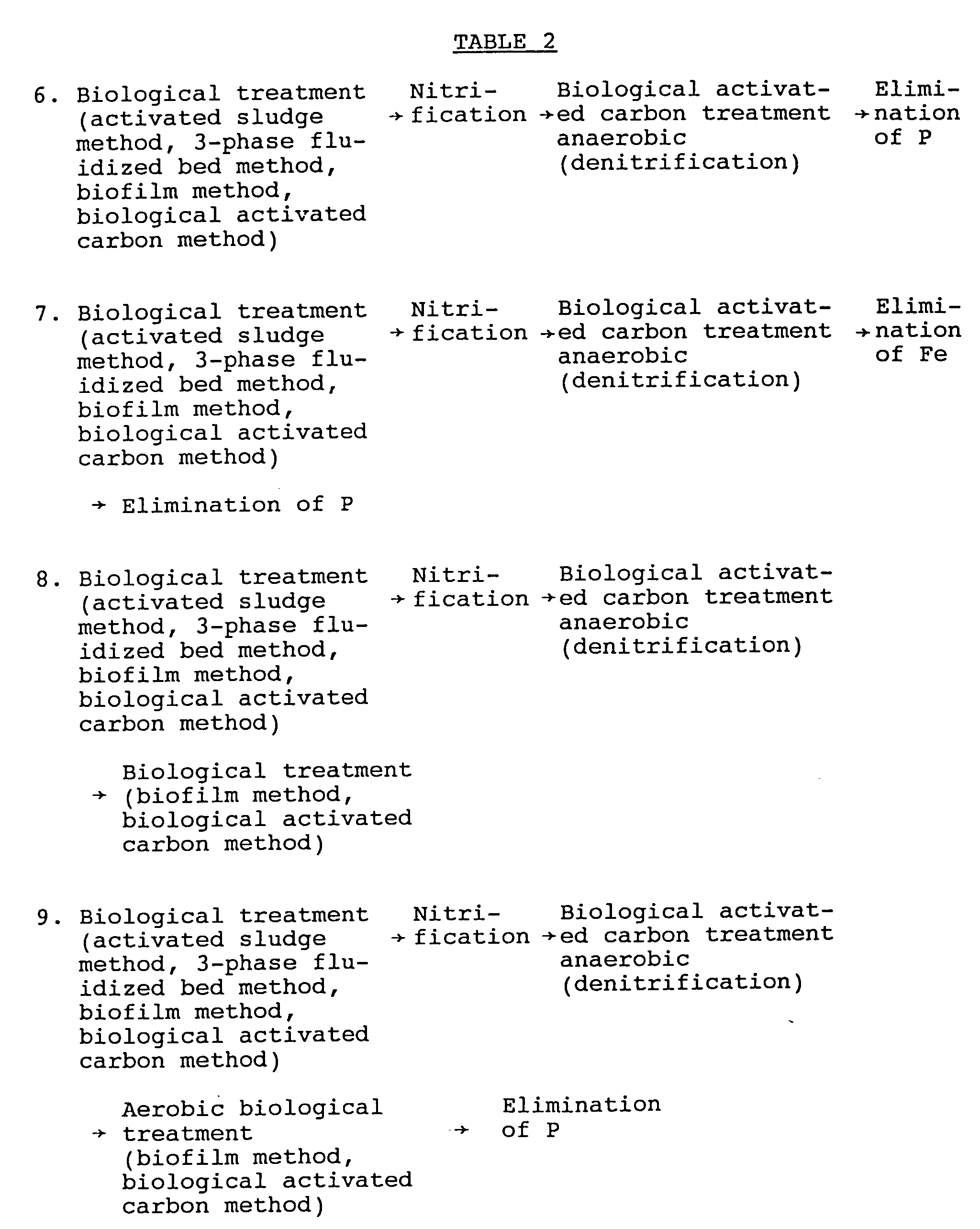

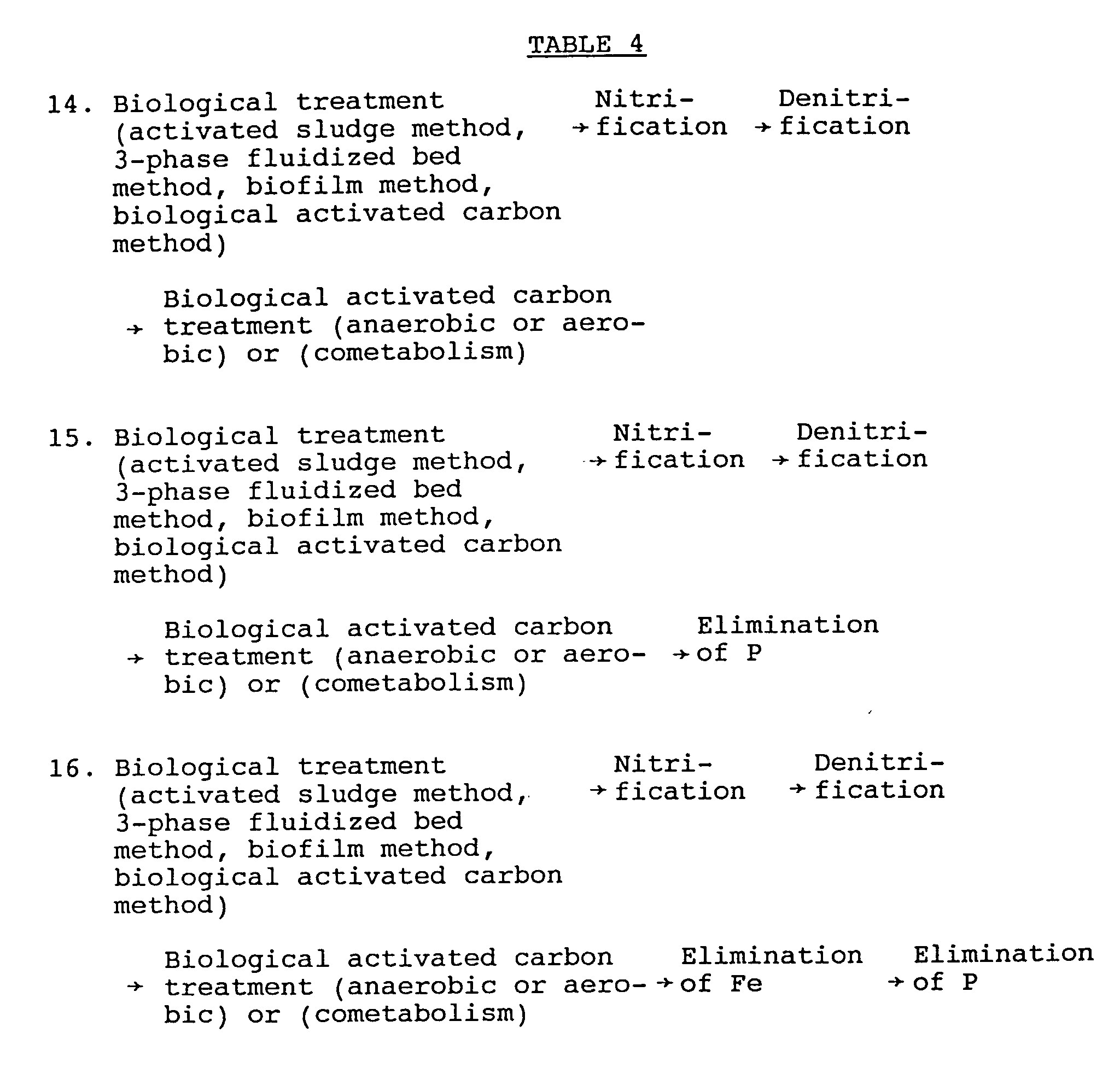
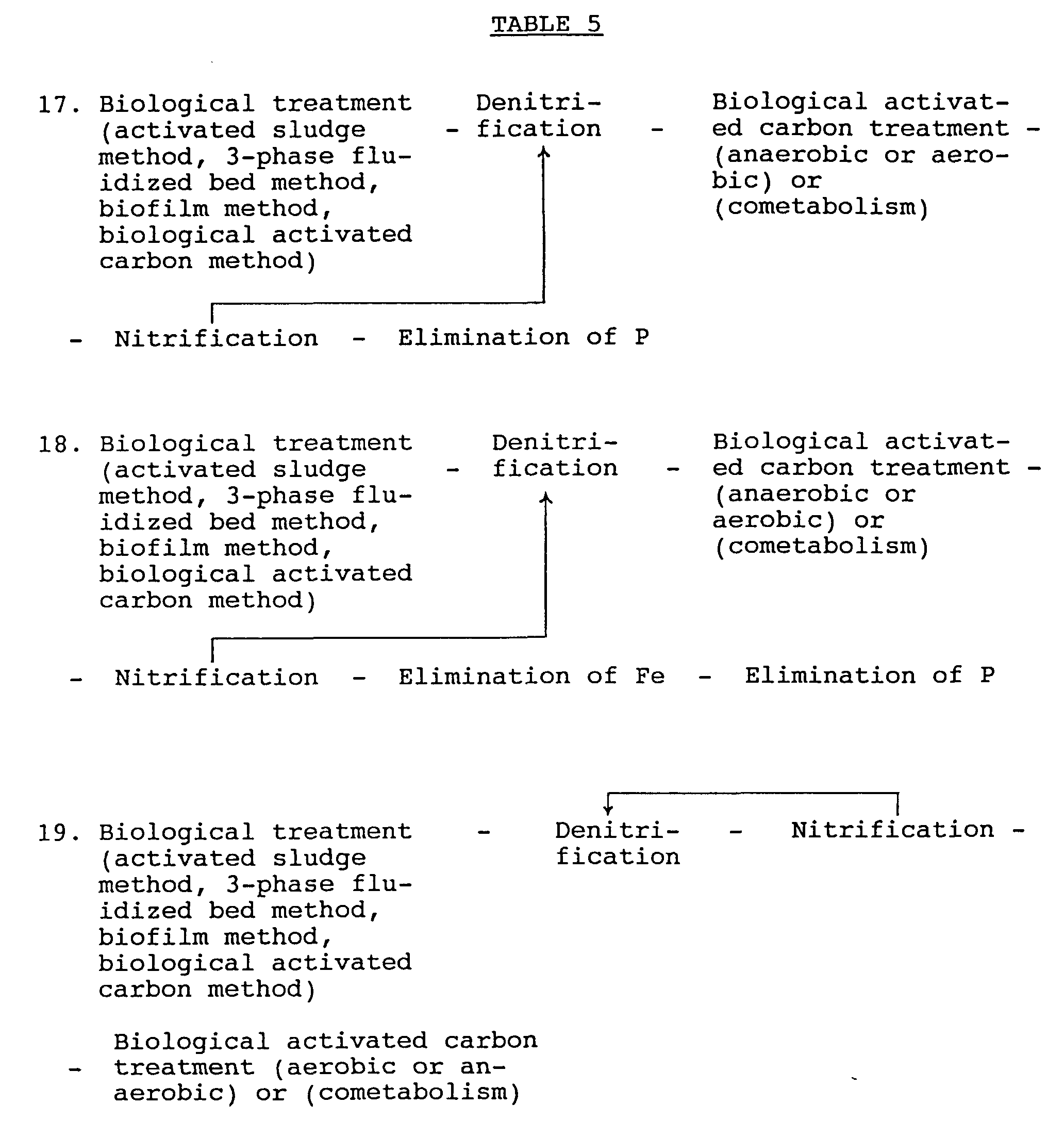

- Among the above flows, flows No. 2 and No. 3 and No. 17 are preferable ones.
- To further illustrate the present invention in greater detail, and not by way of limitation, the following Examples will be given.
- A silver-recovery system waste solution (a mixture comprising waste solutions from fixing solution of color photograph processing CN-16, a mixture of bleaching solution of CN-16Q with fixing solution, bleach-fixing solution of CP-20, bleach-fixing solution of CP-23, fixing solutions of black-and-white photograph processing, Fuji F and GR-F1 and water at a ratio of 4 : 1 : 3 : 2 : 7 : 3 : 2, from which silver had been recovered) was mixed with a development solution-series waste solution (a mixture comprising waste solutions from development solutions of color photograph process development solutions CN-16, CN-16Q, CP-20 and CP-23, waste solutions from black-and-white photograph process development solutions RD3 and GR-D1 and water at a ratio of 4 : 1 : 3 : 2 : 7 : 3 : 2) at a ratio by volume of 1 : 1. The resulting solution had a high inorganic salt concentration of 12 weight/volume %, which made it unsuitable for biological treatments. Thus it was diluted 10-fold with tap water to thereby give an inorganic salt concentration of 1.2 weight/volume %. To this solution was added phosphorus in the form of dipotassium monohydrogen phosphate in an amount corresponding to about 2.5 % by weight of CODMn value (about 4700 ppm). Further, 10 ppm of calcium ions and 2 ppm of magnesium ions were added thereto. The waste solution thus prepared had a pH value of 8.5.
- The terms CN-16, CN-16Q, CP-20, CP-23, Fuji F, GR-F1, RD3 and GR-D1 mean each a trade name of a processing solution manufactured by Fuji Photo Film Co., Ltd.
- The waste solution prepared above was subjected to biological treatments in the following steps.
- First, the waste solution was continuously treated with activated sludge containing sulfur oxidizing bacteria (MLSS 4500 ppm). The activated sludge containing sulfur oxidizing bacteria employed herein was one which had been preincubated for adaption for 1 month while continuously feeding the silver-recovery system waste solution diluted 10-fold (CODMn: about 4500 ppm) at a residence time of 2 days.
- The sulfuric acid thus formed was neutralized with a 10 % aqueous solution of sodium hydroxide to thereby maintain the pH value in the aeration tank to higher than 6.6. The pH value was regulated by using a pH controller (Model FC-10, manufactured by Tokyo Rika).
- Thus, a solution (CODMn: 830 ppm, total organic carbon (TOC): 330 ppm, NH4 concentration: 1000 ppm (NH4-N 780 ppm), Fe-EDTA concentration: 350 ppm, color: 3800) was obtained. The treatment was performed at room temperature and the same will apply hereinafter.
- Microorganisms, which had been acclimated in the following manner, were inoculated into a mixture of 10 g of granular activated carbon (BAC, manufactured by Kureha Chemical Industry, Co., Ltd.), which had been adsorption-equilibrated with the aerobically treated photoprocessing waste solution, with 130 ml of the solution, as a solution to be treated, contained in a 200 ml Erlenmeyer flask.
- The photoprocessing waste solution was continuously treated for 6 months with sludge in the activated sludge processing plant in Ashigara Factory, Fuji Photo Film Co., Ltd. under aerobic conditions. Further, the sludge in the activated sludge processing tank was inoculated into a fluidized bed packed with granular activated carbon and acclimated therein for adaption for 5 months through the treatment of the aerobically treated activated sludge solution of the photoprocessing waste solution.
- The aerobic treatment was performed by shaking the Erlenmeyer flask on a rotary shaker (125 rpm) at 25°C in the dark. The anaerobic treatment was performed by using the solution to be treated which had been saturated with nitrogen gas, continuously feeding nitrogen gas into the space on the solution surface in the Erlenmeyer flask to thereby keep an anaerobic state, and shaking the flask in the same manner as the one employed in the aerobic treatment. In each of the aerobic and anaerobic treatments, a 20 ml portion of the solution in the flask was sampled at intervals of 3.5 days and 20 ml of the fresh solution to be treated was added.
- The TOC and Fe-EDTA levels in the collected samples were monitored by determining by ion chromatography.
- (A-1) By using the aerobically treated photoprocessing waste solution as the solution to be treated, the above-mentioned aerobic treatment was performed in the presence of activated carbon.
- (A-2) By using the aerobically treated photoprocessing waste solution as the solution to be treated, the above-mentioned anaerobic treatment was performed in the presence of activated carbon.
-
- In each of (A-1) and (A-2), the TOC treatment ratio and the Fe-EDTA degradation ratio became almost constant after 10 days.
- Table 7 summarizes the Fe-EDTA degradation ratios of (A-1) and (A-2) after 28 days.
Degradation of hardly degradable components in aerobically treated photoprocessing waste solution treated with biological activated carbon
(shaking, 25°C, 28 days, replaced in 20 ml portions per 3.5 days)Fe-EDTA degradation ratio (%) Fe-1,3-PDTA degradation ratio (%) A-1 aerobic 58 83 A-2 anaerobic 45 62 - As Table 7 shows, the Fe-EDTA degradation ratio of the aerobic one (A-1) is higher than that of the anaerobic one (A-2).
- Use was made of a fluidized bed having a granular activated carbon (BAC manufactured by Kureha Chemical Industry Co., Ltd.), the bulk volume of which amounted to 40 % of the capacity of the treating tank, as a carrier. The inside of the treating tank was maintained in an aerobic state by aerating the inside of the side pipe for circulating the solution.
- The activated carbon was allowed to adsorb the activated sludge-treated solution components of the photoprocessing waste solution. When the equilibrated adsorption concentration (TOC) reached 50 ppm, the same microorganism as the one employed in A was inoculated.
- The treatment was performed by the batch-wise method (each cycle having 5 days) and the amount of the treated solution released from the treating tank was regulated to 80 % of the whole solution per cycle.
- The procedure of the above (B-1) was repeated but effecting no aeration.
- In both of (B-1) and (B-2), TOCs and Fe-EDTA concentrations of the released solutions were determined.
- After 30 days, the TOC of the released solution of (B-1) was 12 ppm, while that of (B-2) was 22 ppm. Thus, the aerobic treatment established a higher TOC processing ratio than the anaerobic treatment did. On the other hand, the Fe-EDTA concentration of (B-1) was 0.5 ppm and that of (B-2) was 1 ppm. Namely, both of these treatment achieved good results, though the aerobic treatment was somewhat superior to the anaerobic one.
- The aerobically treated photoprocessing waste solution contains 60 ppm of Fe-1,3-PDTA.
- Table 7 summarizes the Fe-1,3-PDTA degradation ratios of (A-1) and (A-2) after 28 days.
- As Table 7 shows, Fe-1,3-PDTA is degraded better than Fe-EDTA, and the Fe-1,3-PDTA degradation ratio of the aerobic one (A-1) is higher than that of the anaerobic one (A-2).
- The same photoprocessing waste solution as the one used in Example 1 was biologically treated in the following steps.
- The procedure of Example 1 was repeated.
- The processed solution obtained from the above step was treated by using an aerobic fluidized bed packed with granular activated carbon (BAC, manufactured by Kureha Chemical Industry, Co., Ltd.) as carrier batchwise (1 cycle per 3 days). The discharge of the treated solution from the treatment tank was regulated to 80 % of the whole solution per cycle. The TOC of the treated solution was about 30 ppm while the color thereof was 150. When analyzed by ion chromatography, the treated solution contained little Fe-EDTA.
- Ammonium ions (about 1000 ppm, NH4-N 780 ppm) in the waste solution treated in the above steps were converted into nitrate ions with the use of a nitrification tank wherein acrylamide gel pellets having nitrifying bacterial entrapped and immobilized thereon were suspended.
- This acrylamide gel was prepared in accordance with the method described in "Biseibutsu Koteika-ho ni yoru Haisui Shori (Processing of Waste Water by Microbial Immobilization Method)", ed. by R. Sudo, Sangyo-Yosui Chosa kai (Industrial Water Research Association), p. 196 - 199. The acrylamide gel molded into about 3 mm-cubes was added in an amount of about 10 % of the volume of the aeration tank and suspended therein.
- Nitrification was performed batchwise (1 cycle per 2 days) while regulating the pH value of the contents of the nitrification tank to about 7.5. The discharge of the treated solution from the treatment tank was regulated to about 70 % of the whole solution per cycle.
- Denitrification: Nitrate ions (about 3400 ppm, NO3-N 770 ppm) in the solution thus obtained were denitrified by passing through a fluidized bed biological denitrification column packed with porous ceramic grains as a carrier. As an organic compound required in the denitrification, methanol was added in such an amount as to give TOC of 1530 ppm (TOC/NO3-N: 2/1). Then the denitrified solution was passed through, for example, a biofilter column maintained in an aerobic state to thereby eliminate the residual organic matters. The residence times in the denitrification column and the biofilter were respectively 12 hours and 4 hours. The solution thus obtained had CODMn of 10 ppm and total nitrogen (T-N) of 5 ppm.
- The same photoprocessing waste solution as the one employed in Example 1 was biologically treated in the following steps.
- The procedure of Example 1 was repeated.
- Ammonium ions (about 1000 ppm, NH4-N 78 ppm) in the waste solution treated in the above steps were converted into nitrate ions by the same method as the one employed in the nitrification step of Example 2.
- To the nitrated solution (nitrate ion: about 3400 ppm, NO3-N 770 ppm) thus obtained was added methanol in such an amount as to give TOC of 1150 ppm. Then it was continuously treated by using an anaerobic fluidized bed packed with granular activated carbon (BAC, manufactured by Kureha Chemical Industry, Co., Ltd.) as carrier for a residence time (hydraulic retention time (HRT)) of 3 days. Thus a solution (CODMn: 250 ppm, TOC: 110 ppm, T-N: 5 ppm, Fe-EDTA: 20 ppm) was obtained.
- The treated solution thus obtained was treated by using an aerobic fluidized bed packed with granular activated carbon (BAC, manufactured by Kureha Chemical Industry, Co., Ltd.) as carrier batchwise (1 cycle per day). The discharge of the solution from the treatment tank was regulated to 80 % of the whole solution per cycle. Thus a solution (CODMn: 5 ppm, TOC: 5 ppm, T-N: 5 ppm, Fe-EDTA: < 1 ppm) was obtained.
- By using the same waste solution as the one employed in Example 1, a biological treatment was performed in the following manner.
- The procedure of Example 1 was repeated.
- In a cylindrical precipitation tank having a conical bottom for activated sludge-treated solution was located a denitrification tank which was in the same shape but a smaller size (the diameter of the cylinder corresponding to 60 % of that of the precipitation tank) and had an inlet for the sludge in the precipitation tank at the bottom. Then the contents of the tank were slowly stirred with a stirrer.
- To the denitrification tank (MLSS 5,000 ppm), a nitrified solution was returned from the (later) nitrification step. The amount of the solution thus returned was regulated to thrice as much as the amount of the activated sludge-treated solution flowing into the denitrification tank. The denitrified solution was subjected to solid/liquid separation with the use of an UF membrane. Then the treated solution was transferred into the subsequent step, while the sludge was returned to the denitrification tank. The residence time in the denitrification tank was 4 hours (substantially 16 hours, since the solution was circulated).
- The sludge precipitated onto the bottom of the precipitation tank was returned to the activated sludge-treatment tank. The return (feed back) was regulated to 0.3 times as much as the amount of the solution flowing into the activated sludge-treatment tank.
- After the completion of the denitrification treatment, the obtained solution showed CODMn of 250 ppm, TOC of 99 ppm, ammonium ion (NH4 +-N) concentration of 200 ppm, nitrate ion concentration (NO3 --N) of 115 ppm, Fe-EDTA concentration of 95 ppm and color of 1,000.
- The denitrified solution was continuously treated by using an aerobic fluidized bed having a granular activated carbon (a mixture of F400 manufactured by TOYO CALGON with BAC manufactured by Kureha Chemical Industry, Co., Ltd., mixing ratio by bulk volume = 4 : 1) as a carrier, wherein the bulk volume of the activated carbon amounted to 40 % of the capacity of the treating tank. The residence time in the tank was 12 hours (substantially 2 days).
- After the completion of the denitrification treatment, the obtained solution showed CODMn of 45 ppm, TOC of 23 ppm, ammonium ion (NH4 +-N) concentration of 195 ppm, nitrate ion concentration (NO3 --N) of 120 ppm, Fe-EDTA concentration of 6 ppm and color of 35.
- The method described in Example 2 was employed but a continuous treatment was performed and the residence time was 12 hours (substantially 2 days).
- After the completion of the nitrification, the obtained solution showed CODMn of 40 ppm, TOC of 20 ppm, ammonium ion (NH4 +-N) concentration of 15 ppm, nitrate ion concentration (NO3 --N) of 305 ppm, Fe-EDTA concentration of 5 ppm and color of 40.
- Three quarters of the treated solution obtained from the nitrification step was returned to the above-mentioned denitrification step. The residual quarter was discharged and passed through a fixed bed type biological denitrification column packed with a granular porous ceramic carrier to thereby effect denitrification. As an organic material required in the denitrification, methanol was added in such a manner as to give TOC of 750 ppm (TOC/NO3-N = 2.5/1). The denitrified solution was passed through a biological filtration column maintained in an aerobic state to thereby eliminate the organic matters remaining in the solution. The residence times in the denitrification column and in the aerobic biological filtration column were respectively 6 hours and 4 hours. The obtained solution showed CODMn of 25 ppm, TOC of 15 ppm, T-N concentration of 5 ppm, Fe-EDTA concentration of 5 ppm and color of 35.
- In Example 3, the amount of the methanol required for the denitrification could be reduced by 60 % by returning the nitrified solution to the denitrification step following the activated sludge-treatment, compared with Example 2 wherein no such returning was effected. Thus a treated solution of improved qualities could be obtained at a lower cost.
- This case is exemplified by the biological activated carbon treatment in Example 2.
- The procedure of Example 2 was repeated but using TOYO CALGON F400 as the activated carbon.
- After the completion of the treatment, the obtained solution showed TOC of 15 ppm, color of 30 and Fe-EDTA concentration of 12 ppm.
- The procedure of Example 2 was repeated but using a mixture of F400 with BAC (ratio by bulk volume = 4 : 1) in such an amount that the bulk volume of the mixture amounted to about 40 % of the capacity of the treating tank.
- After the completion of the treatment, the obtained solution showed TOC of 15 ppm, color of 40 and Fe-EDTA concentration of 5 ppm.
- As Example 5 shows, TOYO CALGON F400 (made from coal) exhibited a good degradition performance regarding TOC and color, while Kureha Chemical Industry BAC (made from a pitch) exhibited a good degradition performance regarding Fe-EDTA. Further, the combined use of these activated carbons exhibited a good performance regarding all of TOC, color and Fe-EDTA.
- Supposing that a boiler waste water was contaminated with a waste acid washing solution for boiler, a model waste water from a boiler was prepared. This model solution contained 1 g/l of Na-EDTA and 0.35 g/l of ammonium citrate and showed CODMn of 850 ppm, TOC of 396 ppm and an ammonium ion concentration of 79 ppm.
- The above-mentioned model solution was continuously treated (residence time: 12 hours) by using an activated sludge tank wherein the sludge recovered from the activated sludge processing plant in Ashigara Factory, Fuji Photo Film Co., Ltd. was suspended (MLSS 2,000 ppm). The obtained solution showed CODMn of 650 ppm, TOC of 300 ppm and ammonium ion concentration of 65 ppm.
- The above-mentioned model solution was treated batchwise (2 days per cycle) by using a granular activated carbon (TOYO CALGON F400) which had been settled and fixed by inoculating the sludge recovered from the activated sludge processing plant in Ashigara Factory, Fuji Photo Film Co., Ltd. The inside of the treating column was maintained in an aerobic state by aerating from air diffusing pipes. The solution was liberated at a ratio of 80 % of the whole solution in the tank per cycle. After the completion of the treatment, EDTA contained in the solution had been mostly degraded and the obtained solution showed CODMn of 18 ppm and EDTA concentration of 2 ppm.
- As discussed above, EDTA contained in various waste solutions can be degraded by the process of the present invention.
- According to the present invention, hardly degradable components, which can be hardly degraded by the conventional techniques, can be degraded by using biological treatments commonly employed in the art. Thus the COD, TOC and T-N values and the content of residual organic aminocarboxylic acids (for example, Fe-EDTA) of a waste solution containing organic aminocarboxylic acids such as a photoprocessing waste solution can be largely reduced, thus establishing a process for making the photoprocessing waste solution harmless effectively, economically and constantly.
Claims (7)
- A process for making a waste solution containing organic aminocarboxylic acids harmless which comprises biologically treating the waste solution containing organic aminocarboxylic acids followed by another biological treatment in the presence of activated carbon.
- The process of claim 1, wherein said waste solution is a photoprocessing waste solution.
- The process of claim 1 or 2 further comprising a step of biological nitrification and denitrification.
- The process of claim 3 wherein the denitrification step is carried out before the nitrification step and the solution obtained from said nitrification step is returned to said denitrification step to thereby perform nitrification and denitrification.
- The process of any of claims 1 to 4, wherein the biological treatment in the presence of activated carbon is performed under aerobic conditions.
- The process of any of claims 1 to 5, wherein the biological treatment in the presence of activated carbon is performed by an activated carbon fluidized bed method.
- The process of any of claims 1 to 6, wherein the biological treatment in the presence of activated carbon is performed by using a combination of an activated carbon made from pitch with an activated carbon made from coal or coconut shell.
Applications Claiming Priority (3)
| Application Number | Priority Date | Filing Date | Title |
|---|---|---|---|
| JP10406394 | 1994-05-18 | ||
| JP10406394 | 1994-05-18 | ||
| JP104063/94 | 1994-05-18 |
Publications (3)
| Publication Number | Publication Date |
|---|---|
| EP0683138A2 EP0683138A2 (en) | 1995-11-22 |
| EP0683138A3 EP0683138A3 (en) | 1998-07-01 |
| EP0683138B1 true EP0683138B1 (en) | 2001-04-04 |
Family
ID=14370721
Family Applications (1)
| Application Number | Title | Priority Date | Filing Date |
|---|---|---|---|
| EP19950107548 Expired - Lifetime EP0683138B1 (en) | 1994-05-18 | 1995-05-17 | Process for making photoprocessing waste solution harmless |
Country Status (2)
| Country | Link |
|---|---|
| EP (1) | EP0683138B1 (en) |
| DE (1) | DE69520519T2 (en) |
Cited By (1)
| Publication number | Priority date | Publication date | Assignee | Title |
|---|---|---|---|---|
| CN110217894A (en) * | 2019-05-23 | 2019-09-10 | 北京博泰至淳生物科技有限公司 | A kind of slow-release solid carbon source for the fully biodegradable that can directly launch and preparation method and application |
Families Citing this family (8)
| Publication number | Priority date | Publication date | Assignee | Title |
|---|---|---|---|---|
| US5652085A (en) * | 1995-08-30 | 1997-07-29 | Eastman Kodak Company | Succinic acid derivative degradable chelants, uses and composition thereof |
| GB9524404D0 (en) * | 1995-11-29 | 1996-01-31 | Anglian Water Services Ltd | Activated sludge treatment |
| AU5704498A (en) * | 1996-12-13 | 1998-07-03 | Allied-Signal Inc. | Closed-loop wastewater treatment system |
| GB0028814D0 (en) * | 2000-11-25 | 2001-01-10 | Univ Belfast | Improvements relating to biosorbtion |
| CN105169446B (en) * | 2015-07-27 | 2017-03-15 | 河南越宝生物科技有限公司 | An organic waste deodorant |
| CN106348542B (en) * | 2016-10-27 | 2019-05-24 | 环境保护部华南环境科学研究所 | A kind of processing method of the pharmacy waste water of the antibiotic containing high concentration |
| CN112694213A (en) * | 2021-01-12 | 2021-04-23 | 陕西科技大学 | Method for removing metal ions in wastewater |
| CN115196837B (en) * | 2022-08-09 | 2024-11-26 | 北京艾孚润德环境科技有限责任公司 | A multiphase flow pollutant treatment process with regenerative and cyclic carrier |
Family Cites Families (5)
| Publication number | Priority date | Publication date | Assignee | Title |
|---|---|---|---|---|
| JPS5843782A (en) | 1981-09-07 | 1983-03-14 | Nagase Seikagaku Kogyo Kk | Treatment of ethylenediaminetetraacetic acid with microorganism |
| FR2667860B1 (en) * | 1990-09-04 | 1992-11-27 | Omnium Traitement Valorisa | PROCESS FOR BIOLOGICAL PURIFICATION OF WASTEWATER INCLUDING DENITRIFICATION. |
| JP3318387B2 (en) | 1993-03-17 | 2002-08-26 | 富士写真フイルム株式会社 | Decomposition method of organic aminocarboxylic acid using microorganism |
| JP3370380B2 (en) | 1993-04-15 | 2003-01-27 | 富士写真フイルム株式会社 | Method for treating waste liquid containing organic aminocarboxylic acids |
| JP3376015B2 (en) * | 1993-05-27 | 2003-02-10 | 富士写真フイルム株式会社 | Organic aminocarboxylic acid-degrading bacterium Pseudomonas editoridas and method of treating waste liquid containing organic aminocarboxylic acids using the same |
-
1995
- 1995-05-17 DE DE69520519T patent/DE69520519T2/en not_active Expired - Lifetime
- 1995-05-17 EP EP19950107548 patent/EP0683138B1/en not_active Expired - Lifetime
Cited By (2)
| Publication number | Priority date | Publication date | Assignee | Title |
|---|---|---|---|---|
| CN110217894A (en) * | 2019-05-23 | 2019-09-10 | 北京博泰至淳生物科技有限公司 | A kind of slow-release solid carbon source for the fully biodegradable that can directly launch and preparation method and application |
| CN110217894B (en) * | 2019-05-23 | 2021-12-14 | 北京博泰至淳生物科技有限公司 | A fully biodegradable slow-release solid carbon source that can be directly put in and its preparation method and application |
Also Published As
| Publication number | Publication date |
|---|---|
| EP0683138A2 (en) | 1995-11-22 |
| EP0683138A3 (en) | 1998-07-01 |
| DE69520519D1 (en) | 2001-05-10 |
| DE69520519T2 (en) | 2001-08-09 |
Similar Documents
| Publication | Publication Date | Title |
|---|---|---|
| US5650069A (en) | Dual-stage biological process for removing nitrogen from wastewater | |
| KR100558510B1 (en) | Advanced Wastewater Treatment System Using Submerged Membrane | |
| US20240246842A1 (en) | Immobilized Microbes for Water Treatment | |
| KR101613995B1 (en) | System for advanced wastewater treatment using optimal micro-organism of pollutants and the method thereof | |
| CN1102130C (en) | System and method for removing biologically both nitrogen and phosphorous removal in sewage and wastewater | |
| EP0683138A2 (en) | Process for making photoprocessing waste solution harmless | |
| JP5034778B2 (en) | Membrane separation wastewater treatment method and apparatus | |
| JP2003285096A (en) | Wastewater treatment method with simultaneous removal of nitrogen and phosphorus | |
| KR100969220B1 (en) | A advanced waste-water treatment system comprising a internal filtering screen device | |
| JPH0259000B2 (en) | ||
| KR100643775B1 (en) | Nutrient Salt Treatment Hybrid System Using Suspended and Attached Growth Microorganisms | |
| JPH11156392A (en) | Treating method for ethanolamine-containing waste water | |
| JPH0833894A (en) | Method for making waste photographic processing solution harmless | |
| JPH0994597A (en) | Treatment of photographic waste solution | |
| JP4765308B2 (en) | Nitrogen compound and inorganic ion-containing wastewater treatment apparatus and treatment method | |
| JP3607353B2 (en) | Organic aminocarboxylic acid degrading bacteria and method for treating waste liquid using the same | |
| JPH11267689A (en) | Denitrifying/dephosphorizing method for organic waste water | |
| Golz et al. | Developing backwash protocols for floating bead filters: a model of solids-loading and biofilm-retention effects on nitrification | |
| TW201221484A (en) | Method and apparatus for sludge treatment and use thereof in sewage biotreatment | |
| JP2001058197A (en) | Treatment of wastewater | |
| JPH11156391A (en) | Treating method for ethanolamine-containing waste water | |
| JP3837757B2 (en) | Method for treating selenium-containing water | |
| JP3370380B2 (en) | Method for treating waste liquid containing organic aminocarboxylic acids | |
| CN111807515A (en) | Method for removing total nitrogen of nitrogen-containing organic wastewater | |
| EP0526328B1 (en) | Process for removal of organic nutrients containing carbon, nitrogen and phosphorus |
Legal Events
| Date | Code | Title | Description |
|---|---|---|---|
| PUAI | Public reference made under article 153(3) epc to a published international application that has entered the european phase |
Free format text: ORIGINAL CODE: 0009012 |
|
| AK | Designated contracting states |
Kind code of ref document: A2 Designated state(s): DE FR GB NL |
|
| PUAL | Search report despatched |
Free format text: ORIGINAL CODE: 0009013 |
|
| AK | Designated contracting states |
Kind code of ref document: A3 Designated state(s): DE FR GB NL |
|
| 17P | Request for examination filed |
Effective date: 19980708 |
|
| 17Q | First examination report despatched |
Effective date: 19991115 |
|
| GRAG | Despatch of communication of intention to grant |
Free format text: ORIGINAL CODE: EPIDOS AGRA |
|
| GRAG | Despatch of communication of intention to grant |
Free format text: ORIGINAL CODE: EPIDOS AGRA |
|
| GRAH | Despatch of communication of intention to grant a patent |
Free format text: ORIGINAL CODE: EPIDOS IGRA |
|
| GRAH | Despatch of communication of intention to grant a patent |
Free format text: ORIGINAL CODE: EPIDOS IGRA |
|
| GRAA | (expected) grant |
Free format text: ORIGINAL CODE: 0009210 |
|
| AK | Designated contracting states |
Kind code of ref document: B1 Designated state(s): DE FR GB NL |
|
| PG25 | Lapsed in a contracting state [announced via postgrant information from national office to epo] |
Ref country code: NL Free format text: LAPSE BECAUSE OF FAILURE TO SUBMIT A TRANSLATION OF THE DESCRIPTION OR TO PAY THE FEE WITHIN THE PRESCRIBED TIME-LIMIT Effective date: 20010404 Ref country code: FR Free format text: LAPSE BECAUSE OF FAILURE TO SUBMIT A TRANSLATION OF THE DESCRIPTION OR TO PAY THE FEE WITHIN THE PRESCRIBED TIME-LIMIT Effective date: 20010404 |
|
| REF | Corresponds to: |
Ref document number: 69520519 Country of ref document: DE Date of ref document: 20010510 |
|
| EN | Fr: translation not filed | ||
| NLV1 | Nl: lapsed or annulled due to failure to fulfill the requirements of art. 29p and 29m of the patents act | ||
| REG | Reference to a national code |
Ref country code: GB Ref legal event code: IF02 |
|
| PLBE | No opposition filed within time limit |
Free format text: ORIGINAL CODE: 0009261 |
|
| STAA | Information on the status of an ep patent application or granted ep patent |
Free format text: STATUS: NO OPPOSITION FILED WITHIN TIME LIMIT |
|
| 26N | No opposition filed | ||
| REG | Reference to a national code |
Ref country code: GB Ref legal event code: 732E |
|
| PGFP | Annual fee paid to national office [announced via postgrant information from national office to epo] |
Ref country code: GB Payment date: 20100329 Year of fee payment: 16 |
|
| PGFP | Annual fee paid to national office [announced via postgrant information from national office to epo] |
Ref country code: DE Payment date: 20100422 Year of fee payment: 16 |
|
| REG | Reference to a national code |
Ref country code: DE Ref legal event code: R119 Ref document number: 69520519 Country of ref document: DE |
|
| REG | Reference to a national code |
Ref country code: DE Ref legal event code: R119 Ref document number: 69520519 Country of ref document: DE |
|
| GBPC | Gb: european patent ceased through non-payment of renewal fee |
Effective date: 20110517 |
|
| PG25 | Lapsed in a contracting state [announced via postgrant information from national office to epo] |
Ref country code: GB Free format text: LAPSE BECAUSE OF NON-PAYMENT OF DUE FEES Effective date: 20110517 |
|
| PG25 | Lapsed in a contracting state [announced via postgrant information from national office to epo] |
Ref country code: DE Free format text: LAPSE BECAUSE OF NON-PAYMENT OF DUE FEES Effective date: 20111130 |