EP0680184A2 - Verfahren und Einrichtung zur Dekodierung von trelliskodierten QAM-Signalen - Google Patents
Verfahren und Einrichtung zur Dekodierung von trelliskodierten QAM-Signalen Download PDFInfo
- Publication number
- EP0680184A2 EP0680184A2 EP95100025A EP95100025A EP0680184A2 EP 0680184 A2 EP0680184 A2 EP 0680184A2 EP 95100025 A EP95100025 A EP 95100025A EP 95100025 A EP95100025 A EP 95100025A EP 0680184 A2 EP0680184 A2 EP 0680184A2
- Authority
- EP
- European Patent Office
- Prior art keywords
- subset
- metrics
- modulation function
- signal point
- constellation pattern
- Prior art date
- Legal status (The legal status is an assumption and is not a legal conclusion. Google has not performed a legal analysis and makes no representation as to the accuracy of the status listed.)
- Withdrawn
Links
Images


Classifications
-
- H—ELECTRICITY
- H04—ELECTRIC COMMUNICATION TECHNIQUE
- H04N—PICTORIAL COMMUNICATION, e.g. TELEVISION
- H04N5/00—Details of television systems
- H04N5/44—Receiver circuitry for the reception of television signals according to analogue transmission standards
- H04N5/455—Demodulation-circuits
-
- H—ELECTRICITY
- H04—ELECTRIC COMMUNICATION TECHNIQUE
- H04L—TRANSMISSION OF DIGITAL INFORMATION, e.g. TELEGRAPHIC COMMUNICATION
- H04L27/00—Modulated-carrier systems
- H04L27/32—Carrier systems characterised by combinations of two or more of the types covered by groups H04L27/02, H04L27/10, H04L27/18 or H04L27/26
- H04L27/34—Amplitude- and phase-modulated carrier systems, e.g. quadrature-amplitude modulated carrier systems
- H04L27/3405—Modifications of the signal space to increase the efficiency of transmission, e.g. reduction of the bit error rate, bandwidth, or average power
- H04L27/3416—Modifications of the signal space to increase the efficiency of transmission, e.g. reduction of the bit error rate, bandwidth, or average power in which the information is carried by both the individual signal points and the subset to which the individual points belong, e.g. using coset coding, lattice coding, or related schemes
- H04L27/3427—Modifications of the signal space to increase the efficiency of transmission, e.g. reduction of the bit error rate, bandwidth, or average power in which the information is carried by both the individual signal points and the subset to which the individual points belong, e.g. using coset coding, lattice coding, or related schemes in which the constellation is the n - fold Cartesian product of a single underlying two-dimensional constellation
-
- H—ELECTRICITY
- H04—ELECTRIC COMMUNICATION TECHNIQUE
- H04N—PICTORIAL COMMUNICATION, e.g. TELEVISION
- H04N7/00—Television systems
- H04N7/24—Systems for the transmission of television signals using pulse code modulation
Definitions
- the present invention relates to a trellis coded Quadrature Amplitude Modulation("QAM"); and, more particularly, to a method for decoding digital data which has been coded and transferred by using a trellis coded QAM.
- Digital data for example, digitized video signals for use in broadcasting high definition television signals, can be transmitted over terrestrial VHF or UHF analog channels for communication to end users.
- Analog channels tend to deliver corrupted and transformed versions of their input waveforms. Corruption of the waveform, usually statistical, may be additive and/or multiplicative of, e.g., possible background thermal noises, impulse noises and fades.
- the data is preferably modulated using, for example, a form of Pulse Amplitude Modulation("PAM").
- a Quadrature Amplitude Modulation("QAM) is used to increase the amount of data that can be transmitted within an available channel bandwidth.
- the QAM is a form of PAM wherein a plurality of bits of information are transmitted in a pattern referred to as a "constellation" that can contain, for example, sixteen or thirty-two points.
- each signal is a pulse whose amplitude level is determined by a transmitted symbol.
- symbol amplitudes of -5, -3, -1, 1, 3, 5 in each quadrature channel are typically used.
- Bandwidth efficiency in digital communication systems is normally defined in terms of the number of transmitted bits per second per unit of bandwidth, i.e., the ratio of the data rate to the bandwidth.
- QAM provides a bandwidth efficient modulation.
- TCM trellis coded modulation
- trellis is used because these schemes can be described by a state-transition (trellis) diagram similar to the trellis diagrams of binary convolutional codes. The difference is that TCM extends the principle of convolutional coding to nonbinary modulation with signal sets of an arbitrary size.
- TCM TCM-Coded Modulation with Redundant Signal Sets--Part I: Introduction; Part II:State of the Art", IEEE Communication Magazine , Vol. 25, No. 2, pp.5-21, February, 1987.
- Fig. 1 there is shown a block diagram of a conventional TCM encoding system.
- an (N-1) bit input symbol is first parsed into a first bit on a line 30 and the (N-2) remaining bits on a line 20 at a parsing block 10 shown in Fig. 1.
- the first bit is encoded by employing a rate 1/2 binary convolutional encoding algorithm at a convolutional encoder 40, to thereby provide on a line 45 a two-bit codeword that defines one of four subsets of a 2 N -QAM constellation pattern, wherein each subset includes 2 N /4 symbol points of the constellation pattern.
- the remaining bits correlate the input symbol with one of the 2 N /4 symbol points included in the subset defined by the codeword.
- the codeword is mapped with the N-2 remaining bits to provide a modulation function which includes I and Q components to indicate a specific point on the QAM constellation pattern.
- the modulation function is further processed, e.g., modulated with a carrier for transmission on a communication channel ( see , e.g., U.S. Pat. No. 5,233,629 issued to W.H. Paik et al.).
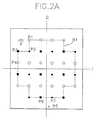
- FIG. 2A there is shown a conventional 32-QAM constellation pattern divided into 4 subsets.
- a modulation function at the encoding system corresponds to one of the symbol points shown in Fig. 2A.
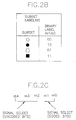
- Four different subsets are represented by four different shaped points as depicted in Fig. 2B.
- a label for each symbol point includes 5 bits as shown in Fig. 2C.
- the coded bits, i.e., m0 and m1 represent a subset while the remaining bits, i.e., m2 to m4 determine the specific points in each subset. Points with a same set of m0 and m1 values are included in a same subset as designated by Fig. 2B.
- a received signal is first demodulated to recover modulation functions in which a two-bit codeword identifies one of the four QAM constellation subsets and the remaining (N-2) bits represent a signal point included therein.
- Each of the modulation functions is pruned to provide a set of I and Q metrics and (N-2) remaining bits.
- the metrics are used for decoding a rate 1/2 binary convolutional code to recover the first bit.
- the metrics are used in conjunction with a decoder that uses a soft-decision algorithm for decoding the convolutional code.
- a soft-decision maximum likelihood decoder e.g., Viterbi decoder, the error occurred in the first bit can be effectively corrected, thereby enabling the determination of a subset corresponding to the modulation function.
- the remaining bits are determined, by using a hard-decision method, from the modulation function.
- a hard-decision method As a rule, the longer the distance between two symbol points, the easier it is to determine a correct symbol point corresponding to the modulation function.
- the minimum distance between two symbol points of a same subset is twice the minimum distance between two neighboring symbol points( see Fig. 2A); and, accordingly, once the subset is correctly determined by using the maximum-likelihood decoder, the remaining bits can be recovered accurately by the hard decision method.
- the recovered first bit and the remaining bits are further processed in the decoding system to provide a decoded output.
- the recovered first bit can be different from that of the encoding part.
- the modulation function corresponds to a signal point P0 shown in Fig. 2A
- m1 and m0 for that signal are most likely to be estimated as '0' and '1', respectively.
- a symbol point with the estimated m1 and m0 values e.g., a symbol point P4
- symbol points P1, P2 and P3 whose m1 and m0 values are different from the estimated ones. Therefore, in that case, it is preferable to decide the received signal as one of the three neighboring symbol points.
- an apparatus for deciding a symbol point in a 2 N -QAM constellation pattern in response to a modulation function wherein the 2 N -QAM constellation pattern is divided into 4 subsets, each subset including 2 N-2 symbol points of the constellation pattern, the modulation function representing a N-bit data including a 2-bit codeword which indicates a subset of the constellation pattern and (N-2) remaining bits which indicate a symbol point in the subset, and N is an integer greater than 2,
- the apparatus comprising: means for determining an I and Q metrics based on a signal point represented by the modulation function, wherein the I and Q metrics obtained from the signal point are selected as the I and Q output metrics if the signal point resides inside of a boundary of the 2 N -QAM constellation pattern, and if the signal point lies outside of the boundary, the I and Q output metrics are determined such that the determined I and Q metrics designate a subset of a nearest symbol point from the signal point; decoder means for deciding a subset
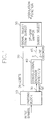
- a decoding system in accordance with the present invention for decoding a received QAM modulation function corresponding to a signal point on a 2 N , e.g., 32, QAM constellation pattern, wherein N is an integer larger than 2.
- the modulation function represents an N, e.g., 5, bit data wherein a 2-bit codeword, encoded from a first bit of an input symbol, determines a subset of the constellation pattern and the (N-2), e.g., 3, remaining bits determine a symbol point in the subset.
- the received modulation function is an input to a pruning block 70, which includes a metric deciding block 80 for providing I and Q metrics to be used in determining a subset corresponding to the modulation function.
- the pruning block 70 also includes a hard-decision block 90 which provides 3 remaining bits.
- the metric deciding block 80 determines the Q and I metrics in accordance with the present invention as will be presented with reference to Figs. 4 and 5. Specifically, first, the Q and I metrics are determined conventionally according to the position of the signal point, then the position of the signal point is checked to see if it lies outside of a predetermined boundary, e.g, B1 shown in Fig. 2A, on the QAM constellation pattern.
- the Q and I metrics are fed to a Viterbi decoder 100 to determine the first bit representing the subset. Otherwise, i.e., the signal point lies outside of the boundary B1, the Q and I metrics are converted as will be presented with reference to Figs. 4A to 4C and fed to the Viterbi decoder 100, thereby determining the first bit.
- the Viterbi decoder 100 decodes an accumulated history of the metrics received from the metric deciding block 80 into the first bit.
- the recovered first bit and the 3 remaining bits are coupled to a decoding block 110, to be further processed therein to provide a decoded output.
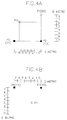
- Fig. 4A there is shown an upper left corner of the 32-QAM constellation pattern of Fig. 2A.
- the 2 bits in the parenthesis are m1 and m0 shown in Fig. 2B which indicate the subset where a given point belongs.
- the Q and I metrics may be decided as 2 and 6, respectively. Therefore, the corresponding values of m1 and m0 are most likely to be estimated as '01' in the Viterbi decoder 100 shown in Fig. 3. However, there is no corresponding symbol point which has the value '01' near P0.
- a received signal point P5 lies outside the boundary B1 shown in Fig. 2A.
- the Q metric may be decided as 2 and corresponding m1 value is most likely to be estimated as '0'. Since the value of m1 for P6 and P7 is '1' it would be preferable to assign a value, e.g., 7, as the Q metric of the signal point P5 so that the signal on P5 can be approximated to the symbol point P6 or P7.
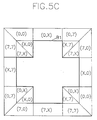
- Figs. 5A to 5C there is shown a scheme for converting I and Q metrics to decide a more accurate symbol point when the received signal point lies outside the boundary B1 shown in 2A.
- Fig 5A shows a scheme for determining Q and I metrics when a received signal point lies at a corner of the constellation pattern.
- a Q metric is set to 7 irrespective of the quadrature amplitude component of the received modulation function.
- the Q metric for the received signal point P0 is set to 7 using the scheme of Fig. 5A.
- the complete Q and I metrics for the signal point P0 are (7, 6), and the corresponding symbol point is decided as P3, which is in fact the nearest symbol point of the received signal point P0.
- a Q metric for a received signal point in a region R1 is set to 7 irrespective of the quadrature amplitude component of the received modulation function, and 0, for a signal point in a region R2 or R5; and an I metric is set to 7 for a signal point in a region R0 or R3, and 0, for a signal point in a region R4 or R7.
- Fig. 5B shows another scheme for determining I and Q metrics when a received signal point lies in one of the four side regions of the constellation pattern, R8, R9, R10 and R11.
- the Q metric is set to 7 irrespective of the quadrature amplitude component of the received modulation function.
- the Q metric for the received signal point P5 is set to 7 using the scheme of Fig. 5B.
- the complete Q and I metrics for the point P5 become (7, 2), and the corresponding symbol point is decided as P7, which is the nearest symbol point for the received signal point P5.
- a Q metric of a signal point residing in a region R8 is set to 0, while I metrics for signal points in regions R9 and R11 are set to 0 and 7, respectively.
- Figs. 5A and 5B are summarized in Fig. 5C, wherein two numerals in the parenthesis denote Q and I metrics, respectively; and X in the parenthesis represents a Q or I metrics obtained from the quadrature amplitude component of a received signal point.
- the received signal can be mapped into a nearest symbol point.
Landscapes
- Engineering & Computer Science (AREA)
- Signal Processing (AREA)
- Computer Networks & Wireless Communication (AREA)
- Multimedia (AREA)
- Digital Transmission Methods That Use Modulated Carrier Waves (AREA)
- Error Detection And Correction (AREA)
Applications Claiming Priority (2)
| Application Number | Priority Date | Filing Date | Title |
|---|---|---|---|
| KR1019940009496A KR0129577B1 (ko) | 1994-04-30 | 1994-04-30 | 32-직각진폭변조방식을 이용하는 영상수신시스템에서 개선된 메트릭 계산방법 |
| KR9409496 | 1994-04-30 |
Publications (2)
| Publication Number | Publication Date |
|---|---|
| EP0680184A2 true EP0680184A2 (de) | 1995-11-02 |
| EP0680184A3 EP0680184A3 (de) | 1997-08-20 |
Family
ID=19382252
Family Applications (1)
| Application Number | Title | Priority Date | Filing Date |
|---|---|---|---|
| EP95100025A Withdrawn EP0680184A3 (de) | 1994-04-30 | 1995-01-02 | Verfahren und Einrichtung zur Dekodierung von trelliskodierten QAM-Signalen. |
Country Status (4)
| Country | Link |
|---|---|
| US (1) | US5654986A (de) |
| EP (1) | EP0680184A3 (de) |
| JP (1) | JPH0846663A (de) |
| KR (1) | KR0129577B1 (de) |
Cited By (6)
| Publication number | Priority date | Publication date | Assignee | Title |
|---|---|---|---|---|
| WO1998023072A1 (en) * | 1996-11-19 | 1998-05-28 | Daewoo Telecom Ltd. | Method and apparatus for constant envelope quadrature-quadrature amplitude modulation |
| US5946329A (en) * | 1996-01-24 | 1999-08-31 | Sony Corporation | Viterbi decoding method and viterbi decoder |
| GB2334862A (en) * | 1998-02-27 | 1999-09-01 | Daewoo Electronics Co Ltd | Mapping symbol points in a quadrature amplitude modulation |
| WO2000041374A1 (en) * | 1998-12-31 | 2000-07-13 | Dsp Software Engineering, Inc. | Computer method and apparatus for modem point slicing |
| WO2000024173A3 (en) * | 1998-10-16 | 2000-07-13 | Analog Devices Inc | Apparatus and method for determining the closest coset points in a trellis decoder |
| EP1367757A3 (de) * | 2002-05-31 | 2011-01-05 | Broadcom Corporation | Echte bitebene dekodierung von turbo-trelliskodierter Modulation mit variabler Koderate und Signalkonstellation |
Families Citing this family (29)
| Publication number | Priority date | Publication date | Assignee | Title |
|---|---|---|---|---|
| DE19529982A1 (de) * | 1995-08-16 | 1997-02-20 | Bosch Gmbh Robert | Verfahren zur Synchronisation |
| US5740203A (en) * | 1995-09-14 | 1998-04-14 | Thomson Consumer Electronics, Inc. | Trellis demapper of a convolutional decoder for decoding pragmatic trellis codes suitable for use in a multi-channel receiver of satellite, terrestrial and cable transmitted FEC compressed-digital television data |
| US5920597A (en) * | 1996-09-16 | 1999-07-06 | Ericsson Inc. | Decoding technique for tail biting codes |
| JP2978792B2 (ja) * | 1996-10-31 | 1999-11-15 | 株式会社次世代デジタルテレビジョン放送システム研究所 | 軟判定方式及び受信装置 |
| EP0884879A3 (de) * | 1997-06-13 | 1999-03-17 | Canon Kabushiki Kaisha | QAM-Übertragung unter Verwendung von Spreizspektrumtechnik, und Folgeschätzung |
| DE19740739A1 (de) * | 1997-09-16 | 1999-03-18 | Siemens Ag | Verfahren zur empfangsseitigen automatischen Erkennung eines gemäß dem QAM-Modus gesendeten Signals auf der Empfangsseite sowie Schaltung zur Durchführung dieses Verfahrens |
| US6148428A (en) * | 1998-05-21 | 2000-11-14 | Calimetrics, Inc. | Method and apparatus for modulation encoding data for storage on a multi-level optical recording medium |
| US7197090B1 (en) * | 1999-01-29 | 2007-03-27 | Northrop Grumman Corporation | Adaptive decision regions and metrics |
| JP2001251200A (ja) * | 2000-03-03 | 2001-09-14 | Nec Corp | 符号化方法 |
| US20050008097A1 (en) * | 2001-08-17 | 2005-01-13 | Tjhung Tjeng Thiang | Coded modulation scheme for a wirelesss communication system and methods thereof |
| WO2003043283A1 (fr) * | 2001-11-14 | 2003-05-22 | Linkair Communications, Inc. | Procede de modulation d'amplitude en quadrature utilise dans un systeme de communication mobile numerique |
| US7027532B2 (en) * | 2001-12-20 | 2006-04-11 | Broadcom Corporation | Viterbi decoding with channel and location information |
| US7254192B2 (en) * | 2002-07-12 | 2007-08-07 | Texas Instruments Incorporated | Iterative detection in MIMO systems |
| EP2378730B1 (de) * | 2005-01-20 | 2017-08-30 | Rambus Inc. | Hochgeschwindigkeitssignalsysteme mit anpassbarer Präemphase und Entzerrung |
| US7957484B2 (en) * | 2006-12-08 | 2011-06-07 | Texas Instruments Incorporated | Candidate list generation and interference cancellation framework for MIMO detection |
| US8155217B2 (en) * | 2007-01-30 | 2012-04-10 | Texas Instruments Incorporated | Systems and methods for low-complexity MIMO detection with analytical leaf-node prediction |
| US8306139B2 (en) * | 2007-01-30 | 2012-11-06 | Texas Instruments Incorporated | Systems and methods for low-complexity MIMO detection using leaf-node prediction via look-up tables |
| US8077790B2 (en) * | 2007-10-23 | 2011-12-13 | Eric Morgan Dowling | Tiled-building-block trellis encoders |
| US20090135946A1 (en) * | 2007-11-26 | 2009-05-28 | Eric Morgan Dowling | Tiled-building-block trellis decoders |
| US8532229B2 (en) * | 2009-08-24 | 2013-09-10 | Trellis Phase Communications, Lp | Hard iterative decoder for multilevel codes |
| US8442163B2 (en) * | 2009-08-24 | 2013-05-14 | Eric Morgan Dowling | List-viterbi hard iterative decoder for multilevel codes |
| US8532209B2 (en) | 2010-11-24 | 2013-09-10 | Trellis Phase Communications, Lp | Methods, apparatus, and systems for coding with constrained interleaving |
| US9116826B2 (en) | 2010-09-10 | 2015-08-25 | Trellis Phase Communications, Lp | Encoding and decoding using constrained interleaving |
| US9240808B2 (en) | 2010-09-10 | 2016-01-19 | Trellis Phase Communications, Lp | Methods, apparatus, and systems for coding with constrained interleaving |
| US9112534B2 (en) | 2010-09-10 | 2015-08-18 | Trellis Phase Communications, Lp | Methods, apparatus, and systems for coding with constrained interleaving |
| US9118350B2 (en) | 2010-09-10 | 2015-08-25 | Trellis Phase Communications, Lp | Methods, apparatus, and systems for coding with constrained interleaving |
| US8537919B2 (en) | 2010-09-10 | 2013-09-17 | Trellis Phase Communications, Lp | Encoding and decoding using constrained interleaving |
| US9362955B2 (en) | 2010-09-10 | 2016-06-07 | Trellis Phase Communications, Lp | Encoding and decoding using constrained interleaving |
| US9564927B2 (en) | 2015-05-27 | 2017-02-07 | John P Fonseka | Constrained interleaving for 5G wireless and optical transport networks |
Family Cites Families (14)
| Publication number | Priority date | Publication date | Assignee | Title |
|---|---|---|---|---|
| GB2088676B (en) * | 1980-11-14 | 1985-09-04 | Plessey Co Ltd | Transmission systems |
| GB2118003B (en) * | 1982-02-02 | 1985-07-31 | Racal Milgo Ltd | Differential encoder and decoder for transmitting binary data |
| US4520490A (en) * | 1983-08-05 | 1985-05-28 | At&T Information Systems Inc. | Differentially nonlinear convolutional channel coding with expanded set of signalling alphabets |
| US4709377A (en) * | 1985-03-13 | 1987-11-24 | Paradyne | Viterbi decoder for wireline modems |
| US4831635A (en) * | 1986-10-02 | 1989-05-16 | American Telephone And Telegraph Company | Trellis codes with spectral nulls |
| US5150381A (en) * | 1989-02-16 | 1992-09-22 | Codex Corporation | Trellis shaping for modulation systems |
| US4901331A (en) * | 1989-05-19 | 1990-02-13 | American Telephone And Telegraph Company | Trellis codes with passband spectral nulls |
| US4941154A (en) * | 1989-05-30 | 1990-07-10 | At&T Bell Laboratories | Trellis coding method and arrangement for fractional bit rates |
| US5095497A (en) * | 1989-10-02 | 1992-03-10 | At & T Bell Laboratories | Technique for achieving the full coding gain of encoded digital signals |
| JP2794964B2 (ja) * | 1991-02-27 | 1998-09-10 | 日本電気株式会社 | 制御信号発生回路 |
| US5233629A (en) * | 1991-07-26 | 1993-08-03 | General Instrument Corporation | Method and apparatus for communicating digital data using trellis coded qam |
| US5384810A (en) * | 1992-02-05 | 1995-01-24 | At&T Bell Laboratories | Modulo decoder |
| US5408503A (en) * | 1992-07-03 | 1995-04-18 | U.S. Philips Corporation | Adaptive viterbi detector |
| US5311557A (en) * | 1992-07-10 | 1994-05-10 | At&T Bell Laboratories | Circular limiter for use in a receiver to reduce the effects of signal distortion |
-
1994
- 1994-04-30 KR KR1019940009496A patent/KR0129577B1/ko not_active Expired - Fee Related
- 1994-12-30 US US08/367,531 patent/US5654986A/en not_active Expired - Fee Related
-
1995
- 1995-01-02 EP EP95100025A patent/EP0680184A3/de not_active Withdrawn
- 1995-02-17 JP JP7053459A patent/JPH0846663A/ja active Pending
Cited By (8)
| Publication number | Priority date | Publication date | Assignee | Title |
|---|---|---|---|---|
| US5946329A (en) * | 1996-01-24 | 1999-08-31 | Sony Corporation | Viterbi decoding method and viterbi decoder |
| WO1998023072A1 (en) * | 1996-11-19 | 1998-05-28 | Daewoo Telecom Ltd. | Method and apparatus for constant envelope quadrature-quadrature amplitude modulation |
| GB2334862A (en) * | 1998-02-27 | 1999-09-01 | Daewoo Electronics Co Ltd | Mapping symbol points in a quadrature amplitude modulation |
| WO2000024173A3 (en) * | 1998-10-16 | 2000-07-13 | Analog Devices Inc | Apparatus and method for determining the closest coset points in a trellis decoder |
| US6594319B1 (en) | 1998-10-16 | 2003-07-15 | Analog Devices, Inc. | Apparatus and method for determining the closest coset points in a trellis decoder |
| WO2000041374A1 (en) * | 1998-12-31 | 2000-07-13 | Dsp Software Engineering, Inc. | Computer method and apparatus for modem point slicing |
| US6421394B1 (en) | 1998-12-31 | 2002-07-16 | Oguz Tanrikulu | Computer method and apparatus for modem point slicing |
| EP1367757A3 (de) * | 2002-05-31 | 2011-01-05 | Broadcom Corporation | Echte bitebene dekodierung von turbo-trelliskodierter Modulation mit variabler Koderate und Signalkonstellation |
Also Published As
| Publication number | Publication date |
|---|---|
| KR0129577B1 (ko) | 1998-04-10 |
| US5654986A (en) | 1997-08-05 |
| KR950030678A (ko) | 1995-11-24 |
| JPH0846663A (ja) | 1996-02-16 |
| EP0680184A3 (de) | 1997-08-20 |
Similar Documents
| Publication | Publication Date | Title |
|---|---|---|
| US5654986A (en) | Method and apparatus for decoding trellis coded QAM signals | |
| US7609787B2 (en) | Reception of a signal modulated according to a multilevel coding technique | |
| JP3230766B2 (ja) | トレリス符号化qamを使用したデジタルデータ通信方法および装置 | |
| JP4780683B2 (ja) | 衛星伝送と、地上伝送と、ケーブル伝送されたディジタルtvデータを復調し復号化する装置 | |
| US4346473A (en) | Error correction coding method and apparatus for multilevel signaling | |
| US5511096A (en) | Quadrature amplitude modulated data for standard bandwidth television channel | |
| US4713829A (en) | Coded modulation system with a simplified decoder capable of reducing the effects of channel distortion | |
| JP4174549B2 (ja) | 衛星伝送と、地上伝送と、ケーブル伝送されたディジタルtvデータを復調し復号化する信号処理装置 | |
| EP0154415B1 (de) | Kodiertes Modulationssystem | |
| US6977972B1 (en) | Method of hybrid soft/hard decision demodulation of signals with multilevel modulation | |
| US5757863A (en) | Apparatus for decoding a signal encoded by using trellis coded modulation | |
| US7289569B2 (en) | HDTV trellis decoder architecture | |
| EP0827298A3 (de) | Datenempfänger und Empfangsverfahren | |
| US6118826A (en) | Method and apparatus for encoding/decoding QAM trellis coded data | |
| EP1028533A1 (de) | Dekodierung eines digitalen Eingangssignals | |
| EP1028534A1 (de) | Anzeigen der Zuverlässigkeit unkodierter Bits in einem digitalen Eingangssignal | |
| CN1117246A (zh) | 对格栅编码的正交振幅调制信号解码的方法和设备 | |
| Saito et al. | Multidimensional coded modulation by assigning code vectors to a signal point |
Legal Events
| Date | Code | Title | Description |
|---|---|---|---|
| PUAI | Public reference made under article 153(3) epc to a published international application that has entered the european phase |
Free format text: ORIGINAL CODE: 0009012 |
|
| AK | Designated contracting states |
Kind code of ref document: A2 Designated state(s): DE FR GB NL |
|
| PUAL | Search report despatched |
Free format text: ORIGINAL CODE: 0009013 |
|
| AK | Designated contracting states |
Kind code of ref document: A3 Designated state(s): DE FR GB NL |
|
| 17P | Request for examination filed |
Effective date: 19971223 |
|
| STAA | Information on the status of an ep patent application or granted ep patent |
Free format text: STATUS: THE APPLICATION HAS BEEN WITHDRAWN |
|
| 18W | Application withdrawn |
Withdrawal date: 20000117 |