EP0678348B1 - Method for rendering waste substances harmless - Google Patents
Method for rendering waste substances harmless Download PDFInfo
- Publication number
- EP0678348B1 EP0678348B1 EP95250091A EP95250091A EP0678348B1 EP 0678348 B1 EP0678348 B1 EP 0678348B1 EP 95250091 A EP95250091 A EP 95250091A EP 95250091 A EP95250091 A EP 95250091A EP 0678348 B1 EP0678348 B1 EP 0678348B1
- Authority
- EP
- European Patent Office
- Prior art keywords
- lime
- soil
- reaction vessel
- hydrocarbon
- charge
- Prior art date
- Legal status (The legal status is an assumption and is not a legal conclusion. Google has not performed a legal analysis and makes no representation as to the accuracy of the status listed.)
- Expired - Lifetime
Links
Images


Classifications
-
- A—HUMAN NECESSITIES
- A62—LIFE-SAVING; FIRE-FIGHTING
- A62D—CHEMICAL MEANS FOR EXTINGUISHING FIRES OR FOR COMBATING OR PROTECTING AGAINST HARMFUL CHEMICAL AGENTS; CHEMICAL MATERIALS FOR USE IN BREATHING APPARATUS
- A62D3/00—Processes for making harmful chemical substances harmless or less harmful, by effecting a chemical change in the substances
- A62D3/30—Processes for making harmful chemical substances harmless or less harmful, by effecting a chemical change in the substances by reacting with chemical agents
- A62D3/35—Processes for making harmful chemical substances harmless or less harmful, by effecting a chemical change in the substances by reacting with chemical agents by hydrolysis
-
- C—CHEMISTRY; METALLURGY
- C09—DYES; PAINTS; POLISHES; NATURAL RESINS; ADHESIVES; COMPOSITIONS NOT OTHERWISE PROVIDED FOR; APPLICATIONS OF MATERIALS NOT OTHERWISE PROVIDED FOR
- C09K—MATERIALS FOR MISCELLANEOUS APPLICATIONS, NOT PROVIDED FOR ELSEWHERE
- C09K17/00—Soil-conditioning materials or soil-stabilising materials
-
- A—HUMAN NECESSITIES
- A62—LIFE-SAVING; FIRE-FIGHTING
- A62D—CHEMICAL MEANS FOR EXTINGUISHING FIRES OR FOR COMBATING OR PROTECTING AGAINST HARMFUL CHEMICAL AGENTS; CHEMICAL MATERIALS FOR USE IN BREATHING APPARATUS
- A62D3/00—Processes for making harmful chemical substances harmless or less harmful, by effecting a chemical change in the substances
- A62D3/30—Processes for making harmful chemical substances harmless or less harmful, by effecting a chemical change in the substances by reacting with chemical agents
- A62D3/38—Processes for making harmful chemical substances harmless or less harmful, by effecting a chemical change in the substances by reacting with chemical agents by oxidation; by combustion
-
- B—PERFORMING OPERATIONS; TRANSPORTING
- B09—DISPOSAL OF SOLID WASTE; RECLAMATION OF CONTAMINATED SOIL
- B09C—RECLAMATION OF CONTAMINATED SOIL
- B09C1/00—Reclamation of contaminated soil
- B09C1/08—Reclamation of contaminated soil chemically
-
- C—CHEMISTRY; METALLURGY
- C09—DYES; PAINTS; POLISHES; NATURAL RESINS; ADHESIVES; COMPOSITIONS NOT OTHERWISE PROVIDED FOR; APPLICATIONS OF MATERIALS NOT OTHERWISE PROVIDED FOR
- C09K—MATERIALS FOR MISCELLANEOUS APPLICATIONS, NOT PROVIDED FOR ELSEWHERE
- C09K17/00—Soil-conditioning materials or soil-stabilising materials
- C09K17/40—Soil-conditioning materials or soil-stabilising materials containing mixtures of inorganic and organic compounds
-
- C—CHEMISTRY; METALLURGY
- C09—DYES; PAINTS; POLISHES; NATURAL RESINS; ADHESIVES; COMPOSITIONS NOT OTHERWISE PROVIDED FOR; APPLICATIONS OF MATERIALS NOT OTHERWISE PROVIDED FOR
- C09K—MATERIALS FOR MISCELLANEOUS APPLICATIONS, NOT PROVIDED FOR ELSEWHERE
- C09K3/00—Materials not provided for elsewhere
- C09K3/32—Materials not provided for elsewhere for absorbing liquids to remove pollution, e.g. oil, gasoline, fat
-
- Y—GENERAL TAGGING OF NEW TECHNOLOGICAL DEVELOPMENTS; GENERAL TAGGING OF CROSS-SECTIONAL TECHNOLOGIES SPANNING OVER SEVERAL SECTIONS OF THE IPC; TECHNICAL SUBJECTS COVERED BY FORMER USPC CROSS-REFERENCE ART COLLECTIONS [XRACs] AND DIGESTS
- Y02—TECHNOLOGIES OR APPLICATIONS FOR MITIGATION OR ADAPTATION AGAINST CLIMATE CHANGE
- Y02W—CLIMATE CHANGE MITIGATION TECHNOLOGIES RELATED TO WASTEWATER TREATMENT OR WASTE MANAGEMENT
- Y02W10/00—Technologies for wastewater treatment
- Y02W10/40—Valorisation of by-products of wastewater, sewage or sludge processing
Definitions
- Another such a problem relates to soil which may have been contaminated through intentional or accidental spills of petroleum oils, hydrocarbon solvents or other, semi-volatile or non-volatile organic materials. Such contaminants may extend over large tracts of land and may directly or indirectly, e.g., through subsequent contamination of an underlying aquifer, constitute an extreme threat to wildlife, vegetation or human health. Conventional methods, e.g., land farming are not very suitable.
- hydrophobic substances e.g., oils and oily substances, as well as macromelecular substances
- hydrophobic substances e.g., oils and oily substances
- macromelecular substances e.g., oil and oily substances
- hydrophobic substances e.g., oils and oily substances
- macromelecular substances e.g., oil and oily substances
- the use of old oil, heating oils, lubricating oils and diesel fuels often leads, either intentionally or through negligence, and often due to emergency situations, to dangerous contamination of the environment.
- adsorbents solves such problem only when the oil can be fixed with them in such a manner that it is chemically unaltered but is encapsulated or otherwise isolated or is accessible to biological degradation and no longer constitutes any danger to the environment.
- adsorptive agents e.g., activated charcoal, kieselguhr or bentonite
- waste oil for example, can be adsorptively bound only with difficulty.
- Large amounts of oil may cement the adsorptive agent, especially in the case of high-viscosity oils, making further processing difficult.
- That Boelsing patent provided a method for rendering an oily waste material harmless by first rendering an alkaline earth metal oxide, e.g., lime, hydrophobic with a surface active agent (e.g., stearic acid), which delayed reaction between the alkaline earth metal oxide and water.
- the hydrophobic lime mixture was combined with oily waste material, e.g., a sludge or an oil-contaminated soil, and was reacted with water to convert the alkaline earth metal oxide to the hydroxide. This subsequent hydration then alleged to result in an extremely fine and uniform dispersion of the contaminants, hydrated lime and soil. In practice, however, that purpose was not always achieved to its optimum.
- U.S. Patent No. 5,290,351 patented March 1, 1994 and U.S. Patent No. 5,374,311 patented December 20, 1994.
- U.S. Patent No. 5,290,351 provided a hydrophobizing agent comprising a blend which is a liquid at room temperature and is readily-atomizable, the blend comprising a mixture of liquid fatty acids having from about 6 to about 12 carbon atoms, and a mixture of glycerides of fatty acids having from about 8 to about 18 carbon atoms.
- U.S. Patent No. 5,374,311 provided a composition for rendering a waste substance harmless, the composition comprising a hydrophobizing agent comprising a blend which is liquid at room temperature and is readily atomizable, the blend comprising a mixture of liquid fatty acids having from about 6 to about 12 carbon atoms, and a mixture of glycerides of fatty acids having from about 8 to about 18 carbon atoms, coated on finely ground lime.
- the present invention provides a method for rendering harmless an oily, hydrocarbon-contaminated soil by mixing finely divided lime with a hydrophobizing surface active agent which temporarily delays reaction between the lime and water until after the lime has interacted with the oily hydrocarbon-contaminated soil, combining the lime carrying the hydrophobizing surface active agent with the oily hydrocarbon-contaminated soil and reacting the lime which has been mixed with the hydrophobizing surface active agent and the oily hydrocarbon-contaminated soil with water, wherein
- the size of the finely-divided lime is from 7 mm to 3 mm (3 to 5 mesh) lineal cm with 2.0 mm sieve openings.
- the mixture of liquid fatty acids comprises a preponderant amount of caprylic acid and capric acid.
- the mixture of liquid fatty acids may be those derived from coconut oil, i.e, coconut acid, e.g., principally lauric acid, and also caprylic, capric, myristic, palmitic, stearic, oleic and linoleic acids.
- coconut acid comprises caprylic acid, about 8.0; capric acid, about 7.0; lauric acid, about 48.0; myristic acid, about 17.5; palmitic acid, about 8.2; stearic acid, about 2.0; oleic acid, about 6.0; and linoleic acid, about 2.5.
- Another such coconut acid comprises lauric acid, about 47%; myristic acid, about 19%; palmitic acid, about 9%; oleic acid, about 7%; stearic acid, ⁇ about 3%; and other lower molecular weight fatty acids, > about 15%.
- babassu oil i.e., babassu acid, e.g., principally lauric acid as well as caprylic acid, capric acid, myristic acid, palmitic acid and oleic acid.
- babassu acid comprises: caprylic acid, about 6.5%; capric acid, about 2.7%; lauric acid, about 45.8%; myristic acid, about 19.9%; palmitic acid, about 6.9%; and oleic acid, about 18.1%.
- Yet another such mixture of liquid fatty acids may be those derived from palm kernel oil, i.e., palm kernel acid, e.g., principally lauric acid, as well as caprylic acid, capric acid, myristic acid, palmitic acid, stearic acid, oleic acid and linoleic acid.
- palm kernel acid comprises: caprylic acid, about 3.0%; capric acid, about 3.0%; lauric acid, about 52.0%; myristic acid, about 15.0%; palmitic acid, about 7.5%; stearic acid, about 2.5%; oleic acid, about 16.0%; and linoleic acid, about 1.0%.
- the method incorporates the step of continuously feeding the blended conditioned lime/soil charge, whereby the blended conditioned lime/soil charge moves slowly through the reaction vessel for a residence time of 10 to 45 minutes.
- the method incorporates the step of batchwise feeding of the blended conditioned lime/soil charge, the blended conditioned lime/soil charge being retained in the reaction vessel for a predetermined period of time, for a residence time of 10 to 45 minutes.
- the direction of flow of the introduced air or oxygen-enriched air is co-current to the direction of flow of the blended conditioned lime/soil charge through the reaction vessel.
- the introduced air or oxygen-enriched air flows from the point of introduction into the reaction vessel to the point of discharge from the reaction vessel.
- up to 1 % by weight of sodium hydroxide, based on the weight of lime, is incorporated into said physically-preconditioned moist, hydrocarbon contaminated soil.
- the decontaminated soil is cooled to a suitable low temperature, e. g., lower than 100°C, before being sprayed with the surfactant.
- the intimate blending is provided by an apparatus capable of imparting sufficient shear and mixing action.
- the conditions of high shear should be similar to those obtained with the aid of a concrete mixer, e.g., the one known by the trade-mark NIKKO MIXER, a product of Nikko Co., Ltd. in Tokyo, Japan.
- the degree of dispersion must be at least near microscopic level.
- the method of the present invention may further include the steps of cooling the decontaminated soil to a temperature below 100°C and then spraying with the surfactant.
- the hydrophobizing agent is preferably prepared by feeding the mixture of liquid fatty acids as described above to a spray nozzle, and that mixture of liquid fatty acids is sprayed into a rising air stream carrying fine lime particles.
- the pressure gradient across the spray nozzle is from 69.3 to 207,98 MPa (520 mm Hg to 1560 mm Hg).
- the air flow velocity is within the range of 910 M/min. to 1820 M/min.
- the background art still did not provide a process for treating hydrocarbon-contaminated soils in a manner which would result in the destruction of the hydrocarbon and the fixation and stabilization of all noxious contaminants.
- the advantageous effects of the present invention are that it provides a method that requires all organic constituents, including chlorinated vapours, pyrolysis products, and other solid, liquid and gaseous residues of incomplete oxidation, to pass through a blended conditioned lime/soil bed at progressively increasing temperatures before emerging from the reactor.
- the complete pyrolysis, dechlorination and ultimate oxidation of the organic components is absolutely assured.
- the present invention now provides a novel solution to the technical problem of treating hydrocarbon contaminated soils in a manner which will result in the destruction of the hydrocarbon and the fixation and stabilization of noxious contaminants.
- the organic molecules are systematically converted to innocuous residues, e.g., water and carbon dioxide and, depending upon the original composition of the contaminants, a variety of acid gases which are subsequently trapped within the solid mixture as common calcium salts.
- the present inventive method tends to be largely energy self-sufficient, since all of the reactions, including lime hydration, pyrolysis and oxidation, are rather strongly exothermic. Thus, a significant measure of the energy required to elevate the temperature of the reaction mixture to that required for hydration, pyrolysis and, ultimately oxidation is internally available.
- the determining characteristic of the fatty acid hydrophobizing agent is its hydrocarbon chain length, e.g., from C 6 - C 12 , i.e., from C 8 - C 10 , and its acid number, e.g., from 355 - 369, since these properties determine the extent of masking of the lime particle surface and the rate of water penetration and breakdown of the mask. More specifically, the most desirable combination of fatty acid properties is a saturated molecular structure of low to moderate carbon chain length and a high acid number.
- One of the advantageous effects of the present invention is that it provides a method involving blending of the contaminated soil with water and chemically preconditioned lime, whereby, when the resulting mixture is conveyed through a specified system in a controlled environment of oxygen or oxygen enriched air and water or steam, it would be subjected to a sequence of precisely programmed thermal treatments to decontaminate the soil.
- the basis for the successful operation of the present invention is the ability of the hydrophobizing agent, when applied at equivalent concentration levels in the range of 0.5% to 2.0% by weight, both adequately to delay the onset of lime hydration to permit thorough mixing of the lime with the soil and also to achieve a comparable final temperature of the mixture at the end of the first, hydration stage of the process.
- a liquid, easily-vaporizable fatty acid hydrophobizing agent e.g., that known by the Trade Mark INDUSTRENE TM 365
- a liquid, easily-vaporizable fatty acid hydrophobizing agent e.g., that known by the Trade Mark INDUSTRENE TM 365
- the effects of the invention are achieved when the determining characteristic of the fatty acid hydrophobizing agent is its hydrocarbon chain length, e.g., from C 6 - C 12 , i.e., from C 8 - C 10 , and its acid number, e.g., from 355 to 369, since these properties determine the extent of masking of the lime particle surface and the rate of water penetration and breakdown of the mask. More specifically, the most desirable combination of fatty acid properties is a saturated molecular structure of low to moderate carbon chain length and a high acid number.
- the amount of the hydrophobizing agent is selected to be sufficient fully to coat the finely divided lime particles. In practice therefore, this would range from 0.5% to 2.5% by weight, with the optimum amount being about 1.0%.
- the size of the finely-divided lime is generally within the range of 3 to 5 mesh/lineal cm with 2 mm sieve openings to sub-micron sizes.
- the lime is mixed with the fatty acid in the manner which will be described hereinbelow.
- the preferred method of providing the conditioned lime comprises feeding of the above-described hydrophobizing agent to a spray nozzle, and spraying such hydrophobizing agent into a rising air stream carrying fine lime particles.
- the pressure gradient across the spray nozzles should be 69,3 - 207,98 MPa (520 mm/Hg to 1560 mm/Hg).
- the velocity of upward flow of air is within the range 910 to 1820 M/mm.
- the lime is conditioned with the fatty acid hydrophobizing agent, in accordance with the method described above,then heated to 50°C to 80°C.
- An appropriate quantity of the thus-conditioned lime ranging, based on the mass of soil, from 15% to 100% as dictated by the quantity of moisture in the feed, the nature of the soil and the type and quantity of the hydrocarbons present (determined through laboratory testing), is intimately blended with physically-preconditioned, moist, hydrocarbon-contaminated soil, which may or may not be further contaminated with noxious heavy metals. While a wide variety of devices capable of imparting the requisite shear and mixing action to the ingredients are commercially available, it is imperative that the degree of dispersion achieved be at the near microscopic level. This provides a blended soil charge.
- the blend of conditioned lime/soil is; then, transferred to a reaction vessel in either continuous or batch-wise fashion. If it is fed in a continuous fashion, the blended conditioned lime/soil charge moves slowly through the reactor. If it is fed batchwise, the blended conditioned lime/soil charge is retained for a predetermined period of time which may range from 10 minutes to 45 minutes but which is adequate for completion of all hydration, hydrolysis and oxidation reactions.
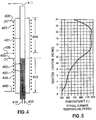
- the reactor design is such that the heat generated during the hydration of the lime in accordance with the reaction: CaO + H 2 O ⁇ Ca(OH) 2 is contained within the blended conditioned lime/soil charge, thereby causing the temperature to rise to a level at which hydrolysis of the hydrophobizing agent and, possibly certain of the hydrocarbon contaminants, is initiated.
- Air, or oxygen-enriched air, combined with water and/or steam where required by the chemical processes, is also introduced into the reactor to effect a flameless, intermediate temperature oxidation of the original hydrocarbons or the hydrolysed degradation products of such hydrocarbons.
- the air or oxygen enriched air flow rate must be sufficiently high to provide an excess of 50% to 100% of the stoichiometric oxygen requirements of the oxidation reactions while being limited to a level which will minimize the heat removal from the reaction mixture.
- the oxidation reactions may be represented generically as: C x H y O z + O 2 ⁇ CO 2 + H 2 O
- the direction of flow of the air and the blended conditioned lime/soil charge in the reactor is co-current. This ensures that any vaporized hydrocarbons, or incompletely hydrolysed/oxidized hydrocarbon degradation products, are carried from the region of high concentration obtaining near the blended conditioned lime/soil charge influent port to a region of low concentration and higher temperature nearer the exit, thereby providing an enhanced opportunity for further reaction.
- the decontaminated soil product which is normally very dry, dusty and extremely hydrophobic, leaves the reactor and, if necessary is pre-cooled, and, also if necessary, then passes through a spray of surfactant en route to another blender (e.g. a conventional pug mill) where it is mixed with a sufficient quantity of water to permit dust-free transfer to the final disposal site and/or compaction into a dense, stable monolith which, upon curing, provides virtually permanent encapsulation of any inorganic or surviving, trace organic residues.
- another blender e.g. a conventional pug mill
Landscapes
- Chemical & Material Sciences (AREA)
- Engineering & Computer Science (AREA)
- Life Sciences & Earth Sciences (AREA)
- Environmental & Geological Engineering (AREA)
- Soil Sciences (AREA)
- Health & Medical Sciences (AREA)
- Materials Engineering (AREA)
- Organic Chemistry (AREA)
- General Chemical & Material Sciences (AREA)
- Oil, Petroleum & Natural Gas (AREA)
- Emergency Management (AREA)
- General Life Sciences & Earth Sciences (AREA)
- General Health & Medical Sciences (AREA)
- Toxicology (AREA)
- Chemical Kinetics & Catalysis (AREA)
- Public Health (AREA)
- Business, Economics & Management (AREA)
- Inorganic Chemistry (AREA)
- Processing Of Solid Wastes (AREA)
- Treatment Of Sludge (AREA)
- Electrical Discharge Machining, Electrochemical Machining, And Combined Machining (AREA)
- Transition And Organic Metals Composition Catalysts For Addition Polymerization (AREA)
- Fire-Extinguishing Compositions (AREA)
Applications Claiming Priority (2)
| Application Number | Priority Date | Filing Date | Title |
|---|---|---|---|
| US229672 | 1988-08-08 | ||
| US08/229,672 US5414207A (en) | 1991-12-09 | 1994-04-19 | Method for rendering waste substances harmless |
Publications (2)
| Publication Number | Publication Date |
|---|---|
| EP0678348A1 EP0678348A1 (en) | 1995-10-25 |
| EP0678348B1 true EP0678348B1 (en) | 1998-06-03 |
Family
ID=22862224
Family Applications (1)
| Application Number | Title | Priority Date | Filing Date |
|---|---|---|---|
| EP95250091A Expired - Lifetime EP0678348B1 (en) | 1994-04-19 | 1995-04-16 | Method for rendering waste substances harmless |
Country Status (15)
| Country | Link |
|---|---|
| US (1) | US5414207A (cs) |
| EP (1) | EP0678348B1 (cs) |
| JP (1) | JPH07328596A (cs) |
| KR (1) | KR950031134A (cs) |
| AT (1) | ATE166804T1 (cs) |
| AU (1) | AU690637B2 (cs) |
| CA (1) | CA2145139A1 (cs) |
| CZ (1) | CZ97495A3 (cs) |
| DE (1) | DE69502767T2 (cs) |
| DK (1) | DK0678348T3 (cs) |
| ES (1) | ES2119306T3 (cs) |
| GR (1) | GR3027784T3 (cs) |
| HU (1) | HUT75884A (cs) |
| SK (1) | SK50195A3 (cs) |
| TW (1) | TW284713B (cs) |
Families Citing this family (28)
| Publication number | Priority date | Publication date | Assignee | Title |
|---|---|---|---|---|
| RU2160758C2 (ru) * | 1998-09-01 | 2000-12-20 | Рудник Михаил Иосифович | Сорбент для очистки от нефтемаслозагрязнений |
| WO2001058611A1 (en) * | 1999-10-11 | 2001-08-16 | Yukoh Akae | Method for manufacturing soil fixing agents and using the agents to fix the soil |
| GB2371298B (en) * | 2001-01-17 | 2005-03-30 | Forkers Ltd | Treatment of a solid material with a fluid |
| DE60230211D1 (de) * | 2001-04-13 | 2009-01-22 | Panasonic Corp | Verfahren zur Reduzierung von Nitrat-Stickstoff und flüchtigen organischen Verbindungen in Böden und Grundwasser |
| US6668947B2 (en) * | 2001-09-25 | 2003-12-30 | Ramon Perez Cordova | Drill cutting treatment method |
| ES2214969B1 (es) * | 2003-03-11 | 2005-12-16 | Universidade De Santiago De Compostela | Procedimiento para la inertizacion y acondicionamiento de residuos pastosos ricos en hidrocarburos por mezclado con lodos de pizarreras. |
| ES2214970B1 (es) * | 2003-03-11 | 2005-12-16 | Universidade De Santiago De Compostela | Procedimiento para la inertizacion y acondicionamiento de residuos pastosos en hidrocarburos por mezclado con encalantes convencionales. |
| ES2214971B1 (es) * | 2003-03-11 | 2005-12-16 | Univerdiade De Santiago De Compostela | Procedimiento para la inertizacion y acondicionamiento de residuos pastosos ricos en hidrocarburos por mezclados con cenizas de combustion de biomasa. |
| FR2854087A1 (fr) * | 2003-04-23 | 2004-10-29 | Bernard Paringaux | Procede economique et dispositif pour l'epuration des elements indesirables du petrole brut ou de ses depots de toutes consistances excluant tout rejet nocif terrestre, maritime ou atmospherique |
| US7690445B2 (en) * | 2003-11-07 | 2010-04-06 | Racional Energy & Environment Co. | Oil contaminated substrate treatment method and apparatus |
| MXYU04000001A (es) | 2004-02-27 | 2005-08-31 | Univ Juarez Autonoma De Tabasc | Proceso de estabilizacion quimica-biologica para la remediacion de suelo y recortes contaminados con aceites y derivados del petroleo. |
| US8735178B2 (en) * | 2006-03-27 | 2014-05-27 | University Of Kentucky Research Foundation | Withanolides, probes and binding targets and methods of use thereof |
| US20100227381A1 (en) * | 2007-07-23 | 2010-09-09 | Verutek Technologies, Inc. | Enhanced biodegradation of non-aqueous phase liquids using surfactant enhanced in-situ chemical oxidation |
| US7963720B2 (en) * | 2007-09-26 | 2011-06-21 | Verutek, Inc. | Polymer coated nanoparticle activation of oxidants for remediation and methods of use thereof |
| EP2209533B1 (en) * | 2007-09-26 | 2012-11-07 | Verutek Technologies, Inc. | Method for decreasing the amount of a contaminant at a side in a subsurface |
| FR2921355B1 (fr) * | 2007-09-26 | 2011-10-14 | Vauche P Sa | Procede et installation de transformation de boues fermentescibles |
| SM200800002B (it) * | 2008-01-14 | 2010-09-10 | Eb S R L Environmental Brocker | Processo per il trattamento esotermico ed il recupero di rifiuti solidi, semisolidi, pastosi e/o umidi |
| KR100861334B1 (ko) * | 2008-03-27 | 2008-10-01 | 주식회사 윈텍에이티에스 | 토양 세척장치 |
| US20110110723A1 (en) * | 2009-09-29 | 2011-05-12 | Verutek Technologies, Inc. | Green synthesis of nanometals using fruit extracts and use thereof |
| US20110091283A1 (en) * | 2009-10-14 | 2011-04-21 | University Of Connecticut | Oxidation of environmental contaminants with mixed valent manganese oxides |
| US8629313B2 (en) * | 2010-07-15 | 2014-01-14 | John Zink Company, Llc | Hybrid flare apparatus and method |
| US8356678B2 (en) | 2010-10-29 | 2013-01-22 | Racional Energy & Environment Company | Oil recovery method and apparatus |
| US9334436B2 (en) | 2010-10-29 | 2016-05-10 | Racional Energy And Environment Company | Oil recovery method and product |
| ES2364062B1 (es) * | 2011-05-27 | 2012-08-16 | Universidad De Cantabria | Instalación para procesado y tratamiento de lodos. |
| CN103521334A (zh) * | 2013-10-10 | 2014-01-22 | 徐州天正活性炭厂 | 一种活性炭无尘粉磨装置和方法 |
| CN111589512A (zh) * | 2020-06-03 | 2020-08-28 | 杭州富阳伟文环保科技有限公司 | 一种重金属污染土壤的洗涤方法 |
| CN114160545B (zh) * | 2021-12-08 | 2022-08-09 | 潍坊泓晟新能源股份有限公司 | 一种用于生物质供热系统的灰渣处理装置及其处理方法 |
| CN119839027B (zh) * | 2025-01-14 | 2026-03-03 | 生态环境部南京环境科学研究所 | 一种针对挥发性有机污染土壤的复合修复处理系统 |
Family Cites Families (6)
| Publication number | Priority date | Publication date | Assignee | Title |
|---|---|---|---|---|
| US842212A (en) * | 1906-04-04 | 1907-01-29 | John A Kyle | Material for protecting sheets, &c., in tinning. |
| US4018679A (en) * | 1971-10-26 | 1977-04-19 | Boelsing Friedrich | Method of rendering waste substances harmless |
| US4383783A (en) * | 1978-09-18 | 1983-05-17 | Shell Oil Company | Pipeline gel plug |
| AT367088B (de) * | 1980-08-29 | 1982-05-25 | Voest Alpine Ag | Verfahren zum aufarbeiten von mineraloelhaltigem gut |
| JPH02215881A (ja) * | 1989-02-17 | 1990-08-28 | Taguchi Kenkyusho:Kk | 注入材 |
| US5290351A (en) * | 1991-12-09 | 1994-03-01 | Ritter Robert A | Composition for rendering waste substances harmless |
-
1994
- 1994-04-19 US US08/229,672 patent/US5414207A/en not_active Expired - Fee Related
-
1995
- 1995-03-21 CA CA 2145139 patent/CA2145139A1/en not_active Abandoned
- 1995-03-25 TW TW84102919A patent/TW284713B/zh active
- 1995-04-14 CZ CZ95974A patent/CZ97495A3/cs unknown
- 1995-04-16 ES ES95250091T patent/ES2119306T3/es not_active Expired - Lifetime
- 1995-04-16 EP EP95250091A patent/EP0678348B1/en not_active Expired - Lifetime
- 1995-04-16 AT AT95250091T patent/ATE166804T1/de not_active IP Right Cessation
- 1995-04-16 DE DE69502767T patent/DE69502767T2/de not_active Expired - Fee Related
- 1995-04-16 DK DK95250091T patent/DK0678348T3/da active
- 1995-04-18 AU AU16494/95A patent/AU690637B2/en not_active Ceased
- 1995-04-18 KR KR1019950009486A patent/KR950031134A/ko not_active Ceased
- 1995-04-18 SK SK50195A patent/SK50195A3/sk unknown
- 1995-04-18 HU HU9501097A patent/HUT75884A/hu unknown
- 1995-04-19 JP JP9356795A patent/JPH07328596A/ja active Pending
-
1998
- 1998-08-31 GR GR980401962T patent/GR3027784T3/el unknown
Also Published As
| Publication number | Publication date |
|---|---|
| JPH07328596A (ja) | 1995-12-19 |
| ES2119306T3 (es) | 1998-10-01 |
| CA2145139A1 (en) | 1995-10-20 |
| DK0678348T3 (da) | 1998-10-12 |
| DE69502767T2 (de) | 1998-11-19 |
| AU1649495A (en) | 1995-10-26 |
| CZ97495A3 (en) | 1996-01-17 |
| AU690637B2 (en) | 1998-04-30 |
| HU9501097D0 (en) | 1995-06-28 |
| HUT75884A (en) | 1997-05-28 |
| DE69502767D1 (de) | 1998-07-09 |
| GR3027784T3 (en) | 1998-11-30 |
| ATE166804T1 (de) | 1998-06-15 |
| TW284713B (cs) | 1996-09-01 |
| SK50195A3 (en) | 1996-01-10 |
| KR950031134A (ko) | 1995-12-18 |
| US5414207A (en) | 1995-05-09 |
| EP0678348A1 (en) | 1995-10-25 |
Similar Documents
| Publication | Publication Date | Title |
|---|---|---|
| US5414207A (en) | Method for rendering waste substances harmless | |
| US4977839A (en) | Process and apparatus for separating organic contaminants from contaminated inert materials | |
| CA1337481C (en) | Process and apparatus for separating organic contaminants from contaminated inert materials | |
| AU648196B2 (en) | Process, system and compositions for rendering waste substances harmless | |
| Amend et al. | Critical evaluation of PCB remediation technologies | |
| Hung et al. | Simultaneous removal of PCDD/Fs, pentachlorophenol and mercury from contaminated soil | |
| Troxler et al. | Treatment of pesticide-contaminated soils with thermal desorption technologies | |
| KR100675050B1 (ko) | 액체 및 고체 할로겐화 탄화수소의 환원 탈할로겐화 방법 | |
| Seok et al. | Thermo-chemical destruction of polychlorinated biphenyls (PCBs) in waste insulating oil | |
| Njoyim-Tamungang et al. | Pollution control of surface waters by coupling gliding discharge treatment with incorporated oyster shell powder | |
| JP2007215552A (ja) | 有機ハロゲン化合物の処理方法 | |
| KR101004154B1 (ko) | 아임계수를 이용한 오염토양 정화방법 및 그 정화장치 | |
| JP2006247483A (ja) | 汚染土壌の処理方法 | |
| US5414206A (en) | Method and process for rendering waste substances harmless | |
| CA2079508C (en) | Method and apparatus for rendering waste substances harmless | |
| JP2006026460A (ja) | 汚染物質の無害化処理方法 | |
| Thurnau | Low-temperature desorption treatment of co-contaminated soils: TCLP as an evaluation technique | |
| US5430232A (en) | Enhanced volatilization of polychlorinated biphenyl compounds | |
| US6893616B2 (en) | Apparatus for converting both halogens in organic halides and organic compounds to inorganic substances | |
| JP3094449B2 (ja) | 固形廃棄物の焼却方法及びその焼却によって発生する固形廃棄物とガスの処理方法 | |
| Harjanto et al. | Formation and transport of PCDD/Fs in the packed bed of soil containing organic chloride during a thermal remediation process | |
| JP2005185873A (ja) | 有害物質含有土壌の浄化方法 | |
| GB2291055A (en) | Process for the treatment of waste or chemically contaminated soil | |
| JP2000288524A (ja) | ハロゲン化有機化合物の分解方法 | |
| JP2000342710A (ja) | ハロゲン化有機化合物の分解方法 |
Legal Events
| Date | Code | Title | Description |
|---|---|---|---|
| PUAI | Public reference made under article 153(3) epc to a published international application that has entered the european phase |
Free format text: ORIGINAL CODE: 0009012 |
|
| AK | Designated contracting states |
Kind code of ref document: A1 Designated state(s): AT BE CH DE DK ES FR GB GR IE IT LI LU MC NL PT SE |
|
| 17P | Request for examination filed |
Effective date: 19951212 |
|
| 17Q | First examination report despatched |
Effective date: 19960808 |
|
| GRAG | Despatch of communication of intention to grant |
Free format text: ORIGINAL CODE: EPIDOS AGRA |
|
| GRAG | Despatch of communication of intention to grant |
Free format text: ORIGINAL CODE: EPIDOS AGRA |
|
| GRAH | Despatch of communication of intention to grant a patent |
Free format text: ORIGINAL CODE: EPIDOS IGRA |
|
| GRAH | Despatch of communication of intention to grant a patent |
Free format text: ORIGINAL CODE: EPIDOS IGRA |
|
| GRAA | (expected) grant |
Free format text: ORIGINAL CODE: 0009210 |
|
| AK | Designated contracting states |
Kind code of ref document: B1 Designated state(s): AT BE CH DE DK ES FR GB GR IE IT LI LU MC NL PT SE |
|
| PG25 | Lapsed in a contracting state [announced via postgrant information from national office to epo] |
Ref country code: GR Free format text: LAPSE BECAUSE OF NON-PAYMENT OF DUE FEES Effective date: 19980603 |
|
| REF | Corresponds to: |
Ref document number: 166804 Country of ref document: AT Date of ref document: 19980615 Kind code of ref document: T |
|
| REG | Reference to a national code |
Ref country code: CH Ref legal event code: EP |
|
| ITF | It: translation for a ep patent filed | ||
| REF | Corresponds to: |
Ref document number: 69502767 Country of ref document: DE Date of ref document: 19980709 |
|
| REG | Reference to a national code |
Ref country code: IE Ref legal event code: FG4D |
|
| REG | Reference to a national code |
Ref country code: CH Ref legal event code: NV Representative=s name: E. BLUM & CO. PATENTANWAELTE |
|
| REG | Reference to a national code |
Ref country code: ES Ref legal event code: FG2A Ref document number: 2119306 Country of ref document: ES Kind code of ref document: T3 |
|
| REG | Reference to a national code |
Ref country code: DK Ref legal event code: T3 |
|
| ET | Fr: translation filed | ||
| REG | Reference to a national code |
Ref country code: PT Ref legal event code: SC4A Free format text: AVAILABILITY OF NATIONAL TRANSLATION Effective date: 19980902 |
|
| RAP2 | Party data changed (patent owner data changed or rights of a patent transferred) |
Owner name: THE ANI CORPORATION LIMITED |
|
| RIN2 | Information on inventor provided after grant (corrected) |
Free format text: RITTER, ROBERT |
|
| NLT2 | Nl: modifications (of names), taken from the european patent patent bulletin |
Owner name: THE ANI CORPORATION LIMITED |
|
| PLBE | No opposition filed within time limit |
Free format text: ORIGINAL CODE: 0009261 |
|
| STAA | Information on the status of an ep patent application or granted ep patent |
Free format text: STATUS: NO OPPOSITION FILED WITHIN TIME LIMIT |
|
| PGFP | Annual fee paid to national office [announced via postgrant information from national office to epo] |
Ref country code: PT Payment date: 19990413 Year of fee payment: 5 |
|
| PG25 | Lapsed in a contracting state [announced via postgrant information from national office to epo] |
Ref country code: LU Free format text: LAPSE BECAUSE OF NON-PAYMENT OF DUE FEES Effective date: 19990416 Ref country code: IE Free format text: LAPSE BECAUSE OF NON-PAYMENT OF DUE FEES Effective date: 19990416 Ref country code: GB Free format text: LAPSE BECAUSE OF NON-PAYMENT OF DUE FEES Effective date: 19990416 Ref country code: DK Free format text: LAPSE BECAUSE OF NON-PAYMENT OF DUE FEES Effective date: 19990416 Ref country code: AT Free format text: LAPSE BECAUSE OF NON-PAYMENT OF DUE FEES Effective date: 19990416 |
|
| PG25 | Lapsed in a contracting state [announced via postgrant information from national office to epo] |
Ref country code: SE Free format text: LAPSE BECAUSE OF NON-PAYMENT OF DUE FEES Effective date: 19990417 Ref country code: ES Free format text: LAPSE BECAUSE OF NON-PAYMENT OF DUE FEES Effective date: 19990417 |
|
| PGFP | Annual fee paid to national office [announced via postgrant information from national office to epo] |
Ref country code: MC Payment date: 19990423 Year of fee payment: 5 |
|
| PG25 | Lapsed in a contracting state [announced via postgrant information from national office to epo] |
Ref country code: LI Free format text: LAPSE BECAUSE OF NON-PAYMENT OF DUE FEES Effective date: 19990430 Ref country code: CH Free format text: LAPSE BECAUSE OF NON-PAYMENT OF DUE FEES Effective date: 19990430 Ref country code: BE Free format text: LAPSE BECAUSE OF NON-PAYMENT OF DUE FEES Effective date: 19990430 |
|
| 26N | No opposition filed | ||
| BERE | Be: lapsed |
Owner name: RITTER ROBERT A. Effective date: 19990430 |
|
| PG25 | Lapsed in a contracting state [announced via postgrant information from national office to epo] |
Ref country code: NL Free format text: LAPSE BECAUSE OF NON-PAYMENT OF DUE FEES Effective date: 19991101 |
|
| GBPC | Gb: european patent ceased through non-payment of renewal fee |
Effective date: 19990416 |
|
| REG | Reference to a national code |
Ref country code: CH Ref legal event code: PL |
|
| PG25 | Lapsed in a contracting state [announced via postgrant information from national office to epo] |
Ref country code: FR Free format text: LAPSE BECAUSE OF NON-PAYMENT OF DUE FEES Effective date: 19991231 |
|
| NLV4 | Nl: lapsed or anulled due to non-payment of the annual fee |
Effective date: 19991101 |
|
| EUG | Se: european patent has lapsed |
Ref document number: 95250091.6 |
|
| REG | Reference to a national code |
Ref country code: FR Ref legal event code: ST |
|
| PG25 | Lapsed in a contracting state [announced via postgrant information from national office to epo] |
Ref country code: DE Free format text: LAPSE BECAUSE OF NON-PAYMENT OF DUE FEES Effective date: 20000201 |
|
| REG | Reference to a national code |
Ref country code: IE Ref legal event code: MM4A |
|
| PG25 | Lapsed in a contracting state [announced via postgrant information from national office to epo] |
Ref country code: PT Free format text: LAPSE BECAUSE OF NON-PAYMENT OF DUE FEES Effective date: 20001031 Ref country code: MC Free format text: LAPSE BECAUSE OF NON-PAYMENT OF DUE FEES Effective date: 20001031 |
|
| REG | Reference to a national code |
Ref country code: DK Ref legal event code: EBP |
|
| REG | Reference to a national code |
Ref country code: PT Ref legal event code: MM4A Free format text: LAPSE DUE TO NON-PAYMENT OF FEES Effective date: 20001031 |
|
| REG | Reference to a national code |
Ref country code: ES Ref legal event code: FD2A Effective date: 20000513 |
|
| PG25 | Lapsed in a contracting state [announced via postgrant information from national office to epo] |
Ref country code: IT Free format text: LAPSE BECAUSE OF NON-PAYMENT OF DUE FEES;WARNING: LAPSES OF ITALIAN PATENTS WITH EFFECTIVE DATE BEFORE 2007 MAY HAVE OCCURRED AT ANY TIME BEFORE 2007. THE CORRECT EFFECTIVE DATE MAY BE DIFFERENT FROM THE ONE RECORDED. Effective date: 20050416 |