EP0675713B1 - Utilisation de prodelphinidines pour le traitement de l'arthrose - Google Patents
Utilisation de prodelphinidines pour le traitement de l'arthrose Download PDFInfo
- Publication number
- EP0675713B1 EP0675713B1 EP94903924A EP94903924A EP0675713B1 EP 0675713 B1 EP0675713 B1 EP 0675713B1 EP 94903924 A EP94903924 A EP 94903924A EP 94903924 A EP94903924 A EP 94903924A EP 0675713 B1 EP0675713 B1 EP 0675713B1
- Authority
- EP
- European Patent Office
- Prior art keywords
- prodelphinidins
- days
- substance
- dna
- culture
- Prior art date
- Legal status (The legal status is an assumption and is not a legal conclusion. Google has not performed a legal analysis and makes no representation as to the accuracy of the status listed.)
- Expired - Lifetime
Links
- 0 **1C(c(cc2*)cc(O)c2O*)Oc2c(*)c(O)cc(*=I)c2C1 Chemical compound **1C(c(cc2*)cc(O)c2O*)Oc2c(*)c(O)cc(*=I)c2C1 0.000 description 1
Classifications
-
- A—HUMAN NECESSITIES
- A61—MEDICAL OR VETERINARY SCIENCE; HYGIENE
- A61K—PREPARATIONS FOR MEDICAL, DENTAL OR TOILETRY PURPOSES
- A61K31/00—Medicinal preparations containing organic active ingredients
- A61K31/74—Synthetic polymeric materials
- A61K31/765—Polymers containing oxygen
-
- A—HUMAN NECESSITIES
- A61—MEDICAL OR VETERINARY SCIENCE; HYGIENE
- A61K—PREPARATIONS FOR MEDICAL, DENTAL OR TOILETRY PURPOSES
- A61K31/00—Medicinal preparations containing organic active ingredients
- A61K31/33—Heterocyclic compounds
- A61K31/335—Heterocyclic compounds having oxygen as the only ring hetero atom, e.g. fungichromin
- A61K31/35—Heterocyclic compounds having oxygen as the only ring hetero atom, e.g. fungichromin having six-membered rings with one oxygen as the only ring hetero atom
-
- A—HUMAN NECESSITIES
- A61—MEDICAL OR VETERINARY SCIENCE; HYGIENE
- A61K—PREPARATIONS FOR MEDICAL, DENTAL OR TOILETRY PURPOSES
- A61K31/00—Medicinal preparations containing organic active ingredients
- A61K31/33—Heterocyclic compounds
- A61K31/335—Heterocyclic compounds having oxygen as the only ring hetero atom, e.g. fungichromin
- A61K31/35—Heterocyclic compounds having oxygen as the only ring hetero atom, e.g. fungichromin having six-membered rings with one oxygen as the only ring hetero atom
- A61K31/352—Heterocyclic compounds having oxygen as the only ring hetero atom, e.g. fungichromin having six-membered rings with one oxygen as the only ring hetero atom condensed with carbocyclic rings, e.g. methantheline
- A61K31/353—3,4-Dihydrobenzopyrans, e.g. chroman, catechin
-
- A—HUMAN NECESSITIES
- A61—MEDICAL OR VETERINARY SCIENCE; HYGIENE
- A61K—PREPARATIONS FOR MEDICAL, DENTAL OR TOILETRY PURPOSES
- A61K36/00—Medicinal preparations of undetermined constitution containing material from algae, lichens, fungi or plants, or derivatives thereof, e.g. traditional herbal medicines
- A61K36/18—Magnoliophyta (angiosperms)
- A61K36/185—Magnoliopsida (dicotyledons)
-
- A—HUMAN NECESSITIES
- A61—MEDICAL OR VETERINARY SCIENCE; HYGIENE
- A61P—SPECIFIC THERAPEUTIC ACTIVITY OF CHEMICAL COMPOUNDS OR MEDICINAL PREPARATIONS
- A61P19/00—Drugs for skeletal disorders
- A61P19/04—Drugs for skeletal disorders for non-specific disorders of the connective tissue
-
- A—HUMAN NECESSITIES
- A61—MEDICAL OR VETERINARY SCIENCE; HYGIENE
- A61P—SPECIFIC THERAPEUTIC ACTIVITY OF CHEMICAL COMPOUNDS OR MEDICINAL PREPARATIONS
- A61P43/00—Drugs for specific purposes, not provided for in groups A61P1/00-A61P41/00
Definitions
- the subject of the present invention is the use of prodelphinidins, and more particularly those obtained from Ribes species , in particular Ribes nigrum , for obtaining medicaments intended for the treatment of osteoarthritis.
- the articular cartilage is subjected to slow reshaping ensured by a perfectly chondroresorption mechanism compensated by a process of chondrorepair (or chondroformation) which maintains articular cartilage in dynamic balance (Franchimont et al., 1991).
- the chondroresorption is ensured by the chondrocyte itself which produces prostaglandins including PGE2, proteolytic enzymes (collagenase, stromelysine, serine proteases ...) and attacking free oxygen radicals to the cartilage matrix, disorganizes and destroys it.
- PGE2 prostaglandins
- proteolytic enzymes collagenase, stromelysine, serine proteases
- a chondroformation takes place homeostatic which repairs altered and / or resorbed matter; there is production of macromolecules that form the structure of the fundamental substance: the type II and type IX collagens, proteoglycans, junction proteins, etc ...
- This phase of chondroformation is a process dependent on several factors including the concentration of macromolecules in the areas around the chondrocyte and the equilibrium hormonal, in particular the secretion of growth hormone, IGF I and II, calcitonin, androgens ...
- pathogenic factors may arise which accelerate the breakdown of cartilage by acceleration of the process of chondrororesorption upsetting the balance between chondrororesorption and chondroreparation in favor from the first.
- pathogenic factors include, among other things, functional and weight overloads joint, microcrystals deposits and nutritional disorders of joint structures.
- pathogenic factors will act by stimulating the production of cytokines (IL1 ⁇ , TNF ⁇ , IL6 ...) by the chondrocytes themselves, by other cells in neighboring structures such as synoviocytes A from the articular synovium.
- the imbalance will be all the more marked as it exists hormonal disturbances (as is the case after age 50, age of development of osteoarthritis) making chondroreparation less effective.
- Drug therapy for osteoarthritis is poor: anti-inflammatory drugs non-steroid fight pain and improve movement; they do not stop the progression of the disease, especially the destruction of cartilage, and do not allow cartilage repair.
- proanthocyanidins for the prevention or treatment of pathologies due to the biological effects of free radicals, in particular inflammations, is the subject of US patent n ° 4, 698, 360 filed April 9, 1985.
- the object of the present invention is precisely to provide medicaments which, by their properties of reduction of the chondoresorption and stimulation of chondrorepair, can effectively treat osteoarthritis or any other pathology directly or indirectly related to destruction of cartilage and the lack of repair of the latter by the biological mechanisms of the organism.
- a particular subject of the invention is the aforementioned use of the prodelphinidins chosen from those corresponding to the following formula (II): in which R 3 , R 4 and R 5 are as defined above in the context of formula (I).
- prodelphinidins By their properties stimulating the production of proteoglycans and collagens (especially type II) in cartilage, prodelphinidins according to the invention are capable of restoring the process of chondroformation.
- prodelphinidins also have the advantage of reducing the chondrororesorption, in particular by their effects of reducing the production of prostaglandins (especially of type E2) and reduction of the production of free radicals in the body.
- the medicaments according to the invention are more particularly intended for oral, parenteral or topical administration.
- the prodelphinidins contained in these drugs are those derived from plants, and more particularly from Ribes species , in particular from Ribes nigrum .
- the plants from which said prodelphinidins are isolated are obtained from conventional field methods, or by in vitro production techniques.
- the abovementioned medicaments include extracts of Ribes species , and more particularly of Ribes nigrum , these extracts themselves comprising prodelphinidins.
- Ribes extracts especially Ribes nigrum extracts can advantageously be obtained according to the following methods.
- a batch of powder is exhausted dry Ribes leaves by slow percolation, using a mixture acetone-water. After obtaining the last percolate, the powder is expressed with press and collect all the liquids.
- the total extract can be shaken vigorously with NaCl, added until two phases are obtained: one upper acetone phase and an aqueous lower phase.
- the sentence acetone is evaporated under reduced pressure at 30 ° C and the aqueous residue is added with an equal volume of water, filtered then re-extracted: either with acetate ethyl, or with butanol.
- the extracts are then evaporated to dryness.
- Extracts are thus obtained containing at least 2% by weight of prodelphinidines of formula (I) or (II).
- the prodelphinidins contained in the abovementioned medicaments are isolated and purified from plant extracts capable of containing said prodelphinidins, and more particularly from plants belonging to Ribes species , notably Ribes nigrum .
- the isolation and purification of the prodelphinidins from the aforementioned plants, and more particularly from Ribes nigrum , is advantageously carried out by various techniques of gel chromatography, or even ultra-filtration techniques known to those skilled in the art. , from extracts obtained according to the methods described above.
- compositions based on prodelphinidins according to the invention on the chondroreparation and chondrororesorption.
- the model used to test proanthocyanidols namely the culture of human chondrocytes in three dimensions, makes it possible to quantify chondroreparation by the production of matrix substances: collagen type II, proteoglycans, and chondrororesorption by reducing the levels of prostaglandin E2 and OH ° and O ° 2 free radicals.
- human articular chondrocytes are cultured in the DMEM (Dulbecco's Modification of Eagle's Medium - ICN - Ghent, Belgium) supplemented with either Ultroser G 1% (GIBCO, Ghent, Belgium) or 10% fetal calf serum (ICN - Ghent - Belgium), and 50 ⁇ g of ascorbic acid / ml.
- the cartilage comes from the apparently normal area of human femoral heads suffering from osteoarthritis, immediately after the operation carried out for the installation of a total hip prosthesis; it can also come from a healthy femoral head, but which has suffered a trauma and needs to be replaced.
- This cartilage is then digested by clostridial collagenase 1 mg / ml (Boehringer-Mannheim, Germany) in a buffer, (120 mM NaCl, 1 mM CaCl 2 , 5 mM KCL, 1 mM KH 2 PO 4 , 25 mM NaHCO 3 , 2 mM and Hepes 30mM, pH 7.4) for 24 hours.
- a buffer 120 mM NaCl, 1 mM CaCl 2 , 5 mM KCL, 1 mM KH 2 PO 4 , 25 mM NaHCO 3 , 2 mM and Hepes 30mM, pH 7.4
- the fresh weight of the aggregates increases with the duration of cultivation, especially during the first days.
- the PGs are measured by a specific and sensitive radioimmunoassay (RIA) of the human cartilaginous PGs (Gysen et al., 1984). PGs were extracted from human cartilage, according to the methods described by Roughley et al. (1981) and by Bayliss and Venn (1980). The antiserum against human cartilage PGs was obtained in rabbits according to the technique of Vaitukaitis et al. (1971).
- RIA radioimmunoassay
- the radioimmunoassay is carried out in a volume of 0.4 ml consisting of 0.1 ml of the tracer solution (15,000 to 20,000 cpm 125 I-PG, labeled by the chloramine T method (Greenwood, 1973), 0 , 1 ml of anti-PG antiserum diluted to 1/5000 in a phosphate buffered saline (PBS - PO 4 50 mM, NaCl 150 mM), containing BSA (bovine serum albumin-5g / l and azide sodium -6.7 mM) (incubation buffer) and 0.2 ml of several dilutions of culture medium or aggregate extract or of the antigen (0.5 - 500 ng / tube).
- PBS - PO 4 50 mM, NaCl 150 mM containing BSA (bovine serum albumin-5g / l and azide sodium -6.7 mM) (incubation buffer) and 0.2 ml of several dilution
- the free PG * (radioactive PG) are separated from the PG * -antibody complexes by double precipitation (Franchimont et al., 1983).
- the sensitivity of the assay is 0.6 ng / tube.
- the accuracy of the measurement is in the order of 4%.
- the intra- and inter-dosing coefficients of variation are less than 10% and 20% respectively.
- Antibodies are directed against the antigenic determinants of central protein of PG. There is a complete cross-reaction with PGs rib cartilage, vertebral disc and trachea, as well as PG extracted from vein or artery. There is no cross-reaction with glycosaminoglycans or with PGs extracted from fetal tissue or small PGs bone.
- the dosage is specific to the species, since the PGs extracted from cartilage of embryonic dog, rat, chicken or calf does not react in the dosage. Type II collagen, fibronectin, chondroitin and hyaluronic acid do not interfere in the dosage.
- the PGs are measured directly in the culture media.
- chondrocyte aggregates they are washed 3 times in a phosphate-buffered saline buffer (PBS-PO 4 50 mM, 150 mM NaCl, pH 7.4) containing protease inhibitors (Oegema et al., 1975: acid- 6-aminohexanoic 100 mM, EDTA 10 mM, benzamidine hydrochloride 50 mM, trypsin inhibitor 5.10 -8 M, sodium azide 6.7 mM and superoxide dismutase 200 U / ml).
- the aggregates are homogenized by dissociation with ultrasound (10 seconds, at 4 ° C, power: 200 watts / cm2). This extraction makes it possible to obtain 70 to 80% of the PGs extracted with HCL-guanidine.
- coll.II The radioimmunological assay method for coll.II has been described in detail (Henrotin et al., 1990). Coll. II is extracted from articular cartilage human according to the technique described by Herbage et al. (1977). The Tale Antiserum coll.II was obtained in rabbits according to the technique of Vaitukaitis et al. (1971).
- the assay is carried out by sequential saturation.
- the radioimmunoassay is carried out in a volume of 0.3 ml consisting of 0.2 ml of incubation buffer (PBS: PO 4 50 mM, NaCl 300 mM, BSA 5g / l (W / V) , sodium azide 6.7 mM, pH 7.4) containing the reference II coll. (0.5 to 500 ng) or the sample to be assayed and 0.1 ml of guinea pig anti-coll II antiserum diluted to 1/5000 (24 h at 4 ° C).
- PBS incubation buffer
- 0.1 ml of guinea pig anti-coll II antiserum diluted to 1/5000 (24 h at 4 ° C).
- 0.1 ml of tracer 125 I-coll In a second step, 0.1 ml of tracer 125 I-coll.
- the dosage is specific for human joint type II collagen. There has no cross-reaction with other components of cartilage: human PG, fibronectin, laminin and hyaluronic acid do not interfere in the dosage.
- bovine collagen type I, III or IV No cross-reaction is obtained with bovine collagen type I, III or IV.
- Culture media are stored at -20 ° C in the presence of inhibitors enzymatic (Oegema et al., 1975). These media are dosed by the method radioimmunological without prior treatment. Chondrocyte aggregates are washed and dissociated by ultrasound according to the method described for the determination of PG. After centrifugation (1500 rpm, 10 minutes), the residue is extracted using 500 mM acetic acid with stirring for 24 hours at 4 ° C. The supernatant of the homogenate and the residue extract are mixed and dosed after equilibration at pH 7.4 using 4M NaOH.
- PGE2 The radioimmunoassay of PGE2 is carried out according to the method described by Serteyn et al., 1988.
- PGE2 is obtained from Sigma (Aldrich-Chemie, Steinheim, Germany) and 3 H-PGE2 from NEN (Du Pont de Nemours, Brussels, Belgium).
- 0.1 ml of the sample to be assayed or of the reference antigen (0-500 pg) are successively added 0.1 ml of incubation buffer (10 mM Tris-HCL, 150 mM NaCl, azide sodium 0.5% (W / V), gelatin 1% (W / V), pH 7.4), 0.1 ml of 3 H-PGE2 (diluted to obtain 10,000 cpm / 0.1 ml) and 0.1 ml of antiserum (1/4000). After 48 hours of incubation at 4 ° C, the free antigen is separated from the antigens linked to the antibodies by precipitation with charcoal - DEXTRAN T70 (0.5 ml per tube).
- the carbon solution - Dextran contains 5g / l of neutral carbon, 500 mg of Dextran 70 / l. After centrifugation (20 minutes, 3000 rpm, 4 ° C), the radioactivity present in the supernatant is measured on the beta counter (Beckman) by liquid scintillation. The sensitivity of the assay is 20 pg / ml.
- the chondrocytes are cultivated in the nutritive medium supplemented with 2 uCi / ml (5 Ci / mmol) of methyl 3 H-thymidine ( 3 H-TDN) (Amersham, Brussels, Belgium) for 24 hours.
- the chondrocyte aggregates are then washed for 20 minutes using a phosphate-buffered saline buffer (PBS: PO 4 50 mM, 150 mM NaCl, pH 7.4) containing the same protease inhibitors as those used for the determination of PG. They are then incubated for 20 minutes in PBS containing cold thymidine (100 ⁇ g / ml), then washed again for 20 minutes, twice.
- PBS phosphate-buffered saline buffer
- the aggregate is then dissociated by ultrasound (10 sec., 4 ° C, 200 watts / cm2).
- the radioactivity incorporated into the aggregate is then measured using a beta scintillation counter.
- the assay of the DNA content of the aggregates is carried out on the aggregates dissociated by ultrasound, according to the fluorimetric method described by Labarca and Paigen (1980).
- FB bisbenzimide fluorochrome
- the results are expressed in quantities of PG, coll. II or PGE2 measured in the culture medium (MC) per ⁇ g of DNA. Cumulative measures are obtained by adding the quantities dosed in the MC at each renewal of MC, for successive periods: 0 to 4, 4 to 8, 8 to 12 days of culture. The total PG production is calculated by adding the cumulative quantities measured in the MCs to those measured in the corresponding aggregates. The average and the standard deviation (m +/- d.s) are calculated. Comparing values means is carried out by the Mann-Whitney U statistical test.
- the products are dissolved in 10 ml flasks at the required concentration in phosphate buffer: 6.6 10 -2 M, p H 7.4 in the presence of ⁇ keto methiolbutyric acid (10 -3 M: KMB). After the bottles are sealed, the samples are irradiated by ⁇ rays supplied by a source of 137 Cs.
- the OH ° radicals produced by ⁇ irradiation react with the KMB to produce ethylene detected by a gas chromatograph.
- the height of the ethylene peak is proportional to the amount of free radicals trained in the environment (Weis et al., 1978).
- the ⁇ irradiation releases pentane which is dose.
- the height of the pentane peak is proportional to the amount of radicals free trained in the middle.
- the incubation medium (2.5 ml) consists of PBS buffer containing glucose (7.5 mM), ferricytochrome C (0.056 mM), CaCl 2 (2.3 mM), MgCl 2 (1, 1 mM), 7.5 ⁇ 10 6 cells and the test substance at a concentration of 0.032 mM.
- the reaction is started by adding phorbol myristate acetate to a final concentration of 0.012 mM and the reduction in cytochrome C is followed at 550 nm for 10 minutes.
- the reference cuvette contains the same material as that described above with an additional 48 ⁇ g of superoxide dismutase (SOD) / ml of medium.
- Collagen II values in 12-day aggregates expressed in ng per ⁇ g of DNA in the 12-day aggregates are shown in Table 12.
- the substance Ic is the only one to be stimulating at a dose of 1 ⁇ g / ml.
- Prostaglandins have been assayed in culture media corresponding to the incubation from the 4th to the 8th day, period when the aggregate is formed.
- the PGs in the aggregates are also significantly increased during incubation of substances Ia, Ib and Ic at concentrations of 10 and 100 ⁇ g / ml.
- Collagen type II increases in culture media when the chondrocytes are incubated with substances Ia, Ib and Ic at concentrations of 10 and 100 ⁇ g / ml. The response is dose-dependent (Tables 18 and 19). In the aggregates, an accident occurred which only allowed collagen II to be measured during experiment 397. An increase in collagen II is observed for the 3 substances Ia, Ib and Ic at concentrations of 10 and 100 ⁇ g / ml. The effect is dose dependent (table 20).
- Substrate KMB % INHIBITION Concentration Products Ia Ib Ic 10 -3 M 78 80 74 10 -4 M 41 46 39 10 -5 M 22 25 20 Inhibition (expressed in% relative to the controls) of the production of the Hydroxyl radicals by the substances Ia, Ib and Ic.
- Substrate Linoleic acid % INHIBITION Concentration Products Ia Ib Ic 10 -3 M 94 93 91 10 -4 M 42 45 40 10 -5 M 0 0 0 0
Landscapes
- Health & Medical Sciences (AREA)
- Life Sciences & Earth Sciences (AREA)
- General Health & Medical Sciences (AREA)
- Chemical & Material Sciences (AREA)
- Veterinary Medicine (AREA)
- Medicinal Chemistry (AREA)
- Public Health (AREA)
- Pharmacology & Pharmacy (AREA)
- Animal Behavior & Ethology (AREA)
- Epidemiology (AREA)
- Natural Medicines & Medicinal Plants (AREA)
- Engineering & Computer Science (AREA)
- Nuclear Medicine, Radiotherapy & Molecular Imaging (AREA)
- Microbiology (AREA)
- General Chemical & Material Sciences (AREA)
- Chemical Kinetics & Catalysis (AREA)
- Mycology (AREA)
- Organic Chemistry (AREA)
- Bioinformatics & Cheminformatics (AREA)
- Alternative & Traditional Medicine (AREA)
- Biotechnology (AREA)
- Botany (AREA)
- Medical Informatics (AREA)
- Physical Education & Sports Medicine (AREA)
- Biomedical Technology (AREA)
- Pharmaceuticals Containing Other Organic And Inorganic Compounds (AREA)
- Saccharide Compounds (AREA)
- Medicines That Contain Protein Lipid Enzymes And Other Medicines (AREA)
- Medicines Containing Plant Substances (AREA)
- Pyrane Compounds (AREA)
Description

- R1 et R2 représentent indépendamment H ou OH,
- R3 et R4 sont différents et représentent H ou OH,
- R5 représente H (catéchine/épicatéchine) ou OH (gallocatéchine/épigallocatéchine), et,
- n est un nombre entier de 2 à 40,
- sous réserve que l'une au moins des 2 à 40 unités décrites ci-dessus,
correspond à une gallocatéchine (R3 = H, R4 = OH), ou à une
épigallocatéchine (R3 = OH, R4 = H), pour laquelle R5 représente OH,
pour l'obtention de médicaments destinés au traitement des pathologies articulaires liées à une destruction du cartilage, et plus particulièrement de l'arthrose.


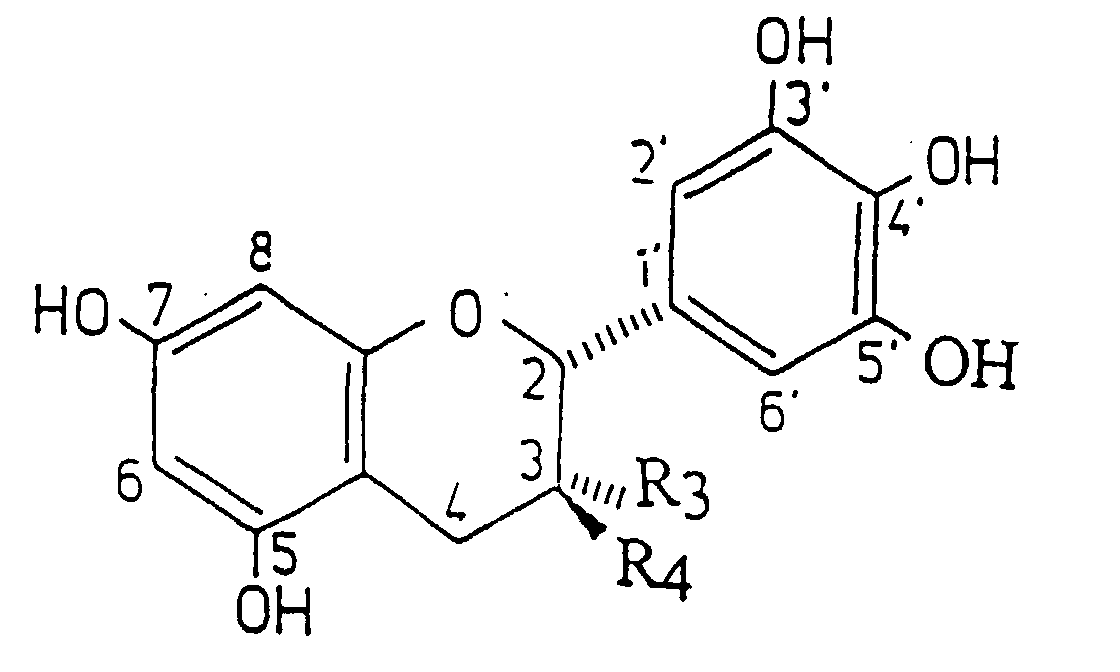
| R3 | R4 | |
| GC | H | OH |
| EGC | OH | H |
| PG LIBERES DANS LE MILIEU DE CULTURE (µg/µg ADN/96 h) | ||||
| TEMPS DE CULTURE (JOURS) | SUBSTANCE Ia (µg/ml) | |||
| 0 | 1 | 10 | 100 | |
| 0 - 4 | 13,6 ± 1,6 | 14,2 ± 1,6 | 22,4 ± 0,2 | 28,6 ± 2,85 |
| 4 - 8 | 1,96 ± 0,24 | 1,74 ± 0,18 | 3,26 ± 0,12 | 3,94 ± 0,1 |
| 8 - 12 | 0,42 ± 0,03 | 0,44 ± 0,04 | 0,74 ± 0,18 | 0,78 ± 0,02 |
| PG LIBERES DANS LE MILIEU DE CULTURE (µg/µg ADN/96 h) | ||||
| TEMPS DE CULTURE (JOURS) | SUBSTANCE Ib (µg/ml) | |||
| 0 | 1 | 10 | 100 | |
| 0 - 4 | 13,7 ± 1,66 | 13,0 ± 1,22 | 20,4 ± 3,0* | 28,2 ± 2,92* |
| 4 - 8 | 3,14± 0,14 | 3,45 ± 0,56 | 4,78 ± 0,56* | 5,65 ± 0,24* |
| 8 - 12 | 0,71 ± 0,09 | 0,72 ± 0,08 | 1,00 ± 0,12* | 1,32 ± 0,01* |
| : p < 0,025 comparé aux témoins (U - test de Mann-Whitney) |
| PG LIBERES DANS LE MILIEU DE CULTURE (µg/µg ADN/96 h) | ||||
| TEMPS DE CULTURE (JOURS) | SUBSTANCE Ic (µg/ml) | |||
| 0 | 1 | 10 | 100 | |
| 0 - 4 | 12,4 ± 0,96 | 15,9 ± 1,15 | 19,1 ± 1,2 | 21,1 ± 1,0 |
| 4 - 8 | 3,0 ± 0,15 | 3,7 ± 0,15 | 4,4 ± 0,52 | 4,9 ± 0,45 |
| 8 - 12 | 1,04 ± 0,07 | 1,32 ± 0,7 | 1,53 ± 0,15 | 1,75 ± 0,05 |
| Substances n° | Concentrations étudiées (µg/ml) | |||||||
| 0 | 1 | 10 | 100 | |||||
| Protéoglycanes libérés durant les 12 jours de culture | ||||||||
| µg /µg ADN /12 jours | µg /µg ADN /12 jours | µg /µg ADN /12 jours | µg /µg ADN /12 jours | |||||
| Abs | % | Abs | % | Abs | % | Abs | % | |
| Ia | 16 | 100 | 16,4 | 103 | 26,4 | 165 | 33,3 | 208 |
| Ib | 17,6 | 100 | 17,2 | 98 | 26,3 | 149 | 35,2 | 200 |
| Ic | 16,4 | 100 | 20,9 | 127 | 25 | 150 | 27,8 | 170 |
| PG DANS LES AGREGATS de 12 jours (ng/µg ADN) | ||||
| AGE DE LA CULTURE (JOURS) | SUBSTANCE Ia (µg/ml) | |||
| 0 | 1 | 10 | 100 | |
| 0 - 12 | 581 ± 98 | 912 ±83,6 | 1411 ± 153 | 2105 ± 42 |
| PG DANS LES AGREGATS de 12 jours (ng/µg ADN) | ||||
| AGE DE LA CULTURE (JOURS) | SUBSTANCE Ib (µg/ml) | |||
| 0 | 1 | 10 | 100 | |
| 0 - 12 | 724 ± 222 | 742 ± 62 | 931 ± 24 | 1108 ± 45 |
| PG DANS LES AGREGATS de 12 jours (ng/µg ADN) | ||||
| AGE DE LA CULTURE (JOURS) | SUBSTANCE Ic (µg/ml) | |||
| 0 | 1 | 10 | 100 | |
| 0 - 12 | 742 ± 50 | 886 ± 114 | 1046 ± 74 | 1184 ± 33 |
| COLL. II LIBERE DANS LE MILIEU DE CULTURE (ng/µg ADN/96 h) | ||||
| TEMPS DE CULTURE (JOURS) | SUBSTANCE Ia (µg/ml) | |||
| 0 | 1 | 10 | 100 | |
| 0 - 4 | 225 ± 22 | 233 ± 25 | 301 ± 52 | 462 ± 51 |
| 4 - 8 | 152 ± 14 | 147 ± 19 | 259 ± 22 | 311 ± 41 |
| 8 - 12 | 97,4 ± 18 | 102,2 ± 10,96 | 147 ± 21 | 109 ± 23 |
| COLL. II LIBERE DANS LE MILIEU DE CULTURE (ng/µg ADN/96 h) | ||||
| TEMPS DE CULTURE (JOURS) | SUBSTANCE Ib (µg/ml) | |||
| 0 | 1 | 10 | 100 | |
| 0 - 4 | 204 ± 21 | 222 ± 26 | 322 ± 33 | 392 ± 46 |
| 4 - 8 | 102 ± 12 | 112 ± 19 | 158 ± 14 | 190 ± 22 |
| 8 - 12 | 62,8 ± 6,9 | 59,9 ± 0,6 | 91,7 ± 6,1 | 137,7 ± 13,4 |
| COLL.II LIBERE DANS LE MILIEU DE CULTURE (ng/µg ADN/96 h) | ||||
| TEMPS DE CULTURE (JOURS) | SUBSTANCE Ic (µg/ml) | |||
| 0 | 1 | 10 | 100 | |
| 0 - 4 | 107,8 ± 0,3 | 149,4 ± 8,7 | 162 ± 11 | 182 ± 5,6 |
| 4 - 8 | 52,2 ± 5,4 | 65,8 ± 7,4 | 70,5 ± 7,1 | 93,8 ± 10,5 |
| 0 - 12 | 32,2 ± 3,4 | 41,2 ± 4,6 | 50,6 ± 4,2 | 61,1 ± 5,2 |
| Substances n° | Doses étudiées (µg/ml) | |||||||
| 0 | 1 | 10 | 100 | |||||
| Libération cumulée du coll.II en 12 jours | ||||||||
| µg /µg ADN /12 jours | µg /µg ADN /12 jours | µg /µg ADN /12 jours | µg /µg ADN /12 jours | |||||
| Abs | % | Abs | % | Abs | % | Abs | % | |
| Ia | 474 | 100 | 482 | 102 | 787 | 166 | 962 | 202 |
| Ib | 369 | 100 | 394 | 107 | 572 | 155 | 728 | 197 |
| Ic | 191 | 100 | 256 | 134 | 292 | 153 | 337 | 176 |
| Valeur absolue: exprimée en ng/µg ADN/12 jours |
| Concentrations moyennes (m ± DS) de collagène de type II dans les
agrégats de chondrocytes au terme de 12 jours de culture Doses étudiées | ||||
| Subs. n° | 0 | 1µg/ml | 10µg/ml | 100µg/ml |
| Ia | 104 ± 15,1 | 105 ± 13 | 165 ± 21 | 175 ± 19 |
| Ib | 90 ± 10 | 98 ± 9 | 121 ± 10 | 158 ± 16 |
| Ic | 61 ± 7 | 81 ± 6 | 94 ± 7 | 121 ± 13 |
| Taux des PGE2 (pg/µg d'ADN) dans les milieux de culture prélevés du 4°
au 8° jour Doses étudiées | ||||
| Subs. n° | 0 | 1µg/ml | 10µg/ml | 100µg/ml |
| Ia | 122 ± 39 | 91,5 ± 9 | 44 ± 0,6 | 25 ± 13 |
| Ib | 146 ± 23 | 129 ± 19 | 76 ± 14 | 48 ± 15 |
| Ic | 138 ± 19 | 101 ± 7 | 81 ± 12 | 39 ± 10 |
| PG DANS LE MILIEU DE CULTURE (µg/µg ADN - 96 H) | |||||||
| TEMPS DE CULTURE (JOURS) | 0 | Substance Ia (µg/ml) | Substance Ib (µg/ml) | Substance Ic (µg/ml) | |||
| 10 | 100 | 10 | 100 | 10 | 100 | ||
| 0 - 4 | 6,5 ± 0,75 (100%) | 7,7 ± 0,49 (118,5%) | 9,5 ± 1,34 (147%) | 7,6 ± 0,41 (117%) | 11,9 ± 2,09 (183,5%) | 7,8 ± 1,51 (120%) | 10,4 ± 1,19 (160%) |
| 4 - 8 | 1,99 ± 0,19 (100%) | 2,37 ± 0,17 (119%) | 2,69 ± 0,15 (135%) | 2,32 ± 0,21 (117%) | 2,71 ± 0,24 (136%) | 2,34 ± 0,08 (118%) | 2,40 ± 0,35 (121%) |
| PG DANS LE MILIEU DE CULTURE (µg/µg ADN - 96 H) SUBSTANCE (µg/ml) | |||||||
| TEMPS DE CULTURE (JOURS) | 0 | Ia | Ib | Ic | |||
| 10 | 100 | 10 | 100 | 10 | 100 | ||
| 0 - 4 | 5,3 ± 0,38 (100%) | 6,9 ± 0,99 (131%) | 8,8 ± 1,49 (166%) | 7,1 ± 0,36 (134%) | 7,9 ± 0,30 (149%) | 7,0 ± 1,19 (132%) | 7,5 ± 0,96 (140%) |
| 4 - 8 | 1,7 ± 0,19 (100%) | 2,1 ± 0,21 (123%) | 2,4 ± 0,09 (138%) | 2,1 ± 0,16 (125%) | 2,3 ± 0,13 (137%) | 2,0 ± 0,17 (117) | 2,4 ± 0,25 (138%) |
| PG DANS LES AGREGATS de 8 jours (ng/µg DNA) | |||||||
| TEMPS DE CULTURE (JOURS) | 0 | Substance Ia (µg/ml) | Substance Ib (µg/ml) | Substance Ic (µg/ml) | |||
| 10 | 100 | 10 | 100 | 10 | 100 | ||
| 0 - 8 | 784 ± 105 (100%) | 1004 ± 56 (128%) | 1242 ± 208 (158%) | 1108 ± 166 (141%) | 1142 ± 110 (146%) | 915 ± 75 (117%) | 1035 ± 121 (132%) |
| PG DANS LES AGREGATS (ng/µg ADN) de 8 jours | |||||||
| TEMPS DE CULTURE (JOURS) | 0 | Substance Ia (µg/ml) | Substance Ib (µg/ml) | Substance Ic (µg/ml) | |||
| 10 | 100 | 10 | 100 | 10 | 100 | ||
| 0 - 8 | 576,0 ± 40,55 (100%) | 688,8 ± 40,65 (120%) | 829,4 ± 9,37 (144%) | 724,0 ± 72,45 (126%) | 832,0 ± 59,10 (144%) | 718,2 ± 62,61 (125%) | 799,5 ± 85,9 (139%) |
| COLL. II LIBERE DANS LE MILIEU DE CULTURE (ng/µg ADN/96 h) | |||||||
| TEMPS DE CULTURE (JOURS) | 0 | Substance Ia (µg/ml) | Substance Ib (µg/ml) | Substance Ic (µg/ml) | |||
| 10 | 100 | 10 | 100 | 10 | 100 | ||
| 0 - 4 | 32,7 ± 5,59 | 44,3 ± 2,30 | 77,0 ± 15,58 | 41,4 ± 0,51 | 81,1 ± 20,2 | 44,1 ± 6,98 | 70,7 ± 10,3 |
| 4 - 8 | 25,9 ± 5,10 | 34,0 ± 3,11 | 47,2 ± 5,19 | 33,3 ± 4,61 | 55,0 ± 17,21 | 33,5 ± 3,71 | 41,7 ± 3,69 |
| COLL. II DANS LE MILIEU DE CULTURE (ng/µg ADN/96 h) | |||||||
| TEMPS DE CULTURE (JOURS) | 0 | Substance Ia (µg/ml) | Substance Ib (µg/ml) | Substance Ic (µg/ml) | |||
| 10 | 100 | 10 | 100 | 10 | 100 | ||
| 0 - 4 | 23,0 ± 3,91 | 37,4 ± 1,98 | 44,2 ± 11,6 | 38,2 ± 2,60 | 56,3 ± 12,41 | 37,9 ± 5,47 | 53,2 ± 4,21 |
| 4 - 8 | 16,3 ± 1,72 | 25,3 ± 2,20 | 38,2 ± 5,71 | 29,6 ± 3,44 | 46,3 ± 2,61 | 23,3 ± 2,11 | 33,5 ± 1,73 |
| COLL. II DANS LES AGREGATS (ng/µg ADN) | |||||||
| TEMPS DE CULTURE (JOURS) | 0 | Substance Ia (µg/ml) | Substance Ib (µg/ml) | Substance Ic (µg/ml) | |||
| 10 | 100 | 10 | 100 | 10 | 100 | ||
| 4 - 8 | 62,8 ± 4,90 | 78,8 ± 10,5 | 114,7 ± 10,55 | 81,6 ± 16,00 | 113,2 ± 18,25 | 85,9 ± 14,45 | 109,8 ± 8,52 |
| PGE2 DANS LE MILIEU DE CULTURE (pg/µg ADN/96 h) | |||||||
| TEMPS DE CULTURE (JOURS) | 0 | Substance Ia (µg/ml) | Substance Ib (µg/ml) | Substance Ic (µg/ml) | |||
| 10 | 100 | 10 | 100 | 10 | 100 | ||
| 0 - 4 | 300 ± 17 | 312 ± 15 | 143 ± 25 | 130 ± 21 | 121 ± 16 | 160 ± 17 | 153 ± 15 |
| 4 - 8 | 48 ± 3,5 | 27 ± 2,5 | 25 ± 3,5 | 30 ± 1,7 | 25 ± 1 | 35,5 ± 2,1 | 29 ± 3,5 |
| Inhibition (exprimée en % par rapport aux témoins) de la production des radicaux Hydroxyle par les substances Ia, Ib et Ic. Substrat: KMB | |||
| % D'INHIBITION | |||
| Produits Concentration | Ia | Ib | Ic |
| 10-3 M | 78 | 80 | 74 |
| 10-4 M | 41 | 46 | 39 |
| 10-5 M | 22 | 25 | 20 |
| Inhibition (exprimée en % par rapport aux témoins) de la production des radicaux Hydroxyle par les substances Ia, Ib et Ic. Substrat: Acide linoléique | |||
| % D'INHIBITION | |||
| Produits Concentration | Ia | Ib | Ic |
| 10-3 M | 94 | 93 | 91 |
| 10-4 M | 42 | 45 | 40 |
| 10-5 M | 0 | 0 | 0 |
Claims (7)
- Utilisation de prodelphinidines de formule (I)dans laquelle:
 R1 et R2 représentent indépendamment H ou OH,R3 et R4 sont différents et représentent H ou OH,R5 représente H (catéchine/épicatéchine) ou OH (gallocatéchine/épigallocatéchine), et,n est un nombre entier de 2 à 40,sous réserve que l'une au moins des 2 à 40 unités décrites ci-dessus, correspond à une gallocatéchine (R3 = H, R4 = OH), ou à une épigallocatéchine (R3 = OH, R4 = R), pour laquelle R5 représente OH,
pour l'obtention de médicaments destinés au traitement des pathologies articulaires liées à une destruction du cartilage, et plus particulièrement de l'arthrose. - Utilisation selon la revendication 1, caractérisée en ce que les prodelphinidines sont choisies parmi celles répondant à la formule (II) suivante:dans laquelle R3, R4 et R5 sont tels que définis dans la revendication 1.

- Utilisation selon la revendication 1 ou la revendication 2, caractérisée en ce que les médicaments sont destinés à l'administration par voie orale. parentérale ou topique.
- Utilisation selon l'une des revendications 1 à 3, caractérisée en ce que les prodelphinidines sont celles issues de Ribes species, et plus particulièrement de Ribes nigrum.
- Utilisation selon la revendication 4, caractérisée en ce que les prodelphinidines sont contenues dans des extraits de Ribes species, et plus particulièrement de Ribes nigrum, obtenus à partir des méthodes classiques en champs ou bien par des techniques de production in vitro.
- Utilisation selon la revendication 5, caractérisée en ce que les prodelphinidines sont isolées et purifiées à partir d'extraits de Ribes species, et plus particulièrement de Ribes nigrum, obtenus à partir des méthodes classiques en champs ou bien par des techniques de production in vitro.
- Utilisation selon l'une des revendications 1 à 6, caractérisée en ce que les prodelphinidines renferment l'une au moins des molécules (Ia), (Ib), et (Ic) suivantes:

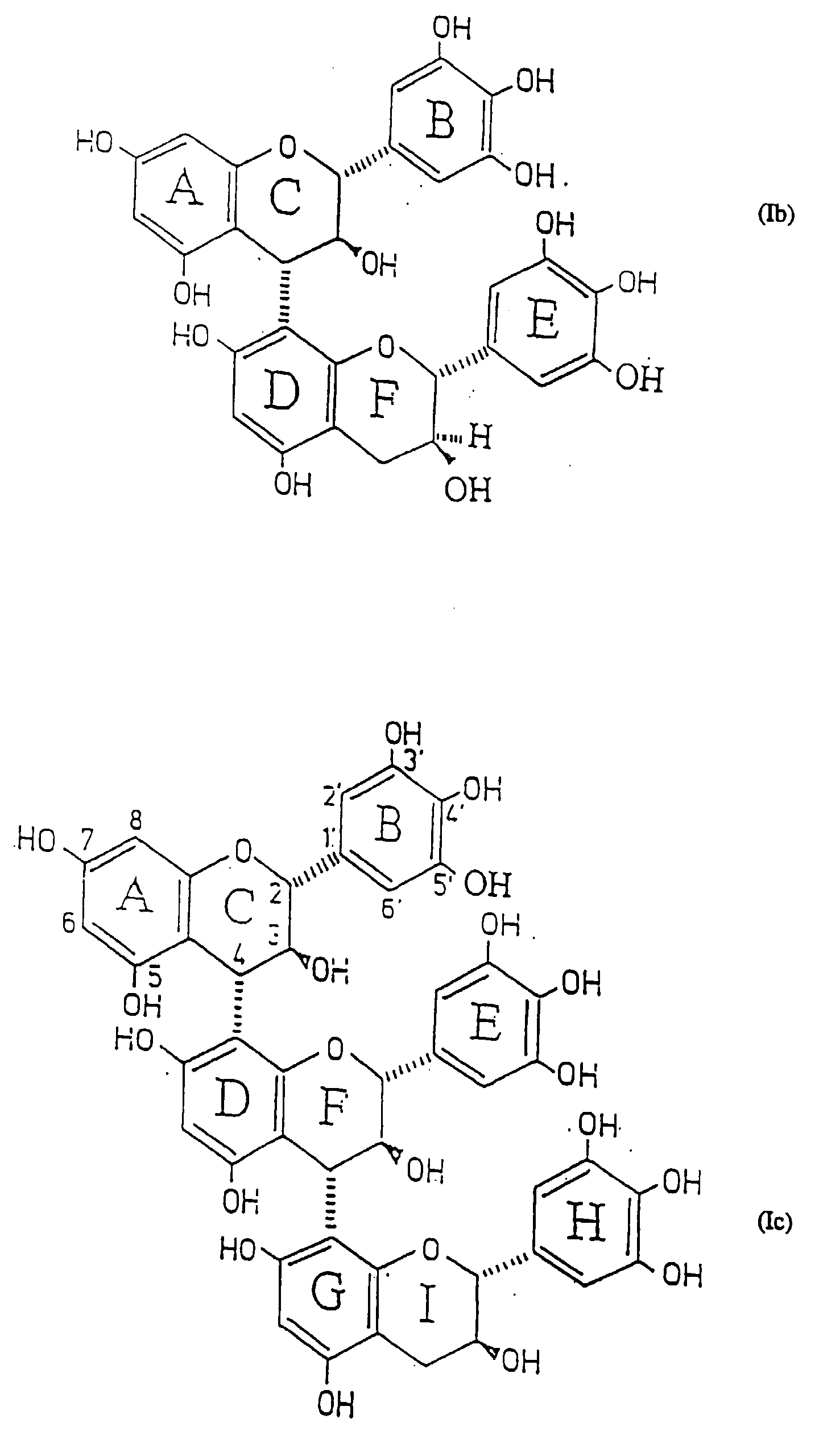
Applications Claiming Priority (3)
| Application Number | Priority Date | Filing Date | Title |
|---|---|---|---|
| FR9215801 | 1992-12-28 | ||
| FR9215801A FR2699819B1 (fr) | 1992-12-28 | 1992-12-28 | Utilisation de prodelphinidines pour l'obtention de médicaments destinés au traitement de l'arthrose. |
| PCT/FR1993/001312 WO1994014432A1 (fr) | 1992-12-28 | 1993-12-28 | Utilisation de prodelphinidines pour le traitement de l'arthrose |
Publications (2)
| Publication Number | Publication Date |
|---|---|
| EP0675713A1 EP0675713A1 (fr) | 1995-10-11 |
| EP0675713B1 true EP0675713B1 (fr) | 2000-03-22 |
Family
ID=9437179
Family Applications (1)
| Application Number | Title | Priority Date | Filing Date |
|---|---|---|---|
| EP94903924A Expired - Lifetime EP0675713B1 (fr) | 1992-12-28 | 1993-12-28 | Utilisation de prodelphinidines pour le traitement de l'arthrose |
Country Status (10)
| Country | Link |
|---|---|
| US (1) | US5670538A (fr) |
| EP (1) | EP0675713B1 (fr) |
| JP (1) | JPH08504213A (fr) |
| AT (1) | ATE190839T1 (fr) |
| AU (1) | AU702124B2 (fr) |
| CA (1) | CA2152506C (fr) |
| DE (1) | DE69328193D1 (fr) |
| FR (1) | FR2699819B1 (fr) |
| NZ (1) | NZ259393A (fr) |
| WO (1) | WO1994014432A1 (fr) |
Families Citing this family (13)
| Publication number | Priority date | Publication date | Assignee | Title |
|---|---|---|---|---|
| US5650432A (en) * | 1995-03-24 | 1997-07-22 | Jlb, Inc. | Method of treating or preventing non-viral microbial infection |
| JPH0725761A (ja) * | 1993-07-09 | 1995-01-27 | Kureha Chem Ind Co Ltd | 軟骨保護剤 |
| JPH1059846A (ja) * | 1996-06-10 | 1998-03-03 | Kikkoman Corp | 白内障の予防または治療薬剤 |
| WO1999012541A1 (fr) * | 1997-09-09 | 1999-03-18 | Rutgers, The State University Of New Jersey | Extrait de proanthocyanidine d'origine vegetale empechant efficacement une adherence de bacteries a fimbriae de type p a des surfaces |
| JP4507027B2 (ja) * | 1998-12-04 | 2010-07-21 | 明治乳業株式会社 | Mmp阻害剤 |
| US6589235B2 (en) * | 2000-01-21 | 2003-07-08 | The Regents Of The University Of California | Method and apparatus for cartilage reshaping by radiofrequency heating |
| JP2006016367A (ja) * | 2004-07-05 | 2006-01-19 | Suntory Ltd | リパーゼ阻害剤 |
| US8697139B2 (en) | 2004-09-21 | 2014-04-15 | Frank M. Phillips | Method of intervertebral disc treatment using articular chondrocyte cells |
| US20070014883A1 (en) * | 2005-07-13 | 2007-01-18 | Peter Rohdewald | Method for treating osteoarthritis |
| JP5253862B2 (ja) * | 2008-03-31 | 2013-07-31 | 株式会社ナリス化粧品 | メラニン産性抑制剤・コラーゲン産生促進剤 |
| SG11201609490QA (en) * | 2014-05-15 | 2016-12-29 | Agency Science Tech & Res | Polymer-flavonoid conjugate and uses thereof |
| JP2015147798A (ja) * | 2015-04-20 | 2015-08-20 | ビーエーエスエフ ビューティ ケア ソリューションズ フランス エスエーエス | 弾性繊維の形成を刺激するための、loxl(リシルオキシダーゼ類似)アイソフォームの合成及び活性の刺激 |
| JP7089274B2 (ja) * | 2018-03-02 | 2022-06-22 | 国立大学法人信州大学 | エピガロカテキンを含むオリゴマーおよびその製造方法 |
Family Cites Families (3)
| Publication number | Priority date | Publication date | Assignee | Title |
|---|---|---|---|---|
| US4268517A (en) * | 1979-08-30 | 1981-05-19 | Continental Pharma | Pharmaceutical composition and therapeutical method for treating degenerative affections of the articular cartilage |
| US4698360B1 (en) * | 1985-04-09 | 1997-11-04 | D Investigations Pharmacologiq | Plant extract with a proanthocyanidins content as therapeutic agent having radical scavenger effect and use thereof |
| FR2672800B1 (fr) * | 1991-02-15 | 1995-03-10 | Dolisos Lab | Nouvelle utilisation en therapeutique de pycnogenols pour la preparation de medicaments a activite anti-inflammatoire. |
-
1992
- 1992-12-28 FR FR9215801A patent/FR2699819B1/fr not_active Expired - Fee Related
-
1993
- 1993-12-28 DE DE69328193T patent/DE69328193D1/de not_active Expired - Lifetime
- 1993-12-28 NZ NZ259393A patent/NZ259393A/en not_active IP Right Cessation
- 1993-12-28 JP JP6514892A patent/JPH08504213A/ja active Pending
- 1993-12-28 AU AU58183/94A patent/AU702124B2/en not_active Ceased
- 1993-12-28 EP EP94903924A patent/EP0675713B1/fr not_active Expired - Lifetime
- 1993-12-28 WO PCT/FR1993/001312 patent/WO1994014432A1/fr not_active Ceased
- 1993-12-28 US US08/464,782 patent/US5670538A/en not_active Expired - Lifetime
- 1993-12-28 AT AT94903924T patent/ATE190839T1/de not_active IP Right Cessation
- 1993-12-28 CA CA002152506A patent/CA2152506C/fr not_active Expired - Fee Related
Non-Patent Citations (1)
| Title |
|---|
| TEUSCHER E.: "Pharmazeutische Biologie , Seiten 250 - 251", 1983, FRIEDR. VIEWEG & SOHN, BRAUNSCHWEIG/WIESBADEN * |
Also Published As
| Publication number | Publication date |
|---|---|
| JPH08504213A (ja) | 1996-05-07 |
| FR2699819B1 (fr) | 1995-02-24 |
| CA2152506A1 (fr) | 1994-07-07 |
| AU5818394A (en) | 1994-07-19 |
| US5670538A (en) | 1997-09-23 |
| FR2699819A1 (fr) | 1994-07-01 |
| ATE190839T1 (de) | 2000-04-15 |
| NZ259393A (en) | 1997-05-26 |
| WO1994014432A1 (fr) | 1994-07-07 |
| DE69328193D1 (de) | 2000-04-27 |
| EP0675713A1 (fr) | 1995-10-11 |
| AU702124B2 (en) | 1999-02-11 |
| CA2152506C (fr) | 2006-01-31 |
Similar Documents
| Publication | Publication Date | Title |
|---|---|---|
| Ma et al. | Cadmium toxicity: a role in bone cell function and teeth development | |
| Kragballe | Treatment of psoriasis by the topical application of the novel cholecalciferol analogue calcipotriol (MC 903) | |
| CA2152506C (fr) | Utilisation de prodelphinidines pour le traitement de l'arthrose | |
| JP2664667B2 (ja) | 乾癬治療用医薬組成物 | |
| EP0813869B1 (fr) | Utilisation de sels de strontium pour le traitement de l'arthrose | |
| Pizzicannella et al. | Endothelial committed oral stem cells as modelling in the relationship between periodontal and cardiovascular disease | |
| KR20010032000A (ko) | 레티노이드 길항제를 이용한 티-보조 세포 제2형 중재면역 질환의 치료 | |
| Dai et al. | Synergistic effect of glucosamine and vitamin E against experimental rheumatoid arthritis in neonatal rats | |
| Xue et al. | Troxerutin suppresses the inflammatory response in advanced glycation end-product-administered chondrocytes and attenuates mouse osteoarthritis development | |
| EP1480601B1 (fr) | Utilisation cosmetique de la phytosphingosine comme agent amincissant et compositions cosmetiques contenant de la phytosphingosine | |
| JP2006520803A (ja) | エステル化脂肪酸組成物 | |
| JP4689039B2 (ja) | ファゴサイトーシスおよびicam−1発現を調節するための組成物および方法 | |
| Michelsson et al. | Inflammatory involvement in rabbit knee following immobilization and resulting in osteoarthritis | |
| Azizi et al. | Potential pharmaceutic effect of Shilajit (mumie) on experimental osteoarthritis in rat | |
| CN114404434B (zh) | 一种治疗骨关节炎的化合物及其用途 | |
| Kakizoe et al. | Increases in mast cells and chymase in fibroproliferative paws of collagen-induced arthritic mice | |
| FR3049866B1 (fr) | Extrait de feuilles de tabac et utilisation pour le traitement de l'addiction au tabac | |
| FR2574089A1 (fr) | Procede de production d'acides gras, en particulier d'acide g-linoleique a partir de tetrahymena, produits obtenus et preparation medicamenteuse ou alimentaire contenant de l'acide g-linolenique ou ses derives en tant qu'agent anti-agregation plaquettaire | |
| JP5984853B2 (ja) | ジャワニッケイの抽出物、抽出方法、ならびにプロトンポンプダウンレギュレーター、酵素阻害剤および粘膜保護剤としてのそれの使用 | |
| JP2015178493A (ja) | トロポエラスチン発現促進剤およびエラスチン産生促進剤 | |
| KR102295111B1 (ko) | 대사성 골질환 또는 갱년기 증상 예방 또는 치료용 조성물 | |
| JP2013151457A (ja) | マトリックスメタロプロテアーゼ−1阻害剤 | |
| US20050058611A1 (en) | Preventing and/or combating collagen fiber degradation induced under conditions of natural exposure to sunlight | |
| JP2009051793A (ja) | 骨疾患治療剤 | |
| SHIZUKUISHI et al. | Effect of coenzyme Q10 on experimental periodontitis in dogs |
Legal Events
| Date | Code | Title | Description |
|---|---|---|---|
| PUAI | Public reference made under article 153(3) epc to a published international application that has entered the european phase |
Free format text: ORIGINAL CODE: 0009012 |
|
| 17P | Request for examination filed |
Effective date: 19950621 |
|
| AK | Designated contracting states |
Kind code of ref document: A1 Designated state(s): AT BE CH DE DK ES FR GB GR IE IT LI LU MC NL PT SE |
|
| 17Q | First examination report despatched |
Effective date: 19970418 |
|
| GRAG | Despatch of communication of intention to grant |
Free format text: ORIGINAL CODE: EPIDOS AGRA |
|
| GRAG | Despatch of communication of intention to grant |
Free format text: ORIGINAL CODE: EPIDOS AGRA |
|
| GRAG | Despatch of communication of intention to grant |
Free format text: ORIGINAL CODE: EPIDOS AGRA |
|
| GRAH | Despatch of communication of intention to grant a patent |
Free format text: ORIGINAL CODE: EPIDOS IGRA |
|
| GRAH | Despatch of communication of intention to grant a patent |
Free format text: ORIGINAL CODE: EPIDOS IGRA |
|
| RAP1 | Party data changed (applicant data changed or rights of an application transferred) |
Owner name: LABORATOIRES DOLISOS |
|
| GRAA | (expected) grant |
Free format text: ORIGINAL CODE: 0009210 |
|
| AK | Designated contracting states |
Kind code of ref document: B1 Designated state(s): AT BE CH DE DK ES FR GB GR IE IT LI LU MC NL PT SE |
|
| PG25 | Lapsed in a contracting state [announced via postgrant information from national office to epo] |
Ref country code: SE Free format text: THE PATENT HAS BEEN ANNULLED BY A DECISION OF A NATIONAL AUTHORITY Effective date: 20000322 Ref country code: NL Free format text: LAPSE BECAUSE OF FAILURE TO SUBMIT A TRANSLATION OF THE DESCRIPTION OR TO PAY THE FEE WITHIN THE PRESCRIBED TIME-LIMIT Effective date: 20000322 Ref country code: IT Free format text: LAPSE BECAUSE OF FAILURE TO SUBMIT A TRANSLATION OF THE DESCRIPTION OR TO PAY THE FEE WITHIN THE PRE;WARNING: LAPSES OF ITALIAN PATENTS WITH EFFECTIVE DATE BEFORE 2007 MAY HAVE OCCURRED AT ANY TIME BEFORE 2007. THE CORRECT EFFECTIVE DATE MAY BE DIFFERENT FROM THE ONE RECORDED.SCRIBED TIME-LIMIT Effective date: 20000322 Ref country code: GR Free format text: LAPSE BECAUSE OF NON-PAYMENT OF DUE FEES Effective date: 20000322 Ref country code: GB Free format text: LAPSE BECAUSE OF FAILURE TO SUBMIT A TRANSLATION OF THE DESCRIPTION OR TO PAY THE FEE WITHIN THE PRESCRIBED TIME-LIMIT Effective date: 20000322 Ref country code: ES Free format text: THE PATENT HAS BEEN ANNULLED BY A DECISION OF A NATIONAL AUTHORITY Effective date: 20000322 Ref country code: AT Free format text: LAPSE BECAUSE OF FAILURE TO SUBMIT A TRANSLATION OF THE DESCRIPTION OR TO PAY THE FEE WITHIN THE PRESCRIBED TIME-LIMIT Effective date: 20000322 |
|
| REF | Corresponds to: |
Ref document number: 190839 Country of ref document: AT Date of ref document: 20000415 Kind code of ref document: T |
|
| REG | Reference to a national code |
Ref country code: CH Ref legal event code: EP |
|
| REF | Corresponds to: |
Ref document number: 69328193 Country of ref document: DE Date of ref document: 20000427 |
|
| REG | Reference to a national code |
Ref country code: IE Ref legal event code: FG4D Free format text: FRENCH |
|
| PG25 | Lapsed in a contracting state [announced via postgrant information from national office to epo] |
Ref country code: DK Free format text: LAPSE BECAUSE OF FAILURE TO SUBMIT A TRANSLATION OF THE DESCRIPTION OR TO PAY THE FEE WITHIN THE PRESCRIBED TIME-LIMIT Effective date: 20000622 |
|
| PG25 | Lapsed in a contracting state [announced via postgrant information from national office to epo] |
Ref country code: PT Free format text: LAPSE BECAUSE OF FAILURE TO SUBMIT A TRANSLATION OF THE DESCRIPTION OR TO PAY THE FEE WITHIN THE PRESCRIBED TIME-LIMIT Effective date: 20000623 |
|
| PG25 | Lapsed in a contracting state [announced via postgrant information from national office to epo] |
Ref country code: DE Free format text: LAPSE BECAUSE OF FAILURE TO SUBMIT A TRANSLATION OF THE DESCRIPTION OR TO PAY THE FEE WITHIN THE PRESCRIBED TIME-LIMIT Effective date: 20000624 |
|
| REG | Reference to a national code |
Ref country code: CH Ref legal event code: NV Representative=s name: BOVARD AG PATENTANWAELTE |
|
| NLV1 | Nl: lapsed or annulled due to failure to fulfill the requirements of art. 29p and 29m of the patents act | ||
| GBV | Gb: ep patent (uk) treated as always having been void in accordance with gb section 77(7)/1977 [no translation filed] |
Effective date: 20000322 |
|
| PG25 | Lapsed in a contracting state [announced via postgrant information from national office to epo] |
Ref country code: IE Free format text: LAPSE BECAUSE OF NON-PAYMENT OF DUE FEES Effective date: 20010109 |
|
| PLBE | No opposition filed within time limit |
Free format text: ORIGINAL CODE: 0009261 |
|
| STAA | Information on the status of an ep patent application or granted ep patent |
Free format text: STATUS: NO OPPOSITION FILED WITHIN TIME LIMIT |
|
| 26N | No opposition filed | ||
| REG | Reference to a national code |
Ref country code: FR Ref legal event code: TP |
|
| REG | Reference to a national code |
Ref country code: FR Ref legal event code: TP |
|
| PGFP | Annual fee paid to national office [announced via postgrant information from national office to epo] |
Ref country code: MC Payment date: 20101122 Year of fee payment: 18 |
|
| PGFP | Annual fee paid to national office [announced via postgrant information from national office to epo] |
Ref country code: LU Payment date: 20101123 Year of fee payment: 18 Ref country code: CH Payment date: 20101210 Year of fee payment: 18 |
|
| REG | Reference to a national code |
Ref country code: CH Ref legal event code: PFA Owner name: LABORATOIRES DOLISOS Free format text: LABORATOIRES DOLISOS#6, RUE BRINDEJONC DES MOULINEAIS B.P. 5839#31505 TOULOUSE CEDEX 5 (FR) -TRANSFER TO- LABORATOIRES DOLISOS#6, RUE BRINDEJONC DES MOULINEAIS B.P. 5839#31505 TOULOUSE CEDEX 5 (FR) |
|
| PGFP | Annual fee paid to national office [announced via postgrant information from national office to epo] |
Ref country code: FR Payment date: 20110119 Year of fee payment: 18 |
|
| PGFP | Annual fee paid to national office [announced via postgrant information from national office to epo] |
Ref country code: BE Payment date: 20110117 Year of fee payment: 18 |
|
| BERE | Be: lapsed |
Owner name: LABORATOIRES *DOLISOS Effective date: 20111231 |
|
| PG25 | Lapsed in a contracting state [announced via postgrant information from national office to epo] |
Ref country code: MC Free format text: LAPSE BECAUSE OF NON-PAYMENT OF DUE FEES Effective date: 20111231 |
|
| REG | Reference to a national code |
Ref country code: CH Ref legal event code: PL |
|
| REG | Reference to a national code |
Ref country code: FR Ref legal event code: ST Effective date: 20120831 |
|
| PG25 | Lapsed in a contracting state [announced via postgrant information from national office to epo] |
Ref country code: LI Free format text: LAPSE BECAUSE OF NON-PAYMENT OF DUE FEES Effective date: 20111231 Ref country code: CH Free format text: LAPSE BECAUSE OF NON-PAYMENT OF DUE FEES Effective date: 20111231 Ref country code: BE Free format text: LAPSE BECAUSE OF NON-PAYMENT OF DUE FEES Effective date: 20111231 |
|
| PG25 | Lapsed in a contracting state [announced via postgrant information from national office to epo] |
Ref country code: FR Free format text: LAPSE BECAUSE OF NON-PAYMENT OF DUE FEES Effective date: 20120102 |
|
| PG25 | Lapsed in a contracting state [announced via postgrant information from national office to epo] |
Ref country code: LU Free format text: LAPSE BECAUSE OF NON-PAYMENT OF DUE FEES Effective date: 20111228 |