EP0666100A2 - Scrubbing of sulfur dioxide - Google Patents
Scrubbing of sulfur dioxide Download PDFInfo
- Publication number
- EP0666100A2 EP0666100A2 EP94119171A EP94119171A EP0666100A2 EP 0666100 A2 EP0666100 A2 EP 0666100A2 EP 94119171 A EP94119171 A EP 94119171A EP 94119171 A EP94119171 A EP 94119171A EP 0666100 A2 EP0666100 A2 EP 0666100A2
- Authority
- EP
- European Patent Office
- Prior art keywords
- aqueous
- sulfur dioxide
- scrubbing
- gaseous stream
- amine
- Prior art date
- Legal status (The legal status is an assumption and is not a legal conclusion. Google has not performed a legal analysis and makes no representation as to the accuracy of the status listed.)
- Withdrawn
Links
Images
Classifications
-
- B—PERFORMING OPERATIONS; TRANSPORTING
- B01—PHYSICAL OR CHEMICAL PROCESSES OR APPARATUS IN GENERAL
- B01D—SEPARATION
- B01D53/00—Separation of gases or vapours; Recovering vapours of volatile solvents from gases; Chemical or biological purification of waste gases, e.g. engine exhaust gases, smoke, fumes, flue gases, aerosols
- B01D53/34—Chemical or biological purification of waste gases
- B01D53/46—Removing components of defined structure
- B01D53/48—Sulfur compounds
- B01D53/50—Sulfur oxides
- B01D53/501—Sulfur oxides by treating the gases with a solution or a suspension of an alkali or earth-alkali or ammonium compound
- B01D53/502—Sulfur oxides by treating the gases with a solution or a suspension of an alkali or earth-alkali or ammonium compound characterised by a specific solution or suspension
-
- B—PERFORMING OPERATIONS; TRANSPORTING
- B01—PHYSICAL OR CHEMICAL PROCESSES OR APPARATUS IN GENERAL
- B01D—SEPARATION
- B01D53/00—Separation of gases or vapours; Recovering vapours of volatile solvents from gases; Chemical or biological purification of waste gases, e.g. engine exhaust gases, smoke, fumes, flue gases, aerosols
- B01D53/34—Chemical or biological purification of waste gases
- B01D53/74—General processes for purification of waste gases; Apparatus or devices specially adapted therefor
- B01D53/80—Semi-solid phase processes, i.e. by using slurries
-
- B—PERFORMING OPERATIONS; TRANSPORTING
- B01—PHYSICAL OR CHEMICAL PROCESSES OR APPARATUS IN GENERAL
- B01D—SEPARATION
- B01D2251/00—Reactants
- B01D2251/30—Alkali metal compounds
- B01D2251/304—Alkali metal compounds of sodium
-
- B—PERFORMING OPERATIONS; TRANSPORTING
- B01—PHYSICAL OR CHEMICAL PROCESSES OR APPARATUS IN GENERAL
- B01D—SEPARATION
- B01D2251/00—Reactants
- B01D2251/30—Alkali metal compounds
- B01D2251/306—Alkali metal compounds of potassium
-
- Y—GENERAL TAGGING OF NEW TECHNOLOGICAL DEVELOPMENTS; GENERAL TAGGING OF CROSS-SECTIONAL TECHNOLOGIES SPANNING OVER SEVERAL SECTIONS OF THE IPC; TECHNICAL SUBJECTS COVERED BY FORMER USPC CROSS-REFERENCE ART COLLECTIONS [XRACs] AND DIGESTS
- Y02—TECHNOLOGIES OR APPLICATIONS FOR MITIGATION OR ADAPTATION AGAINST CLIMATE CHANGE
- Y02A—TECHNOLOGIES FOR ADAPTATION TO CLIMATE CHANGE
- Y02A50/00—TECHNOLOGIES FOR ADAPTATION TO CLIMATE CHANGE in human health protection, e.g. against extreme weather
- Y02A50/20—Air quality improvement or preservation, e.g. vehicle emission control or emission reduction by using catalytic converters
Definitions
- THE PRESENT PROCESS relates to a method of removing sulfur dioxide from hot gaseous streams using an aqueous lime scrubbing medium containing magnesium ions, so as to produce a by-product sludge containing primarily calcium sulfite where the by-product sludge is readily de-watered to a higher solids content than that normally produced by prior art processes.
- An especially useful process for removing sulfur dioxide from flue gases is the wet process where the flue gas is contacted in an agueous slurry of lime that contains an effective amount of magnesium ions to enhance the process.
- Such a process is commercially used and is generally described in US-A-3,919,393, US-A-3,919,394, US-A-3,914,378, US-A-976,937 and other publications. This process has been commercially proven and is economical, easy to operate, dependable and efficient. Such a process, however, does produce an aqueous sludge of primarily calcium sulfite which is difficult to de-water.
- the moisture content of the sludge produced, after de-watering is relatively high, with a solids content in the range of 25-48 percent by weight achieved, depending upon the design of the process and the conditions of the process operation.
- US-A-4,454,101 describes a method where a predetermined amount of thiosulfate ions are provided in a scrubbing loop that produces sulfite-containing liquor slurries where the presence of the thiosulfate ions is said to produce calcium sulfite hemihydrate in a tabular prismatic mode and substantially eliminates the occurrence of porous lamellar aggregates of randomly oriented micaceous crystallites of the calcium sulfite hemihydrate so as to increase the settling rate and enable the ultimate de-watering of the sludge to a high solids content by weight.
- a process for removing sulfur dioxide from a gaseous stream by contact with an aqueous scrubbing medium containing calcium components and a magnesium ion content of between about 2,500 to 10,000 parts per million in a wet scrubbing unit, where calcium sulfite solids are produced and removed as an effluent from the wet scrubbing unit as an aqueous sludge comprising providing in said aqueous scrubbing medium in said aqueous scrubbing unit an effective amount of at least one amine sulfonate ion of the formula: where R is H or OH, and R' is H or S0 3 , with R and R' not both being H.
- said amine sulfonate ion is provided by adding to said aqueous scrubbing medium an amine disulfonate salt having the formula HN(S0 3 X) 2 wherein X is a metal selected from the group consisting of alkali metals and alkaline earth metals.
- said amine sulfonate ion is provided by adding to said aqueous scrubbing medium a hydroxylamine monosulfonate salt having the formula HO-NH-(S0 3 X) wherein X is a metal selected from the group consisting of alkali metals and alkaline earth metals.
- said amine sulfonate ion is provided by adding to said aqueous scrubbing medium a portion of an effluent stream from a scrubbing unit for nitrogen oxides, containing a metal chelate, which effluent stream contains a hydroxylamine N-sulfonate.
- said amine sulfonate ion is present in said aqueous scrubbing medium in an amount of at least 10 millimoles.
- a process for removing sulfur dioxide from a gaseous stream by contact with an aqueous scrubbing medium containing calcium components and a magnesium ion content of between about 2,500 to 10,000 parts per million in a wet scrubbing unit, where calcium sulfate solids are produced and removed as an effluent from the wet scrubbing unit as an aqueous sludge comprising providing in said aqueous scrubbing medium in said aqueous scrubbing unit at least 10 millimoles of an hydroxylamine monosulfonate salt having the formula HO-NH-(S0 3 X) wherein X is a metal selected from the group consisting of alkali metals and alkaline earth metals.
- a process for removing sulfur dioxide from a gaseous stream by contact with an aqueous scrubbing medium containing calcium components and a magnesium ion content of between about 2,500 to 10,000 parts per million in a wet scrubbing unit, where calcium sulfate solids are produced and removed as an effluent from the wet scrubbing unit as an aqueous sludge comprising providing in said aqueous scrubbing medium in said aqueous scrubbing unit a portion of an effluent stream from a scrubbing unit for nitrogen oxides, containing a metal chelate, which portion contains at least 10 millimoles of a hydroxylamine N-sulfonate.
- hydroxylamine N-sulfonate is hydroxylamine-disulfonate.
- X comprises an alkali metal which is potassium.
- X may comprise an alkali metal which is sodium.
- the present invention provides a process for removing sulfur dioxide from hot combustion gases using a magnesium-enhanced aqueous lime scrubbing medium where a more readily de-watered aqueous sludge is produced.
- a hot combustion gas containing sulfur dioxide is contacted with an aqueous scrubbing medium containing lime, and a magnesium ion content of between about 2,500 to 10,000 parts per million, in a wet scrubbing unit under conditions that inhibit oxidation of sulfites produced to sulfates, so as to produce a magnesium sulfate containing effluent from the wet scrubbing unit.
- aqueous scrubbing medium containing lime, and a magnesium ion content of between about 2,500 to 10,000 parts per million
- the effluent or bleed stream from the wet scrubbing unit in magnesium-enhanced lime scrubbing processes generally contains calcium sulfate in hemihydrate form as rosette-like crystalline shapes which are difficult to de-water and form a thixotropic sludge that is difficult to de-water for subsequent disposal.
- amine sulfonate ion useful in the preferred process is one having the formula: where R is H or OH, and R' is H or S0 3 , with R and R' not both being H.
- the above-defined amine sulfonate ion is provided in the magnesium-enhanced aqueous lime scrubbing medium by adding thereto an alkali metal or alkaline earth metal amine sulfonate salt, such as a potassium amine sulfonate salt or a sodium amine sulfonate salt, in solid form or as an aqueous solution.
- an alkali metal or alkaline earth metal amine sulfonate salt such as a potassium amine sulfonate salt or a sodium amine sulfonate salt
- an amine disulfonate salt having the formula HN(S0 3 X) 2 where X is a metal selected from the group consisting of alkali metals and alkaline earth metals, or a hydroxylamine monosulfonate salt having the formula HO-NH-(S0 3 X), where X is a metal selected from the group consisting of alkali metals or alkaline earth metals, is used.
- the amine disulfonate salt preferably of potassium or sodium, maybe produced on site and fed to the aqueous scrubber liquor or can be made elsewhere and provided for addition to the aqueous scrubbing liquor.
- Potassium nitrilosulfonate HN(S0 3 K) 2
- HN(S0 3 K) 2 can be prepared according to the procedure described by H. Sisler and L.F. Audrieth, described in the article "Potassium Nitrilosulfonate", J. am. Chem. Soc., Vol. 60, pp 1947-48 (1938).
- Examples of other useful salt compounds of the ions of the above general formula are alkali metal or alkaline earth metal salts of hydroxylamine disulfonate (HADS), alkali metal or alkaline earth metal salts of hydroxylamine monosulfonate (HAMS), and alkali metal or alkaline earth metal salts of amine disulfonate (ADS).
- the amine sulfonate ions can be provided by adding to the magnesium-enhanced aqueous lime scrubbing medium a portion of an effluent stream from a wet scrubbing unit used to remove nitrogen oxides from a gaseous stream, wherein a metal chelate is used, which effluent stream contains a hydroxylamine N-sulfonate such as hydroxylamine disulfonate.
- metal chelates such as ferrous ethylenediaminetetraacetic acid (Fe(II)EDTA) is described, for example by S.
- amine sulfonates such as amine trisulfonates and amine disulfonates
- HANS hydroxylamine N-sulfonates
- HADS hydroxylamine disulfonate
- HAMS hydroxylamine monosulfonate
- the amount of amine sulfonate ions added to the magnesium-enhanced aqueous lime scrubbing medium should be an effective amount, usually at least about 10 millimoles, and preferably between about 10-800 millimoles.
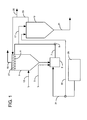
- FIG. 1 an embodiment of the present process is schematically illustrated showing a wet scrubbing unit 1, in which an aqueous lime scrubbing slurry is contacted with flue gases.
- the aqueous lime scrubbing slurry is added to a recycle and hold tank 3, through line 5 and passed through line 7, by means of pump 9, into the wet scrubbing unit 1 through spray nozzles 11.
- the hot flue gas, containing sulfur dioxide is charged to the wet scrubbing unit 1 through line 13 and passes countercurrent to the aqueous scrubbing medium, with sulfur dioxide removed therefrom and clean gases discharged from the wet scrubbing unit 1 through gas outlet 15.
- the aqueous scrubbing medium, after contact with the gases is passed to the recycle and hold tank 3.
- a bleed stream is taken from recycle line 7 through line 17 and passed to a thickener 19 where solids, primarily calcium sulfite solids, are separated therefrom and discharged as a thickener underflow through line 21 for disposal.
- the clarified liquor, or overflow, from the thickener 19 is removed through line 23 and may be discharged through line 25 or recycled to the wet scrubbing unit, preferably to wash demister devices 27 in the wet scrubbing unit 1.
- the system thus described is a known system for the removal of sulfur dioxide from hot flue gas streams using a magnesium-enhanced aqueous lime scrubbing medium.
- a source of an amine sulfonate ion 29 is provided, and the same is charged through line 31 to the recycle and hold tank 3 for admixture with the magnesium-enhanced aqueous lime scrubbing medium in an amount that will provide at least 10 millimoles of such ions in the aqueous scrubbing medium in the wet scrubbing unit 1.
- the amine sulfonate ions can be added elsewhere in the scrubbing system, such as by line 31 through line 33 to the thickener 19, provided that the amount of said ions returned to and present in the wet scrubbing unit 1 is at least about 10 millimoles.
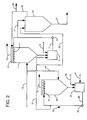
- the source of amine sulfonate ions 29 is a portion of the effluent stream from a scrubbing unit for nitrogen oxides containing a metal chelate.
- the source of amine sulfonate ions 29 comprise a second wet scrubbing unit 35 with a second recycle and hold tank 37 to which an aqueous lime slurry is charged through line 39 and a metal chelate, such as ethylenediaminetetraacidic acid (EDTA) is added through line 41.
- EDTA ethylenediaminetetraacidic acid
- the aqueous medium from second recycle tank 37 is passed through line 43, by means of pump 45 to spray nozzles 47 in the second wet scrubbing unit 35.
- a portion of hot flue gases from line 13 are diverted through line 49 to the second wet scrubbing unit 35 and passed countercurrently to the aqueous scrubbing medium therein.
- the reaction of the aqueous scrubbing medium containing the EDTA removes sulfur dioxide and nitrogen oxides from the hot flue gases, with clean gas discharged through line 51.
- a bleed stream from line 43 will contain amine sulfonate ions which are charged to first recycle and hold tank 3 by means of line 31 or to the thickener 19 by means of line 33.
- a one liter bench scale system was set up having a one-liter beaker contained in a temperature- controlled water bath.
- a stirrer was provided within the beaker for stirring of a synthetic scrubbing liquor which consisted mainly of MgS0 3 and was free of suspended solids.
- Added to the synthetic scrubbing liquor was a lime slurry containing 20% lime by weight.
- a pH probe was provided to monitor the pH of the content in the beaker.
- a stream of H 2 SOa was pumped into the beaker at a constant rate.
- the residual solids from the liquor were dried and the amine disulfonate (ADS) concentration in the dried solids was found by ion chromatography (IC) measurement to be 16.7%.
- the amounts of the residual solids added are indicated in TABLE II, as are the results of the solids contents in the filter cakes.
- the crystals generated were predominantly calcium sulfite.
- the liquors left in the recycle tank and the thickener from the baseline test were then used on the next day.
- the K-ADS was introduced at a rate of -140g per shot immediately after each recycle tank liquor sample was taken.
- the ADS concentrations, [ADS], in the filtrates and rinsates were measured by IC.
- the values of filtercake solids contents are listed below. With the additions of K-ADS, the solids content increased gradually from -31 to wt%.
- Results from the first 5kW K-ADS test indicate that the solubility of K-ADS may be at -150 mM.
- the first batch of Na-ADS was synthesized following the recipe for making K-ADS. The main difference was that sodium nitrite (NaN0 2 ) and sodium metabisulfite (Na 2 S 2 0 5 ), instead of the respective potassium salts, were used.
- This batch of Na-ADS containing solution was labeled as A. No crystal formed and the [ADS] in this batch was measured by IC to be 637 mM.
- the first Na-ADS test was conducted the next day by using synthetic liquors to jump-start the test. Results from this test are listed below.
- the solids content in the filtercake from the first recycle tank sample was 34.9 wt%, which was considered to be the baseline value because no Na-ADS was added yet. Forty five minutes later, 1,300 mL of Na-ADS solution were added.
- the solids content in the filtercake from the last recycle tank sample was 37.3 wt%.
- the measured [ADS] in the corresponding filtrate was 52.5 mM.
- a second batch of Na-ADS solution was synthesized and labeled as B. Liquors left from the above test were re-used two days later. Results from this test are tabulated below.
- the solids content in the first recycle tank liquor sample was 38.8 wt%.
- the [ADS] in the corresponding filtrate and rinsate were 41 and 2.8 mM, respectively.
- 800 mL of Na-ADS solution were added. As more Na-ADS was added, the solids content of the rinsed filtercakes increased.
- the solids content in the filtercake from the last recycle tank liquor sample was 49.3 wt%.
- the [ADS] in the corresponding filtrate and rinsate were 137 and 8.0 mM, respectively.
Landscapes
- Engineering & Computer Science (AREA)
- Chemical & Material Sciences (AREA)
- Environmental & Geological Engineering (AREA)
- Health & Medical Sciences (AREA)
- Biomedical Technology (AREA)
- Analytical Chemistry (AREA)
- General Chemical & Material Sciences (AREA)
- Oil, Petroleum & Natural Gas (AREA)
- Chemical Kinetics & Catalysis (AREA)
- Treating Waste Gases (AREA)
Abstract

Description
- THE PRESENT PROCESS relates to a method of removing sulfur dioxide from hot gaseous streams using an aqueous lime scrubbing medium containing magnesium ions, so as to produce a by-product sludge containing primarily calcium sulfite where the by-product sludge is readily de-watered to a higher solids content than that normally produced by prior art processes.
- Various processes have been provided for the removal of sulfur dioxide from gaseous streams, such as combustion gases from fossil fuel-fired power plants, so as to reduce acidic components discharged into the air and prevent pollution of the environment. Some such processes are preferable to others for various reasons, either economic reasons, ease of operation, dependability, efficiency and other factors. All such processes, however, have one or more factors that could be improved upon.
- An especially useful process for removing sulfur dioxide from flue gases is the wet process where the flue gas is contacted in an agueous slurry of lime that contains an effective amount of magnesium ions to enhance the process. Such a process is commercially used and is generally described in US-A-3,919,393, US-A-3,919,394, US-A-3,914,378, US-A-976,937 and other publications. This process has been commercially proven and is economical, easy to operate, dependable and efficient. Such a process, however, does produce an aqueous sludge of primarily calcium sulfite which is difficult to de-water. In conventional operation of such a magnesium-enhanced lime scrubbing process, the moisture content of the sludge produced, after de-watering, is relatively high, with a solids content in the range of 25-48 percent by weight achieved, depending upon the design of the process and the conditions of the process operation.
- Efforts have been made to provide for better de-watering of aqueous sludge produced by lime scrubbing processes that contain calcium sulfates. For example, US-A-4,454,101 describes a method where a predetermined amount of thiosulfate ions are provided in a scrubbing loop that produces sulfite-containing liquor slurries where the presence of the thiosulfate ions is said to produce calcium sulfite hemihydrate in a tabular prismatic mode and substantially eliminates the occurrence of porous lamellar aggregates of randomly oriented micaceous crystallites of the calcium sulfite hemihydrate so as to increase the settling rate and enable the ultimate de-watering of the sludge to a high solids content by weight. Another process proposed to produce large, regularly shaped calcium sulfite solids in a calcium-based flue gas desulfurisation system is described in US-A-5,246,679, which provides for the addition of a chemical crystal modifier, preferably an organophosfonate, to the calcium sulfite-containing slurry produced by a flue gas desulfurisation process under inhibited oxidation conditions. This method is said to produce large, thick, substantially uniformly sized calcium sulfite crystals that exceed significantly 50 microns. Other modifiers suggested include carboxylic acids, polyacrylates, sulfonates, organic phosfates and polyphosfates.
- According to this invention there is provided a process for removing sulfur dioxide from a gaseous stream by contact with an aqueous scrubbing medium containing calcium components and a magnesium ion content of between about 2,500 to 10,000 parts per million in a wet scrubbing unit, where calcium sulfite solids are produced and removed as an effluent from the wet scrubbing unit as an aqueous sludge, comprising providing in said aqueous scrubbing medium in said aqueous scrubbing unit an effective amount of at least one amine sulfonate ion of the formula:

- In one embodiment of the invention said amine sulfonate ion is provided by adding to said aqueous scrubbing medium an amine disulfonate salt having the formula HN(S03X)2 wherein X is a metal selected from the group consisting of alkali metals and alkaline earth metals.
- In an alternative embodiment of the invention said amine sulfonate ion is provided by adding to said aqueous scrubbing medium a hydroxylamine monosulfonate salt having the formula HO-NH-(S03X) wherein X is a metal selected from the group consisting of alkali metals and alkaline earth metals.
- In a further embodiment of the invention said amine sulfonate ion is provided by adding to said aqueous scrubbing medium a portion of an effluent stream from a scrubbing unit for nitrogen oxides, containing a metal chelate, which effluent stream contains a hydroxylamine N-sulfonate.
- Preferably said amine sulfonate ion is present in said aqueous scrubbing medium in an amount of at least 10 millimoles.
- According to another aspect of this invention there is provided a process for removing sulfur dioxide from a gaseous stream by contact with an aqueous scrubbing medium containing calcium components and a magnesium ion content of between about 2,500 to 10,000 parts per million in a wet scrubbing unit, where calcium sulfate solids are produced and removed as an effluent from the wet scrubbing unit as an aqueous sludge, comprising providing in said aqueous scrubbing medium in said aqueous scrubbing unit at least 10 millimoles of an hydroxylamine monosulfonate salt having the formula HO-NH-(S03X) wherein X is a metal selected from the group consisting of alkali metals and alkaline earth metals.
- According to a further aspect of this invention there is provided a process for removing sulfur dioxide from a gaseous stream by contact with an aqueous scrubbing medium containing calcium components and a magnesium ion content of between about 2,500 to 10,000 parts per million in a wet scrubbing unit, where calcium sulfate solids are produced and removed as an effluent from the wet scrubbing unit as an aqueous sludge, comprising providing in said aqueous scrubbing medium in said aqueous scrubbing unit a portion of an effluent stream from a scrubbing unit for nitrogen oxides, containing a metal chelate, which portion contains at least 10 millimoles of a hydroxylamine N-sulfonate.
- Conveniently said hydroxylamine N-sulfonate is hydroxylamine-disulfonate.
- Preferably X comprises an alkali metal which is potassium. Alternatively X may comprise an alkali metal which is sodium.
- The presence of the amine sulfonate ion described above results in a calcium sulfate solids sludges which are more readily de-watered to a high solids content for subsequent disposal.
- The invention will become more readily apparent from the following description of preferred embodiments thereof shown, by way of example only, in the accompanying drawings where
- FIGURE 1 is a schematic illustration of one embodiment of process of the present invention, and
- FIGURE 2 is a schematic illustration of another embodiment of the process of the present invention.
- The present invention provides a process for removing sulfur dioxide from hot combustion gases using a magnesium-enhanced aqueous lime scrubbing medium where a more readily de-watered aqueous sludge is produced.
- In the preferred process, a hot combustion gas containing sulfur dioxide is contacted with an aqueous scrubbing medium containing lime, and a magnesium ion content of between about 2,500 to 10,000 parts per million, in a wet scrubbing unit under conditions that inhibit oxidation of sulfites produced to sulfates, so as to produce a magnesium sulfate containing effluent from the wet scrubbing unit. Such magnesium-enhanced lime scrubbing systems are described, for example in US-A-3,919,393, US-A-919,394, US-A-3,914,378 and US-A-4,976,937, which are all incorporated by reference herein.
- The effluent or bleed stream from the wet scrubbing unit in magnesium-enhanced lime scrubbing processes generally contains calcium sulfate in hemihydrate form as rosette-like crystalline shapes which are difficult to de-water and form a thixotropic sludge that is difficult to de-water for subsequent disposal.
- We have found that the aqueous sludges from magnesium-enhanced lime scrubbing processes can be more readily de-watered if an effective amount of an amine sulfonate ion is provided to the system so as to be present in the aqueous scrubbing medium in the wet scrubbing unit. The amine sulfonate ion useful in the preferred process is one having the formula:

- In one embodiment of the present process, the above-defined amine sulfonate ion is provided in the magnesium-enhanced aqueous lime scrubbing medium by adding thereto an alkali metal or alkaline earth metal amine sulfonate salt, such as a potassium amine sulfonate salt or a sodium amine sulfonate salt, in solid form or as an aqueous solution. Preferably, an amine disulfonate salt having the formula HN(S03X)2, where X is a metal selected from the group consisting of alkali metals and alkaline earth metals, or a hydroxylamine monosulfonate salt having the formula HO-NH-(S03X), where X is a metal selected from the group consisting of alkali metals or alkaline earth metals, is used. The amine disulfonate salt, preferably of potassium or sodium, maybe produced on site and fed to the aqueous scrubber liquor or can be made elsewhere and provided for addition to the aqueous scrubbing liquor. Potassium nitrilosulfonate, HN(S03K)2, for example, can be prepared according to the procedure described by H. Sisler and L.F. Audrieth, described in the article "Potassium Nitrilosulfonate", J. am. Chem. Soc., Vol. 60, pp 1947-48 (1938). Examples of other useful salt compounds of the ions of the above general formula are alkali metal or alkaline earth metal salts of hydroxylamine disulfonate (HADS), alkali metal or alkaline earth metal salts of hydroxylamine monosulfonate (HAMS), and alkali metal or alkaline earth metal salts of amine disulfonate (ADS).
- In another embodiment of the present process, the amine sulfonate ions can be provided by adding to the magnesium-enhanced aqueous lime scrubbing medium a portion of an effluent stream from a wet scrubbing unit used to remove nitrogen oxides from a gaseous stream, wherein a metal chelate is used, which effluent stream contains a hydroxylamine N-sulfonate such as hydroxylamine disulfonate. The removal of nitrogen oxides along with sulfur dioxide from gaseous streams using metal chelates, such as ferrous ethylenediaminetetraacetic acid (Fe(II)EDTA) is described, for example by S. Chang in an article entitled "Effects of Metal Chelates on West Flue Gas Scrubbing Chemistry", Environmental Science Technology, pp 649-653 Nov. 1983. Such processes, using ferrous ethylenediaminetetraacetic acid have been developed and are known, as described, for example in US-A-4,612,175, US-A-4,670,234, US-A-4,957,716 and US-A-5,200,160, all of which are incorporated by reference herein. The scrubbing liquors of such nitrogen oxide-sulfur dioxide scrubbing processes result in the production of amine sulfonates, such as amine trisulfonates and amine disulfonates, and hydroxylamine N-sulfonates (HANS) such as hydroxylamine disulfonate (HADS), andhydroxylamine monosulfonate (HAMS). A portion of the aqueous effluent liquor may be added, or the aqueous effluent can be concentrated and a concentrated portion or solids resulting can be added.
- The amount of amine sulfonate ions added to the magnesium-enhanced aqueous lime scrubbing medium should be an effective amount, usually at least about 10 millimoles, and preferably between about 10-800 millimoles.
- Referring now to Figure 1, an embodiment of the present process is schematically illustrated showing a
wet scrubbing unit 1, in which an aqueous lime scrubbing slurry is contacted with flue gases. The aqueous lime scrubbing slurry is added to a recycle and holdtank 3, throughline 5 and passed throughline 7, by means ofpump 9, into thewet scrubbing unit 1 throughspray nozzles 11. The hot flue gas, containing sulfur dioxide, is charged to thewet scrubbing unit 1 throughline 13 and passes countercurrent to the aqueous scrubbing medium, with sulfur dioxide removed therefrom and clean gases discharged from thewet scrubbing unit 1 throughgas outlet 15. The aqueous scrubbing medium, after contact with the gases is passed to the recycle and holdtank 3. A bleed stream is taken fromrecycle line 7 throughline 17 and passed to athickener 19 where solids, primarily calcium sulfite solids, are separated therefrom and discharged as a thickener underflow throughline 21 for disposal. The clarified liquor, or overflow, from thethickener 19 is removed throughline 23 and may be discharged throughline 25 or recycled to the wet scrubbing unit, preferably to washdemister devices 27 in thewet scrubbing unit 1. The system thus described is a known system for the removal of sulfur dioxide from hot flue gas streams using a magnesium-enhanced aqueous lime scrubbing medium. In accordance with the present process, a source of anamine sulfonate ion 29 is provided, and the same is charged throughline 31 to the recycle and holdtank 3 for admixture with the magnesium-enhanced aqueous lime scrubbing medium in an amount that will provide at least 10 millimoles of such ions in the aqueous scrubbing medium in thewet scrubbing unit 1. Or, the amine sulfonate ions can be added elsewhere in the scrubbing system, such as byline 31 throughline 33 to thethickener 19, provided that the amount of said ions returned to and present in thewet scrubbing unit 1 is at least about 10 millimoles. - Referring now to Figure 2, another embodiment of the present invention is illustrated wherein the source of
amine sulfonate ions 29 is a portion of the effluent stream from a scrubbing unit for nitrogen oxides containing a metal chelate. As shown, the source ofamine sulfonate ions 29 comprise a secondwet scrubbing unit 35 with a second recycle and holdtank 37 to which an aqueous lime slurry is charged throughline 39 and a metal chelate, such as ethylenediaminetetraacidic acid (EDTA) is added throughline 41. The aqueous medium fromsecond recycle tank 37 is passed throughline 43, by means ofpump 45 to spraynozzles 47 in the secondwet scrubbing unit 35. A portion of hot flue gases fromline 13 are diverted throughline 49 to the secondwet scrubbing unit 35 and passed countercurrently to the aqueous scrubbing medium therein. The reaction of the aqueous scrubbing medium containing the EDTA removes sulfur dioxide and nitrogen oxides from the hot flue gases, with clean gas discharged throughline 51. A bleed stream fromline 43 will contain amine sulfonate ions which are charged to first recycle and holdtank 3 by means ofline 31 or to thethickener 19 by means ofline 33. - A one liter bench scale system was set up having a one-liter beaker contained in a temperature- controlled water bath. A stirrer was provided within the beaker for stirring of a synthetic scrubbing liquor which consisted mainly of MgS03 and was free of suspended solids. Added to the synthetic scrubbing liquor was a lime slurry containing 20% lime by weight. A pH probe was provided to monitor the pH of the content in the beaker. A stream of H2SOa was pumped into the beaker at a constant rate.
- In a control (Control) test no additive was added to the synthetic scrubbing liquor in the beaker, while in repeat tests (a - h), various amounts (millimoles, mM) of potassium amine disulfonate salt (KADS) were added to the beaker. The pH of the synthetic scrubbing liquor was maintained at 6.5 by addition of the 20% lime slurry during pumping of a 3% H2S03 solution into the beaker at a constant rate. The crystals produced, predominantly calcium sulfite, in the beaker were filtered 30 minutes after the addition of the KADS. The wet cake was dried and the solids content determined. The results of the solids contents in the filter cakes from these tests are listed in TABLE I.

- A further series of tests were run using the one liter bench scale system as described in Example I, where the additive (amine sulfonate ions) to the synthetic scrubbing solution was generated by evaporating water from a combined S02/NOx removal process liquor. The synthetic scrubbing solution, prior to evaporation, contained, per 10 liters of solution; 140 grams Mg(OH)2, 80 ml of 98% H2S04, 1000 ml aqueous H2S03 (6% S02), 278 grams FeSO4.7H2O, and 365.31 grams EDTA. The residual solids from the liquor were dried and the amine disulfonate (ADS) concentration in the dried solids was found by ion chromatography (IC) measurement to be 16.7%. The amounts of the residual solids added are indicated in TABLE II, as are the results of the solids contents in the filter cakes. The crystals generated were predominantly calcium sulfite.

- A baseline test using synthetic liquors was first conducted. The filtercakes were first rinsed with 50 mL of D.I. water. Listed below are the values of the solids contents in the rinsed filter cakes measured by the Denver Model 100 Infrared Moisture Analyzer. They are rather constant and the averaged value is 32.7 wt%.
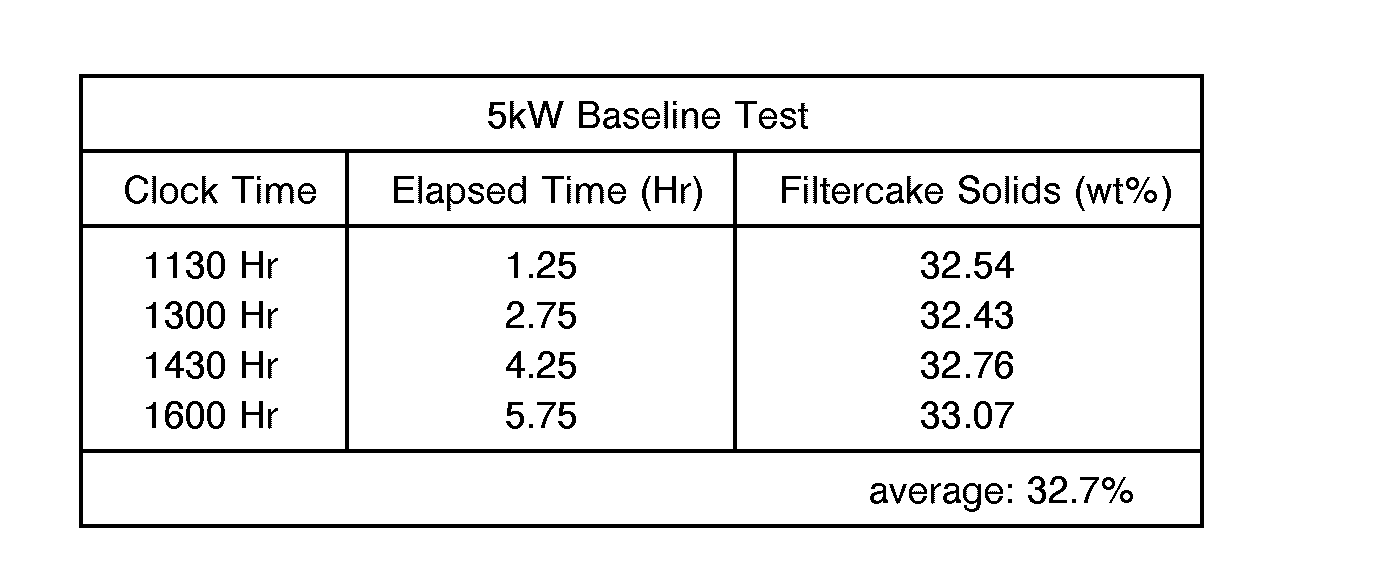
- The liquors left in the recycle tank and the thickener from the baseline test were then used on the next day. The K-ADS was introduced at a rate of -140g per shot immediately after each recycle tank liquor sample was taken. The ADS concentrations, [ADS], in the filtrates and rinsates were measured by IC. The values of filtercake solids contents are listed below. With the additions of K-ADS, the solids content increased gradually from -31 to wt%.

- Liquors left from the first K-ADS test were re-used on the next day. The supernatant liquid in the recycle tank was first sampled at 0900 Hr and the [ADS] was measured by IC to be 159.9 mM. The thickener was then drained and filled with fresh synthetic liquor. After the 1130 Hr recycle tank sample was taken, 70.2g of K-ADS was added. This ADS test was shut down prematurely, due to the unstable gas flow. The solids contents of the rinsed cakes are listed below.

- A third test was conducted four days later, by re-using the liquors left in the recycle tank and the thickener from the second test. The K-ADS was added right after the 1030 Hr recycle tank sample was taken. Again, this test was prematurely shut down due to the unstable gas flow. The [ADS] in the filtrates were estimated, because the IC was not available. The solids contents of two un-rinsed and one rinsed filtercakes are listed below.

- Results from the above K-ADS tests shown that improvements of sludge dewaterability were made after the additions of K-ADS. Furthermore, the solids settled in the thickener very fast. However, there is no explanation for the huge differences between the un-rinsed and rinsed cakes from the 1130 Hr sample from the last test.
- Results from the first 5kW K-ADS test indicate that the solubility of K-ADS may be at -150 mM.
- The first batch of Na-ADS was synthesized following the recipe for making K-ADS. The main difference was that sodium nitrite (NaN02) and sodium metabisulfite (Na2S205), instead of the respective potassium salts, were used. This batch of Na-ADS containing solution was labeled as A. No crystal formed and the [ADS] in this batch was measured by IC to be 637 mM. The first Na-ADS test was conducted the next day by using synthetic liquors to jump-start the test. Results from this test are listed below. The solids content in the filtercake from the first recycle tank sample was 34.9 wt%, which was considered to be the baseline value because no Na-ADS was added yet. Forty five minutes later, 1,300 mL of Na-ADS solution were added. The solids content in the filtercake from the last recycle tank sample was 37.3 wt%. The measured [ADS] in the corresponding filtrate was 52.5 mM.

- A second batch of Na-ADS solution was synthesized and labeled as B. Liquors left from the above test were re-used two days later. Results from this test are tabulated below. The solids content in the first recycle tank liquor sample was 38.8 wt%. The [ADS] in the corresponding filtrate and rinsate were 41 and 2.8 mM, respectively. Immediately after this recycle tank sample was taken, 800 mL of Na-ADS solution were added. As more Na-ADS was added, the solids content of the rinsed filtercakes increased. The solids content in the filtercake from the last recycle tank liquor sample was 49.3 wt%. The [ADS] in the corresponding filtrate and rinsate were 137 and 8.0 mM, respectively.

- Results from the above Na-ADS tests show that improvements of sludge dewaterability by -10 percentage points were made after the additions of Na-ADS.
Claims (10)

Applications Claiming Priority (2)
| Application Number | Priority Date | Filing Date | Title |
|---|---|---|---|
| US08/191,413 US5384111A (en) | 1994-02-03 | 1994-02-03 | Magnesium-enhanced lime scrubbing of sulfur dioxide with production of a high solids content sludge |
| US191413 | 1994-02-03 |
Publications (2)
| Publication Number | Publication Date |
|---|---|
| EP0666100A2 true EP0666100A2 (en) | 1995-08-09 |
| EP0666100A3 EP0666100A3 (en) | 1995-10-04 |
Family
ID=22705408
Family Applications (1)
| Application Number | Title | Priority Date | Filing Date |
|---|---|---|---|
| EP94119171A Withdrawn EP0666100A3 (en) | 1994-02-03 | 1994-12-05 | Scrubbing of sulfur dioxide. |
Country Status (8)
| Country | Link |
|---|---|
| US (1) | US5384111A (en) |
| EP (1) | EP0666100A3 (en) |
| JP (1) | JP2693125B2 (en) |
| KR (1) | KR950031182A (en) |
| CN (1) | CN1111164A (en) |
| CA (1) | CA2117731A1 (en) |
| PL (1) | PL307042A1 (en) |
| TR (1) | TR28513A (en) |
Families Citing this family (3)
| Publication number | Priority date | Publication date | Assignee | Title |
|---|---|---|---|---|
| US5618511A (en) * | 1995-08-11 | 1997-04-08 | The Arizona Board Of Regents On Behalf Of The University Of Arizona | Process for producing ammonium sulfate from flue-gas scrubber waste liquor |
| US5683666A (en) * | 1996-01-19 | 1997-11-04 | Dravo Lime Company | Method for the removal of sulfur dioxide and nitrogen oxides for a gaseous stream |
| US9675979B2 (en) | 2015-06-08 | 2017-06-13 | Saudi Arabian Oil Company | Controlling flow of black powder in hydrocarbon pipelines |
Family Cites Families (15)
| Publication number | Priority date | Publication date | Assignee | Title |
|---|---|---|---|---|
| JPS5210838B2 (en) * | 1971-11-11 | 1977-03-26 | ||
| US3972980A (en) * | 1974-07-31 | 1976-08-03 | Radian Corporation | Process removing sulfur dioxide from gases |
| JPS5223563A (en) * | 1975-08-19 | 1977-02-22 | Mitsubishi Heavy Ind Ltd | Wet exhaust gas treatment process |
| JPS54107468A (en) * | 1978-02-09 | 1979-08-23 | Mitsubishi Heavy Ind Ltd | Wet system exhausted smoke treatment |
| US4283373A (en) * | 1980-03-17 | 1981-08-11 | The Goodyear Tire & Rubber Company | Method for removal of sulfur compounds from a gas |
| US4454101A (en) * | 1982-11-24 | 1984-06-12 | Tennessee Valley Authority | Dewatering of flue gas desulfurization sulfite solids |
| AU569775B2 (en) * | 1984-01-25 | 1988-02-18 | Holter, H. | Stripping nox and sox from flue gases discharged from combustion plants |
| CH666827A5 (en) * | 1985-06-18 | 1988-08-31 | Friedrich Curtius Dipl Ing | METHOD FOR DRY CLEANING SMOKE GASES. |
| US4612175A (en) * | 1985-08-05 | 1986-09-16 | The United States Of America As Represented By The United States Department Of Energy | Flue gas desulfurization/denitrification using metal-chelate additives |
| US4957716A (en) * | 1988-11-21 | 1990-09-18 | Electric Power Research Institute, Inc. | Method for removal of SO2 and NOx from combustion gases by metal chelation and thermal reduction |
| US4994246A (en) * | 1988-12-06 | 1991-02-19 | Electric Power Research Institute, Inc. | Method for removing sulfur oxides from combusting gases in wet, calcium-based flue gas desulfurization processes |
| US5246677A (en) * | 1991-05-07 | 1993-09-21 | Electric Power Research Institute | Addition of organophosphonates for size control of wet calcium-based FGD byproduct solids under forced oxidation conditions |
| US5246679A (en) * | 1991-05-07 | 1993-09-21 | Electric Power Research Institute | Addition of organophosphonates for size control of wet calcium-based FGD byproduct solids under inhibited oxidation conditions |
| US5200160A (en) * | 1991-08-29 | 1993-04-06 | Dravo Lime Company | Process for removing sulfur dioxide and nitrogen oxides from flue gases |
| US5202103A (en) * | 1991-12-20 | 1993-04-13 | Union Carbide Chemicals & Plastics Technology Corporation | Removal of sulfur dioxide from gas streams |
-
1994
- 1994-02-03 US US08/191,413 patent/US5384111A/en not_active Expired - Lifetime
- 1994-10-07 CA CA002117731A patent/CA2117731A1/en not_active Abandoned
- 1994-11-18 TR TR01185/94A patent/TR28513A/en unknown
- 1994-12-05 EP EP94119171A patent/EP0666100A3/en not_active Withdrawn
- 1994-12-28 JP JP6326804A patent/JP2693125B2/en not_active Expired - Lifetime
-
1995
- 1995-02-02 PL PL95307042A patent/PL307042A1/en unknown
- 1995-02-03 KR KR1019950001904A patent/KR950031182A/en not_active Withdrawn
- 1995-02-03 CN CN95102683A patent/CN1111164A/en active Pending
Also Published As
| Publication number | Publication date |
|---|---|
| CN1111164A (en) | 1995-11-08 |
| EP0666100A3 (en) | 1995-10-04 |
| PL307042A1 (en) | 1995-08-07 |
| JPH07213856A (en) | 1995-08-15 |
| US5384111A (en) | 1995-01-24 |
| TR28513A (en) | 1996-09-02 |
| CA2117731A1 (en) | 1995-08-04 |
| KR950031182A (en) | 1995-12-18 |
| JP2693125B2 (en) | 1997-12-24 |
Similar Documents
| Publication | Publication Date | Title |
|---|---|---|
| US4079118A (en) | Method for removing nitrogen oxides using ferricion-EDTA complex solutions | |
| DE68916104T2 (en) | Process for the desulfurization of a gas stream containing sulfur dioxide. | |
| EP0168453A1 (en) | Process for stripping nitrogen oxides and sulphur oxides as well as optionally other noxious elements of flue gas from combustion plants | |
| US4612175A (en) | Flue gas desulfurization/denitrification using metal-chelate additives | |
| US4000991A (en) | Method of removing fly ash particulates from flue gases in a closed-loop wet scrubbing system | |
| US4976936A (en) | Flue gas desulfurization with oxidation of calcium sulfite in FGD discharges | |
| EP0679426B1 (en) | Magnesium-enhanced sulfur dioxide scrubbing with gypsum formation | |
| CA2239390A1 (en) | Desulfurization process for flue gases | |
| PL169819B1 (en) | Method of removing sulfur dioxide and nitrogen oxides from combustion gases | |
| US5082639A (en) | Sulfur dioxide removal from gases using a modified lime | |
| Liu et al. | Removal of nitrogen oxide (NOx) and sulfur dioxide from flue gas using aqueous emulsions of yellow phosphorus and alkali | |
| US5618511A (en) | Process for producing ammonium sulfate from flue-gas scrubber waste liquor | |
| US5384111A (en) | Magnesium-enhanced lime scrubbing of sulfur dioxide with production of a high solids content sludge | |
| JP3572233B2 (en) | Flue gas desulfurization method and flue gas desulfurization system | |
| WO1985003238A2 (en) | Process for stripping nitrogen oxides and sulphur oxides as well as optionally other noxious elements of flue gas from combustion plants | |
| CZ300007B6 (en) | Process for combined production of fertilizers and sulfur-containing compounds | |
| US6960332B2 (en) | Process for purifying aqueous buffer solutions | |
| CA1112848A (en) | Process for removing so.sub.2 and no.sub.x from gases | |
| US5683666A (en) | Method for the removal of sulfur dioxide and nitrogen oxides for a gaseous stream | |
| EP0223803A1 (en) | METHOD FOR SIMULTANEOUSLY REMOVING BY WASHING SO 2?, NO x? AND OPTIONALLY OTHER NOXIOUS SUBSTANCES CONTAINED IN FLUE GASES IN HEATING INSTALLATIONS SUPPLIED WITH FOSSILE FUELS | |
| KR960002260B1 (en) | Treatment method of waste water containing fluorine | |
| RU2077372C1 (en) | Sulfur dioxide absorber in industrial gas purification | |
| SU1177391A1 (en) | Method of isolating nitric and hydrofluoric acids from used etching solutions | |
| CA2792760A1 (en) | System for treating selenium-containing liquid, wet flue gas desulfurization device, and method for treating selenium-containing liquid | |
| JPH11253743A (en) | Exhaust gas desulfurization method |
Legal Events
| Date | Code | Title | Description |
|---|---|---|---|
| PUAI | Public reference made under article 153(3) epc to a published international application that has entered the european phase |
Free format text: ORIGINAL CODE: 0009012 |
|
| AK | Designated contracting states |
Kind code of ref document: A2 Designated state(s): AT BE CH DE DK ES FR GB IT LI NL PT SE |
|
| PUAL | Search report despatched |
Free format text: ORIGINAL CODE: 0009013 |
|
| AK | Designated contracting states |
Kind code of ref document: A3 Designated state(s): AT BE CH DE DK ES FR GB IT LI NL PT SE |
|
| 17P | Request for examination filed |
Effective date: 19960322 |
|
| 17Q | First examination report despatched |
Effective date: 19960724 |
|
| STAA | Information on the status of an ep patent application or granted ep patent |
Free format text: STATUS: THE APPLICATION IS DEEMED TO BE WITHDRAWN |
|
| 18D | Application deemed to be withdrawn |
Effective date: 19980212 |