EP0648564A2 - Procédé de préparation d'un article moulé perméable à l'air - Google Patents
Procédé de préparation d'un article moulé perméable à l'air Download PDFInfo
- Publication number
- EP0648564A2 EP0648564A2 EP94105807A EP94105807A EP0648564A2 EP 0648564 A2 EP0648564 A2 EP 0648564A2 EP 94105807 A EP94105807 A EP 94105807A EP 94105807 A EP94105807 A EP 94105807A EP 0648564 A2 EP0648564 A2 EP 0648564A2
- Authority
- EP
- European Patent Office
- Prior art keywords
- mold
- binder
- molded body
- weight
- parts
- Prior art date
- Legal status (The legal status is an assumption and is not a legal conclusion. Google has not performed a legal analysis and makes no representation as to the accuracy of the status listed.)
- Withdrawn
Links
Images
Classifications
-
- B—PERFORMING OPERATIONS; TRANSPORTING
- B22—CASTING; POWDER METALLURGY
- B22F—WORKING METALLIC POWDER; MANUFACTURE OF ARTICLES FROM METALLIC POWDER; MAKING METALLIC POWDER; APPARATUS OR DEVICES SPECIALLY ADAPTED FOR METALLIC POWDER
- B22F3/00—Manufacture of workpieces or articles from metallic powder characterised by the manner of compacting or sintering; Apparatus specially adapted therefor ; Presses and furnaces
- B22F3/02—Compacting only
-
- B—PERFORMING OPERATIONS; TRANSPORTING
- B22—CASTING; POWDER METALLURGY
- B22F—WORKING METALLIC POWDER; MANUFACTURE OF ARTICLES FROM METALLIC POWDER; MAKING METALLIC POWDER; APPARATUS OR DEVICES SPECIALLY ADAPTED FOR METALLIC POWDER
- B22F5/00—Manufacture of workpieces or articles from metallic powder characterised by the special shape of the product
- B22F5/007—Manufacture of workpieces or articles from metallic powder characterised by the special shape of the product of moulds
-
- B—PERFORMING OPERATIONS; TRANSPORTING
- B22—CASTING; POWDER METALLURGY
- B22F—WORKING METALLIC POWDER; MANUFACTURE OF ARTICLES FROM METALLIC POWDER; MAKING METALLIC POWDER; APPARATUS OR DEVICES SPECIALLY ADAPTED FOR METALLIC POWDER
- B22F1/00—Metallic powder; Treatment of metallic powder, e.g. to facilitate working or to improve properties
- B22F1/10—Metallic powder containing lubricating or binding agents; Metallic powder containing organic material
-
- C—CHEMISTRY; METALLURGY
- C22—METALLURGY; FERROUS OR NON-FERROUS ALLOYS; TREATMENT OF ALLOYS OR NON-FERROUS METALS
- C22C—ALLOYS
- C22C21/00—Alloys based on aluminium
-
- B—PERFORMING OPERATIONS; TRANSPORTING
- B22—CASTING; POWDER METALLURGY
- B22F—WORKING METALLIC POWDER; MANUFACTURE OF ARTICLES FROM METALLIC POWDER; MAKING METALLIC POWDER; APPARATUS OR DEVICES SPECIALLY ADAPTED FOR METALLIC POWDER
- B22F2301/00—Metallic composition of the powder or its coating
- B22F2301/05—Light metals
- B22F2301/052—Aluminium
-
- B—PERFORMING OPERATIONS; TRANSPORTING
- B22—CASTING; POWDER METALLURGY
- B22F—WORKING METALLIC POWDER; MANUFACTURE OF ARTICLES FROM METALLIC POWDER; MAKING METALLIC POWDER; APPARATUS OR DEVICES SPECIALLY ADAPTED FOR METALLIC POWDER
- B22F2999/00—Aspects linked to processes or compositions used in powder metallurgy
Definitions
- This invention relates to a method of preparing a molded body (mold and mold material) at a low cost, which body has air permeability throughout it, good thermal conductivity and heat resistance, and easy workability.
- method (1) has such problems as wherein the traces of the processed pores are transferred to the molded workpiece, as well as wherein the method takes many processes to form a mold and to make the mold porous.
- methods (2) and (3) have such problems as wherein since an oxidatively sintered body is obtained, the methods require much energy for sintering, and as wherein since a ceramic is formed, thermal conductivity is poor, and as wherein processing and modifying a mold is difficult.
- Method (4) has such a problem as wherein, although the molds obtained by it have good air permeability and thermal conductibity, the method is cumbersome since two kinds of binders are used for hardening, and as wherein since when the mold is secondary cured a phenolic resin is bled on the surface of the mold and is hardened there, the obtained mold cannot be used as it is and it is required that the surface of the mold be processed, and thus it cannot be used as a trasferring mold that transfers a fine pattern.
- the present invention was made in consideration of the above problems. It aims at providing a method of producing a mold or mold material (below it will be referred as a molded body) with excellent properties. First, it has fine and contiguous pores throughout the mold and a finely-textured surface; second, it has good thermal conductivity and heat resistance; third, it can be easily prepared and at low cost, fourth, it can be used as a transferring mold and the processability is good; fifth, it has a strength sufficient for use as a mold for vacuum molding, etc.
- the method of preparing an air-permeable molded body by the present invention is characterized by compounding 5-20 parts by weight of a binder consisting of a modified diamine and a modified M. D. I. that are both liquid with 100 parts by weight of an aggregate consisting of aluminum powders or aluminum-alloy powders having a grain size distribution of 325 to 48 mesh, mixing the compound, filling a molding flask with the mixture, compressing the packed mixture under a pressure per unit area of 20-80kg/cm2 and maintaining the mixture in the compressed state to harden the binder, and thereby obtaining a porous body having many fine and contiguous pores throughout it.
- the binder to obtain a molded body use is made of a resin prepared by the combination of a modified diamine and a modified M. D. I., featured by an urea reaction, to satisfy the requirements for the obtained molded body having sufficient strength and heat resistance and for a short time needed until the binder is hardened. Since the urea reaction proceeds very quickly, the molded body is rapidly hardened to shorten the dwell period in a molding flask.
- a modified diamine having a rather high molecular weight, about 1,300, is adopted, considering the fact that when a usual modified diamine with a modified M. D. I. is used the reaction proceeds so rapidly that hardening starts while the binder is being mixed with the aggregate, and thus a good product cannot be obtained by compressing the mixture in a molding flask, and considering the need to confer a sufficient strength, toughness, and heat resistance (to a heat of about 250°C) to a molded body.
- the grain size of the aggregate is very fine, the texture of the surface of a mold becomes fine and thus when the mold is used as a transferring mold it shows excellent transferability, and when it is used as a processing mold excellent plane properties can be expected. However, since if too fine grains are used, pores among the grains become too small to have good air permeability, aggregates having a grain size distribution of 325 to 48 mesh are adopted.
- the binder is compounded in an amount of 5-20 parts by weight based on 100 parts by weight of the aggregate.
- the compressive force is too low, the strength of a molded body becomes low, the properties of the surface of the body get worse, the texture of the surface becomes less fine, and thus the body becomes unsuitable. If the pressure is higher, the strength gets higher and the fineness of the surface texture increases. However, if the force is too high, the spaces among the aggregate ingredients get too small to have good air permeability. Thus the compression is conducted under a pressure per unit area of 20-80kg/cm2.
- the material in the flask was compressed under a pressure per unit area of 50kg/cm2 and was kept in this compressed state for 10 minutes to harden the binder and obtain a molded body (mold material) having external dimensions of 500 ⁇ 500mm and a thickness of 100mm.
- the molded body (mold material) was processed by a milling machine. Then the surface of the body was polished with sandpaper to form a vacuum-forming mold, to produce a keyboard dust cover.
- this vacuum-forming mold was excellent in air permeability, fineness, strength, and thermal conductivity properties, even though it had sharp angles and small ribs, even after ten thousand shots were produced from the mold molded products with all satisfactory small parts were continuously obtained at high speed and the products did not have any broken angle or rib.
- the thus-obtained molded body (transferring mold) D has the following characteristics: (1) the surface of the mold has almost the same smoothness as that of the surface of the pattern mold; (2) it has a strength and air permeability sufficient for conducting vacuum forming; (3) it has a sufficient heat-resistance (it is never deformed, the hardened binder never deteriorates, and the aggregate ingredients never fall off to roughen the surface of the molded body) when it is heated (for example, to about 130°C) to improve moldability, or, when it is used to mold a sheet, which has a high molding temperature (high heat-softening temperature) and a great heat capacity (having a great thickness).
- a plural number of molds having the same shape can be prepared by the above transfer method.
- One processing step was sufficient, when a pattern mold was prepared, to shape the surface of the pattern mold.
- the cost to prepare molds was significantly decreased compared with when the surface of a mold was prepared from a mold material.
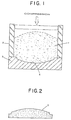
- Fig. 1 is a sectional view that shows the state in which the molded body was prepared in Example 2.
- 1 in the Figure shows a material in a humid state.
- 2 shows a molding flask.
- 3 shows a pattern mold. 4 shows a smooth surface having a curve of a large radius.
- Fig. 2 is a sectional view of the molded body prepared by Example 2. D shows a molded body.
Landscapes
- Engineering & Computer Science (AREA)
- Mechanical Engineering (AREA)
- Manufacturing & Machinery (AREA)
- Chemical & Material Sciences (AREA)
- Materials Engineering (AREA)
- Metallurgy (AREA)
- Organic Chemistry (AREA)
- Moulds For Moulding Plastics Or The Like (AREA)
- Powder Metallurgy (AREA)
- Casting Or Compression Moulding Of Plastics Or The Like (AREA)
Applications Claiming Priority (2)
| Application Number | Priority Date | Filing Date | Title |
|---|---|---|---|
| JP5281647A JPH07113103A (ja) | 1993-10-15 | 1993-10-15 | 通気性成形体の製造方法 |
| JP281647/93 | 1993-10-15 |
Publications (2)
| Publication Number | Publication Date |
|---|---|
| EP0648564A2 true EP0648564A2 (fr) | 1995-04-19 |
| EP0648564A3 EP0648564A3 (fr) | 1996-06-26 |
Family
ID=17642022
Family Applications (1)
| Application Number | Title | Priority Date | Filing Date |
|---|---|---|---|
| EP94105807A Withdrawn EP0648564A3 (fr) | 1993-10-15 | 1994-04-14 | Procédé de préparation d'un article moulé perméable à l'air. |
Country Status (8)
| Country | Link |
|---|---|
| US (1) | US5435967A (fr) |
| EP (1) | EP0648564A3 (fr) |
| JP (1) | JPH07113103A (fr) |
| KR (1) | KR950011015A (fr) |
| CN (1) | CN1102607A (fr) |
| AU (1) | AU663649B2 (fr) |
| CA (1) | CA2122169A1 (fr) |
| TW (1) | TW257704B (fr) |
Cited By (1)
| Publication number | Priority date | Publication date | Assignee | Title |
|---|---|---|---|---|
| WO1997001408A1 (fr) * | 1995-06-28 | 1997-01-16 | Nobel Biocare Ab (Publ) | Procede et moyens de production d'un article ceramique ou metallique destine a etre fritte |
Families Citing this family (4)
| Publication number | Priority date | Publication date | Assignee | Title |
|---|---|---|---|---|
| EA008841B1 (ru) * | 2004-03-23 | 2007-08-31 | Синтокогио, Лтд. | Устройство для формирования пресс-формы и используемая в нем металлическая пресс-форма |
| CN100402199C (zh) * | 2005-09-22 | 2008-07-16 | 远东技术学院 | 透气式模具钢材的制造方法 |
| KR20140007895A (ko) | 2011-02-14 | 2014-01-20 | 신토고교 가부시키가이샤 | 금형용 형재, 금형용 통기성 부재, 및 금형용 형재 및 금형용 통기성 부재의 제조 방법 |
| CN103274758A (zh) * | 2013-06-17 | 2013-09-04 | 深圳市清材科技实业有限公司 | 一种透气式陶瓷模具或模具配件的制造方法 |
Family Cites Families (12)
| Publication number | Priority date | Publication date | Assignee | Title |
|---|---|---|---|---|
| CH618904A5 (fr) * | 1978-02-10 | 1980-08-29 | Claudio Balosetti | |
| CA1266159A (fr) * | 1983-04-09 | 1990-02-27 | Takeo Nakagawa | Article faconne composite durable et permeable |
| JPS6046213A (ja) * | 1983-04-22 | 1985-03-13 | Takeo Nakagawa | 真空成形型の製作法 |
| JPS6167703A (ja) * | 1984-09-07 | 1986-04-07 | Sintokogio Ltd | 多孔性金型の製造方法 |
| US4900698A (en) * | 1987-05-26 | 1990-02-13 | W. R. Grace & Co.-Conn. | Ceramic product and process |
| JPH03250042A (ja) * | 1990-02-28 | 1991-11-07 | Yokohama Rubber Co Ltd:The | 硬質樹脂型用組成物 |
| TW268910B (fr) * | 1991-06-18 | 1996-01-21 | Hoechst Ag | |
| US5270364A (en) * | 1991-09-24 | 1993-12-14 | Chomerics, Inc. | Corrosion resistant metallic fillers and compositions containing same |
| JPH05163506A (ja) * | 1991-12-13 | 1993-06-29 | Sintokogio Ltd | 通気性型材の製造方法 |
| US5219408A (en) * | 1992-03-02 | 1993-06-15 | Sun Donald J C | One-body precision cast metal wood |
| JPH064213A (ja) * | 1992-06-19 | 1994-01-14 | Olympus Optical Co Ltd | タッチパネル式操作装置 |
| JP3240023B2 (ja) * | 1993-10-08 | 2001-12-17 | 新東工業株式会社 | 通気性耐久型の製造方法 |
-
1993
- 1993-10-15 JP JP5281647A patent/JPH07113103A/ja active Pending
-
1994
- 1994-04-14 TW TW083103321A patent/TW257704B/zh active
- 1994-04-14 EP EP94105807A patent/EP0648564A3/fr not_active Withdrawn
- 1994-04-18 AU AU60531/94A patent/AU663649B2/en not_active Ceased
- 1994-04-19 US US08/229,918 patent/US5435967A/en not_active Expired - Fee Related
- 1994-04-20 KR KR1019940008292A patent/KR950011015A/ko not_active Withdrawn
- 1994-04-26 CA CA002122169A patent/CA2122169A1/fr not_active Abandoned
- 1994-05-20 CN CN94105842A patent/CN1102607A/zh active Pending
Cited By (1)
| Publication number | Priority date | Publication date | Assignee | Title |
|---|---|---|---|---|
| WO1997001408A1 (fr) * | 1995-06-28 | 1997-01-16 | Nobel Biocare Ab (Publ) | Procede et moyens de production d'un article ceramique ou metallique destine a etre fritte |
Also Published As
| Publication number | Publication date |
|---|---|
| EP0648564A3 (fr) | 1996-06-26 |
| TW257704B (fr) | 1995-09-21 |
| KR950011015A (ko) | 1995-05-15 |
| AU6053194A (en) | 1995-05-25 |
| CN1102607A (zh) | 1995-05-17 |
| CA2122169A1 (fr) | 1995-04-16 |
| JPH07113103A (ja) | 1995-05-02 |
| US5435967A (en) | 1995-07-25 |
| AU663649B2 (en) | 1995-10-12 |
Similar Documents
| Publication | Publication Date | Title |
|---|---|---|
| US4795673A (en) | Composite material of discontinuous silicon carbide particles and continuous silicon matrix and method of producing same | |
| CA1158259A (fr) | Materiau composite de silicone et de carbure de silicone, et methode de production connexe | |
| US5435967A (en) | Method of preparing an air-permeable molded body | |
| CN118005383B (zh) | 一种氧化铝纤维增强氧化铝基复合材料的制备方法 | |
| US6517756B1 (en) | Method for manufacturing bodies containing reinforcing fibers | |
| US6174481B1 (en) | Method for forming cast tooling for polymer molding | |
| US6007765A (en) | Method of producing molded articles | |
| GB2102016A (en) | Manufacture of cold pressed grinding wheels | |
| US4153666A (en) | Hot-pressing of shapes of non-uniform cross-sectional thickness | |
| US4572828A (en) | Method for producing silicon nitride sintered body of complex shape | |
| US20040035657A1 (en) | Method for producing ceramic brake disks from bmc | |
| JPH07195376A (ja) | 繊維強化プラスチック成形型、マスター型及びそれらの製造方法 | |
| US6699412B2 (en) | Compression-molded silicon carbide structures | |
| EP1137523A1 (fr) | Moulage par injection basse pression de poudres de metal et de ceramique au moyen d'un outillage souple | |
| US6783866B1 (en) | Polymerceramic materials with thermal expansion characteristics similar to those of metals | |
| KR20090040403A (ko) | 연료전지 세퍼레이터의 제조방법 및 연료전지 세퍼레이터 | |
| JPH06199578A (ja) | セラミックス基複合材料、その製造方法および複合材料用セラミックス繊維 | |
| JP3203651B2 (ja) | 炭素繊維強化炭素複合材製二重中空円筒体 | |
| US4668444A (en) | Process for the production of isotrophic spherical fuel or absorber elements for high temperature reactors | |
| JP2001181064A (ja) | 炭素繊維強化炭素複合材用成形体及び炭素繊維強化炭素複合材並びにその製造方法 | |
| JP2940325B2 (ja) | Frm用プリフォームの製造方法 | |
| US6310131B1 (en) | Reconfigurable tooling and method of manufacture | |
| JPS5838386B2 (ja) | 炭素−セラミツクス複合材の製造方法 | |
| WO1990001385A1 (fr) | Procede de production de corps consolides | |
| JP3051897B2 (ja) | グラファイト分散セラミックス成形体の製造方法 |
Legal Events
| Date | Code | Title | Description |
|---|---|---|---|
| PUAI | Public reference made under article 153(3) epc to a published international application that has entered the european phase |
Free format text: ORIGINAL CODE: 0009012 |
|
| AK | Designated contracting states |
Kind code of ref document: A2 Designated state(s): AT BE CH DE FR GB LI SE |
|
| PUAL | Search report despatched |
Free format text: ORIGINAL CODE: 0009013 |
|
| AK | Designated contracting states |
Kind code of ref document: A3 Designated state(s): AT BE CH DE FR GB LI SE |
|
| 17P | Request for examination filed |
Effective date: 19960723 |
|
| 17Q | First examination report despatched |
Effective date: 20000413 |
|
| GRAG | Despatch of communication of intention to grant |
Free format text: ORIGINAL CODE: EPIDOS AGRA |
|
| GRAG | Despatch of communication of intention to grant |
Free format text: ORIGINAL CODE: EPIDOS AGRA |
|
| GRAH | Despatch of communication of intention to grant a patent |
Free format text: ORIGINAL CODE: EPIDOS IGRA |
|
| STAA | Information on the status of an ep patent application or granted ep patent |
Free format text: STATUS: THE APPLICATION HAS BEEN WITHDRAWN |
|
| 18W | Application withdrawn |
Withdrawal date: 20010717 |