EP0647114B2 - Zyklonstaubsauger - Google Patents
Zyklonstaubsauger Download PDFInfo
- Publication number
- EP0647114B2 EP0647114B2 EP93913422A EP93913422A EP0647114B2 EP 0647114 B2 EP0647114 B2 EP 0647114B2 EP 93913422 A EP93913422 A EP 93913422A EP 93913422 A EP93913422 A EP 93913422A EP 0647114 B2 EP0647114 B2 EP 0647114B2
- Authority
- EP
- European Patent Office
- Prior art keywords
- cyclone
- air
- vacuum cleaner
- bleed valve
- airflow
- Prior art date
- Legal status (The legal status is an assumption and is not a legal conclusion. Google has not performed a legal analysis and makes no representation as to the accuracy of the status listed.)
- Expired - Lifetime
Links
- 238000011144 upstream manufacturing Methods 0.000 claims abstract description 4
- JTJMJGYZQZDUJJ-UHFFFAOYSA-N phencyclidine Chemical class C1CCCCN1C1(C=2C=CC=CC=2)CCCCC1 JTJMJGYZQZDUJJ-UHFFFAOYSA-N 0.000 claims description 11
- 238000004140 cleaning Methods 0.000 claims description 8
- 238000000034 method Methods 0.000 claims description 2
- 230000007423 decrease Effects 0.000 description 9
- 239000000428 dust Substances 0.000 description 9
- 230000009977 dual effect Effects 0.000 description 8
- 239000002245 particle Substances 0.000 description 8
- 238000000926 separation method Methods 0.000 description 8
- 239000013618 particulate matter Substances 0.000 description 5
- 230000000694 effects Effects 0.000 description 3
- 238000001816 cooling Methods 0.000 description 2
- 238000012423 maintenance Methods 0.000 description 2
- 239000000463 material Substances 0.000 description 2
- 238000012546 transfer Methods 0.000 description 2
- 230000000740 bleeding effect Effects 0.000 description 1
- 230000003247 decreasing effect Effects 0.000 description 1
- 230000008021 deposition Effects 0.000 description 1
- 238000013461 design Methods 0.000 description 1
- 238000010586 diagram Methods 0.000 description 1
- 238000013021 overheating Methods 0.000 description 1
- 230000010349 pulsation Effects 0.000 description 1
- 239000012858 resilient material Substances 0.000 description 1
- 238000007789 sealing Methods 0.000 description 1
Images


Classifications
-
- A—HUMAN NECESSITIES
- A47—FURNITURE; DOMESTIC ARTICLES OR APPLIANCES; COFFEE MILLS; SPICE MILLS; SUCTION CLEANERS IN GENERAL
- A47L—DOMESTIC WASHING OR CLEANING; SUCTION CLEANERS IN GENERAL
- A47L9/00—Details or accessories of suction cleaners, e.g. mechanical means for controlling the suction or for effecting pulsating action; Storing devices specially adapted to suction cleaners or parts thereof; Carrying-vehicles specially adapted for suction cleaners
- A47L9/10—Filters; Dust separators; Dust removal; Automatic exchange of filters
- A47L9/19—Means for monitoring filtering operation
-
- A—HUMAN NECESSITIES
- A47—FURNITURE; DOMESTIC ARTICLES OR APPLIANCES; COFFEE MILLS; SPICE MILLS; SUCTION CLEANERS IN GENERAL
- A47L—DOMESTIC WASHING OR CLEANING; SUCTION CLEANERS IN GENERAL
- A47L9/00—Details or accessories of suction cleaners, e.g. mechanical means for controlling the suction or for effecting pulsating action; Storing devices specially adapted to suction cleaners or parts thereof; Carrying-vehicles specially adapted for suction cleaners
- A47L9/10—Filters; Dust separators; Dust removal; Automatic exchange of filters
- A47L9/16—Arrangement or disposition of cyclones or other devices with centrifugal action
- A47L9/1616—Multiple arrangement thereof
- A47L9/1625—Multiple arrangement thereof for series flow
-
- A—HUMAN NECESSITIES
- A47—FURNITURE; DOMESTIC ARTICLES OR APPLIANCES; COFFEE MILLS; SPICE MILLS; SUCTION CLEANERS IN GENERAL
- A47L—DOMESTIC WASHING OR CLEANING; SUCTION CLEANERS IN GENERAL
- A47L9/00—Details or accessories of suction cleaners, e.g. mechanical means for controlling the suction or for effecting pulsating action; Storing devices specially adapted to suction cleaners or parts thereof; Carrying-vehicles specially adapted for suction cleaners
- A47L9/10—Filters; Dust separators; Dust removal; Automatic exchange of filters
- A47L9/16—Arrangement or disposition of cyclones or other devices with centrifugal action
- A47L9/165—Construction of inlets
Definitions
- the invention relates to a vacuum cleaner, particularly but not exclusively to a dual cyclonic vacuum cleaner.
- Another advantage of the dual cyclonic vacuum cleaner is that the dirt-collecting chambers are highly unlikely to become blocked because of the size and rigidity of the chambers. However, it is inevitable that the dirty air inlet, either in the form of a cleaner head or a tool attached to a hose or wand, can become blocked to a greater or lesser extent Naturally, this reduces the airflow along the airflow path.
- a single cyclonic vacuum cleaner operates in the same manner but utilises only one cyclone which can become inefficient if the airflow rate though the cyclone is reduced.
- Vacuum cleaner airflow rates are measured at various orifice sizes. The flow rates start at an effective orifice size of 50mm diameter and are reduced to zero at zero diameter. Any flow rate in any given machine therefore has an equivalent "effective orifice" size.
- a vacuum cleaner being used through a hose or wand typically has an effective orifice size of 32mm diameter if it is fully open.
- a vacuum cleaner operating on a carpet through a cleaner head has an effective orifice of about 19mm diameter.
- a crevice tool being used on the end of a wand handle may have an effective orifice of about 15mm diameter.
- the second cyclone of a dual cyclonic vacuum cleaner maintains a good level of fine dust separation.
- the separation efficiency of the second cyclone is reduced if the airflow rate through the second cyclone is reduced to below that of an effective orifice size of 13mm. This can be caused by a number of things; for example, a blockage occurring at any point along the airflow path, or by the user putting a hand or other object over the air inlet.
- the efficiency of the second cyclone is reduced if the flow is interrupted in a pulsing manner or if the suction through the cleaner head causes the cleaner head to seal itself partially or completely against the surface to be cleaned.
- a similar problem arises when the airflow through the cyclone of a single cyclonic vacuum cleaner is reduced.
- the air discharged from a cyclonic vacuum cleaner may be substantially dust free and may in fact be cleaner than the air which is emitted from a vacuum cleaner which utilises a bag or other filter media.
- cyclonic vacuum cleaners may emit larger than desired quantities of fine particulate matter. For example, if the vacuum cleaner picks up a particularly heavy concentration of fine particulate matter, part of the fine particulate matter may pass through the two cyclones and be exhausted from the second cyclone. This may result in the deposition in a room of a layer of fine dust particles. Further, the filtered exhaust air may be passed by the motor housing to cool the motor. If the exhaust air occasionally includes more than desired quantities of fine particulate matter, the motor may experience a build up of fine particulate matter which could decrease the life expectancy of the motor.
- Document DE-A-1 503 601 discloses a cyclonic vacuum cleaner having valves for admitting additional air directly into the cyclone in the event that an excessive amount of entrained material is contained within the incoming air.
- the at least one bleed valve is arranged in the wall of the air flow path upstream of the cyclone.
- two cyclones are arranged sequentially in the airflow path, the bleed valve or valves being arranged between the two cyclones. This arrangement means that the efficiency of the second cyclone is maintained.
- a plurality of bleed valves are provided; preferably three. This arrangement allows the bled air to be introduced to the airflow in the vacuum cleaner in increments so that the airflow from the dirty air inlet is not substantially reduced in a single step. Any reduction that occurs is made in increments with the incremental introduction of bled air.
- all the bleed valves are substantially identical to one another; i.e. they have the same effective area and are designed to open at the same pressure conditions. This gives a satisfactory gradual transfer from the state of no bled air being introduced to the cyclone to the state of all of the air introduced to the cyclone being bled. It is important that this transfer be gradual to allow cleaning to be maintained either, through a tool at the end of the wand or through the cleaning head, even to the point at which the last valve is actuated, which is a very blocked condition.
- the or each bleed valve is spring-loaded and if the effective area, or total effective area, of the or each bleed valve is between 120mm 2 and 150mm 2 , preferably substantially 132mm 2 , i.e. the area of an effective orifice of 13mm diameter.
- the vacuum cleaner may also include adjustment means for varying the size of a single bleed valve for controlling the flow of bled air into the second cyclone, so that an increased flow of bled air can be admitted when the vacuum claner is used, for example, to vacuum a large concentration of fine particulates.
- the adjustment means may advantageously comprise a movably mounted door. The door may be moveable between a first position in which it restricts the flow of bled air through the bleed valve and a second position in which the door restricts the flow of bled air through the bleed valve to a lesser extent than when the door is in the first position.
- Means mounting the door for a decrease in pressure in the cyclone to move the door from the said first position towards the second position may also be provided.
- means biasing the door into the first position, whereby the door will move towards the second position as the pressure in the cyclone decreases thereby admitting an increased flow of bled air into the cyclone may also be provided.
- the vacuum cleaner may include sensing means coupled to the outlet for sensing the amount of particulates in the exhausted air and for producing an output indicative thereof.
- the vacuum cleaner may also have control means coupled between the sensing means and the door, the control means being responsive to the output signal for operating the door to permit an increased flow of bled air into the cyclone when an increased amount of particulates is detected in the exhaust.
- the provision of bled air to the second cyclone reduces the particulate emission in the exhaust from the second cyclone.
- the bled air probably reduces the disturbance to the cyclone action caused by heavy concentrations of fine particulates, or by disturbing pulsations which occur when sealed or partially sealed suction begins and ends, or other disturbances. Accordingly, even when the vacuum daner is used to vacuum a large concentration of particulates, or engages the surface to be cleaned, causing a partial or fully sealed suction condition, the particulate emission from the vacuum cleaner may be greatly reduced.
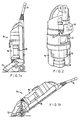
- a typical dual cyclonic vacuum cleaner is shown in Figure 1a in its non-operational position.
- the vacuum cleaner comprises a main body 10 incorporating a cleaning head 12 and a handle 14 which can be released for use in the manner of a wand.
- Various tools and attachments for the wand may be provided but are not shown.
- the means by which the handle 14 is released and the means by which the airflow is directed from either the handle 14 or the cleaning head 12 do not form part of the present invention and are described in other patents and applications. They will not be described further here.
- the main body 10 incorporates a first cyclone 16 and a second cyclone 18.
- the first cyclone is a "low efficiency” cyclone designed to remove relatively large particles from the air flowing therethrough.
- the second cyclone 18 is designed as a "high efficiency” cyclone for removing fine dust particles from the airflow.
- the dirty air inlet is formed by the nozzle in the handle 14 which is removed and used in the manner of a wand.
- the airflow is directed from this dirty air inlet to the first, low efficiency cyclone, subsequently to the second, high efficiency cyclone and then expelled to atmosphere via an exit (not shown).
- the airflow would be directed past the motor to give a cooling effect before being expelled.
- the dirty air inlet is formed by the cleaning head 12 and the airflow is directed from there to the first cyclone and then to the clean air exit via the second cyclone.
- Bleed valves 20 are therefore positioned in the wall of the airflow passage between the exit from the first cyclone and the entry to the second cyclone.
- the location of the bleed valves 20 is shown in Figure 2.
- the airflow enters the first cyclone 16 via the entry port 22 and exits the first cyclone via the mesh screen 24.
- the air passes upward to the entry port 26 to the second cyclone 18 and it is immediately before this entry port 26 that the bleed valves 20 are located.
- Each bleed valve 20 is shown in greatly enlarged cross-section in Figure 3.
- Each valve 20 comprises a valve body 30 to which is attached a rubber washer 32 by means of a fixing disk 34.
- the fixing disk 34 passes through an aperture in the rubber washer 32 and engages with an aperture 36 in the valve body.
- Alternative fixing means can, of course, be used.
- Acting between the airflow passage wall 38 and a flange 40 located on the valve body 30, is an air bleed valve spring 42.
- the spring 42 presses the flange 40 away from the airflow passage wall 38 so that the rubber washer 32 is maintained in sealing contact with the edges of an aperture in the airflow passage wall 38.
- the combined pressure is then increased and the third valve will only be actuated when the combined pressure of the airflow from the dirty air inlet and the two open valves falls to the threshold pressure thus allowing the third valve to open.
- an incremental increase in the bled air is achieved. This ensures that the cleaning effect at the dirty air inlet is maintained even though air is bled into the second cyclone.
- the airflow is maintained in the second cyclone and the air passing therethrough will be efficiently separated from dust particles.
- the air from the second cyclone can also be passed across the motor surface to provide a cooling effect
- each of the three bleed valves has the same effective area.
- the combined effective area of the three valves should be equivalent to the area of the effective orifice of the airflow at which the bleed valves are to be actuated.
- the bleed valves are to be actuated at an airflow of an effective orifice of 13mm diameter, then the combined total effective area of the valves should total 132mm 2 .
- the bleed valves should have an effective combined area of 154mm 2 .
- This effective area should be equally divided between the number of bleed valves present; if three bleed valves are present then each should have an effective area of 51mm 2 but if four bleed valves are present, then each should have an effective area of 38mm 2 . It should be noted that the effective and actual areas of each bleed valve are not the same. The actual area of the bleed valve is restricted by the presence of the valve body near the valve aperture. Thus the effective area of the bleed valve can be considerably less than the actual area of the aperture.
- any number of bleed valves to be positioned in the wall of the airflow path immediately before the inlet to the second cyclone.
- the preferred number of bleed valves is therefore three.
- the risk of the bleed valves themselves becoming blocked by the dirt and fluff particles introduced into the vacuum cleaner via the dirty air inlet is very small because the air passing the bleed valves has already passed through the first cyclone and all of the larger particles entrained with the dirty air have been removed.
- the vacuum cleaner may also include means for varying the the size of the bleed valve 76 and, accordingly, to control the volume of bled air passing into the second cyclone.
- outer cyclone casing 70 is provided with a door 78.
- Door 78 is provided with a handle 80 at one end thereof.
- Door 78 is movably mounted on the outer cyclone casing 70 by means of a pivot 82 and is moveable between a closed position and an open position.
- Door 78 is sized so that when in the closed position, it completely covers bleed valve 76 and therefore prevents any bled air from entering through the bleed valve 76 into the second cyclone 18.
- door 78 is in a partially open position.
- the operator may manually adjust the door 78 from a fully closed position to a partially opened position or from a partially opened position to a fully opened position so that an increased flow of bleed air can be admitted when the vacuum cleaner is used to vacuum a large concentration of fine particulates.
- the operator may elect to leave door 78 in the fully open position for most vacuuming purposes.
- the bleed valve 76 may also be provided with automatic means for opening door 78 as the pressure in second cyclone 18 decreases. Such a decrease in pressure could occur when a condition of full or partially sealed suction occurs.
- An example of such an automatic means is shown in the alternative preferred embodiment which is shown in Fig. 5.
- bleed valve 76 is provided with a door 78 which, when in the closed position, fully covers bleed valve 76 thus preventing the entry of bled air into the second cyclone 18 during normal vacuuming conditions.
- Means biasing the door 78 into the closed position are also provided. Accordingly, the door will move towards the open position as the pressure in second cyclone 18 decreases thereby admitting an increased flow of bled air into the second cyclone as required.
- member 86 having a first end 88, a second end 90 and an arm 92 extending between first end 88 and seond end 90 may be provided.
- First end 88 is fixedly attached to the inner surface 68 of outer cyclone casing 70.
- Second end 90 is fixedly attached to rear surface 84 of door 78.
- Arm 92 may be made from any material which will bias door 78 into the closed position which is shown in Fig. 5.
- arm 92 may be made from a resilient material or may incorporate spring means, such as a leaf spring.
- door 78 may be automatically controlled to allow bled air into second cyclone 18 in response to the amount of particulates which are exhausted from the air exit port of the second cyclone.
- a sensor 94 may be provided on air exit shaft 54. Sensor 94 senses the amount of particulates in the exhaust from the second cyclone.
- sensor 94 may be provided with a light source 96 (e.g. a light emitting diode) and a detector 98 which can be a photodiode. As the amount of particulates in shaft 54 increases, part of the light originating from light source 96 is reflected back by the particulates and picked up by the photodiode 98.
- the signal from photodiode 98 is processed and amplified to produce an output signal 100 which is indicative of the amount of particulates in the exhaust from the second cyclone.
- Output signal 100 is transmitted to door actuator 102.
- Door actuator 102 may be any suitable means which can accept output signal 100 and move door 78 a predetermined amount in response to the specific output signal 100 which is received.
- Door actuator 102 may be connected to a 100-volt electrical source or to any other conveniently available power supply.
- Shaft 104 is provided so as to connect the door actuator to door 78. As shown in Fig. 6, shaft 104 is connected at one end to door actuator 102, and at the other end, to the rear surface 84 of door 78.
- sensor 94 may produce only one output signal. In response to this output signal, door actuator 102 will cause door 78 to move from the dosed postion to a fully opened position when a level of particulate emission, above a predetermined limit, is detected in shaft 54.
- sensor 94 may provide an output signal which varies linearly or in a different desired relationship with the level of particulates in shaft 54. As the level of particulates in shaft 54 increases above a predetermined level, a variable output signal is produced.
- the invention can be applied to any type of vacuum cleaner including upright, cylinder, tank, back-pack and hand-held types.
- the invention although described specifically in relation to a dual cyclonic vacuum cleaner, is equally applicable to a single cyclonic vacuum cleaner or to a cyclonic vacuum cleaner having more than two cyclones as will be apparent to one skilled in the art. Where more than one cyclone is used, bleed valves can be used to maintain the airflow in any one or more of the cyclones as necessary or desired.
Landscapes
- Engineering & Computer Science (AREA)
- Mechanical Engineering (AREA)
- Filters For Electric Vacuum Cleaners (AREA)
- Cyclones (AREA)
- Electric Suction Cleaners (AREA)
- Organic Low-Molecular-Weight Compounds And Preparation Thereof (AREA)
- Vaporization, Distillation, Condensation, Sublimation, And Cold Traps (AREA)
- Detergent Compositions (AREA)
- Addition Polymer Or Copolymer, Post-Treatments, Or Chemical Modifications (AREA)
Claims (17)
- Staubsauger, der einen Schmutzluft-Einlaß (12, 14) aufweist, der mit einem Auslaß für saubere Luft durch eine Luftstrombahn verbunden ist, wobei in der Luftstrombahn ein Zyklon (18) derartig angeordnet ist, daß bei der Benutzung staubbeladene Luft, die längs der Luftstrombahn vom Schmutzluft-Einlaß (12, 14) zum Auslaß für saubere Luft strömt, durch den Zyklon (18) geführt wird, dadurch gekennzeichnet, daß unterhalb des Schmutzluft-Einlasses (12, 14) und oberhalb des Zyklons (18) wenigstens ein Ablassventil (20) vorhanden ist, das dafür geeignet ist, abgelassene Luft in die Luftstrombahn einzuführen, um diese mit der staubbeladenen Luft zu kombinieren und um die Strömungsgeschwindigkeit der staubbeladenen Luft innerhalb des Zyklons (18) zu erhalten, wobei das oder jedes der Ablassventile (20) wirksam werden, wenn bei der Benutzung entweder der Druck der längs der Luftstrombahn strömenden Luft auf oder unter einen festgelegten Wert fällt oder die Menge des Partikulatmaterials in der Luft am Auslaß für saubere Luft oder in dessen Nähe einen festgelegten Wert übersteigt.
- Staubsauger nach Anspruch 1, bei dem wenigstens ein Ablassventil (20) in der Wand der Luftstrombahn oberhalb des Zyklons (18) angeordnet ist.
- Staubsauger nach Anspruch 2, bei dem zwei Zyklone (16, 18) hintereinander in der Luftstrombahn angeordnet sind, wobei sich das Ablassventil oder die Ablassventile (20) zwischen den beiden Zyklonen (16, 18) befinden.
- Staubsauger nach einem der Ansprüche 1 bis 3, bei dem eine Vielzahl von Ablassventilen (20) nebeneinanderliegend vorhanden sind.
- Staubsauger nach Anspruch 4, bei dem die Ablassventile (20) im wesentlichen identisch sind.
- Staubsauger nach Anspruch 4 oder 5, bei dem drei Ablassventile (20) nebeneinanderliegend vorhanden sind.
- Staubsauger nach einem der vorhergehenden Ansprüche, bei dem das oder jedes Ablassventil (20) federbelastet ist.
- Staubsauger nach einem der vorhergehenden Ansprüche, bei dem die wirksame Fläche des Ablassventils (20) oder die wirksame Gesamtfläche der Ablassventile (20) zwischen 120 mm2 und 150 mm2 liegt.
- Staubsauger nach Anspruch 8, bei dem die wirksame Fläche des Ablassventils (20) oder die wirksame Gesamtfläche der Ablassventile (20) im wesentlichen 132 mm2 beträgt.
- Staubsauger nach einem der vorhergehenden Ansprüche, bei dem das oder jedes Ablassventil (20) eine Klappe (78) aufweist, die bewegt werden kann zwischen einer ersten Position, in der bei der Benutzung der Strom der abgelassenen Luft durch das Ablassventil (20) beschränkt ist, und einer zweiten Position, in der bei der Benutzung der Strom der abgelassenen Luft durch das Ablassventil (20) in einem geringeren Umfang beschränkt ist, als das der Fall ist, wenn sich die Klappe (78) in der ersten Position befindet.
- Staubsauger nach Anspruch 10, bei dem die Position der Klappe (78) durch ein Mittel reguliert wird, das auf den Druck des Luftstroms im Zyklon (18) anspricht.
- Staubsauger nach Anspruch 10, bei dem die Position der Klappe (78) durch ein Mittel (94) reguliert wird, das auf die Konzentration von Partikulatstoffen in der aus dem Zyklon (18) abgegebenen Luft anspricht.
- Staubsauger nach einem der vorhergehenden Ansprüche, bei dem das oder jedes Ablassventil (20) so konstruiert ist, daß es sich öffnet, wenn der Druck in der Luftstrombahn gleich dem ist, der durch einen Luftstrom erzeugt wird, der einer effektiven Öffnung zwischen 10 mm und 15 mm Durchmesser oder weniger äquivalent ist.
- Staubsauger nach Anspruch 13, bei dem das oder jedes Ablassventil (20) so konstruiert ist, daß es sich öffnet, wenn der Druck in der Luftstrombahn gleich dem ist, der durch einen Luftstrom erzeugt wird, der einer effektiven Öffnung von 13 mm Durchmesser oder weniger äquivalent ist.
- Staubsauger nach einem der Ansprüche 1 bis 12, bei dem die Menge der Partikulatstoffe in der Luft am Auslaß für saubere Luft oder in dessen Nähe durch einen Sensor (94) bestimmt wird, der unterhalb des Zyklons (18) angeordnet ist.
- Staubsauger nach Anspruch 15, bei dem der Sensor (94) mit einer Lichtquelle (96) und einem Detektor (98) versehen ist.
- Verfahren zum Betreiben eines Zyklon-Staubsaugers, der einen ersten und zweiten Zyklon (16, 18) hat, die in Reihe angeordnet sind, welches die folgenden Schritte umfaßt:dadurch gekennzeichnet, daß abgelassene Luft eingeführt und mit der teilweise gefilterten Luft kombiniert wird, bevor sie in den zweiten Zyklon (18) eintritt, um die Geschwindigkeit des Luftstroms innerhalb des zweiten Zyklons (18) aufrechtzuerhalten und um die Partikulatstoffe in der weiter gereinigten Luft zu verringern.a) Einlassen von schmutziger Luft in den ersten Zyklon (16);b) teilweises Reinigen der schmutzigen Luft im ersten Zyklon (16), um teilweise gefilterte Luft zu erzeugen;c) Weiterleiten der teilweise gefilterten Luft aus dem ersten Zyklon (16) in den zweiten Zyklon (18);d) weiteres Reinigen der teilweise gefilterten Luft im zweiten Zyklon (18), um weiter gereinigte Luft zu erzeugen, unde) Abgeben der weiter gereinigten Luft aus dem zweiten Zyklon (18),
Applications Claiming Priority (5)
| Application Number | Priority Date | Filing Date | Title |
|---|---|---|---|
| US97544692A | 1992-06-24 | 1992-06-24 | |
| US975446 | 1992-06-24 | ||
| GB9225599 | 1992-12-08 | ||
| GB929225599A GB9225599D0 (en) | 1992-12-08 | 1992-12-08 | Vacuum cleaner |
| PCT/GB1993/001325 WO1994000046A1 (en) | 1992-06-24 | 1993-06-24 | Dual cyclonic vacuum cleaner |
Publications (3)
| Publication Number | Publication Date |
|---|---|
| EP0647114A1 EP0647114A1 (de) | 1995-04-12 |
| EP0647114B1 EP0647114B1 (de) | 1997-03-26 |
| EP0647114B2 true EP0647114B2 (de) | 2001-11-14 |
Family
ID=26302121
Family Applications (1)
| Application Number | Title | Priority Date | Filing Date |
|---|---|---|---|
| EP93913422A Expired - Lifetime EP0647114B2 (de) | 1992-06-24 | 1993-06-24 | Zyklonstaubsauger |
Country Status (9)
| Country | Link |
|---|---|
| EP (1) | EP0647114B2 (de) |
| JP (1) | JP3207201B2 (de) |
| AT (1) | ATE150630T1 (de) |
| AU (1) | AU669539B2 (de) |
| CA (1) | CA2138985C (de) |
| DE (1) | DE69309275T3 (de) |
| ES (1) | ES2099450T3 (de) |
| SG (1) | SG46302A1 (de) |
| WO (1) | WO1994000046A1 (de) |
Cited By (2)
| Publication number | Priority date | Publication date | Assignee | Title |
|---|---|---|---|---|
| US7845046B2 (en) | 2003-10-15 | 2010-12-07 | Black & Decker, Inc. | Hand-held cordless vacuum cleaner |
| US8032984B2 (en) | 2006-01-27 | 2011-10-11 | Black & Decker Inc. | Vacuum cleaner filter cleaning mechanisms |
Families Citing this family (63)
| Publication number | Priority date | Publication date | Assignee | Title |
|---|---|---|---|---|
| GB2315231A (en) * | 1996-07-15 | 1998-01-28 | Notetry Ltd | Apparatus for Separating Particles |
| GB2320419B (en) * | 1996-12-20 | 2000-08-16 | Notetry Ltd | Improved vacuum cleaner |
| GB9815783D0 (en) * | 1998-07-20 | 1998-09-16 | Notetry Ltd | Apparatus for separating dirt or dust from an airflow |
| GB2344750B (en) * | 1998-12-18 | 2002-06-26 | Notetry Ltd | Vacuum cleaner |
| GB9902000D0 (en) * | 1999-01-30 | 1999-03-17 | Delta Biotechnology Ltd | Process |
| US6228260B1 (en) | 1999-07-27 | 2001-05-08 | G. B. D. Corp. | Apparatus for separating particles from a cyclonic fluid flow |
| US6231645B1 (en) | 1999-07-27 | 2001-05-15 | G.B.D. Corp. | Apparatus and method for separating particles from a cyclonic fluid flow utilizing a movable access member associated with a cyclonic separator |
| US6251296B1 (en) | 1999-07-27 | 2001-06-26 | G.B.D. Corp. | Apparatus and method for separating particles from a cyclonic fluid flow |
| US6221134B1 (en) | 1999-07-27 | 2001-04-24 | G.B.D. Corp. | Apparatus and method for separating particles from a cyclonic fluid flow |
| US6440197B1 (en) | 1999-07-27 | 2002-08-27 | G.B.D. Corp. | Apparatus and method separating particles from a cyclonic fluid flow including an apertured particle separation member within a cyclonic flow region |
| US6228151B1 (en) | 1999-08-18 | 2001-05-08 | G.B.D. Corp. | Apparatus and method for separating particles from a cyclonic fluid flow |
| US6341404B1 (en) * | 2000-01-13 | 2002-01-29 | Royal Appliance Mfg. Co. | Upright vacuum cleaner with cyclonic airflow pathway |
| GB2362341B (en) * | 2000-05-16 | 2002-12-04 | Samsung Kwangju Electronics Co | Upright-type vacuum cleaner |
| GB2372431B (en) * | 2001-02-24 | 2004-09-15 | Dyson Ltd | A domestic appliance |
| GB0104675D0 (en) | 2001-02-24 | 2001-04-11 | Dyson Ltd | A tool for a vacuum cleaner |
| ATE517571T1 (de) | 2005-08-26 | 2011-08-15 | Miele & Cie | Verfahren zur behandlung von staub und vorrichtungen zur durchführung eines solchen verfahrens |
| DE102005047812A1 (de) * | 2005-10-05 | 2007-04-12 | Miele & Cie. Kg | Verfahren zur Behandlung von Staub in einem Staubsammelbehälter und Vorrichtung zur Durchführung eines solchen Verfahrens |
| DE102005041170B3 (de) * | 2005-08-26 | 2007-01-18 | Miele & Cie. Kg | Staubabscheide-Behälter |
| DE102006046328B4 (de) * | 2006-09-28 | 2008-06-19 | Miele & Cie. Kg | Vorrichtung zum Abscheiden von Staub aus staubbeladener Luft, insbesondere zur Verwendung in einem Staubsauger |
| DE102008004393B3 (de) * | 2008-01-14 | 2009-07-16 | Miele & Cie. Kg | Vorrichtung zum Abscheiden von Staub aus staubbeladener Luft, insbesondere zur Verwendung in einem Staubsauger |
| US9211044B2 (en) | 2011-03-04 | 2015-12-15 | Omachron Intellectual Property Inc. | Compact surface cleaning apparatus |
| CA2674761C (en) | 2009-03-13 | 2016-10-04 | G.B.D. Corp. | Surface cleaning apparatus with different cleaning configurations |
| GB2502131B (en) * | 2012-05-17 | 2014-11-05 | Dyson Technology Ltd | Autonomous vacuum cleaner |
| DE102012105142B4 (de) * | 2012-06-14 | 2020-03-05 | Miele & Cie. Kg | Leistungssteller für einen Staubsauger und Staubsauger mit einem solchen Leistungssteller |
| US20140237764A1 (en) | 2013-02-28 | 2014-08-28 | G.B.D. Corp. | Cyclone such as for use in a surface cleaning apparatus |
| US9451855B2 (en) | 2013-02-28 | 2016-09-27 | Omachron Intellectual Property Inc. | Surface cleaning apparatus |
| US9227151B2 (en) | 2013-02-28 | 2016-01-05 | Omachron Intellectual Property Inc. | Cyclone such as for use in a surface cleaning apparatus |
| US9820621B2 (en) | 2013-02-28 | 2017-11-21 | Omachron Intellectual Property Inc. | Surface cleaning apparatus |
| US9456721B2 (en) | 2013-02-28 | 2016-10-04 | Omachron Intellectual Property Inc. | Surface cleaning apparatus |
| US9295995B2 (en) | 2013-02-28 | 2016-03-29 | Omachron Intellectual Property Inc. | Cyclone such as for use in a surface cleaning apparatus |
| US9326652B2 (en) | 2013-02-28 | 2016-05-03 | Omachron Intellectual Property Inc. | Surface cleaning apparatus |
| US9238235B2 (en) | 2013-02-28 | 2016-01-19 | Omachron Intellectual Property Inc. | Cyclone such as for use in a surface cleaning apparatus |
| US20140237768A1 (en) | 2013-02-28 | 2014-08-28 | G.B.D. Corp. | Surface cleaning apparatus |
| US9227201B2 (en) | 2013-02-28 | 2016-01-05 | Omachron Intellectual Property Inc. | Cyclone such as for use in a surface cleaning apparatus |
| KR20160023120A (ko) | 2014-08-21 | 2016-03-03 | 삼성전자주식회사 | 로봇 청소기 |
| GB2531043A (en) | 2014-10-08 | 2016-04-13 | Dyson Technology Ltd | Vacuum cleaner |
| US9883781B2 (en) | 2014-12-17 | 2018-02-06 | Omachron Intellectual Property Inc. | All in the head surface cleaning apparatus |
| US10022027B2 (en) | 2014-12-17 | 2018-07-17 | Omachron Intellectual Property Inc. | All in the head surface cleaning apparatus |
| US10258210B2 (en) | 2016-12-27 | 2019-04-16 | Omachron Intellectual Property Inc. | Multistage cyclone and surface cleaning apparatus having same |
| US10441125B2 (en) | 2016-08-29 | 2019-10-15 | Omachron Intellectual Property Inc. | Surface cleaning apparatus |
| US10136780B2 (en) | 2016-08-29 | 2018-11-27 | Omachron Intellectual Property Inc. | Surface cleaning apparatus |
| US10433689B2 (en) | 2016-08-29 | 2019-10-08 | Omachron Intellectual Property Inc. | Surface cleaning apparatus |
| US9962050B2 (en) | 2016-08-29 | 2018-05-08 | Omachron Intellectual Property Inc. | Surface cleaning apparatus |
| US10413141B2 (en) | 2016-08-29 | 2019-09-17 | Omachron Intellectual Property Inc. | Surface cleaning apparatus |
| US10321794B2 (en) | 2016-08-29 | 2019-06-18 | Omachron Intellectual Property Inc. | Surface cleaning apparatus |
| US10292550B2 (en) | 2016-08-29 | 2019-05-21 | Omachron Intellectual Property Inc. | Surface cleaning apparatus |
| US10405711B2 (en) | 2016-08-29 | 2019-09-10 | Omachron Intellectual Property Inc. | Surface cleaning apparatus |
| US10441124B2 (en) | 2016-08-29 | 2019-10-15 | Omachron Intellectual Property Inc. | Surface cleaning apparatus |
| US10729295B2 (en) | 2016-08-29 | 2020-08-04 | Omachron Intellectual Property Inc. | Surface cleaning apparatus |
| US10136779B2 (en) | 2016-08-29 | 2018-11-27 | Omachron Intellectual Property Inc. | Surface cleaning apparatus |
| US10271704B2 (en) | 2016-12-27 | 2019-04-30 | Omachron Intellectual Property Inc. | Multistage cyclone and surface cleaning apparatus having same |
| US10827891B2 (en) | 2016-12-27 | 2020-11-10 | Omachron Intellectual Property Inc. | Multistage cyclone and surface cleaning apparatus having same |
| US10016106B1 (en) | 2016-12-27 | 2018-07-10 | Omachron Intellectual Property Inc. | Multistage cyclone and surface cleaning apparatus having same |
| US10299643B2 (en) | 2016-12-27 | 2019-05-28 | Omachron Intellectual Property Inc. | Multistage cyclone and surface cleaning apparatus having same |
| US11285495B2 (en) | 2016-12-27 | 2022-03-29 | Omachron Intellectual Property Inc. | Multistage cyclone and surface cleaning apparatus having same |
| US10405709B2 (en) | 2016-12-27 | 2019-09-10 | Omachron Intellectual Property Inc. | Multistage cyclone and surface cleaning apparatus having same |
| JP6443462B2 (ja) * | 2017-01-12 | 2018-12-26 | 三菱電機株式会社 | サイクロン分離装置及び電気掃除機 |
| US11745190B2 (en) | 2019-01-23 | 2023-09-05 | Omachron Intellectual Property Inc. | Surface cleaning apparatus |
| US10702116B2 (en) | 2017-09-15 | 2020-07-07 | Omachron Intellectual Property Inc. | Surface cleaning apparatus |
| US11246462B2 (en) | 2019-11-18 | 2022-02-15 | Omachron Intellectual Property Inc. | Multi-inlet cyclone |
| US11751740B2 (en) | 2019-11-18 | 2023-09-12 | Omachron Intellectual Property Inc. | Multi-inlet cyclone |
| US20240245190A1 (en) | 2023-01-19 | 2024-07-25 | Sharkninja Operating Llc | Identification of hair care appliance attachments |
| US20250213029A1 (en) | 2023-01-19 | 2025-07-03 | Sharkninja Operating Llc | Hair care appliance with powered attachment |
Citations (1)
| Publication number | Priority date | Publication date | Assignee | Title |
|---|---|---|---|---|
| DE1407995A1 (de) † | 1964-10-23 | 1969-02-20 | Siemens Elektrogeraete Gmbh | Einrichtung zur Abscheidung fester Bestandteile aus einer Luftstroemung |
Family Cites Families (3)
| Publication number | Priority date | Publication date | Assignee | Title |
|---|---|---|---|---|
| DE3171910D1 (en) * | 1980-06-19 | 1985-09-26 | Rotork Appliances Ltd | Vacuum cleaning appliance |
| GR82013B (de) * | 1983-07-08 | 1984-12-12 | Notetry Ltd | |
| US5078761A (en) * | 1990-07-06 | 1992-01-07 | Notetry Limited | Shroud |
-
1993
- 1993-06-24 AT AT93913422T patent/ATE150630T1/de not_active IP Right Cessation
- 1993-06-24 CA CA002138985A patent/CA2138985C/en not_active Expired - Fee Related
- 1993-06-24 WO PCT/GB1993/001325 patent/WO1994000046A1/en not_active Ceased
- 1993-06-24 ES ES93913422T patent/ES2099450T3/es not_active Expired - Lifetime
- 1993-06-24 JP JP50215994A patent/JP3207201B2/ja not_active Expired - Lifetime
- 1993-06-24 EP EP93913422A patent/EP0647114B2/de not_active Expired - Lifetime
- 1993-06-24 DE DE69309275T patent/DE69309275T3/de not_active Expired - Lifetime
- 1993-06-24 AU AU43502/93A patent/AU669539B2/en not_active Ceased
- 1993-06-24 SG SG1996002398A patent/SG46302A1/en unknown
Patent Citations (1)
| Publication number | Priority date | Publication date | Assignee | Title |
|---|---|---|---|---|
| DE1407995A1 (de) † | 1964-10-23 | 1969-02-20 | Siemens Elektrogeraete Gmbh | Einrichtung zur Abscheidung fester Bestandteile aus einer Luftstroemung |
Cited By (2)
| Publication number | Priority date | Publication date | Assignee | Title |
|---|---|---|---|---|
| US7845046B2 (en) | 2003-10-15 | 2010-12-07 | Black & Decker, Inc. | Hand-held cordless vacuum cleaner |
| US8032984B2 (en) | 2006-01-27 | 2011-10-11 | Black & Decker Inc. | Vacuum cleaner filter cleaning mechanisms |
Also Published As
| Publication number | Publication date |
|---|---|
| CA2138985C (en) | 2004-01-20 |
| AU669539B2 (en) | 1996-06-13 |
| HK1000865A1 (en) | 1998-05-01 |
| JPH08501226A (ja) | 1996-02-13 |
| JP3207201B2 (ja) | 2001-09-10 |
| ES2099450T3 (es) | 1997-05-16 |
| DE69309275T2 (de) | 1997-09-04 |
| EP0647114A1 (de) | 1995-04-12 |
| ATE150630T1 (de) | 1997-04-15 |
| SG46302A1 (en) | 1998-02-20 |
| DE69309275T3 (de) | 2002-06-27 |
| DE69309275D1 (de) | 1997-04-30 |
| WO1994000046A1 (en) | 1994-01-06 |
| CA2138985A1 (en) | 1994-01-06 |
| EP0647114B1 (de) | 1997-03-26 |
| AU4350293A (en) | 1994-01-24 |
Similar Documents
| Publication | Publication Date | Title |
|---|---|---|
| EP0647114B2 (de) | Zyklonstaubsauger | |
| US5558697A (en) | Dual cyclonic vacuum cleaner | |
| US5141309A (en) | Apparatus for indicating how dirty an air filter is in a vacuum-cleaning apparatus, in a room filter, etc. | |
| EP1361812B1 (de) | Staubsauger | |
| US7931716B2 (en) | Handheld cleaning appliance | |
| US7861368B2 (en) | Vacuum cleaning head | |
| US4294595A (en) | Vacuum cleaner including automatic shutoff device | |
| KR100597548B1 (ko) | 진공 청소기 | |
| US4940474A (en) | Suction cleaner | |
| GB2372431A (en) | Air bleed valve arrangement in a vacuum cleaner | |
| US7462210B2 (en) | Dust collecting unit for vacuum cleaner | |
| HK1000865B (en) | Cyclonic vacuum cleaner | |
| EP1267695B1 (de) | Elektrische geräte | |
| US4463473A (en) | Vacuum cleaner | |
| US20040143929A1 (en) | Vacuum Cleaner | |
| JP2719822B2 (ja) | 電気掃除機 | |
| US12471746B2 (en) | Vacuum cleaner nozzle | |
| JPH04327823A (ja) | 電気掃除機 | |
| GB2360935A (en) | Vacuum cleaner having a secondary inlet for drawing in airborne particles | |
| JPS6213007B2 (de) |
Legal Events
| Date | Code | Title | Description |
|---|---|---|---|
| PUAI | Public reference made under article 153(3) epc to a published international application that has entered the european phase |
Free format text: ORIGINAL CODE: 0009012 |
|
| 17P | Request for examination filed |
Effective date: 19941230 |
|
| AK | Designated contracting states |
Kind code of ref document: A1 Designated state(s): AT BE CH DE DK ES FR GB GR IE IT LI LU MC NL PT SE |
|
| GRAG | Despatch of communication of intention to grant |
Free format text: ORIGINAL CODE: EPIDOS AGRA |
|
| 17Q | First examination report despatched |
Effective date: 19960708 |
|
| GRAH | Despatch of communication of intention to grant a patent |
Free format text: ORIGINAL CODE: EPIDOS IGRA |
|
| GRAH | Despatch of communication of intention to grant a patent |
Free format text: ORIGINAL CODE: EPIDOS IGRA |
|
| GRAA | (expected) grant |
Free format text: ORIGINAL CODE: 0009210 |
|
| RAP1 | Party data changed (applicant data changed or rights of an application transferred) |
Owner name: NOTETRY LIMITED |
|
| AK | Designated contracting states |
Kind code of ref document: B1 Designated state(s): AT BE CH DE DK ES FR GB GR IE IT LI LU MC NL PT SE |
|
| PG25 | Lapsed in a contracting state [announced via postgrant information from national office to epo] |
Ref country code: LI Free format text: LAPSE BECAUSE OF FAILURE TO SUBMIT A TRANSLATION OF THE DESCRIPTION OR TO PAY THE FEE WITHIN THE PRESCRIBED TIME-LIMIT Effective date: 19970326 Ref country code: GR Free format text: LAPSE BECAUSE OF FAILURE TO SUBMIT A TRANSLATION OF THE DESCRIPTION OR TO PAY THE FEE WITHIN THE PRESCRIBED TIME-LIMIT Effective date: 19970326 Ref country code: DK Effective date: 19970326 Ref country code: CH Free format text: LAPSE BECAUSE OF FAILURE TO SUBMIT A TRANSLATION OF THE DESCRIPTION OR TO PAY THE FEE WITHIN THE PRESCRIBED TIME-LIMIT Effective date: 19970326 Ref country code: AT Effective date: 19970326 |
|
| REF | Corresponds to: |
Ref document number: 150630 Country of ref document: AT Date of ref document: 19970415 Kind code of ref document: T |
|
| REG | Reference to a national code |
Ref country code: CH Ref legal event code: EP |
|
| ITF | It: translation for a ep patent filed | ||
| REF | Corresponds to: |
Ref document number: 69309275 Country of ref document: DE Date of ref document: 19970430 |
|
| ET | Fr: translation filed | ||
| REG | Reference to a national code |
Ref country code: ES Ref legal event code: FG2A Ref document number: 2099450 Country of ref document: ES Kind code of ref document: T3 |
|
| REG | Reference to a national code |
Ref country code: IE Ref legal event code: FG4D Free format text: 72898 |
|
| REG | Reference to a national code |
Ref country code: CH Ref legal event code: NV Representative=s name: PATENTANWAELTE SCHAAD, BALASS, MENZL & PARTNER AG |
|
| PG25 | Lapsed in a contracting state [announced via postgrant information from national office to epo] |
Ref country code: LU Free format text: LAPSE BECAUSE OF NON-PAYMENT OF DUE FEES Effective date: 19970624 |
|
| PG25 | Lapsed in a contracting state [announced via postgrant information from national office to epo] |
Ref country code: PT Effective date: 19970626 |
|
| PLBQ | Unpublished change to opponent data |
Free format text: ORIGINAL CODE: EPIDOS OPPO |
|
| PLBI | Opposition filed |
Free format text: ORIGINAL CODE: 0009260 |
|
| 26 | Opposition filed |
Opponent name: HOOVER LIMITED Effective date: 19971021 |
|
| PG25 | Lapsed in a contracting state [announced via postgrant information from national office to epo] |
Ref country code: MC Effective date: 19971231 |
|
| PLBF | Reply of patent proprietor to notice(s) of opposition |
Free format text: ORIGINAL CODE: EPIDOS OBSO |
|
| NLR1 | Nl: opposition has been filed with the epo |
Opponent name: HOOVER LIMITED |
|
| PLBF | Reply of patent proprietor to notice(s) of opposition |
Free format text: ORIGINAL CODE: EPIDOS OBSO |
|
| PLAW | Interlocutory decision in opposition |
Free format text: ORIGINAL CODE: EPIDOS IDOP |
|
| APAC | Appeal dossier modified |
Free format text: ORIGINAL CODE: EPIDOS NOAPO |
|
| APAE | Appeal reference modified |
Free format text: ORIGINAL CODE: EPIDOS REFNO |
|
| APAC | Appeal dossier modified |
Free format text: ORIGINAL CODE: EPIDOS NOAPO |
|
| APAC | Appeal dossier modified |
Free format text: ORIGINAL CODE: EPIDOS NOAPO |
|
| PLAW | Interlocutory decision in opposition |
Free format text: ORIGINAL CODE: EPIDOS IDOP |
|
| PGFP | Annual fee paid to national office [announced via postgrant information from national office to epo] |
Ref country code: IE Payment date: 20010622 Year of fee payment: 9 |
|
| PGFP | Annual fee paid to national office [announced via postgrant information from national office to epo] |
Ref country code: CH Payment date: 20010628 Year of fee payment: 9 |
|
| PGFP | Annual fee paid to national office [announced via postgrant information from national office to epo] |
Ref country code: ES Payment date: 20010629 Year of fee payment: 9 |
|
| PGFP | Annual fee paid to national office [announced via postgrant information from national office to epo] |
Ref country code: BE Payment date: 20010817 Year of fee payment: 9 |
|
| PUAH | Patent maintained in amended form |
Free format text: ORIGINAL CODE: 0009272 |
|
| STAA | Information on the status of an ep patent application or granted ep patent |
Free format text: STATUS: PATENT MAINTAINED AS AMENDED |
|
| 27A | Patent maintained in amended form |
Effective date: 20011114 |
|
| AK | Designated contracting states |
Kind code of ref document: B2 Designated state(s): AT BE CH DE DK ES FR GB GR IE IT LI LU MC NL PT SE |
|
| REG | Reference to a national code |
Ref country code: CH Ref legal event code: AEN Free format text: MAINTIEN DU BREVET DONT L'ETENDUE A ETE MODIFIEE |
|
| REG | Reference to a national code |
Ref country code: GB Ref legal event code: IF02 |
|
| NLR2 | Nl: decision of opposition | ||
| PG25 | Lapsed in a contracting state [announced via postgrant information from national office to epo] |
Ref country code: ES Free format text: LAPSE BECAUSE OF FAILURE TO SUBMIT A TRANSLATION OF THE DESCRIPTION OR TO PAY THE FEE WITHIN THE PRESCRIBED TIME-LIMIT Effective date: 20020225 |
|
| NLR3 | Nl: receipt of modified translations in the netherlands language after an opposition procedure | ||
| ET3 | Fr: translation filed ** decision concerning opposition | ||
| REG | Reference to a national code |
Ref country code: CH Ref legal event code: PL |
|
| PG25 | Lapsed in a contracting state [announced via postgrant information from national office to epo] |
Ref country code: IE Free format text: LAPSE BECAUSE OF NON-PAYMENT OF DUE FEES Effective date: 20020624 |
|
| PG25 | Lapsed in a contracting state [announced via postgrant information from national office to epo] |
Ref country code: BE Free format text: LAPSE BECAUSE OF NON-PAYMENT OF DUE FEES Effective date: 20020630 |
|
| REG | Reference to a national code |
Ref country code: IE Ref legal event code: MM4A |
|
| NLT1 | Nl: modifications of names registered in virtue of documents presented to the patent office pursuant to art. 16 a, paragraph 1 |
Owner name: DYSON TECHNOLOGY LIMITED |
|
| PG25 | Lapsed in a contracting state [announced via postgrant information from national office to epo] |
Ref country code: IT Free format text: LAPSE BECAUSE OF NON-PAYMENT OF DUE FEES;WARNING: LAPSES OF ITALIAN PATENTS WITH EFFECTIVE DATE BEFORE 2007 MAY HAVE OCCURRED AT ANY TIME BEFORE 2007. THE CORRECT EFFECTIVE DATE MAY BE DIFFERENT FROM THE ONE RECORDED. Effective date: 20050624 |
|
| REG | Reference to a national code |
Ref country code: FR Ref legal event code: CD Ref country code: FR Ref legal event code: CA |
|
| APAH | Appeal reference modified |
Free format text: ORIGINAL CODE: EPIDOSCREFNO |
|
| PGFP | Annual fee paid to national office [announced via postgrant information from national office to epo] |
Ref country code: SE Payment date: 20070607 Year of fee payment: 15 |
|
| EUG | Se: european patent has lapsed | ||
| PG25 | Lapsed in a contracting state [announced via postgrant information from national office to epo] |
Ref country code: SE Free format text: LAPSE BECAUSE OF NON-PAYMENT OF DUE FEES Effective date: 20080625 |
|
| PGFP | Annual fee paid to national office [announced via postgrant information from national office to epo] |
Ref country code: NL Payment date: 20100624 Year of fee payment: 18 |
|
| REG | Reference to a national code |
Ref country code: NL Ref legal event code: V1 Effective date: 20120101 |
|
| PG25 | Lapsed in a contracting state [announced via postgrant information from national office to epo] |
Ref country code: NL Free format text: LAPSE BECAUSE OF NON-PAYMENT OF DUE FEES Effective date: 20120101 |
|
| PGFP | Annual fee paid to national office [announced via postgrant information from national office to epo] |
Ref country code: DE Payment date: 20120627 Year of fee payment: 20 |
|
| PGFP | Annual fee paid to national office [announced via postgrant information from national office to epo] |
Ref country code: FR Payment date: 20120705 Year of fee payment: 20 Ref country code: GB Payment date: 20120625 Year of fee payment: 20 |
|
| REG | Reference to a national code |
Ref country code: DE Ref legal event code: R071 Ref document number: 69309275 Country of ref document: DE |
|
| REG | Reference to a national code |
Ref country code: GB Ref legal event code: PE20 Expiry date: 20130623 |
|
| PG25 | Lapsed in a contracting state [announced via postgrant information from national office to epo] |
Ref country code: DE Free format text: LAPSE BECAUSE OF EXPIRATION OF PROTECTION Effective date: 20130625 Ref country code: GB Free format text: LAPSE BECAUSE OF EXPIRATION OF PROTECTION Effective date: 20130623 |