EP0641808B1 - Matériau polymère réticulable, utilisable en optique non linéaire, et son procédé d'obtention - Google Patents
Matériau polymère réticulable, utilisable en optique non linéaire, et son procédé d'obtention Download PDFInfo
- Publication number
- EP0641808B1 EP0641808B1 EP94401961A EP94401961A EP0641808B1 EP 0641808 B1 EP0641808 B1 EP 0641808B1 EP 94401961 A EP94401961 A EP 94401961A EP 94401961 A EP94401961 A EP 94401961A EP 0641808 B1 EP0641808 B1 EP 0641808B1
- Authority
- EP
- European Patent Office
- Prior art keywords
- group
- chromophore
- anchoring functional
- functional group
- hydrogen atom
- Prior art date
- Legal status (The legal status is an assumption and is not a legal conclusion. Google has not performed a legal analysis and makes no representation as to the accuracy of the status listed.)
- Expired - Lifetime
Links
- 229920000642 polymer Polymers 0.000 title claims description 29
- 230000003287 optical effect Effects 0.000 title claims description 20
- 238000000034 method Methods 0.000 title claims description 8
- 230000008569 process Effects 0.000 title claims description 7
- 238000002360 preparation method Methods 0.000 title description 2
- 125000000524 functional group Chemical group 0.000 claims description 52
- 238000004873 anchoring Methods 0.000 claims description 51
- 239000000463 material Substances 0.000 claims description 47
- 238000004132 cross linking Methods 0.000 claims description 28
- 230000000295 complement effect Effects 0.000 claims description 24
- 150000001875 compounds Chemical class 0.000 claims description 23
- 125000004435 hydrogen atom Chemical group [H]* 0.000 claims description 21
- 230000010287 polarization Effects 0.000 claims description 21
- 230000005684 electric field Effects 0.000 claims description 19
- 239000000178 monomer Substances 0.000 claims description 13
- 125000003178 carboxy group Chemical group [H]OC(*)=O 0.000 claims description 12
- 125000002496 methyl group Chemical group [H]C([H])([H])* 0.000 claims description 11
- 230000032050 esterification Effects 0.000 claims description 10
- 238000005886 esterification reaction Methods 0.000 claims description 10
- PXGOKWXKJXAPGV-UHFFFAOYSA-N Fluorine Chemical compound FF PXGOKWXKJXAPGV-UHFFFAOYSA-N 0.000 claims description 8
- NGNBDVOYPDDBFK-UHFFFAOYSA-N 2-[2,4-di(pentan-2-yl)phenoxy]acetyl chloride Chemical group CCCC(C)C1=CC=C(OCC(Cl)=O)C(C(C)CCC)=C1 NGNBDVOYPDDBFK-UHFFFAOYSA-N 0.000 claims description 7
- 229910052801 chlorine Inorganic materials 0.000 claims description 7
- 125000001309 chloro group Chemical group Cl* 0.000 claims description 7
- 239000011737 fluorine Substances 0.000 claims description 7
- 229910052731 fluorine Inorganic materials 0.000 claims description 7
- 239000001257 hydrogen Substances 0.000 claims description 7
- 229910052739 hydrogen Inorganic materials 0.000 claims description 7
- UFHFLCQGNIYNRP-UHFFFAOYSA-N Hydrogen Chemical compound [H][H] UFHFLCQGNIYNRP-UHFFFAOYSA-N 0.000 claims description 6
- 239000012954 diazonium Substances 0.000 claims description 6
- 150000001989 diazonium salts Chemical class 0.000 claims description 6
- 239000002253 acid Substances 0.000 claims description 5
- 125000003118 aryl group Chemical group 0.000 claims description 5
- 125000000751 azo group Chemical group [*]N=N[*] 0.000 claims description 5
- 125000002887 hydroxy group Chemical group [H]O* 0.000 claims description 5
- LFQSCWFLJHTTHZ-UHFFFAOYSA-N Ethanol Chemical compound CCO LFQSCWFLJHTTHZ-UHFFFAOYSA-N 0.000 claims description 4
- QYKIQEUNHZKYBP-UHFFFAOYSA-N Vinyl ether Chemical class C=COC=C QYKIQEUNHZKYBP-UHFFFAOYSA-N 0.000 claims description 4
- NIXOWILDQLNWCW-UHFFFAOYSA-N acrylic acid group Chemical group C(C=C)(=O)O NIXOWILDQLNWCW-UHFFFAOYSA-N 0.000 claims description 4
- 238000006471 dimerization reaction Methods 0.000 claims description 4
- 230000000694 effects Effects 0.000 claims description 4
- 150000001252 acrylic acid derivatives Chemical class 0.000 claims description 3
- 230000008878 coupling Effects 0.000 claims description 3
- 238000010168 coupling process Methods 0.000 claims description 3
- 238000005859 coupling reaction Methods 0.000 claims description 3
- 238000006193 diazotization reaction Methods 0.000 claims description 3
- 125000001495 ethyl group Chemical group [H]C([H])([H])C([H])([H])* 0.000 claims description 3
- 239000012948 isocyanate Substances 0.000 claims description 3
- 150000002513 isocyanates Chemical class 0.000 claims description 3
- 238000004519 manufacturing process Methods 0.000 claims description 3
- 150000002734 metacrylic acid derivatives Chemical class 0.000 claims description 3
- 239000000126 substance Substances 0.000 claims description 3
- 125000003158 alcohol group Chemical group 0.000 claims description 2
- 150000002576 ketones Chemical class 0.000 claims description 2
- 125000005395 methacrylic acid group Chemical group 0.000 claims description 2
- 230000000087 stabilizing effect Effects 0.000 claims description 2
- 229920001567 vinyl ester resin Polymers 0.000 claims description 2
- 125000004051 hexyl group Chemical group [H]C([H])([H])C([H])([H])C([H])([H])C([H])([H])C([H])([H])C([H])([H])* 0.000 claims 4
- PPBRXRYQALVLMV-UHFFFAOYSA-N Styrene Chemical compound C=CC1=CC=CC=C1 PPBRXRYQALVLMV-UHFFFAOYSA-N 0.000 claims 3
- VAYTZRYEBVHVLE-UHFFFAOYSA-N 1,3-dioxol-2-one Chemical compound O=C1OC=CO1 VAYTZRYEBVHVLE-UHFFFAOYSA-N 0.000 claims 1
- NIXOWILDQLNWCW-UHFFFAOYSA-M Acrylate Chemical compound [O-]C(=O)C=C NIXOWILDQLNWCW-UHFFFAOYSA-M 0.000 claims 1
- CERQOIWHTDAKMF-UHFFFAOYSA-M Methacrylate Chemical compound CC(=C)C([O-])=O CERQOIWHTDAKMF-UHFFFAOYSA-M 0.000 claims 1
- 239000011243 crosslinked material Substances 0.000 claims 1
- 150000002118 epoxides Chemical class 0.000 claims 1
- 150000003440 styrenes Chemical class 0.000 claims 1
- 238000006243 chemical reaction Methods 0.000 description 17
- 230000009477 glass transition Effects 0.000 description 9
- 229920001577 copolymer Polymers 0.000 description 8
- 229910052757 nitrogen Inorganic materials 0.000 description 8
- WPYMKLBDIGXBTP-UHFFFAOYSA-N benzoic acid Chemical compound OC(=O)C1=CC=CC=C1 WPYMKLBDIGXBTP-UHFFFAOYSA-N 0.000 description 7
- OZAIFHULBGXAKX-UHFFFAOYSA-N 2-(2-cyanopropan-2-yldiazenyl)-2-methylpropanenitrile Chemical compound N#CC(C)(C)N=NC(C)(C)C#N OZAIFHULBGXAKX-UHFFFAOYSA-N 0.000 description 6
- -1 C 1 to C 10 alkyl radical Chemical class 0.000 description 6
- 0 CN(*)c1ccc(**c2ccc(*)c(F)c2*)cc1 Chemical compound CN(*)c1ccc(**c2ccc(*)c(F)c2*)cc1 0.000 description 6
- YMWUJEATGCHHMB-UHFFFAOYSA-N Dichloromethane Chemical compound ClCCl YMWUJEATGCHHMB-UHFFFAOYSA-N 0.000 description 6
- VYPSYNLAJGMNEJ-UHFFFAOYSA-N Silicium dioxide Chemical compound O=[Si]=O VYPSYNLAJGMNEJ-UHFFFAOYSA-N 0.000 description 6
- 238000010438 heat treatment Methods 0.000 description 6
- 239000000203 mixture Substances 0.000 description 6
- 239000000047 product Substances 0.000 description 6
- JCXJVPUVTGWSNB-UHFFFAOYSA-N Nitrogen dioxide Chemical compound O=[N]=O JCXJVPUVTGWSNB-UHFFFAOYSA-N 0.000 description 5
- 238000000137 annealing Methods 0.000 description 5
- 230000015572 biosynthetic process Effects 0.000 description 5
- 125000004433 nitrogen atom Chemical group N* 0.000 description 5
- 239000011368 organic material Substances 0.000 description 5
- 238000006116 polymerization reaction Methods 0.000 description 5
- SVAQSFQTRCAABT-UHFFFAOYSA-N 2-(furan-2-yl)prop-2-enoyl chloride Chemical compound ClC(=O)C(=C)C1=CC=CO1 SVAQSFQTRCAABT-UHFFFAOYSA-N 0.000 description 4
- CIZVQWNPBGYCGK-UHFFFAOYSA-N benzenediazonium Chemical group N#[N+]C1=CC=CC=C1 CIZVQWNPBGYCGK-UHFFFAOYSA-N 0.000 description 4
- 125000000031 ethylamino group Chemical group [H]C([H])([H])C([H])([H])N([H])[*] 0.000 description 4
- 239000002861 polymer material Substances 0.000 description 4
- 238000003786 synthesis reaction Methods 0.000 description 4
- FYSNRJHAOHDILO-UHFFFAOYSA-N thionyl chloride Chemical compound ClS(Cl)=O FYSNRJHAOHDILO-UHFFFAOYSA-N 0.000 description 4
- XLYOFNOQVPJJNP-UHFFFAOYSA-N water Substances O XLYOFNOQVPJJNP-UHFFFAOYSA-N 0.000 description 4
- ZCJLOOJRNPHKAV-ONEGZZNKSA-N (e)-3-(furan-2-yl)prop-2-enoic acid Chemical compound OC(=O)\C=C\C1=CC=CO1 ZCJLOOJRNPHKAV-ONEGZZNKSA-N 0.000 description 3
- HYVGFUIWHXLVNV-UHFFFAOYSA-N 2-(n-ethylanilino)ethanol Chemical compound OCCN(CC)C1=CC=CC=C1 HYVGFUIWHXLVNV-UHFFFAOYSA-N 0.000 description 3
- 239000005711 Benzoic acid Substances 0.000 description 3
- OKKJLVBELUTLKV-UHFFFAOYSA-N Methanol Chemical compound OC OKKJLVBELUTLKV-UHFFFAOYSA-N 0.000 description 3
- HEMHJVSKTPXQMS-UHFFFAOYSA-M Sodium hydroxide Chemical compound [OH-].[Na+] HEMHJVSKTPXQMS-UHFFFAOYSA-M 0.000 description 3
- WYURNTSHIVDZCO-UHFFFAOYSA-N Tetrahydrofuran Chemical compound C1CCOC1 WYURNTSHIVDZCO-UHFFFAOYSA-N 0.000 description 3
- ZMANZCXQSJIPKH-UHFFFAOYSA-N Triethylamine Chemical compound CCN(CC)CC ZMANZCXQSJIPKH-UHFFFAOYSA-N 0.000 description 3
- 238000002835 absorbance Methods 0.000 description 3
- 238000000862 absorption spectrum Methods 0.000 description 3
- 150000001412 amines Chemical group 0.000 description 3
- 235000010233 benzoic acid Nutrition 0.000 description 3
- 239000003480 eluent Substances 0.000 description 3
- 229910052500 inorganic mineral Inorganic materials 0.000 description 3
- IQPQWNKOIGAROB-UHFFFAOYSA-N isocyanate group Chemical group [N-]=C=O IQPQWNKOIGAROB-UHFFFAOYSA-N 0.000 description 3
- 239000011707 mineral Substances 0.000 description 3
- 239000000377 silicon dioxide Substances 0.000 description 3
- 238000003756 stirring Methods 0.000 description 3
- 230000001960 triggered effect Effects 0.000 description 3
- JJPIVRWTAGQTPQ-UHFFFAOYSA-N 2-amino-3-nitrobenzoic acid Chemical compound NC1=C(C(O)=O)C=CC=C1[N+]([O-])=O JJPIVRWTAGQTPQ-UHFFFAOYSA-N 0.000 description 2
- OKTJSMMVPCPJKN-UHFFFAOYSA-N Carbon Chemical group [C] OKTJSMMVPCPJKN-UHFFFAOYSA-N 0.000 description 2
- HEDRZPFGACZZDS-UHFFFAOYSA-N Chloroform Chemical compound ClC(Cl)Cl HEDRZPFGACZZDS-UHFFFAOYSA-N 0.000 description 2
- VEXZGXHMUGYJMC-UHFFFAOYSA-N Hydrochloric acid Chemical compound Cl VEXZGXHMUGYJMC-UHFFFAOYSA-N 0.000 description 2
- QIGBRXMKCJKVMJ-UHFFFAOYSA-N Hydroquinone Chemical compound OC1=CC=C(O)C=C1 QIGBRXMKCJKVMJ-UHFFFAOYSA-N 0.000 description 2
- OFBQJSOFQDEBGM-UHFFFAOYSA-N Pentane Chemical compound CCCCC OFBQJSOFQDEBGM-UHFFFAOYSA-N 0.000 description 2
- JUJWROOIHBZHMG-UHFFFAOYSA-N Pyridine Chemical compound C1=CC=NC=C1 JUJWROOIHBZHMG-UHFFFAOYSA-N 0.000 description 2
- 239000011149 active material Substances 0.000 description 2
- 239000000460 chlorine Substances 0.000 description 2
- 238000004587 chromatography analysis Methods 0.000 description 2
- 125000003700 epoxy group Chemical group 0.000 description 2
- 230000006870 function Effects 0.000 description 2
- VOZRXNHHFUQHIL-UHFFFAOYSA-N glycidyl methacrylate Chemical compound CC(=C)C(=O)OCC1CO1 VOZRXNHHFUQHIL-UHFFFAOYSA-N 0.000 description 2
- 230000015654 memory Effects 0.000 description 2
- 150000003254 radicals Chemical class 0.000 description 2
- LPXPTNMVRIOKMN-UHFFFAOYSA-M sodium nitrite Chemical compound [Na+].[O-]N=O LPXPTNMVRIOKMN-UHFFFAOYSA-M 0.000 description 2
- 239000002904 solvent Substances 0.000 description 2
- VZGDMQKNWNREIO-UHFFFAOYSA-N tetrachloromethane Chemical compound ClC(Cl)(Cl)Cl VZGDMQKNWNREIO-UHFFFAOYSA-N 0.000 description 2
- HYNDYAQJODYUGF-UHFFFAOYSA-N 1,2,3,4,5,7,8,9-octahydropyrido[1,2-a][1,4]diazepine Chemical compound C1NCCCN2CCCC=C21 HYNDYAQJODYUGF-UHFFFAOYSA-N 0.000 description 1
- JCERKCRUSDOWLT-UHFFFAOYSA-N 1-bromopropan-1-ol Chemical compound CCC(O)Br JCERKCRUSDOWLT-UHFFFAOYSA-N 0.000 description 1
- VZSRBBMJRBPUNF-UHFFFAOYSA-N 2-(2,3-dihydro-1H-inden-2-ylamino)-N-[3-oxo-3-(2,4,6,7-tetrahydrotriazolo[4,5-c]pyridin-5-yl)propyl]pyrimidine-5-carboxamide Chemical compound C1C(CC2=CC=CC=C12)NC1=NC=C(C=N1)C(=O)NCCC(N1CC2=C(CC1)NN=N2)=O VZSRBBMJRBPUNF-UHFFFAOYSA-N 0.000 description 1
- RUGLDDBRINWXJQ-UHFFFAOYSA-N 2-nitramidobenzoic acid Chemical compound OC(=O)C1=CC=CC=C1N[N+]([O-])=O RUGLDDBRINWXJQ-UHFFFAOYSA-N 0.000 description 1
- IWTYTFSSTWXZFU-UHFFFAOYSA-N 3-chloroprop-1-enylbenzene Chemical compound ClCC=CC1=CC=CC=C1 IWTYTFSSTWXZFU-UHFFFAOYSA-N 0.000 description 1
- TYMLOMAKGOJONV-UHFFFAOYSA-N 4-nitroaniline Chemical class NC1=CC=C([N+]([O-])=O)C=C1 TYMLOMAKGOJONV-UHFFFAOYSA-N 0.000 description 1
- KHOITXIGCFIULA-UHFFFAOYSA-N Alophen Chemical compound C1=CC(OC(=O)C)=CC=C1C(C=1N=CC=CC=1)C1=CC=C(OC(C)=O)C=C1 KHOITXIGCFIULA-UHFFFAOYSA-N 0.000 description 1
- JBRZTFJDHDCESZ-UHFFFAOYSA-N AsGa Chemical compound [As]#[Ga] JBRZTFJDHDCESZ-UHFFFAOYSA-N 0.000 description 1
- CWAWZFNQHTTXAW-BQYQJAHWSA-N C/C(/O)=C\c1ccccc1 Chemical compound C/C(/O)=C\c1ccccc1 CWAWZFNQHTTXAW-BQYQJAHWSA-N 0.000 description 1
- QROGIFZRVHSFLM-QHHAFSJGSA-N C/C=C/c1ccccc1 Chemical compound C/C=C/c1ccccc1 QROGIFZRVHSFLM-QHHAFSJGSA-N 0.000 description 1
- VEXZGXHMUGYJMC-UHFFFAOYSA-M Chloride anion Chemical compound [Cl-] VEXZGXHMUGYJMC-UHFFFAOYSA-M 0.000 description 1
- KZBUYRJDOAKODT-UHFFFAOYSA-N Chlorine Chemical compound ClCl KZBUYRJDOAKODT-UHFFFAOYSA-N 0.000 description 1
- 229910001218 Gallium arsenide Inorganic materials 0.000 description 1
- ZMXDDKWLCZADIW-UHFFFAOYSA-N N,N-Dimethylformamide Chemical compound CN(C)C=O ZMXDDKWLCZADIW-UHFFFAOYSA-N 0.000 description 1
- QSTYUPADMXCCRV-UHFFFAOYSA-N Nc(cc1O)ccc1[N+]([O-])=O Chemical compound Nc(cc1O)ccc1[N+]([O-])=O QSTYUPADMXCCRV-UHFFFAOYSA-N 0.000 description 1
- XLLXMBCBJGATSP-VOTSOKGWSA-N O/C=C/c1ccccc1 Chemical compound O/C=C/c1ccccc1 XLLXMBCBJGATSP-VOTSOKGWSA-N 0.000 description 1
- PMZURENOXWZQFD-UHFFFAOYSA-L Sodium Sulfate Chemical compound [Na+].[Na+].[O-]S([O-])(=O)=O PMZURENOXWZQFD-UHFFFAOYSA-L 0.000 description 1
- 238000010521 absorption reaction Methods 0.000 description 1
- 238000004847 absorption spectroscopy Methods 0.000 description 1
- 238000013019 agitation Methods 0.000 description 1
- 150000008064 anhydrides Chemical class 0.000 description 1
- 238000006555 catalytic reaction Methods 0.000 description 1
- 230000008859 change Effects 0.000 description 1
- 238000012512 characterization method Methods 0.000 description 1
- 230000002860 competitive effect Effects 0.000 description 1
- 229920006037 cross link polymer Polymers 0.000 description 1
- 239000013078 crystal Substances 0.000 description 1
- 230000007423 decrease Effects 0.000 description 1
- 230000003247 decreasing effect Effects 0.000 description 1
- 230000001419 dependent effect Effects 0.000 description 1
- 150000004985 diamines Chemical class 0.000 description 1
- NPOMSUOUAZCMBL-UHFFFAOYSA-N dichloromethane;ethoxyethane Chemical compound ClCCl.CCOCC NPOMSUOUAZCMBL-UHFFFAOYSA-N 0.000 description 1
- 238000007336 electrophilic substitution reaction Methods 0.000 description 1
- FXPHJTKVWZVEGA-UHFFFAOYSA-N ethenyl hydrogen carbonate Chemical class OC(=O)OC=C FXPHJTKVWZVEGA-UHFFFAOYSA-N 0.000 description 1
- RTZKZFJDLAIYFH-UHFFFAOYSA-N ether Substances CCOCC RTZKZFJDLAIYFH-UHFFFAOYSA-N 0.000 description 1
- 239000000706 filtrate Substances 0.000 description 1
- 239000011521 glass Substances 0.000 description 1
- 238000009396 hybridization Methods 0.000 description 1
- 150000002431 hydrogen Chemical class 0.000 description 1
- 239000003999 initiator Substances 0.000 description 1
- 229910010272 inorganic material Inorganic materials 0.000 description 1
- 239000011147 inorganic material Substances 0.000 description 1
- 230000003993 interaction Effects 0.000 description 1
- GQYHUHYESMUTHG-UHFFFAOYSA-N lithium niobate Chemical compound [Li+].[O-][Nb](=O)=O GQYHUHYESMUTHG-UHFFFAOYSA-N 0.000 description 1
- 238000010907 mechanical stirring Methods 0.000 description 1
- 238000002844 melting Methods 0.000 description 1
- 230000008018 melting Effects 0.000 description 1
- VHRYZQNGTZXDNX-UHFFFAOYSA-N methacryloyl chloride Chemical compound CC(=C)C(Cl)=O VHRYZQNGTZXDNX-UHFFFAOYSA-N 0.000 description 1
- 239000012074 organic phase Substances 0.000 description 1
- 150000002924 oxiranes Chemical class 0.000 description 1
- 239000012071 phase Substances 0.000 description 1
- 238000000206 photolithography Methods 0.000 description 1
- 229920003229 poly(methyl methacrylate) Polymers 0.000 description 1
- 229920006254 polymer film Polymers 0.000 description 1
- 230000000379 polymerizing effect Effects 0.000 description 1
- 239000004926 polymethyl methacrylate Substances 0.000 description 1
- 239000002244 precipitate Substances 0.000 description 1
- 238000000425 proton nuclear magnetic resonance spectrum Methods 0.000 description 1
- UMJSCPRVCHMLSP-UHFFFAOYSA-N pyridine Natural products COC1=CC=CN=C1 UMJSCPRVCHMLSP-UHFFFAOYSA-N 0.000 description 1
- 238000010526 radical polymerization reaction Methods 0.000 description 1
- 239000011541 reaction mixture Substances 0.000 description 1
- 230000009467 reduction Effects 0.000 description 1
- 238000010992 reflux Methods 0.000 description 1
- 235000010288 sodium nitrite Nutrition 0.000 description 1
- 229910052938 sodium sulfate Inorganic materials 0.000 description 1
- 235000011152 sodium sulphate Nutrition 0.000 description 1
- 239000007787 solid Substances 0.000 description 1
- 239000000758 substrate Substances 0.000 description 1
- 150000003512 tertiary amines Chemical class 0.000 description 1
- YLQBMQCUIZJEEH-UHFFFAOYSA-N tetrahydrofuran Natural products C=1C=COC=1 YLQBMQCUIZJEEH-UHFFFAOYSA-N 0.000 description 1
- 230000000930 thermomechanical effect Effects 0.000 description 1
- 230000017105 transposition Effects 0.000 description 1
- 238000009849 vacuum degassing Methods 0.000 description 1
- 125000000391 vinyl group Chemical group [H]C([*])=C([H])[H] 0.000 description 1
Images
Classifications
-
- C—CHEMISTRY; METALLURGY
- C08—ORGANIC MACROMOLECULAR COMPOUNDS; THEIR PREPARATION OR CHEMICAL WORKING-UP; COMPOSITIONS BASED THEREON
- C08F—MACROMOLECULAR COMPOUNDS OBTAINED BY REACTIONS ONLY INVOLVING CARBON-TO-CARBON UNSATURATED BONDS
- C08F20/00—Homopolymers and copolymers of compounds having one or more unsaturated aliphatic radicals, each having only one carbon-to-carbon double bond, and only one being terminated by only one carboxyl radical or a salt, anhydride, ester, amide, imide or nitrile thereof
- C08F20/02—Monocarboxylic acids having less than ten carbon atoms, Derivatives thereof
- C08F20/10—Esters
- C08F20/34—Esters containing nitrogen, e.g. N,N-dimethylaminoethyl (meth)acrylate
- C08F20/36—Esters containing nitrogen, e.g. N,N-dimethylaminoethyl (meth)acrylate containing oxygen in addition to the carboxy oxygen, e.g. 2-N-morpholinoethyl (meth)acrylate or 2-isocyanatoethyl (meth)acrylate
-
- C—CHEMISTRY; METALLURGY
- C07—ORGANIC CHEMISTRY
- C07C—ACYCLIC OR CARBOCYCLIC COMPOUNDS
- C07C245/00—Compounds containing chains of at least two nitrogen atoms with at least one nitrogen-to-nitrogen multiple bond
- C07C245/02—Azo compounds, i.e. compounds having the free valencies of —N=N— groups attached to different atoms, e.g. diazohydroxides
- C07C245/06—Azo compounds, i.e. compounds having the free valencies of —N=N— groups attached to different atoms, e.g. diazohydroxides with nitrogen atoms of azo groups bound to carbon atoms of six-membered aromatic rings
- C07C245/08—Azo compounds, i.e. compounds having the free valencies of —N=N— groups attached to different atoms, e.g. diazohydroxides with nitrogen atoms of azo groups bound to carbon atoms of six-membered aromatic rings with the two nitrogen atoms of azo groups bound to carbon atoms of six-membered aromatic rings, e.g. azobenzene
-
- G—PHYSICS
- G02—OPTICS
- G02F—OPTICAL DEVICES OR ARRANGEMENTS FOR THE CONTROL OF LIGHT BY MODIFICATION OF THE OPTICAL PROPERTIES OF THE MEDIA OF THE ELEMENTS INVOLVED THEREIN; NON-LINEAR OPTICS; FREQUENCY-CHANGING OF LIGHT; OPTICAL LOGIC ELEMENTS; OPTICAL ANALOGUE/DIGITAL CONVERTERS
- G02F1/00—Devices or arrangements for the control of the intensity, colour, phase, polarisation or direction of light arriving from an independent light source, e.g. switching, gating or modulating; Non-linear optics
- G02F1/35—Non-linear optics
- G02F1/355—Non-linear optics characterised by the materials used
- G02F1/361—Organic materials
- G02F1/3615—Organic materials containing polymers
- G02F1/3617—Organic materials containing polymers having the non-linear optical group in a side chain
Definitions
- the present invention relates to active materials in nonlinear optics, which are used in particular in the field of optical telecommunications and optical signal processing.
- these materials can be used for the generation of harmonics, frequency transposition, optical memories, optical modulators, optical amplifiers, etc.
- the polymerized organic materials exhibit competitive performance compared to inorganic materials such as gallium arsenide and lithium niobate.
- organic materials make it possible to manufacture multilayer integrated optical circuits by techniques already proven on electronic integrated circuits (in particular photolithography), unlike mineral materials which must be used in the form of single crystals. This results in a lower manufacturing cost of the optical components.
- organic materials allow much faster signal processing than mineral materials, due to their much faster rate of change of state.
- the organic materials make it possible to reduce the control voltage and the length of interaction between the light wave and the electric control field, which allows easier use. and a higher flow of information.
- Nonlinear optics are generally used in film form. They have a carbon skeleton on which are attached optically non-linear lateral groups (GONL) or chromophores.
- GONL optically non-linear lateral groups
- chromophores For the material to be active in nonlinear optics, the GONLs must be oriented, so as to make the medium non-centro-symmetrical.
- This orientation is done by means of an electric polarization field transverse to the polymer film, under a voltage generally of the order of 100 V / ⁇ m of film thickness or greater, while the material is heated to a temperature. close to its glass transition temperature or slightly higher.
- the GONLs When the material is cooled to a temperature below its glass transition temperature, the GONLs retain their orientation imposed by the electric field. However, the GONL gradually lose this orientation over time, and all the more quickly when their glass transition temperature is low. As the glass transition temperature is never very high, the polymer material therefore has non-linear optical properties which are unstable over time.
- optical components generally see their temperature rise during their use, which further accelerates the process of relaxation of the orientation of the GONLs.
- document FR-A-2 630 744 discloses a polymer material usable in non-linear optics, in which the GONLs are kept oriented by a crosslinking of the polymer which is carried out during the application of an electric polarization field of the GONLs. , after polymerization.
- crosslinking is obtained by bonds between the carbon skeletons of the polymerized chains, and not by chemical bonds directly concerning the GONLs. Consequently, the mobility of GONL, if it is hampered by crosslinking, is not thereby suppressed.
- Cécil V. FRANCIS et al. (Chem. Mater. 1993, 5 , 506-510) disclosed a material usable in non-linear optics, obtained by reaction between tolonate HDT (a triisocyanate) and a chromophore which had a hydroxyl group at one end, and an amine function at its opposite end.
- the chromophores were mixed with tolonate HDT and heated to 50 ° C, which caused the reaction of the amine function with certain isocyanate groups of tolonate HDT, giving oligomers which can form a film.
- the film was heated to 75 ° C., during the application of a chromophoric polarization electric field, which caused the film material to crosslink, by reaction between the hydroxyl groups of the chromophores and the remaining isocyanate groups. HDT tolonate.
- the material obtained however has a poor electro-optical coefficient.
- the main object of the present invention is to stabilize the GONLs after their orientation, in order to obtain a polymer which can be used in non-linear optics which has both good non-linear optical properties and great stability at high temperature, with a sufficient GONL concentration.
- the chromophores are oriented by means of an electric polarization field, then they are blocked in their oriented position by thermochemical or photochemical crosslinking, by bonding the functional group of anchoring the chromophores with the complementary crosslinkable functional group.
- the crosslinked polymer material obtained has an excellent electro-optical coefficient, and its optical characteristics exhibit great stability at high temperature.
- the invention also relates to this crosslinked polymeric material.
- R 3 is a group -OR 4 -.
- the motif of the polymer which comprises the chromophore can be chosen from the family of acrylates or methacrylates or from the family of styrenics, from the family of ⁇ -haloacrylates, from the family of ketones, or from the family of vinyl ethers.
- the motif of the polymer which comprises the chromophore may have one of the following formulas: and Z 1 being a hydrogen, fluorine or chlorine atom, or a methyl and GONL group representing the chromophore.
- the polymer may comprise, in addition to the unit which comprises the chromophore, at least one additional unit, the pattern which comprises the chromophore representing a molar proportion of between 10 and 50% of the patterns of the polymer.
- These additional units can be chosen from the family of acrylates or methacrylates, from the family of styrenics, from the family of vinyl esters, from the family of vinyl ethers or from the family of vinyl carbonates.
- These additional patterns may include the complementary anchoring functional group.
- these additional patterns serve to adjust the thermomechanical properties of the material and to adjust the concentration of the chromophores, to determine the optical properties of the material.
- the complementary anchoring functional group can also be carried by additional molecules intimately mixed with the polymer which carries the chromophore.
- additional molecules can be either polymerized molecules of which a motif includes the complementary anchoring functional group, or molecules each carrying two complementary anchoring functional groups which are preferably identical, the radical which carries the two anchoring functional groups. complementary preferably being an aryl or C 1 to C 10 alkyl radical.
- G is a -COOH group and constitutes the functional group for anchoring the chromophore and the complementary anchoring functional group is an isocyanate, epoxide, hydroxyl or -SH group.
- the crosslinking reaction is then triggered by heating, during the application of the electric polarization field.
- one of the groups F and G comprises an alcohol function and constitutes the functional group for anchoring the chromophore, the functional group for additional anchoring being an isocyanate group, -COOH, or acid chloride.
- the crosslinking reaction is then triggered by heating during the application of the electric polarization field.
- the polymer can comprise, in addition to the unit which includes the chromophore, at least one unit which has the following formula (IV):
- the dimerizable groups of the anchoring functional group carried by the chromophore and of the complementary anchoring functional group are identical.
- the dimerization reaction is triggered by exposure, just after application of the electric polarization field.
- the reaction can also be initiated by heating during the application of the electric polarization field.
- the functional anchoring groups carried by the chromophores constitute at least part of the complementary anchoring functional groups, the crosslinking being effected at least in part by dimerization between chromophores. Crosslinking could even possibly be done only by dimerization between chromophores.
- a preferred route consists in polymerizing a monomer of formula (VI) below: in which A, F, G, R 1 , R 2 , are as defined above and M is a group chosen from the family of acrylic, methacrylic and styrenic radicals.
- a subject of the invention is also this monomer.
- the monomer of formula (VI) can be obtained from the compounds and by a process comprising firstly a step of diazotization of the compound (VIII), to obtain a diazonium salt of this compound, then a step of coupling between said diazonium salt and the compound (IX).
- the compound (IX) can be prepared by esterification between the compound and M-OH acid or its acid chloride.
- the compound (IX) can be prepared by reaction between the compound (X) and chloromethylstyrene with catalysis by phase transfer (CTP).
- CTP phase transfer
- G is a group -C (O) -O- (CH 2 ) n -OH
- obtaining this group can comprise a step of esterification of a compound Br- (CH 2 ) n -OH on a group carboxyl.
- This esterification can take place either on the monomer (which is preferred) or on the polymer, or on the above-mentioned compound (VIII).
- G is a group C (O) -OW and -OW is a dimerizable carboxylic group
- G can be obtained by reaction between a group -COOH located initially in place of the group G on the chromophore, and a chloride of Cl acid -W, which gives the anhydride G.
- G is a group C (O) -O- (CH 2 ) n -OW and -OW is a dimerizable carboxylic group
- obtaining this group G can comprise an esterification step between the alcohol Br- (CH 2 ) n -OH and Cl-W acid chloride to obtain the compound (XI): Br- (CH 2 ) n -OW, then an esterification step between the compound (XI) and a carboxyl group initially located in place of the group G in the chromophore.
- the group G can be formed in this way either on the monomer (which is preferred) or on the polymer, or on the above-mentioned compound (VIII).
- the diamine in lanes (b) and (c), can be obtained from alkylated paranitroaniline by reduction of -NO 2 to -NH 2 .
- the grafting of W can be carried out by reaction of Cl-W acid chloride on a hydroxyl group of the chromophore.
- the invention also relates to the use of one of the materials according to the invention in an optical component.
- the materials according to the invention can be used in all applications of non-linear optics, in particular modulators.
- This synthesis firstly comprises a step of diazotization of 3-nitroanthranilic acid (marketed by MAYBRIDGE CO. LIMITED, UK), according to the reaction scheme:
- This step is followed by a step of coupling the diazonium salt obtained with 2- (N-ethyl-anilino) ethyl methacrylate according to the reaction scheme:
- the product is purified by chromatography on silica, using a dichloromethane-ether mixture (9/1) as eluent. The yield is 49%. The melting point of the product is 115 ° C.
- This copolymer is obtained by radical polymerization in solution in THF (tetrahydrofuran) at 60 ° C for 36 hours with AIBN (azobisisobutyronitrile) as initiator.
- THF tetrahydrofuran
- AIBN azobisisobutyronitrile
- the glass transition temperature is around 70 ° C.
- Copolymer films are produced with the spin, with thicknesses of the order of 1.2 to 1.5 ⁇ m on a suitable glass substrate (for example BK 7). They are subjected to a transverse electric field by Corona effect.
- the orientation conditions of the GONL revolve around 100 ° C and 5kV for the Corona voltage (with a distance of 1cm between the electrode and the film) for a few minutes.
- the electro-optical coefficient d 33 obtained by the Maker fringes, is of the order of 50 pm/V (picometers per volts) which is an excellent value.
- the orientation is made to undergo annealing at 130 ° C. for 3 hours while maintaining the electric field, the GONLs are crosslinked while maintaining the orientation. This provides much greater stability.
- the generation of the second harmonic decreased only by 15% in 1 hour at 85 ° C, and by 35% at 130 ° C.
- the orientation is reduced by the crosslinking which forces the dipoles to be placed in directions which are not always those of the electric field of polarization.
- the electro-optical coefficient d 33 goes, after crosslinking at 130 ° C for 1 hour, from 50 pm/V to 20 pm/V, which remains a satisfactory value.
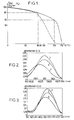
- Figures 2 and 3 show the absorption spectra (absorbance in optical density unit, as a function of the wavelength in nanometers) of a film of the copolymer obtained as indicated in 3 ° above.
- the film is made on a spinner, then it is uniformized by annealing at a temperature close to its glass transition temperature, then the chromophores are oriented by Corona electric field slightly above of the glass transition temperature, and the orientation is frozen by crosslinking, heating clearly above the glass transition temperature, under the Corona electric field.
- furylacrylic acid (marketed by ALDRICH) and thionyl chloride SOCl 2 are reacted in excess at reflux for several hours to obtain furylacrylic acid chloride.
- Furylacrylic acid chloride is thus obtained with a yield of approximately 80% and a purity of approximately 99%.
- the bromopropylester of furylacrylic acid is thus obtained: with a conversion rate of 85%.
Landscapes
- Chemical & Material Sciences (AREA)
- Physics & Mathematics (AREA)
- Organic Chemistry (AREA)
- Nonlinear Science (AREA)
- General Physics & Mathematics (AREA)
- Polymers & Plastics (AREA)
- Medicinal Chemistry (AREA)
- Chemical Kinetics & Catalysis (AREA)
- Health & Medical Sciences (AREA)
- Optics & Photonics (AREA)
- Addition Polymer Or Copolymer, Post-Treatments, Or Chemical Modifications (AREA)
- Graft Or Block Polymers (AREA)
- Polyurethanes Or Polyureas (AREA)
- Epoxy Resins (AREA)
- Macromonomer-Based Addition Polymer (AREA)
- Treatments Of Macromolecular Shaped Articles (AREA)
- Other Resins Obtained By Reactions Not Involving Carbon-To-Carbon Unsaturated Bonds (AREA)
Applications Claiming Priority (2)
| Application Number | Priority Date | Filing Date | Title |
|---|---|---|---|
| FR9310572 | 1993-09-06 | ||
| FR9310572A FR2709755B1 (fr) | 1993-09-06 | 1993-09-06 | Matériau polymère réticulable, utilisable en optique non linéaire, et son procédé d'obtention. |
Publications (2)
| Publication Number | Publication Date |
|---|---|
| EP0641808A1 EP0641808A1 (fr) | 1995-03-08 |
| EP0641808B1 true EP0641808B1 (fr) | 1997-02-26 |
Family
ID=9450585
Family Applications (1)
| Application Number | Title | Priority Date | Filing Date |
|---|---|---|---|
| EP94401961A Expired - Lifetime EP0641808B1 (fr) | 1993-09-06 | 1994-09-02 | Matériau polymère réticulable, utilisable en optique non linéaire, et son procédé d'obtention |
Country Status (5)
| Country | Link |
|---|---|
| US (1) | US5496899A (enExample) |
| EP (1) | EP0641808B1 (enExample) |
| JP (1) | JP2980522B2 (enExample) |
| DE (1) | DE69401791T2 (enExample) |
| FR (1) | FR2709755B1 (enExample) |
Families Citing this family (13)
| Publication number | Priority date | Publication date | Assignee | Title |
|---|---|---|---|---|
| JP3877776B2 (ja) * | 1996-03-07 | 2007-02-07 | Azエレクトロニックマテリアルズ株式会社 | 異常分散により屈折率を変化させた底部反射防止膜 |
| US5652297A (en) * | 1996-08-16 | 1997-07-29 | Hoechst Celanese Corporation | Aqueous antireflective coatings for photoresist compositions |
| US5652317A (en) * | 1996-08-16 | 1997-07-29 | Hoechst Celanese Corporation | Antireflective coatings for photoresist compositions |
| US5733714A (en) * | 1996-09-30 | 1998-03-31 | Clariant Finance (Bvi) Limited | Antireflective coating for photoresist compositions |
| US5981145A (en) * | 1997-04-30 | 1999-11-09 | Clariant Finance (Bvi) Limited | Light absorbing polymers |
| US5994430A (en) * | 1997-04-30 | 1999-11-30 | Clariant Finance Bvi) Limited | Antireflective coating compositions for photoresist compositions and use thereof |
| US6661942B1 (en) | 1998-07-20 | 2003-12-09 | Trans Photonics, Llc | Multi-functional optical switch (optical wavelength division multiplexer/demultiplexer, add-drop multiplexer and inter-connect device) and its methods of manufacture |
| US6429023B1 (en) | 1998-07-20 | 2002-08-06 | Shayda Technologies, Inc. | Biosensors with polymeric optical waveguides |
| US7205347B2 (en) * | 2000-10-19 | 2007-04-17 | Trans Photonics, Llc. | Substituted-polyaryl chromophoric compounds |
| KR100445909B1 (ko) * | 2001-12-26 | 2004-08-25 | 한국전자통신연구원 | 유기 단분자 색소 물질과 발색단을 포함하는 비선형 광학고분자 화합물 |
| FR2891276B1 (fr) * | 2005-09-28 | 2007-12-21 | Corneal Ind Soc Par Actions Si | Composes convenant a titre de colorants jaunes polymerisables; compositions polymerisables et/ou reticulables, matrices polymeres et lentilles intraoculaires les refermant. |
| FR2930252B1 (fr) | 2008-04-18 | 2010-08-20 | Centre Nat Rech Scient | Polymeres thermo-reticulables par reaction de huisgen : application a la preparation des materiaux a proprietes electro-optiques stables |
| CN113831026B (zh) * | 2021-09-22 | 2022-06-24 | 同济大学 | 对硝基苯基重氮盐共价修饰二硫化锡薄膜非线性杂化材料及其制备方法 |
Family Cites Families (10)
| Publication number | Priority date | Publication date | Assignee | Title |
|---|---|---|---|---|
| FR2630744B1 (fr) * | 1988-04-29 | 1992-04-17 | Thomson Csf | Procede d'obtention d'un materiau polymere utilisable en optique non lineaire et materiau polymere obtenu |
| GB2246138A (en) * | 1990-07-20 | 1992-01-22 | Marconi Gec Ltd | Electro optic liquid crystal polymers |
| US5112881A (en) * | 1990-08-24 | 1992-05-12 | University Of Lowell | Photocrosslinked second order nonlinear optical polymers |
| FR2668158B1 (fr) | 1990-10-22 | 1994-05-06 | Thomson Csf | Polymere reticulable pour applications en optique non lineaire. |
| US5266651A (en) * | 1991-05-03 | 1993-11-30 | E. I. Du Pont De Nemours And Company | Crosslinked poled polymers for nonlinear optic applications and method of making them |
| DE4115415A1 (de) * | 1991-05-10 | 1992-11-12 | Basf Ag | Fluessigkristalline polymere mit nahezu einheitlichem molekulargewicht |
| DE4116594A1 (de) * | 1991-05-22 | 1992-11-26 | Basf Ag | Verfahren zur herstellung von polymeren mit nlo-aktiven seitengruppen und deren verwendung |
| FR2678613B1 (fr) * | 1991-07-02 | 1993-09-17 | Thomson Csf | Materiaux reticulables thermiquement pour application en optique non lineaire. |
| DE4232394A1 (de) * | 1992-09-26 | 1994-03-31 | Basf Ag | Copolymerisate mit nichtlinear optischen Eigenschaften und deren Verwendung |
| DE4244197A1 (de) * | 1992-12-24 | 1994-06-30 | Basf Ag | Verfahren zur Herstellung vernetzter Polymerschichten mit nichtlinear optischen Eigenschaften und deren Verwendung |
-
1993
- 1993-09-06 FR FR9310572A patent/FR2709755B1/fr not_active Expired - Lifetime
-
1994
- 1994-09-01 US US08/298,318 patent/US5496899A/en not_active Expired - Lifetime
- 1994-09-02 DE DE69401791T patent/DE69401791T2/de not_active Expired - Lifetime
- 1994-09-02 EP EP94401961A patent/EP0641808B1/fr not_active Expired - Lifetime
- 1994-09-05 JP JP6211527A patent/JP2980522B2/ja not_active Expired - Lifetime
Also Published As
| Publication number | Publication date |
|---|---|
| DE69401791T2 (de) | 1997-08-07 |
| DE69401791D1 (de) | 1997-04-03 |
| JPH07165848A (ja) | 1995-06-27 |
| US5496899A (en) | 1996-03-05 |
| FR2709755B1 (fr) | 1995-11-17 |
| FR2709755A1 (fr) | 1995-03-17 |
| JP2980522B2 (ja) | 1999-11-22 |
| EP0641808A1 (fr) | 1995-03-08 |
Similar Documents
| Publication | Publication Date | Title |
|---|---|---|
| US5219710A (en) | Polymeric nitrones having a styrene-derived backbone chain | |
| US5061404A (en) | Electro-optical materials and light modulator devices containing same | |
| US6555027B2 (en) | Second-order nonlinear optical chromophores containing dioxine and/or bithiophene as conjugate bridge and devices incorporating the same | |
| EP0641808A1 (fr) | Matériau polymère réticulable, utilisable en optique non linéaire, et son procédé d'obtention | |
| US5186865A (en) | Electro-optical materials and light modulator devices containing same | |
| EP0359648B1 (fr) | Polyuréthannes, actifs en optique non linéaire et matériaux les contenant dispositif optique les contenant et procédés de fabrication de ces composés et matériaux | |
| EP0724747B1 (fr) | Polyesterimides utilisables en optique lineaire et/ou en optique non lineaire et l'un de leurs procedes de preparation | |
| EP0482985B1 (fr) | Polymère réticulable pour applications en optique non linéaire | |
| FR2724657A1 (fr) | Materiau reticulable utilisable en opto-electronique, et procede d'obtention de ce materiau, et monomere permettant d'obtenir ce materiau | |
| EP1215271A1 (fr) | Dopants chiraux à induction de pas d'hélice variable et leur application à un affichage réflectif en couleur | |
| FR2630744A1 (fr) | Procede d'obtention d'un materiau polymere utilisable en optique non lineaire et materiau polymere obtenu | |
| US5176983A (en) | Polymeric nitrones having an acrylic backbone chain | |
| FR2706900A1 (enExample) | ||
| US5275924A (en) | Amphiphilic compounds for sequential monolayer deposition | |
| US5273863A (en) | Polymeric nitrones having an acrylic backbone chain | |
| WO2011089351A1 (fr) | Nouveaux chromophores non-lineaires particulierement adaptes pour des applications en modulation electro-optique | |
| CA2215243A1 (en) | Non-linear optical polycarbonates | |
| JP7922725B2 (ja) | 化合物、組成物、硬化物、光学異方体、光学素子、及び導光素子 | |
| JP7727997B2 (ja) | ポリマー及び光制御素子 | |
| JP7402306B2 (ja) | 化合物、液晶組成物 | |
| FR2657083A1 (fr) | Polyesters actifs en optique non lineaire et materiaux les contenant dispositif optique les contenant et procedes de fabrication de ces composes et materiaux. | |
| FR2651237A1 (fr) | Copolymeres amorphes pour applications en optique non lineaire. | |
| KR19980070888A (ko) | 유도 복굴절성이 높은 광어드레스성 측쇄 중합체 | |
| EP2276798B1 (fr) | Procede de reticulation par reaction de huisgen thermique, polymeres chromophores reticulables et materiaux polymeres reticules a proprietes electro-optiques stables | |
| EP0567379B1 (fr) | Matériau réticulé photochimiquement pour application à l'optique non linéaire |
Legal Events
| Date | Code | Title | Description |
|---|---|---|---|
| PUAI | Public reference made under article 153(3) epc to a published international application that has entered the european phase |
Free format text: ORIGINAL CODE: 0009012 |
|
| AK | Designated contracting states |
Kind code of ref document: A1 Designated state(s): DE FR GB IT NL SE |
|
| 17P | Request for examination filed |
Effective date: 19950314 |
|
| GRAG | Despatch of communication of intention to grant |
Free format text: ORIGINAL CODE: EPIDOS AGRA |
|
| 17Q | First examination report despatched |
Effective date: 19960712 |
|
| GRAH | Despatch of communication of intention to grant a patent |
Free format text: ORIGINAL CODE: EPIDOS IGRA |
|
| GRAH | Despatch of communication of intention to grant a patent |
Free format text: ORIGINAL CODE: EPIDOS IGRA |
|
| GRAA | (expected) grant |
Free format text: ORIGINAL CODE: 0009210 |
|
| AK | Designated contracting states |
Kind code of ref document: B1 Designated state(s): DE FR GB IT NL SE |
|
| PG25 | Lapsed in a contracting state [announced via postgrant information from national office to epo] |
Ref country code: IT Free format text: LAPSE BECAUSE OF FAILURE TO SUBMIT A TRANSLATION OF THE DESCRIPTION OR TO PAY THE FEE WITHIN THE PRE;WARNING: LAPSES OF ITALIAN PATENTS WITH EFFECTIVE DATE BEFORE 2007 MAY HAVE OCCURRED AT ANY TIME BEFORE 2007. THE CORRECT EFFECTIVE DATE MAY BE DIFFERENT FROM THE ONE RECORDED.SCRIBED TIME-LIMIT Effective date: 19970226 |
|
| GBT | Gb: translation of ep patent filed (gb section 77(6)(a)/1977) |
Effective date: 19970228 |
|
| REF | Corresponds to: |
Ref document number: 69401791 Country of ref document: DE Date of ref document: 19970403 |
|
| PG25 | Lapsed in a contracting state [announced via postgrant information from national office to epo] |
Ref country code: SE Effective date: 19970526 |
|
| PLBE | No opposition filed within time limit |
Free format text: ORIGINAL CODE: 0009261 |
|
| STAA | Information on the status of an ep patent application or granted ep patent |
Free format text: STATUS: NO OPPOSITION FILED WITHIN TIME LIMIT |
|
| 26N | No opposition filed | ||
| REG | Reference to a national code |
Ref country code: GB Ref legal event code: IF02 |
|
| PGFP | Annual fee paid to national office [announced via postgrant information from national office to epo] |
Ref country code: NL Payment date: 20070824 Year of fee payment: 14 |
|
| REG | Reference to a national code |
Ref country code: FR Ref legal event code: CJ |
|
| PG25 | Lapsed in a contracting state [announced via postgrant information from national office to epo] |
Ref country code: NL Free format text: LAPSE BECAUSE OF NON-PAYMENT OF DUE FEES Effective date: 20090401 |
|
| NLV4 | Nl: lapsed or anulled due to non-payment of the annual fee |
Effective date: 20090401 |
|
| REG | Reference to a national code |
Ref country code: GB Ref legal event code: 732E Free format text: REGISTERED BETWEEN 20090924 AND 20090930 |
|
| PGFP | Annual fee paid to national office [announced via postgrant information from national office to epo] |
Ref country code: DE Payment date: 20100930 Year of fee payment: 17 |
|
| PGFP | Annual fee paid to national office [announced via postgrant information from national office to epo] |
Ref country code: GB Payment date: 20120829 Year of fee payment: 19 |
|
| PGFP | Annual fee paid to national office [announced via postgrant information from national office to epo] |
Ref country code: FR Payment date: 20120910 Year of fee payment: 19 |
|
| PG25 | Lapsed in a contracting state [announced via postgrant information from national office to epo] |
Ref country code: DE Free format text: LAPSE BECAUSE OF NON-PAYMENT OF DUE FEES Effective date: 20130403 |
|
| REG | Reference to a national code |
Ref country code: DE Ref legal event code: R119 Ref document number: 69401791 Country of ref document: DE Effective date: 20130403 |
|
| GBPC | Gb: european patent ceased through non-payment of renewal fee |
Effective date: 20130902 |
|
| REG | Reference to a national code |
Ref country code: FR Ref legal event code: ST Effective date: 20140530 |
|
| PG25 | Lapsed in a contracting state [announced via postgrant information from national office to epo] |
Ref country code: GB Free format text: LAPSE BECAUSE OF NON-PAYMENT OF DUE FEES Effective date: 20130902 |
|
| PG25 | Lapsed in a contracting state [announced via postgrant information from national office to epo] |
Ref country code: FR Free format text: LAPSE BECAUSE OF NON-PAYMENT OF DUE FEES Effective date: 20130930 |