EP0635178B1 - A method for avoiding self-oscillation in conjunction with echo cancellation - Google Patents
A method for avoiding self-oscillation in conjunction with echo cancellation Download PDFInfo
- Publication number
- EP0635178B1 EP0635178B1 EP93909104A EP93909104A EP0635178B1 EP 0635178 B1 EP0635178 B1 EP 0635178B1 EP 93909104 A EP93909104 A EP 93909104A EP 93909104 A EP93909104 A EP 93909104A EP 0635178 B1 EP0635178 B1 EP 0635178B1
- Authority
- EP
- European Patent Office
- Prior art keywords
- coefficients
- echo
- transfer function
- filter
- adaptive
- Prior art date
- Legal status (The legal status is an assumption and is not a legal conclusion. Google has not performed a legal analysis and makes no representation as to the accuracy of the status listed.)
- Expired - Lifetime
Links
Images
Classifications
-
- H—ELECTRICITY
- H04—ELECTRIC COMMUNICATION TECHNIQUE
- H04B—TRANSMISSION
- H04B3/00—Line transmission systems
- H04B3/02—Details
- H04B3/20—Reducing echo effects or singing; Opening or closing transmitting path; Conditioning for transmission in one direction or the other
- H04B3/23—Reducing echo effects or singing; Opening or closing transmitting path; Conditioning for transmission in one direction or the other using a replica of transmitted signal in the time domain, e.g. echo cancellers
Definitions
- the present invention relates to a method for avoiding self-oscillation in a four-wire loop in conjunction with echo cancellation effected with the aid of an adaptive filter.
- the known method there is used a so-called double-talk detector and the updating of an adaptive filter used for echo cancellation is interrupted when signals from a near-end are detected.
- the method can be relatively successful in the case of trunk echo cancelers which are localized in a network so that the echo path will be relatively heavily attenuated, e.g. more than 6 dB.
- attenuation of the echo is poorer in the case of an adaptive hybrid which lies in the actual 2/4-wire transition, and consequently the detector has a more difficult task.
- any self-oscillation will be interpreted as a strong near-end signal, causing updating to be interrupted. In this case, any self-oscillation that had commenced would become permanent, which is unacceptable.
- the adaptive filter is comprised of one of 24 predetermined filters.
- this merely provides highly limited possibilities of effectively canceling echoes. Consequently, it is probable that the method can only be used for adaptive hybrids, due to the relatively low requirement of echo cancellation that then exists.
- the object of the present invention is to provide a method of avoiding self-oscillation in a four-wire loop in conjunction with echo cancellation with the aid of an adaptive filter.
- the method shall be effective in both long and short connections and also when signalling with narrow-band signals. In brief, this is achieved by restricting the permitted range of the coefficients of the adaptive filter in a manner such that the absolute value of the filter transfer function will be sufficiently small for the amplification in the four-wire loop to be less than one.
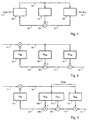
- Figure 1 is a block schematic illustrating a four-wire loop which includes a trunk echo canceller
- Figure 2 is a block schematic equivalent to the block schematic shown in Figure 1
- Figure 3 illustrates an equivalent block schematic for a four-wire loop which incorporates an adaptive hybrid.
- FIG. 1 is a block schematic which constitutes an example of a four-wire loop incorporating an echo canceler which may function as a so-called trunk echo canceler for instance.
- Reference numerals 11 and 12 identify a two-wire line at a far-end and at a near-end respectively. Each of the lines is connected to a respective two/four-wire hybrid 13 and 14.
- the echo canceler includes a digital adaptive filter 15 which is normally referred to as a balance filter in connection with echo canceling.
- the filter is coupled between a branch 16 with the transmission direction to the right, and a branch 17, 19 with the transmission direction to the left.
- An echo estimate is formed in the filter 15 and subtracted from a signal in the branch 17 in a subtraction means 18.
- Figure 2 illustrates a block schematic which is equivalent to the schematic shown in Figure 1 and in which the transfer functions of different blocks have been marked.
- the same reference signs as those used in Figure 1 have also been used in Figure 2.
- the echo transfer functions for the two/four-wire hybrids 13, 14 and the transfer function for the balance filter 15 are called H fa , H ne and H ca , which stand for H far , H near and H cancel respectively.
- a trunk echo canceler is normally placed at a location where echo loss is greater than 6 dB. Consequently, in one such particular case the following will apply for the echo transfer function, at the near-end: H ne ⁇ 0.5 and at the far-end: H fa ⁇ 0.5
- Equation (4) together with equation (2) gives: H ne -H ca ⁇ 2
- Equation (4) together with equation (6) gives the following stability condition: H ca ⁇ 1/ H fa - H ne
- Equation (7) thus gives a general and adequate stability condition for an echo canceler according to Figures 1 and 2.
- This condition will guarantee stability when the absolute value of the balance filter transfer function is limited to being smaller than a given function of the echo transfer function in the far-end of the loop and in its near-end.
- is restricted is to calculate the value of
- the most common type of adaptive filter in an echo canceler is an FIR-filter.
- T 1/f s , where f s is the sampling frequency.
- the most common adaptive filter updating method is the LMS-method.
- Variants of this algorithm in which the error sign and/or the signal sign are used are also common.
- Equation (15) implies that the coefficients are returned to the permitted range at right angles to the condition according to equation (14).
- Equation (15) is very similar to the normal updating equation, i.e. equation (13), and implies that the absolute sum of each coefficient is reduced by an equally as large sum. If so desired, the equation (15) can be modified in a normal manner to obtain the sign algorithm or sign/sign-algorithm. The additional calculation required is moderate and the factor E/Nv is the same for all coefficients and need therefore only be calculated once with each updating process and then added to or subtracted from each coefficient, depending on the sign of the coefficient.
- the transfer function of the echo canceler In order to be able to cancel the one echo path and not induce self-oscillation in the four-wire loop, the transfer function of the echo canceler must therefore be capable of fulfilling the following conditions: 0.5 ⁇ Max( H ca ) ⁇ 1.5
- FIG 3 illustrates an example of an equivalent block schematic illustrating a four-wire loop having an echo canceler in the form of an adaptive hybrid.
- This block schematic includes a balance filter which is located much closer to the near-end hybrid, e.g. on the same circuit board as said hybrid, than is normal in the case described above.
- the balance filter is divided into an adaptive part 150 having the transfer function H ca and a fixed, non-adaptive part 151 having the transfer function H co .
- the output from the adaptive part 150 of the balance filter is connected to a subtraction means 180, whereas the output from the fixed part 151 of said filter is connected to a subtraction means 181.
- the fixed filter part is a non-adaptive path, which, for instance, corresponds to the echo when the line is terminated with the nominal impedance of the line circuit, whereas the adaptive filter part can be considered in the same manner as the balance filter 15 in the example illustrated in Figures 1 and 2.
- the resultant echo transfer function downstream of the adaptive filter part 150, i.e. for the near-end hybrid 14 and the fixed filter part 151, has been marked symbolically with the reference sign H' ne in the Figure and can be said to correspond to H ne in Figure 2, whereas the adaptive filter part, H ca , correspond to H ca in Figure 2.
- H' ne H ne - H co applies for H' ne .
- the absolute value of the transfer function of the adaptive filter part is caused to be smaller than a given function of the echo transfer function in the far-end of the loop and the resultant echo transfer function downstream of the adaptive filter part, i.e. for the fixed filter part together with the echo transfer function in the near-end of the loop.
- the condition according to equation (7) is actually a special case of the condition according to equation (22), since the balance filter 15 of the embodiment illustrated in Figures 1 and 2 does not include a non-adaptive part.
- echo loss in the near-end can be lower than 6 dB, possibly only one or two dB.
- the total echo loss required is much lower, since the adaptive hybrid need only be as good as or only slightly better than a suitable compromise balance, which implies loss of the echo by slightly more than 10 dB.
- loss of the echo in the far-end may also be lower than 6 dB, particularly in the USA where one and the same input and output level is used in a local station, so that no loss occurs in the four-wire loop.
- the following relationships apply when the echo loss in the near-end and the far-end are greater than 3 dB, and when B sum ⁇ 0.7: H' ne ⁇ 0.707, H fa ⁇ 0.707 and H ca ⁇ 0.7, which give: H fa *( H' ne + H ca ) ⁇ 0.707*(0.707+0.7) ⁇ 1 which results in stability, since the loop amplification is lower than one.
- Equation (27) resembles equation (23).
- a third possibility is to apply non-perpendicular updating.
- the same limitation of the transfer function can be obtained by using the aforesaid criteria but with another updating algorithm. However, the convergence along the boundary condition is changed so that true optimum cannot be achieved. However, such a method may be applied to advantage, when it reduces calculation requirements.
- An example of one such updating algorithm is given below.
- equation (30) all coefficients are multiplied by the same factor. This implies that if the condition E ⁇ 0 is not fulfilled, there is introduced a leakage of such large magnitude as to return the coefficients to the permitted range. It can be mentioned that leakage is a measure used to achieve stabilization, in that in the updating process the adaptive coefficients are given a contribution which moves them towards zero or some other predetermined value. Multiplication of the coefficients by the same factor may, for instance, be advantageous when the sign operator is lacking among the routines of the signal processor. If optimum lies outside the boundary condition, updating will proceed towards that point on the border where the direction to the origin of the coordinates is perpendicular to the level curve of the error criterium.
- H ca b com * ⁇ b v *z -v ⁇
- b com is normally 1.0 but is reduced when E is greater than zero.
- Updating can also be effected in the same manner as that described with reference to equations (30) - (33).
Landscapes
- Engineering & Computer Science (AREA)
- Computer Networks & Wireless Communication (AREA)
- Signal Processing (AREA)
- Cable Transmission Systems, Equalization Of Radio And Reduction Of Echo (AREA)
- Interconnected Communication Systems, Intercoms, And Interphones (AREA)
- Filters That Use Time-Delay Elements (AREA)
- Pressure Sensors (AREA)
- Vibration Prevention Devices (AREA)
- Vehicle Body Suspensions (AREA)
- Percussion Or Vibration Massage (AREA)
- Oscillators With Electromechanical Resonators (AREA)
- Gyroscopes (AREA)
Applications Claiming Priority (3)
| Application Number | Priority Date | Filing Date | Title |
|---|---|---|---|
| SE9201145 | 1992-04-09 | ||
| SE9201145A SE470119B (sv) | 1992-04-09 | 1992-04-09 | Metod för att undvika självsvängning i en fyrtrådsslinga i samband med ekosläckning |
| PCT/SE1993/000218 WO1993021695A1 (en) | 1992-04-09 | 1993-03-11 | A method for avoiding self-oscillation in conjunction with echo cancellation |
Publications (2)
| Publication Number | Publication Date |
|---|---|
| EP0635178A1 EP0635178A1 (en) | 1995-01-25 |
| EP0635178B1 true EP0635178B1 (en) | 1999-05-06 |
Family
ID=20385920
Family Applications (1)
| Application Number | Title | Priority Date | Filing Date |
|---|---|---|---|
| EP93909104A Expired - Lifetime EP0635178B1 (en) | 1992-04-09 | 1993-03-11 | A method for avoiding self-oscillation in conjunction with echo cancellation |
Country Status (16)
| Country | Link |
|---|---|
| US (1) | US5446787A (da) |
| EP (1) | EP0635178B1 (da) |
| JP (1) | JPH07505986A (da) |
| KR (1) | KR100271343B1 (da) |
| AT (1) | ATE179849T1 (da) |
| AU (1) | AU668558B2 (da) |
| BR (1) | BR9306205A (da) |
| CA (1) | CA2131890A1 (da) |
| DE (1) | DE69324806T2 (da) |
| DK (1) | DK0635178T3 (da) |
| ES (1) | ES2132229T3 (da) |
| FI (1) | FI944726L (da) |
| GR (1) | GR3030748T3 (da) |
| NO (1) | NO306919B1 (da) |
| SE (1) | SE470119B (da) |
| WO (1) | WO1993021695A1 (da) |
Families Citing this family (9)
| Publication number | Priority date | Publication date | Assignee | Title |
|---|---|---|---|---|
| US5612996A (en) * | 1995-09-21 | 1997-03-18 | Rockwell International Corporation | Loop gain processing system for speakerphone applications |
| US6243366B1 (en) * | 1997-06-20 | 2001-06-05 | At&T Corp. | Method and apparatus for providing interactive two-way communications using a single one-way channel in satellite systems |
| KR100477638B1 (ko) * | 2001-09-11 | 2005-03-23 | 삼성전자주식회사 | 2d/3d 겸용 디스플레이 |
| US7242762B2 (en) * | 2002-06-24 | 2007-07-10 | Freescale Semiconductor, Inc. | Monitoring and control of an adaptive filter in a communication system |
| US7388954B2 (en) * | 2002-06-24 | 2008-06-17 | Freescale Semiconductor, Inc. | Method and apparatus for tone indication |
| US6961423B2 (en) | 2002-06-24 | 2005-11-01 | Freescale Semiconductor, Inc. | Method and apparatus for performing adaptive filtering |
| US7215765B2 (en) * | 2002-06-24 | 2007-05-08 | Freescale Semiconductor, Inc. | Method and apparatus for pure delay estimation in a communication system |
| KR20060087575A (ko) * | 2003-09-23 | 2006-08-02 | 코닌클리즈케 필립스 일렉트로닉스 엔.브이. | 필터 장치 및 필터링 방법 |
| ATE494669T1 (de) * | 2006-11-17 | 2011-01-15 | Siemens Ag | Verfahren und anordnung zur steuerung von adaptiven filtern |
Family Cites Families (5)
| Publication number | Priority date | Publication date | Assignee | Title |
|---|---|---|---|---|
| JPS583430A (ja) * | 1981-06-30 | 1983-01-10 | Nec Corp | まわり込信号抑圧装置 |
| US4712235A (en) * | 1984-11-19 | 1987-12-08 | International Business Machines Corporation | Method and apparatus for improved control and time sharing of an echo canceller |
| US4811261A (en) * | 1985-03-04 | 1989-03-07 | Oki Electric Industry Co., Ltd. | Adaptive digital filter for determining a transfer equation of an unknown system |
| US4894820A (en) * | 1987-03-24 | 1990-01-16 | Oki Electric Industry Co., Ltd. | Double-talk detection in an echo canceller |
| US5111481A (en) * | 1989-11-17 | 1992-05-05 | Nynex Corporation | Dual mode LMS channel equalizer |
-
1992
- 1992-04-09 SE SE9201145A patent/SE470119B/sv not_active IP Right Cessation
-
1993
- 1993-03-11 JP JP5518219A patent/JPH07505986A/ja active Pending
- 1993-03-11 BR BR9306205A patent/BR9306205A/pt not_active IP Right Cessation
- 1993-03-11 WO PCT/SE1993/000218 patent/WO1993021695A1/en not_active Ceased
- 1993-03-11 KR KR1019940703593A patent/KR100271343B1/ko not_active Expired - Fee Related
- 1993-03-11 DE DE69324806T patent/DE69324806T2/de not_active Expired - Fee Related
- 1993-03-11 AU AU39638/93A patent/AU668558B2/en not_active Ceased
- 1993-03-11 ES ES93909104T patent/ES2132229T3/es not_active Expired - Lifetime
- 1993-03-11 CA CA002131890A patent/CA2131890A1/en not_active Abandoned
- 1993-03-11 EP EP93909104A patent/EP0635178B1/en not_active Expired - Lifetime
- 1993-03-11 FI FI944726A patent/FI944726L/fi unknown
- 1993-03-11 AT AT93909104T patent/ATE179849T1/de not_active IP Right Cessation
- 1993-03-11 DK DK93909104T patent/DK0635178T3/da active
- 1993-04-08 US US08/044,050 patent/US5446787A/en not_active Expired - Lifetime
-
1994
- 1994-10-07 NO NO943781A patent/NO306919B1/no not_active IP Right Cessation
-
1999
- 1999-07-13 GR GR990401832T patent/GR3030748T3/el unknown
Also Published As
| Publication number | Publication date |
|---|---|
| SE9201145L (sv) | 1993-10-10 |
| DE69324806T2 (de) | 1999-10-07 |
| AU668558B2 (en) | 1996-05-09 |
| SE9201145D0 (sv) | 1992-04-09 |
| ATE179849T1 (de) | 1999-05-15 |
| WO1993021695A1 (en) | 1993-10-28 |
| NO306919B1 (no) | 2000-01-10 |
| KR100271343B1 (ko) | 2000-11-01 |
| JPH07505986A (ja) | 1995-06-29 |
| GR3030748T3 (en) | 1999-11-30 |
| NO943781L (no) | 1994-10-07 |
| NO943781D0 (no) | 1994-10-07 |
| DE69324806D1 (de) | 1999-06-10 |
| CA2131890A1 (en) | 1993-10-28 |
| ES2132229T3 (es) | 1999-08-16 |
| AU3963893A (en) | 1993-11-18 |
| EP0635178A1 (en) | 1995-01-25 |
| FI944726A7 (fi) | 1994-10-07 |
| BR9306205A (pt) | 1998-06-23 |
| DK0635178T3 (da) | 1999-11-15 |
| FI944726A0 (fi) | 1994-10-07 |
| SE470119B (sv) | 1993-11-08 |
| KR950701165A (ko) | 1995-02-20 |
| FI944726L (fi) | 1994-10-07 |
| US5446787A (en) | 1995-08-29 |
Similar Documents
| Publication | Publication Date | Title |
|---|---|---|
| US5737410A (en) | Method for determining the location of echo in an echo canceller | |
| EP0829147B1 (en) | System and method for avoiding false convergence in the presence of tones in a time-domain echo cancellation process | |
| US5274705A (en) | Nonlinear processor for an echo canceller and method | |
| US4757527A (en) | Echo canceller | |
| EP1202469B1 (en) | Echo canceler and echo path estimating method | |
| CA2139895C (en) | Residual echo elimination with proportionate noise injection | |
| CA1221180A (en) | Method of and device for the digital cancellation of the echo generated in connections with time-varying characteristics | |
| EP0698317B1 (en) | A method and echo canceller for echo cancellation with a number of cascade-connected adaptive filters | |
| EP0116968B1 (en) | Adaptive echo canceller | |
| EP0635178B1 (en) | A method for avoiding self-oscillation in conjunction with echo cancellation | |
| US6185299B1 (en) | Adaptive echo cancellation device in a voice communication system | |
| US5477535A (en) | Method of preventing a divergence of an adaptive echo canceller in a noisy signal environment | |
| KR100320315B1 (ko) | 적응에코제거방법 | |
| US7724893B2 (en) | Method of adaptation step control in echo cancellers | |
| JP2949989B2 (ja) | エコー消去装置 | |
| JPH06503456A (ja) | ノイズ信号の環境における適応性エコーキャンセラーの発散防止方法 | |
| HK1011472B (en) | Method for determining the location of echo in an echo canceller | |
| JPH05183472A (ja) | エコーキャンセラ機能付音声加算装置 | |
| HK1010958B (en) | System and method for avoiding false convergence in the presence of tones in a time-domain echo cancellation process | |
| JPH04262627A (ja) | エコーキャンセラ装置 |
Legal Events
| Date | Code | Title | Description |
|---|---|---|---|
| PUAI | Public reference made under article 153(3) epc to a published international application that has entered the european phase |
Free format text: ORIGINAL CODE: 0009012 |
|
| 17P | Request for examination filed |
Effective date: 19940905 |
|
| AK | Designated contracting states |
Kind code of ref document: A1 Designated state(s): AT BE CH DE DK ES FR GB GR IE IT LI NL |
|
| 17Q | First examination report despatched |
Effective date: 19980324 |
|
| GRAG | Despatch of communication of intention to grant |
Free format text: ORIGINAL CODE: EPIDOS AGRA |
|
| GRAG | Despatch of communication of intention to grant |
Free format text: ORIGINAL CODE: EPIDOS AGRA |
|
| GRAH | Despatch of communication of intention to grant a patent |
Free format text: ORIGINAL CODE: EPIDOS IGRA |
|
| GRAH | Despatch of communication of intention to grant a patent |
Free format text: ORIGINAL CODE: EPIDOS IGRA |
|
| GRAA | (expected) grant |
Free format text: ORIGINAL CODE: 0009210 |
|
| AK | Designated contracting states |
Kind code of ref document: B1 Designated state(s): AT BE CH DE DK ES FR GB GR IE IT LI NL |
|
| REF | Corresponds to: |
Ref document number: 179849 Country of ref document: AT Date of ref document: 19990515 Kind code of ref document: T |
|
| REG | Reference to a national code |
Ref country code: CH Ref legal event code: EP |
|
| REF | Corresponds to: |
Ref document number: 69324806 Country of ref document: DE Date of ref document: 19990610 |
|
| REG | Reference to a national code |
Ref country code: CH Ref legal event code: NV Representative=s name: ISLER & PEDRAZZINI AG |
|
| REG | Reference to a national code |
Ref country code: IE Ref legal event code: FG4D |
|
| ET | Fr: translation filed | ||
| REG | Reference to a national code |
Ref country code: ES Ref legal event code: FG2A Ref document number: 2132229 Country of ref document: ES Kind code of ref document: T3 |
|
| REG | Reference to a national code |
Ref country code: DK Ref legal event code: T3 |
|
| PGFP | Annual fee paid to national office [announced via postgrant information from national office to epo] |
Ref country code: CH Payment date: 20000221 Year of fee payment: 8 |
|
| PLBE | No opposition filed within time limit |
Free format text: ORIGINAL CODE: 0009261 |
|
| STAA | Information on the status of an ep patent application or granted ep patent |
Free format text: STATUS: NO OPPOSITION FILED WITHIN TIME LIMIT |
|
| 26N | No opposition filed | ||
| PGFP | Annual fee paid to national office [announced via postgrant information from national office to epo] |
Ref country code: AT Payment date: 20010221 Year of fee payment: 9 |
|
| PGFP | Annual fee paid to national office [announced via postgrant information from national office to epo] |
Ref country code: GR Payment date: 20010228 Year of fee payment: 9 |
|
| PGFP | Annual fee paid to national office [announced via postgrant information from national office to epo] |
Ref country code: BE Payment date: 20010306 Year of fee payment: 9 |
|
| PGFP | Annual fee paid to national office [announced via postgrant information from national office to epo] |
Ref country code: IE Payment date: 20010329 Year of fee payment: 9 |
|
| PG25 | Lapsed in a contracting state [announced via postgrant information from national office to epo] |
Ref country code: LI Free format text: LAPSE BECAUSE OF NON-PAYMENT OF DUE FEES Effective date: 20010331 Ref country code: CH Free format text: LAPSE BECAUSE OF NON-PAYMENT OF DUE FEES Effective date: 20010331 |
|
| REG | Reference to a national code |
Ref country code: CH Ref legal event code: PL |
|
| REG | Reference to a national code |
Ref country code: GB Ref legal event code: IF02 |
|
| PGFP | Annual fee paid to national office [announced via postgrant information from national office to epo] |
Ref country code: NL Payment date: 20020221 Year of fee payment: 10 Ref country code: FR Payment date: 20020221 Year of fee payment: 10 |
|
| PGFP | Annual fee paid to national office [announced via postgrant information from national office to epo] |
Ref country code: DK Payment date: 20020227 Year of fee payment: 10 |
|
| PG25 | Lapsed in a contracting state [announced via postgrant information from national office to epo] |
Ref country code: IE Free format text: LAPSE BECAUSE OF NON-PAYMENT OF DUE FEES Effective date: 20020311 Ref country code: AT Free format text: LAPSE BECAUSE OF NON-PAYMENT OF DUE FEES Effective date: 20020311 |
|
| PGFP | Annual fee paid to national office [announced via postgrant information from national office to epo] |
Ref country code: DE Payment date: 20020320 Year of fee payment: 10 |
|
| PG25 | Lapsed in a contracting state [announced via postgrant information from national office to epo] |
Ref country code: BE Free format text: LAPSE BECAUSE OF NON-PAYMENT OF DUE FEES Effective date: 20020331 |
|
| PGFP | Annual fee paid to national office [announced via postgrant information from national office to epo] |
Ref country code: ES Payment date: 20020409 Year of fee payment: 10 |
|
| BERE | Be: lapsed |
Owner name: TELEFONAKTIEBOLAGET LM *ERICSSON Effective date: 20020331 |
|
| PG25 | Lapsed in a contracting state [announced via postgrant information from national office to epo] |
Ref country code: GR Free format text: LAPSE BECAUSE OF NON-PAYMENT OF DUE FEES Effective date: 20021007 |
|
| REG | Reference to a national code |
Ref country code: IE Ref legal event code: MM4A |
|
| PG25 | Lapsed in a contracting state [announced via postgrant information from national office to epo] |
Ref country code: ES Free format text: LAPSE BECAUSE OF NON-PAYMENT OF DUE FEES Effective date: 20030312 |
|
| PG25 | Lapsed in a contracting state [announced via postgrant information from national office to epo] |
Ref country code: DK Free format text: LAPSE BECAUSE OF NON-PAYMENT OF DUE FEES Effective date: 20030331 |
|
| PG25 | Lapsed in a contracting state [announced via postgrant information from national office to epo] |
Ref country code: NL Free format text: LAPSE BECAUSE OF NON-PAYMENT OF DUE FEES Effective date: 20031001 Ref country code: DE Free format text: LAPSE BECAUSE OF NON-PAYMENT OF DUE FEES Effective date: 20031001 |
|
| PG25 | Lapsed in a contracting state [announced via postgrant information from national office to epo] |
Ref country code: FR Free format text: LAPSE BECAUSE OF NON-PAYMENT OF DUE FEES Effective date: 20031127 |
|
| NLV4 | Nl: lapsed or anulled due to non-payment of the annual fee |
Effective date: 20031001 |
|
| REG | Reference to a national code |
Ref country code: FR Ref legal event code: ST |
|
| REG | Reference to a national code |
Ref country code: ES Ref legal event code: FD2A Effective date: 20030312 |
|
| PG25 | Lapsed in a contracting state [announced via postgrant information from national office to epo] |
Ref country code: IT Free format text: LAPSE BECAUSE OF NON-PAYMENT OF DUE FEES;WARNING: LAPSES OF ITALIAN PATENTS WITH EFFECTIVE DATE BEFORE 2007 MAY HAVE OCCURRED AT ANY TIME BEFORE 2007. THE CORRECT EFFECTIVE DATE MAY BE DIFFERENT FROM THE ONE RECORDED. Effective date: 20050311 |
|
| PGFP | Annual fee paid to national office [announced via postgrant information from national office to epo] |
Ref country code: GB Payment date: 20120326 Year of fee payment: 20 |
|
| REG | Reference to a national code |
Ref country code: GB Ref legal event code: PE20 Expiry date: 20130310 |
|
| PG25 | Lapsed in a contracting state [announced via postgrant information from national office to epo] |
Ref country code: GB Free format text: LAPSE BECAUSE OF EXPIRATION OF PROTECTION Effective date: 20130310 |