EP0634867B1 - Méthode d'enregistrement de données comprimées et codées - Google Patents
Méthode d'enregistrement de données comprimées et codées Download PDFInfo
- Publication number
- EP0634867B1 EP0634867B1 EP94303964A EP94303964A EP0634867B1 EP 0634867 B1 EP0634867 B1 EP 0634867B1 EP 94303964 A EP94303964 A EP 94303964A EP 94303964 A EP94303964 A EP 94303964A EP 0634867 B1 EP0634867 B1 EP 0634867B1
- Authority
- EP
- European Patent Office
- Prior art keywords
- data
- pack
- packet
- video
- compressed
- Prior art date
- Legal status (The legal status is an assumption and is not a legal conclusion. Google has not performed a legal analysis and makes no representation as to the accuracy of the status listed.)
- Expired - Lifetime
Links
- 238000000034 method Methods 0.000 title claims description 32
- 230000005236 sound signal Effects 0.000 claims description 19
- 239000000872 buffer Substances 0.000 description 19
- 238000010586 diagram Methods 0.000 description 10
- 230000006835 compression Effects 0.000 description 7
- 238000007906 compression Methods 0.000 description 7
- 238000013139 quantization Methods 0.000 description 7
- 102100037812 Medium-wave-sensitive opsin 1 Human genes 0.000 description 4
- 230000005540 biological transmission Effects 0.000 description 4
- 230000001360 synchronised effect Effects 0.000 description 4
- 230000006870 function Effects 0.000 description 3
- 101000946275 Homo sapiens Protein CLEC16A Proteins 0.000 description 2
- 102100034718 Protein CLEC16A Human genes 0.000 description 2
- 230000007423 decrease Effects 0.000 description 2
- 101100122750 Caenorhabditis elegans gop-2 gene Proteins 0.000 description 1
- 238000013459 approach Methods 0.000 description 1
- 238000007796 conventional method Methods 0.000 description 1
- 230000003111 delayed effect Effects 0.000 description 1
- 238000001514 detection method Methods 0.000 description 1
- 238000004519 manufacturing process Methods 0.000 description 1
- 230000008707 rearrangement Effects 0.000 description 1
Images


Classifications
-
- H—ELECTRICITY
- H04—ELECTRIC COMMUNICATION TECHNIQUE
- H04N—PICTORIAL COMMUNICATION, e.g. TELEVISION
- H04N9/00—Details of colour television systems
- H04N9/79—Processing of colour television signals in connection with recording
- H04N9/80—Transformation of the television signal for recording, e.g. modulation, frequency changing; Inverse transformation for playback
- H04N9/804—Transformation of the television signal for recording, e.g. modulation, frequency changing; Inverse transformation for playback involving pulse code modulation of the colour picture signal components
- H04N9/8042—Transformation of the television signal for recording, e.g. modulation, frequency changing; Inverse transformation for playback involving pulse code modulation of the colour picture signal components involving data reduction
- H04N9/8047—Transformation of the television signal for recording, e.g. modulation, frequency changing; Inverse transformation for playback involving pulse code modulation of the colour picture signal components involving data reduction using transform coding
-
- H—ELECTRICITY
- H04—ELECTRIC COMMUNICATION TECHNIQUE
- H04N—PICTORIAL COMMUNICATION, e.g. TELEVISION
- H04N19/00—Methods or arrangements for coding, decoding, compressing or decompressing digital video signals
- H04N19/10—Methods or arrangements for coding, decoding, compressing or decompressing digital video signals using adaptive coding
- H04N19/102—Methods or arrangements for coding, decoding, compressing or decompressing digital video signals using adaptive coding characterised by the element, parameter or selection affected or controlled by the adaptive coding
- H04N19/124—Quantisation
-
- H—ELECTRICITY
- H04—ELECTRIC COMMUNICATION TECHNIQUE
- H04N—PICTORIAL COMMUNICATION, e.g. TELEVISION
- H04N19/00—Methods or arrangements for coding, decoding, compressing or decompressing digital video signals
- H04N19/10—Methods or arrangements for coding, decoding, compressing or decompressing digital video signals using adaptive coding
- H04N19/134—Methods or arrangements for coding, decoding, compressing or decompressing digital video signals using adaptive coding characterised by the element, parameter or criterion affecting or controlling the adaptive coding
- H04N19/146—Data rate or code amount at the encoder output
- H04N19/149—Data rate or code amount at the encoder output by estimating the code amount by means of a model, e.g. mathematical model or statistical model
-
- H—ELECTRICITY
- H04—ELECTRIC COMMUNICATION TECHNIQUE
- H04N—PICTORIAL COMMUNICATION, e.g. TELEVISION
- H04N19/00—Methods or arrangements for coding, decoding, compressing or decompressing digital video signals
- H04N19/10—Methods or arrangements for coding, decoding, compressing or decompressing digital video signals using adaptive coding
- H04N19/169—Methods or arrangements for coding, decoding, compressing or decompressing digital video signals using adaptive coding characterised by the coding unit, i.e. the structural portion or semantic portion of the video signal being the object or the subject of the adaptive coding
- H04N19/17—Methods or arrangements for coding, decoding, compressing or decompressing digital video signals using adaptive coding characterised by the coding unit, i.e. the structural portion or semantic portion of the video signal being the object or the subject of the adaptive coding the unit being an image region, e.g. an object
- H04N19/176—Methods or arrangements for coding, decoding, compressing or decompressing digital video signals using adaptive coding characterised by the coding unit, i.e. the structural portion or semantic portion of the video signal being the object or the subject of the adaptive coding the unit being an image region, e.g. an object the region being a block, e.g. a macroblock
-
- H—ELECTRICITY
- H04—ELECTRIC COMMUNICATION TECHNIQUE
- H04N—PICTORIAL COMMUNICATION, e.g. TELEVISION
- H04N19/00—Methods or arrangements for coding, decoding, compressing or decompressing digital video signals
- H04N19/46—Embedding additional information in the video signal during the compression process
-
- H—ELECTRICITY
- H04—ELECTRIC COMMUNICATION TECHNIQUE
- H04N—PICTORIAL COMMUNICATION, e.g. TELEVISION
- H04N19/00—Methods or arrangements for coding, decoding, compressing or decompressing digital video signals
- H04N19/60—Methods or arrangements for coding, decoding, compressing or decompressing digital video signals using transform coding
- H04N19/61—Methods or arrangements for coding, decoding, compressing or decompressing digital video signals using transform coding in combination with predictive coding
-
- H—ELECTRICITY
- H04—ELECTRIC COMMUNICATION TECHNIQUE
- H04N—PICTORIAL COMMUNICATION, e.g. TELEVISION
- H04N21/00—Selective content distribution, e.g. interactive television or video on demand [VOD]
- H04N21/40—Client devices specifically adapted for the reception of or interaction with content, e.g. set-top-box [STB]; Operations thereof
- H04N21/43—Processing of content or additional data, e.g. demultiplexing additional data from a digital video stream; Elementary client operations, e.g. monitoring of home network or synchronising decoder's clock; Client middleware
- H04N21/433—Content storage operation, e.g. storage operation in response to a pause request, caching operations
- H04N21/4334—Recording operations
-
- H—ELECTRICITY
- H04—ELECTRIC COMMUNICATION TECHNIQUE
- H04N—PICTORIAL COMMUNICATION, e.g. TELEVISION
- H04N21/00—Selective content distribution, e.g. interactive television or video on demand [VOD]
- H04N21/40—Client devices specifically adapted for the reception of or interaction with content, e.g. set-top-box [STB]; Operations thereof
- H04N21/43—Processing of content or additional data, e.g. demultiplexing additional data from a digital video stream; Elementary client operations, e.g. monitoring of home network or synchronising decoder's clock; Client middleware
- H04N21/434—Disassembling of a multiplex stream, e.g. demultiplexing audio and video streams, extraction of additional data from a video stream; Remultiplexing of multiplex streams; Extraction or processing of SI; Disassembling of packetised elementary stream
-
- H—ELECTRICITY
- H04—ELECTRIC COMMUNICATION TECHNIQUE
- H04N—PICTORIAL COMMUNICATION, e.g. TELEVISION
- H04N21/00—Selective content distribution, e.g. interactive television or video on demand [VOD]
- H04N21/40—Client devices specifically adapted for the reception of or interaction with content, e.g. set-top-box [STB]; Operations thereof
- H04N21/43—Processing of content or additional data, e.g. demultiplexing additional data from a digital video stream; Elementary client operations, e.g. monitoring of home network or synchronising decoder's clock; Client middleware
- H04N21/434—Disassembling of a multiplex stream, e.g. demultiplexing audio and video streams, extraction of additional data from a video stream; Remultiplexing of multiplex streams; Extraction or processing of SI; Disassembling of packetised elementary stream
- H04N21/4341—Demultiplexing of audio and video streams
-
- H—ELECTRICITY
- H04—ELECTRIC COMMUNICATION TECHNIQUE
- H04N—PICTORIAL COMMUNICATION, e.g. TELEVISION
- H04N19/00—Methods or arrangements for coding, decoding, compressing or decompressing digital video signals
- H04N19/10—Methods or arrangements for coding, decoding, compressing or decompressing digital video signals using adaptive coding
- H04N19/134—Methods or arrangements for coding, decoding, compressing or decompressing digital video signals using adaptive coding characterised by the element, parameter or criterion affecting or controlling the adaptive coding
- H04N19/146—Data rate or code amount at the encoder output
-
- H—ELECTRICITY
- H04—ELECTRIC COMMUNICATION TECHNIQUE
- H04N—PICTORIAL COMMUNICATION, e.g. TELEVISION
- H04N19/00—Methods or arrangements for coding, decoding, compressing or decompressing digital video signals
- H04N19/10—Methods or arrangements for coding, decoding, compressing or decompressing digital video signals using adaptive coding
- H04N19/134—Methods or arrangements for coding, decoding, compressing or decompressing digital video signals using adaptive coding characterised by the element, parameter or criterion affecting or controlling the adaptive coding
- H04N19/146—Data rate or code amount at the encoder output
- H04N19/152—Data rate or code amount at the encoder output by measuring the fullness of the transmission buffer
-
- H—ELECTRICITY
- H04—ELECTRIC COMMUNICATION TECHNIQUE
- H04N—PICTORIAL COMMUNICATION, e.g. TELEVISION
- H04N9/00—Details of colour television systems
- H04N9/79—Processing of colour television signals in connection with recording
- H04N9/80—Transformation of the television signal for recording, e.g. modulation, frequency changing; Inverse transformation for playback
- H04N9/804—Transformation of the television signal for recording, e.g. modulation, frequency changing; Inverse transformation for playback involving pulse code modulation of the colour picture signal components
- H04N9/806—Transformation of the television signal for recording, e.g. modulation, frequency changing; Inverse transformation for playback involving pulse code modulation of the colour picture signal components with processing of the sound signal
- H04N9/8063—Transformation of the television signal for recording, e.g. modulation, frequency changing; Inverse transformation for playback involving pulse code modulation of the colour picture signal components with processing of the sound signal using time division multiplex of the PCM audio and PCM video signals
Definitions
- the present invention relates to a method of recording compressed and coded video signals on a recording medium, and a method of recording compressed and coded video signals, audio signals and other data in time-division multiplexing.
- MPEG Motion Picture coding Experts Group
- the compressive coding of video signals in this scheme employs predictive coding in combination with motion compensation, and discrete cosine transform (DCT).
- DCT discrete cosine transform
- a compressed and coded data recording method for recording video signals on a recording medium in compressed and coded form, which method comprises the steps of:
- the correlations between a predetermined number of frames of video signals to be recorded and the sizes of the logical block and physical block of the recording medium are well organized.
- the compressed and coded data recording method of the present invention has another characteristic such that the video packet is stored at the end of a pack. Therefore, the data packet and audio packet which contain small amounts of data have only to be delayed to be synchronous with the timing of reproducing the video packet, so that a buffer memory required for accomplishing this delay can have a small capacity.
- An image coded by the MPEG scheme consists of an I picture (Intra coded picture) coded within a frame, a P picture (predictive coded picture) obtained by coding the difference between the current image and an old picture (decoded image of an I or P picture) and a B picture (Bidirectionally predictive coded picture) obtained by coding the difference between the current image and an interpolated image which is predicted bidirectionally from old and future images.
- I picture Intra coded picture
- P picture predictive coded picture
- B picture Bidirectionally predictive coded picture
- coded frame images are symbolized as parallelograms frame by frame. Those frame images correspond to consecutive frames of input video signals, and "I", "P” and “B” affixed to the frame images indicate the aforementioned types of pictures of the frame images. The arrowheads indicate the directions of prediction between frames.
- a certain video sequence unit is collectively called "GOP" (Group Of Pictures). As one example, 15 frames are treated as this unit in Fig. 1 and are sequentially given frame numbers.
- the compression efficiency in this coding varies with the difference in the coding scheme of the individual picture types.
- the compression efficiency is the highest for B pictures, the next highest compression efficiency for P pictures and the lowest compression efficiency for I pictures.
- the amounts of each frame and each GOP are not constant and differ depending on video information to be transmitted.
- Portions (a) and (b) in Fig. 2 conceptually illustrate each coded frame image in view of the amount of data after compression, and the picture types I, P and B and frame numbers correspond to those shown in Fig. 1.
- the coded video signals are arranged in the order of frame numbers as illustrated, and a sequence header SQH can be affixed to ensure independent reproduction GOP by GOP as shown in a portion (c) in Fig. 2.
- the sequence header which is located at least at the head of a stream of data or a video stream as shown in the portion (b) in Fig. 2, describes information about the entire video stream.
- the sequence header may be affixed to the head of every GOP to ensure reproduction of data from a middle part of each GOP, and includes initial data needed for the decoding process, such as the size of an image and the ratio of the vertical pixels to the horizontal pixels.
- initial data needed for the decoding process such as the size of an image and the ratio of the vertical pixels to the horizontal pixels.
- the system part of the MPEG further specifies a scheme of multiplexing a compressed audio stream and a stream of other data in addition to the aforementioned compressed video stream and accomplishing the synchronized reproduction of those streams.
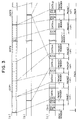
- Fig. 3 exemplifies the multiplexing of various kinds of data, which is specified by the system part of the MPEG.
- a portion (a) indicates a data stream of coded video signals consecutively arranged in the order of GOPs as indicated by the portion (c) in Fig. 2, i.e., a video stream
- a portion (b) indicates a data stream of audio signals that are compressed and coded by a predetermined coding scheme which will not be discussed in detail.
- Partial data of each stream is stored in a packet together with a packet header located at the head of the packet.
- a packet in which video stream data is stored is called a video packet (VP)
- a packet in which audio stream data is stored is called an audio packet (AP).
- a packet in which a stream of data other than video and audio signals, such as control data, is stored is called a data packet (DP) though not illustrated.
- Some of those packets are grouped as a pack with a pack header placed at the head of this pack.
- the packets are transmitted pack by pack in the form shown in a portion (c) in Fig. 3.
- the pack header serves as a system header (SH) which describes information about the whole pack stream and includes a pack start code PS and a system clock reference SCR that indicates the reference of time.
- the packet header includes a presentation time stamp PTS and a decoding time stamp DTS as needed.
- a pack is the collection of individual partial streams each corresponding to a packet.
- SCR in the pack header is the number of system clocks of 90 KHz counted from some point of time, and is used as a reference of time in reproducing the associated pack.
- PTS in the packet header represents the time at which the presentation of the packet containing that PTS as a video image or sound and voices starts, by the number of the system clocks counted.
- DTS represents the time at which decoding of the packet containing that DTS starts.
- the time data of PTS equals that of DTS so that DTS need not particularly be described.
- PTS and DTS should be inserted as needed.
- PTS or a combination of PTS and DTS is inserted in a stream of video and audio packets at an interval of 0.7 sec or below.
- the value of SCR is loaded into a counter in a reproducing apparatus and thereafter the counter starts counting the system clock and is used as a clock.
- PTS or DTS the counter starts counting the system clock and is used as a clock.
- each packet is decoded at the timing at which the presentation of the packet as a video image or sound and voices starts when the value of the counter coincides with PTS. With no PTS and DTS present, each packet is decoded following the decoding of the previous packet of the same kind.
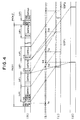
- time data t15 is described in PTS of that packet.
- SCR and PTS are described in the same manner.
- a portion (c) in Fig. 4 shows presented video signals and a portion (d) presented audio signals.
- no PTS is described in the header of that packet which stores packet data DATA12, such a description is unnecessary as long as PTS is inserted at the aforementioned interval of 0.7 sec or below.
- the packet data DATA11 is stored from the data of the first I picture of the GOP1, so that a value equivalent to the time earlier by three frames than PTS is described in DTS in the packet header of the DATA11.
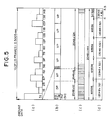
- Fig. 5 is a diagram showing a data format in a method of recording compressed and coded data according to one embodiment of the present invention.
- FIG. 5 the amount of data of video signals after compression as shown in (b) in Fig. 2 differs frame by frame but should always be constant in one GOP.
- a scheme for making the amount of data in a single GOP constant will be discussed later.
- a portion (a) in Fig. 5 shows the amount of data for each frame in a GOP, with the vertical scale representing the amount of data and the horizontal scale representing frames 3I to 14B.
- the data of the GOP is stored as a video packet VP in a pack together with an audio packet AP and a data packet DP as indicated in a portion (b) in Fig. 5.
- the system header SH including the pack start code PS and system clock reference SCR, and a data packet DP occupy 2048 ⁇ 12 bytes
- an audio packet AP occupies 2048 ⁇ 8 bytes
- four video packets VP occupy 2048 ⁇ 124 bytes.
- the above bit rates are sufficient to transmit two channels of high-quality audio signals and video signals having a high image quality.
- the size of the data packet DP should be changed to 2048 ⁇ 4 bytes and an audio packet of 2048 ⁇ 8 bytes should be added so that each pack contains two systems of audio signals.
- the ratio of a pack to physical blocks is set to 2 : 9 in this embodiment for the following reason.
- the period of a GOP accessible at random is the period of one pack
- the size of the pack is set to 2048 ⁇ 144 bytes to ensure transmission of two or four channels of high-quality audio signals and high-quality video signals
- the size of the physical block is set to 2 16 bytes to increase the interleave length while reducing the redundancy of the error correction code.
- the audio packet AP contains compressed audio signals which should be reproduced at substantially the same time as the GOP
- decoding the audio signals and reproducing them in synchronism with the video signals require a buffer memory which has a capacity to store at least one packet of audio signals plus audio signals for the decoding delay of video signals. Because the audio signals carry a small amount of data, however, the buffer memory can have a small capacity.
- the data packet DP To reduce the capacities of delaying buffers to accomplish synchronous reproduction, those two types of packets having small amounts of data are arranged in front of video packets.
- Random accessing of GOPs recorded on a recording medium is accomplished by accessing a target physical block in accordance with the address, which is finally assigned to that physical block and is acquired by searching the logical blocks. Since the correlation between the logical blocks and the physical block for any GOP in Fig. 5 is simple, fast random access can be accomplished easily.
- GOP data whose quantity is constant is divided into four packets which are stored in a pack having a time slot corresponding to this GOP and the size of the pack has simple integer ratios to the sizes of the logical block and physical block of the recording medium.
- the pack and the logical block have a relation of 1 : 144 and the pack and the physical block have a relation of 2 : 9.
- positional control should be performed on the information detected point based on the simple relations of one GOP per 144 logical blocks and nine physical blocks per pack, at the time the desired GOP is accessed.
- the accessing process is therefore performed quickly and simply.
- the ratio of the size of the pack header and a data packet to the size of logical blocks is 1 : 12
- the ratio of the size of an audio packet and the size of the logical blocks is 1 : 8
- the ratio of the size of the total video packets and the size of the logical blocks is 1 : 124.
- the ratio of the size of the pack header and a data packet to the size of physical blocks is 3 : 8
- the ratio of the size of an audio packet and the size of the physical blocks is 1 : 4
- the ratio of the size of the total video packets and the size of the physical blocks is 31 : 8.
- the individual GOPs are not fully independent from one another as shown in Fig. 1, when reproduction starts from an arbitrary GOP, the first two B picture frames of the first GOP cannot be decoded. If a GOP to be accessed at random is determined previously, the first two B picture frames can become decodable if they are coded without using prediction from the previous P picture frame.
- the audio signals and video signals are associated with music, a stream of packs consists of several pieces of music and random access of the pack stream music by music is sufficient, the aforementioned system header SH and sequence header SQH should be inserted only at the head of each piece of music.
- those headers once loaded, may not necessarily be read every random accessing, depending on the structure of the decoder. Even in this case, those headers need not be inserted in every pack.
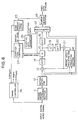
- Fig. 6 presents a schematic block diagram of an encoder which accomplishes this method.
- the encoder comprises a frame order changing section 11, a motion detector 12, a differentiator 13, a discrete cosine transformer (DCT) 14, a quantizer 15, a variable length coder (VLC) 16, a multiplexer 17, a buffer memory 18, an inverse quantizer 19, an inverse DCT 20, an adder 21 and a frame accumulating and predicting section 22.
- the predicting section 22 detects the moving vector, and determines the prediction mode.
- the inverse DCT 20, inverse quantizer 19 and adder 21 constitute a local decoder.
- the basic function of this encoder is to perform discrete cosine transform (DCT) of an input digital video signal by the DCT 14, quantize the transformed coefficient by the quantizer 15, encodes the quantized value by the VLC 16 and output the coded data as a video stream via the buffer memory 18.
- DCT discrete cosine transform
- quantization and coding are carried out in accordance with the detection of the moving vector, the discrimination of the prediction mode, etc., which are accomplished by the local decoder, the predicting section 22 and the motion detector 12.
- This block comprises a code amount calculator 23, a quantization controller 24, a stuffing data generator 25, and a timing controller 26.
- the code amount calculator 23 attains the amount of stored data occupying the buffer memory 18 and calculates the amount of accumulated data of video signals, coded at the input section of the buffer memory 18, (amount of codes) from the head of the GOP.
- the quantization controller 24 determines the quantizer scale for each predetermined unit obtained by dividing one frame by a predetermined size in accordance with the amount of the stored data and the amount of accumulated data, and controls the amount of coded data.
- the stuffing data generator 25 generates predetermined stuffing data in accordance with the amount of accumulated data.
- the timing controller 26 generates timing signals necessary for the individual sections, such as a horizontal sync signal Hsync, a frame sync signal FRsync and a GOP sync signal GOPsync, based on the input digital video signal.
- the quantizer 15 quantizes the coefficient after DCT, divides this value by the quantizer scale obtained by the quantization controller 24, and then outputs the resultant value.
- the quantizer scale becomes an input to the multiplexer 17.
- the output of the stuffing data generator 25, which will be discussed later, is also one input to the multiplexer 17.
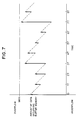
- the buffer memory 18 functions as illustrated in Fig. 7.
- a variable amount of coded data is generated and written in the buffer 18 at times 0, 1T, 2T and so forth (T: frame period).
- T frame period
- the arrows and their lengths respectively represent the writing directions and the amount of data in the memory 18.
- the data is read out from the buffer memory 18 at a constant rate. This is represented by the inclined, broken lines in the diagram.
- the writing and reading are repeated in the illustrated manner.
- the code amount calculator 23 obtains the amount of data occupying the buffer memory 18, and the quantization controller 24 alters the quantizer scale of the quantizer 15 based on the amount of occupying data in such a way that the buffer memory 18 does not overflow or underflow, thus controlling the amount of data to be input to the buffer memory 18.
- the value of the quantizer scale may be determined as follows.
- the quantization controller 24 calculates the amount of accumulated data from the head block of the GOP to the immediately before that block (expected amount of accumulated data), based on the amount of data set previously block by block.
- the quantization controller 24 obtains the difference between this expected amount of accumulated data and the amount of data obtained by the code amount calculator 23 or the amount of accumulated data actually coded and generated from the head block of the GOP to the immediately before that block (actual amount of accumulated data), and determines the value of the quantizer scale so that the actual amount of accumulated data approaches, but does not exceed, the expected amount of accumulated data as close as possible in accordance with the positive or negative sign of that difference and the absolute value thereof.
- the top of each GOP is indicated by the GOP sync signal GOPsync from the timing generator 26.
- the amount of data for each block may be set in the following manner.
- the actual amount of accumulated data is equal to or smaller than the expected amount of accumulated data.
- an insufficient amount is compensated by stuffing data (e.g., dummy data consisting of all "0") generated by the stuffing data generator 25.
- a bit stream has a plurality of positions where a proper amount of stuffing bits having a predetermined bit pattern can be inserted, and the bit stream is defined so that the presence of stuffing bits and the length thereof can be discriminated.
- MB STUFF macroblock stuffing
- the quantizer scale is also defined to be inserted in the bit stream when it is transmitted.
- QS quantizer scale
- the decoder which decodes a video data stream that includes the stuffing data and quantizer scale and has a constant amount of GOP data, detects various headers inserted in the input bit stream (such as the sequence header, GOP start code, picture start code and slice start code), and is synchronized with this bit stream.
- the decoder performs decoding of each block in the bit stream by referring to the quantizer scale and performs no decoding on stuffing data when detected, i.e., the stuffing data is not decoded as video or audio signals or other information. In other words, the decoder disregards the stuffing data and can thus perform decoding without particularly executing the above-described data amount control to make the amount of data in each GOP constant.
- the relation between the pack and the logical blocks is set as a ratio of 1 : 144 and the relation between the pack and the physical blocks is set as a ratio of 2 : 9 in the above-described embodiment, the relations are not limited to those ratios. Those relations can be simple and setting them to 1 : n and 2 : n (n being an integer) can sufficiently facilitate fast random accessing to a recording medium. Although one GOP consists of 15 frames, the number of frames per GOP can of course take any value.
- video packets alone may be stored as so-called soundless video images.
- video signals are compressed and coded for every predetermined number of frames with the amount of codes per the predetermined number of frames being constant, the predetermined number of frames of compressed and coded video signals are stored into at least one video packet, the video packet is stored in a pack having a time slot corresponding to the predetermined number of frames (preferably at the end of that pack), and the video signals are recorded on the recording medium in a pack stream containing such packs, with the relation between the size of the pack and the size of the logical block of the recording medium being set to 1 : n (n: an integer) and a relation between the size of the pack and the size of the physical block of the recording medium being set to 2 : n.
- This invention is therefore advantageous method of recording compressed and coded data, which is advantageous in improving the speed and easiness of random accessing, and reducing the buffer capacity and facilitating control and edition in the reproducing system in the system of recording and reproducing compressed and coded data.
Landscapes
- Engineering & Computer Science (AREA)
- Multimedia (AREA)
- Signal Processing (AREA)
- Physics & Mathematics (AREA)
- Algebra (AREA)
- General Physics & Mathematics (AREA)
- Mathematical Analysis (AREA)
- Mathematical Optimization (AREA)
- Pure & Applied Mathematics (AREA)
- Compression Or Coding Systems Of Tv Signals (AREA)
- Television Signal Processing For Recording (AREA)
- Signal Processing For Digital Recording And Reproducing (AREA)
Claims (8)
- Procédé d'enregistrement de données compressées et codées pour l'enregistrement de signaux vidéo sur un support d'enregistrement, sous une forme compressée et codée, lequel procédé comprend les étapes qui consistent à :compresser et coder des signaux vidéo pour chaque ensemble d'un nombre prédéterminé de trames, la quantité de codes étant constante pour chaque ensemble dudit nombre prédéterminé de trames;le procédé étant caractérisé par la mémorisation dudit nombre prédéterminé de trames de signaux vidéo compressés et codés dans au moins un groupe vidéo ;la mémorisation dudit groupe vidéo dans un paquet ayant une tranche de temps correspondant audit nombre prédéterminé de trames ; etl'enregistrement desdits signaux vidéo sur ledit support d'enregistrement dans un flux de paquets contenant ces paquets, la relation entre la taille dudit paquet et la taille d'un bloc logique dudit support d'enregistrement étant établie à n : 1 (où n est un entier) et la relation entre ladite taille dudit paquet et la taille d'un bloc physique dudit support d'enregistrement étant établie à m : 2 (où m est un entier également).
- Procédé d'enregistrement selon la revendication 1, dans lequel les informations d'en-tête nécessaires pour reproduire ledit flux de paquets et les informations d'en-tête nécessaires pour reproduire un flux de signaux vidéo compressés et codés sont insérées dans tous les paquets.
- Procédé d'enregistrement selon la revendication 1, dans lequel ledit groupe vidéo et un groupe audio contenant ledit nombre prédéterminé de trames de signaux audio compressés et codés ou un groupe de données contenant des informations prédéterminées sont mémorisés dans ledit paquet selon un mode de multiplexage par répartition dans le temps.
- Procédé d'enregistrement selon la revendication 2, dans lequel ledit groupe vidéo et un groupe audio contenant ledit nombre prédéterminé de trames de signaux audio compressés et codés ou un groupe de données contenant des informations prédéterminées sont mémorisés dans ledit paquet selon un mode de multiplexage par répartition dans le temps.
- Procédé d'enregistrement selon la revendication 1, dans lequel ledit groupe vidéo est mémorisé à la fin dudit paquet.
- Procédé d'enregistrement selon la revendication 2, dans lequel ledit groupe vidéo est mémorisé à la fin dudit paquet.
- Procédé d'enregistrement selon la revendication 3, dans lequel ledit groupe vidéo est mémorisé à la fin dudit paquet.
- Procédé d'enregistrement selon la revendication 4, dans lequel ledit groupe vidéo est mémorisé à la fin dudit paquet.
Applications Claiming Priority (3)
| Application Number | Priority Date | Filing Date | Title |
|---|---|---|---|
| JP17669493 | 1993-07-16 | ||
| JP5176694A JPH0787444A (ja) | 1993-07-16 | 1993-07-16 | 圧縮符号化データ記録方法 |
| JP176694/93 | 1993-07-16 |
Publications (3)
| Publication Number | Publication Date |
|---|---|
| EP0634867A2 EP0634867A2 (fr) | 1995-01-18 |
| EP0634867A3 EP0634867A3 (fr) | 1995-04-26 |
| EP0634867B1 true EP0634867B1 (fr) | 1999-08-18 |
Family
ID=16018109
Family Applications (1)
| Application Number | Title | Priority Date | Filing Date |
|---|---|---|---|
| EP94303964A Expired - Lifetime EP0634867B1 (fr) | 1993-07-16 | 1994-06-02 | Méthode d'enregistrement de données comprimées et codées |
Country Status (4)
| Country | Link |
|---|---|
| US (1) | US5572333A (fr) |
| EP (1) | EP0634867B1 (fr) |
| JP (1) | JPH0787444A (fr) |
| DE (1) | DE69420090T2 (fr) |
Cited By (2)
| Publication number | Priority date | Publication date | Assignee | Title |
|---|---|---|---|---|
| US6819712B2 (en) | 2000-02-28 | 2004-11-16 | Kabushiki Kaisha Toshiba | Video encoding apparatus and video encoding method |
| US7406046B2 (en) | 2003-04-15 | 2008-07-29 | Infineon Technologies Ag | Scheduler for signaling a time out |
Families Citing this family (26)
| Publication number | Priority date | Publication date | Assignee | Title |
|---|---|---|---|---|
| JP2931755B2 (ja) * | 1994-04-14 | 1999-08-09 | 株式会社東芝 | データ再生装置、データエンコード装置、データエンコード方法及びデータ再生システム |
| US5809201A (en) * | 1994-06-24 | 1998-09-15 | Mitsubishi Denki Kabushiki Kaisha | Specially formatted optical disk and method of playback |
| JP3050047B2 (ja) * | 1994-06-24 | 2000-06-05 | 日本ビクター株式会社 | 動画像符号化装置及び動画像符号化方法 |
| US6009236A (en) * | 1994-09-26 | 1999-12-28 | Mitsubishi Denki Kabushiki Kaisha | Digital video signal record and playback device and method for giving priority to a center of an I frame |
| SG34287A1 (en) * | 1994-10-28 | 1996-12-06 | Hitachi Ltd | Input-output circuit recording apparatus and reproduction apparatus for digital video signal |
| US5721720A (en) * | 1994-12-28 | 1998-02-24 | Kabushiki Kaisha Toshiba | Optical recording medium recording pixel data as a compressed unit data block |
| US6009202A (en) * | 1994-12-28 | 1999-12-28 | Kabushiki Kaisha Toshiba | Image information encoding/decoding system |
| EP1209923B1 (fr) * | 1995-04-27 | 2006-05-24 | Hitachi, Ltd. | Procédé et appareil pour recevoir et/ou reproduire des signaux numériques |
| US5802240A (en) * | 1995-04-28 | 1998-09-01 | Sony Corporation | Video editing apparatus |
| JP4018166B2 (ja) * | 1995-07-06 | 2007-12-05 | パイオニア株式会社 | 媒体記録方法、装置及び媒体再生方法、装置 |
| US5715176A (en) * | 1996-01-23 | 1998-02-03 | International Business Machines Corporation | Method and system for locating a frame position in an MPEG data stream |
| US6157674A (en) * | 1996-03-21 | 2000-12-05 | Sony Corporation | Audio and video data transmitting apparatus, system, and method thereof |
| JPH10320914A (ja) * | 1997-05-15 | 1998-12-04 | Sanyo Electric Co Ltd | 符号記録装置、符号多重方法 |
| AU8759198A (en) * | 1997-07-28 | 1999-02-16 | Roy H. Campbell | A robust, reliable compression and packetization scheme for transmitting video |
| US6282240B1 (en) * | 1997-09-03 | 2001-08-28 | Oki Electric Industry Co., Ltd. | Picture coder, picture decoder, and transmission system |
| TW451188B (en) | 1997-09-10 | 2001-08-21 | Sony Corp | Information recording method and apparatus and information recording medium |
| EP0982950A3 (fr) * | 1998-08-24 | 2004-09-29 | Sony Corporation | Caméra électronique comprénant un codeur MPEG |
| KR100657237B1 (ko) | 1998-12-16 | 2006-12-18 | 삼성전자주식회사 | 데이터열간의 연속 재생을 보장하기 위한 부가 정보 생성 방법 |
| KR100618961B1 (ko) | 1998-12-16 | 2006-09-01 | 삼성전자주식회사 | 패킷 데이터의 고속 탐색을 위한 정보 생성 방법과 이 정보를 저장하는 기록 매체, 이를 이용하는 기록 및/또는 재생 장치 |
| KR100413176B1 (ko) * | 1999-07-07 | 2003-12-31 | 마쯔시다덴기산교 가부시키가이샤 | 오디오 비디오 데이터 기록장치 및 방법, 상기 오디오비디오 데이터 기록장치 또는 방법으로 기록된 디스크,오디오 비디오 데이터 재생장치 및 방법 |
| GB2356508B (en) * | 1999-11-16 | 2004-03-17 | Sony Uk Ltd | Data processor and data processing method |
| JP3524882B2 (ja) * | 2001-02-19 | 2004-05-10 | 三洋電機株式会社 | 画像記録装置 |
| EP1261204A2 (fr) * | 2001-03-29 | 2002-11-27 | Matsushita Electric Industrial Co., Ltd. | Procédé et appareil de reproduction de données |
| JP3586235B2 (ja) * | 2001-11-09 | 2004-11-10 | 株式会社東芝 | Mpegストリームデータ記録装置、mpegストリームデータ記録方法、及びmpegストリームデータ編集方法 |
| JP2004110876A (ja) * | 2002-09-13 | 2004-04-08 | Canon Inc | 映像データの符号化レート制御方法 |
| JP2007265608A (ja) * | 2007-05-21 | 2007-10-11 | Pioneer Electronic Corp | 情報記録装置及び情報記録方法並びに情報再生装置及び情報再生方法 |
Family Cites Families (5)
| Publication number | Priority date | Publication date | Assignee | Title |
|---|---|---|---|---|
| JPH0624341B2 (ja) * | 1986-12-18 | 1994-03-30 | 三菱電機株式会社 | マルチメディアデータ伝送方式 |
| US5113512A (en) * | 1988-06-21 | 1992-05-12 | Matsushita Electric Industrial Co., Ltd. | System for managing a storage medium reducing physical space needed |
| JPH03141752A (ja) * | 1989-10-27 | 1991-06-17 | Hitachi Ltd | 画像信号伝送方法 |
| US5097261A (en) * | 1989-11-22 | 1992-03-17 | International Business Machines Corporation | Data compression for recording on a record medium |
| US5386402A (en) * | 1993-11-29 | 1995-01-31 | Kabushiki Kaisha Toshiba | Access control apparatus and address translation method for disk storage device |
-
1993
- 1993-07-16 JP JP5176694A patent/JPH0787444A/ja active Pending
-
1994
- 1994-06-02 EP EP94303964A patent/EP0634867B1/fr not_active Expired - Lifetime
- 1994-06-02 DE DE69420090T patent/DE69420090T2/de not_active Expired - Fee Related
-
1996
- 1996-03-11 US US08/614,940 patent/US5572333A/en not_active Expired - Fee Related
Cited By (2)
| Publication number | Priority date | Publication date | Assignee | Title |
|---|---|---|---|---|
| US6819712B2 (en) | 2000-02-28 | 2004-11-16 | Kabushiki Kaisha Toshiba | Video encoding apparatus and video encoding method |
| US7406046B2 (en) | 2003-04-15 | 2008-07-29 | Infineon Technologies Ag | Scheduler for signaling a time out |
Also Published As
| Publication number | Publication date |
|---|---|
| JPH0787444A (ja) | 1995-03-31 |
| EP0634867A2 (fr) | 1995-01-18 |
| DE69420090D1 (de) | 1999-09-23 |
| DE69420090T2 (de) | 2000-03-30 |
| US5572333A (en) | 1996-11-05 |
| EP0634867A3 (fr) | 1995-04-26 |
Similar Documents
| Publication | Publication Date | Title |
|---|---|---|
| US5572333A (en) | Compressed data recording method using integral logical block size and physical block size ratios | |
| US5537409A (en) | Synchronizing system for time-divided video and audio signals | |
| KR100239837B1 (ko) | 오디오 및/또는 비디오 신호 전송방법 및 장치 | |
| US5511054A (en) | Apparatus and method for multiplexing encoded data signals and recording medium having multiplexed signals recorded thereon | |
| US5740307A (en) | Methods for monitoring a trick play data stream to insure MPEG compliance | |
| US6219381B1 (en) | Image processing apparatus and method for realizing trick play | |
| JPH06261303A (ja) | 画像信号符号化方法、復号化方法および画像信号記録媒体 | |
| JP2003169292A (ja) | アフレコ装置、コンピュータプログラム、記録媒体、伝送方法及び再生装置 | |
| EP0826289B1 (fr) | Dispositif de multiplexage de donnees | |
| JP3651699B2 (ja) | 復号化装置及び符号化復号化装置 | |
| JPH0863890A (ja) | 多重化データの復号装置 | |
| JP3277971B2 (ja) | データ多重化装置、データ多重化方法及びデータ記録媒体 | |
| JPH08116532A (ja) | 画像復号化方式および装置 | |
| JPH0898160A (ja) | データ多重化装置 | |
| JPH07221715A (ja) | 情報信号伝送方法及び装置 | |
| JP2823806B2 (ja) | 画像復号装置 | |
| JP4608831B2 (ja) | データ多重化装置およびデータ多重化方法 | |
| JPH08191434A (ja) | 動画/音声符号化データ多重化方法及び動画/音声符号化データ多重化装置 | |
| KR0151024B1 (ko) | 엠펙기반의 디지탈 비디오디스크레코더의 시스템레이어엔코더 | |
| JPH10199140A (ja) | 符号記録装置、及び符号多重方法 | |
| JP2005198350A (ja) | アフレコ信号再生方法 | |
| JP2003235011A (ja) | プログラムストリーム生成装置およびこれを用いた記録再生装置 | |
| JPH08102144A (ja) | デジタル動画像とデジタル音声の再生装置 | |
| JP2005198349A (ja) | 記録媒体 | |
| JPH10271463A (ja) | データ多重化装置およびその方法 |
Legal Events
| Date | Code | Title | Description |
|---|---|---|---|
| PUAI | Public reference made under article 153(3) epc to a published international application that has entered the european phase |
Free format text: ORIGINAL CODE: 0009012 |
|
| AK | Designated contracting states |
Kind code of ref document: A2 Designated state(s): DE FR GB |
|
| PUAL | Search report despatched |
Free format text: ORIGINAL CODE: 0009013 |
|
| AK | Designated contracting states |
Kind code of ref document: A3 Designated state(s): DE FR GB |
|
| 17P | Request for examination filed |
Effective date: 19950501 |
|
| 17Q | First examination report despatched |
Effective date: 19970526 |
|
| GRAG | Despatch of communication of intention to grant |
Free format text: ORIGINAL CODE: EPIDOS AGRA |
|
| GRAG | Despatch of communication of intention to grant |
Free format text: ORIGINAL CODE: EPIDOS AGRA |
|
| GRAG | Despatch of communication of intention to grant |
Free format text: ORIGINAL CODE: EPIDOS AGRA |
|
| GRAH | Despatch of communication of intention to grant a patent |
Free format text: ORIGINAL CODE: EPIDOS IGRA |
|
| GRAH | Despatch of communication of intention to grant a patent |
Free format text: ORIGINAL CODE: EPIDOS IGRA |
|
| GRAA | (expected) grant |
Free format text: ORIGINAL CODE: 0009210 |
|
| AK | Designated contracting states |
Kind code of ref document: B1 Designated state(s): DE FR GB |
|
| REF | Corresponds to: |
Ref document number: 69420090 Country of ref document: DE Date of ref document: 19990923 |
|
| ET | Fr: translation filed | ||
| PG25 | Lapsed in a contracting state [announced via postgrant information from national office to epo] |
Ref country code: GB Free format text: LAPSE BECAUSE OF NON-PAYMENT OF DUE FEES Effective date: 20000602 |
|
| PLBE | No opposition filed within time limit |
Free format text: ORIGINAL CODE: 0009261 |
|
| STAA | Information on the status of an ep patent application or granted ep patent |
Free format text: STATUS: NO OPPOSITION FILED WITHIN TIME LIMIT |
|
| 26N | No opposition filed | ||
| GBPC | Gb: european patent ceased through non-payment of renewal fee |
Effective date: 20000602 |
|
| PG25 | Lapsed in a contracting state [announced via postgrant information from national office to epo] |
Ref country code: DE Free format text: LAPSE BECAUSE OF NON-PAYMENT OF DUE FEES Effective date: 20010403 |
|
| PG25 | Lapsed in a contracting state [announced via postgrant information from national office to epo] |
Ref country code: FR Free format text: LAPSE BECAUSE OF NON-PAYMENT OF DUE FEES Effective date: 20010831 |
|
| REG | Reference to a national code |
Ref country code: FR Ref legal event code: ST |
|
| PG25 | Lapsed in a contracting state [announced via postgrant information from national office to epo] |
Ref country code: FR Free format text: LAPSE BECAUSE OF NON-PAYMENT OF DUE FEES Effective date: 20000630 |