EP0632287A2 - Tragbares Radiosignal-Detektionssystem - Google Patents
Tragbares Radiosignal-Detektionssystem Download PDFInfo
- Publication number
- EP0632287A2 EP0632287A2 EP94109912A EP94109912A EP0632287A2 EP 0632287 A2 EP0632287 A2 EP 0632287A2 EP 94109912 A EP94109912 A EP 94109912A EP 94109912 A EP94109912 A EP 94109912A EP 0632287 A2 EP0632287 A2 EP 0632287A2
- Authority
- EP
- European Patent Office
- Prior art keywords
- radio signal
- antenna
- detecting system
- signal detecting
- azimuth
- Prior art date
- Legal status (The legal status is an assumption and is not a legal conclusion. Google has not performed a legal analysis and makes no representation as to the accuracy of the status listed.)
- Granted
Links
Images





Classifications
-
- G—PHYSICS
- G01—MEASURING; TESTING
- G01S—RADIO DIRECTION-FINDING; RADIO NAVIGATION; DETERMINING DISTANCE OR VELOCITY BY USE OF RADIO WAVES; LOCATING OR PRESENCE-DETECTING BY USE OF THE REFLECTION OR RERADIATION OF RADIO WAVES; ANALOGOUS ARRANGEMENTS USING OTHER WAVES
- G01S7/00—Details of systems according to groups G01S13/00, G01S15/00, G01S17/00
- G01S7/02—Details of systems according to groups G01S13/00, G01S15/00, G01S17/00 of systems according to group G01S13/00
- G01S7/04—Display arrangements
- G01S7/06—Cathode-ray tube displays or other two dimensional or three-dimensional displays
-
- G—PHYSICS
- G01—MEASURING; TESTING
- G01S—RADIO DIRECTION-FINDING; RADIO NAVIGATION; DETERMINING DISTANCE OR VELOCITY BY USE OF RADIO WAVES; LOCATING OR PRESENCE-DETECTING BY USE OF THE REFLECTION OR RERADIATION OF RADIO WAVES; ANALOGOUS ARRANGEMENTS USING OTHER WAVES
- G01S13/00—Systems using the reflection or reradiation of radio waves, e.g. radar systems; Analogous systems using reflection or reradiation of waves whose nature or wavelength is irrelevant or unspecified
- G01S13/02—Systems using reflection of radio waves, e.g. primary radar systems; Analogous systems
- G01S13/06—Systems determining position data of a target
- G01S13/42—Simultaneous measurement of distance and other co-ordinates
-
- G—PHYSICS
- G01—MEASURING; TESTING
- G01S—RADIO DIRECTION-FINDING; RADIO NAVIGATION; DETERMINING DISTANCE OR VELOCITY BY USE OF RADIO WAVES; LOCATING OR PRESENCE-DETECTING BY USE OF THE REFLECTION OR RERADIATION OF RADIO WAVES; ANALOGOUS ARRANGEMENTS USING OTHER WAVES
- G01S7/00—Details of systems according to groups G01S13/00, G01S15/00, G01S17/00
- G01S7/02—Details of systems according to groups G01S13/00, G01S15/00, G01S17/00 of systems according to group G01S13/00
- G01S7/04—Display arrangements
- G01S7/046—Display arrangements using an intermediate storage device, e.g. a recording/reproducing device
-
- G—PHYSICS
- G01—MEASURING; TESTING
- G01S—RADIO DIRECTION-FINDING; RADIO NAVIGATION; DETERMINING DISTANCE OR VELOCITY BY USE OF RADIO WAVES; LOCATING OR PRESENCE-DETECTING BY USE OF THE REFLECTION OR RERADIATION OF RADIO WAVES; ANALOGOUS ARRANGEMENTS USING OTHER WAVES
- G01S7/00—Details of systems according to groups G01S13/00, G01S15/00, G01S17/00
- G01S7/02—Details of systems according to groups G01S13/00, G01S15/00, G01S17/00 of systems according to group G01S13/00
- G01S7/04—Display arrangements
- G01S7/06—Cathode-ray tube displays or other two dimensional or three-dimensional displays
- G01S7/10—Providing two-dimensional and co-ordinated display of distance and direction
- G01S7/12—Plan-position indicators, i.e. P.P.I.
Definitions
- the present invention generally relates to a radio signal detecting system capable of detecting a radio signal reflected from a target. More specifically, the present invention is directed to a compact radio signal detecting system capable of measuring a distance from the target and a direction of the target, and also capable of detecting azimuth of an incoming radio signal transmitted from other radio signal transmitter.
- Radar systems have been widely utilized in air crafts and ships in order to navigate these vehicles and to confirm present positions of the vehicles with respect to a target, and also utilized in meteorological observations.
- an electromagnetic wave in a pulse form such as a microwave pulse signal
- this pulse signal impinges other ships and a land.
- pulse signals are reflected from these objects and processed to measure distances between this ship and other ships. These measured distances are displayed on a CRT display screen.
- This type of conventional marine radar system is arranged by a large-scale transmitter apparatus with employment of a magnetron and the like, a bulky rotary slot antenna having a length of 1 to 3 m and an antenna unit, a display apparatus equipped with an after-image type large CRT screen, and a motor unit for rotating the slot antenna. Accordingly, this marine radar system can own various merits, e.g., high power, high precision, and hard operation conditions. However, there are drawbacks such as bulky system and high power consumption.
- azimuth detecting systems are utilized to correctly detect azimuth of a signal radiation source by measuring azimuth of an incoming radio signal having a specific frequency.
- the incoming radio signals are received by the first loop-shaped antenna and the second vertically-arranged antenna.
- the first loop antenna is rotated to receive the radio signals at every preselected rotation angle, and field strengths of these received radio signals are measured. Then, the direction of one radio signal having the highest field strength is detected as the direction of the incoming radio signal reflected from the target.
- this first loop antenna inherently owns such an antenna characteristic that the field strengths become high when the first loop antenna is located at 90° and 270° with respect to the direction of the incoming radio signal, a decision is made which incoming signal angle corresponds to the incoming direction of the radio signal based upon directivity of the second antenna.
- the radio signal received by the first loop antenna is synthesized with the radio signal received by the second antenna, thereby determing the incoming direction of the radio signal.
- the synthesized signal is amplified, and the field strengths of the synthesized signal with regard to the rotation angles of the first loop antenna are displayed on a CRT display screen as a circular graphic representation.
- the present invention has been made to solve the above-described conventional problems, and therefore, has an object to provide a radio signal detecting system made compact and in light weight.
- Another object of the present invention is to provide a portable radio signal detecting system operable by any operators who are not required as well skilled operators, and suitable to be outdoor use.
- a radio signal detecting system is characterized by comprising: a rotatable antenna; distance measuring means for transmitting a radio signal every time the antenna is rotated by a preselected rotation angle, and for receiving another radio signal reflected from a target to be measured to process the reflected radio signal, thereby producing distance data; memory means for storing the distance data produced by the distance measuring means in correspondence with the rotation angle of the antenna; and display means for displaying the distance data read out from the memory means.
- a radio signal detecting system is characterized by comprising: a wrist-watch-shaped case; an antenna rotatably mounted on the wrist-watch-shaped case; timer circuit means provided within said case, for producing present time information; time display means for displaying the present time information produced by said time circuit means; distance measuring means for transmitting a radio signal every time the antenna is rotated by a preselected rotation angle, and for receiving another radio signal reflected from a target to be measured to process the reflected radio signal, thereby producing distance data; memory means for storing the distance data produced by the distance measuring means in correspondence with the rotation angle of the antenna; and display means for displaying the distance data read out from the memory means.
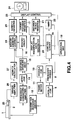
- a radio signal detecting system assembled in an electronic wrist watch, according to a first presently preferred embodiment of the present invention.
- Fig. 1 there is shown an overall circuit arrangement of the first radio signal detecting system.
- a compact antenna 1 is mounted on a rotation supporting member 2, so that the antenna 1 is integrally rotatable in conjunction with the rotation of the rotation supporting member 2.
- the rotating operation of this rotation supporting member 2 is manually performed, and detected by a rotation angle detecting sensor 3.
- this rotation angle detecting sensor 3 it may be so arranged that light/dark marks made from slits or black/white marks are formed on the same circular of the rotation supporting member 2, and these light/dark marks are detected by way of a photocoupler constructed of a light emitting diode (LED) and a phototransistor, whereby the rotation angles of the rotation supporting member 2 are detected in the form of pulse number.
- LED light emitting diode
- the number of clock pulses is added to each other, and thus, is outputted as angle data about the antenna 1 from this antenna angle calculating circuit 5.
- the derived angle data is stored via a memory address control circuit 6 into an antenna angle register 7, and then displayed on a display unit 24.
- An oscillator circuit 8, a frequency dividing circuit 9, a control circuit 19, and a timer circuit 22 will constitute an electronic watch circuit. That is, the oscillator circuit 8 oscillates a reference frequency pulse functioning as a reference timing signal.
- the frequency dividing circuit 9 frequency-divides this reference frequency pulse to obtain a frequency-divided pulse.
- the frequency-divided pulse is supplied via the control circuit 19 to the timer circuit 22 for performing the time counting operation. Accordingly, present time is displayed on the display unit 24 under control by the display control circuit 23.
- the reference frequency pulse which has been frequency-divided by the frequency dividing circuit 9, is also outputted to a modulating circuit 10.
- This frequency-divided pulse is modulated by a high (radio) frequency signal in the modulating circuit 10.
- the modulated radio frequency signal is furnished to a transmitter circuit 11.
- the transmitter circuit 11 supplies a transmission pulse signal to a transmitter/receiver switching circuit 12, and also supplies a signal synchronized with this transmission pulse signal to a distance measuring circuit 15.
- the transmitter/receiver switching circuit 12 switches radiation of the radio signal (electromagnetic wave) carried out by the above-explained transmission pulse signal through the antenna 1, and receptions of the radio signal reflected from a target.
- the reflected radio signals received by this transmitter/receiver switching circuit 12 are amplified by a frequency converting/amplifying circuit 13, and thereafter the amplified radio signals are detected by a detecting circuit 14, so that the detected radio signals are furnished to the distance measuring circuit 15.
- the distance measuring circuit 15 measures a time period since the signal synchronized with the above-explained transmission pulse signal is supplied from the transmitter circuit 11 until the reflected radio signals which have been detected by the detecting circuit 14 are inputted.
- the distance measuring circuit 15 outputs distance data based on this measured time period.
- This time period measuring operation is carried out by utilizing the clock pulse derived from the frequency dividing circuit 9.
- This distance data corresponds to digital data indicative of a distance between a target and this radio signal detecting system.
- This distance data is supplied to a memory circuit 16 constructed of such an electronic memory as a RAM (random access memory).
- the memory circuit 16 contains a large number of memory regions for storing the distance data about the target, and the respective memory regions are addressed by the address control circuit 6 to which the angle data derived from the antenna angle calculating circuit 5 are supplied as the address data.
- this memory circuit 15 is arranged by the memory regions capable of storing 36 pieces of distance data. These distance data stored in the memory circuit, are read out therefrom and stored via the control circuit 19 and the memory address control circuit 6 into a target distance register 17 by operating a distance display button (not shown) provided on an operation unit 18, and further are displayed on the display unit 24. This distance data display is continued until this distance display button is subsequently manipulated.
- a display-magnification-data output circuit 20 controls the display magnification of the distance data to be displayed.
- magnification data designated via the control circuit 20 by the display-magnification-data output circuit 20 is supplied to the target distance register 17 and a distance scale register 21, so that the distance data is displayed in the designated magnification, and also a scale adjusted in accordance with the designated magnification is displayed.
- a transmission pulse is transmitted from the antenna 1 and a reception pulse is received from this antenna 1 as represented in Fig. 2.
- the transmission pulse is transmitted with a time width "L” in a time period "T1”, and the reception pulse (reflection pulses "A” and "B") is received between the successive transmission pulses within a time period T2 (see Fig. 2). That is, for example, when a first transmission pulse is transmitted with a time width "L", the antenna 1 is switched from the transmission mode to the reception mode during another time period "T2". During this time period "T2", the electromagnetic waves reflected from the target (not shown in detail) are received via the antenna 1 by the first radio signal detecting system.
- microwaves having very low signal levels, and FM signals of quasi-microwave band waves such as UHF waves and VHF waves may be utilized as the transmission pulse from the antenna 1.
- the circuit arrangement for transmitting/receiving the pulse signals could be made compact, and furthermore this transmitting/receiving circuit arrangement could be manufactured as an integrated circuit in combination with the control circuit 19, the timer circuit 22, and the antenna angle calculating circuit 5.
- this LCD display unit may be operated by small-sized batteries such as dry cells and button type cells, which are originally used to operate other circuit arrangements. As a consequence, since no longer commercial power source with high capacity is required to operate the first radio signal detecting system, this detecting system can be furthermore made compact.
- the first radio signal detecting system may be manufactured in the form of compact electronic appliances, e.g., a wrist watch, a desk top calculator, and an electronic notebook. Moreover, this system may be realized as portable outdoor gears.
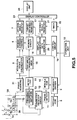
- Fig. 4 represents an overall circuit arrangement of a radio signal detecting system according to a second presently preferred embodiment of the present invention. It should be noted that the same reference numerals shown in Fig. 1 will be employed as those for indicating the same circuit blocks represented in Fig. 4 and other relevant figures, and no further explanations thereof are made in the following descriptions.
- an electronic azimuth sensor 25 such as magnetic sensor is provided on the rotation supporting member 2 of the antenna 1. The electronic azimuth sensor 25 detects the (toward) directions of the antenna 1 which are changed in response to the rotations of this antenna 1, to produce azimuth signals on the basis of the compass north.
- the azimuth signal detected by this electronic azimuth sensor 25 is supplied via a driving/amplifying circuit 26 to an azimuth calculating circuit 27 so as to be calculated as digital azimuth data. Then, the calculated azimuth data is inputted into a memory address control circuit 28, and is used as address data of the memory circuit 16. Further, this azimuth register 29 and displayed on the display unit 24.
- the azimuth data is used as the address data of the memory circuit instead of the previously explained rotation angle data of the antenna 1 employed in the first radio signal detecting system.
- the overall radio signal detecting system is not required to be fixed, the rotation angle of the antenna 1 can be firmly detected even when this second system is slightly swung, or moved.
- the overall first system must be fixed and the rotation angle of the antenna 1 must be judged, or recognized in accordance with the relative position with respect to this previous first system.
- the electronic azimuth sensor 25 may be assembled within the second radio signal detecting system. In this case, it is possible to measure distances about a target with respect to various azimuth positions.
- the distance measuring operation can be performed and the second radio signal detecting system can be made further compact, as compared with the first radio signal detecting system.
- FIG. 5 there is shown an overall circuit arrangement of a radio signal detecting system according to a third currently preferred embodiment of the present invention.
- this antenna 1A is constructed by arranging a plurality of array antennas 1a, 1b, ... , 1n ("n" being any integers greater than 1).
- n being any integers greater than 1
- slit-shaped elongate opening portions are formed in a waveguide at equi-intervals, and these array antennas are mounted on the respective opening portions of this waveguide along the upright direction, resulting in the antenna 1A.
- both the direction and the distance from the target are measured by electronically scanning the respective array antennas 1a, 1b, ... , 1n.
- the configuration of the entire system can be made simpler and portability of this third system can be further improved.
- Fig. 6 is a detailed display form of the display unit 24 according to any of the first to third radio signal detecting systems.
- the display unit 24 owns a first display screen 24a made of a liquid crystal display (LCD) member. Toroidal-shaped distance scales D, E, F are concentrically displayed on this first display screen 24a. A line “G” is displayed as a heading mark from the center toward the upper position. Further, another line “H” is rotatably displayed in response to the rotation of the antenna 1A.
- the azimuth sensor 25 is additionally employed as the second radio signal detecting system, a north mark "I” is displayed. Then, the target marks J1, J2, J3, ... , Jn measured by these first to third systems are displayed together with these marks.
- an azimuth scale "K” is represented on the peripheral portion of the first display screen 24a by way of printing and a carved seal.
- the distance range "L”, and the interval "M” of the distance scales D, E, F displayed on the first display screen 24a are displayed as a digital value.
- the azimuth "N” of the heading mark G and the azimuth "P” of the line H are displayed as a digital value.
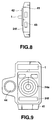
- Figs. 7 and 8 show outer appearances of wrist watches into which the above-described first to third radio signal detecting systems have been embodied.
- a case 41 is fabricated as a wrist watch case.
- a rotary vessel 42 is rotatably fixed on the upper surface of this wrist watch case.
- This rotary vessel 42 corresponds to the above-explained rotation supporting member 2.
- the antenna 1 is mounted on this rotary vessel 42, and the antenna 1 is rotated by manually rotating this rotary vessel 42.
- Reference numeral 43 denotes an operation button arranged on the side surface of this case 41
- reference numeral 44 show an electronic azimuth sensor provided on another side of this case 41. It should be noted that the first display screen 24a to the sixth display screen 24f are arranged on the upper surface of the case 41.
- Fig. 9 represents another example of an outer appearance of the radio signal detecting system.
- the same constructive elements are indicated by the same reference numerals as employed in Fig. 7 and Fig. 8.
- the antenna 1 is fixed on the case 41.
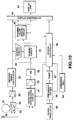
- Fig. 10 schematically shows an overall arrangement of the fourth radio signal detecting system.
- a first antenna 51 formed in a loop shape and a second antenna 52 which is separated from the first antenna 51 and is positioned along the vertical direction.
- the first antenna 51 is vertically mounted on a rotation supporting member 53 which is rotatable in a 360° range.
- the rotation supporting member 53 is rotated, the first antenna 51 is integrally rotated in conjunction with the rotation supporting member 53.
- the rotation angles of the rotation supporting member 53 namely the rotation angles of the first antenna 51 are detected by a rotation angle position detecting sensor 54 constructed as, for instance, a photocoupler.
- the detected rotation angles are derived as rotation angle signals from this sensor 54, and are amplified by a sense amplifier 55.
- the amplified rotation angle signals are supplied to an antenna angle calculating circuit 56 to obtain azimuth angle data.
- the radio signals received by the first antenna 51 and the second antenna 52 are entered into a detecting/synthesizing circuit 57 to be detected and then synthesized with each other, thereby producing field strength data.
- the field strength data is amplified by an amplifying circuit 58, and thereafter converted into a digital field strength value by an A/D-converting circuit 59.
- this field strength data is stored into a memory circuit 61 constructed of an electronic memory such as a RAM.
- the field strength data are stored as digital values at addresses corresponding to the various directional angels under control of a memory address control/read/write control circuit 60.
- the field strength data corresponding to the respective rotation angles are stored into the memory circuit 61.
- the field strength data stored in the memory circuit 61 are supplied via a display control circuit 63 to a display unit 64 such as a liquid crystal display (LCD) for display purposes.
- a display unit 64 such as a liquid crystal display (LCD) for display purposes.
- Reference numeral 62 indicates a maximum value judging circuit.
- the maximum value judging circuit 62 sequentially reads the field strength data out from the memory circuit 61, and makes a decision on the azimuth angle of the highest field strength data among these field strength data, so that this azimuth angle is determined as the direction of the radio signal reflected from the target (not shown in detail). Thus, the determined signal coming direction is displayed on the display unit under control of the display control circuit 63.
- a timer function is provided with the fourth radio signal detecting system.
- a clock signal oscillating circuit 65 is provided to oscillate a clock signal which is used as a time reference pulse signal.
- This reference pulse signal is frequency-divided by a frequency dividing circuit 66, and the frequency-divided pulse signal is furnished to a timer circuit 67 and also via a system control circuit 69 to the display control circuit 63.
- present time is displayed on the display unit 64.
- the system control circuit 69 is employed to control the overall operation of the fourth radio signal detecting system, and an operation unit 68 is manipulated by an operator so as the select data to be displayed on the display unit 64.
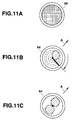
- Fig. 11A to Fig. 11F illustrate display samples of the display unit 64 in the fourth radio signal detecting system.
- the first antenna 51 Before the first antenna 51 is manually, or automatically rotated, no indication is seen on the display unit 64 (see Fig. 11A). Then, when the first antenna 1 is commenced to be rotated, the field strengths of the incoming radio signals which have been processed in accordance with the above-explained manner, are successively displayed on the LCD screen of the display unit 64 as follows: As shown in Fig. 11B, the first antenna 51 is being swept, and a side "A" of the signal incoming direction on the LCD screen is turned ON. Fig.
- FIG. 11C represents such a condition that the first sweeping operation by the first antenna 51 is complete, in which both the side "A" and an opposite side thereof on the LCD screen are turned ON.
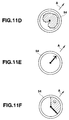
- Fig. 11D indicates such a condition that the radio signal information derived from the first antenna 51 is synthesized with the radio signal information derived from the second antenna 52, in which the side "A" of the signal incoming direction is continuously turned ON.
- the maximum value judging circuit 62 may judge the maximum value among the incoming signal levels (field strengths) to determine the radio signal incoming direction.
- the determined signal incoming direction is represented by an arrow as illustrated in Fig. 11E.
- Fig. 11F represents such a condition that the first antenna 51 is being swept during the second sweeping operation, and the arrow indication for the first sweeping operation shown in Fig. 11E is superimposed with this screen display and displayed by a white frame.
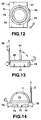
- Fig. 12 to Fig. 14 show various outer appearances of the fourth radio signal detecting system indicated in Fig. 10.
- Reference numeral 71 indicates a wrist watch type case in which the circuit arrangement of the fourth radio signal detecting system is installed.
- An LCD display screen for constituting the display unit 74 is provided on an upper surface of this case 71.
- a toroidal-shaped rotary bezel 73 is arranged around the LCD display screen at the upper surface of the case 71.
- the first antenna 51 having a loop shape is mounted on this rotary bezel 73 in such a manner that this loop antenna 51 can rise up from the rotary bezel 73. Accordingly, the rotary bezel 73 constitutes the rotation supporting member 53 shown in Fig. 10.
- the second antenna 52 is mounted on the side surface of the case 71 in such a way that the second antenna 52 is rotatably fixed thereon and is retractable.
- Reference numeral 74 denotes an operation button
- reference numeral 75 represents a mounting portion of a watch belt (not shown).
- Fig. 15A through Fig. 15D illustrate how to mount/stand the first antenna 51 with respect to the above-explained rotary bezel 73.
- the first antenna 51 is laid on the rotary bezel 73 under the folding condition.
- this first antenna 51 is gradually stood, or raised as illustrated in Fig. 15B and Fig. 15C.
- the first antenna 51 is stood perpendicular to the rotary bezel 73 (see Fig. 15D).
- the rotary bezel 73 is rotated, so that the above-described selection of the signal incoming direction is carried out and is displayed on the LCD display screen 72.
- this detecting system can be made compact and can be readily operated, and furthermore can simply and correctly display the radio signal incoming direction.
- FIG. 16 there is represented an overall arrangement of a radio signal detecting system according to a fifth embodiment of the present invention.
- An electronic azimuth sensor 81 is mounted on the rotation supporting member 53 for rotatably supporting the first antenna 51.
- the electronic azimuth sensor 81 detects earth magnetism with very weak magnetic fields to sense the compass north. Accordingly, the rotation direction of the first antenna 51 is sensed under such a condition that the compass north at the measuring point is used as the reference azimuth.
- a magnetoresistive element may be employed which is positioned within a space defined by, for instance, one electromagnetic coil for operation purposes and the other electromagnetic coil for applying a bias field. These electromagnetic coils are arranged on the X axis and the Y axis perpendicular to the X axis, respectively.
- the azimuth detection signal derived from this electronic azimuth sensor 81 is supplied via a drive circuit and a sense amplifier 82 to an azimuth calculating circuit 83.
- the azimuth calculating circuit 83 converts the azimuth direction analog signal for the first antenna 51 into the corresponding azimuth digital data. Based upon this azimuth digital data, the address of the memory circuit 61 is controlled in order to store the field strength corresponding to the compass north for the first antenna 51.
- reference numeral 84 shows an azimuth register for detecting the maximum field strength from the received field strengths to judge the radio signal incoming direction.
- Reference numeral 85 represents a latch circuit for reading the field strength previously stored in the memory circuit 61
- reference numeral 86 shows a maximum value register write controlling circuit for writing the maximum value read out from the latch circuit 85
- reference numeral 87 represents a register for storing the maximum value of the field strength.
- the maximum field strength value of this register 87 is compared with the maximum field strength value of the latch circuit 85 in a comparator circuit 88, and the comparison result is outputted to the azimuth register 84.
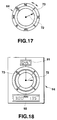
- Fig. 17 illustrates a display screen 72 of a display unit 64 employed in the fifth radio signal detecting system.
- a rotary bezel 73 is arranged outside the LCD display screen 72.
- the azimuth is represented on the rotary bezel 73, and is made coincident with the azimuth of the compass north by rotating this rotary bezel 73.
- an operator can recognize the azimuth of the radio signal incoming direction indicated on the LCD display screen 72.
- Fig. 18 schematically shows another display unit 64 employed in the fifth radio signal detecting system.
- This display unit 64 is provided with a first display section 91 for displaying electronic compass azimuth.
- the first display section 91 indicates the azimuth of 12:00 hour of a clock measured from the compass north.
- a second display section 92 is provided which displays the frequency of the received radio signal and the incoming direction of this received radio signal by the angle measured from the compass north.
- the radio signal incoming direction is displayed by either the absolute direction, or the digital value from 0° to 360° , this azimuth of the radio signal incoming direction can be confirmed. While the first antenna 51 is rotated, the radio signal incoming direction can be correctly displayed irrelevant to the direction and the attitude of the fifth radio signal detecting system, resulting in improvements of operabilities thereof.
Landscapes
- Engineering & Computer Science (AREA)
- Radar, Positioning & Navigation (AREA)
- Remote Sensing (AREA)
- Computer Networks & Wireless Communication (AREA)
- Physics & Mathematics (AREA)
- General Physics & Mathematics (AREA)
- Electric Clocks (AREA)
- Radar Systems Or Details Thereof (AREA)
Applications Claiming Priority (6)
| Application Number | Priority Date | Filing Date | Title |
|---|---|---|---|
| JP18755793A JP3404806B2 (ja) | 1993-06-30 | 1993-06-30 | 電波強度表示装置 |
| JP187559/93 | 1993-06-30 | ||
| JP5187559A JPH0720232A (ja) | 1993-06-30 | 1993-06-30 | レーダー装置 |
| JP187557/93 | 1993-06-30 | ||
| JP18755993 | 1993-06-30 | ||
| JP18755793 | 1993-06-30 |
Publications (3)
| Publication Number | Publication Date |
|---|---|
| EP0632287A2 true EP0632287A2 (de) | 1995-01-04 |
| EP0632287A3 EP0632287A3 (de) | 1996-10-09 |
| EP0632287B1 EP0632287B1 (de) | 2003-12-17 |
Family
ID=26504436
Family Applications (1)
| Application Number | Title | Priority Date | Filing Date |
|---|---|---|---|
| EP94109912A Expired - Lifetime EP0632287B1 (de) | 1993-06-30 | 1994-06-27 | Tragbares Radiosignal-Detektionssystem |
Country Status (4)
| Country | Link |
|---|---|
| US (1) | US5534872A (de) |
| EP (1) | EP0632287B1 (de) |
| CN (1) | CN1059036C (de) |
| DE (1) | DE69433419T2 (de) |
Cited By (2)
| Publication number | Priority date | Publication date | Assignee | Title |
|---|---|---|---|---|
| RU2256937C1 (ru) * | 2003-11-28 | 2005-07-20 | Федеральное государственное унитарное предприятие "Центральный научно-исследовательский институт "Гранит" | Система обнаружения радиолокационных сигналов |
| CN102711151A (zh) * | 2012-05-02 | 2012-10-03 | 京信通信系统(中国)有限公司 | 智能数字无线直放站的控制方法及智能数字无线直放站 |
Families Citing this family (11)
| Publication number | Priority date | Publication date | Assignee | Title |
|---|---|---|---|---|
| JPH10126135A (ja) * | 1994-09-09 | 1998-05-15 | Software Sekkei:Kk | ビームアンテナの方向測定方法と方向測定装置及びビームアンテナの方向制御装置 |
| US6041242A (en) * | 1996-06-21 | 2000-03-21 | Coulthard; Steve M. | Portable emergency response communications system and method |
| US6677889B2 (en) * | 2002-01-22 | 2004-01-13 | Raytheon Company | Auto-docking system |
| US6707414B2 (en) * | 2002-01-22 | 2004-03-16 | Raytheon Company | Docking information system for boats |
| EP1369954A3 (de) * | 2002-06-05 | 2004-10-20 | Fujitsu Limited | Adaptive Antenneneinheit für Mobilgerät |
| KR100656017B1 (ko) * | 2003-09-04 | 2006-12-11 | 학교법인 도시샤 | 무선 통신 시스템 |
| US7480486B1 (en) | 2003-09-10 | 2009-01-20 | Sprint Spectrum L.P. | Wireless repeater and method for managing air interface communications |
| US7406295B1 (en) * | 2003-09-10 | 2008-07-29 | Sprint Spectrum L.P. | Method for dynamically directing a wireless repeater |
| ES2345512T3 (es) * | 2007-04-16 | 2010-09-24 | Moba - Mobile Automation Ag | Aparato y metodo para determinar una elevacion de herramientas de trabajo basandose en un sistema laser. |
| GB2459479B8 (en) * | 2008-04-23 | 2012-08-08 | Bigger Than The Wheel Ltd | Short range RF monitoring system |
| TWI675209B (zh) * | 2018-11-15 | 2019-10-21 | 銓鼎塑膠股份有限公司 | 用於量測及調整天線輻射場型的系統 |
Family Cites Families (9)
| Publication number | Priority date | Publication date | Assignee | Title |
|---|---|---|---|---|
| US3721950A (en) * | 1969-08-13 | 1973-03-20 | Sanders Associates Inc | Responsive navigation beacon |
| JPS5544970A (en) * | 1978-09-27 | 1980-03-29 | Toshiba Corp | Radar display device |
| US4364048A (en) * | 1980-08-13 | 1982-12-14 | The United States Of America As Represented By The Secretary Of The Navy | Interleaved sweep radar display for improved target detection |
| JPS58148526A (ja) * | 1982-02-26 | 1983-09-03 | Mitsubishi Electric Corp | 救難用信号装置 |
| US4588992A (en) * | 1982-11-01 | 1986-05-13 | Clark William E | Radar tracking system and display |
| JPS6148283A (ja) * | 1984-08-14 | 1986-03-08 | Furuno Electric Co Ltd | 映像表示装置 |
| ATE76830T1 (de) * | 1987-03-03 | 1992-06-15 | Comerford Ernest | Anzeigevorrichtung fuer tauchparameter. |
| JPH03226691A (ja) * | 1990-02-01 | 1991-10-07 | Matsushita Electric Ind Co Ltd | レーダー装置 |
| SE9002493L (sv) * | 1990-07-24 | 1991-09-02 | Staffan Gunnarsson | Anordning vid fordon foer positionsangivning vid automatisk tankning |
-
1994
- 1994-06-22 US US08/263,474 patent/US5534872A/en not_active Expired - Lifetime
- 1994-06-27 EP EP94109912A patent/EP0632287B1/de not_active Expired - Lifetime
- 1994-06-27 DE DE69433419T patent/DE69433419T2/de not_active Expired - Lifetime
- 1994-06-30 CN CN94107808A patent/CN1059036C/zh not_active Expired - Fee Related
Cited By (2)
| Publication number | Priority date | Publication date | Assignee | Title |
|---|---|---|---|---|
| RU2256937C1 (ru) * | 2003-11-28 | 2005-07-20 | Федеральное государственное унитарное предприятие "Центральный научно-исследовательский институт "Гранит" | Система обнаружения радиолокационных сигналов |
| CN102711151A (zh) * | 2012-05-02 | 2012-10-03 | 京信通信系统(中国)有限公司 | 智能数字无线直放站的控制方法及智能数字无线直放站 |
Also Published As
| Publication number | Publication date |
|---|---|
| HK1013441A1 (en) | 1999-08-27 |
| EP0632287B1 (de) | 2003-12-17 |
| CN1103953A (zh) | 1995-06-21 |
| US5534872A (en) | 1996-07-09 |
| DE69433419D1 (de) | 2004-01-29 |
| CN1059036C (zh) | 2000-11-29 |
| EP0632287A3 (de) | 1996-10-09 |
| DE69433419T2 (de) | 2004-06-09 |
Similar Documents
| Publication | Publication Date | Title |
|---|---|---|
| EP0632287B1 (de) | Tragbares Radiosignal-Detektionssystem | |
| EP0395733B1 (de) | Abtast-sonarsystem | |
| US4080600A (en) | Scanning beam radio navigation method and apparatus | |
| US7973704B2 (en) | Handheld radar | |
| US4479206A (en) | Scanning sonar display system | |
| US3469262A (en) | Radio direction finder | |
| HK1013441B (en) | Portable radio signal detecting system | |
| JPH0720232A (ja) | レーダー装置 | |
| JP3404806B2 (ja) | 電波強度表示装置 | |
| US4225867A (en) | Orientation system | |
| JP2973019B2 (ja) | 複数方位表示型方向探知装置 | |
| US4198631A (en) | Apparatus for displaying VHF-direction finder data on a radar PPI | |
| JPH0339744Y2 (de) | ||
| US5367498A (en) | Lateral direction detection sonar | |
| JPH0770901B2 (ja) | 移動体用アンテナ装置 | |
| JPH0623982Y2 (ja) | レーダ近接警報装置 | |
| JPS59125084A (ja) | レ−ダ近接警報装置 | |
| US3374670A (en) | Navigation instrumentation | |
| JPS5922542Y2 (ja) | 方向探知機 | |
| JPH0131976Y2 (de) | ||
| JPS6231890Y2 (de) | ||
| JPH0697711A (ja) | 衛星放送受信用アンテナ | |
| US3184744A (en) | Automatic radio direction finder | |
| JP3097264B2 (ja) | Gps受信装置 | |
| JPH05256946A (ja) | 魚群探知機 |
Legal Events
| Date | Code | Title | Description |
|---|---|---|---|
| PUAI | Public reference made under article 153(3) epc to a published international application that has entered the european phase |
Free format text: ORIGINAL CODE: 0009012 |
|
| 17P | Request for examination filed |
Effective date: 19940627 |
|
| AK | Designated contracting states |
Kind code of ref document: A2 Designated state(s): DE FR GB |
|
| PUAL | Search report despatched |
Free format text: ORIGINAL CODE: 0009013 |
|
| RHK1 | Main classification (correction) |
Ipc: G01S 7/26 |
|
| AK | Designated contracting states |
Kind code of ref document: A3 Designated state(s): DE FR GB |
|
| RAP1 | Party data changed (applicant data changed or rights of an application transferred) |
Owner name: CASIO COMPUTER CO., LTD. |
|
| 17Q | First examination report despatched |
Effective date: 20001215 |
|
| GRAH | Despatch of communication of intention to grant a patent |
Free format text: ORIGINAL CODE: EPIDOS IGRA |
|
| GRAS | Grant fee paid |
Free format text: ORIGINAL CODE: EPIDOSNIGR3 |
|
| GRAA | (expected) grant |
Free format text: ORIGINAL CODE: 0009210 |
|
| AK | Designated contracting states |
Kind code of ref document: B1 Designated state(s): DE FR GB |
|
| REG | Reference to a national code |
Ref country code: GB Ref legal event code: FG4D |
|
| REF | Corresponds to: |
Ref document number: 69433419 Country of ref document: DE Date of ref document: 20040129 Kind code of ref document: P |
|
| RIC2 | Information provided on ipc code assigned after grant |
Ipc: 7G 01S 7/12 B Ipc: 7G 01S 7/04 B Ipc: 7G 01S 13/42 A |
|
| ET | Fr: translation filed | ||
| PLBE | No opposition filed within time limit |
Free format text: ORIGINAL CODE: 0009261 |
|
| STAA | Information on the status of an ep patent application or granted ep patent |
Free format text: STATUS: NO OPPOSITION FILED WITHIN TIME LIMIT |
|
| 26N | No opposition filed |
Effective date: 20040920 |
|
| REG | Reference to a national code |
Ref country code: HK Ref legal event code: GR Ref document number: 1013441 Country of ref document: HK |
|
| PGFP | Annual fee paid to national office [announced via postgrant information from national office to epo] |
Ref country code: FR Payment date: 20110621 Year of fee payment: 18 |
|
| PGFP | Annual fee paid to national office [announced via postgrant information from national office to epo] |
Ref country code: GB Payment date: 20110622 Year of fee payment: 18 |
|
| PGFP | Annual fee paid to national office [announced via postgrant information from national office to epo] |
Ref country code: DE Payment date: 20110622 Year of fee payment: 18 |
|
| GBPC | Gb: european patent ceased through non-payment of renewal fee |
Effective date: 20120627 |
|
| REG | Reference to a national code |
Ref country code: FR Ref legal event code: ST Effective date: 20130228 |
|
| REG | Reference to a national code |
Ref country code: DE Ref legal event code: R119 Ref document number: 69433419 Country of ref document: DE Effective date: 20130101 |
|
| PG25 | Lapsed in a contracting state [announced via postgrant information from national office to epo] |
Ref country code: GB Free format text: LAPSE BECAUSE OF NON-PAYMENT OF DUE FEES Effective date: 20120627 Ref country code: FR Free format text: LAPSE BECAUSE OF NON-PAYMENT OF DUE FEES Effective date: 20120702 Ref country code: DE Free format text: LAPSE BECAUSE OF NON-PAYMENT OF DUE FEES Effective date: 20130101 |