EP0617759B1 - Reverse phase and high discharge temperature protection in a scroll compressor - Google Patents
Reverse phase and high discharge temperature protection in a scroll compressor Download PDFInfo
- Publication number
- EP0617759B1 EP0617759B1 EP92925204A EP92925204A EP0617759B1 EP 0617759 B1 EP0617759 B1 EP 0617759B1 EP 92925204 A EP92925204 A EP 92925204A EP 92925204 A EP92925204 A EP 92925204A EP 0617759 B1 EP0617759 B1 EP 0617759B1
- Authority
- EP
- European Patent Office
- Prior art keywords
- discharge
- compressor
- gas
- passage
- pressure portion
- Prior art date
- Legal status (The legal status is an assumption and is not a legal conclusion. Google has not performed a legal analysis and makes no representation as to the accuracy of the status listed.)
- Expired - Lifetime
Links
Images

Classifications
-
- F—MECHANICAL ENGINEERING; LIGHTING; HEATING; WEAPONS; BLASTING
- F04—POSITIVE - DISPLACEMENT MACHINES FOR LIQUIDS; PUMPS FOR LIQUIDS OR ELASTIC FLUIDS
- F04C—ROTARY-PISTON, OR OSCILLATING-PISTON, POSITIVE-DISPLACEMENT MACHINES FOR LIQUIDS; ROTARY-PISTON, OR OSCILLATING-PISTON, POSITIVE-DISPLACEMENT PUMPS
- F04C28/00—Control of, monitoring of, or safety arrangements for, pumps or pumping installations specially adapted for elastic fluids
- F04C28/28—Safety arrangements; Monitoring
-
- F—MECHANICAL ENGINEERING; LIGHTING; HEATING; WEAPONS; BLASTING
- F04—POSITIVE - DISPLACEMENT MACHINES FOR LIQUIDS; PUMPS FOR LIQUIDS OR ELASTIC FLUIDS
- F04C—ROTARY-PISTON, OR OSCILLATING-PISTON, POSITIVE-DISPLACEMENT MACHINES FOR LIQUIDS; ROTARY-PISTON, OR OSCILLATING-PISTON, POSITIVE-DISPLACEMENT PUMPS
- F04C2270/00—Control; Monitoring or safety arrangements
- F04C2270/19—Temperature
-
- F—MECHANICAL ENGINEERING; LIGHTING; HEATING; WEAPONS; BLASTING
- F04—POSITIVE - DISPLACEMENT MACHINES FOR LIQUIDS; PUMPS FOR LIQUIDS OR ELASTIC FLUIDS
- F04C—ROTARY-PISTON, OR OSCILLATING-PISTON, POSITIVE-DISPLACEMENT MACHINES FOR LIQUIDS; ROTARY-PISTON, OR OSCILLATING-PISTON, POSITIVE-DISPLACEMENT PUMPS
- F04C2270/00—Control; Monitoring or safety arrangements
- F04C2270/70—Safety, emergency conditions or requirements
-
- F—MECHANICAL ENGINEERING; LIGHTING; HEATING; WEAPONS; BLASTING
- F04—POSITIVE - DISPLACEMENT MACHINES FOR LIQUIDS; PUMPS FOR LIQUIDS OR ELASTIC FLUIDS
- F04C—ROTARY-PISTON, OR OSCILLATING-PISTON, POSITIVE-DISPLACEMENT MACHINES FOR LIQUIDS; ROTARY-PISTON, OR OSCILLATING-PISTON, POSITIVE-DISPLACEMENT PUMPS
- F04C2270/00—Control; Monitoring or safety arrangements
- F04C2270/70—Safety, emergency conditions or requirements
- F04C2270/72—Safety, emergency conditions or requirements preventing reverse rotation
-
- F—MECHANICAL ENGINEERING; LIGHTING; HEATING; WEAPONS; BLASTING
- F05—INDEXING SCHEMES RELATING TO ENGINES OR PUMPS IN VARIOUS SUBCLASSES OF CLASSES F01-F04
- F05B—INDEXING SCHEME RELATING TO WIND, SPRING, WEIGHT, INERTIA OR LIKE MOTORS, TO MACHINES OR ENGINES FOR LIQUIDS COVERED BY SUBCLASSES F03B, F03D AND F03G
- F05B2270/00—Control
- F05B2270/30—Control parameters, e.g. input parameters
- F05B2270/303—Temperature
- F05B2270/3032—Temperature excessive temperatures, e.g. caused by overheating
Definitions
- This invention relates generally to the protection of scroll compressors from damage due to the existence of abnormal operating conditions.
- Hermetic compressors including those of the scroll type, are of a high or a low side type.
- a high side compressor is one in which the motor is disposed in the discharge or high pressure portion of the compressor shell.
- a low side compressor is one in which the motor is disposed in the suction or low pressure portion of the hermetic shell.
- This backflow is as a result of the natural tendency of the system within which the compressor is employed to equalize its internal pressure when the compressor is de-energized.
- Such backflow if not prevented, can cause the high speed reverse rotation of the compression mechanism and can lead to potentially serious compressor damage.
- the prevention of such backflow upon compressor shutdown is typically accomplished by the disposition of a discharge check valve downstream of the aperture through which gas is discharged from the compressor's compression mechanism.
- the discharge check valve is closed by the initial backflow of refrigerant gas through the compressor which begins immediately upon compressor shutdown.
- the closing of the discharge check valve may be assisted or accelerated by a biasing member such as a spring.
- the scroll device functions as a gas expander or pump as opposed to a compressor.
- Still another difficulty and potential source for damage in scroll compressors is the development of high discharge gas temperatures in operation.
- Such high discharge temperatures can result from, among other things, the operation of the compressor in a system where pressure ratios develop that are outside of the compressor's normal operating range.
- Such high discharge gas temperatures can cause thermal growth within the compressor, and, in particular, thermal growth of the scroll wraps.
- the thermal expansion of the scroll wraps can lead to high wrap tip contact loads and the galling of the wrap tips.
- Compressor protection with respect to the development of high discharge temperatures has historically involved the disposition of a temperature sensor on a discharge line leading from the compressor's hermetic shell or the disposition of an internally mounted temperature sensor closely proximate to the location at which discharge gas issues from between the scroll wraps into the discharge portion of the compressor shell.
- the former arrangement can be inadequate because the externally mounted sensor, which is remote from the critical scroll wrap location, may not sense the existence of high discharge temperatures sufficiently early to prevent damage to the scroll members.
- the need continues to exist to protect hermetic scroll compressors of the low side type from the damage which can result from their improper electrical hookup or from the occurrence of high discharge temperatures, while eliminating the need to position a temperature sensor in the discharge portion of the compressor shell and the need to route sensor leads through or out of the shell's discharge pressure portion.
- US-A-4840545 is concerned with preventing damage to a scroll compressor due to reverse rotation of the scroll members thereof and discloses an apparatus for compressing a gas comprising:
- the invention provides apparatus for compressing a gas comprising:
- the flow permitting means includes means defining a passage internal of said shell which communicates between said suction pressure portion and said discharge pocket.
- the flow permitting means may include a valve member, said valve member being actuated to permit said gas flow through said passage (i) by the development of gas pressure in said discharge pocket less than gas pressure in said suction pressure portion and (ii) by the occurrence of discharge gas temperatures which exceed said predetermined temperature.
- the valve member may be a thermally responsive bimetal valve.
- valve member is disposed entirely within said passage and is not connected to any other element of the apparatus.
- the bimetal valve member responds to discharge temperatures which exceed said predetermined temperature by changing shape to permit said gas flow from said discharge pocket to said suction pressure portion.
- the apparatus may further comprise means for preventing backflow of gas from said discharge pressure portion of the shell to said discharge pocket when the pressure in said discharge pocket is less than the pressure in said discharge pressure portion.
- the passage may have one end disposed within said shell at a location upstream of said backflow preventing means.
- the passage may communicate with said discharge pocket via an opening upstream of said backflow preventing means.
- the backflow preventing means may be disposed downstream of said discharge pressure portion of the shell.
- the passage may be at least partially defined by a fixed one of said scroll members.
- the apparatus may further comprise a motor for driving one of said first and second scroll members, said motor being disposed in said suction pressure portion of the shell.
- the passage may open into said suction pressure portion of the shell adjacent a thermally actuated protective device for de-energising said motor when exposed to temperatures exceeding said predetermined temperature.
- the thermally actuated protective device may be a line break which is integral to said motor.
- the invention includes a method for protecting a scroll compressor against damage due to reverse direction motor rotation or high discharge temperatures, the method comprising the steps of defining a passage in said compressor, said passage communicating between a suction pressure portion of said compressor and a portion of said compressor through which discharge gas flows when said compressor is in normal operation, and controlling flow through said passage such that: (i) gas is permitted to flow through said passage from said suction pressure portion to said portion of said compressor through which discharge gas normally flows when the pressure in said suction pressure portion exceeds the pressure in said portion of said compressor through which discharge gas normally flows; (ii) gas is permitted to flow through said passage from said portion of said compressor through which discharge gas normally flows to said suction pressure portion of said compressor when the temperature of said gas exceeds a predetermined temperature; and (iii) gas is prevented from flowing through said passage when said discharge temperature is less than said predetermined temperature and when the pressure in said portion of said compressor through which discharge gas normally flows exceeds the pressure in said suction pressure portion.
- the method may comprise the step of disposing a thermally responsive valve in said passage.
- the scroll compressor includes a motor disposed in said suction pressure portion of said shell, the method further comprising the step of disposing a thermally actuated motor protective device adjacent the location where said passage opens into said suction pressure portion of said shell.
- the method may comprise the step of fabricating said valve from a bimetal so that said valve responds to temperatures in excess of said predetermined temperature by changing shape, the change of shape of said valve opening said passage to gas flow when discharge gas temperatures exceed said predetermined temperature.
- the fabricating step may include the step of sizing said valve such that when disposed in said passage the valve is free to move within a predetermined portion of said passage and is not connected to said compressor.
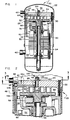
- compressor 20 has a hermetic shell 22, in which a fixed scroll member 24 is disposed.
- Fixed scroll member 24 defines a discharge aperture 26 and has an involute wrap 28 extending from it.
- An orbiting scroll member 30 is likewise disposed in shell 22 and likewise has an extending involute wrap 32 which is disposed in interleaving engagement with the involute wrap 28 of fixed scroll member 24.
- Scroll members 24 and 30 and their interleaved involute wraps 28 and 32 cooperate to define a plurality of pockets therebetween.
- the volume of the pockets decrease as they move in a radially inward direction toward discharge aperture 26 when compressor 20 is in normal operation.
- the pockets and their movement are created by the relative orbital motion of the scroll members.
- Discharge pocket 34 is the radially innermost pocket defined by the scroll members and is in flow communication with discharge aperture 26 of the fixed scroll member.
- Fixed scroll member 24 serves to divide hermetic shell 22 into a discharge pressure portion 36 and a suction pressure portion 38. It should be understood that the division of hermetic shell 22 into a discharge pressure portion 36 and suction pressure portion 38 can be accomplished by means other than the use of fixed scroll member 24 such as by the use of an independent barrier or seal member.
- a suction port 40 is provided to permit gas at suction pressure to enter suction pressure portion 38 of hermetic shell 22. Suction gas enters the radially outermost pocket defined by the scroll members, which is cyclically formed and closed by the orbital movement of the orbiting scroll member with respect to the fixed scroll member.
- a discharge port 42 is provided in shell 22 to permit the discharge of compressed gas from the discharge portion 36 of the compressor.
- a protective arrangement for the compressor 20 comprises means adapted for selectively permitting flow between the suction pressure portion 38 and the discharge pocket 34 which flow permitting means comprises a passage 46 in which a valve member 48 is disposed.
- the passage 46 comprises passage portions 46a and 46b interconnected by a chamber 62.
- Compressor 20 is driven by an electric motor 50 which is disposed in the suction pressure portion 38 of shell 22 and is therefore a low-side compressor.
- Motor 50 includes a stator 52 and rotor 54.
- a drive shaft 56 connects motor rotor 54 and orbiting scroll member 28 through a swing link mechanism 58.
- Motor 50 includes a thermally actuated line break device 60 associated with stator 52. The line break device is disposed adjacent the opening of passage 46 into suction pressure portion 38 of the compressor shell.
- compressor 20 is illustrated as including a swing link mechanism, it should be understood that the present invention is equally applicable to scroll compressors which do not make use of swing link apparatus including scroll compressors of the fixed throw type. It must also be understood that although device 60 is preferably a thermally actuated line break device which is integral with the compressor motor, other thermally actuated devices are suitable for use and are within the scope of the present invention.
- Compressor 20 includes means, operable when the pressure in discharge pressure portion 36 of shell 22 exceeds the pressure in discharge pocket 34 (such as upon compressor shutdown), for preventing the backflow of refrigerant gas from discharge pressure portion of the shell back through passage 44 and into discharge pocket 34 between the scroll members.
- such means are a discharge check valve assembly 100 which is disposed atop fixed scroll member 24.
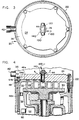
- Discharge check valve assembly 100 is comprised of a stop member 120 which is fixedly disposed between guide posts 130 as is best illustrated in Figure 3.
- Valve assembly 100 includes a free-floating valve element 140 which operates between a closed position in which it seats over and closes passage 44 from discharge portion 36 and an open position in which the flow of discharge gas through passage 44 lifts the valve element upward so that it seats against stop member 120.
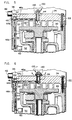
- valve element 140 When compressor 20 is shut down and pressures within shell 22 are equalized, valve element 140 rests over discharge passage 44, as is illustrated in Figure 2, and is maintained there by force of gravity. When compressor 22 starts and discharge gas begins to flow through passage 44 from pocket 34, the flow of the compressed gas lifts valve element 140 and maintains it in the open position resting against stop member 120 as is illustrated in Figure 4.
- valve element 140 will be in its closed position whenever the compressor is at rest, including those instances where the compressor has not yet been initially wired or has been electrically disconnected, it will be appreciated that if motor 50 is initially or subsequently miswired such that orbiting scroll member 28 is driven in a direction opposite from that which is intended, the pockets defined by the scroll member, including discharge pocket 34 will be caused to expand and move radially outward. As a result, compressor 20 will function, in effect, as an expander.
- the scroll members will act against the closed discharge check valve assembly 100 so that pressure in the compression pockets, including discharge pocket 34, is pulled down and becomes less than suction pressure.
- the pressure may, in fact, approach vacuum because closed valve element 140 prevents the flow of gas from the discharge pressure portion of the compressor and eliminates a souce of gas from which the miswired apparatus can pump. Under such conditions, the tips of the wraps of the scroll members are drawn into exceedingly high frictional contact with the opposing scroll member and severe compressor damage can occur.
- the compressor can be damaged by exceedingly high discharge temperatures which can occur, for instance, due to operation of the compressor at pressure ratios outside of its normal operating range. Such temperatures can cause thermal growth of the scroll members, particularly in their wraps, with the result that contact loads on the tips of the scroll members become exceedingly high.
- compressor 20 will function as an expander.
- the expansion of the compression pockets, including discharge pocket 34, causes a reduction in pressure in those pockets such that pressures less than suction pressure will occur within the pockets in a very short time.
- discharge pocket 34 is open to discharge passage 44 which, under such circumstances, is closed off from the discharge pressure portion of the compressor by the seating of valve element 140 over passage 44, the development of a sub-suction pressure within discharge pocket 34 will result in the development of sub-suction pressures both in discharge passage 44 and in the portion 46a of passage 46.
- Passage portion 46a is on the discharge pressure side of valve member 48 and opens into passage 44.
- Valve member 48 is an otherwise free-floating element within the chamber 62 and is unconnected to any other compressor element. Chamber 62 in this embodiment is closed such as by plugs 64a and 64b and can be characterized as an enlarged portion of the passage 46.
- valve member 48 upon the occurrence of even a slight pressure differential across free-floating valve member 48, as would be indicative of the development of sub-suction pressure in the discharge pocket defined by the scroll wraps, suction pressure gas will quickly begin to flow through passage 46 and into discharge pocket 34 to prevent the development of excessive contact loads on the scroll wrap tips.
- valve member 48 At such time as pressure greater than suction pressure comes to exist in discharge pocket 34 and discharge passage 44, such as by the proper wiring of the compressor and the resulting compression of gas between the scroll members, valve member 48 will be caused to seat within chamber 62 by discharge pressure gas and will prevent the flow of gas through passage 46 under what amounts to a normal operating condition.
- valve member 48 is a bimetal valve comprised of two layers 48a and 48b of dissimilar metals the thermal expansion rates of which are dissimilar.
- the metals selected for the fabrication of valve member 48 are selected in accordance with their thermal expansion characteristics so that when the valve member is heated the differing expansion rates of the dissimilar metals will cause the valve to deform in the manner of a diaphragm.
- Valve member 48 has a generally circular portion the facial area of which is greater than the cross sectional area of passage portion 46b.
- the valve member preferably has three legs such that when it deforms, or diaphragms, due to being exposed to gas which is at an abnormally high temperature, the legs of the valve member are maintained in contact with the interior of chamber 62.
- the spaces created between the legs of the diaphragmed valve member under such circumstances permit the passage of the abnormally hot discharge pressure gas between them and into passage portion 46b.
- the gas then flows into suction pressure portion 38 of the compressor shell. It will be appreciated that given the direction of gas flow described under these circumstances the flow of gas, along with the force of gravity, will maintain the legs of valve member 48 in contact with an interior surface of chamber 62 as illustrated.
- Passage portion 46b opens into suction pressure portion 38 of compressor shell 22 at a location proximate to motor stator 52 and the location on motor stator 52 where thermally actuated line break device 60 is disposed.
- the discharge gas will flow through passage 46, past diaphragmed valve member 48, and will issue into the suction pressure portion of the compressor.
- the hot discharge gas issuing from passage portion 46b will cause thermally actuated line break device 60 to be heated to a point where electrical continuity within the motor will be interrupted and the motor will be de-energized.
- the thermal characteristics of valve member 48 and line break 60 are selected to ensure their operation and the shutdown of the motor before discharge temperatures reach levels which can potentially cause damage to the compressor.
- the protective arrangement of the compressor 20 eliminates the need to dispose a discharge temperature sensor in the discharge pressure portion of the compressor in close proximity to discharge chamber 34 or to the discharge check valve assembly. It also eliminates the need to penetrate shell 22 or fixed scroll member 24 with sensor wiring.
- protective arrangement is equally applicable to compressors which do not have an internal discharge check valve assembly such as where a discharge check valve is disposed downstream of the discharge pressure portion of the compressor shell. If the discharge check valve assembly is located downstream of the discharge pressure portion of the compressor shell it will be appreciated that protective passage 46, which in net effect is a passage between a discharge pressure and a suction pressure portion of the compressor, can be located anywhere within the compressor so long as it opens both into the discharge and suction pressure portions of the compressor shell.
- FIG. 9 One such alternative protective arrangement is illustrated in Figure 9.
- the discharge check valve 100' of this arrangement is schematically illustrated as being disposed in discharge port element 42'.
- the alternative protective arrangement comprises means adapted for selectively permitting gas flow between the suction pressure portion 38' and the discharge pocket 34' which flow permitting means comprises a passage 46' which is illustrated as an essentially straight passage through the fixed scroll member 24' and includes a chamber 62'.
- the flow permitting means further comprises a valve member 48' disposed in the chamber 62'.
- Figure 10 illustrates that protective bimetal valve member 48' is disposed and confined, in a free-floating manner, in a chamber 62'. Chamber 62', in this arrangement, is open directly to the discharge pressure portion 36' of the shell and therethrough to passage 44' and pocket 34'.
- valve member 48' is retained in chamber 62' by a retainer insert 66'.
- the compressor protecting arrangement of Figures 9 and 10 operates on the same principles as the arrangement disclosed in Figures 1-8 including the opening of passage 46' into suction pressure portion 38' adjacent thermally actuated line break device 60'.
- a scroll compressor is provided with a protective arrangement which selectively permits the flow of refrigerant gas (i.) in a first direction within the compressor in response to the development of high compressor discharge temperatures and (ii.) in the opposite direction within the compressor in response to the reverse direction rotation of the driven scroll member but which (iii.) prevents any such flow under normal compressor operating conditions.
- Such permitted internal refrigerant flow during other than normal operating conditions is through an interruptable passage within the shell of the compressor that communicates between the suction pressure portion of the shell and a portion of the compressor through which discharge gas flows during normal operation.
- the controlled internal refrigerant flow permitted by the protective arrangement prevents compressor damage which would otherwise result from the development of high discharge temperatures or the development of sub-suction pressures between the scroll members such as can result from reverse direction compressor motor rotation. When the circumstances of high discharge temperature or sub-suction pressures between the scroll members do not exist, refrigerant flow through the internal passage is prevented.
- the protective valve member is disposed in the passage which is arranged to communicate between the suction portion of the compressor shell and a location downstream of the aperture through which compressed gas is discharged from between the scroll members in normal operation.
- the valve member is, however, located upstream of the discharge check valve which operates to cut off the backflow of compressed gas through the compressor upon normal compressor shutdown.
- the protective valve member is preferably a free-floating bimetal valve which, as described above, is unconnected to any other compressor element, and is disposed in an enlarged portion of the internal refrigerant passage.
- the protective valve member is lifted by the flow of gas from the suction pressure portion of the compressor through the passage which occurs when a pressure gradient develops across the valve member.
- Such a pressure gradient across the valve member will develop under circumstances which include the reverse direction rotation of the driven scroll member and the operation of the compressor as an expander as explained above.
- Such protective refrigerant flow through the passage will be from the suction portion of the compressor shell, through the passage in which the bimetal valve is disposed and back to a pocket defined by the scroll members. This will result in general pressure equalization between the pockets defined by the scroll members and the suction pressure portion of the compressor.
- the compressor acting as an expander, will pump from suction back to suction so long as the improper reverse direction motor rotation continues. In net effect, the compression apparatus is short-circuited under such circumstances by the lifting of the protective valve member in a manner which prevents damage to the scroll members.
- the bimetal valve Upon the occurrence of abnormally high discharge temperatures, the bimetal valve, which is normally exposed to compressor discharge gas through the passage in which it is disposed, deforms in the manner of a diaphragm which permits the venting of discharge gas around it and through the passage back to the suction pressure portion.
- the motor protection device By positioning the passage, where it opens into the suction pressure portion of the compressor, to be near a thermally actuated motor protection device, the motor protection device can be quickly actuated to shut the compressor down under high discharge temperature condition.
- the compressor is therefore protected from high discharge temperatures in a manner which does not require the use of a temperature sensor disposed in the discharge portion of the shell or the routing of sensor leads out of that portion of the compressor.
Landscapes
- Engineering & Computer Science (AREA)
- Mechanical Engineering (AREA)
- General Engineering & Computer Science (AREA)
- Applications Or Details Of Rotary Compressors (AREA)
- Rotary Pumps (AREA)
Applications Claiming Priority (3)
| Application Number | Priority Date | Filing Date | Title |
|---|---|---|---|
| US07/811,777 US5186613A (en) | 1991-12-20 | 1991-12-20 | Reverse phase and high discharge temperature protection in a scroll compressor |
| US811777 | 1991-12-20 | ||
| PCT/US1992/009797 WO1993013317A1 (en) | 1991-12-20 | 1992-11-13 | Reverse phase and high discharge temperature protection in a scroll compressor |
Publications (2)
| Publication Number | Publication Date |
|---|---|
| EP0617759A1 EP0617759A1 (en) | 1994-10-05 |
| EP0617759B1 true EP0617759B1 (en) | 1996-03-27 |
Family
ID=25207543
Family Applications (1)
| Application Number | Title | Priority Date | Filing Date |
|---|---|---|---|
| EP92925204A Expired - Lifetime EP0617759B1 (en) | 1991-12-20 | 1992-11-13 | Reverse phase and high discharge temperature protection in a scroll compressor |
Country Status (8)
| Country | Link |
|---|---|
| US (1) | US5186613A (OSRAM) |
| EP (1) | EP0617759B1 (OSRAM) |
| JP (1) | JPH07502583A (OSRAM) |
| AU (1) | AU3135393A (OSRAM) |
| CA (1) | CA2123325C (OSRAM) |
| HK (1) | HK210896A (OSRAM) |
| TW (1) | TW235331B (OSRAM) |
| WO (1) | WO1993013317A1 (OSRAM) |
Families Citing this family (24)
| Publication number | Priority date | Publication date | Assignee | Title |
|---|---|---|---|---|
| US5849261A (en) * | 1991-02-08 | 1998-12-15 | Diatide, Inc. | Radiolabeled vasoactive intestinal peptides for diagnosis and therapy |
| US5248244A (en) * | 1992-12-21 | 1993-09-28 | Carrier Corporation | Scroll compressor with a thermally responsive bypass valve |
| US5290154A (en) * | 1992-12-23 | 1994-03-01 | American Standard Inc. | Scroll compressor reverse phase and high discharge temperature protection |
| US5368446A (en) * | 1993-01-22 | 1994-11-29 | Copeland Corporation | Scroll compressor having high temperature control |
| US5803716A (en) * | 1993-11-29 | 1998-09-08 | Copeland Corporation | Scroll machine with reverse rotation protection |
| US5591014A (en) * | 1993-11-29 | 1997-01-07 | Copeland Corporation | Scroll machine with reverse rotation protection |
| US5366352A (en) * | 1993-12-13 | 1994-11-22 | Deblois Raymond L | Thermostatic compressor suction inlet duct valve |
| US5452989A (en) * | 1994-04-15 | 1995-09-26 | American Standard Inc. | Reverse phase and high discharge temperature protection in a scroll compressor |
| US5707210A (en) * | 1995-10-13 | 1998-01-13 | Copeland Corporation | Scroll machine with overheating protection |
| FR2756877B1 (fr) * | 1996-12-05 | 1999-01-22 | Maneurop | Compresseur hermetique destine a la circulation de gaz |
| US5807081A (en) * | 1997-01-06 | 1998-09-15 | Carrier Corporation | Combination valve for screw compressors |
| US6171064B1 (en) * | 1998-03-23 | 2001-01-09 | Scroll Technologies | Reverse rotation detection for scroll compressor utilizing suction temperature |
| US20050171486A1 (en) * | 1999-05-10 | 2005-08-04 | Hochman Mark N. | Safety syringe |
| US6267565B1 (en) | 1999-08-25 | 2001-07-31 | Copeland Corporation | Scroll temperature protection |
| ITMO20010176A1 (it) * | 2001-08-31 | 2003-03-03 | Esam Spa | Dispositivo di regolazione per compressori - aspiratori |
| US6821092B1 (en) | 2003-07-15 | 2004-11-23 | Copeland Corporation | Capacity modulated scroll compressor |
| KR100585799B1 (ko) * | 2003-12-19 | 2006-06-07 | 엘지전자 주식회사 | 스크롤압축기의 고온방지장치 |
| KR100585798B1 (ko) * | 2003-12-19 | 2006-06-07 | 엘지전자 주식회사 | 스크롤압축기의 과열방지장치 |
| US20070036661A1 (en) * | 2005-08-12 | 2007-02-15 | Copeland Corporation | Capacity modulated scroll compressor |
| JP5278496B2 (ja) * | 2011-03-25 | 2013-09-04 | 株式会社豊田自動織機 | 車両用排熱回収装置 |
| US10487832B2 (en) * | 2016-12-22 | 2019-11-26 | Lennox Industries Inc. | Method and apparatus for pressure equalization in rotary compressors |
| US10801510B2 (en) | 2017-04-24 | 2020-10-13 | Lennox Industries Inc. | Method and apparatus for pressure equalization in rotary compressors |
| CN112219076A (zh) | 2018-04-09 | 2021-01-12 | 开利公司 | 在离心压缩机中防止反向旋转 |
| KR20240109318A (ko) * | 2023-01-03 | 2024-07-11 | 삼성전자주식회사 | 과열 방지 장치를 구비한 스크롤 압축기 |
Family Cites Families (10)
| Publication number | Priority date | Publication date | Assignee | Title |
|---|---|---|---|---|
| US4934910A (en) * | 1980-10-08 | 1990-06-19 | American Standard, Inc. | Scroll-type fluid apparatus with radially compliant driving means |
| JPS60101296A (ja) * | 1983-10-21 | 1985-06-05 | Hitachi Ltd | スクロール圧縮機 |
| JPS61218792A (ja) * | 1985-03-25 | 1986-09-29 | Matsushita Electric Ind Co Ltd | スクロ−ル圧縮機 |
| US4828462A (en) * | 1987-12-10 | 1989-05-09 | Dana Corporation | Pressure detecting system for a hydraulic device |
| US4820130A (en) * | 1987-12-14 | 1989-04-11 | American Standard Inc. | Temperature sensitive solenoid valve in a scroll compressor |
| US4840545A (en) * | 1988-05-16 | 1989-06-20 | American Standard Inc. | Scroll compressor relief valve |
| JPH0221696A (ja) * | 1988-07-11 | 1990-01-24 | Hitachi Ltd | 多層配線基板 |
| US4955795A (en) * | 1988-12-21 | 1990-09-11 | Copeland Corporation | Scroll apparatus control |
| JP2567712B2 (ja) * | 1989-12-28 | 1996-12-25 | 三洋電機株式会社 | スクロール圧縮機 |
| US5141407A (en) * | 1990-10-01 | 1992-08-25 | Copeland Corporation | Scroll machine with overheating protection |
-
1991
- 1991-12-20 US US07/811,777 patent/US5186613A/en not_active Expired - Fee Related
-
1992
- 1992-11-13 JP JP5511642A patent/JPH07502583A/ja active Pending
- 1992-11-13 CA CA002123325A patent/CA2123325C/en not_active Expired - Fee Related
- 1992-11-13 EP EP92925204A patent/EP0617759B1/en not_active Expired - Lifetime
- 1992-11-13 WO PCT/US1992/009797 patent/WO1993013317A1/en not_active Ceased
- 1992-11-13 AU AU31353/93A patent/AU3135393A/en not_active Abandoned
- 1992-11-17 TW TW081109193A patent/TW235331B/zh active
-
1996
- 1996-11-28 HK HK210896A patent/HK210896A/en not_active IP Right Cessation
Also Published As
| Publication number | Publication date |
|---|---|
| TW235331B (OSRAM) | 1994-12-01 |
| HK210896A (en) | 1996-12-06 |
| JPH07502583A (ja) | 1995-03-16 |
| AU3135393A (en) | 1993-07-28 |
| EP0617759A1 (en) | 1994-10-05 |
| US5186613A (en) | 1993-02-16 |
| CA2123325A1 (en) | 1993-07-08 |
| WO1993013317A1 (en) | 1993-07-08 |
| CA2123325C (en) | 1997-11-04 |
Similar Documents
| Publication | Publication Date | Title |
|---|---|---|
| EP0617759B1 (en) | Reverse phase and high discharge temperature protection in a scroll compressor | |
| US5290154A (en) | Scroll compressor reverse phase and high discharge temperature protection | |
| US5452989A (en) | Reverse phase and high discharge temperature protection in a scroll compressor | |
| EP1286052B1 (en) | Scroll compressor | |
| US4840545A (en) | Scroll compressor relief valve | |
| JP3796277B2 (ja) | スクロール式機械 | |
| EP0608073B1 (en) | Scroll compressor having high temperature control | |
| US5591014A (en) | Scroll machine with reverse rotation protection | |
| US6210120B1 (en) | Low charge protection vent | |
| US5803716A (en) | Scroll machine with reverse rotation protection | |
| US6896498B1 (en) | Scroll compressor with hot oil temperature responsive relief of back pressure chamber | |
| KR19980042643A (ko) | 역회전 보호식 스크롤 머신 | |
| WO1999011936A1 (en) | Scroll compressor with back pressure seal protection during reverse rotation | |
| US6190138B1 (en) | Flow valve for correcting reverse rotation in scroll compressor | |
| JP3766725B2 (ja) | 油冷式スクリュ圧縮機 | |
| US7547195B2 (en) | Scroll compressor with high side to low side oil bleed valve | |
| US6217302B1 (en) | Floating seal bias for reverse fun protection in scroll compressor | |
| US5201648A (en) | Screw compressor mechanical oil shutoff arrangement | |
| JP4109246B2 (ja) | 過熱防止装置を有するスクロール圧縮機 | |
| US20030072663A1 (en) | Scroll compressor with condition responsive back pressure chamber valve | |
| EP0535533B1 (en) | Screw vacuum pump | |
| KR100308289B1 (ko) | 스크롤압축기의보호장치 | |
| US6485268B1 (en) | Oil utilized as motor protector trip for scroll compressor | |
| US6379133B1 (en) | Scroll compressor with reduced stiction surface for check valve | |
| JPH09158856A (ja) | スクロール気体圧縮機 |
Legal Events
| Date | Code | Title | Description |
|---|---|---|---|
| PUAI | Public reference made under article 153(3) epc to a published international application that has entered the european phase |
Free format text: ORIGINAL CODE: 0009012 |
|
| 17P | Request for examination filed |
Effective date: 19940714 |
|
| AK | Designated contracting states |
Kind code of ref document: A1 Designated state(s): FR GB |
|
| 17Q | First examination report despatched |
Effective date: 19950217 |
|
| GRAH | Despatch of communication of intention to grant a patent |
Free format text: ORIGINAL CODE: EPIDOS IGRA |
|
| GRAA | (expected) grant |
Free format text: ORIGINAL CODE: 0009210 |
|
| AK | Designated contracting states |
Kind code of ref document: B1 Designated state(s): FR GB |
|
| ET | Fr: translation filed | ||
| PLBE | No opposition filed within time limit |
Free format text: ORIGINAL CODE: 0009261 |
|
| STAA | Information on the status of an ep patent application or granted ep patent |
Free format text: STATUS: NO OPPOSITION FILED WITHIN TIME LIMIT |
|
| 26N | No opposition filed | ||
| PGFP | Annual fee paid to national office [announced via postgrant information from national office to epo] |
Ref country code: GB Payment date: 19971104 Year of fee payment: 6 |
|
| PGFP | Annual fee paid to national office [announced via postgrant information from national office to epo] |
Ref country code: FR Payment date: 19971112 Year of fee payment: 6 |
|
| PG25 | Lapsed in a contracting state [announced via postgrant information from national office to epo] |
Ref country code: GB Free format text: LAPSE BECAUSE OF NON-PAYMENT OF DUE FEES Effective date: 19981113 |
|
| GBPC | Gb: european patent ceased through non-payment of renewal fee |
Effective date: 19981113 |
|
| PG25 | Lapsed in a contracting state [announced via postgrant information from national office to epo] |
Ref country code: FR Free format text: LAPSE BECAUSE OF NON-PAYMENT OF DUE FEES Effective date: 19990730 |
|
| REG | Reference to a national code |
Ref country code: FR Ref legal event code: ST |