EP0600519B1 - Verfahren zur Herstellung von Tetraalkylvinylidendiphosphonat Monomeren - Google Patents
Verfahren zur Herstellung von Tetraalkylvinylidendiphosphonat Monomeren Download PDFInfo
- Publication number
- EP0600519B1 EP0600519B1 EP93119566A EP93119566A EP0600519B1 EP 0600519 B1 EP0600519 B1 EP 0600519B1 EP 93119566 A EP93119566 A EP 93119566A EP 93119566 A EP93119566 A EP 93119566A EP 0600519 B1 EP0600519 B1 EP 0600519B1
- Authority
- EP
- European Patent Office
- Prior art keywords
- monomer
- mda
- diphosphonate
- toluene
- tetra
- Prior art date
- Legal status (The legal status is an assumption and is not a legal conclusion. Google has not performed a legal analysis and makes no representation as to the accuracy of the status listed.)
- Expired - Lifetime
Links
Images
Classifications
-
- C—CHEMISTRY; METALLURGY
- C07—ORGANIC CHEMISTRY
- C07F—ACYCLIC, CARBOCYCLIC OR HETEROCYCLIC COMPOUNDS CONTAINING ELEMENTS OTHER THAN CARBON, HYDROGEN, HALOGEN, OXYGEN, NITROGEN, SULFUR, SELENIUM OR TELLURIUM
- C07F9/00—Compounds containing elements of Groups 5 or 15 of the Periodic Table
- C07F9/02—Phosphorus compounds
- C07F9/28—Phosphorus compounds with one or more P—C bonds
- C07F9/38—Phosphonic acids [RP(=O)(OH)2]; Thiophosphonic acids ; [RP(=X1)(X2H)2(X1, X2 are each independently O, S or Se)]
- C07F9/40—Esters thereof
- C07F9/4003—Esters thereof the acid moiety containing a substituent or a structure which is considered as characteristic
- C07F9/4025—Esters of poly(thio)phosphonic acids
- C07F9/4028—Esters of poly(thio)phosphonic acids containing no further substituents than -PO3H2 groups in free or esterified form
- C07F9/4031—Acyclic unsaturated derivatives
Definitions
- the present invention is directed generally to a method of preparing a monomer of tetraalkyl vinylidene-1,1-diphosphonate. More particularly, the invention is directed to a method of preparing in a few hours of reaction time the monomer of tetraalkyl vinylidene-1, 1-diphosponate.
- the monomer of tetraalkyl vinylidene-1,1-diphosponate has a number of important uses including the manufacture of ion exchange resins, polymeric flame retardants and pharmaceutical applications.
- Conventional methods of producing this monomer have included (1) thermal dehydration of tetrasodium (1-hydroxyethylidene) bis (phosphonate) at high temperatures and (2) a two-step process as set forth in U.S. Pat. No. 4,939,284 involving the base catalyzed reaction of a methylenebis (phosphonate) ester with a paraformaldehyde followed by addition of an acid catalyst to catalyze elimination of alcohol from the reaction product.
- the first method however, has the disadvantage of requiring precise temperature control during the dehydration step and a lengthy, time-consuming purification process.
- the second method avoids these problems, but the reaction time typically requires up to 200 hours to go to seventy percent completion for the tetraisopropyl ester form. In addition, this procedure requires use of an alcohol solvent which complicates processing conditions.
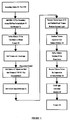
- FIG. 1 A preferred method of manufacturing a monomer of tetraalkyl vinylidene-1, 1-diphosphonate in accordance with the invention is illustrated in FIG. 1.
- Reactants 10 are accumulated from conventional supply sources, and the reactants 10 include a first reactant 12 of formaldehyde, such as, for example, formalin, paraformaldehyde or trioxane.
- a second reactant 14 includes a secondary amine, such as, for example, a dipropylamine, dimethylamine or diethylamine.
- a third reactant 16 includes a tetra (alkyl) methylene diphosphonate (MDA), such as, for example, tetra (methyl), or (ethyl), or (propyl) or (isopropyl) methylene diphosphonate.
- MDA tetra (alkyl) methylene diphosphonate
- the reactants 10 are combined by dissolving the amine into water, the MDA and formalin is added and a resulting mixture 18 is stirred.
- the pH is monitored to initilize the pH above about 6 in order to allow the reaction to proceed (during which pH will vary in accordance with the reaction). While a most preferred initial pH range is 7.35-7.4, any pH above 6 (and up to 14) will suffice.
- To control initial pH one can add a secondary amine ⁇ HCl, (or other such conventional acidic formulations) with the formalin.
- formalin, diethylamine and diethylamine ⁇ HCl and MDA The preferred ratio of formalin to diethylamine and diethylamine HCl to MDA is about 3.2:0.6:1:1. This can be compared to the preferred basic constituent ratios of formalin:dipropylamine:MDA of about 3.2:1.8:1.
- the aqueous mixture 18 is placed into a container, such as a heavy walled flask, and closed with a stopper.
- the mixture 18 is refluxed for about one to two hours to achieve a product 20. Under these most preferred conditions, increased reflux time beyond about two hours does not substantially affect the yield.
- a higher purity product can be obtained by purifying the product 20.
- the product 20 is placed in a separatory funnel.
- a toluene and azeotrope is added to the product 20.
- a volume of toluene and half the toluene volume of 1N HCl (and also preferably including NaCl) is then added to form the second mixture 22.
- This second mixture 22 is stirred, and the contents are allowed to settle.
- the toluene layer of the second mixture 22 is removed, and a fresh toluene wash is performed on the aqueous layer.
- the two toluene layers are then combined to form toluene solution 24.
- the combined toluene solution 24 is added to a one-neck flask, and a Dean-Stark trap and condenser are added to the flask.
- the toluene solution 24 is refluxed for about three hours, emptying the Dean-Stark trap enough (usually several times) until only toluene is being distilled over.
- the toluene portion is then removed by using a rotary evaporator by heating the toluene solution 24 to 60°C.
- a remaining product mix 28 contains monomeric tetraalkyl vinylidene-1, 1-diphosphonate and MDA in the ratio of about 81:19 or greater and with a product yield of about 90%.
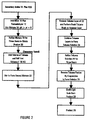
- the initialized pH in the second step can be achieved by adding a concentrated acid, such as HCl, to establish the pH at or above a value of 6.
- a concentrated acid such as HCl
- the mixture 18 is refluxed for about three hours to achieve the product 20. Extending the reflux time beyond about three hours does not substantially affect the yield.
- further purification steps can be used to improve the product purity.
- a volume of toluene and half that volume of 1N HCl is added to the product 20 to form a second mixture 22.
- Further processing steps are substantially the same as in the process of FIG. 1.
- the remaining product mix contains monomeric tetraalykyl vinylidene-1, 1-diphosphonate and MDA in the ratio of about 7:3 and greater.
- Example 2 As in Example 1, except use 40% aqueous dimethylamine solution, a 5:2:1 formalin:amine:MDA initial ratio, and a pH of 6.86; a resulting vinylidene:MDA ratio is 3.4:96.6.
- Example 2 As in Example 1, except with paraformaldehyde:diethylamine: MDA in a 5:2:1 ratio and no water as solvent; a vinylidene:MDA ratio of 54.2:45.8 and a 57% yield.
- the ratio of formalin to diethylamine to diethylamine HCl to MDA is preferably about 3.2 to 0.6 to 1 to 1.
- Example 10 The same procedure as Example 10 was followed, but all quantities of components were increased by the same molar percentage except for the MDA.
- the product results are substantially insensitive. If increase quantities by 10%, the yield is 84.2% with MDA/monomer - 22/78. If quantities are increased by 40%, then the yield is 76% with an MDA/monomer ratio of 19/81.
- Example 10 The same procedure as in Example 10 was followed except a variety of secondary amines and secondary amine salts were used.
- Dipropylamine (0.1-1.0 moles) was combined with dimethylamine ⁇ HCl in the ratio of, for example, dipropylamine at 0.6 moles and dimethylamine ⁇ HCl at 1 mole. This yields 83.9% with the ratio of MDA/monomer (VDPA) being 34/66.
- diethylamine (0.1-1.0 moles) was combined with dimethylamine ⁇ HCl in the preferred ratio of diethylamine at 0.6 moles to dimethylamine ⁇ HCL at 1 moles. This yields 86.7% with an MDA/VDPA monomer ratio of 25/75.
- Example 10 The same procedure as in Example 10 was followed with the effect of temperature on yield and MDA/monomer (VDPA) evaluated.
- the ratio of formalin to diethylamine to dimethylamine ⁇ HCl to MDA was 3.2 to 0.7 to 1.0 to 1.0.
- the yield was 80.1% with a ratio of 24/76 for MDA/monomer.
- the yield was 78.2% with a ratio of 43/57 for MDA/monomer.
Landscapes
- Chemical & Material Sciences (AREA)
- Organic Chemistry (AREA)
- Health & Medical Sciences (AREA)
- Life Sciences & Earth Sciences (AREA)
- Biochemistry (AREA)
- General Health & Medical Sciences (AREA)
- Molecular Biology (AREA)
- Organic Low-Molecular-Weight Compounds And Preparation Thereof (AREA)
Claims (10)
- Verfahren zur Herstellung eines Tetraalkylvinyliden-1,1-diphosphonat-Monomeren, das die Schritte umfaßt:(a) Vereinigen eines sekundären Amins, eines Formaldehyds und eines Tetra(alkyl)methylendiphosphonats, derart daß eine erste wäßrige Mischung mit einem pH-Wert oberhalb von 6 gebildet wird, und(b) Behandeln der wäßrigen Mischung unter Rückfluß, so daß ein unter Rückfluß behandeltes Produkt des Tetraalkylvinyliden-1,1-diphosphonats erhalten wird.
- Verfahren nach Anspruch 1, wobei die erste wäßrige Mischung bei einem pH-Wert oberhalb von 6 gehalten wird.
- Verfahren nach Anspruch 1, wobei Tetra(alkyl)methylen-diphosphonat aus der Gruppe ausgewählt ist, die aus Tetra(methyl)-, Tetra(ethyl)-, Tetra(propyl-) und Tetra(isopropyl)-methylendiphosphonat besteht.
- Verfahren nach Anspruch 1, wobei das sekundäre Amin zumindest eines aus Dipropylamin, Diethylamin und Dimethylamin enthält.
- Verfahren nach Anspruch 1, wobei das Formaldehyd aus der Gruppe ausgewählt ist, die aus Formalin, einem Paraformaldehyd und Trioxan besteht.
- Verfahren nach Anspruch 1, wobei das sekundäre Amin ungefähr 0,1 bis 1,0 mol aufweist.
- Verfahren nach Anspruch 5, wobei die Menge an Formalin zwischen etwa 0,1-1,0 mol variiert wird.
- Verfahren nach Anspruch 1, das ferner einen Reinigungsschritt beinhaltet, der umfaβt:(1) Zugabe von Toluol und Säure zu dem Rückflußprodukt, so daß eine Mischung gebildet wird,(2) Behandeln dieser Mischung aus Toluol, Säure und dem Rückflußprodukt unter Rückfluß, und(3) Verdampfen und Destillieren unerwünschter Teile der Rückflußmischung, so daß ein gereinigtes Tetraalkylvinyliden 1,1-diphosphonat gebildet wird.
- Verfahren nach Anspruch 8, wobei das Monomer einen Bereich für das Vinyliden:MDA-Verhältnis von etwa 3,4 zu 96,9 bis 7 zu 3 aufweist.
- Verfahren nach Anspruch 8, wobei das obere Verhältnis von Monomer zu Tetra(alkyl)methylendiphosphonat etwa 9 zu 1 ist, wenn während des Reinigungsvorgangs unter sehr hohem Vakuum von weniger als etwa 0,01 mmHg (0,0133 hPa) destilliert wird.
Applications Claiming Priority (2)
| Application Number | Priority Date | Filing Date | Title |
|---|---|---|---|
| US07/985,974 US5256808A (en) | 1992-12-04 | 1992-12-04 | Synthesis of tetraalkyl vinylidene diphosphonate monomer |
| US985974 | 2001-11-07 |
Publications (2)
| Publication Number | Publication Date |
|---|---|
| EP0600519A1 EP0600519A1 (de) | 1994-06-08 |
| EP0600519B1 true EP0600519B1 (de) | 1998-09-16 |
Family
ID=25531957
Family Applications (1)
| Application Number | Title | Priority Date | Filing Date |
|---|---|---|---|
| EP93119566A Expired - Lifetime EP0600519B1 (de) | 1992-12-04 | 1993-12-04 | Verfahren zur Herstellung von Tetraalkylvinylidendiphosphonat Monomeren |
Country Status (7)
| Country | Link |
|---|---|
| US (2) | US5256808A (de) |
| EP (1) | EP0600519B1 (de) |
| JP (1) | JPH06234781A (de) |
| CA (1) | CA2110620A1 (de) |
| DE (1) | DE69321079T2 (de) |
| FI (1) | FI935446A7 (de) |
| NO (1) | NO934398L (de) |
Families Citing this family (8)
| Publication number | Priority date | Publication date | Assignee | Title |
|---|---|---|---|---|
| DE69225325T2 (de) * | 1991-09-05 | 1998-08-27 | Toray Industries | Methandiphosphonsäurederivat, herstellung davon und verwendung davon als arzneimittel |
| US5722303A (en) * | 1993-03-03 | 1998-03-03 | University Of Chicago | Mixed-mu superconducting bearings |
| US5618851A (en) * | 1995-02-06 | 1997-04-08 | Arch Development Corp. | Grafted methylenediphosphonate ion exchange resins |
| AU5972096A (en) * | 1995-06-07 | 1996-12-30 | Eichrom Industries, Inc. | Process and apparatus for separating tritiated water |
| US5854968A (en) * | 1997-06-09 | 1998-12-29 | Arch Development Corporation | Process and apparatus for the production of BI-213 cations |
| KR100620672B1 (ko) * | 2002-12-14 | 2006-09-13 | 주식회사 하이닉스반도체 | 포토레지스트 조성물 |
| US8076432B2 (en) | 2004-07-07 | 2011-12-13 | Unichem Technologies, Inc. | Phosphonic compounds and methods of use thereof |
| US8101700B2 (en) * | 2008-12-31 | 2012-01-24 | Unichem Technologies, Inc. | Phosphonic polymers having a phosphinate backbone and methods of making and using thereof |
Family Cites Families (3)
| Publication number | Priority date | Publication date | Assignee | Title |
|---|---|---|---|---|
| GB1204967A (en) * | 1967-05-08 | 1970-09-09 | Monsanto Co | Organic phosphorus compounds, their production and use |
| US3686290A (en) * | 1969-05-29 | 1972-08-22 | Robert L Carroll | Processes for preparing olefinic organo-phosphorus compounds |
| US4939284A (en) * | 1985-11-04 | 1990-07-03 | The Procter & Gamble Company | Process for the manufacture of tetraalkyl ethenylidenebisphosphonate esters |
-
1992
- 1992-12-04 US US07/985,974 patent/US5256808A/en not_active Expired - Lifetime
-
1993
- 1993-10-05 US US08/131,904 patent/US5442085A/en not_active Expired - Lifetime
- 1993-11-29 JP JP5297782A patent/JPH06234781A/ja active Pending
- 1993-12-03 CA CA002110620A patent/CA2110620A1/en not_active Abandoned
- 1993-12-03 NO NO934398A patent/NO934398L/no unknown
- 1993-12-03 FI FI935446A patent/FI935446A7/fi unknown
- 1993-12-04 DE DE69321079T patent/DE69321079T2/de not_active Expired - Fee Related
- 1993-12-04 EP EP93119566A patent/EP0600519B1/de not_active Expired - Lifetime
Also Published As
| Publication number | Publication date |
|---|---|
| CA2110620A1 (en) | 1994-06-05 |
| DE69321079T2 (de) | 1999-02-25 |
| NO934398D0 (no) | 1993-12-03 |
| FI935446L (fi) | 1994-06-05 |
| FI935446A0 (fi) | 1993-12-03 |
| FI935446A7 (fi) | 1994-06-05 |
| JPH06234781A (ja) | 1994-08-23 |
| NO934398L (no) | 1994-06-06 |
| DE69321079D1 (de) | 1998-10-22 |
| US5256808A (en) | 1993-10-26 |
| EP0600519A1 (de) | 1994-06-08 |
| US5442085A (en) | 1995-08-15 |
Similar Documents
| Publication | Publication Date | Title |
|---|---|---|
| US4705651A (en) | Process for the preparation of diphosphonic acids | |
| TWI325862B (en) | Removal of acids from chemical reaction mixtures with the aid of ionic liquids | |
| EP0600519B1 (de) | Verfahren zur Herstellung von Tetraalkylvinylidendiphosphonat Monomeren | |
| SK2482001A3 (en) | Novel hydrate forms of alendronate sodium, processes for manufacture thereof, and pharmaceutical compositions thereof | |
| US20110207928A1 (en) | Purification method for adefovir dipivoxil | |
| JPS6117834B2 (de) | ||
| US5106604A (en) | Use of metal salts in the synthesis of oligomeric hydrogensilsesquioxanes via hydrolysis/condensation reactions | |
| EP0270724B1 (de) | Herstellung von Alkyltrifluoracetoacetat | |
| JPH0899983A (ja) | 6−オキソ−(6H)−ジベンズ−[c,e][1,2]−オキサホスホリンを製造するための方法 | |
| EP0233229B1 (de) | Herstellung von einem allylamin und quaternären diallylammoniumverbindungen | |
| US3121731A (en) | Process for making mono (aminoalkyl) phosphite esters | |
| JPH03153656A (ja) | 3―シアノ―3,5,5’―トリメチル―1―シクロヘキサノン及びその製法 | |
| CA2158471C (en) | Process for the manufacture of aminomethanephosphonic acid | |
| EP0452960B1 (de) | Verfahren zur Herstellung von hexamethylcyclotrisilazan | |
| KR20010102162A (ko) | 알렌드론산을 제조하는 신규한 방법 | |
| Failla et al. | SYNTHESIS AND CHARACTERIZATION OF AMINOPYRIDIN-2-YL-METHYL-PHOSPHONIC ACIDS | |
| JP2548427B2 (ja) | ジヒドロキシジフェニルメタンの製造方法 | |
| US8003815B2 (en) | Method for preparation of cross-condensed compound between amino acids and aminoalkylsilane having alkoxy groups using microwave | |
| JP2766135B2 (ja) | ナトリウムビストリメチルシリルアミド溶液の製造方法 | |
| JP2927880B2 (ja) | 4,4’‐ジヒドロキシ‐3,3’,5,5’‐テトラメチルジフェニルメタンの製造方法 | |
| Gilman et al. | Scission of the Silicon-Silicon Bond in Halogenated Polysilanes by Organometallic Reaggents | |
| JPS6117835B2 (de) | ||
| JP2008521804A (ja) | ベンズフェタミンの結晶化方法 | |
| RU2057118C1 (ru) | Способ получения n,n-диэтилметатолуамида | |
| JPS6318955B2 (de) |
Legal Events
| Date | Code | Title | Description |
|---|---|---|---|
| PUAI | Public reference made under article 153(3) epc to a published international application that has entered the european phase |
Free format text: ORIGINAL CODE: 0009012 |
|
| AK | Designated contracting states |
Kind code of ref document: A1 Designated state(s): DE FR GB |
|
| 17P | Request for examination filed |
Effective date: 19940730 |
|
| 17Q | First examination report despatched |
Effective date: 19961220 |
|
| GRAG | Despatch of communication of intention to grant |
Free format text: ORIGINAL CODE: EPIDOS AGRA |
|
| GRAG | Despatch of communication of intention to grant |
Free format text: ORIGINAL CODE: EPIDOS AGRA |
|
| GRAG | Despatch of communication of intention to grant |
Free format text: ORIGINAL CODE: EPIDOS AGRA |
|
| GRAH | Despatch of communication of intention to grant a patent |
Free format text: ORIGINAL CODE: EPIDOS IGRA |
|
| RBV | Designated contracting states (corrected) |
Designated state(s): DE FR GB |
|
| GRAH | Despatch of communication of intention to grant a patent |
Free format text: ORIGINAL CODE: EPIDOS IGRA |
|
| GRAA | (expected) grant |
Free format text: ORIGINAL CODE: 0009210 |
|
| AK | Designated contracting states |
Kind code of ref document: B1 Designated state(s): DE FR GB |
|
| REF | Corresponds to: |
Ref document number: 69321079 Country of ref document: DE Date of ref document: 19981022 |
|
| ET | Fr: translation filed | ||
| PLBE | No opposition filed within time limit |
Free format text: ORIGINAL CODE: 0009261 |
|
| STAA | Information on the status of an ep patent application or granted ep patent |
Free format text: STATUS: NO OPPOSITION FILED WITHIN TIME LIMIT |
|
| 26N | No opposition filed | ||
| PGFP | Annual fee paid to national office [announced via postgrant information from national office to epo] |
Ref country code: GB Payment date: 20011102 Year of fee payment: 9 |
|
| PGFP | Annual fee paid to national office [announced via postgrant information from national office to epo] |
Ref country code: FR Payment date: 20011120 Year of fee payment: 9 |
|
| PGFP | Annual fee paid to national office [announced via postgrant information from national office to epo] |
Ref country code: DE Payment date: 20011205 Year of fee payment: 9 |
|
| REG | Reference to a national code |
Ref country code: GB Ref legal event code: IF02 |
|
| PG25 | Lapsed in a contracting state [announced via postgrant information from national office to epo] |
Ref country code: GB Free format text: LAPSE BECAUSE OF NON-PAYMENT OF DUE FEES Effective date: 20021204 |
|
| PG25 | Lapsed in a contracting state [announced via postgrant information from national office to epo] |
Ref country code: DE Free format text: LAPSE BECAUSE OF NON-PAYMENT OF DUE FEES Effective date: 20030701 |
|
| GBPC | Gb: european patent ceased through non-payment of renewal fee | ||
| PG25 | Lapsed in a contracting state [announced via postgrant information from national office to epo] |
Ref country code: FR Free format text: LAPSE BECAUSE OF NON-PAYMENT OF DUE FEES Effective date: 20030901 |
|
| REG | Reference to a national code |
Ref country code: FR Ref legal event code: ST |