EP0589368B1 - Reversibles thermisches Aufzeichnungsmaterial - Google Patents
Reversibles thermisches Aufzeichnungsmaterial Download PDFInfo
- Publication number
- EP0589368B1 EP0589368B1 EP93115008A EP93115008A EP0589368B1 EP 0589368 B1 EP0589368 B1 EP 0589368B1 EP 93115008 A EP93115008 A EP 93115008A EP 93115008 A EP93115008 A EP 93115008A EP 0589368 B1 EP0589368 B1 EP 0589368B1
- Authority
- EP
- European Patent Office
- Prior art keywords
- solvent
- thermal recording
- reversible thermal
- crystal particles
- recording medium
- Prior art date
- Legal status (The legal status is an assumption and is not a legal conclusion. Google has not performed a legal analysis and makes no representation as to the accuracy of the status listed.)
- Expired - Lifetime
Links
Images



Classifications
-
- B—PERFORMING OPERATIONS; TRANSPORTING
- B41—PRINTING; LINING MACHINES; TYPEWRITERS; STAMPS
- B41M—PRINTING, DUPLICATING, MARKING, OR COPYING PROCESSES; COLOUR PRINTING
- B41M5/00—Duplicating or marking methods; Sheet materials for use therein
- B41M5/26—Thermography ; Marking by high energetic means, e.g. laser otherwise than by burning, and characterised by the material used
- B41M5/36—Thermography ; Marking by high energetic means, e.g. laser otherwise than by burning, and characterised by the material used using a polymeric layer, which may be particulate and which is deformed or structurally changed with modification of its' properties, e.g. of its' optical hydrophobic-hydrophilic, solubility or permeability properties
- B41M5/363—Thermography ; Marking by high energetic means, e.g. laser otherwise than by burning, and characterised by the material used using a polymeric layer, which may be particulate and which is deformed or structurally changed with modification of its' properties, e.g. of its' optical hydrophobic-hydrophilic, solubility or permeability properties using materials comprising a polymeric matrix containing a low molecular weight organic compound such as a fatty acid, e.g. for reversible recording
Definitions
- the present invention relates to a reversible thermal recording medium capable of recording and erasing information reversibly by heating, and a method and apparatus for manufacturing the same.
- photochromic materials which form or eliminate colors by irradiation with light such as spiropyran compounds have hitherto been widely studied. These materials had, however, problems in stability to light or heat, and durability in repeated use.
- Japanese Laid-open Patent Application Sho. 54-119377 discloses organic crystal particles dispersed in a matrix polymer, in which the recording material is changed in phase by heat to form transparent states and opaque states, thereby recording and displaying the information reversibly.
- This reversible thermal recording material obtained by dispersing organic crystal particles in a matrix polymer records and erases as it forms transparent states and opaque states by heating and cooling processes.
- the film thickness of the reversible thermal recording layer In the reversible thermal recording medium known previously in this field, generally, when the film thickness of the reversible thermal recording layer is thin, sufficient turbidity in the opaque state is not obtained, and the visibility (contrast) is inferior. To solve these problems, the film thickness of the reversible thermal recording layer must be increased; and as the film thickness increases, it is necessary to transmit heat also throughout the film's thickness, thereby requiring a large heat source.
- the increases in the film thickness result in slowing the recording speed, and also require a control in heating to provide a uniform temperature throughout the thickness of the recording layer.
- a matrix polymer or organic crystal particles are contained in an amount greater than its solubility, and a part of the matrix polymer or organic crystal particles is dispersed in a granular form.
- the organic crystal particles are aggregated in the reversible thermal recording layer, and the level of dispersion of the organic crystal particles tends to be poor.
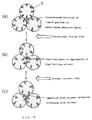
- the film forming process (a to c) in Fig. 8 takes place. More specifically, as water evaporates from the state of Fig. 8a in which a lot of water is contained in the coating layer, the matrix polymer is filled up with emulsion particles 7 (Fig. 8b). At this time, organic crystal particles 3 aggregate, and by directly heating the coating layer above the minimum temperature required for forming a continuous film (minimum film-forming temperature), a continuous film is formed as emulsion particles 7 fuse with each other. As a result, a reversible thermal recording layer in which organic crystal particles are poorly dispersed is formed.
- the interface area of the organic crystal particles and matrix polymer decreases.
- the rate of organic crystal particles contributing to the opaque state is also lowered, thus lowering the transparent/opaque contrast and visibility.
- a first object of the invention to provide a reversible thermal recording medium having excellent contrast.
- a second object is to provide a method for manufacturing a reversible thermal recording medium excellent in contrast from a paint, in which a matrix polymer and organic crystal particles are contained and at least one of the matrix polymer and organic crystal particles is dispersed in a granular form.
- a third object is to provide an apparatus for manufacturing a reversible thermal recording medium excellent in contrast from the paint mentioned above.
- the first object of the invention is achieved by the reversible thermal recording medium, having a porous reversible thermal recording layer on a substrate.
- the reversible thermal recording layer is formed by applying a paint, in which organic crystal particles and matrix polymer are contained and the organic crystal particles are dispersed, to the substrate. Therefore, the thermal recording medium can reversibly show transparent states and opaque states by cooling after two modes of heating.
- Fig. 2 shows the recording characteristics of a reversible thermal heating medium used in the invention.
- the organic crystal particles in the matrix polymer are in a polycrystalline state, and the reversible thermal recording medium is in an opaque state due to the scattering incident light among organic crystal particles of the polycrystal.
- the grain boundary of the polycrystalline organic crystal particles is dissolved, and the reversible thermal recording medium becomes transparent.
- the reversible thermal recording layer comprises pores formed in the matrix polymer.
- the mean pore size of the pores of the reversible thermal recording layer is from 0.1 to 10 ⁇ m.
- the porosity of the reversible thermal recording layer is from 5 to 50 vol.%.
- the reversible thermal recording layer comprises gaps formed in the interfaces of the organic crystal particles and the matrix polymer.
- the mean particle size of the organic crystal particles is 3 ⁇ m or less.
- the mean width of the gaps formed in the reversible thermal recording layer is 1 ⁇ m or less.
- a method for manufacturing the reversible thermal recording medium having a porous reversible thermal recording layer on a substrate comprises a coating step of applying a paint in which a matrix polymer, organic crystal particles and pore forming particles are contained and at least one of the matrix polymer and organic crystal particles is dispersed in a granular form on the substrate to form a coating layer; a solvent contact step of eluting the pore forming particles by contacting the coating layer with a solvent in which the pore forming particles are soluble; and a drying step.
- the solvent contact step is effected by immersing the coating layer in the solvent.
- the pore forming particles are soluble in water or alcohol.
- the coating layer is a layer made from a water-based emulsion paint containing an emulsifier. More preferably the pore forming particles are the emulsifier.
- the coating layer contains an organic solvent of high boiling point having a compatibility for the solvent. More preferably the organic solvent of high boiling point remains in the coating layer in the solvent contact step.
- Another method for manufacturing the reversible thermal recording medium having a porous reversible thermal recording layer on a substrate comprises a coating step of applying a paint in which a matrix polymer and organic crystal particles are contained and at least one of the matrix polymer and organic crystal particles is dispersed in a granular form on a substrate to form a coating layer; a solvent contact step of contacting the coating layer with a solvent in which the matrix polymer and organic crystal particles are soluble; and a drying step.
- the organic crystal particles are crystalized after the solidification of the matrix polymer when the organic crystal particles have higher solubility in the solvent than the matrix polymer, thereby forming gaps during the drying step due to contraction of the organic crystal particles.
- the drying step is carried out at a temperature higher than the melting point of the organic crystal particles, and that the organic crystal particles are in a supercooled state below the glass-transition temperature of the matrix polymer after the drying step, thus crystalizing the organic crystal particles in a vitrified matrix polymer and forming gaps due to contraction of the organic crystal particles.
- the solvent contact step is effected by immersing the coating layer in the solvent.
- the solvent contact step is effected by exposing the coating layer to the vapor of the solvent.
- the paint contains an organic solvent of high boiling point, having a compatibility for the solvent and dissolving both matrix polymer and organic crystal particles. More preferably the organic solvent of high boiling point remains in the coating layer in the solvent contact step.
- the organic solvent of high boiling point has a boiling point in a range of 120 to 180°C
- the paint is a water-based emulsion paint containing an emulsifier.
- a provisional drying step for drying the coating layer at a temperature below the minimum film-forming temperature of the paint is carried out between the coating step and the solvent contact step.
- the paint is a water-based emulsion paint containing an emulsifier.
- the paint comprises the matrix polymer which is a resin mainly composed of repeating units of vinyl chloride units or a resin mainly composed of polyester, and organic crystal particles with higher aliphatic compounds having hydrogen bonds.
- the solvent contact step is effected by causing the coating layer to come into contact with the solvent containing at least one type of solvent selected from the group consisiting of acetone, methyl acetate, ethyl acetate, tetrahydrofuran, and methylene chloride.
- the paint comprises glycol monoalkyl ether or dimethyl formamide as the organic solvent of high boiling solvent.
- glycol monoalkyl ether is selected from the group consisting of ethylene glycol monomethyl ether, ethylene glycol monoethyl ether, ethylene glycol monopropyl ether, and ethylene glycol monobutyl ether.
- the paint is a water-based emulsion paint including an alcohol. More preferably the alcohol is selected from the group consisting of propanol, butanol, and isoamyl alcohol.
- the second object is achieved by either of the two methods mentioned above.
- the third object is achieved with a manufacturing apparatus for a reversible thermal recording medium, which is characterized by comprising solvent contact means for exposing the coating layer to the vapor of a solvent while placing a cloth sheet, impregnated with the solvent in which the matrix polymer and organic crystal particles are soluble, oppositely with a gap against the coating layer.
- the coating layer is formed on a substrate by applying a paint in which the matrix polymer and organic crystal particles are contained and at least one of the matrix polymer and organic crystal particles is dispersed in a granular form.
- the cloth sheet is a cloth foil resistant to the solvent selected from the group consisting of woven cloth, nonwoven cloth, and air permeable net.
- the solvent vapor contact means comprises a band-shaped cloth sheet in roll form, a rotary roll, a solvent feed part, a solvent evaporating part, and a cover box; the band-shaped cloth sheet is impregnated with the solvent in the solvent feed part containing the solvent; and the solvent vapor contact means rotates and moves the band-shaped cloth sheet impregnated with the solvent to the evaporating part by the rotary roll, thereby placing the coating layer and the band-shaped cloth sheet face to face across a gap in the evaporating part and exposing the coating layer to vapor of the solvent.
- the solvent feed part and the solvent evaporating part are located in the cover box which prevents outflow of the vapor of the solvent, and that the solvent feed part is used as a means for immersing the band-shaped cloth sheet in a container filled with the solvent or as a means for spraying the solvent onto the band-shaped cloth sheet.
- the manufacturing apparatus further comprises means for controlling the temperature of the solvent feed part and the solvent evaporating part inside the cover box, and that the means for controlling comprise at least one hot plate. More preferably the hot plate is located facing at least one side surface of the cloth sheet and the substrate formed with the coating layer.
- the principle of recording and erasing of the reversible thermal recording medium depends on the changes in a light scattering state due to the changes in the crystal state of organic crystal particles.
- the transparency and opacity of a recording layer in this field has been hitherto said to depend on the crystallinity of organic crystal particles and the mutual action of the organic crystal particles and the matrix polymer.
- the contrast has been said to be dependent on the film thickness of the recording layer, the mean particle size of the organic crystal particles, the level of dispersion of the organic crystal particles in the matrix polymer, the difference in light scattering of organic crystal particles between the transparent state and the opaque state, and the transparency of the matrix polymer, or the like.
- the visibility enhancing means of the invention have been made by forming a part possessing a different refractive index in the recording layer and by scattering more effectively the light from the organic crystal particles in a opaque state. More specifically, in the invention, a part having a refractive index difference is formed by a porous reversible thermal recording layer.
- the porous reversible thermal recording layer is available in the following two representative compositions.
- the reversible thermal recording layer of type (1) there is a large difference in refractive index between the pores and the matrix polymer, and the scattered light obtained by shining light onto the organic crystal particles in the opaque state is more randomly reflected on the interface of the pores and matrix polymer, thereby emphasizing the scattering and enhancing the turbidity of the opaque state.
- the transparent state by nature, the transparency of the organic crystal particles and matrix polymer is high. In a case that light is shone onto the organic crystal particles in their transparent state, scattering of light hardly takes place although refraction occurs depending on the refractive index difference between the organic crystal particles and the pores in the monocrystalline state. The refraction is not random but only in one specific direction. Hence there is almost no effect on the transparency. Accordingly, the contrast between the opaque state and the transparent state is enhanced, thus producing the reversible thermal recording medium excellent in visibility of this invention.
- the reversible thermal recording layer of type (2) has a large difference in refractive index between the gaps and the organic crystal particles, the scattering in the opaque state is emphasized as in the case of type (1).
- the turbidity is improved, and the contrast between the opaque state and the transparent state is enhanced because there is almost no effect on transparency in the transparent state.
- the portion responsible for refractive index difference is in contact with the organic crystal particles which are scattering parts, the scattered light in the organic crystal particles in the opaque state is reflected randomly on the interface against the gaps at a high degree of probability. In this sense, the composition of type (2) is more effective than the composition of type (1).
- the first manufacturing method of the invention forms the reversible thermal recording layer of type (1), and a reversible thermal recording medium excellent in visibility is obtained.
- the second manufacturing method of the invention forms the gaps shown in type (2) when the organic solvent used in the solvent contact step is evaporated from the coating layer. This is because the solubility of the matrix polymer and organic crystal particles in the solvent, or the precipitation speed of the matrix polymer and organic crystal particles from the solvent is different.
- the gaps are formed due to the contraction of the organic crystal particles, which are crystalized after the solidification of the matrix polymer.
- the matrix polymer is solidified after the crystalization of the organic crystal particles, the gaps are formed due to the contraction of the solidified matrix polymer.
- re-arrangement or re-precipitation of the matrix polymer and organic crystal particles originates from a swollen or dissolved state, and the organic crystal particles are dispersed in the matrix polymer as fine particles, thereby forming the reversible thermal recording layer; the level of dispersion of the organic crystal particles is significantly improved.
- a reversible thermal recording medium excellent in visibility is obtained.
- the vapor of the solvent at high concentration can be uniformly applied over the entire surface of the coating layer in a short time by the manufacturing apparatus of the invention mentioned above.
- the solvent can be uniformly applied on the surface of the coating layer without generating the dew condensation from the vapor of the volatile solvent, as compared with the treatment of using the vapor directly from the liquid surface of the solvent.
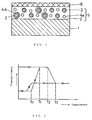
- Fig. 1 is a sectional view showing an embodiment of a reversible thermal recording medium of the invention.
- Fig. 2 is a diagram showing the recording characteristics of the reversible thermal recording medium of the invention.
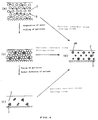
- Fig. 3 is a conceptual diagram showing an embodiment of the manufacturing method of a reversible thermal recording medium of the invention.
- Fig. 4 is a conceptual diagram showing another embodiment of the manufacturing method of a reversible thermal recording medium of the invention.
- Fig. 5 is a conceptual diagram showing a film forming process from water-based emulsion paint.
- Fig. 6 is a diagram showing an embodiment of the manufacturing apparatus for the coating layer of the invention.
- Fig. 7 is a diagram showing another embodiment of the manufacturing apparatus for the coating layer of the invention.
- Fig. 8 is a diagram showing a film forming process from water-based emulsion paint of the prior art.
- FIG. 1 A representative example of a reversible thermal recording medium of the invention is shown in Fig. 1.
- a reversible thermal recording layer 5 composed of a matrix polymer 2, organic crystal particles 3, pores 4A formed in the matrix polymer, and gaps 4B formed in the interfaces between the organic crystal particles 3 and matrix polymer 2, and a protective layer 6 are sequentially layered on a substrate 1.
- the effect of the invention is expressed even if either of the pores 4A or the gaps 4B are formed.
- pores 4A and gaps 4B vary significantly depending on the manufacturing method. However, in this invention, the effect of the invention appears regardless of the type or shape of the pores 4A or gaps 4B since the presence of the interface of the pores 4A or gaps 4B and the reversible thermal recording material (organic crystal particles 3 and matrix polymer 2) contributes to the enhancement of turbidity.
- gaps 4B are preferred to be formed so as to surround organic crystal particles 3 rather than to be formed in part of the interface of the matrix polymer and organic crystal particles. This is because the area of the interfaces between gaps 4B and organic crystal particles 3 is greater.
- the pores 4A or gaps 4B may be present independently or in conjunction with each other.
- the mean size of pores 4A is preferably about 0.1 to 10 ⁇ m, but the smaller mean size is more effective because the area of interface to the reversible thermal recording material per volume is greater. If the total volume of the pores occupying reversible thermal recording layer 5 is too small, the effect of the pores hardly appears; if it is too large, the volume of the reversible thermal recording material comprised of the matrix polymer and organic crystal particles itself occupying reversible thermal recording layer 5 is lowered, thus reducing the turbidity of the opaque state. Hence the porosity of the reversible thermal recording layer is appropriate in a range of about 5 to 50 vol.%.
- the mean width of gaps 4B becomes large, the mutual action of the matrix polymer and organic crystal particles becomes small. As a result, the visibility of recording becomes poor.
- the mean width of the gaps is preferred to be 1 ⁇ m or less.
- organic crystal particles with 3 ⁇ m or less mean particle size are dispersed, it is effective as the area of the interface with gaps 4B per unit volume of organic crystal particles increases.
- the distribution of pores 4A or gaps 4B is desired to be macroscopically uniform in reversible thermal recording layer 5, but they may be also distributed uniformly near the surface of reversible thermal recording layer 5. If the distribution of pores 4A or gaps 4B is not uniform, the turbidity displayed in the opaque state may be uneven.
- reversible thermal recording layer 5 As the method of forming reversible thermal recording layer 5, general plastic foam manufacturing methods such as solvent decomposition methods and solvent dissipation methods may be applied. In particular, by employing the manufacturing method for the reversible thermal recording medium of the invention explained below, reversible thermal recording layer 5 may be easily and effectively obtained.
- Matrix polymer 2 composing reversible thermal recording layer 5 of the invention must be able to disperse and maintain organic crystal particles 3 uniformly in a granular form, and must possess a high transparency in the transparent state. Accordingly, superior film-forming performance, excellent mechanical properties, and an optically transparent nature are preferred.
- Such resins include polyvinyl chloride, polyvinyl acetate, polyvinylidene chloride, vinyl chloride-vinyl acetate copolymer resin, vinyl chloride-vinyl acetate-vinyl alcohol copolymer resin, vinyl chloride-vinyl acetate-maleic acid copolymer resin, vinyl chloride-acrylate copolymer resin, vinyl chloride-vinylidene chloride copolymer resin, vinylidene chloride-acrylonitrile copolymer resin, other resins having vinyl chloride as a repeating unit, polyester resin, polyamide resin, polyacrylic resin, polymethacrylic resin, acryl-methacryl copolymer resin, and butyral resin, which may be used either alone or in combination of two or more kinds.
- resins having a vinyl chloride unit as the principal repeating unit and polyester resins such as vinyl chloride-vinyl acetate copolymer resin, vinyl chloride-partially saponified vinyl acetate copolymer resin, vinyl chloride-vinyl acetate-vinylamine copolymer resin, vinyl chloride-vinyl acetate-vinyl methanol amine copolymer resin, vinyl chloride-vinyl acetate-vinyl ethanol amine copolymer resin, vinyl chloride-vinyl acetate-maleic acid copolymer resin, vinyl chloride-vinyl acetate-acrylic acid ester copolymer resin, and vinyl chloride-vinyl acetate-acrylic acid ester-acrylic acid copolymer resin, are suited to the invention because of their preferable mutual actions with organic crystal particles.
- organic crystal particles 3 for reversible thermal recording layer 5 of the invention compounds which show temperature characteristics as shown in Fig. 2 by being dispersed in matrix polymer 2 are used.
- the transparent temperature range (T 1 to T 2 ) and opaque temperature range (T 2 to T 3 ) may be selected.
- the melting point of the compound of organic crystal particles 3 is preferred to be in the range of 30 to 200°C, and considering the allowance of reversible thermal recording, it is desired to be in a range of 50 to 150°C.
- molecules for the organic crystal particles include hydrocarbon molecules such as alkane, alkene, alkyne, cycloalkane, cycloalkene and cycloalkyne, alkyl ammonium salt, thioalcohol, thiocarboxylic acid or their esters, amide, or ammonium salt, ester carboxylate of thioalcohol, and halogen compounds of these compounds.
- the molecular weight may be selected to control the range of melting points and vapor points, and they can be used either alone or in combination of more than one kind.
- organic crystal particles 3 comprise a higher aliphatic compound containing hydrogen bonds. This is because the visibility is enhanced by the mutual action between the hydrogen bonds and the matrix polymer. That is, for example, among the compounds containing -O- group, -OH group, -COOH group, -CONH- group, -NH- group, -NH 2 group, etc., higher aliphatic alcohol, higher fatty acid, higher aliphatic dicarboxylic acid, oxycarboxylic acid, and higher aliphatic amide may be used. These compounds may be used either alone or in combinations of more than one type, and the number of carbon atoms in these compounds is desired to be 10 to 60 in consideration of the melting point, preferably 10 to 38, and more preferably 10 to 30.
- the composition ratio of matrix polymer 2 to the compound of organic crystal particles 3 is desired to be 0.5:1 to 20:1 by weight. If the composition ratio of matrix polymer 2 to the compound is lower than 0.5:1, the content of organic crystal particles 3 increases. As a result, uniform coating of reversible thermal recording layer 5 becomes difficult. On the contrary, if the composition ratio of matrix polymer 2 to the compound exceeds 20:1, the content of organic crystal particles 3 decreases. Accordingly, opacity becomes poor, and the visibility is lowered.
- Substrate 1 of the invention is selected in consideration of strength, rigidity or the like.
- Nylon, cellulose acetate resin, polystyrene, polyethylene, polypropylene, polyester, polyimide, polycarbonate, polyvinyl chloride, and other plastics may be used either alone or in combination.
- polyester or polyvinyl chloride are useful.
- the thickness of substrate 1 is generally about 0.05 to 5 mm.
- an information recording layer other than a thermal recording layer, such as a magnetic recording layer, may also be formed on substrate 1.
- Protective layer 6 of the invention is effective to prevent the reduction of recording characteristics due to the entry of impurities from the surrounding atmosphere into reversible thermal recording layer 5, or to improve the mechanical strength of reversible thermal recording layer 5.
- resin component used for protective layer 6 thermosetting resins such as acrylic resin, epoxy resin, and unsaturated polyester resin are preferred because they can provide a high hard coating effect.
- acrylic ultraviolet radiation setting resin the resin can be easily hardened by being irradiated with ultraviolet rays after the application; the resin also has excellent transparency.
- the manufacturing method of the reversible thermal recording medium of the invention is realized in the following two methods.
- a conceptual diagram of the manufacturing method of (M-1) is shown in Fig. 3 while a conceptual diagram of the manufacturing method of (M-2) is shown in Fig. 4.
- a water-based emulsion paint in which matrix polymer 2 or organic cystal particles 3 are contained in a granular form is used for these methods.
- Fig. 3a As water evaporates from the state of Fig. 3a in which a lot of water is contained in the coating layer, matrix polymer 2 is filled up with emulsion particles 7 (Fig. 3b).
- Fig. 3c shows a continuous film formed by directly heating the coating layer above the minimum temperature required for forming the continuous film.
- pore forming particles 8 are eluted, and pores 4A are formed in reversible thermal recording layer 5 (Fig. 3d), thus improving the visibility of reversible thermal recording layer 5.
- Fig. 4a As water evaporates from the state of Fig. 4a in which a lot of water is contained in the coating layer, matrix polymer 2 is filled up with emulsion particles 7 (Fig. 4b).
- Fig. 4c shows a continuous film formed by directly heating the coating layer above the minimum temperature required for forming the continuous film.
- gaps 4B are formed in reversible thermal recording layer 5 as the solvent evaporates from the coating layer (Fig. 4d).
- reversible thermal recording layer 5 containing dispersed organic crystal particles 3 and having pores 4A and gaps 4B, can also be formed by carrying out the solvent contact methods of both (M-1) and (M-2) and using a solvent in which matrix polymer 2, organic crystal particles 3 and pore forming particles 8 are soluble.
- the solvent used in the invention contains the solvent possessing the above properties either by itself or together with another liquid.
- the solvent may be either a uniform solution or a dispersed solution, but in case of a dispersed solution, a colloidal solution is preferred from the viewpoint of dispersion stability.
- the pore forming particles are not particularly defined as far as they disperse in a granular form in the coating layer after the formation of the coating layer, and elute into the solvent in the solvent contact step.
- the pore forming particles are soluble in water or alcohol, matrix polymer 2 and organic crystal particles 3 cannot be dissolved in these solvents. Therefore, in case of using these solvents as the solvent, the coating layer does not elute in the solvent contact step, thereby selectively eluting only the pore forming particles and making the solvent contact step easier.
- inorganic salts such as sodium chloride, potassium chloride, and sodium carbonate
- water-soluble high molecules such as polyvinyl alcohol and polyethylene glycol are applicable as pore forming particles soluble in water.
- the emulsifier used for emulsifying matrix polymer 2 or organic crystal particles 3 may be directly used as the pore forming particles. That is, when the coating layer is formed from a water-based emulsion paint containing matrix polymer 2, organic crystal particles 3 and emulsifier, the hydrophobic emulsifier aggregates easily into the hydrophobic coating layer. Then, only the aggregated emulsifier elutes from the coating layer by contacting the coating layer with water. As a result, multiple pores 4A are formed in reversible thermal recording layer 5.
- the method of contacting the coating layer with the vapor of the solvent only the vapor contacts the coating layer, and the coated surface including matrix polymer 2 and organic crystal particles 3 is not disturbed, thereby providing clean reversible thermal recording layer 5.
- the solvent contact step is directed easily by leaving the coating layer in a covered box filled with the vapor of the solvent, and the time required for the solvent contact step can be adjusted by regulating the temperature in the box.
- the solvent contact step can be carried out more effectively.
- the method of spraying the solvent onto the coating layer is also effective.
- any organic solvent may be used as long as matrix polymer 2 and organic crystal particles 3 are soluble in the solvent.
- the solvent in the method of contacting the coating layer with the vapor of the solvent in the solvent contact step, it is preferred that the solvent be volatile. Since the solubility of matrix polymer 2 and organic crystal particles 3 in the solvent and the precipitation speed of organic crystal particles 3 in a drying step differ with the kind of the solvent, the particle size and dispersion state of organic crystal particles 3 in matrix polymer 2 depend on the type of solvent. The visibility of reversible thermal recording layer 5, in addition, tends to be influenced by the type of solvent used for manufacturing the paint, in case of forming the layer from the paint.
- the solvent is preferred to contain at least one organic solvent selected from the group consisting of acetone, methyl acetate, ethyl acetate, tetrahydrofuran and methylene chloride.
- organic solvents are effective because matrix polymer 2 or organic crystal particles 3 are soluble in these solvents.
- tetrahydrofuran is especially a useful solvent since both matrix polymer 2 and organic crystal particles 3 are dissolved very well in the solvent. Due to its high volatility, tetrahydrofuran is also effective for contacting the coating layer with its vapor in the solvent contact step.
- the manufacturing methods, (M-1) and (M-2), of the invention involve the solvent contact step, and the time required for the solvent contact step can be controlled by the permeation speed of the solvent into the coating layer.
- the paint used in the invention contains an organic solvent of high boiling point soluble in the solvent used in the solvent contact step
- the organic solvent of high boiling point left in the coating layer is replaced by the solvent in the solvent contact step; the solvent quickly permeates into the film so that the time of solvent contact step can be shortened.
- any solvent having the above properties may be used.
- the solvent in case of using a water-based emulsion paint, the solvent must have an affinity for water.
- alcohol, ketone, ester, alkyl halide, and amide are preferred because of their affinity for water.
- any one of propanol, butanol and isoamyl alcohol is preferred because of their affinity for both water and organic crystal particles 3, so that it is more effective to stabilize organic crystal particles 3 in water.
- the liquid portion of the water-based emulsion paint, especially the component which is hard to evaporate, is left and concentrated in the coating layer.
- the emulsion particles are solidified as shown in (b), and capillary gaps or aggregates containing residual solvent are formed among the emulsion particles.
- the coating means is not particularly specified and may include gravure coating, roll coating, air knife process, and others.
- the drying step of the invention by drying the coating layer after the solvent contact step, the organic solvent of high boiling point and the solvent left in the layer are evaporated, and reversible thermal recording layer 5 is formed.
- the drying temperature is set in consideration of the boiling point of the organic solvent of high boiling point or the solvent.
- M-2 manufacturing method of (M-2)
- the drying step is carried out at a temperature higher than the melting point of organic crystal particles 3, and organic crystal particles 3 are in a supercooled state below the glass-transition temperature of the matrix polymer after the drying step, the gaps are formed effectively due to contraction of organic crystal particles 3 crystalizing in a vitrified matrix polymer 2.
- the coating layer is usually dried by blowing hot air on the layer or contacting substrate 1 with a hot plate.
- the paint used in the manufacturing method of the reversible thermal recording medium of the invention is a paint, in which matrix polymer 2 and organic crystal particles 3 are contained and at least one of matrix polymer 2 and organic crystal particles 3 is dispersed in a granular form.
- a paint using a general-purpose organic solvent of low volatility and odor or a water-based emulsion paint is preferred in consideration of a long-term application and the prevention of environmental pollution.
- matrix polymer 2 is a resin mainly composed of repeating units of vinyl chloride units or a resin mainly composed of polyester
- organic crystal particles 3 include higher aliphatic compounds having hydrogen bonds
- at least one organic solvent selected from the group consisting of alcohol, methyl ethyl ketone, toluene, and ethylene glycol ether is suited for the general-purpose paint of low volatility and odor.
- the solubility of the organic crystal particles in these organic solvents is not high.
- organic crystal particles 3 are mixed in an organic solvent in which matrix polymer 2 is dissolved or swollen, and the paint is then processed by a sand mill, ball mill, attriter, or another grinder.
- pulverized organic crystal particles 3 are stably and uniformly dispersed to prepare a water-based emulsion dispersion.
- the emulsion dispersion is then mixed and stirred with a water-based emulsion dispersion of matrix polymer, thereby providing a water-based emulsion paint.
- Both ingredients are water-based emulsions, and they can be dispersed well without particularly powerful mixing and stirring, and the organic crystal particles are dispersed homogeneously.
- a water-based emulsion paint of excellent dispersion stability is prepared by treating a mixed solution of water-based emulsion dispersion of matrix polymer 2, organic crystal particles 3, emulsifier, water, and organic solvent in a grinding process by attriter, ball mill or the like, and pulverizing organic crystal particles 3.
- any ordinary grinding method may be employed, and when matrix polymer 2 is soft, it is easy to grind by setting the grinding temperature below the glass transition temperature of matrix polymer 2.
- the stability and thixotropy of water-based emulsion paint vary perceptibly depending on the pH or type of emulsion, and these points must be sufficiently taken into consideration when mixing and preparing the water-based emulsion paint.
- Common emulsifiers include anionic, cationic, and nonionic compounds, and it is desirable to combine these emulsifiers properly.
- a water-based emulsion dispersion of matrix polymer 2 is mainly prepared by emulsifying polymerization and solid polymer emulsifying methods.
- emulsifiers required for emulsifying polymerization or emulsification of solid polymer ordinary surface active agents may be used.
- soaps, alkyl benzene sulfonate, alkyl sulfate, and dialkyl sulfosuccinate are used.
- a water-based emulsion dispersion may be prepared.
- the organic solvent alcohol or ethylene glycol monoalkyl ether having an affinity for water may be used.
- organic crystal particles 3 As the water-based emulsion dispersant for organic crystal particles 3, ordinary surface active agents mentioned above may be used. It is also possible to emulsify organic crystal particles 3 by adding an organic solvent possessing a relative affinity for water.
- organic solvent for example, alcohol, ether, ketone, ester, halogenated alkane, and amide are suitable.
- the manufacturing apparatus for the reversible thermal recording medium of the invention is described below.
- Fig. 6 shows a typical structural example of a manufacturing apparatus for the coating layer of the invention capable of performing continuous coating and vapor treatment.
- a paint 9 in which matrix polymer 2 and organic crystal particles 3 are contained and at least one of matrix polymer 2 and organic crystal particles 3 is dispersed in a granular form, is applied as a coating layer.
- a cloth sheet 10 impregnated with a solvent 11 is spaced by a gap from the coating layer across a gap, and the coating layer is exposed to the vapor of solvent 11.
- the solvent contact step may be conducted easily and efficiently.
- the vapor treating means of the solvent is realized, for example as shown in Fig. 6, by band-shaped cloth sheet 10 in loop form, rotary roll 14, solvent feed part, solvent evaporation part, and cover box 13.
- band-shaped cloth sheet 10 is rotated and moved by rotary roll 14, and solvent 11 is supplied in the solvent feed part and impregnated in band-shaped cloth sheet 10.
- Band-shaped cloth sheet 10 is set near the coating layer and spaced by a gap from it in the solvent evaporation part, thereby exposing it to the vapor of solvent 11.
- the vapor of solvent 11 since the vapor of solvent 11 has an affinity for the coating layer, it permeates into the coating layer.
- solvent 11 is evaporated in drying step 15.
- the vapor of solvent 11 generated at this time is recovered by an exhaust device with a trap.
- the organic solvent used in the solvent contact step is isolated in cover box 13 in the solvent contact step, and the solvent leaks outside only in the drying step, so that solvent odor does not diffuse widely.
- the solvent contact step may be realized, aside from the above means, also by means of directly bringing the liquid surface of the solvent near the coating layer.
- this technique as compared with the technique of using the cloth sheet, homogeneous solvent contact on the whole surface of the coating layer is difficult, and the liquid surface varies as the solvent is evaporated, so that it is difficult to keep the gap between the surface of the solvent and the coating layer at a uniform distance.
- the time required for the solvent contact step may be shortened.
- Water-based emulsion dispersion of matrix polymer 2 (1) Water-based emulsion dispersion of vinyl chloride-vinyl acetate-vinyl methanol amine copolymer resin (using dodecyl benzene sulfonic sodium as emulsifier, solid content 50%) 100 parts
- Water-based emulsion dispersion of organic crystal particles 3 (1) Erucic amide 17 parts (2) n-Propanol 17 parts (3) Ethylene glycol monoethyl ether 17 parts (4) Purified water 51 parts
- a water-based emulsion paint A was prepared by mixing and stirring 100 parts of the water-based emulsion dispersion of matrix polymer 2 and 102 parts of the water-based emulsion dispersion of organic crystal particles 3.
- This paint was applied 200 ⁇ m thick in the coating step on a substrate 1, made of transparent polyethylene terephthalate sheet, and was dried for 2 minutes by warm air at 50°C, below the minimum film-forming temperature of the water-based emulsion dispersion of matrix polymer 2, in the provisional drying step to form a coating layer.
- the coating layer was immersed in warm water at 80°C adjusted to pH 7 in the solvent contact step for at least five minutes. Afterwards, on a hot plate at 130°C, a 10 ⁇ m thick reversible thermal recording layer 5 was formed in the drying step.
- an acrylic ultraviolet setting resin was formed as a protective layer 6 3 ⁇ m thick, and was cured by irradiation with ultraviolet rays.
- support material 1 and protective layer 6 were of the same material and properties as in Example 1, while the paint and the manufacturing condition of reversible thermal recording layer 5 were varied as follows, and respective reversible thermal recording media were prepared.
- Example 2 The same coating layer as in Example 1 was immersed in ethyl acetate at 20°C in the solvent contact step for thirty seconds. Afterwards, by drying on a hot plate at 130°C, a reversible thermal recording layer 5 of 10 ⁇ m in thickness was prepared.
- Example 2 The same coating layer as in Example 1 was immersed in tetrahydrofuran at 20°C in the solvent contact step for thirty seconds. Afterwards, by drying on a hot plate at 130°C, a reversible thermal recording layer 5 of 10 ⁇ m in thickness was prepared.
- Example 2 The same coating layer as in Example 1 was contacted with a saturated vapor of tetrahydrofuran in an enclosed container at 20°C in the solvent contact step for at least three minutes. Afterwards, by drying on a hot plate at 130°C, a reversible thermal recording layer 5 of 10 ⁇ m in thickness was prepared.
- Example 2 The same coating layer as in Example 1 was contacted with saturated vapor of acetone in an enclosed container at 20°C in the solvent contact step for at least five minutes. Afterwards, by drying on a hot plate at 130°C, a reversible thermal recording layer 5 of 10 ⁇ m in thickness was prepared.
- Example 2 The same water-based emulsion paint A as in Example 1 was applied on the substrate 1 in the coating step, and substrate 1 was then dried by hot air at 130°C to form a continuous coating layer.
- This coating layer was treated in the solvent contact step under the same conditions as in Example 1. The effect was small when the contact time was five minutes, and 15 minutes was required. Afterwards, by drying on a hot plate at 130°C, a reversible thermal recording layer 5 of 10 ⁇ m in thickness was prepared.
- Example 7 The same continuous coating layer as in Example 7 was treated in the solvent contact step in the same condition as in Example 5, but the effect was small when the contact time was three minutes, and 10 minutes was required. Afterwards, by drying on a hot plate at 130°C, a reversible thermal recording layer 5 of 10 ⁇ m in thickness was prepared.
- the following water-based emulsion dispersion of matrix polymer 2 and water-based emulsion dispersion of organic crystal particles 3 were used.
- A Water-based emulsion dispersion of matrix polymer 2: (1) Water-based emulsion dispersion of vinyl chloride-vinyl acetate-vinyl methanol amine copolymer resin (using dodecyl benzene sulfonic sodium as emulsifier, solid content 50%) 100 parts
- B Water-based emulsion dispersion of organic crystal particles 3: (1) Erucic amide 17 parts (2) Dodecyl benzene sulfonic sodium 2 parts (3) Purified water 51 parts
- a water-based emulsion paint B was prepared by mixing and stirring 100 parts of water-based emulsion dispersion of matrix polymer 2 and 70 parts of water-based emulsion dispersion of organic crystal particles 3.
- This paint was applied to a substrate 1 in the coating step and dried for 2 minutes by warm air at 50°C, below the minimum film-forming temperature of the water-based emulsion dispersion of matrix polymer 2, in the provisional drying step to form a coating layer.
- Substrate 1 was then treated under the same conditions as in Example 5 in the solvent contact step, and contact for at least five minutes was required. Afterwards, by drying on a hot plate of 130°C, a 10 ⁇ m thick reversible thermal recording layer 5 was formed on substrate 1.
- the following water-based emulsion dispersion of matrix polymer 2 and water-based emulsion dispersion of organic crystal particles 3 were used.
- A Water-based emulsion dispersion of matrix polymer 2: (1) Water-based emulsion dispersion of vinyl chloride-vinyl acetate-vinyl methanol amine copolymer resin (using dodecyl benzene sulfonic sodium as emulsifier, solid content 50%) 100 parts
- B Water-based emulsion dispersion of organic crystal particles 3: (1) Erucic amide 7 parts (2) n-Propanol 17 parts (3) Purified water 51 parts
- a water-based emulsion paint C was prepared by mixing and stirring 100 parts of the water-based emulsion dispersion of matrix polymer 2 and 85 parts of the water-based emulsion dispersion of organic crystal particles 3.
- This paint was applied to a substrate 1 in the coating step, and dried for 2 minutes by warm air at 50°C, below the minimum film-forming temperature of the water-based emulsion dispersion of matrix polymer, in the provisional drying step to form a coating layer.
- Substrate 1 was then treated under the same conditions as in Example 5 in the solvent contact step, and at least five minutes was required for the contact step. Afterwards, by drying on a hot plate of 130°C, a 10 ⁇ m thick reversible thermal recording layer 5 was formed on substrate 1.
- the following water-based emulsion dispersion of matrix polymer 2 and water-based emulsion dispersion of organic crystal particles 3 were used.
- A Water-based emulsion dispersion of matrix polymer 2: (1) Water-based emulsion dispersion of vinyl chloride-vinyl acetate-vinyl methanol amine copolymer resin (using dodecyl benzene sulfonic sodium as emulsifier, solid content 50%) 100 parts
- B Water-based emulsion dispersion of organic crystal particles 3: (1) Erucic amide 17 parts (2) n-Propanol 17 parts (3) n-Butanol 17 parts (4) Purified water 51 parts
- a water-based emulsion paint D was prepared by mixing and stirring 100 parts of the water-based emulsion dispersion of matrix polymer 2 and 102 parts of the water-based emulsion dispersion of organic crystal particles 3.
- This paint was applied to a substrate 1 in the coating step, and dried for 2 minutes by warm air at 50°C, below the minimum film-forming temperature of the water-based emulsion dispersion of matrix polymer 2, in the provisional drying step to form a coating layer.
- Substrate 1 was then treated under the same conditions as in Example 5 in the solvent contact step, and at least three minutes was required for the contact step. Afterwards, by drying on a hot plate of 130°C, a 10 ⁇ m thick reversible thermal recording layer 5 was formed on substrate 1.
- This paint was applied to a substrate 1 in a coating step, and dried for 2 minutes by warm air at 50°C, below the minimum film-forming temperature of the water-based emulsion dispersion of matrix polymer, in the provisional drying step to form a coating layer.
- Substrate 1 was treated under the same conditions as in Example 5 in the solvent contact step, and at least five minutes was required for the contact step. Afterwards, by drying on a hot plate of 130°C, a 10 ⁇ m thick reversible thermal recording layer 5 was formed on substrate 1.
- Water-based emulsion dispersion of matrix polymer 2 (1) Polyester resin 100 parts (2) Ethylene glycol mono-n-butyl ether 30 parts (3) Purified water 170 parts
- B Water-based emulsion dispersion of organic crystal particles 3: (1) Erucic amide 17 parts (2) n-Propanol 17 parts (3) Ethylene glycol monoethyl ether 17 parts (4) Purified water 51 parts
- a water-based emulsion paint F was prepared by mixing and stirring 150 parts of the water-based emulsion dispersion of matrix polymer 2 and 102 parts of the water-based emulsion dispersion of organic crystal particles 3.
- This paint was applied in a coating step to a substrate 1, and dried for 2 minutes by warm air at 50°C, below the minimum film-forming temperature of the water-based emulsion dispersion of matrix polymer 2, in the provisional drying step to form a coating layer.
- Substrate 1 was then treated under the same conditions as in Example 5 in the solvent contact step, and at least three minutes was required for the contact step. Afterwards, by drying on a hot plate of 130°C, a 10 ⁇ m thick reversible thermal recording layer 5 was formed on substrate 1.
- the following organic solvent paint G was prepared.
- Vinyl chloride-vinyl acetate copolymer 100 parts Erucic amide 33 parts
- Toluene/methyl ethyl ketone ( 1/1 volume) 533 parts
- This paint was applied to a substrate 1 in a coating step, and dried by hot air at 120°C to form a coating layer.
- the coating layer was treated for at least three minutes in the saturated vapor of tetrahydrofuran in an enclosed container at 20°C. Tetrahydrofuran was used as a solvent in the solvent contact step. Then, by drying on a hot plate at 150°C, a 10 ⁇ m thick reversible thermal recording layer 5 was formed on substrate 1.
- Example 1 While using the same coating layer as in Example 1 and the apparatus shown in Fig. 7, a nonwoven cloth impregnated with tetrahydrofuran and the coating layer were set face to face across a gap of 1 cm in the solvent contact step for 30 seconds. By drying with hot air at 130°C, a 10 ⁇ m thick reversible thermal recording layer 5 was formed on substrate 1.
- Water-based emulsion paint A was applied on a substrate 1, and dried by hot air at 130°C to form a continuous film.
- a 10 ⁇ m thick reversible thermal recording layer 5 was formed on substrate 1 without resort to a solvent contact step.
- Water-based emulsion paint G was applied on a substrate 1, and dried by hot air at 130°C. A 10 ⁇ m thick reversible thermal recording layer 5 was formed on substrate 1 without resort to a solvent contact step.
- Example 2 While using the same coating layer as in Example 1, the liquid surface of tetrahydrofuran was set opposite to the surface of the coating layer across a gap of 1 cm. The solvent contact step was conducted for 30 seconds. After the solvent contact step, dew condensation marks of tetrahydrofuran not experienced in Example 13 were observed on the surface of the coating layer in several locations for each area of 1 m 2 .
- Example 1 organic crystal particles 3 of about 5 ⁇ m were dispersed in matrix polymer 2. In matrix polymer 2, also, multiple pores 4A of about 1 ⁇ m were observed. The porosity was about 10 vol.%.
- Example 2 organic crystal particles 3 of about 5 ⁇ m were dispersed in matrix polymer 2.
- matrix polymer 2 also, multiple pores 4A of about 1 ⁇ m were observed, and multiple gaps 4B of about 0.1 ⁇ m in width were observed in the interfaces between organic crystal particles 3 and matrix 2.
- the porosity was about 10 vol.%.
- organic crystal particles 3 of about 1 ⁇ m were dispersed in matrix polymer 2.
- matrix polymer 2 also, multiple pores 4A of about 1 ⁇ m were observed, and gaps 4B of about 0.1 ⁇ m in width were observed in the interfaces between organic crystal particles 3 and matrix 2.
- the porosity was about 13 vol.%.
- organic crystal particles 3 of about 1 ⁇ m were dispersed in the matrix polymer 2. Multiple gaps 4B of about 0.1 ⁇ m in width were observed in the interfaces between organic crystal particles 3 and matrix 2. The porosity was about 5 vol.%.
- Comparative Example 1 organic crystal particles 3 of about 5 ⁇ m were dispersed in matrix polymer 2, but pores 4A and gaps 4B were hardly observed at all.
- Comparative Example 2 organic crystal particles 3 of about 3 ⁇ m were dispersed in matrix polymer 2, but pores 4A were not observed. Gaps 4B were observed only in the interface between part of the matrix polymer 2 and organic crystal particles 3.
- the transparent phase temperature range of the reversible thermal recording media of the examples and comparative examples was measured; all findings fell within the range of 75 to 80°C.
- the reversible thermal recording media manufactured in Examples 1 to 15 and Comparative Examples 1 to 3 were set in transparent state at 75°C, and in opaque state at 100°C; the transparent states and opaque states of the reversible thermal recording media were measured by using reflection densitometer (MacBeth densitometer RD-918) in terms of colorimetric concentration on the standard black board. The results are recorded in Table 1.
- the measurement by the reflection densitometer was 1.78 in the reflection concentration of the standard black board, and 0.05 in the standard white board. The value was smaller when the turbidity was higher, and larger when the transparency was higher. The visibility (or contrast) was evaluated by finding the difference in measurements between the transparent state and opaque state. Table 1 Sample No.
- Example 1 1.53 0.61 0.92
- Example 2 1.55 0.53 1.02
- Example 3 1.55 0.50 1.05
- Example 4 1.56 0.41 1.15
- Example 5 1.65 0.45 1.20
- Example 6 1.64 0.76 0.88
- Example 7 1.55 0.80 0.75
- Example 8 1.63 0.78 0.85
- Example 9 1.65 0.67 0.98
- Example 10 1.66 0.65 1.01
- Example 11 1.67 0.62 1.05
- Example 12 1.65 0.40 1.25
- Example 13 1.52 0.55 0.97
- Example 14 1.63 0.43 1.20
- Example 15 1.64 0.45 1.19 Comparative Ex. 1 1.61 1.06 0.56 Comparative Ex. 2 1.52 0.71 0.81 Comparative Ex. 3 1.63 0.45 1.18
Landscapes
- Physics & Mathematics (AREA)
- Optics & Photonics (AREA)
- Thermal Transfer Or Thermal Recording In General (AREA)
- Heat Sensitive Colour Forming Recording (AREA)
Claims (31)
- Reversibles thermisches Aufzeichnungsmaterial mit einer reversiblen thermischen Aufzeichnungsschicht auf einem Substrat, das reversibel einen transparenten Zustand bzw. einen opaken Zustand durch Abkühlen nach zwei Arten von Erhitzen zeigt, wobei die reversible thermische Aufzeichnungsschicht organische in einem Matrixpolymer dispergierte Kristallteilchen umfaßt und porös ist.
- Reversibles thermisches Aufzeichnungsmaterial nach Anspruch 1, in dem die Poren der reversiblen thermischen Aufzeichnungsschicht im Matrixpolymer gebildet sind.
- Reversibles thermisches Aufzeichnungsmaterial nach Anspruch 2, in dem die mittlere Porengröße der Poren 0.1 µm bis 10 µm beträgt.
- Reversibles thermisches Aufzeichnungsmaterial nach einem der Ansprüche 1 bis 3, in dem die Porosität der reversiblen thermischen Aufzeichnungsschicht 5 Vol.-% bis 50 Vol.- % beträgt.
- Reversibles thermisches Aufzeichnungsmaterial nach einem der Ansprüche 1 bis 4, in dem die reversible thermische Aufzeichnungsschicht Lücken umfaßt, die an den Grenzflächen der organischen Kristallteilchen und des Matrixpolymers gebildet sind.
- Reversibles thermisches Aufzeichnungsmaterial nach Anspruch 5, in dem die mittlere Teilchengröße der organischen Kristallteilchen 3 µm oder weniger beträgt.
- Reversibles thermisches Aufzeichnungsmaterial nach Anspruch 5, in dem die mittlere Breite der in der reversiblen thermischen Aufzeichnungsschicht gebildeten Lücken 1 µm oder weniger beträgt.
- Verfahren zur Herstellung eines reversiblen thermischen Aufzeichungsmaterials mit einer porösen reversiblen thermischen Aufzeichnungsschicht auf einem Substrat, das einen Beschichtungsschritt des Aufbringens eines Anstrichs, in dem ein Matrixpolymer, organische Kristallteilchen und porenbildende Teilchen enthalten sind und mindestens ein Vertreter des Matrixpolymers und der organischen Kristallteilchen in granulierter Form dispergiert ist, auf das Substrat, wobei eine Beschichtungsschicht gebildet wird, einen Lösungsmittelkontaktschritt der Elution der porenbildenden Teilchen durch Inkontaktbringen der Beschichtungsschicht mit einem Lösungsmittel, in dem die porenbildenden Teilchen löslich sind, und einen Trocknungsschritt umfaßt.
- Verfahren zur Herstellung eines reversiblen thermischen Aufzeichnungsmaterials nach Anspruch 8, wobei der Lösungsmittelkontaktschritt durch Eintauchen der Beschichtungsschicht in das Lösungsmittel durchgeführt wird.
- Verfahren zur Herstellung eines reversiblen thermischen Aufzeichnungsmaterials nach Anspruch 8 oder 9, wobei die porenbildenden Teilchen in Wasser oder Alkohol löslich sind.
- Verfahren zur Herstellung eines reversiblen thermischen Aufzeichnungsmaterials nach einem der Ansprüche 8 bis 10, wobei die Beschichtungsschicht eine aus einem Emulsionsanstrich auf Wasserbasis, einschließlich eines Emulgators, hergestellte Schicht ist und wobei die porenbildenden Teilchen der Emulgator sind.
- Verfahren zur Herstellung eines reversiblen thermischen Aufzeichnungsmaterials nach einem der Ansprüche 8 bis 11, wobei die Beschichtungsschicht ein organisches Lösungsmittel mit hohem Siedepunkt mit Verträglichkeit mit dem Lösungsmittel enthält, und wobei das organische Lösungsmittel mit hohem Siedepunkt beim Lösungsmittelkontaktschritt in der Beschichtungsschicht verbleibt.
- Verfahren zur Herstellung eines reversiblen thermischen Aufzeichnungsmaterials mit einer porösen reversiblen thermischen Aufzeichnungsschicht auf einem Substrat, das einen Beschichtungsschritt des Aufbringens eines Anstrichs, in dem ein Matrixpolymer und organische Kristallteilchen enthalten sind und mindestens ein Vertreter des Matrixpolymers und der organischen Kristallteilchen in granulierter Form dispergiert ist, auf das Substrat, wobei eine Beschichtungsschicht gebildet wird, einen Lösungsmittelkontaktschritt des Inkontaktbringens der Beschichtungsschicht mit einem Lösungsmittel, in dem das Matrixpolymer und die organischen Kristallteilchen löslich sind, und einen Trocknungsschritt umfaßt.
- Verfahren zur Herstellung eines reversiblen thermischen Aufzeichnungsmaterials nach Anspruch 13, wobei die organischen Kristallteilchen nach Verfestigung des Matrixpolymers kristallisiert werden, wenn die organischen Kristallteilchen eine höhere Löslichkeit im Lösungsmittel als das Matrixpolymer aufweisen, wobei während des Trocknungsschritts durch die Kontraktion der organischen Kristallteilchen Lücken gebildet werden.
- Verfahren zur Herstellung eines reversiblen thermischen Aufzeichnungsmaterials nach Anspruch 13 oder 14, wobei der Trocknungsschritt bei einer höheren Temperatur als der Schmelzpunkt der organischen Kristallteilchen durchgeführt wird, und wobei die organischen Kristallteilchen nach dem Trocknungsschritt in einem supergekühlten Zustand unter der Glasübergangstemperatur des Matrixpolymers sind, um so die organischen Kristallteilchen in einem glasartigen Matrixpolymer zu kristallisieren und Lücken durch die Kontraktion der organischen Kristallteilchen zu bilden.
- Verfahren zur Herstellung eines reversiblen thermischen Aufzeichnungsmaterials nach einem der Ansprüche 13 bis 15, wobei der Lösungsmittelkontaktschritt durch Eintauchen der Beschichtungsschicht in das Lösungsmittel durchgeführt wird.
- Verfahren zur Herstellung eines reversiblen thermischen Aufzeichnungsmaterials nach einem der Ansprüche 13 bis 16, wobei der Lösungsmittelkontaktschritt durch Aussetzen der Beschichtungsschicht an den Dampf des Lösungsmittels durchgeführt wird.
- Verfahren zur Herstellung eines reversiblen thermischen Aufzeichnungsmaterials nach einem der Ansprüche 13 bis 17, wobei der Anstrich ein organisches Lösungsmittel mit hohem Siedepunkt einschließt, das Verträglichkeit mit dem Lösungsmittel aufweist und sowohl das Matrixpolymer als auch die organischen Kristallteilchen löst, und wobei das organische Lösungsmittel mit hohem Siedepunkt im Lösungsmittelkontaktschritt in der Beschichtungsschicht verbleibt.
- Verfahren zur Herstellung eines reversiblen thermischen Aufzeichnungsmaterials nach Anspruch 18, wobei das organische Lösungsmittel mit hohem Siedepunkt einen Siedepunkt im Bereich von 120 bis 180°C aufweist.
- Verfahren zur Herstellung eines reversiblen thermischen Aufzeichnungsmaterials nach einem der Ansprüche 13 bis 19, wobei der Anstrich ein Emulsionsanstrich auf Wasserbasis ist, der einen Emulgator enthält.
- Verfahren zur Herstellung eines reversiblen thermischen Aufzeichnungsmaterials nach einem der Ansprüche 13 bis 20, wobei ein vorläufiger Trocknungsschritt zum Trocknen der Beschichtungsschicht bei einer geringeren Temperatur als der minimalen Filmbildungstemperatur des Anstrichs dem Beschichtungsschritt und dem Lösungsmittelkontaktschritt durchgeführt wird, und wobei der Anstrich ein Emulsionsanstrich auf Wasserbasis ist, der einen Emulgator enthält.
- Verfahren zur Herstellung eines reversiblen thermischen Aufzeichnungsmaterials nach einem der Ansprüche 13 bis 21, wobei der Anstrich ein Matrixpolymer, das ein hauptsächlich aus sich wiederholenden Einheiten von Vinylchlorideinheiten bestehendes Harz oder ein hauptsächlich aus Polyester bestehendes Harz ist, und organische Kristallteilchen mit höheren aliphatischen Verbindungen mit Wasserstoffbindungen umfaßt.
- Verfahren zur Herstellung eines reversiblen thermischen Aufzeichnungsmaterials nach einem der Ansprüche 13 bis 22, wobei der Lösungsmittelkontaktschritt unter Inkontaktbringen der Beschichtungsschicht mit dem Lösungsmittel durchgeführt wird, das mindestens eine Art von Lösungsmittel, ausgewählt aus Aceton, Essigsäuremethylester, Essigsäureethylester, Tetrahydrofuran und Dichlormethan, enthält, und wobei die Beschichtungsschicht das Matrixpolymer, das ein hauptsächlich aus sich wiederholenden Einheiten von Vinylchlorideinheiten bestehendes Harz oder ein hauptsächlich aus Polyester bestehendes Harz ist, und organische Kristallteilchen mit höheren aliphatischen Verbindungen mit Wasserstoffbindungen umfaßt.
- Verfahren zur Herstellung eines reversiblen thermischen Aufzeichnungsmaterials nach Anspruch 22, wobei der Anstrich Glycolmonoalkylether oder Dimethylformamid als organisches Lösungsmittel mit hohem Siedepunkt umfaßt.
- Verfahren zur Herstellung eines reversiblen thermischen Aufzeichnungsmaterials nach Anspruch 24, wobei der Glycolmonoalkylether aus Ethylenglycolmonomethylether, Ethylenglycolmonoethylether, Ethylenglycolmonopropylether und Ethylenglycolmonobutylether ausgewählt ist.
- Verfahren zur Herstellung eines reversiblen thermischen Aufzeichnungsmaterials nach Anspruch 22, wobei der Anstrich ein Emulsionsanstrich auf Wasserbasis ist, der einen Alkohol enthält, wobei der Alkohol aus Propanol, Butanol und Isoamylalkohol ausgewählt ist.
- Vorrichtung zur Herstellung eines reversiblen thermischen Aufzeichnungsmaterials, die eine Lösungsmittelkontaktvorrichtung zum Aussetzen einer Beschichtungsschicht auf einem Substrat an den Dampf eines Lösungsmittels, in dem ein Matrixpolymer und organische Kristallteilchen in der Beschichtungsschicht löslich sind, umfaßt, wobei eine Stoffbahn, die mit dem Lösungsmittel getränkt ist, in einem festgelegten Abstand von der Beschichtungsschicht angeordnet ist.
- Vorrichtung zur Herstellung eines reversiblen thermischen Aufzeichnungsmaterials nach Anspruch 27, wobei die Stoffbahn eine gegenüber dem Lösungsmittel beständige Stoffolie ist, die aus gewebtem Stoff, Vliesstoff oder luftdurchlässigem Netz ausgewählt ist.
- Vorrichtung zur Herstellung eines reversiblen thermischen Aufzeichnungsmaterials nach Anspruch 27 oder 28, wobei die Lösungsmittel-Dampf-Kontaktvorrichtung eine bandförmige Stoffbahn in Rollenform, eine Rotationswalze, einen Lösungsmittelzugabeteil, einen Lösungsmittelverdampfungsteil und ein Abdeckgehäuse umfaßt, wobei die bandförmige Stoffbahn mit dem Lösungsmittel im Lösungsmittelzugabeteil, der das Lösungsmittel enthält, getränkt wird, und wobei die Lösungsmittel-Dampf-Kontaktvorrichtung rotiert und die mit dem Lösungsmittel getränkte bandförmige Stoffbahn durch die Rotationswalze zum Verdampfüngsteil bewegt, dabei die Beschichtungsschicht und die bandförmige Stoffbahn direkt über einen Zwischenraum im Verdampfungsteil placiert und die Beschichtungsschicht dem Dampf des Lösungsmittels aussetzt.
- Vorrichtung zur Herstellung eines reversiblen thermischen Aufzeichnungsmaterials nach einem der Ansprüche 27 bis 29, wobei der Lösungsmittelzugabeteil und der Lösungsmittelverdampfüngsteil sich in dem Abdeckgehäuse befinden, das das Ausströmen des Dampfes des Lösungsmittels verhindert, und wobei der Lösungsmittelzugabeteil als Vorrichtung zum Eintauchen der bandförmigen Stoffbahn in einen mit dem Lösungsmittel gefüllten Behälter oder als Vorrichtung zum Sprühen des Lösungsmittels auf die bandförmige Stoffbahn verwendet wird.
- Vorrichtung zur Herstellung eines reversiblen thermischen Aufzeichnungsmaterials nach einem der Ansprüche 27 bis 30, die ferner eine Vorrichtung zur Regelung der Temperatur des Lösungsmittelzugabeteils und Lösungsmittelverdampfungsteils im Abdeckgehäuse umfaßt, wobei die Vorrichtung zur Regelung mindestens eine heiße Platte umfaßt, wobei die heiße Platte so angeordnet ist, daß sie mindestens einer Seitenoberfläche der Stoffbahn und des Substrats, auf dem die Beschichtungsschicht gebildet ist, gegenüberliegt.
Applications Claiming Priority (8)
| Application Number | Priority Date | Filing Date | Title |
|---|---|---|---|
| JP250987/92 | 1992-09-21 | ||
| JP4250987A JP2658763B2 (ja) | 1992-09-21 | 1992-09-21 | 可逆感熱記録媒体およびその製造方法 |
| JP5037650A JP2658798B2 (ja) | 1993-02-26 | 1993-02-26 | 可逆感熱記録媒体の製造方法 |
| JP37650/93 | 1993-02-26 | ||
| JP58240/93 | 1993-03-18 | ||
| JP5058240A JP2988180B2 (ja) | 1993-03-18 | 1993-03-18 | 塗工膜の製造装置 |
| JP5138190A JP2701694B2 (ja) | 1993-06-10 | 1993-06-10 | 可逆感熱記録媒体の製造方法 |
| JP138190/93 | 1993-06-10 |
Publications (2)
| Publication Number | Publication Date |
|---|---|
| EP0589368A1 EP0589368A1 (de) | 1994-03-30 |
| EP0589368B1 true EP0589368B1 (de) | 1997-02-26 |
Family
ID=27460453
Family Applications (1)
| Application Number | Title | Priority Date | Filing Date |
|---|---|---|---|
| EP93115008A Expired - Lifetime EP0589368B1 (de) | 1992-09-21 | 1993-09-17 | Reversibles thermisches Aufzeichnungsmaterial |
Country Status (3)
| Country | Link |
|---|---|
| US (2) | US5409879A (de) |
| EP (1) | EP0589368B1 (de) |
| DE (1) | DE69308256T2 (de) |
Families Citing this family (5)
| Publication number | Priority date | Publication date | Assignee | Title |
|---|---|---|---|---|
| US5662868A (en) * | 1994-09-22 | 1997-09-02 | Stone & Webster Engineering Corporation | Short residence time cracking apparatus and process |
| AT403222B (de) * | 1994-10-10 | 1997-12-29 | Skidata Gmbh | Vorrichtung zum lesen und kennzeichnen eines bedruckbaren, kartenförmigen datenträgers sowie mit dieser vorrichtung verwendbarer datenträger |
| US6214266B1 (en) | 1999-04-06 | 2001-04-10 | Green Tokai Co., Ltd. | Method for injection molding plastic parts |
| EP2307796A4 (de) * | 2008-06-24 | 2012-08-08 | Kilolambda Tech Ltd | Lichtbegrenzendes fenster |
| US20250075372A1 (en) * | 2023-08-29 | 2025-03-06 | Meta Platforms Technologies, Llc | Organic solid crystal encapsulation |
Family Cites Families (7)
| Publication number | Priority date | Publication date | Assignee | Title |
|---|---|---|---|---|
| DE3725948A1 (de) * | 1987-08-05 | 1989-02-16 | Hoechst Ag | Dispersionsloesung, daraus hergestellte bistabile reversible dispersionsschicht und deren verwendung |
| JP2726297B2 (ja) * | 1988-01-27 | 1998-03-11 | 株式会社リコー | 可逆性感熱記録材料 |
| US5260254A (en) * | 1989-06-20 | 1993-11-09 | Ricoh Company, Ltd. | Information memory and display medium |
| EP0429010B1 (de) * | 1989-11-17 | 1994-06-08 | Oki Electric Industry Co., Ltd. | Thermoreversibles Aufzeichnungsmaterial, eine Vorrichtung, die das Material gebraucht und Verfahren zu deren Herstellung |
| JP3221009B2 (ja) * | 1991-08-23 | 2001-10-22 | 東レ株式会社 | 記録シート |
| US5364829A (en) * | 1991-08-30 | 1994-11-15 | Matsushita Electric Industrial Co., Ltd. | Rewritable recording medium and a method of recording in the same |
| JPH0596853A (ja) * | 1991-10-09 | 1993-04-20 | Ricoh Co Ltd | 可逆的感熱記録媒体 |
-
1993
- 1993-09-17 EP EP93115008A patent/EP0589368B1/de not_active Expired - Lifetime
- 1993-09-17 DE DE69308256T patent/DE69308256T2/de not_active Expired - Fee Related
- 1993-09-20 US US08/123,479 patent/US5409879A/en not_active Expired - Lifetime
-
1995
- 1995-02-09 US US08/364,925 patent/US5523116A/en not_active Expired - Lifetime
Also Published As
| Publication number | Publication date |
|---|---|
| DE69308256D1 (de) | 1997-04-03 |
| EP0589368A1 (de) | 1994-03-30 |
| US5523116A (en) | 1996-06-04 |
| US5409879A (en) | 1995-04-25 |
| DE69308256T2 (de) | 1997-06-12 |
Similar Documents
| Publication | Publication Date | Title |
|---|---|---|
| US4695528A (en) | Process for forming images using body with reversible fixable and temperature-variable light extinctions | |
| US5219820A (en) | Reversible thermosensitive recording material and method of producing the same | |
| DE19507151C2 (de) | Reversibler thermischer Aufzeichnungsträger | |
| JPH01502217A (ja) | 改良された安定性を有する記録媒体 | |
| EP0589368B1 (de) | Reversibles thermisches Aufzeichnungsmaterial | |
| DE69601432T2 (de) | Schwarz-Metall wärmebildbare Transparenz-Elemente | |
| CA1103021A (en) | Method of continuous tone imaging and imaging film therefor | |
| JPS59109389A (ja) | 感熱転写記録媒体 | |
| JPH0820165A (ja) | 黒色金属熱画像形成性透明成分 | |
| DE60108809T2 (de) | Reversibles, wärmeempfindliches Aufzeichnungsmedium und -Etikett, Informationsdatenspeicherungseinheit, Bilderzeugungs- und Löschverfahren und -Gerät | |
| JP2658798B2 (ja) | 可逆感熱記録媒体の製造方法 | |
| KR860000465B1 (ko) | 영상 매체 용액의 제조 방법 | |
| JP2658763B2 (ja) | 可逆感熱記録媒体およびその製造方法 | |
| JP2701694B2 (ja) | 可逆感熱記録媒体の製造方法 | |
| JP4040579B2 (ja) | オーバーコート層およびこのような層を備える感熱画像記録部材 | |
| Talmon et al. | Particle size determination of soft latices by electron microscopy | |
| US5306689A (en) | Reversible thermosensitive recording material | |
| DE60033169T2 (de) | Verfahren und vorrichtung zum nichtlesbarmachen und betrugssichern eines optischen kodierten mediums | |
| JP2988180B2 (ja) | 塗工膜の製造装置 | |
| EP0051286B1 (de) | Verfahren zur Herstellung einer Lösung für ein Bildaufnahmemedium | |
| JPH05185720A (ja) | 可逆性感熱記録材料の製造方法 | |
| JP3667431B2 (ja) | 可逆性感熱記録材料の製造方法 | |
| JPH10100546A (ja) | 熱可逆性記録材料 | |
| JP3254651B2 (ja) | 可逆性感熱記録材料及びその製造法 | |
| JPH06344661A (ja) | 情報記録媒体 |
Legal Events
| Date | Code | Title | Description |
|---|---|---|---|
| PUAI | Public reference made under article 153(3) epc to a published international application that has entered the european phase |
Free format text: ORIGINAL CODE: 0009012 |
|
| AK | Designated contracting states |
Kind code of ref document: A1 Designated state(s): DE FR GB |
|
| 17P | Request for examination filed |
Effective date: 19940317 |
|
| GRAG | Despatch of communication of intention to grant |
Free format text: ORIGINAL CODE: EPIDOS AGRA |
|
| 17Q | First examination report despatched |
Effective date: 19960119 |
|
| GRAH | Despatch of communication of intention to grant a patent |
Free format text: ORIGINAL CODE: EPIDOS IGRA |
|
| GRAH | Despatch of communication of intention to grant a patent |
Free format text: ORIGINAL CODE: EPIDOS IGRA |
|
| GRAA | (expected) grant |
Free format text: ORIGINAL CODE: 0009210 |
|
| RAP1 | Party data changed (applicant data changed or rights of an application transferred) |
Owner name: MATSUSHITA ELECTRIC INDUSTRIAL CO., LTD. |
|
| AK | Designated contracting states |
Kind code of ref document: B1 Designated state(s): DE FR GB |
|
| REF | Corresponds to: |
Ref document number: 69308256 Country of ref document: DE Date of ref document: 19970403 |
|
| ET | Fr: translation filed | ||
| PLBE | No opposition filed within time limit |
Free format text: ORIGINAL CODE: 0009261 |
|
| 26N | No opposition filed | ||
| REG | Reference to a national code |
Ref country code: GB Ref legal event code: IF02 |
|
| PGFP | Annual fee paid to national office [announced via postgrant information from national office to epo] |
Ref country code: FR Payment date: 20060908 Year of fee payment: 14 |
|
| PGFP | Annual fee paid to national office [announced via postgrant information from national office to epo] |
Ref country code: GB Payment date: 20060913 Year of fee payment: 14 |
|
| PGFP | Annual fee paid to national office [announced via postgrant information from national office to epo] |
Ref country code: DE Payment date: 20060914 Year of fee payment: 14 |
|
| GBPC | Gb: european patent ceased through non-payment of renewal fee |
Effective date: 20070917 |
|
| PG25 | Lapsed in a contracting state [announced via postgrant information from national office to epo] |
Ref country code: DE Free format text: LAPSE BECAUSE OF NON-PAYMENT OF DUE FEES Effective date: 20080401 |
|
| REG | Reference to a national code |
Ref country code: FR Ref legal event code: ST Effective date: 20080531 |
|
| PG25 | Lapsed in a contracting state [announced via postgrant information from national office to epo] |
Ref country code: FR Free format text: LAPSE BECAUSE OF NON-PAYMENT OF DUE FEES Effective date: 20071001 |
|
| PG25 | Lapsed in a contracting state [announced via postgrant information from national office to epo] |
Ref country code: GB Free format text: LAPSE BECAUSE OF NON-PAYMENT OF DUE FEES Effective date: 20070917 |