EP0585768B1 - Nickel-cobalt based alloys - Google Patents
Nickel-cobalt based alloys Download PDFInfo
- Publication number
- EP0585768B1 EP0585768B1 EP93113435A EP93113435A EP0585768B1 EP 0585768 B1 EP0585768 B1 EP 0585768B1 EP 93113435 A EP93113435 A EP 93113435A EP 93113435 A EP93113435 A EP 93113435A EP 0585768 B1 EP0585768 B1 EP 0585768B1
- Authority
- EP
- European Patent Office
- Prior art keywords
- alloy
- cmba
- hours
- alloys
- fastener
- Prior art date
- Legal status (The legal status is an assumption and is not a legal conclusion. Google has not performed a legal analysis and makes no representation as to the accuracy of the status listed.)
- Expired - Lifetime
Links
Images



Classifications
-
- C—CHEMISTRY; METALLURGY
- C22—METALLURGY; FERROUS OR NON-FERROUS ALLOYS; TREATMENT OF ALLOYS OR NON-FERROUS METALS
- C22C—ALLOYS
- C22C19/00—Alloys based on nickel or cobalt
- C22C19/03—Alloys based on nickel or cobalt based on nickel
- C22C19/05—Alloys based on nickel or cobalt based on nickel with chromium
- C22C19/058—Alloys based on nickel or cobalt based on nickel with chromium without Mo and W
-
- C—CHEMISTRY; METALLURGY
- C22—METALLURGY; FERROUS OR NON-FERROUS ALLOYS; TREATMENT OF ALLOYS OR NON-FERROUS METALS
- C22C—ALLOYS
- C22C19/00—Alloys based on nickel or cobalt
- C22C19/03—Alloys based on nickel or cobalt based on nickel
- C22C19/05—Alloys based on nickel or cobalt based on nickel with chromium
- C22C19/051—Alloys based on nickel or cobalt based on nickel with chromium and Mo or W
- C22C19/056—Alloys based on nickel or cobalt based on nickel with chromium and Mo or W with the maximum Cr content being at least 10% but less than 20%
-
- C—CHEMISTRY; METALLURGY
- C22—METALLURGY; FERROUS OR NON-FERROUS ALLOYS; TREATMENT OF ALLOYS OR NON-FERROUS METALS
- C22C—ALLOYS
- C22C19/00—Alloys based on nickel or cobalt
- C22C19/07—Alloys based on nickel or cobalt based on cobalt
-
- C—CHEMISTRY; METALLURGY
- C22—METALLURGY; FERROUS OR NON-FERROUS ALLOYS; TREATMENT OF ALLOYS OR NON-FERROUS METALS
- C22F—CHANGING THE PHYSICAL STRUCTURE OF NON-FERROUS METALS AND NON-FERROUS ALLOYS
- C22F1/00—Changing the physical structure of non-ferrous metals or alloys by heat treatment or by hot or cold working
- C22F1/10—Changing the physical structure of non-ferrous metals or alloys by heat treatment or by hot or cold working of nickel or cobalt or alloys based thereon
Definitions
- This invention relates to nickel-cobalt based alloys and, more particularly, high strength nickel-cobalt based alloys and articles made therefrom having increased thermal stability and microstructural stability at elevated temperatures.
- alloys which have high strength combined with increased thermal stability and microstructural stability for use in applications subject to higher service temperatures.
- advances over recent years in the design of gas turbines have resulted in engines which are capable of operating at higher temperatures, pressure ratios and rotational speeds, which assist in providing increased engine efficiencies and improved performance.
- alloys used to produce components in these engines such as fastener components, must be capable of providing the higher temperature properties necessary for use in these advanced engines operating at the higher service temperatures.
- composition-dependent transition zones of temperatures in which transformations between phases occur are also characterized by composition-dependent transition zones of temperatures in which transformations between phases occur.
- FCC face-centered cubic
- HCP hexagonal close-packed
- This transformation is sluggish and cannot be thermally induced.
- cold working metastable face-centered cubic material at a temperature below the upper limit of the transformation zone, some of it is transformed into the hexagonal close-packed phase which is dispersed as platelets throughout a matrix of the face-centered cubic material. It is this cold working and phase transformation which is indicated to be responsible for the ultimate tensile and yield strengths of these alloys.
- the MP35N alloys described in the Smith patent have stress-rupture properties which make them unsuitable for use at temperatures above about 427°C (800°F).
- U.S. Patent No. 3,767,385, Slaney discloses certain nickel-cobalt alloys, which are commercially known as MP159 alloys (MP159 is a registered trademark of SPS Technologies, Inc.).
- MP159 alloys described in the Slaney '385 patent are an improvement on the Smith patent alloys.
- the composition of the alloys was modified by the addition of certain amounts of aluminum, titanium and niobium in order to take advantage of additional precipitation hardening of the alloy, thereby supplementing the hardening effect due to conversion of FCC to HCP phase.
- the alloys disclosed include elements, such as iron, in amounts which were formerly thought to result in the formation of disadvantageous topologically close-packed (TCP) phases such as the sigma, mu or chi phases (depending on composition), and thus thought to severely embrittle the alloys. But this disadvantageous result was said to be avoided with the invention of the Slaney patent.
- TCP topologically close-packed
- the alloys of the Slaney patent are reported to contain iron in amounts from 6% to 25% by weight while being substantially free of embrittling phases.
- the alloys must further have an electron vacancy number (N v ), which does not exceed certain fixed values in order to avoid the formation of embrittling phases.
- N v number is the average number of electron vacancies per 100 atoms of the alloy.
- the Slaney '385 patent states that cobalt based alloys which are highly corrosion resistant and have excellent ultimate tensile and yield strengths can be obtained. These properties are disclosed to be imparted by formation of a platelet HCP phase in a matrix FCC phase and by precipitating a compound of the formula Ni 3 X, where X is titanium, aluminum and/or niobium. This is accomplished by working the alloys at a temperature below the upper temperature of a transition zone of temperatures in which transformation between HCP phase and FCC phase occurs and then heat treating between 427°C (800°F) and 732°C (1350°F) for about 4 hours. Nevertheless, the MP159 alloys described in the Slaney '385 patent have stress-rupture properties which make them unsuitable for use at temperatures above about 593°C (1100°F).
- alloys described in this patent are multiphase alloys forming an HCP-FCC platelet structure.
- U.S. Patent No. 4,908,069 discloses an invention premised upon the recognition that advantageous mechanical properties (such as high strength), and high hardness levels, can be attained in certain alloy materials having high resistance to corrosion through formation of a gamma prime phase in those materials and the retention of a substantial gamma prime phase after the materials have been worked to cause formation of an HCP platelet phase in an FCC matrix.
- this patent describes a certain method of making a work-strengthenable alloy which includes a gamma prime phase.
- This method comprises: forming a melt containing, in percent by weight, 6-16% molybdenum, 13-25% chromium, 0-23% iron, 10-55% nickel, 0-0.05% carbon, 0-0.05% boron, and the balance (constituting at least 20%) cobalt, wherein the alloy also contains one or more elements which form gamma prime phase with nickel and has a certain defined electron vacancy number (N V ); cooling the melt; and heating the alloy at a temperature from 600°-900°C for a time sufficient to form the gamma prime phase, prior to strengthening of the alloy by working it to achieve a reduction in cross-section of at least 5%.
- U.S. Patent No. 4,931,255 discloses nickel-cobalt alloys having, in weight percentage, 0-0.05% carbon, 6-11% molybdenum, 0-1% iron, 0-6% titanium, 15-23% chromium, 0.005-0.020% boron, 1.1-10% niobium, 0.4-4.0% aluminum, 30-60% cobalt and the balance nickel, wherein the alloys have a certain defined electron vacancy number (N V ).
- alloy designer can attempt to improve one or two of these design properties by adjusting the compositional balance of known alloys.
- Alloy design is a procedure of compromise which attempts to achieve the best overall mix of properties to satisfy the various requirements of component design. Rarely is any one property maximized without compromising another property. Rather, through development of a critically balanced chemistry and proper processing to produce the component, the best compromise among the desired properties is achieved.
- the unique alloys of the present invention provide an excellent blend of the properties necessary for use in producing fastener components and other parts for higher temperature service, such as up to about 760°C (1400°F).
- Articles for use at elevated temperatures can be suitably made from the alloys of this invention.
- the article can be a component for turbine engines or other equipment subjected to elevated operating temperatures and, more particularly, the component can be a fastener for use in such engines and equipment.
- the nickel-cobalt based alloy compositions of this invention have critically balanced alloy chemistries which result in unique blends of desirable properties at elevated temperatures. These properties include: component produceability, particularly for fastener components; very good tensile strength, excellent stress-rupture strength, very good corrosion resistance, very good fatigue strength, very good shear strength, excellent creep-rupture strength up to about 816°C (1500°F) and a desirable thermal expansion coefficient.
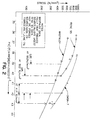
- FIG. 1 is a Larson Miller stress-rupture plot comparing results from CMBA-6 and CMBA-7 alloy samples of the present invention to those of prior art Waspaloy and MP210 alloys.
- FIG. 2 is a Larson Miller stress-rupture plot comparing results from CMBA-7 alloy samples of the present invention to those of prior art Waspaloy and Rene 95 alloys.
- FIG. 3 is a Larson Miller stress-rupture plot comparing results from CMBA-7 alloy samples of the present invention to those of prior art MERL 76 alloy.
- FIG. 4 is a photomicrograph (Etchant: 150 ml HCl + 100 ml ethyl alcohol + 13 g cupric chloride) at 400X magnification of sample CMBA-6 of the present invention, which has a fully worked and aged bar microstructure that has been hot extruded, hot rolled, cold swaged and aged 10 hours at 719°C (1325°F).
- FIG. 5 is a photomicrograph (Etchant: 150 ml HC1 + 100 ml ethyl alcohol + 13 g cupric chloride) at 400X magnification of sample CMBA-7 of the present invention, which has a fully worked and aged bar microstructure that has been hot extruded, hot rolled, cold swaged and aged 10 hours at 719°C (1325°F).
- FIG. 6 is a photomicrograph (Etchant: 150 ml HCl + 100 ml ethyl alcohol + 13 g cupric chloride) at 1000X magnification of a creep-rupture specimen microstructure of a CMBA-7 sample of the present invention, produced under 760°C/413.7N/mm 2 (1400°F/60.0 ksi) test condition with a rupture life of 994.4 hours.
- FIG. 7 is a scanning electron photomicrograph (Etchant: 150 ml HCl + 100 ml ethyl alcohol + 13 g cupric chloride) at 5000X magnification of the fracture section of a creep-rupture specimen of a CMBA-7 sample of the present invention, produced under 760°C/413.7N/mm 2 (1400°F/60.0 ksi) test condition with a rupture life of 994.4 hours.
- FIG. 8 is a scanning electron photomicrograph (Etchant: 150 ml HC1 + 100 ml ethyl alcohol + 13 g cupric chloride) at 10,000X magnification of the fracture section of a creep-rupture specimen of a CMBA-7 sample of the present invention, produced under 760°C/413.7N/mm 2 (1400°F/60.0 ksi) test condition with a rupture life of 994.4 hours.
- nickel-cobalt based alloys of the present invention are given in claim 1, and preferred embodiments in dependent claims 2-7.
- alloy compositions have critically balanced alloy chemistries which result in unique blends of desirable properties, which are particularly suitable for use in producing fastener components. These properties include increased thermal stability, microstructural stability, and stress- and creep-rupture strength at elevated temperatures, particularly up to about 760°C (1400°F), relative to prior art nickel and nickel-cobalt based alloys which are used to produce fastener components.
- Major factors which restrict the higher temperature strength of prior art alloys, such as the MP159 alloy, include the instability of the solid solution and gamma prime strengthening phases at higher temperature. Prolonged exposure at elevated temperatures in such materials can result in the dissolution of desired strengtheners and reprecipitation of non-cubic, ductility- and strength-deterring phases.
- the HCP to FCC transus temperature in these prior art alloys and the thermal stability of the strengthening phases can be improved by alloy additions.
- the elements which normally form the gamma-prime phase are nickel, titanium, aluminum, niobium, vanadium and tantalum, while the matrix is dominated by nickel, chromium, cobalt, molybdenum and tungsten.
- the alloys of the present invention are balanced with such elements to provide relatively high HCP/FCC transus temperature, microstructural stability and stress/creep-rupture strength.
- the alloys of the present invention have a tantalum content of 3.8 percent to 5.0 percent by weight, and the tungsten content is from 1.8 percent to 3.0 percent by weight.
- tungsten and tantalum may contribute to increasing the FCC/HCP transus temperature.
- these elements provide significant solid solution strengthening to the alloys due to their relatively large atomic diameter and, therefore, are important additions for strength retention while potentially allowing an increase in ductility through lower cold work levels.
- the lower cold work levels are possible since the alloys of the present invention do not depend exclusively upon cold work for strength attainment.
- This invention's alloys must also have at least one gamma-prime forming element selected from the group consisting of aluminum, titanium, niobium, tantalum and vanadium.
- the aluminum content is 0.9 - 1.1 percent by weight, and the titanium content is 1.9 - 4.0 percent by weight.
- aluminum is present in an amount of 0.9 percent to 1.1 percent by weight, and titanium is present in an amount of 1.9 percent to 4.0 percent by weight.
- the aluminum and titanium additions in these compositions promote gamma-prime formation.
- the strength and volume fraction of the gamma-prime phase is increased through the additions of tantalum and niobium to these alloys, thereby increasing the alloys' strength.
- the elements aluminum, titanium and tantalum are also effective in these alloys toward providing improved environmental properties, such as resistance to hot corrosion and oxidation.
- the niobium is present in an amount of 0.9 percent to 1.3 percent by weight.
- the amount of tantalum that can be added to these alloys is higher than niobium since, besides partitioning to the gamma prime, tantalum contributes favorably to the alloys' matrix. It is a more effective strengthener than niobium due to its greater atomic diameter.
- Gamma-prime phase formation is promoted in these alloys since it assists the attainment of the high strength. Additionally, a significant volume fraction of gamma prime is desired since it may assist in the materials' response to various types of processing, such as methods which involve aging first, then cold working, followed by a further aging treatment; such methods potentially lowering the amount of cold work required for strength attainment in this type of material.
- the vanadium content in these compositions is 0 to 0.01 percent by weight.
- the alloys of this invention have a carbon content of 0.005 - 0.03 percent by weight. Carbon is added to these alloys since it assists with melt deoxidation during the VIM production process, and may contribute to grain boundary strength in these alloys. Additionally, the boron content is 0.01 percent to 0.02 percent by weight. Boron is added to these alloys within the specified range in order to improve grain boundary strength.
- the amount of chromium in the alloys of the present invention is 13.0 percent to 17.5 percent by weight Chromium provides corrosion resistance to these alloys, although it may also assist with the alloys' resistance to oxidation. Furthermore, the molybdenum content is 2.7 percent to 4.0 percent by weight. The addition of molybdenum to these compositions is a means of improving the strength of the alloys. Moreover, the zirconium content is 0 to 0.02 percent by weight. Zirconium also improves grain boundary strength in these alloys.
- the cobalt content is 24.5 to 34.0 percent by weight. Cobalt assists in providing a stable multiphase structure and possibly corrosion resistance to these alloys.
- the balance of this invention's alloy compositions is comprised of nickel and small amounts of incidental impurities. Generally, these incidental impurities are entrained from the industrial process of production, and they should be kept to the least amount possible in the compositions so that they do not affect the advantageous aspects of the alloys.
- incidental impurities do not exceed: 0.025 percent by weight silicon, 0.01 percent by weight manganese, 0.1 percent by weight iron, 0.01 percent by weight copper, 0.01 percent by weight phosphorus, 0.002 percent by weight sulfur, 0.001 percent by weight nitrogen and 0.001 percent by weight oxygen.
- N v3B is defined by the PWA N-35 method of nickel-based alloy electron vacancy TCP phase control factor calculation. This calculation is as follows:
- the alloys of the present invention exhibit increased thermal stability and microstructural stability, such as resistance to formation of undesirable TCP phases, at elevated temperatures up to about 760°C (1400°F). Furthermore, this invention provides alloy compositions having unique blends of desirable properties. These properties include: component produceability, particularly for fastener components; very good tensile strength, excellent stress-rupture life, very good corrosion resistance, very good fatigue strength, very good shear strength, a desirable thermal expansion coefficient, and excellent resistance to creep under high stress, high temperature conditions up to about 816°C (1500°F).
- One embodiment of this invention has the capability of withstanding 199.9N/mm 2 (29 ksi) stress at 704°C (1300°F) for 1000 hours before exhibiting 0.1% creep deformation and 310.3N/mm 2 (45 ksi) stress at 704°C (1300°F) for 1000 hours before exhibiting 0.2% creep deformation.
- the alloys have a multiphase structure with a platelet phase and a gamma prime phase dispersed in a face centered cubic matrix, which is believed to be a factor in providing the improved higher temperature properties of these alloys. These alloys are also substantially free of embrittling phases. Nevertheless, as noted above, the alloys of this invention have precise compositions with only small permissible variations in any one element if the unique blend of properties is to be maintained.
- This invention's alloys can be used to suitably make articles for use at elevated temperatures, particularly up to about 760°C (1400°F).
- the article can be a component for turbine engines or other equipment subjected to elevated operating temperatures.
- the alloy compositions of this invention are particularly useful in making high strength fasteners having increased thermal stability and microstructural stability at elevated temperatures up to about 760°C (1400°F), while maintaining extremely good mechanical strength and corrosion resistance.
- fastener parts which can be suitably made from the alloys of this invention include bolts, screws, nuts, rivets, pins and collars.
- These alloys can be used to produce a fastener having an increased resistance to creep under high stress, high temperature conditions up to about 816°C (1500°F), as well as a stress- rupture life at 704°C (1300°F)/689,5 N/mm 2 (100 Ksi) condition greater than 150 hours, which are considered important alloy properties that are highly desirable when producing fasteners for use in turbine engines and other equipment subjected to elevated operating temperatures.
- the alloy compositions of this invention are suitably prepared and melted by any appropriate technique known in the art, such as conventional ingot metallurgy techniques or by powder metallurgy techniques.
- the alloys can be first melted, suitably by vacuum induction melting (VIM), under appropriate conditions, and then cast as an ingot. After casting as ingots, the alloys are preferably homogenized and then hot worked into billets or other forms suitable for subsequent working.
- VIM vacuum induction melting
- evaluations of the present invention undertaken with larger diameter VIM product revealed that ingot microstructural variation and elemental segregation may adversely affect the yield of hot reduced product for alloys of this invention. For this reason, it may be desirable to vacuum arc remelt (VAR) or electroslag remelt (ESR) the alloys before they are worked and aged.
- VAR vacuum arc remelt
- ESR electroslag remelt
- ESR and VAR are two types of consumable electrode melting processes that are well known in the art.
- a VIM ingot electrode
- VAR the melting and resolidification may occur in vacuum which may reduce the level of high vapor pressure tramp elements in the melt.
- ESR is carried out using a molten refining slag layer between the electrode and the resolidifying ingot.
- compositional refining and removal of impurities can occur prior to resolidification in the ingot.
- the improved microstructure and reduction in elemental segregation imparted to the resulting ingot by either of these consumable electrode melting processes results in improved response to subsequent heat treating and hot working operations.
- the molten alloy can be impinged by gas jet or otherwise dispersed as small droplets to form powders. Powdered alloys of this sort can then be densified into a desired shape according to techniques known in powder metallurgy. Also, spray casting techniques known in the art can be utilized.
- the alloys of the present invention are advantageously worked to achieve a reduction in cross-section of at least 5 percent.
- the alloy is cold worked to achieve a reduction in cross-section of from about 10% to 40%, although higher levels of cold work may be used with some loss of functionality.
- cold working means deformation at a temperature (below the FCC/HCP transus temperature) which will induce the transformation of a portion of the metastable FCC matrix into the platelet phase.
- hot working means deformation at a temperature above the FCC/HCP transus temperature.
- the alloys can be aged after cold working.
- the alloys can be aged for about 1 to about 50 hours after cold working.
- the alloys are advantageously aged at a temperature of from about 427°C (800°F) to about 760° (1400°F) for about 1 hour to about 50 hours after cold working.
- the alloys can be first aged, cold worked to achieve a reduction in cross-section of at least 5%, and then aged again.
- the alloys are aged at a temperature of from about 649°C (1200°F) to about 899°C (1650°F) for about 1 hour to about 200 hours, cold worked to achieve a reduction in cross-section of about 10% to 40% and then aged again at a temperature of from about 427°C (800°F) to about 760°C (1400°F) for about 1 hour to about 50 hours. Following aging, the alloys may be air-cooled.
- the alloys can be vacuum arc remelted or electroslag remelted before being worked and aged.
- the alloys can also be aged first, cold worked to achieve the necessary reduction in cross-section, and then aged again.
- the alloys can first be aged at a temperature of from about 649°C (1200°F) to about 899°C (1650°F) for about 1 hour to about 200 hours before being cold worked to achieve a reduction in cross-section of at least 5%.
- the optimum temperatures and times for cold working and aging in all of the above processing steps depends on the precise composition of the alloy.
- the cold worked alloy can be air-cooled after aging. The process of this invention can be suitably used to make alloys for production of fasteners.
- compositions of the present invention began with the definition of two alloy systems, designated CMBA-6 and CMBA-7.
- CMBA-8 a third alloy system
- the developmental compositions were designed to exhibit multiphase-type reaction, i.e., partial transformation with cold work of the metastable FCC matrix to its lower temperature HCP structure, while also utilizing more conventional strengthening mechanisms.
- CMBA-6 and CMBA-7 alloy compositions were produced.
- the melting was done in a vacuum furnace, which operated with an argon backfill.
- the aim chemistries and actual cast ingot chemistries for the CMBA-6 and CMBA-7 alloy samples are presented in Table 1 below.
- the aim chemistry and actual cast ingot chemistry for the subsequently produced CMBA-8 alloy sample is also presented in Table 1.
- CMBA-6 and CMBA-7 alloys were homogenized as follows: the CMBA-6 sample was soaked at 1177°C (2150°F) for approximately 27 hours, and the CMBA-7 sample was soaked at 1218°C (2225°F) for approximately 46 hours.
- CMBA-6 and CMBA-7 alloys were surface cleaned to remove oxide scale, and subsequently canned with stainless steel in preparation for extrusion.
- the test bars were extruded at 1149°C (2100°F), at a reduction ratio of 2.56:1, to 3.175 cm (1.25 inch) diameter bar.
- test materials were aged at 719°C (1325°F)/10 Hr./AC (air-cooled) test condition following cold work.
- Other test samples were aged for 20 hours at temperatures in the 719-816°C (1325-1500°F) range, and limited room temperature and elevated temperature tensile tests were undertaken.
- the aged specimens were machined/ground, and then tensile, stress-rupture and creep-rupture tested; all in accordance with standard ASTM procedures.
- CMBA-6 tensile test results presented in Table 2 are compared to typical Waspaloy properties. In general, these results indicate that CMBA-6 provides much higher tensile strength than Waspaloy, but with lower ductility.
- the test results presented in Table 5 indicate that the CMBA-7 composition exhibits greater creep-rupture strength than the CMBA-6 composition.
- a specific example of this is provided in Table 5 wherein comparison of time to 1.0% and 2.0% creep for the two alloys tested at the 704°C/741.2 N/mm 2 (1300°F/107.5 ksi) condition shows the CMBA-7 sample creeping at a significantly lower rate.
- the test results presented in Table 5 further indicate that the CMBA-7 composition also provides greater rupture strength and rupture ductility than the CMBA-6 composition. Additionally, some of the rupture results tabulated are graphically represented in Figure 1 where a Larson Miller stress-rupture plot provides a comparison of the alloys' capabilities.
- CMBA-7 alloy provides a 12°C (21°F) metal temperature advantage relative to CMBA-6 alloy.
- a 9°C (16°F) advantage is indicated at 551.6 N/mm 2 (80.0 ksi.)
- Figure 1 also plots the elevated temperature rupture capability of Waspaloy and MP 210 (the alloy disclosed in the aforementioned U.S. Patent No. 4,795,504). It is apparent that for the 689.5 N/mm 2 (100 ksi) stress level, CMBA-7 alloy provides approximate respective metal temperature advantages of 39°C (71°F) over MP210 alloy and 71°C (127°F) over Waspaloy. Similarly, for 551.6 N/mm 2 (80.0 ksi) stressed exposure, the alloy exhibits approximately 36°C (64°F) advantage vs. MP210 alloy and 52°C (94°F) advantage relative to Waspaloy.
- CMBA-7 alloy provides approximate respective metal temperature advantages of 39°C (71°F) over MP210 alloy and 71°C (127°F) over Waspaloy.
- the alloy exhibits approximately 36°C (64°F) advantage vs. MP210 alloy and 52°C (94°F) advantage relative to Waspaloy.
- Figure 2 is another Larson Miller stress-rupture plot comparing the CMBA-7 alloy to Waspaloy and Rene 95 alloy (a product of the General Electric Company). As illustrated in Figure 2, for an 551.6 N/mm 2 (80.0 ksi) operating stress, CMBA-7 alloy provides approximately 32°C (57°F) greater metal temperature capability than Rene 95 alloy. Furthermore, comparison to Waspaloy at 413.7 N/mm 2 (60 ksi) indicates that the CMBA-7 alloy provides an additional approximate 36°C (64°F) capability.
- Figure 3 is a Larson Miller stress-rupture plot comparing the CMBA-7 alloy's rupture strength to the MERL 76 alloy (a product of the United Technologies Corporation).
- the Figure illustrates that for a 413.7 N/mm 2 (60 ksi) stress level, the CMBA-7 alloy provides an approximate 23°C (41°F) metal temperature advantage relative to MERL 76 alloy.
- FIG. 4 is a photomicrograph at 400X magnification of a CMBA-6 sample of the present invention, which has a fully worked and aged bar microstructure that has been hot extruded, hot rolled, cold swaged and aged 10 hours at 719°C (1325°F).
- FIG. 4 is a photomicrograph at 400X magnification of a CMBA-6 sample of the present invention, which has a fully worked and aged bar microstructure that has been hot extruded, hot rolled, cold swaged and aged 10 hours at 719°C (1325°F).
- FIG. 5 is a photomicrograph at 400X magnification of a CMBA-7 sample of the present invention, which has a fully worked and aged bar microstructure that has been hot extruded, hot rolled, cold swaged and aged 10 hours at 719°C (1325°F).
- FIG. 6 is a photomicrograph at 1000X magnification of a creep-rupture specimen microstructure of a CMBA-7 sample of the present invention, produced under 760°C/413.7 N/mm 2 (1400°F/60.0) ksi test condition with a rupture life of 994.4 hours.
- FIG. 7 is a scanning electron photomicrograph at 5000X magnification of the fracture section of a creep-rupture specimen of a CMBA-7 sample of the present invention, produced under 760°C/413.7 N/mm 2 (1400°F/60.0) ksi test condition with a rupture life of 994.4 hours.
- FIG. 6 is a photomicrograph at 1000X magnification of a creep-rupture specimen microstructure of a CMBA-7 sample of the present invention, produced under 760°C/413.7 N/mm 2 (1400°F/60.0) ksi test condition with a rupture life of 994.4 hours.
- FIG. 8 is a scanning electron photomicrograph at 10,000X magnification of the fracture section of a creep-rupture specimen of a CMBA-7 sample of the present invention, produced under 760°C/413.7 N/mm 2 (1400°F/60.0) ksi test condition with a rupture life of 994.4 hours.
- Tension impact tests were performed with stud samples.
- the test apparatus employed was the type described in ASTM E23. However, instead of testing notched, rectangular bars, the test utilized threaded fixtures and adaptors which permitted the testing of threaded samples.
- the apparatus applied an impact load along the longitudinal axis of the respective test pieces, and the energy absorbed by the respective test piece prior to fracture was measured. The results are presented in Table 11 below.
- CMBA-6, CMBA-7 and CMBA-8 VIM material was processed for hot extrusion and hot rolling reduction, but the effort was not pursued past the hot extrusion reduction since some ingot cracking was experienced.
- the materials produced for this example were made in accordance with the aim chemistries indicated in Table 1, except that respective Al and Ti additions were slightly increased due to their expected partial loss during the ESR remelting operation.
- 7.62 cm (Three-inch) diameter VIM ingot samples (Heats VF 755 and VF 757) were ESR processed into 10.16 cm (four-inch) diameter, 23 k g (50 pound) ingots.
- a 67-10-10-10-3 slag formulation (67CaF, 10CaO, 10MgO, 10A1 2 O 3 , 3TiO 2 ) was utilized, and it is believed that the alloy chemistries were maintained adequately during the ESR process, although modest silicon and nitrogen pick-up were noted.
- CMBA-6 and CMBA-8 samples were successfully forged further to 3.175 cm (1-1/4 inch) thick slabs, while the CMBA-7 samples cracked.
- CMBA-6 and CMBA-8 specimens exhibited minor edge cracking during the subsequent hot rolling reduction to 3.175 mm (1/8 inch) thickness at 1121°C (2050°F)-1149°C (2100°F). Several re-heats were necessary to complete the desired reduction. The materials were cold rolled to reduction ranging 5-15%, and subsequently aged for 20 hours at 719°C (1325°F)/AC.
- CMBA-6 and CMBA-8 tensile, stress-rupture and creep-rupture test samples were prepared and tested according to standard ASTM procedures.
- Table 13 shows longitudinal tensile property test results for CMBA-6 specimens which were 15% cold rolled.
- the tensile 0.2% yield strength, ultimate tensile strength, and percent elongation were measured for the CMBA-6 samples at room temperature (RT), 482°C (900°F), 593°C (1100°F), 649°C (1200°F), and 704°C (1300°F).
- the 15% cold rolled CMBA-6 test results are compared with the commercially reported Waspaloy tensile properties.
- Table 14 presented below, shows results of transverse sheet specimen tensile tests undertaken with CMBA-8 materials which were cold rolled to 5% and 15% levels. Average transverse tensile properties are presented for room temperature (RT), 371°C (700°F), 482°C (900°F), 593°C (1100°F), 649°C (1200°F), 704°C (1300°F), and 760°C (1400°F) tests.
- Table 15 shows average longitudinal tensile property test results obtained for CMBA-8 sheet specimens, which were 5% and 15% cold rolled.
- Elevated temperature longitudinal and transverse creep-rupture tests were also conducted with CMBA-6 and CMBA-8 sheet samples.
- the results for tests conducted between 649°C (1200°F) to 816°C (1500°F) are presented in Table 16 below.
- the tests were undertaken with CMBA-6 samples which were 15% cold rolled, while the CMBA-8 alloy was evaluated at both 5% and 15% levels.
- a second sublot (RR) was hot rolled to .11.354 mm (.447") diameter, solution treated at 1102°C (2015°F) for 2 hours, aged at 850°C (1562°F) for 10 hours/AC, and then cold drawn to 9.906 mm (.390") diameter (24% reduction).
- a third sublot (MM) was hot rolled to 11.074 mm (.436”) diameter, solution treated at 1102°C (2015°F) for 2 hours, aged at 800°C (1472°F) for 6 hours/AC, and then cold drawn to 9.906 mm (.390") diameter (20% reduction).
- the fourth sublot (PP) was hot rolled to 10.947 mm (.431") diameter, solution treated at 1102°C (2015°F) for 2 hours, aged at 850°C (1562°F) for 10 hours/AC, and then cold drawn to 9.906 mm (.390") diameter (18% reduction). All four sublots were given a final age at 732°C (1350°F) for 4 hours/AC.
- Threaded studs (3/8-24 x 1.5) were fabricated and tested. The results of such tests are presented in Table 17 below. The tensile tests were conducted per MIL-STD-1312, test numbers 8 and 18. Stress-rupture tests were conducted per MIL-STD-1312, test number 10. Tension-impact tests were conducted as described in Example 2 above.
- Exposure cycle #1 704°C/344.7 N/mm 2 (1300°F/50 ksi)/100 hours.
- Exposure cycle #2 566°C/951.5 N/mm 2 (1050°F/138 ksi)/640 hours.
- CMBA-6 The thermal expansion coefficient of CMBA-6 alloy was measured on 9.525 mm (.375") diameter x 5.08 cm (2") long specimens per ASTM E228. The test results are presented in Table 20 below. TABLE 20 CMBA-6 (Heat VF 790, Lot 1) THERMAL EXPANSION COEFFICIENT DATA Temperature Range a(m/m/°C x 10 -6 ) 20°C - 425°C 13.5 20°C - 540°C 13.9 20°C - 650°C 14.4 20°C - 705°C 14.8 Notes: ⁇ Test Article: 9.525 mm (0.375") diameter x 5.08 cm (2.0") long pins. ⁇ Condition: Solutioned + 24% cold work + 732°C (1350°F)/4 hours/AC.
- Fatigue tests were run on the bolts per MIL-STD-1312, test number 11. The tests were conducted at room temperature (RT) with an R-ratio of 0.1 or 0.8, at 260°C (500°F) with an R-ratio of 0.6, and at 704°C (1300°F) with an R-ratio of 0.05. These test results are presented in Table 25 below.
- a 682 kg (1500 pound) heat (VV 584) of CMBA-6 was VIM-processed to 24.13 ccm (91 ⁇ 2") diameter, ESR-processed to 36.83 cm (141 ⁇ 2") diameter, homogenize-annealed at 1163°C (2125°F)/4 hours + 1177°C (2150°F)/65 hours, and hot forged at about 1121°C (2050°F) to 11.43 cm (41 ⁇ 4") diameter.
- Some of the material was divided into seven lots and processed to 10.033 mm (.395") diameter bar as described below in Table 30:
- Standard 6.4 mm (.252") diameter specimens were fabricated from each sublot and tensile tested per ASTM E8 and E21.
- Heat VV 584 was used to make 13.589 mm (.535") and 19.558 mm (.770") diameter bars. They were produced by rolling the hot forged stock at about 1121°C (2050°F) to about 15.596 mm (.614") and 22.428 mm (.883") diameters, respectively, solution treating at 1093°C (2000°F)/2 hours/AC, and cold drawing 24% to the desired 13.589 mm (.535") and 19.558 mm (.770”) dimensions. The bars were given a final age at 732°C (1350°F) for 4 hours/AC. Various tests were conducted utilizing these materials as described below.
- Young's modulus, shear modulus and Poisson's ratio were determined by performing dynamic modulus measurements on a 12.7 mm (0.500") diameter by 5.08 cm (2.000") long specimen per ASTM E494. The test temperature ranged from 21°C (70°F) to 704°C (1300°F). The results are presented in Table 36 below.
Landscapes
- Chemical & Material Sciences (AREA)
- Engineering & Computer Science (AREA)
- Materials Engineering (AREA)
- Mechanical Engineering (AREA)
- Metallurgy (AREA)
- Organic Chemistry (AREA)
- Physics & Mathematics (AREA)
- Thermal Sciences (AREA)
- Crystallography & Structural Chemistry (AREA)
- Turbine Rotor Nozzle Sealing (AREA)
- Manufacture And Refinement Of Metals (AREA)
- Heat Treatment Of Steel (AREA)
- Forging (AREA)
Applications Claiming Priority (4)
| Application Number | Priority Date | Filing Date | Title |
|---|---|---|---|
| US93810492A | 1992-08-31 | 1992-08-31 | |
| US25207 | 1993-03-02 | ||
| US08/025,207 US5476555A (en) | 1992-08-31 | 1993-03-02 | Nickel-cobalt based alloys |
| US938104 | 2001-08-23 |
Publications (2)
| Publication Number | Publication Date |
|---|---|
| EP0585768A1 EP0585768A1 (en) | 1994-03-09 |
| EP0585768B1 true EP0585768B1 (en) | 1997-02-19 |
Family
ID=26699436
Family Applications (1)
| Application Number | Title | Priority Date | Filing Date |
|---|---|---|---|
| EP93113435A Expired - Lifetime EP0585768B1 (en) | 1992-08-31 | 1993-08-23 | Nickel-cobalt based alloys |
Country Status (4)
| Country | Link |
|---|---|
| US (3) | US5476555A (enExample) |
| EP (1) | EP0585768B1 (enExample) |
| JP (1) | JP4047939B2 (enExample) |
| DE (1) | DE69308180T2 (enExample) |
Families Citing this family (66)
| Publication number | Priority date | Publication date | Assignee | Title |
|---|---|---|---|---|
| US5476555A (en) * | 1992-08-31 | 1995-12-19 | Sps Technologies, Inc. | Nickel-cobalt based alloys |
| US6106767A (en) * | 1995-12-21 | 2000-08-22 | Teledyne Industries, Inc. | Stress rupture properties of nickel-chromium-cobalt alloys by adjustment of the levels of phosphorus and boron |
| US6017274A (en) * | 1997-09-02 | 2000-01-25 | Automotive Racing Products, Inc. | Method of forming a fastener |
| JP4315582B2 (ja) * | 2000-09-19 | 2009-08-19 | 日本発條株式会社 | Co−Ni基耐熱合金およびその製造方法 |
| US6416564B1 (en) * | 2001-03-08 | 2002-07-09 | Ati Properties, Inc. | Method for producing large diameter ingots of nickel base alloys |
| SE518695C2 (sv) * | 2001-03-22 | 2002-11-05 | Rolls Royce Ab | Axelkoppling samt axelförband med en första axeldel, en andra axeldel och en axelkoppling |
| US7051961B2 (en) * | 2002-06-07 | 2006-05-30 | Synerject, Llc | Fuel injector with a coating |
| JP4264926B2 (ja) * | 2002-07-05 | 2009-05-20 | 日本発條株式会社 | 析出強化型Co−Ni基耐熱合金の製造方法 |
| JP3842717B2 (ja) * | 2002-10-16 | 2006-11-08 | 株式会社日立製作所 | 溶接材料、溶接構造物、ガスタービン動翼及びガスタービン動翼又は静翼の補修方法 |
| US8048369B2 (en) | 2003-09-05 | 2011-11-01 | Ati Properties, Inc. | Cobalt-nickel-chromium-molybdenum alloys with reduced level of titanium nitride inclusions |
| US7156932B2 (en) * | 2003-10-06 | 2007-01-02 | Ati Properties, Inc. | Nickel-base alloys and methods of heat treating nickel-base alloys |
| US7211690B2 (en) * | 2004-04-13 | 2007-05-01 | General Electric Company | Methods of making an antistatic agent |
| US20060096672A1 (en) * | 2004-11-09 | 2006-05-11 | Robert Burgermeister | Quaternary cobalt-nickel-chromium-molybdenum fatigue resistant alloy for intravascular medical devices |
| US20080260570A1 (en) * | 2004-12-02 | 2008-10-23 | Hiroshi Harada | Heat-Resistant Superalloy |
| US7159801B2 (en) * | 2004-12-13 | 2007-01-09 | Synerject, Llc | Fuel injector assembly and poppet |
| US7531054B2 (en) * | 2005-08-24 | 2009-05-12 | Ati Properties, Inc. | Nickel alloy and method including direct aging |
| US7985304B2 (en) * | 2007-04-19 | 2011-07-26 | Ati Properties, Inc. | Nickel-base alloys and articles made therefrom |
| GB0719195D0 (en) * | 2007-10-02 | 2007-11-14 | Rolls Royce Plc | A nickel base superalloy |
| JP5248197B2 (ja) * | 2008-05-21 | 2013-07-31 | 株式会社東芝 | Ni基鋳造合金およびそれを材料とする蒸気タービン用鋳造部品 |
| JP2010150586A (ja) * | 2008-12-24 | 2010-07-08 | Toshiba Corp | 高温強度特性、鍛造性および溶接性に優れた、蒸気タービンの鍛造部品用のNi基合金、蒸気タービンの動翼、蒸気タービンの静翼、蒸気タービン用螺合部材、および蒸気タービン用配管 |
| US8992700B2 (en) * | 2009-05-29 | 2015-03-31 | General Electric Company | Nickel-base superalloys and components formed thereof |
| US8992699B2 (en) * | 2009-05-29 | 2015-03-31 | General Electric Company | Nickel-base superalloys and components formed thereof |
| JP4987921B2 (ja) * | 2009-09-04 | 2012-08-01 | 株式会社日立製作所 | Ni基合金並びにこれを用いた蒸気タービン用鋳造部品、蒸気タービンロータ、蒸気タービンプラント用ボイラチューブ、蒸気タービンプラント用ボルト及び蒸気タービンプラント用ナット |
| JP5566758B2 (ja) * | 2009-09-17 | 2014-08-06 | 株式会社東芝 | 鍛造又は圧延用Ni基合金およびそれを材料とする蒸気タービン用部品 |
| JP5165008B2 (ja) * | 2010-02-05 | 2013-03-21 | 株式会社日立製作所 | Ni基鍛造合金と、それを用いた蒸気タービンプラント用部品 |
| JP5296046B2 (ja) * | 2010-12-28 | 2013-09-25 | 株式会社日立製作所 | Ni基合金、及びそれを用いたガスタービンのタービン動・静翼 |
| KR20140059823A (ko) * | 2011-08-26 | 2014-05-16 | 콘삭 코퍼레이션 | 소모성 전극 진공 아크 재용해 공정에 의한 반금속의 정제 |
| US9441542B2 (en) | 2011-09-20 | 2016-09-13 | General Electric Company | Ultrasonic water atomization system for gas turbine inlet cooling and wet compression |
| US20140373979A1 (en) | 2011-12-15 | 2014-12-25 | National Institute For Material Science | Nickel-based heat-resistant superalloy |
| US9752215B2 (en) | 2012-02-14 | 2017-09-05 | United Technologies Corporation | Superalloy compositions, articles, and methods of manufacture |
| US9783873B2 (en) * | 2012-02-14 | 2017-10-10 | United Technologies Corporation | Superalloy compositions, articles, and methods of manufacture |
| US9540714B2 (en) | 2013-03-15 | 2017-01-10 | Ut-Battelle, Llc | High strength alloys for high temperature service in liquid-salt cooled energy systems |
| US9377245B2 (en) | 2013-03-15 | 2016-06-28 | Ut-Battelle, Llc | Heat exchanger life extension via in-situ reconditioning |
| US10017842B2 (en) | 2013-08-05 | 2018-07-10 | Ut-Battelle, Llc | Creep-resistant, cobalt-containing alloys for high temperature, liquid-salt heat exchanger systems |
| US9435011B2 (en) | 2013-08-08 | 2016-09-06 | Ut-Battelle, Llc | Creep-resistant, cobalt-free alloys for high temperature, liquid-salt heat exchanger systems |
| GB201400352D0 (en) | 2014-01-09 | 2014-02-26 | Rolls Royce Plc | A nickel based alloy composition |
| US9683280B2 (en) | 2014-01-10 | 2017-06-20 | Ut-Battelle, Llc | Intermediate strength alloys for high temperature service in liquid-salt cooled energy systems |
| FR3020509B1 (fr) * | 2014-04-29 | 2016-05-13 | Axon Cable Sa | Contact electrique miniature de haute stabilite thermique |
| US9683279B2 (en) | 2014-05-15 | 2017-06-20 | Ut-Battelle, Llc | Intermediate strength alloys for high temperature service in liquid-salt cooled energy systems |
| US9605565B2 (en) | 2014-06-18 | 2017-03-28 | Ut-Battelle, Llc | Low-cost Fe—Ni—Cr alloys for high temperature valve applications |
| GB201421949D0 (en) * | 2014-12-10 | 2015-01-21 | Rolls Royce Plc | Alloy |
| EP3042973B1 (en) | 2015-01-07 | 2017-08-16 | Rolls-Royce plc | A nickel alloy |
| GB2539957B (en) | 2015-07-03 | 2017-12-27 | Rolls Royce Plc | A nickel-base superalloy |
| JP6733210B2 (ja) | 2016-02-18 | 2020-07-29 | 大同特殊鋼株式会社 | 熱間鍛造用Ni基超合金 |
| JP6733211B2 (ja) * | 2016-02-18 | 2020-07-29 | 大同特殊鋼株式会社 | 熱間鍛造用Ni基超合金 |
| ITUA20161551A1 (it) | 2016-03-10 | 2017-09-10 | Nuovo Pignone Tecnologie Srl | Lega avente elevata resistenza all’ossidazione ed applicazioni di turbine a gas che la impiegano |
| US20180029241A1 (en) * | 2016-07-29 | 2018-02-01 | Liquidmetal Coatings, Llc | Method of forming cutting tools with amorphous alloys on an edge thereof |
| GB2554898B (en) * | 2016-10-12 | 2018-10-03 | Univ Oxford Innovation Ltd | A Nickel-based alloy |
| KR102403029B1 (ko) * | 2017-04-21 | 2022-05-30 | 씨알에스 홀딩즈, 엘엘씨 | 석출 경화성의 코발트-니켈 베이스 초합금 및 이로부터 제조된 물품 |
| EP3415649B1 (en) * | 2017-06-14 | 2022-08-03 | Heraeus Deutschland GmbH & Co. KG | A composite wire |
| EP3415195A1 (en) * | 2017-06-14 | 2018-12-19 | Heraeus Deutschland GmbH & Co. KG | A method for manufacturing a cable |
| EP3415651A1 (en) * | 2017-06-14 | 2018-12-19 | Heraeus Deutschland GmbH & Co. KG | A method for manufacturing a passivated product |
| EP3415650A1 (en) * | 2017-06-14 | 2018-12-19 | Heraeus Deutschland GmbH & Co. KG | A method for manufacturing a composite wire |
| GB2565063B (en) | 2017-07-28 | 2020-05-27 | Oxmet Tech Limited | A nickel-based alloy |
| US20190241995A1 (en) * | 2018-02-07 | 2019-08-08 | General Electric Company | Nickel Based Alloy with High Fatigue Resistance and Methods of Forming the Same |
| EP3572541B1 (en) * | 2018-05-23 | 2023-05-17 | Rolls-Royce plc | Nickel-base superalloy |
| GB2584654B (en) | 2019-06-07 | 2022-10-12 | Alloyed Ltd | A nickel-based alloy |
| GB2587635B (en) | 2019-10-02 | 2022-11-02 | Alloyed Ltd | A Nickel-based alloy |
| US11697869B2 (en) | 2020-01-22 | 2023-07-11 | Heraeus Deutschland GmbH & Co. KG | Method for manufacturing a biocompatible wire |
| CN112553504B (zh) * | 2020-11-23 | 2021-12-14 | 中国华能集团有限公司 | 一种高抗氧化性能的析出强化型镍钴基合金及其制备方法 |
| US11313014B1 (en) | 2021-03-04 | 2022-04-26 | National Chung Shan Institute Of Science And Technology | Nickel-based superalloy and material thereof |
| CN113502427B (zh) * | 2021-06-23 | 2022-06-28 | 沈阳航空航天大学 | 2.3GPa强度级别Co-Ni-Cr基合金及其制备方法 |
| JP2024527351A (ja) | 2021-07-09 | 2024-07-24 | エイティーアイ・プロパティーズ・エルエルシー | ニッケル基合金 |
| CN115026232B (zh) * | 2022-06-23 | 2023-03-21 | 西北工业大学 | 一种高应变硬化指数钴镍基合金丝的半模拉拔方法 |
| WO2024006374A1 (en) * | 2022-06-28 | 2024-01-04 | Ati Properties Llc | Nickel-base alloy |
| EP4689206A1 (en) | 2023-04-06 | 2026-02-11 | ATI Properties LLC | Nickel-base alloys |
Family Cites Families (19)
| Publication number | Priority date | Publication date | Assignee | Title |
|---|---|---|---|---|
| GB135533A (enExample) * | ||||
| NL260545A (enExample) * | 1960-02-01 | |||
| US3300347A (en) * | 1964-05-07 | 1967-01-24 | Huck Mfg Co | Fastening device and method of making same |
| CA920394A (en) * | 1965-04-09 | 1973-02-06 | R. Whitney Clyde | Nickel base alloy |
| GB1148390A (en) * | 1965-07-22 | 1969-04-10 | Int Nickel Ltd | Nickel-chromium alloys |
| US3356542A (en) * | 1967-04-10 | 1967-12-05 | Du Pont | Cobalt-nickel base alloys containing chromium and molybdenum |
| US3589893A (en) * | 1967-11-24 | 1971-06-29 | Martin Metals Co | Sulfidation resistant alloys and structures |
| US3667938A (en) * | 1970-05-05 | 1972-06-06 | Special Metals Corp | Nickel base alloy |
| US3653987A (en) * | 1970-06-01 | 1972-04-04 | Special Metals Corp | Nickel base alloy |
| US3767385A (en) * | 1971-08-24 | 1973-10-23 | Standard Pressed Steel Co | Cobalt-base alloys |
| US4093476A (en) * | 1976-12-22 | 1978-06-06 | Special Metals Corporation | Nickel base alloy |
| US4795504A (en) * | 1984-08-08 | 1989-01-03 | Latrobe Steel Company | Nickel-cobalt base alloys |
| US4769087A (en) * | 1986-06-02 | 1988-09-06 | United Technologies Corporation | Nickel base superalloy articles and method for making |
| US5037495A (en) * | 1987-10-02 | 1991-08-06 | General Electric Company | Method of forming IN-100 type fatigue crack resistant nickel base superalloys and product formed |
| US4908069A (en) * | 1987-10-19 | 1990-03-13 | Sps Technologies, Inc. | Alloys containing gamma prime phase and process for forming same |
| US5156808A (en) * | 1988-09-26 | 1992-10-20 | General Electric Company | Fatigue crack-resistant nickel base superalloy composition |
| US5226980A (en) * | 1990-02-06 | 1993-07-13 | Diado Tokushuko Kabushiki Kaisha | Skid rail alloy |
| JP2841970B2 (ja) * | 1991-10-24 | 1998-12-24 | 株式会社日立製作所 | ガスタービン及びガスタービン用ノズル |
| US5476555A (en) * | 1992-08-31 | 1995-12-19 | Sps Technologies, Inc. | Nickel-cobalt based alloys |
-
1993
- 1993-03-02 US US08/025,207 patent/US5476555A/en not_active Expired - Lifetime
- 1993-08-04 JP JP21220093A patent/JP4047939B2/ja not_active Expired - Fee Related
- 1993-08-23 DE DE69308180T patent/DE69308180T2/de not_active Expired - Lifetime
- 1993-08-23 EP EP93113435A patent/EP0585768B1/en not_active Expired - Lifetime
-
1995
- 1995-04-07 US US08/418,746 patent/US5637159A/en not_active Expired - Lifetime
-
1997
- 1997-06-03 US US08/868,224 patent/US5888316A/en not_active Expired - Lifetime
Also Published As
| Publication number | Publication date |
|---|---|
| DE69308180T2 (de) | 1997-06-05 |
| US5476555A (en) | 1995-12-19 |
| JP4047939B2 (ja) | 2008-02-13 |
| DE69308180D1 (de) | 1997-03-27 |
| JPH06212325A (ja) | 1994-08-02 |
| US5888316A (en) | 1999-03-30 |
| EP0585768A1 (en) | 1994-03-09 |
| US5637159A (en) | 1997-06-10 |
Similar Documents
| Publication | Publication Date | Title |
|---|---|---|
| US5637159A (en) | Nickel-cobalt based alloys | |
| Kennedy | Allvac 718Plus, superalloy for the next forty years | |
| US4144102A (en) | Production of low expansion superalloy products | |
| US4981644A (en) | Nickel-base superalloy systems | |
| CN102586652B (zh) | 用于先进燃气涡轮发动机的Ni-Cr-Co合金 | |
| RU2289637C2 (ru) | Сплав на основе никеля | |
| JPS61147839A (ja) | 耐疲労性ニツケル基超合金鍛造体とその製法 | |
| EP0714453A1 (en) | Al-cu-li alloys with improved cryogenic fracture toughness | |
| US5059257A (en) | Heat treatment of precipitation hardenable nickel and nickel-iron alloys | |
| EP0312966B1 (en) | Alloys containing gamma prime phase and process for forming same | |
| US20260275459A1 (en) | Nickel-base alloy | |
| US20170037498A1 (en) | Gamma - gamma prime strengthened tungsten free cobalt-based superalloy | |
| US4200459A (en) | Heat resistant low expansion alloy | |
| EP3597785A1 (en) | Nickel based superalloy with high volume fraction of precipitate phase | |
| SE461857B (sv) | Nickelbaslegering med gammabis-fas | |
| AU637790B2 (en) | (copper and nickel) based alloy in particular for use in a marine environment | |
| EP0758686B1 (en) | High-strength aluminium alloy having good porthole extrudability | |
| CA2131363C (en) | Nickel-molybdenum alloys | |
| Caron et al. | Effects of composition, processing, and structure on properties of nonferrous alloys | |
| US3212886A (en) | High temperature alloy | |
| Fernández Álvarez | Understanding forgeability in highly reinforced cast-and-wrought superalloys | |
| HK40124440A (zh) | 镍基合金 | |
| EP0365716A1 (en) | Nickel-cobalt base alloys | |
| ROLLING | Journal Homepage:-www. journalijar. com | |
| JPH03122244A (ja) | 耐応力腐食割れ性に優れる溶接用高力アルミニウム合金 |
Legal Events
| Date | Code | Title | Description |
|---|---|---|---|
| PUAI | Public reference made under article 153(3) epc to a published international application that has entered the european phase |
Free format text: ORIGINAL CODE: 0009012 |
|
| AK | Designated contracting states |
Kind code of ref document: A1 Designated state(s): DE FR GB |
|
| 17P | Request for examination filed |
Effective date: 19940906 |
|
| 17Q | First examination report despatched |
Effective date: 19950119 |
|
| GRAG | Despatch of communication of intention to grant |
Free format text: ORIGINAL CODE: EPIDOS AGRA |
|
| GRAH | Despatch of communication of intention to grant a patent |
Free format text: ORIGINAL CODE: EPIDOS IGRA |
|
| GRAH | Despatch of communication of intention to grant a patent |
Free format text: ORIGINAL CODE: EPIDOS IGRA |
|
| GRAA | (expected) grant |
Free format text: ORIGINAL CODE: 0009210 |
|
| AK | Designated contracting states |
Kind code of ref document: B1 Designated state(s): DE FR GB |
|
| REF | Corresponds to: |
Ref document number: 69308180 Country of ref document: DE Date of ref document: 19970327 |
|
| ET | Fr: translation filed | ||
| PLBE | No opposition filed within time limit |
Free format text: ORIGINAL CODE: 0009261 |
|
| 26N | No opposition filed | ||
| REG | Reference to a national code |
Ref country code: GB Ref legal event code: IF02 |
|
| PGFP | Annual fee paid to national office [announced via postgrant information from national office to epo] |
Ref country code: GB Payment date: 20120726 Year of fee payment: 20 |
|
| PGFP | Annual fee paid to national office [announced via postgrant information from national office to epo] |
Ref country code: DE Payment date: 20120831 Year of fee payment: 20 Ref country code: FR Payment date: 20120809 Year of fee payment: 20 |
|
| REG | Reference to a national code |
Ref country code: DE Ref legal event code: R071 Ref document number: 69308180 Country of ref document: DE |
|
| REG | Reference to a national code |
Ref country code: GB Ref legal event code: PE20 Expiry date: 20130822 |
|
| PG25 | Lapsed in a contracting state [announced via postgrant information from national office to epo] |
Ref country code: DE Free format text: LAPSE BECAUSE OF EXPIRATION OF PROTECTION Effective date: 20130824 |
|
| PG25 | Lapsed in a contracting state [announced via postgrant information from national office to epo] |
Ref country code: GB Free format text: LAPSE BECAUSE OF EXPIRATION OF PROTECTION Effective date: 20130822 |