EP0581600B1 - Quadrupole ion trap at high sensitivity and method of operating the same - Google Patents
Quadrupole ion trap at high sensitivity and method of operating the same Download PDFInfo
- Publication number
- EP0581600B1 EP0581600B1 EP93306025A EP93306025A EP0581600B1 EP 0581600 B1 EP0581600 B1 EP 0581600B1 EP 93306025 A EP93306025 A EP 93306025A EP 93306025 A EP93306025 A EP 93306025A EP 0581600 B1 EP0581600 B1 EP 0581600B1
- Authority
- EP
- European Patent Office
- Prior art keywords
- ions
- ion
- trapping
- mass
- waveform
- Prior art date
- Legal status (The legal status is an assumption and is not a legal conclusion. Google has not performed a legal analysis and makes no representation as to the accuracy of the status listed.)
- Expired - Lifetime
Links
- 238000000034 method Methods 0.000 title claims description 35
- 238000005040 ion trap Methods 0.000 title claims description 8
- 230000035945 sensitivity Effects 0.000 title description 6
- 150000002500 ions Chemical class 0.000 claims description 145
- 239000007789 gas Substances 0.000 claims description 22
- 239000002131 composite material Substances 0.000 claims description 9
- 230000000717 retained effect Effects 0.000 claims description 5
- 230000004044 response Effects 0.000 claims description 3
- 230000014759 maintenance of location Effects 0.000 claims 2
- 230000000153 supplemental effect Effects 0.000 description 11
- 238000002955 isolation Methods 0.000 description 10
- 230000000694 effects Effects 0.000 description 9
- 238000010586 diagram Methods 0.000 description 7
- 230000005284 excitation Effects 0.000 description 7
- 238000001228 spectrum Methods 0.000 description 7
- 230000007613 environmental effect Effects 0.000 description 5
- 238000004422 calculation algorithm Methods 0.000 description 4
- 238000004364 calculation method Methods 0.000 description 4
- 230000006870 function Effects 0.000 description 4
- 238000001819 mass spectrum Methods 0.000 description 4
- RVZRBWKZFJCCIB-UHFFFAOYSA-N perfluorotributylamine Chemical compound FC(F)(F)C(F)(F)C(F)(F)C(F)(F)N(C(F)(F)C(F)(F)C(F)(F)C(F)(F)F)C(F)(F)C(F)(F)C(F)(F)C(F)(F)F RVZRBWKZFJCCIB-UHFFFAOYSA-N 0.000 description 4
- 238000009825 accumulation Methods 0.000 description 3
- 238000013459 approach Methods 0.000 description 3
- 238000002474 experimental method Methods 0.000 description 3
- 230000008569 process Effects 0.000 description 3
- 238000004885 tandem mass spectrometry Methods 0.000 description 3
- 230000008901 benefit Effects 0.000 description 2
- 239000012634 fragment Substances 0.000 description 2
- 230000006872 improvement Effects 0.000 description 2
- 239000000463 material Substances 0.000 description 2
- 239000011159 matrix material Substances 0.000 description 2
- 230000007935 neutral effect Effects 0.000 description 2
- 238000012360 testing method Methods 0.000 description 2
- 238000010521 absorption reaction Methods 0.000 description 1
- 238000010420 art technique Methods 0.000 description 1
- 230000009286 beneficial effect Effects 0.000 description 1
- 239000012159 carrier gas Substances 0.000 description 1
- 230000015556 catabolic process Effects 0.000 description 1
- 150000001875 compounds Chemical class 0.000 description 1
- 239000004020 conductor Substances 0.000 description 1
- 239000000470 constituent Substances 0.000 description 1
- 239000000356 contaminant Substances 0.000 description 1
- 230000008878 coupling Effects 0.000 description 1
- 238000010168 coupling process Methods 0.000 description 1
- 238000005859 coupling reaction Methods 0.000 description 1
- 238000006731 degradation reaction Methods 0.000 description 1
- 230000001419 dependent effect Effects 0.000 description 1
- 238000011161 development Methods 0.000 description 1
- 230000008030 elimination Effects 0.000 description 1
- 238000003379 elimination reaction Methods 0.000 description 1
- 230000004907 flux Effects 0.000 description 1
- 238000013467 fragmentation Methods 0.000 description 1
- 238000006062 fragmentation reaction Methods 0.000 description 1
- 238000004817 gas chromatography Methods 0.000 description 1
- -1 ions ion Chemical class 0.000 description 1
- 238000007620 mathematical function Methods 0.000 description 1
- 230000010355 oscillation Effects 0.000 description 1
- 239000002245 particle Substances 0.000 description 1
- 238000005086 pumping Methods 0.000 description 1
- 230000009467 reduction Effects 0.000 description 1
- 238000009877 rendering Methods 0.000 description 1
- 238000000926 separation method Methods 0.000 description 1
- 230000003595 spectral effect Effects 0.000 description 1
Images

Classifications
-
- H—ELECTRICITY
- H01—ELECTRIC ELEMENTS
- H01J—ELECTRIC DISCHARGE TUBES OR DISCHARGE LAMPS
- H01J49/00—Particle spectrometers or separator tubes
- H01J49/26—Mass spectrometers or separator tubes
- H01J49/34—Dynamic spectrometers
- H01J49/42—Stability-of-path spectrometers, e.g. monopole, quadrupole, multipole, farvitrons
- H01J49/4205—Device types
- H01J49/424—Three-dimensional ion traps, i.e. comprising end-cap and ring electrodes
-
- H—ELECTRICITY
- H01—ELECTRIC ELEMENTS
- H01J—ELECTRIC DISCHARGE TUBES OR DISCHARGE LAMPS
- H01J49/00—Particle spectrometers or separator tubes
- H01J49/26—Mass spectrometers or separator tubes
- H01J49/34—Dynamic spectrometers
- H01J49/42—Stability-of-path spectrometers, e.g. monopole, quadrupole, multipole, farvitrons
- H01J49/426—Methods for controlling ions
- H01J49/427—Ejection and selection methods
- H01J49/4285—Applying a resonant signal, e.g. selective resonant ejection matching the secular frequency of ions
-
- H—ELECTRICITY
- H01—ELECTRIC ELEMENTS
- H01J—ELECTRIC DISCHARGE TUBES OR DISCHARGE LAMPS
- H01J49/00—Particle spectrometers or separator tubes
- H01J49/26—Mass spectrometers or separator tubes
- H01J49/34—Dynamic spectrometers
- H01J49/42—Stability-of-path spectrometers, e.g. monopole, quadrupole, multipole, farvitrons
- H01J49/426—Methods for controlling ions
- H01J49/427—Ejection and selection methods
- H01J49/429—Scanning an electric parameter, e.g. voltage amplitude or frequency
Definitions
- This invention relates to a method for improving collection sensitivity and isolation of ions of interest in a quadrupole ion trap mass spectrometer.
- Mass spectrometers are devices for making precise determinations of the constituents of a material by providing scparations of all the different masses in a sample according to their mass to charge ratio.
- the material to be analyzed is first disassociated/fragmented into charged atoms or molecularly bound groups of atoms, i.e. ions.
- the quadrupole mass spectometer is a relatively recent apparatus which was first described in a paper by Paul, et al. in 1952.
- the quadrupole mass spectrometer differs from earlier spectrometers because it does not require use of large magnets but employs radio frequency fields in conjunction with a specifically shaped electrode structure.
- RF fields can be shaped so that they interact with ions so that the resultant force on certain ions is a restoring force so that the ions are caused to oscillate about a neutral position.
- QIT quadrupole ion trap
- the MS/MS technique requires improved ion isolatian. Isolation techniques have been improved by use of so called “supplementary generators” to assist in the selective isolation of particular ions by resonantly ejecting unwanted ions.
- US-A-4,749,860 employs such a supplemental generator RF field which is connected across the QIT end caps and provides an excitation frequent which corresponds to the so called "secular frequency" of an ion which is to be ejected
- the supplemental frequency can be selected, for a particular RF trapping voltage to be equal to the secular frequency of the next closest trapped ion having m/z ratio of m(p) + 1.
- the supplemental voltage is applied to the end caps of the trap simultaneously with the scanning of the voltage of the trapping field.
- This approach suffers from at least three problems.
- mass instability scanning to eject ions of mass less than m(p) suffers from poor mass resolution and thus results in significant loss in the intensity of the m(p) ion while attempting to completely remove the m(p)-1 ion out of the stability region.
- Second, the stability boundary on the high side is flat so that this procedure also suffers significant loss of the m(p) ion when trying to eliminate the m(p) + 1 ion.
- FT synthesizer To create a time domain excitation based on a spectrum of desired excitation frequencies to cause tailored ejection of specific bands or ranges of ions.
- FT synthesizer technique employs very high power amplifiers. Also, even when phase scramblers are used with FT, it is not possible to achieve arbitrary excitation frequency spectrum at suitable low peak excitation voltages because of so called Gibbs oscillations.
- EP-A-362,432 It is also known from EP-A-362,432 to shorten the process scan time in a QIT by simultaneously eliminating uninteresting ions at the same time as their creation.
- the express reason for the procedure is stated in EP-A-362,432 at Col. 4, line 7, "The advantage of this method is the shorter time needed to eliminate the unwanted ions as compared to ... alternate steps.".
- McLucky paper J.Am Soc. Mass Spectrometer , 1991, V. 2. p. 11-21 recognizes that situations can occur where desired ion accumulation cannot occur due to rapid buildup of matrix ions, and that matrix ion ejection might be most useful when applied during ion accumulation.
- McLucky noted empirically seeing discrimination effects of space charge in situations of widely different m/z values, he did not disclose or identify the relationship between space charge and stored mass or the significance of the effects of common environmental air gases on the accumulation of high m ions.
- FIG. 4 is a spectra of PFTB with the same parameters as in FIG. 3 with the air gas ejection of our invention.
- MDS minimum discernable signal
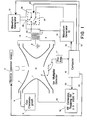
- Samples to be analyzed can be introduced via a tube 6, which is illustrated as coming from a gas chromatography apparatus 5, although the sample could originate from any source.
- a tube 6 Connected across the end caps 2, 2' is a grounded 8, center tapped secondary coil 7 of a transformer.
- the primary coil 12 of the transformer is coupled through switch 25 in switch box 26 to a Waveform Generator I 13, and through switch 24 to Waveform Generator II, 14.
- Switch box 26 is controlled via line 23 from computer 15.
- the interior space of the trap 10 is maintained at vacuum pressures by coupling to a vacuum pump not shown. Electrons from the electron ionization source 3 are caused, under control of computer 15 via connector 22, to violently impact the gases in the space 10 and to fragment the gases into ions, neutrals and groups of charged particles.
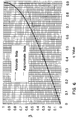
- ⁇ z can be calculated accurately using the method suggested in equations 20.3.13 and 20.3.14 according to the method in 20.3.14 of Abromowitz and Stegun, Handbook of Mathematical Functions , Dover Publications, Inc., 1965, Pg. 728. The calculated values are shown plotted in FIG. 6.
- FIG. 3 is a PFTBA spectrum recorded for my QIT under normal operating conditions for PFTBA with no ejection of low mass ions derived from environmental air gases.
- FIG. 4 shows the PFTBA spectrum recorded with the supplemental waveform applied to eject ions m/z 28 and 32 during e-beam bombardment The effect of ejecting the air gases can be seen to be much more significant at the higher masses.
- the higher masses i.e., above 300, had not been trapped efficiently during electron bombardment because of the space charge of the large number of lighter air gas ions.
- Computer 15 is employed to generate the complete waveform for Waveform Generator 13 including the environmental air gas secular frequencies.
- Computer 15 also includes a program sequence generator to provide timing control to Waveform Generator I and II via lines 18 and 19 respectively under the control of switch 26.
- the Computer 15 also provides the scanning voltage control on line 20 for controlling the RF Generator trapping voltage and the switching on and off of the electron ionization source via line 22,
- the computer 15 includes a standard microprocessor, not shown, for providing digital values to a standard digital-to-analog-converter (DAC) in Waveform Generator I.
- DAC digital-to-analog-converter
- the hardware and software for transferring the digital values is available from Quatech Corporation, Akron, Ohio.
- the hardware is identified as the WSB-100 10 MHz Board with the WSB-A12 Analog module.
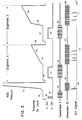
- Waveform Generator II With reference to FIG. 2, the supplemental voltage from Waveform Generator II at 46, 47 and 48 is applied to the end caps during the scanning intervals 34, 35, 38 and 39 respectively.
- Waveform Generator II is not part of the invention. It is set at a fixed frequency approximately equal to 0.92W o .
- FIG. 1 shows the use of two RF generator sources. Since the excitation from the two generators is applied at different instances of time, it is within the capability of RF Generator I to provide both waveforms and to eliminate the switch 26 and RF Generator II.
- FIG. 2 also illustrates the previously known automatic gain control (AGC) sequence.
- AGC automatic gain control
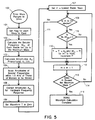
- FIG. 5 The flow diagram of the program employed to create the waveform of Waveform Generator I is shown in FIG. 5.
- the actual program in FORTRAN is available in the file wrapper of the US application from which this application claims priority.
- the program Based on a predetermined low amplitude of the RF trapping field, the program provides the calculation of the exact fundamental secular frequency for each integer mass ion which may be stored in the trap.
- the waveform is calculated by adding the contribution at each instant of time from the single frequency waveforms required to eject each ion which is not desired.
- the amplitudes of each component frequency in the waveform are weighted appropriately so that all undesired masses and only those undesired masses are ejected during the same time period as the amplitude of the composite waveform is increased.
- the width of the resonant power absorption of an ion in our QIT is about 1000 Hz
- our program will also reduce the amplitude of those frequency components used to eject masses which are very close to masses which are to be retained. If the secular frequency of an undesired ion is within, for example, 2000 Hz of the secular frequency of a desired ion, our algorithm will selectively reduce the calculated amplitude of the ion to be ejected by 50 to 99%.
- our program does not calculate a contribution for a mass if it differs in frequency by less than an arbitrary amount, i.e. 200 Hz. This arbitrary frequency difference is selectable.
- the selected phase of the frequency components is not critical because they are not integer multiples and do not tend to come into phase, We can use a random number generator to select the phase, but we also used a fixed phase angle addition relative to the phase of the previous added component.
- FIG. 5 is a flow chart for the algorithm used to determine the composite waveform for RF Generator I.
- the operator enters the mass or mass ranges to store, and in step 101 the program sets flags for each mass to eject.
- the program calculates the secular frequencies for all stable ions up to the maximum mass.
- the amplitudes A m for the frequencies to eject the unwanted ions is calculated according to the inverse mass relationship.
- the program scales the previously calculated amplitudes of those frequencies that are within 1.5 KHz of the secular frequency of masses to be stored. After the above, the amplitudes are corrected for frequency response errors in the hardware.
- the above portion of the algorithm addresses the computation of the amplitudes of the ejected frequencies.
- the next portion of the program is concerned with the creation of the composite time domain waveform to be applied to the end caps by RF Generator I during the ejection interval.
- RF Generator I we accumulate the instantaneous value of each of the ejection frequencies, with shifted phase, for 4000 points over a two millisecond time interval.
- There is a memory array for storing the accumulated amplitude of the composite waveform for each increment of time, T i for i 1,2...4000.
- T i for i 1,2...4000.
- the phase angle p is constant for each frequency W m and is incremented by ⁇ /2 for the next mass.
- the mass register 112 is then incremented to the next mass value; and so long as the maximum mass is not exceeded at decision block 113, the loop is re-entered via a jump 114 back to step 109.
- the above described procedure for selectively trapping ions may not have sufficient resolution at higher masses. Because the initial isolation occurs at low storage RF amplitude for best trapping efficiency, the secular frequencies of m(p) and m(p) + 1 may differ by less than 70 Hz. As described above, the resonant ejection occurs in our trap over a range of about 1000 Hz, so that it is not possible at higher masses to efficiently store ions at a single mass m(p) while completely rejecting ions of mass m(p) ⁇ 1.
- a narrow mass range including m(p) is selectively stored until the trap is completely filled to capacity, using the method already described. Then, the RF storage level is raised to a value which corresponds to q z of 0.7 or greater, and a waveform containing frequency components at or near the secular frequencies of each of the ions in the narrow mass range to be ejected is applied for a time sufficient to cause the ejection of all ions with masses different from m(p).
- the secular frequency of m(p) + 1 will differ from that of m(p) by an amount comparable to the linewidth, and efficient isolation of m(p) is possible.
Landscapes
- Chemical & Material Sciences (AREA)
- Analytical Chemistry (AREA)
- Electron Tubes For Measurement (AREA)
- Other Investigation Or Analysis Of Materials By Electrical Means (AREA)
Applications Claiming Priority (2)
| Application Number | Priority Date | Filing Date | Title |
|---|---|---|---|
| US923093 | 1992-07-31 | ||
| US07/923,093 US5300772A (en) | 1992-07-31 | 1992-07-31 | Quadruple ion trap method having improved sensitivity |
Publications (3)
| Publication Number | Publication Date |
|---|---|
| EP0581600A2 EP0581600A2 (en) | 1994-02-02 |
| EP0581600A3 EP0581600A3 (en) | 1995-08-09 |
| EP0581600B1 true EP0581600B1 (en) | 1998-12-23 |
Family
ID=25448106
Family Applications (1)
| Application Number | Title | Priority Date | Filing Date |
|---|---|---|---|
| EP93306025A Expired - Lifetime EP0581600B1 (en) | 1992-07-31 | 1993-07-30 | Quadrupole ion trap at high sensitivity and method of operating the same |
Country Status (4)
| Country | Link |
|---|---|
| US (1) | US5300772A (enExample) |
| EP (1) | EP0581600B1 (enExample) |
| JP (1) | JP3468473B2 (enExample) |
| DE (1) | DE69322706T2 (enExample) |
Families Citing this family (18)
| Publication number | Priority date | Publication date | Assignee | Title |
|---|---|---|---|---|
| US5396064A (en) * | 1994-01-11 | 1995-03-07 | Varian Associates, Inc. | Quadrupole trap ion isolation method |
| DE19501823A1 (de) * | 1995-01-21 | 1996-07-25 | Bruker Franzen Analytik Gmbh | Verfahren zur Regelung der Erzeugungsraten für massenselektives Einspeichern von Ionen in Ionenfallen |
| JPH095298A (ja) * | 1995-06-06 | 1997-01-10 | Varian Assoc Inc | 四重極イオントラップ内の選択イオン種を検出する方法 |
| JP3385327B2 (ja) * | 1995-12-13 | 2003-03-10 | 株式会社日立製作所 | 三次元四重極質量分析装置 |
| US5793038A (en) * | 1996-12-10 | 1998-08-11 | Varian Associates, Inc. | Method of operating an ion trap mass spectrometer |
| DE10027545C1 (de) * | 2000-06-02 | 2001-10-31 | Bruker Daltonik Gmbh | Regelung der Ionenfüllung in Ionenfallenmassenspektrometern |
| US6627875B2 (en) * | 2001-04-23 | 2003-09-30 | Beyond Genomics, Inc. | Tailored waveform/charge reduction mass spectrometry |
| US6777673B2 (en) * | 2001-12-28 | 2004-08-17 | Academia Sinica | Ion trap mass spectrometer |
| CA2517700C (en) * | 2003-03-19 | 2009-11-17 | Thermo Finnigan Llc | Obtaining tandem mass spectrometry data for multiple parent ions in an ion population |
| US7378648B2 (en) * | 2005-09-30 | 2008-05-27 | Varian, Inc. | High-resolution ion isolation utilizing broadband waveform signals |
| US7378653B2 (en) | 2006-01-10 | 2008-05-27 | Varian, Inc. | Increasing ion kinetic energy along axis of linear ion processing devices |
| US7405399B2 (en) * | 2006-01-30 | 2008-07-29 | Varian, Inc. | Field conditions for ion excitation in linear ion processing apparatus |
| US7405400B2 (en) * | 2006-01-30 | 2008-07-29 | Varian, Inc. | Adjusting field conditions in linear ion processing apparatus for different modes of operation |
| US7351965B2 (en) * | 2006-01-30 | 2008-04-01 | Varian, Inc. | Rotating excitation field in linear ion processing apparatus |
| US7842918B2 (en) * | 2007-03-07 | 2010-11-30 | Varian, Inc | Chemical structure-insensitive method and apparatus for dissociating ions |
| GB0810599D0 (en) | 2008-06-10 | 2008-07-16 | Micromass Ltd | Mass spectrometer |
| US10192730B2 (en) * | 2016-08-30 | 2019-01-29 | Thermo Finnigan Llc | Methods for operating electrostatic trap mass analyzers |
| US11342169B2 (en) * | 2019-04-12 | 2022-05-24 | Agilent Technologies, Inc. | Multi frequency LC resonator topologies applicable to mass spectrometer radio-frequency drive systems |
Family Cites Families (11)
| Publication number | Priority date | Publication date | Assignee | Title |
|---|---|---|---|---|
| US4540884A (en) * | 1982-12-29 | 1985-09-10 | Finnigan Corporation | Method of mass analyzing a sample by use of a quadrupole ion trap |
| EP0202943B2 (en) * | 1985-05-24 | 2004-11-24 | Thermo Finnigan LLC | Method of operating an ion trap |
| US4761545A (en) * | 1986-05-23 | 1988-08-02 | The Ohio State University Research Foundation | Tailored excitation for trapped ion mass spectrometry |
| US4749860A (en) * | 1986-06-05 | 1988-06-07 | Finnigan Corporation | Method of isolating a single mass in a quadrupole ion trap |
| US4818869A (en) * | 1987-05-22 | 1989-04-04 | Finnigan Corporation | Method of isolating a single mass or narrow range of masses and/or enhancing the sensitivity of an ion trap mass spectrometer |
| DE3886922T2 (de) * | 1988-04-13 | 1994-04-28 | Bruker Franzen Analytik Gmbh | Methode zur Massenanalyse einer Probe mittels eines Quistors und zur Durchführung dieses Verfahrens entwickelter Quistor. |
| EP0362432A1 (en) * | 1988-10-07 | 1990-04-11 | Bruker Franzen Analytik GmbH | Improvement of a method of mass analyzing a sample |
| US5075547A (en) * | 1991-01-25 | 1991-12-24 | Finnigan Corporation | Quadrupole ion trap mass spectrometer having two pulsed axial excitation input frequencies and method of parent and neutral loss scanning and selected reaction monitoring |
| US5171991A (en) * | 1991-01-25 | 1992-12-15 | Finnigan Corporation | Quadrupole ion trap mass spectrometer having two axial modulation excitation input frequencies and method of parent and neutral loss scanning |
| US5173604A (en) * | 1991-02-28 | 1992-12-22 | Teledyne Cme | Mass spectrometry method with non-consecutive mass order scan |
| US5089703A (en) * | 1991-05-16 | 1992-02-18 | Finnigan Corporation | Method and apparatus for mass analysis in a multipole mass spectrometer |
-
1992
- 1992-07-31 US US07/923,093 patent/US5300772A/en not_active Expired - Lifetime
-
1993
- 1993-07-30 DE DE69322706T patent/DE69322706T2/de not_active Expired - Lifetime
- 1993-07-30 EP EP93306025A patent/EP0581600B1/en not_active Expired - Lifetime
- 1993-07-30 JP JP20692093A patent/JP3468473B2/ja not_active Expired - Fee Related
Also Published As
| Publication number | Publication date |
|---|---|
| JPH06203792A (ja) | 1994-07-22 |
| JP3468473B2 (ja) | 2003-11-17 |
| US5300772A (en) | 1994-04-05 |
| EP0581600A2 (en) | 1994-02-02 |
| EP0581600A3 (en) | 1995-08-09 |
| DE69322706T2 (de) | 1999-04-29 |
| DE69322706D1 (de) | 1999-02-04 |
Similar Documents
| Publication | Publication Date | Title |
|---|---|---|
| US5300772A (en) | Quadruple ion trap method having improved sensitivity | |
| CA1242536A (en) | Method of operating ion trap detector in ms/ms mode | |
| JP3395983B2 (ja) | イオン単離のための四重極トラップの改良方法 | |
| EP0700069B1 (en) | Frequency modulated selected ion species in a quadrapole ion trap | |
| US5572022A (en) | Method and apparatus of increasing dynamic range and sensitivity of a mass spectrometer | |
| US7285773B2 (en) | Quadrupole ion trap device and methods of operating a quadrupole ion trap device | |
| US5285063A (en) | Method of detecting ions in an ion trap mass spectrometer | |
| US7842918B2 (en) | Chemical structure-insensitive method and apparatus for dissociating ions | |
| US5289010A (en) | Ion purification for plasma ion implantation | |
| CA2097212C (en) | Quadrupole trap improved technique for collisional induced disassociation for ms/ms processes | |
| EP0736221B1 (en) | Mass spectrometry method with two applied trapping fields having same spatial form | |
| US5128542A (en) | Method of operating an ion trap mass spectrometer to determine the resonant frequency of trapped ions | |
| CA2317663C (en) | Method of ion fragmentation in a quadrupole ion trap | |
| EP0715538B1 (en) | A method of selective ion trapping for quadrupole ion trap mass spectrometers | |
| US5623144A (en) | Mass spectrometer ring-shaped electrode having high ion selection efficiency and mass spectrometry method thereby | |
| EP0746873B1 (en) | Quadrupole trap ion isolation method | |
| EP0643415B1 (en) | Mass spectroscopy using collision induced dissociation | |
| JP2009510691A (ja) | 広帯域波形信号を利用する高分解能イオン分離 |
Legal Events
| Date | Code | Title | Description |
|---|---|---|---|
| PUAI | Public reference made under article 153(3) epc to a published international application that has entered the european phase |
Free format text: ORIGINAL CODE: 0009012 |
|
| AK | Designated contracting states |
Kind code of ref document: A2 Designated state(s): DE FR GB IT |
|
| PUAL | Search report despatched |
Free format text: ORIGINAL CODE: 0009013 |
|
| AK | Designated contracting states |
Kind code of ref document: A3 Designated state(s): DE FR GB IT |
|
| 17P | Request for examination filed |
Effective date: 19951110 |
|
| 17Q | First examination report despatched |
Effective date: 19960621 |
|
| GRAG | Despatch of communication of intention to grant |
Free format text: ORIGINAL CODE: EPIDOS AGRA |
|
| GRAG | Despatch of communication of intention to grant |
Free format text: ORIGINAL CODE: EPIDOS AGRA |
|
| GRAH | Despatch of communication of intention to grant a patent |
Free format text: ORIGINAL CODE: EPIDOS IGRA |
|
| GRAH | Despatch of communication of intention to grant a patent |
Free format text: ORIGINAL CODE: EPIDOS IGRA |
|
| GRAA | (expected) grant |
Free format text: ORIGINAL CODE: 0009210 |
|
| AK | Designated contracting states |
Kind code of ref document: B1 Designated state(s): DE FR GB IT |
|
| REF | Corresponds to: |
Ref document number: 69322706 Country of ref document: DE Date of ref document: 19990204 |
|
| ITF | It: translation for a ep patent filed | ||
| ET | Fr: translation filed | ||
| PLBE | No opposition filed within time limit |
Free format text: ORIGINAL CODE: 0009261 |
|
| STAA | Information on the status of an ep patent application or granted ep patent |
Free format text: STATUS: NO OPPOSITION FILED WITHIN TIME LIMIT |
|
| 26N | No opposition filed | ||
| REG | Reference to a national code |
Ref country code: FR Ref legal event code: TP |
|
| REG | Reference to a national code |
Ref country code: GB Ref legal event code: 732E |
|
| REG | Reference to a national code |
Ref country code: GB Ref legal event code: IF02 |
|
| PGFP | Annual fee paid to national office [announced via postgrant information from national office to epo] |
Ref country code: IT Payment date: 20100728 Year of fee payment: 18 Ref country code: DE Payment date: 20100728 Year of fee payment: 18 |
|
| PGFP | Annual fee paid to national office [announced via postgrant information from national office to epo] |
Ref country code: GB Payment date: 20100726 Year of fee payment: 18 |
|
| REG | Reference to a national code |
Ref country code: GB Ref legal event code: 732E Free format text: REGISTERED BETWEEN 20110324 AND 20110330 |
|
| REG | Reference to a national code |
Ref country code: FR Ref legal event code: TP Owner name: AGILENT TECHNOLOGIES INC, US Effective date: 20110823 |
|
| PGFP | Annual fee paid to national office [announced via postgrant information from national office to epo] |
Ref country code: FR Payment date: 20110727 Year of fee payment: 19 |
|
| REG | Reference to a national code |
Ref country code: DE Ref legal event code: R082 Ref document number: 69322706 Country of ref document: DE Representative=s name: EISENFUEHR, SPEISER & PARTNER, DE |
|
| REG | Reference to a national code |
Ref country code: DE Ref legal event code: R082 Ref document number: 69322706 Country of ref document: DE Representative=s name: EISENFUEHR SPEISER PATENTANWAELTE RECHTSANWAEL, DE Effective date: 20111130 Ref country code: DE Ref legal event code: R082 Ref document number: 69322706 Country of ref document: DE Representative=s name: EISENFUEHR, SPEISER & PARTNER, DE Effective date: 20111130 Ref country code: DE Ref legal event code: R081 Ref document number: 69322706 Country of ref document: DE Owner name: AGILENT TECHNOLOGIES INC., SANTA CLARA, US Free format text: FORMER OWNER: VARIAN, INC., PALO ALTO, CALIF., US Effective date: 20111130 Ref country code: DE Ref legal event code: R081 Ref document number: 69322706 Country of ref document: DE Owner name: AGILENT TECHNOLOGIES INC., US Free format text: FORMER OWNER: VARIAN, INC., PALO ALTO, US Effective date: 20111130 |
|
| GBPC | Gb: european patent ceased through non-payment of renewal fee |
Effective date: 20110730 |
|
| PG25 | Lapsed in a contracting state [announced via postgrant information from national office to epo] |
Ref country code: DE Free format text: LAPSE BECAUSE OF NON-PAYMENT OF DUE FEES Effective date: 20120201 |
|
| REG | Reference to a national code |
Ref country code: DE Ref legal event code: R119 Ref document number: 69322706 Country of ref document: DE Effective date: 20120201 |
|
| PG25 | Lapsed in a contracting state [announced via postgrant information from national office to epo] |
Ref country code: IT Free format text: LAPSE BECAUSE OF NON-PAYMENT OF DUE FEES Effective date: 20110730 |
|
| PG25 | Lapsed in a contracting state [announced via postgrant information from national office to epo] |
Ref country code: GB Free format text: LAPSE BECAUSE OF NON-PAYMENT OF DUE FEES Effective date: 20110730 |
|
| REG | Reference to a national code |
Ref country code: FR Ref legal event code: ST Effective date: 20130329 |
|
| PG25 | Lapsed in a contracting state [announced via postgrant information from national office to epo] |
Ref country code: FR Free format text: LAPSE BECAUSE OF NON-PAYMENT OF DUE FEES Effective date: 20120731 |