EP0565663B1 - Programmierbare faseroptische verzögerungsleitung, und damit ausgestattetes radarzielsimulationssystem - Google Patents
Programmierbare faseroptische verzögerungsleitung, und damit ausgestattetes radarzielsimulationssystem Download PDFInfo
- Publication number
- EP0565663B1 EP0565663B1 EP92921408A EP92921408A EP0565663B1 EP 0565663 B1 EP0565663 B1 EP 0565663B1 EP 92921408 A EP92921408 A EP 92921408A EP 92921408 A EP92921408 A EP 92921408A EP 0565663 B1 EP0565663 B1 EP 0565663B1
- Authority
- EP
- European Patent Office
- Prior art keywords
- delay
- fiber optic
- segments
- radar
- line
- Prior art date
- Legal status (The legal status is an assumption and is not a legal conclusion. Google has not performed a legal analysis and makes no representation as to the accuracy of the status listed.)
- Expired - Lifetime
Links
- 239000000835 fiber Substances 0.000 title claims abstract description 52
- 238000004088 simulation Methods 0.000 title claims description 12
- 230000003287 optical effect Effects 0.000 claims description 35
- 230000001934 delay Effects 0.000 claims description 11
- 230000003111 delayed effect Effects 0.000 claims description 11
- 230000033001 locomotion Effects 0.000 claims description 5
- 230000005540 biological transmission Effects 0.000 claims 1
- 238000012360 testing method Methods 0.000 abstract description 12
- 239000013307 optical fiber Substances 0.000 description 11
- 230000005693 optoelectronics Effects 0.000 description 6
- 238000010586 diagram Methods 0.000 description 5
- 238000013459 approach Methods 0.000 description 4
- 238000000034 method Methods 0.000 description 4
- 238000006243 chemical reaction Methods 0.000 description 2
- 238000003780 insertion Methods 0.000 description 2
- 230000037431 insertion Effects 0.000 description 2
- 230000007246 mechanism Effects 0.000 description 2
- 230000003134 recirculating effect Effects 0.000 description 2
- 230000008859 change Effects 0.000 description 1
- 230000008878 coupling Effects 0.000 description 1
- 238000010168 coupling process Methods 0.000 description 1
- 238000005859 coupling reaction Methods 0.000 description 1
- 230000001186 cumulative effect Effects 0.000 description 1
- 230000001419 dependent effect Effects 0.000 description 1
- 238000013461 design Methods 0.000 description 1
- 238000002592 echocardiography Methods 0.000 description 1
- 238000011010 flushing procedure Methods 0.000 description 1
- 230000006870 function Effects 0.000 description 1
- 239000012535 impurity Substances 0.000 description 1
- 230000010287 polarization Effects 0.000 description 1
- 230000008569 process Effects 0.000 description 1
- 238000012545 processing Methods 0.000 description 1
- 230000005855 radiation Effects 0.000 description 1
- 230000008929 regeneration Effects 0.000 description 1
- 238000011069 regeneration method Methods 0.000 description 1
- 230000008439 repair process Effects 0.000 description 1
- 230000010076 replication Effects 0.000 description 1
- 230000008672 reprogramming Effects 0.000 description 1
- 238000005070 sampling Methods 0.000 description 1
- 238000012163 sequencing technique Methods 0.000 description 1
- 230000003595 spectral effect Effects 0.000 description 1
- 238000010897 surface acoustic wave method Methods 0.000 description 1
- 230000001360 synchronised effect Effects 0.000 description 1
Images
Classifications
-
- G—PHYSICS
- G01—MEASURING; TESTING
- G01S—RADIO DIRECTION-FINDING; RADIO NAVIGATION; DETERMINING DISTANCE OR VELOCITY BY USE OF RADIO WAVES; LOCATING OR PRESENCE-DETECTING BY USE OF THE REFLECTION OR RERADIATION OF RADIO WAVES; ANALOGOUS ARRANGEMENTS USING OTHER WAVES
- G01S7/00—Details of systems according to groups G01S13/00, G01S15/00, G01S17/00
- G01S7/02—Details of systems according to groups G01S13/00, G01S15/00, G01S17/00 of systems according to group G01S13/00
- G01S7/40—Means for monitoring or calibrating
- G01S7/4052—Means for monitoring or calibrating by simulation of echoes
-
- G—PHYSICS
- G01—MEASURING; TESTING
- G01S—RADIO DIRECTION-FINDING; RADIO NAVIGATION; DETERMINING DISTANCE OR VELOCITY BY USE OF RADIO WAVES; LOCATING OR PRESENCE-DETECTING BY USE OF THE REFLECTION OR RERADIATION OF RADIO WAVES; ANALOGOUS ARRANGEMENTS USING OTHER WAVES
- G01S7/00—Details of systems according to groups G01S13/00, G01S15/00, G01S17/00
- G01S7/02—Details of systems according to groups G01S13/00, G01S15/00, G01S17/00 of systems according to group G01S13/00
- G01S7/40—Means for monitoring or calibrating
- G01S7/4052—Means for monitoring or calibrating by simulation of echoes
- G01S7/4082—Means for monitoring or calibrating by simulation of echoes using externally generated reference signals, e.g. via remote reflector or transponder
- G01S7/4095—Means for monitoring or calibrating by simulation of echoes using externally generated reference signals, e.g. via remote reflector or transponder the external reference signals being modulated, e.g. rotating a dihedral reflector or modulating a transponder for simulation of a Doppler echo
Definitions
- the present invention relates to a programmable fiber optic delay system and to a radar target speed and distance simulation system using the programmable fiber optic delay system.
- U.S. patent 4 671 605 discloses a length-dependent optical time delay device for electrical signals.
- the device comprises two optical time delay components each made up of a plurality of parallel optical fibers of varying length. Each one fiber of the first and the second group thereof can be connected in series in order to delay an optical signal, respectively.
- each two switches of the 8:1 and 1:8 type are provided, respectively.
- a 1:8 selector is provided at the input of each group or time delay component and at the output of each group an 8:1 selector is necessary.
- These selectors or switches are part of an integrated circuit and are being controlled by a variable voltage source.
- Each of the optical fibers of the time delay components is increased in length with respect to an adjacent fiber by the same amount, so that this differential length gives the resolution of this system.
- the maximum delay is limited to N-times differential delay, whereby N is the number of parallel fibers in each group.
- WO-A-89/08854 discloses a radar target simulation system which produces a replica of the radar signal substantially delayed in time.
- the radar signal modulates a laser light which is controllable delayed in time by transmitting the modulated laser light through a fiber optic delay line.
- the output of the delay line is demodulated and the delayed radar signal is returned to the radar as a test signal.
- the fiber optic delay line comprises one fiber optic cable, the amount of achieved time delay being direct proportional to the length of this fiber optic cable.
- U.S. patent 4 028 702 discloses a fiber optic delay line comprising a plurality of fiber optic segments connected in series by optical switches. Each segment has an associated segment with a relatively negligible delay wherein the optical switches select for each of the delay segments between said delay segment and said associated negligible delay segment for inclusion in the delay line.
- Test systems used to simulate a moving target are generally designed to return a copy or simulated copy of a transmitted radar pulse, after delaying or simulating the delay of the pulse by a period of time corresponding to the round-trip transit time to the target, with the addition of an expected Doppler frequency shift.
- the delay parameters are updated at regular intervals, corresponding to the target velocity and the desired range resolution, to simulate target movement.
- the general approach to testing using delayed transmitted radar pulses has been to put a large target (such as a corner reflector or repeater) out at a distance from the radar so that a long delay is achieved because of the round trip time to this simulated target.
- This technique suffers from the fact that the radar signal is perturbed by the outside environment that is not under the control of the tester, and has several undesirable features. Excessive losses at radio frequency (RF) rule out the feasibility of using coaxial cables to provide long delay times. Surface acoustic wave delay lines are also lossy, with a limited RF bandwidth and delay time capability.
- Simulated target generators for radar testing can employ digital RF memory (DRFM) to simulate a moving target.
- DRFM digital RF memory
- Such a system employs sampling and analog-to-digital conversion techniques to store sampled waveform data of the transmitted radar pulses.
- DRFM introduces undesired frequency spurs (spectral impurities), has a reduced dynamic range and bandwidth because of the need for analog-to-digital conversion, and requires complex circuitry that has a relatively high power consumption.
- an RF target generator system can generate a simulated delayed radar pulse by using reference signals from the radar to generate the pulse in the same way the radar generates the signal that goes to the radar transmitter.
- a fixed fiber optic delay line is described in U.S. patent 4 903 029 to Newberg et al. While this is a low loss delay mechanism, it encorporates a fixed delay that cannot be adjusted, and therefore can be used to simulate only a fixed target distance without any target movement.
- a programmable fiber optic delay system comprising:
- a radar target speed and distance simulation system comprising:
- the present invention seeks to provide a programmable signal delay mechanism for a radar test target simulator that can provide real time delay of the actual radar transmitted pulses and simulate long target distances, without excessive losses or corruption from outside environment while being located adjacent to the radar, and yet has both fine delay resolution and long delay times so that it can simulate a broad range of distances and target speeds.
- a relatively wide RF bandwidth, the avoidance of undue complexity and low noise levels are further goals of the invention.
- the simulation of an ideal target signal return to the radar is achieved without or with only a minimum number of control signals from the radar. This is a unique and desired capability of a test set that is not provided by other types of target simulators.
- the new radar target speed and distance simulation system employs a minimum of two optical fiber delay lines. At any given time, only one of these lines is being used to provide the delay. This line, the active line, has the correct length for the distance being simulated. While this active line is being used, the inactive line(s) are being reconfigured for new simulated distances. This reconfiguration consists of changing the line length by switching in or out incremental lengths of line, flushing the unwanted information out of the line, allowing the mechanical switching transients to decay, and reloading the line with a properly sequenced signal. At the appropriate time this properly prepared second line is selected to provide the delay, and the first line becomes inactive. Because line selection is performed with a very high speed optical or microwave switch, the flow of data is essentially uninterrupted.
- Each delay line includes a plurality of fiber optic segments having predetermined optical delays, and a switching scheme for connecting into an aggregate delay line only those segments which accumulate to the desired delay.
- different segments have different lengths and correspondingly different delay periods, and are arranged in a binary progression.
- the selected segments are switched into the aggregate delay line; optical bypasses are switched into the aggregate delay line for the undesired segments.
- Optical amplifiers are incorporated into the overall delay line to compensate for losses; the amplifiers are preferably located between adjacent segments of shorter length, and within segments of longer length.
- a computer can be used to program the individual delay lines and control the switching among those lines.
- the output radar signal is sampled by either direct coupling or via an antenna to receive some of the radar's radiation, and modulated onto the optical signal of the opto-electronic transmitter for processing through the optical delay system.
- the output of that system is converted back to an electrical signal that is a nearly ideal replica of the radar's transmitted signal and fed back to the radar as a simulated radar target at a selected range (delay) and speed (velocity).
- the multi-line approach allows one to use relatively slow mechano-optical or thermo-optical switches to change the length of the inactive line, while maintaining an uninterrupted flow of delayed signal through the active line.
- Mechano-optical switches have low loss and low crosstalk, properties that are necessary for ultra-long, high-resolution programmable delay lines.
- the two-line approach also allows one to unambiguously remove "incorrect" information from the line, and to reload it with correct information (i.e., a properly sequenced signal train). Proper sequencing is essential for accurate replication of radar echoes.
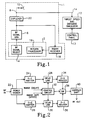
- FIG. 1 presents a summary block diagram of the new target speed and distance simulator connected to a radar system 1.
- the radar system processor includes a computer 2 that selects the characteristics of the radar RF signal to be transmitted; this function is indicated by block 4.
- the desired signal is produced by an RF signal generator 6 and delivered via a duplexer 20 and line 8 to an antenna 10, which typically will also provide a reception in a radar transceiver system.
- the target speed and distance simulator system of the present invention is indicated by block 12.
- An input line 14 can tap the RF signal on line 8 and deliver at least a portion of that signal to the simulator system.
- a sample from the radar for input line 14 could also be obtained from several other places, such as the output of antenna 10 or elsewhere within a typical radar system.
- This system block 12 produces a controlled initial delay signal that simulates a target distance from the radar set, and periodically updates the delay at a controlled rate to simulate a target speed relative to the radar set based on an input from simulator operator control panel 13.
- These simulation parameters are typically provided by a computer that is part of the simulator and that is set up by the front panel 13 set of controls.
- the delayed signal output from the simulator is delivered back to the radar system, which processes this "ideal" signal as if it were real to determine the simulated target speed, range and other typical radar parameters.
- the signal returned to the radar can be connected back to the radar receiver 18 either via the radar duplexer 20 or by radiating into antenna 10. From the return receiver 18 the signal is delivered to a return processor 16 that decodes the signal to calculate the simulated target speed and range.
- the return processor 16 can conveniently be implemented by the computer 2 that is already resident in the radar processor system.
- Typical modern airborne radar can have a long range (up to about 80 nautical miles) and high resolution (about 25 feet) capability. This translates into a simulator signal delay requirement of up to about 1,000 microseconds to simulate this maximum radar range. To adequately test radar range resolution, and to smoothly simulate target motion, this delay must be changeable in increments as small as 50 nanoseconds.
- the present invention uses optical fibers, which have a wide bandwidth and extremely low optical loss (about 0.2 db/km), to achieve this range of delays.
- the basic approach is to convert a sample of the radar transmitted signal into an amplitude modulated light wave, which is then transmitted through a programmed length of optical fiber to produce the desired time delay.
- the modulated light signal is demodulated at the end of the fiber and, after shifting the output electrical signal by the proper Doppler frequency shift, a simulated radar return signal is obtained that can be used to evaluate the end-to-end performance of the entire radar.
- This use of the radar as its own tester by returning a delayed ideal replica simulated target is an excellent way to evaluate radar system end-to-end (total) performance.
- Other types of radars with different parameters of range, range rate and range resolution capability can also be simulated by designing a simulator with different parameters then the typical values stated above.
- FIG. 2 A block diagram of the present simulator 12 in FIG. 1 is provided in FIG. 2.
- the signal from the radar in FIG. 1 is split by an RF power divider 22, and each divided portion is used to modulate respective low noise opto-electronic transmitters 24 and 26.
- the opto-electronic transmitters can be directly modulated lasers or external modulators. While two opto-electronic transmitters and corresponding delay lines are shown in FIG. 2, the system could be expanded to incorporate three or more separate delay lines if desired. Instead of dividing the input RF signal, it could be used to modulate a single opto-electronic transmitter, with the transmitter output then split between the various delay lines with an optical splitter.
- Each opto-electronic transmitter 24,26 transmits an RF-modulated optical beam to corresponding fiber optic delay lines 28,30.
- the delay which these lines add to their respective optical signals is controlled by the computer in the simulator 12 via appropriate control interface circuitry 32.
- the delayed optical outputs from the delay lines 28,30 are converted to electrical signals by opto-electric transducers 34,36, respectively, which are preferably implemented as photodiodes.
- the electrical outputs from transducers 34 and 36 are presented to a conventional RF switch 38 that selects the signal from only one line at a time. Optical switching means could also be used if they have fast switching times.
- the signals presented to the switch can be from DC through the microwave frequency range (from about 100 MHz to 100 GHz), depending upon the capability of the photonic components used.
- the operation of switch 38 is controlled by the computer in the simulator 12, via control interface 32.
- the second line's delay is thus provided as the output for the overall simulator.
- the first line is reprogrammed with a new delay period.
- the switch is actuated by the simulator computer to disconnect from the second delay line and connect to the first delay line, thus changing the simulator's output delay to the newly programmed delay of the first line.
- the second delay line which is disconnected from the delay output at this time, can now be reprogrammed with a new delay period of its own.
- the switch 38 continues to alternate between the two delay lines, with the disconnected delay line reprogrammed while the other delay line provides the simulator output. In this fashion an almost constant output is produced from the simulator, with a rapid updating capability.
- the switching between delay lines also allows the line to be emptied and reloaded with new data pulses.
- the maximum switching rate between lines is determined by the optical switch settling time or the line load time for new pulses, whichever is longer; this maximum switching rate along with the delay line range resolution determines the maximum closing target speed that can be simulated.
- a conventional RF switch 38 is capable of operating at speeds of up to about 100-200 MHz. However, it requires about 6 msec to reprogram the fiber optic delay lines, including settling time for a reprogram delay.
- the operation of switch 38 is synchronized with the reprogramming of the multiple delay lines 28,30, and is thus operated at a rate far below its capacity. The dead time during which no useable signal is produced by the simulator is thus reduced to a very low level that is determined by the switching time of the high speed RF switch 38, which can be as low as a few nanoseconds.
- a Doppler frequency shift circuit 40 of conventional design is connected to the output of switch 38.
- the addition of a Doppler shift to the radar signal delay provides a complete simulation of a target moving either towards or away from the radar set.
- both the target speed (operator selectable) and radar radiated frequency (not necessarily known) must be utilized.
- the radar frequency is measured by a commercial unit so that it does not have to be sent from the radar as a data input, and thus the test set can be independent of radar control signals; this is a desired feature of this test target simulator.
- An additional fiber optic delay line at the input to the simulator not shown in FIG. 2, is used to delay the input signal long enough for the external (to radar) commercial frequency measuring unit to measure the radar frequency and set up the correct Doppler shift for the frequency of the delay line output.
- the two delay lines 28 and 30 are preferably identical.
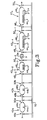
- a preferred structure for each delay line is shown in FIG. 3.
- the delay line is broken into a series of individual fiber optic delay segments 42 a , 42 b ,...42 n-2 , 42 n-1 , 42 n , where n in the total number of delay segments.
- Each segment consists of a coiled length of optical fiber 44 a , 44 b , etc., and a short adjacent length of optical fiber 46 a , 46 b , etc. whose length produces a negligible delay.
- the coiled length and negligible delay length form two selectable signal paths, and a switch on each end can be used to switch between them.
- the lengths of the optical fiber coils preferably form a binary sequence in the form L times 2 k , where L is a unit of optical fiber delay in the coiled segment and is given in seconds, and k is the order of a given fiber segment.
- the segments accordingly provide respective delay times of L times 2 k seconds each. If T is the total number of binary segments, then the total line length is 2 T -1 times L seconds.
- 14 segments are used, with the first 13 segments arranged in a binary progression and the length of the 14th segment equal to that of the 13th. To obtain a simulated range of up to 80 nautical miles and a range resolution of 42 feet the length of the first segment 44 a is 17m, which produces a delay in the fiber optic cable of about 83 nsec.
- This length increases up to the 13th segment 44 n-1 , which is about 70 km long. With the final segment 44 n also about 70 km, the total length of the delay line when all of the segments are connected together in series is about 208 km; this provides an upper limit delay of about 1 millisecond, which corresponds to a maximum radar range of about 80 nautical miles.
- switches 48 a , 48 b ,...48 n-2 , 48 n-1 , 48 n are provided at the input end of each delay segment, while similar switches 50 a , 50 b ,...50 n-2 , 50 n-1 , 50 n are provided at the output of each delay segment.
- the switches 48 and 50 are connected to select between their respective delay lines 44 a , 44 b , etc. and the optical bypasses to those lines 46 a , 46 b , etc. for inclusion in an aggregate delay line. Control over the various switches is provided from the control interface 32 over a control interface bus 52.
- a desired overall delay is implemented by selecting individual segments whose total delay adds up to the desired amount, switching the segments into the aggregate delay line, and switching in the bypasses for the other segments into the aggregate line.
- the delay period is reprogrammed by altering the switching pattern so that a new combination of delay segments, whose individual delays total to the new desired overall delay, are included in the aggregate delay line.
- electro-mechanical switches While fast operating electro-optic devices could be used for the switches 48 and 50, these devices also have high insertion losses. It is therefore desirable to use electro-mechanical switches, which have relatively low insertion losses. Electro-mechanical switches, however, also have considerably lower switching speeds than electro-optic switches.
- the parallel programmable delay line architecture of the present invention permits the use of electro-mechanical switches without limiting the overall simulator to their relatively slow switching speeds.
- in-line fiber optic amplifiers 54 may be employed. Such amplifiers are preferably of the erbium-doped type, which are characterized by low noise, high gain and polarization insensitivity. For the shorter segments it is generally sufficient to locate an amplifier between a pair of adjacent segments, while for the longer segments such as 42 n-1 , 42 n it may be desirable to integrate an amplifier in with the segment.
- the amplifiers 54 are pumped with respective pump lasers p. For economy, a high power laser can be used with a power divider to pump the several amplifiers 54.
Landscapes
- Engineering & Computer Science (AREA)
- Computer Networks & Wireless Communication (AREA)
- Physics & Mathematics (AREA)
- General Physics & Mathematics (AREA)
- Radar, Positioning & Navigation (AREA)
- Remote Sensing (AREA)
- Optical Radar Systems And Details Thereof (AREA)
- Radar Systems Or Details Thereof (AREA)
- Light Guides In General And Applications Therefor (AREA)
- Monitoring And Testing Of Transmission In General (AREA)
Claims (14)
- Programmierbares faseroptisches Verzögerungssystem, mit:einer Vielzahl von faseroptischen Verzögerungsleitungen (28, 30), wobei jede Verzögerungsleitung (28, 30) eine programmierbare Verzögerungszeitdauer sowie eine Vielzahl von faseroptischen Segmenten (44) mit vorbestimmten optischen Verzögerungen aufweist, wobei die Segmente (44) in Serie in die Verzögerungsleitung (28, 30) schaltbar sind,Koordinierungsmitteln (32), um die Verzögerungsleitungen (28, 30) mit entsprechenden Serien von Verzögerungen zu programmieren, indem gewünschte Segmente (44) in jede Verzögerungsleitung (28, 30) eingeschaltet werden,Schaltmitteln (38), um zwischen der Vielzahl von Verzögerungsleitungen (28, 30) zum Einfügen in einen Verzögerungspfad zu schalten, undwobei die Koordinierungsmittel (32) die Schaltmittel (38) mit der Programmierung der Verzögerungsleitungen (28, 30) so koordinieren, daß nur eine Verzögerungsleitung (28, 30) mit eingestelltem Verzögerungsprogramm in den Verzögerungspfad eingefügt wird.
- Das programmierbare faseroptische Verzögerungssystem nach Anspruch 1, dadurch gekennzeichnet, daß die Koordinierungsmittel (32) Mittel umfassen, um die Schaltrate zwischen den Verzögerungsleitungen (28, 30) zu variieren.
- Das programmierbare faseroptische Verzögerungssystem nach Anspruch 1, ferner gekennzeichnet durch Mittel (24, 26), die einer jeden Verzögerungsleitung (28, 30) zugeordnet sind, um optische Signale für die Übertragung längs ihrer entsprechenden Verzögerungsleitungen (28, 30) in Antwort auf ein Hochfrequenz (HF) -Eingangssignal zu erzeugen, und durch Mittel (34, 36), um die optischen Eingangssignale zurück in HF-Ausgangssignal zu konvertieren.
- Das programmierbare faseroptische Verzögerungssystem nach Anspruch 1, dadurch gekennzeichnet, daß jede Verzögerungsleitung (28, 30) weiter einen optoelektrischen Wandler (34, 36) aufweist, um ihr verzögertes optisches Signal in ein elektrisches Signal zu konvertieren, wobei die Schaltmittel (38) unter den elektrischen Signalen zur Einfügung in den Verzögerungspfad auswählen.
- Das programmierbare faseroptische Verzögerungssystem nach Anspruch 1, dadurch gekennzeichnet, daß für jede Verzögerungsleitung (28, 30) wenigstens einige der Segmente (24) verschiedene Längen mit entsprechend verschiedenen Verzögerungen aufweisen.
- Das programmierbare faseroptische Verzögerungssystem nach Anspruch 1, dadurch gekennzeichnet, daß weitere Schaltmittel (48, 50) vorgesehen sind, um die Segmente (44) in die Verzögerungsleitungen (28, 30) zu schalten.
- Das programmierbare faseroptische Verzögerungssystem nach Anspruch 6, dadurch gekennzeichnet, daß für jede Verzögerungsleitung (28, 30) wenigstens einige der Segmente (24) eine binäre Progression der entsprechenden Längen und Verzögerungszeiten aufweisen.
- Das programmierbare faseroptische Verzögerungssystem nach Anspruch 6, dadurch gekennzeichnet, daß für jede Verzögerungsleitung (28, 30) jedes der Segmente (44) ein zugeordnetes faseroptisches Segment (46) mit einer relativ vernachlässigbaren Verzögerung aufweist, wobei die weiteren Schaltmittel (48, 50) zwischen jedem der Verzögerungssegmente und ihrem zugeordneten Segment (46) mit vernachlässigbarer Verzögerung zur Einfügung in die Serienverzögerungsleitung (28, 30) auswählen.
- Das programmierbare faseroptische Verzögerungssystem nach Anspruch 1, gekennzeichnet durch eine Vielzahl von optischen Verstärkern in der Verzögerungsleitung (28, 30).
- Das programmierbare faseroptische Verzögerungssystem nach Anspruch 9, dadurch gekennzeichnet, daß einige der optischen Verstärker (54) zwischen benachbarten Segmenten (44n-2, 44n-1) und einige innerhalb eines Segmentes (44n) angeordnet sind.
- Das programmierbare faseroptische Verzögerungssystem nach Anspruch 9, bei dem die Segmente (44) eine Vielzahl von verschiedenen Längen mit entsprechend verschiedenen Verzögerungen aufweisen, dadurch gekennzeichnet, daß wenigstens einige der optischen Verstärker (54) zwischen benachbarten Segmenten (44n-2, 44n-1) von kürzerer Länge und wenigstens einige innerhalb eines Segmentes (44n) von größerer Länge angeordnet sind.
- System zur Simulation von Geschwindigkeit und Entfernung eines Radarzieles mit:a) einemRadarprozessor (2, 6) zur Erzeugung eines Radarsignales,b) Mitteln (24, 26) zum Konvertieren des Radarsignales in ein entsprechendes optisches Signal,c) einem faseroptischen Verzögerungssystem (28 - 38), um das optische Signal um eine Zeitdauer zu verzögern, die einer simulierten Zielentfernung entspricht, undd) Mitteln (18), um ein Signal, das die Verzögerung des Verzögerungspfades beinhaltet, als eine simulierte Zielentfernung zu dem Radarprozessor (2) zurückzuleiten,wobei das faseroptische Verzögerungssystem (28 - 38) das programmierbare faseroptische Verzögerungssystem (28 - 38) aus einem der Ansprüche 1 bis 11 ist und die Serie von Verzögerungen einer simulierten Geschwindigkeit einer Zielbewegung entspricht.
- Das System zur Simulation von Geschwindigkeit und Entfernung eines Radarzieles nach Anspruch 12, dadurch gekennzeichnet, daß ein Steuercomputer programmiert und verschaltet ist, um für die Programmierung der Verzögerungsleitung sowie die Koordinierung der Schaltmittel (38) mit der Programmierung der Verzögerungsleitung zu sorgen.
- Das System zur Simulation von Geschwindigkeit und Entfernung eines Radarzieles nach Anspruch 12, dadurch gekennzeichnet, daß die Mittel (18) zum Zuführen des Signales Mittel beinhalten, um das verzögerte optische Signal in ein Hochfrequenz (HF)-Radarzielsignal zu konvertieren.
Applications Claiming Priority (3)
| Application Number | Priority Date | Filing Date | Title |
|---|---|---|---|
| US07/773,187 US5177488A (en) | 1991-10-08 | 1991-10-08 | Programmable fiber optic delay line, and radar target simulation system incorporating the same |
| US773187 | 1991-10-08 | ||
| PCT/US1992/008224 WO1993007508A1 (en) | 1991-10-08 | 1992-09-25 | Programmable fiber optic delay line, and radar target simulation system incorporating the same |
Publications (2)
| Publication Number | Publication Date |
|---|---|
| EP0565663A1 EP0565663A1 (de) | 1993-10-20 |
| EP0565663B1 true EP0565663B1 (de) | 1997-07-23 |
Family
ID=25097473
Family Applications (1)
| Application Number | Title | Priority Date | Filing Date |
|---|---|---|---|
| EP92921408A Expired - Lifetime EP0565663B1 (de) | 1991-10-08 | 1992-09-25 | Programmierbare faseroptische verzögerungsleitung, und damit ausgestattetes radarzielsimulationssystem |
Country Status (6)
| Country | Link |
|---|---|
| US (1) | US5177488A (de) |
| EP (1) | EP0565663B1 (de) |
| JP (1) | JPH06507028A (de) |
| DE (1) | DE69221121T2 (de) |
| IL (1) | IL103344A (de) |
| WO (1) | WO1993007508A1 (de) |
Cited By (1)
| Publication number | Priority date | Publication date | Assignee | Title |
|---|---|---|---|---|
| CN109459733A (zh) * | 2018-10-26 | 2019-03-12 | 中电科仪器仪表有限公司 | 基于调相方式的防撞雷达目标速度模拟装置、系统及方法 |
Families Citing this family (87)
| Publication number | Priority date | Publication date | Assignee | Title |
|---|---|---|---|---|
| US5300934A (en) * | 1992-08-27 | 1994-04-05 | Fieldtech Avionics & Instruments, Inc. | Radar altimeter loop simulator |
| US5262786A (en) * | 1992-10-07 | 1993-11-16 | Westinghouse Electric Corp. | Radar test instrument using optical delay means |
| US5329118A (en) * | 1992-12-23 | 1994-07-12 | Riza Nabeel A | Optical transversal filter |
| US5339087A (en) * | 1993-10-27 | 1994-08-16 | The United States Of America As Represented By The Secretary Of The Navy | Wavefront simulator for evaluating RF communication array signal processors |
| US5786922A (en) * | 1996-02-15 | 1998-07-28 | Honeywell Inc. | Dual signal subharmonic carrier for systems with unknown delay |
| KR100269182B1 (ko) * | 1997-07-29 | 2000-11-01 | 박태진 | 레이다 시스템의 표적모의 시험장치 |
| US6067041A (en) * | 1998-10-15 | 2000-05-23 | Northrop Grumman Corporation | Moving target simulator |
| FR2787588B1 (fr) * | 1998-12-18 | 2001-03-16 | Thomson Csf | Systeme lidar et application a un systeme radar |
| US6346909B1 (en) * | 2000-09-06 | 2002-02-12 | The United States Of America As Represented By The Secretary Of The Army | System for generating simulated radar targets |
| EP1434522B1 (de) | 2000-10-30 | 2010-01-13 | The General Hospital Corporation | Optische systeme zur gewebeanalyse |
| DE60212468T2 (de) * | 2001-02-08 | 2007-06-14 | Fujitsu Ten Ltd., Kobe | Verfahren und Vorrichtung zum Justieren einer Einbauanordnung für Radar, sowie Radar justiert von diesem Verfahren oder dieser Vorrichtung |
| DE60219147T2 (de) * | 2001-03-30 | 2007-12-13 | Corning Incorporated | Optische übertragungsleitung |
| GB0113766D0 (en) * | 2001-05-31 | 2003-02-26 | Bae Systems Plc | Improvements relating to optical delay lines |
| US7313635B1 (en) * | 2002-03-21 | 2007-12-25 | Cisco Technology | Method and apparatus for simulating a load on an application server in a network |
| RU2213421C1 (ru) * | 2002-06-21 | 2003-09-27 | Южно-Российский государственный университет экономики и сервиса | Динамическое запоминающее устройство радиосигналов |
| US7145504B1 (en) * | 2004-03-11 | 2006-12-05 | Raytheon Company | Arbitrary radar target synthesizer (arts) |
| US7447408B2 (en) | 2004-07-02 | 2008-11-04 | The General Hospital Corproation | Imaging system and related techniques |
| JP5324095B2 (ja) | 2004-08-24 | 2013-10-23 | ザ ジェネラル ホスピタル コーポレイション | 血管セグメントを画像化する方法および装置 |
| JP2008521516A (ja) * | 2004-11-29 | 2008-06-26 | ザ ジェネラル ホスピタル コーポレイション | サンプル上の複数の地点を同時に照射し検出することによって光学画像生成を実行する構成、装置、内視鏡、カテーテル、及び方法 |
| JP2008538612A (ja) * | 2005-04-22 | 2008-10-30 | ザ ジェネラル ホスピタル コーポレイション | スペクトルドメイン偏光感受型光コヒーレンストモグラフィを提供することの可能な構成、システム、及び方法 |
| ES2337497T3 (es) | 2005-04-28 | 2010-04-26 | The General Hospital Corporation | Evaluacion de caracteristicas de la imagen de una estructura anatomica en imagenes de tomografia de coherencia optica. |
| US9060689B2 (en) * | 2005-06-01 | 2015-06-23 | The General Hospital Corporation | Apparatus, method and system for performing phase-resolved optical frequency domain imaging |
| WO2007019574A2 (en) * | 2005-08-09 | 2007-02-15 | The General Hospital Corporation | Apparatus, methods and storage medium for performing polarization-based quadrature demodulation in optical coherence tomography |
| US20070049833A1 (en) * | 2005-08-16 | 2007-03-01 | The General Hospital Corporation | Arrangements and methods for imaging in vessels |
| WO2007038787A1 (en) | 2005-09-29 | 2007-04-05 | General Hospital Corporation | Method and apparatus for optical imaging via spectral encoding |
| WO2007084903A2 (en) | 2006-01-19 | 2007-07-26 | The General Hospital Corporation | Apparatus for obtaining information for a structure using spectrally-encoded endoscopy techniques and method for producing one or more optical arrangements |
| EP1973467B1 (de) * | 2006-01-20 | 2013-10-16 | The General Hospital Corporation | Systeme und Verfahren zur Bereitstellung von Speckle-Reduktion über eine Wellenfront -Modulation zur optischen Kohärenzentomographie |
| EP1983921B1 (de) | 2006-02-01 | 2016-05-25 | The General Hospital Corporation | Systeme zur bereitstellung elektromagnetischer strahlung für mindestens einen teil einer probe mittels konformer lasertherapieverfahren |
| EP2659851A3 (de) | 2006-02-01 | 2014-01-15 | The General Hospital Corporation | Vorrichtung zur Anwendung mehrerer elektromagnetischer Strahlungen auf einer Probe |
| EP2982929A1 (de) | 2006-02-24 | 2016-02-10 | The General Hospital Corporation | Verfahren und systeme zur durchführung von winkelaufgelöster optischer kohärenztomografie im fourier-bereich |
| US7801447B1 (en) * | 2006-02-28 | 2010-09-21 | Lockheed Martin Corporation | Method and system for signal processing by modulation of an optical signal with a multichannel radio frequency signal |
| JP2009536740A (ja) | 2006-05-10 | 2009-10-15 | ザ ジェネラル ホスピタル コーポレイション | サンプルの周波数領域画像形成を提供するためのプロセス、構成およびシステム |
| WO2008049118A2 (en) | 2006-10-19 | 2008-04-24 | The General Hospital Corporation | Apparatus and method for obtaining and providing imaging information associated with at least one portion of a sample and effecting such portion(s) |
| WO2008121180A2 (en) * | 2007-02-07 | 2008-10-09 | Lockheed Martin Corporation | Miniaturized microwave-photonic receiver |
| US7782250B2 (en) * | 2008-06-13 | 2010-08-24 | Honeywell International Inc. | Millimeter wave radar target simulation systems and methods |
| EP2309923B1 (de) | 2008-07-14 | 2020-11-25 | The General Hospital Corporation | Vorrichtung und verfahren für eine farbendoskopie |
| EP2324390A1 (de) * | 2008-09-18 | 2011-05-25 | Selex Sistemi Integrati S.P.A. | Faseroptischer transponder mit schaltbaren verzögerungen mit optischer erzeugung von dopplerverschiebung |
| US9615748B2 (en) | 2009-01-20 | 2017-04-11 | The General Hospital Corporation | Endoscopic biopsy apparatus, system and method |
| WO2010091190A2 (en) * | 2009-02-04 | 2010-08-12 | The General Hospital Corporation | Apparatus and method for utilization of a high-speed optical wavelength tuning source |
| JP5819823B2 (ja) | 2009-07-14 | 2015-11-24 | ザ ジェネラル ホスピタル コーポレイション | 血管の内部の流れおよび圧力を測定する装置および装置の作動方法 |
| GB2474863A (en) * | 2009-10-28 | 2011-05-04 | Univ Gent | Optical buffer with controllable delay |
| EP3753480A1 (de) | 2010-03-05 | 2020-12-23 | The General Hospital Corporation | Systeme, verfahren und per computer zugängliches medium zur bereitstellung mikroskopischer bilder von mindestens einer anatomischen struktur mit einer bestimmten auflösung |
| US9069130B2 (en) | 2010-05-03 | 2015-06-30 | The General Hospital Corporation | Apparatus, method and system for generating optical radiation from biological gain media |
| WO2011149972A2 (en) | 2010-05-25 | 2011-12-01 | The General Hospital Corporation | Systems, devices, methods, apparatus and computer-accessible media for providing optical imaging of structures and compositions |
| EP2575598A2 (de) | 2010-05-25 | 2013-04-10 | The General Hospital Corporation | Vorrichtungen, systeme, verfahren und computerlesbares medium zur spektralanalyse von bildern aus einer optischen kohärenz-tomographie |
| EP2575591A4 (de) | 2010-06-03 | 2017-09-13 | The General Hospital Corporation | Vorrichtung und verfahren für geräte zur abbildung von strukturen in oder an einem oder mehreren lumenorganen |
| EP2632324A4 (de) | 2010-10-27 | 2015-04-22 | Gen Hospital Corp | Vorrichtungen, systeme und verfahren zur blutdruckmessung in mindestens einem gefäss |
| US8452187B2 (en) | 2010-12-02 | 2013-05-28 | Eastern Optx Inc. | Bi-directional, compact, multi-path and free space channel replicator |
| US8248297B1 (en) * | 2011-04-11 | 2012-08-21 | Advanced Testing Technologies, Inc. | Phase noise measurement system and method |
| US8755693B2 (en) * | 2011-05-16 | 2014-06-17 | Eastern Optx, Inc. | Bi-directional, compact, multi-path and free space channel replicator |
| WO2013013049A1 (en) | 2011-07-19 | 2013-01-24 | The General Hospital Corporation | Systems, methods, apparatus and computer-accessible-medium for providing polarization-mode dispersion compensation in optical coherence tomography |
| JP2015502562A (ja) * | 2011-10-18 | 2015-01-22 | ザ ジェネラル ホスピタル コーポレイション | 再循環光学遅延を生成および/または提供するための装置および方法 |
| WO2013148306A1 (en) | 2012-03-30 | 2013-10-03 | The General Hospital Corporation | Imaging system, method and distal attachment for multidirectional field of view endoscopy |
| US11490797B2 (en) | 2012-05-21 | 2022-11-08 | The General Hospital Corporation | Apparatus, device and method for capsule microscopy |
| US9541640B2 (en) * | 2012-08-01 | 2017-01-10 | David R. Hall | Ground penetrating radar with variable dwell time |
| WO2014031748A1 (en) | 2012-08-22 | 2014-02-27 | The General Hospital Corporation | System, method, and computer-accessible medium for fabrication minature endoscope using soft lithography |
| JP6560126B2 (ja) | 2013-01-28 | 2019-08-14 | ザ ジェネラル ホスピタル コーポレイション | 光周波数ドメインイメージングに重ね合わせされる拡散分光法を提供するための装置および方法 |
| US10893806B2 (en) | 2013-01-29 | 2021-01-19 | The General Hospital Corporation | Apparatus, systems and methods for providing information regarding the aortic valve |
| US11179028B2 (en) | 2013-02-01 | 2021-11-23 | The General Hospital Corporation | Objective lens arrangement for confocal endomicroscopy |
| KR101287973B1 (ko) | 2013-03-05 | 2013-07-19 | 국방과학연구소 | Fmcw 레이더 점검용 지연장치 |
| US10478072B2 (en) | 2013-03-15 | 2019-11-19 | The General Hospital Corporation | Methods and system for characterizing an object |
| US9784681B2 (en) | 2013-05-13 | 2017-10-10 | The General Hospital Corporation | System and method for efficient detection of the phase and amplitude of a periodic modulation associated with self-interfering fluorescence |
| EP3021734B1 (de) | 2013-07-19 | 2020-04-08 | The General Hospital Corporation | Abbildungsvorrichtung unter verwendung einer endoskopie mit multidirektionalem sichtfeld |
| US10117576B2 (en) | 2013-07-19 | 2018-11-06 | The General Hospital Corporation | System, method and computer accessible medium for determining eye motion by imaging retina and providing feedback for acquisition of signals from the retina |
| ES2893237T3 (es) | 2013-07-26 | 2022-02-08 | Massachusetts Gen Hospital | Aparato con una disposición láser que utiliza dispersión óptica para aplicaciones en la tomografía de coherencia óptica en el dominio de Fourier |
| US9733460B2 (en) | 2014-01-08 | 2017-08-15 | The General Hospital Corporation | Method and apparatus for microscopic imaging |
| US10736494B2 (en) | 2014-01-31 | 2020-08-11 | The General Hospital Corporation | System and method for facilitating manual and/or automatic volumetric imaging with real-time tension or force feedback using a tethered imaging device |
| WO2015153982A1 (en) | 2014-04-04 | 2015-10-08 | The General Hospital Corporation | Apparatus and method for controlling propagation and/or transmission of electromagnetic radiation in flexible waveguide(s) |
| EP3171766B1 (de) | 2014-07-25 | 2021-12-29 | The General Hospital Corporation | Einrichtung zur in-vivo-bildgebung und -diagnose |
| AT519539B1 (de) | 2016-12-29 | 2018-10-15 | Avl List Gmbh | Radarzielemulator mit einer Überblendungsvorrichtung und Verfahren zum Überblenden von Signalen |
| AT519538B1 (de) | 2016-12-29 | 2019-05-15 | Avl List Gmbh | Verfahren und System zur simulationsgestützten Bestimmung von Echopunkten sowie Verfahren zur Emulation und Emulationsvorrichtung |
| AT519540B1 (de) | 2016-12-29 | 2018-10-15 | Avl List Gmbh | Schaltvorrichtung für einen Radarzielemulator und Radarzielemulator mit einer solchen Schaltvorrichtung |
| US10509107B2 (en) * | 2017-01-13 | 2019-12-17 | Rohde & Schwarz Gmbh & Co. Kg | Device, system and method for simulating at least one echo signal of an electromagnetic signal |
| US10852394B2 (en) * | 2017-08-03 | 2020-12-01 | Eastern Optx, Inc. | High speed radar test system processing and logic |
| AT520578B1 (de) | 2017-10-06 | 2021-01-15 | Avl List Gmbh | Vorrichtung und Verfahren zur Konvertierung eines Radarsignals sowie Prüfstand |
| CN108490405B (zh) * | 2018-03-27 | 2020-10-30 | 中国电子科技集团公司第二十六研究所 | 一种目标模拟器中模拟高度的校准方法 |
| CN113544531B (zh) * | 2019-02-11 | 2024-04-30 | 德斯拜思有限公司 | 用于测试利用电磁波工作的距离传感器的测试设备 |
| WO2021026657A1 (en) | 2019-08-13 | 2021-02-18 | Nanowave Technologies Inc. | Delay device and method of emulating radar signal propagation delays |
| WO2021034357A1 (en) | 2019-08-20 | 2021-02-25 | Keysight Tecnhologies, Inc. | Multi-target radar emulator system |
| US11520008B2 (en) * | 2019-08-20 | 2022-12-06 | Keysight Technologies, Inc. | Radar target emulation and multi-distance emulation using PMCW radar |
| US11408992B2 (en) | 2020-02-12 | 2022-08-09 | Viavi Solutions Inc. | Altimeter testing device and methods |
| EP3879301B1 (de) * | 2020-03-09 | 2025-07-30 | Rohde & Schwarz GmbH & Co. KG | Radarzielsimulationssystem und -verfahren |
| US11256032B1 (en) * | 2020-12-15 | 2022-02-22 | Dspace Gmbh | Programmable fiber-optic delay line |
| US11867832B2 (en) | 2021-02-15 | 2024-01-09 | Keysight Technologies, Inc. | Separating receive and transmit antennas of a radar test system |
| CN114002774B (zh) * | 2021-10-22 | 2023-06-23 | 中国电子科技集团公司第十一研究所 | 光纤延时装置及远距离光信号传输特性模拟方法 |
| CN114002776B (zh) * | 2021-11-04 | 2024-11-08 | 青岛浦芮斯光电技术有限公司 | 一种可调光纤延迟线 |
| US12436238B2 (en) | 2023-02-24 | 2025-10-07 | Keysight Technologies, Inc. | Emulation of spatially distributed objects with a sparsely populated array of radar target simulators |
Family Cites Families (7)
| Publication number | Priority date | Publication date | Assignee | Title |
|---|---|---|---|---|
| US4028702A (en) * | 1975-07-21 | 1977-06-07 | International Telephone And Telegraph Corporation | Fiber optic phased array antenna system for RF transmission |
| US4533242A (en) * | 1982-09-28 | 1985-08-06 | The United States Of America As Represented By The Administrator Of The National Aeronautics And Space Administration | Ranging system which compares an object-reflected component of a light beam to a reference component of the light beam |
| JPS60142301A (ja) * | 1983-12-29 | 1985-07-27 | Hamamatsu Photonics Kk | 遅延時間切換可能な光遅延装置 |
| US4671605A (en) * | 1985-02-06 | 1987-06-09 | The United States Of America As Represented By The Secretary Of The Air Force | Length dependent, optical time delay/filter device for electrical signals |
| US4903029A (en) * | 1988-03-18 | 1990-02-20 | Hughes Aircraft Company | Delayed replica radar test set target |
| US5032010A (en) * | 1988-12-19 | 1991-07-16 | Gte Laboratories Incorporated | Optical serial-to-parallel converter |
| US5125051A (en) * | 1991-04-24 | 1992-06-23 | The United States Of America As Represented By The Secretary Of The Air Force | Wavelength-coded binary fiberoptic delay line apparatus for time steering of array antennas |
-
1991
- 1991-10-08 US US07/773,187 patent/US5177488A/en not_active Expired - Lifetime
-
1992
- 1992-09-25 WO PCT/US1992/008224 patent/WO1993007508A1/en not_active Ceased
- 1992-09-25 JP JP5506985A patent/JPH06507028A/ja active Pending
- 1992-09-25 EP EP92921408A patent/EP0565663B1/de not_active Expired - Lifetime
- 1992-09-25 DE DE69221121T patent/DE69221121T2/de not_active Expired - Fee Related
- 1992-10-05 IL IL10334492A patent/IL103344A/en not_active IP Right Cessation
Cited By (1)
| Publication number | Priority date | Publication date | Assignee | Title |
|---|---|---|---|---|
| CN109459733A (zh) * | 2018-10-26 | 2019-03-12 | 中电科仪器仪表有限公司 | 基于调相方式的防撞雷达目标速度模拟装置、系统及方法 |
Also Published As
| Publication number | Publication date |
|---|---|
| IL103344A (en) | 1995-05-26 |
| DE69221121D1 (de) | 1997-09-04 |
| JPH06507028A (ja) | 1994-08-04 |
| EP0565663A1 (de) | 1993-10-20 |
| US5177488A (en) | 1993-01-05 |
| WO1993007508A1 (en) | 1993-04-15 |
| DE69221121T2 (de) | 1998-03-05 |
Similar Documents
| Publication | Publication Date | Title |
|---|---|---|
| EP0565663B1 (de) | Programmierbare faseroptische verzögerungsleitung, und damit ausgestattetes radarzielsimulationssystem | |
| US5518400A (en) | Portable radar target simulator | |
| Engelhardt et al. | A high bandwidth radar target simulator for automotive radar sensors | |
| US5493304A (en) | Calibration system for wide band array using true-time-delay beamsteering | |
| US6803877B2 (en) | Device for generating a transit time delay of a pulsed radar signal and method for operation thereof | |
| US7852260B2 (en) | Methods and systems for generating virtual radar targets | |
| EP0033237A1 (de) | Multiplex-Vorrichtung für Nachrichtenerfassungssystem | |
| CN101082667A (zh) | 一种毫米波捷变频雷达目标模拟器 | |
| KR20050074544A (ko) | 근거리 측정 레이더를 위한 다중 분리 방법 및 장치 | |
| US4523196A (en) | Test equipment for a synthetic aperture radar system | |
| GB980217A (en) | Improvements in radar testing equipment | |
| US5442360A (en) | Echo distance-measuring system with calibration apparatus | |
| US4590477A (en) | Automatic calibration system for distance measurement receivers | |
| JPS61142483A (ja) | 遅延シミユレ−タ | |
| US3365719A (en) | System for simulating radar terrain returns | |
| US3991417A (en) | MTI canceller utilizing fiber optic delay medium and frequency reiteration | |
| CN204595206U (zh) | 基于光纤延迟线的高精度雷达目标模拟器 | |
| DE102022100948A1 (de) | System zur Erzeugung einer einstellbaren Verzögerung | |
| KR0140570B1 (ko) | 에스밴드 펄스 도플러 레이다 모의 표적발생 장치 | |
| JP3573430B2 (ja) | レーダー装置 | |
| US5214435A (en) | Near field monitor for a microwave landing system | |
| KR960016391B1 (ko) | 모의표적 발생기능을 가지는 레이다시스템 | |
| RU2176382C1 (ru) | Радиолокационный импульсный рециркуляционный уровнемер | |
| US3214758A (en) | Distributed radar target simulator | |
| JP2024501629A (ja) | プログラミング可能な光ファイバ遅延線 |
Legal Events
| Date | Code | Title | Description |
|---|---|---|---|
| PUAI | Public reference made under article 153(3) epc to a published international application that has entered the european phase |
Free format text: ORIGINAL CODE: 0009012 |
|
| AK | Designated contracting states |
Kind code of ref document: A1 Designated state(s): DE FR GB |
|
| 17P | Request for examination filed |
Effective date: 19931012 |
|
| 17Q | First examination report despatched |
Effective date: 19950911 |
|
| GRAG | Despatch of communication of intention to grant |
Free format text: ORIGINAL CODE: EPIDOS AGRA |
|
| GRAH | Despatch of communication of intention to grant a patent |
Free format text: ORIGINAL CODE: EPIDOS IGRA |
|
| GRAH | Despatch of communication of intention to grant a patent |
Free format text: ORIGINAL CODE: EPIDOS IGRA |
|
| GRAA | (expected) grant |
Free format text: ORIGINAL CODE: 0009210 |
|
| AK | Designated contracting states |
Kind code of ref document: B1 Designated state(s): DE FR GB |
|
| REF | Corresponds to: |
Ref document number: 69221121 Country of ref document: DE Date of ref document: 19970904 |
|
| ET | Fr: translation filed | ||
| PLBE | No opposition filed within time limit |
Free format text: ORIGINAL CODE: 0009261 |
|
| STAA | Information on the status of an ep patent application or granted ep patent |
Free format text: STATUS: NO OPPOSITION FILED WITHIN TIME LIMIT |
|
| 26N | No opposition filed | ||
| REG | Reference to a national code |
Ref country code: GB Ref legal event code: 732E |
|
| REG | Reference to a national code |
Ref country code: FR Ref legal event code: TP Ref country code: FR Ref legal event code: CD Ref country code: FR Ref legal event code: CA |
|
| REG | Reference to a national code |
Ref country code: GB Ref legal event code: IF02 |
|
| PGFP | Annual fee paid to national office [announced via postgrant information from national office to epo] |
Ref country code: FR Payment date: 20020812 Year of fee payment: 11 |
|
| PGFP | Annual fee paid to national office [announced via postgrant information from national office to epo] |
Ref country code: GB Payment date: 20020815 Year of fee payment: 11 |
|
| PGFP | Annual fee paid to national office [announced via postgrant information from national office to epo] |
Ref country code: DE Payment date: 20020822 Year of fee payment: 11 |
|
| PG25 | Lapsed in a contracting state [announced via postgrant information from national office to epo] |
Ref country code: GB Free format text: LAPSE BECAUSE OF NON-PAYMENT OF DUE FEES Effective date: 20030925 |
|
| PG25 | Lapsed in a contracting state [announced via postgrant information from national office to epo] |
Ref country code: DE Free format text: LAPSE BECAUSE OF NON-PAYMENT OF DUE FEES Effective date: 20040401 |
|
| GBPC | Gb: european patent ceased through non-payment of renewal fee |
Effective date: 20030925 |
|
| PG25 | Lapsed in a contracting state [announced via postgrant information from national office to epo] |
Ref country code: FR Free format text: LAPSE BECAUSE OF NON-PAYMENT OF DUE FEES Effective date: 20040528 |
|
| REG | Reference to a national code |
Ref country code: FR Ref legal event code: ST |