EP0562807B1 - Primary cleaning of photoreceptor substrates by immersion in dry ice paticles - Google Patents
Primary cleaning of photoreceptor substrates by immersion in dry ice paticles Download PDFInfo
- Publication number
- EP0562807B1 EP0562807B1 EP93302180A EP93302180A EP0562807B1 EP 0562807 B1 EP0562807 B1 EP 0562807B1 EP 93302180 A EP93302180 A EP 93302180A EP 93302180 A EP93302180 A EP 93302180A EP 0562807 B1 EP0562807 B1 EP 0562807B1
- Authority
- EP
- European Patent Office
- Prior art keywords
- dry ice
- cleaning chamber
- substrate
- cleaning
- ice particles
- Prior art date
- Legal status (The legal status is an assumption and is not a legal conclusion. Google has not performed a legal analysis and makes no representation as to the accuracy of the status listed.)
- Expired - Lifetime
Links
- 238000004140 cleaning Methods 0.000 title claims description 99
- 239000000758 substrate Substances 0.000 title claims description 95
- CURLTUGMZLYLDI-UHFFFAOYSA-N Carbon dioxide Chemical compound O=C=O CURLTUGMZLYLDI-UHFFFAOYSA-N 0.000 title claims description 80
- 235000011089 carbon dioxide Nutrition 0.000 title claims description 72
- 108091008695 photoreceptors Proteins 0.000 title claims description 20
- 238000007654 immersion Methods 0.000 title description 2
- 239000002245 particle Substances 0.000 claims description 51
- 238000000034 method Methods 0.000 claims description 37
- 239000000356 contaminant Substances 0.000 claims description 22
- 239000011261 inert gas Substances 0.000 claims description 20
- 238000002844 melting Methods 0.000 claims description 7
- 230000008018 melting Effects 0.000 claims description 7
- XLYOFNOQVPJJNP-UHFFFAOYSA-N water Chemical compound O XLYOFNOQVPJJNP-UHFFFAOYSA-N 0.000 claims description 7
- 238000009833 condensation Methods 0.000 claims description 6
- 230000005494 condensation Effects 0.000 claims description 6
- 238000009826 distribution Methods 0.000 claims description 6
- 230000001965 increasing effect Effects 0.000 claims description 6
- IJGRMHOSHXDMSA-UHFFFAOYSA-N Atomic nitrogen Chemical compound N#N IJGRMHOSHXDMSA-UHFFFAOYSA-N 0.000 claims description 4
- 229910002092 carbon dioxide Inorganic materials 0.000 claims description 4
- 239000001569 carbon dioxide Substances 0.000 claims description 4
- 239000012466 permeate Substances 0.000 claims description 4
- 238000010926 purge Methods 0.000 claims description 4
- 238000000859 sublimation Methods 0.000 claims description 4
- 230000008022 sublimation Effects 0.000 claims description 4
- 229910052757 nitrogen Inorganic materials 0.000 claims description 2
- 238000004519 manufacturing process Methods 0.000 description 12
- 238000000576 coating method Methods 0.000 description 9
- 230000003749 cleanliness Effects 0.000 description 7
- 239000011248 coating agent Substances 0.000 description 7
- 238000007789 sealing Methods 0.000 description 5
- 238000005201 scrubbing Methods 0.000 description 4
- CBENFWSGALASAD-UHFFFAOYSA-N Ozone Chemical compound [O-][O+]=O CBENFWSGALASAD-UHFFFAOYSA-N 0.000 description 2
- 230000002708 enhancing effect Effects 0.000 description 2
- 239000000463 material Substances 0.000 description 2
- 239000004065 semiconductor Substances 0.000 description 2
- 239000002904 solvent Substances 0.000 description 2
- 239000008199 coating composition Substances 0.000 description 1
- 239000003599 detergent Substances 0.000 description 1
- 238000003618 dip coating Methods 0.000 description 1
- 230000007613 environmental effect Effects 0.000 description 1
- 230000001747 exhibiting effect Effects 0.000 description 1
- 239000007789 gas Substances 0.000 description 1
- 238000005286 illumination Methods 0.000 description 1
- 238000003384 imaging method Methods 0.000 description 1
- 239000007788 liquid Substances 0.000 description 1
- 238000002156 mixing Methods 0.000 description 1
- 239000000843 powder Substances 0.000 description 1
- 239000007921 spray Substances 0.000 description 1
- 238000001771 vacuum deposition Methods 0.000 description 1
Images

Classifications
-
- B—PERFORMING OPERATIONS; TRANSPORTING
- B08—CLEANING
- B08B—CLEANING IN GENERAL; PREVENTION OF FOULING IN GENERAL
- B08B7/00—Cleaning by methods not provided for in a single other subclass or a single group in this subclass
- B08B7/0064—Cleaning by methods not provided for in a single other subclass or a single group in this subclass by temperature changes
-
- B—PERFORMING OPERATIONS; TRANSPORTING
- B24—GRINDING; POLISHING
- B24B—MACHINES, DEVICES, OR PROCESSES FOR GRINDING OR POLISHING; DRESSING OR CONDITIONING OF ABRADING SURFACES; FEEDING OF GRINDING, POLISHING, OR LAPPING AGENTS
- B24B31/00—Machines or devices designed for polishing or abrading surfaces on work by means of tumbling apparatus or other apparatus in which the work and/or the abrasive material is loose; Accessories therefor
- B24B31/10—Machines or devices designed for polishing or abrading surfaces on work by means of tumbling apparatus or other apparatus in which the work and/or the abrasive material is loose; Accessories therefor involving other means for tumbling of work
Definitions
- the invention relates to a method and apparatus for cleaning photoreceptor substrates. More particularly, the invention relates to an efficient cleaning method and apparatus that reduces the cost of the cleaning process, eliminates use of solvents or CFC's, is useful in cleaning photoreceptor substrates (metallic or plastic rigid cylinders, metallic or plastic flexible seamless belts, and the like) and, for that matter, any smooth surface object subject to strict cleanliness standards during manufacture, thereby reducing the unit manufacturing cost by virtue of this simplified cleaning process.
- a photoreceptor is a cylinder or belt-like device used in a xerographic apparatus.
- the photoreceptor substrate is coated with one or more layers of a photoconductive material, i.e., a material whose electrical conductivity changes upon illumination.
- a photoconductive material i.e., a material whose electrical conductivity changes upon illumination.
- an electrical potential is applied across the photoconductive layer and then exposed to light from an image.
- the electrical potential of the photoconductive layer decays at the portions irradiated by the light from the image, leaving a distribution of electrostatic charge corresponding to the dark areas of the projected image.
- the electrostatic latent image is made visible by development with a suitable powder. Better control of the coating quality yields better imaging performance.
- the coating of a substrate is generally accomplished through an automated four step process, whereby the substrate to be coated is first loaded on a support arm structure (Step 1) which then moves the substrate to successive processing stations.
- the substrate is first moved to the cleaning station (Step 2) which includes a cleaning chamber for receiving the support arm bearing the substrate and having decontaminating means for removing contaminants from the substrate; and then on to a coating station (Step 3) which includes a coating chamber for receiving the support arm bearing the substrate and having an applicator for applying a coating formulation onto the substrate.
- the substrate is moved to a curing station (Step 4) which includes a curing chamber for receiving the support arm bearing the coated substrate and has curing means for curing the coating on the substrate.
- Another object of the invention is to provide a method or apparatus which permits cleaning of photoreceptor substrates without the use of harsh solvents or environmental contaminants such as freon and ozone.
- Another object of the invention is to provide a method or apparatus for cleaning photoreceptor substrates which is automatic and highly adaptable to cleaning different substrates of varying diameters.
- the method and apparatus includes a cleaning chamber with sealing means for receiving a support arm bearing at least one photoreceptor substrate to be cleaned and having decontaminating means for removing contaminants from the substrate.
- the decontaminating means includes a dry ice particle bath, the dry ice particles being of a particular diameter, which is fed into the cleaning chamber at one end while spent and contaminant laden dry ice particles are removed at the other end of the cleaning chamber.
- the substrate to be cleaned is introduced by the support arm into the cleaning chamber containing the dry ice particle bath and rotated at a predetermined speed which causes the dry ice particles to rub against the substrate surface in a scrubbing action, thereby causing localized melting and refreezing, and allowing the dry ice particles to capture contaminant particulates.
- the cleaning chamber is also equipped with a perforated other end connected to a distribution plenum through which a filtered inert gas (the inert gas must be dry and highly pure to prevent water vapor condensation within the chamber) is supplied at a controlled rate.
- the inert gas which permeates and contraflows through the dry ice particle bath as the substrate rotates, is collected at an exhaust port located near the one end of the cleaning chamber.
- the cleaning chamber may also include a directing baffle which is disposed within and attached to an inner wall of the cleaning chamber to partially restrict the flow of dry ice particles. This flow restriction improves the cleaning process by forcing the dry ice particles against the substrate surface while it is rotated thereby increasing contact and pressure of the dry ice particles against the substrate surface.
- a squeezing means disposed within the cleaning chamber and actuated via known means, compresses the dry ice particles against the substrate surface at the beginning of the cleaning cycle, thereby increasing contact and melting pressure of the dry ice particles against the substrate surface and enhancing the removal of contaminants from the substrate.
- the squeezing means is contained within a flexible sleeve or boot that allows movement of the squeezing means within the cleaning chamber, but does not allow the dry ice particles access to the region behind the squeezing means. At a predetermined time, the squeezing means is retracted automatically via the actuator and the cleaning process continues uninterrupted as described above until completion.
- the primary photoreceptor cleaning method and apparatus will be described in relation to fabrication of cylindrical and belt-like photoreceptor substrates, and particularly rigid cylindrical and flexible belt photoreceptor substrates for photocopiers.
- the invention is applicable to other smooth surface substrates requiring extreme cleanliness during manufacture.
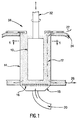
- the overall apparatus and process for primary cleaning of photoreceptor substrates includes a cleaning chamber 14 with sealing means (not shown) for receiving at least one support arm 32 bearing at least one substrate 10, the sealing means sealing the open end of cleaning chamber 14 through which the at least one support arm 32 is inserted.
- the cleaning chamber 14 has decontaminating means 34 for removing contaminant particles from the substrate surface 10.
- the decontaminating means 34 includes a dry ice particle bath 12, where dry ice particles of a particular diameter, preferably in the range of 6.35 mm (1/4 inch) to 0.79 mm (1/32 inch), are fed into the cleaning chamber 14 through a dry ice supply port 24 at a first end region of said cleaning chamber 14, while spent and contaminant laden dry ice particles are removed at a dry ice and contaminant exhaust port 26 at a second end region of the cleaning chamber 14.
- the cleaning chamber 14, and necessarily the decontaminating means 34 is additionally equipped at a second end region with a perforated chamber portion 16 connected to a distribution plenum 18 through which filtered inert gas, preferably dry nitrogen, is supplied at a controlled rate through an inert gas supply port 20.
- the inert gas permeates and contraflows through the dry ice particles 12 and is collected through an exhaust port 22 located near the first end region of the cleaning chamber 14.
- This element of the decontaminating means 34 prevents water vapor condensation within the chamber 14 and serves to substantially purge the cleaning chamber 14 of carbon dioxide and contaminant particulates released by the dry ice via sublimation.
- the substrate 10 to be cleaned is inserted into the cleaning chamber 14 by the support arm 32 and rotated by the support arm 32 at a predetermined speed.
- the substrate preferably rotates during the cleaning process in the range of 30-200 rpm.
- Rotating the substrate 10 in the dry ice particle bath 12 causes the dry ice particles 12 to rub against the substrate surface 10 in a scrubbing action, which causes localized melting and refreezing, thereby capturing contaminant particulates on the dry ice surface.
- the chamber sealing means (not shown) opens and the support arm 32 retracts the substrate 10 from the cleaning chamber 14.
- the support arm 32 then, if part of the photoreceptor manufacturing system described above, moves the substrate to the next station in the manufacturing process.
- the substrate 10 is extremely cold and, therefore, must be protected from water vapor condensation to ensure that the cleaned substrate 10 is not thusly recontaminated.
- Several methods exist of preventing water vapor condensation for instance, providing non-contact heaters through which the substrate passes or, preferably, the substrate 10 is maintained in a dry, inert atmosphere throughout the coating process. In any event, the substrate is now clean and ready for further processing.
- Figure 2 shows the substrate 10 being rotated in the cleaning chamber 14 and the dry ice bath 12 with the inert gas contra-flow 20 exhibiting its scrubbing action against the substrate surface. It will be noted, that this is a top cross-sectional view of the cleaning chamber 14 along line 1-1 of Figure 1.
- Figure 3 shows another embodiment of the cleaning chamber 14.
- at least one directing baffle 28 is attached to an inner wall 36 of the cleaning chamber 14 to at least partially restrict and therefore, increase the flow rate of dry ice particles 12. This forces the dry ice particles 12 against the substrate surface 10 by a wedging action while the substrate is rotated thereby increasing contact and pressure of the dry ice particles 12 as they scrub against the substrate surface 10. In this way, enhanced cleaning is obtained for situations requiring heightened cleanliness or a substrate with particularly difficult to remove contaminant particulates.
- FIG 4 shows another embodiment of the cleaning chamber according to the invention.
- a squeezing means 30 disposed within the chamber 14 and actuated by known means, such as hydraulic, pneumatic or worm screw actuators, (not shown) has been added.
- the squeezing means 30 compresses the dry ice particles 12 against the substrate surface 10 for a predetermined time near the beginning cycle of the cleaning process, while the substrate 10 continues to be rotated. Again increased contact and melting pressure of the dry ice particles 12 against the substrate surface 10 results, thereby enhancing the removal of contaminant particulates from the substrate 10.
- the squeezing means 30 may be contained within a flexible sleeve or boot 38 that allows movement of the squeezing means 30 within the cleaning chamber 14, but does not allow the dry ice particles 12 access to the region behind the squeezing means 30.
- the squeezing means 30 is automatically retracted via the actuator and the cleaning process continues uninterrupted as described above until completion.
- this process is extremely effective when heightened cleanliness standards must be maintained or a particularly difficult and contaminated substrate is to be cleaned. It may additionally prove effective when cleaning substrates of a significantly reduced diameter.
Landscapes
- Engineering & Computer Science (AREA)
- Mechanical Engineering (AREA)
- Photoreceptors In Electrophotography (AREA)
- Cleaning In General (AREA)
Applications Claiming Priority (2)
| Application Number | Priority Date | Filing Date | Title |
|---|---|---|---|
| US07/858,807 US5232512A (en) | 1992-03-27 | 1992-03-27 | Primary cleaning of photoreceptor substrates by immersion in dry ice particles |
| US858807 | 1992-03-27 |
Publications (2)
| Publication Number | Publication Date |
|---|---|
| EP0562807A1 EP0562807A1 (en) | 1993-09-29 |
| EP0562807B1 true EP0562807B1 (en) | 1995-09-27 |
Family
ID=25329245
Family Applications (1)
| Application Number | Title | Priority Date | Filing Date |
|---|---|---|---|
| EP93302180A Expired - Lifetime EP0562807B1 (en) | 1992-03-27 | 1993-03-23 | Primary cleaning of photoreceptor substrates by immersion in dry ice paticles |
Country Status (4)
| Country | Link |
|---|---|
| US (1) | US5232512A (enExample) |
| EP (1) | EP0562807B1 (enExample) |
| JP (1) | JPH0643680A (enExample) |
| BR (1) | BR9300762A (enExample) |
Families Citing this family (8)
| Publication number | Priority date | Publication date | Assignee | Title |
|---|---|---|---|---|
| US5161233A (en) * | 1988-05-17 | 1992-11-03 | Dai Nippon Printing Co., Ltd. | Method for recording and reproducing information, apparatus therefor and recording medium |
| US5372652A (en) * | 1993-06-14 | 1994-12-13 | International Business Machines Corporation | Aerosol cleaning method |
| US5429715A (en) * | 1993-11-01 | 1995-07-04 | Xerox Corporation | Method for rendering imaging member substrates non-reflective |
| US5846338A (en) * | 1996-01-11 | 1998-12-08 | Asyst Technologies, Inc. | Method for dry cleaning clean room containers |
| RU2200638C2 (ru) * | 2001-02-16 | 2003-03-20 | Новиков Василий Васильевич | Способ удаления загрязнений и покрытий |
| ITLU20020007A1 (it) * | 2002-05-27 | 2002-08-26 | Tommasina Vittorio Della | Lucidatrice automatica di oggetti torniti realizzati in marmo, pietreo graniti. |
| US8038510B2 (en) * | 2008-10-29 | 2011-10-18 | Southern Taiwan University | Apparatus and method for spiral polishing with electromagnetic abrasive |
| CN110883019B (zh) * | 2019-12-04 | 2020-12-08 | 日牵(唐山)电机有限公司 | 一种用于电机维护的干冰清洗系统 |
Family Cites Families (16)
| Publication number | Priority date | Publication date | Assignee | Title |
|---|---|---|---|---|
| US2425640A (en) * | 1945-04-23 | 1947-08-12 | Steel Products Eng Co | Surface finishing |
| FR1009749A (fr) * | 1950-12-14 | 1952-06-03 | Procédé de polissage et dispositifs de mise en oeuvre | |
| US2787854A (en) * | 1955-11-18 | 1957-04-09 | Reflectone Corp | Method of treating an object |
| US3250521A (en) * | 1964-11-06 | 1966-05-10 | Gen Electric | Apparatus for decoating utilizing a heated fluidized bed |
| US3250643A (en) * | 1965-09-30 | 1966-05-10 | Gen Electric | Method for decoating utilizing a heated fluidized bed |
| US3702519A (en) * | 1971-07-12 | 1972-11-14 | Chemotronics International Inc | Method for the removal of unwanted portions of an article by spraying with high velocity dry ice particles |
| DE3108685C2 (de) * | 1981-03-07 | 1984-04-05 | Basf Farben + Fasern Ag, 2000 Hamburg | Verfahren zum Reinigen verschmutzter Behälter |
| US4662425A (en) * | 1983-11-09 | 1987-05-05 | General Kinematics Corporation | Vibratory part scrubber and method |
| US4727687A (en) * | 1984-12-14 | 1988-03-01 | Cryoblast, Inc. | Extrusion arrangement for a cryogenic cleaning apparatus |
| JPS61178170A (ja) * | 1985-01-31 | 1986-08-09 | Murata Mfg Co Ltd | 金属不要付着物の除去方法 |
| US4747992A (en) * | 1986-03-24 | 1988-05-31 | Sypula Donald S | Process for fabricating a belt |
| US4777804A (en) * | 1987-08-26 | 1988-10-18 | Texas Instruments Incorporated | Method and apparatus for easing surface particle removal by size increase |
| US5123206A (en) * | 1987-12-04 | 1992-06-23 | Whitemetal, Inc. | Wet abrasive blasting method |
| US5038707A (en) * | 1989-12-27 | 1991-08-13 | Xerox Corporation | Modular apparatus for cleaning, coating and curing photoreceptors in an enclosed planetary array |
| US5032052A (en) * | 1989-12-27 | 1991-07-16 | Xerox Corporation | Modular apparatus for cleaning, coating and curing photoreceptors in a dual planetary array |
| WO1991018710A1 (fr) * | 1990-05-15 | 1991-12-12 | Nauchno-Proizvodstvennoe Obiedinenie Po Abrazivam I Shlifovaniju (Npo Vniiash) | Procede de traitement abrasif d'articles |
-
1992
- 1992-03-27 US US07/858,807 patent/US5232512A/en not_active Expired - Fee Related
-
1993
- 1993-03-04 JP JP5044080A patent/JPH0643680A/ja active Pending
- 1993-03-05 BR BR9300762A patent/BR9300762A/pt not_active Application Discontinuation
- 1993-03-23 EP EP93302180A patent/EP0562807B1/en not_active Expired - Lifetime
Also Published As
| Publication number | Publication date |
|---|---|
| JPH0643680A (ja) | 1994-02-18 |
| US5232512A (en) | 1993-08-03 |
| BR9300762A (pt) | 1993-11-23 |
| EP0562807A1 (en) | 1993-09-29 |
Similar Documents
| Publication | Publication Date | Title |
|---|---|---|
| US5913981A (en) | Method of rinsing and drying semiconductor wafers in a chamber with a moveable side wall | |
| US5232512A (en) | Primary cleaning of photoreceptor substrates by immersion in dry ice particles | |
| US4281031A (en) | Method and apparatus for processing workpieces | |
| KR100415865B1 (ko) | 브러시 장치 | |
| JPH09223664A (ja) | 半導体ウェハの洗浄装置 | |
| US5350428A (en) | Electrostatic apparatus and method for removing particles from semiconductor wafers | |
| US6523208B1 (en) | Flexible web cleaning system | |
| TW201250771A (en) | Substrate cleaning apparatus | |
| KR19980079954A (ko) | 처리장치 | |
| AU674554B2 (en) | Ion deposition printer cleaning apparatus and related method | |
| EP0411877B1 (en) | Drum chucking device | |
| US20020066467A1 (en) | Method and apparatus for cleaning a substrate | |
| EP0416645B1 (en) | Use of cleaning plate for semiconductor fabricating device | |
| CN113427391A (zh) | 自动水磨设备 | |
| US5357687A (en) | Method and apparatus for drying/curing rigid cylindrical and flexible belt substrates | |
| CN117524925B (en) | Wafer post-processing device | |
| KR100396380B1 (ko) | 포토마스크상의 미세 입자 제거장치 및 제거 방법 | |
| JP4362245B2 (ja) | 塗膜端部処理装置 | |
| JPH06163491A (ja) | 半導体基板の洗浄方法および洗浄装置 | |
| JPH01187567A (ja) | 電子写真感光体の製造法 | |
| US5878316A (en) | Cleaning mechanism for a reproduction apparatus | |
| KR101300361B1 (ko) | 회전 롤의 오염 제거 기구 | |
| JPH1110097A (ja) | 基板類キャリアの洗浄装置及び洗浄方法 | |
| JPH09155311A (ja) | ドラム搬送パレットの洗浄方法及び洗浄装置 | |
| JP2005266308A (ja) | トナーカートリッジ洗浄方法、トナーカートリッジ洗浄装置、及びトナーカートリッジ |
Legal Events
| Date | Code | Title | Description |
|---|---|---|---|
| PUAI | Public reference made under article 153(3) epc to a published international application that has entered the european phase |
Free format text: ORIGINAL CODE: 0009012 |
|
| AK | Designated contracting states |
Kind code of ref document: A1 Designated state(s): FR GB NL |
|
| 17P | Request for examination filed |
Effective date: 19940228 |
|
| 17Q | First examination report despatched |
Effective date: 19941107 |
|
| GRAA | (expected) grant |
Free format text: ORIGINAL CODE: 0009210 |
|
| AK | Designated contracting states |
Kind code of ref document: B1 Designated state(s): FR GB NL |
|
| ET | Fr: translation filed | ||
| PLBE | No opposition filed within time limit |
Free format text: ORIGINAL CODE: 0009261 |
|
| STAA | Information on the status of an ep patent application or granted ep patent |
Free format text: STATUS: NO OPPOSITION FILED WITHIN TIME LIMIT |
|
| 26N | No opposition filed | ||
| PGFP | Annual fee paid to national office [announced via postgrant information from national office to epo] |
Ref country code: FR Payment date: 20010313 Year of fee payment: 9 |
|
| PGFP | Annual fee paid to national office [announced via postgrant information from national office to epo] |
Ref country code: GB Payment date: 20010321 Year of fee payment: 9 |
|
| PGFP | Annual fee paid to national office [announced via postgrant information from national office to epo] |
Ref country code: NL Payment date: 20010331 Year of fee payment: 9 |
|
| REG | Reference to a national code |
Ref country code: GB Ref legal event code: IF02 |
|
| PG25 | Lapsed in a contracting state [announced via postgrant information from national office to epo] |
Ref country code: GB Free format text: LAPSE BECAUSE OF NON-PAYMENT OF DUE FEES Effective date: 20020323 |
|
| PG25 | Lapsed in a contracting state [announced via postgrant information from national office to epo] |
Ref country code: NL Free format text: LAPSE BECAUSE OF NON-PAYMENT OF DUE FEES Effective date: 20021001 |
|
| GBPC | Gb: european patent ceased through non-payment of renewal fee |
Effective date: 20020323 |
|
| PG25 | Lapsed in a contracting state [announced via postgrant information from national office to epo] |
Ref country code: FR Free format text: LAPSE BECAUSE OF NON-PAYMENT OF DUE FEES Effective date: 20021129 |
|
| NLV4 | Nl: lapsed or anulled due to non-payment of the annual fee |
Effective date: 20021001 |
|
| REG | Reference to a national code |
Ref country code: FR Ref legal event code: ST |