EP0558332B1 - Process for the preparation of 3-cyano-3,5,5- trimethylcyclohexanone - Google Patents
Process for the preparation of 3-cyano-3,5,5- trimethylcyclohexanone Download PDFInfo
- Publication number
- EP0558332B1 EP0558332B1 EP93301451A EP93301451A EP0558332B1 EP 0558332 B1 EP0558332 B1 EP 0558332B1 EP 93301451 A EP93301451 A EP 93301451A EP 93301451 A EP93301451 A EP 93301451A EP 0558332 B1 EP0558332 B1 EP 0558332B1
- Authority
- EP
- European Patent Office
- Prior art keywords
- cyanide
- reaction
- lithium
- hcn
- isophorone
- Prior art date
- Legal status (The legal status is an assumption and is not a legal conclusion. Google has not performed a legal analysis and makes no representation as to the accuracy of the status listed.)
- Revoked
Links
- 238000000034 method Methods 0.000 title claims abstract description 39
- JJDFVIDVSCYKDS-UHFFFAOYSA-N 1,3,3-trimethyl-5-oxocyclohexane-1-carbonitrile Chemical compound CC1(C)CC(=O)CC(C)(C#N)C1 JJDFVIDVSCYKDS-UHFFFAOYSA-N 0.000 title claims abstract description 37
- 238000002360 preparation method Methods 0.000 title claims abstract description 12
- HJOVHMDZYOCNQW-UHFFFAOYSA-N isophorone Chemical compound CC1=CC(=O)CC(C)(C)C1 HJOVHMDZYOCNQW-UHFFFAOYSA-N 0.000 claims abstract description 140
- WMFOQBRAJBCJND-UHFFFAOYSA-M Lithium hydroxide Chemical compound [Li+].[OH-] WMFOQBRAJBCJND-UHFFFAOYSA-M 0.000 claims abstract description 100
- 238000006243 chemical reaction Methods 0.000 claims abstract description 53
- 239000003054 catalyst Substances 0.000 claims abstract description 46
- XFXPMWWXUTWYJX-UHFFFAOYSA-N Cyanide Chemical compound N#[C-] XFXPMWWXUTWYJX-UHFFFAOYSA-N 0.000 claims abstract description 24
- 239000007787 solid Substances 0.000 claims abstract description 21
- 239000002253 acid Substances 0.000 claims abstract description 17
- 238000001914 filtration Methods 0.000 claims abstract description 10
- ZRXHLJNBNWVNIM-UHFFFAOYSA-N 3-methyl-1-benzofuran Chemical compound C1=CC=C2C(C)=COC2=C1 ZRXHLJNBNWVNIM-UHFFFAOYSA-N 0.000 claims abstract description 8
- 229910003002 lithium salt Inorganic materials 0.000 claims abstract description 6
- 159000000002 lithium salts Chemical class 0.000 claims abstract description 5
- GLXDVVHUTZTUQK-UHFFFAOYSA-M lithium;hydroxide;hydrate Chemical compound [Li+].O.[OH-] GLXDVVHUTZTUQK-UHFFFAOYSA-M 0.000 claims abstract description 4
- LELOWRISYMNNSU-UHFFFAOYSA-N hydrogen cyanide Chemical compound N#C LELOWRISYMNNSU-UHFFFAOYSA-N 0.000 claims description 119
- OKKJLVBELUTLKV-UHFFFAOYSA-N Methanol Chemical compound OC OKKJLVBELUTLKV-UHFFFAOYSA-N 0.000 claims description 56
- BJEPYKJPYRNKOW-UHFFFAOYSA-N alpha-hydroxysuccinic acid Natural products OC(=O)C(O)CC(O)=O BJEPYKJPYRNKOW-UHFFFAOYSA-N 0.000 claims description 22
- BJEPYKJPYRNKOW-REOHCLBHSA-N (S)-malic acid Chemical compound OC(=O)[C@@H](O)CC(O)=O BJEPYKJPYRNKOW-REOHCLBHSA-N 0.000 claims description 19
- 239000001630 malic acid Substances 0.000 claims description 18
- 235000011090 malic acid Nutrition 0.000 claims description 18
- WHXSMMKQMYFTQS-UHFFFAOYSA-N Lithium Chemical compound [Li] WHXSMMKQMYFTQS-UHFFFAOYSA-N 0.000 claims description 12
- 229910052744 lithium Inorganic materials 0.000 claims description 12
- 239000002244 precipitate Substances 0.000 claims description 8
- 230000003197 catalytic effect Effects 0.000 claims description 6
- 238000010438 heat treatment Methods 0.000 claims description 4
- 239000012452 mother liquor Substances 0.000 claims description 4
- PQVSTLUFSYVLTO-UHFFFAOYSA-N ethyl n-ethoxycarbonylcarbamate Chemical compound CCOC(=O)NC(=O)OCC PQVSTLUFSYVLTO-UHFFFAOYSA-N 0.000 claims description 3
- 229940040692 lithium hydroxide monohydrate Drugs 0.000 claims description 3
- 230000000977 initiatory effect Effects 0.000 claims description 2
- 239000007795 chemical reaction product Substances 0.000 claims 1
- 230000015572 biosynthetic process Effects 0.000 abstract description 14
- 239000012535 impurity Substances 0.000 abstract description 11
- IJDSUFQMYUARCQ-QZTJIDSGSA-N diisophorone Chemical compound C([C@@](C1)(C)C2)C(C)(C)C[C@]1(O)C1=C2CC(C)(C)CC1=O IJDSUFQMYUARCQ-QZTJIDSGSA-N 0.000 abstract description 9
- 150000002825 nitriles Chemical class 0.000 abstract description 3
- 229920000642 polymer Polymers 0.000 abstract description 3
- 238000005292 vacuum distillation Methods 0.000 abstract description 2
- XLYOFNOQVPJJNP-UHFFFAOYSA-N water Substances O XLYOFNOQVPJJNP-UHFFFAOYSA-N 0.000 description 31
- 239000000243 solution Substances 0.000 description 21
- 229940099690 malic acid Drugs 0.000 description 17
- 239000000047 product Substances 0.000 description 14
- JORQDGTZGKHEEO-UHFFFAOYSA-N lithium cyanide Chemical compound [Li+].N#[C-] JORQDGTZGKHEEO-UHFFFAOYSA-N 0.000 description 13
- 239000002904 solvent Substances 0.000 description 10
- HEMHJVSKTPXQMS-UHFFFAOYSA-M Sodium hydroxide Chemical compound [OH-].[Na+] HEMHJVSKTPXQMS-UHFFFAOYSA-M 0.000 description 6
- NBIIXXVUZAFLBC-UHFFFAOYSA-N Phosphoric acid Chemical compound OP(O)(O)=O NBIIXXVUZAFLBC-UHFFFAOYSA-N 0.000 description 5
- 238000006471 dimerization reaction Methods 0.000 description 5
- 239000000706 filtrate Substances 0.000 description 5
- IJGRMHOSHXDMSA-UHFFFAOYSA-N Atomic nitrogen Chemical compound N#N IJGRMHOSHXDMSA-UHFFFAOYSA-N 0.000 description 4
- KFZMGEQAYNKOFK-UHFFFAOYSA-N Isopropanol Chemical compound CC(C)O KFZMGEQAYNKOFK-UHFFFAOYSA-N 0.000 description 4
- QAOWNCQODCNURD-UHFFFAOYSA-N Sulfuric acid Chemical compound OS(O)(=O)=O QAOWNCQODCNURD-UHFFFAOYSA-N 0.000 description 4
- 238000002474 experimental method Methods 0.000 description 4
- MUBZPKHOEPUJKR-UHFFFAOYSA-N Oxalic acid Chemical compound OC(=O)C(O)=O MUBZPKHOEPUJKR-UHFFFAOYSA-N 0.000 description 3
- 238000004821 distillation Methods 0.000 description 3
- 229940049920 malate Drugs 0.000 description 3
- 230000020477 pH reduction Effects 0.000 description 3
- SQGYOTSLMSWVJD-UHFFFAOYSA-N silver(1+) nitrate Chemical compound [Ag+].[O-]N(=O)=O SQGYOTSLMSWVJD-UHFFFAOYSA-N 0.000 description 3
- RNLHGQLZWXBQNY-UHFFFAOYSA-N 3-(aminomethyl)-3,5,5-trimethylcyclohexan-1-amine Chemical compound CC1(C)CC(N)CC(C)(CN)C1 RNLHGQLZWXBQNY-UHFFFAOYSA-N 0.000 description 2
- CSCPPACGZOOCGX-UHFFFAOYSA-N Acetone Chemical compound CC(C)=O CSCPPACGZOOCGX-UHFFFAOYSA-N 0.000 description 2
- VEXZGXHMUGYJMC-UHFFFAOYSA-M Chloride anion Chemical compound [Cl-] VEXZGXHMUGYJMC-UHFFFAOYSA-M 0.000 description 2
- LFQSCWFLJHTTHZ-UHFFFAOYSA-N Ethanol Chemical compound CCO LFQSCWFLJHTTHZ-UHFFFAOYSA-N 0.000 description 2
- 150000007513 acids Chemical class 0.000 description 2
- 229910000147 aluminium phosphate Inorganic materials 0.000 description 2
- 239000007864 aqueous solution Substances 0.000 description 2
- 239000006227 byproduct Substances 0.000 description 2
- 238000006555 catalytic reaction Methods 0.000 description 2
- 238000001816 cooling Methods 0.000 description 2
- 239000012043 crude product Substances 0.000 description 2
- 125000004093 cyano group Chemical group *C#N 0.000 description 2
- 230000007423 decrease Effects 0.000 description 2
- -1 diisophorone nitrile Chemical class 0.000 description 2
- SMBQBQBNOXIFSF-UHFFFAOYSA-N dilithium Chemical class [Li][Li] SMBQBQBNOXIFSF-UHFFFAOYSA-N 0.000 description 2
- 239000000539 dimer Substances 0.000 description 2
- 239000012458 free base Substances 0.000 description 2
- INHCSSUBVCNVSK-UHFFFAOYSA-L lithium sulfate Chemical compound [Li+].[Li+].[O-]S([O-])(=O)=O INHCSSUBVCNVSK-UHFFFAOYSA-L 0.000 description 2
- 238000004519 manufacturing process Methods 0.000 description 2
- VNWKTOKETHGBQD-UHFFFAOYSA-N methane Natural products C VNWKTOKETHGBQD-UHFFFAOYSA-N 0.000 description 2
- 238000006386 neutralization reaction Methods 0.000 description 2
- 229910052757 nitrogen Inorganic materials 0.000 description 2
- 239000003960 organic solvent Substances 0.000 description 2
- 125000001453 quaternary ammonium group Chemical group 0.000 description 2
- 229910001220 stainless steel Inorganic materials 0.000 description 2
- 239000010935 stainless steel Substances 0.000 description 2
- 235000011149 sulphuric acid Nutrition 0.000 description 2
- 238000004448 titration Methods 0.000 description 2
- 238000012546 transfer Methods 0.000 description 2
- 238000005406 washing Methods 0.000 description 2
- RYHBNJHYFVUHQT-UHFFFAOYSA-N 1,4-Dioxane Chemical compound C1COCCO1 RYHBNJHYFVUHQT-UHFFFAOYSA-N 0.000 description 1
- BTBUEUYNUDRHOZ-UHFFFAOYSA-N Borate Chemical compound [O-]B([O-])[O-] BTBUEUYNUDRHOZ-UHFFFAOYSA-N 0.000 description 1
- CPELXLSAUQHCOX-UHFFFAOYSA-M Bromide Chemical compound [Br-] CPELXLSAUQHCOX-UHFFFAOYSA-M 0.000 description 1
- VEXZGXHMUGYJMC-UHFFFAOYSA-N Hydrochloric acid Chemical compound Cl VEXZGXHMUGYJMC-UHFFFAOYSA-N 0.000 description 1
- 239000005058 Isophorone diisocyanate Substances 0.000 description 1
- GRYLNZFGIOXLOG-UHFFFAOYSA-N Nitric acid Chemical compound O[N+]([O-])=O GRYLNZFGIOXLOG-UHFFFAOYSA-N 0.000 description 1
- 230000002378 acidificating effect Effects 0.000 description 1
- 150000001298 alcohols Chemical class 0.000 description 1
- 239000003513 alkali Substances 0.000 description 1
- 239000000908 ammonium hydroxide Substances 0.000 description 1
- 238000003928 amperometric titration Methods 0.000 description 1
- 238000004458 analytical method Methods 0.000 description 1
- 238000013459 approach Methods 0.000 description 1
- 238000003556 assay Methods 0.000 description 1
- QVGXLLKOCUKJST-UHFFFAOYSA-N atomic oxygen Chemical compound [O] QVGXLLKOCUKJST-UHFFFAOYSA-N 0.000 description 1
- 230000001580 bacterial effect Effects 0.000 description 1
- NDKBVBUGCNGSJJ-UHFFFAOYSA-M benzyltrimethylammonium hydroxide Chemical compound [OH-].C[N+](C)(C)CC1=CC=CC=C1 NDKBVBUGCNGSJJ-UHFFFAOYSA-M 0.000 description 1
- 229910021538 borax Inorganic materials 0.000 description 1
- 229940006460 bromide ion Drugs 0.000 description 1
- 150000003842 bromide salts Chemical class 0.000 description 1
- 239000012295 chemical reaction liquid Substances 0.000 description 1
- 239000003795 chemical substances by application Substances 0.000 description 1
- 239000013078 crystal Substances 0.000 description 1
- 238000002425 crystallisation Methods 0.000 description 1
- 230000008025 crystallization Effects 0.000 description 1
- 230000006378 damage Effects 0.000 description 1
- 238000000354 decomposition reaction Methods 0.000 description 1
- 238000010586 diagram Methods 0.000 description 1
- 150000004985 diamines Chemical class 0.000 description 1
- 125000005442 diisocyanate group Chemical group 0.000 description 1
- 230000000694 effects Effects 0.000 description 1
- 230000008030 elimination Effects 0.000 description 1
- 238000003379 elimination reaction Methods 0.000 description 1
- 238000004128 high performance liquid chromatography Methods 0.000 description 1
- 238000005984 hydrogenation reaction Methods 0.000 description 1
- XLYOFNOQVPJJNP-UHFFFAOYSA-M hydroxide Chemical compound [OH-] XLYOFNOQVPJJNP-UHFFFAOYSA-M 0.000 description 1
- 150000004679 hydroxides Chemical class 0.000 description 1
- NIMLQBUJDJZYEJ-UHFFFAOYSA-N isophorone diisocyanate Chemical compound CC1(C)CC(N=C=O)CC(C)(CN=C=O)C1 NIMLQBUJDJZYEJ-UHFFFAOYSA-N 0.000 description 1
- 239000007788 liquid Substances 0.000 description 1
- 239000011159 matrix material Substances 0.000 description 1
- 229910052751 metal Inorganic materials 0.000 description 1
- 239000002184 metal Substances 0.000 description 1
- OJURWUUOVGOHJZ-UHFFFAOYSA-N methyl 2-[(2-acetyloxyphenyl)methyl-[2-[(2-acetyloxyphenyl)methyl-(2-methoxy-2-oxoethyl)amino]ethyl]amino]acetate Chemical compound C=1C=CC=C(OC(C)=O)C=1CN(CC(=O)OC)CCN(CC(=O)OC)CC1=CC=CC=C1OC(C)=O OJURWUUOVGOHJZ-UHFFFAOYSA-N 0.000 description 1
- 125000002496 methyl group Chemical group [H]C([H])([H])* 0.000 description 1
- 150000004682 monohydrates Chemical group 0.000 description 1
- 230000003472 neutralizing effect Effects 0.000 description 1
- 229910017604 nitric acid Inorganic materials 0.000 description 1
- 235000006408 oxalic acid Nutrition 0.000 description 1
- 230000003647 oxidation Effects 0.000 description 1
- 238000007254 oxidation reaction Methods 0.000 description 1
- 239000001301 oxygen Substances 0.000 description 1
- 229910052760 oxygen Inorganic materials 0.000 description 1
- 238000012856 packing Methods 0.000 description 1
- 239000002245 particle Substances 0.000 description 1
- 239000002574 poison Substances 0.000 description 1
- 231100000614 poison Toxicity 0.000 description 1
- 238000005086 pumping Methods 0.000 description 1
- 238000010992 reflux Methods 0.000 description 1
- 229920006395 saturated elastomer Polymers 0.000 description 1
- 239000004328 sodium tetraborate Substances 0.000 description 1
- 235000010339 sodium tetraborate Nutrition 0.000 description 1
- 239000011949 solid catalyst Substances 0.000 description 1
- VDZOOKBUILJEDG-UHFFFAOYSA-M tetrabutylammonium hydroxide Chemical compound [OH-].CCCC[N+](CCCC)(CCCC)CCCC VDZOOKBUILJEDG-UHFFFAOYSA-M 0.000 description 1
- BJQWBACJIAKDTJ-UHFFFAOYSA-N tetrabutylphosphanium Chemical compound CCCC[P+](CCCC)(CCCC)CCCC BJQWBACJIAKDTJ-UHFFFAOYSA-N 0.000 description 1
- 239000002699 waste material Substances 0.000 description 1
Images

Classifications
-
- C—CHEMISTRY; METALLURGY
- C07—ORGANIC CHEMISTRY
- C07C—ACYCLIC OR CARBOCYCLIC COMPOUNDS
- C07C253/00—Preparation of carboxylic acid nitriles
- C07C253/08—Preparation of carboxylic acid nitriles by addition of hydrogen cyanide or salts thereof to unsaturated compounds
- C07C253/10—Preparation of carboxylic acid nitriles by addition of hydrogen cyanide or salts thereof to unsaturated compounds to compounds containing carbon-to-carbon double bonds
-
- C—CHEMISTRY; METALLURGY
- C07—ORGANIC CHEMISTRY
- C07C—ACYCLIC OR CARBOCYCLIC COMPOUNDS
- C07C2601/00—Systems containing only non-condensed rings
- C07C2601/12—Systems containing only non-condensed rings with a six-membered ring
- C07C2601/14—The ring being saturated
Definitions
- Isophorone nitrile IPN
- IPDA diamine
- IPDI diisocyanate
- IPH isophorone
- the quaternary ammonium catalysts are used as their chloride or bromide salts; the chloride ion or bromide ion is exchanged for cyanide ion and this cyanide ion is transferred from the water to the solvent layer via the well known phase transfer mechanism.
- German Patent No. 1,240,854 to Scholven-Chemie discloses a process for the preparation of IPN by reacting isophorone with hydrogen cyanide in the presence of a basic catalyst such as alkali cyanide, hydroxides or alcoholates. The catalyst is removed by washing with dilute nitric acid.
- a basic catalyst such as alkali cyanide, hydroxides or alcoholates.
- Japanese Laid-Open specification 61-33157 to Nippon Kagako K.K. discloses a process for the preparation of isophorone nitrile by reacting isophorone with hydrogen cyanide in the presence of tetra-n-butylammonium hydroxide, tetra-n-butylphosphonium hydroxide or benzyltrimethylammonium hydroxide. The resulting reaction liquid is washed with water.
- European Patent Application 0 433 615 discloses a method for producing 1,3,3-trimethyl-5-oxo-cyclohexane-carbonitrile by the addition of hydrogen cyanide to isophorone in the presence of lithium hydroxide as a catalyst, at temperature conditions of 100° to 160°C.
- U.S. Patent No. 5,011,968 discloses a process for producing isophorone nitrile in the presence of a quaternary ammonium hydroxide as a catalyst.
- Isophorone itself contains many impurities. Upon exposure to air, the product becomes yellow, which is believed to be a result of the apparent oxidation product of isophorone via direct addition of oxygen to the unsaturated site.
- the present invention seeks to address the problems of the prior art by providing a process for the preparation of isophorone nitrile utilizing lithium cyanide as a catalyst in accordance with the following reaction:
- a polyacidic acid can be used to acidify the batch, followed by filtration to remove the precipitated lithium salt of the acid, and vacuum distillation to remove liberated HCN and excess isophorone.
- the resulting isophorone nitrile is obtained in high yield and with low impurity content, and light color.
- the present invention provides, in one embodiment, a process for the preparation of isophorone nitrile, comprising:
- the invention provides a process for the preparation of isophorone nitrile, comprising:
- free cyanide In accordance with the process of the present invention, which has as an object the preparation of isophorone nitrile in high yield and with low impurity content, free cyanide must be present at all times but in low concentration in order to prevent the generation of free LiOH, which result in the undesirable formation of diisophorone and leads to formation of diisophorone nitrile(s) and other high boilers. If the free cyanide concentration drops below a level equivalent to the amount of catalyst present (about 200 ppm) at any time during the reaction, diisophorone and diisophorone nitrile(s) begin to form. On the other hand, if the free cyanide concentration exceeds about 4000 ppm, dark and turbid product is produced.
- HCN addition is begun and the basic catalyst is immediately added to the reaction system at a low temperature. The temperature is then increased at a controlled rate while feeding the HCN also at a controlled rate.
- LiCN is formed without ever exposing the IPH to LiOH. This minimizes dimerization and the formation of high boilers.
- a suitable low temperature at which the catalyst is introduced is 80°C.
- the temperature of the reaction system may then be ramped to, for example, 110°C, either by the independent addition of heat, or by using the heat of reaction, or by a combination of the two.
- the temperature is maintained at about 110°C for the balance of the reaction. It is important to maintain the free HCN at a low concentration to minimize the formation of HCN polymer. Since the IPH concentration is highest at the start of the HCN feed and decreases throughout the run, HCN consumption may be moderated by using a temperature profile with a reduced temperature at the start and increasing the temperature as the IPN formation rate decreases. Alternatively, both the rate of HCN addition and the temperature can be simultaneously controlled in such a way that a nearly constant concentration of HCN is maintained.
- the quality of the isophorone and the concentration of the lithium catalyst are important factors that must be addressed in order to obtain the product in good yield. Isophorone which has a yellow color and a high acidity does not produce good product. The exact effect of color is unknown, but high acidity tends to neutralize and thus destroy the catalyst. Accordingly, it is preferred that the isophorone be distilled prior to reaction with HCN.
- good quality i.e., low acidity
- IPH the proper mole ratio of Li:HCN is between about >0.0025:1.00 ad less than about 0.01:1.00; preferably about 0.005-0.01:1.00, most preferably about 0.0075-0.0080:1.00, especially where non-distilled HCN is used.
- Such mole ratios ensure that sufficient cyanide concentration is present at all times for the addition of HCN to isophorone without the simultaneous presence of free base which would catalyze the undesirable formation of diisophorone from IPH.
- a mole ratio of 0.005:1.00 may produce low yields due to neutralization of some of the catalyst by acidity in the IPH plus acidity in the HCN; thus, if this mole ratio is employed, the HCN should be distilled prior to the reaction.
- a mole ratio greater than ⁇ 0.01:1.00 may cause dimerization of IPH to occur.
- the lithium should be added as a solid or as a solution in an organic solvent.
- Any solvent which will dissolve the LiOH ⁇ H2O but is inert in the presence of LiOH is acceptable. (Water also could be used, but may cause somewhat reduced yields and increased by-product formation).
- Suitable solvents include acetone and dioxane, and alcohols such as methanol and ethanol. The preferred solvent is methanol.
- the catalyst must be neutralized with an acid just at the point where the HCN has fully reacted, to eliminate cyanide ion, primarily in the form of LiCN, and free base (LiOH).
- Suitable acids for this purpose include polyacidic acids such as malic (hydroxysuccinic) acid, oxalic acid, sulfuric acid, and phosphoric acid, with malic acid being preferred.
- Malic acid is relatively inexpensive, is very soluble in water and in methanol, and forms a crystalline precipitate of the di-lithium salt which is easily removed by filtration, leaving a clear light yellow solution of IPN in IPH.
- LiOH can be added to isophorone at temperatures up to 80° - 90°C without generating impurities, provided that the HCN feed is promptly initiated.
- neutralizing the catalyst with malic acid rather than phosphoric acid improves the filtering process by forming easily filterable crystals in the IPN reaction matrix.
- the dilithium salt of malic acid is also insoluble in the isophorone. Lithium cyanide is the preferred catalyst.
- lithium hydroxide when used, it should be added as a solid or as a solution in an organic solvent, with the preferred solvent being methanol.
- Solid LiOH ⁇ H2O causes less diisophorone formation than LiOH in methanol, presumably because the former only slowly dissolves in IPH and therefore less is instantly available for catalysis of the dimerization of IPH.
- solid LiOH ⁇ H2O eliminates the addition of solvent which occurs when methanolic LiOH is used. Accordingly, solid LiOH ⁇ H2O is preferred over LiOH dissolved in a solvent. The mono-hydrate form is preferred over anhydrous LiOH for economic reasons.
- suitable reaction temperatures are between about 80° and 115 °C, preferably between about 110° and 115 °C, most preferably about 110°C.
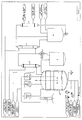
- FIG 1 there is shown one example of apparatus to carry out one embodiment of the process of the instant invention.
- Isophorone is fed from a drum (not shown) to a 200 gallon stainless steel reactor 2.
- Liquid hydrogen cyanide is fed from pressurized cylinder 1 to reactor 2.
- 5% LiOH in methanol and 30% malic acid in methanol are added to reactor 2 as shown.
- the crude product is passed through a filter to remove the dilithium malate precipitate.
- the filtered product is collected in a 200 gallon stainless steel hold tank (not shown).
- Vacuum is pulled on reactor 2 by vacuum pump 4.
- Vapors are condensed in condenser 5 and the condensed vapors are collected in condensate receiver 6.
- Non-condensable vapors (such as HCN) are vented from vacuum pump 4 to scrubber 7.
- Dilute NaOH is circulated to scrubber 7 from scrubber hold tank 8 through condenser 9 which serves as a heat exchanger.
- the molten IPN product which has been stripped free of IPH, methanol, and HCN, is transferred to drums.
- the apparatus used included a 1 liter Parr autoclave/Harvard syringe pump.
- the batch charge was based upon the mole ratio of IPH:HCN of2.00:1.00. This amount of IPH was needed to dissolve all the IPN formed. Use of less IPH would have resulted in crystallization during filtrations had the solution cooled to ⁇ ⁇ 60°C.
- the actual charge was 4.00M IPH (553 grams at 99%) and 2.00M HCN (54.1 grams).
- Cyanide ion was determined by amperometric titration with standard AgNO3 with the sample dissolved in 50/50 isopropanol/water solvent plus borax buffer. Acidity and pH were determined by dissolving the sample in 50/50 water/isopropanol. pH was measured using a 2% or 5% solution. Acidity or alkalinity was determined by titration with standard 0.1 N NaOH or HCl to pH 7.0.
- LiCN catalyst was prepared by adding HCN to a solution of LiOH ⁇ H2O in methanol. This catalyst was added to the IPH and HCN was added immediately thereafter at a constant rate over 60 minutes while simultaneously and rapidly raising the temperature to 110°C. Samples were taken at 15 minute intervals and titrated for free HCN. The batch was held at 110°C for various periods of time and samples were again taken during this hold.
- Table 1 These data show the excellent results obtained when using an amount of catalyst in the range of 0.005-0.01M/M HCN, and the severe decomposition of product occurring by heating the crude IPN in the presence of the catalyst.
- the apparatus used included a 1 liter flask with a heating mantle and reflux condenser. Temperature was controlled by a Love Controller operating relays controlling the heat to the heating mantle and a 1 ⁇ 8'' ss cooling coil mounted in the flask.
- HCN was added via the Harvard syringe pump used in Example 1. The batch charge was the same as in Example 1, except that the HCN was distilled to remove the acidity due to H2SO4 by adding 5% water thereto and pumping this HCN/H2O solution into a small heated tube. The HCN was flashed off and carried into and below the surface of the IPH via a continuous sweep of N2. The acidity was trapped in the water remaining in the distillation tube. This eliminated the neutralization of LiOH or LiCN to Li2SO4 by the H2SO4 in the HCN and thereby permitted use of the LiCN catalyst in a mole ratio of 0.005:1.00 Li:HCN.
- IPH was charged and heated to ⁇ 80°C and the catalyst was prepared and added as described in Example 1.
- the HCN pump was started while simultaneously increasing the set-point of the controller to 110°C.
- the reaction temperature rose to 110°C for within 10-15 minutes.
- the IPN solution was held at 110°C for 30 minutes.
- the temperature was then raised to 140°C in an effort to determine whether the HCN concentration could be forced to ⁇ 10 ppm by such a treatment, and the batch was held for 3 hours.
- the IPN solution was cooled to 85°C, acidified with D,L malic acid, and N2 sparged for an additional 2.5 hours. It was then cooled to 80°C and filtered.
- the concentration of HCN in the filtered product was 4 ppm.
- the yield of IPN calculated from HPLC analysis was 99+%.
- Example 2 The apparatus of Example 2 was used. Isophorone having a 5% pH of 5.28 and an acidity of 0.0015 meq H+/g was neutralized by addition of 0.80 grams LiOH ⁇ H2O in methanol, thereby producing a 5% pH of 8.41.
- the HCN was not distilled, thus, to be certain that the Li catalyst was present in sufficient excess over the acidity in the HCN, a mole ratio of 0.0075M Li:1.00M HCN was used.
- the neutralized IPH was heated to 80°C, LiCN in methanol was added, and HCN addition was immediately started. The temperature was linearly ramped to 110°C over 15 minutes and then held at 110°C. The time of addition was 63 minutes. The batch was held at 110°C for an additional 30 minutes.
- the free HCN concentration was 85 ppm.
- the conversion was 98% and the impurity level was 1.08%.
- Example 2 The apparatus of Example 2 was used, with the addition of a Harvard Pump Speed Modulator which was interfaced with the Harvard syringe pump.
- the first and third batches were identical. Isophorone was charged to a 200 gallon reactor and heated to 80°C. A solution of 5% LiOH in CH3OH was charged and the HCN feed was promptly initiated. The reaction exotherm was allowed to raise the batch temperature from 80°C to 110°C, and then the temperature was maintained at 110°C for the remainder of the HCN feed. After the HCN feed, the catalyst was neutralized with a 10% excess of freshly prepared 30% malic acid in CH3OH. The neutralized catalyst was removed by filtration and the batch was vacuum stripped free of isophorone.
- Batch 2 employed a programmed HCN feed rate and temperature ramp.
- the programmed feed rate was very accurately maintained but the temperature ramp was not.
- the temperature lagged behind the programmed temperature and a sizeable exotherm occurred once the batch reached the target temperature.
- the batch remained above the 110-115 °C target temperature range for 20 minutes. The results were poor.
- Batch 3 was a replicate of batch 1, except that the reactor jacket was empty during the temperature ramp portion of the HCN feed. The reaction exotherm raised the batch temperature from 80 to 110°C in 20 minutes. The results were excellent.
- Batch 4 was a repeat of the programmed feed of batch 2, except that batch 4 was aggressively steam heated at the start of the HCN feed so that the temperature program could be maintained. However, an exotherm still resulted which caused the batch temperature to exceed 115°C. The results of this batch were superior to batch 2, but inferior to batches 1 and 3.
- Example 2 The apparatus of Example 2 was used. The isophorone employed had no titratable acidity. The catalyst in each batch was added to 558.4 grams of IPH at 80°C and then immediately and simultaneously the HCN addition was begun at a linear rate over 60 minutes using a linear temperature ramp of 80°C to 110°C over 15 minutes followed by holding at 110°C for the balance of the feed (total 54.1 grams HCN) plus a 30 minute hold period during which the residual free HCN dropped to ⁇ 100 ppm. The following catalysts were used: Batch No.
- H2O Form 4% in MeOH 4% in MeOH 8% in H2O solid Mole Ratio Li:HCN (HCN 1.00) 0.005 0.075 0.075 0.075 Minutes hold @ 110°C/ppm HCN 30/4400 ppm 30/129 ppm 30/12950 ppm 30/278 90/10650 ppm 90/211 180/9665 ppm GC based data: new method w.int. std.
- Example 1 The apparatus of Example 1 was used. 0.11 grams of water/M IPH was added to the IPH to simulate a line flush in a plant-scale process. The HCN feed was begun, followed immediately by the addition of 5% LiOH ⁇ H2O/MeOH catalyst. The crude product was treated with 30% aqueous malic acid and then nitrogen sparged at 120°C to remove the water. The batch was cooled to approximately 80°C and filtered through a medium porosity filter paper. The Li2 malate precipitate was easily removed by this filtration, and the filtrate was analyzed. This experiment was replicated, and the data generated are illustrated in Table V.
- Example 7 was repeated except that solid LiOH ⁇ H2O (0.08M/M HCN) was used as the catalyst, solid malic acid (0.6 M/M Li) was used for acidification, and the 0.11 g of water was eliminated. The run was carried out in duplicate. The amount of free HCN before acidification was 39 ppm and 109 ppm, demonstrating that reaction is complete when solid catalyst is used. The Li content of the filtrates was 0.97 ppm.
- Example 8 was repeated using solid LiOH ⁇ H2O as catalyst.
- the batch was split into several portions and acidified with various amounts of solid malic acid, as set forth in Table VI.
- the filtrates were analyzed for lithium.
- the data confirm that a mole ratio of malic acid:Li of 0.50:1.00 is sufficient for nearly complete removal of the catalyst.
- Example 8 was repeated, except that the IPH used analyzed as 91.04% IPH and 4.89% impurities by G.C. Consequently, an increased charge of IPH was used to account for the low IPH assay. The reaction proceeded normally, with an HCN conversion of 99+%.
Landscapes
- Chemical & Material Sciences (AREA)
- Organic Chemistry (AREA)
- Health & Medical Sciences (AREA)
- Toxicology (AREA)
- Organic Low-Molecular-Weight Compounds And Preparation Thereof (AREA)
- Low-Molecular Organic Synthesis Reactions Using Catalysts (AREA)
Applications Claiming Priority (2)
| Application Number | Priority Date | Filing Date | Title |
|---|---|---|---|
| US843867 | 1992-02-27 | ||
| US07/843,867 US5235089A (en) | 1992-02-27 | 1992-02-27 | Process for the preparation of 3-cyano-3,5,5-trimethylcyclohexanone |
Publications (2)
| Publication Number | Publication Date |
|---|---|
| EP0558332A1 EP0558332A1 (en) | 1993-09-01 |
| EP0558332B1 true EP0558332B1 (en) | 1996-05-29 |
Family
ID=25291190
Family Applications (1)
| Application Number | Title | Priority Date | Filing Date |
|---|---|---|---|
| EP93301451A Revoked EP0558332B1 (en) | 1992-02-27 | 1993-02-26 | Process for the preparation of 3-cyano-3,5,5- trimethylcyclohexanone |
Country Status (9)
| Country | Link |
|---|---|
| US (1) | US5235089A (enExample) |
| EP (1) | EP0558332B1 (enExample) |
| JP (1) | JPH0616612A (enExample) |
| AT (1) | ATE138642T1 (enExample) |
| AU (1) | AU660765B2 (enExample) |
| CA (1) | CA2090555A1 (enExample) |
| DE (1) | DE69302842T2 (enExample) |
| ES (1) | ES2088225T3 (enExample) |
| NZ (1) | NZ247011A (enExample) |
Families Citing this family (9)
| Publication number | Priority date | Publication date | Assignee | Title |
|---|---|---|---|---|
| DE4407487A1 (de) * | 1994-03-07 | 1995-09-14 | Basf Ag | Verfahren zur Herstellung von 3-Cyano-3,5,5-trimethylcyclohexanon |
| DE10251680A1 (de) * | 2002-11-07 | 2004-05-19 | Basf Ag | Verfahren zur CaO-katalysierten Herstellung von Isophoronnitril |
| DE10259708A1 (de) * | 2002-12-19 | 2004-07-08 | Basf Ag | Verbesserte Neutralisation von Isophoronnitril-Syntheseausträgen |
| CN102020586B (zh) * | 2010-11-25 | 2013-08-28 | 重庆紫光化工股份有限公司 | 异氟尔酮腈的制备方法 |
| DE102010062603A1 (de) | 2010-12-08 | 2012-06-14 | Evonik Degussa Gmbh | Verfahren zur Herstellung von 3-Aminomethyl-3,5,5-trimethylcyclohexylamin |
| DE102011077681A1 (de) | 2011-06-17 | 2012-12-20 | Evonik Degussa Gmbh | Verfahren zur Herstellung von 3-Cyano-3,5,5-trimethylcyclohexanon |
| EP3069789B1 (de) * | 2015-03-19 | 2017-10-04 | Evonik Degussa GmbH | Verfahren zur abtrennung von kationen aus einem isophoronnitril-produktgemisch |
| CN105732423B (zh) * | 2016-03-28 | 2018-03-09 | 浙江大学 | 一种连续制备异佛尔酮腈的方法 |
| CN106977422B (zh) * | 2017-03-06 | 2018-12-04 | 万华化学集团股份有限公司 | 一种连续生产异佛尔酮腈的方法 |
Family Cites Families (8)
| Publication number | Priority date | Publication date | Assignee | Title |
|---|---|---|---|---|
| DE1083871B (de) * | 1959-05-15 | 1960-06-23 | Telefunken Gmbh | Gegensprechanlage mit veraenderbarer Verstaerkung fuer den Sprechbetrieb in Raeumen mit hohem Stoerpegel |
| DE1240854B (de) * | 1964-10-24 | 1967-05-24 | Scholven Chemie Ag | Verfahren zur Herstellung von 3-Cyan-3, 5, 5-trimethylcyclohexanon aus Isophoron undBlausaeure |
| FR2468584A1 (fr) * | 1979-10-26 | 1981-05-08 | Ugine Kuhlmann | Procede de preparation de cyano-3-trimethyl-3,5,5-cyclohexanone |
| JPS57116038A (en) * | 1981-01-12 | 1982-07-19 | Nitto Chem Ind Co Ltd | Preparation of 3-cyano-3,5,5-trimethylcyclohexanone |
| DE3640306A1 (de) * | 1986-11-26 | 1988-06-09 | Huels Chemische Werke Ag | Verfahren zur herstellung von 4.4.8.8.10-pentamethyl-10-cyano-bicyclo-(4.4.0)-decen-(1,6)-on-(2) |
| IT1236969B (it) * | 1989-11-02 | 1993-05-07 | Caffaro Spa Societa Per L Indu | Procedimento di preparazione di 3-ciano-3,5,5'-trimetil-1-cicloesanone. |
| DE3942371A1 (de) * | 1989-12-21 | 1991-06-27 | Degussa | Verfahren zur herstellung von 1,3,3-trimethyl-5-oxo-cyclohexan-carbonitril |
| US5011968A (en) * | 1990-02-06 | 1991-04-30 | W. R. Grace & Co.-Conn. | Process for the preparation of 3-cyano-3,5,5-trimethylcyclohexanone |
-
1992
- 1992-02-27 US US07/843,867 patent/US5235089A/en not_active Expired - Lifetime
-
1993
- 1993-02-25 AU AU33783/93A patent/AU660765B2/en not_active Ceased
- 1993-02-26 ES ES93301451T patent/ES2088225T3/es not_active Expired - Lifetime
- 1993-02-26 DE DE69302842T patent/DE69302842T2/de not_active Revoked
- 1993-02-26 CA CA002090555A patent/CA2090555A1/en not_active Abandoned
- 1993-02-26 NZ NZ247011A patent/NZ247011A/en unknown
- 1993-02-26 JP JP5061314A patent/JPH0616612A/ja active Pending
- 1993-02-26 AT AT93301451T patent/ATE138642T1/de not_active IP Right Cessation
- 1993-02-26 EP EP93301451A patent/EP0558332B1/en not_active Revoked
Also Published As
| Publication number | Publication date |
|---|---|
| CA2090555A1 (en) | 1993-08-28 |
| ATE138642T1 (de) | 1996-06-15 |
| ES2088225T3 (es) | 1996-08-01 |
| JPH0616612A (ja) | 1994-01-25 |
| DE69302842T2 (de) | 1996-10-10 |
| EP0558332A1 (en) | 1993-09-01 |
| NZ247011A (en) | 1995-04-27 |
| AU660765B2 (en) | 1995-07-06 |
| AU3378393A (en) | 1993-09-02 |
| DE69302842D1 (de) | 1996-07-04 |
| US5235089A (en) | 1993-08-10 |
Similar Documents
| Publication | Publication Date | Title |
|---|---|---|
| DE69621491T2 (de) | Verfahren zur Herstellung von Epsilon-Caprolactam | |
| JP2667696B2 (ja) | ガス分散反応器を用いたトリエチルアミン触媒作用によるネオペンチルグリコールの製造 | |
| US5235089A (en) | Process for the preparation of 3-cyano-3,5,5-trimethylcyclohexanone | |
| DE3942371C2 (enExample) | ||
| CA2034640A1 (en) | Process for the preparation of 3-cyano-3, 5, 5-trimethylcyclohexanone | |
| DE69709705T2 (de) | Verfahren zur herstellung von freien alpha-hydroxysäuren aus ammoniumsalzen | |
| DE69316433T2 (de) | Verfahren zur Herstellung von Alkylisocyanaten | |
| JPH04266847A (ja) | 酢酸メチルの精製方法 | |
| DE69801490T2 (de) | Verfahren zur ununterbrochener herstellung einer wässrigen mischung von (e)-caprolactam und (e)-caprolactamvorläufern | |
| EP0146784A2 (de) | Verfahren zur Herstellung von Glyoxal, Alkylglyoxalen und von deren Acetalen | |
| DE69803252T2 (de) | Verfahren zur Herstellung eines polyhydrischen Alkohols | |
| US5053545A (en) | Method of preparing amino alcohols | |
| DE69910353T2 (de) | Verfahren zur herstellung von epsilon-caprolactam | |
| EP0647614B1 (de) | Verfahren zur Herstellung von 5-Fluoranthranilsäure | |
| JPS6311346B2 (enExample) | ||
| US5629449A (en) | Controlled feed process for making 3, 5-diaminobenzotrifluoride | |
| DE102019216652B4 (de) | Verfahren zur Herstellung von Phosphorsäurearylesterdiamiden | |
| EP0147756B1 (de) | Verfahren zur Herstellung von beta-Hydroxipropionsäureamid | |
| JPH05117187A (ja) | ネオペンチルグリコールの製造方法 | |
| US2846476A (en) | Removal of formate ions from pentaerythritol solutions | |
| JPH0276859A (ja) | 4−メチル−5−[(2−アミノエチル)−チオメチル]−イミダゾールの製法 | |
| SU755779A1 (ru) | Способ получения 2-семикарбазидоуксусной кислоты1 | |
| SU291909A1 (ru) | Способ выделения моно- и дикарбоновых кислот | |
| CN122427168A (zh) | 砜吡草唑的制备方法 | |
| AU487853B2 (en) | Manufacture of concentrated aqueous (meth) acrylamide solutions by catalytic addition of water to (meth) acrylonitrile |
Legal Events
| Date | Code | Title | Description |
|---|---|---|---|
| PUAI | Public reference made under article 153(3) epc to a published international application that has entered the european phase |
Free format text: ORIGINAL CODE: 0009012 |
|
| AK | Designated contracting states |
Kind code of ref document: A1 Designated state(s): AT BE CH DE DK ES FR GB IT LI NL PT SE |
|
| 17P | Request for examination filed |
Effective date: 19931020 |
|
| 17Q | First examination report despatched |
Effective date: 19950119 |
|
| GRAH | Despatch of communication of intention to grant a patent |
Free format text: ORIGINAL CODE: EPIDOS IGRA |
|
| GRAA | (expected) grant |
Free format text: ORIGINAL CODE: 0009210 |
|
| AK | Designated contracting states |
Kind code of ref document: B1 Designated state(s): AT BE CH DE DK ES FR GB IT LI NL PT SE |
|
| PG25 | Lapsed in a contracting state [announced via postgrant information from national office to epo] |
Ref country code: LI Effective date: 19960529 Ref country code: DK Effective date: 19960529 Ref country code: CH Effective date: 19960529 Ref country code: AT Effective date: 19960529 |
|
| REF | Corresponds to: |
Ref document number: 138642 Country of ref document: AT Date of ref document: 19960615 Kind code of ref document: T |
|
| REG | Reference to a national code |
Ref country code: ES Ref legal event code: BA2A Ref document number: 2088225 Country of ref document: ES Kind code of ref document: T3 |
|
| REF | Corresponds to: |
Ref document number: 69302842 Country of ref document: DE Date of ref document: 19960704 |
|
| ITF | It: translation for a ep patent filed | ||
| REG | Reference to a national code |
Ref country code: ES Ref legal event code: FG2A Ref document number: 2088225 Country of ref document: ES Kind code of ref document: T3 |
|
| PG25 | Lapsed in a contracting state [announced via postgrant information from national office to epo] |
Ref country code: PT Effective date: 19960829 |
|
| ET | Fr: translation filed | ||
| REG | Reference to a national code |
Ref country code: CH Ref legal event code: PL |
|
| PG25 | Lapsed in a contracting state [announced via postgrant information from national office to epo] |
Ref country code: SE Effective date: 19970227 |
|
| PG25 | Lapsed in a contracting state [announced via postgrant information from national office to epo] |
Ref country code: BE Effective date: 19970228 |
|
| PLBI | Opposition filed |
Free format text: ORIGINAL CODE: 0009260 |
|
| PLBF | Reply of patent proprietor to notice(s) of opposition |
Free format text: ORIGINAL CODE: EPIDOS OBSO |
|
| 26 | Opposition filed |
Opponent name: DEGUSSA AG, FRANKFURT - ZWEIGNIEDERLASSUNG WOLFGAN Effective date: 19970228 |
|
| NLR1 | Nl: opposition has been filed with the epo |
Opponent name: DEGUSSA AG, FRANKFURT - ZWEIGNIEDERLASSUNG WOLFGAN |
|
| PLBF | Reply of patent proprietor to notice(s) of opposition |
Free format text: ORIGINAL CODE: EPIDOS OBSO |
|
| BERE | Be: lapsed |
Owner name: HAMPSHIRE CHEMICAL CORP. Effective date: 19970228 |
|
| PLBF | Reply of patent proprietor to notice(s) of opposition |
Free format text: ORIGINAL CODE: EPIDOS OBSO |
|
| EUG | Se: european patent has lapsed |
Ref document number: 93301451.6 |
|
| PGFP | Annual fee paid to national office [announced via postgrant information from national office to epo] |
Ref country code: FR Payment date: 19990209 Year of fee payment: 7 |
|
| PGFP | Annual fee paid to national office [announced via postgrant information from national office to epo] |
Ref country code: ES Payment date: 19990222 Year of fee payment: 7 |
|
| PGFP | Annual fee paid to national office [announced via postgrant information from national office to epo] |
Ref country code: NL Payment date: 19990224 Year of fee payment: 7 |
|
| PGFP | Annual fee paid to national office [announced via postgrant information from national office to epo] |
Ref country code: GB Payment date: 19990225 Year of fee payment: 7 |
|
| PGFP | Annual fee paid to national office [announced via postgrant information from national office to epo] |
Ref country code: DE Payment date: 19990305 Year of fee payment: 7 |
|
| PLAB | Opposition data, opponent's data or that of the opponent's representative modified |
Free format text: ORIGINAL CODE: 0009299OPPO |
|
| R26 | Opposition filed (corrected) |
Opponent name: DEGUSSA-HUELS AG PATENTE UND MARKEN Effective date: 19970228 |
|
| RDAH | Patent revoked |
Free format text: ORIGINAL CODE: EPIDOS REVO |
|
| RDAG | Patent revoked |
Free format text: ORIGINAL CODE: 0009271 |
|
| STAA | Information on the status of an ep patent application or granted ep patent |
Free format text: STATUS: PATENT REVOKED |
|
| 27W | Patent revoked |
Effective date: 19990624 |
|
| GBPR | Gb: patent revoked under art. 102 of the ep convention designating the uk as contracting state |
Free format text: 990624 |
|
| NLR2 | Nl: decision of opposition |