EP0553931B1 - Process for upgrading a hydrocarbonaceous feedstock - Google Patents
Process for upgrading a hydrocarbonaceous feedstock Download PDFInfo
- Publication number
- EP0553931B1 EP0553931B1 EP93200231A EP93200231A EP0553931B1 EP 0553931 B1 EP0553931 B1 EP 0553931B1 EP 93200231 A EP93200231 A EP 93200231A EP 93200231 A EP93200231 A EP 93200231A EP 0553931 B1 EP0553931 B1 EP 0553931B1
- Authority
- EP
- European Patent Office
- Prior art keywords
- isoparaffins
- mono
- separated
- fraction
- normal paraffins
- Prior art date
- Legal status (The legal status is an assumption and is not a legal conclusion. Google has not performed a legal analysis and makes no representation as to the accuracy of the status listed.)
- Expired - Lifetime
Links
Images
Classifications
-
- C—CHEMISTRY; METALLURGY
- C10—PETROLEUM, GAS OR COKE INDUSTRIES; TECHNICAL GASES CONTAINING CARBON MONOXIDE; FUELS; LUBRICANTS; PEAT
- C10G—CRACKING HYDROCARBON OILS; PRODUCTION OF LIQUID HYDROCARBON MIXTURES, e.g. BY DESTRUCTIVE HYDROGENATION, OLIGOMERISATION, POLYMERISATION; RECOVERY OF HYDROCARBON OILS FROM OIL-SHALE, OIL-SAND, OR GASES; REFINING MIXTURES MAINLY CONSISTING OF HYDROCARBONS; REFORMING OF NAPHTHA; MINERAL WAXES
- C10G61/00—Treatment of naphtha by at least one reforming process and at least one process of refining in the absence of hydrogen
- C10G61/02—Treatment of naphtha by at least one reforming process and at least one process of refining in the absence of hydrogen plural serial stages only
- C10G61/06—Treatment of naphtha by at least one reforming process and at least one process of refining in the absence of hydrogen plural serial stages only the refining step being a sorption process
Definitions
- the present invention relates to a process for upgrading a hydrocarbonaceous feedstock substantially boiling in the gasoline range.
- One of the main objects in nowaday's oil refining is to produce gasolines fulfilling the increasing environmental demands on product quality and having a high octane number.
- Object of the present invention is to provide a process for the preparation of gasolines fulfilling both the increasing environmental demands on product quality and the high octane requirement.
- gasolines can be produced having a high octane number and a reduced aromatics content, in particular benzene, when use is made of an upgrading process comprising a specific sequence of process steps.
- the present invention relates to a process for upgrading a hydrocarbonaceous feedstock substantially boiling in the gasoline range, which process comprises:
- the hydrocarbonaceous feedstock substantially boiling in the gasoline range can suitably be obtained by distillation of crude oil or from catalytic cracking although it may be obtained by other cracking processes such as thermal cracking, delayed coking, visbreaking and flexicoking.
- Such gasoline feedstocks usually contain unacceptable levels of sulphur and nitrogen and benefit from a hydrotreatment before they are subjected to the process according to the present invention.
- the full gasoline boiling range fraction may be included in the feedstock, it may be preferred to employ as feedstock a cut thereof substantially boiling in the range of 70 to 220 °C.
- the hydrocarbonaceous feedstock consists essentially of a hydrocarbon mixture substantially boiling in the gasoline range.
- the separation treatment can suitably be established by passing the feedstock to a separation zone comprising a shape-selective separatory molecular sieve having a pore size of 4.5 x 4.5 ⁇ or smaller and being shaped to permit adsorption of normal paraffins in a selective manner vis-à-vis mono-isoparaffins, di-isoparaffins, other multi-branched paraffins, cyclic paraffins and aromatic hydrocarbons.
- the normal paraffins can selectively be separated from mono-isoparaffins and di-isoparaffins.
- the first separation effluent stream comprising substantially normal paraffins can be recovered and at least part of the second separation effluent stream comprising di-isoparaffins can be subjected to the separation treatment in step c).
- at least part of the first separation effluent stream can be co-processed in step d).
- At least part of this separation effluent stream can also suitably be used as a preferred chemical feedstock. For instance, as a feedstock for a highly selective cyclization process.
- the process according to the present invention is carried out in such a way that in step a) both the normal paraffins and mono-isoparaffins are separated from the di-isoparaffins.
- the separation treatment can suitably be established by passing the hydrocarbonaceous feedstock to a separation zone comprising a shape-selective separatory molecular sieve having a pore size intermediate 5.5 x 5.5 to 4.5 x 4.5 ⁇ but excluding 4.5 x 4.5 ⁇ , the pore size being sufficient to permit entry of normal paraffins and mono-isoparaffins but restrictive to prohibit entry of di-isoparaffins, other multi-branched paraffins, cyclic paraffins and aromatic hydrocarbons.
- the normal paraffins and mono-isoparaffins can selectively be separated from the di-isoparaffins.
- the first separation effluent stream comprising both normal paraffins and mono-isoparaffins can be recovered and at least part of the second separation effluent stream comprising di-isoparaffins can be subjected to the separation treatment in step c).
- at least part of this first separation effluent stream can be co-processed in step d).
- At least part of this separation effluent stream can also suitably be used as a preferred chemical feedstock as indicated hereinbefore.
- step a) the normal paraffins are firstly separated from the mono-isoparaffins and di-isoparaffins, whereas the mono-isoparaffins are subsequently separated from the di-isoparaffins.
- a multiple select adsorbent molecular sieve system having particular separatory qualities.
- the multiple separatory sieve system to be used comprises a first molecular sieve having a pore size of 4.5 x 4.5 ⁇ or smaller and being shaped to permit adsorption of normal paraffins in a selective manner vis-à-vis mono-isoparaffins, di-isoparaffins, other multi-branched paraffins, cyclic paraffins and aromatic hydrocarbons and a second molecular sieve having a pore size intermediate 5.5 x 5.5 to 4.5 x 4.5 ⁇ , but excluding 4.5 x 4.5 ⁇ , being selected to permit adsorption of mono-isoparaffins (and any remaining normal paraffins) in deference to di-isoparaffins and other multi-branched paraffins, cyclic paraffins and aromatic hydrocarbons.
- the hydro-carbonaceous feedstock is firstly passed to a first separation zone comprising the first shape-selective separatory molecular sieve as defined hereinabove to produce the first separation effluent stream comprising the normal paraffins and the second separation effluent stream comprising both mono- and di-isoparaffins.
- the latter hydrocarbon effluent stream is subsequently passed to a second separation zone comprising the second shape-selective separatory molecular sieve as described hereinabove.
- a third separation effluent stream comprising mono-isoparaffins can be recovered and at least part of a fourth separation effluent stream comprising di-isoparaffins can be separated into a light and a heavy fraction in step c).
- At least part of the first and/or third separation effluent streams can be co-processed in step d). At least part of these streams can also suitbly be used as a preferred chemical feedstock as indicated hereinbefore.
- the multiple select adsorbent molecular sieve system as described hereinabove comprises at least two molecular sieves. These can be arranged in separate vessels, or they can be arranged in a stacked flow scheme within one vessel.
- the first molecular sieve can be a calcium 5 ⁇ zeolite or any other sieve of similar pore dimensions, i.e. pore dimensions of 4.5 x 4.5 ⁇ . It is not necessary to size the first sieve to adsorb all of the normal paraffins, but it is preferred so that the second molecular sieve does not have to function as a normal paraffin adsorption sieve.
- the second sieve to be applied in a multiple select adsorbent molecular sieve system is exemplified by a molecular sieve which has eight and ten member rings and pore dimensions intermediate 5.5 x 5.5 and 4.5 x 4.5 ⁇ , but excluding 4.5 x 4.5 ⁇ .
- the preferred second molecular sieve of this invention is exemplified by a ferrierite molecular sieve. It is preferred that the ferrierite sieve be present in a hydrogen form, but it alternatively can be exchanged with a cation of an alkali metal, or alkaline earth metal or transition metal cation.
- the molecular sieves of this invention include ferrierite and other analogous shape-selective materials with pore openings intermediate in dimensions to those of the calcium 5 ⁇ zeolite and ZSM-5.
- Other examples of crystalline sieves include aluminophosphates, silicoaluminophosphates, and borosilicates.
- the aluminophosphate, silicoaluminophosphate and borosilicate molecular sieves which can be used as a second molecular sieve will have a pore opening intermediate between 5.5 x 5.5 and 4.5 x 4.5 ⁇ , but excluding 4.5 x 4.5 ⁇ .
- the molecular sieve comprises a large pore zeolite that has been ion exchanged with cations to diminish the effective pore size of the sieve to within the aforementioned range of dimensions.
- the respective sieves in a multiple select adsorbent molecular sieve system should be arranged in a process sequence to first provide adequate adsorption of the normal paraffin hydrocarbons, and then, adsorption of the mono-isoparaffins.
- Each of these respective sieves can be provided with a common desorbent stream or each sieve may have its own desorbent stream.
- the desorbent is preferably a gaseous material such as a hydrogen gas stream.
- the normal paraffins can firstly be separated from the mono-isoparaffins and di-isoparaffins using a molecular sieve as described hereinbefore, whereafter the second separation effluent stream comprising mono-isoparaffins and di-isoparaffins is separated in step c) into a light fraction comprising hydrocarbons of the C 6 -C 10 range and a heavy fraction comprising C 8 and greater hydrocarbons. Subsequently, the heavy fraction obtained can be subjected to a separation treatment as described hereinbefore wherein mono-isoparaffins are separated from di-isoparaffins.
- a third separation stream comprising mono-isoparaffins can be recovered and at least part of a fourth separation effluent stream comprising di-isoparaffins can be subjected to the reforming step.
- At least part of the streams comprising normal or di-isoparaffins can be co-processed in step d), or applied as a preferred chemical feedstock as indicated hereinbefore.
- step c) The light and heavy fraction in step c) can suitably be obtained by distillation.
- At least part of the reformate is subjected to a separation treatment wherein normal paraffins and optionally mono-isoparaffins are separated from di-isoparaffins, and whereby a first hydrocarbon product stream comprising normal paraffins is recovered and a second hydrocarbon product stream comprising di-isoparaffins is recovered.
- the separation treatment downstream the reforming step can suitably be established by passing at least part of the reformate to a separation zone comprising a shape-selective separatory molecular sieve having a pore size of 4.5 x 4.5 ⁇ or smaller and being shaped to permit adsorption of normal paraffins in a selective manner vis-à-vis mono-isoparaffins, di-isoparaffins, other multi-branched paraffins, cyclic paraffins and aromatic hydrocarbons.
- the normal paraffins can selectively be separated from mono-isoparaffins and di-isoparaffins.
- At least part of the first hydrocarbon product stream comprising substantially normal paraffins thus obtained can suitably be used as a preferred chemical feedstock as indicated hereinbefore.
- at least part of this stream is co-processed in step d).
- the process according to the present invention is carried out in such a way that downstream the reforming step both the normal paraffins and mono-isoparaffins are separated from the di-isoparaffins.
- a separation zone comprising a shape-selective separatory molecular sieve having a pore size intermediate 5.5 x 5.5 to 4.5 x 4.5 ⁇ but excluding 4.5 x 4.5 ⁇ , the pore size being sufficient to permit entry of normal paraffins and mono-isoparaffins but restrictive to prohibit entry of di-isoparaffins, other multi-branched paraffins, cyclic paraffins and aromatic paraffins.
- the normal paraffins and mono-isoparaffins can selectively be separated from the di-isoparaffins. Subsequently, a first hydrocarbon product stream comprising both normal paraffins and mono-isoparaffins can be recovered and a second product stream comprising di-isoparaffins can be recovered.
- the separation treatments upstream and downstream the reforming step can suitably be carried out in the same separation zone.
- At least part of the first hydrocarbon product stream can be applied as a preferred chemical feedstock as indicated hereinbefore, or co-processed in step d).
- the normal paraffins are firstly separated from the mono-isoparaffins and the di-isoparaffins, whereas the mono-isoparaffins are subsequently separated from the di-isoparaffins.
- a multiple select adsorbent molecular sieve system as described hereinbefore.
- a first hydrocarbon product stream comprising normal paraffins and a second hydrocarbon product stream comprising mono-isoparaffins can be selectively separated from a third hydrocarbon product stream comprising di-isoparaffins.
- At least part of the first and/or second hydrocarbon product stream can suitably be applied as a preferred chemical feedstock as indicated hereinbefore, or co-processed in step d).
- At least part of the reformate obtained is separated, for instance by distillation, into a gaseous fraction, a light fraction comprising C 5 -C 6 hydrocarbons and a gasoline fraction. At least part of the light fraction can be introduced with another light refinery hydrocarbon stream comprising C 5 -C 6 hydrocarbons into an isomerization unit. The isomerate so obtained can subsequently be passed to the gasoline blending pool.
- the gasoline fraction obtained can subsequently directly be passed to the gasoline blending pool or it can be subjected to a separation treatment wherein normal paraffins and optionally mono-isoparaffins are separated from di-isoparaffins as described hereinbefore.
- At least part of the light fraction obtained in step c) can directly be passed to the gasoline blending pool.
- at least part of the light fraction obtained in step c) is co-processed with the reformate and subjected to a separation treatment as described hereinbefore wherein normal and optionally mono-isoparaffins are separated from di-isoparaffins.
- the light fraction obtained in step c) can directly be subjected to the separation treatment downstream the reforming step wherein mono-isoparaffins are separated from di-isoparaffins.
- step c) The light and heavy fraction in step c) can suitably be obtained by distillation.
- At least part of one or more of the separation effluent streams comprising normal paraffins and/or mono-isoparaffins can suitably be co-processed with the heavy fraction in step d).
- butane can be added to to the gasoline obtained in the gasoline blending pool in order to obtain an overall gasoline having the maximum allowable RVP (Reid Vapour Pressure) specification.
- RVP Reid Vapour Pressure
- At least part of the gasoline fraction obtained downstream the reforming step can be separated, for instance by means of distillation, into a light gasoline fraction comprising hydrocarbons of the C 6 -C 10 range and a heavy gasoline fraction comprising C 8 and greater hydrocarbons.
- At least part of the light gasoline fraction obtained can suitably be subjected to a separation treatment as described hereinbefore wherein normal paraffins and optionally mono-isoparaffins are separated from di-isoparaffins.
- At least part of the heavy gasoline fraction obtained can directly be passed to the gasoline blending pool.
- any conventional reforming catalyst can be applied.
- a catalyst is used having a substantial (dehydro)cyclization activity.
- a conventional reforming catalyst is a platinum-containing catalyst platinum present in for instance a range of 0.005 wt% to 10.0 wt%.
- the catalytic metals associated with the reforming function are preferably noble metals from Group VIII of the Periodic Table of elements, such as platinum and palladium.
- the reforming catalyst can be present per se or it may be mixed with a binder material.
- noble metal(s)-containing reforming catalysts normally requires a pretreatment in the form of a catalytic hydrotreatment of the feedstock to be upgraded. In this way nitrogen-compounds and sulphur-compounds can be removed from the feedstock which compounds would otherwise reduce the performance of the reforming catalyst considerably.
- the reforming step can suitably be carried out under conventional reforming conditions. Typically the process is carried out at a temperature from 450 to 550 °C and a pressure of 3 to 20 bar.
- the reaction section in which the reforming step is to be performed can suitably be separated into several stages or reactors.
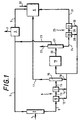
- a process according to the present invention is carried out in accordance with the flow diagram as schematically shown in Figure 1.
- a hydrocarbonaceous feedstock substantially boiling in the gasoline range and having properties as set out in Table 1 is introduced via a line 1 into a distillation column 2 wherein the feedstock is separated into a first light fraction comprising hydrocarbons of the C 5 -C 6 range and a heavy fraction comprising C 6 and greater hydrocarbons.
- the light fraction is withdrawn via a line 3 and introduced into an isomerization unit 4.
- the isomerate effluent obtained therefrom is withdrawn via a line 5 and introduced into the blending gasoline pool 6, whereas a gaseous fraction is withdrawn via a line 7.
- the heavy fraction is withdrawn via a line 8, and passed to a separation zone 9 which contains two molecular sieves 10 and 11.
- Molecular sieve #1 (10) is a commercial zeolite having pore size of from 4.5 to 4.5 ⁇ or smaller.
- Molecular sieve 11, referred to as molecular sieve #2, has a pore size intermediate 5.5 x 5.5 to 4.5 x 4.5 ⁇ , but excludes 4.5 x 4.5 ⁇ .
- the first molecular sieve 10 selectively adsorbs normal paraffins in preference to mono-isoparaffins, di-isoparaffins, other multi-branched paraffins, cyclic paraffins and aromatic hydrocarbons.
- a fraction comprising the normal paraffins is withdrawn via a line 12.
- the separation effluent stream substantially freed from normal paraffins is withdrawn via a line 13 and contacted with molecular sieve #2 (11).
- mono-isoparaffins are adsorbed while di-isoparaffins and other multi-branched paraffins, cyclic paraffins and aromatic hydrocarbons are passed through the sieve without adsorption.
- a fraction comprising mono-isoparaffins is withdrawn via a line 14, and the remaining separation effluent (di-isoparaffins fraction) which is now substantially freed from normal paraffins and mono-isoparaffins is withdrawn via a line 15.
- the separation effluent comprising the di-isoparaffins is introduced into a distillation column 16 wherein the effluent stream is separated into a light fraction comprising hydrocarbons of the C 6 -C 10 range, which is passed via a line 17 to the gasoline blending pool 6, and a heavy fraction comprising C 8 and greater hydrocarbons.
- the heavy fraction is withdrawn via a line 18 and then introduced into a reforming reactor 19.
- the reforming is carried out at a temperature of 498 °C, a pressure of 10.6 bar, a weight hourly space velocity of 1.8 kg/kg/hr and a hydrogen/feed ratio of 510 Nl/kg.
- the commercially available reforming catalyst comprises platinum and tin on alumina.
- the fractions withdrawn via the lines 12 and 14 are co-processed in the reforming step.
- the reformate obtained is subsequently withdrawn via a line 20 and introduced into a distillation column 21. In the distillation column 21 the reformate is separated into a gaseous fraction, a second light fraction comprising C 5 -C 6 hydrocarbons and a gasoline fraction.
- the gaseous fraction is withdrawn via a line 22, the second light fraction is co-processed with the first light fraction comprising C 5 -C 6 hydrocarbons via a line 23 and the gasoline fraction is withdrawn via a line 24.
- the gasoline fraction is passed to a separation zone 25 containing molecular sieves 26 and 27.
- Molecular sieve #3 (26) is a commercial zeolite having pore size of from 4.5 to 4.5 ⁇ or smaller.
- Molecular sieve 27, referred to as molecular sieve #4 has a pore size intermediate 5.5 x 5.5 to 4.5 x 4.5 ⁇ , but excludes 4.5 x 4.5 ⁇ .
- the first molecular sieve 26 selectively adsorbs normal paraffins in preference to mono-isoparaffins, di-isoparaffins, cyclic paraffins and aromatic hydrocarbons.
- a fraction comprising the normal paraffins is withdrawn via a line 28.
- the separation effluent stream substantially freed from normal paraffins is withdrawn via a line 29 and contacted with molecular sieve #4 (27).
- mono-isoparaffins are adsorbed while di-isoparaffins and other multi-branched paraffins, cyclic paraffins and aromatic hydrocarbons are passed through the sieve without adsorption.
- the fraction comprising mono-isoparaffins is withdrawn via a line 30, and the remaining separation effluent (di-isoparaffins fraction) which is now substantially freed from normal paraffins and mono-isoparaffins is withdrawn via a line 31 and introduced into the blending gasoline pool 6.
- the fractions withdrawn via the lines 28 and 30 are co-processed in the reforming step.
- the overall gasoline obtained in the blending gasoline pool 6 has the properties as set out in Table 2.
Landscapes
- Chemical & Material Sciences (AREA)
- Oil, Petroleum & Natural Gas (AREA)
- Engineering & Computer Science (AREA)
- Chemical Kinetics & Catalysis (AREA)
- General Chemical & Material Sciences (AREA)
- Organic Chemistry (AREA)
- Production Of Liquid Hydrocarbon Mixture For Refining Petroleum (AREA)
Priority Applications (1)
| Application Number | Priority Date | Filing Date | Title |
|---|---|---|---|
| EP93200231A EP0553931B1 (en) | 1992-01-30 | 1993-01-28 | Process for upgrading a hydrocarbonaceous feedstock |
Applications Claiming Priority (3)
| Application Number | Priority Date | Filing Date | Title |
|---|---|---|---|
| EP92200273 | 1992-01-30 | ||
| EP92200273 | 1992-01-30 | ||
| EP93200231A EP0553931B1 (en) | 1992-01-30 | 1993-01-28 | Process for upgrading a hydrocarbonaceous feedstock |
Publications (2)
| Publication Number | Publication Date |
|---|---|
| EP0553931A1 EP0553931A1 (en) | 1993-08-04 |
| EP0553931B1 true EP0553931B1 (en) | 1997-04-16 |
Family
ID=8210394
Family Applications (1)
| Application Number | Title | Priority Date | Filing Date |
|---|---|---|---|
| EP93200231A Expired - Lifetime EP0553931B1 (en) | 1992-01-30 | 1993-01-28 | Process for upgrading a hydrocarbonaceous feedstock |
Country Status (10)
| Country | Link |
|---|---|
| EP (1) | EP0553931B1 (enExample) |
| JP (1) | JP3157324B2 (enExample) |
| CN (1) | CN1040225C (enExample) |
| AU (1) | AU657035B2 (enExample) |
| CA (1) | CA2088324C (enExample) |
| DE (1) | DE69309729T2 (enExample) |
| DK (1) | DK0553931T3 (enExample) |
| ES (1) | ES2103419T3 (enExample) |
| MY (1) | MY110356A (enExample) |
| ZA (1) | ZA93612B (enExample) |
Families Citing this family (6)
| Publication number | Priority date | Publication date | Assignee | Title |
|---|---|---|---|---|
| EP0629681B1 (en) * | 1993-06-15 | 1999-01-07 | Shell Internationale Researchmaatschappij B.V. | Process for upgrading a hydrocarbonaceous feedstock |
| ES2126053T3 (es) * | 1993-06-15 | 1999-03-16 | Shell Int Research | Procedimiento de mejora de una carga hidrocarbonada. |
| EP0629682B1 (en) * | 1993-06-15 | 1998-12-02 | Shell Internationale Researchmaatschappij B.V. | Process for upgrading a hydrocarbonaceous feedstock |
| US5885441A (en) * | 1997-04-11 | 1999-03-23 | Intevep, S.A. | Steam conversion process and catalyst |
| CN1100116C (zh) * | 1999-06-23 | 2003-01-29 | 中国石油化工集团公司 | 一种多产柴油和液化气的催化转化方法 |
| CN102465044B (zh) * | 2010-11-15 | 2014-05-07 | 周向进 | 一种联合生产低辛烷值汽油和高辛烷值汽油的方法 |
Family Cites Families (7)
| Publication number | Priority date | Publication date | Assignee | Title |
|---|---|---|---|---|
| FR1208231A (fr) * | 1957-05-01 | 1960-02-22 | Exxon Research Engineering Co | Procédé perfectionné de reformage des naphtas |
| US2935539A (en) * | 1958-04-25 | 1960-05-03 | Exxon Research Engineering Co | Hydrocarbon separation process using metallic amine complex substituted molecular sieves |
| GB1106044A (en) * | 1965-07-05 | 1968-03-13 | Universal Oil Prod Co | Production of jet and motor fuel |
| US5055177A (en) * | 1984-05-21 | 1991-10-08 | Mobil Oil Corporation | Closed cyclone FCC catalyst separation method and apparatus |
| US5059292A (en) * | 1989-02-28 | 1991-10-22 | Collins George J | Single-chamber apparatus for in-situ generation of dangerous polyatomic gases and radicals from a source material contained within a porous foamed structure |
| US5076908A (en) * | 1989-07-19 | 1991-12-31 | Chevron Research & Technology Company | Method and apparatus for an on-stream particle replacement system for countercurrent contact of a gas and liquid feed stream with a packed bed |
| US5107052A (en) * | 1990-12-31 | 1992-04-21 | Uop | Extraction of dimethyl paraffins from isomerates |
-
1993
- 1993-01-28 DE DE69309729T patent/DE69309729T2/de not_active Expired - Fee Related
- 1993-01-28 JP JP03111593A patent/JP3157324B2/ja not_active Expired - Fee Related
- 1993-01-28 CN CN93100919A patent/CN1040225C/zh not_active Expired - Fee Related
- 1993-01-28 ZA ZA93612A patent/ZA93612B/xx unknown
- 1993-01-28 ES ES93200231T patent/ES2103419T3/es not_active Expired - Lifetime
- 1993-01-28 EP EP93200231A patent/EP0553931B1/en not_active Expired - Lifetime
- 1993-01-28 DK DK93200231.4T patent/DK0553931T3/da active
- 1993-01-28 CA CA002088324A patent/CA2088324C/en not_active Expired - Fee Related
- 1993-01-28 MY MYPI93000126A patent/MY110356A/en unknown
- 1993-01-28 AU AU32084/93A patent/AU657035B2/en not_active Ceased
Also Published As
| Publication number | Publication date |
|---|---|
| EP0553931A1 (en) | 1993-08-04 |
| ZA93612B (en) | 1993-08-30 |
| MY110356A (en) | 1998-04-30 |
| JPH05263083A (ja) | 1993-10-12 |
| AU3208493A (en) | 1993-08-05 |
| CN1040225C (zh) | 1998-10-14 |
| DK0553931T3 (da) | 1997-09-22 |
| ES2103419T3 (es) | 1997-09-16 |
| CA2088324C (en) | 2004-04-06 |
| CN1074927A (zh) | 1993-08-04 |
| AU657035B2 (en) | 1995-02-23 |
| CA2088324A1 (en) | 1993-07-31 |
| DE69309729D1 (de) | 1997-05-22 |
| DE69309729T2 (de) | 1997-09-18 |
| JP3157324B2 (ja) | 2001-04-16 |
Similar Documents
| Publication | Publication Date | Title |
|---|---|---|
| EP1335961B1 (en) | Ethylene production by steam cracking of normal paraffins | |
| US5401386A (en) | Reforming process for producing high-purity benzene | |
| KR0136582B1 (ko) | 한정된 c9+탄화수소 함량을 갖는 탄화수소 분류물의 개질 방법 | |
| CA2038824C (en) | Combination process for hydrogenation and isomerization of benzene- and paraffin-containing feedstocks | |
| US9302955B2 (en) | Systems and methods for separating xylene isomers using selective adsorption | |
| US8551328B2 (en) | Organic chloride adsorbent | |
| US5190633A (en) | Hydrocracking process with polynuclear aromatic dimer foulant adsorption | |
| EP0569631A1 (en) | Adsorption-desorption seperation process | |
| US5294328A (en) | Production of reformulated gasoline | |
| US5135639A (en) | Production of reformulated gasoline | |
| US9950972B2 (en) | Apparatuses and methods for forming C8 aromatic streams with selected amounts of C9 aromatics | |
| WO2022025985A1 (en) | Recycle catalytic reforming process to increase aromatics yield | |
| CA2088324C (en) | Process for upgrading a hydrocarbonaceous feedstock | |
| EP0629683B1 (en) | Process for upgrading a hydrocarbonaceous feedstock | |
| EP0554945B1 (en) | Process for upgrading a hydrocarbonaceous feedstock | |
| US3928175A (en) | Upgrading crude oil by combination processing | |
| EP0629682B1 (en) | Process for upgrading a hydrocarbonaceous feedstock | |
| EP0629681B1 (en) | Process for upgrading a hydrocarbonaceous feedstock | |
| KR0136583B1 (ko) | 디메틸부탄-비함유 탄화수소 분류물의 개질방법 | |
| GB2162534A (en) | Silicalite reforming process | |
| WO2026128898A1 (en) | Process for producing light olefins | |
| EP4665821A1 (en) | Aromax process for improved selectivity and heavier feeds processing |
Legal Events
| Date | Code | Title | Description |
|---|---|---|---|
| PUAI | Public reference made under article 153(3) epc to a published international application that has entered the european phase |
Free format text: ORIGINAL CODE: 0009012 |
|
| AK | Designated contracting states |
Kind code of ref document: A1 Designated state(s): BE CH DE DK ES FR GB IT LI NL SE |
|
| 17P | Request for examination filed |
Effective date: 19931231 |
|
| 17Q | First examination report despatched |
Effective date: 19950803 |
|
| GRAG | Despatch of communication of intention to grant |
Free format text: ORIGINAL CODE: EPIDOS AGRA |
|
| GRAH | Despatch of communication of intention to grant a patent |
Free format text: ORIGINAL CODE: EPIDOS IGRA |
|
| GRAH | Despatch of communication of intention to grant a patent |
Free format text: ORIGINAL CODE: EPIDOS IGRA |
|
| RHK1 | Main classification (correction) |
Ipc: C10G 61/06 |
|
| GRAA | (expected) grant |
Free format text: ORIGINAL CODE: 0009210 |
|
| AK | Designated contracting states |
Kind code of ref document: B1 Designated state(s): BE CH DE DK ES FR GB IT LI NL SE |
|
| REG | Reference to a national code |
Ref country code: CH Ref legal event code: NV Representative=s name: KIRKER & CIE SA Ref country code: CH Ref legal event code: EP |
|
| REF | Corresponds to: |
Ref document number: 69309729 Country of ref document: DE Date of ref document: 19970522 |
|
| ITF | It: translation for a ep patent filed | ||
| ET | Fr: translation filed | ||
| REG | Reference to a national code |
Ref country code: ES Ref legal event code: FG2A Ref document number: 2103419 Country of ref document: ES Kind code of ref document: T3 |
|
| REG | Reference to a national code |
Ref country code: DK Ref legal event code: T3 |
|
| PLBE | No opposition filed within time limit |
Free format text: ORIGINAL CODE: 0009261 |
|
| STAA | Information on the status of an ep patent application or granted ep patent |
Free format text: STATUS: NO OPPOSITION FILED WITHIN TIME LIMIT |
|
| 26N | No opposition filed | ||
| REG | Reference to a national code |
Ref country code: GB Ref legal event code: IF02 |
|
| PG25 | Lapsed in a contracting state [announced via postgrant information from national office to epo] |
Ref country code: IT Free format text: LAPSE BECAUSE OF NON-PAYMENT OF DUE FEES Effective date: 20050128 |
|
| PGFP | Annual fee paid to national office [announced via postgrant information from national office to epo] |
Ref country code: DK Payment date: 20071109 Year of fee payment: 16 |
|
| PGFP | Annual fee paid to national office [announced via postgrant information from national office to epo] |
Ref country code: SE Payment date: 20071114 Year of fee payment: 16 |
|
| PGFP | Annual fee paid to national office [announced via postgrant information from national office to epo] |
Ref country code: ES Payment date: 20080130 Year of fee payment: 16 Ref country code: CH Payment date: 20080115 Year of fee payment: 16 |
|
| PGRI | Patent reinstated in contracting state [announced from national office to epo] |
Ref country code: IT Effective date: 20080301 |
|
| PGFP | Annual fee paid to national office [announced via postgrant information from national office to epo] |
Ref country code: BE Payment date: 20080125 Year of fee payment: 16 |
|
| PGFP | Annual fee paid to national office [announced via postgrant information from national office to epo] |
Ref country code: FR Payment date: 20081120 Year of fee payment: 17 |
|
| PGFP | Annual fee paid to national office [announced via postgrant information from national office to epo] |
Ref country code: NL Payment date: 20090127 Year of fee payment: 17 Ref country code: DE Payment date: 20090203 Year of fee payment: 17 |
|
| PGFP | Annual fee paid to national office [announced via postgrant information from national office to epo] |
Ref country code: GB Payment date: 20081222 Year of fee payment: 17 |
|
| PGFP | Annual fee paid to national office [announced via postgrant information from national office to epo] |
Ref country code: IT Payment date: 20090126 Year of fee payment: 17 |
|
| REG | Reference to a national code |
Ref country code: CH Ref legal event code: PL |
|
| EUG | Se: european patent has lapsed | ||
| REG | Reference to a national code |
Ref country code: DK Ref legal event code: EBP |
|
| PG25 | Lapsed in a contracting state [announced via postgrant information from national office to epo] |
Ref country code: LI Free format text: LAPSE BECAUSE OF NON-PAYMENT OF DUE FEES Effective date: 20090131 Ref country code: CH Free format text: LAPSE BECAUSE OF NON-PAYMENT OF DUE FEES Effective date: 20090131 |
|
| PG25 | Lapsed in a contracting state [announced via postgrant information from national office to epo] |
Ref country code: BE Free format text: LAPSE BECAUSE OF NON-PAYMENT OF DUE FEES Effective date: 20090131 |
|
| REG | Reference to a national code |
Ref country code: ES Ref legal event code: FD2A Effective date: 20090129 |
|
| PG25 | Lapsed in a contracting state [announced via postgrant information from national office to epo] |
Ref country code: ES Free format text: LAPSE BECAUSE OF NON-PAYMENT OF DUE FEES Effective date: 20090129 |
|
| PG25 | Lapsed in a contracting state [announced via postgrant information from national office to epo] |
Ref country code: DK Free format text: LAPSE BECAUSE OF NON-PAYMENT OF DUE FEES Effective date: 20090731 |
|
| REG | Reference to a national code |
Ref country code: NL Ref legal event code: V1 Effective date: 20100801 |
|
| GBPC | Gb: european patent ceased through non-payment of renewal fee |
Effective date: 20100128 |
|
| REG | Reference to a national code |
Ref country code: FR Ref legal event code: ST Effective date: 20100930 |
|
| PG25 | Lapsed in a contracting state [announced via postgrant information from national office to epo] |
Ref country code: NL Free format text: LAPSE BECAUSE OF NON-PAYMENT OF DUE FEES Effective date: 20100801 Ref country code: FR Free format text: LAPSE BECAUSE OF NON-PAYMENT OF DUE FEES Effective date: 20100201 |
|
| PG25 | Lapsed in a contracting state [announced via postgrant information from national office to epo] |
Ref country code: DE Free format text: LAPSE BECAUSE OF NON-PAYMENT OF DUE FEES Effective date: 20100803 |
|
| PG25 | Lapsed in a contracting state [announced via postgrant information from national office to epo] |
Ref country code: GB Free format text: LAPSE BECAUSE OF NON-PAYMENT OF DUE FEES Effective date: 20100128 |
|
| PG25 | Lapsed in a contracting state [announced via postgrant information from national office to epo] |
Ref country code: IT Free format text: LAPSE BECAUSE OF NON-PAYMENT OF DUE FEES Effective date: 20100128 |
|
| PG25 | Lapsed in a contracting state [announced via postgrant information from national office to epo] |
Ref country code: SE Free format text: LAPSE BECAUSE OF NON-PAYMENT OF DUE FEES Effective date: 20090129 |