EP0553672A1 - Farbstoffmischungen enthaltend zwei verschiedene Monoazofarbstoffe - Google Patents
Farbstoffmischungen enthaltend zwei verschiedene Monoazofarbstoffe Download PDFInfo
- Publication number
- EP0553672A1 EP0553672A1 EP93100648A EP93100648A EP0553672A1 EP 0553672 A1 EP0553672 A1 EP 0553672A1 EP 93100648 A EP93100648 A EP 93100648A EP 93100648 A EP93100648 A EP 93100648A EP 0553672 A1 EP0553672 A1 EP 0553672A1
- Authority
- EP
- European Patent Office
- Prior art keywords
- dye
- weight
- parts
- formula
- tautomeric forms
- Prior art date
- Legal status (The legal status is an assumption and is not a legal conclusion. Google has not performed a legal analysis and makes no representation as to the accuracy of the status listed.)
- Granted
Links
- 239000000975 dye Substances 0.000 title claims abstract description 93
- 239000000203 mixture Substances 0.000 title claims abstract description 29
- 239000000987 azo dye Substances 0.000 title 1
- NYGZLYXAPMMJTE-UHFFFAOYSA-M metanil yellow Chemical group [Na+].[O-]S(=O)(=O)C1=CC=CC(N=NC=2C=CC(NC=3C=CC=CC=3)=CC=2)=C1 NYGZLYXAPMMJTE-UHFFFAOYSA-M 0.000 title 1
- 125000000217 alkyl group Chemical group 0.000 claims abstract description 6
- 125000003118 aryl group Chemical group 0.000 claims abstract description 5
- 125000000753 cycloalkyl group Chemical group 0.000 claims abstract description 5
- WMFOQBRAJBCJND-UHFFFAOYSA-M Lithium hydroxide Chemical compound [Li+].[OH-] WMFOQBRAJBCJND-UHFFFAOYSA-M 0.000 claims description 23
- XLYOFNOQVPJJNP-UHFFFAOYSA-N water Substances O XLYOFNOQVPJJNP-UHFFFAOYSA-N 0.000 claims description 23
- GSEJCLTVZPLZKY-UHFFFAOYSA-N Triethanolamine Chemical compound OCCN(CCO)CCO GSEJCLTVZPLZKY-UHFFFAOYSA-N 0.000 claims description 14
- ZBCBWPMODOFKDW-UHFFFAOYSA-N diethanolamine Chemical compound OCCNCCO ZBCBWPMODOFKDW-UHFFFAOYSA-N 0.000 claims description 13
- 125000000041 C6-C10 aryl group Chemical group 0.000 claims description 5
- 125000004169 (C1-C6) alkyl group Chemical group 0.000 claims description 4
- 125000005913 (C3-C6) cycloalkyl group Chemical group 0.000 claims description 3
- 238000004043 dyeing Methods 0.000 claims description 3
- 238000000034 method Methods 0.000 claims 1
- 239000002904 solvent Substances 0.000 abstract description 4
- 238000002360 preparation method Methods 0.000 abstract description 2
- KGZUHYIHYBDNLC-UHFFFAOYSA-N 2-(4-aminophenyl)-6-methyl-1,3-benzothiazole-7-sulfonic acid Chemical compound S1C2=C(S(O)(=O)=O)C(C)=CC=C2N=C1C1=CC=C(N)C=C1 KGZUHYIHYBDNLC-UHFFFAOYSA-N 0.000 description 8
- HNYOPLTXPVRDBG-UHFFFAOYSA-N barbituric acid Chemical compound O=C1CC(=O)NC(=O)N1 HNYOPLTXPVRDBG-UHFFFAOYSA-N 0.000 description 8
- LYCAIKOWRPUZTN-UHFFFAOYSA-N Ethylene glycol Chemical compound OCCO LYCAIKOWRPUZTN-UHFFFAOYSA-N 0.000 description 6
- ZMXDDKWLCZADIW-UHFFFAOYSA-N N,N-Dimethylformamide Chemical compound CN(C)C=O ZMXDDKWLCZADIW-UHFFFAOYSA-N 0.000 description 6
- DNIAPMSPPWPWGF-UHFFFAOYSA-N Propylene glycol Chemical compound CC(O)CO DNIAPMSPPWPWGF-UHFFFAOYSA-N 0.000 description 6
- PQVSTLUFSYVLTO-UHFFFAOYSA-N ethyl n-ethoxycarbonylcarbamate Chemical compound CCOC(=O)NC(=O)OCC PQVSTLUFSYVLTO-UHFFFAOYSA-N 0.000 description 5
- GLXDVVHUTZTUQK-UHFFFAOYSA-M lithium hydroxide monohydrate Substances [Li+].O.[OH-] GLXDVVHUTZTUQK-UHFFFAOYSA-M 0.000 description 5
- 229940040692 lithium hydroxide monohydrate Drugs 0.000 description 5
- 239000000725 suspension Substances 0.000 description 5
- VVSASNKOFCZVES-UHFFFAOYSA-N 1,3-dimethyl-1,3-diazinane-2,4,6-trione Chemical compound CN1C(=O)CC(=O)N(C)C1=O VVSASNKOFCZVES-UHFFFAOYSA-N 0.000 description 4
- ZHNUHDYFZUAESO-UHFFFAOYSA-N Formamide Chemical compound NC=O ZHNUHDYFZUAESO-UHFFFAOYSA-N 0.000 description 4
- PEDCQBHIVMGVHV-UHFFFAOYSA-N Glycerine Chemical compound OCC(O)CO PEDCQBHIVMGVHV-UHFFFAOYSA-N 0.000 description 4
- JBKVHLHDHHXQEQ-UHFFFAOYSA-N epsilon-caprolactam Chemical compound O=C1CCCCCN1 JBKVHLHDHHXQEQ-UHFFFAOYSA-N 0.000 description 4
- KWIUHFFTVRNATP-UHFFFAOYSA-N glycine betaine Chemical compound C[N+](C)(C)CC([O-])=O KWIUHFFTVRNATP-UHFFFAOYSA-N 0.000 description 4
- 239000000654 additive Substances 0.000 description 3
- 230000008878 coupling Effects 0.000 description 3
- 238000010168 coupling process Methods 0.000 description 3
- 238000005859 coupling reaction Methods 0.000 description 3
- 125000004178 (C1-C4) alkyl group Chemical group 0.000 description 2
- DNZPLHRZXUJATK-UHFFFAOYSA-N 2-sulfanylidene-5-[[5-[2-(trifluoromethyl)phenyl]furan-2-yl]methyl]-1,3-diazinane-4,6-dione Chemical compound FC(F)(F)C1=CC=CC=C1C(O1)=CC=C1CC1C(=O)NC(=S)NC1=O DNZPLHRZXUJATK-UHFFFAOYSA-N 0.000 description 2
- VEXZGXHMUGYJMC-UHFFFAOYSA-N Hydrochloric acid Chemical compound Cl VEXZGXHMUGYJMC-UHFFFAOYSA-N 0.000 description 2
- XSQUKJJJFZCRTK-UHFFFAOYSA-N Urea Chemical compound NC(N)=O XSQUKJJJFZCRTK-UHFFFAOYSA-N 0.000 description 2
- 229960003237 betaine Drugs 0.000 description 2
- 239000004202 carbamide Substances 0.000 description 2
- 125000001495 ethyl group Chemical group [H]C([H])([H])C([H])([H])* 0.000 description 2
- 235000011187 glycerol Nutrition 0.000 description 2
- LPXPTNMVRIOKMN-UHFFFAOYSA-M sodium nitrite Chemical compound [Na+].[O-]N=O LPXPTNMVRIOKMN-UHFFFAOYSA-M 0.000 description 2
- 150000005846 sugar alcohols Polymers 0.000 description 2
- XUCMDLYIYOXEBF-UHFFFAOYSA-N 1,3-diethyl-1,3-diazinane-2,4,6-trione Chemical compound CCN1C(=O)CC(=O)N(CC)C1=O XUCMDLYIYOXEBF-UHFFFAOYSA-N 0.000 description 1
- VGXKBQKYYXGSQK-DRWHREFUSA-N Cc(ccc1c2SC([C@@H]3C=CC(/N=N\[C@H](C(N(C)C(N4)=O)O)C4=O)=CC3)N1)c2S(O)(=O)=O Chemical compound Cc(ccc1c2SC([C@@H]3C=CC(/N=N\[C@H](C(N(C)C(N4)=O)O)C4=O)=CC3)N1)c2S(O)(=O)=O VGXKBQKYYXGSQK-DRWHREFUSA-N 0.000 description 1
- IOVCWXUNBOPUCH-UHFFFAOYSA-M Nitrite anion Chemical compound [O-]N=O IOVCWXUNBOPUCH-UHFFFAOYSA-M 0.000 description 1
- 235000019646 color tone Nutrition 0.000 description 1
- 125000000113 cyclohexyl group Chemical group [H]C1([H])C([H])([H])C([H])([H])C([H])(*)C([H])([H])C1([H])[H] 0.000 description 1
- 125000001511 cyclopentyl group Chemical group [H]C1([H])C([H])([H])C([H])([H])C([H])(*)C1([H])[H] 0.000 description 1
- 125000001559 cyclopropyl group Chemical group [H]C1([H])C([H])([H])C1([H])* 0.000 description 1
- 150000001989 diazonium salts Chemical class 0.000 description 1
- 238000006193 diazotization reaction Methods 0.000 description 1
- 125000001449 isopropyl group Chemical group [H]C([H])([H])C([H])(*)C([H])([H])[H] 0.000 description 1
- 125000002496 methyl group Chemical group [H]C([H])([H])* 0.000 description 1
- LNOPIUAQISRISI-UHFFFAOYSA-N n'-hydroxy-2-propan-2-ylsulfonylethanimidamide Chemical compound CC(C)S(=O)(=O)CC(N)=NO LNOPIUAQISRISI-UHFFFAOYSA-N 0.000 description 1
- 125000004123 n-propyl group Chemical group [H]C([H])([H])C([H])([H])C([H])([H])* 0.000 description 1
- 125000001624 naphthyl group Chemical group 0.000 description 1
- 125000001147 pentyl group Chemical group C(CCCC)* 0.000 description 1
- 125000001997 phenyl group Chemical group [H]C1=C([H])C([H])=C(*)C([H])=C1[H] 0.000 description 1
- 235000010288 sodium nitrite Nutrition 0.000 description 1
- 230000006641 stabilisation Effects 0.000 description 1
- 238000011105 stabilization Methods 0.000 description 1
- 239000000126 substance Substances 0.000 description 1
- 125000000999 tert-butyl group Chemical group [H]C([H])([H])C(*)(C([H])([H])[H])C([H])([H])[H] 0.000 description 1
Classifications
-
- C—CHEMISTRY; METALLURGY
- C09—DYES; PAINTS; POLISHES; NATURAL RESINS; ADHESIVES; COMPOSITIONS NOT OTHERWISE PROVIDED FOR; APPLICATIONS OF MATERIALS NOT OTHERWISE PROVIDED FOR
- C09B—ORGANIC DYES OR CLOSELY-RELATED COMPOUNDS FOR PRODUCING DYES, e.g. PIGMENTS; MORDANTS; LAKES
- C09B67/00—Influencing the physical, e.g. the dyeing or printing properties of dyestuffs without chemical reactions, e.g. by treating with solvents grinding or grinding assistants, coating of pigments or dyes; Process features in the making of dyestuff preparations; Dyestuff preparations of a special physical nature, e.g. tablets, films
- C09B67/0033—Blends of pigments; Mixtured crystals; Solid solutions
- C09B67/0046—Mixtures of two or more azo dyes
- C09B67/0051—Mixtures of two or more azo dyes mixture of two or more monoazo dyes
-
- D—TEXTILES; PAPER
- D21—PAPER-MAKING; PRODUCTION OF CELLULOSE
- D21H—PULP COMPOSITIONS; PREPARATION THEREOF NOT COVERED BY SUBCLASSES D21C OR D21D; IMPREGNATING OR COATING OF PAPER; TREATMENT OF FINISHED PAPER NOT COVERED BY CLASS B31 OR SUBCLASS D21G; PAPER NOT OTHERWISE PROVIDED FOR
- D21H21/00—Non-fibrous material added to the pulp, characterised by its function, form or properties; Paper-impregnating or coating material, characterised by its function, form or properties
- D21H21/14—Non-fibrous material added to the pulp, characterised by its function, form or properties; Paper-impregnating or coating material, characterised by its function, form or properties characterised by function or properties in or on the paper
- D21H21/28—Colorants ; Pigments or opacifying agents
Definitions
- Dye mixtures containing 5 to 25 parts by weight of dye of the formula (I) and 0.2 to 5 parts by weight of dye of the formula are very particularly preferred and / or their tautomeric forms.
- alkyl in the definition of R1 and R2 are methyl, ethyl, n- and iso-propyl, n-, iso-, tert-butyl, straight-chain and branched pentyl and hexyl radicals.
- cycloalkyl in the definition of R1 and R2 are cyclopropyl, cyclopentyl and cyclohexyl.
- aryl in the definition of R1 and R2 are phenyl and naphthyl.
- the dyes of the formulas (I) and (II) and their tautomeric forms are known (compare, for example, DE-A 2 221 666 and EP-A 0 369 940) and can be prepared in a known manner, e.g. by coupling the diazotization product from 2- (p-aminophenyl) -6-methyl-7-benzothiazolesulfonic acid to barbituric acid or a corresponding barbituric acid derivative.
- the dye mixtures according to the invention of the dyes (I) and (II) and / or their tautomeric forms are particularly suitable for the preparation of concentrated, storage-stable solutions of these dyes.
- Another object of the present invention are concentrated aqueous dye solutions containing a mixture of the dyes of the formulas (I) and (II) and / or their tautomeric forms.
- the dye solutions according to the invention preferably contain up to 2 to 30 parts by weight of a mixture of the dyes (I) and (II) and / or their tautomeric forms and 98 to 50 parts by weight of water.
- Dye solutions containing mixtures of the dye of the formula (I) with the dye of the formula (IIa) are very particularly preferred. and / or their tautomeric forms.
- the dye solutions according to the invention preferably contain 5 to 25 parts by weight of dye of the formula (I) and / or its tautomeric forms and 0.2 to 5 parts by weight of dye of the formula (II) and / or its tautomeric forms and 94.8 up to 70 parts by weight of water.
- the dye solutions according to the invention can contain conventional additives such as urea, formamide, ⁇ -caprolactam, dimethylformamide, polyhydric alcohols such as e.g. Contain ethylene glycol, propylene glycol or glycerin. These additives are added in the usual amounts for the substances mentioned.
- the dye solutions according to the invention preferably contain 1 to 10 parts by weight of triethanolamine and 0 to 1 part by weight of diethanolamine and 0 to 1 part by weight of lithium hydroxide.
- the dye solutions according to the invention preferably contain no further additives.
- Contain particularly preferred dye solutions according to the invention 5 - 25 parts by weight of dye of the formula (I) and / or its tautomeric forms, 0.2 - 5 parts by weight of dye of the formula (II) and / or its tautomeric forms, 1 - 10 parts by weight of triethanolamine, 0 - 1 parts by weight diethanolamine, 0-1 parts by weight of lithium hydroxide and 93.8-58 parts by weight of water.
- a very particularly preferred dye solution according to the invention 7-25 parts by weight of dye of the formula (I) and / or its tautomeric forms, 0.2-2 parts by weight of dye of the formula (IIa) and / or its tautomeric forms, 1 - 5 parts by weight of triethanolamine, 0.1-0.5 parts by weight diethanolamine, 0.1-0.5 parts by weight of lithium hydroxide and 91.6-67 parts by weight of water
- Concentrated solutions of a dye of the formula (I) or (II) are known, for example, from EP 0 369 940.
- the dye solutions according to the invention preferably contain only a small amount of at most 12 parts by weight of organic solubilizers triethanolamine, diethanolamine and LiOH and are otherwise preferably free of further water-soluble organic solubilizers such as e.g. Urea, formamide, ⁇ -caprolactam, dimethylformamide or polyhydric alcohols such as Ethylene glycol, propylene glycol and glycerin.
- organic solubilizers triethanolamine, diethanolamine and LiOH and are otherwise preferably free of further water-soluble organic solubilizers such as e.g. Urea, formamide, ⁇ -caprolactam, dimethylformamide or polyhydric alcohols such as Ethylene glycol, propylene glycol and glycerin.
- the dye solutions according to the invention are distinguished by improved storage stability compared to the prior art.
- the dye mixtures according to the invention can be prepared by per-mole of diazotized 2- (p-aminophenyl) -6-methyl-7-benzothiazole sulfonic acid a mixture of preferably 0.60 to 0.98 mol of barbituric acid and 0.02 to 0.40 mol of barbituric acid derivative of the formula (III) wherein R1 and R2 have the broadest meaning given in formula (II).
- the coupling is preferably carried out in water and preferably in the presence of triethanolamine and optionally in the presence of diethanolamine and lithium hydroxide at a temperature in the range from 20 to 40.degree.
- the concentrated aqueous dye solutions according to the invention are generally prepared in such a way that the betaine of the diazotized 2- (p-aminophenyl) -6-methyl-7-benzothiazole sulfonic acid is washed with low-salt water and then in demineralized water with a mixture from barbituric acid and a coupling component of the formula (III) - is coupled directly to the solution with triethanolamine and optionally diethanolamine and lithium hydroxide and is adjusted to the desired color strength with water.
- the pH of the dye solutions according to the invention is preferably in a range between pH 6.5 and 8.5, in particular between pH 7 and 7.5.
- the concentrated aqueous dye mixtures obtained are notable in particular for good storage stability at temperatures from -8 ° C. to + 40 ° C.
- the dye solutions according to the invention are used in particular for dyeing and printing paper.
- the paper dyeings obtained with them are characterized by good light and wet fastness as well as by the brilliance and clarity of the color tones.
- This suspension is mixed with a mixture of 50.2 g barbituric acid and 3.2 g of 1,3-dimethylbarbituric acid were added, and the pH was added 2.3 g diethanolamine, 8.0 g of lithium hydroxide monohydrate and 35.2 g of triethanolamine set to 7. After clarifying the solution with Diluted 360 ml of water.
- the dye solution contains about 12.3 parts by weight of dye of the formula I and 0.6 parts by weight of dye of the formula IIa. After three months of storage at -8 ° C or + 40 ° C, the solution shows no residue.
Landscapes
- Chemical & Material Sciences (AREA)
- Chemical Kinetics & Catalysis (AREA)
- Organic Chemistry (AREA)
- Paper (AREA)
- Coloring (AREA)
- Printing Plates And Materials Therefor (AREA)
Abstract
Description
- Die vorliegende Erfindung betrifft Farbstoffmischungen enthaltend den Farbstoff der Formel (I)

und einen Farbstoff der Formel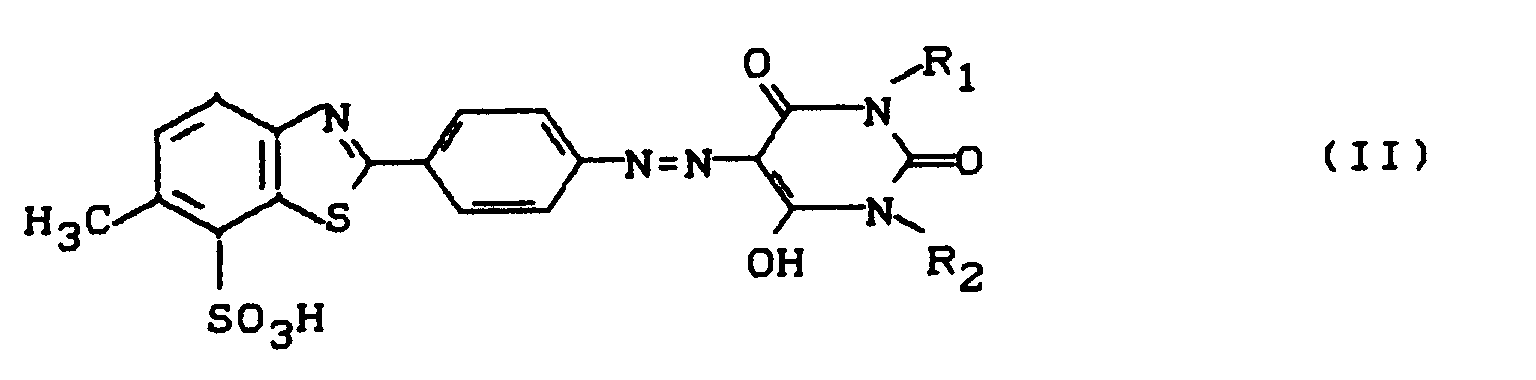
worin - R₁ und R₂
- unabhängig voneinander für Alkyl, Cycloalkyl oder Aryl stehen,
- Bevorzugt sind Farbstoffmischungen enthaltend den Farbstoff der Formel (I) und einen Farbstoff der Formel (II), worin
- R₁ und R₂
- unabhängig voneinander für C₁-C₆-Alkyl, C₃-C₆-Cycloalkyl oder C₆-C₁₀-Aryl stehen,
- Besonders bevorzugt sind Farbstoffmischungen enthaltend den Farbstoff (I) und einen Farbstoff der Formel (II), worin
- R₁ und R₂
- unabhängig voneinander für C₁-C₄-Alkyl stehen,
- Ganz besonders bevorzugt sind Farbstoffmischungen enthaltend 5 bis 25 Gew.-Tle Farbstoff der Formel (I) und 0,2 bis 5 Gew.-Tle Farbstoff der Formel

und/oder deren tautomere Formen. - Die angegebenen Formeln (I), (II) und (IIa) stellen jeweils nur eine der möglichen tautomeren Formen dar, Die Erfindung umfaßt jedoch jeweils alle tautomeren Formen.
- Beispiele für Alkyl in der Definition von R¹ und R² sind Methyl-, Ethyl-, n- und iso-Propyl-, n-, iso-, tert.-Butyl-, geradkettige und verzweigte Pentyl- und Hexylreste.
- Beispiele für Cycloalkyl in der Definition von R¹ und R² sind Cyclopropyl, Cyclopentyl und Cyclohexyl.
- Beispiele für Aryl in der Definition von R₁ und R₂ sind Phenyl und Naphthyl.
- Die Farbstoffe der Formeln (I) und (II) und deren tautomeren Formen sind bekannt (vergleiche z.B. DE-A 2 221 666 und EP-A 0 369 940) und können auf bekannte Art und Weise z.B. durch Kupplung des Diazotierungsproduktes aus 2-(p-Aminophenyl)-6-methyl-7-benzothiazolsulfonsäure auf Barbitursäure oder ein entsprechendes Barbitursäurederivat hergestellt werden.
- Die erfindungsgemäßen Farbstoffmischungen der Farbstoffe (I) und (II) und/oder deren tautomere Formen eignen sich insbesondere zur Herstellung konzentrierter, lagerstabiler Lösungen dieser Farbstoffe.
- Ein weiterer Gegenstand der vorliegenden Erfindung sind konzentrierte wäßrige Farbstofflösungen enthaltend eine Mischung der Farbstoffe der Formeln (I) und (II) und/oder deren tautomere Formen.
- Die erfindungsgemäßen Farbstofflösungen enthalten vorzugsweise bis zu 2 bis 30 Gew.-Tle einer Mischung aus den Farbstoffen (I) und (II) und/oder deren tautomeren Formen und 98 bis 50 Gew.-Tle Wasser.
- Bevorzugt sind konzentrierte Farbstofflösungen enthaltend Mischungen des Farbstoffs der Formel (I) mit einem Farbstoff der Formel (II), worin
- R₁ und R₂
- unabhängig voneinander für C₁-C₆-Alkyl, C₃-C₆-Cyclohexyl oder C₆-C₁₀-Aryl stehen,
- Besonders bevorzugt sind Farbstofflösungen enthaltend Mischungen des Farbstoffs der Formel (I) mit einem Farbstoff der Formel (II), worin
- R₁ und R₂
- unabhängig voneinander für C₁-C₄-Alkyl stehen,
- Ganz besonders bevorzugt sind Farbstofflösungen enthaltend Mischungen des Farbstoffs der Formel (I) mit dem Farbstoff der Formel (IIa)

und/oder deren tautomere Formen. - Vorzugsweise enthalten die erfindungsgemäßen Farbstofflösungen 5 bis 25 Gew.-Tle Farbstoff der Formel (I) und/oder dessen tautomere Formen und 0,2 bis 5 Gew.-Tle Farbstoff der Formel (II) und/oder dessen tautomere Formen und 94,8 bis 70 Gew.-Tle Wasser.
- Die erfindungsgemäßen Farbstofflösungen können übliche Zusätze wie beispielsweise Harnstoff, Formamid, ε-Caprolactam, Dimethylformamid, mehrwertige Alkohole wie z.B. Ethylenglykol, Propylenglykol oder Glycerin enthalten. Diese Zusätze werden in den für die genannten Stoffe üblichen Mengen zugesetzt.
- Vorzugsweise enthalten die erfindungsgemäßen Farbstofflösungen 1 bis 10 Gew.-Tle Triethanolamin sowie 0 bis 1 Gew.-Tle Diethanolamin und 0 bis 1 Gew.-Tle Lithiumhydroxid.
- Außer Triethanolamin und gegebenenfalls Diethanolamin und Lithiumhydroxid enthalten die erfindungsgemäßen Farbstofflösungen vorzugsweise keine weiteren Zusätze.
- Besonders bevorzugte erfindungsgemäße Farbstofflösungen enthalten
5 - 25 Gew.-Tle Farbstoff der Formel (I) und/oder dessen tautomere Formen,
0,2 - 5 Gew.-Tle Farbstoff der Formel (II) und/oder dessen tautomere Formen,
1 - 10 Gew.-Tle Triethanolamin,
0 - 1 Gew.-Tle Diethanolamin,
0 - 1 Gew.-Tle Lithiumhydroxid und
93,8- 58 Gew.-Tle Wasser. - Eine ganz besonders bevorzugte erfindungsgemäße Farbstofflösung enthält
7 - 25 Gew.-Tle Farbstoff der Formel (I) und/oder dessen tautomere Formen,
0,2 - 2 Gew.-Tle Farbstoff der Formel (IIa) und/oder dessen tautomere Formen,
1 - 5 Gew.-Tle Triethanolamin,
0,1 -0,5 Gew.-Tle Diethanolamin,
0,1 -0,5 Gew.-Tle Lithiumhydroxid und
91,6- 67 Gew.-Tle Wasser
Konzentrierte Lösungen eines Farbstoffs der Formel (I) oder (II) sind z.B. aus EP 0 369 940 bekannt. - Diese Farbstofflösungen enthalten jedoch zur Stabilisierung große Mengen an organischen Lösungsvermittlern, trotzdem erfüllt ihre Lagerstabilität nicht alle an sie gestellten Anforderungen.
- Die erfindungsgemäßen Farbstofflösungen enthalten vorzugsweise nur eine geringe Menge von maximal 12 Gew.-Tle an organischen Lösungsvermittlern Triethanolamin, Diethanolamin und LiOH und sind im übrigen vorzugsweise frei von weiteren wasserlöslichen organischen Lösungsvermittlern wie z.B. Harnstoff, Formamid, ε-Caprolactam, Dimethylformamid oder mehrwertigen Alkoholen wie z.B. Ethylenglykol, Propylenglykol und Glycerin.
- Darüberhinaus zeichnen sich die erfindungsgemäßen Farbstofflösungen durch eine verbesserte Lagerstabilität gegenüber dem Stand der Technik aus.
- Die erfindungsgemäßen Farbstoffmischungen können hergestellt werden, indem man pro Mol an diazotierter 2-(p-Aminophenyl)-6-methyl-7-benzothiazolsulfonsäure eine Mischung von vorzugsweise 0,60 bis 0,98 Mol Barbitursäure und 0,02 bis 0,40 Mol Barbitursäurederivat der Formel (III)

worin
R₁ und R₂ die breiteste bei Formel (II) angegebene Bedeutung haben, einsetzt. - Die Kupplung wird vorzugsweise in Wasser und vorzugsweise in Gegenwart von Triethanolamin und gegebenenfalls in Gegenwart von Diethanolamin und Lithiumhydroxid bei einer Temperatur im Bereich von 20 bis 40°C durchgeführt.
- Die Herstellung der erfindungsgemäßen konzentrierten wäßrigen Farbstofflösungen erfolgt im allgemeinen in der Weise, daß das Betain der diazotierten 2-(p-Aminophenyl)-6-methyl-7-benzothiazolsulfonsäure mit demineralisiertem Wasser salzarm gewaschen wird und anschließend in demineralisiertem Wasser mit einer Mischung -bestehend aus Barbitursäure und einer Kupplungskomponente der Formel (III) - direkt zur Lösung mit Triethanolamin sowie gegebenenfalls Diethanolamin und Lithiumhydroxid gekuppelt wird und mit Wasser auf die gewünschte Farbstärke eingestellt wird.
- Der pH-Wert der erfindungsgemäßen Farbstofflösungen liegt vorzugsweise in einem Bereich zwischen pH 6,5 und 8,5, insbesondere zwischen pH 7 und 7,5.
- Die erhaltenen konzentrierten wäßrigen Farbstoffmischungen zeichnen sich vor allem durch eine gute Lagerstabilität bei Temperaturen von -8°C bis +40°C aus.
- Verwendung finden die erfindungsgemäßen Farbstofflösungen insbesondere zum Färben und Bedrucken von Papier.
- Die mit ihnen erhaltenen Papierfärbungen zeichnen sich durch gute Licht- und Naßechtheiten sowie durch Brillanz und Klarheit der Farbtöne aus.
- 139,3 g 2-(p-Aminophenyl)-6-methyl-7-benzothiazolsulfonsäure werden in
955 ml Wasser suspendiert. Nach Zusatz von
69 ml konzentrierter Salzsäure werden bei 30°C bis 40°C
101 ml 30%ige Natriumnitritlösung zugetropft. Man rührt eine Stunde nach und zerstört überschüssiges Nitrit mit Amidosulfonsäure. Das Betain der Diazoniumverbindung wird abgesaugt und mit
270 ml demineralisiertem Wasser gewaschen. Anschließend werden
560 ml demineralisiertes Wasser vorgelegt, die Diazotierungspaste zugesetzt und verrührt. Diese Suspension wird unter Rühren mit einer Mischung aus
50,2 g Barbitursäure und
3,2 g 1,3-Dimethylbarbitursäure versetzt und der pH-Wert mit
2,3 g Diethanolamin,
8,0 g Lithiumhydroxid-Monohydrat und
35,2 g Triethanolamin auf 7 gestellt. Nach Klären wird die Lösung mit
360 ml Wasser verdünnt. Die Farbstofflösung enthält ca. 12,3 Gew.-Tle Farbstoff der Formel I und 0,6 Gew.-Tle Farbstoff der Formel IIa. Die Lösung zeigt nach dreimonatiger Lagerung bei -8°C beziehungsweise +40°C keinerlei Rückstand. - 139,3 g 2-(p-Aminophenyl)-6-methyl-7-benzothiazolsulfonsäure werden wie in Beispiel 1 diazotiert, isoliert und wieder in Wasser verrührt. Diese Suspension wird unter Rühren mit einer Mischung aus
47,6 g Barbitursäure und
6,4 g 1,3-Dimethylbarbitursäure versetzt und der pH-Wert mit
2,3 g Diethanolamin,
8,0 g Lithiumhydroxid-Monohydrat und
35,2 g Triethanolamin auf 7 gestellt. Nach Klären wird die Lösung mit
360 ml Wasser verdünnt. Die Farbstofflösung enthält ca. 11,7 Gew.-Tle Farbstoff der Formel I und 1,3 Gew.-Tle Farbstoff der Formel IIa. Die Lösung zeigt nach dreimonatiger Lagerung bei -8°C beziehungsweise +40°C keinerlei Rückstand. - 139,3 g 2-(p-Aminophenyl)-6-methyl-7-benzothiazolsulfonsäure werden wie in Beispiel 1 diazotiert, isoliert und wieder in Wasser verrührt. Diese Suspension wird unter Rühren mit einer Mischung aus
50,2 g Barbitursäure und
3,8 g 1,3-Diethylbarbitursäure versetzt und der pH-Wert mit
2,3 g Diethanolamin,
8,0 g Lithiumhydroxid-Monohydrat und
35,2 g Triethanolamin auf 7 gestellt. Nach Klären wird die Lösung mit
360 ml Wasser verdünnt. Die Farbstofflösung enthält ca. 12,3 Gew.-Tle Farbstoff der Formel I und 0,7 Gew.-Tle Farbstoff der Formel II mit R₁ und R₂ = Ethyl. Die Lösung zeigt nach dreimonatiger Lagerung bei -8°C beziehungsweise +40°C keinerlei Rückstand. - 139,3 g 2-(p-Aminophenyl)-6-methyl-7-benzothiazolsulfonsäure werden wie in Beispiel 1 diazotiert, isoliert und wieder in Wasser verrührt. Diese Suspension wird unter Rühren mit einer Mischung aus
50,2 g Barbitursäure und
3,2 g 1,3-Dimethylbarbitursäure versetzt und der pH mit
4,0 g Diethanolamin,
4,0 g Lithiumhydroxid-Monohydrat und
37,0 g Triethanolamin auf 7 gestellt. Nach Klären wird die Lösung mit
360 ml Wasser verdünnt. Die Farbstofflösung enthält ca. 12,3 Gew.-Tle Farbstoff der Formel I und 0,6 Gew.-Tle Farbstoff der Formel IIa. Die Lösung zeigt nach dreimonatiger Lagerung bei -8°C beziehungsweise +40°C keinerlei Rückstand. - 139,3 g 2-(p-Aminophenyl)-6-methyl-7-benzothiazolsulfonsäure werden wie in Beispiel 1 diazotiert, isoliert und wieder in Wasser verrührt. Diese Suspension wird unter Rühren mit einer Mischung aus
47,6 g Barbitursäure und
6,4 g 1,3-Dimethylbarbitursäure versetzt und der pH mit
4,0 g Diethanolamin,
8,0 g Lithiumhydroxid-Monohydrat und
36,5 g Triethanolamin auf 7,5 gestellt. Nach Klären wird die Lösung mit
360 ml Wasser verdünnt. Die Farbstofflösung enthält ca. 11,7 Gew.-Tle Farbstoff der Formel I und 1,3 Gew.-Tle Farbstoff der Formel IIa. Die Lösung zeigt nach dreimonatiger Lagerung bei -8°C beziehungsweise +40°C keinerlei Rückstand.
Claims (10)
- Farbstoffmischungen enthaltend den Farbstoff der Formel (I)

 R₁ und R₂ unabhängig voneinander für Alkyl, Cycloalkyl oder Aryl stehen,und/oder tautomere Formen der Farbstoffe der Formeln (I) und/oder (II).
 - Farbstoffmischungen des Anspruchs 1, worin in Formel (II) R₁ und R₂ unabhängig voneinander für C₁-C₆-Alkyl, C₃-C₆-Cycloalkyl oder C₆-C₁₀-Aryl stehen.
- Farbstoffmischungen des Anspruchs 1, worin in Formel (II) R₁ und R₂ unabhängig voneinander für C₁-C₄-Alkyl stehen.
- Farbstoffmischungen des Anspruchs 1 enthaltend 5 bis 25 Gew.-Tle Farbstoff der Formel (I) und 0,2 bis 5 Gew.-Tle Farbstoff der Formel (IIa)

- Konzentrierte Farbstofflösungen enthaltend eine Farbstoffmischung gemäß Ansprüchen 1 bis 4.
- Konzentrierte Farbstofflösungen des Anspruchs 5 enthaltend 2 bis 30 Gew.-Tle Farbstoffmischung und 98 bis 50 Gew.-Tle Wasser.
- Konzentrierte Farbstofflösungen der Ansprüche 5 und 6 enthaltend 5 bis 25 Gew.-Tle Farbstoff der Formel (I) und/oder dessen tautomere Formen und 0,2 bis 5 Gew.-Tle Farbstoff der Formel (II) und/oder dessen tautomere Formen und 94,8 bis 70 Gew.-Tle Wasser.
- Konzentrierte Farbstofflösungen der Ansprüche 5 bis 7 enthaltend 1 bis 10 Gew.-Tle Triethanolamin.
- Konzentrierte Farbstofflösungen der Ansprüche 5 bis 8 enthaltend
7 - 25 Gew.-Tle Farbstoff der Formel (I), und/oder dessen tautomere Formen,
0,2 - 2 Gew.-Tle Farbstoff der Formel (IIa), und/oder dessen tautomere Formen,
1 - 5 Gew.-Tle Triethanolamin,
0,1 -0,5 Gew.-Tle Diethanolamin und
0,1 -0,5 Gew.-Tle Lithiumhydroxid und
91,6 - 67 Gew.-Tle Wasser. - Verfahren zum Färben und Bedrucken von Papier, dadurch gekennzeichnet, daß Farbstofflösungen gemäß Ansprüchen 5 bis 9 verwendet werden.
Applications Claiming Priority (2)
| Application Number | Priority Date | Filing Date | Title |
|---|---|---|---|
| DE4202527 | 1992-01-30 | ||
| DE4202527A DE4202527A1 (de) | 1992-01-30 | 1992-01-30 | Farbstoffmischungen |
Publications (2)
| Publication Number | Publication Date |
|---|---|
| EP0553672A1 true EP0553672A1 (de) | 1993-08-04 |
| EP0553672B1 EP0553672B1 (de) | 1996-04-17 |
Family
ID=6450546
Family Applications (1)
| Application Number | Title | Priority Date | Filing Date |
|---|---|---|---|
| EP93100648A Expired - Lifetime EP0553672B1 (de) | 1992-01-30 | 1993-01-18 | Farbstoffmischungen enthaltend zwei verschiedene Monoazofarbstoffe |
Country Status (4)
| Country | Link |
|---|---|
| US (1) | US5295999A (de) |
| EP (1) | EP0553672B1 (de) |
| JP (1) | JPH05279587A (de) |
| DE (2) | DE4202527A1 (de) |
Cited By (3)
| Publication number | Priority date | Publication date | Assignee | Title |
|---|---|---|---|---|
| WO2005087872A1 (en) * | 2004-03-12 | 2005-09-22 | Clariant International Ltd. | Concentrated dye solutions |
| WO2006122891A3 (en) * | 2005-05-18 | 2007-03-15 | Ciba Sc Holding Ag | Aqueous solutions of direct dyes |
| US7976586B2 (en) | 2005-05-18 | 2011-07-12 | Basf Se | 1-phenoxy-2-propanol as a formulating aid for dyes |
Families Citing this family (1)
| Publication number | Priority date | Publication date | Assignee | Title |
|---|---|---|---|---|
| DE4240981A1 (de) * | 1992-12-05 | 1994-06-09 | Basf Ag | Verdoppelte Azofarbstoffe |
Citations (4)
| Publication number | Priority date | Publication date | Assignee | Title |
|---|---|---|---|---|
| FR2135265A1 (de) * | 1971-05-03 | 1972-12-15 | American Cyanamid Co | |
| EP0201690A2 (de) * | 1985-03-30 | 1986-11-20 | Bayer Ag | Verfahren zur Herstellung aromatischer Diazoniumsalze und von Azofarbstoffen |
| EP0369940A2 (de) * | 1988-11-15 | 1990-05-23 | Ciba-Geigy Ag | Konzentrierte Farbstofflösungen |
| EP0479056A2 (de) * | 1990-09-29 | 1992-04-08 | BASF Aktiengesellschaft | Konzentrierte wässrige Lösungen von 2-Phenylbenzthiazolazofarbstoffen |
Family Cites Families (1)
| Publication number | Priority date | Publication date | Assignee | Title |
|---|---|---|---|---|
| DE3844067A1 (de) * | 1988-12-28 | 1990-07-05 | Bayer Ag | Mischungen von dispersionsazofarbstoffen |
-
1992
- 1992-01-30 DE DE4202527A patent/DE4202527A1/de not_active Withdrawn
-
1993
- 1993-01-18 EP EP93100648A patent/EP0553672B1/de not_active Expired - Lifetime
- 1993-01-18 DE DE59302213T patent/DE59302213D1/de not_active Expired - Fee Related
- 1993-01-21 US US08/006,590 patent/US5295999A/en not_active Expired - Fee Related
- 1993-01-27 JP JP5029655A patent/JPH05279587A/ja active Pending
Patent Citations (4)
| Publication number | Priority date | Publication date | Assignee | Title |
|---|---|---|---|---|
| FR2135265A1 (de) * | 1971-05-03 | 1972-12-15 | American Cyanamid Co | |
| EP0201690A2 (de) * | 1985-03-30 | 1986-11-20 | Bayer Ag | Verfahren zur Herstellung aromatischer Diazoniumsalze und von Azofarbstoffen |
| EP0369940A2 (de) * | 1988-11-15 | 1990-05-23 | Ciba-Geigy Ag | Konzentrierte Farbstofflösungen |
| EP0479056A2 (de) * | 1990-09-29 | 1992-04-08 | BASF Aktiengesellschaft | Konzentrierte wässrige Lösungen von 2-Phenylbenzthiazolazofarbstoffen |
Cited By (6)
| Publication number | Priority date | Publication date | Assignee | Title |
|---|---|---|---|---|
| WO2005087872A1 (en) * | 2004-03-12 | 2005-09-22 | Clariant International Ltd. | Concentrated dye solutions |
| US7686851B2 (en) | 2004-03-12 | 2010-03-30 | Clariant Finance (Bvi) Limited | Concentrated dye solutions |
| WO2006122891A3 (en) * | 2005-05-18 | 2007-03-15 | Ciba Sc Holding Ag | Aqueous solutions of direct dyes |
| US7976586B2 (en) | 2005-05-18 | 2011-07-12 | Basf Se | 1-phenoxy-2-propanol as a formulating aid for dyes |
| US8034129B2 (en) | 2005-05-18 | 2011-10-11 | Basf Se | Aqueous solutions of direct dyes |
| KR101298054B1 (ko) * | 2005-05-18 | 2013-08-20 | 바스프 에스이 | 직접 염료 수용액 |
Also Published As
| Publication number | Publication date |
|---|---|
| US5295999A (en) | 1994-03-22 |
| JPH05279587A (ja) | 1993-10-26 |
| DE4202527A1 (de) | 1993-08-05 |
| EP0553672B1 (de) | 1996-04-17 |
| DE59302213D1 (de) | 1996-05-23 |
Similar Documents
| Publication | Publication Date | Title |
|---|---|---|
| EP0074515B1 (de) | Azobarbitursäure-Derivate, ihre festen Lösungen, Einschlussverbindungen und Interkalationsverbindungen | |
| DE1768884C3 (de) | Haltbare, konzentrierte wässrige echte Lösungen von metallfreien Direktfarbstoffen | |
| EP0553672B1 (de) | Farbstoffmischungen enthaltend zwei verschiedene Monoazofarbstoffe | |
| DE2206551B2 (de) | Azofarbstoffe, ihre herstellung und verwendung zum faerben und bedrucken von papier sowie natuerlicher und regenerierter cellulose | |
| DE2529657C3 (de) | Flüssige Farbstoffzubereitungen von faserreaktiven Azofarbstoffen, Verfahren zu ihrer Herstellung und ihre Verwendung | |
| DE2855944C3 (de) | Verfahren zur Herstellung von Pigmentzusammensetzungen | |
| DE3313797C2 (de) | ||
| DE2451219C3 (de) | Verfahren zur Herstellung konzentrierter Lösungen von Farbstoffen und Farbstoffzwischenprodukten und Verwendung der Lösungen | |
| DE2142947C3 (de) | Wasserlösliche 2-Phenylbenzthiazol-Monoazofarbstoffe und deren Verwendung zum Färben von Papier | |
| EP0591103A1 (de) | Disazofarbstoffe zum Färben von Papier | |
| EP0281920A2 (de) | Farbstoffe mit N-(2-Aminoethyl)-piperazingruppen und ihre Verwendung | |
| EP0062824B1 (de) | Sulfonsäuregruppenhaltige kationische Azofarbstoffe, ihre Herstellung und ihre Verwendung | |
| DE2817780C2 (de) | Reaktivfarbstoffe | |
| EP0183151B1 (de) | Monoazofarbstoffe | |
| EP0056578B1 (de) | Verfahren zur Herstellung von Lösungen kationischer Azofarbstoffe | |
| DE959748C (de) | Verfahren zur Herstellung neuer Monoazofarbstoffe | |
| DE2030783A1 (de) | Neue Farbstoffe, insbesondere zum Far ben hydrophober Fasern geeignet | |
| EP0013750A1 (de) | Tris- oder Tetrakisazostilbenfarbstoffe und deren Verwendung beim Färben cellulosehaltigen Materials | |
| EP0030337A2 (de) | Monoazofarbstoffe, Verfahren zu deren Herstellung und deren konzentrierte Lösungen | |
| EP0023309A1 (de) | Disazofarbstoffe der Aminopyridin- oder Aminopyrimidinreihe sowie ihre Verwendung beim Färben cellulosehaltigen Textilmaterials | |
| DE2557523A1 (de) | Beta-anilinoaethansulfonylfluoride | |
| EP0046237A1 (de) | Verfahren zur Herstellung von Lösungen kationischer Azofarbstoffe | |
| EP0624628A1 (de) | Kationische Diazacyaninfarbstoffe | |
| EP0757083A2 (de) | Kationische Thiazolazu- und Benzthiazolazofarbstoffe | |
| EP0169459B1 (de) | Azofarbstoffe |
Legal Events
| Date | Code | Title | Description |
|---|---|---|---|
| PUAI | Public reference made under article 153(3) epc to a published international application that has entered the european phase |
Free format text: ORIGINAL CODE: 0009012 |
|
| AK | Designated contracting states |
Kind code of ref document: A1 Designated state(s): CH DE FR GB LI |
|
| 17P | Request for examination filed |
Effective date: 19930818 |
|
| 17Q | First examination report despatched |
Effective date: 19950802 |
|
| GRAA | (expected) grant |
Free format text: ORIGINAL CODE: 0009210 |
|
| AK | Designated contracting states |
Kind code of ref document: B1 Designated state(s): CH DE FR GB LI |
|
| REG | Reference to a national code |
Ref country code: CH Ref legal event code: NV Representative=s name: E. BLUM & CO. PATENTANWAELTE |
|
| REF | Corresponds to: |
Ref document number: 59302213 Country of ref document: DE Date of ref document: 19960523 |
|
| GBT | Gb: translation of ep patent filed (gb section 77(6)(a)/1977) |
Effective date: 19960510 |
|
| ET | Fr: translation filed | ||
| PLBE | No opposition filed within time limit |
Free format text: ORIGINAL CODE: 0009261 |
|
| STAA | Information on the status of an ep patent application or granted ep patent |
Free format text: STATUS: NO OPPOSITION FILED WITHIN TIME LIMIT |
|
| 26N | No opposition filed | ||
| PGFP | Annual fee paid to national office [announced via postgrant information from national office to epo] |
Ref country code: DE Payment date: 19981211 Year of fee payment: 7 |
|
| PGFP | Annual fee paid to national office [announced via postgrant information from national office to epo] |
Ref country code: CH Payment date: 19990121 Year of fee payment: 7 Ref country code: GB Payment date: 19990121 Year of fee payment: 7 |
|
| PGFP | Annual fee paid to national office [announced via postgrant information from national office to epo] |
Ref country code: FR Payment date: 19990126 Year of fee payment: 7 |
|
| PG25 | Lapsed in a contracting state [announced via postgrant information from national office to epo] |
Ref country code: GB Free format text: LAPSE BECAUSE OF NON-PAYMENT OF DUE FEES Effective date: 20000118 |
|
| PG25 | Lapsed in a contracting state [announced via postgrant information from national office to epo] |
Ref country code: LI Free format text: LAPSE BECAUSE OF NON-PAYMENT OF DUE FEES Effective date: 20000131 Ref country code: CH Free format text: LAPSE BECAUSE OF NON-PAYMENT OF DUE FEES Effective date: 20000131 |
|
| GBPC | Gb: european patent ceased through non-payment of renewal fee |
Effective date: 20000118 |
|
| REG | Reference to a national code |
Ref country code: CH Ref legal event code: PL |
|
| PG25 | Lapsed in a contracting state [announced via postgrant information from national office to epo] |
Ref country code: FR Free format text: LAPSE BECAUSE OF NON-PAYMENT OF DUE FEES Effective date: 20000929 |
|
| PG25 | Lapsed in a contracting state [announced via postgrant information from national office to epo] |
Ref country code: DE Free format text: LAPSE BECAUSE OF NON-PAYMENT OF DUE FEES Effective date: 20001101 |
|
| REG | Reference to a national code |
Ref country code: FR Ref legal event code: ST |