EP0550989B1 - Reactive melt mixing process for preparing cross-linked toner resin - Google Patents
Reactive melt mixing process for preparing cross-linked toner resin Download PDFInfo
- Publication number
- EP0550989B1 EP0550989B1 EP92311544A EP92311544A EP0550989B1 EP 0550989 B1 EP0550989 B1 EP 0550989B1 EP 92311544 A EP92311544 A EP 92311544A EP 92311544 A EP92311544 A EP 92311544A EP 0550989 B1 EP0550989 B1 EP 0550989B1
- Authority
- EP
- European Patent Office
- Prior art keywords
- cross
- linking
- linked
- resin
- temperature
- Prior art date
- Legal status (The legal status is an assumption and is not a legal conclusion. Google has not performed a legal analysis and makes no representation as to the accuracy of the status listed.)
- Expired - Lifetime
Links
- 229920005989 resin Polymers 0.000 title claims description 125
- 239000011347 resin Substances 0.000 title claims description 125
- 238000002156 mixing Methods 0.000 title claims description 35
- 238000004519 manufacturing process Methods 0.000 title description 2
- 238000004132 cross linking Methods 0.000 claims description 86
- 238000000034 method Methods 0.000 claims description 76
- 230000008569 process Effects 0.000 claims description 54
- 239000003999 initiator Substances 0.000 claims description 53
- 239000002245 particle Substances 0.000 claims description 43
- 229920000642 polymer Polymers 0.000 claims description 43
- 239000000126 substance Substances 0.000 claims description 13
- 238000002844 melting Methods 0.000 claims description 12
- 230000008018 melting Effects 0.000 claims description 12
- 239000007863 gel particle Substances 0.000 claims description 9
- 239000003431 cross linking reagent Substances 0.000 claims description 7
- 238000006243 chemical reaction Methods 0.000 description 31
- WYURNTSHIVDZCO-UHFFFAOYSA-N Tetrahydrofuran Chemical compound C1CCOC1 WYURNTSHIVDZCO-UHFFFAOYSA-N 0.000 description 28
- 239000000499 gel Substances 0.000 description 25
- -1 alkyl pyridinium halides Chemical class 0.000 description 21
- 229920002554 vinyl polymer Polymers 0.000 description 21
- 125000000391 vinyl group Chemical group [H]C([*])=C([H])[H] 0.000 description 20
- 229920006305 unsaturated polyester Polymers 0.000 description 19
- 239000000203 mixture Substances 0.000 description 18
- 239000000047 product Substances 0.000 description 17
- 229920006337 unsaturated polyester resin Polymers 0.000 description 17
- 238000000113 differential scanning calorimetry Methods 0.000 description 16
- 239000000155 melt Substances 0.000 description 16
- YLQBMQCUIZJEEH-UHFFFAOYSA-N tetrahydrofuran Natural products C=1C=COC=1 YLQBMQCUIZJEEH-UHFFFAOYSA-N 0.000 description 14
- 239000004342 Benzoyl peroxide Substances 0.000 description 13
- OMPJBNCRMGITSC-UHFFFAOYSA-N Benzoylperoxide Chemical compound C=1C=CC=CC=1C(=O)OOC(=O)C1=CC=CC=C1 OMPJBNCRMGITSC-UHFFFAOYSA-N 0.000 description 13
- 235000019400 benzoyl peroxide Nutrition 0.000 description 13
- 230000001965 increasing effect Effects 0.000 description 13
- 229920000728 polyester Polymers 0.000 description 13
- YXFVVABEGXRONW-UHFFFAOYSA-N Toluene Chemical compound CC1=CC=CC=C1 YXFVVABEGXRONW-UHFFFAOYSA-N 0.000 description 12
- 238000001125 extrusion Methods 0.000 description 11
- 229920001225 polyester resin Polymers 0.000 description 11
- 239000004645 polyester resin Substances 0.000 description 11
- 239000011230 binding agent Substances 0.000 description 10
- ZWEHNKRNPOVVGH-UHFFFAOYSA-N 2-Butanone Chemical compound CCC(C)=O ZWEHNKRNPOVVGH-UHFFFAOYSA-N 0.000 description 9
- OKKJLVBELUTLKV-UHFFFAOYSA-N Methanol Chemical compound OC OKKJLVBELUTLKV-UHFFFAOYSA-N 0.000 description 9
- 238000005227 gel permeation chromatography Methods 0.000 description 9
- 238000011144 upstream manufacturing Methods 0.000 description 9
- PXHVJJICTQNCMI-UHFFFAOYSA-N Nickel Chemical compound [Ni] PXHVJJICTQNCMI-UHFFFAOYSA-N 0.000 description 8
- IISBACLAFKSPIT-UHFFFAOYSA-N bisphenol A Chemical compound C=1C=C(O)C=CC=1C(C)(C)C1=CC=C(O)C=C1 IISBACLAFKSPIT-UHFFFAOYSA-N 0.000 description 8
- 239000000178 monomer Substances 0.000 description 8
- DNIAPMSPPWPWGF-UHFFFAOYSA-N Propylene glycol Chemical compound CC(O)CO DNIAPMSPPWPWGF-UHFFFAOYSA-N 0.000 description 7
- 239000000654 additive Substances 0.000 description 7
- 230000000903 blocking effect Effects 0.000 description 7
- XKRFYHLGVUSROY-UHFFFAOYSA-N Argon Chemical compound [Ar] XKRFYHLGVUSROY-UHFFFAOYSA-N 0.000 description 6
- VZCYOOQTPOCHFL-OWOJBTEDSA-N Fumaric acid Chemical compound OC(=O)\C=C\C(O)=O VZCYOOQTPOCHFL-OWOJBTEDSA-N 0.000 description 6
- 150000008064 anhydrides Chemical class 0.000 description 6
- 238000001914 filtration Methods 0.000 description 6
- 230000009477 glass transition Effects 0.000 description 6
- 238000002360 preparation method Methods 0.000 description 6
- LYCAIKOWRPUZTN-UHFFFAOYSA-N Ethylene glycol Chemical compound OCCO LYCAIKOWRPUZTN-UHFFFAOYSA-N 0.000 description 5
- 239000006229 carbon black Substances 0.000 description 5
- 239000003086 colorant Substances 0.000 description 5
- 230000000052 comparative effect Effects 0.000 description 5
- 229920006037 cross link polymer Polymers 0.000 description 5
- 238000009826 distribution Methods 0.000 description 5
- 238000001704 evaporation Methods 0.000 description 5
- 239000000463 material Substances 0.000 description 5
- 239000000049 pigment Substances 0.000 description 5
- 238000006068 polycondensation reaction Methods 0.000 description 5
- 238000006116 polymerization reaction Methods 0.000 description 5
- 239000000376 reactant Substances 0.000 description 5
- 239000002904 solvent Substances 0.000 description 5
- VZCYOOQTPOCHFL-UHFFFAOYSA-N trans-butenedioic acid Natural products OC(=O)C=CC(O)=O VZCYOOQTPOCHFL-UHFFFAOYSA-N 0.000 description 5
- 238000004627 transmission electron microscopy Methods 0.000 description 5
- 239000003039 volatile agent Substances 0.000 description 5
- XLYOFNOQVPJJNP-UHFFFAOYSA-N water Substances O XLYOFNOQVPJJNP-UHFFFAOYSA-N 0.000 description 5
- 230000008901 benefit Effects 0.000 description 4
- 229940106691 bisphenol a Drugs 0.000 description 4
- WOZVHXUHUFLZGK-UHFFFAOYSA-N dimethyl terephthalate Chemical compound COC(=O)C1=CC=C(C(=O)OC)C=C1 WOZVHXUHUFLZGK-UHFFFAOYSA-N 0.000 description 4
- 150000002009 diols Chemical class 0.000 description 4
- 230000002708 enhancing effect Effects 0.000 description 4
- 238000010438 heat treatment Methods 0.000 description 4
- 229910052759 nickel Inorganic materials 0.000 description 4
- 239000011541 reaction mixture Substances 0.000 description 4
- OZAIFHULBGXAKX-UHFFFAOYSA-N 2-(2-cyanopropan-2-yldiazenyl)-2-methylpropanenitrile Chemical compound N#CC(C)(C)N=NC(C)(C)C#N OZAIFHULBGXAKX-UHFFFAOYSA-N 0.000 description 3
- IFXDUNDBQDXPQZ-UHFFFAOYSA-N 2-methylbutan-2-yl 2-ethylhexaneperoxoate Chemical compound CCCCC(CC)C(=O)OOC(C)(C)CC IFXDUNDBQDXPQZ-UHFFFAOYSA-N 0.000 description 3
- OKTJSMMVPCPJKN-UHFFFAOYSA-N Carbon Chemical compound [C] OKTJSMMVPCPJKN-UHFFFAOYSA-N 0.000 description 3
- XEEYBQQBJWHFJM-UHFFFAOYSA-N Iron Chemical compound [Fe] XEEYBQQBJWHFJM-UHFFFAOYSA-N 0.000 description 3
- 230000000996 additive effect Effects 0.000 description 3
- 229910052786 argon Inorganic materials 0.000 description 3
- 239000006227 byproduct Substances 0.000 description 3
- 239000007795 chemical reaction product Substances 0.000 description 3
- 238000000576 coating method Methods 0.000 description 3
- MTHSVFCYNBDYFN-UHFFFAOYSA-N diethylene glycol Chemical compound OCCOCCO MTHSVFCYNBDYFN-UHFFFAOYSA-N 0.000 description 3
- 230000000694 effects Effects 0.000 description 3
- 239000011521 glass Substances 0.000 description 3
- 125000002887 hydroxy group Chemical group [H]O* 0.000 description 3
- 230000000977 initiatory effect Effects 0.000 description 3
- 239000000543 intermediate Substances 0.000 description 3
- 230000007246 mechanism Effects 0.000 description 3
- 150000001451 organic peroxides Chemical class 0.000 description 3
- 229960004063 propylene glycol Drugs 0.000 description 3
- 235000013772 propylene glycol Nutrition 0.000 description 3
- 229920005792 styrene-acrylic resin Polymers 0.000 description 3
- 238000012360 testing method Methods 0.000 description 3
- HEDRZPFGACZZDS-UHFFFAOYSA-N Chloroform Chemical compound ClC(Cl)Cl HEDRZPFGACZZDS-UHFFFAOYSA-N 0.000 description 2
- VYPSYNLAJGMNEJ-UHFFFAOYSA-N Silicium dioxide Chemical compound O=[Si]=O VYPSYNLAJGMNEJ-UHFFFAOYSA-N 0.000 description 2
- PPBRXRYQALVLMV-UHFFFAOYSA-N Styrene Chemical compound C=CC1=CC=CC=C1 PPBRXRYQALVLMV-UHFFFAOYSA-N 0.000 description 2
- KKEYFWRCBNTPAC-UHFFFAOYSA-N Terephthalic acid Chemical compound OC(=O)C1=CC=C(C(O)=O)C=C1 KKEYFWRCBNTPAC-UHFFFAOYSA-N 0.000 description 2
- GWEVSGVZZGPLCZ-UHFFFAOYSA-N Titan oxide Chemical compound O=[Ti]=O GWEVSGVZZGPLCZ-UHFFFAOYSA-N 0.000 description 2
- 239000002253 acid Substances 0.000 description 2
- WNLRTRBMVRJNCN-UHFFFAOYSA-N adipic acid Chemical compound OC(=O)CCCCC(O)=O WNLRTRBMVRJNCN-UHFFFAOYSA-N 0.000 description 2
- 125000000217 alkyl group Chemical group 0.000 description 2
- 238000010923 batch production Methods 0.000 description 2
- WPYMKLBDIGXBTP-UHFFFAOYSA-N benzoic acid Chemical compound OC(=O)C1=CC=CC=C1 WPYMKLBDIGXBTP-UHFFFAOYSA-N 0.000 description 2
- WERYXYBDKMZEQL-UHFFFAOYSA-N butane-1,4-diol Chemical compound OCCCCO WERYXYBDKMZEQL-UHFFFAOYSA-N 0.000 description 2
- 238000010382 chemical cross-linking Methods 0.000 description 2
- 239000011248 coating agent Substances 0.000 description 2
- 239000000356 contaminant Substances 0.000 description 2
- 230000003247 decreasing effect Effects 0.000 description 2
- 238000011161 development Methods 0.000 description 2
- FPDLLPXYRWELCU-UHFFFAOYSA-M dimethyl(dioctadecyl)azanium;methyl sulfate Chemical compound COS([O-])(=O)=O.CCCCCCCCCCCCCCCCCC[N+](C)(C)CCCCCCCCCCCCCCCCCC FPDLLPXYRWELCU-UHFFFAOYSA-M 0.000 description 2
- 239000000975 dye Substances 0.000 description 2
- 238000007720 emulsion polymerization reaction Methods 0.000 description 2
- 239000003822 epoxy resin Substances 0.000 description 2
- 239000001530 fumaric acid Substances 0.000 description 2
- LNEPOXFFQSENCJ-UHFFFAOYSA-N haloperidol Chemical compound C1CC(O)(C=2C=CC(Cl)=CC=2)CCN1CCCC(=O)C1=CC=C(F)C=C1 LNEPOXFFQSENCJ-UHFFFAOYSA-N 0.000 description 2
- 238000003384 imaging method Methods 0.000 description 2
- QQVIHTHCMHWDBS-UHFFFAOYSA-N isophthalic acid Chemical compound OC(=O)C1=CC=CC(C(O)=O)=C1 QQVIHTHCMHWDBS-UHFFFAOYSA-N 0.000 description 2
- 239000007788 liquid Substances 0.000 description 2
- FPYJFEHAWHCUMM-UHFFFAOYSA-N maleic anhydride Chemical compound O=C1OC(=O)C=C1 FPYJFEHAWHCUMM-UHFFFAOYSA-N 0.000 description 2
- 150000004702 methyl esters Chemical class 0.000 description 2
- BDJRBEYXGGNYIS-UHFFFAOYSA-N nonanedioic acid Chemical compound OC(=O)CCCCCCCC(O)=O BDJRBEYXGGNYIS-UHFFFAOYSA-N 0.000 description 2
- WLJVNTCWHIRURA-UHFFFAOYSA-N pimelic acid Chemical compound OC(=O)CCCCCC(O)=O WLJVNTCWHIRURA-UHFFFAOYSA-N 0.000 description 2
- 229920000647 polyepoxide Polymers 0.000 description 2
- 239000004800 polyvinyl chloride Substances 0.000 description 2
- 238000005086 pumping Methods 0.000 description 2
- 238000010926 purge Methods 0.000 description 2
- 229920013730 reactive polymer Polymers 0.000 description 2
- 229920006395 saturated elastomer Polymers 0.000 description 2
- CXMXRPHRNRROMY-UHFFFAOYSA-N sebacic acid Chemical compound OC(=O)CCCCCCCCC(O)=O CXMXRPHRNRROMY-UHFFFAOYSA-N 0.000 description 2
- 239000007787 solid Substances 0.000 description 2
- 239000000243 solution Substances 0.000 description 2
- TYFQFVWCELRYAO-UHFFFAOYSA-N suberic acid Chemical compound OC(=O)CCCCCCC(O)=O TYFQFVWCELRYAO-UHFFFAOYSA-N 0.000 description 2
- 239000000725 suspension Substances 0.000 description 2
- 238000010557 suspension polymerization reaction Methods 0.000 description 2
- 229920001169 thermoplastic Polymers 0.000 description 2
- 239000004416 thermosoftening plastic Substances 0.000 description 2
- 238000000214 vapour pressure osmometry Methods 0.000 description 2
- DJKGDNKYTKCJKD-BPOCMEKLSA-N (1s,4r,5s,6r)-1,2,3,4,7,7-hexachlorobicyclo[2.2.1]hept-2-ene-5,6-dicarboxylic acid Chemical compound ClC1=C(Cl)[C@]2(Cl)[C@H](C(=O)O)[C@H](C(O)=O)[C@@]1(Cl)C2(Cl)Cl DJKGDNKYTKCJKD-BPOCMEKLSA-N 0.000 description 1
- FVQMJJQUGGVLEP-UHFFFAOYSA-N (2-methylpropan-2-yl)oxy 2-ethylhexaneperoxoate Chemical compound CCCCC(CC)C(=O)OOOC(C)(C)C FVQMJJQUGGVLEP-UHFFFAOYSA-N 0.000 description 1
- QEQBMZQFDDDTPN-UHFFFAOYSA-N (2-methylpropan-2-yl)oxy benzenecarboperoxoate Chemical compound CC(C)(C)OOOC(=O)C1=CC=CC=C1 QEQBMZQFDDDTPN-UHFFFAOYSA-N 0.000 description 1
- MUTGBJKUEZFXGO-OLQVQODUSA-N (3as,7ar)-3a,4,5,6,7,7a-hexahydro-2-benzofuran-1,3-dione Chemical compound C1CCC[C@@H]2C(=O)OC(=O)[C@@H]21 MUTGBJKUEZFXGO-OLQVQODUSA-N 0.000 description 1
- KMOUUZVZFBCRAM-OLQVQODUSA-N (3as,7ar)-3a,4,7,7a-tetrahydro-2-benzofuran-1,3-dione Chemical compound C1C=CC[C@@H]2C(=O)OC(=O)[C@@H]21 KMOUUZVZFBCRAM-OLQVQODUSA-N 0.000 description 1
- RIPYNJLMMFGZSX-UHFFFAOYSA-N (5-benzoylperoxy-2,5-dimethylhexan-2-yl) benzenecarboperoxoate Chemical compound C=1C=CC=CC=1C(=O)OOC(C)(C)CCC(C)(C)OOC(=O)C1=CC=CC=C1 RIPYNJLMMFGZSX-UHFFFAOYSA-N 0.000 description 1
- DNIAPMSPPWPWGF-GSVOUGTGSA-N (R)-(-)-Propylene glycol Chemical compound C[C@@H](O)CO DNIAPMSPPWPWGF-GSVOUGTGSA-N 0.000 description 1
- ZQHJVIHCDHJVII-OWOJBTEDSA-N (e)-2-chlorobut-2-enedioic acid Chemical compound OC(=O)\C=C(\Cl)C(O)=O ZQHJVIHCDHJVII-OWOJBTEDSA-N 0.000 description 1
- IMYCVFRTNVMHAD-UHFFFAOYSA-N 1,1-bis(2-methylbutan-2-ylperoxy)cyclohexane Chemical compound CCC(C)(C)OOC1(OOC(C)(C)CC)CCCCC1 IMYCVFRTNVMHAD-UHFFFAOYSA-N 0.000 description 1
- NALFRYPTRXKZPN-UHFFFAOYSA-N 1,1-bis(tert-butylperoxy)-3,3,5-trimethylcyclohexane Chemical compound CC1CC(C)(C)CC(OOC(C)(C)C)(OOC(C)(C)C)C1 NALFRYPTRXKZPN-UHFFFAOYSA-N 0.000 description 1
- HSLFISVKRDQEBY-UHFFFAOYSA-N 1,1-bis(tert-butylperoxy)cyclohexane Chemical compound CC(C)(C)OOC1(OOC(C)(C)C)CCCCC1 HSLFISVKRDQEBY-UHFFFAOYSA-N 0.000 description 1
- UICXTANXZJJIBC-UHFFFAOYSA-N 1-(1-hydroperoxycyclohexyl)peroxycyclohexan-1-ol Chemical compound C1CCCCC1(O)OOC1(OO)CCCCC1 UICXTANXZJJIBC-UHFFFAOYSA-N 0.000 description 1
- RTBFRGCFXZNCOE-UHFFFAOYSA-N 1-methylsulfonylpiperidin-4-one Chemical compound CS(=O)(=O)N1CCC(=O)CC1 RTBFRGCFXZNCOE-UHFFFAOYSA-N 0.000 description 1
- HCMGUYVGXYMWRB-UHFFFAOYSA-N 1-propoxyperoxypropane Chemical compound CCCOOOCCC HCMGUYVGXYMWRB-UHFFFAOYSA-N 0.000 description 1
- JCTXKRPTIMZBJT-UHFFFAOYSA-N 2,2,4-trimethylpentane-1,3-diol Chemical compound CC(C)C(O)C(C)(C)CO JCTXKRPTIMZBJT-UHFFFAOYSA-N 0.000 description 1
- HQOVXPHOJANJBR-UHFFFAOYSA-N 2,2-bis(tert-butylperoxy)butane Chemical compound CC(C)(C)OOC(C)(CC)OOC(C)(C)C HQOVXPHOJANJBR-UHFFFAOYSA-N 0.000 description 1
- CMQUQOHNANGDOR-UHFFFAOYSA-N 2,3-dibromo-4-(2,4-dibromo-5-hydroxyphenyl)phenol Chemical compound BrC1=C(Br)C(O)=CC=C1C1=CC(O)=C(Br)C=C1Br CMQUQOHNANGDOR-UHFFFAOYSA-N 0.000 description 1
- ODBCKCWTWALFKM-UHFFFAOYSA-N 2,5-bis(tert-butylperoxy)-2,5-dimethylhex-3-yne Chemical compound CC(C)(C)OOC(C)(C)C#CC(C)(C)OOC(C)(C)C ODBCKCWTWALFKM-UHFFFAOYSA-N 0.000 description 1
- DMWVYCCGCQPJEA-UHFFFAOYSA-N 2,5-bis(tert-butylperoxy)-2,5-dimethylhexane Chemical compound CC(C)(C)OOC(C)(C)CCC(C)(C)OOC(C)(C)C DMWVYCCGCQPJEA-UHFFFAOYSA-N 0.000 description 1
- JGBAASVQPMTVHO-UHFFFAOYSA-N 2,5-dihydroperoxy-2,5-dimethylhexane Chemical compound OOC(C)(C)CCC(C)(C)OO JGBAASVQPMTVHO-UHFFFAOYSA-N 0.000 description 1
- SMZOUWXMTYCWNB-UHFFFAOYSA-N 2-(2-methoxy-5-methylphenyl)ethanamine Chemical compound COC1=CC=C(C)C=C1CCN SMZOUWXMTYCWNB-UHFFFAOYSA-N 0.000 description 1
- XMNIXWIUMCBBBL-UHFFFAOYSA-N 2-(2-phenylpropan-2-ylperoxy)propan-2-ylbenzene Chemical compound C=1C=CC=CC=1C(C)(C)OOC(C)(C)C1=CC=CC=C1 XMNIXWIUMCBBBL-UHFFFAOYSA-N 0.000 description 1
- JAHNSTQSQJOJLO-UHFFFAOYSA-N 2-(3-fluorophenyl)-1h-imidazole Chemical compound FC1=CC=CC(C=2NC=CN=2)=C1 JAHNSTQSQJOJLO-UHFFFAOYSA-N 0.000 description 1
- NIXOWILDQLNWCW-UHFFFAOYSA-N 2-Propenoic acid Natural products OC(=O)C=C NIXOWILDQLNWCW-UHFFFAOYSA-N 0.000 description 1
- WYGWHHGCAGTUCH-UHFFFAOYSA-N 2-[(2-cyano-4-methylpentan-2-yl)diazenyl]-2,4-dimethylpentanenitrile Chemical compound CC(C)CC(C)(C#N)N=NC(C)(C#N)CC(C)C WYGWHHGCAGTUCH-UHFFFAOYSA-N 0.000 description 1
- XRXANEMIFVRKLN-UHFFFAOYSA-N 2-hydroperoxy-2-methylbutane Chemical compound CCC(C)(C)OO XRXANEMIFVRKLN-UHFFFAOYSA-N 0.000 description 1
- RFSCGDQQLKVJEJ-UHFFFAOYSA-N 2-methylbutan-2-yl benzenecarboperoxoate Chemical compound CCC(C)(C)OOC(=O)C1=CC=CC=C1 RFSCGDQQLKVJEJ-UHFFFAOYSA-N 0.000 description 1
- FSGAMPVWQZPGJF-UHFFFAOYSA-N 2-methylbutan-2-yl ethaneperoxoate Chemical compound CCC(C)(C)OOC(C)=O FSGAMPVWQZPGJF-UHFFFAOYSA-N 0.000 description 1
- RCEJCSULJQNRQQ-UHFFFAOYSA-N 2-methylbutanenitrile Chemical compound CCC(C)C#N RCEJCSULJQNRQQ-UHFFFAOYSA-N 0.000 description 1
- BIISIZOQPWZPPS-UHFFFAOYSA-N 2-tert-butylperoxypropan-2-ylbenzene Chemical compound CC(C)(C)OOC(C)(C)C1=CC=CC=C1 BIISIZOQPWZPPS-UHFFFAOYSA-N 0.000 description 1
- FRIBMENBGGCKPD-UHFFFAOYSA-N 3-(2,3-dimethoxyphenyl)prop-2-enal Chemical compound COC1=CC=CC(C=CC=O)=C1OC FRIBMENBGGCKPD-UHFFFAOYSA-N 0.000 description 1
- PKQIDSVLSKFZQC-UHFFFAOYSA-N 3-oxobutanal Chemical compound CC(=O)CC=O PKQIDSVLSKFZQC-UHFFFAOYSA-N 0.000 description 1
- LHYQAEFVHIZFLR-UHFFFAOYSA-L 4-(4-diazonio-3-methoxyphenyl)-2-methoxybenzenediazonium;dichloride Chemical compound [Cl-].[Cl-].C1=C([N+]#N)C(OC)=CC(C=2C=C(OC)C([N+]#N)=CC=2)=C1 LHYQAEFVHIZFLR-UHFFFAOYSA-L 0.000 description 1
- KNDQHSIWLOJIGP-UHFFFAOYSA-N 826-62-0 Chemical compound C1C2C3C(=O)OC(=O)C3C1C=C2 KNDQHSIWLOJIGP-UHFFFAOYSA-N 0.000 description 1
- 239000005711 Benzoic acid Substances 0.000 description 1
- YIVJZNGAASQVEM-UHFFFAOYSA-N Lauroyl peroxide Chemical compound CCCCCCCCCCCC(=O)OOC(=O)CCCCCCCCCCC YIVJZNGAASQVEM-UHFFFAOYSA-N 0.000 description 1
- CERQOIWHTDAKMF-UHFFFAOYSA-N Methacrylic acid Chemical compound CC(=C)C(O)=O CERQOIWHTDAKMF-UHFFFAOYSA-N 0.000 description 1
- VVQNEPGJFQJSBK-UHFFFAOYSA-N Methyl methacrylate Chemical compound COC(=O)C(C)=C VVQNEPGJFQJSBK-UHFFFAOYSA-N 0.000 description 1
- 239000002033 PVDF binder Substances 0.000 description 1
- LGRFSURHDFAFJT-UHFFFAOYSA-N Phthalic anhydride Natural products C1=CC=C2C(=O)OC(=O)C2=C1 LGRFSURHDFAFJT-UHFFFAOYSA-N 0.000 description 1
- 239000004793 Polystyrene Substances 0.000 description 1
- OFOBLEOULBTSOW-UHFFFAOYSA-N Propanedioic acid Natural products OC(=O)CC(O)=O OFOBLEOULBTSOW-UHFFFAOYSA-N 0.000 description 1
- BLRPTPMANUNPDV-UHFFFAOYSA-N Silane Chemical compound [SiH4] BLRPTPMANUNPDV-UHFFFAOYSA-N 0.000 description 1
- 229910000831 Steel Inorganic materials 0.000 description 1
- KDYFGRWQOYBRFD-UHFFFAOYSA-N Succinic acid Natural products OC(=O)CCC(O)=O KDYFGRWQOYBRFD-UHFFFAOYSA-N 0.000 description 1
- RTAQQCXQSZGOHL-UHFFFAOYSA-N Titanium Chemical compound [Ti] RTAQQCXQSZGOHL-UHFFFAOYSA-N 0.000 description 1
- JUIBLDFFVYKUAC-UHFFFAOYSA-N [5-(2-ethylhexanoylperoxy)-2,5-dimethylhexan-2-yl] 2-ethylhexaneperoxoate Chemical compound CCCCC(CC)C(=O)OOC(C)(C)CCC(C)(C)OOC(=O)C(CC)CCCC JUIBLDFFVYKUAC-UHFFFAOYSA-N 0.000 description 1
- KYIKRXIYLAGAKQ-UHFFFAOYSA-N abcn Chemical compound C1CCCCC1(C#N)N=NC1(C#N)CCCCC1 KYIKRXIYLAGAKQ-UHFFFAOYSA-N 0.000 description 1
- 239000006230 acetylene black Substances 0.000 description 1
- 238000010669 acid-base reaction Methods 0.000 description 1
- 229920006397 acrylic thermoplastic Polymers 0.000 description 1
- 239000001361 adipic acid Substances 0.000 description 1
- 235000011037 adipic acid Nutrition 0.000 description 1
- 230000002411 adverse Effects 0.000 description 1
- 150000001298 alcohols Chemical class 0.000 description 1
- AZDRQVAHHNSJOQ-UHFFFAOYSA-N alumane Chemical class [AlH3] AZDRQVAHHNSJOQ-UHFFFAOYSA-N 0.000 description 1
- JFCQEDHGNNZCLN-UHFFFAOYSA-N anhydrous glutaric acid Natural products OC(=O)CCCC(O)=O JFCQEDHGNNZCLN-UHFFFAOYSA-N 0.000 description 1
- 229940027983 antiseptic and disinfectant quaternary ammonium compound Drugs 0.000 description 1
- 238000013459 approach Methods 0.000 description 1
- 239000012298 atmosphere Substances 0.000 description 1
- 125000004429 atom Chemical group 0.000 description 1
- QVGXLLKOCUKJST-UHFFFAOYSA-N atomic oxygen Chemical compound [O] QVGXLLKOCUKJST-UHFFFAOYSA-N 0.000 description 1
- 239000011324 bead Substances 0.000 description 1
- 235000010233 benzoic acid Nutrition 0.000 description 1
- 235000021028 berry Nutrition 0.000 description 1
- 230000015572 biosynthetic process Effects 0.000 description 1
- 238000012662 bulk polymerization Methods 0.000 description 1
- OWBTYPJTUOEWEK-UHFFFAOYSA-N butane-2,3-diol Chemical compound CC(O)C(C)O OWBTYPJTUOEWEK-UHFFFAOYSA-N 0.000 description 1
- KDYFGRWQOYBRFD-NUQCWPJISA-N butanedioic acid Chemical compound O[14C](=O)CC[14C](O)=O KDYFGRWQOYBRFD-NUQCWPJISA-N 0.000 description 1
- JHIWVOJDXOSYLW-UHFFFAOYSA-N butyl 2,2-difluorocyclopropane-1-carboxylate Chemical compound CCCCOC(=O)C1CC1(F)F JHIWVOJDXOSYLW-UHFFFAOYSA-N 0.000 description 1
- BXIQXYOPGBXIEM-UHFFFAOYSA-N butyl 4,4-bis(tert-butylperoxy)pentanoate Chemical compound CCCCOC(=O)CCC(C)(OOC(C)(C)C)OOC(C)(C)C BXIQXYOPGBXIEM-UHFFFAOYSA-N 0.000 description 1
- 229910052793 cadmium Inorganic materials 0.000 description 1
- BDOSMKKIYDKNTQ-UHFFFAOYSA-N cadmium atom Chemical compound [Cd] BDOSMKKIYDKNTQ-UHFFFAOYSA-N 0.000 description 1
- 229910052799 carbon Inorganic materials 0.000 description 1
- RBHJBMIOOPYDBQ-UHFFFAOYSA-N carbon dioxide;propan-2-one Chemical compound O=C=O.CC(C)=O RBHJBMIOOPYDBQ-UHFFFAOYSA-N 0.000 description 1
- 125000003178 carboxy group Chemical group [H]OC(*)=O 0.000 description 1
- 239000000969 carrier Substances 0.000 description 1
- 230000008859 change Effects 0.000 description 1
- 239000002800 charge carrier Substances 0.000 description 1
- 239000003638 chemical reducing agent Substances 0.000 description 1
- HNEGQIOMVPPMNR-IHWYPQMZSA-N citraconic acid Chemical compound OC(=O)C(/C)=C\C(O)=O HNEGQIOMVPPMNR-IHWYPQMZSA-N 0.000 description 1
- 229940018557 citraconic acid Drugs 0.000 description 1
- 229910017052 cobalt Inorganic materials 0.000 description 1
- 239000010941 cobalt Substances 0.000 description 1
- GUTLYIVDDKVIGB-UHFFFAOYSA-N cobalt atom Chemical compound [Co] GUTLYIVDDKVIGB-UHFFFAOYSA-N 0.000 description 1
- 150000001875 compounds Chemical class 0.000 description 1
- 238000009833 condensation Methods 0.000 description 1
- 230000005494 condensation Effects 0.000 description 1
- 238000006482 condensation reaction Methods 0.000 description 1
- 238000010924 continuous production Methods 0.000 description 1
- 230000001276 controlling effect Effects 0.000 description 1
- 238000007796 conventional method Methods 0.000 description 1
- 238000001816 cooling Methods 0.000 description 1
- 229920001577 copolymer Polymers 0.000 description 1
- VVOLVFOSOPJKED-UHFFFAOYSA-N copper phthalocyanine Chemical compound [Cu].N=1C2=NC(C3=CC=CC=C33)=NC3=NC(C3=CC=CC=C33)=NC3=NC(C3=CC=CC=C33)=NC3=NC=1C1=CC=CC=C12 VVOLVFOSOPJKED-UHFFFAOYSA-N 0.000 description 1
- XJOBOFWTZOKMOH-UHFFFAOYSA-N decanoyl decaneperoxoate Chemical compound CCCCCCCCCC(=O)OOC(=O)CCCCCCCCC XJOBOFWTZOKMOH-UHFFFAOYSA-N 0.000 description 1
- 238000006356 dehydrogenation reaction Methods 0.000 description 1
- LSXWFXONGKSEMY-UHFFFAOYSA-N di-tert-butyl peroxide Chemical compound CC(C)(C)OOC(C)(C)C LSXWFXONGKSEMY-UHFFFAOYSA-N 0.000 description 1
- 239000012933 diacyl peroxide Substances 0.000 description 1
- 230000003292 diminished effect Effects 0.000 description 1
- SZXQTJUDPRGNJN-UHFFFAOYSA-N dipropylene glycol Chemical compound OCCCOCCCO SZXQTJUDPRGNJN-UHFFFAOYSA-N 0.000 description 1
- VAPILSUCBNPFBS-UHFFFAOYSA-L disodium 2-oxido-5-[[4-[(4-sulfophenyl)diazenyl]phenyl]diazenyl]benzoate Chemical compound [Na+].[Na+].Oc1ccc(cc1C([O-])=O)N=Nc1ccc(cc1)N=Nc1ccc(cc1)S([O-])(=O)=O VAPILSUCBNPFBS-UHFFFAOYSA-L 0.000 description 1
- 239000002270 dispersing agent Substances 0.000 description 1
- 239000006185 dispersion Substances 0.000 description 1
- 238000004090 dissolution Methods 0.000 description 1
- 238000005485 electric heating Methods 0.000 description 1
- 239000003995 emulsifying agent Substances 0.000 description 1
- 239000000839 emulsion Substances 0.000 description 1
- NICWAKGKDIAMOD-UHFFFAOYSA-N ethyl 3,3-bis(2-methylbutan-2-ylperoxy)butanoate Chemical compound CCOC(=O)CC(C)(OOC(C)(C)CC)OOC(C)(C)CC NICWAKGKDIAMOD-UHFFFAOYSA-N 0.000 description 1
- HARQWLDROVMFJE-UHFFFAOYSA-N ethyl 3,3-bis(tert-butylperoxy)butanoate Chemical compound CCOC(=O)CC(C)(OOC(C)(C)C)OOC(C)(C)C HARQWLDROVMFJE-UHFFFAOYSA-N 0.000 description 1
- 229920002313 fluoropolymer Polymers 0.000 description 1
- 239000004811 fluoropolymer Substances 0.000 description 1
- 230000004907 flux Effects 0.000 description 1
- 238000010528 free radical solution polymerization reaction Methods 0.000 description 1
- 125000000524 functional group Chemical group 0.000 description 1
- 239000007789 gas Substances 0.000 description 1
- 150000002334 glycols Chemical class 0.000 description 1
- 239000008187 granular material Substances 0.000 description 1
- 230000005484 gravity Effects 0.000 description 1
- 238000000227 grinding Methods 0.000 description 1
- RBTKNAXYKSUFRK-UHFFFAOYSA-N heliogen blue Chemical compound [Cu].[N-]1C2=C(C=CC=C3)C3=C1N=C([N-]1)C3=CC=CC=C3C1=NC([N-]1)=C(C=CC=C3)C3=C1N=C([N-]1)C3=CC=CC=C3C1=N2 RBTKNAXYKSUFRK-UHFFFAOYSA-N 0.000 description 1
- FLBJFXNAEMSXGL-UHFFFAOYSA-N het anhydride Chemical compound O=C1OC(=O)C2C1C1(Cl)C(Cl)=C(Cl)C2(Cl)C1(Cl)Cl FLBJFXNAEMSXGL-UHFFFAOYSA-N 0.000 description 1
- 239000011346 highly viscous material Substances 0.000 description 1
- 239000001257 hydrogen Substances 0.000 description 1
- 229910052739 hydrogen Inorganic materials 0.000 description 1
- 125000004435 hydrogen atom Chemical group [H]* 0.000 description 1
- WGCNASOHLSPBMP-UHFFFAOYSA-N hydroxyacetaldehyde Natural products OCC=O WGCNASOHLSPBMP-UHFFFAOYSA-N 0.000 description 1
- 238000010348 incorporation Methods 0.000 description 1
- 229910052742 iron Inorganic materials 0.000 description 1
- UQSXHKLRYXJYBZ-UHFFFAOYSA-N iron oxide Inorganic materials [Fe]=O UQSXHKLRYXJYBZ-UHFFFAOYSA-N 0.000 description 1
- 235000013980 iron oxide Nutrition 0.000 description 1
- VBMVTYDPPZVILR-UHFFFAOYSA-N iron(2+);oxygen(2-) Chemical class [O-2].[Fe+2] VBMVTYDPPZVILR-UHFFFAOYSA-N 0.000 description 1
- 238000004898 kneading Methods 0.000 description 1
- VZCYOOQTPOCHFL-UPHRSURJSA-N maleic acid Chemical compound OC(=O)\C=C/C(O)=O VZCYOOQTPOCHFL-UPHRSURJSA-N 0.000 description 1
- 239000011976 maleic acid Substances 0.000 description 1
- QSHDDOUJBYECFT-UHFFFAOYSA-N mercury Chemical compound [Hg] QSHDDOUJBYECFT-UHFFFAOYSA-N 0.000 description 1
- 229910052753 mercury Inorganic materials 0.000 description 1
- HNEGQIOMVPPMNR-NSCUHMNNSA-N mesaconic acid Chemical compound OC(=O)C(/C)=C/C(O)=O HNEGQIOMVPPMNR-NSCUHMNNSA-N 0.000 description 1
- LVHBHZANLOWSRM-UHFFFAOYSA-N methylenebutanedioic acid Natural products OC(=O)CC(=C)C(O)=O LVHBHZANLOWSRM-UHFFFAOYSA-N 0.000 description 1
- HNEGQIOMVPPMNR-UHFFFAOYSA-N methylfumaric acid Natural products OC(=O)C(C)=CC(O)=O HNEGQIOMVPPMNR-UHFFFAOYSA-N 0.000 description 1
- 238000003801 milling Methods 0.000 description 1
- 230000004048 modification Effects 0.000 description 1
- 238000012986 modification Methods 0.000 description 1
- 238000003541 multi-stage reaction Methods 0.000 description 1
- SLCVBVWXLSEKPL-UHFFFAOYSA-N neopentyl glycol Chemical compound OCC(C)(C)CO SLCVBVWXLSEKPL-UHFFFAOYSA-N 0.000 description 1
- 150000004028 organic sulfates Chemical class 0.000 description 1
- 239000001301 oxygen Substances 0.000 description 1
- 229910052760 oxygen Inorganic materials 0.000 description 1
- 239000008188 pellet Substances 0.000 description 1
- 108091008695 photoreceptors Proteins 0.000 description 1
- 239000004014 plasticizer Substances 0.000 description 1
- 229920003229 poly(methyl methacrylate) Polymers 0.000 description 1
- 229920002959 polymer blend Polymers 0.000 description 1
- 229920005862 polyol Polymers 0.000 description 1
- 150000003077 polyols Chemical class 0.000 description 1
- 229920002223 polystyrene Polymers 0.000 description 1
- 229920000915 polyvinyl chloride Polymers 0.000 description 1
- 229920002981 polyvinylidene fluoride Polymers 0.000 description 1
- 238000012545 processing Methods 0.000 description 1
- 125000002572 propoxy group Chemical group [*]OC([H])([H])C(C([H])([H])[H])([H])[H] 0.000 description 1
- 238000010298 pulverizing process Methods 0.000 description 1
- 150000003856 quaternary ammonium compounds Chemical class 0.000 description 1
- 238000010992 reflux Methods 0.000 description 1
- 230000001105 regulatory effect Effects 0.000 description 1
- 238000009877 rendering Methods 0.000 description 1
- PYWVYCXTNDRMGF-UHFFFAOYSA-N rhodamine B Chemical compound [Cl-].C=12C=CC(=[N+](CC)CC)C=C2OC2=CC(N(CC)CC)=CC=C2C=1C1=CC=CC=C1C(O)=O PYWVYCXTNDRMGF-UHFFFAOYSA-N 0.000 description 1
- 238000004626 scanning electron microscopy Methods 0.000 description 1
- 238000001350 scanning transmission electron microscopy Methods 0.000 description 1
- 229910000077 silane Inorganic materials 0.000 description 1
- 239000010703 silicon Substances 0.000 description 1
- 229910052710 silicon Inorganic materials 0.000 description 1
- 235000012239 silicon dioxide Nutrition 0.000 description 1
- 239000000377 silicon dioxide Substances 0.000 description 1
- VVNRQZDDMYBBJY-UHFFFAOYSA-M sodium 1-[(1-sulfonaphthalen-2-yl)diazenyl]naphthalen-2-olate Chemical compound [Na+].C1=CC=CC2=C(S([O-])(=O)=O)C(N=NC3=C4C=CC=CC4=CC=C3O)=CC=C21 VVNRQZDDMYBBJY-UHFFFAOYSA-M 0.000 description 1
- 229910001220 stainless steel Inorganic materials 0.000 description 1
- 239000010935 stainless steel Substances 0.000 description 1
- 239000010959 steel Substances 0.000 description 1
- 238000003756 stirring Methods 0.000 description 1
- 238000003860 storage Methods 0.000 description 1
- 239000000758 substrate Substances 0.000 description 1
- BDHFUVZGWQCTTF-UHFFFAOYSA-M sulfonate Chemical compound [O-]S(=O)=O BDHFUVZGWQCTTF-UHFFFAOYSA-M 0.000 description 1
- 239000004094 surface-active agent Substances 0.000 description 1
- 229920001897 terpolymer Polymers 0.000 description 1
- NMOALOSNPWTWRH-UHFFFAOYSA-N tert-butyl 7,7-dimethyloctaneperoxoate Chemical compound CC(C)(C)CCCCCC(=O)OOC(C)(C)C NMOALOSNPWTWRH-UHFFFAOYSA-N 0.000 description 1
- SWAXTRYEYUTSAP-UHFFFAOYSA-N tert-butyl ethaneperoxoate Chemical compound CC(=O)OOC(C)(C)C SWAXTRYEYUTSAP-UHFFFAOYSA-N 0.000 description 1
- ISXSCDLOGDJUNJ-UHFFFAOYSA-N tert-butyl prop-2-enoate Chemical compound CC(C)(C)OC(=O)C=C ISXSCDLOGDJUNJ-UHFFFAOYSA-N 0.000 description 1
- CIHOLLKRGTVIJN-UHFFFAOYSA-N tert‐butyl hydroperoxide Chemical compound CC(C)(C)OO CIHOLLKRGTVIJN-UHFFFAOYSA-N 0.000 description 1
- AUHHYELHRWCWEZ-UHFFFAOYSA-N tetrachlorophthalic anhydride Chemical compound ClC1=C(Cl)C(Cl)=C2C(=O)OC(=O)C2=C1Cl AUHHYELHRWCWEZ-UHFFFAOYSA-N 0.000 description 1
- CTQBRSUCLFHKGM-UHFFFAOYSA-N tetraoxolan-5-one Chemical compound O=C1OOOO1 CTQBRSUCLFHKGM-UHFFFAOYSA-N 0.000 description 1
- 239000004408 titanium dioxide Substances 0.000 description 1
- 238000012546 transfer Methods 0.000 description 1
- QQQSFSZALRVCSZ-UHFFFAOYSA-N triethoxysilane Chemical compound CCO[SiH](OCC)OCC QQQSFSZALRVCSZ-UHFFFAOYSA-N 0.000 description 1
- 150000003673 urethanes Chemical class 0.000 description 1
- 239000001060 yellow colorant Substances 0.000 description 1
- NDKWCCLKSWNDBG-UHFFFAOYSA-N zinc;dioxido(dioxo)chromium Chemical compound [Zn+2].[O-][Cr]([O-])(=O)=O NDKWCCLKSWNDBG-UHFFFAOYSA-N 0.000 description 1
- 229910052845 zircon Inorganic materials 0.000 description 1
- GFQYVLUOOAAOGM-UHFFFAOYSA-N zirconium(iv) silicate Chemical compound [Zr+4].[O-][Si]([O-])([O-])[O-] GFQYVLUOOAAOGM-UHFFFAOYSA-N 0.000 description 1
- 229910000859 α-Fe Inorganic materials 0.000 description 1
Images
Classifications
-
- G—PHYSICS
- G03—PHOTOGRAPHY; CINEMATOGRAPHY; ANALOGOUS TECHNIQUES USING WAVES OTHER THAN OPTICAL WAVES; ELECTROGRAPHY; HOLOGRAPHY
- G03G—ELECTROGRAPHY; ELECTROPHOTOGRAPHY; MAGNETOGRAPHY
- G03G9/00—Developers
- G03G9/08—Developers with toner particles
- G03G9/087—Binders for toner particles
- G03G9/08784—Macromolecular material not specially provided for in a single one of groups G03G9/08702 - G03G9/08775
- G03G9/08793—Crosslinked polymers
Definitions
- the present, invention is generally directed to processes for the preparation of toner resins and tones,
- Toner utilized in development in electrographic processes is generally prepared by mixing and dispersing a colorant and a charge enhancing additive into a thermoplastic binder resin, followed by micropulverization.
- a thermoplastic binder resin several polymers are known, including polystyrenes, styrene-acrylic resins, styrene-methacrylic resins, polyesters, epoxy resins, acrylics, urethanes and copolymers thereof.
- the colorant carbon black is utilized often, and as the charge enhancing additive, alkyl pyridinium halides, distearyl dimethyl ammonium methyl sulfate, and the like are known.
- hot roll fixing is commonly used.
- the support medium carrying a toner image is transported between a heated fuser roll and a pressure roll, with the image face contacting the fuser roll.
- the toner melts and adheres to the support medium, forming a fixed image.
- Such a fixing system is very advantageous in heat transfer efficiency and is especially suited for high speed electrophotographic processes.
- Fixing performance of the toner can be characterized as a function of temperature.
- the lowest temperature at which the toner adheres to the support medium is called the Cold Offset Temperature (COT), and the maximum temperature at which the toner does not adhere to the fuser roll is called the Hot Offset Temperature (HOT).
- COT Cold Offset Temperature
- HAT Hot Offset Temperature
- MFT Minimum Fix Temperature
- the hot roll fixing system and a number of toners used therein exhibit several problems.
- the binder resins in the toner can require a relatively high temperature in order to be affixed to the support medium. This may result in high power consumption, low fixing speeds, and reduced life of the fuser roll and fuser roll bearings.
- toners containing vinyl type binder resins such as styrene-acrylic resins may have an additional problem which is known as vinyl offset.
- Vinyl offset occurs when a sheet of paper or transparency with a fixed toner image comes in contact for a period of time with a polyvinyl chloride (PVC) surface containing a plasticizer used in making the vinyl material flexible such as, for example, in vinyl binder covers, and the fixed image adheres to the PVC surface.
- PVC polyvinyl chloride
- toner resins with low fix temperature (typically below 200°C and preferably below 160°C) and high offset temperature for wide fusing latitude) and superior vinyl offset property, and processes for the preparation of such resins.
- polyester binder resins can be rendered lower than that of other materials, such as styrene-acrylic resins. However, this may lead to a lowering of the hot offset temperature and, as a result, decreased offset resistance. In addition, me glass transition temperature of the resin may be decreased, which may cause the undesirable phenomenon of blocking of the toner during storage.
- the EP-A-0261585 is concerned with a process for making a toner comprising the steps of melt-binding a resin and a colorent and subsequently grinding the blend after cooling.
- a toner which is free of sol is not mentioned therein.
- linear portion a cross-linked portion which is law in cross-linking density and therefore is soluble in some solvents, e.g., tetrahydrofuran, toluene and the like, and is called sol, and a portion comprising highly cross-linked gel particles which is not soluble in substantially any solvent. e.g.. tetrahydrofuran, toluene arid the like and is called gel.
- the second portion with low cross-linking density (sol) is responsible for widening the molecular weight distribution of the soluble part which results in an elevation of the minimum fixing temperature of the toner.
- the present invention enables preparation of resins for toner, by batch or continuous processes in an economical, robust and reproducible manner.
- Cross-linking may be carried out very quickly to form microgel particles during melt mixing.
- High shear conditions disperse the microgels substantially uniformly in the polymer melt and prevent the microgels from continuing to increase in size with increasing degree of cross-linking.
- a reactive resin such as, for example, unsaturated linear polyester resin
- base resin such as, for example, unsaturated linear polyester resin
- a chemical initiator such as, for example, organic peroxide, as a cross-linking agent
- the Cross-linking step is carried out in either less than 10 minutes, or preferably less than 5 minutes.
- this process produces a toner resin in which the cross-linked portions consist of high density cross-linked microgel particles.
- the steps of melting the base resin and cross-linking the polymer melt are carried out in an extruder.
- the base resin and initiator are preblended and fed upstream to a melt mixing device such as an extruder at an upstream location, or the base resin and initiator are fed separately to the melt mixing device. e.g., an extruder at either upstream or downstream locations.
- a melt mixing device such as an extruder at an upstream location
- An extruder screw configuration, length and temperature may be used which enable the initiator to be well dispersed in the polymer melt before the onset of cross-linking, and further, which provide a sufficient, but short, residence time for the cross-linking reaction to be carried out. Adequate temperature control enables the cross-linking reaction to be carried out in a controlled and reproducible fashion.
- Extruder screw configuration and length can also provide high shear conditions to distribute microgels, formed during the cross-linking reaction, well in the polymer melt and to keep the microgels from inordinately increasing in size with increasing degree of cross-linking.
- An optional devolatilization zone may be used to remove any volatiles, if needed.
- the polymer melt may then be pumped through a die to a pelletizer.
- Processes in accordance with the invention can be utilized to produce low cost, safe cross-linked toner resin with substantially no unreacted or residual by products of cross-linking, and which can be sufficiently fixed at low temperature by hot roll fixing to afford energy saving, are particularly suitable for high speed fixing, show excellent offset resistance and wide fusing latitude (e.g., low fix temperature and high offset temperature), and shows minimized or no vinyl offset.
- a reactive melt mixing process in accordance with the invention comprises the steps of: (1) melting base resin, thereby forming a polymer melt, in a melt mixing device; (2) initiating cross-linking of the polymer melt, preferably with a chemical initiator and increased reaction temperature; (3) keeping the polymer melt in the melt mixing devices for a sufficient residence time that partial cross-linking of the base resin may be achieved; (4) providing sufficiently high shear during the cross-linking reaction, thereby keeping gel particles formed during cross-linking small in size and well distributed in the polymer melt, and (5) optionally devolatilizing the melt to remove any effluent volatiles.
- the process comprises the steps of: (1) feeding the base resin and initiator to an extruder; (2) melting the base resin, thereby forming a polymer melt; (3) mixing the molten base resin and initiator at low temperature to enable good dispersion of the initiator in the base resin before the onset of cross-linking; (4) initiating cross-linking of the base resin with the initiator by raising the melt temperature and controlling it along the extruder channel; (5) keeping the polymer melt in the extruder for a sufficient residence time at a given temperature such that the required amount of cross-linking is achieved; (6) providing sufficiently high shear during the cross-linking reaction thereby keeping the gel particles formed during cross-linking small in size and well distributed in the polymer melt; (7) optionally devolatilizing the melt to remove any effluent volatiles; and (8) pumping the cross-linked resin melt through a die to a pelletizer.
- the fabrication of the cross-linked resin may be carried out in a melt mixing device such as an extruder described in U.S. Patent No. 4,894,308 to Mahabadi et al.
- a melt mixing device such as an extruder described in U.S. Patent No. 4,894,308 to Mahabadi et al.
- any high shear, high temperature melt mixing device suitable for processing polymer melts may be employed.
- continuous melt mixing devices include single screw extruders or twin screw extruders, continuous internal mixers, gear extruders, disc extruders and roll mill extruders.
- batch internal melt mixing devices include Banbury mixers, Brabender mixers and Haake mixers.
- extruder is the fully intermeshing corotating twin screw extruder such as, for example, the ZSK-30 twin screw extruder, available from Werner & Pfleiderer Corporation, Ramsey, New Jersey, U.S.A., which has a screw diameter of 30.7 millimeters and a length-to-diameter (L/D) ratio of 37.2
- the extruder can melt the base resin, mix the initiator into the base resin melt, provide high temperature and adequate residence time for the cross-linking reaction to be carried out, control the reaction temperature via appropriate temperature control along the extruder channel, optionally devolatilize the melt to remove any effluent volatiles if needed, and pump the cross-linked polymer melt through a die such as, for example, a strand die to a pelletizer.
- a die such as, for example, a strand die to a pelletizer.
- reactive extrusion is particularly efficient, and is advantageous because it requires no solvents, and thus is easily environmentally controlled. It is also advantageous because it permits a high degree of initial mixing of base resin and initiator to take place, and provides an environment wherein a controlled high temperature (adjustable along the length of the extruder) is available so that a very quick reaction can occur. It also enables a reaction to take place continuously, and thus the reaction is not limited by the disadvantages of a batch process, wherein the reaction must be repeatedly stopped so that the reaction products may be removed and the apparatus cleaned and prepared for another similar reaction. As soon as the desired amount of cross-linking is achieved, the reaction products can be quickly removed from the reaction chamber.
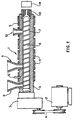
- FIG. 1 shows a twin screw extrusion device 1 containing a drive motor 2, a gear reducer 3, a drive belt 4, an extruder barrel 5, a screw 6, a screw channel 7, an upstream supply port or hopper 8, a downstream supply port 9, a downstream devolatilizer 10, a heater 11, a thermocouple 12, a die or head pressure generator 13, and a pelletizer 14.
- the barrel 5 consists of modular barrel sections, each separately heated with heater 11 and temperature controlled by thermocouple 12. With modular barrel sections, it is possible to locate feed ports and devolatilizing ports at required locations, and to provide segregated temperature control along the screw channel 7.
- the screw 6 is also modular, enabling the screw to be configured with modular screw elements and kneading elements having the appropriate lengths, pitch angles, etc. in such a way as to provide optimum conveying, mixing, reaction, devolatilizing and pumping conditions.
- the components to be reacted and extruded e.g., the base resin and chemical initiator
- enter the extrusion apparatus from the first upstream supply port 8 and/or second downstream supply port 9.
- the base resin usually in the form of solid pellets, chips, granules, or other forms can be fed to the first upstream supply port 8 and second downstream supply port 9 by starve feeding, gravity feeding, volumetric feeding, loss-in-weight feeding, or other known feeding methods. Feeding of the chemical initiator to the extruder depends in part on the nature of the initiator.
- the base resin and initiator are preblended prior to being added to the extruder, and the preblend, the base resin and/or additional initiator may be added through either upstream supply port 8, downstream supply port 9, or both.
- the base resin and initiator can preferably be added to the extruder separately through upstream supply port 8, downstream supply port 9, or both. This does not preclude other methods of adding the base resin and initiator to the extruder.
- the resin is melted and the initiator is dispersed into the molten resin as it is heated, but preferably still at a lower temperature than is needed for crass-linking.
- Heating takes place from two sources: (1) external barrel heating from heaters 11, and (2), internal heating from viscous dissipation within the polymer melt itself.
- the temperature of the molten resin and initiator reach a critical point, onset of the cross-linking reaction takes place. It is preferable, although not absolutely necessary, that the time required for completion of the cross-linking reaction does not exceed the residence time in the screw channel 7.
- the rotational speed of the extruder screw preferably ranges from about 50 to about 500 revolutions per minute.
- the cross-linked resin is pumped in molten form through die 13, such as for example a strand die, to pelletizer 14 such as, for example, a water bath pelletizer, underwater granulator, etc.
- the rotational speed of the screw 6 can be of any suitable value. Generally, the rotational speed of screw 6 is from about 50 revolutions per minute to about 500 revolutions per minute.
- the barrel temperature which is controlled by thermocouples 12 and generated in part by heaters 11, is from 40°C to 250°C.
- the temperature range for mixing the base resin and initiator in the upstream barrel zones is from about the melting temperature of the base resin to below the cross-linking onset temperature. and preferably within 40°C of the melting temperature of the base resin. For example, for an unsaturated polyester base resin the temperature is preferably 90°C to 130°C.
- the temperature range for the cross-linking reaction in the downstream barrel zones is above the cross-linking onset temperature and the base resin melting temperature, preferably within 150°C of the base resin melting temperature.
- the temperature is preferably 90°C to 250°C.
- the die or head pressure generator 13 generates pressure from 50 pounds per square inch (345 x 10 3 Pa)to 500 pounds per square inch (3450 x 10 3 Pa).
- the screw is allowed to rotate at 100 revolutions per minute, the temperature along barrel 5 is maintained at 70°C in the first barrel section and 160°C further downstream, and the die pressure is 50 pounds per square inch (345 x 10 3 Pa).
- the residence time is preferably in the range of 10 seconds to 5 minutes.
- the rotational speed of a rotor in the device is preferably 10 to 500 revolutions per minute.
- a reactive base resin and a chemical initiator are fed to a reactive melt mixing apparatus and cross-linking is carried out at high temperature and high shear to produce a cross-linked resin which enables the preparation of low fix temperature toners with good fusing latitude and vinyl offset properties.
- the base resin may have a reactive polymer, preferably a linear reactive polymer such as, for example, linear unsaturated polyester.
- the base resin may have a degree of unsaturation of 0.1 to 30 mole percent, preferably 5 to 25 mole percent.
- the linear unsaturated polyester base resin may be characterized by number-average molecular weight (M n ) as measured by gel permeation chromatography (GPC) in the range typically from 1000 to 20,000, and preferably from 2000 to 5000, weight-average molecular weight (M w ) in the range typically from 2000 to 40,000, and preferably from 4000 to 15,000.
- M w /M n may be in the range typically from 1.5 to 6, and preferably from 2 to 4.
- Onset glass transition temperature (T g ) as measured by differential scanning calorimetry (DSC) may be in the range typically from 50°C to 70°C, and preferably from 51°C to 60°C.
- Melt viscosity as measured with a mechanical spectrometer at 10 radians per second may be from 5.000 to 200,000 g/(cm ⁇ s)(poise), and preferably from 20,000 to 100,000 g/(cm ⁇ s)(poise), at 100°C and drops sharply with increasing temperature to from 100 to 5000 g/(cm ⁇ s)(poise), and preferably from 400 to 2,000 g/(cm ⁇ s)(poise), as temperature rises from 100°C to 130°C.
- Linear unsaturated polyesters used as the base resin are low molecular weight condensation polymers which may be formed by the step-wise reactions between both saturated and unsaturated diacids (or annydrides) and dihydric alcohols (glycols or diols).
- the resulting unsaturated polyesters are reactive (e.g., cross-linkable) on two fronts: (i) unsaturation sites (double bonds) along the polyester chain and (ii) functional groups such as carboxyl, hydroxy, etc. groups amenable to acid-base reactions.
- Typical unsaturated polyesters that can be used are prepared by melt polycondensation or other polymerization processes using diacids and/or anhydrides and diols.
- Suitable diacids and anhydrides include but are not limited to saturated diacids and/or anhydrides such as, for example, succinic acid, glutaric acid, adipic acid, pimelic acid, suberic acid, azelaic acid, sebacic acid, isophthalic acid, terephthalic acid, hexachloroendomethylene tetrahydrophthalic acid, phthalic anhydride, chlorendic anhydride, tetrahydrophthalic anhydride, hexahydrophthalic anhydride, endomethylene tetrahydrophthalic anhydride, tetrachlorophthalic anhydride, tatrabromophthalic anhydride, and the like and mixtures thereof; and unsaturated diacids and/or anhydrides such as, for example, maleic acid, fumaric acid, chloromaleic acid, methacrylic acid, acrylic acid, itaconic acid, citraconic acid, mesaconic acid, maleic
- Suitable diols include but are not limited to, for example propylene glycol, ethylene glycol, diethylene glycol, neopentyl glycol, dipropylene glycol, dibromaneopentyl glycol, propoxylated bisphenol-A, 2,2,4-trimetylpentane-1,3-diol, tetrabromo bisphenol dipropoxy ether, 1,4-butanediol, and the like and mixtures thereof, soluble in good solvents such as, for example, tetrahydrofuran, toluene and the like.
- Preferred linear unsaturated polyester base resins are prepared from diacids and/or anhydrides such as, for example maleic anhydride, fumaric acid, and the like end mixtures thereof, and diols such as, for example, propoxylated bisphenol-A, propylene glycol, and the like and mixtures thereof.
- a particularly preferred polyester is poly(propoxylated bisphenol A fumarate).
- Substantially any suitable unsaturated polyester can be used, including unsaturated polyesters known for use in toner resins and including unsaturated polyesters whose properties previously made them undesirable or unsuitable for use as toner resins (but which adverse properties are eliminated or reduced by cross- linking them as described).
- Any appropriate initiation technique for cross-linking can be used.
- Chemical initiators such as, for example, organic peroxides or azo-compounds are preferred.
- Suitable organic peroxides include diacyl peroxides such as, for example, decanoyl peroxide, lauroyl peroxide and benzoyl peroxide, ketone peroxides such as, for example, cyclohexanone peroxide and methyl ethyl ketone, alkyl peroxyesters such as, for example, t-butyl peroxy neodecanoate, 2,5-dimethyl 2,5-di (2-ethyl hexanoyl peroxy) hexane, t-amyl peroxy 2-ethyl hexanoate, t-butyl peroxy 2-ethyl hexanoate, t-butyl peroxy acetate, t-amyl peroxy acetate, t-but
- alkyl hydroperoxides such as, for example, 2,5-dihydro peroxy 2,5-dimethyl hexane, cumene hydroperoxide, t-butyl hydroperoxide and t-amyl hydroperoxide, and alkyl peroxyketals such as, for example, n-butyl 4,4-di (t-butyl peroxy) valerate, 1,1-di (t-butyl peroxy) 3,3,5-trimethyl cyclohexane, 1,1-di (t-butyl peroxy) cyclohexan
- Suitable azo-compounds include azobis-isobutyronitrile, 2,2'-azobis (isobutyronitrile), 2,2'-azobis (2,4-dimethyl valeronitrile), 2,2 -azobis (methyl butyronitrile), 1,1'-azobis (cyano cyclohexane) and other similar known compounds.
- the chemical initiator such as for example benzoyl peroxide
- the chemical initiator disassociates to form free radicals which attack the linear unsaturated base resin polymer chains (e.g., at double bonds) to form polymeric radicals.
- Cross-linking occurs as these polymeric radicals react with other unsaturated chains or other polymeric radicals many times, forming very high molecular weight gel particles with high cross-linking density.
- the cross-linking is characterized by at least one reactive site (e.g., one unsaturation) within a polymer chain reacting substantially directly (e.g., with no intervening monomer(s)) with at least one reactive site within a second polymer chain, and by this reaction occurring repeatedly to form a series of cross-linked units.
- This polymer cross-linking reaction may occur by a number of mechanisms. Without intending to be bound by theory, it is believed that the cross-linking may occur through one or more of the following mechanisms:
- an exemplary propoxylated bisphenol A fumarate unsaturated polymer undergoes a cross-linking reaction with a chemical cross-linking initiator, such as, for example, benzoyl peroxide
- a chemical cross-linking initiator such as, for example, benzoyl peroxide
- free radicals produced by the chemical initiator may attack an unsaturation site on the polymer in the following manner:
- m 1 and m 2 are at least 1 and the sum of m 1 and m 2 is not greater than 3, or m 1 and m 2 are independently 1-3, and n is approximately 8 to 11.
- cross-linking may occur between chains of the same exemplary molecule where the free radicals formed from a chemical cross-linking initiator such as benzoic acid attack the carbon of the propoxy group by hydrogen abstraction of a tertiary hydrogen of a benzoyloxy radical in the following manner:
- a small concentration of initiator is adequate to carry out the cross-linking, usually in the range from 0.01 to 10 percent by weight of initiator in the base resin, and preferably in the range from 0.1 to 4 percent by weight of initiator in the base resin.
- An advantage of using a chemical initiator as the cross-linking agent is that by utilizing low concentrations of initiator (for example, less than 10 percent by weight and often less than 4 percent by weight) and carrying our the cross-linking at high temperature, little or no unreacted initiator remains in the product, and therefore, the residual contaminants produced in the cross-linking reaction are minimal.
- the cross-linked resin produced is a clean and safe polymer mixture comprising cross-linked gel particles and a noncross-linked or linear portion but no sol.
- Gel Content Total Sample Weight - Weight of Soluble Polymer Total Sample Weight x 100%
- cross-linked polymer which' is not gel that is, low cross-link density polymer or sol, as would be obtained in conventional cross-linking processes such as, for example, polycondensation, bulk, solution, suspension, emulsion and suspension polymerization processes.
- the cross-linked portions of the cross-linked resin consist essentially of very high molecular weight microgel particles with high density cross-linking (as measured by gel content) and which are not soluble in substantially any solvents such as, for example, tetrahydrofuran, toluene and the like.
- the microgel particles are highly cross-linked polymers with a short cross-link distance of zero or a maximum of one atom such as, for example, oxygen.
- the linear portions of the cross-linked resin have substantially the same number average molecular weight (M n ), weight-average molecular weight (M w ), molecular weight distribution (M w /M n ), onset glass transition temperature (T g ) and melt viscosity as the base resin.
- the entire cross-linked resin may have an onset glass transition temperature of from 50°C to 70°C, and preferably from 51°C to 60°C, and a melt viscosity of from 5,000 to 200,000 g/(cm ⁇ s)(poise), and preferably from 20,000 to 100,000g/(cm ⁇ s)(poise) at 100°C and from 10 to 20,000 poise at 150°C.
- Cross-linked unsaturated polyester resins prepared by processes in accordance with the present invention as described above enable the preparation of toners with minimum fix temperatures in the range of 100°C to 200°C, preferably 100°C to 160°C, more preferably 110° to 140°C. Also, these low fix temperature toners have fusing latitudes ringing from 10°C to 120°C and preferably more than 20°C and more preferably more than 30°C. Toners can be produced which have minimized, or substantially no, vinyl offset.
- Cross-linked polymers produced by processes in accordance with the invention, as described above, have the important rheological property of enabling preparation of toners showing low fix temperature and high offset temperature.
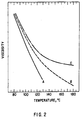
- the low fix temperature is a function of the molecular weight and molecular weight distribution of the linear portion, and is believed not to be significantly affected by the amount of microgel or degree of cross-linking in the resin. This is portrayed by the proximity of the viscosity curves at low temperature such as for example at 100°C as shown in Figure 2 for cross-linked unsaturated polyester.
- the hot offset temperature is increased with the presence of microgel particles which impart elasticity to the resin. With higher degree of cross-linking or gel content, the hot offset temperature increases.
- the hot offset temperature can increase approximately 30%. Again, this can be achieved by cross-linking in the melt state at high temperature and high shear such as, for example, in an extruder resulting in the formation of microgel alone, distributed substantially uniformly throughout the linear portion, and no intermediates which are cross-linked polymers with low cross-linking density (sol).
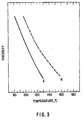
- cross-linked intermediate polymers are generated by conventional polymerization processes the viscosity curves shift in parallel from low to high degree of cross-linking as shown in Figure 3. This is reflected in increased hot offset temperature, but also increased minimum fix temperature.
- reactive melt mixing processes in accordance with the invention have several other important advantages.
- the minimum fix temperature can be easily manipulated.
- the hot offset temperature can be easily manipulated by the gel content in the cross-linked resin which can be controlled by the amount of initiator fed to the extruder and/or regulating the entruder process conditions such as, for example, feed rate, screw rotational speed, barrel temperature profile and screw configuration and length.
- Cross-linking by the use of chemical initiators in the extruder is one of the cleanest means of modifying resin, since very low concentrations of initiators are used, often less than 4 percent by weight, and the residual contaminants of the cross-linking reaction are minimal.
- the resins are generally present in the toner in an amount of from 40 to 98 percent by weight. and more preferably from 70 to 98 percent by weight, although they may be present in greater or lesser amounts.
- toner resin can be subsequently melt blended or otherwise mixed with a colorant, charge carrier additives, surfactants, emulsifiers, pigment dispersants, flow additives, and the like.
- the resultant product can then be pulverized by known methods such as milling to form toner particles.
- the toner particles preferably have an average volume particle diameter of 5 to 25, more preferably 10 to 20 ⁇ m.
- Suitable colorants can be employed in the toners, including suitable colored pigments, dyes, and mixtures thereof including Carbon Black, such as Regal 330 ® carbon black (Cabot), Acetylene Black, Lamp Black, Aniline Black, Chrome Yellow, Zinc Yellow, Sicofast Yellow, Luna Yellow: Novaperm Yellow, Chrome Orange, Bayplast Orange, Cadmium Red, Lithol Scarlet, Hostaperm Red, Fanal Pink, Hostaperm Pink, Lithol Red, Rhodamine Lake B, Brilliant Carmine, Heliogen Blue, Hostaperm Blue, Neopan Blue, PV Fast blue, Cinquassi Green, Hostaperm Green, titanium dioxide, cobalt, nickel, iron powder, Sicopur 4068 FF, and iron oxides such as Mapico Black (Columbia), NP608 and NP604 (Northern Pigment), Bayferrox B610 (Bayer), MO8699 (Mobay), TMB-100 (Magnox), mixtures thereof and the like.
- Carbon Black such as Regal 330 ® carbon black (C
- the colorant preferably carbon black, cyan, magenta and/or yellow colorant, is incorporated in an amount sufficient to impart the desired color to the toner.
- pigment or dye is employed in an amount ranging from 2 to 60 percent by weight, and preferably from 2 percent by weight for color toner and 5 to 60 percent by weight for black toner.
- Suitable effective positive or negative charge enhancing additives can be selected for incorporation into the toner compositions, preferably in an amount of 01 to 10, more preferably 1 to 3, percent by weight.
- suitable effective positive or negative charge enhancing additives include quaternary ammonium compounds inclusive of alkyl pyridinium halides; alkyl pyridinium compounds, reference U.S. Pat. No, 4,298,672; organic sulfate and sulfonate compositions, reference U.S. Pat No. 4,338,390; cetyl pyridinium tetrafluoroborates; distearyl dimethyl ammonium methyl sulfate; aluminum salts such as Bontron E84TM or E88TM (Hodogaya Chemical): and the like.
- the resulting toner particles optionally can be formulated into a developer composition by mixing with carrier particles.
- carrier particles include those particles that are capable of triboelectrically obtaining a charge of opposite polarity to that of the toner particles. Accordingly, carrier particles may be selected so as to be of a negative polarity in order that toner particles which are positively charged will adhere to and surround the carrier particles.
- carrier particles include granular zircon, granular silicon, glass, steel, nickel, iron ferrites, silicon dioxide, and the like. Additionally, there can be selected as carrier particles nickel berry carriers as disclosed in U.S. Pat. No.
- 3,847,604 which are comprised of nodular carrier beads of nickel, characterized by surfaces of reoccurring recesses and protrusions thereby providing particles with a relatively large external area.
- Other carners are disclosed in U.S. Patents Nos. 4,937,166 and 4,935,326.
- the selected carrier particles can be used with or without a coating, the coating generally being comprised of fluoropolymers, such as polyvinylidene fluoride resins, terpolymers of styrene, methyl methacrylate, a silane, such as triethoxy silane, tetrafluoroethylenes, other known coatings and the like.
- fluoropolymers such as polyvinylidene fluoride resins, terpolymers of styrene, methyl methacrylate, a silane, such as triethoxy silane, tetrafluoroethylenes, other known coatings and the like.
- the diameter of the carrier particles is generally from 50 ⁇ m to 1,000 ⁇ m preferably 200 ⁇ m, thus allowing these particles to possess sufficient density and inertia to avoid adherence to the electrostatic images during the development process.
- the carrier particles can be mixed with the toner particles in various suitable combinations. Best results are obtained when 1 part carrier to 10 parts to 200 parts by weight of toner are mixed.
- the toners produced can be used in known electrostatographic imaging methods, although the fusing energy requirements of some of those methods can be reduced in view of the advantageous fusing properties of the subject toners as discussed herein.
- the toners or developers can be charged, e.g.. triboelectrically, and applied to an oppositely charged latent image on an imaging member such as a photoreceptor or jonographic receiver.
- the resultant toner image can then be transferred, either directly or via an intermediate transport member, to a support such as paper or a transparency sheet.
- the toner image can then be fused to the support by application of heat and/or pressure, for example with a heated fuser roll at a temperature lower than 200°C. preferably lower than 160°C, more preferably lower than 140°C, and more preferably 110°C.
- a cross-linked unsaturated polyester resin is prepared by the reactive extrusion process by melt mixing 99.3 parts of a linear unsaturated polyester with the following structure: wherein n is the number of repeating units and having M n of 4.000, M w of 10,300, M w /M n of 2.58 as measured by GPC, onset T g of 55°C as measured by DSC, and melt viscosity of about 29,000 g/(cm ⁇ s)(poise) at 100°C and 750 g/(cm ⁇ s)(poise) at 130°C as measured at 10 radians per second, and 0.7 parts benzoyl peroxide initiator as outlined in the following procedure.
- the unsaturated polyester resin and benzoyl peroxide initiator are blended in a rotary tumble blender for 30 minutes.
- the resulting dry mixture is then fed into a Werner & Pfleiderer ZSK-30 twin screw extruder, with a screw diameter of 30.7 mm and a length-to-diameter (L/D) ratio of 37.2, at 4.54 kg/h (10 pounds per hour) using a loss-in-weight feeder.
- the cross-linking is carried out in the extruder using the following process conditions: barrel temperature profile of 70/140/140/140/140/ 140/140°C, die head temperature of 140°C, screw speed of 100 revolutions per minute and average residence time of about three minutes.
- the extrudate melt upon exiting from the strand die, is cooled in a water bath and pelletized.
- the product which is cross-linked polyester has an onset T g of 54°C as measured by DSC, melt viscosity of 40,000 g/(cm ⁇ s)(poise) at 100°C and 150 g/(cm ⁇ s)(poise) at 160°C as measured at 10 radians per second, a gel content of 0.7 weight percent and a mean microgel particle size of 1 ⁇ m as determined by transmission electron microscopy.
- the linear and cross-linked pardons of the product are separated by dissolving the product in tetrahydrofuran and filtering off the microgel.
- the dissolved part is reclaimed by evaporating the tetrahydrofuran.
- This linear part of the resin when characterized by GPC, is found to have M n of 3,900, M w of 10,100,. M w /M n of 2.59, and onset T g of 55°C which is substantially the same as the original noncross-linked resin, which indicates that it contains no sol.
- a toner is formulated by melt mixing the above prepared cross-linked unsaturated polyester resin, 92 percent by weight, with 6 percent by weight carbon black and 2 percent by weight alkyl pyridinium halide charge enhancing additive in a Haake batch mixer.
- the toner is pulverized and classified to form a toner with an average particle diameter of about 9.1 ⁇ m and a geometric size distribution (GSD) of 1.32.
- GSD geometric size distribution
- the toner is evaluated for fixing, blocking, and vinyl offset performance. Results show that the cold offset temperature is 110°C, the minimum fix temperature is 126°C, the hot offset temperature is 135°C, and the fusing latitude is 9°C. Also, the toner has excellent blocking performance ( 53°C as measured by DSC) and shows no apparent vinyl offset.
- a cross-linked unsaturated polyester resin is prepared by the reactive extrusion process by melt mixing 98.6 parts of a linear unsaturated polyester with the structure and properties described in Example I, and 1.4 parts benzoyl peroxide initiator as outlined in the following procedure.
- the unsaturated polyester resin and benzoyl peroxide initiator are blended in a rotary tumble blender for 30 minutes.
- the resulting dry mixture is then fed into a Werner & Pfleiderer ZSK-30 twin screw extruder at 4.54 kg/h (10 pounds per hour) using a loss-in-weight feeder.
- the cross-linking is carded out in the extruder using the following process conditions: barrel temperature profile of 70/160/160/160/160/ 160/160°C, die head temperature of 160°C, screw rotational speed of 100 revolutions per minute and average residence time of three minutes.
- the extrudate melt upon exiting from the strand die, is cooled in a water bath and pelletized.
- the product which is cross-linked polyester has an onset T g of 54°C as measured by DSC. melt viscosity of 65,000 g/(cm ⁇ s)(poise) at 100°C and 12,000 g/(cm ⁇ s)(poise) at 160°C as measured at 10 radians per second a gel cantent of 50 weight percent and a mean microgel particle size of 0.1 ⁇ m as determined by transmission electron microscopy.
- the linear and cross-linked portions of the product are separated by dissolving the product in tetrahydrofuran and filtering off the microgel.
- the dissolved part is reclaimed by evaporating the tetrahydrofuran.
- This linear part of the resin when characterized by GPC, is found to have M n of 3,900, M w of 10,000, M w /M n of 2.59, and onset T g of 55°C which is substantially the same as the original noncross-linked resin, which indicates that it contains no sol.
- a toner is prepared and evaluated according to the same procedure as in Example I except that the average particle diameter is 9.8 ⁇ m and the GSD is 1.33. Results show that the cold offset temperature is 110°C, the minimum fix temperature is 135°C, the hot offset temperature is 195°C, and the fusing latitude is 60°C. Also, the toner has excellent blocking performance ( 53°C as measured by DSC) and shows no apparent vinyl offset
- This comparative example shows the effect of changes in gel content on toner fixing performance for cross-linked unsaturated polyester resins.
- Two resins are compared in this example.
- Resin A is linear unsaturated polyester with the structure and properties of the linear unsaturated polyester described in Example I.
- Resin B is partially cross-linked polyester resin prepared by the reactive extrusion process by melt mixing 99.0 parts linear unsaturated polyester (Resin A) and 1.0 part benzoyl peroxide initiator as outlined in the following procedure.
- the unsaturated polyester resin (Resin A) and benzoyl peroxide initiator are blended in a rotary tumble blender for 30 minutes.
- the resulting dry mixture is then fed into a Werner & Pfleiderer ZSK-30 twin screw extruder at 4.54 kg/h (10 pounds per hour) using a loss-in-weight feeder.
- the cross-linking is carried out in the extruder using the following process conditions: barrel temperature profile of 70/160/160/160/160/160/160°C, die head temperature of 160°C, screw rotational speed of 100 revolutions per minute and average residence time of about three minutes.
- the extrudate melt upon exiting from the strand die, is cooled in a water bath and pelletized.
- Toners A and B are prepared from the resins A and B, and evaluated according to the same procedure as in Example I.
- the toner of resin A has an average particle diameter of 9.3 ⁇ m and a GSD of 1.29.
- the toner of resin B has an average particle diameter of 10.1 ⁇ m and a GSD of about 1.32.
- Results of fixing tests are shown in Table 1.
- Results for Toner A produced from Resin A show a cold offset temperature of 110°C and a hot offset temperature at 120°C. Due to the proximity of COT and HOT, it is not possible to determine the minimum fix temperature, indicating that the fusing latitude is very small. From Table 1, it can be seen that with Toner B (i.e.
- This comparative example shows the difference between cross-linked polyester resins prepared by a conventional cross-linking method and a resin prepared according to the present invention.
- Two additional resins are considered in this example, a linear polyester and a cross-linked polyester prepared by conventional cross-linking.
- a linear polyester resin, Resin C is prepared by the following procedure. About 1.645 grams of dimethyl terephthalate, 483 grams of 1,2-propane diol, and 572 grams of 2.3-butane diol are charged to a three liter, four necked resin kettle which is fitted with a thermometer, a stainless steel stirrer, a glass inlet tube and a flux condenser. The flask is supported in an electric heating mantle. Argon gas is allowed to flow through the glass inlet tube thereby sparging the reaction mixture and providing an inert atmosphere in the reaction vessel.
- the stirrer and heating mantle are activated and the reaction mixture is heated to 80°C at which time 0.96 grams of tetraisapropyl titanate is added to the reaction mixture.
- the reaction mixture is gradually heated to a temperature of 170°C whereupon methanol from the condensation reaction is condensed and is removed as it is formed.
- the reaction temperature is slowly increased to 200°C. Over this period, 94 weight percent of the theoretical methanol is removed.
- the reactor is cooled to room temperature and the reactor is modified by replacing the reflux condenser with a dry ice-acetone cooled trap with the outlet of the trap connected to a laboratory vacuum pump through an appropriate vacuum system.
- Resin D is prepared by polyesterification by the following procedure. 1,645 grams of dimethyl terephthalate, 483 grams of 1.2-propane dial, 572 grams of 1,3-butane dial and 15 grams of pentaerythritoal as cross-linking agent are charged to a three liter, four necked resin kettle and the polyesterification and cross-linking are carried out under the same conditions as above. The resulting polymer is found to have a hydroxyl number of 48, an acid number of 0.7, a methyl ester number of 7.5 and a glass transition temperature of 56°C.
- the polymer By dissolution in chloroform and filtration through a 0.22 ⁇ m MF millipore filter under air pressure, the polymer is found to contain about 16 weight percent gel. Using vapor pressure osmometry in methyl ethyl ketone, the number average molecular weight of the soluble fraction of the polymer is found to be 6,100 which is comprised of linear polymer with a number average molecular weight of 4,200 and sol.
- Toners C and D are prepared from the two resins, C and D, and evaluated according to the same procedure as in Example I. Results of fixing tests are shown in Table 2 along with the results for the Toner B of Comparative Example I (i.e. a toner produced from a cross-linked unsaturated polyester resin prepared according to the present invention).
- the toner particles of Resin C have an average particle diameter of 8.7 ⁇ m and a GSD of 1.30, while those of Resin D have an average particle diameter of 10.5 ⁇ m and a GSD of 1.31.
- the hot offset temperature increases (32°C) with increasing degree of cross-linking (sol and gel content is 30%).
- a cross-linked unsaturated polyester resin is prepared by the reactive extrusion process by melt mixing 98.5 parts of a linear unsaturated polyester with the structure described in example I and having M n of 3.600, M w of 11.000. M w /M n of 3.06 as measured by GPC, onset T g of 55°C as measured by DSC, and melt viscosity of 30,600 g/(cm ⁇ s)(poise) at 100°C and 800 g/(cm ⁇ s)(poise) at 130°C as measured at 10 radians per second, and 1.2 parts benzoyl peroxide initiator as outlined in the following procedure.
- a 50 gram blend of the unsaturated polyester resin and benzoyl peroxide initiator is prepared by blending in a rotary tumble blender for 20 minutes. The resulting dry mixture is then charged into a Haake batch mixer, and the cross-linking is carried out in the mixer using the following process conditions: barrel temperature of 160°C, rotor speed of 100 revolutions per minute. and mixing time of 15 minutes.
- the product which is cross-linked polyester has an onset T g of 54°C as measured by DSC, melt viscosity of 42,000 g/(cm ⁇ s)(poise)at 100°C and 1,200 g/(cm ⁇ s)(poise) at 160°C as measured at 10 radians per second, a gel content of 11 weight percent and a mean microgel particle site of 0.1 ⁇ m as determined by transmission electron microscopy.
- the linear and cross-linked portions of the product are separated by dissolving the product in tetrahydrofuran and filtering off the microgel.
- the dissolved part is reclaimed by evaporating the tetrahydrofuran.
- This linear part of the resin when characterized by GPC and DSC, is found to have M n of 3,500, M w of 10,700, M w /M n of 3.06. and onset T g of 55°C, which is substantially the same as the original noncross-linked resin, which indicates that it contains substantially no sol.
- a toner is prepared and evaluated according to the same procedure as in Example I except that the average particle diameter is 9.9 ⁇ m and the GSD is about 1.31. Results show that the cold offset temperature is 110°C, the minimum fix temperature is 127°C, the hot offset temperature is 150°C, and the fusing latitude is 23°C. Also, the toner has excellent blocking performance ( 53°C as measured by DSC) and shows no apparent vinyl offset.
- a cross-linked unsaturated polyester resin is prepared by the reactive extrusion process by melt mixing 98.7 parts of a linear unsaturated polyester with the structure and properties described in Example III and 1.3 puts t-amyl peroxy 2-ethyl hexanoate initiator as outlined in the following procedure.
- the resulting product which is cross-linked polyester has an onset T g of 54°C as measured by DSC, melt viscosity of 51,000 g/(cm ⁇ s)(poise) at 100°C and 3,100 g/(cm ⁇ s)(poise) at 160°C as measured at 10 radians per second, a gel content of 17 weight percent and a mean microgel particle size of about 0.1 ⁇ m as determined by transmission electron microscopy.
- the linear and cross-linked portions of the product are separated by dissolving the product in tetrahydrofuran and filtering off the microgel.
- the dissolved part is reclaimed by evaporating the tetrahydrofuran.
- This linear part of the resin when characterized by GPC and DSC, is found to have M n of 3,500, M w of 10,600, M w /M n of 3.03, and onset Tg of 55°C which is substantially the same as the original noncross-linked resin, which indicates that it contains substantially no sol.
- a toner is prepared and evaluated according to the same procedure as in Example I except that the average particle diameter is about 10.4 ⁇ m and the GSD is 1.32. Results show that the cold offset temperature is 110°C, the minimum fix temperature is 130°C, the hot offset temperature is 160°C, and the fusing latitude is 30°C. Also, the toner has excellent blocking performance ( 53°C as measured by DSC) and shows no apparent vinyl offset.
- a cross-linked unsaturated polyester resin is prepared by the reactive extrusion process by melt mixing 98.9 parts by weight of a linear unsaturated polyester with the structure and properties described in Example I, and 1.1 parts by weight benzoyl peroxide initiator as outlined in the following procedure.
- the unsaturated polyester resin and benzoyl peroxide initiator are blended in a rotary tumble blender for 30 minutes.
- the resulting dry mixture is then fed into a Werner & Pfleiderer ZSK-30 twin screw extruder at 4.54 kg/h (10 pounds per hour) using a loss-in-weight feeder.
- the cross-linking is carried out in the extruder using the following process conditions: barrel temperature profile of 70/140/140/140/140/ 140/140°C, die head temperature of 140°C, screw rotational speed of 100 revolutions par minute and average residence time of about three minutes.
- the extrudate melt upon exiting from the strand die, is cooled in a water bath and pelletized.
- the resulting product which is cross-linked polyester has an onset T g of 54°C as measured by DSC, melt viscosity of 45,000 g/(cm ⁇ s)(poise) at 100°C and 1,600 g/(cm ⁇ s)(poise) at 160°C as measured at 10 radians per second, a gel content of 13 weight percent and a mean microgel particle size of about 0.1 ⁇ m as determined by transmission electron microscopy.
- the linear and cross-linked portions of the product are separated by dissolving the product in tetrahydrofuran and filtering off the rnicrogel.
- the dissolved part is reclaimed by evaporating the tetrahydrofuran.
- This linear part of the resin when characterized by GPC and DSC, is found to have M n of 3,900, M w of 10,100, M w /M n of 2.59, and onset T g of 55°C. which is substantially the same as the original noncross-linked resins, which indicates that it contains substantially no sol.
- a toner is prepared aria evaluated according to the same procedure as in Example I, except that the average particle diameter is about 9.6 ⁇ m and the GSD is 1.30. Results show that the cold offset temperature is 110°C the minimum fix temperature is 128°C, the hot offset temperature is 155°C, arid the fusing latitude is 27°C. Also, the toner has excellent blocking performance ( 53°C as measured by DSC) and shows no apparent vinyl offset.
Landscapes
- Physics & Mathematics (AREA)
- Spectroscopy & Molecular Physics (AREA)
- General Physics & Mathematics (AREA)
- Developing Agents For Electrophotography (AREA)
- Processes Of Treating Macromolecular Substances (AREA)
- Adhesives Or Adhesive Processes (AREA)
Applications Claiming Priority (2)
| Application Number | Priority Date | Filing Date | Title |
|---|---|---|---|
| US07/814,641 US5376494A (en) | 1991-12-30 | 1991-12-30 | Reactive melt mixing process for preparing cross-linked toner resin |
| US814641 | 1991-12-30 |
Publications (2)
| Publication Number | Publication Date |
|---|---|
| EP0550989A1 EP0550989A1 (en) | 1993-07-14 |
| EP0550989B1 true EP0550989B1 (en) | 2000-07-05 |
Family
ID=25215613
Family Applications (1)
| Application Number | Title | Priority Date | Filing Date |
|---|---|---|---|
| EP92311544A Expired - Lifetime EP0550989B1 (en) | 1991-12-30 | 1992-12-17 | Reactive melt mixing process for preparing cross-linked toner resin |
Country Status (5)
| Country | Link |
|---|---|
| US (2) | US5376494A (enExample) |
| EP (1) | EP0550989B1 (enExample) |
| JP (1) | JP3239904B2 (enExample) |
| CA (1) | CA2081539C (enExample) |
| DE (1) | DE69231219T2 (enExample) |
Families Citing this family (87)
| Publication number | Priority date | Publication date | Assignee | Title |
|---|---|---|---|---|
| US5395723A (en) * | 1992-09-30 | 1995-03-07 | Xerox Corporation | Low gloss, low melt cross-linked toner resins |
| US5407772A (en) * | 1993-11-30 | 1995-04-18 | Xerox Corporation | Unsaturated polyesters |
| US5368970A (en) * | 1993-12-06 | 1994-11-29 | Xerox Corporation | Toner compositions with compatibilizer |
| JP3591010B2 (ja) * | 1994-07-29 | 2004-11-17 | 三菱化学株式会社 | 静電荷像現像用トナーの製造方法 |
| US5480756A (en) * | 1994-10-31 | 1996-01-02 | Xerox Corporation | High gloss, low melt crosslinked resins and toners |
| US5536613A (en) * | 1995-02-23 | 1996-07-16 | Xerox Corporation | Processes for preparing toner |
| US5571655A (en) * | 1995-04-17 | 1996-11-05 | Xerox Corporation | Toner reactive melt mixing process |
| US5556732A (en) * | 1995-05-30 | 1996-09-17 | Xerox Corporation | Processes for preparing toners with selectable gloss |
| US5650484A (en) * | 1995-07-12 | 1997-07-22 | Xerox Corporation | Feedback control system for polymer modification of toner resins and toners |
| US5700413A (en) * | 1996-03-27 | 1997-12-23 | Xerox Corporation | Extruder die plate with removable splitters |
| US5997272A (en) * | 1996-03-27 | 1999-12-07 | Xerox Corporation | Extruder die insert plate system |
| US5686219A (en) * | 1996-03-29 | 1997-11-11 | Xerox Corporation | Toner extruder feed port insert |
| US5656408A (en) * | 1996-04-29 | 1997-08-12 | Xerox Corporation | Coated carrier particles |
| US5874034A (en) * | 1997-04-14 | 1999-02-23 | Xerox Corporation | Swell reducing extrusion die |
| US5929136A (en) * | 1997-06-13 | 1999-07-27 | Xerox Corporation | Coated carriers |
| US5853942A (en) * | 1997-09-02 | 1998-12-29 | Xerox Corporation | Tuner processes |
| US5916722A (en) * | 1998-02-05 | 1999-06-29 | Xerox Corporation | Toner compositions |
| US5948583A (en) * | 1998-04-13 | 1999-09-07 | Xerox Corp | Toner composition and processes thereof |
| US5998077A (en) * | 1998-06-29 | 1999-12-07 | Xerox Corporation | Coated carrier |
| US6063827A (en) * | 1998-07-22 | 2000-05-16 | Xerox Corporation | Polyester process |
| US6004712A (en) * | 1998-08-26 | 1999-12-21 | Xerox Corporation | Coated carrier |
| US5935750A (en) * | 1998-08-26 | 1999-08-10 | Xerox Corporation | Coated carrier |
| US6042981A (en) * | 1998-08-26 | 2000-03-28 | Xerox Corporation | Coated carrier |
| US6010812A (en) * | 1998-08-26 | 2000-01-04 | Xerox Corporation | Coated carrier |
| US5945244A (en) * | 1998-08-26 | 1999-08-31 | Xerox Corporation | Coated carrier |
| US6054179A (en) * | 1998-11-30 | 2000-04-25 | Xerox Corporation | Processes for the preparation of colorants |
| US6083652A (en) * | 1999-03-01 | 2000-07-04 | Xerox Corporation | Coated carriers |
| US6124071A (en) * | 1999-03-01 | 2000-09-26 | Xerox Corporation | Toner compositions |
| US6051354A (en) * | 1999-04-30 | 2000-04-18 | Xerox Corporation | Coated carrier |
| US6017668A (en) * | 1999-05-26 | 2000-01-25 | Xerox Corporation | Toner compositions |
| US6221551B1 (en) | 1999-09-23 | 2001-04-24 | Xerox Corporation | Method of producing liquid toner with polyester resin |
| US6319647B1 (en) * | 2000-03-07 | 2001-11-20 | Xerox Corporation | Toner and developer for magnetic brush development system |
| US6287742B1 (en) | 2000-05-16 | 2001-09-11 | Matsci Solutions, Inc. | Toner compositions and method of producing toner for developing latent electrostatic images |
| US6358659B1 (en) | 2000-08-17 | 2002-03-19 | Xerox Corporation | Coated carriers |
| DE10041621A1 (de) * | 2000-08-24 | 2002-03-07 | Oce Printing Systems Gmbh | Universal-Carrier, Verfahren zu seiner Herstellung und Zwei-Komponenten-Entwickler für elektrophotographische Drucksysteme |
| US6406822B1 (en) | 2000-09-29 | 2002-06-18 | Xerox Corporation | Color-blind melt flow index properties for toners |
| US6593053B1 (en) * | 2000-10-23 | 2003-07-15 | Xerox Corporation | Method for controlling melt rheology of resin mixtures |
| US6359105B1 (en) * | 2000-10-26 | 2002-03-19 | Xerox Corporation | Cross-linked polyester toners and process of making such toners |
| US6376147B1 (en) | 2000-11-27 | 2002-04-23 | Xerox Corporation | Method of producing liquid toner with metallic sheen |
| US6451495B1 (en) | 2001-05-07 | 2002-09-17 | Xerox Corporation | Toner and developer compositions with charge enhancing additives |
| US6426170B1 (en) | 2001-05-07 | 2002-07-30 | Xerox Corporation | Toner and developer compositions with charge enhancing additives |
| US6461783B1 (en) | 2001-05-18 | 2002-10-08 | Dpi Solutions, Inc. | Micro-serrated color toner particles and method of making same |
| US6531255B2 (en) | 2001-05-18 | 2003-03-11 | Dpi Solutions, Inc. | Micro-serrated particles for use in color toner and method of making same |
| US6544705B2 (en) | 2001-05-18 | 2003-04-08 | Dpi Solutions, Inc. | Micro-serrated, dyed color toner particles and method of making same |
| US20030025236A1 (en) * | 2001-08-01 | 2003-02-06 | Xerox Corporation | Toner extruder feed apparatus |
| US6680153B2 (en) | 2002-05-21 | 2004-01-20 | Xerox Corporation | Toner compositions |
| US7288347B2 (en) * | 2004-08-31 | 2007-10-30 | Xerox Corporation | Method of applying spot varnish to xerographic image and emulsion aggregation toners for use therein |
| US20060115758A1 (en) * | 2004-11-30 | 2006-06-01 | Xerox Corporation | Toner including amorphous polyester, cross-linked polyester and crystalline polyester |
| US7632620B2 (en) * | 2005-01-28 | 2009-12-15 | Xerox Corporation | Coated carrier |
| US7354689B2 (en) * | 2005-03-23 | 2008-04-08 | Xerox Corporation | Process for producing toner |
| US20070111130A1 (en) * | 2005-11-15 | 2007-05-17 | Xerox Corporation | Toner compositions |
| US20070111129A1 (en) * | 2005-11-15 | 2007-05-17 | Xerox Corporation | Toner compositions |
| US7419753B2 (en) * | 2005-12-20 | 2008-09-02 | Xerox Corporation | Toner compositions having resin substantially free of crosslinking, crosslinked resin, polyester resin, and wax |
| US8034522B2 (en) * | 2006-11-13 | 2011-10-11 | Reichhold, Inc. | Polyester toner resin compositions |
| MY149508A (en) * | 2007-07-05 | 2013-09-13 | Univ Malaya | Environmentally friendly natural oil-based toner resin |
| US8420286B2 (en) * | 2008-03-27 | 2013-04-16 | Xerox Corporation | Toner process |
| US8437825B2 (en) * | 2008-07-03 | 2013-05-07 | Cercacor Laboratories, Inc. | Contoured protrusion for improving spectroscopic measurement of blood constituents |
| US8133649B2 (en) | 2008-12-01 | 2012-03-13 | Xerox Corporation | Toner compositions |
| JP5298952B2 (ja) * | 2009-02-27 | 2013-09-25 | 株式会社リコー | 画像形成用トナー、一成分現像剤、二成分現像剤、画像形成方法、画像形成装置およびプロセスカートリッジ |
| JP5225193B2 (ja) * | 2009-04-30 | 2013-07-03 | 三菱レイヨン株式会社 | 架橋ポリエステル樹脂の製造方法 |
| US8293444B2 (en) | 2009-06-24 | 2012-10-23 | Xerox Corporation | Purified polyester resins for toner performance improvement |
| US20100330486A1 (en) * | 2009-06-24 | 2010-12-30 | Xerox Corporation | Toner Compositions |
| US8257899B2 (en) | 2009-08-27 | 2012-09-04 | Xerox Corporation | Polyester process |
| US8383311B2 (en) | 2009-10-08 | 2013-02-26 | Xerox Corporation | Emulsion aggregation toner composition |
| US20110177444A1 (en) | 2010-01-19 | 2011-07-21 | Xerox Corporation | Additive package for toner |
| US8588634B2 (en) * | 2010-02-22 | 2013-11-19 | Xerox Corporation | Electrophotographic apparatus |
| US8431302B2 (en) * | 2010-02-22 | 2013-04-30 | Xerox Corporation | Tunable gloss toners |
| US8431318B2 (en) | 2010-04-09 | 2013-04-30 | Xerox Corporation | Toner compositions and processes |
| US9581926B2 (en) | 2010-04-13 | 2017-02-28 | Xerox Corporation | Imaging processes |
| US8663886B2 (en) | 2010-12-21 | 2014-03-04 | Xerox Corporation | Toner compositions and processes |
| US8227159B1 (en) | 2011-02-24 | 2012-07-24 | Xerox Corporation | Toner compositions and processes |
| US8642241B2 (en) | 2011-12-21 | 2014-02-04 | Xerox Corporation | Mixer apparatus and method of making developer |
| WO2014105488A1 (en) * | 2012-12-26 | 2014-07-03 | Bridgestone Americas Tire Operations, Llc | Appearance enhancer for rubber compositions with antidegradants |
| US9791797B2 (en) | 2016-03-11 | 2017-10-17 | Xerox Corporation | Metallic toner compositions |
| US10358557B1 (en) | 2018-03-07 | 2019-07-23 | Xerox Corporation | Toner compositions and surface polymeric additives |
| US11639053B2 (en) | 2019-03-29 | 2023-05-02 | Xerox Corporation | Process for preparing a three-dimensional printing composition |
| US11001662B2 (en) | 2019-03-29 | 2021-05-11 | Xerox Corporation | Surface additive for three-dimensional polymeric printing powders |
| US10725394B1 (en) | 2019-03-29 | 2020-07-28 | Xerox Corporation | Cross-linked polymeric latex prepared with a low surface tension surfactant |
| US11628494B2 (en) | 2019-03-29 | 2023-04-18 | Xerox Corporation | Surface additive for three-dimensional metal printing compositions |
| US11150568B2 (en) | 2019-03-29 | 2021-10-19 | Xerox Corporation | Toner compositions and processes having reduced or no titania surface additives |
| US11086243B1 (en) | 2020-02-25 | 2021-08-10 | Xerox Corporation | Dual wax toner composition |
| US11086244B1 (en) | 2020-02-25 | 2021-08-10 | Xerox Corporation | Titania-free toner additive formulation with cross-linked organic polymeric additive |
| US11092906B1 (en) | 2020-02-25 | 2021-08-17 | Xerox Corporation | Toner including toner additive formulation |
| US12252568B2 (en) | 2021-10-05 | 2025-03-18 | Xerox Corporation | Silicone copolymer surface additive |
| US12405547B2 (en) | 2022-03-17 | 2025-09-02 | Xerox Corporation | Toner comprising reactive charge control agent |
| US12517445B2 (en) | 2022-03-17 | 2026-01-06 | Xerox Corporation | Toner comprising charge control agent |
| US12429792B2 (en) | 2022-03-17 | 2025-09-30 | Xerox Corporation | Toner comprising charge control agent |
Citations (1)
| Publication number | Priority date | Publication date | Assignee | Title |
|---|---|---|---|---|
| EP0553559A1 (en) * | 1991-12-30 | 1993-08-04 | Xerox Corporation | Cross-linked toner resins |
Family Cites Families (42)
| Publication number | Priority date | Publication date | Assignee | Title |
|---|---|---|---|---|
| US31072A (en) * | 1861-01-08 | Improvement in corn-planters | ||
| US3590000A (en) * | 1967-06-05 | 1971-06-29 | Xerox Corp | Solid developer for latent electrostatic images |
| US3843757A (en) * | 1967-11-15 | 1974-10-22 | Hercules Inc | Process for extruding foamed thermoplastics by utilizing an intermeshing co-rotating twin screw extruder |
| US3678024A (en) * | 1970-01-05 | 1972-07-18 | Dow Chemical Co | Crosslinking of ethylene polymers without a crosslinking agent |
| US3681106A (en) * | 1970-12-11 | 1972-08-01 | Atlas Chem Ind | Electrostatic developer containing polyester resin and a process of using same |
| US3847604A (en) * | 1971-06-10 | 1974-11-12 | Xerox Corp | Electrostatic imaging process using nodular carriers |
| JPS5225427B2 (enExample) * | 1971-09-30 | 1977-07-07 | ||
| JPS5123354B2 (enExample) * | 1973-01-16 | 1976-07-16 | ||
| DE2424364B2 (de) * | 1974-05-16 | 1980-03-06 | Ikegai Tekko K.K., Tokio | Verfahren und Vorrichtung zum vernetzenden Formpressen von hochmolekularen Stoffen |
| DE2806560B2 (de) * | 1978-02-16 | 1981-05-07 | Kabel- und Metallwerke Gutehoffnungshütte AG, 3000 Hannover | Verfahren zur kontinuierlichen Herstellung wärmeisolierter Leitungsrohre |
| US4298672A (en) * | 1978-06-01 | 1981-11-03 | Xerox Corporation | Toners containing alkyl pyridinium compounds and their hydrates |
| JPS55166651A (en) * | 1979-06-15 | 1980-12-25 | Dainippon Ink & Chem Inc | Toner for static charge developer |
| JPS5919329B2 (ja) * | 1979-12-27 | 1984-05-04 | 石原産業株式会社 | 電子写真感光材料 |
| JPS5694362A (en) * | 1979-12-28 | 1981-07-30 | Dainippon Ink & Chem Inc | Toner for electrostatic developer |
| JPS56116041A (en) * | 1980-02-18 | 1981-09-11 | Toyobo Co Ltd | Binder for photographic toner |
| US4338390A (en) * | 1980-12-04 | 1982-07-06 | Xerox Corporation | Quarternary ammonium sulfate or sulfonate charge control agents for electrophotographic developers compatible with viton fuser |
| JPS57109825A (en) * | 1980-12-26 | 1982-07-08 | Kao Corp | Preparation of novel polyester resin |
| US4533614A (en) * | 1982-06-01 | 1985-08-06 | Canon Kabushiki Kaisha | Heat-fixable dry system toner |
| JPS58211166A (ja) * | 1982-06-02 | 1983-12-08 | Canon Inc | トナ−の製造方法 |
| US4513074A (en) * | 1983-06-06 | 1985-04-23 | Xerox Corporation | Stable conductive developer compositions |
| US4973439A (en) * | 1984-07-13 | 1990-11-27 | Xerox Corporation | Process for preparing toner particles |
| US4556624A (en) * | 1984-09-27 | 1985-12-03 | Xerox Corporation | Toner compositions with crosslinked resins and low molecular weight wax components |
| US4788122A (en) * | 1985-03-14 | 1988-11-29 | Kao Corporation | Production of polyester and elecrophotographic toner containing the same |
| US4604338A (en) * | 1985-08-09 | 1986-08-05 | Xerox Corporation | Positively charged colored toner compositions |
| US4935326A (en) * | 1985-10-30 | 1990-06-19 | Xerox Corporation | Electrophotographic carrier particles coated with polymer mixture |
| US4937166A (en) * | 1985-10-30 | 1990-06-26 | Xerox Corporation | Polymer coated carrier particles for electrophotographic developers |
| JPH0740142B2 (ja) * | 1985-11-05 | 1995-05-01 | 日本カーバイド工業株式会社 | 静電荷像現像用トナ− |
| JPS62195677A (ja) * | 1986-02-21 | 1987-08-28 | Kao Corp | 電子写真用現像剤組成物 |
| EP0261585A3 (en) * | 1986-09-26 | 1989-09-06 | Hercules Incorporated | New cross-linking system for making toners that are useful in electrophotography |
| ES2032286T3 (es) * | 1986-12-01 | 1993-02-01 | Kao Corporation | Pigmento en polvo para el revelado de imagenes cargadas electrostaticamente. |
| US4824750A (en) * | 1987-10-30 | 1989-04-25 | Xerox Corporation | Toner compositions with a crosslinked resin component |
| US4990293A (en) * | 1987-11-09 | 1991-02-05 | Regents Of The University Of Minnesota | Process of and apparatus for extruding a reactive polymer mixture |
| CA1326154C (en) * | 1988-02-29 | 1994-01-18 | Koichi Tomiyama | Magnetic toner for developing electrostatic images |
| US4894308A (en) * | 1988-10-17 | 1990-01-16 | Xerox Corporation | Process for preparing electrophotographic toner |
| US5015724A (en) * | 1988-11-18 | 1991-05-14 | Kao Corporation | Process of producing polyester, and developer composition for electrophotography |
| SG48073A1 (en) * | 1990-01-19 | 1998-04-17 | Canon Kk | Electrostatic image developing toner and fixing method |
| US5147747A (en) * | 1990-08-06 | 1992-09-15 | Eastman Kodak Company | Low fusing temperature tone powder of crosslinked crystalline and amorphous polyesters |
| US5089547A (en) * | 1990-08-06 | 1992-02-18 | Eastman Kodak Company | Cross-linked low surface adhesion additives for toner compositions |
| US5057392A (en) * | 1990-08-06 | 1991-10-15 | Eastman Kodak Company | Low fusing temperature toner powder of cross-linked crystalline and amorphous polyester blends |
| US5112715A (en) * | 1990-08-06 | 1992-05-12 | Eastman Kodak Company | Toner compositions containing a multi-purpose additive |
| US5145762A (en) * | 1991-03-29 | 1992-09-08 | Xerox Corporation | Processes for the preparation of toners |
| US5156937A (en) * | 1991-06-10 | 1992-10-20 | Eastman Kodak Company | Reduced viscosity polyester composition for toner powders |
-
1991
- 1991-12-30 US US07/814,641 patent/US5376494A/en not_active Expired - Lifetime
-
1992
- 1992-10-27 CA CA002081539A patent/CA2081539C/en not_active Expired - Lifetime
- 1992-12-17 EP EP92311544A patent/EP0550989B1/en not_active Expired - Lifetime
- 1992-12-17 DE DE69231219T patent/DE69231219T2/de not_active Expired - Lifetime
- 1992-12-22 JP JP34280092A patent/JP3239904B2/ja not_active Expired - Fee Related
-
1993
- 1993-03-23 US US08/035,609 patent/US5401602A/en not_active Expired - Lifetime
Patent Citations (1)
| Publication number | Priority date | Publication date | Assignee | Title |
|---|---|---|---|---|
| EP0553559A1 (en) * | 1991-12-30 | 1993-08-04 | Xerox Corporation | Cross-linked toner resins |
Also Published As
| Publication number | Publication date |
|---|---|
| CA2081539A1 (en) | 1993-07-01 |
| EP0550989A1 (en) | 1993-07-14 |
| JP3239904B2 (ja) | 2001-12-17 |
| US5401602A (en) | 1995-03-28 |
| US5376494A (en) | 1994-12-27 |
| DE69231219D1 (de) | 2000-08-10 |
| CA2081539C (en) | 1997-05-27 |
| JPH05249739A (ja) | 1993-09-28 |
| DE69231219T2 (de) | 2000-11-09 |
Similar Documents
| Publication | Publication Date | Title |
|---|---|---|
| CA2081539C (en) | Reactive melt mixing process for preparing cross-linked toner resin | |
| EP0553559B1 (en) | Cross-linked toner resins | |
| US5500324A (en) | Processes for low melt crosslinked toner resins and toner | |
| US5480756A (en) | High gloss, low melt crosslinked resins and toners | |
| EP0590314B1 (en) | Low gloss, low melt cross-linked toner resins | |
| US5556732A (en) | Processes for preparing toners with selectable gloss | |
| US6359105B1 (en) | Cross-linked polyester toners and process of making such toners | |
| US5536613A (en) | Processes for preparing toner | |
| US5414052A (en) | Processes for preparing toner | |
| US5393630A (en) | Melt mixing processes | |
| US5397671A (en) | Processes for preparing crosslinked resins and toner compositions therefrom | |
| US5571655A (en) | Toner reactive melt mixing process | |
| US6114076A (en) | Reactive melt mixing processes | |
| US5688625A (en) | Toner compositions with dispersed wax | |
| US5853942A (en) | Tuner processes | |
| US5436103A (en) | Modified unsaturated polyesters | |
| JPH0782356A5 (enExample) | ||
| JP2000162818A (ja) | 電子写真用トナー | |
| JPH05323647A (ja) | 現像剤用添加剤及び現像剤組成物 |
Legal Events
| Date | Code | Title | Description |
|---|---|---|---|
| PUAI | Public reference made under article 153(3) epc to a published international application that has entered the european phase |
Free format text: ORIGINAL CODE: 0009012 |
|
| AK | Designated contracting states |
Kind code of ref document: A1 Designated state(s): DE FR GB NL |
|
| 17P | Request for examination filed |
Effective date: 19931223 |
|
| 17Q | First examination report despatched |
Effective date: 19951222 |
|
| GRAG | Despatch of communication of intention to grant |
Free format text: ORIGINAL CODE: EPIDOS AGRA |
|
| GRAG | Despatch of communication of intention to grant |
Free format text: ORIGINAL CODE: EPIDOS AGRA |
|
| GRAH | Despatch of communication of intention to grant a patent |
Free format text: ORIGINAL CODE: EPIDOS IGRA |
|
| GRAH | Despatch of communication of intention to grant a patent |
Free format text: ORIGINAL CODE: EPIDOS IGRA |
|
| GRAA | (expected) grant |
Free format text: ORIGINAL CODE: 0009210 |
|
| AK | Designated contracting states |
Kind code of ref document: B1 Designated state(s): DE FR GB NL |
|
| RIN1 | Information on inventor provided before grant (corrected) |
Inventor name: HOFFEND, THOMAS R. Inventor name: BARBETTA, ANGELO J. Inventor name: GRUSHKIN, BERNARD Inventor name: ALLISON, GERALD R. Inventor name: MCDOUGALL, MARIA N.V. Inventor name: AGUR, ENNO E. Inventor name: DRAPPEL, STEPHAN Inventor name: MAHABADI, HADI KHAN |
|
| REF | Corresponds to: |
Ref document number: 69231219 Country of ref document: DE Date of ref document: 20000810 |
|
| ET | Fr: translation filed | ||
| PLBE | No opposition filed within time limit |
Free format text: ORIGINAL CODE: 0009261 |
|
| STAA | Information on the status of an ep patent application or granted ep patent |
Free format text: STATUS: NO OPPOSITION FILED WITHIN TIME LIMIT |
|
| 26N | No opposition filed | ||
| REG | Reference to a national code |
Ref country code: GB Ref legal event code: IF02 |
|
| PGFP | Annual fee paid to national office [announced via postgrant information from national office to epo] |
Ref country code: GB Payment date: 20101215 Year of fee payment: 19 |
|
| PGFP | Annual fee paid to national office [announced via postgrant information from national office to epo] |
Ref country code: DE Payment date: 20101215 Year of fee payment: 19 |
|
| PGFP | Annual fee paid to national office [announced via postgrant information from national office to epo] |
Ref country code: NL Payment date: 20111220 Year of fee payment: 20 Ref country code: FR Payment date: 20111219 Year of fee payment: 20 |
|
| REG | Reference to a national code |
Ref country code: DE Ref legal event code: R071 Ref document number: 69231219 Country of ref document: DE |
|
| REG | Reference to a national code |
Ref country code: DE Ref legal event code: R071 Ref document number: 69231219 Country of ref document: DE |
|
| REG | Reference to a national code |
Ref country code: NL Ref legal event code: V4 Effective date: 20121217 |
|
| REG | Reference to a national code |
Ref country code: GB Ref legal event code: PE20 Expiry date: 20121216 |
|
| PG25 | Lapsed in a contracting state [announced via postgrant information from national office to epo] |
Ref country code: GB Free format text: LAPSE BECAUSE OF EXPIRATION OF PROTECTION Effective date: 20121216 |