EP0550234A1 - Facsimile transmission system - Google Patents
Facsimile transmission system Download PDFInfo
- Publication number
- EP0550234A1 EP0550234A1 EP92311659A EP92311659A EP0550234A1 EP 0550234 A1 EP0550234 A1 EP 0550234A1 EP 92311659 A EP92311659 A EP 92311659A EP 92311659 A EP92311659 A EP 92311659A EP 0550234 A1 EP0550234 A1 EP 0550234A1
- Authority
- EP
- European Patent Office
- Prior art keywords
- bit map
- pointer
- description
- transmitting
- generic
- Prior art date
- Legal status (The legal status is an assumption and is not a legal conclusion. Google has not performed a legal analysis and makes no representation as to the accuracy of the status listed.)
- Withdrawn
Links
Images



Classifications
-
- G—PHYSICS
- G06—COMPUTING OR CALCULATING; COUNTING
- G06F—ELECTRIC DIGITAL DATA PROCESSING
- G06F40/00—Handling natural language data
- G06F40/10—Text processing
- G06F40/166—Editing, e.g. inserting or deleting
- G06F40/174—Form filling; Merging
-
- G—PHYSICS
- G06—COMPUTING OR CALCULATING; COUNTING
- G06K—GRAPHICAL DATA READING; PRESENTATION OF DATA; RECORD CARRIERS; HANDLING RECORD CARRIERS
- G06K17/00—Methods or arrangements for effecting co-operative working between equipments covered by two or more of main groups G06K1/00 - G06K15/00, e.g. automatic card files incorporating conveying and reading operations
-
- G—PHYSICS
- G06—COMPUTING OR CALCULATING; COUNTING
- G06K—GRAPHICAL DATA READING; PRESENTATION OF DATA; RECORD CARRIERS; HANDLING RECORD CARRIERS
- G06K19/00—Record carriers for use with machines and with at least a part designed to carry digital markings
- G06K19/06—Record carriers for use with machines and with at least a part designed to carry digital markings characterised by the kind of the digital marking, e.g. shape, nature, code
- G06K19/08—Record carriers for use with machines and with at least a part designed to carry digital markings characterised by the kind of the digital marking, e.g. shape, nature, code using markings of different kinds or more than one marking of the same kind in the same record carrier, e.g. one marking being sensed by optical and the other by magnetic means
-
- H—ELECTRICITY
- H04—ELECTRIC COMMUNICATION TECHNIQUE
- H04N—PICTORIAL COMMUNICATION, e.g. TELEVISION
- H04N1/00—Scanning, transmission or reproduction of documents or the like, e.g. facsimile transmission; Details thereof
- H04N1/41—Bandwidth or redundancy reduction
- H04N1/411—Bandwidth or redundancy reduction for the transmission or storage or reproduction of two-tone pictures, e.g. black and white pictures
- H04N1/4115—Bandwidth or redundancy reduction for the transmission or storage or reproduction of two-tone pictures, e.g. black and white pictures involving the recognition of specific patterns, e.g. by symbol matching
Definitions
- the present invention relates generally to facsimile transmission systems, and more particularly to a facsimile transmission system that reduces the amount of transmission time required to transmit a document. Transmission of documents via facsimile machines is common. Although standards exist for error correction and data compression, transmission times remain considerable for large documents and those with high printing density.
- U.S. Patent No. 4,933,979 discloses a form sheet reading apparatus that has a means for storing form information on form sheets and means for automatically discriminating a frame line of a form sheet, which is read and detected by comparing the detected frame line with frame line information within the form information stored in the storing means.
- data entered within predetermined regions of the form sheet are read under reading conditions determined by the form information stored in the storing means. This permits optimization of the efficiency of an optical character reader.
- the present invention is directed to the problem of reducing the transmission time of a facsimile device, without degrading the quality of the transmitted document.
- the present invention uses a system of self-encoded forms that carry a description of the form on the form itself: only the description of the form need be transmitted rather than the entire form, as well as bit maps of the unique parts of the form. Thus, the document can be regenerated at the receiving end from the form description and its unique parts.
- a first method of the present invention for transmitting a form to a regenerating device which form has a generic part and a unique part, encodes a description of the generic part on the form itself.
- the transmitting device then scans the form to detect both the unique and generic parts. After the scanning step, the transmitting device creates a bit map of the unique part and a digital encoding of the description of generic part and transmits them over the communications link to the regenerating device. Finally, the regenerating device regenerates the form from the bit map and the digital encoding.
- the step of encoding may comprise encoding the form with shaped encoded data. Alternatively, the step of encoding may comprise encoding the form with bar codes.
- a second method of the present invention stores a description of the generic part in a memory location within the receiving device and encodes a pointer on the form, which pointer specifies the memory location within the receiving device in which the description of the generic part is stored.
- the transmitting device then scans the form to detect the pointer and the unique part and creates a bit map of the unique part and a digital encoding of the pointer. This bit map and pointer code is then transmitted over the communications link to the receiving device.
- the receiving device retrieves the description of the generic part from the storage location specified by the pointer and regenerates the form from the bit map and the description.
- the step of encoding may comprise encoding the form with shape encoded data. Alternatively, the step of encoding may comprise encoding the form with bar codes.
- the step of creating a digital encoding may comprise creating an ASCII coding of the pointer.
- a third method of the present invention for transmitting a form to a standard facsimile, stores a description of the generic part in a memory location within the transmitting device and encodes a pointer on the form itself, which pointer specifies the memory location within the transmitting device in which the description of the generic part is stored.
- the transmitting device scans the form to detect the pointer and the unique part and retrieves the description of the generic part from the storage location specified by the pointer. This eliminates the need to scan the generic part of the form, thus reducing the scanning time and hence the total transmission time.
- the transmitting device then creates a bit map of the unique and generic parts and transmits the bit map over the communications link to the standard facsimile.
- the standard facsimile then regenerates the form in the from the bit map.
- the step of encoding may comprise encoding the form with shape encoded data. Alternatively, the step of encoding may comprise encoding the form with bar codes.
- An apparatus for implementing the first method of the present invention uses a scanner to scan the form for detecting the unique part and the description of the generic part.
- the scanner creates a bit map of the unique part and a digital encoding of the description of the generic part.
- a transmitter coupled to the scanner and to the communications link transmits the bit map and the digital encoding over the communications link to a receiver.
- the receiver receives the bit map and the digital encoding, from which a regenerating device, coupled to the receiver, regenerates the form.
- Said document processor and said transmitter may comprise a facsimile device. Alternatively, said document processor may further comprise a computer coupled to a display terminal.
- An apparatus for implementing the second method of the present invention uses a scanner to scan the form for detecting the unique part and a pointer.
- the scanner creates a bit map of the unique part and a digital encoding of the pointer.
- a transmitter coupled to the scanner and also to the communications link transmits the bit map and the digital encoding over the communications link to a receiver.
- the receiver receives the bit map and the digital encoding, representing the pointer, which points to a memory location in a storage which stores a description of the generic part.
- a regenerating device coupled to the receiver and to the storage retrieves the description of the generic part from the memory location in the storage specified by the pointer and regenerates the form from the bit map and the description.
- Said document processor and said transmitter may comprise a facsimile device. Alternatively, said document processor may further comprise a computer coupled to a display terminal.
- An apparatus which implements the third method of the present invention uses a storage on the transmitting side for storing a description of the generic part in a memory location specified by the pointer.
- a scanner is coupled to the storage and scans the form to detect the unique part and the pointer. The scanner retrieves the description of the generic part from the memory location specified by the pointer and creates a bit map of the entire form, i.e. the unique and generic parts.
- a transmitter coupled to the scanner and to the communications link transmits the bit map over the communications link to a receiver.
- the receiver receives the bit map and a regenerating device coupled to the receiver regenerates the form from the bit map.
- Said regenerating device and said receiver may comprise a facsimile device.
- said document processor and said transmitter may comprise a facsimile device.
- said document processor may further comprise a computer coupled to a display terminal.
- One embodiment of the invention uses a computer workstation to interpret and act upon the forms.
- Another possible embodiment of the present invention incorporates the software required to perform the recognition and processing of the forms into a single standard processor. The combination of these two embodiments enables two new classes of improved facsimile transmission and reception devices.
- Machine encoding of forms allows a simple recognition system to determine what marks on the form bear relevant information and, then to transmit only the relevant information.
- the original document may be processed at the reception site after only a small fraction of the document' contents has been transmitted.
- Transmission of bit mapped information is thus proportional only to the size and density of the bit map to be transmitted.
- Transmission of other types of information, e.g. checkboxes or ASCII coded data, is proportional to the number of such items, and not their size or density.
- New Fax refers to a facsimile device which contains both hardware and software to interpret, transmit and receive form information in accordance with the present invention. Such information can be, e.g. the name or ID of the form, the name of checkboxes on the form that have been checked, the name of each alphanumeric field and the recognized ASCII text that each contains, or the name of any saved bit map region and the bit map it contains.
- Fax Server refers to a workstation that has the same capabilities as the New Fax.
- New Fax with storage refers to a New Fax that also has the capability of retaining descriptions of a variety of forms.
- Standard Fax refers to a conventional facsimile that traffics in the commonly employed transmission standards, such as CCITT G2, G3, G4 and ISDN, but has no capability for forms recognition, e.g. a Xerox 7021 telecopier which can send and decode touch-tones, ASCII, CCITT G2 and G3, and raw bit maps, but has no recognition capability.
- XG3 refers to the transmission of decoded form information by a FAX Server or a New Fax using any or all of the following - touch-tones, ASCII, CCITT G2, G3, G4, ISDN, and raw bit maps.
- Morph glyphs refer to digitally encoded data on paper represented by marks, such as bar codes. Parse refers to understanding a form's description via the morph glyphs.
- two New Faxes 1 and 2 transmit a form 3 that has been created by a forms editor 5.
- the creation of the form by the forms editor 5 is discussed in EP-A-0 459 793, and need not be addressed here.
- the form 3 contains two check boxes 7 and 8, an alphanumeric region 9, a bit map 11, and an encoding of the form's description 13, as illustrated by the grey area.
- the encoding of the form's description is also discussed in EP-A-0 459 793 and need not be addressed here, but could simply be a bar code, for example.
- the New Fax 1 scans the form 3 into its buffer (not shown), and passes the contents of its buffer through the interpretive routines (not shown).
- the form's description is then extracted from the shape encoded data 13, and used to parse the form 3. If the New Fax 1 transmits the form 3 to another New Fax 2, then the transmitting New Fax 1 sends a compressed ASCII encoding of the form 3 description, and the name value pairs for each field on the form 3 that has been marked. For example, if a saved region has bits blackened in its interior, the name of the field, and the compressed bit map of the region are transmitted. The receiving New Fax 2 reconstructs the original document 3 from the form description and the labelled bit maps 13. If the New Fax 1 transmits the form 3 to a Standard Fax 15, then the New Fax 1 ships the traditional CCITTG3 compressed raster of the entire page to the Standard Fax 15.
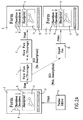
- Figure 2a presents an expanded scenario in which the transmitting New Fax 1 and the receiving New Fax 2 have the additional feature of Forms Storage.
- Previously loading the form description into New Faxes 1 and 2 enables the form description to be removed from the transmission. In this case all that must be transmitted is the forms's ID, and the relevant fields and their values.
- the form itself to only contain the form ID, and not the entire form description, if it is known that both New Faxes 1 and 2 have the form registered.
- the forms could be programmed into the New Faxes, either locally or remotely, according to EP-A-0 459 793. Additionally, since form descriptions are not necessarily memory intensive, the New Fax 1 or 2 could store the last n forms that it has processed.
- n depends on the New Fax's memory size and the size of each individual form description.
- successive transactions could be of the abbreviated sort as in Figure 2b.
- the generic Form Description must be saved to enable any future instance of that form to be used, i.e. only the description of the fields found on the form, not the overall looks of the form, which would include extraneous test and graphics.
- only a blank form could then be generated from this stored version at this point.
- Figure 3 illustrates the transmission of a document from a New Fax 1 to a remote New Fax server 17.
- Registering all forms on a central Fax Server 17 would enable a remote New Fax 1 to send a very brief long distance transaction to the Fax server 17, which could disperse many fax transmissions to local standard faxes at inexpensive local telephone rates.
- the Fax Server 17 could begin processing the forthcoming document 3 (or spawn an application) immediately upon reception of the transmission, without a lag for form recognition.
- Bit map transmission could also be significantly reduced if character recognition on alphanumeric form fields took place before transmission, with only the resultant ASCII being transmitted.
- the forms carry a description of the forms; in Fig. 2b, the forms carry a pointer to a memory location in which the description of the form is stored; in Fig. 3, the forms carry only a pointer to a memory location in which the description of the form is stored.
- Other applications include transmitting between a computer that has a display terminal and a facsimile.
- the computer scans the screen of the display to create the bit maps of the unique parts of the form and to create the description of the generic parts of the form, thus enabling transmission to a New Fax, or to a standard fax by simply creating a bit map of the entire image.
Landscapes
- Engineering & Computer Science (AREA)
- Theoretical Computer Science (AREA)
- Physics & Mathematics (AREA)
- General Physics & Mathematics (AREA)
- Audiology, Speech & Language Pathology (AREA)
- Computational Linguistics (AREA)
- General Health & Medical Sciences (AREA)
- Health & Medical Sciences (AREA)
- General Engineering & Computer Science (AREA)
- Artificial Intelligence (AREA)
- Multimedia (AREA)
- Signal Processing (AREA)
- Facsimiles In General (AREA)
- Editing Of Facsimile Originals (AREA)
- Machine Translation (AREA)
Applications Claiming Priority (2)
| Application Number | Priority Date | Filing Date | Title |
|---|---|---|---|
| US814514 | 1991-12-30 | ||
| US07/814,514 US5363214A (en) | 1990-05-30 | 1991-12-30 | Facsimile transmission system |
Publications (1)
| Publication Number | Publication Date |
|---|---|
| EP0550234A1 true EP0550234A1 (en) | 1993-07-07 |
Family
ID=25215276
Family Applications (1)
| Application Number | Title | Priority Date | Filing Date |
|---|---|---|---|
| EP92311659A Withdrawn EP0550234A1 (en) | 1991-12-30 | 1992-12-21 | Facsimile transmission system |
Country Status (3)
| Country | Link |
|---|---|
| US (1) | US5363214A (enExample) |
| EP (1) | EP0550234A1 (enExample) |
| JP (1) | JP3338097B2 (enExample) |
Cited By (3)
| Publication number | Priority date | Publication date | Assignee | Title |
|---|---|---|---|---|
| EP0658042A1 (en) * | 1993-12-09 | 1995-06-14 | AT&T Corp. | Dropped-form document image compression |
| GB2355359A (en) * | 1999-08-23 | 2001-04-18 | Ibm | Compression of images in gray level |
| US9491316B2 (en) | 2008-09-09 | 2016-11-08 | Applied Systems, Inc. | Methods and apparatus for delivering documents |
Families Citing this family (29)
| Publication number | Priority date | Publication date | Assignee | Title |
|---|---|---|---|---|
| JPH04321183A (ja) * | 1991-04-20 | 1992-11-11 | Ricoh Co Ltd | ファイリング装置の文書登録方法 |
| US5448375A (en) * | 1992-03-20 | 1995-09-05 | Xerox Corporation | Method and system for labeling a document for storage, manipulation, and retrieval |
| US5465167A (en) * | 1992-03-20 | 1995-11-07 | Xerox Corporation | Using an image from a form in automatic creation of a form or sheet |
| DE69328702T2 (de) * | 1992-03-30 | 2000-10-26 | Canon K.K., Tokio/Tokyo | Gerät und Verfahren zur Bildverarbeitung |
| US5848426A (en) * | 1993-03-05 | 1998-12-08 | Metanetics Corporation | Automatic data translation between different business systems |
| JPH0778251A (ja) * | 1993-07-22 | 1995-03-20 | Xerox Corp | ソースベリファイ方法 |
| JPH0756956A (ja) * | 1993-07-22 | 1995-03-03 | Xerox Corp | 人間の作成したイメージに基づくデータアクセス方法 |
| US5850490A (en) * | 1993-12-22 | 1998-12-15 | Xerox Corporation | Analyzing an image of a document using alternative positionings of a class of segments |
| JPH07273914A (ja) * | 1994-03-30 | 1995-10-20 | Canon Inc | 画像記録装置 |
| JPH08139840A (ja) * | 1994-11-08 | 1996-05-31 | Matsushita Graphic Commun Syst Inc | ファクシミリ装置 |
| US5815595A (en) * | 1995-12-29 | 1998-09-29 | Seiko Epson Corporation | Method and apparatus for identifying text fields and checkboxes in digitized images |
| US6562077B2 (en) | 1997-11-14 | 2003-05-13 | Xerox Corporation | Sorting image segments into clusters based on a distance measurement |
| US6825945B1 (en) * | 1999-05-25 | 2004-11-30 | Silverbrook Research Pty Ltd | Method and system for delivery of a brochure |
| US7942328B2 (en) | 2000-01-03 | 2011-05-17 | Roelesis Wireless Llc | Method for data interchange |
| US7798417B2 (en) | 2000-01-03 | 2010-09-21 | Snyder David M | Method for data interchange |
| US6764009B2 (en) | 2001-05-30 | 2004-07-20 | Lightwaves Systems, Inc. | Method for tagged bar code data interchange |
| US7070103B2 (en) | 2000-01-03 | 2006-07-04 | Tripletail Ventures, Inc. | Method and apparatus for bar code data interchange |
| US7150400B2 (en) | 2004-05-18 | 2006-12-19 | Tripletail Ventures, Inc. | Method and apparatus for capturing and decoding an image of a remotely located bar code |
| AU2001242030A1 (en) * | 2000-03-10 | 2001-09-24 | Ams Services, Inc. | Traffic reduction in networked data collection |
| US7010503B1 (en) | 2000-03-10 | 2006-03-07 | Ams Services, Inc. | Traffic reduction in networked data collection |
| US7664733B2 (en) * | 2003-04-11 | 2010-02-16 | Ricoh Company, Ltd. | Techniques for performing operations on a source symbolic document |
| US9063932B2 (en) | 2009-12-18 | 2015-06-23 | Vertafore, Inc. | Apparatus, method and article to manage electronic or digital documents in a networked environment |
| US8700682B2 (en) | 2009-12-24 | 2014-04-15 | Vertafore, Inc. | Systems, methods and articles for template based generation of markup documents to access back office systems |
| US9384198B2 (en) | 2010-12-10 | 2016-07-05 | Vertafore, Inc. | Agency management system and content management system integration |
| US8731973B2 (en) | 2011-04-19 | 2014-05-20 | Vertafore, Inc. | Overlaying images in automated insurance policy form generation |
| US9507814B2 (en) | 2013-12-10 | 2016-11-29 | Vertafore, Inc. | Bit level comparator systems and methods |
| US9367435B2 (en) | 2013-12-12 | 2016-06-14 | Vertafore, Inc. | Integration testing method and system for web services |
| US9747556B2 (en) | 2014-08-20 | 2017-08-29 | Vertafore, Inc. | Automated customized web portal template generation systems and methods |
| US9600400B1 (en) | 2015-10-29 | 2017-03-21 | Vertafore, Inc. | Performance testing of web application components using image differentiation |
Citations (4)
| Publication number | Priority date | Publication date | Assignee | Title |
|---|---|---|---|---|
| US4187520A (en) * | 1977-05-31 | 1980-02-05 | Compagnie Industrielle Des Telecommunications Cit-Alcatel | Facsimile transmission installation in particular for copying forms |
| EP0411231A2 (en) * | 1989-08-04 | 1991-02-06 | International Business Machines Corporation | Method for digitizing information written into forms by means of very large symbol matching |
| EP0459793A1 (en) * | 1990-05-30 | 1991-12-04 | Xerox Corporation | Document processing |
| DE4031195A1 (de) * | 1990-09-28 | 1992-04-02 | Siemens Ag | Bildverarbeitungsverfahren |
Family Cites Families (6)
| Publication number | Priority date | Publication date | Assignee | Title |
|---|---|---|---|---|
| JPS5715566A (en) * | 1980-07-02 | 1982-01-26 | Mitsubishi Electric Corp | Automatic part transmitter |
| JPS63155386A (ja) * | 1986-12-19 | 1988-06-28 | Ricoh Co Ltd | 帳票デ−タ読取装置 |
| US5084769A (en) * | 1988-06-13 | 1992-01-28 | Canon Kabushiki Kaisha | Image processing apparatus |
| US4922348B1 (en) * | 1989-02-10 | 1994-10-11 | Bell Telephone Labor Inc | Facsimile service |
| US5258855A (en) * | 1991-03-20 | 1993-11-02 | System X, L. P. | Information processing methodology |
| US5274468A (en) * | 1991-06-27 | 1993-12-28 | Ojha Purnendu S | Reproduction apparatus and method with user-definable editing and machine operation functions |
-
1991
- 1991-12-30 US US07/814,514 patent/US5363214A/en not_active Expired - Lifetime
-
1992
- 1992-12-21 EP EP92311659A patent/EP0550234A1/en not_active Withdrawn
- 1992-12-21 JP JP34033992A patent/JP3338097B2/ja not_active Expired - Fee Related
Patent Citations (4)
| Publication number | Priority date | Publication date | Assignee | Title |
|---|---|---|---|---|
| US4187520A (en) * | 1977-05-31 | 1980-02-05 | Compagnie Industrielle Des Telecommunications Cit-Alcatel | Facsimile transmission installation in particular for copying forms |
| EP0411231A2 (en) * | 1989-08-04 | 1991-02-06 | International Business Machines Corporation | Method for digitizing information written into forms by means of very large symbol matching |
| EP0459793A1 (en) * | 1990-05-30 | 1991-12-04 | Xerox Corporation | Document processing |
| DE4031195A1 (de) * | 1990-09-28 | 1992-04-02 | Siemens Ag | Bildverarbeitungsverfahren |
Non-Patent Citations (1)
| Title |
|---|
| PATENT ABSTRACTS OF JAPAN vol. 6, no. 77 (E-106)(955) 14 May 1982 & JP-A-57 015 566 ( MITSUBISHI DENKI KK ) 26 January 1982 * |
Cited By (7)
| Publication number | Priority date | Publication date | Assignee | Title |
|---|---|---|---|---|
| EP0658042A1 (en) * | 1993-12-09 | 1995-06-14 | AT&T Corp. | Dropped-form document image compression |
| JPH07200720A (ja) * | 1993-12-09 | 1995-08-04 | At & T Corp | 脱落書式文書画像圧縮 |
| US5631984A (en) * | 1993-12-09 | 1997-05-20 | Ncr Corporation | Method and apparatus for separating static and dynamic portions of document images |
| GB2355359A (en) * | 1999-08-23 | 2001-04-18 | Ibm | Compression of images in gray level |
| GB2355359B (en) * | 1999-08-23 | 2003-12-03 | Ibm | Compression of images in gray level |
| US6728426B1 (en) | 1999-08-23 | 2004-04-27 | International Business Machines Corporation | Compression of form images in gray-level |
| US9491316B2 (en) | 2008-09-09 | 2016-11-08 | Applied Systems, Inc. | Methods and apparatus for delivering documents |
Also Published As
| Publication number | Publication date |
|---|---|
| US5363214A (en) | 1994-11-08 |
| JPH05268459A (ja) | 1993-10-15 |
| JP3338097B2 (ja) | 2002-10-28 |
Similar Documents
| Publication | Publication Date | Title |
|---|---|---|
| US5363214A (en) | Facsimile transmission system | |
| US5227893A (en) | Pseudo-bar code control of image transmission | |
| US5974203A (en) | Pattern recognition communication apparatus for transmitting and receiving image data | |
| EP0208852A2 (en) | Communication terminal device | |
| US5339169A (en) | Electronic filing system | |
| WO1992013420A1 (en) | Integrated telefacsimile and character communication system | |
| DE69315095T2 (de) | Bildübertragungsgerät | |
| WO1996020556A1 (en) | Telefacsimile module connectable to telefacsimile machines for transmitting data in standard or high speed modes | |
| US4796092A (en) | Image processing with compression encoding | |
| CN1207849A (zh) | 扫描行压缩传真通信系统 | |
| EP1189423A2 (en) | Image communications | |
| US5703967A (en) | Color image transmitting method | |
| US5432620A (en) | Mixed mode communication method and apparatus | |
| US5438432A (en) | Data transmitting apparatus | |
| US6501569B1 (en) | Image transmission apparatus | |
| JP3640429B2 (ja) | ファクシミリocrデ−タ誤り表示方式およびファクシミリocr装置 | |
| JP3524208B2 (ja) | 複合画像処理装置及び画像処理方法 | |
| US5809168A (en) | Method and apparatus for estimating a character size of an alphanumeric subject copy in a facimile system | |
| JPH02194770A (ja) | ファクシミリ装置 | |
| KR0128667B1 (ko) | Mh코드 디코딩 장치 및 방법 | |
| JPH04313960A (ja) | 画データ送信装置及び画データ受信装置 | |
| JPH05327998A (ja) | コンピュータ連動機能を有したファクシミリ装置 | |
| JPS5958583A (ja) | 文字認識システム | |
| JPH0575757A (ja) | データ伝送装置 | |
| AU7323896A (en) | Image communications |
Legal Events
| Date | Code | Title | Description |
|---|---|---|---|
| PUAI | Public reference made under article 153(3) epc to a published international application that has entered the european phase |
Free format text: ORIGINAL CODE: 0009012 |
|
| AK | Designated contracting states |
Kind code of ref document: A1 Designated state(s): DE FR GB |
|
| 17P | Request for examination filed |
Effective date: 19931223 |
|
| 17Q | First examination report despatched |
Effective date: 19951106 |
|
| STAA | Information on the status of an ep patent application or granted ep patent |
Free format text: STATUS: THE APPLICATION HAS BEEN WITHDRAWN |
|
| 18W | Application withdrawn |
Withdrawal date: 19960503 |